Category: News
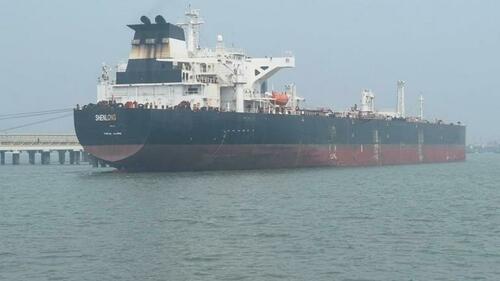
Iran May Let Indian Tankers Through Hormuz Strait, Reports Of High-Level Talks
Iran May Let Indian Tankers Through Hormuz Strait, Reports Of High-Level Talks
First it was China, now an India exception?
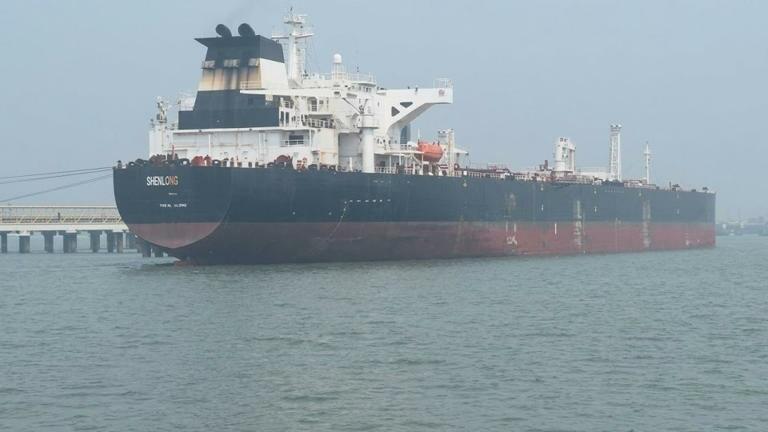
Bloomberg reports another major potential exception Tehran could make for Strait of Hormuz oil transit. “India is in talks with Iran to secure the safe passage of more than 20 tankers through the Strait of Hormuz, according to people familiar with the matter,” a Thursday morning report indicates.
“Negotiations are still ongoing and are being handled by the ministry of foreign affairs, said the people, who asked not to be named as the conversations are sensitive,” Bloomberg continues. “The narrow waterway, through which around a fifth of the world’s crude typically flows, has been effectively closed since the start of the war in the Persian Gulf.”
However, Reuters has separately cited an Iranian source to say no such agreement has been made for safe passage of Indian vessels.
India ranks as third among the world’s top crude importers, with China at the top. New Delhi gets some 40% of all its global imports from the Mideast and based on transit through the vital Strait of Hormuz waterway.
Since the US-Israeli Operation Epic Fury began, maritime monitors have noticed that China-owned tankers, or at least ones signaling their China links, appeared to have been given free and safe passage – not coming under Iranian attack. Also, one report this week notes:
Iran has continued to send large amounts of crude oil via the Strait of Hormuz to China even as the war between U.S.-Israel and Iran has jeopardized broader supplies through the critical waterway.
Iran has sent at least 11.7 million barrels of crude oil through the Strait of Hormuz since the war began on Feb. 28, all of which were headed to China, Samir Madani, co-founder of TankerTrackers.com, told CNBC on Tuesday.
But now Indian tankers laden with crude oil, liquefied petroleum gas and liquefied natural gas – all stuck in regional waters amid the broader international backlog of ships too afraid to make the passage, especially now that the Iranians are reportedly laying explosive mines in the narrow water lanes – are hoping their own government could get a ‘pass’ akin to what some Chinese tankers appear to be enjoying.
Such was also the case in the Red Sea, with the past two years of the Houthi war on global shipping, which the US Navy ultimately could not thwart at the time – despite some significant engagements and bombing campaigns: Chinese and Russian vessels were declared by the Iran-linked Houthis to be safe.
Meanwhile, of the jagged, mountainous coastline from which the Iranians can easily fire on the strait:
WSJ: “Reopening the strait, military analysts say, may require a ground operation to seize the Iranian coastline.”https://t.co/CMw7lgrSbf pic.twitter.com/yrtJZTNKTZ
— Steve Lookner (@lookner) March 12, 2026
It remains too early to say whether a similar deal might be unfolding with the Islamic Republic in Hormuz, but one source notes that “The Economic Times, an Indian outlet, reported on Thursday that Iran had allowed two India-flagged tankers to transit the Strait of Hormuz after the Indian and Iranian foreign ministers held a telephone conversation to discuss keeping the route open for Indian vessels.”
As a reminder the IEA said in a Thursday report, “The war in the Middle East is creating the largest supply disruption in the history of the global oil market.”
There are so many VLCCs oil tankers in the Gulf of Aden right now that one could walk from Djibouti to Socrota island wihtout getting their feet wet.
(… and no, contrary to some social media posts, the Houthis have not attacked any tankers — so far…)
— Javier Blas (@JavierBlas) March 12, 2026
Tyler Durden
Thu, 03/12/2026 – 08:40
Once Again, Initial Jobless Claims Refuse To Signal Labor Market Stress
Once Again, Initial Jobless Claims Refuse To Signal Labor Market Stress
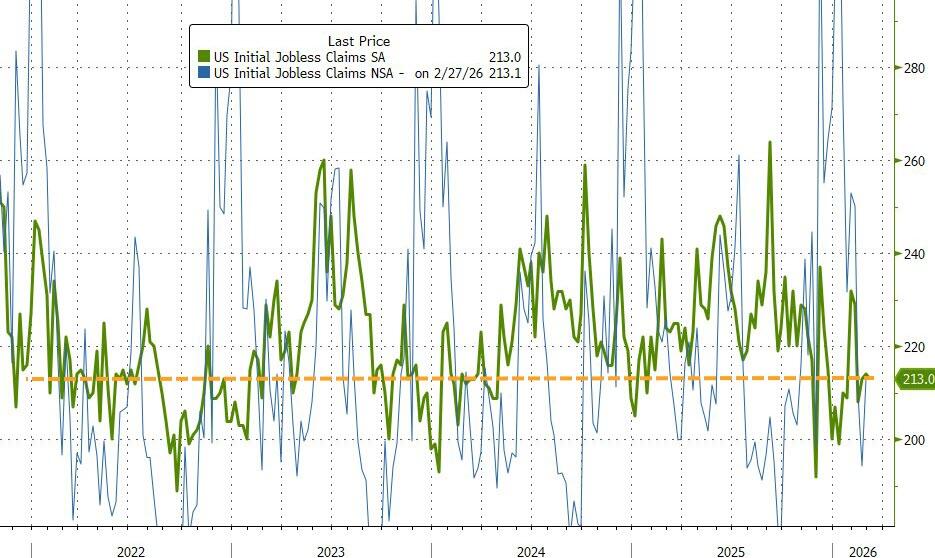
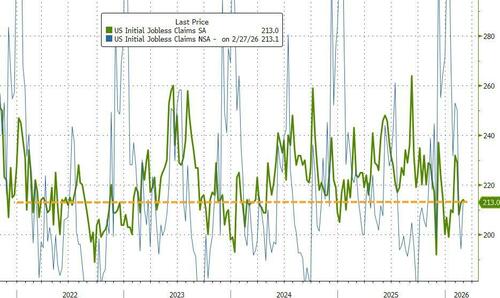
Initial jobless claims dipped last week to 213k – basically unchanged since Nov 2021 – continuing to suggest an economy that is not seeing the average joe get canned at anything other than a de minimus rate…
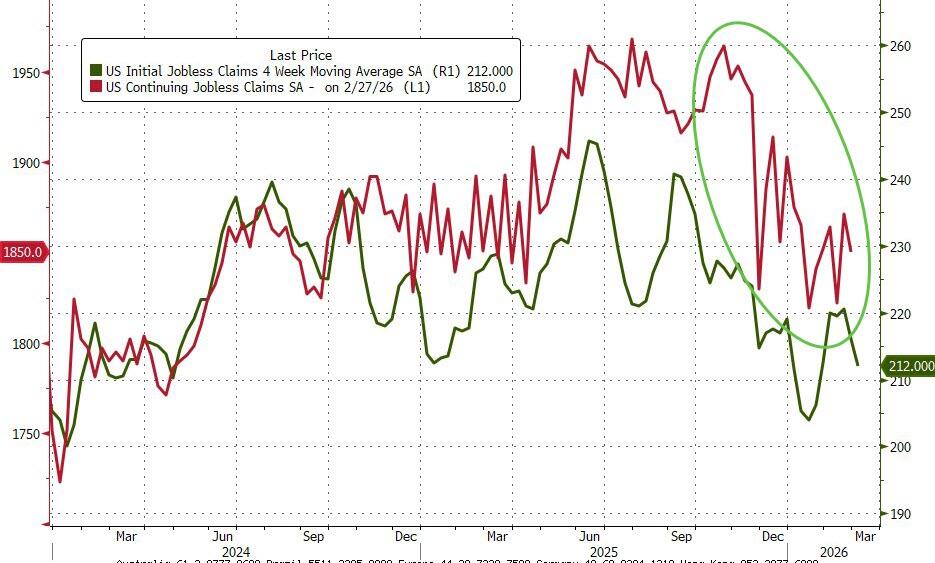
Continuing jobless claims also dipped last week, remaining well below the 1.9 million Americans Maginot Line…
With ADP’s strong job additions report earlier in the week, all indications (except the aberrant payrolls print) are that the US labor market remains solid. The ‘no hire, no fire’ economy may be improving to a ‘some hire, no fire’ economy… for now.
Tyler Durden
Thu, 03/12/2026 – 08:36
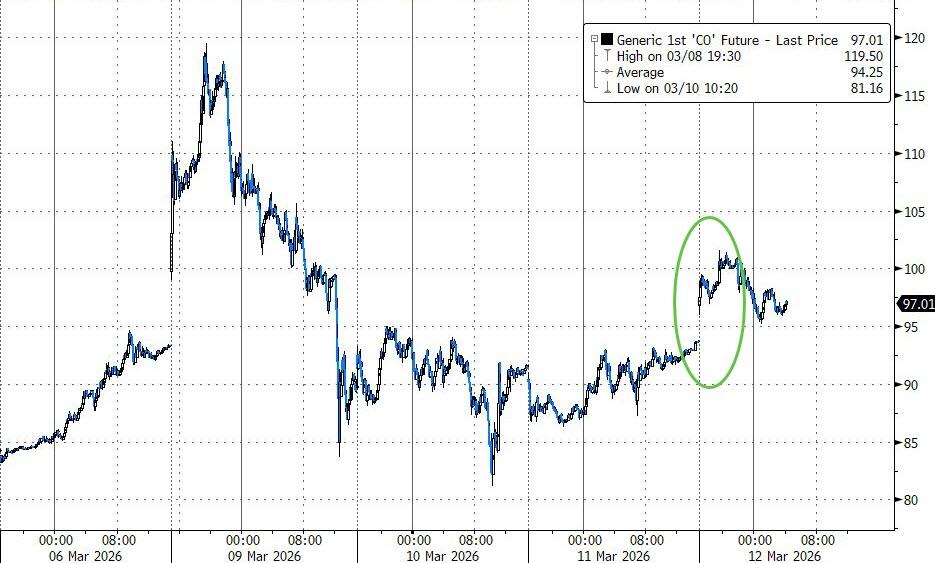
Futures Tumble As Oil Jumps Above $100 On Iran War Chaos
Futures Tumble As Oil Jumps Above $100 On Iran War Chaos
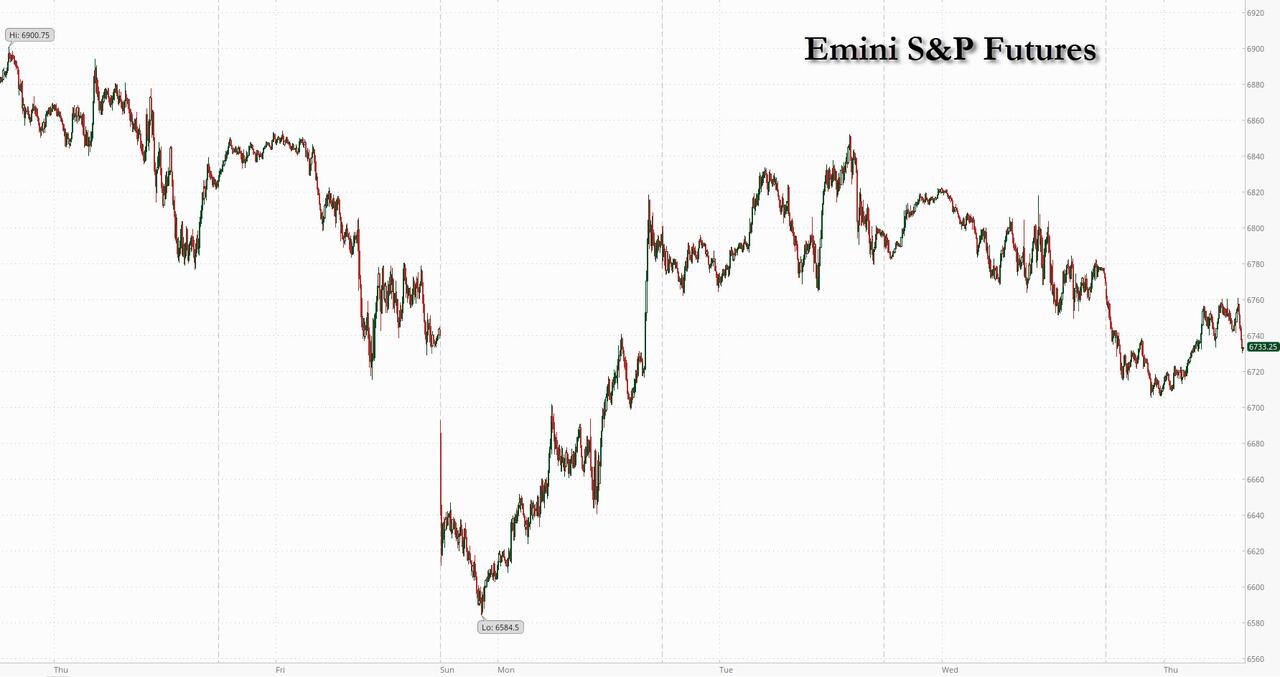
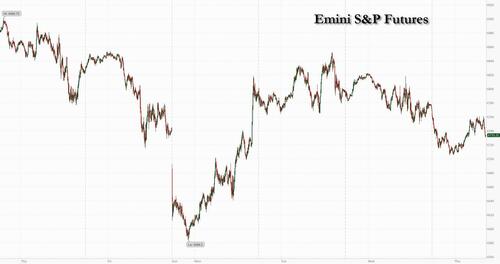
US futures are sharply lower, as oil briefly surges back over $100 while markets start to accept the view that the Iran war will not end this week, and possibly any time soon. As of 8:15am ET, S&P and Nasdaq futures are down 0.7% and R2K futures slide more than 1%. Futures dropped more than 1% overnight as Iraq suspended oil terminal activity following an attack on two tankers; they recovered some losses after the resumption of normal operations at Oman’s Mina Al Fahal oil terminal. Global market moves overnight were relatively benign: KOSPI down 48bps the most muted day in weeks, China flattish, Europe mixed with Germany flat and France down 50bps. In premarket trading, Mag 7 names are all weaker, energy names are stronger, and defensives outperform cyclicals on the move lower. Iran offered an off-ramp (guarantee of no future attacks from US and Israel) but unclear if that will be accepted. Private credit fears continue to surface as Morgan Stanley and Cliffwater gated withdrawals from their private credit funds, pressuring both Equities and Credit. Bond yields are flat, the USD is bid, and commodities are seeing strength across all 3 complexes, led by Energy. Today’s macro data focus is on jobless claims and housing starts. The Fed remains in blackout into next week’s (Mar 18) meeting. The market wants to see if Powell echoed Trump’s view that prices increases from the conflict are transitory when other central banks are seeing expectations flip from cuts to hikes.
In premarket trading, Mag 7 stocks are all lower (Alphabet -0.7%, Meta -0.7%, Amazon -0.6%, Microsoft -0.4%, Nvidia -0.4%, Tesla and Apple little changed)
Fertilizer, energy and chemical stocks climb as the war in Iran and disruptions to the Strait of Hormuz tighten supply, raising prices, while airlines and cruise stocks are down as higher crude prices lift costs.
Blue Owl Capital Inc. (OWL) falls 3% after the asset manager defended its recent sale of $1.4 billion of loans from three of its funds, arguing the transaction contained no backstops or hidden incentives.
Bumble (BMBL) rises 24% after the online dating company forecast Ebitda for the first quarter that beat expectations. Analysts noted that focus now shifts to upcoming product overhaul planned for later in the year.
Hims & Hers Health (HIMS) rises 5% after rallying 10% on Wednesday. The stock is set to extend its advance for a fourth straight session.
Lightwave Logic (LWLG) climbs 16% after the company announced a development agreement with Tower Semiconductor.
Petco (WOOF) rises 10% as the pet health and wellness company’s adjusted Ebitda forecast for the first quarter beat the average analyst estimate. Jefferies upgrades its rating, noting that investors underappreciate the progress made thus far.
UiPath (PATH) falls 6% after the software company reported fourth-quarter results. Bloomberg Intelligence writes that growth concerns persist despite a strong quarter.
In corporate news, Atlassian is the latest software firm to announce AI-linked job cuts. Abivax shares are surging after French media reported that the biotech had granted AstraZeneca exclusive access to confidential information until March 23 with a view to formalizing an offer. And the widening war has upended global travel, sending fares soaring and leaving travelers facing record prices ahead of the Easter rush.
Iran escalated attacks on parts of Dubai and shipping assets, pushing oil briefly back above $100 a barrel and intensifying concern about the length of the Middle East war and the effective closure of the Strait of Hormuz. Multiple oil tankers were attacked in Iraqi waters and Oman evacuated ships from a key terminal. The Iran war has disrupted 7.5% of global crude supply, with flows through the Strait down by more than 90%, the IEA said. It’s telling that after yet another Whitehouse jawbone and the IEA’s record reserve release announcement, oil still failed to drop. Overnight Reuters reported, “Iran has laid about a dozen mines in Strait of Hormuz, sources say”.
Hostilities are fast-approaching a third week, with no sign of de-escalation. Iran escalated attacks on parts of Dubai and shipping assets, driving oil prices higher and increasing concern among traders about how much longer the conflict in the Middle East will go on for. The surge in oil prices reflects concern that the conflict could throw energy markets into turmoil for a prolonged period, with efforts to cushion the impact offering little relief. Crude is driving moves across asset classes as traders fear that higher fuel costs will rekindle inflation and hit economic growth.
“What you’re are seeing is the market pricing a long-lasting scenario of high oil prices,” said Karen Georges, an equity fund manager at Ecofi in Paris. “The security of shipping in the region is a big concern while the release of emergency oil reserves can only provide temporary relief.”
The International Energy Agency said in a monthly report that the Iran war is causing unprecedented turmoil in oil markets. Global oil supply will be slashed by 8 million barrels a day this month, or almost 250 million barrels in total, the IEA estimated. The report comes after the agency’s members agreed to release 400 million barrels from emergency reserves on Wednesday.
“While Trump’s claim that we could soon see a resolution to the conflict does provide hesitancy for the bulls, the reality of the situation will undoubtedly call for higher prices as the days roll on,” said Joshua Mahony, chief market analyst at Scope Markets.
For Francois Rimeu, senior strategist at Credit Mutuel Asset Management in Paris, the reaction in equity markets has been rather sanguine given how broad and impactful a worst-case scenario for the conflict could be. “The draw-down could really turn much lower should the conflict last longer, and the longer it lasts, the longer a return to business as usual will be,” Rimeu said. “If you ask me when is the right time to buy back, I would tend to say when one actually sees ships crossing the Strait of Hormuz again.”
In the latest hit to private credit, Morgan Stanley and Cliffwater gated withdrawals from their multibillion-dollar private credit funds after investors sought to redeem vastly more than the vehicles allow. Partners Group warned that private credit default rates could double in the next few years. Tariffs are also back in the spotlight as the US begins a probe into trade investigations that set the stage for new levies.
Back on oil, China tightened fuel export curbs, while the average retail cost for one gallon of gasoline in the US has risen to the highest level since May 2024, piling pressure onto the administration to find an off-ramp for the conflict. Trump has said that the war could end soon, but the latest rhetoric from Iran dimmed prospects for a quick resolution.
Elsewhere, JPMorgan said hedge funds are experiencing the biggest drawdown since April’s tariff turmoil, as unwinds in crowded trades punish the fast-money cohort. In a brutal trading week, Citadel’s Global Fixed Income Fund and Taula Capital Management are among the hedge funds worst hit, while D.E. Shaw’s two main vehicles were a rare bright spot in the industry.
European stocks are lower across the board but off session troughs after the resumption of normal operations at Oman’s Mina Al Fahal oil terminal provided some reprieve. Banks are the biggest underperformer, while chemicals outperform most. Here are the biggest movers Thursday:
Accelleron Industries shares rise as much as 17%, a record jump that briefly sent the stock to an all-time high, after the maker of turbochargers posted full-year earnings that topped expectations, with a solid outlook and its first buybacks
Abivax shares rise as much as 17% after La Lettre reported the biotech company had granted AstraZeneca exclusive access to confidential information until March 23 with a view to formalizing an offer
K+S gains as much as 8.8%, the most since last April, after the German fertilizer group reported solid earnings, which analysts said boded well for 2026. They noted that higher sulfur prices due to tumult in the Middle East could prove a tailwind
Zalando gains as much as 9.2%, the most since November, after the German online seller of fashion announced a new share buyback program of up to €300 million, which RBC said should soothe concerns over capital allocation
Leonardo shares gain as much as 8.7% to a new record high after the defense technology firm outlined its targets through 2030, which Mediobanca described as “bullish.” Analysts highlight, in particular, order intake expectations
Bachem shares jump as much as 9.7%, the most since July, after the pharmaceutical ingredients producer reported slightly better results than expected
PolyPeptide advances as much as 11% after confirming its 2025 numbers and providing outlook commentary which Jefferies says demonstrates the biotechnology company’s strong execution
Trainline shares slide as much as 6.7% after its annual results, with JPMorgan warning the rail ticketing platform is lacking visibility and faces a “more challenging chapter ahead” in FY27
Bodycote drops as much as 5.5% after being downgraded at RBC Capital Markets, with analysts citing more limited upside. The cut comes a day after the provider of heat treatment and specialist thermal processing services beat expectation
Savills shares fall as much as 8.4% to the lowest in six months, as the property services group’s in-line results are overshadowed by the war in the Middle East
On the Beach shares drop as much as 15% to the lowest level since November 2024. The online seller of package holidays suspended its full-year guidance of £39m to £43m adjusted profit before tax due to a “significant slowdown”
Earlier in the session, Asian stocks fell on Thursday, snapping a two-day rising streak after a string of disruptions in the Iran war renewed fears of a longer-term energy supply strain in the Middle East and briefly pushed Brent crude back above $100 a barrel. The MSCI Asia Pacific Index fell as much as 2%, led by chipmakers TSMC, Samsung and SK Hynix. The jump in oil prices came as Iran suspended oil terminal activity following an assault on two tankers, and Oman temporarily evacuated its main export hub. The regional benchmark had climbed for two previous sessions when oil prices softened, underscoring investors’ focus on volatile energy markets. Bonds in the euro area trimmed early declines.
In FX, the Bloomberg Dollar Spot Index gains 0.3%, before paring the advance; the greenback is on course for a fresh 2026 high, options markets show. USD/JPY is little changed at 158.90; it rose earlier to a two-month high at 159.24 as options traders and strategists see a high threshold for intervention from Japan to defend the yen
In rates, US rates have clambered off session lows but remain weak with global bonds erasing 2026 gains. US yields are down around 1bps across the curve. US long-end yields are little changed with front-end tenors richer by 1bp-2bp, steepening 5s30s spread by around 1bp. 10-year near 4.21% is lower by about 1bp with UK counterpart up about 4bp. In IG issuance, Salesforce led eight issuers that sold a combined $41.7 billion Wednesday, taking weekly volume past $107b, the third largest on record achieved in only two sessions. Issuers paid an elevated 21bp in new issue concessions on deals that were 1.9 times covered. At least one issuer stood down Wednesday, while a couple are considering Thursday.
A Bloomberg index that tracks total returns from investment-grade government and corporate bonds is now flat for 2026. The gauge had been up as much as 2.1% this year through Feb. 27, just before the US and Israel attacked Iran.
In commodities, Brent crude futures rise 4.6% to $98 but off session highs; Iranian attacks on shipping assets and areas of Dubai alongside China tightening fuel export curbs briefly lifted prices above the $100 a barrel mark.Spot gold and silver are higher by 1.5% and 0.1% respectively. Bitcoin is down 0.4%.
US economic data slate includes January trade balance and housing starts and weekly jobless claims (8:30am) and 4Q household change in net worth (12pm)
Market Snapshot
S&P 500 mini -0.6%
Nasdaq 100 mini -0.6%
Russell 2000 mini -1.3%
Stoxx Europe 600 -0.6%
DAX -0.5%
CAC 40 -0.7%
10-year Treasury yield little changed at 4.23%
VIX +1.3 points at 25.53
Bloomberg Dollar Index +0.2% at 1204.95
euro -0.1% at $1.1551
WTI crude +6.2% at $92.66/barrel
Top Overnight News
Iran escalated attacks on parts of Dubai and shipping assets, pushing oil briefly back above $100 a barrel and intensifying concern about the length of the Middle East war and the effective closure of the Strait of Hormuz. Two oil tankers were attacked in Iraqi waters and Oman evacuated ships from a key terminal. The Iran war has disrupted 7.5% of global crude supply, with flows through the Strait down by more than 90%, the IEA said. BBG
President Trump—faced with rising oil prices and pushback from his MAGA base—is signaling that he wants to wind down the war he launched against Iran less than two weeks ago. Stopping the fighting carries risks. Leaving in place Iran’s theocratic regime—angry, defiant and in possession of its nuclear stockpile and what remains of its arsenal of missiles and drones—would essentially grant Tehran control over the world’s energy markets. WSJ
India plans to unveil a more than $10.8 billion fund aimed at bolstering domestic chipmaking, people familiar said. BBG
German bond yields rose to their highest since October 2023 as the Iran war stoked inflation concerns. BBG
Oracle has stepped up preparations to cut jobs over the coming months as it credits AI with driving efficiencies in its team and conserves cash to fund its costly push into data centers. FT
President Trump—faced with rising oil prices and pushback from his MAGA base—is signaling that he wants to wind down the war he launched against Iran less than two weeks ago. Stopping the fighting carries risks. Leaving in place Iran’s theocratic regime—angry, defiant and in possession of its nuclear stockpile and what remains of its arsenal of missiles and drones—would essentially grant Tehran control over the world’s energy markets. WSJ
U.S. officials say relentless American and Israeli aerial attacks have crippled Iran’s air defenses, navy and missile arsenal. But the regime in Tehran has so far held on to power, and it effectively shut down a crucial choke point for the world’s oil supplies. CNBC
The White House believes it has until the end of March before rising gas prices become an “unsustainable” political five-alarm fire, one of the officials said. CNBC
Morgan Stanley and private credit lender Cliffwater have restricted withdrawals from private credit funds, in the latest sign of investor unease about the sector. Separately, a US distressed debt investment fund told its investors that private credit lenders such as Blue Owl are obscuring weaknesses in their portfolios and a sharp correction in debt markets is approaching soon. FT
Investors demanded significant concessions in Salesforce’s $25bn bond deal on Wed, highlighting rising worries on Wall Street about how AI technology could disrupt software companies. FT
Trump is to signs orders on housing in the coming days, according to Punchbowl citing a White House spokesperson.
BofA Card Spending (w/e March 7th): +4.6% Y/Y, vs 3.2% in February. Y/Y spending appears to be robust in the early part of March.
A more detailed look at global markets courtesy of Newsquawk
APAC stocks declined as rising oil prices dampened sentiment and stoked inflationary concerns, while the announcement of a record joint emergency reserves release failed to drag energy prices lower, due to likely slow deliveries and with further disruptions in the Middle East from the ongoing hostilities. ASX 200 was dragged lower by losses in nearly all sectors aside from energy, and with further calls by large banks for the RBA to deliver a back-to-back rate hike next week. Nikkei 225 briefly slumped below the 54,000 level as the higher oil prices lifted yields and weighed on manufacturer and exporter sentiment. Hang Seng and Shanghai Comp conformed to the broad downbeat mood in the region, with risk appetite also not helped by the announcement that the US is initiating a Section 301 investigation into 16 trading partners, including China, the EU, Mexico, Vietnam, India and Japan.
Top Asian News
Japanese PM Takaichi said won’t rule out using FY25 reserve funds for fuel and the existing fund has JPY 280bln remaining, adds no additional budget for fuel subsidies now and will use existing fund for fuel price measures.
European bourses (STOXX 600 -0.4%) have started the cash session on the backfoot, with higher oil prices continuing to weigh on growth prospects. Weakness in banks continues to affect the IBEX 35 (-0.9%), given its exposure. The DAX 40 (U/C) is modestly lower, but losses are limited due to gains in Zalando (+12.2%), Rheinmetall (+2.9%) and Hannover Re (+3.2%). European sectors are broadly in the red, with Banks (-2.1%) continuing to underperform. Automobiles (-0.9%) also sit near the bottom of the pile after BMW (-1.1%) missed Q4 sales estimates and forecast higher tariffs acting as a headwind on EBIT margin. Basic Resources (+0.7%) are benefiting from the rise in metals prices, while Chemicals (+0.8%) gain after K+S (+8.0%) beat Adj. EBITDA estimates.
Top European News
Germany’s IFW institute sees 2026 inflation at 2.5% (prev. 1.8%), GDP at 0.8% (prev. 1.0%), 2027 GDP at 1.4% (prev. 1.3%).
Trade/Tariffs
USTR Greer said US is initiating Section 301 investigation into 16 trading partners, including China, EU, Mexico, Vietnam, India and Japan, adds the investigation could lead to responsive actions, including tariffs. Said the EU has done approximately 0% of what was agreed in the bilateral trade deal.
South Korea parliament passes US investment bill, as expected.
FX
DXY is slightly firmer this morning and trades within a 99.31-99.52 range, and now heading back to the YTD high at 99.69 (March 9th). Upside on Wednesday was facilitated by higher yields as the energy prices continue to trudge higher as the geopolitical situation in Iran is showing little signs of abating any time soon, as an overnight attack on Omani export terminals led Brent back above USD 100/bbl. The recent IEA 400mln barrel reserve release has ultimately had little impact on prices, given the lengthy timeline for the barrels to enter the market and ING rightly points out, it still works out to be “far short of the supply losses we are seeing from the Persian Gulf”. Domestically, weekly jobless claims, trade data and Fed speak via Bowman – though she will not touch on monetary policy.
G10s are broadly flat to lower against the USD. The JPY and CAD hold afloat, though the former remains within the touted intervention zone beyond 158.00. As mentioned in previous FX pieces, intervention seems unlikely given, a) intervention would prove to be ineffective given the current geopolitical environment, b) low volume short positions on the JPY, c) the move is fundamentally driven by higher energy prices d) the recent lack of verbal intervention suggests potentially higher bar for USD/JPY to rise. Nonetheless, markets will be cognizant of any jawboning heading into the BoJ meeting and wage negations next week.
AUD underperforms vs USD this morning, scaling back some of this week’s gains. RBA hike bets continue to be taken by sell-side banks, with ANZ the latest see a 25bps increase at next week’s meeting; money markets now assign a circa 80% chance of such a move.
Central Banks
Bank of Japan Governor Ueda said foreign exchange is an important factor affecting the economy and prices, during parliamentary testimony. Need to be mindful that Forex has larger impacts on prices than in the past and could affect inflation expectations. Will conduct appropriate monetary policy while assessing how Forex affects the likelihood of our forecasts.
ANZ Bank and Goldman Sachs now see the RBA hiking the Cash Rate at next week’s meeting.
NBP’s Janczyk said the current base rate is at an appropriate level for the coming quarters.
BoK member Hwang said need to make rate decision with greater caution.
Fixed Income
Another bearish session for fixed as, despite the IEA stockpile announcement, energy benchmarks are on the front foot once again with Brent eclipsing USD 100/bbl in APAC trade and Dutch TTF as high as EUR 53.80/MWh. In brief, energy strength comes as the market digests the time it will take for the IEA flows to hit the market, the Middle East conflict showing no immediate signs of stopping, and the associated ongoing Strait of Hormuz block.
Given this, USTs are lower by a handful of ticks and holding just off a 111-21 base. If the move continues, we look to support at 111-19+, 111-10 and 111-08+ from earlier in the year. The US docket is headlined by Fed speak and then a 30yr auction to round off the week, after a poor 3yr and a 10yr that was an improvement from the last outing, but softer than the average tap.
Gilts lower by around 40 ticks at most, hitting a 89.36 trough, which, while notable is still some way clear of the 88.80 MTD low and the 88.52 contract base. Pressure a function of the referenced energy moves and a return towards some of the hawkish BoE pricing seen at the start of the week, with around a 20% chance of a hike by end-2026 currently implied.
Finally, Bunds followed suit at first and hit a 125.91 base, taking the German 10yr yield to another multi-year high. Amidst this, market pricing got to around an 80% chance of two 25bps hikes by the ECB in 2026; reminder, at most we have seen two hikes fully priced in recent sessions. However, this pared across the mid-morning with the benchmark briefly, but only marginally, moving into the green. No clear or overt fundamental behind the gradual turnaround, but the action is potentially a function of energy benchmarks easing from overnight peaks.
Commodities
WTI and Brent futures trade firmer but off best levels after Brent futures briefly rose above USD 100/bbl in APAC hours, with the former currently in a USD 88.61-95.97/bbl range and the latter in a USD 96.69-101.59/bbl parameter. The gains come amid a war that seems to be escalating rather than abating (full Newsquawk Analysis available on the headline feed).
European natgas prices are firmer but off their best levels after rising almost 8% in sympathy with crude prices. The EU’s Dombrovskis warned that inflation could exceed 3% this year if the Middle East war keeps Brent around USD 100/bbl and gas prices elevated for a prolonged period; under that scenario, 2026 growth would be up to 0.4ppts below the 1.4% pace forecast late last year.
Spot gold is mildly firmer this morning and largely moves in tandem with the USD, which in turn tracks oil prices. Gold retreated overnight following US CPI data, which reduced expectations for any near-term Fed rate cuts, and as the Middle East conflict lifted crude prices. XAU/USD resides in a USD 5,125.64-5,189.86/oz range within Tuesday’s USD 5,117.35-5,238.75/oz.
3M LME copper ekes mild gains on either side of USD 13,000/t as the red metal largely tracks the USD and oil for any impact on the growth narrative, with further upside likely capped by the US initiating a Section 301 investigation into 16 trading partners, including China, the EU. 3M LME copper currently resides in a narrow USD 12,920.60-13,055.88/t range at the time of writing.
IEA OMR: cuts 2026 global oil supply growth forecast to 1.1mln BPD (prev. 2.4mln BPD), total 2026 supply forecast 107.2mln BPD (prev. 108.6mln BPD). Middle East conflict is the largest oil supply disruption ever. Demand Forecasts. 2026, total: 104.8mln BPD. 2026, growth: 640k BPD (prev. 850k BPD). OPEC+ production decreased by 210k BPD in February.
US is to release 172mln barrels of crude from strategic petroleum reserve, according to Energy Department. The release will begin next week, with delivery expected to take around 120 days based on planned discharge rates, while the US will replace reserves by 20% more than what will be withdrawn. SPR release is part of the broader coordinated crude oil release from IEA member countries in response to the Iran war.
US President Trump said IEA decision to release oil from reserves will substantially reduce oil prices.
Oman’s Mina Al Fahal crude export terminal has resumed normal operations after a temporary halt earlier Thursday, with loading activities now proceeding as usual, according to reported.
Iraqi official said oil ports have completely stopped operations, while commercial ports continue to operate following attack on two fuel tankers.
India is in discussions with Iran to secure passage for 20 tankers through the Strait of Hormuz, Bloomberg reported citing sources.
US Energy Secretary Wright said hope to see ships through the Strait of Hormuz in a few weeks.
China reportedly expands BHP’s (BHP AT) iron ore ban to new products, asking domestic steel mills not to take delivery from BHP’s Portside Newman fines from next week.
Geopolitics
A senior US administration official, on the Middle East conflict and President Trump’s view, said “The Iranians fcking around with the Strait makes him more dug in”. An advisor said that Trump is bullish on the success of the operation thus far and believes the American people will believe it was the right approach once it is over. Advisor adds that Trump, and others in the administration, genuinely believe that gas prices will substantially fall when the Middle East conflict concludes, and long enough before the midterms to not be a problem.
US President Trump was reportedly “ambiguous and noncommittal” during the G7 leaders call, Axios reported; with some participants thinking POTUS wants to end the war, while other attendees left with the opposite view.
US President Trump said we knocked out Iran’s navy and mine layers, adds oil prices will come down, but we won’t leave early. said the job on Iran must be finished and don’t want to return every two years.
US President Trump said we know where Iranian sleeper cells are and have eyes on all of them, adds we are going to look very closely at the Straits.
Reports of a drone attack on a US military base in Kuwait, Tasnim reported.
According to Lebanese newspaper citing diplomatic sources, Iran clarified that they defend itself against American and Israeli aggression and that it will not agree to a ceasefire that is not accompanied by clear guarantees, via N12 News reporter Lipkin.
Officials from four nations are attempting to persuade Iran to begin talks with the US, Jerusalem Post reported citing sources; however, thus far, Iran has refused to engage and is maintaining a hardline position.
Reports suggests that Iran says it struck a US oil tanker in the Strait of Hormuz.
Iran said it gives permission for Indian oil tankers to pass through the Strait of Hormuz. This was later denied by an Iranian source.
“The campaign against Hezbollah will not be short and will not adhere to a specific timetable”, according to Sky News Arabia citing Israeli officials.
Iranian explosive-laden boats hit two fuel tankers in Iraqi waters.
Iran military-affiliated outlet Defa press cites informed sources that note Yemeni resistance and some other resistance groups are fully prepared to join the battle in the coming days. According to predictions, with the entry of these groups, there is a risk of closing the strategic Bab-al-Mandab Strait which would disrupt transit in the Suez Canal.
UKMTO received a report of an incident 35 nautical miles north of Jebel Ali in United Arab Emirates, in which a container ship was struck by an unknown projectile causing a small fire, while all crew are safe.
Saudi Ministry of Defence said they are intercepting a drone heading to the Shaybah oil field, Sky News Arabia reported; reported suggest the interception was successful.
Qatar residents reportedly receive mobile alert for missile threat.
US Event Calendar
8:30 am: United States Jan Trade Balance, est. -66b, prior -70.3b
8:30 am: United States Mar 7 Initial Jobless Claims, est. 215k, prior 213k
8:30 am: United States Feb 28 Continuing Claims, est. 1849k, prior 1868k
8:30 am: United States Jan Housing Starts, est. 1340.5k, prior 1404k
8:30 am: United States Jan P Building Permits, est. 1410k, prior 1455k
11:00 am: United States Fed’s Bowman Speaks on Basel III
DB’s Jim Reid concludes the overnight wrap
As we go to press this morning, the market volatility has shown no sign of easing, with Brent crude surging back +8.95% overnight to $100.21/bbl. The main catalyst for that has been further attacks on shipping, with two tankers and a container vessel struck in the Gulf this morning. Moreover, Bloomberg have also reported overnight that Oman has evacuated ships from the export terminal of Mina Al Fahal, which exports around 1mn barrels per day. So that’s driven a fresh surge in oil prices, and there’s been a clear risk-off move as a result. Indeed, futures on the S&P 500 (-0.86%) and the German DAX (-1.06%) have seen further declines this morning, and the major indices in Asia have all lost ground as well.
From a market perspective, the problem is that investors are increasingly pricing in a more protracted conflict that causes extensive economic damage. After all, with no concrete signs of de-escalation yet, that’s keeping oil prices elevated, and raising the risk of a broader stagflationary shock. Indeed, we know that investors are pricing in the longer scenarios, because the 6-month Brent future is also up +3.06% this morning to $82.97/bbl, and with each passing day it gets harder to argue that the disruption to shipping and energy infrastructure will only prove temporary.
With the latest move back above $100/bbl, we’re also getting closer to the territory that’s historically led to bigger risk-off moves. I explored this in a note on Monday (link here), looking at the scenarios where previous oil shocks have led to sizeable market selloffs. So far at least we’ve not been in that territory, because of the assumption that oil prices aren’t going to be elevated for a sustained period, which we can see in the futures curve. In other words, markets aren’t yet pricing in a 2022-style scenario, where oil prices spent around 5 months above $100/bbl. In addition, fears of a hawkish response aren’t as prominent today relative to 2022 because inflation was running well above target to start with back then, even before the oil price spike. But clearly the longer that oil remains at these levels, expectations of a sustained shock will only grow.
Those fears of a longer conflict have been reflected in the latest newsflow as well, with few signs that either side are moving towards a ceasefire. Indeed, Iran’s Fars News agency cited a military spokesman yesterday who said that they were moving from reciprocal to continuous strikes, while Bloomberg reported later in the day that Iran had told regional intermediaries that to achieve a ceasefire the US must guarantee that neither it nor Israel will strike Iran in the future. Meanwhile, President Trump separately said that the US could strike even more targets if they wanted. So comments like that added to the concern that both sides were preparing for an extended operation, with no obvious sign of either backing down.
For investors, a big focus is whether the Strait of Hormuz can reopen, but traffic there is still largely suspended in practice. For instance, the German foreign minister said yesterday that it was “definitely not navigable at the moment”. And even though there was more discussion about escorting ships through the Strait of Hormuz, President Macron said it would take a few weeks to coordinate. However, there was some brief relief from the International Energy Agency’s announcement, as they agreed to release 400mn barrels from emergency reserves, with the US confirming later on that this would include 172mn barrels from its Strategic Petroleum Reserve to be released over 120 days.
The latest oil spike overnight comes on the back of another tough session yesterday, with Brent crude (+4.76%) already posting a decent increase back up to $91.98/bbl, even before the latest attacks. And there was little respite elsewhere, as hawkish ECB commentary led to a major selloff for European sovereign bonds, with 10yr bund yields (+9.7bps) closing at their highest level since late-2023, at 2.93%. So it was a tough day across the board, and concern about the wider economic damage meant equities struggled, even before the latest falls overnight. Indeed, we know that the longer-term scenarios are being priced in, because the 12-month Brent future (+2.94%) was up to $74.17/bbl, posting its biggest daily gain yesterday since the strikes began.
As all that was happening, there were huge moves for European sovereigns yesterday as speculation grew about an ECB rate hike this year. That was driven by comments from Slovakia’s central bank governor Kazimir, who said “a reaction by the ECB is potentially closer than many people think”. Meanwhile, Bundesbank President Nagel said the ECB “will act decisively” if the energy shock translates into higher medium-term inflation. So those comments and yesterday’s oil price moves saw investors fully price in an ECB rate hike as soon as the July meeting. And in turn, yields on 10yr bunds (+9.7bps), OATs (+12.6bps) and BTPs (+14.3bps) all saw their biggest rise since March last year, back when the German debt brake reform was announced. So these were significant moves, even in the context of the volatility of recent days. Indeed, there were even larger yield moves at the front end of the curve, with 2yr German yields (+12.4bps) jumping up to 2.37%, their highest since September 2024.
That pattern was echoed in the US, where investors also moved to dial back the pace of cuts this year. So by the close, there was just a 35% probability of a cut by the June meeting, which spoke to growing doubt about how quickly a new Fed Chair could start easing policy. And looking further out, just 30bps of cuts were priced in by the December meeting, which is the fewest so far this year, and overnight that’s fallen back to 28bps. So Treasury yields rose across the curve, with the 2yr yield (+6.1bps) at a 5-month high of 3.65%, whilst the 10yr yield (+7.4bps) was up to 4.23%. And overnight, the 10yr yield (+1.0bps) is up again to 4.24%.
Amidst all that, we did get the latest US CPI print for February. However, markets were paying a lot less attention to that than usual, given we know there’s going to be a fresh price shock from the Middle East conflict. So to some extent, the print was already seen as backward-looking. Even so, there was little reaction anyway, as the numbers were broadly in line with expectations beforehand. So headline CPI was at a monthly +0.3% as expected, keeping the year-on-year rate at +2.4%. And core CPI was at a monthly +0.2%, leaving the year-on-year rate at +2.5%.
Given the mounting fears about an extended economic shock, with potentially hawkish implications, global equities have lost ground across the world. In Asia overnight, the major indices have fallen back across the region, with declines for the Nikkei (-1.34%), the Hang Seng (-1.32%), the CSI 300 (-0.98%), the KOSPI (-0.91%) and the Shanghai Comp (-0.65%). Then in Europe, the STOXX 600, the DAX (-1.37%) and the CAC 40 (-0.19%) all fell back. And in the US, the S&P 500 (-0.08%) was down for a second day running despite paring back its losses later in the session. That was another broad-based decline, with two-thirds of the S&P 500’s constituents down on the day, though a third consecutive gain for the Mag 7 (+0.37%) helped counteract the deeper losses elsewhere.
In other news, US Trade Representative Greer announced that they would begin Section 301 investigations into over a dozen major economies, including China, the EU, India and Japan, focusing on alleged excess manufacturing capacity. The investigations are required for the President to be able to set tariffs against countries deemed to rely on unfair trading practices, which the administration could use to replace the stopgap 150-day Section 122 duties that it imposed after the Supreme Court struck down the IEEPA tariffs last month.
Looking at the day ahead, data releases include the US weekly initial jobless claims, along with housing starts and building permits for January. Otherwise, central bank speakers include BoE Governor Bailey, the Fed’s Bowman, and the ECB’s Villeroy.
Tyler Durden
Thu, 03/12/2026 – 08:33
https://www.zerohedge.com/markets/futures-tumble-oil-jumps-above-100-iran-war-chaos
DHS IG Launched Probe Into $220M Contract For Noem Ads
DHS IG Launched Probe Into $220M Contract For Noem Ads
Authored by Susan Crabtree via RealClearInvestigations,
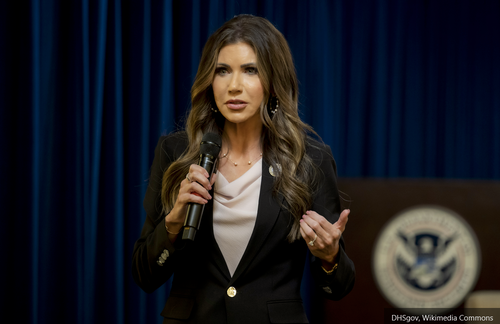
The Department of Homeland Security Office of Inspector General has for more than a month been investigating the process in which three businesses received $220 million for an ad campaign encouraging illegal immigrants to self-deport and featuring outgoing Secretary of Homeland Security Kristi Noem, according to sources familiar with the probe.
The existence of the IG probe and its inquiries have raised concerns among other investigators within the watchdog agency that Noem and her leadership team have retaliated against them by blocking access to critical information and data necessary to provide congressionally mandated oversight of key DHS functions, including the Trump administration’s immigration crackdown.
A source in the DHS community accused Noem of “retaliating” by not allowing the IG to “work real cases” because she and her top adviser, Corey Lewandowski, could be implicated in the watchdog probe of the ad contracts.
The $220 million ad contract sparked bipartisan Senate scrutiny during a Judiciary Committee hearing last week before Trump fired Noem, who will leave her role by March 31. Trump, who has since openly criticized the ad campaign’s price tag, tapped Oklahoma GOP Sen. Markwayne Mullin to replace Noem.
Republican Sens. John Kennedy and Thom Tillis joined Sen. Peter Welch, a Vermont Democrat, in questioning Noem about the ad campaign contract and whether any DHS employee had financially benefited from it. The senators repeatedly pressed Noem on why it was awarded to three companies, including a subcontractor run by Ben Yoho, the husband of former DHS press secretary Tricia McLaughlin.
Welch and Sen. Richard Blumenthal, who is the ranking member of the Permanent Subcommittee on Investigations, followed up late last week with letters to the three companies – Safe America Media, People Who Think, and Yoho’s Strategy Group. Safe America Media was incorporated in Delaware less than two weeks before receiving a $143 million contract. People Who Think was awarded a $77 million contract.
As the lead contractors, Safe America Media and People Who Think stood to reap millions in profit for the ad placements in media companies across the United States. Safe America Media is run by veteran GOP operative Michael McElwain, who through his DMM Media company is a well-known ad buyer for Senate Republican campaign committees.
Ad maker Pat McCarthy, also of DMM Media, is best known for producing Trump’s viral 2024 “They/Them” ad targeting then-Vice President Kamala Harris’ support for transgender surgeries for California prisoners. MAGA Inc., the super PAC that spent the most money supporting Trump’s 2024 campaign, hammered Harris in the ads, echoing a Trump campaign ad almost exactly, saying, “Crazy liberal Kamala’s for they/them. President Trump is for you.”
People Who Think is associated with Jay Connaughton, who worked with Lewandowski on Jeff Landry’s Louisiana gubernatorial campaign.
A DHS spokesperson denied any retaliation against the Inspector General’s office.
“It is completely false that there has been any kind of retaliation against the IG and his staff,” an unidentified DHS spokesperson told RealClearPolitics in an emailed statement.
A spokesman for the DHS IG’s office said it could not confirm nor deny the existence of any particular investigation. On its website, however, the IG lists as one of its ongoing projects “an audit of grants and contracts awarded by any means other than full and open competition during fiscal year 2025,” which could perceivably include information about the process in which DHS officials awarded the contracts for the $220 million Noem ad campaign.
That audit, which is congressionally mandated to take place on a yearly basis and apply oversight to all DHS grants and contracts, is currently paused because the ongoing DHS government shutdown has forced the watchdog agency to furlough employees assigned to it. One source, however, said the DHS IG investigation into the Noem ad campaign in question was separate from this audit.
Inspector General Joseph Cuffari in a letter to Congress sent last week accused DHS leadership of having “systematically obstructed” his work, including on a criminal investigation and another into the Secret Service’s failures before and after the 2024 assassination attempt on Trump’s life in Butler, Pennsylvania.
Cuffari claimed that DHS leadership had blocked his team’s access to a compartmentalized intelligence program related to the Secret Service’s mishandling of the threats against Trump, even though a separate intelligence agency had approved his access.
Preventing the access significantly “stymied” his investigation into the USSS’ failures, Cuffari wrote to the chairmen and ranking members of the Senate and House Homeland Security Committees.
“This is particularly troubling given the other reported attempts on President Trump’s life coupled with the present worldwide conflict,” Cuffari stressed, asking the lawmakers for their help in resolving these problems.
In addition, Cuffari, whom Trump appointed during his first term, said leaders at Immigrations and Custom Enforcement late last year revoked his team’s prior years-long access to key enforcement databases, and that Customs and Border Patrol has refused to grant access to a data warehouse containing information about border crossings, among other limitations.
DHS general counsel James Percival II wrote a letter to Cuffari in late January arguing that the watchdog had refused to provide “answers to basic questions” that would allow him to address the access complaints. Percival also asked Cuffari to document the scope of his requests, arguing that specific scopes are “even more warranted” as it pertains to classified information systems.
Percival, acting on Noem’s behalf, requested a list of all ongoing DHS IG investigations, which he confirmed in a letter to Democratic Sen. Tammy Duckworth in early February after the lawmaker expressed concern that the department was considering halting the watchdog’s oversight role.
Duckworth at the time said the DHS Office of Inspector General has received “repeated tacit threats” in the form of a reminder about a provision of the law that allows the secretary to kill ongoing inspector general investigations.
Percival said that DHS was within its legal rights to request a full accounting of investigations the watchdog had undertaken but argued that neither he nor Noem was trying to quash any of the probes.
“Rather, I requested on her behalf a list of all investigations to ensure she can evaluate whether it might ever be appropriate to exercise that power,” the general counsel said in a letter to Duckworth.
Duckworth called Percival’s response an admission that Noem’s office was seeking to “sabotage” the watchdog agency’s independence.
Cuffari had no choice but to provide the list of ongoing investigations and audits because he was forced to do so under the law, even though no other inspector general in the 48 years since an act of Congress created these watchdogs has been asked to do so.
Tyler Durden
Thu, 03/12/2026 – 08:25
https://www.zerohedge.com/political/dhs-ig-launched-probe-220m-contract-noem-ads

Carson Block Turns Bearish, Says AI Threatens 15% Of US Knowledge Jobs
Carson Block Turns Bearish, Says AI Threatens 15% Of US Knowledge Jobs
Carson Block says artificial intelligence has completely changed how he views markets over the past several weeks, according to Bloomberg.
In a conversation with Barry Ritholtz at the Future Proof Wealth Management conference in Miami Beach, the founder and chief investment officer of Muddy Waters Capital said his outlook has flipped.
“Up until one month ago, I was completely sanguine on the S&P 500 and markets in general and the economy,” Block said. “And my view has 180-ed.”
Known for his short-selling campaigns, Block had been relatively constructive on equities as recently as late November, saying he preferred being long rather than short the U.S. market and even revealing several uncommon long positions. Since then, however, the S&P 500 has lost momentum after a stretch of successive record highs.
Block now believes AI could meaningfully reshape both the economy and the stock market. Investor anxiety has been building over whether the hundreds of billions being spent on AI infrastructure will generate sufficient returns — or instead disrupt large parts of the corporate landscape and eliminate many white-collar jobs.
At the center of his concern is how job losses could ripple through the labor market and eventually affect financial markets.
“I think it’s not unrealistic to say 15% of knowledge worker jobs in the US in three years are gone,” Block said.
If new roles don’t emerge quickly enough, higher unemployment could reduce flows into retirement accounts such as 401(k) plans, which have long supported equity markets. If displaced workers then begin withdrawing savings because they cannot find new jobs, it could add further pressure.
Bloomberg writes that once that process begins, “there’s nobody there to catch the falling knife,” he said.
Block expects the disruption to appear first in fields such as law, accounting, tax advisory and finance support functions, particularly among junior staff and administrative roles. In hedge funds, he said many operational and back-office functions, including IT work, could be replaced by automated systems that are cheaper and more efficient. Large, profitable firms may continue hiring junior analysts out of tradition, but businesses operating with thinner margins will likely automate quickly.
Even with those concerns, Block sees opportunities in parts of the market. His firm has positioned trades that effectively bet against extremely tight credit spreads and seek to exploit liquidity mismatches in certain exchange-traded funds.
“I do think credit spreads are stupidly tight right now and credit volatility is stupidly low,” he said. “To me, you want convexity, and there are lots of ways to play it where you’re capping your potential loss.”
He also argued that years of easy money and ultra-low interest rates have made investors more tolerant of risk and enabled questionable corporate behavior. While outright fraud remains relatively rare, he believes a broad “gray zone” of aggressive accounting and misleading narratives has become common.
“My business has gotten harder because unless it’s something really, really egregious, people don’t care,” he said.
Tyler Durden
Thu, 03/12/2026 – 07:45
https://www.zerohedge.com/markets/carson-block-turns-bearish-says-ai-threatens-15-us-knowledge-jobs
Sixth Ship Struck: Oil Tops $100 As Tanker Attacks Escalate Hours After Trump’s “We Won”
Sixth Ship Struck: Oil Tops $100 As Tanker Attacks Escalate Hours After Trump’s “We Won”
Summary
Shipping turmoil escalates as multiple vessels (at least six) struck overnight
Brent crude oil prices top $100 amid “the largest supply disruption in the history of the global oil market,” the IEA reports.
Dubai suffers significant drone attacks
Northern Israel hammered by Hezbollah, “largest wave” of missiles since war began
IDF says it struck key Iranian nuclear development site
US Intel assesses Iranian regime remains intact
Oman port operations halted
Trump proclaims “we won”
* * *
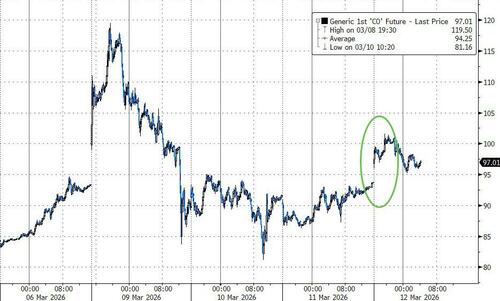
Brent crude futures in Asian trading jumped above $101/bbl overnight, despite news of a planned record emergency SPR release by the International Energy Agency’s 32 member countries, in an effort aimed at capping triple-digit oil prices.
Today’s focus is on reports that IRGC forces struck two foreign oil tankers in the Gulf area, bringing the total to six vessels hit over the past 24 hours. Iranian kamikaze drones also struck an energy export hub in Oman, while IRGC naval mine threats in the Strait of Hormuz soared by midweek.
The Wall Street Journal reported that two oil tankers were struck in Iraqi waters. The U.K. maritime security agency UKMTO also said a containership was hit off the coast of Dubai, adding to earlier reports that three cargo vessels were struck around the Strait of Hormuz area. Also worth recalling is the dramatic video from yesterday showing an IRGC drone slamming into a critical tank farm in Oman.
Video footage from the deck of a Chinese cargo ship which allegedly shows the moment an Iranian one-way attack drone, a Shahed-136, struck an oil tank earlier today at the MINA Petroleum Facility on the Port of Salalh in Oman. pic.twitter.com/45KGfrjYak
— OSINTdefender (@sentdefender) March 11, 2026
The market reaction to the overnight hostilities, as Operation Epic Fury rages on this week and IRGC forces lob missiles and bombs at Gulf states, was a surge in Brent crude futures to the $101 handle.
Goldman’s Rich Privorotsky on the overnight energy market moves:
A series of attacks across the Gulf has sent oil up nearly another 10% (fading to up 5%), with Brent back briefly through the $100 level. The move in products looks even more acute, with distillates leading. Quite telling yesterday that, after yet another Whitehouse jawbone and the IEA’s record reserve release announcement, oil still failed to come in meaningfully. Overnight Reuters reported, “Iran has laid about a dozen mines in Strait of Hormuz, sources say” … if that is confirmed it’s not quickly reversible.
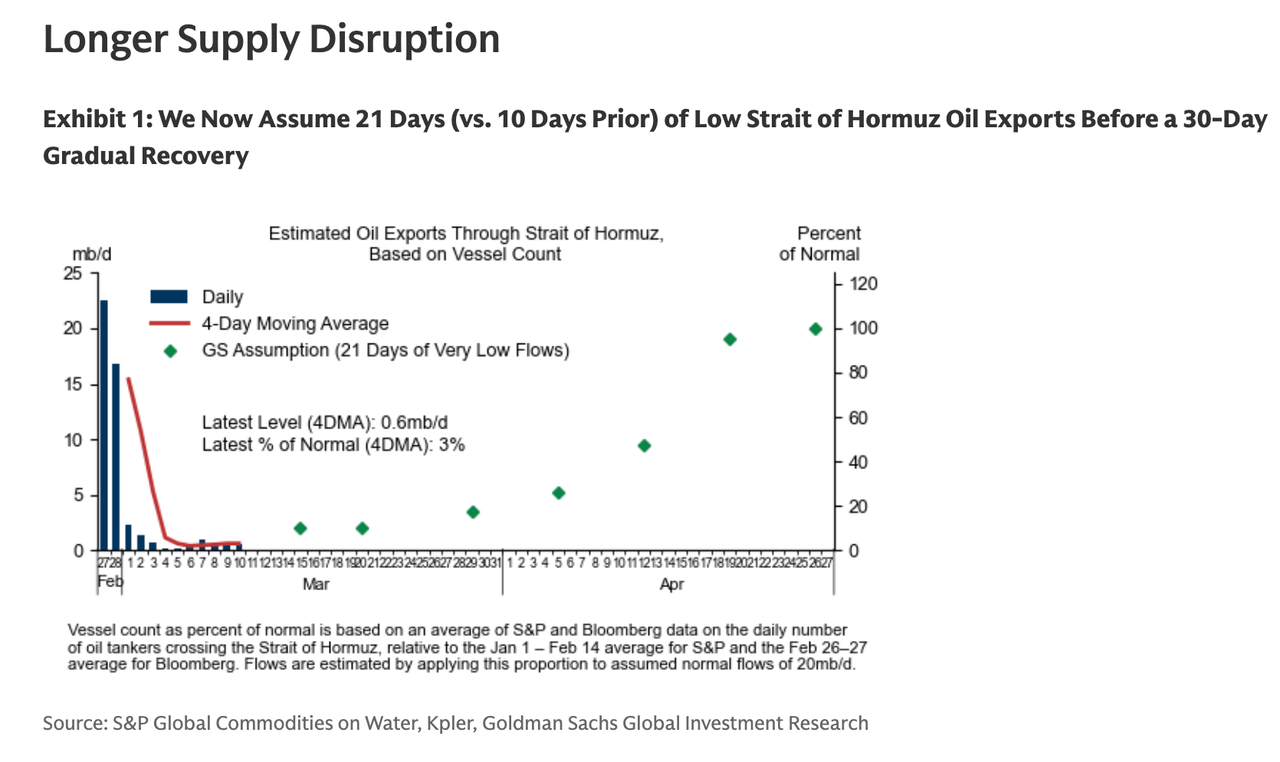
Goldman expects longer disruptions on the Hormuz chokepoint:
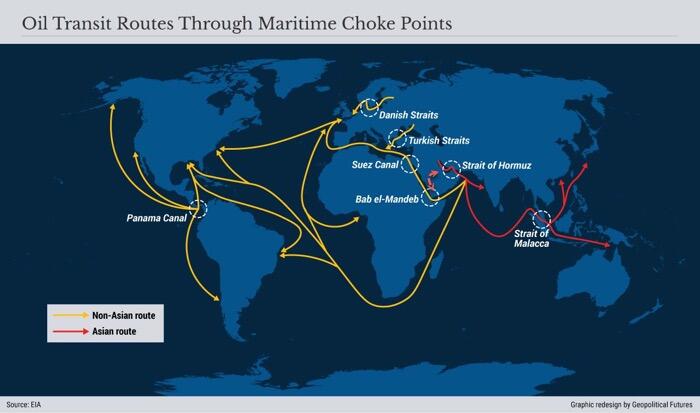
Here’s where things get even more complicated: Six commercial vessels and oil infrastructure in the Gulf area were hit in IRGC strikes, and attention is now shifting to another critical maritime chokepoint.
Overnight, Iran’s semi-official Fars News Agency warned that the Houthis in Yemen and other Iran-backed groups could move to shut the Bab el-Mandeb Strait at the southern tip of the Arabian Peninsula.
The overnight chaos sent Brent crude back over $101/bbl, but it has since fallen to $96/bbl by 0630 ET. This comes after the IEA’s 32 member countries agreed on a “record” 400 million barrel release to cap energy prices. U.S. Energy Secretary Chris Wright announced that the U.S. will contribute 172 million barrels. As we explained to readers on Wednesday, this SPR dump is likely to have only a minimal impact.
Meanwhile, President Donald Trump told supporters in Kentucky last night that Operation Epic Fury was effectively over almost as soon as it began. “It’s just a question of when—when do we stop?” he said.
“Let me say we’ve won. You know, you never like to say too early you won. We won. We won, in the first hour it was over, but we won,” Trump said.
He added, “We don’t want to leave early, do we? We’ve got to finish the job.”
NOW – Trump declares “we’ve won” the Iran War. pic.twitter.com/vx0J9Z9SJr
— Disclose.tv (@disclosetv) March 11, 2026
It is clear that U.S.-Israeli operations have dealt a major blow to the IRGC’s conventional military capabilities, but the lingering threat will be asymmetric warfare, including drone attacks, naval mines, the potential sabotage of undersea cables, and a wide range of other low-cost, high-disruption weapons.
What’s important from the overnight (courtesy of Bloomberg):
Energy Market
The Iran war is causing the largest supply disruption in the history of the global oil market, hitting 7.5% of global supply and an even bigger share of exports
Oil prices surged above $100 a barrel as Iran escalated attacks on Dubai and shipping assets
IEA members agreed to release an unprecedented 400 million barrels from emergency reserves to calm the market
IRGC Military Actions
Iran escalated attacks on parts of Dubai with missile alerts and a drone that fell on a building in Creek Harbour on Wednesday night
Iran says it maintains control over the strategic Strait of Hormuz and claims it carried out strikes on Israeli military and intelligence facilities
Iran’s military announced the policy of reciprocal strikes has ended, stating, ‘from now on, our policy will be strike after strike’
More than 2,100 Shahed-136 weapons have been fired so far, damaging oil infrastructure, shutting airports and destroying military hardware
US Security Warnings
The US State Department warned that Iran and affiliated groups could be planning attacks on oil infrastructure owned by the United States in Iraq
US Central Command warned that Iran is using civilian ports along the Strait of Hormuz for military operations, making them legitimate targets
California Governor Newsom said he’s aware of potential drone strikes in California after FBI warnings that Iran has allegedly considered launching offensive drones against the West Coast
Economic Impact
Goldman Sachs and Citigroup told staffers in Dubai to stay away from their offices amid Iran threats
On the Beach suspended its full-year guidance due to a ‘significant slowdown’ in demand following the Middle East conflict, with shares dropping as much as 15%
Chinese oil refiners have begun canceling agreed refined fuel export cargoes as Beijing tightens curbs to cope with the war’s impact
Diplomatic Developments
Iran has told regional intermediaries that for a ceasefire, the US must guarantee that neither it nor Israel will strike the country in the future
A former IRGC chief said Iran would agree to no ceasefire until the country reaches a ‘definite outcome’
The UN Security Council approved a resolution condemning Iran’s attacks on its Gulf neighbors including Bahrain, Kuwait, Oman, Qatar, Saudi Arabia, UAE and Jordan
Related energy market reads:
Oil “VIX” At 121 — Markets Aren’t Pricing De-Escalation
Oil Volatility Is Exploding — And Something Is Starting To Break
Is it too early for Trump to be calling a “win” when asymmetric warfare is still a very big threat and will be lingering for many weeks, if not months? As one pundit has pointed out: “Endurance regimes do not need clean victory to change the game. They only need to survive the shock while making the old equilibrium too costly for their adversaries to restore.”
Tyler Durden
Thu, 03/12/2026 – 07:20
US Reportedly Has Just Two Months Of Rare Earths Left
US Reportedly Has Just Two Months Of Rare Earths Left
The U.S. military’s reliance on Chinese rare-earth minerals is emerging as a strategic vulnerability as Washington’s conflict with Iran unfolds and President Donald Trump prepares for a closely watched visit to Beijing later this month.
US officials and analysts say the war has intensified concerns about supply chains for the specialized minerals used in advanced weapons systems, SCMP reports. According to people familiar with the issue, the U.S. may have only about two months of rare-earth inventories remaining, raising questions about how long current military operations could be sustained if access to Chinese supplies were disrupted.
As we noted in 2023, former Raytheon CEO Greg Hayes admitted that Beijing effectively has the US military’s supply chain by the balls thanks to its reliance on rare earths and other materials which come from, or are processed in, China.
According to Hayes, Raytheon has “several thousand suppliers in China,” because of which “decoupling … is impossible.“
“We can de-risk but not decouple,” he told the Financial Times, adding that he thinks this is the case “for everybody.”
“Think about the $500bn of trade that goes from China to the US every year. More than 95 per cent of rare earth materials or metals come from, or are processed in, China. There is no alternative,” Hayes continued, adding “If we had to pull out of China, it would take us many many years to re-establish that capability either domestically or in other friendly countries.”
Hayes’ comments underline the difficulties facing western manufacturers amid growing friction between China and the US and its allies.
Beijing in February imposed new sanctions on both Raytheon and US defence peer Lockheed Martin for supplying weapons to Taiwan. Hayes has also been placed under sanctions.
The sanctions have had little commercial impact as the groups are not allowed to sell military equipment to China. Raytheon, however, has a substantial commercial aerospace business in the country through its engine subsidiary, Pratt & Whitney, and aviation systems and cabin equipment specialist Collins Aerospace. It has about 2,000 direct employees in China. -FT
Hayes – at least two years ago, said that the company is looking “to take some of the most critical components and have second sources but we are not in a position to pull out of China the way we did out of Russia.“
Now, concerns over the allegedly limited supply will loom over Trump’s planned meeting with Chinese President Xi Jinping scheduled to take place March 31 to April 2, according to a White House official, while people briefed on the discussions say rare-earth supplies could dominate the agenda when the two leaders meet.
Rabobank’s Michael Every has drawn parallels to the 1956 Suez Crisis, when the United States used financial pressure to force Britain and France to halt military operations in Egypt. In that episode, Washington’s leverage reshaped the geopolitical balance among Western powers.:
This is obviously of critical importance. To extend an analogy used yesterday, is China of 2026 the US of 1956 and the US of 2026 the UK and France of the Suez Crisis? (This is as Germany may emulate Japan in shoring up critical minerals supply via joint purchasing from its key firms aimed at reducing reliance on China.)
Today, the roles could be reversed. China’s control over critical mineral supplies raises the possibility that Beijing may wield similar influence over Washington at a moment when U.S. military operations and industrial supply chains depend heavily on those materials.
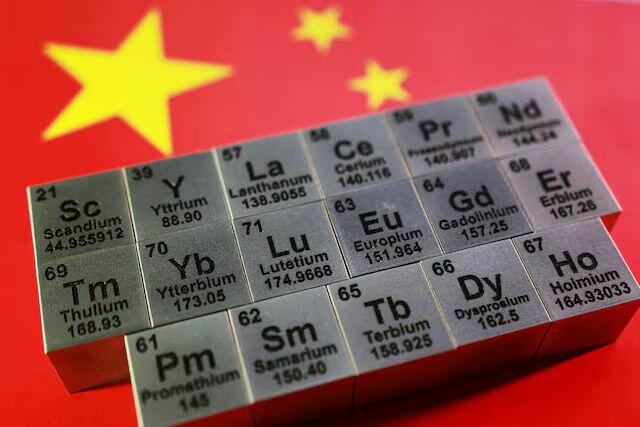
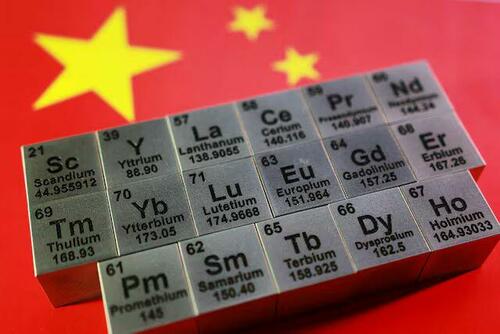
Rare-earth elements – particularly heavy varieties such as dysprosium and terbium – are essential to the manufacture of high-performance permanent magnets, radar systems, missile guidance components and propulsion systems used in modern weapons. China has long dominated global production and processing of these minerals, leaving the U.S. dependent on imports for critical components of its defense industry.
A report this month from the U.S. Geological Survey found that China accounted for 71% of U.S. rare-earth imports between 2021 and 2024 (so obviously less reliant than 2.5 years ago). During that period, China was the sole supplier of certain heavy rare earths, including terbium, with no immediate alternative sources available.
Marina Zhang, an associate professor at the University of Technology Sydney’s Australia-China Relations Institute, told SCMP that the imbalance gives Beijing “significant indirect leverage over the duration and cost of potential conflicts,” creating what she described as an “asymmetric vulnerability for Washington,” potentially allowing China to influence geopolitical negotiations by tightening or loosening access to materials vital for weapons production.
Zhao Minghao, a professor at Fudan University’s Institute of International Studies, said Beijing is likely to press the U.S. to ease tariffs and export controls in exchange for assurances on stable rare-earth supplies.
The issue has gained urgency as the U.S. military burns through munitions in its campaign against Iran, which began Feb. 28. President Trump initially projected that the strikes could last four to five weeks but said Monday that American objectives had nearly been achieved and the crisis could end “very soon.”
The Washington Post, citing unnamed U.S. officials, reported that the Pentagon expended roughly $5.6 billion worth of munitions during the first two days of operations alone, highlighting the pace at which advanced weapons stockpiles are being drawn down.
While existing missile inventories could support several months of combat, replenishing them could prove difficult if access to Chinese minerals is constrained, according to Amanda van Dyke, founder of the industry think tank Critical Minerals Hub.
“Missile stockpiles are more than sufficient to sustain the Iran war for at least three to six months,” she said. “But restocking those munitions afterward may take much longer without Chinese minerals.”
The Trump administration has attempted to mitigate the risk by launching “Project Vault,” a $12 billion public-private initiative aimed at building strategic stockpiles of critical minerals. Industry analysts say the program may help but could fall short of meeting the specific needs of modern weapons systems.
China has already demonstrated its willingness to use rare-earth exports as leverage. In April, Beijing imposed export controls on seven medium and heavy rare-earth elements – including dysprosium and terbium – requiring special licenses for shipments abroad. The move came in retaliation for U.S. tariffs introduced under Trump’s so-called “Liberation Day” trade measures.
Additional restrictions introduced in October were suspended the following month as part of a temporary trade truce, though the earlier licensing requirements remain in place.
For Washington, however, the stakes may extend beyond trade. As the conflict in Iran continues and munitions stockpiles shrink, the availability of rare earths could become an increasingly central factor in both military planning and diplomacy.
Tyler Durden
Thu, 03/12/2026 – 06:55
https://www.zerohedge.com/political/washington-reportedly-has-just-two-months-rare-earths-left

They’re Replacing Winston Churchill With A Hedgehog
They’re Replacing Winston Churchill With A Hedgehog
Authored by Steve Watson via Modernity.news,
In a stunning betrayal, the Bank of England has announced plans to scrub Winston Churchill and other iconic British figures from the nation’s banknotes, ludicrously swapping them out for images of wildlife like hedgehogs, badgers, and otters.
This comes after a so-called public consultation where nature themes supposedly won out, but detractors see it as the latest chapter in a relentless campaign to dismantle British heritage under the guise of ‘progress’.
Conservatives and history defenders are fuming, labeling the decision a cowardly capitulation to woke sensitivities that deem giants like Churchill too “divisive.” As globalist forces push to rewrite the past, this shift reeks of an agenda to erase the very leaders who built and defended the free world—forwarding a relentless pattern.
Winston Churchill will soon disappear from UK banknotes, as the cigar-toting, wartime leader makes way for creatures like hedgehogs and badgers. After a public consultation, the next generation of pound notes will feature native British wildlife, according to the Bank of England.… pic.twitter.com/gfRYz5B8JU
— Bloomberg (@business) March 11, 2026
The Bank of England revealed the overhaul following a consultation that drew over 44,000 responses, with 60 percent favoring nature over historical figures, architecture, or cultural milestones. Current notes feature Churchill on the £5, Jane Austen on the £10, JMW Turner on the £20, and Alan Turing on the £50. All will be phased out in favor of native species, plants, and landscapes, albeit with King Charles III remaining on the front.
A second consultation this summer will finalize specifics, drawing from a shortlist curated by wildlife experts. The bank claims this boosts security features and celebrates the UK’s environment, but the timing—amid ongoing attacks on British icons—raises eyebrows.
‘It’s absurd at a time where this country is worried about Britain’s status in the world!’
Conservative MP Andrew Bowie reacts to news that Sir Winston Churchill is set to be removed from British banknotes, to be replaced by wildlife imagery. pic.twitter.com/fzQWRFJcGC
— GB News (@GBNEWS) March 11, 2026
Former business minister Kevin Hollinrake didn’t hold back, calling the idea “bonkers” and insisting banknotes should honor “historical giants who shaped our nation.” Ex-business secretary Sir Jacob Rees-Mogg piled on, accusing the bank of lacking seriousness: “Animals on notes? What next, squirrels running the economy?”
‘The Bank of England has been totally captured by the progressive left and this is just more evidence of it!’
Rafe Heydel-Mankoo slams the Bank of England for erasing Winston Churchill from five pound banknotes, adding ‘it is a war on our history!’ pic.twitter.com/NjgFbbbpAx
— GB News (@GBNEWS) March 11, 2026
The Express reported Conservative pledges to reverse the change if they regain power, slamming it as a sign of cultural self-loathing. “We should be proud of our history, not hide it,” one source told the paper.
‘Our history is being erased!’
Lee Anderson reacts to reports that the wartime Prime Minister Winston Churchill is set to be taken off banknotes and replaced by pictures of wildlife. pic.twitter.com/ls82xeD5tE
— GB News (@GBNEWS) March 11, 2026
The development prompted many to predict what else we could soon see appearing on our currency:
— Proper Memes ?? (@Proper_Memes) March 11, 2026
New £5 note leaked pic.twitter.com/rmJLiXeTle
— Lance (@username_08880) March 11, 2026
okay hear me out pic.twitter.com/8NIB135Lnb
— Lewis (@BasedLewis) March 11, 2026
— Ian Bott (@Buzzer_1960) March 11, 2026
New £5 note btw. https://t.co/M6AgQEux5F pic.twitter.com/UzLsTzroKP
— Landeur ??????? (@Landeur) March 11, 2026
— Ian Bott (@Buzzer_1960) March 11, 2026
Na this is the new 5er mate..
???? pic.twitter.com/0y7DhZIwqD
— accsmith1982@yahoo.co.uk (@accsmith1982) March 11, 2026
This isn’t an isolated incident. It’s part of a broader leftist crusade to purge Britain’s past. As we detailed in our coverage of a London museum draping a historical portrait in cloth to “reclaim Caribbean history,” institutions are bending over backward to obscure figures tied to empire, even flagging statues of Nelson and Churchill for potential removal.
Recall how Prime Minister Keir Starmer gutted 10 Downing Street of artworks depicting Shakespeare, Thatcher, and Churchill himself, replacing them with abstract pieces from “diverse” artists like Denzil Forrester and Lynette Yiadom-Boakye. Critics labeled the move a petty purge, swapping heritage for soulless scribbles that scream contempt for English roots.
Academic elites have long fueled this fire. Cambridge University has hosted panels in recent years branding Churchill a “white supremacist” whose empire was “worse than the Nazis,” downplaying his role in crushing fascism while amplifying outdated grievances.
Schools aren’t immune. A London primary renamed its “Churchill House” after footballer Marcus Rashford for “diversity,” ignoring the wartime PM’s legacy in favor of modern symbolism. Parents raged, but the headteacher pressed on, claiming it empowered student voices.
During 2020’s BLM unrest, a petition demanded uncovering Churchill’s Parliament Square statue after it was boxed up amid vandalism fears—yet Boris Johnson did zilch.
The Churchill statue has become a repeated target for obsessed misanthropic leftists.
BREAKING:
The Churchill statue in Parliament Square in London has been vandalized by pro-Palestine activists pic.twitter.com/4Z4rXZaY4P
— Visegrád 24 (@visegrad24) February 27, 2026
Another push in Croydon sought to erase a Churchill mural, backed by a Labour councillor who peddled the “racist bigot” narrative.
These assaults add up to a calculated effort to strip Britain of its identity. By ditching Churchill for badgers, the Bank of England plays into hands that view national heroes as obstacles to a borderless, history-free utopia.
The humiliation is the point. https://t.co/pgY6aqyfpx
— Paul Joseph Watson (@PrisonPlanet) March 11, 2026
It’s clear: this caters to a vocal minority obsessed with decolonizing everything, from currency to classrooms.
The irony bites hard. Churchill, who rallied the free world against tyranny with lines like “We shall fight on the beaches,” now gets sidelined for squirrels. If this doesn’t wake up the masses to the cultural erosion, what will?
Your support is crucial in helping us defeat mass censorship. Please consider donating via Locals or check out our unique merch. Follow us on X @ModernityNews.
Tyler Durden
Thu, 03/12/2026 – 06:30
https://www.zerohedge.com/political/theyre-replacing-winston-churchill-hedgehog

Humanoid Soldiers Tested In Ukraine; Founder Eyes Contract To Patrol US Border
Humanoid Soldiers Tested In Ukraine; Founder Eyes Contract To Patrol US Border
Corporate media is finally catching up to our humanoid robot theme, with these bots moving beyond factory floors and possibly soon marching onto modern battlefields, as conflicts rage in Eastern Europe and the Middle East.
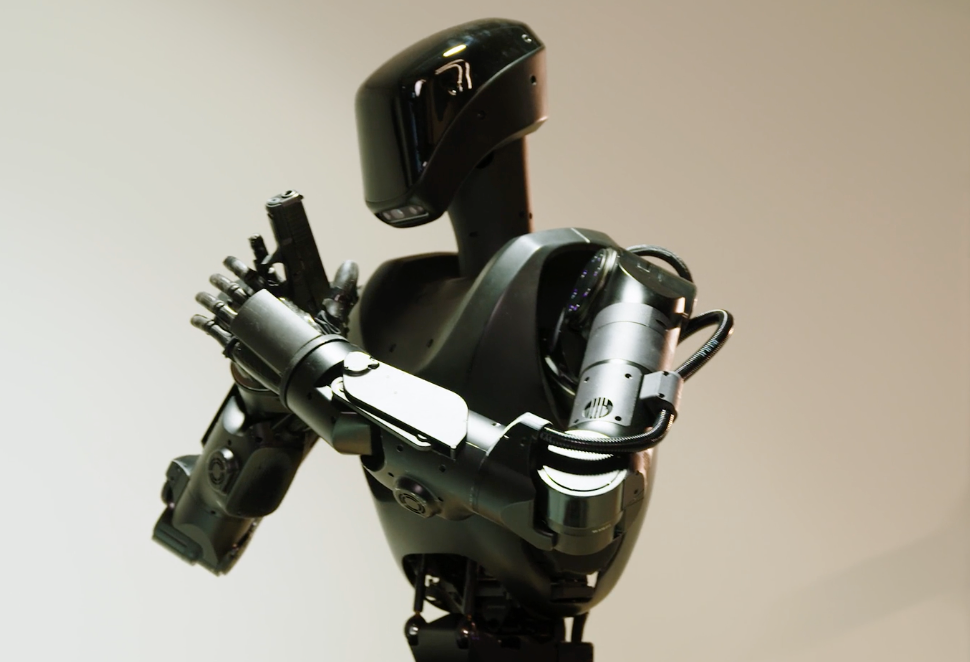
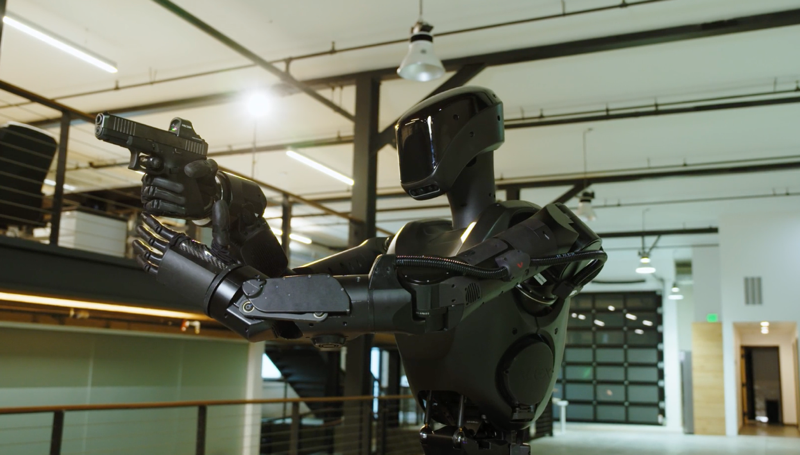
TIME reports that Foundation Robotics, a U.S.-based startup developing humanoid robots for industrial and military applications, has recently sent two Phantom MK1 robots to Ukraine for testing.
A Foundation spokesperson said the startup is preparing its Phantom robots for potential deployment in combat scenarios for the Pentagon, which “continues to explore the development of militarized humanoid prototypes designed to operate alongside warfighters in complex, high-risk environments.”
Foundation co-founder Mike LeBlanc, a 14-year Marine Corps veteran with multiple tours in Iraq and Afghanistan, also told the outlet that the company is in “very close contact” with the Department of Homeland Security regarding possible patrol functions for Phantom along the U.S. southern border.
LeBlanc prepares to hand a shotgun to a PhantomMattia Balsamini for TIME. Source: TIME
Foundation is already a military-approved vendor and holds government research contracts worth $24 million with the U.S. Army, Navy, and Air Force. This suggests that these war bots are very close to being tested in war zones.
TIME reported that the MK1 robots will soon be training with the Marine Corps for the “methods of entry” operations. This advanced course teaches soldiers breaching techniques for buildings, structures, and ships, using several types of methods: explosive, ballistic, thermal, manual, and mechanical entry.
LeBlanc pointed out that the natural evolution of today’s autonomous systems is a leap from drones to ground bots to humanoid robots. He said humanoid soldiers do not crack under intense mental pressure and can be deployed as highly expendable assets.
In February, we outlined that humanoid robots would soon enter the modern battlefield, and it appears TIME has now confirmed it.
AI’s Next Frontier Is Physical As Humanoid Robots Begin March On Assembly Lines And Beyond
Watch: Russian Soldiers Surrender To Gun-Wielding Robot; Humanoid Warfare Nears
The conflicts in Ukraine and the Middle East have demonstrated that modern warfare is becoming increasingly automated, with low-cost ground bots, FPVs, weaponized AI kill chains, and many other technologies now being deployed by foreign adversaries.
Sankaet Pathak, Foundation co-founder and CEO, told the outlet that a humanoid-soldier arms race is “already happening,” as Russia and China develop dual-use technology.
“Just like drones, machine guns, or any technology, you first have to get them into the hands of customers,” Pathak said.
With the world seemingly at war on two fronts, the development and deployment of next-generation war tech, such as humanoid robots, is likely to be thrown into hyperdrive. This is bullish for “war unicorns,” as the Department of War’s DOGE resets procurement program directs more funding toward defense startups.
Tyler Durden
Thu, 03/12/2026 – 05:45
https://www.zerohedge.com/technology/humanoid-soldiers-set-battlefield-testing-world-seemingly-war
Germany’s Commuters Bear The Cost Of The Iran Crisis And Tax State
Germany’s Commuters Bear The Cost Of The Iran Crisis And Tax State
Submitted by Thomas Kolbe
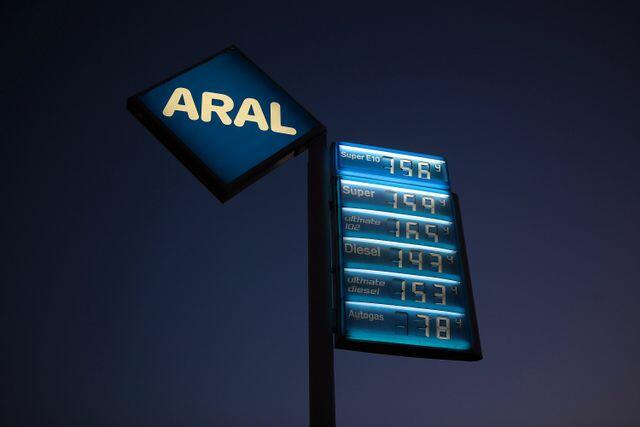
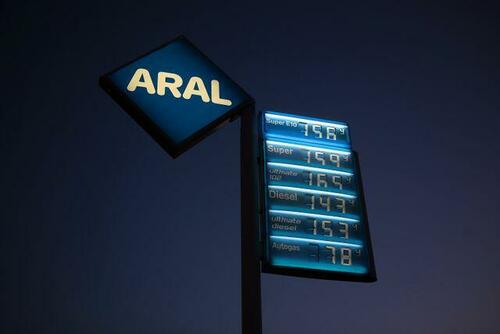
The excessive fiscal burden on fuels has driven gasoline prices in Germany higher since the start of the Iran crisis. Yet it seems unlikely that German policymakers will ease the burden on commuters or businesses. Apart from a task force, nothing has been planned. Other regions are proving more resilient.
The Iran conflict has entered its second week, and with it, concerns are growing over the consequences of the slowly but steadily building energy crisis for the global economy.
In Germany, the rise in oil prices was quickly reflected at the pumps. Prices jumped from around €1.65 per liter to over €2 – a roughly 25 percent increase in a very short period (Apollo News reported).
At the same time, suspicions arise that oil companies are securing quick profits by selling already invoiced and refined petroleum as well as existing gasoline stocks at the now significantly higher retail price, realizing excess profits.
However, this is a temporary effect, likely to be balanced quickly by market dynamics. The internationally high increase in German gasoline prices is almost entirely due to the fact that the state, through its tax policies, accounts for roughly 65 percent of the retail price. A silent profiteer in the crisis, while commuters face growing problems.
Whether CO₂ levies, fuel taxes, or VAT – the government should now act with fiscal restraint and provide significant relief to both commuters and businesses. So far, this is not the case. German politics stares like a rabbit at the snake in the Iran conflict. Slowly, it becomes clear that decades of ideologically driven energy policy were nothing more than a trillion-euro, subsidized fantasy – now turning into a nightmare.
USA Operate Autarkically
Across the Atlantic, the situation is very different. Gas prices in the United States rose by about five to ten percent. Eight months before the crucial midterm elections, this will be decisive for President Donald Trump to uphold his campaign promises and keep inflation under control.
A quick end to the Iran war is now imperative. Washington is weighing the geopolitical effects, control of global oil markets, and domestic inflation risks.
Since 2018, the United States has been the world’s largest oil producer with a daily output of 18 million barrels and is also an exporter of “black gold.” Its dominant position makes it relatively insulated from major oil price shocks while giving it significant market influence.
If the crisis persists, the global energy market risks fragmentation. Massive price hikes threaten import-dependent states, such as many European countries, while energy-autarkic nations retain pricing power and are largely shielded from extreme increases.
South Korea as a Special Case
Looking to Asia, South Korea is highly energy-dependent like Europe but boasts substantial refining capacity. Companies such as SK Energy, GS Caltex, or S-Oil typically operate on long-term supply contracts and fixed prices, while holding significant crude inventories that can be drawn down during a supply disruption.
The South Korean economy is temporarily insulated from a Hormuz blockade. Gas prices rose about 13 percent since the outbreak of the war, from €1.11 to €1.25 per liter – markedly less than in Germany.
Taxes and levies account for only around 40 percent of the retail gasoline price in South Korea, providing an advantage compared with Germany’s steadily rising mobility and energy taxes.
It may take up to three weeks for an oil shock to reach Korean gas stations. During this time, firms hedge currency and price risks on futures markets, operating largely in isolation. Refineries and storage practices act as an additional strategic oil reserve directly integrated into the processing of the economy’s key resource.
Politically, the government remains on alert. Seoul has so far refrained from temporary fuel tax cuts, a measure historically used to support the economy. Most recently, this occurred during the lockdown phase. This suggests that Korean authorities do not expect a prolonged conflict – and certainly not a ground invasion by U.S. or Israeli troops. Such a scenario would inevitably escalate, including on global commodity markets.
Crystal Ball Outlook
It is currently almost impossible to predict how the conflict will evolve. Regime change in Tehran appears to be neither a U.S. nor Israeli objective. Likewise, ground troop interventions remain highly unlikely, especially given the approaching midterms in the U.S.
This makes a short conflict duration likely. Strategic oil reserves in most EU countries cover roughly three months and have not yet been tapped. Despite rapid price increases, no acute supply shortages currently exist.
To relieve pressure at the pumps, fuel taxes would need to be cut. Yet it is unlikely that Finance Minister Lars Klingbeil will forgo the additional revenues generated by the temporary energy price spike.
Politically, the focus remains on optics: a gasoline price task force has been convened – a media maneuver during election season, a political chimera drawn reflexively from the government’s toolkit.
Structural solutions to Europe’s dangerous energy dependence would require a geopolitical reset, including a peace settlement with Russia, exploitation of domestic resources such as the continent’s immense gas reserves, and potentially a return to nuclear power in Germany.
* * *
About the author: Thomas Kolbe, a German graduate economist, has worked for over 25 years as a journalist and media producer for clients from various industries and business associations. As a publicist, he focuses on economic processes and observes geopolitical events from the perspective of the capital markets. His publications follow a philosophy that focuses on the individual and their right to self-determination.
Tyler Durden
Thu, 03/12/2026 – 05:00
https://www.zerohedge.com/markets/germanys-commuters-bear-cost-iran-crisis-and-tax-state