Category: News
Why Constant Talk Of TACO Is Likely Wrong, With Both Sides Escalating
Why Constant Talk Of TACO Is Likely Wrong, With Both Sides Escalating
By Michael Every of Rabobank
The only way out of this crisis is through
We warned 2026 would tell 2025, which revolved around tariffs, ‘Hold my beer’: yesterday, the US launched two new Section 301 trade investigations, and it hardly registered in the headlines even if it could lead to higher, court-immune US tariffs this summer vs China, the EU, India, Japan, South Korea, Mexico, Taiwan, Vietnam, Thailand, Malaysia, Cambodia, Singapore, Indonesia, Bangladesh, Switzerland, and Norway.
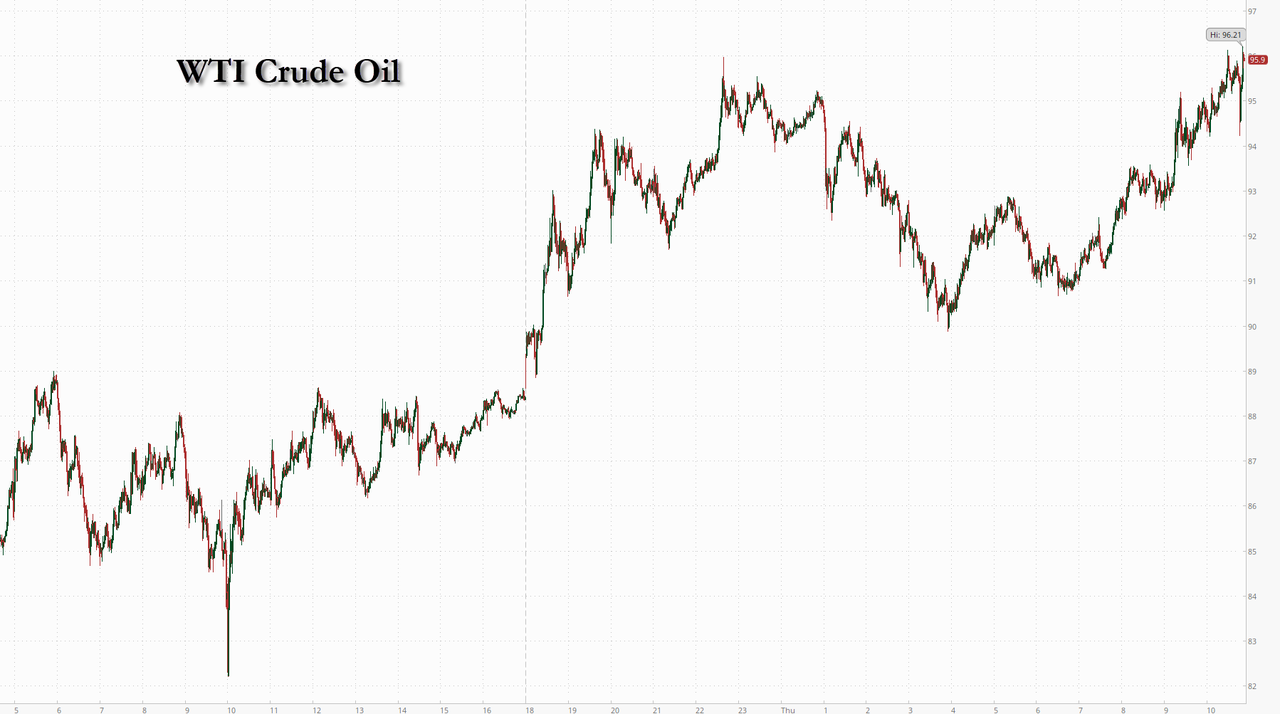
The focus is instead on Iran and Hormuz, as Brent oil tests towards $100 a barrel this morning. As also warned, things are going to escalate before any de-escalation on those fronts. Ignore that “There’s “practically nothing left” to target in Iran”; balance news that US intelligence says Iran’s government is not at risk of collapse with reports suggesting potential cracks forming in it; and above all heed our underlying geopolitical logic, echoed in the Wall Street Journal, that ‘Ending Iran War Quickly Carries Big Risks for the US and Allies’ because “Leaving the regime undefeated could motivate Tehran to develop nuclear weapons and leave it in control of much of the world’s energy flows.” That’s why constant talk of TACO is likely wrong, and both sides are escalating.
The Iranians hit three ships in Hormuz yesterday, as Tehran warned the world to get ready for $200 oil while boasting of new underwater anti-ship weapons. It also struck two oil tankers at port in Iraq, which has seen those key facilities taken out of action. That means another immediate drop in global oil supply while expanding the field of danger for oil flows far wider than Hormuz: could the Saudi Red Sea pipeline to Yanbu be targeted too, making everything exponentially worse? Meanwhile, Iran is able to get its oil out of Hormuz. Tehran also expanded the war into the cybersphere in hacking a US company, and the FBI warned Iranian drones could even hit California’s coast(!)
The US bombed harder and warned Iranian ports are targets if the military uses them. Impotently, the UN Security Council demanded Iran halt attacks on Gulf states; somewhat less so, perhaps, G7 leaders agreed to examine the option of escorting ships to navigate freely through Hormuz – yet that would drag all of them into a shooting war with Iran. (It also comes just after von der Leyen was forced to walk back suggestions that the EU should sometimes look to its own self-interest, rather than just following the letter of international law, if it wants to be a geopolitical actor.) Elsewhere, after Hezbollah and Iran attacked Israel jointly, the IDF pounded Beirut, warned parts of it will ‘look like Gaza’ if such strikes don’t stop, and ordered reinforcements north for a potential broader invasion of Lebanon.
Against this, the IEA oversaw a record release of oil reserves. However, that flow vs the lack of physical supply in Asia already looked like a plaster on a shotgun wound, to quote our energy analyst Joe DeLaura before Iraqi oil ports were taken offline, which is another cartridge fired into the same injury. Indeed, Bloomberg reports some refineries are turning down available oil because they are forced to pay a huge premium over ‘market’ rates; Australia’s top fuel sellers are halting spot sales on tight supply and are only dealing with regular customers; freight rates are sky-rocketing, e.g., a South Indian firm has seen quoted air-freight costs double, while containers via ship have jumped 630% and for refrigeration by 900%, with real fears of no bunker fuel ahead. South Korea is warning that without helium supplies, it won’t be able to keep making semiconductors – the same is true for all global producers outside the US.
Moreover, Chris Cook, a former regulator and director of the International Petroleum Exchange, is deeply sceptical about the huge plunge in oil prices on Monday that reversed the earlier record spike. He posts: “This episode is a macro-market ‘goose’/manipulation –an inverse April 2020– facilitated by the smartest guys in the room and financed (Fed liquidity) & funded (China Treasury collateral) by the same state actors. Ends middlemen era & begins #EnergyDominance paradigm.”
As Joe (on oil) and Florence Schmit (on LNG) note in their latest note on the Iran crisis: “We suspect that the $120 mark will be retested again if the SPR barrel releases are debated over for some time and not implemented immediately while the conflict drags on with no outlet for energy supplies. Our current base case going forward is as follows: we expect that the Strait will remain fully closed through the end of March. We believe that April, May, and June will see the slow return of tankers to the world market via the US insurance guarantees plus US naval escorts of some kind.” And perhaps with G7 help – though that remains to be seen.
In short, the only way out of this crisis is through. Through Hormuz. Through Iranian resistance. Through violence. Anything that happens in the financial, not the physical, space is ultimately irrelevant vs. that dynamic.
Meanwhile, the Japanese press underlines that China’s Xi is torn between his long ties with the Khameneis and US relations. Indeed, we are approaching a critical tipping point. Will China, looking to the upcoming Xi-Trump meeting, help the US to resolve this crisis via pressure on Iran, even if it means that it loses Tehran as a regional ally – and for what geopolitical quid pro quo? Or will it back the regime, along with Moscow, and escalate across different dimensions and geographies?
On that note, amongst a multiplicity of factors, consider that while China has stocks of key goods and Iranian oil can still flow to China for now, helium, sulphur, and fertiliser can’t, and China can’t keep exporting to the rest of the world (excluding the US) if it’s all sucked into an economic crisis. Beijing also prizes stability. Yet to say there’s a lot riding on the US-China angle, which most commentators have belatedly explained this Iran war is all about, is an understatement.
Yet there are other things worth noting today – really:
Ukraine has reached a milestone: making ‘China-free’ drones. It’s now supplying anti-drone tech and know-how to the Gulf. That shows how supply chains can shift if one wants, and how an understanding of how to use, and resist, applied violence is key to success in the current world order. Indeed, Zelenskyy just told Trump, via Politico, to put more pressure on Putin, ‘not on me’.
In France, the far-right presidential candidate Bardella’s main rival, former PM Édouard Philippe, risks crashing out of 2027 race if he loses an upcoming local election to a Communist challenger, which, following local election results in Germany, says a lot about political polarisation and rules-based orders even before we get any fat tail inflation risks from the current Iran crisis.
And traditionally free-market Hong Kong now has its first 5-year plan… to develop its role as a global financial hub.
Tyler Durden
Thu, 03/12/2026 – 11:45
https://www.zerohedge.com/markets/why-constant-talk-taco-likely-wrong-both-sides-escalating
In From The Cold Already: Putin Envoy Met With US Team On Energy Markets Crisis
In From The Cold Already: Putin Envoy Met With US Team On Energy Markets Crisis
With the globe’s attention focused on the now almost two week long ongoing Iran war, Moscow is busy in the sidelines making strides to improve bilateral relations with the United States, while demonstrating how vital Russia is to global energy markets.
Kirill Dmitriev, Putin’s directly appointed special envoy, held a meeting in the US “with the heads of the working group on economic cooperation between Russia and the United States,” according to his Telegram statement and fresh reporting in Bloomberg.
Dmitriev and US officials discussed “promising projects that could contribute to the restoration of Russian-American relations, as well as the current crisis in global energy markets” – according to the top Kremlin official’s statement.
More to come as the world recognizes Russia as a must-have supplier of energy. https://t.co/YnIlEhm25b
— Kirill Dmitriev (@kadmitriev) March 6, 2026
The US-Russia meeting comes on the heels of Washington having declared a temporary ease in targeted energy sanctions earlier in the Iran conflict, allowing India to buy Russian oil currently stranded at sea.
The US Treasury Department Secretary described the one-month waiver as a “deliberate short-term measure” to allow oil to keep flowing in the global market, in an effort to free up millions of barrels of oil and gas stuck in transit near the Strait of Hormuz.
The ongoing blockage of the strait impacts nearly half of all Indian oil and gas imports. Meanwhile, overnight Reuters has reported that “Iran has laid about a dozen mines in Strait of Hormuz, sources say.”
Amid the energy market mayhem and deep uncertainly, Dmitriev is offering Russia as a key partner in stabilizing the energy crisis:
“Many countries, especially the United States, are beginning to better understand the key, systemically important role of Russian oil and gas in ensuring global economic stability, as well as the ineffectiveness and destructive nature of sanctions against Russia,” Dmitriev stated.
With the Iran war and energy in the foreground, the over four-year long Russia-Ukraine war has largely receded into the background, in terms of global media coverage.
Moscow likely sees this as a great advantage – no longer facing the same avalanche of pressure and daily Washington condemnation. Now, it’s more likely to be that the Trump administration needs Russia if it hopes to manage oil prices and the fallout from Trump’s Iran gambit.
What does this picture of the Strait of Hormuz mean for oil markets? Not AI. pic.twitter.com/wr5dyqJIyj
— Kirill Dmitriev (@kadmitriev) March 11, 2026
Dmitriev has also recently stated that everything happening with oil prices demonstrates that “sanctions do not work and are counterproductive.“
Tyler Durden
Thu, 03/12/2026 – 11:30
https://www.zerohedge.com/geopolitical/cold-already-putin-envoy-met-us-team-energy-markets-crisis

Trump Set To Suspend Jones Act To Help Tame Oil Prices
Trump Set To Suspend Jones Act To Help Tame Oil Prices
One day after the Trump administration flip-flopped on using the Strategic Petroleum Reserve (SPR) – eventually deciding to release 172 million barrels to try and counter the rising price of oil, they’re now planning to issue temporary waivers for a century-old maritime law, the Jones Act, that requires American-built ships to be used to transport goods between US ports, in yet another attempt to control crude.
Under the plan, 30-day waivers would be issued that would allow foreign tankers to help supply refiners on the East Coast with fuel from the Gulf Coast and elsewhere, according to Bloomberg.
The US government can temporarily waive the Jones Act, but it cannot permanently lift it without Congress. The law requires that goods transported between US ports be carried on ships that are US-built, US-flagged, and US-crewed. However, under the Merchant Marine Act of 1920 framework, the administration can grant temporary waivers if it determines they are necessary for national defense or in response to emergencies, typically through coordination between the US Department of Homeland Security and the US Department of Defense.
Such waivers have been issued several times, for example after major hurricanes to allow foreign tankers to move fuel between US ports. Combining a release from the SPR with a temporary waiver of the Jones Act would make the policy more effective. Without a waiver, limited US-flagged tanker capacity could constrain how fast SPR barrels reach key refining centers or deficit regions.
The US last issued a waiver for the Jones Act in October 2022 for a tanker heading to Puerto Rico to deliver supplies following Hurricane Fiona. The Biden administration temporarily eased the law in 2021 for refiner Valero Energy Corp. following a cyberattack on a major East Coast fuel pipeline in 2021.
This builds directly on earlier reporting that the administration was actively reviewing options to combat the oil price spike, including lifting Jones Act requirements to ease domestic shipping bottlenecks and get Gulf Coast supply to high-demand coastal areas faster. In related comments, U.S. Energy Secretary Chris Wright stated that the administration was not considering imposing restrictions on exports of U.S. energy as a way to control prices, aligning with President Trump’s approach to prioritize increasing domestic supply flows and international coordination over export curbs that could disrupt global markets.
Admin going down the list https://t.co/ivV0Vz0kOn
— zerohedge (@zerohedge) March 12, 2026
Developing…
Tyler Durden
Thu, 03/12/2026 – 11:00
https://www.zerohedge.com/political/trump-set-suspend-jones-act-help-tame-oil-prices

Nearly 20% Of House Hunters Looking To Relocate: Report
Nearly 20% Of House Hunters Looking To Relocate: Report
Authored by Naveen Athrappully via The Epoch Times (emphasis ours),
In the fourth quarter of 2025, 18.8 percent of house hunters across the United States were looking to relocate to a different part of the country.
A house for sale in Washington on May 19, 2025. Madalina Vasiliu/The Epoch Times
This was up from 17.9 percent a year back and 15.9 percent five years ago during the COVID pandemic period, real estate brokerage Redfin said in a March 10 statement.
During the pandemic in 2020 and 2021, the average weekly mortgage rate on a 30-year fixed-rate mortgage mostly hovered around 2.5–3.5 percent, according to Freddie Mac. Pandemic-fueled remote work was also common. These factors drove many people to relocate, the brokerage said.
Mortgage rates began to climb in the following years, hitting a peak of 7.79 percent in October 2023. In January 2025, rates hit 7.04 percent and have been declining since. For the week ending March 4, the rate was 6 percent.
“Migration from one part of the country to another ticked up in 2025 as mortgage rates eased and more homes came on the market. While home sales were still slow, more buyers and renters were able to relocate,” Redfin said.
“Remote work also remains more common than it was before the pandemic, allowing more Americans to relocate for affordability or lifestyle reasons without changing jobs.”
Sacramento, California, was the most popular metro destination for relocation. This was followed by Las Vegas, Nevada, and Florida’s Cape Coral-Fort Myers, North Port-Sarasota, and Miami.
Los Angeles topped the list of metros with the most homebuyers leaving. This was followed by New York, San Jose-San Francisco, Seattle, and Chicago.
State-wise, Florida was the top destination, with South Carolina, Arizona, Nevada, and Tennessee listed as other popular destinations for homebuyers in the fourth quarter, according to Redfin.
Moreover, NAR’s Housing Affordability Index improved for the eighth consecutive month in February. The index hit a value of 117.6, the highest level since March 2022.
In a March 10 post on X, Housing and Urban Development Secretary Scott Turner highlighted the improvement in housing affordability, crediting President Donald Trump’s economic agenda.
The Trump administration is also considering introducing 50-year mortgage terms to lower monthly payments, issuing a national housing emergency declaration to speed up development, and opening up federal lands for construction.
While housing affordability is improving and “consumers are responding,” NAR Chief Economist Lawrence Yun said the nation still has a long way to go to return to pre-pandemic levels of housing transaction activity.
There are over 6 million more jobs than in 2019, yet home sales per annum are down by 1 million units, Yun said.
The economist also raised concerns about inventory growing at a sluggish pace. “If demand picks up notably in the coming months and outpaces supply growth, home prices will inevitably rise,” he said. “That is why increasing supply is so important to help limit home price growth, improve housing affordability, and boost transactions.”
In a March 4 report, real estate platform Zillow suggested that the housing market was starting to “regain confidence.”
Home values rose for the first time in seven months in February, together with existing home sales improving on an annual basis, Zillow said. Lower mortgage rates have aided in boosting the purchasing power of buyers by roughly $30,000 over the past year for a median-income household.
“Zillow expects 2026 to be the first year of meaningful sales growth since 2021. A sustained dip for mortgage rates below 6 percent could provide a psychological boost that prompts more buyers and sellers to return to the market,” the report said.
Tyler Durden
Thu, 03/12/2026 – 10:40
https://www.zerohedge.com/markets/nearly-20-house-hunters-looking-relocate-report
“The Situation Is Dire”: Half Of Available Global LNG Tankers Are Trapped In The Persian Gulf
“The Situation Is Dire”: Half Of Available Global LNG Tankers Are Trapped In The Persian Gulf
There are thousands of ships in the global oil tanker fleet, by some estimates nearly as many as 9000 (and that excludes sanctions vessels). Just a fraction of these are either waiting to enter the blockaded straits of hormuz, or to leave it.
By contrast, the global LNG fleet is a tiny fraction, and now most of it is stuck inside the Persian Gulf.
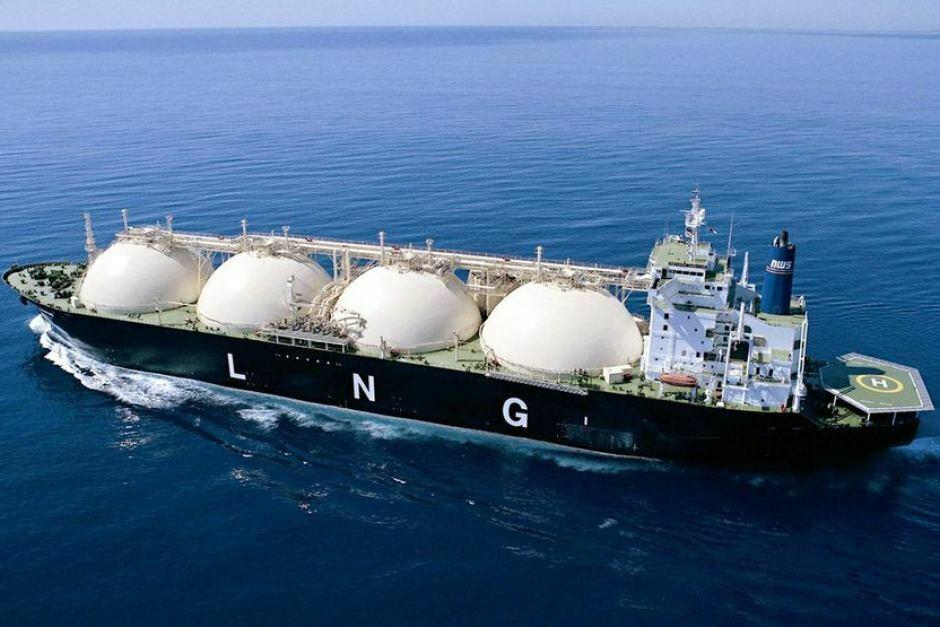
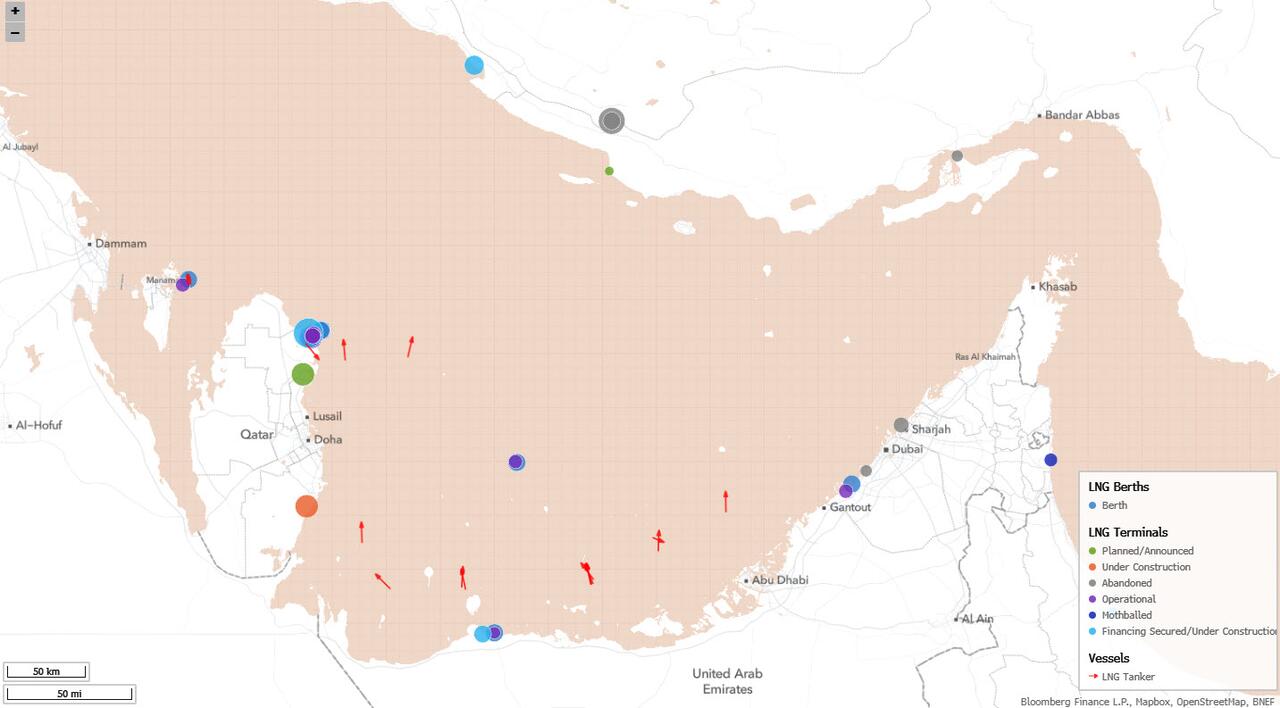
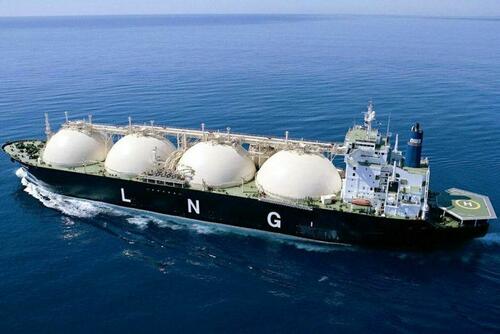
According to the WSJ, at least 20 LNG carriers a bout half the available global fleet – are trapped in the Persian Gulf, with daily freight costs soaring as demand from Asia surges, according to ship brokers. Bloomberg lists the known LNG tankers which are currently transmitting their positions as follows:
Al Rayyan
Al Kharaitiyat
Umm Al Amad
Lebrethah
Gaslog Skagen
Sohar Lng
Disha
Al Daayen
Mubaraz
Al Sahla
Rasheeda
Patris
Seapeak Bahrain
Fuwairit
Mihzem
Mraikh
Al Ghashamiya
Most are located just off the UAE coastline:
“The situation is dire and will have a lasting impact on the market, regardless of how quickly the conflict ends,” Kostas Karathanos, the chief operating officer of Athens-based Gaslog, which operates 34 gas carriers, told The Wall Street Journal.
Some 20% of global LNG exports come from Gulf countries. At the moment, however, only a handful of ships can get through the Strait of Hormuz, and production facilities like those operated by QatarEnergy have been attacked and have stopped production.
Ship brokers said the 20 ships trapped in the Persian Gulf make up nearly half of all LNG ships currently available for charter, with daily rates rising to more than $200,000 from less than $98,000 before the start of the Iran hostilities.
Energy traders expect LNG prices to rise by early next week, adding to this week’s 40% rise in Asia and Europe. “The effect on LNG shipping will outlast the conflict for a few months,” Karathanos said.
Amid the scramble to procure LNG, more shipments bound for Europe are diverting to Asia. At least nine cargoes initially headed to Europe have changed course to Asia since the start of the fighting, according to ship-tracking data compiled by Bloomberg, with the trend accelerating in recent days. A buffer of spare supply is quickly drying up, threatening more competition and higher prices for both regions.
Adding to the turmoil, LNG suppliers, including Shell Plc, are declaring force majeure for customers across Asia due to halted flows from the Middle East, according to people with knowledge of the matter. This illustrates a growing ripple effect throughout the global gas market.
With virtually no available tankers to transport cargoes, Asian buyers of LNG are preparing for the war in the Middle East to disrupt deliveries for months, Bloomberg reports.
Companies in Thailand are looking to buy LNG cargoes for delivery through May, according to traders with knowledge of the matter. Bangladesh bought shipments for April, and is considering procuring fuel for May onward as well, the traders said. Major buyers in Taiwan and South Korea are also preparing to purchase more supply for those two months.
The moves demonstrate that Asia’s importers aren’t relying on a swift resolution to the US-Israeli war against Iran, and that the outage in Qatar, which supplies 20% of the world’s LNG. is expected to be prolonged. The longer the plant is shuttered, the worse the supply shock as there’s no alternative route to export the fuel, nor spare capacity elsewhere to cover the lost output.
Companies need to make contingency plans to prepare for a 2 to 4 months disruption, Dai Jiaquan, chief economist at CNPC Economics and Technology Research Institute, said at a BloombergNEF Summit in Beijing on Thursday.
Qatar shut the Ras Laffan export facility last week after an Iranian drone strike, upending the market and sending the price of gas in Europe and Asia soaring. A number of companies, including Shell Plc, have declared force majeure on their shipments of Qatari LNG to customers in Asia.
At least nine LNG shipments bound for Europe have rerouted to Asia since the fighting began, according to ship-tracking data compiled by Bloomberg, after Asian buyers offered higher rates than their rivals in Europe.
Meanwhile, Taiwan – which desperately needs LNG for conversion into helium, a critical component to to make Taiwan Semi’s chips – has started securing alternative LNG for May, cabinet spokesperson Michelle Lee said at a briefing in Taipei on Thursday. The island has fully secured supply for March and April, Lee added.
India, which sources about half its LNG from Qatar, has been scrambling to procure alternative shipments for immediate delivery, traders said. Gail India Ltd. was able to book an LNG cargo for March on Tuesday after a few failed attempts, while others are still looking, they said.
Tyler Durden
Thu, 03/12/2026 – 10:20

“Please, Please, Please”: Denmark’s Energy Minister Begs Citizens To Stop Driving As Global Energy Shock Spreads
“Please, Please, Please”: Denmark’s Energy Minister Begs Citizens To Stop Driving As Global Energy Shock Spreads
Iran launched another round of overnight strikes on tankers and Gulf energy infrastructure, sending Brent crude back above $101/bbl and sparking fears that chaos in the Middle East has triggered what the IEA warned could be the largest-ever supply disruption in the history of the global oil market.
“The war in the Middle East is creating the largest supply disruption in the history of the global oil market,” the IEA said on Wednesday.
With the record release of SPRs by IEA members announced on Wednesday, failing to halt Brent from re-entering triple-digit territory, Denmark’s energy minister issued a dire warning to citizens across the Scandinavian country, urging them to immediately conserve fuel and electricity.
“What the Danes should please, please, please do is, if there is any energy consumption that you can do without—if it is not strictly necessary to drive the car—then don’t do it,” Lars Aagaard, Denmark’s minister for climate, energy, and utilities, told local broadcaster DR in an interview earlier today, quoted by CNBC.
Aagaard said energy shock has driven the country to rely on its oil reserves amid “towering oil prices,” with no end to the conflict in sight.
We detailed the overnight chaos across the Gulf region in our geopolitical wrap titled, “Sixth Ship Struck: Oil Tops $100 As Tanker Attacks Escalate Hours After Trump’s ‘We Won.'”
“Firstly, it can be felt in the private wallet, and secondly, it can help stretch our reserves so that they last longer,” Aagaard said.
Related:
These EM Countries Face Greatest Risk If Energy Shock Spreads
Energy conservation warnings have also emerged in the U.K., Vietnam, and the Philippines as governments and industry groups try to curb fuel demand and protect domestic reserves to weather the energy crisis.
Tyler Durden
Thu, 03/12/2026 – 10:00

Eat The Rich: Sanders And Khanna Introduce Federal Billionaires Tax
Eat The Rich: Sanders And Khanna Introduce Federal Billionaires Tax
“Enough is enough.” With those words, Senator Bernie Sanders (I., Vt) launched a push to impose a 5% annual wealth tax on America’s billionaires. With Rep. Ro Khanna (D., Cal.), the legislation, “Make Billionaires Pay Their Fair Share Act,” echoes the growing “eat-the-rich” mantra on the left — seeking to replicate a disastrous push in California that has led to an exodus from that state and an estimated loss of $2 trillion in taxable assets.
It is also flagrantly unconstitutional.
Under the plan, Congress would target 938 billionaires to tap them for $4.4 trillion. That money would then be redistributed as a $3,000 direct payment to every man, woman, and child in a household making $150,000 or less – $12,000 for a family of four.
The timing of the move is telling. Not only is it calculated before the midterm elections, in which the Democrats hope to retake power, but it follows the push by California Democrats and unions to impose a similar wealth tax in that state.
Khanna, who represents Silicon Valley, has supported the state law, which includes a ruinous provision for startup entrepreneurs. The law would not only be retroactive to try to trap wealthy taxpayers who have fled the state, but also base wealth calculations on the voting shares of corporate executives. Often, with start-ups, entrepreneurs hold greater voting shares than actual ownership. However, just in case they need more incentive to leave the state, they will be taxed as if their voting shares represented actual wealth.
The practical problem is that the wealthy, like their wealth, are mobile. As a result, many are fleeing California. So now Khanna is joining with the nation’s leading Democratic Socialists to ensure there is nowhere to hide in the United States. For billionaires in California, they could be double-tapped for ten percent of their wealth.
It has long been the dream of the far left. Years ago, Sen. Elizabeth Warren delighted Democratic voters in her run for the presidency by telling the rich she was coming after “your Rembrandts, your stock portfolio, your diamonds and your yachts.” In one debate, she dramatically rubbed her hands together after saying she would take some of the wealth of fellow candidate John Delaney, a self-made millionaire.
In my book, “Rage and the Republic: The Unfinished Story of the American Revolution,” I discuss the growing threat of “economic factionalism” as politicians fuel rage against the wealthy based on the false premise that they are not “paying their fair share.” While there are good-faith arguments for adjusting tax burdens to address budget demands, the top 1 percent pays more taxes than the bottom 90 percent combined.
There is little reason to believe that a wealth tax targeting billionaires will not, if upheld, be later extended to lower tax brackets, starting with multimillionaires. That is the signature of economic factionalism, which feeds an insatiable appetite for greater wealth seizure.
The Sanders-Khanna plan is notable in its express commitment to direct wealth redistribution. It also explains why the left has made the packing of the Supreme Court a priority. As Harvard professor Michael Klarman explained years ago, the radical agenda to change the system to guarantee Republicans “will never win another election” requires control of the Supreme Court to uphold such measures.
The problem is that the Constitution bars the implementation of such a federal wealth tax. When the 16th Amendment was ratified, it allowed for federal income taxes, and only income taxes: “The Congress shall have power to lay and collect taxes on incomes, from whatever source derived, without apportionment among the several States, and without regard to any census or enumeration.”
The effort to expand federal taxation beyond income taxes will require either a constitutional amendment or an enabling, packed Court.
Nevertheless, these politicians will continue to dangle wealth distribution before voters. They will demonize figures like Mark Zuckerberg and Elon Musk for their wealth while ignoring that these same figures are wealth and job creators, driving our economic growth. Instead, Sanders declared that “Billionaires cannot have it all.”
The irony of Rep. Khanna (who has been floating a run for President in 2028) turning on his own constituents in Silicon Valley underscores the appeal of wealth-redistribution campaigns. He is turning the very heart of his state’s economic growth as state deficits and out-of-state migration increase.
For Sanders, the legislation is a key moment to advance his long-standing socialist agenda. He declared the beginning of the end of “unprecedented income and wealth inequality” in the United States through such redistribution. The stated objective of erasing wealth inequality highlights how this is just the start and the end of wealth taxation.
As discussed in Rage and the Republic, none of this is new. Countries like France previously targeted the wealthy, triggering an exodus of taxpayers and their businesses from the country. It had to reverse its policy as the economy collapsed.
Of course, many young people have no memory of such failures in the 20th Century. Instead, they are drawn to the very same soundbites used in France and Great Britain before disastrous experiments with socialism. With no experience with socialist economies, figures like socialist mayor Zohran Mamdani can entice voters to “the warmth of collectivism.”
There are legitimate concerns over the glaring and growing wealth gap in the United States. However, a wealth tax is neither a constitutional nor a practical way of addressing the problem.
Jonathan Turley is a law professor and the author of the New York Times bestselling “Rage and the Republic: The Unfinished Story of the American Revolution.”
Tyler Durden
Thu, 03/12/2026 – 09:40

Fresh US Intel Assessment Says Iran Regime Not Close To Collapse After 2 Weeks At War
Fresh US Intel Assessment Says Iran Regime Not Close To Collapse After 2 Weeks At War
A fresh report in Reuters says what should already be quite obvious to all: US intelligence has assessed that Iran’s leadership and government are largely in tact and the system does not risk collapse, after two weeks of heavy sustained US-Israeli bombardment and ‘decapitation’ strikes which have killed Ayatollah Ali Khamenei and over forty top military leaders.
One of the intel sources was cited as saying that “multitude” of intelligence reports provide “consistent analysis that the regime is not in danger” of collapsing and “retains control of the Iranian public”.
West Asia News Agency via Reuters
The source in the Wednesday-issued Reuters report indicated the most recent US intelligence was only completed within a few days prior. This week President Trump has also been busy declaring that the war could end “soon” and that “we won”.
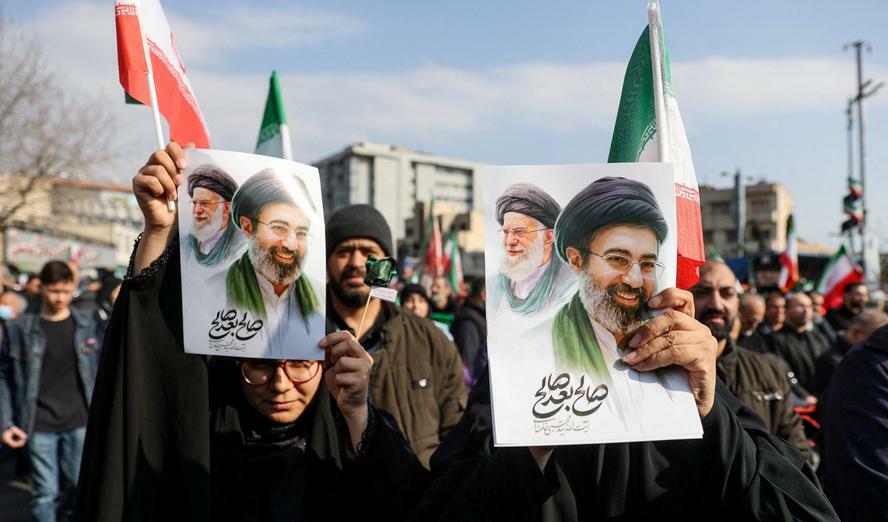
And yet, the intelligence assessments indicates Iran’s clerical leadership has remained cohesive, now rallying around the late supreme leader’s successor – his son Mojtaba Khamenei, who is said to be more hardline. Other sources suggest that it is the elite Islamic Revolutionary Guard Corps (IRGC) effectively running the country and executing the war. Indeed Israel and Gulf states continue to get pummeled in retaliatory missile and drone waves. Of course, Tehran itself is enduring heavy destruction, also as the US-Israeli strikes go after civic infrastructure.
Reuters adds: “Israeli officials in closed discussions also have acknowledged there is no certainty the war will lead to the clerical government’s collapse” – based also on the perspective of a senior Israeli official.
We might point out that any serious analyst would have assessed this before the strikes had even started, and indeed there’s some evidence that the Chairman of the Joint Chiefs of Sstaff tried to warn just this before Trump ordered the operation.
As one pundit has pointed out: “Endurance regimes do not need clean victory to change the game. They only need to survive the shock while making the old equilibrium too costly for their adversaries to restore.” So ‘winning’ for Iran looks much different, compared to US objectives.
Journalist Jeremy Scahill, who starting over two decades ago covered the lead-up to the Iraq war from on the ground in Baghdad, has reiterated that “In asymmetric warfare, the less powerful side does not need to militarily defeat an adversary, but rather force it to a point where it determines the costs of continuing the war is too high.”
“When past presidents balked at the possibility of war with Iran, they weren’t just dodging a hard choice; they were deterred by all the obvious reasons a conflict could perilously spiral. Nobody should be shocked that the expected is now coming to pass” https://t.co/diHQNCGKvB
— Jonathan Lemire (@JonLemire) March 11, 2026
Concerning Trump’s Operation Epic Fury, there does appear to be a concerted effort to collapse the system, though pretty much all war analysts are in agreement that doing this in a purely air campaign is next to impossible.
Striking directly at the banking system could be part of these efforts, as a Wednesday regional report indicates:
The data center of Iran’s state-run Bank Sepah was hit by a strike in Tehran on Wednesday, The Jerusalem Post learned.
The disruption at the bank, which is largely responsible for paying the salaries of Iran’s military and the Islamic Revolutionary Guard Corps, is expected to prevent it from paying salaries for a period, forcing it to find alternative solutions.
Reports suggest that a vital data center crucial in carrying out payments to some up to 190,000 IRGC members was impacted, though we might also presume there’s redundancy to the data and other systems capable of carrying this out. But the thinking might be that if the troops can’t get paid, and their families can’t survive, this would immediately weaken the country’s ability to defend itself.
Tyler Durden
Thu, 03/12/2026 – 09:20

Epstein Guard Called To Testify As Oversight Committee Explores Potential Murder
Epstein Guard Called To Testify As Oversight Committee Explores Potential Murder
Authored by Steve Watson via Modernity.news,
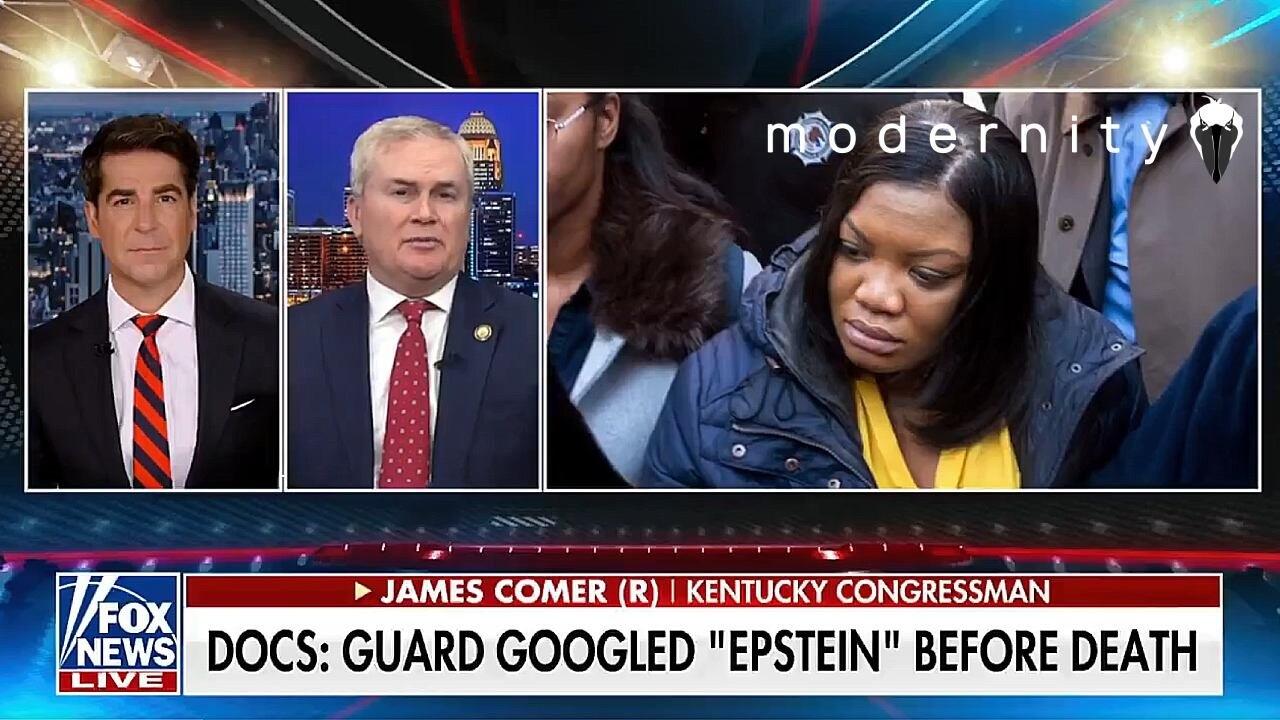
House Oversight Chairman James Comer is ramping up the heat on the botched handling of Jeffrey Epstein’s custody, announcing a subpoena for prison guard Tova Noel amid bombshell revelations of suspicious cash deposits and online searches just before the disgraced elitist’s alleged suicide.
With fresh DOJ documents unearthing red flags that scream cover-up, Comer’s move signals a long-overdue push for transparency against the bureaucratic stonewalling that has shielded powerful figures tied to Epstein’s web of abuse.
Comer dropped the news during a Fox News interview, pointing to media reports and overlooked Justice Department records that cast doubt on the official narrative of Epstein’s 2019 death at the Metropolitan Correctional Center.
Chairman Comer Calls for Epstein Prison Guard to Testify Under Oath
Lawmakers push for answers on long-standing questions surrounding Epstein’s death as investigators seek sworn testimony from the guard on duty #WashingtonEye pic.twitter.com/Lx7BIvRSXl
— Washington Eye (@washington_EY) March 11, 2026
“Well, the recent media reports, what you just said, are very concerning — especially the suspicious activity report on a $5,000 mysterious deposit that she had,” Comer told host Jesse Watters. “The reason that stands out to me, Jesse, is because very seldom are suspicious activity reports even reported for sums less than $10,000.”
“That’s a mystery there, and that’s something that, according to the DOJ documents, they never looked into — never asked her about,” he continued.
Comer emphasized broader questions lingering over Epstein’s case: “Because of this, because of the media reports, and because of the fact that, honestly, most people on the committee aren’t confident 100% that Epstein’s death was a suicide, we’re going to ask Ms. Noel to come in for a transcribed interview.”
“Again, no one’s accusing her of any wrongdoing, but we have a lot of questions about Epstein — questions about who else was involved in abusing girls,” Comer added. “Why did the government not do a better job of investigating and prosecuting Epstein when they had a chance years before they finally convicted him? Was Epstein a spy? Was our government involved in any way, shape, or form in trying to destroy evidence or hide evidence from any of those four properties?”
“Now, was Epstein’s death a suicide, as the government has reported, or was there something else?” he questioned. “Again, no one’s accusing this prison guard of any wrongdoing, but I will announce tonight on your show that we are going to ask her to come in and sit for an interview because we have a lot of questions.”
The subpoena targets Noel, who was on duty the night Epstein died. DOJ records show she googled “latest on Epstein in jail” at 5:42 a.m. and 5:52 a.m., just 40 minutes before her colleague discovered the body at 6:30 a.m.
Instead of conducting required checks, Noel admitted to napping and online shopping, while falsifying logs—a lapse that earned her a deferred prosecution deal from an Obama-era judge in 2021.
FBI forensics flagged her search as the only notable one in a 66-page review of the guards’ computers. Noel denied remembering the searches, calling records “inaccurate.”
Chase Bank flagged suspicious deposits into Noel’s account, including $5,000 on July 30, 2019—ten days before Epstein’s death. From December 2018, seven deposits totaled $11,880, coinciding with her assignment to Epstein’s unit. Yet DOJ investigators never questioned her about it.
An FBI briefing identified Noel as an “orange flash” on camera approaching Epstein’s cell at 10:40 p.m. the night before, carrying linens or clothing—the last approach to the tier. She denied it.
Noel now faces a lawsuit for alleged assault at her new job as a medical assistant.
The guard’s actions fueled a heated exchange between journalist Michael Shellenberger and Joe Rogan during his latest podcast episode.
This development echoes ongoing scrutiny of Epstein’s death. DOJ documents labeled his death a “MURDER” in one instance, showed it documented a day early, and highlighted the wrong noose being DNA-tested.
As one X user noted in response to those revelations: “Epstein is alive. He was extracted, likely by our own government.”
Another pointed to a bipartisan cover-up: “The evidence points to a cover-up: Trump’s first AG Bill Barr oversaw the initial Epstein “suicide” ruling amid massive irregularities, Biden’s DOJ continued the stonewalling, and now Trump’s team is doing the same. Epstein was likely a protected CIA/elite asset—too many powerful world leaders, billionaires & influencers were involved in his crimes. The government decided to bury it all to avoid total exposure & chaos.”
A third captured public frustration: “The richest people in the world did horrible things to thousands of kids, Epstein was clearly and obviously either removed or murdered, Your government refuses to do anything about it while bragging about how awesome they are every day. That’s where we’re at.”
There is also a record of Epstein claiming his cellmate tried to murder him weeks before his suspicious death. Prison notes revealed: “Denies suicidal. Does not know what happened. Woke up with marks on neck. Cellmate tried to kill him. Cellmate is cop who killed 4 people. Tried to extort him. Threatened him.”
A prison psychologist recorded: “I have spoken with him. He denies suicidality. He says he doesn’t know what happened. He thinks maybe someone tried to kill him.”
Epstein claimed his cellmate, Nicholas Tartaglione, said “he would beat him up” if unpaid. Tartaglione, a ex-cop accused of four murders, was cleared internally.
Your support is crucial in helping us defeat mass censorship. Please consider donating via Locals or check out our unique merch. Follow us on X @ModernityNews.
Tyler Durden
Thu, 03/12/2026 – 09:00
US Housing Starts Highest In Over A Year As Mortgage Rates Tumbled In January
US Housing Starts Highest In Over A Year As Mortgage Rates Tumbled In January
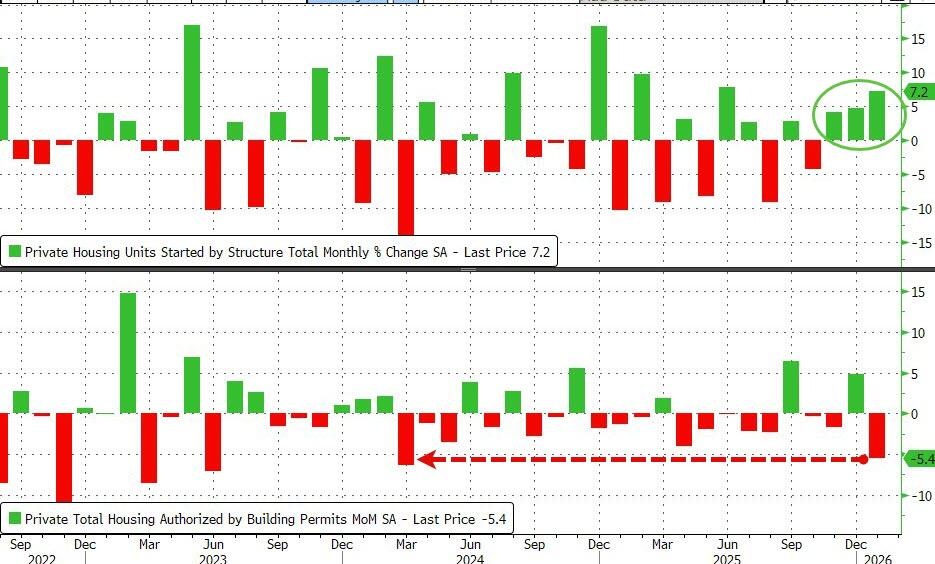
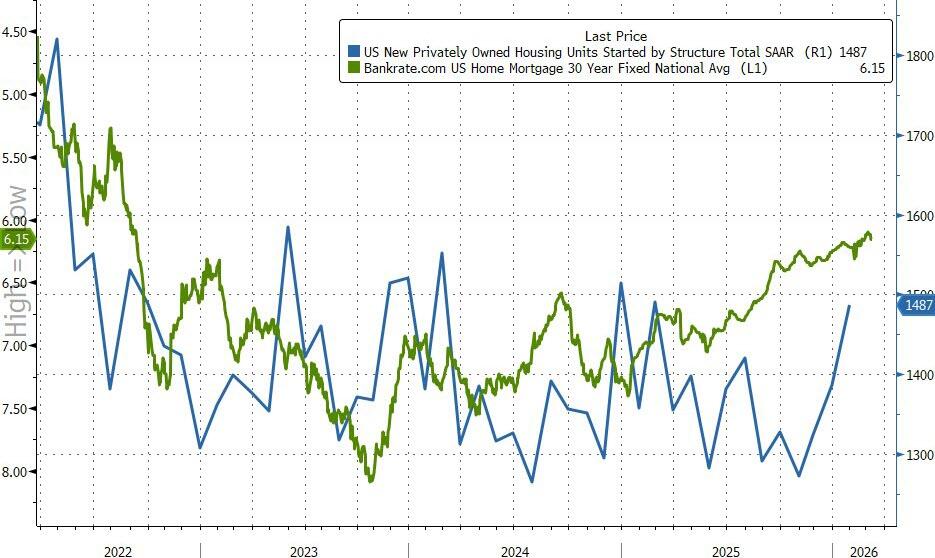
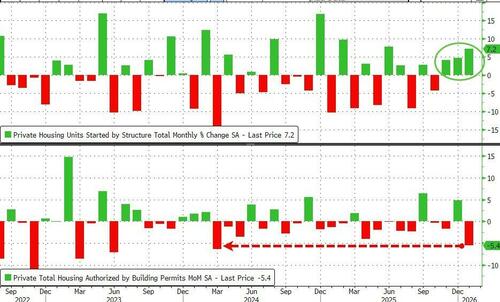
With mortgage rates tumbling (before the war started) and a top-down push for affordability, Housing Starts printed better than expected for January while the more forward-looking Building Permits disappointed, falling more than expected.
Starts rose 7.2k in preliminary January data (far greater than the 4.5% MoM decline expected while Permits plunged 5.4% MoM (worse than the 3.1% decline expected)…
Source: Bloomberg
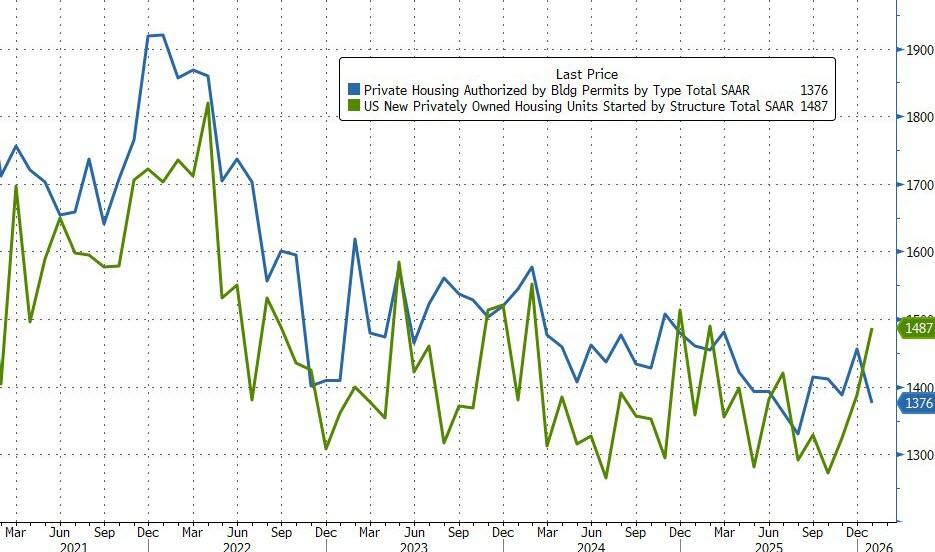
This pushed the SAAR totals for Starts to their highest since Dec 2024, but Building Permits fell to their lowest since Aug 2025…
Source: Bloomberg
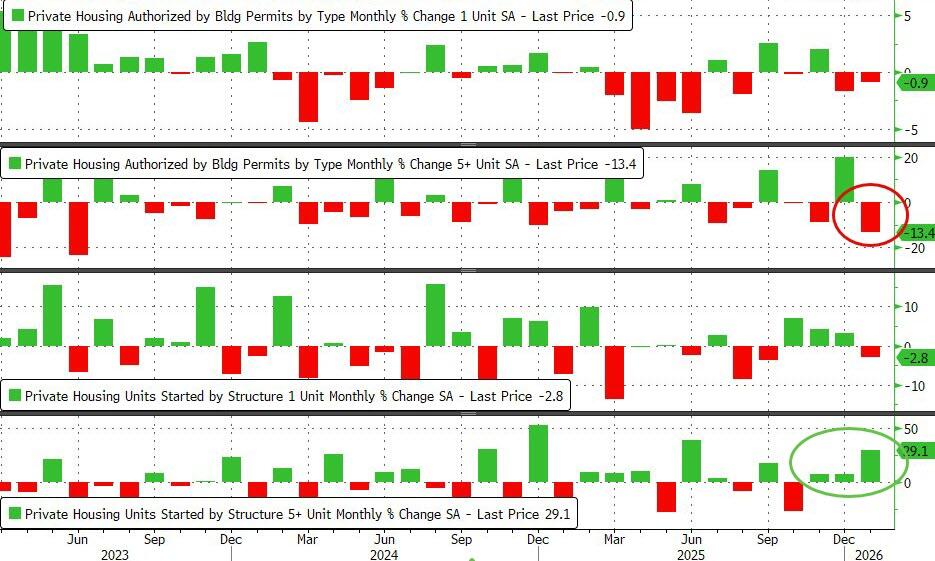
Under the hood, Multi-Family Permits plunged 13.5% MoM (biggest drop since June 2023) while Multi-Family Starts soared 29.1% MoM…
Source: Bloomberg
The lowest mortgage rate since Aug 2022 likely helped spark homebuilder appetite to start building…
A mixed bag overall, and tough to project given the impact of surging Treasury yields on the mortgage rates currently.
Tyler Durden
Thu, 03/12/2026 – 08:48