Category: News
EU and Australia Seal Trade Deal Amid Strategic Resource Concerns
EU and Australia Seal Trade Deal Amid Strategic Resource Concerns
Submitted by Thomas Kolbe
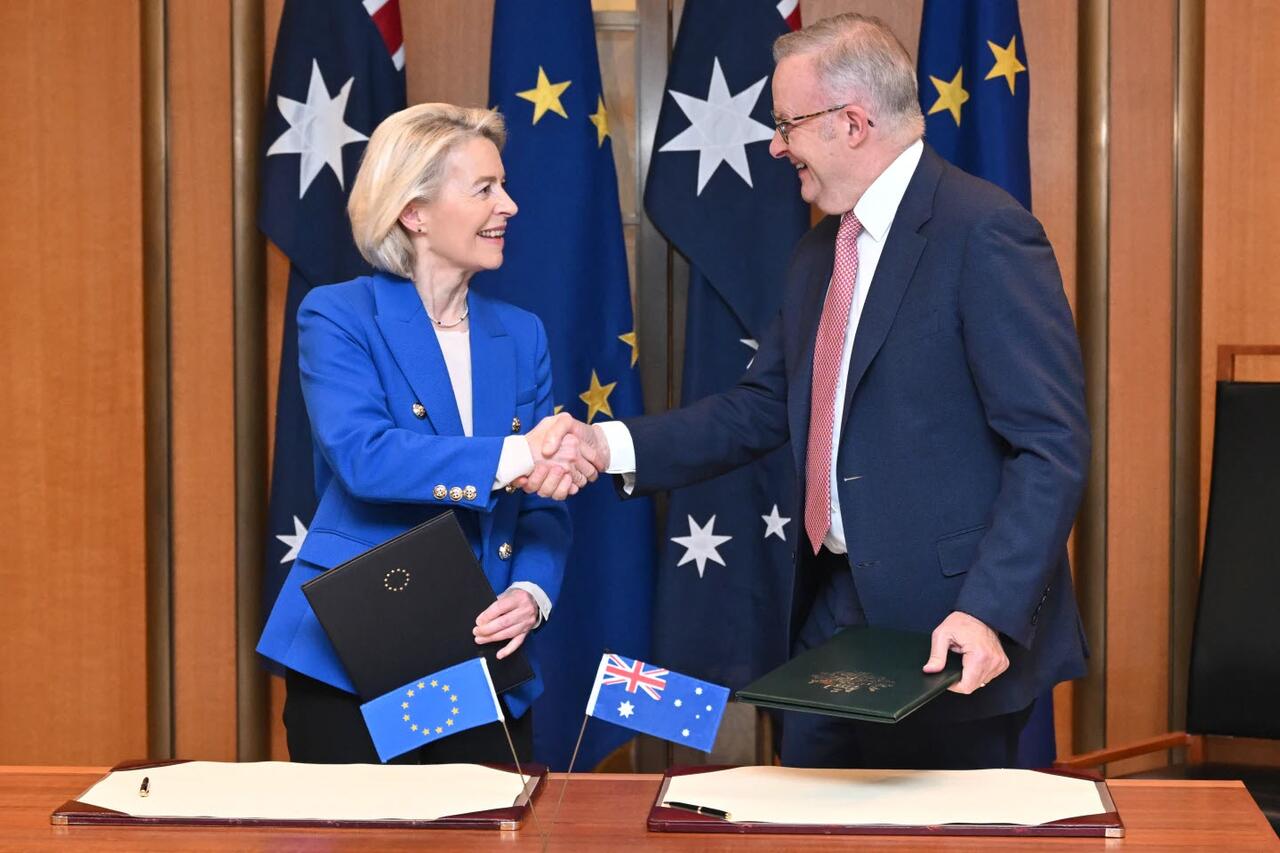
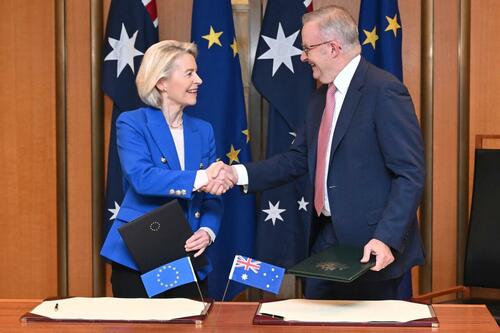
It took an astonishing eight years before the European Union and Australia were able, at the beginning of the week, to agree on a joint trade agreement. What EU Commission President Ursula von der Leyen and Australian Prime Minister Anthony Albanese presented in Australia’s capital Canberra represented a far-reaching reduction of direct tariffs over a medium-term period.
Over 90 percent of goods will be able to circulate freely between the two continents, of course always under the application of common harmonization regulations and, above all, European climate protection rules. This must be taken into account in every so-called free trade agreement. The regulations do not disappear for businesses. In the case of agreements with the EU, they are largely extended to the trading partners.
In every trade agreement where the European Union is a signatory, Brussels tries to weave massive climate protectionism into global trade. In a sense, a kind of postmodern climate colonialism. That is the concept of free trade as Europeans practice it.
The agreement to be signed is expected, according to participants, to increase EU exports to Australia by up to one third and expand investments by European companies in Australia by up to eighty percent. The strategic direction is clear: the EU is attempting to free itself in the critical area of raw materials, such as rare earths, from China’s grip. And Australia indeed has a rich catalogue of resources to offer.
Trade agreements like the one with Australia follow a very clear strategy. On one side, awareness seems to be growing of supply issues caused by the Iran war. On the other side, European industry is pushing to open new sales markets and strengthen the relative competitive position of companies, which have been under heavy pressure in Germany’s industrial heartland, especially during the energy crisis.
Clearly, Brussels is ready to combine gains in manufacturing with a corresponding reduction of protectionist rules in agriculture. This creates potential conflict, as seen with the EU’s Mercosur agreement with the South American countries Argentina, Uruguay, Paraguay, and Brazil in recent weeks.
The agreement, following a similar spirit to the one with Australia, is provisionally set to take effect in May. This occurs despite major political players such as France and Italy already announcing strong opposition to the pact, which will particularly place European farmers—and thus European agriculture—under severe competitive pressure, since South America follows a very different regulatory framework than the EU.
In the case of the Australian agreement, there was largely calm on this front; the Australian market is too small for the potentially imported volumes of beef, which are to be quota-shipped to Europe, to cause major concerns.
From the perspective of the German economy, the Australian trade contract can be roughly outlined as follows: while the crisis sectors of the automotive industry, mechanical engineering, and the chemical industry will benefit from a radical reduction of Australian import tariffs, the EU will gain access to rare earths, cobalt, and lithium mined in Australia and must accept that beef production will increasingly reach the European market.
Ultimately, Australia accounts for only around one percent of EU trade. The country ranks twentieth among the EU’s most important trading partners.
And yet, it is a small step toward freeing itself from China’s grip, which, as seen last year, does not hesitate for a moment to leverage its geopolitical tools in raw materials like rare earths, positioning its politically controlled export engine in trade policy.
Diversification is everything. Building reserves is all the more important, as we know today, given dwindling gas storage and missing petroleum reserves.
Strategic reserves are a political acknowledgment of reality. The fact that European policy once allowed itself the luxury of prioritizing climate ideology and transformational fantasies over real-world necessities now exacts a bitter price.
Trade competitors such as China or the United States hold reserves in fundamental areas of energy and raw materials that can secure the supply for the economy and society for more than a year. Acute crises, such as the current closure of the Strait of Hormuz, thus appear comparatively easier to manage and control.
Fundamentally, European trade policy must follow this path. It must clearly focus on the strategic interests of its own economy and overcome ideological missteps if it still wants to save what can be saved in the severe crisis of European industry.
Supply chains and the fundamental supply of raw materials and energy must be central topics on the European political agenda. Reintegration of Russia as a gas supplier, the development of domestic resources—whether fracking gas, North Sea gas, or domestic coal deposits—should buy time to develop a pan-European nuclear strategy, which would take many years.
As long as these considerations are not incorporated into a comprehensive overall strategy, the Australian trade agreement remains piecemeal—a small, hardly relevant move on the geopolitical chessboard, dominated by the Washington-Peking duopoly.
* * *
About the author: Thomas Kolbe, a German graduate economist, has worked for over 25 years as a journalist and media producer for clients from various industries and business associations. As a publicist, he focuses on economic processes and observes geopolitical events from the perspective of the capital markets. His publications follow a philosophy that focuses on the individual and their right to self-determination.
Tyler Durden
Wed, 03/25/2026 – 05:00
https://www.zerohedge.com/markets/eu-and-australia-seal-trade-deal-amid-strategic-resource-concerns

“Changed My Entire Life”: Top OnlyFans Creators Mourn Death Of Billionaire Founder
“Changed My Entire Life”: Top OnlyFans Creators Mourn Death Of Billionaire Founder
Top OnlyFans creator pornstar Sophie Rain, who has earned tens of millions of dollars on the adult content platform over the last several years, mourned the death of OnlyFans owner and billionaire Leonid Radvinsky on Monday.
Rain, one of the platform’s highest earners who has reportedly grossed over $100 million since 2023, thanked Radvinsky for changing her life.
“I don’t even know how to put this into words. That man built something that changed my entire life. Like, I grew up on food stamps and now I can take care of my whole family because of a platform he created. I will never forget that,” Rain told the New York Post in an exclusive interview.
Rain said, “Before OnlyFans, I was waitressing and barely making rent. That platform gave me everything. And that doesn’t happen without someone building it in the first place.”
She told the NY Post that she never met the billionaire, “but everything I have right now is because he built something that gave people like me a chance,” adding, “Sending so much love to his family. This is really, really sad.”
Piper Rockelle, another OnlyFans adult star, told the outlet, “I’ve only been on the platform since January, but it already changed everything for me. Like, I owe a lot to what that man built … I don’t really know what to say other than thank you for building something that gave people like me a shot. I wouldn’t be where I am right now without it.”
Radvinsky died of cancer at the early age of 43 on Monday, according to a statement from the company. His death raises new questions about the platform’s future ownership, especially since he reportedly placed his majority stake in a trust in 2024.
Tyler Durden
Wed, 03/25/2026 – 04:15
Being A Pedophile Now Not Enough To Warrant Deportation
Being A Pedophile Now Not Enough To Warrant Deportation
Authored by Steve Watson via Modernity.news,
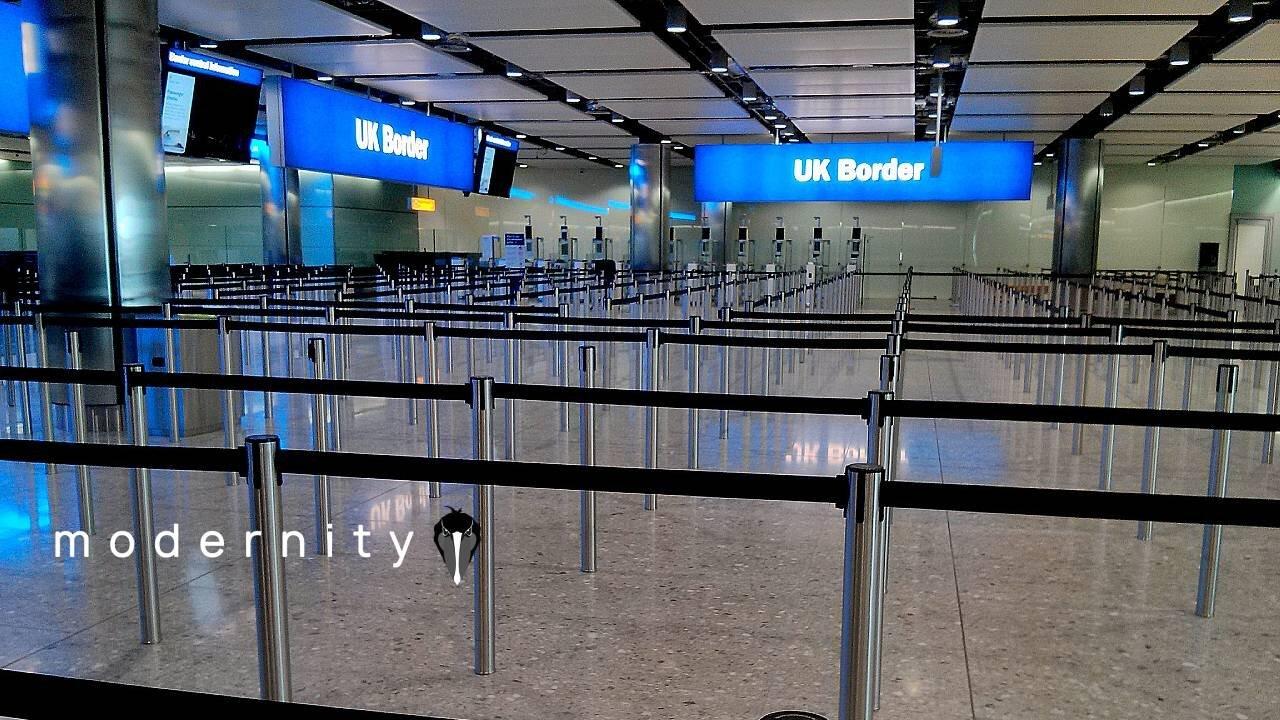
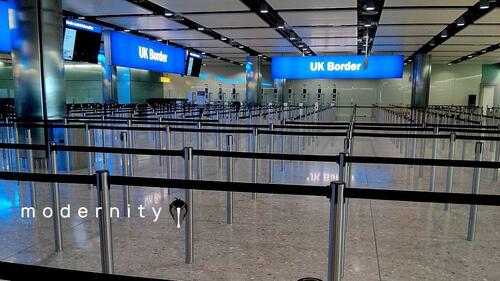
A convicted paedophile migrant who failed to disclose his child sex offence when applying to stay in Britain has won an appeal against deportation – because a judge ruled the omission was simply an “honest mistake.”
YES, REALLY.
Edi Cardoso Ramos, who was convicted in Portugal of molesting a five-year-old child, can now fight to remain in the UK after the Upper Tribunal accepted his explanation that he thought the immigration form only asked about UK convictions.
Paedophile migrant who failed to disclose child sex offence after coming to UK wins appeal against deportation as judge rules it was ‘honest mistake’ https://t.co/PQgn7qiayL
— Daily Mail (@DailyMail) March 23, 2026
This decision leaves British families wondering why foreign sex offenders keep getting second chances while the system fails to protect the public.
The Daily Mail reports that Ramos was convicted in 2014, when he was 19, of a serious sexual offence involving the molestation of a five-year-old child. He received a three-year suspended custodial sentence. He migrated to the UK in 2018. In 2020, when applying for leave to remain, he denied having any prior convictions on the form. He later claimed he misunderstood the question, thinking it asked only about convictions in the United Kingdom.
In 2024, Ramos was caught with a prostitute in his car and accepted a police caution for outraging public decency. A background check then revealed his 2014 conviction in Portugal, prompting the Home Office to start deportation proceedings. He appealed the decision.
Judge Paul Lodato of the Upper Tribunal of the Immigration and Asylum Chamber allowed the appeal. The judge stated: “Does (Ramos) represent a genuine, present and sufficiently serious threat to ‘a fundamental interest of society’? It was agreed that if I conclude that he does not, his appeal falls to be allowed.”
Molesting toddlers doesn’t represent a genuine threat, apparently.
The judge continued: “Having considered this issue very carefully, I am not satisfied, based on the evidence before me, that the (Home Office) has established that the threat (Ramos) represents is a present threat.”
On the non-disclosure, Judge Lodato ruled: “I accept (Ramos’s) explanation as being credible. I find that he made an honest mistake when he answered the question about his previous convictions and that his failure to disclose the material fact of his 2014 conviction in Portugal was not dishonest.”
He added: “I therefore do not consider (Ramos’s) non-disclosure of his 2014 conviction when he completed his 2020 leave to remain application indicates that (Ramos) is a present threat… (Ramos) is a genuine and sufficiently serious threat, but one that is not present.”
For these reasons, the appeal was allowed and Ramos can now fight deportation from a fresh hearing.
Social media erupted in fury at the ruling.
Same judge who says adult migrants are children… ?
This judge is an enemy of the British people. Get him out. pic.twitter.com/CqaZS1XNn9
— Emily Wilding Davison??????? (@Wommando) March 23, 2026
These so called judges are simply not fit for purpose. Crass decisions such as this just show that a mass clearout of the Judiciary is required.
— Dave (@DaveKent101) March 23, 2026
“oh, you forgot that you were a convicted sex criminal. Easily done. On your way”
?
— Tom Foster SDP ????????? Afuera! (@tompfoster) March 23, 2026
File this latest farce alongside a growing litany of ridiculous reasons sex criminals and other offenders have dodged deportation under the same broken system.
Albanian migrant Klevis Disha, who entered the UK illegally in 2001 under a false name and was later convicted for possessing £250,000 in dirty money, successfully fought deportation by claiming it would be unduly harsh on his 11-year-old British son – who apparently dislikes “foreign” chicken nuggets because of texture issues.
First-tier Tribunal Judge Linda Veloso accepted the Article 8 family-life argument. Reform UK’s Shadow Home Secretary Zia Yusuf said: “A criminal migrant who entered Britain illegally under a false name and lied in a failed asylum claim has successfully fought his deportation by arguing his son disliked foreign chicken nuggets. This is the country the Tories and Labour have created.”
A Somali criminal, schizophrenic and alcohol-dependent for nearly 20 years, was allowed to stay because deportation would cause him excessive “stress” and breach Article 3 of the European Convention on Human Rights by worsening his mental health. Deputy Upper Tribunal Judge Ian Jarvis ruled: “I conclude that the weight of the evidence before the Tribunal indicates that the [man] will very quickly become noncompliant with his medication… without the 24/7 support and monitoring which he currently receives in the United Kingdom.”
An insane Pakistani paedophile who reoffended by assaulting a teenage girl after release from prison for sex offences escaped deportation because his “uncontrollable” alcoholism would allegedly lead to “inhuman or degrading treatment” in Pakistan without proper treatment. He remains in Britain.
A separate Pakistani migrant arrived on a spousal visa and was convicted of attempting to cause children under 16 to engage in sexual acts after grooming decoy “barely pubescent girls” online while his wife was hospitalised with Covid. He won his appeal because deportation would be “unduly harsh” on his British children and family life.
Migrant shambles as unnamed judge lets paedophile we cannot name (to protect HIS privacy) stay in UK because pervert’s Pakistani family might disapprove of him lusting after ‘barely pubescent girls’ https://t.co/4by6HxEcZ6
— Daily Mail (@DailyMail) February 7, 2025
The judge even factored in the wife’s lack of intimate relations during her illness. Shadow justice secretary Robert Jenrick called the case “disgraceful,” adding: “The public are right to think that our immigration system is rigged in the interests of people who mean us harm, illegal migrants, against the interests of the British public.”
And as the Daily Mail also revealed, another migrant won asylum by claiming he was gay and fleeing persecution – only to be exposed with a secret wife and child back in Cameroon.
Revealed: Migrant granted asylum in Britain after claiming he was gay has a secret wife and child in Cameroon https://t.co/TMiC6wcoUI
— Daily Mail (@DailyMail) March 22, 2026
The pattern is undeniable. Activist judges, human rights laws that handcuff the Home Office, and a political class addicted to open borders keep handing victories to those who should never have been here in the first place.
Britain’s children and communities deserve better. The safety of the public must come first – not endless excuses for foreign criminals.
Your support is crucial in helping us defeat mass censorship. Please consider donating via Locals or check out our unique merch. Follow us on X @ModernityNews.
Tyler Durden
Wed, 03/25/2026 – 03:30
https://www.zerohedge.com/political/being-pedophile-now-not-enough-warrant-deportation

Israel Seeks To Disrupt Russian-Iranian Arms Transfer Route In The Caspian Sea
Israel Seeks To Disrupt Russian-Iranian Arms Transfer Route In The Caspian Sea
Russia and Iran have long had positive bilateral relations, which deepened in the context of the Ukraine war, and now in the midst of Trump’s Operation Epic Fury, where Moscow is said to be sharing vital intelligence and targeting information with Tehran.
Fresh reporting in The Wall Street Journal suggests that recent large-scale Israeli attacks in the Caspian Sea could mean flirting with WW3 and potential attacks on Russian interests and assets.
“An Israeli strike on a naval outpost in the Caspian Sea targeted Russia’s support for Iran in the war, hitting a supply line that the countries have used to move ammunition, drones and other weaponry, people familiar with the matter said,” WSJ writes late in the day Tuesday.
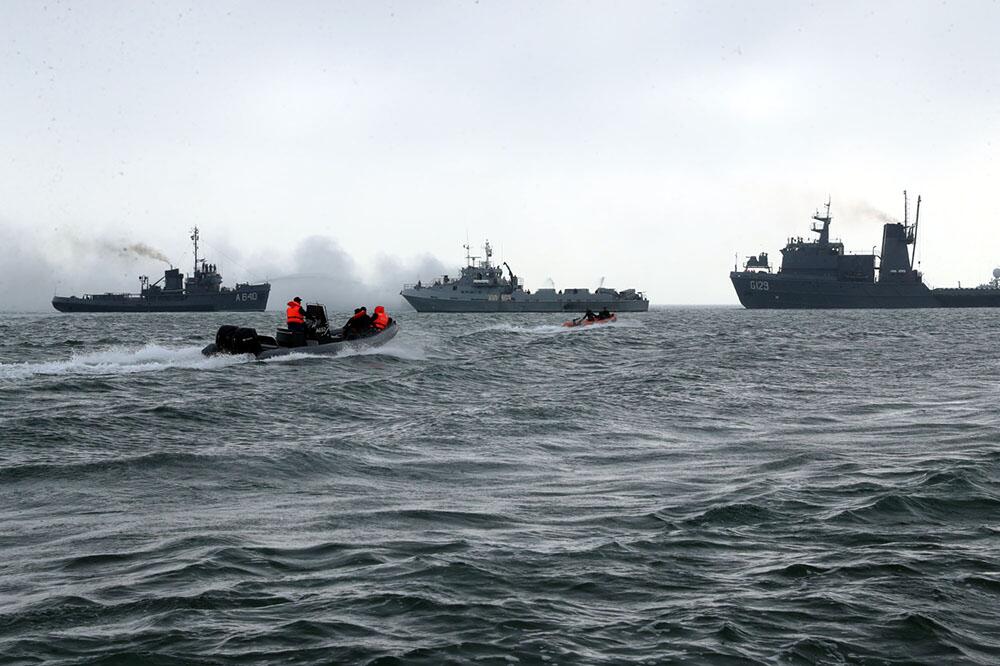
Illustrative: Prior Iranian Navy Caspian Sea drills
“Last week’s strike was Israel’s first ever on the world’s largest inland sea,” the report continues to point out. It was “Far beyond the reach of the U.S. Navy, the sea connects Russian and Iranian ports about 600 miles apart, giving the countries a place to freely swap weapons along with goods such as wheat and oil.”
While Western media has labeled this as a ‘smuggling route’ – Moscow would see this as more simply legitimate bilateral trade on defense and other items.
According to more details:
The route has become especially important for transferring Iran’s Shahed drones—now made in both countries—which Russia has used to bombard Ukrainian cities and Tehran has used to strike airports, energy facilities and U.S. bases across the Persian Gulf.
Cooperation between the two countries has expanded during the war, with Russia sharing satellite imagery and improved drone technology to help Iran attack U.S. assets and other targets across the Gulf, people familiar with the matter have said.
Again, that Iran and Russia exercise transfer of goods under their mutual economic and defense pacts should come as no surprise.
What should comes as a surprise is Israel’s willingness to brazenly poke the bear in its own backyard. Eliezer Marum, a former commander of the Israeli Navy, was quoted in the same report as saying: “The most important goal of this strike was to limit Russian smuggling and show the Iranians that they don’t have sea defenses in the Caspian.”
This is coming from Russia in response to Israeli jet fighters striking key Iranian Navy infrastructure in the Caspian Sea on March 18th. pic.twitter.com/HNfOUavrxF
— Noam Chomsky Quotes (Year 534) (@chomsky_quotes) March 24, 2026
Both Israel and the US have since touted that the whole of the Iranian Navy is basically destroyed and incapacitated, including its fleet in the Caspian Sea. Not much in the way of video, images, or ground-level confirmation have been forthcoming, other than what Israel’s military has shared. But it is probably safe to assume that Iran’s naval capabilities have indeed been greatly degraded.
Tyler Durden
Wed, 03/25/2026 – 02:45

What’s So Great About Diversity?
What’s So Great About Diversity?
Authored by DSr. James Allan via DailySceptic.org,
‘Diversity is our strength.’ One hears this, or myriad variants of the same idea, unrelentingly. Certainly I work in an Australian university where the extent of higher-ups pushing this notion does indeed qualify as unrelenting, even matching totalitarian state levels of propaganda. But even outside the hallowed halls of impartial, politically balanced academia (did I write that with a straight face?) the mantra or cliché that diversity somehow delivers a stronger balance sheet or a more cohesive society or just better outcomes is pervasive in today’s democracies that have committed themselves to multiculturalism and to the various neo-Marxist versions of feminism. Sure, those spouting these ‘diversity is a panacea’ nostrums never cash out the claim. They never tell us precisely how ‘diversity’ is making society better or wealthier or more unified. We are all just supposed to take it on faith, as it were.
We’re just to believe the bureaucratic, political and various professional bodies’ elites who push this line, and believe it simply because they are the ones telling us it’s so.
But you and I both know there isn’t a lot of evidence to support this cliché. Worse, if you’re like me you’re thinking that these are the same elites who massively failed us by imposing thuggish, illiberal lockdowns that weaponised the police, closed schools, infringed all sorts of free speech criticisms and also transferred huge wealth from poor to rich and from young to old (think asset inflation after steroidal money printing and unchecked government spending). You’re remembering these are the same elites who likewise failed us by not being willing to stand up to a transgender lunacy lobby that makes those with IQs over 130 unable to say what a woman is. The same elites, too, who failed us by abandoning all scepticism and critical thinking around our changing weather, willingly impoverishing us in the patent untruth that renewables are cheaper all-up. Like me you’re wondering what the odds are that these same people are likely to be right about anything. Hint: Not bloody high. And certainly not very high that they are right about some motherhood-type slogan meant to silence debate about large-scale immigration and about their efforts to take merit out of any and all hiring and ‘who gets into university’ decisions. This looks a lot like one of those Mark Twain situations of being quietly coerced to ‘believe what you know ain’t so’.
But let’s resist the temptation to mock this cliché that ‘diversity is our strength’ and consider it a bit more carefully. We all know, for instance, that a bit of genetic diversity in parents is better for the offspring of that match. All things considered we’d prefer to avoid siblings or even first cousins mating. Not for most people the inbreeding of some of the former European royal families, where disappearing chins was the norm. Yet the amount of genetic diversity needed to produce healthy kids is pretty tiny. Just anyone outside the immediate family will do. Same culture? Tick. Same commitment to Western civilisation? Tick. Same belief in free speech and the role of women? Tick again. Just don’t sleep with your sister. So if that’s what was meant by all the propaganda on behalf of the joys of diversity, I think we could all get on board. (Well, I hesitate to speak for Tasmanians, those hailing from Arkansas, or any readers from the Catlins south of Dunedin in New Zealand, but readers get the general point.)
On the other side of the equation we know that the best fighting units are often drawn from the same geographical area. Just look at how the British army used to recruit soldiers. Closer bonds mean a greater willingness to put your life on the line for someone else. Or ask yourself whether you believe hiring ‘in the name of diversity’ has lowered physical standards when it comes to combat troops, firefighters going in to rescue people in burning homes or cops on the beat. It sure seems to be the case that whenever physical strength is a core component of the job, advocates of hiring women start by promising that not a single standard will be lowered but we end up with – you guessed it – lower standards for women. Is that really a strength? Who do you want carrying you out of a burning house or getting into a fight on the street with the thug attacking you? (By the way, the biggest lie told by Hollywood in its movies is that some 55 kilo woman can beat up a 90 kilo robber or rapist. It’s a complete lie.)
It gets worse because the whole ‘diversity’ (often thrown in with ‘equity’ and ‘inclusion’) edifice is chock full of contradictions. We are sold the idea that proponents of diversity welcome everyone into their fold. It matters not what you bring to the table. But if you doubt the worth of diversity itself? You are out. Just look at the huge push for ‘diversity, equity and inclusion’ in universities. You know which people have disappeared from our universities? Conservatives. The people who are sceptical about this anti-merit, ‘equality of outcome’ worldview. They aren’t hired. Promotions are harder. The data on this are astounding. A recent report looking at the political donations and survey answers to academics’ political views reported that there was not a single Trump Republican academic working at Yale. Not one! And remember the Voice campaign here? We have some 38 law schools. There were four legal academics in the entire country who publicly opposed the Voice and myriad numbers in favour.
Diversity always and everywhere boils down to a diversity of skin pigmentation or type of reproductive organs, or other favoured inherited group characteristic. But it never, ever involves pushing for a diversity of political or worldview opinions. And if you are opposed to, say, any affirmative action type programmes for women, Aborigines, non-heterosexuals, anyone thinking he was born in the wrong body (an incoherent claim, by the way), well, you are not welcome. Full stop. And the facts in terms of who is employed and gets to the top show that to be blatantly true.
When some people now claim that working class white boys are the most discriminated-against group, that sure looks true to me if we’re talking about who gets special scholarships, who gets special support, who gets quiet, unspoken hiring help. Hint: Australian unis don’t have explicit quotas. Nope. Rather they look at a dean’s department, measure the percentage of favoured – only favoured – groups in society at large and then in the department, and then make the dean’s performance review’s success depend on getting a match. The incentives are brutal but indirect. And all of this existed and got worse under nine years of Coalition governments. It’s hard to claim with a straight face that the Libs ever fight for anything, take on any vested interests, or repeal any disliked statutes. Hence, mes amis, the rise of One Nation.
That is the truth of the matter. Diversity divas are divisive.
They shun and exclude non-believers in the name of the insipid faith they are proselytising.
Deep down they don’t believe in merit (save, ironically, their own because those imposing implicit quotas all, remarkably, believe that they themselves got there on merit).
This whole diversity (and equity and inclusion) mantra is a disaster.
Tyler Durden
Wed, 03/25/2026 – 02:00
https://www.zerohedge.com/political/whats-so-great-about-diversity

Islamic Symbol Erected On Mountain Overlooking Phoenix Destroyed
Islamic Symbol Erected On Mountain Overlooking Phoenix Destroyed
Religiously motivated vandalism that doesn’t involve an attack on a Christian church? It’s an incredibly rare occurrence in the US, despite the myths often spread by the progressive media. That said, it is likely to become far more frequent as clashes between the west and eastern ideologies continue to escalate.
Tempe police are investigating the destruction of a religious symbol placed on “A” Mountain (also known as Hayden Butte) for the Muslim holy month of Ramadan. Officers say a Muslim student group from Arizona State University working with a local Islamic center put a 15-foot tall crescent moon on the mountain to “shine a light” on the community of Phoenix. A similar temporary landmark was built back in 2003, but was not attempted again for 20 years.
When electrified at night, the sign could be seen for many miles across the Tempe/Phoenix desert.
Some residents initially complained on social media about the placement of the landmark on public land looming over the city, and described the large LED display as essentially “unavoidable”.
Per investigators, the display was knocked over and vandalized on March 17, causing $20,000 in damage. There is no description of any suspects. Tempe city officials say “there is no place in our community for this kind of hate.”
“People of all faiths are welcome in Tempe and they have the right to feel safe and be safe,” read a portion of their statement.
As noted, religiously motivated vandalism against Islamic centers and landmarks is rare in the US. There were less than a dozen incidents across the country in the the past year, compared to 415 hostile incidents against Christian churches. There have been 1384 attacks on churches since 2018. In Europe where Islamic immigration has overtaken most countries, vandalism and destruction of Christian churches occurs thousands of times per year and very few of these events are investigated by authorities.
The Phoenix area is home to around 110,000 Muslims with the population nearly doubling from 60,000 only ten years ago. Surveys show around 58% of all Muslims in the US are first generation immigrants.
The obvious conclusion is that recent geopolitical tensions with Iran have catalyzed a sense of suspicion among Americans when it comes to the Muslim ideology. However, the distaste for Islam was gestating well before the war started.
The political lefts co-option of the Gaza issue has not helped the Islamic cause in the west. Muslim leaders working closely with progressive politicians are seen to be exploiting misplaced liberal sensibilities as a tool for quiet conquest.
The public’s distrust is not unfounded. With clear fraud and the theft of public funds taking place among Muslim migrants in states like Wisconsin and California as well as the crippling criminal violence perpetrated by migrants in the EU and UK, there is little love for Islamic groups among native citizens.
It’s not surprising that people in Arizona don’t want what many see as a symbol of oppressing lighting up their night skyline. Perhaps the best option for Muslims in the US is to keep their religion quietly to themselves and avoid grand displays that could be interpreted as Islam “planting its flag” in America.
Tyler Durden
Tue, 03/24/2026 – 22:40
https://www.zerohedge.com/political/islamic-symbol-erected-mountain-overlooking-phoenix-destroyed

Islamic Symbol Erected On Mountain Overlooking Phoenix Destroyed
Islamic Symbol Erected On Mountain Overlooking Phoenix Destroyed
Religiously motivated vandalism that doesn’t involve an attack on a Christian church? It’s an incredibly rare occurrence in the US, despite the myths often spread by the progressive media. That said, it is likely to become far more frequent as clashes between the west and eastern ideologies continue to escalate.
Tempe police are investigating the destruction of a religious symbol placed on “A” Mountain (also known as Hayden Butte) for the Muslim holy month of Ramadan. Officers say a Muslim student group from Arizona State University working with a local Islamic center put a 15-foot tall crescent moon on the mountain to “shine a light” on the community of Phoenix. A similar temporary landmark was built back in 2003, but was not attempted again for 20 years.
When electrified at night, the sign could be seen for many miles across the Tempe/Phoenix desert.
Some residents initially complained on social media about the placement of the landmark on public land looming over the city, and described the large LED display as essentially “unavoidable”.
Per investigators, the display was knocked over and vandalized on March 17, causing $20,000 in damage. There is no description of any suspects. Tempe city officials say “there is no place in our community for this kind of hate.”
“People of all faiths are welcome in Tempe and they have the right to feel safe and be safe,” read a portion of their statement.
As noted, religiously motivated vandalism against Islamic centers and landmarks is rare in the US. There were less than a dozen incidents across the country in the the past year, compared to 415 hostile incidents against Christian churches. There have been 1384 attacks on churches since 2018. In Europe where Islamic immigration has overtaken most countries, vandalism and destruction of Christian churches occurs thousands of times per year and very few of these events are investigated by authorities.
The Phoenix area is home to around 110,000 Muslims with the population nearly doubling from 60,000 only ten years ago. Surveys show around 58% of all Muslims in the US are first generation immigrants.
The obvious conclusion is that recent geopolitical tensions with Iran have catalyzed a sense of suspicion among Americans when it comes to the Muslim ideology. However, the distaste for Islam was gestating well before the war started.
The political lefts co-option of the Gaza issue has not helped the Islamic cause in the west. Muslim leaders working closely with progressive politicians are seen to be exploiting misplaced liberal sensibilities as a tool for quiet conquest.
The public’s distrust is not unfounded. With clear fraud and the theft of public funds taking place among Muslim migrants in states like Wisconsin and California as well as the crippling criminal violence perpetrated by migrants in the EU and UK, there is little love for Islamic groups among native citizens.
It’s not surprising that people in Arizona don’t want what many see as a symbol of oppressing lighting up their night skyline. Perhaps the best option for Muslims in the US is to keep their religion quietly to themselves and avoid grand displays that could be interpreted as Islam “planting its flag” in America.
Tyler Durden
Tue, 03/24/2026 – 22:40
https://www.zerohedge.com/political/islamic-symbol-erected-mountain-overlooking-phoenix-destroyed
After The Epstein Files, It’s Become All But Impossible To Believe He Killed Himself
After The Epstein Files, It’s Become All But Impossible To Believe He Killed Himself
Authored by Tom Elliott via substack,
As soon as the feds announced Jeffrey Epstein killed himself while awaiting prosecution on charges of sex trafficking, the popular reaction was disbelief: “Jeffrey Epstein didn’t kill himself” quickly became an internet meme. And now, with the release of the Epstein Files, it’s only become harder — if not all but impossible — to believe the official story that Jeffrey Epstein hanged himself in the Manhattan Correctional Center on August 10, 2019.
The “Suicide”
The DoJ’s Inspector General released a report that officially concluded there was no reason to doubt the suicide story, but actually contains many disturbing details if you read the included evidence. As summarized by JustFacts:
Federal prison officials placed Epstein in a cell with a murderous, hulking ex-cop — a death trap for any child molester.
Less than two weeks later, prison guards found Epstein in the middle of the night in a semiconscious state with a rope and “friction marks” around his neck.
Despite a court order requiring the prison to preserve video surveillance footage near Epstein’s cell during the strangulation, federal prison officials failed to do so and also lost the backup due to “technical errors.”
Federal prison officials took Epstein off “suicide watch” just one day after the strangulation without determining whether Epstein was attacked by his cellmate or tried to commit suicide.
One day before Epstein’s death, federal prison officials removed his new cellmate and didn’t replace him. They did this even though a prison psychologist sent an email to over 70 prison staffers stating that Epstein “needs” a cellmate — a common suicide prevention measure.
One day before Epstein’s death, a federal court unsealed more than 2,000 pages of lawsuit records that named and implicated wealthy and powerful people in Epstein’s sex crimes, as well as federal officials in covering up the crimes.
One day before Epstein’s death, federal prison officials permitted Epstein to make a completely unmonitored phone call in direct violation of prison policy and under patently false pretenses.
Federal officers placed a hoard of linens in Epstein’s cell, which is commonly prohibited because they can be used to create nooses.
Federal officers left Epstein alone in his cell for nearly eight hours on the night he died — despite the fact that they were required to check on all inmates in his unit “at least twice per hour” and were only 15 feet from Epstein’s cell.
Federal officers falsified records to show that they had checked on Epstein, a violation of federal law punishable by up to five years in prison.
Federal prosecutors “dismissed all charges pending against” the two officers who falsified the records and “declined” to prosecute others who “falsely certified inmate countslips and round sheets on the day before and the day of Epstein’s death.”
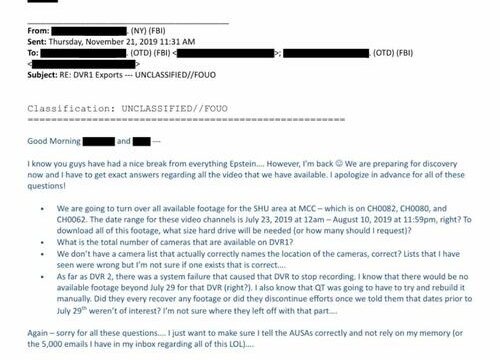
Federal prison officials failed to record footage from 9 of the 11 surveillance cameras around Epstein’s cell on the night of his death, including one that showed Epstein’s cell tier and cell door.
The FBI agents who searched Epstein’s New York mansion found and then abandoned a sexually explicit trove of photos and CDs labeled with the names of “young” females alongside people other than Epstein. This allowed one of Epstein’s most notorious accomplices to take the evidence and potentially scrub it before giving it to the feds.
To this day, the federal government hasn’t revealed the names of the people that were written beside the “young” females on Epstein’s CDs.
Hours before Epstein’s reported suicide, he made an unmonitored call to his girlfriend, Karyna Shuliak. She told friends Epstein gave no indication he was thinking of harming himself. The New York Times asked the Bureau of Prisons for his full call logs; “those logs show only one social call during his stay, more than a week earlier, to Shuliak.” In other words, the logs omitted this critical call. To date there is no knowledge of its contents, beyond Shuliak saying Epstein appeared to be in good spirits.
The Cameras
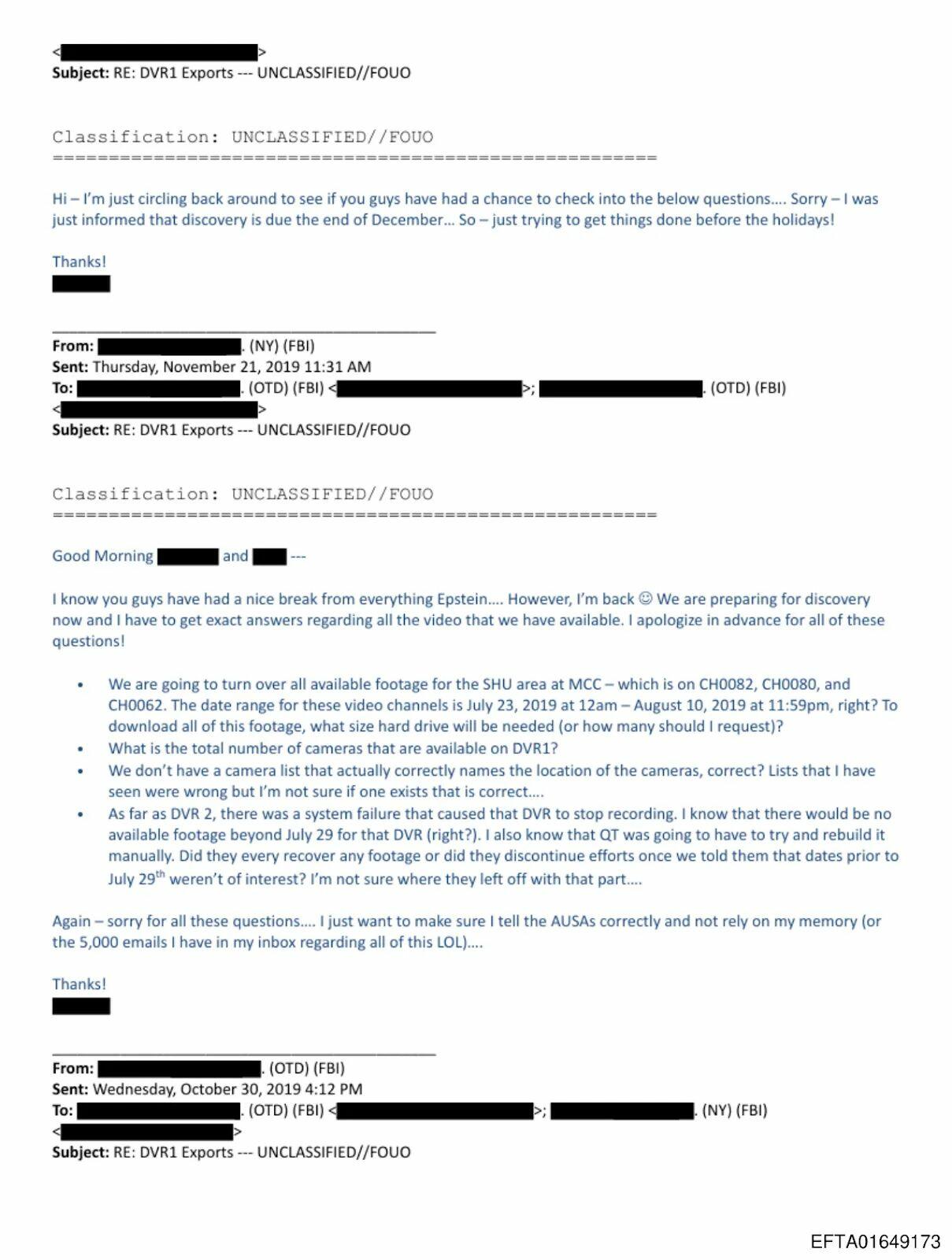
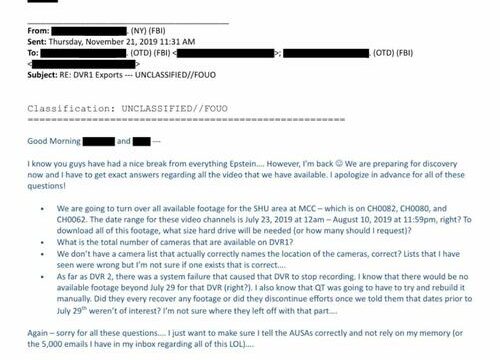
Due to a known issue with the prison’s DVR system — an issue jail officials were already aware of — only one security camera in the SHU unit was functioning. The feds said there exists no camera list correctly naming camera locations in the jail. The corrupted DVR drives were shipped to Quantico, where the FBI reportedly planned to attempt data recovery. However, according to an FBI letter, “they discontinue[d] those efforts once we told them dates prior to July 29th weren’t of interest.” This is itself strange, as pre-July 29th would have covered Epstein’s original reported strangulation.
According to the Inspector General’s report, both guards tasked with monitoring Epstein that night fell asleep during key hours, missing six of the six mandatory visual checks on Epstein. At other points during the night, as newly surfaced surveillance footage shows, the guards were actively walking around mere “steps away” from Epstein’s cell as he was reportedly preparing sheets to hang himself.
👀 Newly surfaced surveillance footage from the night of Jeffrey Epstein’s death … and it appears to show prison guards hanging out just steps away from his cell during the suspected timeframe he had taken his own life.
🎥 DOJ pic.twitter.com/BP6ksnChCi
— TMZ (@TMZ) March 21, 2026
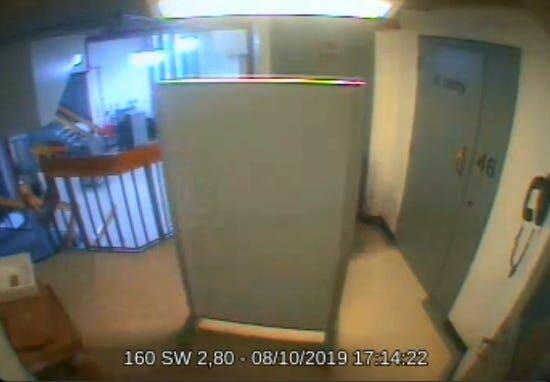
Many online researchers have noted that by using a technique to search Epstein files displaying the text “no images produced,” you’ll find files with a .pdf extension that, when renamed to .mp4, reveal video files. One interesting video is surveillance footage from the Manhattan Correctional Center from the night prior to Epstein’s “suicide.” It shows a large screen blocking the camera from the stairwell.
The Body Swap Theory
Why might blocking the stairwell camera be necessary? One possibility is to facilitate what a worker at the jail posted about on 4Chan: that the night before the “suicide,” the feds swapped Epstein out.
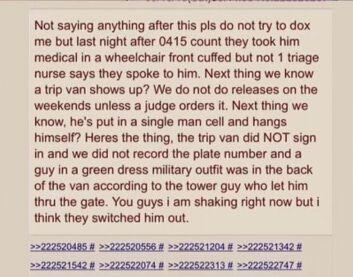
“Last night after 0415 count they took him medical in a wheelchair front cufed but not 1 triage nurse says they spoke to him. Next thing we know a trip van shows up? We do not release weekends unless a judge orders it. Next thing we know, he’s put in a single man cell and hangs himself? Here’s the thing, the trip van did NOT sign in and we did not record the plate number and a guy in a green military outfit was in the back of the van according to the tower guy who let him thru the gate. You guys I am shaking right now but I think they switched him out.”
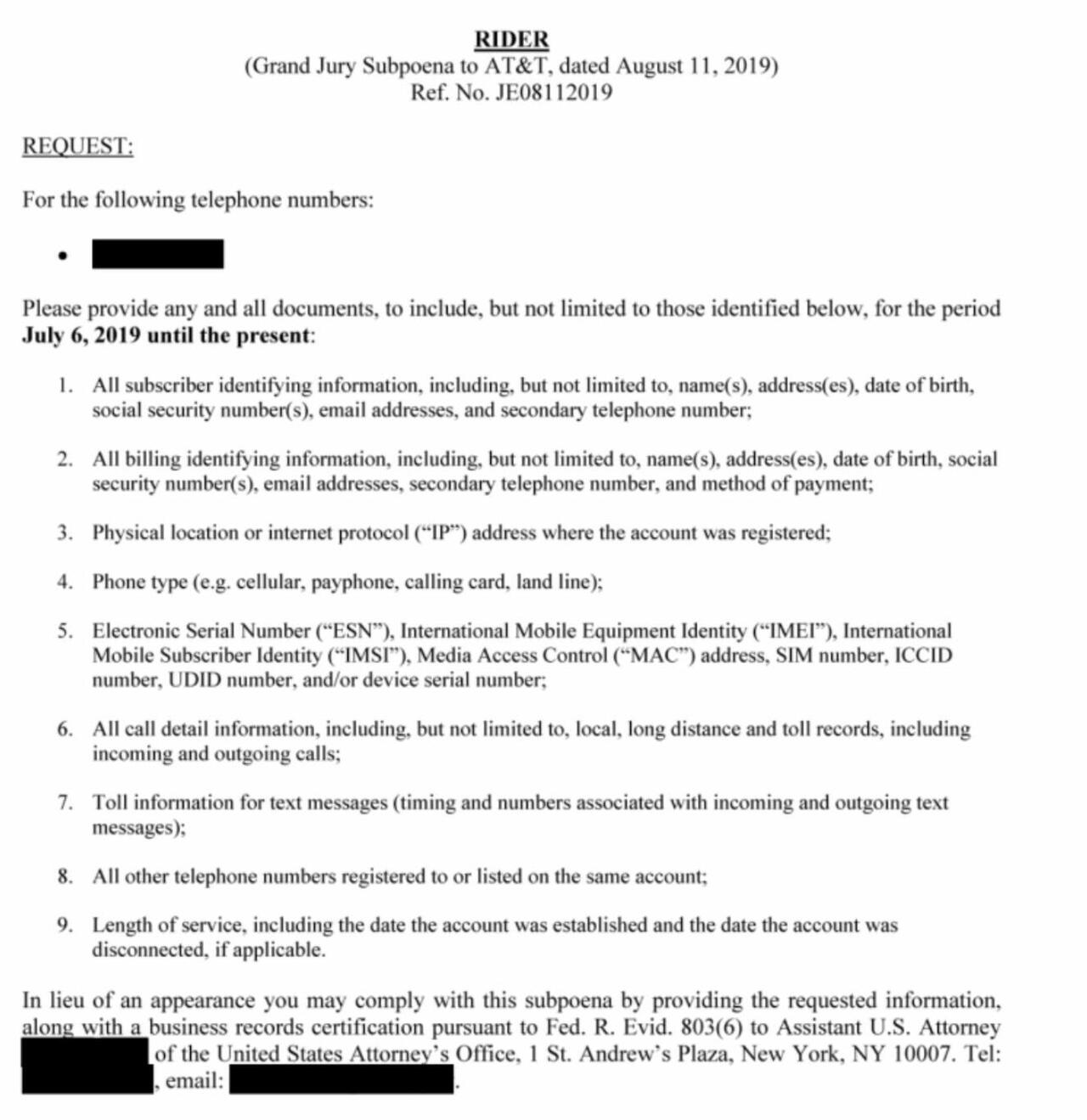
Within 24 hours, the feds subpoenaed Apple, AT&T, CitiBank, and 4Chan to investigate this poster’s identity and determined it was indeed a staffer at the jail. Consider the priorities this reveals: subpoenas issued within hours of an anonymous post, while the investigation into the most high-profile prisoner death in modern history was left to two guards who falsified records.
Multiple sources in the Epstein files note that at 10:39 PM on August 9, investigators reviewing jail surveillance footage flagged an orange-colored figure moving up a staircase toward the locked tier housing Epstein’s cell. The Inspector General said it could be someone carrying bedding; CBS reported independent analysts said it looked more like an inmate. Officials have repeatedly stated no one entered Epstein’s housing tier that night.
The Guards
The NY Post reported that one of the jail guards, Tova Noel, was googling “Latest Epstein jail” in the hours before his reputed death. Noel also “made a mysterious $5,000 cash deposit 10 days before the predator’s jail-cell suicide, new Department of Justice documents reveal.” Noel drove a $62,000 Range Rover — an extravagant luxury for a jail guard.
Noel was one of the two jail workers accused of faking records to say they checked on Epstein throughout the night of his “suicide.” She was fired, but the feds later dropped criminal charges.
Per the NY Post, “Noel googled ‘latest on Epstein in jail’ at 5:42 a.m. and then again at 5:52 a.m. — less than 40 minutes before her colleague, correctional officer Michael Thomas, found the disgraced financier dead in his jail cell.” Noel later denied to the feds that she had googled Epstein — a claim her internet history would disprove. Despite the DoJ knowing she was actively checking for updates on Epstein throughout that night, the IG report downplays this, merely stating she read an article about Epstein:
“OIG analysis of the activity on the SHU computers revealed that Noel used the computer periodically throughout the night, including to search the Internet for furniture sales and benefit websites and to read a news article about Epstein. Thomas used the computer briefly around 1 a.m. and 6 a.m. to search for motorcycle sales and sports news.”
Noel reported that faking records at the Manhattan Correctional Center was just the way things operated there.
The files only contain Noel’s bank records beginning in December 2018. They show seven cash deposits totaling $11,880. Noel started working at the Special Housing Unit — where Epstein had been held — beginning on July 7, 2019, just weeks before his death.
Noel, who drove a $62,000 2019 Land Rover Range Rover, wasn’t asked about the cash during her DOJ interview, records showed.
The Miami Herald reports that an inmate during Epstein’s incarceration overheard a commotion the morning Epstein was reportedly found dead:
The federal government’s online Epstein library contains a five-page handwritten report of an FBI interview with an inmate who awoke the morning of Aug. 10, 2019 to the loud commotion in the Special Housing Unit, or SHU, where he and Epstein were jailed.
“Breathe! Breathe!” he recalled officers shouting about 6:30 a.m. Then he said he heard an officer say “Dudes, you killed that dude.” A female guard replied “If he is dead, we’re going to cover it up and he’s going to have an alibi — my officers,” the FBI notes said. The inmate claimed the whole wing overheard the exchange.
Later, after learning Epstein had died, he said inmates said “Miss Noel killed Jeffrey.”
He identified the female guard as Tova Noel, one of two correctional officers who were later charged with falsifying reports so that it appeared from their records that they had made their rounds that night — when they had not. The charges against her and the other officer, Michael Thomas, were later dropped, but both were fired.
And another curiosity. In an interview with an unnamed jail worker, the redacted interviewee says they used a fake body to confuse the press:
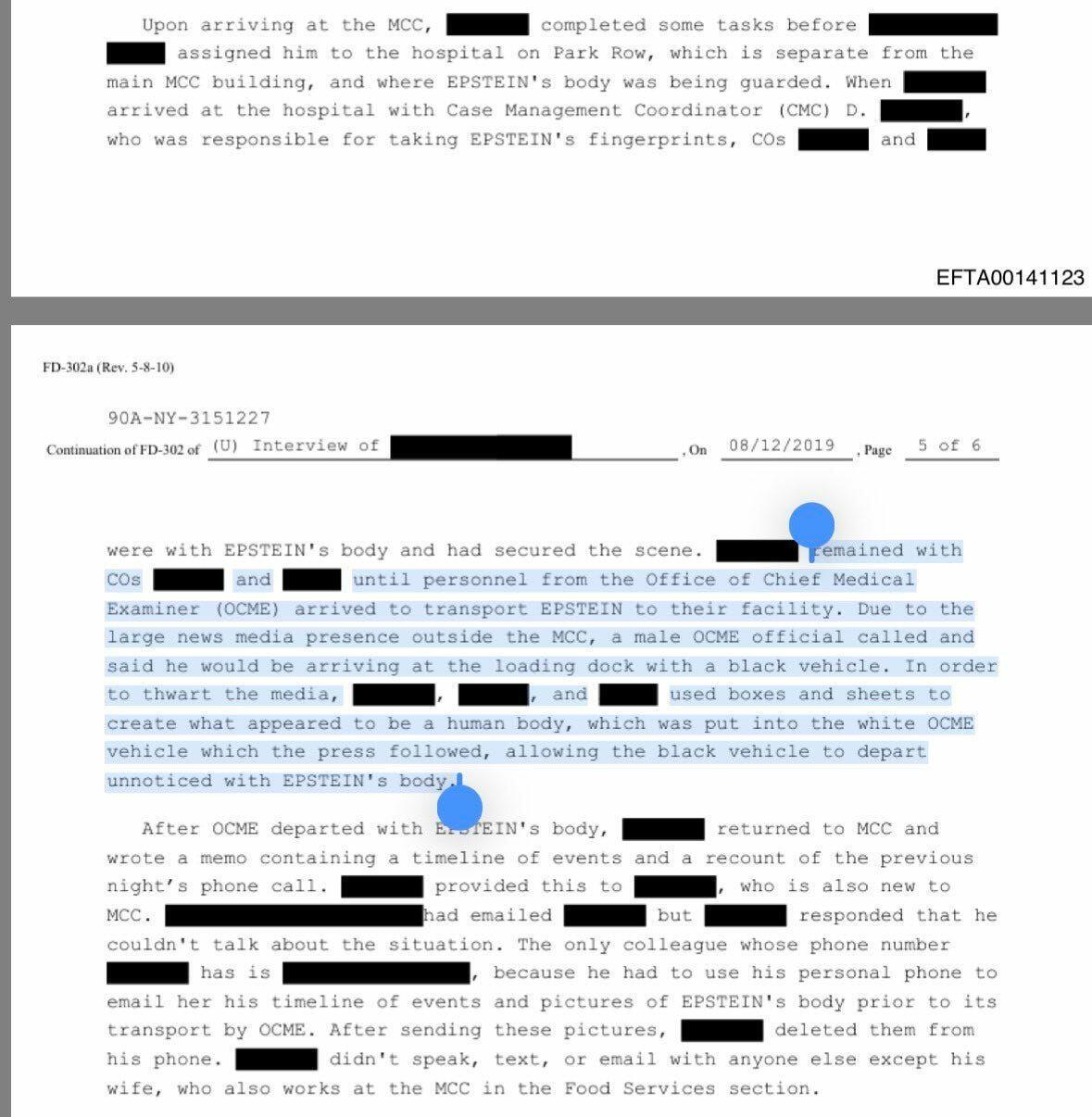
“[REDACTED] remained with COs [REDACTED] and [REDACTED] until personnel from the Office of Chief Medical Examiner (OCME) arrived to transport EPSTEIN to their facility. Due to the large news media presence outside the MCC, a male OCHE official called and said he would be arriving at the loading dock with a black vehicle. In order to thwart the media, [REDACTED], [REDACTED] and [REDACTED] used boxes and sheets to create what appeared to be a human body, which was put into the white OCME vehicle which the press followed, allowing the black vehicle to depart unnoticed with EPSTEIN’s body.”
The Body Doesn’t Match: The Prostate
It seems clear enough someone died of hanging or strangulation that morning. The question is whether it was Epstein’s body, or someone else’s.
Perhaps the most damning evidence that it was not Epstein’s body comes from his prostate — or rather, his lack of one.
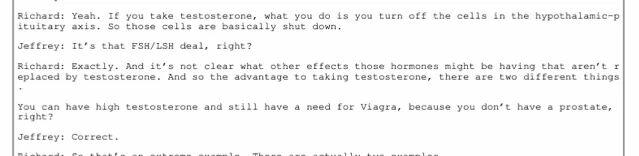
In an exchange with Dr. Richard Axel, Epstein said that despite taking testosterone, he also takes Viagra due to not having a prostate. This is Epstein, in his own words, telling a doctor that his prostate had been removed.
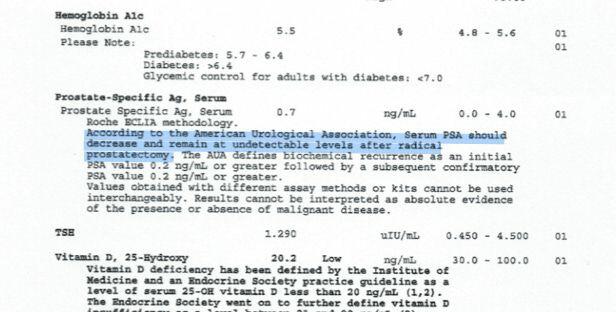
His medical records corroborate this. A LabCorp patient report for Epstein references his “radical prostatectomy” — boilerplate language triggered by a prostatectomy flag in his patient history. This language appears in reports from both 2010 and 2018.
In two of the Epstein files, we have Epstein texting himself about needing a prostate cancer specialist. In April 2019 — just months before his death — NY-Presbyterian Hospital told Epstein the doctor he sought was no longer practicing and included several alternative recommendations. Of a proposed doctor they wrote: “He has been listed as an expert in nerve-sparing radical prostatectomy techniques as well as male infertility by Castle Connolly’s ‘Best Doctors’ Guide since 1999 as well as other national ‘Best Doctor’ lists.” (“Nerve-sparing” translates to Epstein being able to continue his favorite pastime.)
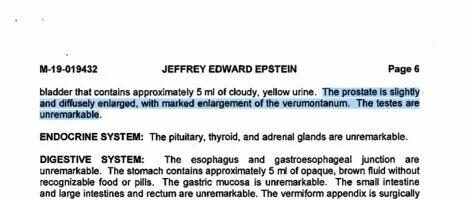
And yet: despite all of these records indicating Epstein’s prostate had been removed, the NYC coroner report describes the deceased as having a prostate that is “slightly and diffusely enlarged, with marked enlargement of the verumontanum.” The verumontanum is an anatomical structure that exists within the prostate. You cannot have one without the other.
To date, there is no publicly known way to regrow a prostate.
The Body Doesn’t Match: The Lipoma
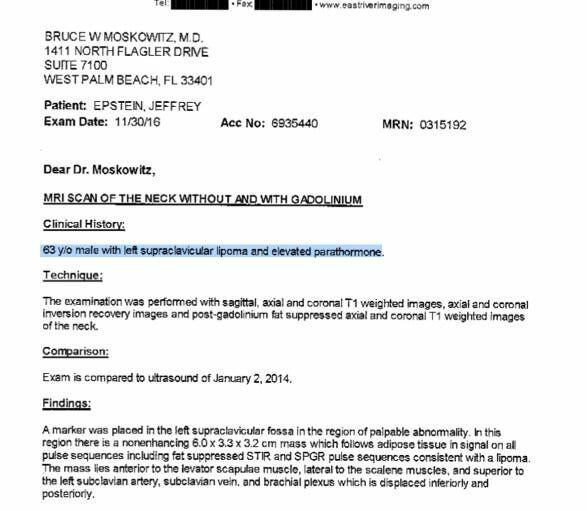
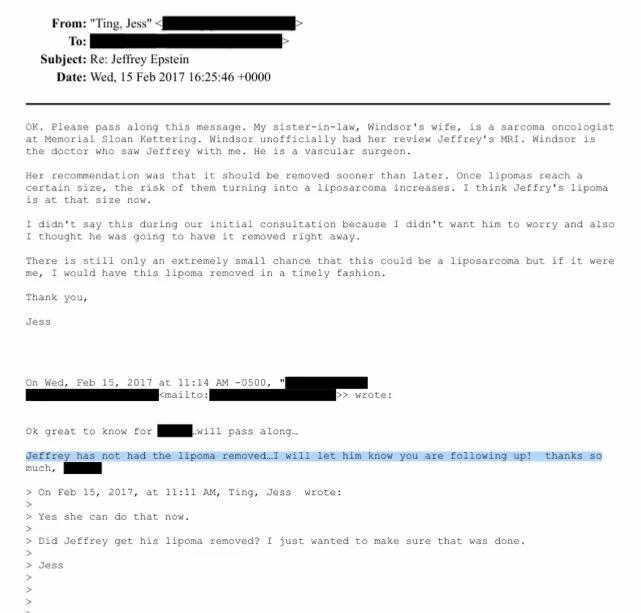
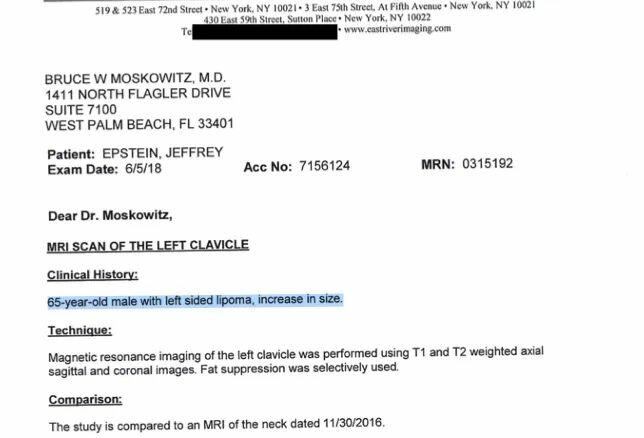
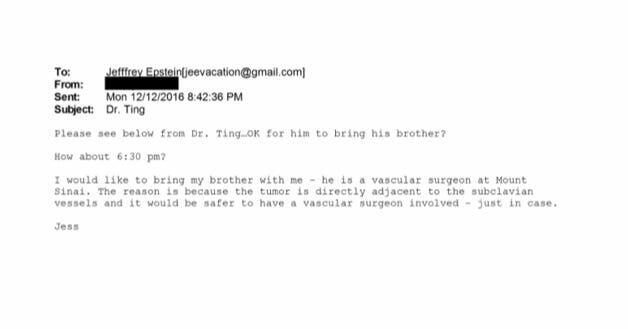
Jeffrey Epstein suffered from a roughly 6 cm lipoma (fatty tumor) in his left supraclavicular fossa — the area above his left collarbone — documented in 2016, 2017, and again in 2018. The 2016 report also references a similar exam from 2014. In 2016 there were communications about surgical removal. In 2017, Epstein’s assistant confirms he hasn’t had it removed. In 2018, it’s being MRI’d all over again.
2016:
2017:
2018:
Both MRIs document a mass large enough to displace the brachial plexus — a critical nerve bundle serving the arm. The autopsy makes no mention of it whatsoever, despite a detailed neck dissection necessitated by the hanging injuries. The 2016 MRI also documented multilevel cervical spondylosis (C3-C7) with cord compression at C5-C6. The autopsy doesn’t mention this either. Its musculoskeletal section notes only a healed rib fracture and general musculature — no soft tissue masses anywhere.
Despite Epstein’s voluminous communications with his doctors in the years and months before his reported death, there is no record anywhere of Epstein having the lipoma removed. As late as September 2018, he was texting his doctor about it. And even if he had somehow undergone an undocumented surgery and recovery in the months before his arrest, that level of operation should have left scarring or other evidence the autopsy would have noted.
The lipoma’s location also creates a cardiovascular problem for the official narrative. “Evaluation of the left supraclavicular fossa once again demonstrates a lesion identified, inferior to the subclavian vein, and displacing the roots of the brachial plexus inferiorly,” the radiologist, Dr. Douglas DeCorato, observed in the 2018 MRI. In 2016, in an exchange with one of his doctors, the surgeon says he’s bringing his brother, a vascular surgeon, because “the tumor is directly adjacent to the subclavian vessels.”
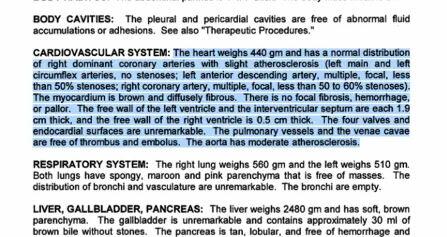
Here is what the official autopsy says of the deceased’s cardiovascular system (a section redacted in some versions of the document):
During autopsy, the cardiovascular system examination involves tracing major vessels including the subclavian. A 6 cm mass resting on those vessels should have been encountered during that dissection — yet the autopsy reports the pulmonary vessels and venae cavae as simply “free of thrombus and embolus” with no mention of any adjacent mass.
The 2018 MRI explicitly states there is “no evidence of adenopathy.” The autopsy, roughly 14 months later, documents multiple enlarged cervical lymph nodes up to 1.5 cm. That could be a new development, but combined with the missing lipoma and the impossible prostate, it deepens the question of whether these records describe the same person.
The Body Doesn’t Match: Physical Appearance
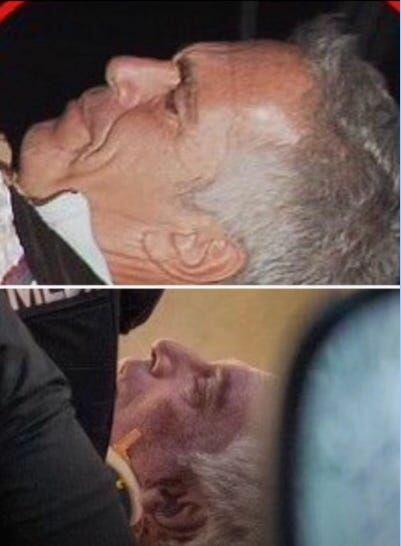
The Epstein in the post-mortem photos has ears and a nose that look markedly different from Epstein’s known features. Morticians have also noted that images of the deceased with his mouth closed do not align with how faces typically present after death by hanging — muscles relax and gravity takes over, meaning mouths and eyes usually fall open.
The Medical Examiner
The original death certificate, from the day after his reported suicide, lists his immediate cause of death as “Pending Further Study.” New York City’s medical examiner, Dr. Kristin Roman, told federal investigators that due to the high-profile nature of the case, she wanted to be “thorough” and speak with the guard who found him. However, she was not permitted to do so. She changed the ruling to suicide after reviewing “additional evidence” — which sources say was his alleged prior suicide attempt.
Jeffrey Epstein’s brother hired famed pathologist Michael Baden to observe the autopsy. “Baden served for decades as a member of the New York State Correction Medical Review Board, an entity responsible for reviewing deaths of inmates in custody,” the Miami Herald reports. “Baden has conducted more than 20,000 autopsies including reviewing those of former President John F. Kennedy, and civil rights leaders the Rev. Martin Luther King Jr. and Medgar Evers.”
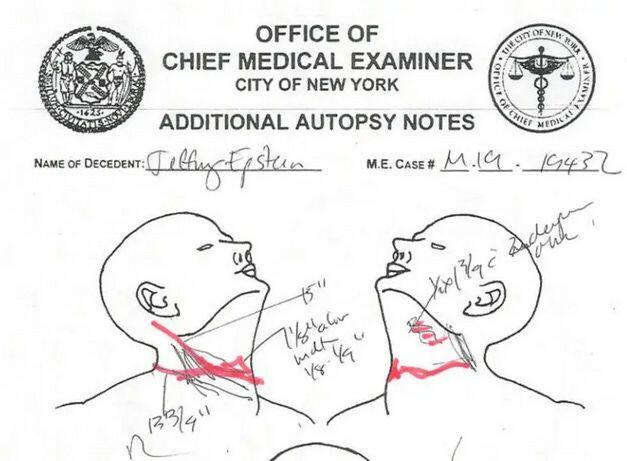
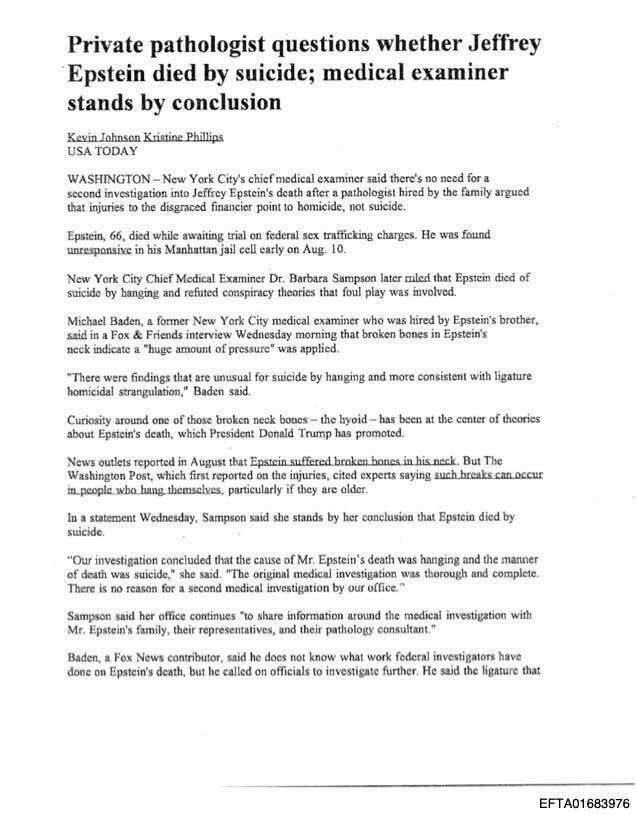
Baden found three separate fractures: two on the left and right sides of the thyroid cartilage (the Adam’s apple), plus one on the left hyoid bone. He described the injuries as requiring a “huge amount of pressure” and specifically noted they were “more consistent with ligature homicidal strangulation” than suicide. “I have never seen three fractures like this in a suicidal hanging,” Baden later told 60 Minutes. “Going over a thousand jail hangings, suicides in the New York City state prisons over the past 40-50 years, no one had three fractures.” Others have noted that hyoid fractures can occur in hangings, particularly among older individuals — but three fractures remains highly unusual.
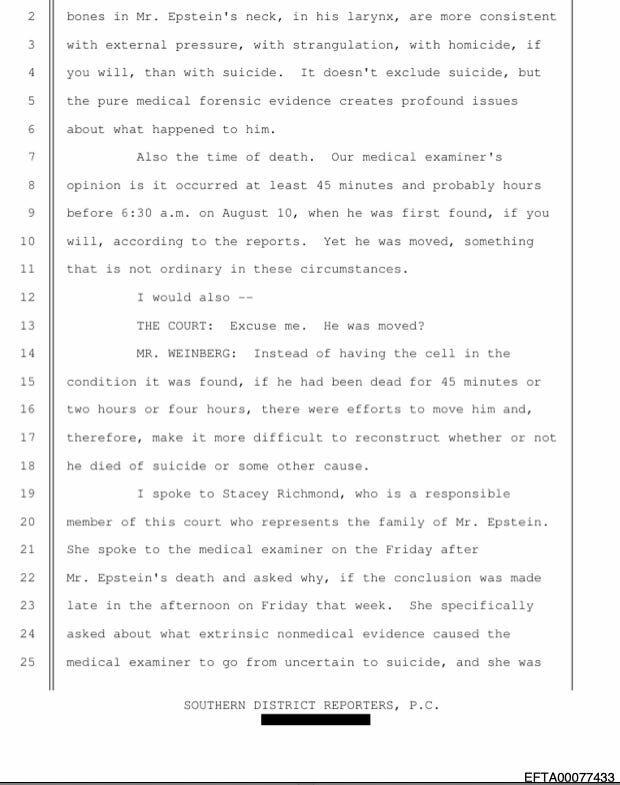
Attorneys for Jeffrey Epstein told the Southern District of New York: “We also had been in receipt of a tremendous amount of medical and scientific evidence volunteered to us opining that the injuries suffered, as reported, were far more consistent with assault than with suicide, and we are happy to supply the court with all the information we have.” These attorneys also noted how the prison guards had moved the body, complicating investigation efforts: “Instead of having the cell in the condition it was found, if he had been dead for 45 minutes or two hours or four hours, there were efforts to move him and, therefore, make it more difficult to reconstruct whether or not he died of suicide or some other cause.”
The Pre-Dated Death Announcement
The feds’ statement on Epstein’s death appears to have been drafted a day before he died. As many as 23 documents in the disclosure are labeled as statements from the Southern District of New York’s US Attorney’s Office. In one version, the date reads August 9, 2019 — a day before Epstein was reportedly found dead. It states: “Earlier this morning, the Manhattan Correctional Centre confirmed that Jeffrey Epstein, who faced charges brought by this Office of engaging in the sex trafficking of minors, had been found unresponsive in his cell and pronounced dead shortly thereafter.”
The DOJ has called it “merely an unfortunate typo that was later updated to reflect the correct date before being publicized.” Theoretically possible, sure. But it’s another incident in an impossibly long string of coincidences where you must extend the feds the benefit of the doubt.
Destruction of Evidence
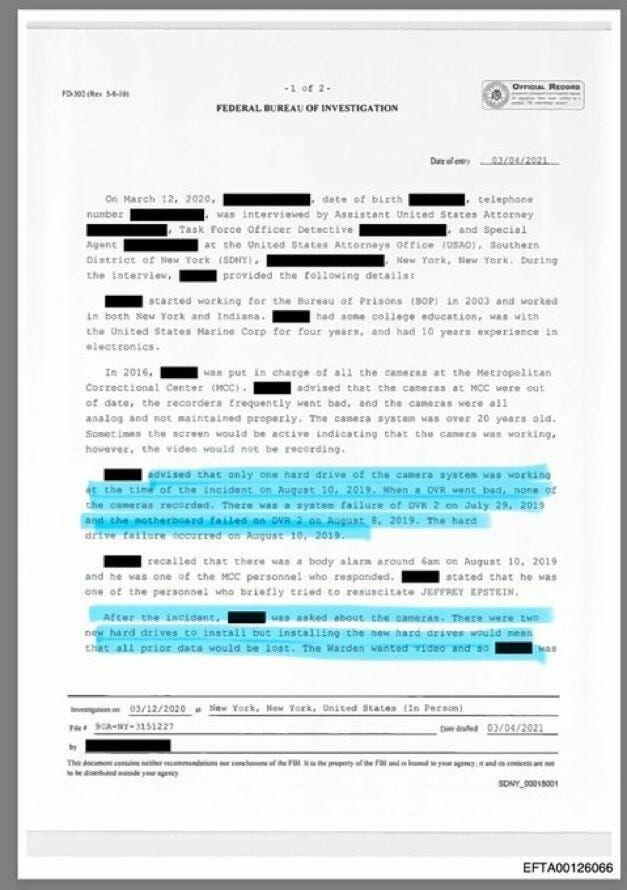
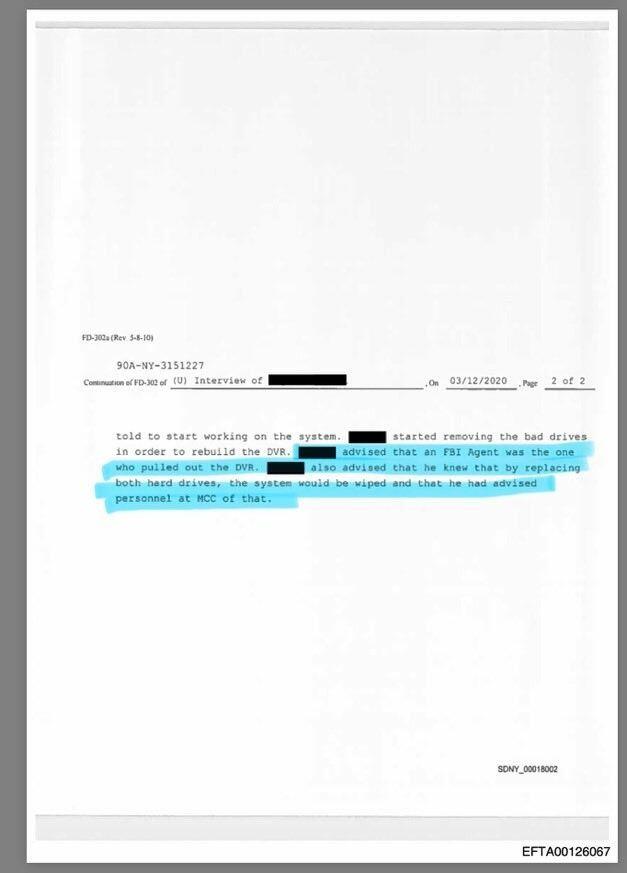
Then there are the jail’s surveillance hard drives. The Epstein Files contain an FBI memorandum admitting that an FBI agent removed the hard drive from the jail’s camera system, wiping all of the data from the night Epstein died. The agent did this, they acknowledge, even as he knew doing so would result in the content’s corruption. This comes on top of two other surveillance systems that independently failed that night.
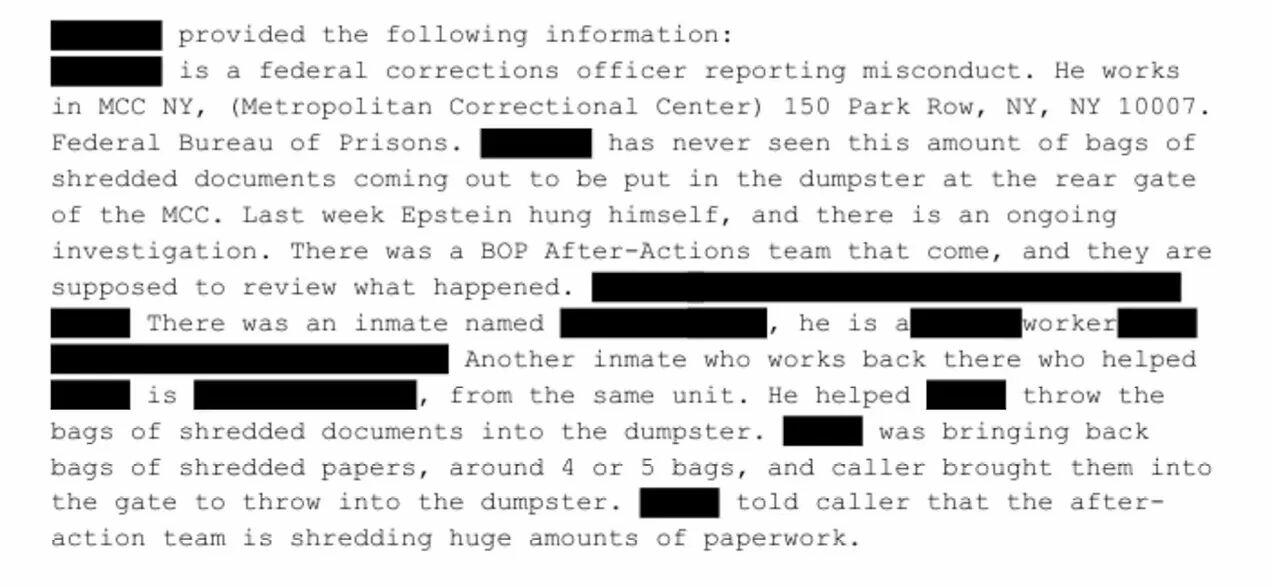
And it gets worse. Just yesterday, the Daily Beast reported that six days after Epstein’s death, the Department of Justice shredded a massive volume of documents from the jail:
A Bureau of Prisons “After-Actions team” went through the jail and shredded the files, according to a report drafted by an FBI official whose name has been redacted. The document is part of the tranche of files released by the Department of Justice earlier this year.
“[Redacted] has never seen this amount of bags of shredded documents coming out to be put in the dumpster at the rear gate of the MCC,” the report said.
“Last week Epstein hung [sic] himself, and there is an ongoing investigation. There was a BOP After-Actions team that come, and they are supposed to review what happened,” the report continued.
… “Caller found it suspicious that an after-action team charged with investigating would be shredding huge amounts of paperwork with all of the officials from the AIG, FBI and BO[P] in the building in the middle of an investigation. Those giving instructions to [redacted] said, ‘Make sure you get that box too,’” the document said, referring to the assistant inspector general.
That this was no normal cleanup operation is underscored by the fact that at least one inmate was recruited to help dispose of the shredded material: “[Redacted] was bringing back bags of shredded papers, around 4 or 5 bags, and caller brought them into the gate to throw into the dumpster. [Redacted] told caller that the after-action team is shredding huge amounts of paperwork.”
Even more damning: a federal prosecutor later wrote that “all institutional count slips prior to August 10, 2019, which we requested on August 12, 2019, are apparently ‘missing.’”
The Miami Herald notes there were two separate corruption probes associated with Epstein’s death — “one, an obstruction-of-justice case involving the shredding of documents and possible charges of dereliction of duty and other misconduct by correctional officers; and second, a blackmail-for-sex scheme involving a correctional officer that the DOJ labeled a ‘Color of Law’ probe” — and both were transferred from being an FBI criminal case to being a matter for the DoJ’s Office of Inspector General (OIG), which lacks prosecuting power.
From the outset, on the day Epstein’s body was found, then-Attorney General William Barr immediately announced that Epstein died of an “apparent suicide.” And then, six days later, on Aug. 16, Sampson confirmed the suicide ruling.
With the cause and manner of death already determined, and no foul play suspected, the only aspects of the case left unresolved – at least in the eyes of the Justice Department – was whether the actions of any of the officers contributed to Epstein’s suicide.
This seemed to color the investigation almost from the beginning, since Epstein’s death was never treated as suspicious. As a result, his cell was never considered a possible crime scene that would, under normal circumstances, be examined by experienced criminal and forensic experts who would take fingerprints, blood samples and other evidence. One thing that got lost as a result of the cell not being examined was that the piece of fabric that Epstein allegedly used to hang himself was never identified.
Before moving on, it’s worth recalling that Epstein significantly revised and signed his will two days before his reported death. Normally, dramatic changes to your estate hours before a death arouse suspicion, but it’s also not inconsistent with suicide.
The Tattoo Question
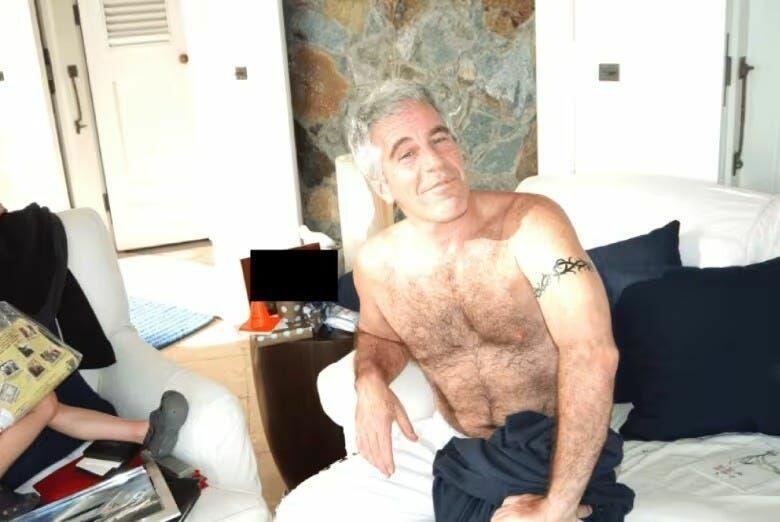
Many have called into question an apparent discrepancy between Epstein having at least one tattoo and the autopsy body having none. The files contain an undated image of Epstein with a barbed wire tattoo on his left arm:
However, this situation isn’t straightforward. In 2009, Epstein references his tattoo in an email. In 2010, his assistant emailed him about tattoo removal options. There are also several redacted emails about a tattoo. Some have pointed to a 2017 DoJ deposition referencing a “barbed wire” tattoo on the left arm, but this deposition is actually from one of the victims, not a contemporaneous observation of Epstein.
Due to Epstein’s 2010 interest in tattoo removal and the lack of dated photos confirming the tattoo’s presence at the time of his arrest, there’s not enough to establish this discrepancy definitively. It’s also possible someone has inserted a fake image of Epstein with a barbed wire tattoo specifically to plant a debunkable conspiracy theory — a known disinformation technique.
Post-Mortem Activity
Meanwhile, accounts connected with Epstein have remained active after his reported death.
The Irish media outlet The Ditch “gained access to the convicted paedophile’s FedEx account after the US Department of Justice published an unredacted password. The department later removed it from the Epstein files.”
The account was used as recently as summer 2024 — despite Epstein’s death in 2019.
The Ditch still has access to the FedEx account and address book, which contains almost 100 names and addresses, including an ex-Israeli Air Force Lieutenant Colonel who now advises Alan Dershowitz.
A package collected from Gulfstream’s product support centre in Savannah, Georgia, was shipped to Plan D LLC in Kennesaw, Georgia, on 20 May, 2024.
Plan D is the now-dissolved firm that Epstein incorporated to own and operate his private jet, which Donald Trump used during the 2024 US presidential election campaign.
Another package was shipped from the same Gulfstream address in Georgia to Empire Aviation in West Palm Beach, Florida, on 12 March, 2024, according to invoices.
FedEx deleted both invoices from the child sex offender’s account in the past few days.
Then there’s Fortnite.
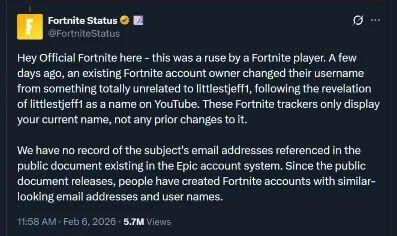
One of the early public discoveries from the Epstein files drop is that Epstein had a Fortnite account under the username littlestjeff1.
This username matches an email listed in the Epstein files, littlestjeff@yahoo.com (Littlest = Little St. James). It also appears as the username of his YouTube account.
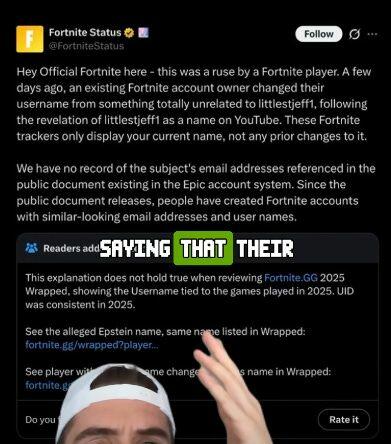
After people looked up the account’s status, it appeared to be actively used from Tel Aviv. Fortnite removed the account from online tracking, then issued a statement saying it was a “ruse” — actually another player “who changed their username” to match Epstein’s.
However, Fortnite’s player community noted a problem with this explanation: when people change their username on the platform, you can see the previous usernames. This account showed no prior name. (That community note was later removed from X.)
Other details that Epic Games’ statement didn’t address: the account showed a gap in activity that coincided with Epstein’s stay in the Manhattan Correctional Center, and records of its use were scrubbed from the Wayback Machine.
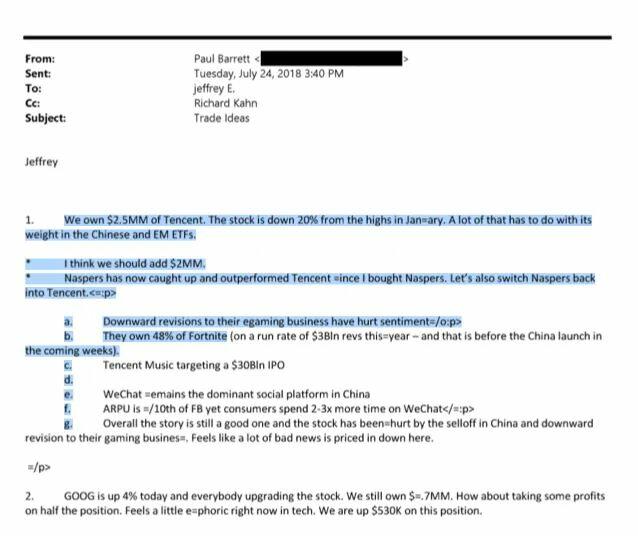
Could anyone in Epstein’s orbit exert influence over Epic Games? One pathway: Epstein’s estimated $5 million equity stake in Tencent, the Chinese technology conglomerate that purchased a 48.4 percent outstanding stake — equating to 40 percent of total capital — in Epic Games in 2012. Tencent’s acquisition triggered a number of high-profile departures from Epic, reputedly over the company’s shifting philosophy. A financial whistleblower also alerted the feds to suspicious Epstein activities related to Tencent’s ownership.
Epstein’s “secret” bank in the U.S. Virgin Islands, Southern Country International, also saw significant post-mortem activity. The New York Times reported that Southern Country had $693,157 in assets when Epstein died. Then, in mid-December 2019, the estate transferred $15.5 million to the bank. Two weeks later, its assets were back down to $499,759. The estate offered no explanation. A magistrate judge reviewing the transactions said, “There’s no explanation for it.”
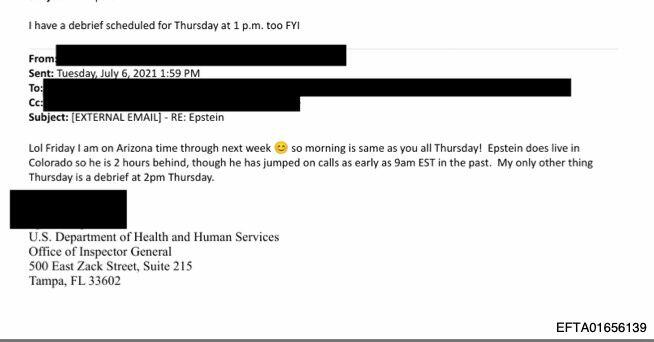
The Epstein files dump also includes emails between DoJ and HHS officials from July 6, 2021 — two years after Epstein’s death — discussing “Epstein’s” availability for a call in Colorado. Snopes investigated and found evidence indicating these emails refer to Richard Epstein, a cooperating witness in a Medicare fraud investigation. Despite my general skepticism of Snopes, I believe they’re correct here: the evidence strongly suggests this email chain referred to a different Epstein.
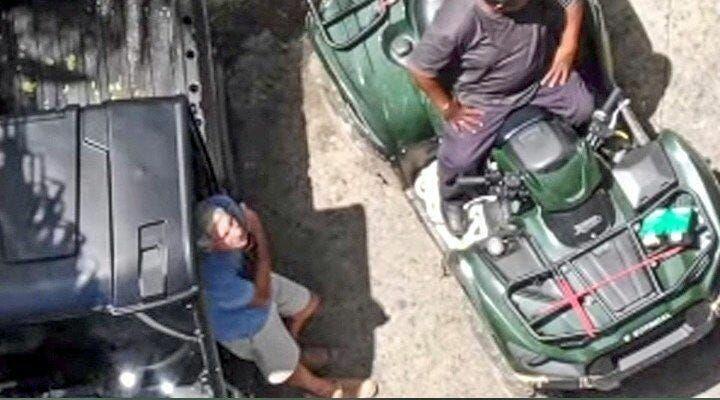
There are also the supposed sightings. Someone thought he might have seen Ghislaine (and someone who looks like Alan Dershowitz) in Quebec. Someone else brought a drone to Little St. James and caught a glimpse of someone who resembles Epstein (and his most recent girlfriend) in the weeks after his reported suicide. Another sighting had him in a random port in Greece.
Why the Feds Might Help Him Disappear
Why would the federal government help Epstein flee? There are actually many reasons.
He provided them a skill they find valuable: money laundering. CBS News recently revealed a previously undisclosed DEA investigation — a five-year-plus probe targeting Epstein and 14 other individuals for approximately $50 million in suspicious wire transfers linked to illicit narcotics and prostitution activity in the U.S. Virgin Islands and New York City.
He was an international power broker, coordinating operations among banking families, intelligence agencies, universities, and governments. He’d been a key cog in the apparatus that seems to run our power structure for at least 40 years. And he provided the U.S. intelligence:
Epstein “told colleagues and friends that he was an intelligence asset”
The FBI closed a forfeiture proceeding against Epstein, noting “Epstein… has provided information to the FBI as agreed upon”
There’s speculation that Epstein was a “confidential informant”
The U.S. State Department rented Epstein a luxurious townhouse in New York City that had been seized from the Iranian government in 1992. They didn’t even complain when he failed to pay his bills.
Researcher Mike Benz has detailed reporting all but conclusively showing Epstein helped launder money for the CIA during, at least, Iran-Contra.
And yes, most likely he was leveraging sexual blackmail — as everyone now largely agrees. Were they really going to let Epstein go to trial where he starts spilling secrets? A guy like Epstein would have sooner torched the whole cathedral than quietly accept a life sentence. That was never going to happen.
My working theory is that the feds initially hoped Epstein would be killed in jail — the most convenient outcome for Trump, Barr, and others. Which may explain why they kept housing him with violent inmates. When that failed, they went to Plan B.
Suppression Over Investigation
Of course I cannot prove any of this definitively — although the prostate issue seems as close to proof as it gets. But one thing I can say: even if the feds didn’t help Epstein abscond, why are they acting like they did? If you start with this theory — that they orchestrated a conclusion to the Epstein chapter they hoped would tie up countless loose ends — everything else starts making sense. Including Trump and Bondi’s absolute resistance to dig deeper into the files.
One of the most notable aspects of the feds’ post-Epstein behavior is how focused they are on suppressing incriminating information rather than investigating it.
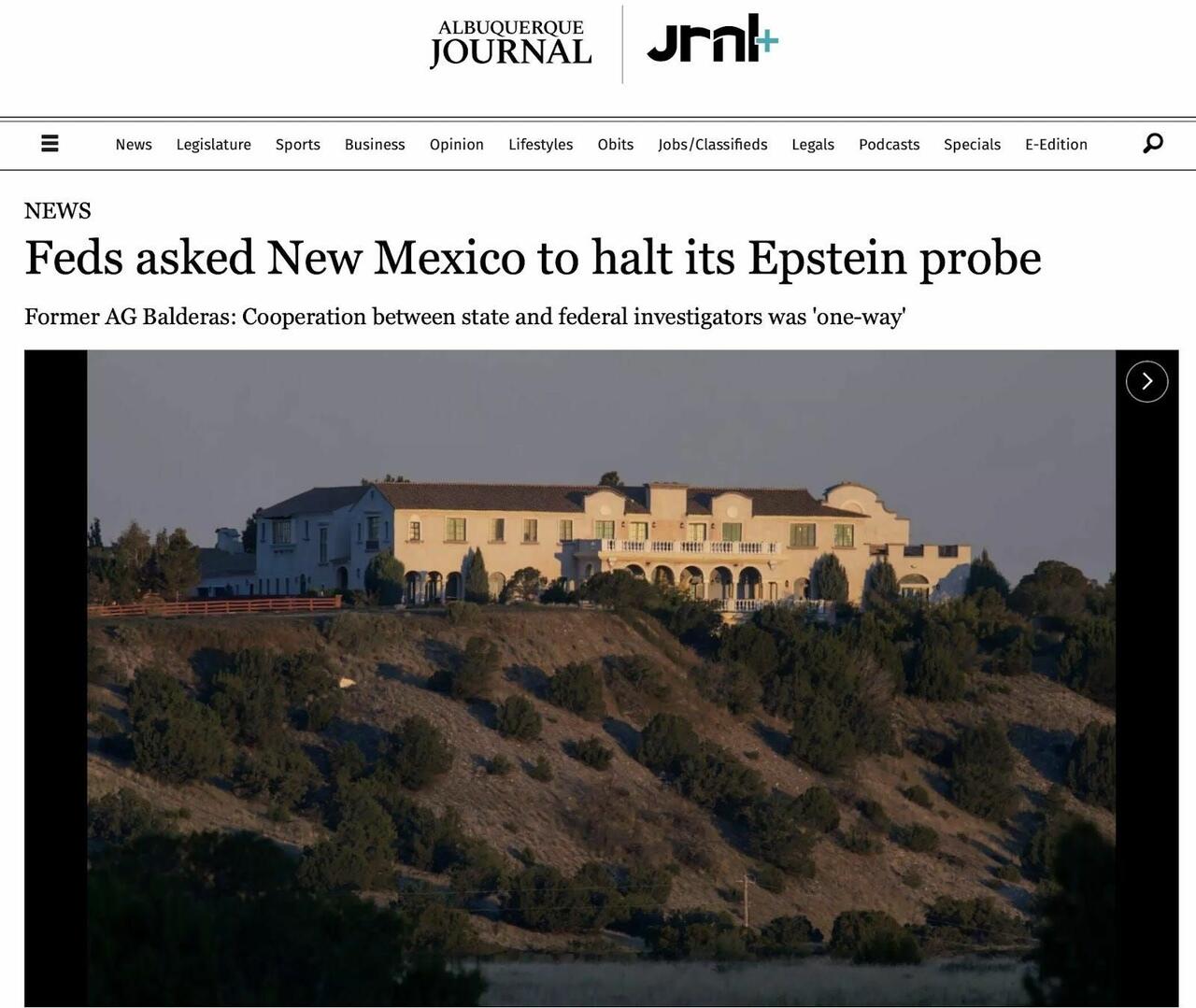
Case in point: Zorro Ranch. Many Americans have wondered why the feds never raided Epstein’s 7,500-acre New Mexico compound despite multiple victims testifying of abuse there. But it’s worse than neglect — the feds actively prevented others from investigating, reports the Albuquerque Journal.
The request by federal prosecutors essentially “gutted” New Mexico’s investigation into sex trafficking at Epstein’s 7,500-acre Zorro Ranch located 30 miles south of Santa Fe, Balderas said.
“We provided information to them to strengthen their prosecution,” he said. Prosecutors made assurances they would provide findings to New Mexico investigators. “They were making the representation that they were going to prosecute with a multijurisdictional, multistate focus.”
Balderas’ office also sent a letter in 2020 urging federal prosecutors to seize control of Zorro Ranch to preserve evidence, records show. Balderas said he also offered to assist serving search warrants at the ranch but never received a response and has no reason to believe prosecutors acted on the requests …
None of the investigative records provided by New Mexico appear to be among the more than 3 million pages of documents released last month by the U.S. Department of Justice.
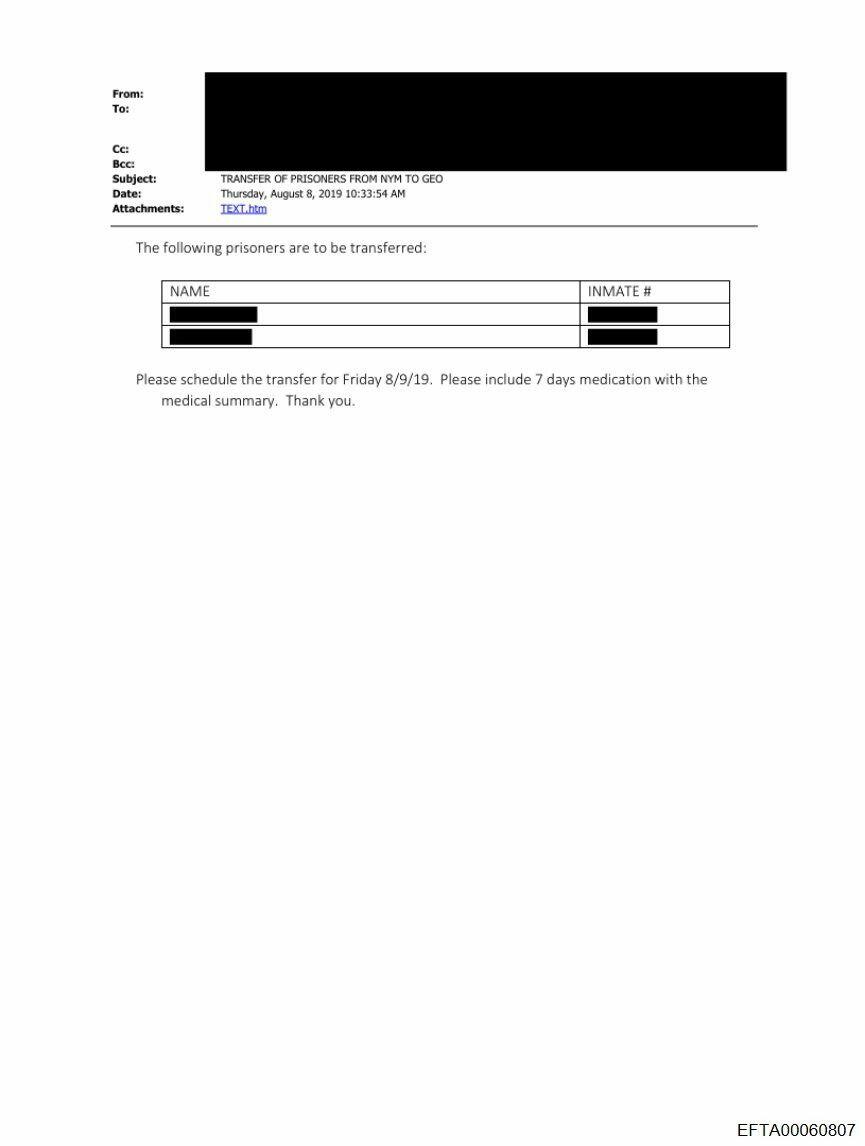
The FBI/DoJ’s redactions — technically illegal under the Massie/Khanna disclosure bill — are also telling. The day before Epstein was reported dead, the federal jail transferred out Epstein’s cellmate despite a prison psychologist expressly forbidding this. The records reporting the transfer are blacked out:
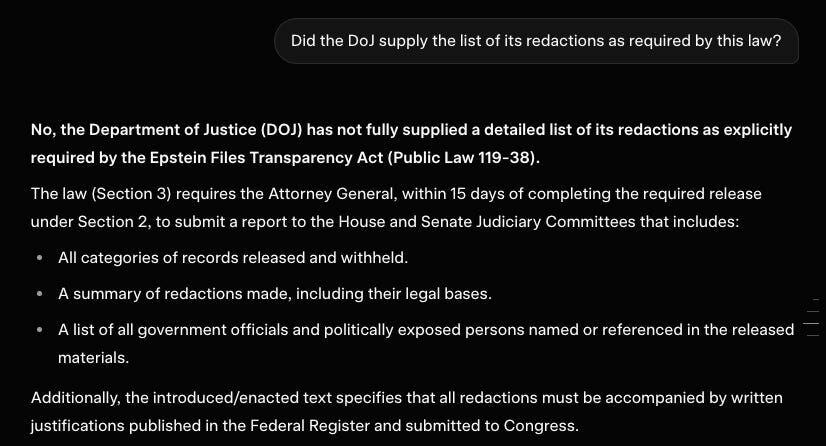
This is one of thousands of similar examples. The Massie/Khanna bill specifies redactions are only “permitted to withhold certain information such as the personal information of victims and materials that would jeopardize an active federal investigation.” The law also requires the DoJ to list all redactions and categories of redactions. The DoJ refuses to comply with either requirement.
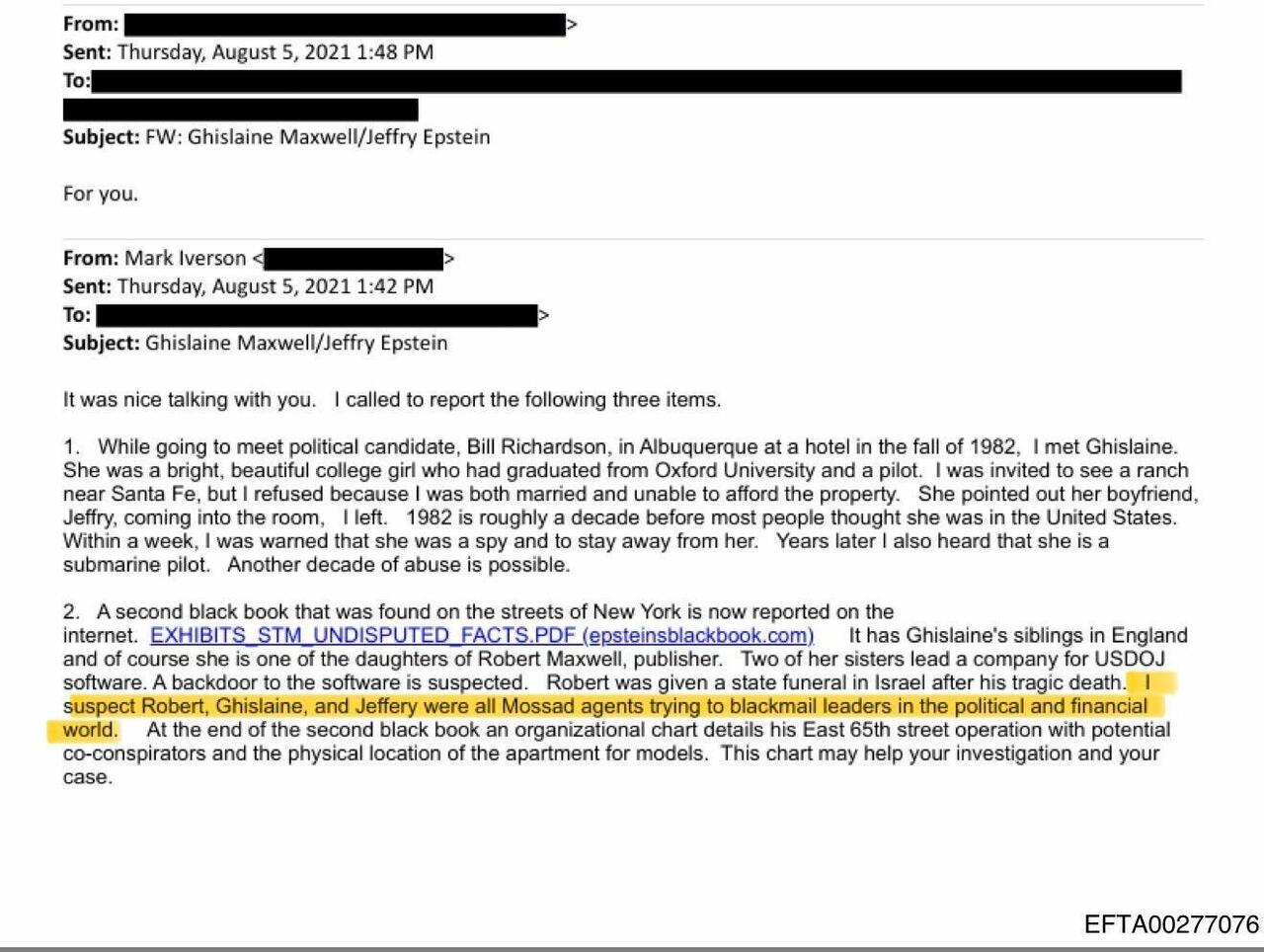
Should we wonder if the FBI has a conflict of interest considering its post-9/11 data-mining was in large part assisted by Chiliad, a Big Data company run by Ghislaine Maxwell’s sister, Christine? One whistleblower told the FBI “a backdoor to the software is suspected … I suspect Robert, Ghislaine, and Jeffrey were all Mossad agents trying to blackmail leaders in the political and financial world.”
The Impossible Coincidences
I can’t help but acknowledge that putting all of this in writing will be controversial. But this is the actual presumption of a very large swath of the American public — and for good reason. We already know the feds lied about Epstein’s “sweetheart deal.” They lied about his intelligence connections. They lied about the lack of incriminating evidence in the Epstein Files. They refuse to comply with the law requiring the release of unredacted records. And all of that is before the chain of impossibly improbable events surrounding his supposed suicide.
To continue believing the official narrative, you must believe:
It’s just bad luck the body autopsied had an enlarged prostate, despite Epstein telling his own doctor he’d had his removed.
It’s just bad luck a 6 cm tumor documented in Epstein’s neck through 2018 vanished from the 2019 autopsy — with no surgical record explaining its absence.
It’s just bad luck the jail’s known-to-be-broken DVR system wasn’t repaired before the most notorious inmate in the country was found dead.
It’s just bad luck 11 of 12 cameras were either offline or not recording that night.
It’s just bad luck an FBI agent corrupted the data on one of the surveillance drives still in existence.
It’s just bad luck the FBI was unable to recover that footage.
It’s just bad luck the Bureau of Prisons shredded “huge amounts of paperwork” from the jail six days after Epstein’s death, during an active investigation, and that the institutional count slips from the night he died went “missing.”
It’s just a coincidence someone working at the jail posted that he believed they swapped the body out — and the feds subpoenaed his records within hours.
It’s just bad luck that not one but both guards assigned to Epstein’s unit that night fell asleep, failed to make their rounds, and lied about it.
It’s just a coincidence one of those guards was receiving unexplained cash deposits and driving a $62,000 Range Rover, and spent part of the night googling for updates on Epstein in jail.
It’s just bad luck the DoJ dropped charges against both guards.
It’s just bad luck the medical examiner initially needed more time, was denied access to the guard who found the body, and then changed her ruling.
It’s just bad luck a competing pathologist found three neck fractures — more consistent with strangulation than hanging — something he’d never seen in thousands of jail suicides.
It’s just bad luck the feds’ announcement of Epstein’s death was dated the day before he died.
It’s just bad luck Epstein’s FedEx account was shipping packages five years after his death, and his Fortnite account showed activity from Tel Aviv.
It’s just bad luck the feds shut down New Mexico’s investigation into Zorro Ranch and then failed to include any of New Mexico’s records in the 3 million pages they released.
It’s just bad luck so many of the feds’ documents regarding Epstein’s reported final days are still being illegally redacted.
All of this only scratches the surface. Further examples of the feds’ withholding of evidence, as well as conflicts of interest between Epstein-affiliated enterprises and federal officials, are too numerous to document here. One rabbit hole: the Epstein-backed surveillance company Reporty (later renamed Carbyne, also known as Smart911), whose financial backers — including former Israeli Prime Minister Ehud Barak — overlap with the president’s, and whose technology appears to be used at the Pentagon. (There is more on this in the book “Epstein: Dead Men Tell No Tales.” And I can’t help but quickly add: The authors of that book interviewed Epstein’s attorney, victims’ attorneys, among others, and the only person willing to go on record stating he believed Epstein killed himself was Alan Dershowitz. )
Speaking for myself, I can only weather so many insults to my intelligence before accepting I’m being had. We’ll likely never know exactly what happened on August 10, 2019. But one thing I can say with confidence: the feds have absolutely earned their distrust.
Tyler Durden
Tue, 03/24/2026 – 22:15
After The Epstein Files, It’s Become All But Impossible To Believe He Killed Himself
After The Epstein Files, It’s Become All But Impossible To Believe He Killed Himself
Authored by Tom Elliott via substack,
As soon as the feds announced Jeffrey Epstein killed himself while awaiting prosecution on charges of sex trafficking, the popular reaction was disbelief: “Jeffrey Epstein didn’t kill himself” quickly became an internet meme. And now, with the release of the Epstein Files, it’s only become harder — if not all but impossible — to believe the official story that Jeffrey Epstein hanged himself in the Manhattan Correctional Center on August 10, 2019.
The “Suicide”
The DoJ’s Inspector General released a report that officially concluded there was no reason to doubt the suicide story, but actually contains many disturbing details if you read the included evidence. As summarized by JustFacts:
Federal prison officials placed Epstein in a cell with a murderous, hulking ex-cop — a death trap for any child molester.
Less than two weeks later, prison guards found Epstein in the middle of the night in a semiconscious state with a rope and “friction marks” around his neck.
Despite a court order requiring the prison to preserve video surveillance footage near Epstein’s cell during the strangulation, federal prison officials failed to do so and also lost the backup due to “technical errors.”
Federal prison officials took Epstein off “suicide watch” just one day after the strangulation without determining whether Epstein was attacked by his cellmate or tried to commit suicide.
One day before Epstein’s death, federal prison officials removed his new cellmate and didn’t replace him. They did this even though a prison psychologist sent an email to over 70 prison staffers stating that Epstein “needs” a cellmate — a common suicide prevention measure.
One day before Epstein’s death, a federal court unsealed more than 2,000 pages of lawsuit records that named and implicated wealthy and powerful people in Epstein’s sex crimes, as well as federal officials in covering up the crimes.
One day before Epstein’s death, federal prison officials permitted Epstein to make a completely unmonitored phone call in direct violation of prison policy and under patently false pretenses.
Federal officers placed a hoard of linens in Epstein’s cell, which is commonly prohibited because they can be used to create nooses.
Federal officers left Epstein alone in his cell for nearly eight hours on the night he died — despite the fact that they were required to check on all inmates in his unit “at least twice per hour” and were only 15 feet from Epstein’s cell.
Federal officers falsified records to show that they had checked on Epstein, a violation of federal law punishable by up to five years in prison.
Federal prosecutors “dismissed all charges pending against” the two officers who falsified the records and “declined” to prosecute others who “falsely certified inmate countslips and round sheets on the day before and the day of Epstein’s death.”
Federal prison officials failed to record footage from 9 of the 11 surveillance cameras around Epstein’s cell on the night of his death, including one that showed Epstein’s cell tier and cell door.
The FBI agents who searched Epstein’s New York mansion found and then abandoned a sexually explicit trove of photos and CDs labeled with the names of “young” females alongside people other than Epstein. This allowed one of Epstein’s most notorious accomplices to take the evidence and potentially scrub it before giving it to the feds.
To this day, the federal government hasn’t revealed the names of the people that were written beside the “young” females on Epstein’s CDs.
Hours before Epstein’s reported suicide, he made an unmonitored call to his girlfriend, Karyna Shuliak. She told friends Epstein gave no indication he was thinking of harming himself. The New York Times asked the Bureau of Prisons for his full call logs; “those logs show only one social call during his stay, more than a week earlier, to Shuliak.” In other words, the logs omitted this critical call. To date there is no knowledge of its contents, beyond Shuliak saying Epstein appeared to be in good spirits.
The Cameras
Due to a known issue with the prison’s DVR system — an issue jail officials were already aware of — only one security camera in the SHU unit was functioning. The feds said there exists no camera list correctly naming camera locations in the jail. The corrupted DVR drives were shipped to Quantico, where the FBI reportedly planned to attempt data recovery. However, according to an FBI letter, “they discontinue[d] those efforts once we told them dates prior to July 29th weren’t of interest.” This is itself strange, as pre-July 29th would have covered Epstein’s original reported strangulation.
According to the Inspector General’s report, both guards tasked with monitoring Epstein that night fell asleep during key hours, missing six of the six mandatory visual checks on Epstein. At other points during the night, as newly surfaced surveillance footage shows, the guards were actively walking around mere “steps away” from Epstein’s cell as he was reportedly preparing sheets to hang himself.
👀 Newly surfaced surveillance footage from the night of Jeffrey Epstein’s death … and it appears to show prison guards hanging out just steps away from his cell during the suspected timeframe he had taken his own life.
🎥 DOJ pic.twitter.com/BP6ksnChCi
— TMZ (@TMZ) March 21, 2026
Many online researchers have noted that by using a technique to search Epstein files displaying the text “no images produced,” you’ll find files with a .pdf extension that, when renamed to .mp4, reveal video files. One interesting video is surveillance footage from the Manhattan Correctional Center from the night prior to Epstein’s “suicide.” It shows a large screen blocking the camera from the stairwell.
The Body Swap Theory
Why might blocking the stairwell camera be necessary? One possibility is to facilitate what a worker at the jail posted about on 4Chan: that the night before the “suicide,” the feds swapped Epstein out.
“Last night after 0415 count they took him medical in a wheelchair front cufed but not 1 triage nurse says they spoke to him. Next thing we know a trip van shows up? We do not release weekends unless a judge orders it. Next thing we know, he’s put in a single man cell and hangs himself? Here’s the thing, the trip van did NOT sign in and we did not record the plate number and a guy in a green military outfit was in the back of the van according to the tower guy who let him thru the gate. You guys I am shaking right now but I think they switched him out.”
Within 24 hours, the feds subpoenaed Apple, AT&T, CitiBank, and 4Chan to investigate this poster’s identity and determined it was indeed a staffer at the jail. Consider the priorities this reveals: subpoenas issued within hours of an anonymous post, while the investigation into the most high-profile prisoner death in modern history was left to two guards who falsified records.
Multiple sources in the Epstein files note that at 10:39 PM on August 9, investigators reviewing jail surveillance footage flagged an orange-colored figure moving up a staircase toward the locked tier housing Epstein’s cell. The Inspector General said it could be someone carrying bedding; CBS reported independent analysts said it looked more like an inmate. Officials have repeatedly stated no one entered Epstein’s housing tier that night.
The Guards
The NY Post reported that one of the jail guards, Tova Noel, was googling “Latest Epstein jail” in the hours before his reputed death. Noel also “made a mysterious $5,000 cash deposit 10 days before the predator’s jail-cell suicide, new Department of Justice documents reveal.” Noel drove a $62,000 Range Rover — an extravagant luxury for a jail guard.
Noel was one of the two jail workers accused of faking records to say they checked on Epstein throughout the night of his “suicide.” She was fired, but the feds later dropped criminal charges.
Per the NY Post, “Noel googled ‘latest on Epstein in jail’ at 5:42 a.m. and then again at 5:52 a.m. — less than 40 minutes before her colleague, correctional officer Michael Thomas, found the disgraced financier dead in his jail cell.” Noel later denied to the feds that she had googled Epstein — a claim her internet history would disprove. Despite the DoJ knowing she was actively checking for updates on Epstein throughout that night, the IG report downplays this, merely stating she read an article about Epstein:
“OIG analysis of the activity on the SHU computers revealed that Noel used the computer periodically throughout the night, including to search the Internet for furniture sales and benefit websites and to read a news article about Epstein. Thomas used the computer briefly around 1 a.m. and 6 a.m. to search for motorcycle sales and sports news.”
Noel reported that faking records at the Manhattan Correctional Center was just the way things operated there.
The files only contain Noel’s bank records beginning in December 2018. They show seven cash deposits totaling $11,880. Noel started working at the Special Housing Unit — where Epstein had been held — beginning on July 7, 2019, just weeks before his death.
Noel, who drove a $62,000 2019 Land Rover Range Rover, wasn’t asked about the cash during her DOJ interview, records showed.
The Miami Herald reports that an inmate during Epstein’s incarceration overheard a commotion the morning Epstein was reportedly found dead:
The federal government’s online Epstein library contains a five-page handwritten report of an FBI interview with an inmate who awoke the morning of Aug. 10, 2019 to the loud commotion in the Special Housing Unit, or SHU, where he and Epstein were jailed.
“Breathe! Breathe!” he recalled officers shouting about 6:30 a.m. Then he said he heard an officer say “Dudes, you killed that dude.” A female guard replied “If he is dead, we’re going to cover it up and he’s going to have an alibi — my officers,” the FBI notes said. The inmate claimed the whole wing overheard the exchange.
Later, after learning Epstein had died, he said inmates said “Miss Noel killed Jeffrey.”
He identified the female guard as Tova Noel, one of two correctional officers who were later charged with falsifying reports so that it appeared from their records that they had made their rounds that night — when they had not. The charges against her and the other officer, Michael Thomas, were later dropped, but both were fired.
And another curiosity. In an interview with an unnamed jail worker, the redacted interviewee says they used a fake body to confuse the press:
“[REDACTED] remained with COs [REDACTED] and [REDACTED] until personnel from the Office of Chief Medical Examiner (OCME) arrived to transport EPSTEIN to their facility. Due to the large news media presence outside the MCC, a male OCHE official called and said he would be arriving at the loading dock with a black vehicle. In order to thwart the media, [REDACTED], [REDACTED] and [REDACTED] used boxes and sheets to create what appeared to be a human body, which was put into the white OCME vehicle which the press followed, allowing the black vehicle to depart unnoticed with EPSTEIN’s body.”
The Body Doesn’t Match: The Prostate
It seems clear enough someone died of hanging or strangulation that morning. The question is whether it was Epstein’s body, or someone else’s.
Perhaps the most damning evidence that it was not Epstein’s body comes from his prostate — or rather, his lack of one.
In an exchange with Dr. Richard Axel, Epstein said that despite taking testosterone, he also takes Viagra due to not having a prostate. This is Epstein, in his own words, telling a doctor that his prostate had been removed.
His medical records corroborate this. A LabCorp patient report for Epstein references his “radical prostatectomy” — boilerplate language triggered by a prostatectomy flag in his patient history. This language appears in reports from both 2010 and 2018.
In two of the Epstein files, we have Epstein texting himself about needing a prostate cancer specialist. In April 2019 — just months before his death — NY-Presbyterian Hospital told Epstein the doctor he sought was no longer practicing and included several alternative recommendations. Of a proposed doctor they wrote: “He has been listed as an expert in nerve-sparing radical prostatectomy techniques as well as male infertility by Castle Connolly’s ‘Best Doctors’ Guide since 1999 as well as other national ‘Best Doctor’ lists.” (“Nerve-sparing” translates to Epstein being able to continue his favorite pastime.)
And yet: despite all of these records indicating Epstein’s prostate had been removed, the NYC coroner report describes the deceased as having a prostate that is “slightly and diffusely enlarged, with marked enlargement of the verumontanum.” The verumontanum is an anatomical structure that exists within the prostate. You cannot have one without the other.
To date, there is no publicly known way to regrow a prostate.
The Body Doesn’t Match: The Lipoma
Jeffrey Epstein suffered from a roughly 6 cm lipoma (fatty tumor) in his left supraclavicular fossa — the area above his left collarbone — documented in 2016, 2017, and again in 2018. The 2016 report also references a similar exam from 2014. In 2016 there were communications about surgical removal. In 2017, Epstein’s assistant confirms he hasn’t had it removed. In 2018, it’s being MRI’d all over again.
2016:
2017:
2018:
Both MRIs document a mass large enough to displace the brachial plexus — a critical nerve bundle serving the arm. The autopsy makes no mention of it whatsoever, despite a detailed neck dissection necessitated by the hanging injuries. The 2016 MRI also documented multilevel cervical spondylosis (C3-C7) with cord compression at C5-C6. The autopsy doesn’t mention this either. Its musculoskeletal section notes only a healed rib fracture and general musculature — no soft tissue masses anywhere.
Despite Epstein’s voluminous communications with his doctors in the years and months before his reported death, there is no record anywhere of Epstein having the lipoma removed. As late as September 2018, he was texting his doctor about it. And even if he had somehow undergone an undocumented surgery and recovery in the months before his arrest, that level of operation should have left scarring or other evidence the autopsy would have noted.
The lipoma’s location also creates a cardiovascular problem for the official narrative. “Evaluation of the left supraclavicular fossa once again demonstrates a lesion identified, inferior to the subclavian vein, and displacing the roots of the brachial plexus inferiorly,” the radiologist, Dr. Douglas DeCorato, observed in the 2018 MRI. In 2016, in an exchange with one of his doctors, the surgeon says he’s bringing his brother, a vascular surgeon, because “the tumor is directly adjacent to the subclavian vessels.”
Here is what the official autopsy says of the deceased’s cardiovascular system (a section redacted in some versions of the document):
During autopsy, the cardiovascular system examination involves tracing major vessels including the subclavian. A 6 cm mass resting on those vessels should have been encountered during that dissection — yet the autopsy reports the pulmonary vessels and venae cavae as simply “free of thrombus and embolus” with no mention of any adjacent mass.
The 2018 MRI explicitly states there is “no evidence of adenopathy.” The autopsy, roughly 14 months later, documents multiple enlarged cervical lymph nodes up to 1.5 cm. That could be a new development, but combined with the missing lipoma and the impossible prostate, it deepens the question of whether these records describe the same person.
The Body Doesn’t Match: Physical Appearance
The Epstein in the post-mortem photos has ears and a nose that look markedly different from Epstein’s known features. Morticians have also noted that images of the deceased with his mouth closed do not align with how faces typically present after death by hanging — muscles relax and gravity takes over, meaning mouths and eyes usually fall open.
The Medical Examiner
The original death certificate, from the day after his reported suicide, lists his immediate cause of death as “Pending Further Study.” New York City’s medical examiner, Dr. Kristin Roman, told federal investigators that due to the high-profile nature of the case, she wanted to be “thorough” and speak with the guard who found him. However, she was not permitted to do so. She changed the ruling to suicide after reviewing “additional evidence” — which sources say was his alleged prior suicide attempt.
Jeffrey Epstein’s brother hired famed pathologist Michael Baden to observe the autopsy. “Baden served for decades as a member of the New York State Correction Medical Review Board, an entity responsible for reviewing deaths of inmates in custody,” the Miami Herald reports. “Baden has conducted more than 20,000 autopsies including reviewing those of former President John F. Kennedy, and civil rights leaders the Rev. Martin Luther King Jr. and Medgar Evers.”
Baden found three separate fractures: two on the left and right sides of the thyroid cartilage (the Adam’s apple), plus one on the left hyoid bone. He described the injuries as requiring a “huge amount of pressure” and specifically noted they were “more consistent with ligature homicidal strangulation” than suicide. “I have never seen three fractures like this in a suicidal hanging,” Baden later told 60 Minutes. “Going over a thousand jail hangings, suicides in the New York City state prisons over the past 40-50 years, no one had three fractures.” Others have noted that hyoid fractures can occur in hangings, particularly among older individuals — but three fractures remains highly unusual.
Attorneys for Jeffrey Epstein told the Southern District of New York: “We also had been in receipt of a tremendous amount of medical and scientific evidence volunteered to us opining that the injuries suffered, as reported, were far more consistent with assault than with suicide, and we are happy to supply the court with all the information we have.” These attorneys also noted how the prison guards had moved the body, complicating investigation efforts: “Instead of having the cell in the condition it was found, if he had been dead for 45 minutes or two hours or four hours, there were efforts to move him and, therefore, make it more difficult to reconstruct whether or not he died of suicide or some other cause.”
The Pre-Dated Death Announcement
The feds’ statement on Epstein’s death appears to have been drafted a day before he died. As many as 23 documents in the disclosure are labeled as statements from the Southern District of New York’s US Attorney’s Office. In one version, the date reads August 9, 2019 — a day before Epstein was reportedly found dead. It states: “Earlier this morning, the Manhattan Correctional Centre confirmed that Jeffrey Epstein, who faced charges brought by this Office of engaging in the sex trafficking of minors, had been found unresponsive in his cell and pronounced dead shortly thereafter.”
The DOJ has called it “merely an unfortunate typo that was later updated to reflect the correct date before being publicized.” Theoretically possible, sure. But it’s another incident in an impossibly long string of coincidences where you must extend the feds the benefit of the doubt.
Destruction of Evidence
Then there are the jail’s surveillance hard drives. The Epstein Files contain an FBI memorandum admitting that an FBI agent removed the hard drive from the jail’s camera system, wiping all of the data from the night Epstein died. The agent did this, they acknowledge, even as he knew doing so would result in the content’s corruption. This comes on top of two other surveillance systems that independently failed that night.
And it gets worse. Just yesterday, the Daily Beast reported that six days after Epstein’s death, the Department of Justice shredded a massive volume of documents from the jail:
A Bureau of Prisons “After-Actions team” went through the jail and shredded the files, according to a report drafted by an FBI official whose name has been redacted. The document is part of the tranche of files released by the Department of Justice earlier this year.
“[Redacted] has never seen this amount of bags of shredded documents coming out to be put in the dumpster at the rear gate of the MCC,” the report said.
“Last week Epstein hung [sic] himself, and there is an ongoing investigation. There was a BOP After-Actions team that come, and they are supposed to review what happened,” the report continued.
… “Caller found it suspicious that an after-action team charged with investigating would be shredding huge amounts of paperwork with all of the officials from the AIG, FBI and BO[P] in the building in the middle of an investigation. Those giving instructions to [redacted] said, ‘Make sure you get that box too,’” the document said, referring to the assistant inspector general.
That this was no normal cleanup operation is underscored by the fact that at least one inmate was recruited to help dispose of the shredded material: “[Redacted] was bringing back bags of shredded papers, around 4 or 5 bags, and caller brought them into the gate to throw into the dumpster. [Redacted] told caller that the after-action team is shredding huge amounts of paperwork.”
Even more damning: a federal prosecutor later wrote that “all institutional count slips prior to August 10, 2019, which we requested on August 12, 2019, are apparently ‘missing.’”
The Miami Herald notes there were two separate corruption probes associated with Epstein’s death — “one, an obstruction-of-justice case involving the shredding of documents and possible charges of dereliction of duty and other misconduct by correctional officers; and second, a blackmail-for-sex scheme involving a correctional officer that the DOJ labeled a ‘Color of Law’ probe” — and both were transferred from being an FBI criminal case to being a matter for the DoJ’s Office of Inspector General (OIG), which lacks prosecuting power.
From the outset, on the day Epstein’s body was found, then-Attorney General William Barr immediately announced that Epstein died of an “apparent suicide.” And then, six days later, on Aug. 16, Sampson confirmed the suicide ruling.
With the cause and manner of death already determined, and no foul play suspected, the only aspects of the case left unresolved – at least in the eyes of the Justice Department – was whether the actions of any of the officers contributed to Epstein’s suicide.
This seemed to color the investigation almost from the beginning, since Epstein’s death was never treated as suspicious. As a result, his cell was never considered a possible crime scene that would, under normal circumstances, be examined by experienced criminal and forensic experts who would take fingerprints, blood samples and other evidence. One thing that got lost as a result of the cell not being examined was that the piece of fabric that Epstein allegedly used to hang himself was never identified.
Before moving on, it’s worth recalling that Epstein significantly revised and signed his will two days before his reported death. Normally, dramatic changes to your estate hours before a death arouse suspicion, but it’s also not inconsistent with suicide.
The Tattoo Question
Many have called into question an apparent discrepancy between Epstein having at least one tattoo and the autopsy body having none. The files contain an undated image of Epstein with a barbed wire tattoo on his left arm:
However, this situation isn’t straightforward. In 2009, Epstein references his tattoo in an email. In 2010, his assistant emailed him about tattoo removal options. There are also several redacted emails about a tattoo. Some have pointed to a 2017 DoJ deposition referencing a “barbed wire” tattoo on the left arm, but this deposition is actually from one of the victims, not a contemporaneous observation of Epstein.
Due to Epstein’s 2010 interest in tattoo removal and the lack of dated photos confirming the tattoo’s presence at the time of his arrest, there’s not enough to establish this discrepancy definitively. It’s also possible someone has inserted a fake image of Epstein with a barbed wire tattoo specifically to plant a debunkable conspiracy theory — a known disinformation technique.
Post-Mortem Activity
Meanwhile, accounts connected with Epstein have remained active after his reported death.
The Irish media outlet The Ditch “gained access to the convicted paedophile’s FedEx account after the US Department of Justice published an unredacted password. The department later removed it from the Epstein files.”
The account was used as recently as summer 2024 — despite Epstein’s death in 2019.
The Ditch still has access to the FedEx account and address book, which contains almost 100 names and addresses, including an ex-Israeli Air Force Lieutenant Colonel who now advises Alan Dershowitz.
A package collected from Gulfstream’s product support centre in Savannah, Georgia, was shipped to Plan D LLC in Kennesaw, Georgia, on 20 May, 2024.
Plan D is the now-dissolved firm that Epstein incorporated to own and operate his private jet, which Donald Trump used during the 2024 US presidential election campaign.
Another package was shipped from the same Gulfstream address in Georgia to Empire Aviation in West Palm Beach, Florida, on 12 March, 2024, according to invoices.
FedEx deleted both invoices from the child sex offender’s account in the past few days.
Then there’s Fortnite.
One of the early public discoveries from the Epstein files drop is that Epstein had a Fortnite account under the username littlestjeff1.
This username matches an email listed in the Epstein files, littlestjeff@yahoo.com (Littlest = Little St. James). It also appears as the username of his YouTube account.
After people looked up the account’s status, it appeared to be actively used from Tel Aviv. Fortnite removed the account from online tracking, then issued a statement saying it was a “ruse” — actually another player “who changed their username” to match Epstein’s.
However, Fortnite’s player community noted a problem with this explanation: when people change their username on the platform, you can see the previous usernames. This account showed no prior name. (That community note was later removed from X.)
Other details that Epic Games’ statement didn’t address: the account showed a gap in activity that coincided with Epstein’s stay in the Manhattan Correctional Center, and records of its use were scrubbed from the Wayback Machine.
Could anyone in Epstein’s orbit exert influence over Epic Games? One pathway: Epstein’s estimated $5 million equity stake in Tencent, the Chinese technology conglomerate that purchased a 48.4 percent outstanding stake — equating to 40 percent of total capital — in Epic Games in 2012. Tencent’s acquisition triggered a number of high-profile departures from Epic, reputedly over the company’s shifting philosophy. A financial whistleblower also alerted the feds to suspicious Epstein activities related to Tencent’s ownership.
Epstein’s “secret” bank in the U.S. Virgin Islands, Southern Country International, also saw significant post-mortem activity. The New York Times reported that Southern Country had $693,157 in assets when Epstein died. Then, in mid-December 2019, the estate transferred $15.5 million to the bank. Two weeks later, its assets were back down to $499,759. The estate offered no explanation. A magistrate judge reviewing the transactions said, “There’s no explanation for it.”
The Epstein files dump also includes emails between DoJ and HHS officials from July 6, 2021 — two years after Epstein’s death — discussing “Epstein’s” availability for a call in Colorado. Snopes investigated and found evidence indicating these emails refer to Richard Epstein, a cooperating witness in a Medicare fraud investigation. Despite my general skepticism of Snopes, I believe they’re correct here: the evidence strongly suggests this email chain referred to a different Epstein.
There are also the supposed sightings. Someone thought he might have seen Ghislaine (and someone who looks like Alan Dershowitz) in Quebec. Someone else brought a drone to Little St. James and caught a glimpse of someone who resembles Epstein (and his most recent girlfriend) in the weeks after his reported suicide. Another sighting had him in a random port in Greece.
Why the Feds Might Help Him Disappear
Why would the federal government help Epstein flee? There are actually many reasons.
He provided them a skill they find valuable: money laundering. CBS News recently revealed a previously undisclosed DEA investigation — a five-year-plus probe targeting Epstein and 14 other individuals for approximately $50 million in suspicious wire transfers linked to illicit narcotics and prostitution activity in the U.S. Virgin Islands and New York City.
He was an international power broker, coordinating operations among banking families, intelligence agencies, universities, and governments. He’d been a key cog in the apparatus that seems to run our power structure for at least 40 years. And he provided the U.S. intelligence:
Epstein “told colleagues and friends that he was an intelligence asset”
The FBI closed a forfeiture proceeding against Epstein, noting “Epstein… has provided information to the FBI as agreed upon”
There’s speculation that Epstein was a “confidential informant”
The U.S. State Department rented Epstein a luxurious townhouse in New York City that had been seized from the Iranian government in 1992. They didn’t even complain when he failed to pay his bills.
Researcher Mike Benz has detailed reporting all but conclusively showing Epstein helped launder money for the CIA during, at least, Iran-Contra.
And yes, most likely he was leveraging sexual blackmail — as everyone now largely agrees. Were they really going to let Epstein go to trial where he starts spilling secrets? A guy like Epstein would have sooner torched the whole cathedral than quietly accept a life sentence. That was never going to happen.
My working theory is that the feds initially hoped Epstein would be killed in jail — the most convenient outcome for Trump, Barr, and others. Which may explain why they kept housing him with violent inmates. When that failed, they went to Plan B.
Suppression Over Investigation
Of course I cannot prove any of this definitively — although the prostate issue seems as close to proof as it gets. But one thing I can say: even if the feds didn’t help Epstein abscond, why are they acting like they did? If you start with this theory — that they orchestrated a conclusion to the Epstein chapter they hoped would tie up countless loose ends — everything else starts making sense. Including Trump and Bondi’s absolute resistance to dig deeper into the files.
One of the most notable aspects of the feds’ post-Epstein behavior is how focused they are on suppressing incriminating information rather than investigating it.
Case in point: Zorro Ranch. Many Americans have wondered why the feds never raided Epstein’s 7,500-acre New Mexico compound despite multiple victims testifying of abuse there. But it’s worse than neglect — the feds actively prevented others from investigating, reports the Albuquerque Journal.
The request by federal prosecutors essentially “gutted” New Mexico’s investigation into sex trafficking at Epstein’s 7,500-acre Zorro Ranch located 30 miles south of Santa Fe, Balderas said.
“We provided information to them to strengthen their prosecution,” he said. Prosecutors made assurances they would provide findings to New Mexico investigators. “They were making the representation that they were going to prosecute with a multijurisdictional, multistate focus.”
Balderas’ office also sent a letter in 2020 urging federal prosecutors to seize control of Zorro Ranch to preserve evidence, records show. Balderas said he also offered to assist serving search warrants at the ranch but never received a response and has no reason to believe prosecutors acted on the requests …
None of the investigative records provided by New Mexico appear to be among the more than 3 million pages of documents released last month by the U.S. Department of Justice.
The FBI/DoJ’s redactions — technically illegal under the Massie/Khanna disclosure bill — are also telling. The day before Epstein was reported dead, the federal jail transferred out Epstein’s cellmate despite a prison psychologist expressly forbidding this. The records reporting the transfer are blacked out:
This is one of thousands of similar examples. The Massie/Khanna bill specifies redactions are only “permitted to withhold certain information such as the personal information of victims and materials that would jeopardize an active federal investigation.” The law also requires the DoJ to list all redactions and categories of redactions. The DoJ refuses to comply with either requirement.
Should we wonder if the FBI has a conflict of interest considering its post-9/11 data-mining was in large part assisted by Chiliad, a Big Data company run by Ghislaine Maxwell’s sister, Christine? One whistleblower told the FBI “a backdoor to the software is suspected … I suspect Robert, Ghislaine, and Jeffrey were all Mossad agents trying to blackmail leaders in the political and financial world.”
The Impossible Coincidences
I can’t help but acknowledge that putting all of this in writing will be controversial. But this is the actual presumption of a very large swath of the American public — and for good reason. We already know the feds lied about Epstein’s “sweetheart deal.” They lied about his intelligence connections. They lied about the lack of incriminating evidence in the Epstein Files. They refuse to comply with the law requiring the release of unredacted records. And all of that is before the chain of impossibly improbable events surrounding his supposed suicide.
To continue believing the official narrative, you must believe:
It’s just bad luck the body autopsied had an enlarged prostate, despite Epstein telling his own doctor he’d had his removed.
It’s just bad luck a 6 cm tumor documented in Epstein’s neck through 2018 vanished from the 2019 autopsy — with no surgical record explaining its absence.
It’s just bad luck the jail’s known-to-be-broken DVR system wasn’t repaired before the most notorious inmate in the country was found dead.
It’s just bad luck 11 of 12 cameras were either offline or not recording that night.
It’s just bad luck an FBI agent corrupted the data on one of the surveillance drives still in existence.
It’s just bad luck the FBI was unable to recover that footage.
It’s just bad luck the Bureau of Prisons shredded “huge amounts of paperwork” from the jail six days after Epstein’s death, during an active investigation, and that the institutional count slips from the night he died went “missing.”
It’s just a coincidence someone working at the jail posted that he believed they swapped the body out — and the feds subpoenaed his records within hours.
It’s just bad luck that not one but both guards assigned to Epstein’s unit that night fell asleep, failed to make their rounds, and lied about it.
It’s just a coincidence one of those guards was receiving unexplained cash deposits and driving a $62,000 Range Rover, and spent part of the night googling for updates on Epstein in jail.
It’s just bad luck the DoJ dropped charges against both guards.
It’s just bad luck the medical examiner initially needed more time, was denied access to the guard who found the body, and then changed her ruling.
It’s just bad luck a competing pathologist found three neck fractures — more consistent with strangulation than hanging — something he’d never seen in thousands of jail suicides.
It’s just bad luck the feds’ announcement of Epstein’s death was dated the day before he died.
It’s just bad luck Epstein’s FedEx account was shipping packages five years after his death, and his Fortnite account showed activity from Tel Aviv.
It’s just bad luck the feds shut down New Mexico’s investigation into Zorro Ranch and then failed to include any of New Mexico’s records in the 3 million pages they released.
It’s just bad luck so many of the feds’ documents regarding Epstein’s reported final days are still being illegally redacted.
All of this only scratches the surface. Further examples of the feds’ withholding of evidence, as well as conflicts of interest between Epstein-affiliated enterprises and federal officials, are too numerous to document here. One rabbit hole: the Epstein-backed surveillance company Reporty (later renamed Carbyne, also known as Smart911), whose financial backers — including former Israeli Prime Minister Ehud Barak — overlap with the president’s, and whose technology appears to be used at the Pentagon. (There is more on this in the book “Epstein: Dead Men Tell No Tales.” And I can’t help but quickly add: The authors of that book interviewed Epstein’s attorney, victims’ attorneys, among others, and the only person willing to go on record stating he believed Epstein killed himself was Alan Dershowitz. )
Speaking for myself, I can only weather so many insults to my intelligence before accepting I’m being had. We’ll likely never know exactly what happened on August 10, 2019. But one thing I can say with confidence: the feds have absolutely earned their distrust.
Tyler Durden
Tue, 03/24/2026 – 22:15

New Details: US Pilot Suffered Shrapnel Wounds After ‘Unkillable’ F-35 Was Struck By Iran
New Details: US Pilot Suffered Shrapnel Wounds After ‘Unkillable’ F-35 Was Struck By Iran
Very little is known about last week’s incident which forced an ‘unkillable’ F-35 fighter jet to make an emergency landing at an airbase in the Middle East last week, amid reports it took on Iranian fire.
Iranian state media said it was shot and successfully downed. Al Jazeera observed that “If true, this would be the first time during the war that an F-35, the cornerstone of Washington’s aerial firepower, has been struck by Iran.”
US Central Command in the wake of the downing has only offered minimal disclosure, merely confirming the jet was struck, was forced into an emergency landing and that the pilot remains in “stable” condition.
But now Air & Space Forces Magazine has some further details, reporting that the US Air Force pilot was wounded by shrapnel during the attack:
A U.S. Air Force F-35A pilot suffered shrapnel wounds after their aircraft was damaged during a combat mission over Iran on March 19, people familiar with the matter told Air & Space Forces Magazine.
The aircraft was hit by ground fire. Though U.S. Central Command has not provided details, the aircraft was most likely damaged by a surface-to-air missile rather than by small-arms fire or another projectile, given the altitude at which the F-35 typically flies. The incident is under investigation, according to U.S. military officials.
It’s believed to have been a likely surface-to-air missile given the high-altitude profile of the F-35, making small arms basically an impossibility unless for some reason it was flying very close to the earth and at a slow speed.
Meanwhile, Iran’s Islamic Revolutionary Guard Corps (IRGC) had released footage days ago claiming to show the strike, stating: “The fate of the fighter jet is unclear and under investigation, and the likelihood of its crash is very high.”
Earlier in the conflict three US F-16s were downed over Kuwait in what the Pentagon has somewhat dubious claimed was a friendly fire incident.
The CENTCOM press release had stated that “During active combat—that included attacks from Iranian aircraft, ballistic missiles, and drones — the U.S. Air Force fighter jets were mistakenly shot down by Kuwaiti air defenses.”
“All six aircrew ejected safely, have been safely recovered, and are in stable condition. Kuwait has acknowledged this incident, and we are grateful for the efforts of the Kuwaiti defense forces and their support in this ongoing operation,” it continued. This has naturally provoked immense skepticism from many journalists and pundits.
Tyler Durden
Tue, 03/24/2026 – 21:50