Category: News
Fuels (And Canada) Spark US Import/Export Price Surge In February
Fuels (And Canada) Spark US Import/Export Price Surge In February
As we have noted numerous times in the last week or two, inflation fears are back (or rather stagflation) as growth stagnates and prices re-accelerate…
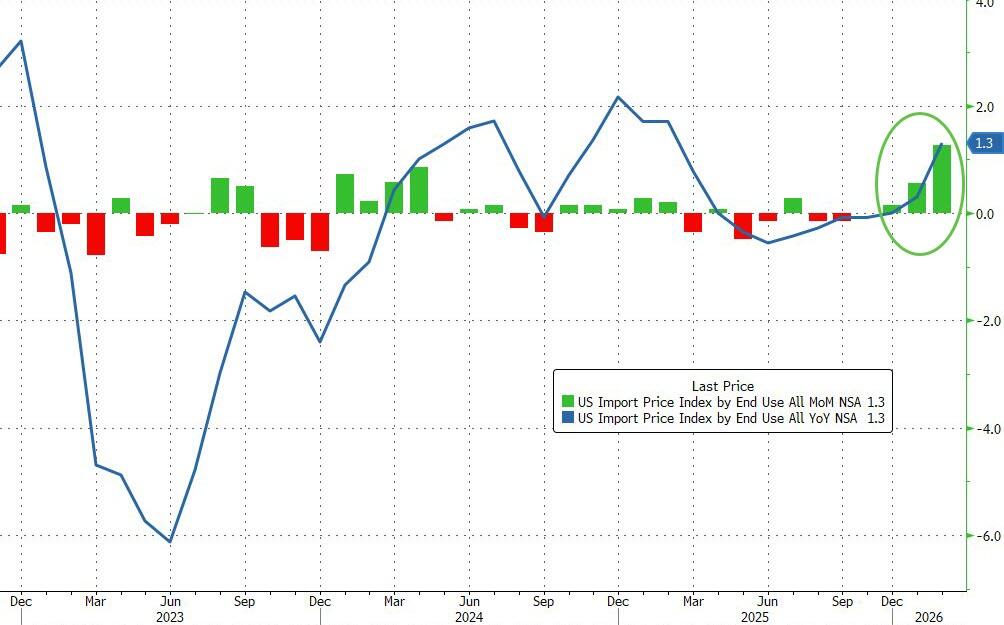
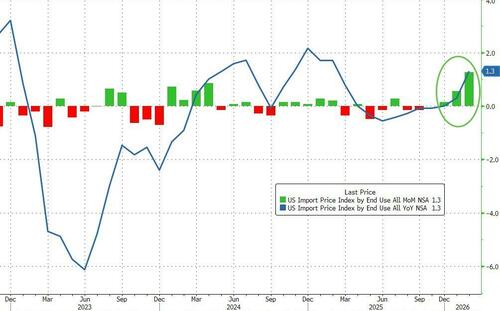
This morning we get yet more confirmation of the second wave of inflation as US Import/Export prices blew expectations away…
US Import prices jumped by 1.5% MoM (the third monthly rise in a row) – the biggest MoM jump since March 2022.
The acceleration in prices pushed import costs up 1.3% YoY – highest since Feb 2025.
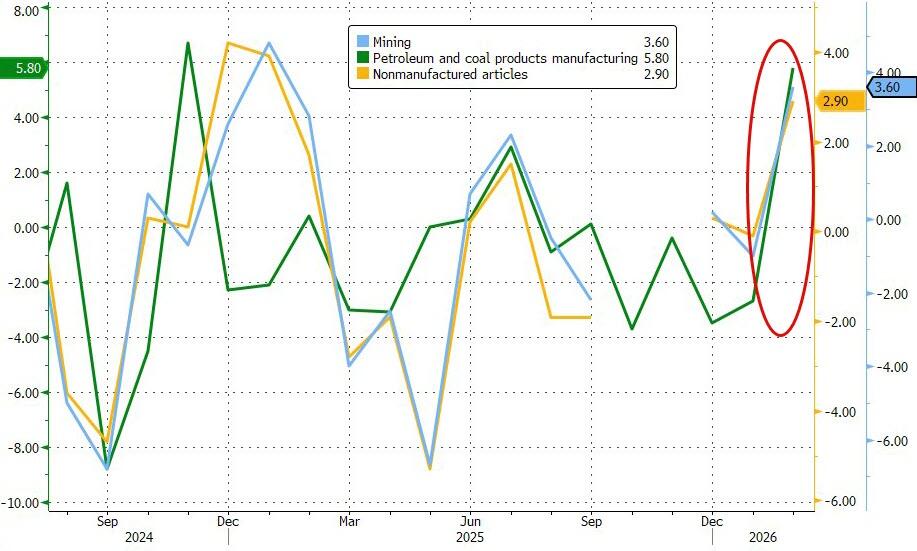
Under the hood, Petroleum, Mining, and Non-manufactured articles were the biggest drivers of the MoM surge in import prices…
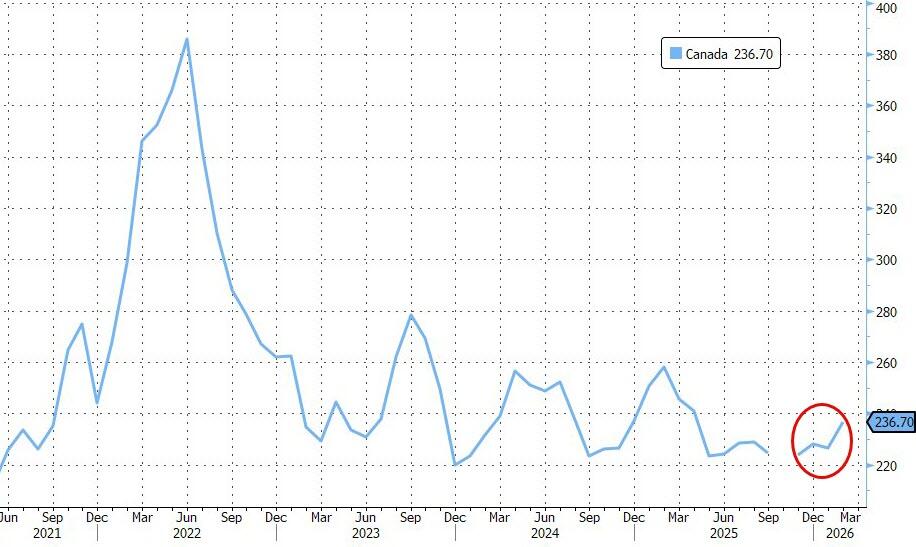
Canadian non-manufactured articles rose the most…
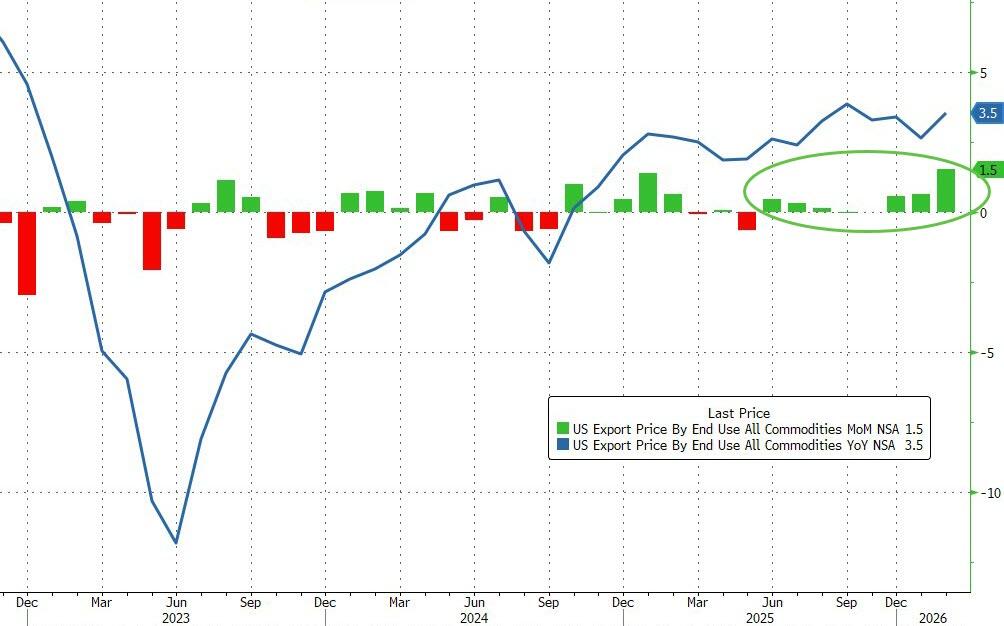
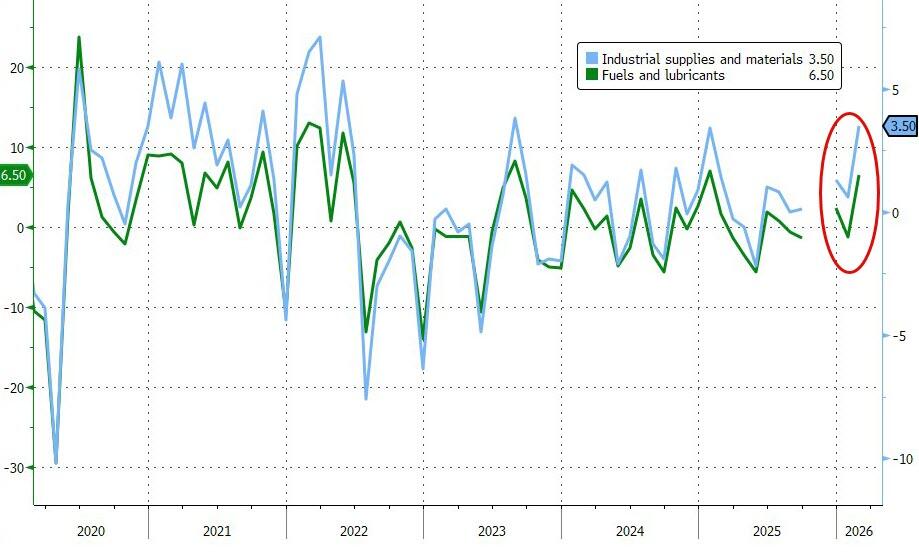
Export prices surged 1.5% MoM – the biggest jump since March 2022 (Russia-Ukraine war) with prices up 3.5% YoY (highest since Sept 2025)
Under the hood, Industrial supplies and Fuels & Lubricants dominated export price hikes…
…and this data is from before the war even started, so expect rate-change odds to shift more hawkish (having already erased any expectations of a cut in 2026).
Tyler Durden
Wed, 03/25/2026 – 09:00
https://www.zerohedge.com/markets/fuels-and-canada-spark-us-importexport-price-surge-february

UFO ‘Gatekeeper’ General Vanishes Days After Trump’s Full Disclosure Order
UFO ‘Gatekeeper’ General Vanishes Days After Trump’s Full Disclosure Order
Authored by Steve Watson via modernity.news,
President Trump’s order to release every UAP and UFO file appears to have triggered a wave of vanishings and deaths among the very insiders who guarded those secrets — and now Congress is being actively blocked from investigating.
The general is retired Maj. Gen. William Neil McCasland, former commander of the Air Force Research Laboratory at Wright-Patterson Air Force Base. He walked out of his Albuquerque home on February 27 with only hiking boots, a wallet, and a revolver. No phone. No glasses. No trace since.
Fox News host Jesse Watters covered the development:
🚨 HOLY SMOKES: AIR FORCE GENERAL — KNOWN AS THE UFO “GATEKEEPER” — VANISHES 💣👀
Led TOP-SECRET SPACE WEAPONS programs tied to ADVANCE AEROSPACE TECH… then GONE😳🛸
Days after UFO files announcement… he DISAPPEARS 🤯
Now MULTIPLE SCIENTISTS MISSING or DEAD — coincidence…… pic.twitter.com/UwsX2dGO50
— Jesse Watters (@JesseBWatters) March 24, 2026
In addition, a rocket scientist tied to the General has also reportedly disappeared under similar circumstances.
🇺🇸 A rocket scientist tied to a missing Air Force general with alleged UFO links has reportedly disappeared under similar circumstances.
At least 6 people connected to the same U.S. defense research network are now dead or missing within a year.
The cases include Monica Jacinto… https://t.co/hhZ3qS2XGR pic.twitter.com/4jAD6EIXCa
— Mario Nawfal (@MarioNawfal) March 22, 2026
Monica Jacinto Reza, 60, vanished while hiking in California’s Angeles National Forest. She co-developed Mondaloy, a patented nickel-based super-alloy for high-performance rocket engines, on a project funded and overseen by programs under McCasland’s command.
Newsmax reported Rep. Tim Burchett directly accusing intelligence agencies of obstruction: some intelligence agencies have thwarted his attempts at finding out what happened to the several prominent scientists and researchers in the U.S. who have reportedly died or gone missing over the past year.
Rep. Tim Burchett says some intelligence agencies have thwarted his attempts at finding out what happened to the several prominent scientists and researchers in the U.S. who have reportedly died or gone missing over the past year. https://t.co/3gnBWyDuIf
— NEWSMAX (@NEWSMAX) March 24, 2026
Burchett told reporters the numbers seem very high in these certain areas of research. “I think we’d better be paying attention, and I don’t think we should trust our government.”
He added there have been several others throughout the country that have disappeared under suspicious circumstances. “I think we ought to be paying attention to it.” Burchett specifically noted McCasland’s suspected involvement in UFO-related matters, saying those folks are very secretive about what they know.
This cluster of at least six dead or missing insiders — all tied to the same classified aerospace network — exploded into public view just as Trump’s February 20 directive kicked into high gear.
The Executive Office of the President has quietly registered the aliens.gov domain, after Trump ordered the Pentagon and every federal agency to hand over all records on “alien and extraterrestrial life, UAP, and UFOs.”
The New York Post reported that the impending release could include videos and photos of non-human craft that would prove we are not alone.
McCasland ran billions in black-budget aerospace R&D. Reza’s alloy fed straight into next-generation propulsion systems under his oversight. Their parallel hiking disappearances, plus the broader pattern of six linked cases, cannot be waved away as coincidence.
Burchett’s revelation that intelligence agencies are actively thwarting congressional inquiries suggests gatekeepers are scrambling. The deep state does not vanish its own people and then block oversight when the story is harmless. It does so when the story threatens the entire house of cards.
Your support is crucial in helping us defeat mass censorship. Please consider donating via Locals or check out our unique merch. Follow us on X @ModernityNews.
Tyler Durden
Wed, 03/25/2026 – 08:45
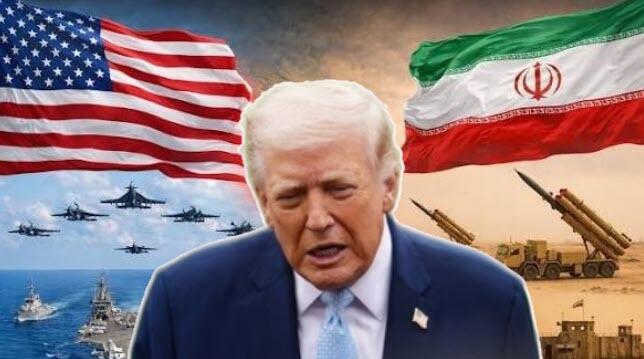
Iran Rejects US Proposed Ceasefire, Won’t Be ‘Fooled Again’ As Attacks Continue With US Troops En Route
Iran Rejects US Proposed Ceasefire, Won’t Be ‘Fooled Again’ As Attacks Continue With US Troops En Route
Summary
Iran Does Not Accept Ceasefire, Says US Talks Illogical: Fars. The statement says that talks are not viable in current conditions, oil jumps.
3,000 elite Army Airborne soldiers & Marines still en route after Trump said Monday says Iran has been destroyed “militarily”.
Iran is tightening control of Hormuz, demanding detailed ship data and in some cases fees for passage
Iran continues to say it is ready for long war, monitors US troop movements: Parliament Speaker says “Do not test our resolve to defend our land.”
* * *
Iran Rejects US Ceasefire Draft Deal: “Illogical”
Confusion reigns over diplomacy as Pakistan reportedly relays Washington’s ceasefire terms to Iran. “A document given to Pakistan by the Trump administration has been presented to the Iranians,” according to Al Jazeera. An alleged early draft can be viewed here.
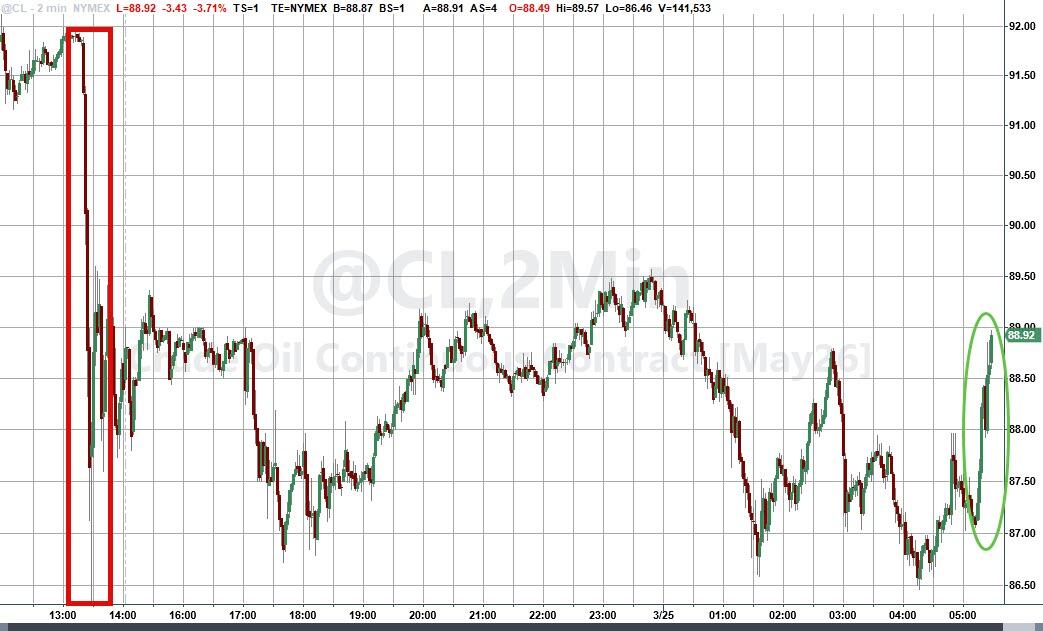
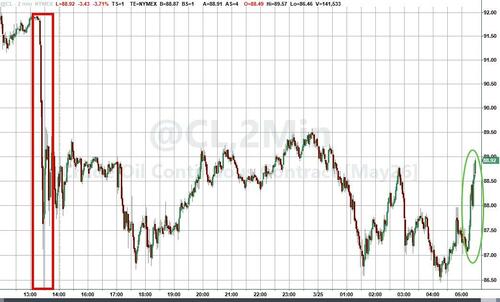
Iran’s Fars citing informed source on ceasefire Wednesday: Iran Does Not Accept Ceasefire, Says US Talks Illogical: Fars. The statement says that talks are not viable in current conditions. Oil jumps on the headline:
Tehran has consistently been denying any negotiations outright, with Iran’s ambassador insists no direct or indirect talks are happening, even as “friendly countries” conduct consultations. Iran’s military also brushed off claims by President Trump, vowing to press on with the fight, and asserting that Washington is merely negotiating with itself, trying to will something into existence which isn’t yet reality.
Bloomberg has summarized where things stand: “Iran kept up missile and drone attacks on Israel and Arab Gulf states, even after the US floated a plan to end a war that’s wreaked havoc across the Middle East and in global markets.” The below are also key points:
Iranian officials have told the countries trying to mediate peace talks with the U.S. that they have now been tricked twice by President Trump and “we don’t want to be fooled again,” according to a source with direct knowledge of those discussions. They worry Trump is buying time as he brings more military equipment to the Middle East.
Iran has received an American 15-point plan for a ceasefire for the Iran war through intermediaries from Pakistan, officials in Islamabad said Wednesday. The proposal was sent even as Washington began to move paratroopers to the Middle East to back up a contingent of Marines already heading to the region.
Iran military spokesman: “Have your internal conflicts reached the point where you’re negotiating with yourselves?“
🔺NEW: Spokesman for Khatam al-Anbiya Central Headquarters addresses the U.S.:
🔹“Have your internal conflicts reached the point where you’re negotiating with yourselves?”
🔹“Don’t call your defeat an ‘agreement’. You will see neither your investments in the region nor previous… pic.twitter.com/PHackJjyjf
— Drop Site (@DropSiteNews) March 25, 2026
Trump’s “Very Big Present” & Hormuz Leverage
Trump, meanwhile, claims Iran offered a “present…worth a tremendous amount of money,” tied to energy flows through the Strait of Hormuz – but provided no details. At the same time, the US is ramping troop deployments even as it touts negotiations to end the conflict. He also claimed “we are… talking to the right people” in Iran, adding to the confusion and ambiguity.
On the ground, Iran is tightening control of Hormuz, demanding detailed ship data and in some cases fees for passage – especially for oil and gas tankers. Traffic has thinned, with non-compliant vessels turned away, raising pressure on Asian economies like India and drawing pushback from China.
Hundreds of vessels still remain paralyzed, after Iran adopted an “eye for an eye” policy to re-establish deterrence and impose sever costs on both America’s Gulf partners and the global economy. Here’s the latest on Iran’s statements and policy regarding passage:
Iran has said that “non-hostile” ships may transit the Strait of Hormuz amid a collapse of maritime traffic through the waterway that has prompted the biggest global energy crisis in decades.
In a statement on Tuesday, Iran’s mission to the United Nations said vessels may avail of “safe passage” through the waterway, “provided that they neither participate in nor support acts of aggression against Iran and fully comply with the declared safety and security regulations.”
Tit-for-Tat Hits On Key Infrastructure
US-Israeli strikes on Iran continue, while Iranian missiles trigger alarms across Israel. Gulf states are still feeling the pain, with Saudi Arabia and Bahrain intercepted incoming threats, while Kuwait reported a fire at its main airport after a fuel tank was hit, according to Bloomberg.
Israel says it has crossed the 15,000-munitions mark in strikes on Iran since late February – highlighting the scale of the conflict, now far exceeding prior rounds of fighting. On Wednesday, the Israel Defense Forces (IDF) said the air force has carried out multiple new waves of airstrikes over Tehran, targeting what it described as Iranian regime infrastructure.
This has apparently included Iran’s only submarine development facility, as part of a broader wave of attacks on weapons production sites around Isfahan. According to the IDF, the targeted underwater R&D center is the “only site in Iran responsible for the planning and development of submarines and auxiliary systems for the Iranian navy.” It added: “The regime produced various models of unmanned vessels at the site.”
Reports say Iran again targeted Israel’s largest power plant in Hadera (Orot Rabin):
BREAKING: Reports claim Iran again targeted Israel’s largest power plant in Hadera (Orot Rabin), but the missile landed several kilometers away. pic.twitter.com/bLmnQ5HFWy
— The Breaking Minutes (@BreakingMinutes) March 25, 2026
Israel is also escalating in Lebanon, bombing Beirut and pushing deeper into the south as it signals plans for a longer-term occupation zone.
Tehran ‘Closely Monitoring’ US Troop Deployments
Iranian officials are issuing stark warnings, most importantly with parliament speaker Mohammad-Bagher Ghalibaf having declared: “We are closely monitoring all US movements in the region, especially troop deployments. Do not test our resolve to defend our land.” He added, “What the generals have broke, the soldiers can’t fix; instead, they will fall victim to Netanyahu’s delusions.”
Official casualty latest per Pentagon: 232 U.S. service members have been injured since the start of the conflict, a U.S. Central Command spokesperson has said. Of those, 207 have returned to duty and 10 are seriously wounded. At least 13 have been killed.
As for the US troops, it’s anything but clear at this point what comes next after they finally arrive in the region. There’s talk that Trump could order a Kharg Island takeover, which itself would be ultra high-risk, given how deep inside the narrow strait that the island lies.
Meanwhile WSJ reviews of the above mentioned Ghalibaf: “Iran’s combative Parliament speaker, Mohammad-Bagher Ghalibaf, is emerging as an unlikely figure in Washington’s search for a deal to halt a widening Middle East war.”
We went from “no more wars” to Fox News showing where US troops are going to invade Iran. pic.twitter.com/MxftEv5954
— Nathan Hughes (@rallynate) March 24, 2026
“Ghalibaf, a former Islamic Revolutionary Guard Corps air-force commander and Tehran mayor, has denied any talks with the U.S. are under way,” the report continues. “He has taunted President Trump and Defense Secretary Pete Hegseth and called the U.S.-Israeli air war with Iran a quagmire. He served in the Revolutionary Guard during Iran’s brutal war with Iraq in the 1980s and is known as a hard-liner’s hard-liner.”
But, the report notes, “At the same time, he is credited with helping to modernize Tehran while he was mayor, becoming famous for riding his motorcycle around town and expanding major highways and the metro system in a traffic-clogged city. In 2008, he traveled to the World Economic Forum in Davos, Switzerland, portraying himself as a leader with a more business-friendly attitude than other parts of the regime.” Some analysts have said that Washington could eventually work with him.
Tyler Durden
Wed, 03/25/2026 – 08:30
Stock Futures Surge, Oil Tumbles On Iran Ceasefire Optimism
Stock Futures Surge, Oil Tumbles On Iran Ceasefire Optimism
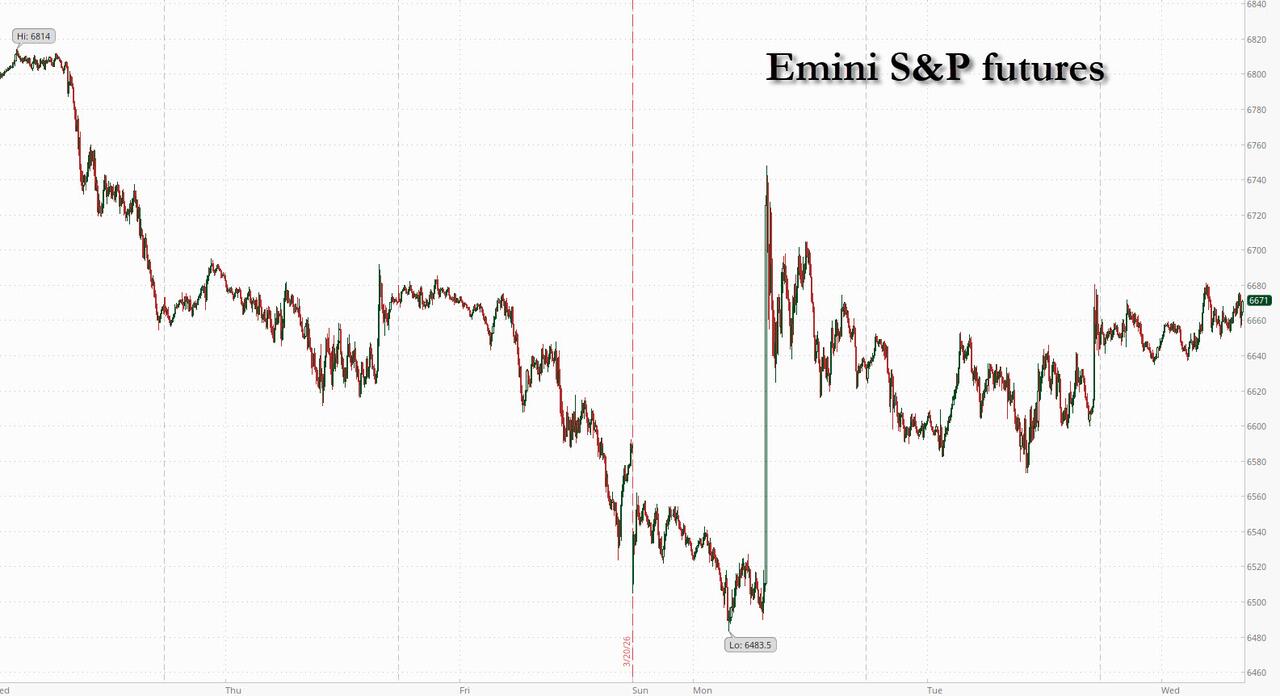
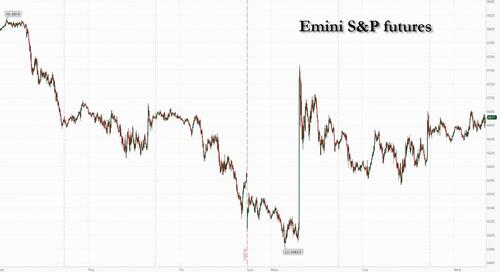
US futures are sharply higher and oil tumbles as the US reportedly offered a15-point plan to help bring the conflict to a close triggering a global rally; Meanwhile Iran is said to have rejected the plan and kept up missile and drone attacks on Israel and Arab Gulf states in response to attacks on its own facilities, while the US continues to move new military assets into place ahead of Trump’s deadline to reopen the SoH. So the situation remains fluid. Even so, S&P futures rose 1.0% and Nasdaq futures gained over 1.1% , with all Mag 7 stocks higher pre-market; Semis and Cyclicals ex-Energy are higher with some defensives such as healthcare maintaining a bid. The yield on two-year Treasuries dropped four basis points to 3.86% while 10Y yields traded down to 4.31%; the USD is flat and commodities are selling off. Energy and natgas are weaker; Brent fell 6% to below $99 a barrel even as the Strait of Hormuz remained effectively shut as a diplomatic push by the US to try to end the war with Iran gathered pace, eclipsing news of more troops being sent to the region; precious metals are rallying despite the USD being flat. Meanwhile, reminding us that another war is taking place, drones attacked Russia’s Ust-Luga port on the Baltic Sea, setting it on fire as Ukraine carried out the most intense air strike on its foe in more than a year. Today’s US economic data calendar includes February import/export priced index and 4Q current account balance (8:30am). Fed speaker slate includes Miran at 4:10pm
In premarket trading, Mag 7 stocks all rise (Alphabet +1.3%, Amazon +1.3%, Apple +0.8%, Nvidia +1.5%, Meta +0.9%, Microsoft +1%, Tesla +1.8%). Miners such as Newmont Corp. and Freeport-McMoRan Inc. were among the biggest gainers in US premarket trading.
Arm Holdings (ARM) rises 12% after the semiconductor designer said it will start selling its own chips for the first time. The new business is expected to generate about $15 billion annually within five years.
Blaize Holdings (BZAI) soars 42% after the semiconductor device company reported its fourth-quarter results and gave an outlook that analysts are positive on.
Braze (BRZE) gains 21% after the software company forecast revenue for the first quarter that was higher than the average analyst estimate. The company also reported better-than-expected revenue for the fourth quarter.
Chewy (CHWY) gains 6% after online retailer of pet food posted fourth-quarter results.
General Motors Co. (GM) climbs 2% after Wolfe raised its rating to outperform, saying investors may be underestimating several tailwinds, including a lower net tariff burden.
EchoStar (SATS) rises 5%, Rocket Lab (RKLB) gains 3% and AST SpaceMobile (ASTS) climbs 3% as the Information reports that SpaceX aims to file a prospectus for an initial public offering as soon as this week.
KB Home (KBH) falls 4% after the single-family home builder forecast deliveries for the second quarter that missed the average analyst estimate.
Sturm Ruger & Co. (RGR) rises 5% after the gunmaker said Beretta Holding said it’s prepared to commence a tender offer for up to 20% of the outstanding shares not already owned at a purchase price of $44.80 per share.
Terns Pharmaceuticals (TERN) gains 5% after Merck & Co. agreed to buy the drugmaker in a $6.7 billion deal.
In other corporate news, Meta’s rollout of new display-equipped Ray-Ban smart glasses in the EU has been hampered by battery and AI regulations in addition to supply constraints. Amazon, Qualcomm Ventures and Tether are among investors in robotics startup Neura’s latest funding round. SpaceX aims to file a prospectus for its IPO as soon as this week, The Information reported.
In AI news, Arm shares are up in premarket trading after the chip designer said it will begin selling its own chips for the first time, adding a business that it expects to generate about $15 billion annually within five years. OpenAI plans to discontinue its Sora AI video generator six months after the high-profile launch of a standalone app for the service. It will also wind down a partnership with Disney which had centered on Sora. Disney’s CEO has now seen two technology bets falter in a week.
Traders are finding some relief after weeks of headline-driven volatility that have left the S&P 500 on track for its biggest monthly loss in a year. The overnight mood was lifted by news that the US sent Iran a 15-point plan to resolve the conflict. Details are still coming out, but the AP reported that it includes sanctions relief, a rollback of Iran’s nuclear program, missile limits and access for shipping through the Strait of Hormuz. Despite Wednesday’s rebound, investors remain wary as Iran kept up attacks on neighboring states and several officials signaled that the Islamic Republic isn’t ready to negotiate.
“There’s a rebound in risk appetite this morning, which makes sense given the newsflow, but for us this is no time to buy the rally,” said Christophe Boucher, chief investment officer at ABN Amro Investment Solutions. “One can actually feel the algos reacting to the ‘peace’, ‘negotiation’ and ‘ceasefire’ keywords.”
For Francisco Simón, European head of strategy at Santander Asset Management, the sustainability of today’s rally will depend heavily on a constructive response from Iran, and the situation on the ground meant investors should remain cautious.
“The outcome does not depend solely on the US,” he said. “The regional geopolitical landscape remains complex, involving multiple actors, most notably Iran, which retains meaningful negotiating leverage. This continues to introduce an additional layer of risk, particularly through the energy channel.”
Oil fell, with WTI back down to around $88 a barrel. The retreat in oil prices prompted traders to scale back expectations for tighter monetary policy from central banks. Swaps now price in less than a one-in-five chance of a Federal Reserve interest-rate hike this year, while pointing to between two and three increases from the Bank of England. Traders priced in three BOE hikes on Tuesday. ECB President Christine Lagarde also pushed back against expectations of an imminent response to higher energy prices, saying that the ECB could look through a limited, short-lived shock.
While bond markets continued to signal a more negative scenario for the war than equities, “these perspectives should converge once visibility improves, likely returning to a more benign baseline,” said Roberto Scholtes, head of strategy at Singular Bank.
The impact on companies and supply chains continues to play out. Airgas said it will curtail helium shipments after Qatar halted production at a major LNG facility. Governments are rushing to secure supplies of critical crop nutrients ahead of the spring planting season. And the Trump administration is said to be preparing to expand the opportunity for sales of higher-ethanol E15 gasoline this summer.
Europe’s Stoxx 600 advanced 1.4%, heading for its first three-day run of gains since the conflict began. Mining and technology stocks are leading gains, while telecoms and personal care shares are the biggest laggards. Here are the biggest movers Wednesday:
UBS shares rise as much as 2.6% amid broader gains for financials and as Bank of America analysts reiterate a buy rating on the Swiss firm
Diageo rises as much as 2.5% after BNP Paribas upgraded the drinksmaker’s stock to neutral from underperform, citing improved risk-reward following material underperformance and trough valuation levels
Croda shares rise as much as 5.4% after Morgan Stanley raised the stock to overweight from equal-weight, the second bank to upgrade the stock this week
Grifols shares rise as much as 9.5%, the most since July 30, following the Spanish blood plasma company’s plan to list a minority stake in its US biopharma business
Lanxess shares soared 16% after JPMorgan double upgraded the German specialty chemical company, saying it should get an earnings boost as the war in Iran eases competitive pressures and increases pricing power
Volex shares rise as much as 13% after the UK connectivity and power product group said it expects financial performance to be significantly ahead of market expectations
ASOS shares rise as much as 17%, the most in more than four months, after the online fashion retailer posted first-half earnings that surpassed analysts’ forecasts
RS Group shares drop as much as 6.7%, the most in 14 months, after the distributor of electronic and industrial products warned like-for-like sales are expected to decline in the year to the end of March
Reckitt Benckiser shares fall as much as 2.8% after JPMorgan (neutral) cut its first-quarter sales forecast for the consumer goods company, citing weak seasonal over-the-counter products and destocking after a poor flu season
Inwit shares slide as much as 9.9% after key customer Swisscom sought to terminate their service agreement in 2028, a move that escalates a dispute between the two parties
Earlier, Asian stocks rose for a second session, with all major markets in the green, as hopes for a de-escalation of the Iran war gathered strength on reports of diplomatic efforts by the US. The MSCI Asia Pacific Index rose as much as 2.4%, the most since March 10, with chipmaker TSMC among the biggest contributors. Benchmarks rose more than 1.5% each in South Korea, Japan, India and Taiwan.
The rebound in risk assets was driven by expectations of a negotiated settlement in the Middle East conflict. The US has presented Iran a 15-point plan to end the war, people familiar with the matter told Bloomberg News, while Israel’s Channel 12 reported that Washington is seeking a one-month ceasefire for negotiations. Elsewhere in the region, Indonesian stocks gained as the market reopened after a weeklong holiday. Australian shares climbed as inflation rose less than expected in February.
In FX, the US dollar is unchanged, while the Aussie dollar is leading declines against the greenback, falling 0.5%. The pound is little changed after UK inflation held at an 11-month low in February as expected.
In rates, treasuries were relatively stable overnight, broadly holding Tuesday’s late gains into the US session as the Trump administration stepped up efforts for ending the war with Iran.US yields lower by 3bp to 4bp across the curve with spreads broadly trading within a basis points of Tuesday close. US 10-year yields trade around 4.32%, near bottom of day’s range and with 10-year note futures trading toward top of Tuesday range — in the 10-year sector bunds and gilts outperform Treasuries by 2.5bp and 5bp on the day. Oil prices hold losses, supporting European bonds over the London session. In the UK, February CPI data printed broadly in-line with estimates, while PPI data was slightly softer than estimates. US session focus includes a 5-year note auction, which follows Tuesday’s poor 2-year auction. This week’s Treasury auction cycle resumes with a $70 billion 5-year note sale at 1pm New York, following a weak 2-year note auction on Tuesday that tailed the WI by 1.8bp. The WI 5-year at ~3.972% is ~36bp cheaper than the February stop-out, which tailed the WI by 0.7bp
In commodities, WTI and Brent futures both trade lower by over 5% on the day, supporting S&P futures (+1.0%) and lower Treasury yields, following report that the US drafted a 15-point plan to help bring the Iran conflict to a close. Brent crude futures for May fall about 5% to around $99 a barrel, while WTI traded around $88 a barrel. European natural gas futures drop 5.5%. Precious metals gain.
Today’s US economic data calendar includes February import/export priced index and 4Q current account balance (8:30am). Fed speaker slate includes Miran at 4:10pm
Market Snapshot
S&P 500 mini +0.9%
Nasdaq 100 mini +1.1%
Russell 2000 mini +1.4%
Stoxx Europe 600 +1.5%
DAX +1.8%
CAC 40 +1.6%
10-year Treasury yield -4 basis points at 4.32%
VIX -1.4 points at 25.53
Bloomberg Dollar Index -0.1% at 1207.99
euro little changed at $1.1602
WTI crude -5.2% at $87.51/barrel
Top Overnight News
Iranian officials have told the countries trying to mediate peace talks with the U.S. that they have now been tricked twice by President Trump and “we don’t want to be fooled again,” according to a source with direct knowledge of those discussions. They worry Trump is buying time as he brings more military equipment to the Middle East. Axios
Iran has received an American 15-point plan for a ceasefire for the Iran war through intermediaries from Pakistan, officials in Islamabad said Wednesday. The proposal was sent even as Washington began to move paratroopers to the Middle East to back up a contingent of Marines already heading to the region. AP
Chinese artificial intelligence service stocks rallied after state media highlighted a sharp increase in domestic AI model adoption and a surge in token usage they generate. BBG
Chevron’s refining head warned that California is heading toward a fuel crisis and that it may quit refining oil in the state unless officials roll back taxes and regulations. BBG
Australia’s inflation eased slightly in February, but remained well above the central bank’s target range, keeping the door open for a further rise in interest rates. Headline inflation was 3.7% on-year in February, easing from 3.8% in January, but still well above the 2% to 3% range targeted by the Reserve Bank of Australia. WSJ
The U.K.’s annual rate of inflation was unchanged in February, but is set to rise over the coming months as energy and food prices jump in the wake of the U.S.-Israel conflict with Iran. CPI was inline on the headline for Feb at +3%, but ran slightly ahead on core (+3.2% vs. the Street +3.1%) and services (+4.3% vs. the Street +4.2%). WSJ
SpaceX may file an IPO as soon as this week, The Information reported. The company may try to raise more than $75 billion, but won’t decide until a few weeks before the offering. BBG
DHS funding deal receives critical pushback from both sides of the aisle, raising doubts about whether an agreement is imminent. Politico
The DOJ acknowledged that they did not have evidence of wrongdoing in its criminal investigation of the Fed over the cost of its building renovations, according to a transcript of the court proceedings. WaPo
A more detailed look at global markets courtesy of Newsquawk
APAC stocks traded higher with risk sentiment spurred by hopes of a halt to the Iran conflict after optimistic comments from US President Trump regarding negotiations, while it was reported that the US was working on a 1-month ceasefire and offered a 15-point plan to Iran for ending the conflict. ASX 200 rallied with gains led by outperformance in mining stocks as gold producers cheered a rebound in the precious metal, while the federal and Queensland governments announced a AUD 2bln bailout for Rio Tinto’s Boyne aluminium smelter. Nikkei 225 outperformed and returned to above the USD 53,000 level as Iran ceasefire hopes to alleviate the recent oil and inflation-related pressures. Hang Seng and Shanghai Comp were positive, albeit to varying degrees throughout the day, as participants digested a slew of earnings releases, while the PBoC conducted a CNY 500bln on 1yr MLF operation.
Top Asian News
Australian Inflation Rate YoY (Feb) Y/Y 3.7% vs. Exp. 3.8% (Prev. 3.8%, Low. 3.5%, High. 4.0%).
Australian Inflation Rate MoM (Feb) M/M 0.0% vs. Exp. 0% (Prev. 0.4%, Low. -0.2%, High. 0.4%).
Australian RBA Weighted Median CPI YoY (Feb) Y/Y 3.5% vs. Exp. 3.6% (Prev. 3.6%).
Australian RBA Weighted Median CPI MoM (Feb) M/M 0.2% vs. Exp. 0.3% (Prev. 0.3%).
Australian RBA Trimmed Mean CPI YoY (Feb) Y/Y 3.3% vs. Exp. 3.4% (Prev. 3.4%, Low. 3.3%, High. 3.4%).
Top European News
UK Business Secretary Kyle is to hold emergency talks with company bosses Wednesday morning about the impact of the Iran war on the UK economy, Sky News reported.
Nigel Farage’s Reform UK abandoned pledge to nationalise water and energy companies, according to FT.
Danish PM Frederiksen’s bloc wins the election but lacks the majority with the left bloc winning 84 seats, right bloc gets 77 seats, and Danish moderate party wins 14 seats to become kingmaker, according to AFP.
US President Trump endorses Hungarian PM Orban, stating he’s a truly strong and powerful leader with a proven track record delivering of phenomenal results.
FX
DXY is slightly firmer this morning, with the trough of the day coinciding with its 21 DMA at 99.07 (vs peak of 99.42). Geopols once again the main driver of action for the index this morning; to recap, a US-led 15-point ceasefire plan has been formed, whilst Iran has denied negotiations entirely. Earlier today, the index dipped off best levels on reports that Iran had received the 15-point plan, pointing to some initial progress to diplomacy. DXY fell from 99.36 to 99.25 within a few minutes, before then reversing much of that move thereafter.
G10s are entirely lower vs USD this morning. The net-importers of energy regions (EUR, GBP, JPY) appear to be faring better vs peers, given the pressure in crude prices in recent trade. Antipodeans are underperforming, with underperformance in the Aussie in the aftermath of the slightly softer-than-expected Australian monthly inflation data.
EUR has had some ECB speak to digest this morning, and a few regional data points. ECB President Lagarde highlighted that “small, one-off and short-lived supply shocks can be looked through”, but noted that it “will not be paralysed by hesitation”. No move on her comments. Chief Economist Lane also provided some commentary, where he stated that market-based inflation expectations have risen since the start of the Iran conflict. Also, in the rearview, German Ifo metrics were fairly resilient, with Business Climate holding steady at 88.6 (topping expectations), whilst Expectations dipped to 86.0 (prev. 90.2). ING believes the recent Middle East conflict should only “delay, not derail” the rebound in Germany. EUR is currently a touch lower vs USD, and trades within a 1.1587-1.1630 range.
GBP is also incrementally lower vs the USD, holding within a 1.3370-1.3436 range and trading in close proximity to its 100 DMA (1.3407), 21 DMA (1.3390) and 200 DMA (1.3433). Cable saw some fleeting upside on this morning’s inflation report, where headline printed a touch below expectations though core and services Y/Y figures topped expectations. Ultimately, the data lacks significance given it surveys the February period, before the Iran conflict began. Nonetheless, the series marginally adds to the stagflationary diagnosis the UK economy is currently subject to.
Barclays FX month-end rebalancing: strong USD buying against most majors, and moderate buying against the EUR, JPY and GBP.
Central Banks
Fed’s Goolsbee (2027 voter) said energy shocks can pose risks to both sides of the Fed mandate, while he doesn’t know if they can cut rates again and it depends on how long the war will last. Possible that energy prices could stay high after the war ends. Likely to see a downturn in consumer sentiment. It’s not an obvious playbook for what to do and it’s a bad situation for a central bank.
Fed’s Barr (voter) sees rates holding steady for some time and wants evidence of sustainable inflation retreat. Labour market seems to be stabilising. Middle East conflict raises additional risk.
ECB’s Lagarde said “Small, one-off and short-lived supply shocks can be looked through. But as expected deviations from our inflation target grow larger and more persistent, the case for action becomes stronger.”. “When the energy shock hit in 2021–22, several of these channels were operating simultaneously. But there are factors today which point to a lesser pass through.”; namely, the initial shock has thus far been smaller, and today’s macroeconomic backdrop is more benign. “We will not act before we have sufficient information on the size and persistence of the shock and its propagation. But we will not be paralysed by hesitation: our commitment to delivering 2% inflation over the medium term is unconditional.”
ECB’s Lane said the central bank will at every meeting consider what the scenario is before setting policy.
BoJ Minutes from the January 22nd-23rd meeting stated some members expressed the recognition that the Bank was currently at the stage of closely monitoring developments in economic activity and prices as well as financial conditions.
Riksbank Minutes (Mar): Thedeen said “Our starting point with low inflation gives us some respite until we have a clearer picture of the economic consequences of the war…”.
RBA Assistant Governor Jones said RBA is shifting focus from if to how on digital tokens.
RBNZ Chief Economist Paul Conway urged New Zealand’s government to pursue structural reforms to lift productivity, saying monetary policy can’t solve the cost-of-living crisis alone.
Fixed Income
A bullish start to the day as the progress towards a ceasefire weighs on the energy space, allowing yields to ease from highs and in turn underpinning the fixed income space. Thus far, USTs have been as high as 110-30 with gains of 17 ticks at best. However, the benchmark remains shy of the WTD peak at 1110-04+ and by extension well off recent peaks.
Elsewhere, EGBs and Gilts are bid, with gains of 43 and 53 ticks respectively, but off best levels by around 20 and 40 ticks.
Bunds unreactive to remarks from ECB’s Lagarde and Lane, which largely stuck to the script from last week. Elsewhere, the March German Ifo series was better than expected, though the readings did decline from the prior, with the exception of the Current Assessment. However, the series clearly shows that the economy is feeling the impact of the Middle East situation, but participants are yet to determine if the crisis is a lasting one or not, in terms of its economic impact. In short, further evidence of stagflation in the EZ.
For Gilts, the bias was bullish given the above. However, the February CPI series marginally added to the stagflationary diagnosis the UK economy is currently subject to. Nonetheless, Gilts opened higher by around 35 ticks before climbing to an 88.62 peak with gains of 99 ticks at best. Ahead, BoE’s Greene may weigh in on the UK’s precarious economic situation.
Germany sells EUR 1.726bln vs exp. EUR 2.0bln 2.60% 2041 and 0.00% 2052 Bund.
Italy sells EUR 2.0bln vs exp. EUR 1.75-2.0bln 2.20% 2028 BTP & EUR 2.0bln vs exp. EUR 1.5-2.0bln 1.10% 2031, 1.80% 2036 BTPei.
German KfW Head of Capital Markets said Euro Green bond issuance “likely to come early” in Q2; Issuance window is now shorter amid the conflict.
Commodities
WTI and Brent futures have pulled back this morning in a continuation of the premium unwind following reports the US is proposing a one-month ceasefire mechanism being developed by Witkoff and Kushner, similar to frameworks used in Gaza and Lebanon, whilst US also sent Iran a 15-point plan to end the war (full Newsquawk Analysis on the board). Iranian representatives reportedly told the Trump administration that the bar for returning to ceasefire talks remains high. There are also efforts to begin talks as soon as Thursday. The reports of US diplomatic drive have driven cautious optimism that the conflict may ease, helping lift equities and weigh on crude. Brent is trading below USD 96/bbl (in a USD 93.45-97.00/bbl range), while WTI trades a little beneath USD 89/bbl (in a USD 96.59-89.57/bbl range), despite the continued disruption in the Strait of Hormuz and additional US troop deployments to the Middle East.
Nat gas prices meanwhile are weaker by some 7.5% at the time of writing, trading on either side of EUR 50/MWh, whilst reports suggested Dutch gas storage levels fall to the lowest point for this time of the year since 2010.
Spot gold edged higher overnight and returned above the USD 4,500/oz level amid softer yields and lower oil prices, with the bullion currently within USD 4,456-4,602/oz. Analysts at ING suggest that “Near term, gold remains highly sensitive to Fed policy expectations, currency moves and geopolitical developments. Risks remain elevated as Iran retains control over the Strait of Hormuz and Israel continues operations against Iranian assets.”
Copper futures benefit alongside the positive risk environment amid hopes for a ceasefire in the Iran conflict, with 3M LME copper in a USD 12,192.00- 12,348.35/t. Desks also suggest that positioning data points to a cautious rebound in risk appetite across base metals.
Russia’s Baltic Sea ports of Primorsk and Ust-Luga have reportedly suspended crude oil and oil products loadings after drone attacks.
Russia is reviewing its energy supply chains amid Middle-East crisis to prioritise neighbouring nations, Tass reports.
Hungarian PM Orban said gas flows to Ukraine will stop until oil flows through the Druzhba pipeline resumes.
Japanese PM Takaichi requests the IEA to prepare additional oil release if needed, and met with IEA Executive Director Birol.
IEA said it stands ready to release additional volumes from strategic oil reserves as required to support market stability.
Valero (VLO) is said to be preparing its Port Arthur refinery to restart.
Italian PM Meloni to meet top Algerian officials today in an effort to secure alternative gas supplies, according to FT.
US President Trump’s administration is expected to lift summer gasoline regulations to curb energy prices as soon as Wednesday, according to sources.
Venezuela’s opposition leader Machado said the country requires USD 150bln to boost oil output to 5mln bpd.
Cosco (601919 CH / 1919 HK) have resumed new bookings for standard containers to the UAE, Saudi Arabia, Bahrain, Qatar, Kuwait and Iraq, effective immediately.
Trade/Tariffs
China’s Commerce Ministry, on Mexico’s tariff increases on Chinese and non-FTA products, said it creates investment barriers; said China reserves the right to take measures.
Geopolitics
Iranian source says Pakistan has handed a US proposal to Iran, while the venue of talks is still being discussed, Reuters reports.
Iran has reportedly received the 15-point US ceasefire proposal, according to AP citing Pakistani officials. The Pakistani officials described the proposal broadly as touching on sanctions relief, civilian nuclear cooperation, a rollback of Iran’s nuclear program, monitoring by the International Atomic Energy Agency, missile limits and access for shipping through the Strait of Hormuz.
Iran’s Ambassador to Pakistan said there were no talks between the US and Iran, either directly or indirectly, IRNA reported; said “friendly countries” seek to lay the ground for talks, “hopes these efforts can help in ending the war”.
Iran suspects US President Trump’s peace talk push is a trick, while Iranian officials told countries attempting to mediate peace talks that they have been tricked twice by Trump and don’t want to be fooled again, according to a source cited by Axios.
Iranian officials have told the Trump administration via channels that they do not want to resume negotiations with Envoy Steve Witkoff and Jared Kushner, while it prefers to negotiate with VP JD Vance.
Iranian representatives have communicated to the Trump administration a high bar for re-entering ceasefire negotiations, according to people familiar with the matter cited by WSJ/Dow Jones.
United Command of Iranian Armed Forces spokesperson said US is negotiating with itself, according to IRNA.
Iranian Foreign Ministry spokesperson said there is no dialogue or negotiations with the US; no one trusts US diplomacy. Forces are focussed on defense.
Iranian Navy Commander says USS Lincoln strike group is under constant Iranian monitoring and will be targeted as soon as it comes within range of missile systems, SNN reports.
A senior analyst with knowledge of the ongoing ceasefire talks said that discussions between the US and Iran were making quiet but swift progress.
Israel’s UN envoy said Israel is not part of negotiations between the US and Iran.
US and Arab officials say mediators from Turkey, Egypt and Pakistan are pushing to have a meeting arranged between US and Iran in the next 48 hours, but both sides remain far apart, according to WSJ.
Trump administration increasingly using US Treasury Secretary Bessent to communicate its case on Iran as it seeks to contain market fallout, Semafor reported. Some critics called the choice unusual and a sign of dysfunction, while others said his standing in economic circles made him a credible spokesman. White House officials said he was key to reassuring markets and the public.
US orders 82nd Airborne army paratroopers to the Middle East as earlier flagged, according to Washington Post. US officials said that seizing Kharg Island is among the plans the administration is considering.
US Senate voted 53-47 to block resolution that would limit President Trump’s Iran war power.
Israel hit a Russian-Iranian weapons smuggling route in the Caspian Sea, according to WSJ.
IDF said it has started a new wave of strikes targeting Iranian regime’s infrastructure in Tehran.
Five explosions at a missile site in Isfahan this morning, Al Hadath reported citing Iranian media.
IAEA Chief Grossi said talks between Washington and Tehran on the nuclear program and other issues may be held in Islamabad in the coming days.
Kuwait’s General Authority of Civil Aviation said drones targeted fuel tanks at Kuwait’s international airport, causing a fire, although there were no casualties reported.
UK PM Starmer said UK is now working with partners on a plan to ensure flows of goods through key maritime routes, following a call with the Saudi Crown Prince.
US Event Calendar
7:00 am: United States Mar 20 MBA Mortgage Applications, prior -10.9%
8:30 am: United States Feb Import Price Index MoM, est. 0.6%, prior 0.2%
8:30 am: United States 4Q Current Account Balance, est. -208.5b, prior -226.4b
4:10 pm: United States Fed’s Miran in Moderated Conversation on Digital Assets
DB’s Jim Reid concludes the overnight wrap
Markets continue to gyrate around the latest Iran headlines, with softness earlier yesterday amid doubts on the status of any negotiations between the US and Iran giving way to more optimism late in the US session and into Asia this morning. So that sent Brent crude on a decent roundtrip, peaking at $105/bbl just after the European close but falling back to $100 by the end of the US session, and down to $99.38 as I type. Together with inflationary signals from the flash PMIs, that backdrop had seen sovereign bonds lose ground as investors priced in more hawkish central banks, though 10yr Treasuries (+1.9bps to 4.36%) pared back most of an 8bp intra-day rise by the close and have rallied another -1.6bps this morning. And while US equities struggled yesterday, with the S&P 500 falling -0.37%, its futures are up by a larger +0.72% this morning. So it’s fair to say we’re a bit all over the place but that sentiment net net is on the up since the later part of the US session.
In terms of the latest on the conflict, investors were trading headlines once again, with oil prices clearly moving on the back of different reports. Initially that had led to a negative mood as the war showed no sign of easing up. Indeed, Israel’s defence minister Israel Katz said that strikes on Iran were continuing at “full intensity”.
However, a flurry of reporting and commentary on possible talks then emerged during US hours. A key trigger for an improved mood came just after the US equity close as Israel’s Channel 12 reported the US was proposing a one-month ceasefire for talks as it sent Iran a 15-point plan to end the conflict, with the details of the plan also reported by Axios and New York Times. A little earlier Trump said that Iran had offered a “present” related to energy flows through the Strait of Hormuz as a show of good faith and that Secretary of State Rubio and Vice President Vance were also involved in the negotiations.
So while it’s not clear just how receptive Tehran is to Washington’s diplomatic push, the news helped take some of the risk premia out of oil markets, with Brent crude dropping by about $4//bbl late in the US session to close at $99.91/bbl, and trending a little lower still to $99.38 overnight. That’s still a touch above its lows at $96/bbl right after Trump’s Monday announcement of “productive conversations” with Iran but well below the $113/bbl it had reached right before that post.
Overnight, the Wall Street Journal reported on Iran’s demands in the ongoing negotiations, which appear notably hawkish. According to the report, Tehran is seeking the closure of all US military bases in the Gulf, firm guarantees against any further attacks, an end to Israeli strikes on Hezbollah, the complete lifting of sanctions on Iran, reparations for war-related damage, and no restrictions on its missile programme. Obviously all negotiations start from extreme positions but this is some list. US troops are building in the Gulf so everything remains very fluid
In the meantime, yesterday also brought the flash PMIs for March, which showed that the global economy was clearly slowing under the impact of the Middle East conflict. For instance, the Euro Area composite PMI was down to a 10-month low of 50.5 (vs. 51.0 expected), and the US composite PMI fell to an 11-month low of 51.4 (vs. 51.9 expected). The only bright spot was that they weren’t even worse, with both still (just about) above the 50 mark that separates expansion from contraction. So that fits with broader market pricing, which isn’t yet at recessionary levels, although we’ve seen a clear step-down from the pre-conflict trajectory. At the same time, the PMIs pointed to rising inflationary pressures, with the euro area composite input price series seeing its sharpest spike since March 2022, while in the US the composite output price series rose to its highest level since September 2022.
US equities struggled to gain traction yesterday, with the S&P 500 (-0.37%) falling back after Monday’s bounce, with big losses among some of the more cyclical sectors. Indeed, the Mag 7 fell -1.37%, and the NASDAQ fell -0.84%. Once again, the energy sector (+2.05%) was the main outperformer, climbing to another record high. And the broader mood wasn’t too negative, with most S&P 500 constituents higher on the day, whilst the small-cap Russell 2000 rose +0.45%. In Europe, there was also a relatively stronger performance, with the STOXX 600 up +0.43% as energy and materials stocks led the gains.
Yesterday’s US equity underperformance wasn’t helped by a couple of familiar concerns. First was a renewed bout of fears around private credit, as Ares Management limited withdrawals from one of its private credit funds. And that follows the news on Monday that Apollo was limiting withdrawals. So that hit the shares of some of the companies in space, including Ares (-1.01%) and Blackstone (-1.25%). The second concern was in the software space, with that component of the S&P 500 down -3.43%, marking its worst day in the last month. That followed a report from The Information that Amazon Web Services were developing AI tools which could automate functions in its sales and business development functions. So that revived the prominent concerns in January and February about disruption, and several stocks like Oracle (-4.70%), Workday (-5.67%) and Salesforce (-6.23%) saw strong declines.
For sovereign bonds, the losses were more consistent on both sides of the Atlantic, as higher oil prices and the PMI releases revived investor fears about higher inflation and potential rate hikes. So investors dialled up the probability of an ECB hike at the next meeting in April, taking that back up to an 86% chance. In turn, yields on 10yr bunds (+2.4bps), OATs (+4.8bps) and BTPs (+7.6bps) all moved higher.
Over in the US, Treasury yields had drifted 4-5bps higher on the day by the European close, before seeing some sizeable headline-driven volatility. Yields first spiked higher following a soft 2yr auction as well as a WSJ report that the US was sending a unit of airborne troops to the Middle East. However, this move reversed late in the session on increased ceasefire hopes. By the close, the 2yr yield (+3.8bps) was up to 3.89%, whilst the 10yr yield (+1.9bps) reached 4.36% before dipping further to 4.344% this morning. There were also fresh milestones for the US 10yr real yield (+4.0bps), which hit an 8-month high of 2.05%.
Asian equity markets are advancing this morning as the headline ping pong continues. As I check my screens, the Nikkei (+3.05%) is leading gains followed by the S&P/ASX 200 (+1.81%) and the KOSPI (+1.56%) as falling oil prices and revived optimism over a diplomatic resolution in the Middle East is enhancing investor sentiment in the region. Chinese equity risk is also up over a percent.
Early morning data showed that Australia’s consumer inflation eased marginally, with the headline CPI rising by +3.7% y/y in February, a decrease from +3.8% previously. However, underlying measures remain stubborn, as the Reserve Bank of Australia’s (RBA) preferred metric, which excludes significant price fluctuations, has remained steady at 3.3%. Net net the report was a touch softer than expected but the data does not yet account for the surge in energy prices triggered by the conflict in the Middle East. Following the release of this data, yields on the policy-sensitive 3-year Australian government bonds fell -11.3bps, trading at 4.62%, while the 10-year yields have dropped by -9.2bps, currently standing at 4.95%.
Looking at the day ahead, data releases include the UK CPI print for February, and the German Ifo business climate indicator for March. Otherwise, central bank speakers include ECB President Lagarde, the ECB’s Lane, Rehn, Kocher and Villeroy, the Fed’s Miran, and the BoE’s Greene.
Tyler Durden
Wed, 03/25/2026 – 08:13
https://www.zerohedge.com/markets/stock-futures-surge-oil-tumbles-iran-ceasefire-optimism
TACO Vs TAW: Fade This (Equity) Rally
TACO Vs TAW: Fade This (Equity) Rally
Authored by Peter Tchir via Academy Securities,
Ceasefire?
The U.S., via Pakistan, and apparently consistent with negotiations being carried out by Witkoff and Kushner, has delivered a 15 point agreement for a ceasefire.
Markets responded with oil down (Brent futures, at 5:30 am are back down below $100, from a high of $105 on Tuesday).
Stock futures and treasuries are rebounding as well (even the 2-year, after the drubbing it took after yesterday’s auction noticeable for an absence of “direct” bids).
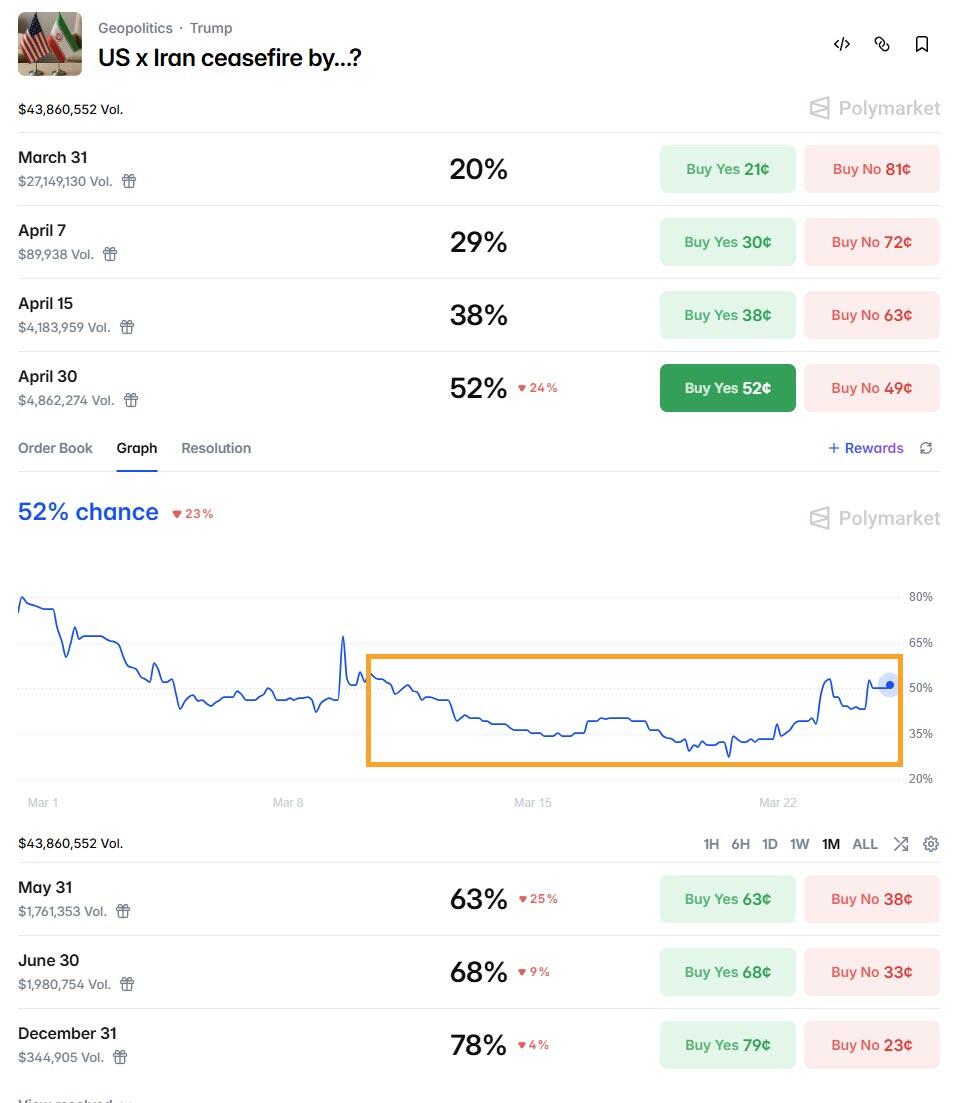
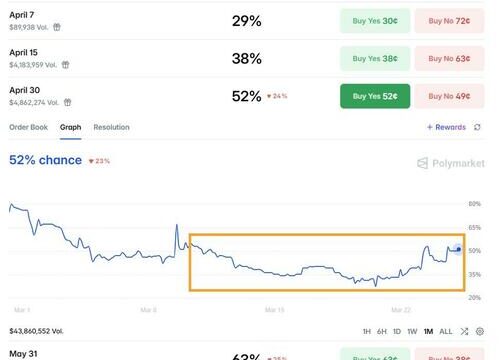
Many of the Polymarket Strait of Hormuz “prediction” markets have barely moved in response to the ceasefire proposal announcement, fwiw.
What to do?
We Have Already Had Regime Change
I think the most important thing said yesterday, was that the President, for the first time, made the case that the regime is so different (due to so many senior leaders being killed), there has been a regime change.
We have argued, since day 1, that true regime change, without boots on the ground, etc., is difficult to achieve. Finding a powerful enough faction who wants to protect their own lives and those of their family, willing to make a deal to achieve that and retain whatever power and wealth, they currently have, seemed more plausible.
While it is unclear who exactly the U.S. is negotiating with, it is important that the President has started to frame, whatever the new leadership structure is, in Iran, it meets “our” definition of regime change.
TACO vs TAW
We hear so much about “TACO” – Trump Always Chickens Out, that we don’t focus as much on the “TAW” – Trump Always Wins.
The President frames every outcome as him winning. From Liberation Day to Greenland, his steps and the end result are framed as having won.
To some degree, I think you can look at the series of social media posts and statements as “trial balloons”.
Toss out an idea and see if you can convince enough people to see it as “victory” and move on.
This may be a key component of the U.S. next steps. If enough of the public agrees that this ceasefire (or some form of ceasefire) is a “win” then he can move on.
We will get a sense of public opinion in the coming days, which I do think will shape the administration’s next steps.
The NFL “Scripted Play” Strategy Comparison of Where We are in Iran
In response to questions such as “what inning” is the conflict in Iran in, or how much longer to go, one of our generals argues (persuasively) that we are near the end of the “scripted play” segment of a football game. Many coaches “script” plays ahead of time and then execute on those plays.
Similarly, the U.S. had a list of prioritized targets. The U.S. has been going through that list. At the same time, Iran also had “scripted” responses. If this happens, then we do X.
Both sides have been war gaming, planning, strategizing about this conflict for years.
It doesn’t mean that you don’t adjust plans on the fly, but you do go through a relatively “scripted” set of actions to achieve objectives. The side that is “winning” has more ability to stick to their script.
After more than 3 weeks of fighting, both sides have experienced wins and losses. Both sides have likely seen things work, go according to plan, or even exceed their expectations. Similarly, there are likely disappointments and some consternation.
From everything we can see, it seems like the U.S. has had more wins, with Iran mounting more losses, but difficult to know. We only have some transparency into the U.S. side (and we should not have full transparency as that could put troops at risk, or make it difficult for the U.S. to negotiate, using bluffs, etc., to get the upper hand). We know very little about Iran’s expectations and where they stand relative to what they thought.
All of this leads Geopolitical Intelligence Group member after member to see 2 to 4 weeks more of fighting to make it highly probable that we can open the Strait (things could happen faster, but consensus seems to be forming around that timeframe given all that we have seen so far).
Buying Time?
The GIG, on that timeframe sees ultimate success in being able to re-open the Strait.
Part of the reason they see it potentially taking that long is that not all U.S. assets are in theater. The Marines coming from Japan are on their way. The Boxer (which Academy’s Brett Lowry served on) is now headed there. Airborne units, more vessels and more marines are all on their way.
It takes time for them to get to station and then time for them to become fully operational.
All that time, the Strait continues to see limited traffic, largely controlled by Iran.
If a 30-day ceasefire is achieved, the U.S. will be in an even stronger position then, than we are today (resupply, etc., can all occur).
The entire world can try and stock up on as much oil, gas, LNG, diesel, urea, etc., as possible during the ceasefire window.
We already have Air Supremacy (better than Air Superiority) and that is not going away in 30 days.
Should We Stop?
Many people are advocating that we have an opportunity to truly end the threat of Iran on the region, the world and even many of their own people, and that we should not stop.
Never has leadership there been in more disarray. Not only is Iran on its heels militarily, but their proxies have been hit hard and so far have been ineffective since the start of this conflict.
It is easy to see a world after all of this where Iran is not plotting for revenge, but is part of a much more robust and peaceful Middle East. Where the region’s economies can thrive, which would also help the entire global economy with cheaper and better access to all the goods and products and commodities produced in the region.
Had this outcome been sold better (or at all) to the world and even the domestic audience, we might not be as miserable and worried every time oil spikes higher. Maybe we would have the “fortitude” to withstand more affordability issues, with a clear end in sight.
Red Teaming the Negotiations
The U.S. plan seems clear:
Get agreement and enforce it and call it regime change and win (or call it a win).
Be better prepared (and allow the world to be better prepared) for the resumption of hostilities after the ceasefire.
What about Iran:
Iran has now been attacked twice while “negotiating”. The element of surprise helped those attacks, but it must leave a lot of doubt in the mind of the Iranians, that any ceasefire will be honored. The “best” case, is that if they decide to take that risk, it is probably because they too are prepared to violate the ceasefire.
What can Iran do in 30 days to offset what the U.S. and the rest of the world can do in 30 days? Iran would be insane not to think that the rest of the world will be much better prepared for any supply constrictions. It would be shocking to see anything less than the biggest restocking of energy products in the next 30 days, that the world has ever seen. So your economic leverage gets lower than it is today. It is clear that the U.S. and maybe even some forces from the rest of the world will be bigger and more prepared for the next round. Is Iran hauling missiles out of bunkers so deeply buried that they haven’t been hit?
Does Iran believe that they can use the next 30 days to be in position to inflict more damage on a bigger, freshly supplied enemy, and a world that stocked up on oil?
Are their own people coalescing around a common enemy? Have the attacks reduced the pressure for regime change from within? Or is the regime itself being blamed by the people, making the regime’s position even more precarious? This could be playing out in either direction and it is difficult to tell since we get so little information from within Iran.
What happens to the IRGC members if they are not in power after a deal? To be brutally honest, the consensus view is they will be killed. This is a powerful group, who have created links between powerful families within the IRGC. They have wealth. They have power. They have been brutal. Not exactly ideal conditions to slink off, in the event of loss.
Does Iran believe that there is some amount of “time” where the disruption to global trade (oil and more) causes the U.S. to offer better terms. Economic problems (and recession probabilities) are already growing in Asia and Europe. We had the CEO of a domestic homebuilder mention the conflict in the Middle East as a headwind for home sales in the U.S. Yes, we are somewhat isolated, but we are not an oasis, that won’t feel the impact.
Bottom Line
It is easy to see why we would make these proposals.
If Iran agrees to them all and we truly believe they won’t just try rebuild (as they have done time and time again, like they did after the 12 days of attacks last year), then we have truly won (even if some faction within the IRGC remains in power).
If we change our minds and decide to attack again, unless Iran has some surprises up its sleeve (which is a possibility as they just recently launched missiles with a longer range than they have previously admitted to), we will be in better shape to attack.
It is more difficult to see why Iran decides to take the chance, rather than continue the fight now.
So, my inclination is to “fade” this rally, because I struggle more to see Iran agreeing.
Also, even if we get a “deal” and rally more, I think the rally is capped as there is already damage done to the global economy, affordability has shaken confidence again, and all the issues (especially around jobs, private credit, etc.) have not been resolved.
If anything, quietly, behind the scenes (because Iran is front and center) those issues seem to be deteriorating rather than improving.
Tyler Durden
Wed, 03/25/2026 – 08:05
https://www.zerohedge.com/markets/taco-vs-taw-fade-equity-rally

Days After Trump Delays Xi Summit, Chinese Carrier Unveils 101-Jet Airbus Deal
Days After Trump Delays Xi Summit, Chinese Carrier Unveils 101-Jet Airbus Deal
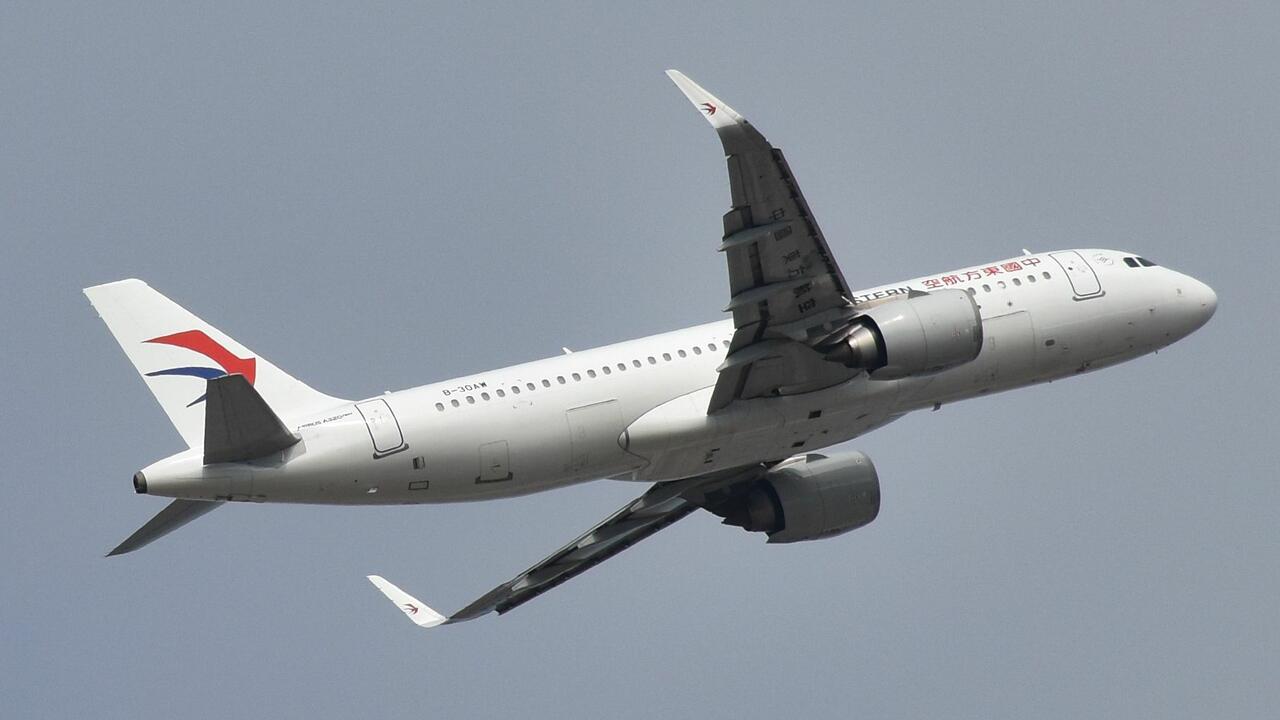
Days after President Donald Trump delayed a planned meeting with Chinese President Xi Jinping over the now 26-day-old U.S.-Iran conflict, one of China’s top state-owned airlines unveiled a major narrow-body aircraft deal with Airbus.
China Eastern Airlines announced a $15.8 billion deal for 101 Airbus A320neo aircraft on Wednesday, with deliveries scheduled between 2028 and 2032.
The Shanghai-based carrier, which operates domestic and international passenger and cargo flights, said it negotiated prices well below list value and expects to fund the order through a mix of internal resources and external financing, with installment payments not expected to materially affect cash flow or operations.
The timing of the China Eastern Airlines-Airbus deal comes as a report earlier this month said China was expected to announce a massive deal for 500 Boeing 737 Max jets, with possible orders for 100 widebody aircraft, including 787 Dreamliners and 777Xs.
But the Trump-Xi summit was originally planned for March 31 through April 2. Trump requested that China delay it by “a month or so,” explaining, “We got a war going on. I think it’s important that I be here.”
As seen in past trade war flare-ups between the two superpowers, aircraft orders have often signaled goodwill, while restrictions on jet parts have signaled heightened tensions.
At the same time, surprisingly, Beijing is not angrier at Trump, even though the U.S.-Iran conflict has sparked a fuel crisis across Asia.
The key question now is whether a future Trump-Xi summit will still yield a Boeing jet deal.
Tyler Durden
Wed, 03/25/2026 – 07:45
Italy Cuts Fuel Taxes As Iran Crisis Drives Oil Higher; Germany Refuses Relief Despite Windfall
Italy Cuts Fuel Taxes As Iran Crisis Drives Oil Higher; Germany Refuses Relief Despite Windfall
Submitted by Thomas Kolbe
A robust market economy unfolds its maximum absorption capacity precisely during external shocks. In such cases, policymakers would essentially only need to sit still, as the storm clouds usually pass on their own—true to the principle that high prices are the cure for high prices. This, of course, only applies to energy markets if governments have not already removed themselves from the equation through grotesque political interventions long before the crisis.
For European economies, however, the opposite holds true. They are overregulated, fiscally overburdened, and structurally fragile systems that can barely deploy effective shock absorbers in the face of the Iran crisis. High energy prices hit relentlessly, and national policy responses now diverge sharply across competing European jurisdictions.
Italian Prime Minister Giorgia Meloni reacted swiftly to the tightening situation at the country’s gas stations. Following a cabinet decision on March 18, an immediate reduction in fuel excise taxes came into force via decree, applying to both gasoline and diesel. Prices are expected to fall by 25 cents per liter—across the board for households, businesses, and all market participants, according to government sources.
In Italy, policymakers appear to keep a close ear to the ground—attuned to the realities faced by citizens, businesses, and traders alike. In stark contrast to the government of Chancellor Friedrich Merz, Rome is opting for relief measures aimed at the private sector amid a crisis that is steadily eroding purchasing power. Meanwhile, Merz and his finance minister Lars Klingbeil are entangled in debates over tax increases—detached from the Hormuz disruption and largely disconnected from the realities of workers, commuters, and companies. Berlin’s fiscal apparatus appears self-referential and monotonous, advancing to the next act of its own tragicomedy.
Italy—once more statist in spirit than its northern rival—now acts swiftly, pragmatically, and decisively. The tax cut will initially remain in place for 20 days but is likely to be extended should the situation in the largely blocked Strait of Hormuz fail to improve. The Italian government thus demonstrates a capacity to act that is sorely lacking in Germany. Merz, by contrast, remains hesitant when it comes to rolling back state intervention—a committed statist who, even in a moment of acute crisis, fails to initiate the necessary fiscal steps to shield businesses and consumers from the gathering storm.
In Berlin, policymakers continue to deny both citizens and businesses the long-overdue relief from soaring fuel prices—despite the fact that roughly two-thirds of the price flows to the state through various taxes. Perhaps that is precisely why the issue is being postponed. What prevails in Berlin is a mentality of extraction, even as public coffers run dry. Spending cuts that could create room for relief are being avoided at all costs in the 2026 super-election year.
The situation in Rome is markedly different: In addition to cutting fuel taxes, the Italian government is granting tax credits to transport companies, directly linked to verified diesel consumption.
These credits are intended to relieve the logistics sector—one of the hardest hit by rising energy prices—and to prevent escalating costs and extreme volatility in energy markets from fully passing through to freight rates and consumer prices.
But the measures do not stop there. The Italian government has quickly assembled a broader package aimed at curbing potential price speculation at the pump. To prevent excessive markups, an anti-speculation mechanism is being introduced to detect and limit unjustified price increases.
In practice, this means that retail fuel prices will be tightly linked to actual movements in global crude oil prices, ensuring that unjustified markups are immediately suppressed.
Oil companies and gas station operators are required to regularly report their prices to authorities, which monitor the entire supply and distribution chain. Deviations from price movements justified by changes in crude oil markets may result in sanctions.
In the acute emergency triggered by the Iran crisis, the executive power of the Italian government proves to be a clear advantage. It can enact temporary measures swiftly via decree. The decision to cut fuel taxes is particularly notable given that Italy, like Germany, imposes very high fuel taxes. Up to 62% of gasoline prices and around 58% of diesel prices are collected by the state.
The importance of the tax cut became evident on commodity markets Thursday afternoon, when WTI crude rose to around $114 per barrel. The attack on Iran’s South Pars energy complex delivered another shock to the market overnight.
For Italians, there is hope that this acute crisis will ultimately lead to a broader realization—especially for Transport Minister Matteo Salvini and Prime Minister Giorgia Meloni—that relieving citizens of fuel costs is fundamentally the right approach. Mobility and affordable transport costs remain key competitive factors.
The state must learn to exercise restraint. A lean state protects citizens in times of crisis far better, thanks to its flexibility, than the bloated bureaucratic apparatus we know today. Though this is a conclusion Germany’s chancellor and finance minister would strongly dispute.
* * *
About the author: Thomas Kolbe, a German graduate economist, has worked for over 25 years as a journalist and media producer for clients from various industries and business associations. As a publicist, he focuses on economic processes and observes geopolitical events from the perspective of the capital markets. His publications follow a philosophy that focuses on the individual and their right to self-determination.
Tyler Durden
Wed, 03/25/2026 – 07:20
Russia Launches Largest One-Day Drone Blitz Of Ukraine War
Russia Launches Largest One-Day Drone Blitz Of Ukraine War
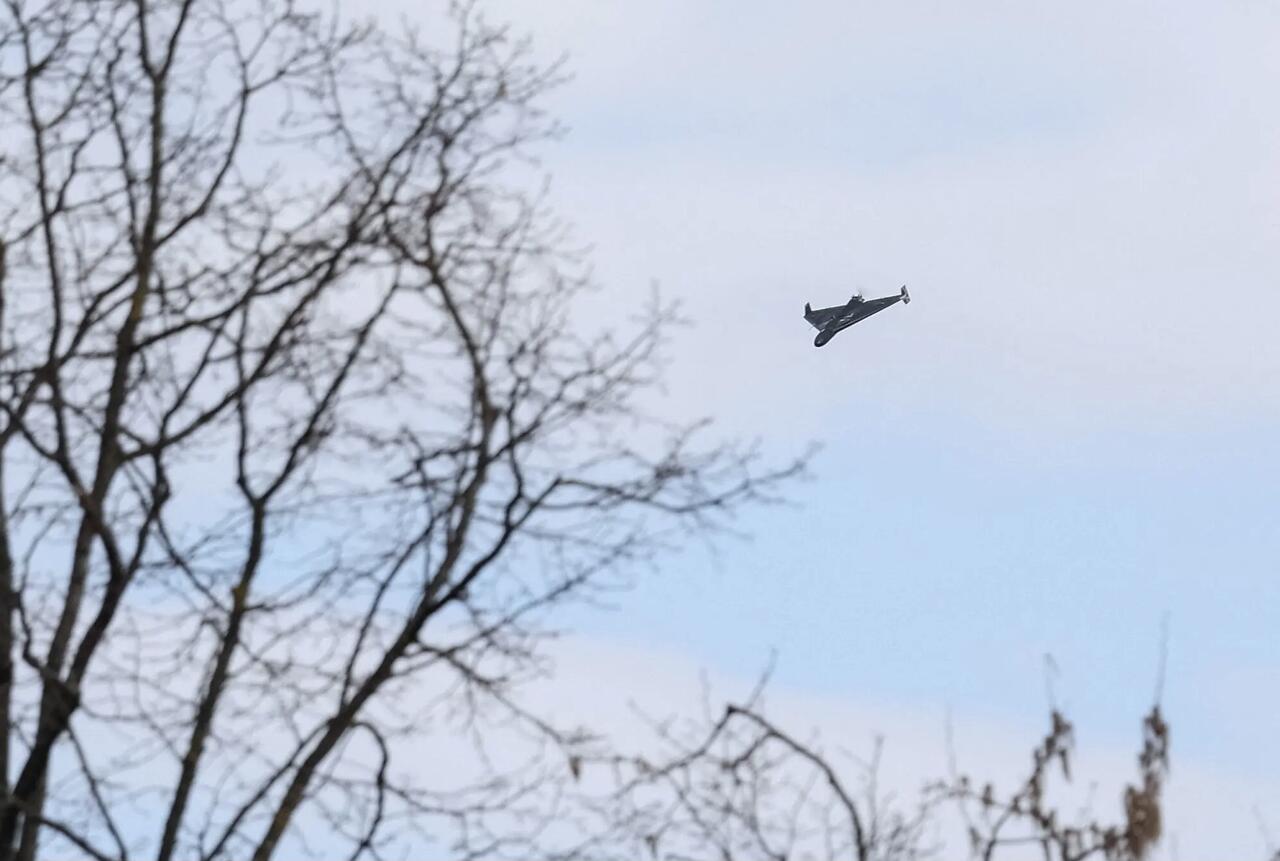
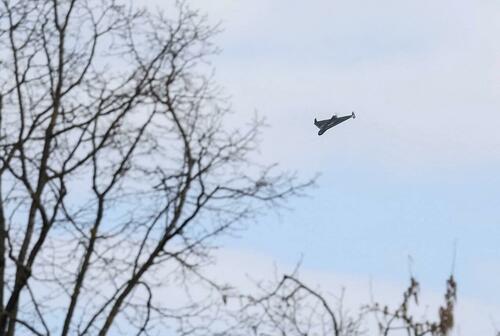
At least seven people were killed in Ukraine on Tuesday after Russia launched a truly massive drone attack that’s said to be the largest of the four-year war. Counting both drones and cruise missiles, 979 warheads poured into Ukrainian airspace as diplomatic efforts at ending the war remain stalled and the world’s attention focused almost entirely on the US-Israeli war on Iran.
Daylight death from above: A Russian Shahed drone above central Lviv (Reuters via New York Times)
Ukrainian officials said it began with an overnight attack comprising almost 400 long-range drones and 23 cruise missiles. Then, in a surprise twist, Russia unleashed even more in broad daylight. Startled Ukrainians were sent rushing to bomb shelters after alarms rang out around noon, as a swarm of 556 drones hammered cities across the western part of the country, including Lviv, Ternopil, Vinnytsia, Ivano-Frankivsk, Zhytomyr, Zaporizhzhia and Dnipro.
Ukraine’s air force claimed it shot most of them down, with only 15 of the daytime drones supposedly hitting anything. Ukraine said the impacted structures included apartment buildings, hospitals and a UNESCO World Heritage site. Video captured the dramatic sound and site of a Shahed drone as it descended and then smashed into a what is said to be a residential building in Lviv:
WATCH: The moment a Russian drone struck the center of Lviv. pic.twitter.com/QA3R1z4z0H
— Clash Report (@clashreport) March 24, 2026
Beyond the broad-daylight aspect of the attacks, the onslaught was noteworthy for its inclusion of the historic city of Lviv in the targeting package. To this point, Lviv — a city of 700,000 only 40 miles from Poland — had gone relatively unscathed compared to many other Ukrainian cities. The region’s governor, Maksym Kozytskyi struck an alarmed tone, posting, “The threat remains high. Stay in shelters!!!”
“Iranian Shaheds, modernized by Russia, hit a church in Lviv — it’s absolute perversion,” Ukrainian Prime Minister Volodymyr Zelensky said in his nightly national address. “The scale of today’s attack strongly indicates that Russia has no intention of really ending this war.”
2/ Read the Russian Offensive Campaign Assessment, March 24, 2026: https://t.co/I4Dhizn5EO pic.twitter.com/7XYSBEJhdn
— Institute for the Study of War (@TheStudyofWar) March 25, 2026
Efforts at ending the war have gone into a lull, as the United States and western European governments are fully occupied with the war on Iran, which threatens to plunge the world into an economic catastrophe that surpasses the Great Depression. Via social media, Ukrainian First Lady Olena Zelenska noted that global diversion of attention, writing, “Amid the news the world is drowning in every day, we will not let Ukrainian grief get lost, become just another statistic, a headline that will be casually skipped over.”
Though the war on Iran is depriving the Ukraine war of attention, it will likely have a profound effect on the battlefields, as surging energy prices will give a major shot in the arm to Russia’s armed forces, just as the war is set for its latest return to fighting season. Per reporting in Financial Times earlier in March, Russia is generating up to $150 million per day in extra budget revenue amid its increased taxes on oil exports to markets like China and India, with potential total added revenue reaching billions by the end of this month.
...it’s just one more way Trump’s decision to start a regime-change war on Iran is looking like one of the greatest strategic blunders in US history.
Tyler Durden
Wed, 03/25/2026 – 06:55
https://www.zerohedge.com/geopolitical/russia-launches-largest-one-day-drone-blitz-ukraine-war

Britain’s Countryside Is Still Racist
Britain’s Countryside Is Still Racist
Authored by Steve Watson via Modernity.news,
The National Trust’s director-general has declared that Britain’s countryside remains unwelcoming to ethnic minorities, blaming everything from clothing choices to ignorance of basic rural etiquette.
This isn’t some fringe activist rant — it’s official policy from the charity tasked with protecting the nation’s heritage, straight out of the same DEI playbook that’s already consumed government agencies.
In a video clip shared on X, National Trust Director-General Hilary McGrady stated: “The research clearly shows that ethnic minorities don’t feel comfortable in the countryside — there are lots of reasons for this, they don’t know what to wear, don’t know the countryside code.”
🚨DIRECTOR FOR NATIONAL TRUST SAYS COUNTRYSIDE IS RACIST
“The research clearly shows that ethnic minorities don’t feel comfortable in the countryside – there are lots of reasons for this, they don’t know what to wear, don’t know the countryside code”
What is wrong with her? pic.twitter.com/ImoDVyq1Wv
— Basil the Great (@BasilTheGreat) March 24, 2026
Speaking on LBC, she expanded: “Everything from: it’s not culturally something that they necessarily feel as if it’s part of what they do when they go there. They don’t necessarily know ‘what am I meant to wear, how do I behave? What’s a countryside code? I’ve never heard of it’. So there’s loads of different reasons why they don’t feel confident all the time.”
McGrady insisted the charity must act because “the research comes back really clearly to say they don’t [feel it’s a place for them]. So we accept that and we have to respond in a way that tries to help because the National Trust is here for everyone. That’s part of our charitable purpose.”
As we’ve previously detailed, the government is obsessed with making Britain’s countryside less white.
Under Defra guidance, National Landscapes and local councils across the Chilterns, Cotswolds, Malvern Hills, Nidderdale, Surrey Hills and beyond are rolling out diversity targets, outreach to Muslim communities in Luton, staff recruitment drives, and marketing in “community languages” — all to address supposed barriers like “concerns about how they will be received” or fear of dogs.
The push traces directly to a 2019 Defra-commissioned report by Julian Glover, which warned the countryside was an “exclusive, mainly white, mainly middle-class club” and risked becoming “irrelevant” as society changes.
A follow-up 2022 Defra report, which cost taxpayers £108,000, claimed protected landscapes are seen as “a white space, to which they did not belong,” with ethnic minorities citing “white culture” issues like traditional pubs and drinking.
It gets worse. In 2024, the Wildlife and Countryside Link — an umbrella group whose members include the RSPCA, WWF and the National Trust itself — told Parliament the countryside is a “racist colonial” white space “governed by white British cultural values.”
They demanded legally binding targets to force more non-white access, claiming cultural barriers mean ethnic minorities can’t “enjoy the outdoors” because of “white British cultural values” embedded in green spaces.
The Muslim Hikers group has echoed the same line, insisting rural areas feel unwelcoming.
Meanwhile, as these organisations lecture the public about “inclusion,” our countryside is being buried under mountains of fly-tipped rubbish from urban areas — 20 tonnes dumped in Dorset’s Holt Heath nature reserve, entire streams of waste visible for miles on Welsh mountains, and protected sites turned into third-world dumps.
The contrast couldn’t be starker: instead of tackling real problems created by unchecked mass migration, officials fixate on making the English landscape feel less English.
McGrady’s comments are the latest chapter in this relentless campaign. The National Trust, once a guardian of Britain’s history and beauty, now treats the countryside like a failing diversity quota that must be fixed.
Forget centuries of British culture, literature, and tradition that shaped these landscapes — the new priority is ensuring everyone knows the right boots to wear and the right code to follow, or else it’s racism.
The real story here is cultural incompatibility being reframed as systemic bigotry, with taxpayer-funded charities and government departments working overtime to guilt-trip the majority population into surrendering their heritage.
Britain’s countryside doesn’t need more lectures on whiteness. It needs protection from the very policies that erode the unique character millions of Brits cherish.
As mass immigration reshapes the nation, preserving these green spaces as they are — for the people who actually value and respect them — is the only way to keep them relevant for generations to come.
Your support is crucial in helping us defeat mass censorship. Please consider donating via Locals or check out our unique merch. Follow us on X @ModernityNews.
Tyler Durden
Wed, 03/25/2026 – 06:30
https://www.zerohedge.com/political/britains-countryside-still-racist

Volkswagen May Convert German Auto Plant Into Iron Dome War Factory
Volkswagen May Convert German Auto Plant Into Iron Dome War Factory
Struggling German automaker Volkswagen may soon begin transforming its Lower Saxony factory from producing T-Roc Cabriolets to manufacturing parts for the Iron Dome missile interceptor system, according to a new Financial Times report. This reveals a new reality for the West: a nation’s auto industry can become a dual-use industrial base in times of conflict.
FT reports that Israel’s Rafael Advanced Defence Systems is in talks with VW regarding its troubled Osnabrück plant to produce Iron Dome components.
“The aim is to save everybody, maybe even to grow,” said a source with knowledge of the talks. “The potential is so high. But it’s also an individual decision for the workers if they want to be part of the idea.”
Production of the Iron Dome part could be operational in 12 to 18 months, the source said, as long as factory workers agree to switch to weapons production.
The Osnabrück factory would be transformed to produce Iron Dome components, including heavy-duty trucks that carry the system’s missiles, launchers, and power plants (commonly called generators).
The actual missiles, however, would be produced at a separate facility in Germany, operated by weapons specialists under Rafael’s plans.
News of this potential factory conversion comes as Israel, the US, and allied forces in the Gulf region are depleting their stockpiles of interceptors to counter IRGC missiles and drones.
FT noted that VW has been searching for the next chapter for the Osnabrück factory amid weak demand and a flood of cheap autos from China.
The importance of keeping an industrial base, such as auto factories, operational is that, in wartime, production lines can easily be converted to manufacture missiles, tanks, and other war machines.
Tyler Durden
Wed, 03/25/2026 – 05:45
https://www.zerohedge.com/military/volkswagen-may-convert-german-auto-plant-iron-dome-war-factory