Category: News
In Win For Putin, India Buys 60 Million Barrels Of Russian Oil, As Refiners Increasingly Transact In Yuan, Dirham
In Win For Putin, India Buys 60 Million Barrels Of Russian Oil, As Refiners Increasingly Transact In Yuan, Dirham
Indian refiners have bought about 60 million barrels of Russian oil for delivery next month, which is set to ease some supply concerns as the Middle East war chokes flows.
Citing people familiar, Bloomberg reports that the cargoes were booked at premiums of $5 to $15 a barrel to Brent. The volume is similar to the amount of purchases for this month, but more than double than that for February, according to data intelligence firm Kpler.
The buying spree followed a US waiver that allowed India to take Russian oil that was already loaded onto vessels before March 5 to offset shortages caused by the effective closure of the Strait of Hormuz. The measure was subsequently expanded to include other countries and updated to allow purchases of crude already at sea before March 12.
India has bought ~60 million barrels of Russian oil in March, and already booked a similar amount for delivery in April.
The purchases are at a premium of $5-$15 a barrel **above** the Brent benchmark. And current prices, that’s worth >$6.5 billion for each month.
Putin wins.
— Javier Blas (@JavierBlas) March 25, 2026
The South Asian nation has been among the heaviest hit by the Hormuz blockade and the plunge in oil supply as it is heavily reliant on imported oil, and became a major buyer of discounted Russian crude following the invasion of Ukraine in early 2022. However, India sharply cut back purchases from late last year under US pressure, turning instead to barrels from Saudi Arabia and Iraq, much of which then became trapped inside the Persian Gulf after the outbreak of the war.
Indian officials expect the US waiver to be extended as long as disruptions in Hormuz persist, the people said. Refiners such as Mangalore Refinery & Petrochemicals and Hindustan Mittal Energy, which had avoided Russian oil since December, have returned to the market, they said.
Separately, Bloomberg also reports that Indian refiners are increasingly settling purchases of Russian oil in alternative currencies, as they seek to reduce reliance on the dollar amid rising geopolitical tensions and shifts in US policy. Transactions are being carried out by depositing Indian rupees into special overseas bank accounts held by Russian sellers which are then being converted into UAE’s dirham or the Chinese yuan. The trades are being facilitated by Indian banks with limited offshore presence.
In addition to the dirham and yuan, firms are also considering the Singapore dollar and Hong Kong dollar, though transactions depend on individual banks’ comfort levels, one of the people added.
While the US earlier this month granted India a waiver to ramp up purchases of Russian oil, it is set to expire on April 11. Ahead of that deadline, some Russian oil firms are pushing for more durable arrangements, seeking payment in alternative currencies to limit exposure to shifting US policy.
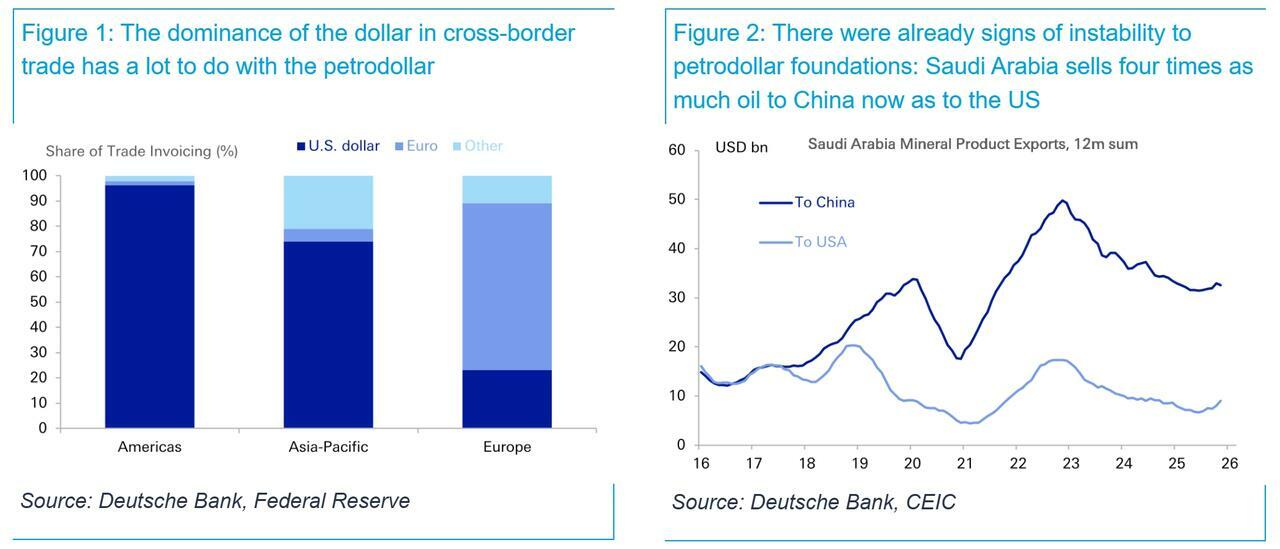
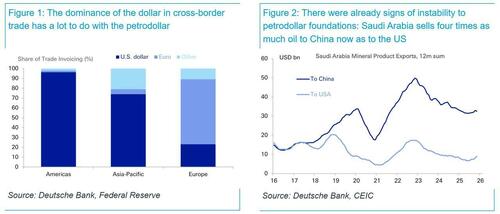
In a note on Tuesday, Deutsche Bank said the conflict is testing the Petrodollar’s role as the currency for global oil trade, with one long-term consequence being a potential shift toward the yuan.
No matter what currency is used, Russia is reaping bumper profits on renewed demand and elevated prices for its oil. The Kremlin is earning the most from its crude exports since March 2022, shortly after Moscow’s troops poured into Ukraine.
In addition to buying more Russian oil, Indian processors are also looking elsewhere to diversify their supply as the war drags on. The country’s purchases of Venezuelan crude for April arrival are projected at 8 million barrels, the highest since October 2020, according to Kpler.
Tyler Durden
Wed, 03/25/2026 – 12:25
Meta To Lay Off Hundreds Of Workers Today As AI Pivot Accelerates
Meta To Lay Off Hundreds Of Workers Today As AI Pivot Accelerates
Meta Platforms is laying off a few hundred employees today as its workforce restructuring continues, following years of terrible metaverse bets and overhiring during the Covid era. Reports of another round of layoffs surfaced earlier this month, and just last week, Meta shut down Horizon Worlds, its virtual reality social network for Quest headsets.
The Information reports that a few hundred employees will be let go today as part of the company’s effort to reposition itself in the AI space.
People familiar with the workforce restructuring say a majority of the cuts will focus on staff in Reality Labs, social media teams, recruiting, and a smaller number of sales roles.
“Teams across Meta regularly restructure or implement changes to ensure they’re in the best position to achieve their goals. Where possible, we are finding other opportunities for employees whose positions may be impacted,” a Meta spokesperson told the outlet.
In mid-March, Reuters reported that a new round of layoffs at Meta was imminent and would reduce the workforce by 20%. The outlet said that the workforce restructuring is intended to redirect capital flows toward AI infrastructure.
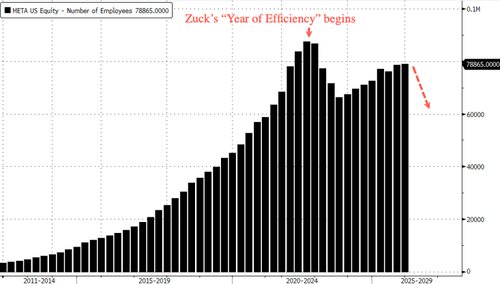
The latest Bloomberg data show Meta’s total workforce at the end of 2025 was about 79,000. Any layoffs today would amount to only a quarter of a percent.
Meta CEO Mark Zuckerberg has been downsizing the workforce since the 2022–23 “year of efficiency” layoffs.
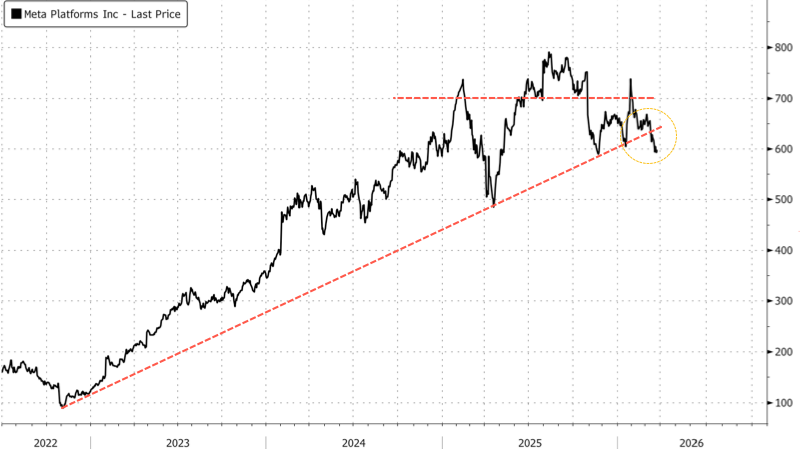
Shares of Meta peaked in August 2025 at around $790 and have since been locked in a bear market, down around 25%.
The reason for Meta’s underperformance can be found in our note on Tuesday titled “What’s The Matter With Meta: Goldman Explains The Stock’s Ongoing Slump.”
Tyler Durden
Wed, 03/25/2026 – 12:05
https://www.zerohedge.com/technology/meta-lay-hundreds-workers-today-ai-pivot-accelerates

US Has Been Engaged In Major Airstrikes On Pro-Iran Paramilitaries In Iraq
US Has Been Engaged In Major Airstrikes On Pro-Iran Paramilitaries In Iraq
Authored by Dave DeCamp via AntiWar.com,
Iraq’s Popular Mobilization Forces (PMF) said Tuesday that US airstrikes in Anbar, western Iraq, killed 15 of its fighters, including a senior commander.
“In a blatant and cowardly attack, the commander of the Anbar Operations in the Popular Mobilization Forces, Saad Dua al-Bayji, was martyred along with a group of his heroic comrades following a treacherous American airstrike that targeted the command headquarters while they were performing their national duty,” the PMF said in a statement, according to The Cradle.
The group added that it was holding the Iraqi government “fully responsible” for “confronting these repeated American violations and taking clear and resolute positions to preserve the country’s sovereignty and put an end to these grave transgressions.”
Iraqi media later reported that Iraq’s National Security Council, chaired by Iraqi Prime Minister Mohammed Shia al-Sudani, has given the PMF the green light to respond to attacks on its positions, a significant step from the US-backed Iraqi government that will likely lead to further escalations inside the country.
The PMF is a coalition of mostly Shia militias aligned with Iran that formed in 2014 to fight ISIS and is officially part of Iraq’s security forces. Since the US and Israel launched the war against Iran on February 28, the US has launched extensive strikes against the PMF, killing dozens of its fighters.
US bases and diplomatic facilities in Iraq have come under constant missile and drone attacks and have mostly been claimed by a group that calls itself the Islamic Resistance in Iraq (IRI), which includes some of the factions in the PMF. Amid the heavy attacks, the US ordered all American citizens to leave Iraq, and NATO has withdrawn its forces from the country.
The IRI said on Monday that the US has also pulled all of its forces out of Camp Victory, a major US base near the Baghdad airport, but the withdrawal hasn’t been confirmed. “We confirm that the American and NATO forces have completed their withdrawal from Camp Victory near Baghdad Airport via cargo planes and vehicles overland towards Jordan,” the group said. “We will not allow the current government, or the future government, God willing, to allow the Americans and NATO to return to Iraq.”
If the US did pull its troops out of Baghdad, there would still be US forces in Iraqi Kurdistan. Kataib Hezbollah, one of the main Iran-aligned militias in Iraq, has said that it has halted attacks on the US Embassy in Baghdad to give the US time to evacuate the facility. “Our primary condition is the expulsion of all foreign troops from the north to the south of Iraq,” a Kataib Hezbollah official said.
* * *
Tyler Durden
Wed, 03/25/2026 – 11:25

Supreme Court Limits ISPs’ Liability For Online Piracy
Supreme Court Limits ISPs’ Liability For Online Piracy
The Supreme Court on Tuesday sharply curtailed when internet service providers can be held liable for copyright infringement committed by their subscribers, handing a major victory to broadband companies and dealing a setback to Sony Music Entertainment and other major labels seeking to combat online piracy.
In a 7-2 decision (with Justices Sotomayor and Jackson concurring only in the judgment), the justices ruled that Cox Communications Inc. cannot be held liable for the actions of customers who illegally downloaded and shared songs using its network, even after the company received more than 163,000 infringement notices from copyright holders. The ruling reverses a $1 billion jury verdict against the Atlanta-based cable and internet giant and clarifies long-standing uncertainties about secondary liability under U.S. copyright law.
The case stemmed from a 2018 lawsuit in which the labels accused Cox of willful contributory and vicarious infringement for failing to terminate repeat offenders. A federal jury in Virginia sided with the labels on both theories and awarded $1 billion in statutory damages. The Fourth Circuit upheld the contributory-liability finding but tossed the vicarious-liability verdict, leading to the Supreme Court appeal on the contributory issue alone.
Writing for the majority, Justice Clarence Thomas said a service provider is liable for a user’s infringement only if it intended its service to be used for that purpose. “The provider of a service is contributorily liable for a user’s infringement only if it intended that the provided service be used for infringement, which can be shown only if the party induced the infringement or the provided service is tailored to that infringement,” he wrote.
Such intent exists only when the provider actively induces infringement – such as by marketing a product as a tool for piracy – or offers a service that is “not capable of ‘substantial’ or ‘commercially significant’ noninfringing uses,” the opinion stated, citing the court’s landmark 1984 decision in Sony Corp. of America v. Universal City Studios Inc. and the 2005 ruling in Metro-Goldwyn-Mayer Studios Inc. v. Grokster Ltd.
“Mere knowledge that a service will be used to infringe is insufficient to establish the required intent to infringe,” Thomas emphasized, rejecting the broader “material contribution” standard applied by the U.S. Court of Appeals for the Fourth Circuit.
The decision rejects the Fourth Circuit’s holding that Cox could be liable simply by continuing to provide internet service to subscribers whose accounts were linked to repeated violations. “The Fourth Circuit’s holding went beyond the two forms of liability recognized in Grokster and Sony,” the opinion states.
Cox, which serves about six million subscribers, had argued it took reasonable steps to address piracy, including sending warnings, suspending service and terminating accounts after multiple notices. The company contractually prohibits subscribers from using its network for infringing activity. Sony Music Entertainment and other major labels countered that Cox’s efforts were insufficient.
Tuesday’s ruling is expected to have ripple effects across the telecom and entertainment industries – with industry executives long warning that expansive secondary-liability rules could force providers to monitor and police all user activity, raising costs and privacy concerns. Copyright owners have argued that without stronger accountability for intermediaries, online piracy remains rampant.
For Cox, the ruling caps years of litigation. The company has said it will continue to cooperate with copyright holders through the Digital Millennium Copyright Act’s notice-and-takedown process, though the court noted that the statute creates defenses rather than new causes of action.
The decision comes as Congress continues to debate updates to copyright law in the digital age. In the meantime, Tuesday’s opinion provides clear guidance: Internet providers cannot be turned into copyright enforcers simply by virtue of knowing that some of their subscribers are breaking the rules.
Tyler Durden
Wed, 03/25/2026 – 11:05
https://www.zerohedge.com/political/supreme-court-limits-isps-liability-online-piracy

Democrats Flip Trump’s Mar-a-Lago District In Florida Special Election Upset
Democrats Flip Trump’s Mar-a-Lago District In Florida Special Election Upset
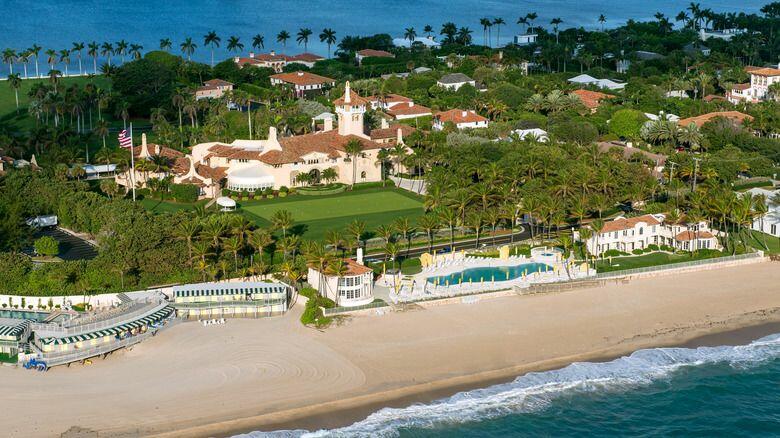
Democrats flipped a reliably red Florida state House seat that includes President Donald Trump’s Mar-a-Lago estate on Tuesday, scoring a narrow but symbolically significant victory in a special election that drew national attention.
Democrat Emily Gregory defeated Trump-endorsed Republican Jon Maples in House District 87 by just over 2 percentage points, according to unofficial results. The win marks an approximately 11-point swing toward Democrats compared to the 2024 performance in the Palm Beach County district.
Gregory, a first-time candidate who runs a fitness center for postpartum moms and has a background in public health and mental health administration, campaigned on affordability, taxes and kitchen-table issues. Maples, a financial planner and former local council member, had received an endorsement from Trump, who along with first lady Melania Trump and their son Barron voted by mail in the contest.
“I think it demonstrates where the Florida voter is,” Gregory told Politico after her victory. “They want someone who is focused on solutions and the issues and not focused on the noise.”
Democrats also picked up a narrow win in a Tampa-area state Senate seat, where union leader and Navy veteran Brian Nathan defeated former state Rep. Josie Tomkow by a slim margin despite being outspent roughly 10-to-1.
The two Democratic victories will not alter Republican supermajorities in the Florida Legislature. But they come as the latest data point in a series of special-election overperformances and flips for Democrats in the state since Trump’s 2024 victory there – and amid a broader national trend of Democrats gaining ground in state legislative races over the past year.
Florida Democratic Party Chair Nikki Fried credited the party’s sustained organizing with the win.
“This victory reiterates an undeniable trend in Florida: With year-round organizing and infrastructure investment, Democrats can run and win anywhere – including Donald Trump’s backyard,” Fried said in a statement. “Floridians are tired of the chaos, corruption, and sky-high prices on everything from groceries to gas and health care.”
In 2024, the House District 87 race had been held by Republican Mike Caruso, who won it by 19 points before being appointed to a local post by Gov. Ron DeSantis, triggering the special election. The contest grew heated in its final days, with sharp exchanges in mailers and text messages.
Democrats poured significant resources into the Palm Beach County race, viewing it as a chance to compete in Trump’s home turf. Republicans, meanwhile, downplayed the significance of the low-turnout special election.
In the state Senate District 14 race, which opened after DeSantis appointed Lt. Gov. Jay Collins last August, Nathan’s upset win was described as a surprise even by some Democrats. Tomkow, a rancher who previously held a House seat in neighboring Polk County, faced questions about her residency in the district.
Nathan, a union leader and veteran, was outspent by roughly 10 to 1 in the race to replace Collins and had received scant support from state Democrats. He narrowly defeated former state Rep. Josie Tomkow, a rancher who had held a House seat in neighboring Polk County. Tomkow’s residency had come under question, although she said she planned to move into the district once she was elected. But even Fried acknowledged that Nathan’s win was in state Senate District 14 was a surprise.
A separate House race created by Tomkow’s departure was won by Republican Hilary Holley by nine points – a solid victory but narrower than Tomkow’s margin in 2024.
Tuesday’s outcomes add to Democratic momentum in Florida special elections, even as the GOP maintains firm control of state government. Party strategists on both sides will be watching whether the results signal anything larger heading into the 2026 midterm cycle.
* * * Must-try Mangoes
Tyler Durden
Wed, 03/25/2026 – 10:45
WTI Steady After Biggest Cushing Crude Build In 3 Years; Imports From Venezuela Highest Since 2019
WTI Steady After Biggest Cushing Crude Build In 3 Years; Imports From Venezuela Highest Since 2019
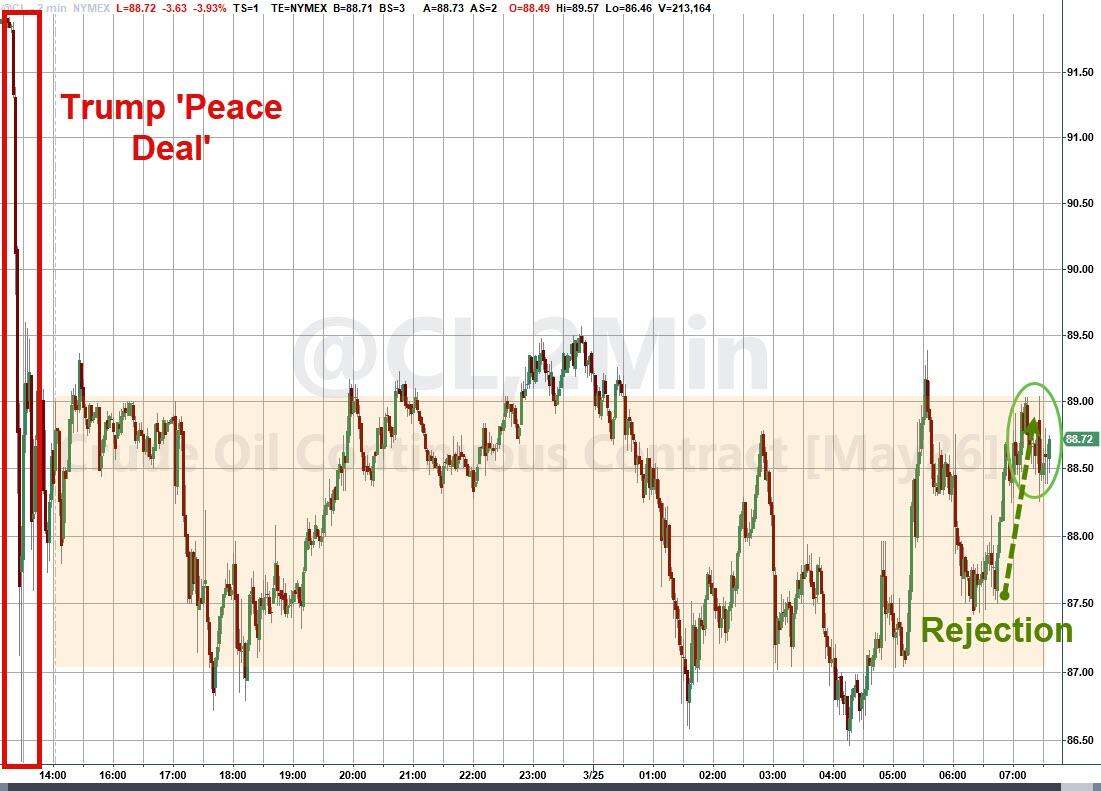
Oil prices remain lower this morning, following the US proposal for a ceasefire with Iran, but off the lows following Iran’s rejection.
“From the Iranian perspective, Trump’s actions this week have demonstrated that the US can be pressured when Iran threatens further escalation,” said Arne Lohmann Rasmussen, chief analyst at A/S Global Risk Management.
Futures had already pared losses as Tehran fired a new wave of missiles at Israel, and signaled little willingness to compromise. Iran’s armed forces added to a stream of messaging that ruled out ceasefire talks, according to state-run IRIB News. They added that they wouldn’t allow oil prices to return to their previous levels until all threats against the country were removed.
Overnight saw API report a modest rise in crude and refined product inventories and while oil prices are really more attuned to the geopolitical headlines currently, we’re keeping our eyes on the domestic supply and demand for any signs of an actual impact locally.
API
Crude +2.35mm
Cushing
Gasoline +528k
Distillates +1.39mm
DOE
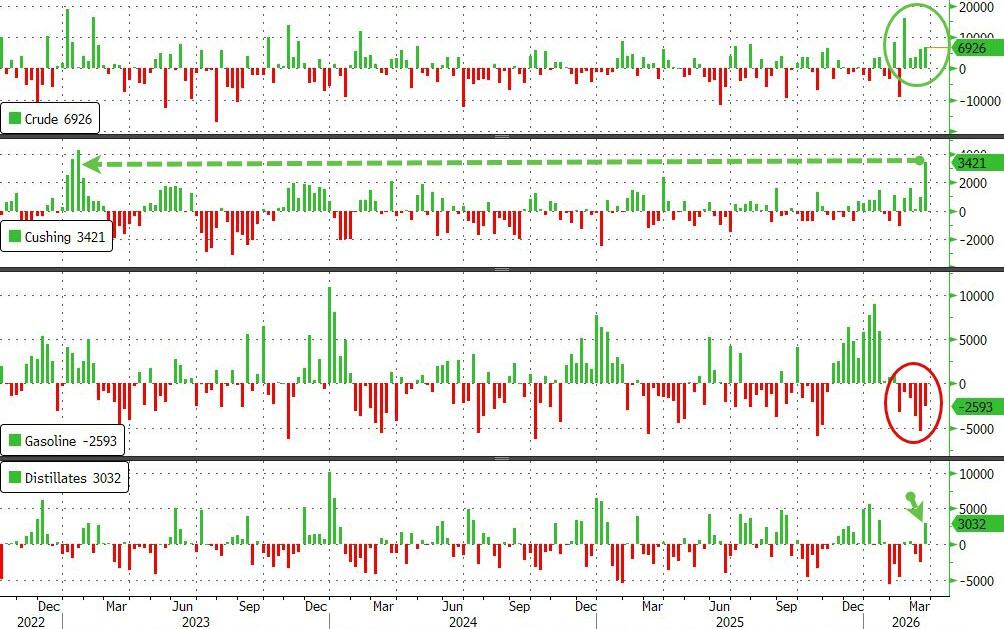
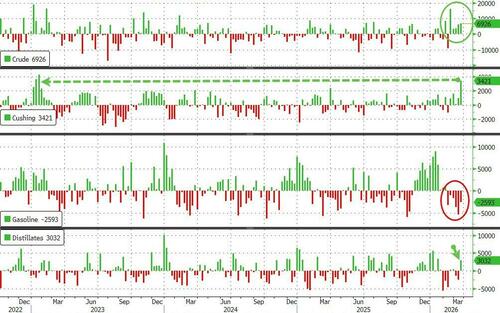
Crude +6.93mm (-200k exp)
Cushing +3.42mm – biggest weekly build since Jan 2023
Gasoline -2.59mm
Distillates +3.03mm
US crude stocks rose for the 5th straight week with inventories at the Cushing Hub soaring by 3.4mm barrels – the biggest build since Jan 2023. Refined products were mixed with Distillates stocks up bigly while Gasoline stocks fell for the sixth straight week…
Source: Bloomberg
For the 5th week in a row, there was no addition (or drawdown) for the US SPR.
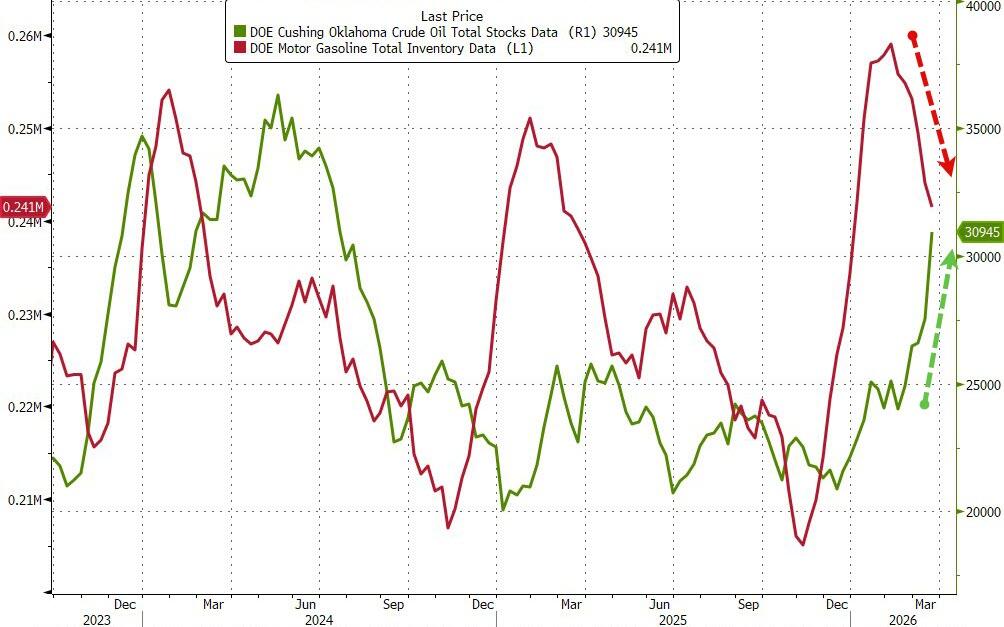
Total Cushing stocks are their highest since July 2024 while total gasoline stocks tumbled to their lowest since the start of the year…
Source: Bloomberg
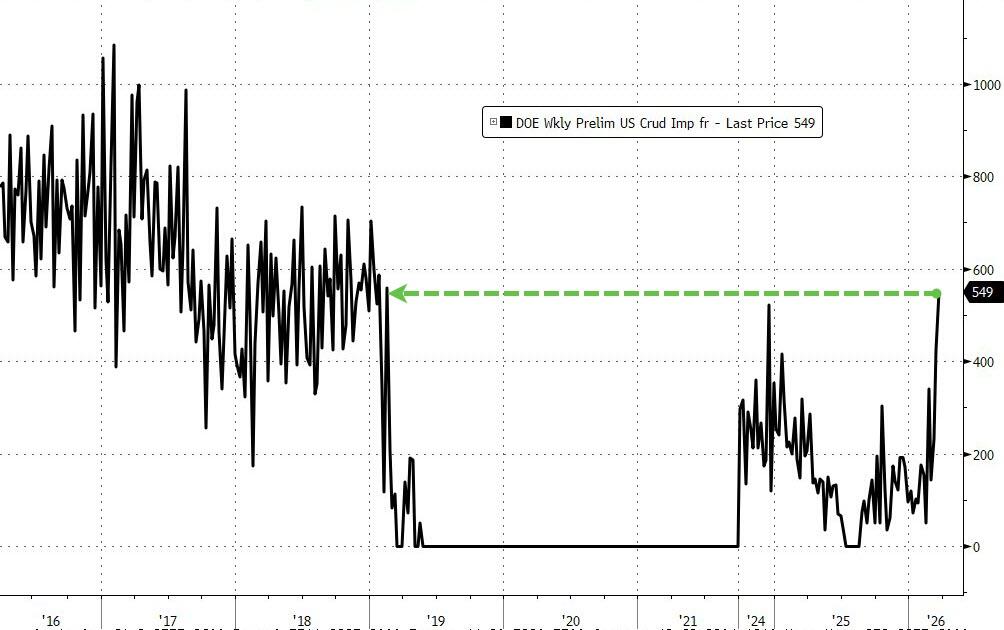
Crude imports from Venezuela surged to their highest since 2019…
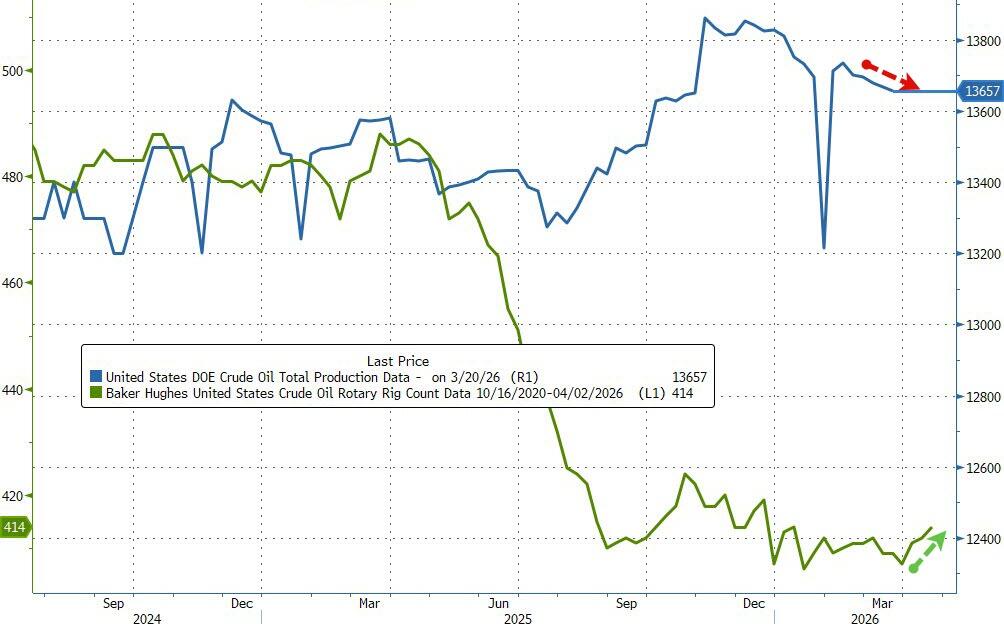
US Crude production remains ‘near’ record highs – but despite a rising rig count, production is not increasing…
Source: Bloomberg
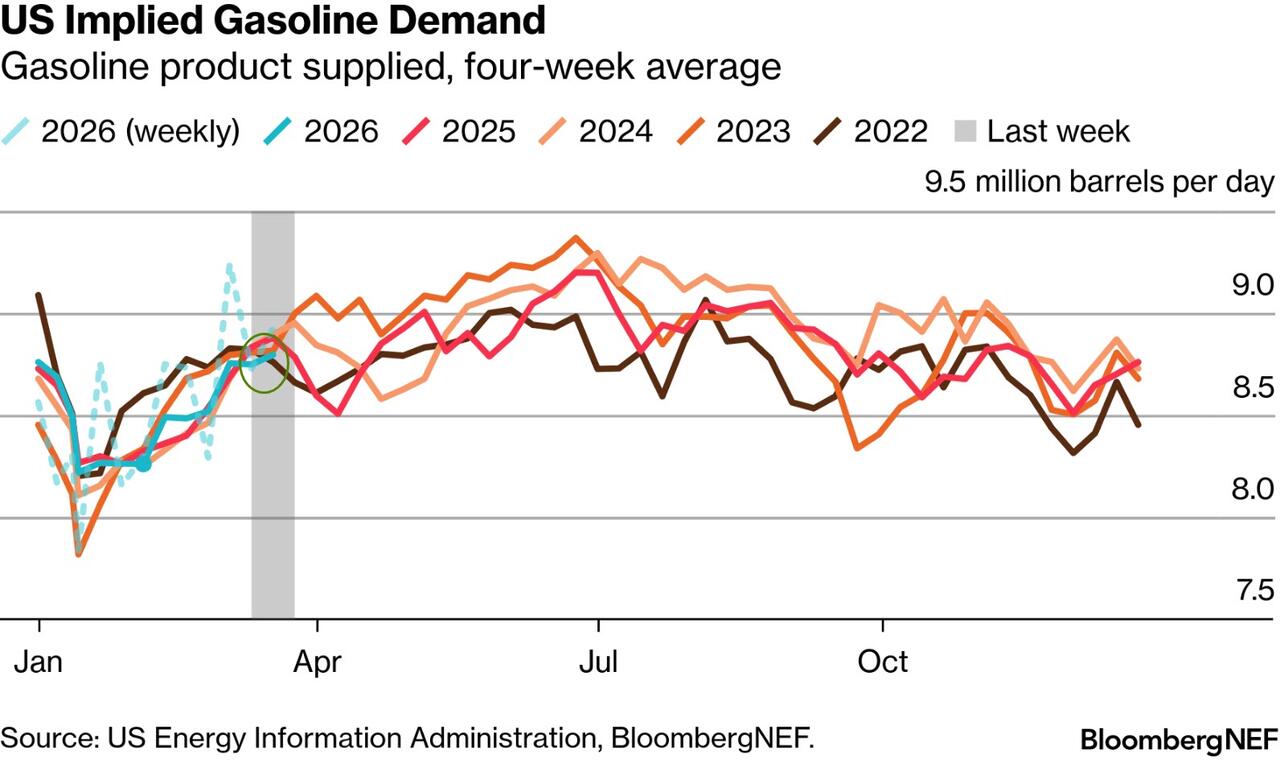
No signs of gasoline demand destruction so far. Finished motor gasoline product supplied came in at 8.9 million barrels per day for the EIA week, a week-on-week increase of 196,000 barrels per day.
WTI was trading around $89 ahead of the official inventory data (at the upper end of the overnight session’s range)…
“In the past 24 hours, the Trump administration has been signaling both to concerned citizens, policymakers, allies, adversaries, and perhaps most importantly markets, that there may be an end in sight sooner than the president himself had let on just about a week ago,” Behnam Ben Taleblu, Iran program senior director at the Foundation for Defense of Democracies, told Bloomberg TV.
“A lot of that is hand-holding, particularly for energy markets.”
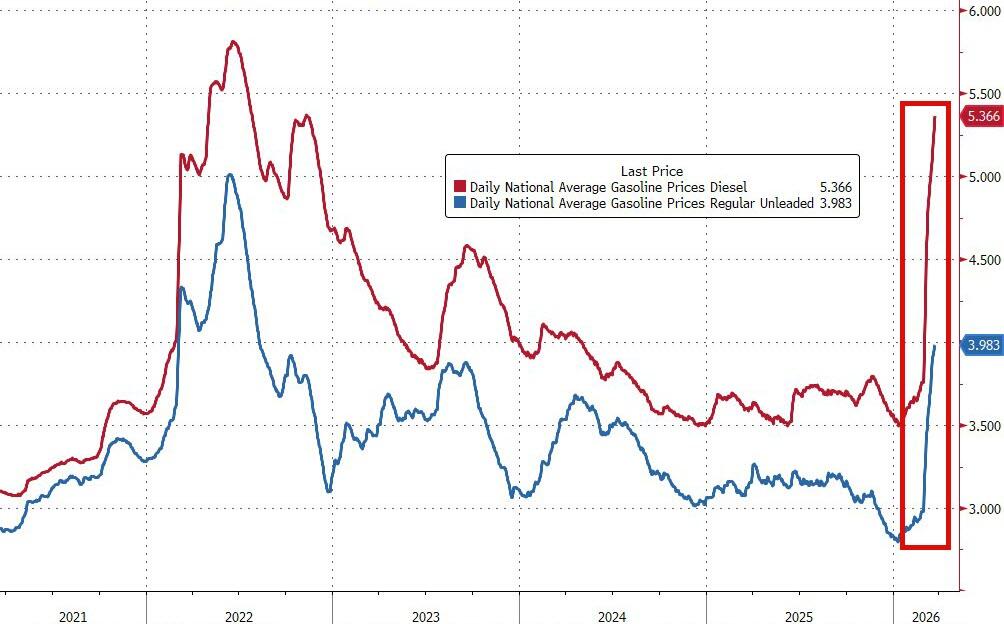
Perhaps this is why…
Not a great backdrop for the Midterms (admittedly six months away).
Tyler Durden
Wed, 03/25/2026 – 10:39
https://www.zerohedge.com/energy/wti-steady-after-biggest-cushing-crude-build-3-years
Both Sides’ Starting Ceasefire Positions Are: “We Won, You Surrender”
Both Sides’ Starting Ceasefire Positions Are: “We Won, You Surrender”
By Michael Every of Rabobank
Don’t screen yourself off from reality
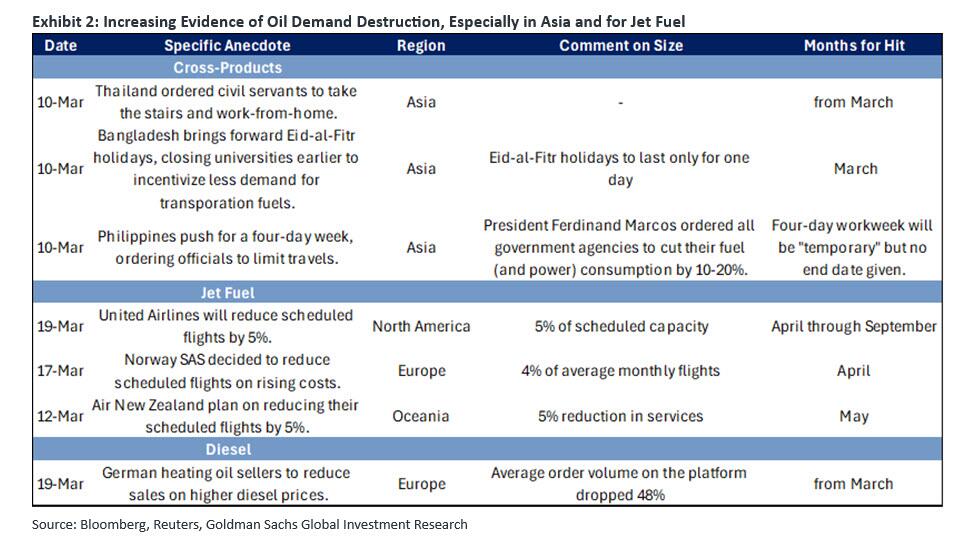
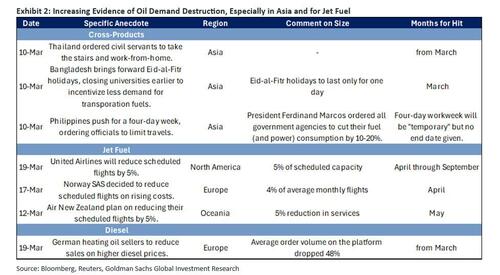
Today starts with markets in a positive mood, stocks up in Asia, bond yields down slightly, and Brent oil down around 7% to $97.5. Yet don’t screen yourself from reality. As underlined before, the price of energy on a screen currently has no relation to its actual availability in different forms in certain geographies. The Philippines just declared a national emergency to conserve fuel; South Korea is curtailing private driving; Slovenia has introduced rationing; and the boss of Shell is quoted saying Europe will face fuel shortages within days (see “Where Demand Destruction Is Greatest “).
Iran, via its parliamentary speaker Ghalibaf, whom the US is now negotiating with, also makes this clear: “We are aware of what is happening in the paper oil market, including the firms hired to influence oil futures. We also see the broader jawboning campaign. But let’s see if they can turn that into “actual fuel” at the pump – or maybe even print gas molecules!”
We are aware of what is happening in the paper oil market, including the firms hired to influence oil futures. We also see the broader jawboning campaign.
But let’s see if they can turn that into “actual fuel” at the pump —or maybe even print gas molecules!
— محمدباقر قالیباف | MB Ghalibaf (@mb_ghalibaf) March 24, 2026
That said, Iran has stated “non-hostile” ships can now transit Hormuz if the vessels co-ordinate with it. That would mean this crisis is essentially already over, albeit with Iran de facto taking control of Hormuz as a toll-way: only the US and Israel are ‘hostiles’, and they don’t use the Strait. But haven’t we seen this on our screens before? Did you notice any change in energy flows?
Indeed, looking at your screens won’t tell you what’s going to happen in this war. For example, the New York Times reports Saudi’s MBS is still pushing Trump to continue fighting due to the “historic opportunity” to remake the region; officially, Saudi rebuts these claims. Israel says it backs any US efforts to start talks with Iran but privately feels otherwise – and Israel is hitting Russian-Iranian weapons smuggling routes in the Caspian Sea, expanding the war to a new geography that links it back to the one in Ukraine.
Positively, and showing official denials don’t mean much, the US is negotiating with some in Tehran – though do they speak for a fracturing regime? It has sent a 15-point plan to end the war, according to Reuters, with Ghalibaf and foreign minister Araghchi reportedly told they won’t be killed while talks are ongoing(!) The first round is pencilled in by Thursday in Pakistan: Iran just said they don’t want to talk to Witkoff and Kushner, preferring anti-neocon VP Vance.
However, both sides’ starting positions are: ‘We won, you surrender.’ The US is offering a one-month ceasefire, with Iran: dismantling its nuclear capabilities; vowing to “never seek” nuclear weapons; stopping the enrichment of nuclear material; delivering its enriched uranium to the IAEA; decommissioning and destroying Natanz, Isfahan and Fordow; granting the IAEA full access; stopping funding and arming its proxies; stepping back from its ballistic missile program, keeping them only for defence; and promising to keep the Strait of Hormuz open. This is in return for US support for the development of a civilian nuclear program in Bushehr and lifting all sanctions. By contrast, Iran is demanding an apology from the US, reparations for wartime losses, guarantees against future US or Israeli military action, the removal of US military bases in the region, no restrictions on its ballistic missile program, no shift in its proxies approach, and formal control over the Strait of Hormuz.
Where is the workable compromise?
Yet, again, is there more going on in reality? What Iran says its positions are may not be what they actually are – and the same could be true for the US, to a lesser extent, given the deal on the table is a more muscular version of the much-derided Obama-era JCPOA.
In that regard, Trump says Iran has given the US a gift “worth a tremendous amount of money” which isn’t nuclear, but energy related: what might that be? Trump says it shows he is “dealing with the right people.” That implies the wrong people are there too, so Iranian factions are forming, which implies any deal may not hold for everyone who can shoot a missile or drone.
Iran is singing “Won’t get fooled again” over the negotiations. After all, new US military power allowing for boots on the ground will arrive in Hormuz after markets close on Friday. What position does the US intend to take? Doing nothing? Or seizing Iran’s enriched uranium? Or Kharg island, which wouldn’t reopen Hormuz, but would stop most Iranian oil flows, choking the regime while exacerbating the global energy crisis? Or smaller islands in and parts of the shoreline of Hormuz to ensure the Strait reopens? Inaction is pointless, but all actions risk Iran escalating against Gulf energy facilities. Or could the ‘gift’ Trump referred to be linked in some way, e.g., “Kharg-a-Lago”? Maritime expert John Konrad also floats an addition to his earlier hypothesis that the unstated US aim here may be to not reopen Hormuz and use the leverage it achieves as a result. Pick a US position, then pick a market position, then watch your screen.
Meanwhile, it’s not exactly quiet elsewhere:
The USS Nimitz aircraft carrier, on its last hurrah, is to be sent to SOUTHCOM (LatAm) not CENTCOM (the Middle East): does that point to geopolitical action in that region – like Cuba?
The EU said it won’t reverse its Russian gas ban or slow down its green transition, despite the current crisis – but a Russian oil import ban has suddenly dropped off of Brussels’ short-term agenda.
The EU’s enlargement chief said the bloc needs to change its rules to enable a new wave of countries to join and called on member states to present their own plans after they rejected proposals by the Commission to streamline the process.
EU lawmakers told the US to give up trying to change EU tech rules as the UK wants to bring back 76 EU laws, according to the Telegraph: new legislation is planned to allow Labour to transfer Brussels powers back onto the UK statute book.
Germany’s VW is in talks with Israel’s Iron Dome maker to shift from making cars to missile defences in one of its factories, which underlines the shift in political economy underway. So does Anduril and Palantir developing the US Golden Dome missile shield’s software.
Denmark’s centre-left PM won her snap election with 38% of the vote and is now trying to put together a new coalition, but notably the far-right Danish People’s Party rose to 16%, continuing a similar trend seen in many European polities.
The US is reportedly looking at trying to reform the WTO along its own lines rather than just ignoring it entirely. But for now, world trade revolves around what happens in Hormuz far more: no bunker fuel, no ships carrying cargo, not much trade at all.
Tyler Durden
Wed, 03/25/2026 – 10:25
https://www.zerohedge.com/markets/both-sides-starting-ceasefire-positions-are-we-won-you-surrender
Trapped: The Private Credit Exit Door Has Been Locked And Sealed Shut
Trapped: The Private Credit Exit Door Has Been Locked And Sealed Shut
Submitted by QTR’s Fringe Finance
While headlines are fixated on the Iran war and today’s “feel good” market rally, it is worth noting that beneath the surface, hours ago credit markets just got worse.
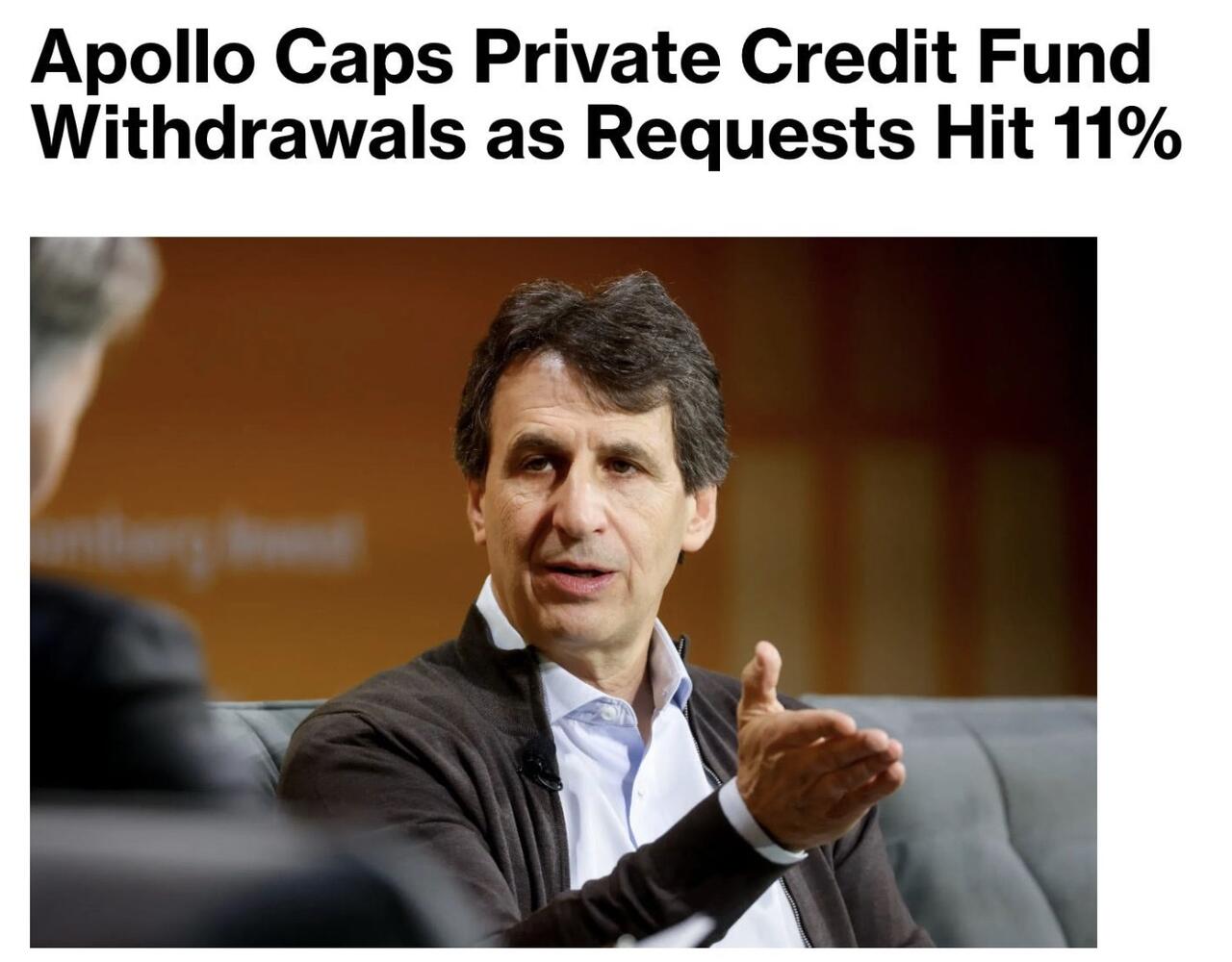
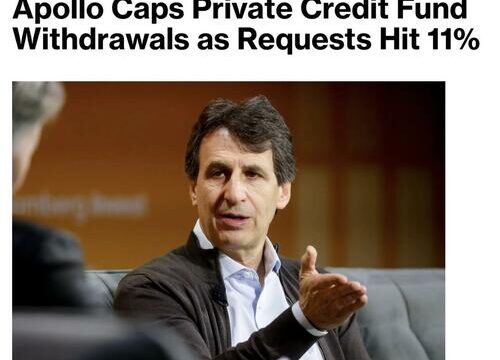
The latest example comes from Apollo, which has been forced to put the brakes on investor withdrawals from one of its largest retail focused funds, according to Bloomberg. Its $25 billion Apollo Debt Solutions vehicle is the latest private credit flaming bag of shit that has hit redemption limits after investors tried to pull more than double what the structure allows.
In other words, investors want out and are being treated like the old ladies on line at the South Philly Acme trying to buy liverwurst and chicken salad at the deli counter. That is, to say, they’re being told to take a number.
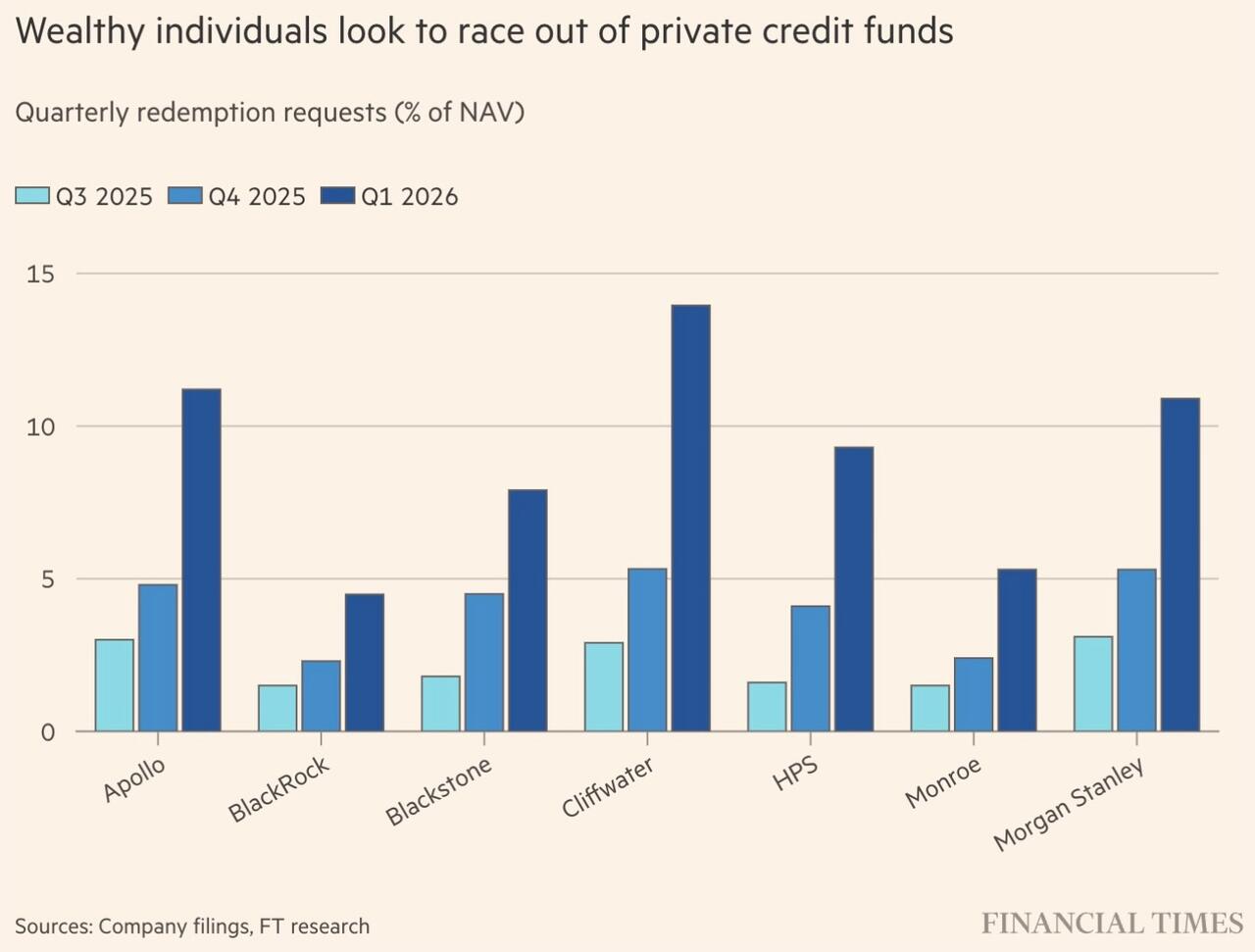
As I’ve been documenting, BlackRock recently hit similar limits in its own fund, and Morgan Stanley has been dealing with pro rated withdrawals at roughly the same levels. The difference now is scale and urgency. Apollo investors tried to redeem over 11% of the fund in one window. That’s a quintessential “race for the exits”.
And it was an Apollo executive himself who said just days ago that “all” marks in private credit are “wrong”. Oh, the irony.
The size with these funds is not trivial. These are not obscure niche strategies. These are $25 to $30 billion vehicles seeing real redemption pressure. That is large enough to matter, even if people would prefer to pretend otherwise. Combined, we’re already talking about stress on nearly $100 billion in assets.
It is worth remembering what these funds actually own. They are not sitting on piles of cash waiting to hand it back. They hold loans that are illiquid, often priced off internal models, and extended to companies that depend on continued access to financing. Those loans have counterparties. Those counterparties have their own problems. That is how stress spreads.
🔥 50% OFF FOR LIFE: Using this coupon entitles you to 50% off an annual subscription to Fringe Finance for life: Get 50% off forever
When investors want liquidity and the assets cannot be sold without taking a hit, the system does not magically fix itself. It just stalls. Gating redemptions buys time, but it also quietly concentrates risk in a smaller pool of remaining investors. Not exactly the kind of feature you have McKinsey highlight in the $3,000 per hour, focus group approved marketing deck.
To put this in context, none of this should come as a surprise. What we are seeing in private credit is part of a broader unwind across lower quality lending that only looked stable when money was free. The buy now pay later space is probably the cleanest example. It scaled by extending tiny, unsecured loans to increasingly questionable borrowers, all funded by investors desperate for yield. I noted that here: The Private Credit Crisis Is Spreading
For a while that got labeled as innovation. In reality it was just credit being pushed further down the spectrum. If someone needs to finance a $40 discretionary purchase in installments, you are dealing with someone who either cannot or does not want to pay upfront, which tends to matter a lot more once rates go up.
That model worked beautifully when capital was abundant and refinancing was easy. It worked during years when liquidity was effectively unlimited. It works a lot less well when rates normalize and credit markets start behaving like actual credit markets again.
What we are seeing now is the same story repeating itself across different areas. First it showed up in names like Carvana, then in private credit, now in BNPL. Subprime lending with better branding is still subprime lending.
Funds like Stone Ridge’s LENDX made that painfully clear. Investors tried to exit and discovered that the structure would not let them.
Chart: FT
What has really changed here is psychology. For years private credit worked because investors believed it was stable, illiquid by design, and somehow insulated from the volatility you see in public markets. That belief is starting to crack. Once investors begin to question marks, liquidity, and exit mechanics at the same time, the whole pitch unravels quickly. The genie is out of the bottle now. People have seen gates, they have seen prorated withdrawals, and they have realized that “long term capital” often just means “you are not getting your money back when you want it.” Once that shift happens, it tends to feed on itself. More redemption requests lead to more restrictions, which leads to even more urgency to get out.
And historically, that kind of psychological break does not just stabilize on its own. It keeps going until something forces it to stop.
We are in the early stages of a credit cycle turn where liquidity is no longer hiding asset quality. Valuations across private markets look increasingly questionable, recovery assumptions are likely too optimistic, and investor confidence is starting to crack at the edges.
When multiple large funds start limiting withdrawals at the same time, that is not random. That is a signal.
And just to state the obvious, since it apparently needs to be said:
This is not the time to be buying dips in private credit, in my opinion.
The entire sales pitch for this asset class was built on steady income, low volatility, and the illusion of insulation from public markets. Now that liquidity is tightening, those assumptions are getting tested in real time. Marks start to matter, structure starts to matter, and suddenly that extra yield does not look quite as comforting.
There will be opportunities in credit eventually. There always are once things break enough. But those tend to show up after forced selling, after repricing, and after people stop pretending everything is fine.
We are not there yet.
Tracking the private credit meltdown:
March 24, 2026 – Ares restricts withdrawals on its Strategic Income Fund after redemption requests hit 11.6%
March 23, 2026 – Apollo caps withdrawals on its $25 billion Apollo Debt Solutions vehicle after redemptions hit 11%
March 19, 2026 – Stone Ridge’s Alternative Lending Risk Premium Fund gates redemptions after overwhelming redemption requests
March 16, 2026 – Apollo co-president says that “all” marks in parts of the private markets industry are “wrong”
March 11, 2026 – Morgan Stanley and Cliffwater cap redemptions in $8 billion, and $33 billion funds, respectively
March 6, 2026 – BlackRock begins limiting withdrawals from its $26 billion HPS Corporate Lending Fund
March 3, 2026 – Blackstone faces “record” redemptions from its flagship private credit vehicle, investors sought to redeem 7.9% of fund’s $82B in assets
February 19, 2026 – Blue Owl restricts redemptions from its retail private credit fund
January 26, 2026 – Blackrock takes 19% markdowns on TCP Capital Corp.
December 17, 2025 – Blue Owl walks away from $10 billion data center deal for Oracle
October 15, 2025 – QTR warns private credit is one of 10 areas of the market that I would avoid heading into 2026
QTR’s Disclaimer: Please read my full legal disclaimer on my About page here. This post represents my opinions only. In addition, please understand I am an idiot and often get things wrong and lose money. I may own or transact in any names mentioned in this piece at any time without warning. Contributor posts and aggregated posts have been hand selected by me, have not been fact checked and are the opinions of their authors. They are either submitted to QTR by their author, reprinted under a Creative Commons license with my best effort to uphold what the license asks, or with the permission of the author.
This is not a recommendation to buy or sell any stocks or securities, just my opinions. I often lose money on positions I trade/invest in. I may add any name mentioned in this article and sell any name mentioned in this piece at any time, without further warning. None of this is a solicitation to buy or sell securities. I may or may not own names I write about and are watching. Sometimes I’m bullish without owning things, sometimes I’m bearish and do own things. Just assume my positions could be exactly the opposite of what you think they are just in case. If I’m long I could quickly be short and vice versa. I won’t update my positions. All positions can change immediately as soon as I publish this, with or without notice and at any point I can be long, short or neutral on any position. You are on your own. Do not make decisions based on my blog. I exist on the fringe. If you see numbers and calculations of any sort, assume they are wrong and double check them. I failed Algebra in 8th grade and topped off my high school math accolades by getting a D- in remedial Calculus my senior year, before becoming an English major in college so I could bullshit my way through things easier.
The publisher does not guarantee the accuracy or completeness of the information provided in this page. These are not the opinions of any of my employers, partners, or associates. I did my best to be honest about my disclosures but can’t guarantee I am right; I write these posts after a couple beers sometimes. I edit after my posts are published because I’m impatient and lazy, so if you see a typo, check back in a half hour. Also, I just straight up get shit wrong a lot. I mention it twice because it’s that important.
Tyler Durden
Wed, 03/25/2026 – 10:05
https://www.zerohedge.com/markets/trapped-private-credit-exit-door-has-been-locked-and-sealed-shut
Goldman Sees Risk Of Food Price Spike Amid Fertilizer Disruption
Goldman Sees Risk Of Food Price Spike Amid Fertilizer Disruption
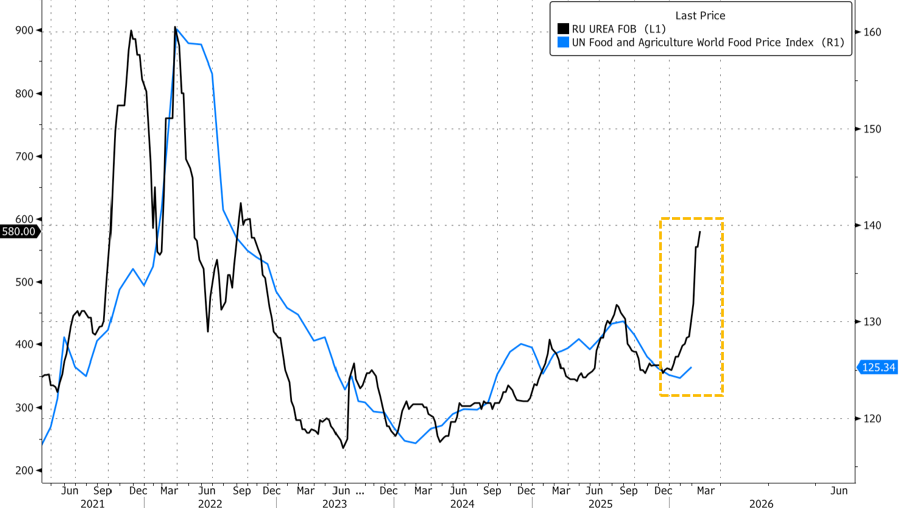
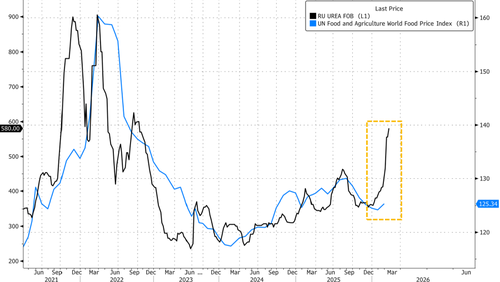
The conversation grows louder by the day as disruption at the Hormuz chokepoint hits the global nitrogen fertilizer market and, in turn, is set to impact upcoming corn and grain harvests in some key growing regions.
Goldman commodity analysts Lina Thomas and Daan Struyven penned a note on Tuesday warning clients that chokepoint risks in the Strait of Hormuz may affect global agricultural prices.
“The Strait of Hormuz is a critical route in the global nitrogen fertilizer market, which accounts for 60% of global fertilizer use and is especially important for crops like corn and other grains,” Thomas and Struyven wrote in the note.
They warned that Hormuz disruptions not only constrain global fertilizer availability, but also that, with seaborne LNG flows from the region limited, any ability to boost fertilizer production elsewhere would be impacted.
“Given fertilizer accounts for ~20% of grain costs, the largest potential boost to grain prices is more likely to come from reduced grain supply. Fertilizer disruptions may reduce grain production both through yield losses from delayed or sub-optimal nitrogen application and potential acreage shifts toward less fertilizer-intensive crops,” the analysts said.
They noted that the US is viewed as “currently relatively insulated because the conflict began just ahead of the planting season,” adding that the most exposed areas include Europe, Australia, and the Southern Hemisphere, where crop calendars are later.
Even though US farmers may be relatively insulated, that does not mean US crop prices will remain low, as analysts expect global crop prices to rise.
Also on Tuesday, Russia suspended ammonium nitrate exports from March 21 through April 21 to secure domestic fertilizer supplies during the spring planting season. The report was released by Russia’s state-run news agency TASS, citing the Agriculture Ministry.
Last week, former central bank adviser Alexandra Prokopenko put a timeline on when the food price shock could appear in global markets, saying she believes it could emerge in six to nine months.
Latest on fertilizer and food supply chain amid Hormuz chokepoint:
Russia Halts Ammonium Nitrate Exports As Global Fertilizer Crisis Set To Worsen
Glitch Shuts Australia’s Biggest Maker Of Vital Fertilizer Input For 2 Months At Worst Possible Time
Bloomberg macro strategist Simon White recently noted that the energy and fertilizer supply shock is “troublesome for second-round inflationary effects.”
Professional subscribers can read the full Goldman report here at our new Marketdesk.ai portal
Tyler Durden
Wed, 03/25/2026 – 09:45
https://www.zerohedge.com/commodities/goldman-sees-risk-food-price-spike-amid-fertilizer-disruption

‘Cuba Next!’: 1000s Rally In Favor Of American Intervention In Communist Island Nation
‘Cuba Next!’: 1000s Rally In Favor Of American Intervention In Communist Island Nation
Authored by Troy Myers via The Epoch Times,
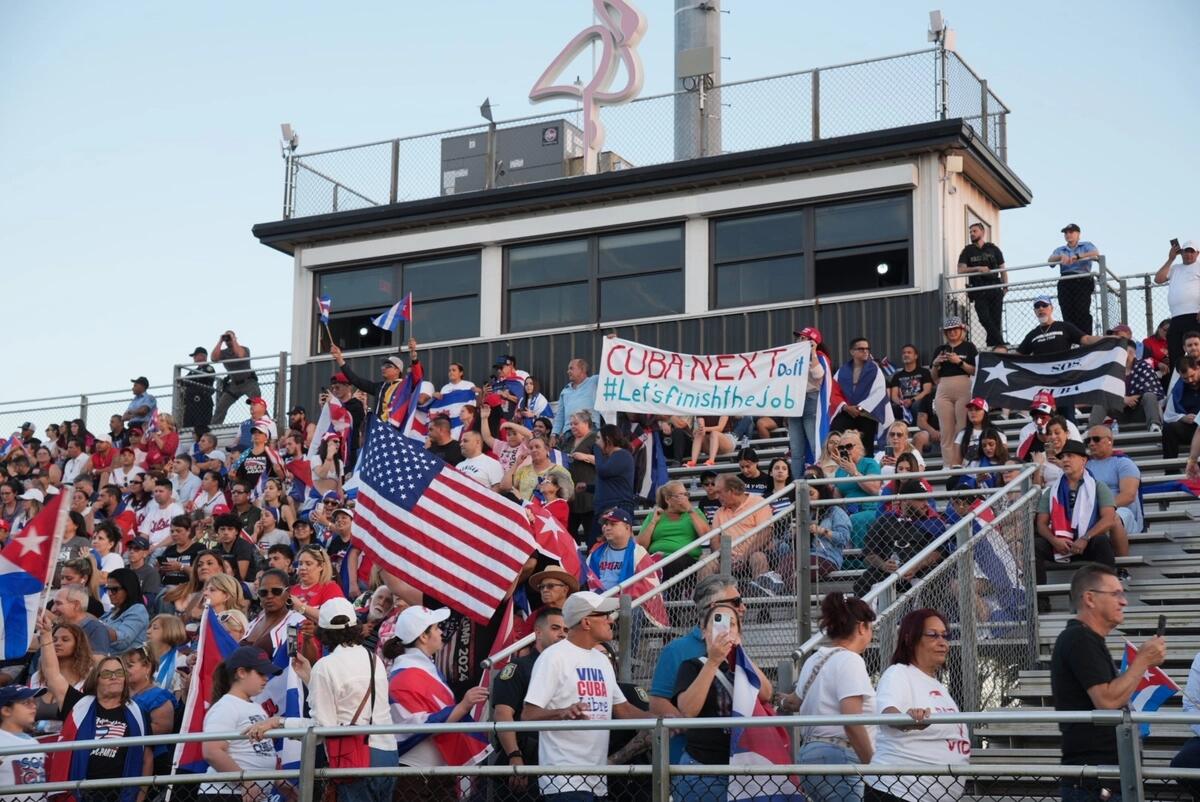
Thunderous chants of “Cuba next,” “patria y vida,” and “libertad” echoed from thousands of Cuban Americans in Hialeah, Florida, on Tuesday evening at a rally for a post-regime Cuba.
“Patria y vida means that we get to have our country and also have life,” one of the attendees, Venus Barrera, said. “I came today to beg for an intervention so Cuba can finally be free. We have been dealing with a dictatorship for the last 67 years.”
Translated to English, “patria y vida” means “homeland and life.”
Dozens of Cubans who spoke to The Epoch Times expressed their hope that U.S. President Donald Trump will intervene to rid Cuba of what they described as a tyrannical regime that has imprisoned, punished, exiled, and killed its opposition for nearly 70 years.
Wearing “Make Cuba Great Again” hats and waving American, Cuban, and Trump flags, the thousands of attendees all synchronized in a single message: the time for freedom in Cuba is overdue.
Barrera told The Epoch Times that she has lost several close family members to the communist regime, including her brother, over the past three years.
“There’s no freedom,” Barrera said.
Cuban Americans gathered at a rally for a post-regime Cuba. Following the event, attendees stayed behind to sing and dance together, in Hialeah, Fla., on March 25, 2026. Troy Myers/Epoch Times
Cuban American influencers, opposition leaders, and local and state politicians spoke at the “Free Cuba Rally” on Tuesday night, alternating with Cuban American musicians singing songs about a free Cuba.
Barrera was born in the United States after her parents fled the island nation, which is less than 100 miles from the closest point of Florida, in search of a better life, she said. To achieve a free Cuba, there must not be any communist politicians left in power—they must leave the country entirely, she said.
“They have destroyed our country,” Barrera said. “I wouldn’t even dare go back there.”
Another attendee at the rally, 83-year-old Maria, who did not wish to provide her last name, told The Epoch Times that she arrived in the United States four months ago and had witnessed firsthand a once beautiful country turn into the failed communist state it is today, describing Fidel Castro’s far-left revolution in 1959 as a “cancer.”
Current Cuban leader Miguel Díaz-Canel must be removed, Maria said.
“Destroy everything that has to do with communism,” the 83-year-old said.
Hialeah Mayor Bryan Calvo, who organized the event alongside city council members, told the crowd that his city stands ready to lead and support the vision of a post-regime Cuba.
Expatriates previously told The Epoch Times at length about their hopes for the Cuban communist regime to be the next in line to fall after the successful capture of former Venezuelan leader Nicolás Maduro by U.S. military forces.
Tuesday night’s rally in South Florida reinforced these hopes of American intervention, as top U.S. officials have repeatedly hinted that such action against Cuba could be coming.
Cuban Americans draped their country and the U.S. flag around themselves at a rally for a post-regime Cuba, in Hialeah, Fla., on March 25, 2026. Troy Myers/The Epoch Times
Trump said on March 8 that Cuba was “at the end of the line” after the nation lost its main oil provider and ally, Maduro.
Days later, while speaking at a news conference, Trump said the communist country faces severe humanitarian challenges. He also suggested the possibility of a U.S. takeover.
“It may be a friendly takeover. It may not be a friendly takeover,” Trump said.
Then, on March 17, the president told reporters at the White House: “I do believe I’ll be having the honor of taking Cuba. That’s a big honor. Whether I free it, take it, I think I can do anything I want with it.”
That statement was approved of by many Cuban Americans at the Tuesday night rally.
Yeslier Sanchez, who arrived in the United States more than 30 years ago, said he believes he can speak for all Cubans in demanding dramatic change in the communist regime that’s oppressed its people for decades.
“Cuba next,” thousands of Cuban Americans chanted in unison at a rally for American intervention in the island nation’s communist regime. Attendees listened to politicians, influencers, musicians, and Cuban opposition leaders at the event in Hialeah, Fla., on March 25, 2026. Troy Myers/The Epoch Times
“We never forget,” Sanchez told The Epoch Times. “Everybody in the government must be held accountable for what they did over these 67 years.”
Prior to the elaborately planned and executed capture of Maduro, the Trump administration began pressuring the Venezuelan regime. The United States has been applying the same kind of tactics to Cuba.
Trump signed an executive order on Jan. 29 that would impose tariffs on any nation selling oil to Cuba. A recent 29-hour nationwide blackout, amid the U.S. oil blockade, highlighted Cuba’s crippled infrastructure.
“Cuba has an economy that doesn’t work and a political and governmental system that can’t fix it,” Secretary of State Marco Rubio said on March 17.
Thousands of Cuban Americans showed up for a rally to support American intervention in Cuba’s communist regime. Attendees held a sign saying “Cuba Next” in Hialeah, Fla., on March 25, 2026. Troy Myers/The Epoch Times
Rubio, who is of Cuban descent, also called for dramatic change in Cuban leadership. Anytime the speakers at the Tuesday rally mentioned the secretary of state’s name, the crowd erupted in support.
With success in Venezuela and the weeks-long devastation of the Iranian regime in Operation Epic Fury, Trump could be emboldened to make a move on the communist island nation in America’s backyard next.
“We don’t negotiate with killers and assassins,” Sanchez said. “In order to have a free Cuba, they either must die or they must go.”
Tyler Durden
Wed, 03/25/2026 – 09:25