Category: News
“There’s A Lot Of Concern”: GOP Lawmakers Predict Midterm Disaster If Troops Deployed To Iran
“There’s A Lot Of Concern”: GOP Lawmakers Predict Midterm Disaster If Troops Deployed To Iran
While most Republicans are still with Trump on Iran, beneath the outward show of unity, something more politically dangerous is beginning to emerge: a growing fear that a war sold as limited could turn into the kind of Middle East quagmire MAGA voters thought they had already rejected.
And it isn’t just the usual anti-interventionist voices. It is now being voiced by Trump allies, rank-and-file House Republicans, and even senior GOP lawmakers leaving closed-door briefings sounding less reassured than rattled.
To wit – several Republican members of Congress and two GOP senators told ZeroHedge that the Iran war – or, just as importantly, its economic fallout in the form of higher gas prices – could seriously frustrate MAGA voters if it drags on.
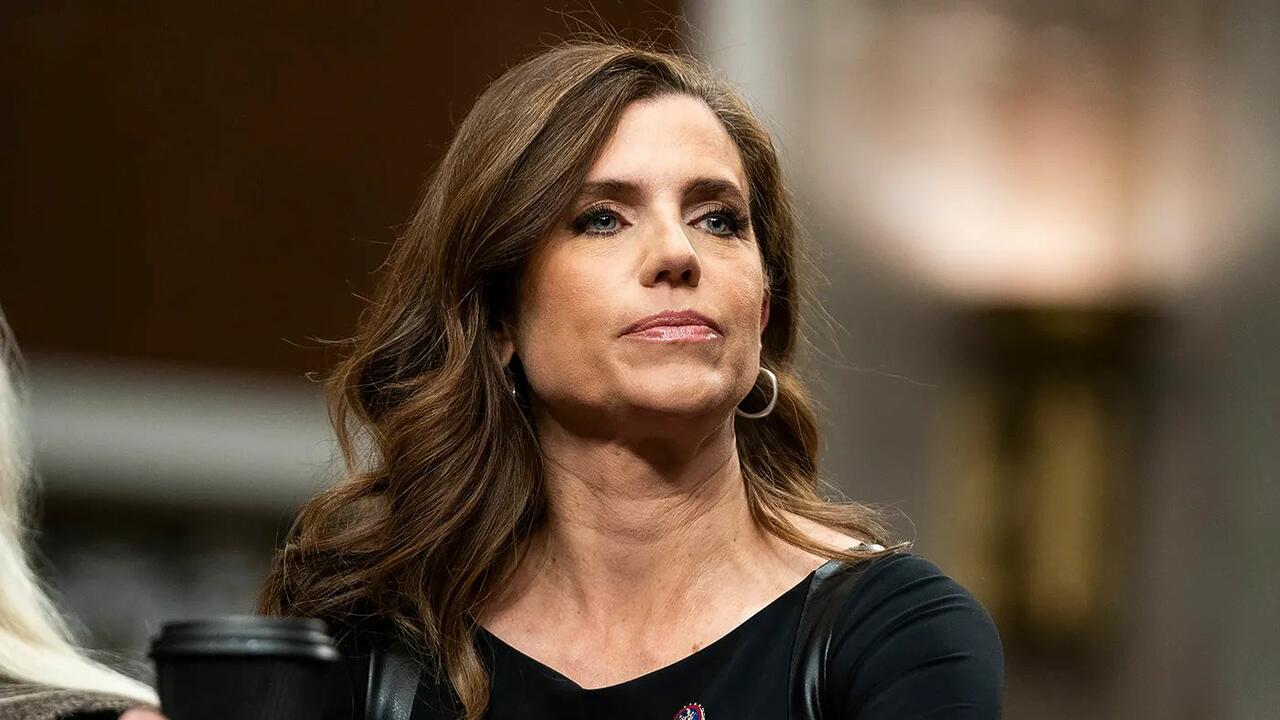
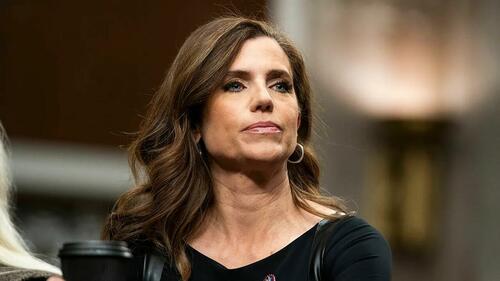
The clearest warning came from South Carolina Rep. and gubernatorial candidate Nancy Mace, who said that during her statewide campaigns, she’s received standing ovations for her opposition of U.S. boots on the ground.
“This is in front of conservative MAGA Republicans,” she told ZH on Wednesday.
“If there are boots on the ground, public sentiment on this war changes overnight in a flash… people are not going to go for it,” Mace added. “I was just in the briefing with House Armed Services [Committee], and I got to tell you it did not inspire confidence. I quite frankly stormed out.“
Mace has since made clear that her opposition is not rhetorical. Earlier this week she told reporters: “I’ll be voting against the funding if we’re putting troops on the ground. I’m not going to fund that.”
Mace: I’ll be voting against the funding if we’re putting troops on the ground. I’m not going to fund that—no U.S. troops. pic.twitter.com/qLDbT0OrvA
— Acyn (@Acyn) March 24, 2026
She later sharpened the point further, writing on X: “If a single boot of a single American soldier sets foot on Iranian soil, I will vote against this. I will not vote to fund sending South Carolina’s sons and daughters to die in a ground war in Iran.”
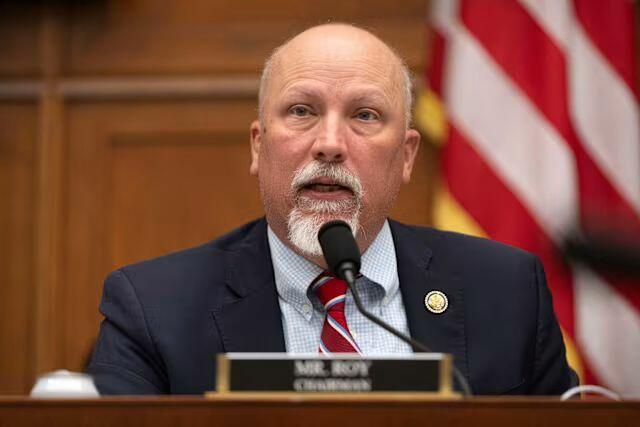
Texas Rep. Chip Roy, originator of the hotly debated SAVE America Act, struck a similar note. For Roy, the issue is not just strategy but clarity: if the administration is moving toward troop deployments, Republican voters will want to know exactly why, exactly for how long, and exactly what victory is supposed to look like.
“There’s a lot of concern,” he said when asked about actual conversations he’s had with constituents. “It would need to be very clear what we’re doing if that’s where it’s headed.”
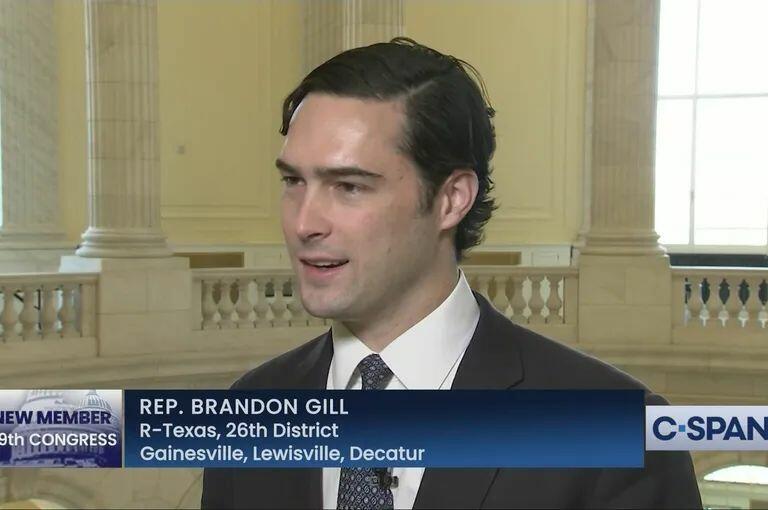
Another Texas House Republican, Brandon Gill, emphasized his trust in the President and the national security rationale for the war. But even Gill echoed the same red line voiced by Mace and Roy: support can evaporate quickly if this becomes an open-ended nation-building exercise.
“[Voters] don’t want to get us into – for the United States to get into – a long prolonged Middle East,” Gill told ZH. “We’re not going to go out and start nation building. The American people don’t want us to.”
That is the core tension now running through the GOP. Many Republican voters and lawmakers may still support the strikes as a show of force. But support begins to erode as the prospect of deeper involvement grows.
GOP lawmakers are belatedly starting to wake up to the possibility that the United States could once again get bogged down in another Middle East quagmire – this time in a country roughly double the size of Iraq in both geography and population.
At the center of that concern is the fear that what began as a supposedly limited operation is rapidly expanding into something far more costly, more open-ended, and more politically toxic. The Pentagon’s massive supplemental funding request only intensified those suspicions, especially after White House officials had initially previewed the war as lasting only “days” or a few “weeks,” not months or years.
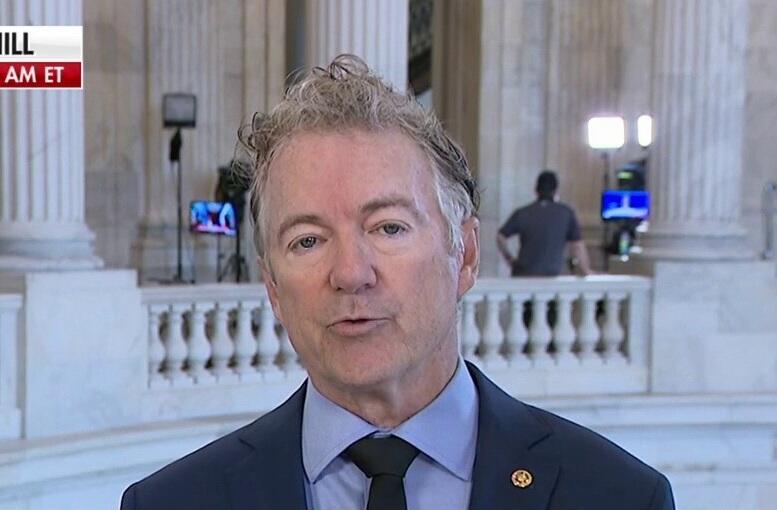
That uncertainty matters because the politics of this war may ultimately be decided less by ideology than by cost. Kentucky Senator Rand Paul told us bluntly that the political fate of the conflict could be sealed at the gas pump.
“It’s going to be an uprising of [voters] saying they don’t want $5 gasoline,” Paul told ZH.
“The longer it goes on, particularly for people who most of their paycheck goes to rent, gas, and food, those people become increasingly against the war over time.”
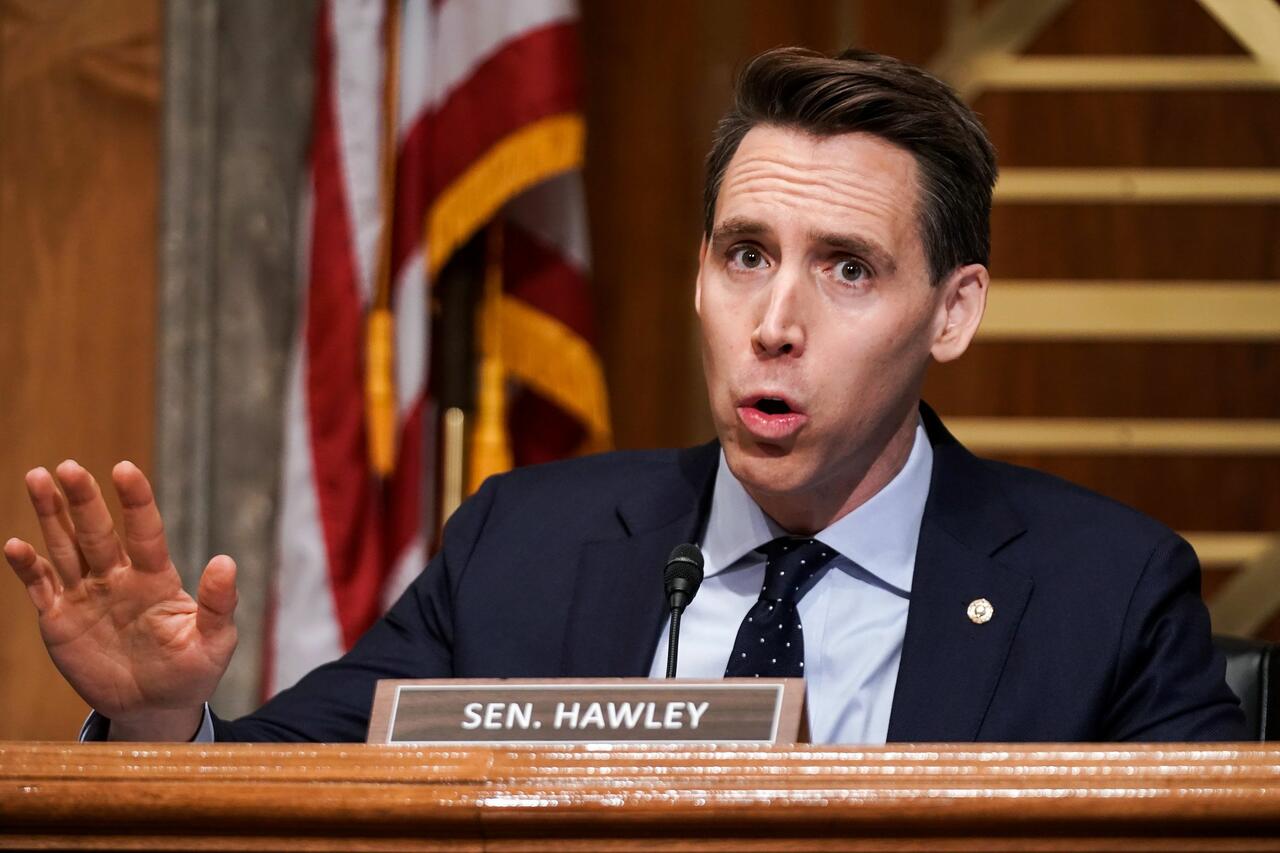
Missouri Sen. Josh Hawley, while stopping short of criticizing the war itself, pointed to the same underlying vulnerability. Asked what is upsetting GOP voters and contributing to setbacks in places that should be safely Republican, he said simply: the cost of living.
“They want to see prices come down. They want gas to be cheaper. They want healthcare to be cheaper. Families need it,” Hawley told ZH. “What we have right now where everything continues to get expensive, or at least it’s not getting less so, but their wages are not meaningfully going up, something’s got to change.”
That is the danger now hanging over Trump and congressional Republicans alike. The admin has already lost anti-war conservatives, but they may be able to maintain the middle of the bell curve if the war doesn’t drag on.
Or as Mace put it, support could change “overnight in a flash.”
Tyler Durden
Fri, 03/27/2026 – 09:40

Peak Lobotomized American Consumer
Peak Lobotomized American Consumer
Submitted by QTR’s Fringe Finance
There’s a very specific kind of financial confession I’ve had to make to myself recently.
I see charges pop up on my phone’s home screen on various credit cards all the time. A lot of times they just say “Apple” or “Amazon.” No details. No explanation. Just a clean, confident withdrawal from my account like I’m renting air to breathe from both of these companies. And like a good American lobotomized consumer, I do absolutely nothing about it.
I don’t investigate. I don’t even tap for more information. I just stare at it for half a second, nod internally, and think, yeah that feels right. Then I keep scrolling like I didn’t just get billed by a corporation with the transparency of Area 51.
At this point, I have to admit something. I have fully surrendered to Amazon and Apple. Not in a dramatic way. Not in a conscious, principled decision. More in the slow, quiet erosion of resistance. Somewhere along the line, I stopped being a person who tracks purchases and became a person who assumes all unexplained charges are probably valid. I’m the opposite of the assholes who subscribe to my blog, download the content they want, then contest the charge with their credit card companies.
And hey, if a random company hit my card like this, I’d immediately spiral. I’d be calling my bank, questioning my entire digital security setup. But when it’s Apple or Amazon, I assume the problem is me. I must have done something. Bought something. Subscribed to something. Needed something. Movie rental. NFL Thursday night football. Cascade brand dishwasher detergent. AppleCare. Prime subscription. Recurring donation to feed starving children I signed up for at Whole Foods.
Who the f**k knows? The point is, I don’t check. I accept. Getting older. Brain functioning less. Surrendering more to Skynet. Arguing with my Apple HomePod about why it can’t accurately tell me what day it is, assuming the faceless, brainless, soulless machine is going to reason with me and respond accordingly. I am drifting toward Idiocracy.
🔥 50% OFF FOR LIFE: Using this coupon entitles you to 50% off an annual subscription to Fringe Finance for life: Get 50% off forever
I used to think strong business models were about margins or scale or innovation. Now I’m pretty sure it’s about getting to a place where I can’t even be bothered to ask why money is leaving my account. Both of these companies have built systems that feel less like products and more like default settings. I didn’t just buy into them. I live inside them. My storage, my shopping, my entertainment, my random late night decisions, all quietly routed through pipelines I no longer examine.
Each individual charge is small enough to ignore. That’s the trick. Nothing ever feels big enough to question, but somehow it adds up to a steady stream of money leaving my account with my full, passive approval.
There is no moment where I sit down and actively renew anything. The decision has already been made for me by a past version of myself who clicked “subscribe” once and then disappeared. Now everything just continues, indefinitely, like a background process I forgot how to shut off…like how the Fed assumes inflation will work in the dark machinery of the night. And the worst part is, I’m not even annoyed about it. The charges could literally say “Apple — Kiss Our F**king Ass”, and I probably still wouldn’t check on them.
I’ve crossed into that dangerous territory where the thought process is no longer “what is this charge” but “I’m sure it’s something I use.” That’s it. That’s the whole audit. So yes, this is an admission.
I am the ideal customer. I see vague charges from trillion dollar companies and simply assume they are correct. No questions asked. No follow up required. So congratulations, Apple and Amazon. You win. I surrender.
Now read:
Fire, Already
Ever Wonder Where $7 Trillion Goes?
The Smarter Way To Bet On Anthropic And OpenAI
The ‘Blame Game’ In Private Credit Begins…
Fringe Finance Stocks To Watch
QTR’s Disclaimer: Please read my full legal disclaimer on my About page here. This post represents my opinions only. In addition, please understand I am an idiot and often get things wrong and lose money. I may own or transact in any names mentioned in this piece at any time without warning. Contributor posts and aggregated posts have been hand selected by me, have not been fact checked and are the opinions of their authors. They are either submitted to QTR by their author, reprinted under a Creative Commons license with my best effort to uphold what the license asks, or with the permission of the author.
This is not a recommendation to buy or sell any stocks or securities, just my opinions. I often lose money on positions I trade/invest in. I may add any name mentioned in this article and sell any name mentioned in this piece at any time, without further warning. None of this is a solicitation to buy or sell securities. I may or may not own names I write about and are watching. Sometimes I’m bullish without owning things, sometimes I’m bearish and do own things. Just assume my positions could be exactly the opposite of what you think they are just in case. If I’m long I could quickly be short and vice versa. I won’t update my positions. All positions can change immediately as soon as I publish this, with or without notice and at any point I can be long, short or neutral on any position. You are on your own. Do not make decisions based on my blog. I exist on the fringe. If you see numbers and calculations of any sort, assume they are wrong and double check them. I failed Algebra in 8th grade and topped off my high school math accolades by getting a D- in remedial Calculus my senior year, before becoming an English major in college so I could bullshit my way through things easier.
The publisher does not guarantee the accuracy or completeness of the information provided in this page. These are not the opinions of any of my employers, partners, or associates. I did my best to be honest about my disclosures but can’t guarantee I am right; I write these posts after a couple beers sometimes. I edit after my posts are published because I’m impatient and lazy, so if you see a typo, check back in a half hour. Also, I just straight up get shit wrong a lot. I mention it twice because it’s that important.
Tyler Durden
Fri, 03/27/2026 – 09:20
https://www.zerohedge.com/markets/peak-lobotomized-american-consumer
Escalation On All Fronts As Mediators Say Iran Hasn’t Requested Pause On US Energy Strikes
Escalation On All Fronts As Mediators Say Iran Hasn’t Requested Pause On US Energy Strikes
Summary
No pause from Tehran, war footing deepens: Iran denies requesting Donald Trump’s 10-day halt
Escalation on all fronts: IRGC HQ targeted by US-Israsel; Iran signals expansion by naming UAE targets, hitting Kuwait ports and sending drones on Riyadh
Israel doubles down amid reports of manpower strain: IDF chief warns of manpower pressure even as Defense Minister Katz vows to “intensify and expand” strikes.
Risk rises that Iran is holding back more advanced missiles for a prolonged war: WSJ writes “The US and Israel are pounding Iran’s missile-launching sites… But Tehran’s missiles keep flying.”
* * *
Iran Didn’t Request Trump’s 10-Day Pause: WSJ
Iran has not requested a 10-day pause on strikes on its energy plants, peace talk mediators have been cited in WSJ as saying, and has still not issued formal response to the 15-point US plan delivered via Pakistan. This as the Pentagon is moving thousands of Marines and Army Airborne soldiers into the region.
The Wall Street Journal points out that “The U.S. and Israel are pounding Iran’s missile-launching sites, hitting some over and over across almost a month of war. But Tehran’s missiles keep flying.”
One pundit questions, are we ‘winning’ yet?… writing the following brief assessment of where things stand: IRGC Joint Staff headquarters under US-Israeli strikes. Iran naming UAE targets as Abu Dhabi enters the war. IDF Chief of Staff warning publicly the Israeli military could “collapse” from manpower shortages. Iran claiming over one million fighters mobilised with IRGC lowering the age for support roles to 12. Pentagon considering 10,000 additional ground troops within striking distance of Kharg. Trump pausing energy-plant destruction for 10 days until April 6. Iran denying it requested the pause. Houthis warning they will enter the war. Lavrov saying the quiet part: “Iran did not violate any of its international obligations.” Russia’s oil revenue doubling to $24 billion this month.
Oil prices continued to spike this morning, with international Brent crude oil once again surpassing $110 per barrel. For the day so far that’s up another 3%.
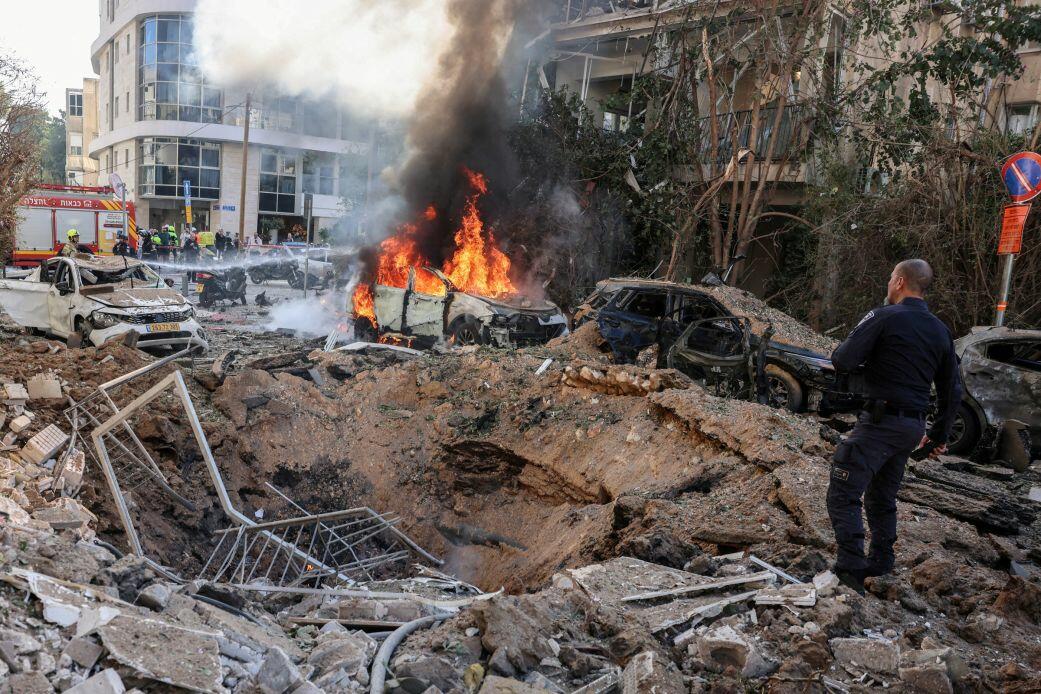
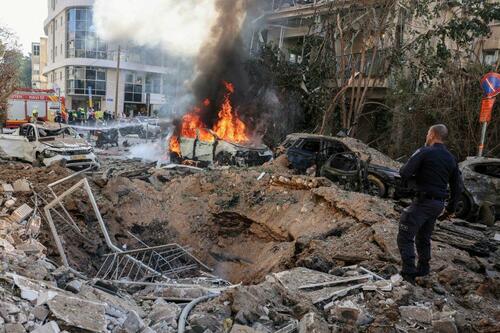
Aftermath of strikes earlier this week on central Israel
“After several glimmers of hope, fueled by comments from President Trump, which were quickly dashed, the market is becoming more demanding in terms of rhetoric,” said Amélie Derambure, senior multi-asset portfolio manager at Amundi. “The TACO trade is more difficult to do because a return to square one is not possible from here.”
Gulf Flashpoint Widens: Iran Signals No Let Up
Multiple GCC countries issued incoming-attack alerts as drones and missiles light up the region Friday, with Kuwait taking at least two new hits: Shuwaikh Port was struck by “hostile drones” – per the Kuwait Ports Authority, with a second target, Mubarak Al-Kabeer Port, reportedly hit by drones and cruise missiles. Infrastructure damage has been reported in both cases, but no reported casualties.
Saudi Arabia maintains its air defense footing, with the Ministry of Defense saying drones were intercepted and destroyed over Riyadh and the Eastern Province, following a warning for Al-Kharj – home to Prince Sultan Air Base. Six ballistic missiles were detected: two intercepted, with four splashing into the Persian Gulf and empty areas.
Absolute chaos in Tel Aviv…
Caos absoluto en Tel Aviv. La ciudad está en llamas. La sociedad israelí está viviendo su peor momento en décadas. Las nuevas oleadas de misiles de Irán son cada vez mas violentas y la situación se está volviendo insostenible. Se ha prohibido incluso la divulgación de todos los… pic.twitter.com/C5SDgtBigk
— Martín Dandach (@MartinDandach) March 26, 2026
New explosions have been reported in Dubai and Abu Dhabi on Friday. It’s as if Iran and the IRGC are sending a clear “f-you” message to Trump in the wake of the series of ultimatums and deadlines Tehran never asked for. Trump earlier went from 48 hours to 5 days to now a 10-day window amid the threats to attack power and energy infrastructure.
Israel Escalates Too: Will ‘Intensify & Expand’ Strikes on Iran
The White House has been busy talking about its backchannel diplomacy and getting the beginnings of a peace deal off the ground via Pakistan, and at one point within the past week there was talk of Vice President J.D. Vance actually traveling to Islamabad – but the situation on the ground suggests the opposite, given also Israel has on Friday announced escalation of its posture. Israel has continued coming under consistent missile strikes.
⚡️Nahariya, Israel pic.twitter.com/5rl2HtWuYT
— War Monitor (@WarMonitors) March 26, 2026
Now, Defense Minister Israel Katz is vowing Israel’s attacks will “intensify and expand” – citing that Islamic Republic had not heeded warnings “to stop firing missiles at Israel’s civilian population.” Katz said: “The fire has continued – and therefore, IDF strikes in Iran will intensify and expand to additional targets and domains that assist the regime in developing and deploying weapons against Israeli civilians.”
There remains a huge risk for Israel amid the expectation that Iran has been saving its biggest and most advanced, longer range missiles – rationing its arsenal as it settles in for a long war.
Strait of Hormuz Status & Overnight News
Tehran could still be playing a double game of public rejection coupled with private behind-the-scenes signaling. According to Axios’ latest, Iranian officials are quietly showing interest in talks even as they reject Washington’s proposal, with mediators leaning hard to force or ‘will into existence’ a meeting in the coming days. “Things are progressing very slowly” in terms of negotiations between the US and Iran, and as of now, no meeting between senior officials is even on the calendar, per Isreal’s i24NEWS.
An Iranian girl swings on a beach in Bandar Abbas as smoke rises from a nearby naval base hit by strikes.pic.twitter.com/8B2Pdt2iql
— Clash Report (@clashreport) March 27, 2026
The IRGC Navy is still declaring the Strait of Hormuz effectively shut: traffic “to and from” ports tied to enemy allies is banned outright, with warnings any movement will be “severely dealt with.” In a rare twist, The Wall Street Journal and others report Iran has even blocked two Chinese vessels from transiting Hormuz – signaling enforcement isn’t just for Western targets. Washington seems to be trying to adapt in real time, as Reuters reports the US has deployed uncrewed drone boats into the theater, opening yet another front in an already widening conflict.
Tyler Durden
Fri, 03/27/2026 – 09:05
AI Disruption Returns: Cybersecurity Stocks Tumble On Report Of New Anthropic “Step Change” AI Model
AI Disruption Returns: Cybersecurity Stocks Tumble On Report Of New Anthropic “Step Change” AI Model
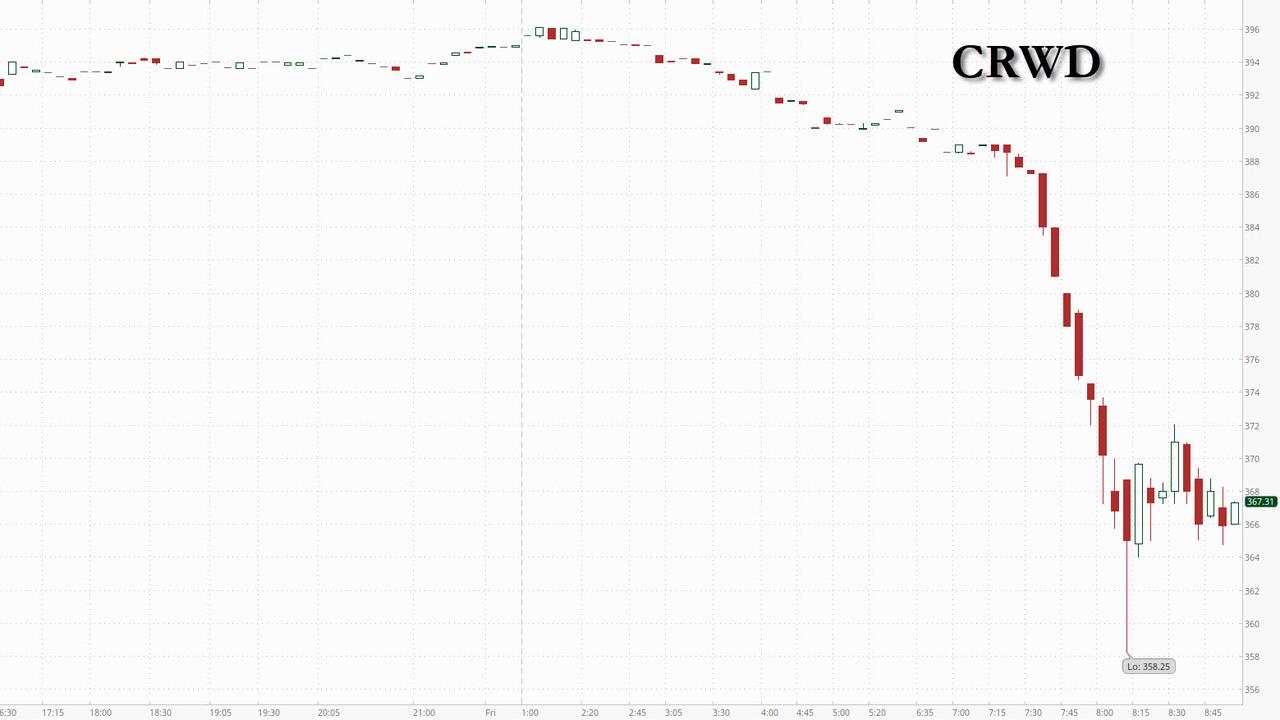
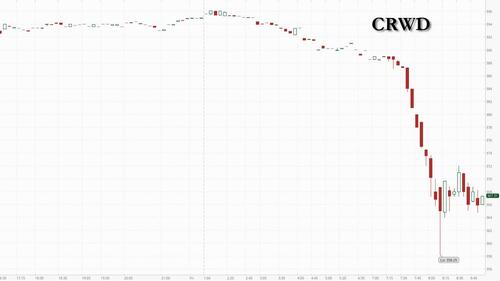
Cybersecurity stocks are slumping in premarket trading on Friday as the AI disruption trade returns after a Fortune report said Anthropic is testing a new AI model that “poses significant cybersecurity risks.”
According to the report, Anthropic is “developing and has begun testing with early access customers a new AI model more capable than any it has released previously,” the company said, following a data leak that revealed the model’s existence.
An Anthropic spokesperson said the new model represented “a step change” in AI performance and was “the most capable we’ve built to date.” The company said the model is currently being trialed by “early access customers.”
Descriptions of the model were inadvertently stored in a publicly-accessible data cache and were reviewed by Fortune.
A draft blog post that was available in an unsecured and publicly-searchable data store prior to Thursday evening said the new model is called “Claude Mythos” and that the company believes it poses unprecedented cybersecurity risks.
Among notable movers this morning: CrowdStrike -6.0%, Palo Alto Networks -4.6%, Cloudflare -3.9%, Zscaler -4.7%, Fortinet -4.0%, Okta -4.26%. The broader Global X Cybersecurity ETF is down 2.7%
Security stocks — along with software names more broadly — have been pressured by concerns that tools from AI companies like Anthropic or OpenAI could reduce demand for products from legacy providers, weighing on their growth, margins, and pricing power.
Tyler Durden
Fri, 03/27/2026 – 09:01
Trump Fails To Jawbone Market As Futures, Bitcoin Tumble; Oil And Yields Soar
Trump Fails To Jawbone Market As Futures, Bitcoin Tumble; Oil And Yields Soar
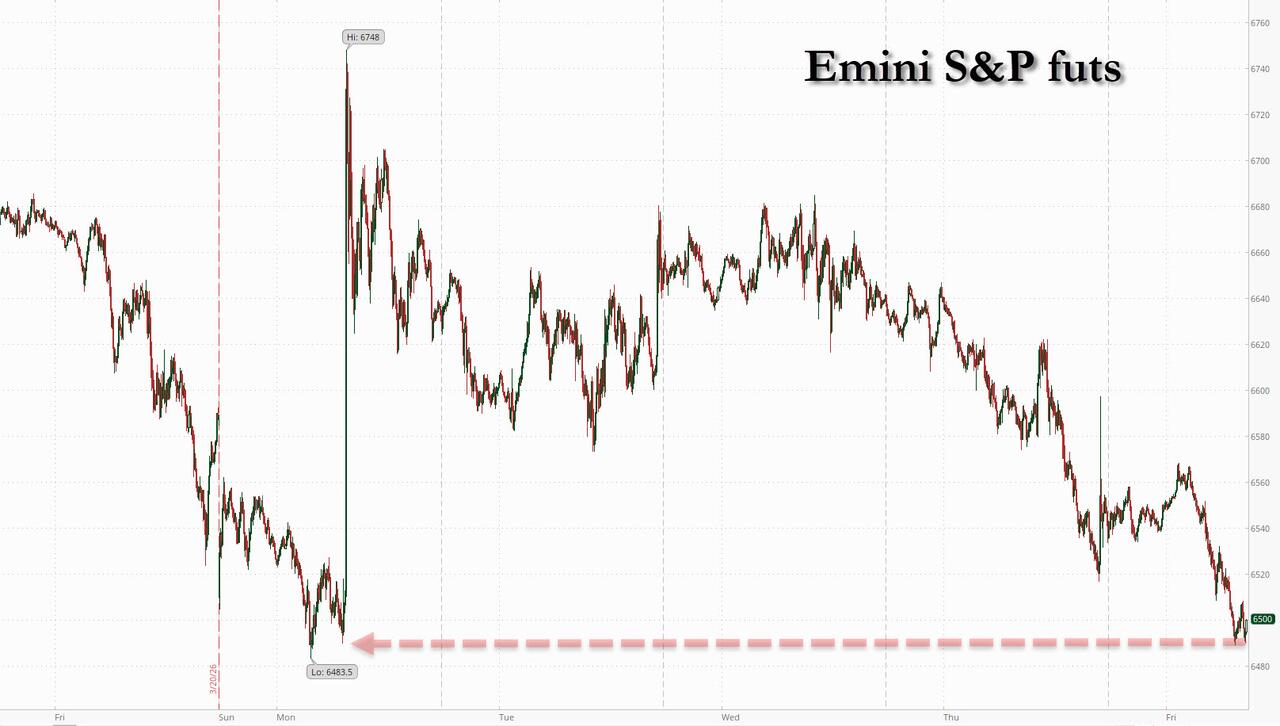
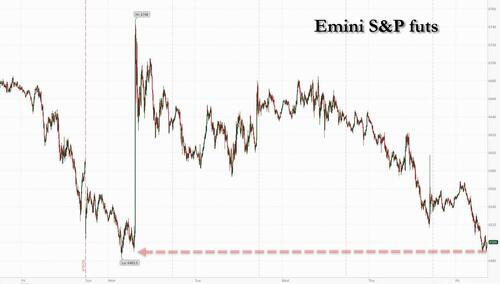
Futures are sharply lower, erasing modest overnight gains and trading near session lows as Brent crude futures are back above $110 a barrel after erasing an earlier fall and knocking broader risk sentiment off course in the process. There didn’t appear to be a single catalyst for the oil turnaround, although a steady stream of drone and missile attacks in the Middle East will have played a role and erased what little optimism Trump’s 10 day delay to an Iranian energy plant strike may have prompted, a move which is now widely seen as a smokescreen to get more US troops – and potentially Gulf allies – behind a ground invasion of one or more Iranian islands in the Persian Gulf. As of 8:00am ET S&P futures down 0.3% despite the initial spike in equities after Trump announced another delay in the ceasefire deal; with March coming to a close, the Iran war has driven WTI oil toward its best month since 2020 and stocks to their worst since 2022. Nasdaq futures slide 0.6% as equities, rates and commodities all reverse the immediately reactions. Pre-market, Mag 7 are all red Bond yields added another 3-5bp led by the long-end: 10y yields +4.8bp rising to 4.47%. Oil went up again with WTI now over $96 (+2.2% since yesterday’s close). Base metals are mostly lower (Copper -1.4%), while precious metals also reverse earlier gains.
In premarket trading, Mag 7 stocks are all red following a sharp drop in the Nasdaq 100 Thursday, as concerns over a prolonged Middle East conflict weigh on sentiment (Apple -0.1%, Nvidia -0.1%, Amazon -0.5%, Meta -0.8%, Tesla -0.5%, Microsoft -0.4%, Alphabet -1%)
Argan Inc. (AGX) rises 10% after the power plant-builder reported earnings per share and revenue for the fourth quarter that beat the average analyst estimate. JPMorgan raises its rating on the stock to overweight, saying the results were strong with EPS “well ahead” of expectations.
Rocket Pharmaceuticals (RCKT) rises 12% after the FDA approved the drug developer’s Kresladi for the treatment of severe Leukocyte Adhesion Deficiency Type I — a rare white blood cell disorder — in pediatric patients.
Two Harbors Investment (TWO) slips 2% after agreeing to be acquired by CrossCountry.
Unity Software (U) jumps 11% after the company reported preliminary first-quarter earnings. The results showed significant strength in Vector, the company’s AI-driven advertising unit, according to analysts.
In corporate news, Anthropic won a court order blocking a Trump administration ban on government use of its AI tech, arguing the move could cost it billions in lost revenue. The company behind the Claude chatbot is considering an IPO as soon as October, as it races rival OpenAI to market. And Brown-Forman, the owner of Jack Daniel’s, and France’s Pernod Ricard are discussing a merger as the alcoholic drinks industry looks at ways to weather a downturn.
“After several glimmers of hope, fueled by comments from President Trump, which were quickly dashed, the market is becoming more demanding in terms of rhetoric,” said Amélie Derambure, senior multi-asset portfolio manager at Amundi. “The TACO trade is more difficult to do because a return to square one is not possible from here.”
Optimism about the latest deadline extension for Tehran to reach a deal quickly faded as Trump no longer can jawbone market, and as a result S&P 500 futures gave back early gains to trade at session lows as US traders walk in, after Thursday saw the most bruising session for US stocks since the conflict began. Messages about the war remain mixed. Trump again delayed his deadline for Iran to agree to a ceasefire deal or face more attacks, saying talks with Tehran were going “very well”. Meanwhile, the WSJ reported that the Pentagon is looking at sending as many as 10,000 more ground troops to the Middle East. At the same time, Israel said it would escalate and expand its attacks on the Islamic Republic. The conflict has inflicted damage to energy infrastructure across the Gulf and effectively shut a vital artery for oil and gas shipments. Traders fear a broadening impact on energy supplies and oil prices, stoking fears of an inflationary spiral that could force central banks to tighten monetary policy.
“Trump is unpredictable, so one doesn’t know whether he’s gaining time to send troops to invade the Strait of Hormuz or to negotiate further,” said Nicolas Domont, a fund manager at Optigestion in Paris. “The war could stop anytime and things could return to normal within a few months but one could also end up with oil at $200 in six months.”
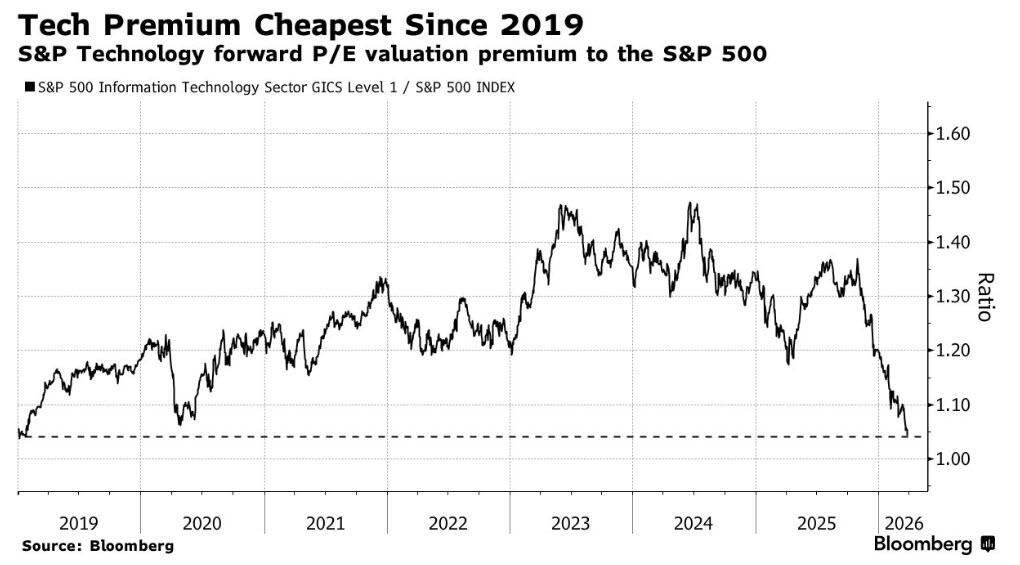
Turning back to markets, Bloomberg notes that tech’s pullback leaves the Nasdaq’s forward price to earnings valuation premium over the S&P 500 at just 4.4%, the smallest since January 2019. As recently as October, the premium stood at 35.7%.
Also weighing on sentiment was China’s move to open a trade probe into the US ahead of an expected summit between Trump and President Xi Jinping. China’s investigations into US trade practices signaled the country’s retaliation against similar probes by the Trump administration. The move is a direct mirror of steps Trump took to revive his tariff agenda after the Supreme Court last month struck down some of his duties.
“China has learnt that a confrontational approach on trade produces the most favorable outcome in negotiations,” said Wolf von Rotberg, equity strategist at Bank J Safra Sarasin. “The reciprocal action China has launched should be seen as a move to stake out its territory ahead of the Trump-Xi meeting.”
Trump is set to address a Saudi sovereign wealth fund-backed investment conference in Miami, as the Iran war drives WTI oil toward its best month since 2020 and stocks to their worst since 2022.
In Europe, the Stoxx 600 is down 0.9% with media, industrial and energy shares leading declines. Chemicals and health care outperform. Here are the biggest movers Friday:
AstraZeneca shares rise as much as 3.8% after the drugmaker said its experimental drug for chronic obstructive pulmonary disease — a deadly lung condition also known as COPD — helped reduce the worsening of symptoms in two late-stage trials
Enagas shares rise as much as 15%, the most in six years, after Spanish regulator CNMC unveiled a draft proposal for gas companies that JPMorgan says is surprisingly positive
JM gains as much as 5.2% after SEB Equities upgraded the Swedish construction and real estate development group to buy from hold and said stock prices in zero valuation creation from the land bank
SOL shares gained as much as 11% in Milan trading, the most since March 2020, as some analysts increased their price targets on the industrial and medical gases manufacturer, citing solid full-year financial results
Netcompany gains as much as 11% after upgrading its adjusted Ebitda margin guidance, with the Danish IT services provider citing “delivery excellence and implementation, supported by the ongoing embedding of AI capabilities”
Dino Polska plummets by as much as 18% after Polish food supermarket chain posted its thinnest quarterly Ebitda margin as cut-throat cost competition continued among the industry
CTS Eventim slumps as much as 17%, with JPMorgan saying that while full-year results met expectations, the set-up for the ticker seller is more mixed for 2026
Harbour Energy shares drop as much as 9% after German chemical giant BASF sold shares at a discount to Thursday’s closing price
Future Plc shares fall as much as 14% on Friday after the publisher was downgraded to hold from buy by Jefferies, which said the company faces dual headwinds from both AI and social media content
Earlier in the session, Asian stocks fell on Friday, staying on course for a fourth-straight weekly loss, as concerns over the wide-ranging economic impact of the Middle East war deterred risk-taking. Down 1.8% so far this week, the MSCI Asia Pacific Index is heading for its longest stretch of weekly declines since November 2024. The region’s tech-heavy markets of South Korea and Taiwan led Friday’s selloff, while the sector was also the biggest drag on the benchmark gauge. That’s after Meta Platforms and Alphabet drove a selloff in the US on Thursday. “The situation is becoming more and more complex and problematic,” Jasmine Duan, senior investment strategist at RBC Wealth Management Asia, said in a Bloomberg Television interview. The firm has reduced its positioning in Asian equities since the onset of the war as “Asian economies in general will be affected more by the energy crisis,” she added.
In FX, the Bloomberg Dollar Spot Index rises 0.1%. The Swiss franc is the weakest of the G-10 currencies, falling 0.3% against the greenback. The pound falls a few pips despite stronger-than-expected UK retail sales data.
In commodities, Brent crude futures are back above $110 a barrel after erasing an earlier fall and knocking broader risk sentiment off course in the process. There didn’t appear to be a single catalyst for the oil turnaround, although a steady stream of drone and missile attacks in the Middle East will have played a role. Stocks and bonds fell as a result, with China’s move to open a trade probe into the US also likely weighing on sentiment. Precious metals advance. Bitcoin loses 2.9%.
In rates, the fall in Treasuries has pushed US 10-year yields up 5 bps to a year-to-date high at 4.46%. Treasuries hold losses in early US session amid steeper declines for European bonds, particularly UK gilts, where long-end yields are 12bp higher on the day. US yields resumed rising with oil prices, erasing the late-Thursday drop that followed US President Trump pushing back a deadline for striking Iran’s energy infrastructure by 10 days. US yields are 2bp-5bp higher across a steeper curve, with 2- to 10-year tenors having reached fresh yearly highs and 30-year approaching 5%, last seen in July; 2s10s and 5s30s spreads are ~3bp and ~1bp wider respectively. Gilts lead a selloff in European government bonds with UK 10-year borrowing costs rising 11 bps. In UK curve-steepening selloff, 30-year yields peaked at 5.69%, highest since September. Fed-dated OI contracts price in around 20bp of rate hikes by the end of the year, the most hawkish point in the current cycle; about 3bp of tightening is priced in for the April meeting.
US economic data calendar includes March final University of Michigan sentiment (10am) and March Kansas City Fed services activity (11am). Fed speaker slate includes Barkin (11am), Paulson (11:30am) and Daly (11:30am)
Market Snapshot
S&P 500 mini -0.3%
Nasdaq 100 mini 0.6%
Russell 2000 mini -0.5%
Stoxx Europe 600 -0.9%
DAX -1.1%
CAC 40 -0.6%
10-year Treasury yield +5 basis points at 4.46%
VIX +1.2 points at 28.63
Bloomberg Dollar Index little changed at 1216.36
euro little changed at $1.1522
WTI crude +1.7% at $96.05/barrel
Top Overnight News
Trump said that Iran asked him to extend the pause and in a certain sense, we’ve already won, while he added that Iran made a request to him through his people and had asked for seven days, but he gave 10 days because of Hormuz ‘gift’. Iran was very thankful.
Mediators said Iran hasn’t requested a 10-day pause on strikes on its energy plants and is yet to deliver a final response to a 15-point plan to end the war: WSJ.
US is considering sending up to 10,000 additional ground troops to the Middle East: WSJ.
Iran and Israel Keep Up Attacks After Trump Extends Deadline: BBG
Iranian officials are interested in negotiations despite the announcement of their rejection of the US proposal, while mediators are pressuring Tehran to agree to a meeting with Washington in the coming days: Axios.
“Things are progressing very slowly” in terms of negotiations between the US and Iran, as it stands, no meeting has been scheduled between senior officials: i24’s Stein reports;
Iran’s IRGC Navy announced that the Strait of Hormuz is closed, and any traffic in this strait will be severely dealt with; traffic of any ship “to and from” the ports of origin of the allies of the enemies is prohibited from any corridor.
Iran Blocks Two Chinese Ships From Hormuz in Rare Move: WSJ
U.S. and Israel Have Pounded—but Not Eliminated—Iran’s Missile Threat: WSJ
US deploys uncrewed drone boats in conflict with Iran: Reuters
Trump is weighing several options for dramatically escalating the war against Iran should his latest push for diplomacy fail: CNN.
Senate Passes Homeland Security Deal After Airport Delays; the vote comes hours after Trump said that he signed an Emergency Order directing the homeland security secretary to pay Transportation Security Administration agents: Reuters.
China Starts Trade Probes Against US Before Xi-Trump Summit: BBG
Trump is scheduled to deliver remarks at Future Investment Initiative at 17:30EST on Friday and will participate in MAGA Inc meeting at 18:30EST on Saturday, while he will deliver remarks to farmers at 12:30EST on Sunday.
Oaktree to Meet 8.5% Private Credit Fund Redemptions in Full: BBG
Wall Street Says Stocks Are Too Cheap to Ignore Despite War: BBG
BofA’s weekly flow report noted USD 2.7bln into bonds, USD 35bln out of cash, USD 29bln out of stocks, USD 6.3bln out of gold, USD 0.5bln out of crypto.
A more detailed look at global markets courtesy of Newsquawk
APAC stocks were cautious but off worst levels with headwinds seen following the tech and comms-led selling stateside, and despite US President Trump’s 10-day extension to the Strait of Hormuz deadline. The delay extends the pause on strikes against Iran’s energy facilities through to April 6th, which Trump said was due to a request by Iran, which had wanted a 7-day extension, but he gave them 10 due to Iran’s Hormuz ‘gift’. Nonetheless, mixed signals persisted as mediators stated that Iran had not made a request for a 10-day extension, while it was also reported that the US is considering sending up to an additional 10k ground troops to the region and that Trump is weighing several options for dramatically escalating the war if his latest diplomacy efforts fail. ASX 200 marginally declined with underperformance seen in tech, real estate and gold miners, while a lack of fresh catalysts outside of geopolitics and the absence of data kept price action subdued. Nikkei 225 retreated at the open and briefly dipped below the 53,000 level following the recent upside in oil and yields, but has since clawed back nearly all of the losses. Hang Seng and Shanghai Comp shrugged off the initial indecision as participants digested a slew of earnings releases, while it was also reported that China’s Commerce Minister Wang met with USTR Greer and said that China is willing to strengthen economic and trade cooperation with the US.
Top Asian News
Japan’s government approves a five-year science and tech plan and is to invest JPY 60tln in science and tech over five years, while it set JPY 180tln public-private investment target.
Japanese Finance Minister Katayama announces measures to ensure stable business funding and will hold a meeting on financial aid amid the Middle East crisis. Will hold G7 Finance Ministers’ online meeting and will take decisive steps on Forex.
European bourses (STOXX 600 -1.0%) start Friday’s session entirely in the red, reversing the modest pre-cash gains. This comes following China’s MOFCOM launching new US probes and recent geopolitical flare ups. European sectors are mainly in the red. Media and Retail sit at the bottom of the pile, while Health Care posts modest gains as AstraZeneca supports the sector.
Top European News
UK Retail Sales MoM (Feb) M/M -0.4% vs. Exp. -0.8% (Prev. 1.8%, Low. -1.0%, High. 1.1%).
UK Retail Sales YoY (Feb) Y/Y 2.5% vs. Exp. 2.1% (Prev. 4.5%, Low. 1.8%, High. 4.4%).
UK Retail Sales ex Fuel YoY (Feb) Y/Y 3.4% vs. Exp. 2.9% (Prev. 5.5%).
UK Retail Sales ex Fuel MoM (Feb) M/M -0.4% vs. Exp. -0.8% (Prev. 2%).
UK Gfk Consumer Confidence (Mar) -21 vs. Exp. -24 (Prev. -19).
FX
DXY is incrementally firmer, and is currently trading within a 99.90-100.04 range. Focus remains on the geopolitical situation after US President Trump announced a 10-day pause in planned strikes on energy plants, adding that talks with Iran are going very well. Though WSJ reported that the Iranians are demanding that the US dial back on demands made in the 15-point ceasefire plan. Earlier today, there was a barrage of Iranian attacks on several Gulf countries, and interestingly, the IRGC announced that the Strait of Hormuz is shut, having turned away three ships of different nationalities.
G10s are mixed against the USD, with some mild strength seen in the Antipodeans, whilst the CHF lags a touch. The former appears to be a slight rebound following the hefty losses seen in the prior session. EUR and GBP are both incrementally lower against the USD this morning. Price action is in stasis as traders await any definitive developments heading into the weekend. There was some data for both pairs to digest this morning, but ultimately had little impact. Spanish inflation (Mar) rose at its fastest pace since 2024, amidst the Iranian war (but did miss expectations), whilst the UK’s Retail Sales topped expectations – though the survey period was before the Iranian war had begun.
Elsewhere, the JPY is essentially flat against the USD, though price action has been volatile this morning for a number of factors. Overnight, Japanese Finance Minister Katayama provided some jawboning, which helped to strengthen the JPY. She suggested that she will take decisive steps on forex, including bold actions. USD/JPY troughed at 159.45 as markets digested her comments, though the pair rebounded off lows in the APAC session. The pair then took a leg higher as the European session got underway to make a peak at 159.97, approaching the touted “line in the sand” at 160.00. Some traders may see physical intervention as ineffective at this stage given the turbulent geopolitical environment, which could push the pair beyond the 160.00 mark. Moreover, ING opines that recent pressure in USTs may lead to less support from the US Treasury to conduct rate checks/intervention, given large-scale FX intervention could extend the Treasury sell-off.
Fixed Income
A bearish session for fixed income as tensions remain high and rhetoric/reporting/activity around the Middle East ramps up into the weekend. As it stands, the main thing we are attentive to is any sign of a ‘last strike’ or ground incursion by the US.
Initially, benchmarks were only modestly lower as crude was only USD 0.30-40/bbl into the green. However, throughout the morning, on reports of attacks at US military bases, Hormuz remaining closed, and continued reporting around a possible ground incursion, energy has lifted to the detriment of fixed income.
USTs at a 109-27+ base, lower by c. 10 ticks, notching a fresh WTD and contract low. Similarly, Bunds are at a 124.28 base with downside of 70 ticks at most, also marking a WTD and contract low. Finally, Gilts are directionally in-fitting but with magnitudes larger, as has been the case in recent days. As above, the benchmark is at a WTD and contract low of 85.91, with losses of over a full point at most.
Finally, Spanish preliminary CPI wasn’t as hot as expected this morning for March, though the figure did come in markedly above the prior rate, with the headline a full point higher vs the prior; no move to the data. Within the series, INE wrote that the evolution of prices was “mainly due to the rise in prices of fuels and lubricants for personal vehicles.”; i.e. signs that the Middle East situation is filtering through. Ahead, participants, as is the ECB, are particularly attentive to any signs of second-round inflationary effects.
Italy sells EUR 5bln vs exp. EUR 4.0-5.0bln 2.85% 2031 and 3.45% 2036 BTP & EUR 3.5bln vs exp. EUR 2.5-3.5bln 1.468% 2035 CCTeu.
Commodities
Crude initially fell after Trump paused attacks on Iran’s energy sector and signalled ongoing talks, but prices later turned higher, with Brent briefly topping USD 104/bbl (USD 99.01-104.18/bbl range) and WTI near USD 97/bbl (USD 92.08-96.75/bbl range). Dutch TTF prices trade flat intraday but remain at elevated levels north of EUR 55/MWh.
Gold rose after Trump extended the Iran deadline, with bullion rebounding to around USD 4,450/oz after Thursday’s near 3% decline. The yellow metal came off its best levels as the USD strengthened amid the tilt to risk aversion in the early European morning.
Copper is on track for its first weekly gain this month, supported by hopes that US efforts to end the Middle East war may avert a broader hit to global growth, though uncertainty over negotiations and potential troop deployments remains, whilst Iran continues attacks on US bases across the region. Further, China opened two probes against the US: 1) regarding trade practices, and 2) regarding green products. The probes are to conclude within six months but can be extended, MOFCOM said. 3M LME copper resides in a USD 12,138.00- 12,333.95/t range.
India has reportedly sought a US waiver to purchase Russian LNG.
India’s Oil Minister said government has taken a huge hit on tax revenues to ensure very high losses of oil companies at the time of sky-high international prices are reduced.
Japanese PM Takaichi says some respite will be given to LNG via the permit of additional coal use
Japanese Trade Minister Akazawa said firms are mulling oil supply sources such as Central Asia, and not ruling out any options for all supply sources.
Australia PM Albanese said the country’s fuel supply looks safe in the coming months.
New Zealand Finance Minister said no current need for fuel restrictions and government updates national fuel plan with a four-phase response framework, said New Zealand is well-positioned for global shocks.
Outage said to have occurred at Chevron (CVX)-operated Wheatstone platform, causing suspension of LNG and gas production.
Shanghai International Energy Exchange is to diversify deliverable crude stream for crude oil futures; Buzios crude oil and Djeno crude oil will be added as deliverable crude stream.
Trade/Tariffs
China’s Commerce Ministry said it has launched a probe regarding US trade measures and measures that hinder trade in green products; China to investigate US trade practices starting March 27th; probe to conclude within six months but can be extended.
China’s MOFCOM spokesperson, on the US probes, said will take relevant measures based on the probe’s findings.
China’s Ministry of Commerce (MOFCOM) said China and the US should properly handle the relationship between competition and cooperation. China and the US should maintain close communication, look forward together, and promote healthy, stable, and sustainable development of bilateral economic and trade relations. China is willing to strengthen multilateral and regional economic and trade cooperation with the US. China expressed serious concern regarding US Section 301 investigations against multiple economies, including China.
China’s Commerce Minister Wang Wentao is said to have met with US Trade Representative Greer to discuss China-US trade relations.
China’s Commerce Minister said they are willing to expand imports from the EU and hopes the EU relaxes curbs on high-tech products. China is concerned about some EU members abusing industrial policies and violating subsidy discipline.
China and EU auto industry bodies sign an MoU to promote cross-border data flow, state media reported.
Central Banks
Fed’s Barr (voter) said he has particular concern for long-run inflation expectations, adds the longer inflation remains above 2%, the greater the risk that it becomes entrenched. In a good place to hold rates and assess incoming data. The economy has remained resilient through a series of shocks, but these have complicated the Fed reaching its 2% inflation goal. It makes sense for the Fed to take time to assess economic developments before further policy changes. Extended war could have broad impact on prices and the economy. If the Middle East conflict ends soon, the economic impact could be limited, but broader implications remain if it persists.
Fed’s Jefferson (vice chair) said sustained high energy prices could worsen inflation and spending outlook, also noted trade policy and geopolitical tensions pose inflation risks. Current policy is appropriately positioned.
Fed’s Cook (voter) said uncertainty is elevated and balance of risks are largely on net in balance, adds sees inflation risk greater now as a result of the war in Iran and that it could have a substantial effect on inflation.
Fed’s Miran (voter) said Fed could cut balance sheet by USD 2tln without market turmoil, adds easing liquidity regulations could aid balance sheet cuts and Fed balance sheet reduction could take several years.
BoJ said using the latest data, Japan’s estimated neutral rate was in the range of around -0.9% to +0.5%; BoJ is presently adjusting degree of monetary accommodation towards a sustainable and stable 2% target. Given uncertainty surrounding estimates of the natural rate of interest, it is necessary to assess the degree of monetary accommodation in comprehensive manner, carefully examining economic activity, prices, and financial developments.
EU ECB Consumer Inflation Expectations (Feb) 2.5% (Prev. 2.6%). 97% of the responses were recorded before the onset of the war in the Middle East on 28 February; Median consumer perceptions of inflation over the past 12 months remained unchanged.
ECB’s Muller says ECB may not need full visibility of second round effects to act.
ECB’s Patsalides said there is not sufficient information now to make a decision on whether to look through inflation surge or to raise rates, but will not hesitate to hike. Longer-term inflation expectations are well anchored. Economy still developing along the baseline.
BoE announces a simplification and reduction in the Discount Window Facility (DWF) pricing, as part of its previously announced review of the DWF. This Market Notice confirms lower and fixed pricing for DWF drawings against each collateral set, which will be set at 15bps for Level A collateral, 25bps for Level B collateral and 50bps for Level C collateral.
UBS now sees the RBA hiking rates twice more to lift the Cash Rate to 4.60%.
UBS expects the ECB to deliver two 25bp hikes in June and September this year (vs prev. forecast of unchanged).
Geopolitics
Iran’s IRGC Navy announced that the Strait of Hormuz is closed, and any traffic in this strait will be severely dealt with; traffic of any ship “to and from” the ports of origin of the allies of the enemies is prohibited from any corridor.
US President Trump is weighing several options for dramatically escalating the war against Iran should his latest push for diplomacy fail, according to CNN.
US President Trump said that Iran asked him to extend the pause and in a certain sense, we’ve already won, while he added that Iran made a request to him through his people and had asked for seven days, but he gave 10 days because of Hormuz ‘gift’. Iran was very thankful.
US is considering sending up to 10,000 additional ground troops to the Middle East, according to WSJ.
“Things are progressing very slowly” in terms of negotiations between the US and Iran, i24’s Stein reports; as it stands, no meeting has been scheduled between senior officials.
Iranian officials are interested in negotiations despite the announcement of their rejection of the US proposal, while mediators are pressuring Tehran to agree to a meeting with Washington in the coming days, according to Axios.
Mediators said Iran hasn’t requested a 10-day pause on strikes on its energy plants and is yet to deliver a final response to a 15-point plan to end the war, according to WSJ.
“Iran, in order to reach a decision to end the war, basically does not receive the right signals from the US”, IRNA reported.
US VP Vance reportedly told Israeli PM Netanyahu during a phone call a few days ago that his assessments of the development of the war in Iran and the prospect of toppling the regime were too optimistic, Israeli N12 reports.
US VP Vance is expected to be the main US negotiator in any potential peace discussions with Iran, Axios reports.
The US has fired more than 850 Tomahawk cruise missiles in four weeks of war with Iran, raising concern among some Pentagon officials about limited supplies, WaPo reports
Iran’s IRGC called on people in West Asia to urgently leave areas where American forces are stationed.
Iranian Foreign Minister Araghchi said Iranian defence shall persist as long as needed.
UN Security Council has scheduled a closed consultation on Iran for Friday morning at the request of Russia, according to Times of Israel.
Semafor writes “Why Trump’s latest Iran moves may signal ground troops”. “The [administration] has played this same move three times in just one year,” said Jonathan Hackett, a former Marine Corps interrogator and special operations capabilities specialist. “Trump has also not ordered large-footprint military assets in either of his presidencies without actually using those forces.”.
Explosions were heard at a site behind Mount Safah in Isfahan, central Iran, according to Al Hadath citing Iranian media; “Bombing a site near the Abadan refinery, southwest of Ahvaz”.
Sources report explosions caused by an attack on American bases in Saudi Arabia, Tasnim reported.
Explosions reported today at American bases in Kuwait, Qatar, Saudi Arabia and Bahrain, Iran’s ISNA reported.
Explosions heard in Tehran, while a report also noted the bombing of a Revolutionary Guard headquarters in the city of Kashan, central Iran.
Explosions sound in Iran’s capital Tehran, according to Al Jazeera.
“Kuwait Ports Corporation: Shuwaikh Port was attacked by drones, which caused material damage without human injuries”, via Sky News Arabia.
Reports of a drone attack on the headquarters of the US military in Kuwait, IRIB News reported.
Arab sources report missile attacks against American bases in the UAE, according to SNN.
Iranian Revolutionary Guard said they targeted oil tanks and depots and an Israeli army site in Ashdod, according to Al Jazeera.
Informed military source announced the new strategic plan of Iran’s armed forces in accordance with the developments in the field and, referring to the role of the UAE and Bahrain in supporting the recent US threat of a ground attack on Iranian islands.
UAE pushes for international force to reopen Hormuz, according to FT.
Russia’s President Putin asks oligarchs to contribute to budget amid soaring costs of Ukraine war, according to FT.
US Event Calendar
10:00 am: United States Mar F U. of Mich. Sentiment, est. 54, prior 55.5
11:00 am: United States Fed’s Barkin Speaks on Economic Outlook
11:30 am: United States Fed’s Paulson Speaks on Macroeconomics and Monetary Policy
11:30 am: United States Fed’s Daly Speaks at Monetary Policy Conference
DB’s Jim Reid concludes the overnight wrap
This time last year I went on a two week holiday just as Liberation Day hit and today is my last day before this year’s equivalent. Last year’s wasn’t really a holiday with all the commotion, and given the pressing deadlines in the Iranian conflict I’m not sure this one will be either. Henry and Peter will be keeping you up to date in my absence. If you don’t hear from me for two weeks consider that as very good news for markets and vice-versa.
Markets were approaching the end of the week in a nervous mood as they have tended to do as we near the weekends in this conflict with risk premium being added. A bit of that premium has been taken out overnight though after Trump posted that he would extend by 10 days his pledge not to attack Iran’s power plants, with his earlier 5-day deadline having been due to expire today. This came after the S&P 500 had posted its worst day (-1.74%) since the Iran war began. S&P futures are up +0.56% as I type this morning. Similarly, Brent crude is trading -0.55% at $107.42/bbl, reversing a small portion of yesterday’s +5.66% rise. So we’ve seen only a mini easing of the market tension that drove 10yr bund yields to post-2011 highs yesterday. Similar bond market stress is also being felt in Asia this morning, where Japanese 10yr JGB yields are +7.7bps higher as I type. The USD/JPY has also retreated over the last 24 hours to come within touching levels of 160 for the first time since 2024. Japan’s Finance Minister Katayama said overnight that some of the moves are “speculative”, driven by oil-related trading. Given the use of the “speculative move” label is often used to justify intervention, the market is understandably putting some stock in these comments with the sell-off slightly easing.
Asian equities are more in wait and see mode with the Hang Seng (+0.83%) and CSI 300 (+0.70%) higher but with the KOSPI (-0.55%) and Nikkei 225 (-0.10%) weaker. Part of the KOSPI’s weakness is also due to the ongoing sell-off in South Korean chipmaker stocks from Google’s memory chip announcement.
Recapping that Trump post just after the US equity close, the President said he was “pausing the period of Energy Plant destruction by 10 Days to Monday, April 6”. He claimed that this was done “as per Iranian Government request” and that “talks are ongoing and… they are going very well”. While a kneejerk reaction saw Brent fall by as much as $4.50/bbl in response, most of this move proved fleeting, and Brent crude is currently trading within touching distance of the level it was at before Trump’s post. While the delay might reduce some of the immediate escalation risk, it offers no new visibility on the path towards resolution, given Iran’s denials over talks, and while the Strait of Hormuz remains largely closed.
More concrete signs of talks would surely be taken positively by investors, but they also have to grapple with the potential for further escalation, with the Wall Street Journal reporting last night that the US was considering sending as many as 10,000 additional troops to the Middle East. Indeed, growing fears of escalation drove a more negative market mood yesterday, not least as Trump had earlier sounded more doubtful on the prospects of a deal, saying that he didn’t know “if we’re willing to work on a deal with Iran”, and that he “didn’t care” when asked by reporters if he wanted to end the war. Admittedly, we did hear from Iran’s Tasnim news agency that they’d responded to the US 15-point ceasefire proposal and were waiting for the US to respond.
Yesterday’s fears about fresh escalation prompted global equities to sharply reverse their gains from recent days. Both the S&P 500 (-1.74%) and the Nasdaq (-2.38%) saw the biggest declines since the start of the war and fell back to their lowest levels since September, while the VIX index (+2.11pts) rose to 27.44pts, its highest since March 6. Part of that selloff was also driven by the ongoing rout from Tuesday’s announcement that Google had found a new algorithm that could reduce the memory chip amount needed in AI models. The news caused the Philadelphia Semiconductor Index to fall -4.79%, while the Mag 7 also fell -3.17%, bringing its YTD decline to -13.3%. Nvidia (remember them?) fell -4.16%. Meanwhile in Europe the STOXX 600 (-1.13%), DAX (-1.50%), FTSE 100 (-1.33%) and CAC 40 (-0.98%) were also all weak.
Growing fears of a stagflationary shock also weighed on bond markets, with some huge moves for European sovereigns in particular. In fact, yesterday saw 10yr bund yields (+11.5bps) post their biggest daily jump in a year, back when the government announced the historic reforms to the debt brake last March. Moreover, that pushed the 10yr bund yield up to 3.07%, its highest closing level since mid-2011, back when the Euro crisis was in full swing. And it was a similar story elsewhere, with 10yr OATs (+14.9bps) seeing their biggest daily jump in over a year, reaching a post-2009 high of 3.80%.
Those moves came as investors dialled up the chance of faster central bank rate hikes once again. So for the ECB, the probability of an April rate was back up to 73%. And over at the Fed, a hike is now more than 50% priced as soon as the October meeting. That came as we also heard from ECB President Lagarde, who said in an interview with The Economist that markets may be too optimistic on the Iran situation, with the fallout from the damage potentially taking years to undo. In the meantime, US Treasuries also witnessed aggressive moves, with the 10yr Treasury (+8.1bps) picking up to 4.41%, its highest close since July, whilst the 2yr yield (+9.9bps) hit its highest since June, at 3.99%.
Looking forward, today we’ll get the first of the Euro Area’s flash inflation figures for March with the Spanish release, which will be the first to reflect the conflict’s impact on energy prices, so stay tuned for that. That comes ahead of Germany’s release on Monday, before the Euro Area-wide release on Tuesday. In light of the ongoing conflict, our European economists have updated their inflation forecasts, seeing headline HICP rising to +2.58% y/y in March (vs +1.89% previously).
Otherwise yesterday, Norway’s central bank held their deposit rate at 4% as expected, but markets took the decision in a hawkish light after they signalled a rate hike was likely at an upcoming meeting. So markets are now pricing in 43bps of hikes by the August meeting, up from 28bps the previous day, and the Norwegian Krone was the second-best performing G10 currency on the day after the US dollar.
Finally, in a parallel universe the markets were closely watching the latest US data, with initial jobless claims inching up a touch to 210k, in line with consensus, while continuing claims came in at 1.819m (vs. 1.849m expected).
To the day ahead now, we’ll get the US March Kansas City Fed services activity, UK February retail sales. Central bank events include the ECB consumer expectations survey, and the Fed’s Daly and Paulson will speak.
Tyler Durden
Fri, 03/27/2026 – 08:29
First Qatar Supply Shock, Now Cyclone Chaos Slams Major Australian LNG Plants
First Qatar Supply Shock, Now Cyclone Chaos Slams Major Australian LNG Plants
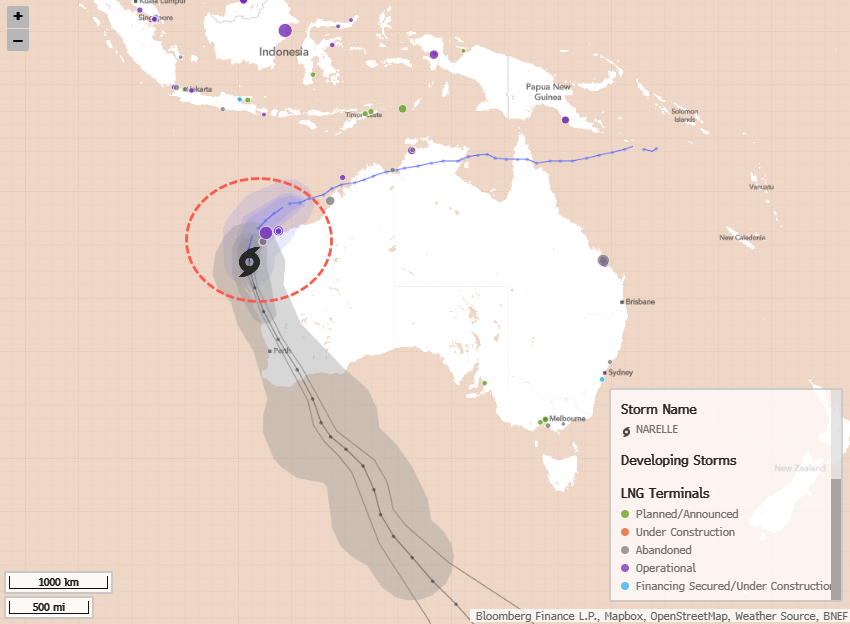
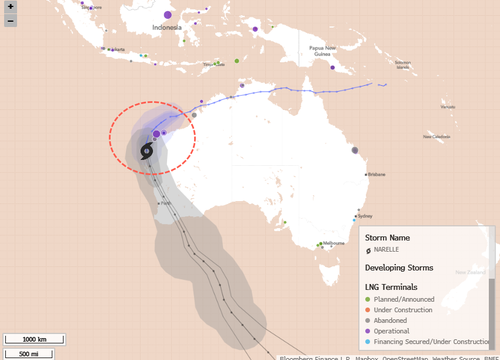
In a troubling overnight development that could further deepen the Gulf energy shock, especially in global LNG markets, a tropical cyclone has disrupted operations at three major Australian LNG facilities, which together account for roughly 8.4% of global supply. The timing is alarming: Iranian strikes have already knocked out about 17% of Qatar’s LNG export capacity, with repairs potentially taking years. The Australian outages now add near-term supply risks for buyers, particularly in Asia and Europe, who are already panicking and scrambling for new supplies.
Tropical Cyclone Narelle is bearing down on Western Australia’s coastline and has sparked major disruptions across three of Australia’s top LNG facilities, including Gorgon, Wheatstone, and North West Shelf (as per Bloomberg):
Woodside Energy Group Ltd.’s North West Shelf export plant in Western Australia had a production interruption due to severe Tropical Cyclone Narelle, according to a company spokesperson.
Meanwhile, Chevron Corp. said one of the three production units at its Gorgon plant was shut, as well as a platform that feeds its Wheatstone facility and domestic gas production.
Following the closure of the Strait of Hormuz and Iranian strikes damaging the world’s largest liquefaction plant in Qatar, Australia has become the second-largest LNG exporter, with the US in the top spot.
“Temporary shut-ins at Australian LNG plants come at the worst time for LNG buyers looking to replace supply from Qatar,” said Josh Runciman, lead analyst for Australian gas at the Institute for Energy Economics and Financial Analysis. “LNG spot prices are likely to increase on the back of the shut-ins, leading to further pain for buyers.”
MST Marquee analyst Saul Kavonic warned the cyclone “will exacerbate gas market tightness in Asia and Europe, especially if it takes more than a matter of days to normalize Australian production levels again.”
Asian LNG prices have soared by 90% since the conflict in the Middle East erupted in late February, and the conflict is set to enter its first month. In Europe, natural gas prices have doubled since the start of the conflict.
The big question now is whether Australia’s Gorgon, Wheatstone, and North West Shelf facilities, which together accounted for roughly half of the country’s LNG exports last month and about 8.4% of global trade, can resume operations quickly once the cyclone passes. Any meaningful storm damage would risk extending outages, further tightening the global LNG market in crisis, and compounding supply woes for buyers in Asia and Europe.
Amid the chaos, one country stands to benefit (read here).
Tyler Durden
Fri, 03/27/2026 – 08:20
Did Melania Trump’s White House Walk With Humanoid Robot Signal Admin’s Push Into Physical AI
Did Melania Trump’s White House Walk With Humanoid Robot Signal Admin’s Push Into Physical AI
The White House on Wednesday hosted an education summit featuring first lady Melania Trump walking side by side with an American-made humanoid robot.
“Figure 03” AI-powered robot accompanies first lady Melania Trump to a White House summit on empowering children with educational technology. pic.twitter.com/RShdfvEG38
— CSPAN (@cspan) March 25, 2026
The robot’s placement at a White House event suggests the technology wing of the Trump administration is pivoting toward physical AI, with the next chapter increasingly centered on American-made humanoid robotics.
A Politico report in December revealed that the administration was preparing to go “all in” on accelerating humanoid robotics, with sources saying White House officials were considering an executive order sometime this year.
Melania’s appearance alongside the Figure 03 robot may be the clearest signal yet that the administration is preparing to embrace robotics as the next natural progression of physical AI.
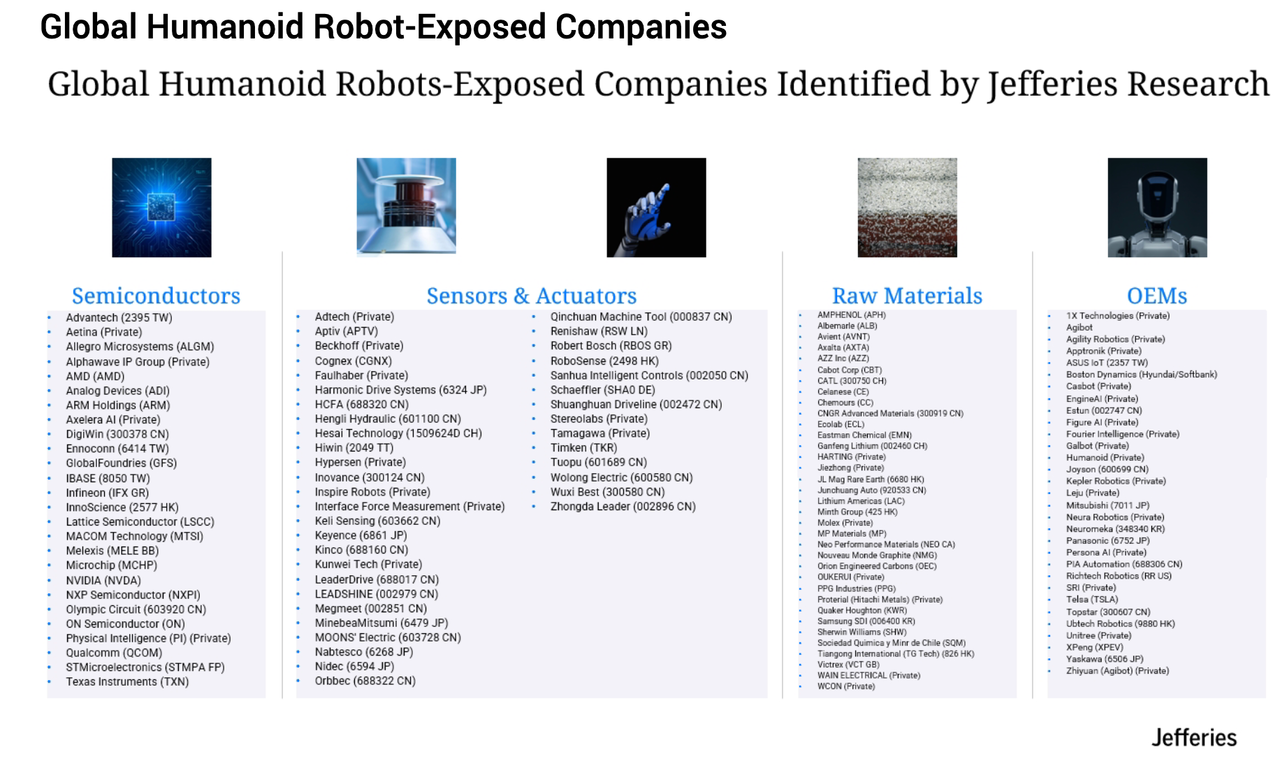
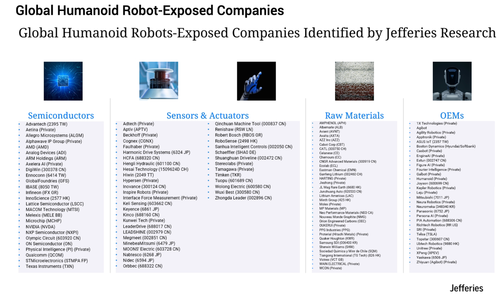
Also on Wednesday, Jefferies analysts published an insightful note titled, “Humanoid Robots Begin to Clock In”…
“Given recent advancements in materials science, battery technology and, most importantly, AI/processing, the dream of larger-scale deployments is edging closer to reality,” the analysts wrote.
With humanoid robots now entering factory floors, and, as we have also pointed out, soon the battlefield, deployment of these autonomous machines in real-world commercial applications is set to ramp up this year and next.
How to profit
The analysts provided clients with a company breakdown of the most critical companies supplying components to humanoid robots, outlining where clients may be positioned to get the most exposure as the industry gears up for increased deployments
Deployment Begins
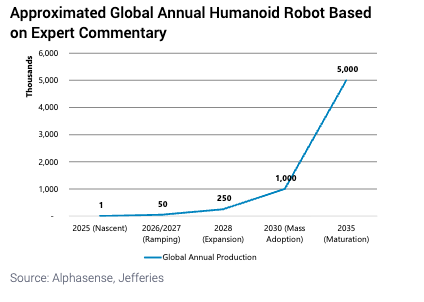
The deployment timeline for these robots on factory floors is set to ramp this year and next, then accelerate sharply into the end of the decade before taking a quantum leap in the early 2030s.
Why
The analysts pointed to three structural forces set to accelerate mass adoption:
Aging populations, particularly in China and other developed markets, are increasing demand for labor supplementation and assistance.
Declining interest in manufacturing jobs among younger generations is creating labor mismatches across global supply chains.
Breakthroughs in semiconductors and AI are sharply improving robot intelligence and functionality while reducing costs.
The other major breakthrough is labor cost: With workers demanding $20 to $25 per hour and much higher rates for skilled jobs, companies could operate these robots on a fully loaded basis for between $2 and $3 per hour after accounting for operating costs.
Mass adoption of these robots, with price points around $25,000 by 2030, would make them very appealing for companies looking to automate low-skilled tasks and drive down labor costs.
The analysts noted that robots are already beginning to invade factory floors. As they wrote, “In late ’24, California-based Figure AI achieved a milestone by delivering its Figure 02 humanoid robot to a paying client. Around the same time in China, UBTech Robotics began the world’s first large-scale deployment of full-sized humanoid robots.”
Melania walking with a humanoid robot this week may mark an early signal that the Trump administration is preparing to accelerate the American-made humanoid robotics, assuming policy support has already been drafted, which could spark an investment cycle into companies in the same field, both public and private.
Professional subscribers can read the full “From Asimov to the Assembly Line: Humanoid Robots Begin to Clock In” at our new Marketdesk.ai portal
Tyler Durden
Fri, 03/27/2026 – 07:45
Senate Passes DHS Funding Bill To End 40-Day Shutdown, Airport Chaos
Senate Passes DHS Funding Bill To End 40-Day Shutdown, Airport Chaos
At 2:22 a.m. EST, the Senate unanimously passed a spending bill to fund the Department of Homeland Security after a 40-day shutdown that disrupted airport security and sparked travel chaos for millions of Americans.
The bill, which excludes funding for Immigration and Customs Enforcement and Customs and Border Protection, still needs House approval and President Trump’s signature. The overnight breakthrough came as airport TSA lines worsened nationwide this week, with TSA agents calling out sick or quitting due to missed paychecks.
BREAKING.
The Senate just passed funding for most of DHS for the rest of the fiscal year.
The bill funds all but ICE and *Border Patrol*
This was by unanimous voice vote. It now goes to the House, which is still in town and can vote later today.
The bill contains no…
— Lisa Desjardins (@LisaDNews) March 27, 2026
Unpaid TSA agents have been calling out by the hundreds at major airports so far, including Atlanta, Baltimore, Houston, and New York, sparking long checkpoint lines. The funding lapse has led to 480 TSA workers resigning.
The breakthrough also came after President Trump added pressure on Thursday (read here), saying he would sign an order to fund TSA officers’ paychecks.
“I am going to sign an Order instructing the Secretary of Homeland Security, Markwayne Mullin, to immediately pay our TSA Agents in order to address this Emergency Situation, and to quickly stop the Democrat Chaos at the Airports,” Trump wrote in a Truth Social post on Thursday.
President Trump pins blame on Democrats for DHS shutdown at cabinet meeting: “They need to end this shutdown immediately, or we’ll have to take some very drastic measures.” pic.twitter.com/Pt4pFK2wB0
— CSPAN (@cspan) March 26, 2026
Senate Majority Leader John Thune (R-S.D.) said, “Hopefully they’ll be around, and we can get at least a lot of the government opened up again, and then we’ll go from there.”
Thune blamed unhinged Democrats for the airport chaos: “President Trump should never have had to step in to rescue TSA workers and U.S. air travel. We are here because, thanks to Democrats’ determined refusal to reach an agreement, there will be no Homeland Security funding bill this year.”
Democrats have widely objected to passing a DHS spending bill that includes funding for ICE and CBP. This is mostly because the president has used those federal agencies to deport illegal aliens, the very ones that Democrats let in through disastrous open borders to build a new voting bloc in their aspirations of a one-party rule nation, just like the insanity in California, Maryland, and other deeply blue states.
Punchbowl News explained there were “no winners” in this six-week standoff.
“Who won the Senate standoff? No one, in truth. Nothing really changed. Both sides wanted to have this fight, so it happened. It was another example of how little moderation is left in the Trump era, where the first instinct is to go to war,” the outlet wrote in a morning note.
Tyler Durden
Fri, 03/27/2026 – 07:20
K-Shaped Economy Bites Back: Retail CRE Transactions For Shops, Malls Plunge
K-Shaped Economy Bites Back: Retail CRE Transactions For Shops, Malls Plunge
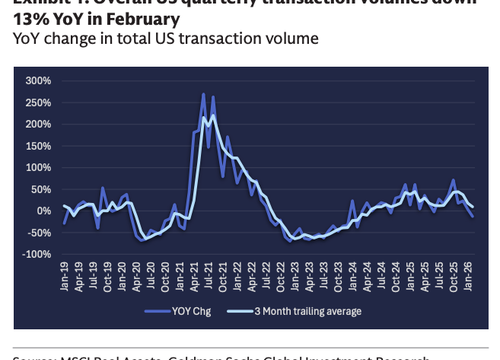
February U.S. commercial real estate transaction activity appeared soft on the surface, but Goldman analysts believe the weak initial print will likely be revised meaningfully higher. The most notable area of weakness in last month’s transaction data was across the retail space, which is not especially surprising as the K-shaped economy continues to pressure lower-income consumers.
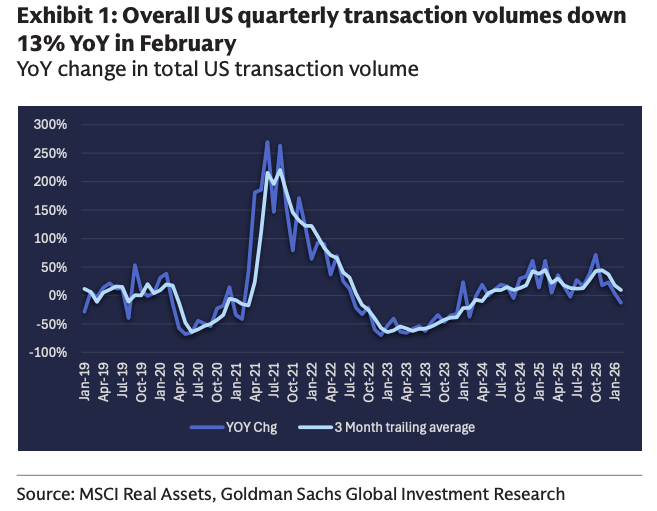
Goldman real estate analyst Julien Blouin wrote Wednesday that the initial February reading on CRE transaction volumes showed a 13% year-over-year decline. He noted that transaction data from MSCI Real Assets is typically “revised materially higher” and said the early print is not a major cause for concern.
Blouin added that prior months were revised higher by roughly 24% to 25% on average, suggesting the final February reading will likely show transaction growth in the high single-digit territory once the data is finalized.
February Transaction Volumes
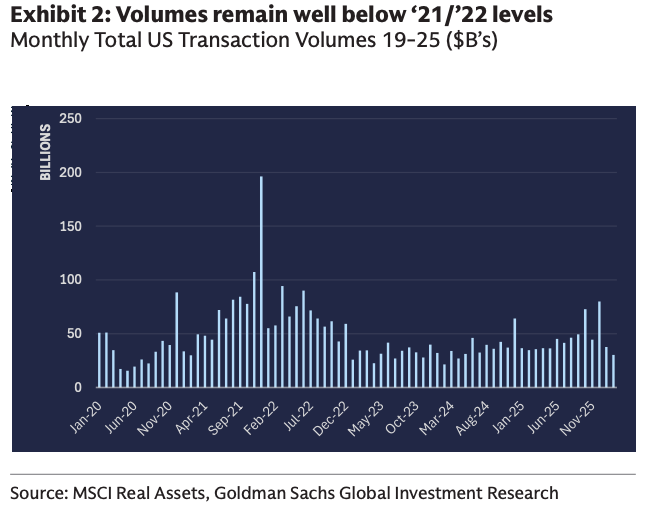
Volumes are muted and well below Covid surge. Need rates lower.
Deal activity is improving in some areas, especially office and industrial. Multifamily faced a much tougher comparison versus the same period last year, so the decline looks a lot worse than the underlying trend. The sharpest drop in CRE transactions was in retail, which includes shops, strip malls, convenience stores, restaurants, and malls.
CRE bucket breakdown for February:
Multifamily/apartments: down 24% year over year
Office: up 9%
Industrial: up 15%
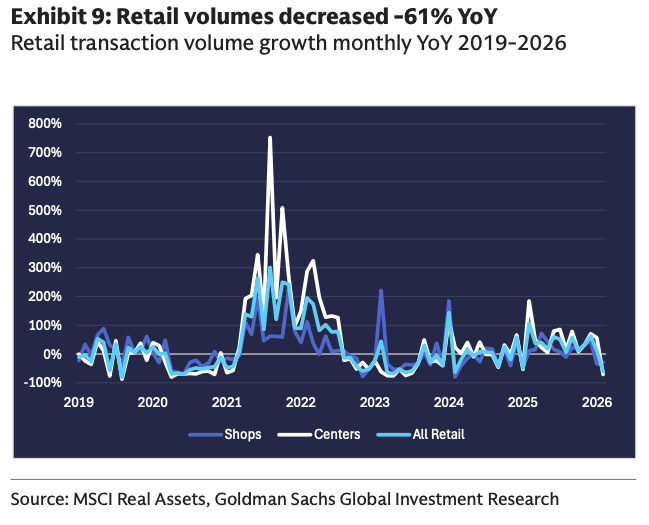
Retail: down 61%
Retail CRE volumes plunged
Blouin did not get into the details of the slump in retail deal activity, but it does appear buyers may still be selective in retail, due in part to the K-shaped economy, which is pressuring lower-income consumers’ ability to go out and spend at restaurants and shops.
Related:
AI Takeover Complete: Data Center Construction Surpasses Office Construction For The First Time
The takeaway is that the sharp drop in retail CRE transactions likely reflects buyer caution around consumer-exposed properties, given everything we know about the K-shaped economy.
Professional subscribers can read the full Goldman note here at our new Marketdesk.ai portal
Tyler Durden
Fri, 03/27/2026 – 06:55

UK Pushes Ahead With Temporary Ban On Political Crypto Donations
UK Pushes Ahead With Temporary Ban On Political Crypto Donations
Authored by Stephen Katte via CoinTelegraph.com,
The UK government is advancing plans for a moratorium on political donations made through cryptocurrencies, following an independent review and pressure from multiple high-ranking politicians.
Cointelegraph reported on Wednesday that the Rycroft Review, an independent inquiry into foreign financial interference in the UK’s political and electoral systems, recommended a moratorium on crypto donations to political parties.
New statements from UK Prime Minister Keir Starmer on Wednesday have confirmed that the government will pursue the temporary ban.
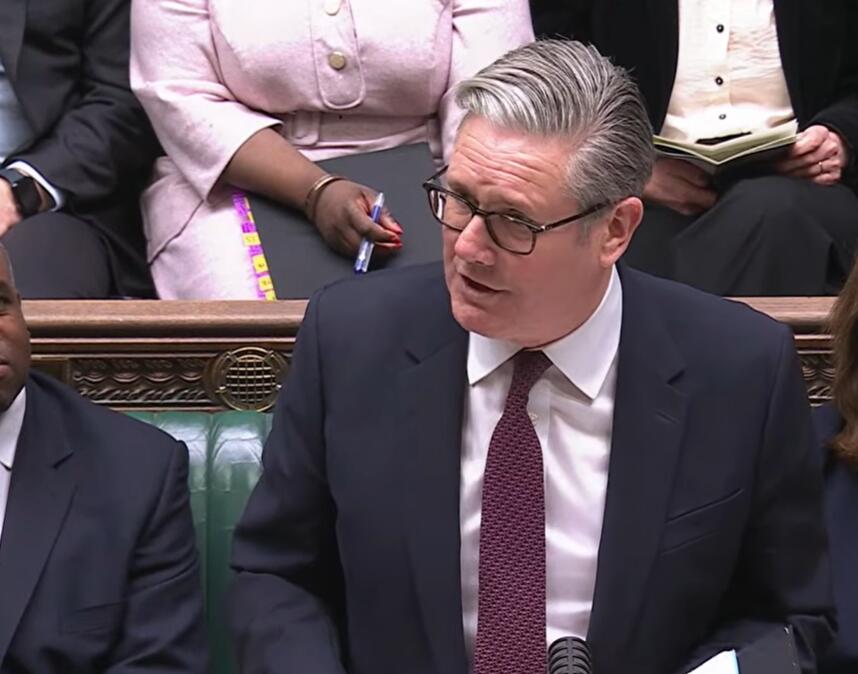
“I can tell the House we will act decisively to protect our democracy. That will include a moratorium on all political donations made through cryptocurrencies,” said Starmer during Prime Minister’s Question Time on Wednesday.
Several members of parliament, including the chair of the security committee, have been pushing for a full ban this year, warning that foreign states could exploit crypto payments to influence UK politics.
UK Prime Minister Keir Starmer pledged a moratorium on all crypto political donations. Source: YouTube
Under the new measure, crypto will be prohibited for political donations until robust regulations are in place to prevent untraceable funds and foreign interference in UK elections, according to a separate government statement on Wednesday.
Bill still has to pass and become law
The ban would require amending the Representation of the People Bill, and the government said the changes would take “retrospective effect” from March 25.
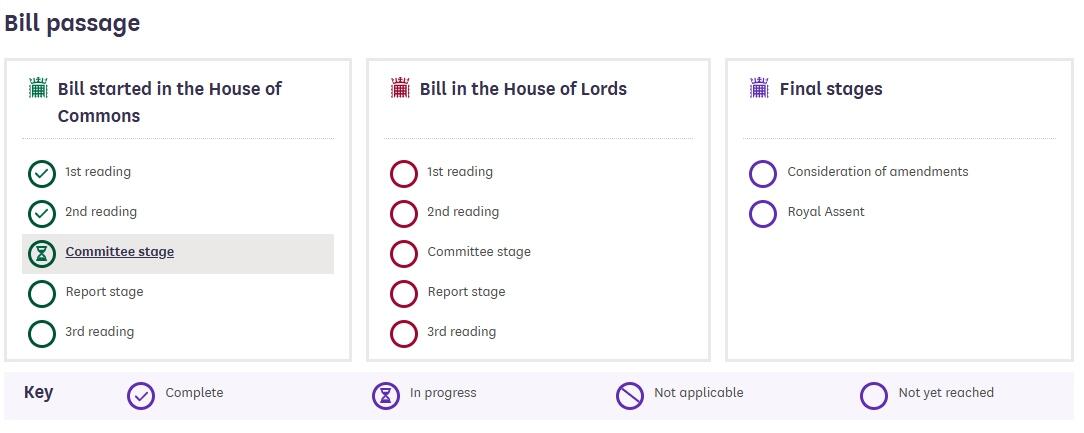
The legislation is at the committee stage in the House of Commons. It needs to pass through both the House of Commons and the House of Lords, then receive royal assent from King Charles III to become law.
The legislation is still at the committee stage in the House of Commons. Source: UK Parliament
“Once the legislation comes into force, political parties and regulated entities like candidates and MPs will then have 30 days to return any unlawful donations they may have received in the interim, after which enforcement action can be taken,” the government said.
Reform UK was the first political party in the country to accept crypto donations in May last year, with leader Nigel Farage announcing at the Bitcoin 2025 conference in Las Vegas that the group would accept Bitcoin and other cryptocurrencies from eligible donors.
Ban will not be lifted until sign-off from government
Once the ban comes into force, it won’t lift until “Parliament and the Electoral Commission are satisfied that the regulatory environment is robust enough to ensure confidence and transparency in donations being made in this way.”
The next general election in the UK must be held by Aug. 15, 2029.
Tyler Durden
Fri, 03/27/2026 – 06:30
https://www.zerohedge.com/crypto/uk-pushes-ahead-temporary-ban-political-crypto-donations