Category: News

Education Department takes a major step forward in the Trump administration’s plans to dismantle it
WASHINGTON — The U.S. Education Department is handing off some of its biggest grant programs to other federal agencies as the Trump administration accelerates its plan to shut down the department.
It represents a major step forward for the administration’s dismantling of the department, which has mainly involved cutting jobs since President Donald Trump called for its elimination with an executive action in March.
Six new agreements signed by the Education Department will effectively move billions of dollars in grant programs to other agencies. Most notable is one that will put the Department of Labor over some of the largest federal funding streams for K-12 schools, including Title I money for schools serving low-income communities.
Opponents have urged against such a shake-up, saying it could disrupt programs that support some of the nation’s most vulnerable student populations. Some argue that other agencies don’t have the expertise that schools and families rely on at the Education Department.
A union representing department workers said students, educators and families depend on the agency’s support for schools.
“That national mission is weakened when its core functions are scattered across other federal or state agencies that are not equipped or positioned to provide the same support and services as ED staff,” AFGE Local 252 President Rachel Gittleman said.
Department officials said the programs will continue to be funded at levels set by Congress. They did not say whether the changes would bring further job cuts at the department, which has been thinned by waves of mass layoffs and voluntary retirement offers.
“The Trump Administration is taking bold action to break up the federal education bureaucracy and return education to the states,” Education Secretary Linda McMahon said in a statement. “Cutting through layers of red tape in Washington is one essential piece of our final mission.”
The action leaves in place the Education Department’s $1.6 trillion student loan portfolio and its funding for students with disabilities, though McMahon has suggested both would be better managed by other federal departments. Also unaffected is the department’s Office for Civil Rights, which works with students and families who bring allegations of discrimination.
McMahon and her staff have spent months hammering out the deals, which allow the department to lop off large parts of its footprint without action from Congress. It’s being done through formal agreements that agencies often make with one another when their work overlaps.
The Education Department tested the idea in June with a deal that moved adult education programs to Labor. The new agreements take it a step further and lay the groundwork for more.
Under the new plan, Labor will oversee almost all grant programs that are now managed by the Education Department’s offices for K-12 and higher education. Along with the $18 billion Title I program, that includes smaller funding pools for teacher training, English instruction and TRIO, a program that helps steer low-income students to college degrees.
It will effectively outsource the department’s Office of Elementary and Secondary Education and Office of Postsecondary Education, two of the agency’s largest units. Two major roles of the postsecondary office will remain with the Education Department: oversight of student loan policy and the accreditation of colleges for eligibility to receive students’ federal financial aid.
States and schools should not expect any disruptions in their funding, the department said, but their federal money will now come from the Department of Labor.
Another deal will put Health and Human Services in charge of a grant program for parents who are attending college, along with management of foreign medical school accreditation. The State Department will take on foreign language programs. Interior will oversee programs for Native American education.
McMahon has increasingly pointed to what she sees as failures of the department as she argues for its demise. In its 45 years, she says it has become a bloated bureaucracy while student outcomes continue to lag behind. She points to math and reading scores for the country’s K-12 students, which plummeted in the wake of pandemic restrictions.
Her vision would abolish the Education Department and give states wider flexibility in how they spend money that’s now earmarked for specific purposes, including literacy and education for homeless students. That, however, would require approval from Congress. The task is complicated by the fact that some of the department’s core work has long had bipartisan support.
The new deals are part of a broader plan to prove that America’s schools and colleges can operate without the department. As part of the plan, officials say McMahon will continue touring the country to highlight the successes of local schools — and she will also spend more time making her pitch to lawmakers on Capitol Hill.
https://www.chicagotribune.com/2025/11/18/education-department-dismantle/

Shota Imanaga accepts his qualifying offer to stay with the Chicago Cubs, while Kyle Tucker rejects his
Shota Imanaga is staying with the Chicago Cubs for at least one more season.
Imanaga accepted the Cubs’ qualifying offer ahead of Tuesday’s 3 p.m. deadline, a source confirmed to the Tribune. Kyle Tucker declined his qualifying offer as expected, which will net the Cubs draft-pick compensation if the 28-year-old right fielder signs elsewhere.
Imanaga was one of four players to accept among the 13 big-leaguers who were tendered a qualifying offer. The 32-year-old left-hander will earn $22.025 million in 2026.
Tucker’s decision was a no-brainer with him positioned to earn a lucrative long-term contract. Imanaga faced a more difficult choice: take the high salary and stay with the Cubs for another season or seek a multiyear deal with more guaranteed money but likely a lower salary next year.
The Cubs would not have been surprised if Imanaga had turned down the qualifying offer in an effort to find a multiyear deal elsewhere. Earlier this month they chose to decline the three-year, $57 million club option in Imanaga’s contract, triggering a $15 million player option for 2026 that he declined.
“We have really good feelings toward him, and our decision doesn’t reflect at all our feelings about Shota,” president of baseball operations Jed Hoyer said last week at the general managers meetings in Las Vegas. “I don’t think his decision reflects how he feels. Both sides are trying to make the best decision for them, and we’ll continue to have dialogue.
“Obviously he struggled a bit at the end (of this past season). But when you look at the entire body of work over the two years, it was exceptional.”
The Cubs still can negotiate a multiyear deal with Imanaga, though clearly the two sides view his value differently. Pitching was already a priority for Hoyer and the Cubs this offseason. Imanaga’s return doesn’t change that approach. The organization is emphasizing that need as the Cubs look to bolster the rotation and rebuild the bullpen.
https://www.chicagotribune.com/2025/11/18/chicago-cubs-shota-imanaga-kyle-tucker-qualifying-offers/

Oak Brook mansion sells for $5.3M, the highest sale price in that village in 16 years
A five-bedroom, 6,671-square-foot, contemporary-style mansion in Oak Brook sold in mid-October for $5.3 million — the highest sale price in Oak Brook in 16 years and the west suburban village’s third highest-priced sale ever.
Built in 2016 and set on wooded lot measuring just over an acre in Oak Brook’s guard-gated Hunter Trails subdivision, the mansion is made of wood, stone, glass and steel. It has 7-1/2 bathrooms, a glass paneled front door, an open floor plan, new European white oak floors, sculptural wood and stone accents and a brand-new kitchen with Gabana Quartzite slabs, custom cabinetry and a triple-width hood.
Other features include a first-floor guest suite, a breakfast nook, a family room with a stone-clad fireplace, a second-floor primary bedroom suite with three walk-in closets and a walk-out lower level with a recreation room with a wet bar, a mirrored exercise studio, a wine tasting room, a wine cellar and another guest suite.
In all, the mansion has more than 10,000 square feet of living space, including the basement. Outside on the property are a swimming pool, a spa and a covered patio. The home also has a four-car garage.
The sellers, who bought the mansion in 2023 for $4.75 million, first listed it in late August for $5.195 million. It went under contract less than three weeks later, and closed on Oct. 15.
“What made this home so unique is the architectural style. It had a little bit of Frank Lloyd Wright to it, but with a modern vibe. It looked like something you’d see in California or maybe Colorado — something along those lines,” listing agent Michael LaFido of LPT Realty told Elite Street. “At that price point, on its face you’re not going to get tons of showings for a $5 million listing in DuPage County. We had 10-plus showings in a couple weeks and multiple offers because of this unique style at this price point.”
The house had a $38,576 property tax bill in the 2024 tax year. It also has $438 in monthly homeowners association dues.
Oak Brook’s all-time record sale price occurred in 2003, when Hall of Fame slugger Frank Thomas sold his mansion on Midwest Road for $7.95 million. The second highest-priced sale occurred in 2009, when a 9,968-square-foot mansion on Adams Street sold for $5.45 million.
Goldsborough is a freelance reporter.
A five-bedroom, 6,671-square-foot, contemporary-style mansion in Oak Brook sold in mid-Oct. for $5.3 million — the highest sale price in Oak Brook in 16 years and the west suburban village’s third highest-priced sale ever. (Michael LaFido)
https://www.chicagotribune.com/2025/11/18/oak-brook-mansion-record-sale/

Election board dismisses political sign complaint against St. John police chief
The Lake County Board of Elections on Tuesday dismissed a political sign violation complaint filed against St. John Police Chief Steven Flores.
The board made a unanimous decision after hearing from Crown Point resident Ronald Segert, who filed the complaint, as well as from Flores and his lawyer, Jim Wieser.
Segert, in his argument, said he filed his complaint initially in August after seeing an election-related billboard near the Lake County Fairgrounds for 10 days during the fair last summer.
The billboard, which Segert said had no disclaimer and was illegally posted more than 30 days before the election, read: “Flores For Sheriff.”
Segert said his complaint, later amended and resent to the county in September, included a Facebook photo of the Flores For Sheriff billboard sign, again without a disclaimer.
“This sign is a violation of Lake County Code Ordinance and IC-3-9-3-2.5,” Segert said in his complaint.
Segert, in his complaint, said he felt Flores must have endorsed it because he wrote: “In case you are near the fair for the last night, you may see this sign. We love it!”
Flores has indicated he is one of several candidates running for the position of Lake County Sheriff, which will be decided in the 2026 election.
Flores, when under questioning by Wieser, said the official name of his committee is “Committee to elect Steven Flores” and not “Flores For Sheriff,” as was written on the billboard and on the Facebook photo.
When asked, Flores said he had not approved nor did he have any ownership or involvement with the billboard that had been located near the Lake County Fairgrounds.
That billboard has since been taken down, board officials said.
Flores, when questioned by board chairman Kevin Smith, did acknowledge he had written the comment on his Facebook page.
“Yes, I’m not denying that at all,” Flores answered.
In other business, the board continued to its Dec. 9 meeting a complaint filed by Stephen Aichner of Hobart, against five individuals for failure to have correct election credentials.
Aichner, in his complaint filed on May 8, said he had entered the Early Learning Center in Hobart on May 5, where Hobart precincts 12 and 19 were located and where the referendum election was held.
Aichner serves as deputy election commissioner.
Those named in Aichner’s complaint included Sandra Garza, Lauren Ross, Theresa Kolczak, John Brezik and Christopher Kosovich.
Wieser, a lawyer for the defendants, said their understanding was that they didn’t need to have credentials issued since it was a referendum and not a partisan election.
“They acknowledged what they did was wrong,” Wieser said.
Brezik, who was in the polling place but had credentials, was dismissed from the complaint, Wieser said.
Nathan Vis, an attorney representing Aichner, said: “Mr. Brezik was dismissed, but an additional charge was to be brought up today.”
“It would be appropriate if Mr. Brezik was here,” Vis added.
Vis, when asked by Smith if he wanted to continue the case until the next meeting, said yes, so all parties could be in attendance.
Deborah Laverty is a freelance reporter for the Post-Tribune.

Rick Armstrong’s high school football rankings and quarterfinal players of the week for Aurora-Elgin area
Batavia maintains top spot in rankings, while red-hot Oswego continues its postseason surge.
Top 10
With records through Saturday and previous rankings in parentheses.
1. Batavia 10-2 (1)
Michael Vander Luitgaren passes for 139 yards, runs for 57 as Bulldogs top Glenbard North 42-27.
2. Oswego 10-2 (4)
Conor Tully helps defense force five turnovers in Panthers’ 24-21 comeback against Maine South.
3. St. Charles North 10-2 (3)
Keaton Reinke catches nine passes for 141 yards in North Stars’ 42-18 loss to Brother Rice.
4. Burlington Central 10-2 (2)
Gavin Bergemann grabs five passes for 92 yards from Landon Arnold in 49-21 loss to Fenwick.
5. Kaneland 8-3 (5)
Did not play. Season ended.
6. Yorkville 7-3 (6)
Did not play. Season ended.
7. Aurora Christian 8-3 (7)
Did not play. Season ended.
8. Oswego East 6-4 (8)
Did not play. Season ended.
9. South Elgin 7-3 (9)
Did not play. Season ended.
10. West Aurora 7-3 (10)
Did not play. Season ended.
Offensive Player of the Week
Mariano Velasco, a senior receiver/defensive back, catches two touchdown passes and returns an interception 42 yards for a TD as Oswego rallies from 14-0 deficit for 24-21 win over Maine South in a Class 8A quarterfinal. Velasco’s TDs covered 40 and 20 yards, respectively.
Defensive Player of the Week
Senior safety Andrew Culotta accounts for three turnovers for Batavia in a 42-27 win over Glenbard North in a Class 7A quarterfinal. He returns an interception 67 yards for a TD, plus recovers a fumbled punt and an onside kick. He also tallies six tackles and a pass breakup.

Plan de EEUU para la reconstrucción de Gaza enfrenta grandes desafíos
Por LEE KEATH
EL CAIRO (AP) — El Consejo de Seguridad de la ONU respalda el ambicioso plan de Estados Unidos para el futuro de la Franja de Gaza. Sin embargo, aún se desconoce cómo y cuándo se llevará a cabo.
En un giro inimaginable a lo largo de la tumultuosa historia del conflicto israelí-palestino, el plan significaría que el presidente de Estados Unidos, Donald Trump, se convierta en el gobernante de facto de la Franja. El territorio ha quedado devastado por la campaña de Israel para eliminar a Hamás tras su ataque del 7 de octubre de 2023, que desató la guerra.
Un organismo internacional conocido como la Junta de Paz, presidido por Trump, gobernará Gaza y supervisará la reconstrucción bajo un mandato renovable de la ONU de dos años. Una Fuerza Internacional de Estabilización (FIE) armada se encargará de mantener la seguridad y garantizar el desarme de Hamás, una demanda clave de Israel.
Grandes interrogantes se ciernen sobre casi todas las partes del plan y el plazo para su implementación. Mientras tanto, casi todos los palestinos siguen desplazados y dependen de la ayuda humanitaria, Hamás mantiene un importante control sobre casi la mitad de Gaza y la reconstrucción del territorio apenas ha comenzado.
Desafíos en cada paso
Algunas conversaciones sobre los siguientes pasos han tenido lugar tras bambalinas entre Estados Unidos, Israel, Qatar, Egipto y otros países. Pero no han comenzado negociaciones serias porque Israel y Hamás siguen en la primera fase del acuerdo de alto el fuego que entró en vigor en octubre. Al grupo armado aún se le exige entregar los cuerpos de los últimos tres rehenes.
La resolución de la ONU, aprobada el lunes, dio legitimidad internacional al plan. Eso abre la puerta para que las naciones árabes y de mayoría musulmana participen, particularmente contribuyendo con tropas a la FIE. Estados Unidos espera que, cuanto más involucrados estén esos países, más aceptable será el gobierno internacional para los más de dos millones de personas en Gaza.
Pero la aceptación del público palestino está lejos de ser segura. Sin ella, la Junta de Paz corre el riesgo de ser vista como una ocupación extranjera que trabaja en nombre de Israel, frustrando aún más su sueño de lograr la autodeterminación y un estado propio.
El plan no da a los palestinos casi ninguna voz en el gobierno de Gaza. Debido a la feroz oposición de Israel, no promete la creación de un estado y ofrece solo una vaga referencia de que algún día podría ser posible. También proporciona un ambiguo cronograma para que comience la reconstrucción y para que el ejército israelí se retire del alrededor del 50% de la Franja de Gaza que aún ocupa desde que comenzó el alto el fuego.
¿Ocurrirá el desarme?
El desarme de Hamás y la desmilitarización de Gaza son las piedras angulares de todo el plan. Pero no hay detalles sobre cómo sucederán.
Hasta ahora, el grupo rebelde no ha aceptado desarmarse. En un comunicado emitido tras la aprobación de la resolución de la ONU, Hamás dijo que el destino de sus armas está vinculado a garantizar un camino hacia el fin de la ocupación israelí y la creación de un estado palestino.
La Fuerza Internacional de Estabilización tiene la tarea de asegurar el desarme y la destrucción de la infraestructura militar de Hamás. También supervisará una fuerza policial palestina, compuesta por miembros verificados y entrenados por Egipto y Jordania.
Se ha mencionado a varios países como posibles contribuyentes a la FIE, como Egipto, Indonesia, Turquía y Azerbaiyán. Pero ninguno se ha comprometido a enviar tropas aún, e Israel se opone a que Turquía participe en la fuerza.
Es poco probable que quieran que sus soldados tomen las armas de Hamás por la fuerza. El grupo advirtió que intentar hacerlo convertiría a la FIE “en una parte del conflicto a favor de la ocupación”.
Hamás enfrenta una fuerte presión, particularmente de Qatar y Egipto, para llegar a un acuerdo. Una posible idea es una “desactivación”: entregar el arsenal a la FIE para su custodia, con lo que Hamás podría argumentar que no se trata de una renuncia permanente a su derecho a la resistencia armada.
Sin desarme, gran parte del resto del plan podría estancarse. La retirada de tropas israelíes está vinculada al ritmo de la desmilitarización de Hamás y al despliegue de la FIE. Asimismo, es poco probable que la reconstrucción ocurra en la mayor parte de Gaza a menos que Hamás se desarme.
Muchos palestinos temen que el resultado final sea una partición de Gaza entre una zona controlada por Israel, donde podría tener lugar alguna reconstrucción, y el resto, donde casi toda la población de más de dos millones vive, con poca reconstrucción.
¿Quién compondrá la Junta de Paz?
Trump ha dicho que la junta estará compuesta por “líderes distinguidos” de otros países, como el ex primer ministro británico Tony Blair, y que sus miembros serán nombrados en las próximas semanas.
Pero no se sabe quiénes serán, y ni siquiera se ha confirmado la participación de Blair.
La resolución de la ONU otorga a la Junta plena autoridad en Gaza con poderes sobre la FIE, la reconstrucción y la recuperación económica. La Junta también supervisará un “comité tecnocrático y apolítico de palestinos competentes” que gestionará el servicio civil diario en Gaza.
¿Quiénes son estos palestinos independientes?
Los miembros del comité palestino no deben tener vínculos ni con Hamás ni con la Autoridad Palestina, que actualmente administra partes dispersas de Cisjordania ocupada por Israel. Tel Aviv ha rechazado cualquier función de la Autoridad Palestina en Gaza.
El plan no especifica quién seleccionará a los miembros, pero esto probablemente recaerá en la Junta de Paz. Israel querrá tener una fuerte influencia en quién puede ser incluido.
En una publicación en línea, el analista político y encuestador palestino Khalil Shikaki dijo que el comité debería ser elegido a través de un proceso “totalmente palestino” para aumentar su apoyo, consultando entre facciones políticas, sindicatos, líderes locales y organizaciones de mujeres y jóvenes.
Pero si la Junta y el comité son considerados como una herramienta para Estados Unidos o Israel, prominentes palestinos podrían mostrarse reacios a unirse. En su declaración del lunes, Hamás denunció la “tutela internacional” que la resolución de la ONU impone sobre Gaza, diciendo que busca promover los intereses de Israel.
¿A qué conduce todo esto?
El plan enfatiza dos objetivos para Gaza: desmilitarización y reconstrucción. Cualquier cosa más allá de eso sigue siendo incierta en gran medida.
La resolución de la ONU ofrece la posibilidad de que la Autoridad Palestina eventualmente tome el control de Gaza si lleva a cabo una serie de reformas internas a satisfacción de la Junta de Paz, desde combatir la corrupción y aumentar la eficiencia hasta celebrar elecciones.
El lunes, en un comunicado, la Autoridad Palestina recibió con beneplácito la resolución de la ONU y dijo que estaba preparada para intervenir y gobernar Gaza. Pero la oposición israelí genera dudas sobre si eso se permitirá alguna vez.
Bajo la presión de aliados árabes, Estados Unidos insertó una referencia a la creación de un estado palestino en la resolución de la ONU.
Pero no deja de ser solo un vago reconocimiento. En ella se afirma que, si la Autoridad Palestina “cumple fielmente” con las reformas y si el desarrollo de Gaza avanza, “finalmente podrían existir las condiciones para un camino creíble hacia la autodeterminación y la creación de un estado palestino”.
La falta de un camino claro hacia la autodeterminación amenaza con complicar cada paso. Por ejemplo, escribió Shikaki, sin un camino hacia la creación de un estado, “el desarme será visto como una capitulación; con él, la desmovilización puede enmarcarse como parte de una estrategia nacional”.
Para gran parte de la población, la prioridad es ver la reconstrucción y un renacimiento de la economía de Gaza para que las familias tengan medios para ganarse la vida. Si eso ocurre, podría suavizar la reticencia hacia el gobierno internacional, al menos por un tiempo. Si no ocurre, o si los palestinos no ven un avance hacia la autodeterminación, es probable que el resentimiento aumente.
El potencial de caos es alto debido a las múltiples divisiones dentro de Gaza. El territorio ya tiene a Hamás, varias bandas armadas respaldadas por Israel que se oponen al grupo armado y al propio ejército israelí. A eso se suman una fuerza policial palestina, tropas internacionales, palestinos que se unen a la administración y aquellos que se oponen a ella, y la escena se vuelve aún más volátil.
___
Esta historia fue traducida del inglés por un editor de AP con la ayuda de una herramienta de inteligencia artificial generativa.

Ford’s new Dearborn world headquarters to help the automaker operate differently
DEARBORN, Michigan — Hundreds of visitors on Sunday braved chilly temperatures to get the public’s first view of Ford Motor Co.’s new world headquarters, which aims to help the company compete for talent and technology leadership in a rapidly changing global auto industry.
Dubbed “the Hub,” the glass-faced building anchors a campus that fosters collaboration between employees across different teams, speeds up movement of people and vehicles, and helps attract top talent — attributes the automaker is leaning into as it competes against rivals increasingly focused on electrification, connectivity and self-driving technology.
“The way we’re going to work in the future is very different than the way we worked in the past,” Ford Executive Chairman Bill Ford told The Detroit News. “It’s so nice to finally be in a building where the product is. In the old world headquarters, every time I wanted to go see anything product related, I had to get in my car and drive over. This will be great. I’ll just walk downstairs and wander around.”
He hasn’t moved into his new office — it’s not complete as construction continues on the Hub into 2027: “They don’t need me to keep the place going, but we need them,” Ford quipped.
The new headquarters features a “crown jewel” showroom, eight cuisine stations, six courtyards, six studios and a state-of-the-art prototype shop — that’s also still using a 1948 lathe. Ford employees and retirees and community members joined in the celebration of the building’s official opening.
Visitors on Sunday marveled at Heritage Collection vehicles, investigated the menu options in the cafeteria and spoke with designers in the prototype shop. A Ford Racing Raptor Thrill Ride and jump, Camp Bronco s’more toasting, Lincoln Lounge showcasing the brand’s sensory features, the company’s 2025 America’s Parade float, and a community car show also entertained guests.
Among them was Robert Marshall, 74, of Brighton, who retired from purchasing after 32 years with the company,
“I think it’s tremendous,” Marshall, 74, said as he looked at a Mustang GTD in the showroom. “I can’t tell you the number of hours I spent driving between buildings. I think they’re going to do all right here.”
Added his daughter Angela Marshall, 33, of Brighton: “I want to work here. It’s very employee-focused with the design and the outdoor and garden space. It’s like a second home.”
The four-story building — that eventually will encompass 2.1 million square feet — will replace the smaller Glass House across town, which is set to be demolished. The Hub will help drive faster product development, higher profits and more innovation, executives said.
No longer is this site of Ford’s former 1953-opened product development center a cubicle city. Top executives and support staff aren’t siloed and separated by department three miles away in the 1956-opened Glass House. Instead, they’ll be around open spaces with employees in engineering, design, sales, marketing and finance, likely all working together.
There will be 4,000 people assigned to the building, whose construction will be completed in 2027 — double those working out of the previous 12-story headquarters. There are more than 14,000 people within a 10-minute walk and another 9,000 people within a 10-minute drive. By 2027, 90% of Ford’s in-office employees will be working in new or renovated spaces.
“It’s a renewal of Ford’s commitment to Dearborn,” Mayor Abdullah Hammoud said. “We are thankful. It’ll be the inspiration for future leaders, engineers and designers who will drive past.”
A previous pilot aimed at working more collaboratively brought forth the popular Maverick small pickup that debuted in 2021. The Hub will offer a physical space matching that mentality, Ford CEO Jim Farley said.
“There’s a long history — it was kind of lumpy,” Farley told The News, referencing a similar philosophy that was used for vehicles like the Ford Taurus, which debuted in the mid-1980s. “Now we built a building around it. So we want to make it a permanent thing, where the whole product development team, from software, all the mechanical engineers, the supply chain and the marketing people and the physical designers, are all together. And we’re organizing that around the world.”
It’s a part of what Farley sees as his job leading the 122-year-old automaker: “We’re really trying hard to modernize the company all the way through it, not just the parts that people see on the outside, but the actual way we work. It’s expensive. It may be a reason why it wasn’t done. Maybe that’s part of my contribution to the company — we’re all trying to fix it for the future. The building is a metaphor for that.”
Ford hasn’t shared the cost of the new headquarters, though experts previously have estimated the campus revitalization at more than $1 billion. Farley credited his predecessor, Jim Hackett, and the learnings he brought from his previous leadership of office furniture company Steelcase Inc. for the adoption of that thinking. Hackett said the project turned out better than he’d imagined.
“It was a long design process, and I feel very good about it,” the former CEO told The News. “I had spent 20 years in running the world’s largest office environment company, which got me near the world’s best architects and CEOs of lots of other companies that had capital-intensive challenges, so I felt: right guy, right time to deal with this question.”
Adrian Aguirre, chief Expedition engineer whose whole team has worked from the Hub for about a month now, already has seen the benefits of the openness and mixing of teams. Almost daily, he said he’s had experiences of running into the right person or had a conversation that sparked an idea — situations that would’ve otherwise happened over email or perhaps not at all.
“It was more like everyone had their own little fiefdom,” Aguirre said. “Even though we mentally and culturally had broken through the barrier, the physical things are still there, and now those walls are literally not there. You’ve built a place that responds to the kind of culture and way that we work hand-in-hand.”
Ford isn’t the only Detroit automaker getting new digs. Crosstown rival General Motors Co. plans to move into the downtown Hudson’s Detroit development from the Renaissance Center, which first opened in 1977. Ahead of that, though, it increasingly relocated and consolidated employees about 17 miles away at its Warren Technical Center, which it also has updated.
GM will take up four floors of the new 12-story mixed-use building in Detroit owned by mortgage mogul Dan Gilbert’s Bedrock LLC, adjacent to the complex’s skyscraper. Move-in is expected to happen by January. GM is working with Bedrock on redeveloping the Ren Cen with a smaller hotel, apartments and new retail and community space.
Chrysler parent Stellantis NV’s North American headquarters in Auburn Hills connects the Pentastar-topped executive office tower to its vehicle development technical center. Under previous leadership, however, the company discussed selling the 1990s building in a leaseback deal amid intensifying financial pressure. Since then, though, Stellantis has increasingly returned employees to in-office work.
Glenn Stevens, executive director of MichAuto, the automotive arm of the Detroit Regional Chamber, recalled his first visit years ago to Tesla Inc. It was chaotic, but it differed from legacy automakers in that everyone was working together in the same space.
“That’s what the best companies are doing,” he said. “It’s better to have the people and technology tools and suppliers and all the functions together to work as fast as possible in the most innovative way as possible. You have to have the highest quality and the highest design, or you can’t compete, because that is what those other global companies are doing.”
At Ford’s new headquarters, employees enter through the American Road Lobby and walk up the stairs to “the hive,” a cafe area with coffee, other beverages and food where Ford employees can work or have a meeting. It’s reminiscent of the hospitality hub that will greet customers under Ford’s new dealership retail design, signaling the global effort to create a recognizable Ford design without the company’s name plastered in all spaces.
“Jim Farley has said in the past, when you walk into our existing headquarters building, you’re not quite sure if you’re walking into Ford or if you’re walking into a shampoo company,” Jim Dobleske, chairman and CEO of Ford Land, the Dearborn automaker’s real estate arm, said during a tour ahead of the building’s grand opening Sunday. “This building, you know you are walking into Ford Motor Company.”
White walls are broken up by splashes of wood and earthy tones, Ford navy blue accents, and artwork that showcases Ford’s history and modern products and artists from Detroit and Cranbrook. Floor-to-ceiling windows let in daylight. A rug from Shaw Hospitality Group repeated throughout the building is the Blue Oval in a proprietary textile cut up and collaged together. Oval motifs repeat throughout the design.
On one of the upper floors of the Hub, there are executive offices and a board room, like on the top, 12th-floor C-suite of the Glass House — one of the few changes made to the design of the building once Ford decided to make it its new headquarters, Dobleske said.
But for the most part, employees don’t have assigned seats, working instead in a hotel-style model that Ford has adopted at most of its office spaces in the wake of the COVID-19 pandemic. Every corner turned seems to reveal open desks, tables and chairs or lounge areas for meeting in groups. Closed-door individual “focus” rooms and team “energy” rooms are also found throughout the building.
Nathan Vidican, a Ford technical specialist, said his team has been ensuring strong WiFi signals throughout the building over the past few weeks and laid claim to an area overlooking the Henry Ford Museum. He pointed out the different parts of the building to his mother, Debra Vidican, 67, of Windsor, Ontario, on a self-guided tour.
The building is beautiful, but for Debra Vidican, the highlight was her son: “I love seeing him so excited. I can see the joy in him talking about what he does here. I love seeing how happy he is.”
Special credentials are needed to access the studios where Ford keeps the trucks, SUVs and other vehicles of the future. There are desks for designers, more capacity for vehicles than the previous product design center had, and large digital displays for reviewing designs. A two-tiered courtyard brings daylight in, and lighting can be changed inside when Michigan’s skies don’t shine as brightly. Vehicles can be driven into the courtyard and on the roof as well. Fritted windows that block ultraviolet light incorporate an oval pattern and Ford patent numbers.
Two vehicle elevators in the building help reduce the time it takes to move vehicles and materials through the building by 83%. Downstairs is the 207,000-square-foot prototype shop with spaces for milling clay models and all sorts of materials except glass — wood, metals, plastics and more. A whole room is dedicated to 40 3D printing machines capable of handling various materials — a revelation since the old building predated the technology, said Jim Conner, director of 3D process for Ford Design.
Designers benchmarked the Hub against other corporate headquarters and research and engineering campuses, said Craig Dykers, founding partner at Norwegian architecture firm Snøhetta, which is behind the project. But most comparison facilities are making small digital technologies or entail flat airplane plants.
“This is the largest facility of its type (at least in North America) that’s three dimensionally mobile, so things move up and down and sideways, which is very unique,” Dykers said.
https://www.chicagotribune.com/2025/11/18/ford-dearborn-headquarters/

After Gates Foundation Cuts Ties, Arabella Advisors “Ceases Operations,” Reemerges As “Sunflower Services”
After Gates Foundation Cuts Ties, Arabella Advisors “Ceases Operations,” Reemerges As “Sunflower Services”
Nearly three months after the New York Times revealed that the Gates Foundation had decided to sever ties with philanthropic advisor Arabella Advisors, which engineered a sprawling “dark money” network of nonprofit entities, including the New Venture Fund (NVF), Sixteen Thirty Fund, Hopewell Fund, and Windward Fund, that continues to wage color-revolution-style operations against President Trump in an effort to crush the populist movement through the protest-industrial complex, there is news that the powerful far-left philanthropic consulting firm that handles money for rogue progressive billionaires or their foundations is being rolled into a new vehicle.
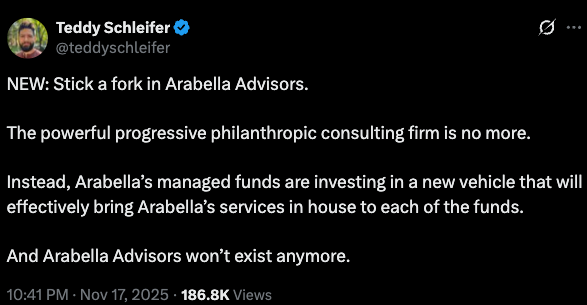
“Stick a fork in Arabella Advisors. The powerful progressive philanthropic consulting firm is no more,” New York Times reporter Teddy Schleifer wrote on X, adding, “Instead, Arabella’s managed funds are investing in a new vehicle that will effectively bring Arabella’s services in house to each of the funds. And Arabella Advisors won’t exist anymore.”
Schleifer pointed to a press release stating that Sunflower Services, a newly spun-up Public Benefit Corporation backed by NVF with support from the Windward and Hopewell Funds, has acquired Arabella Advisors’ fiscal sponsorship servicing business.
“Arabella Advisors will cease operations, and Sunflower Services will ensure continuity for clients and staff,” the press release stated.
The deal transfers Arabella’s operational infrastructure and staff to Sunflower, which will now provide administrative and operational services for NVF, Windward, Hopewell, and numerous other nonprofit projects. The nonprofits handled more than $1.179 billion across nearly 200 projects in the last year.
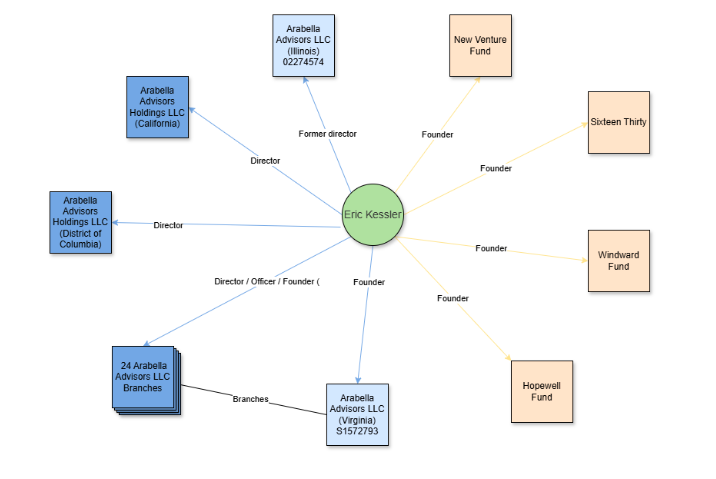
Corporate Composition of Arabella Advisors LLC – Virginia
Those nonprofits, ones mentioned above, act as fiscal sponsors for hundreds of political and activist groups.
Arabella Advisors Network
Even though Arabella claims neutrality, overwhelming evidence from Peter Schweizer & Seamus Bruner of the Government Accountability Institute shows that through the Arabella network, some of these funds have supported organizations linked to left-wing, anti-capitalist, anti-police, anti-Israel, and at times anti-American agendas.
Tracing the donors of the Arabella network is tricky. But according to the NYT, the Gates Foundation has plowed $450 million into the network since 2008, which in turn funneled money into other nonprofit entities, ranging from radical leftist climate groups to abortion initiatives, and even supporting the permanent protest-industrial complex against President Trump.
Related:
Bringing ‘Dark Money’ Operatives Out Of The Shadows
Dark-Money Network Funneled Millions Into ‘No Kings’ Nationwide Color Revolution Operation
X user Bad Kitty Unleashed noted, “Arabella reorganizing. Why, because everyone now knows that Arabella handles money for Soros Democracy Alliance APO partners? Screenshot – Soros democracy Alliance document. Sixteen Thirty and New Venture funds are Arabella. They collect and disburse the funds. Any DOJ with half a brain would watch this.”
The nonprofit world is in chaos:
“Panic Unfolds”: Nonprofit Sector Battered By 419% Surge In Job Losses And Grantmaking Freeze
“When you shine light on billion-dollar NGO networks, they scramble. We are seeing the panic unfold in real time — burner phones, law firms, and retreat statements. That tells you our research is hitting the mark. When you follow the money, the facts speak louder than spin,” Seamus Bruner recently said.
Hmm.
“At What Point Does This Become Treason?”
Bruner recently told President Trump about the Arabella problem on national television.
Way more than $100M of US taxpayer money
— Elon Musk (@elonmusk) October 8, 2025
Also, there is evidence that NVF and Windward are linked to the anti-capitalist group, the Alliance for Global Justice (AFGJ), through substantial financial contributions.
AFGJ’s links to Tides Foundation, Tides Center, Open Societies, Arabella Advisors, and others are troubling and support the protest industrial complex against Trump.
🚨#BREAKING: Multiple self-driving Waymo cars, collectively worth upwards of $600,000 each have been destroyed and light on fire by rioters
At this time, Los Angeles police are urgently requesting Waymo to shut down its self-driving car app as… pic.twitter.com/eU4ANqPfyt
— R A W S A L E R T S (@rawsalerts) June 9, 2025
There is suspicion that AFGJ could be linked to Latin American foreign influence operations. Yet the Trump administration looks the other way and focuses on Antifa.
Tyler Durden
Tue, 11/18/2025 – 15:45

Experts explain impact of data centers, as Naperville weighs a proposal
A controversial data center proposal in Naperville is set to once again come before the Planning and Zoning Commission Wednesday evening.
Developer Karis Critical’s plan calls for the construction of a 211,000-square-foot, 36-megawatt building, half of what it had initially requested, on the former Alcatel-Lucent site off Interstate 88. The land at 1960 Lucent Lane is zoned for office, research and light industry, a category that includes data centers, but the project needs city variance approval before it can move forward.
Ever since the proposal came to light, many Naperville residents have pushed back against the project. Data centers have been popping up around the suburbs of Chicago as the state makes an effort to bring these projects to Illinois.
The Naperville Sun spoke with a few experts to discuss what a data center is and the industry’s impact on the state. While not an exhaustive list, this article hopes to cover some questions readers may have.
What is a data center?
In its most basic form, data centers are warehouses with computers in them.
They serve as the backbone of the internet and society’s digital infrastructure. Anything you access online, such as electronic healthcare records and banking and financial transactions, are supported by data centers, according to Dan Diorio, vice president of state policy for the Data Center Coalition.
“But what happened is that these buildings with computers in them, which is basically what they were in the late 1990s, turned into successively larger and larger buildings,” said Andrew Chien, a computer science professor at the University of Chicago.
With the rise of generative artificial intelligence, some data centers are requiring more power to run their computing systems. Chien said the most power intensive one he has seen is a five-gigawatt data center (one gigawatt is equivalent to the power for the city of Philadelphia).
In 2001, a 36-megawatt data center would’ve been considered a large-sized data center, but in today’s era it’s considered more small to medium size, Chien said. A 36-megawatt data center is also the equivalent of about 20,000 homes in Naperville, which Brian Groth, Naperville’s electric utility director, confirmed.
Why do we need to build so many more data centers?
The data center boom is often associated with the increased use of artificial intelligence in society. That’s one driving factor, but it’s not the only one.
“As a society, we will generate twice as much data in the next five years as we did in the previous 10,” Diorio said. “Our digitization of the economy and of our everyday lives is leading to the need for increased digital infrastructure to help support that growing demand.”
The U.S. government also has a vested interest in adding more data centers to help keep sensitive information within its borders, Diorio said.
“We need to keep pace with other countries that are investing in this area heavily, and not just for economic competitiveness, but also for national security,” he said. “Our banking and financial records, our healthcare records, we want that secured here at home in the U.S.”
Why is a data center coming to my community?
Illinois has made a concerted effort to bring more data centers to the state through their Data Center Investment Program, which attracts large-scale data centers through a variety of sales and use tax exemptions, according to the Illinois Department of Commerce and Economic Opportunity.
“Illinois is one of 37 states throughout the country that have some kind of a tax exemption program for data centers, and so it makes it a very competitive state overall,” Diorio said.
According to the Illinois Governor’s office, the program has “delivered $15 billion in investment, thousands of construction jobs, and significant local property tax revenue.”
At the same time, the number of data centers coming to Illinois has posed challenges for the state on everything from water to energy usage. Data centers typically require significant amounts of water to cool their computer systems, which experts warn could lead to shortages and conflicts in parts of the Great Lakes region if not regulated properly.
Another issue is making sure the electricity grid can handle the amount of energy required to power all of these data centers.
“There’s no set of criteria of what is mandated in each municipality,” said Anna Markowski, Midwest director of climate and energy at the Natural Resources Defense Council. “It’s different in ComEd territory. It’s going to be different in Naperville. … The utilities are doing the best they can to make sure that these loads are brought on in a way that’s responsible.”
How close should data centers be to residential areas?
This depends on the size and scale of the data center, but Chien said that one effective way to introduce larger data centers into communities is to set up industrial districts for those companies.
“This could have a bunch of benefits. One is it separates it cleanly from these residential kinds of challenges,” Chien said. “Second, you need to put in large-scale power infrastructure and large-scale cooling infrastructure, and sometimes there can even be an issue with a little bit of noise. So it’s a good idea to put all these things together because it makes it easier for the data center companies.”
Why do data centers cause electricity bills to spike?
In some communities where data centers were added, residents have seen electricity bills spike. One reason is because after about 25 years of little to no growth in electricity consumption in the U.S., the nation’s electricity grid is suddenly seeing huge increases in consumption.
“When this large growth comes, of course, there’s a certain number of generation plants that have already been built, and there’s more competition for that supply, right?” Chien said. “So you see that in these wholesale markets. That’s not what you and I pay, but that’s what the big power companies pay to each other. Prices have already gone up significantly.”
That was true in the last annual auction for power grid operator PJM Interconnection, which Chicago is part of.
“So there’s already big signs that prices are going up and the simple reason for that is supply and demand,” Chien said.
Another element is the need to build more power lines to support data centers.
“And the way that utilities pay for these power lines is they pay them back over like a 30-year lifetime, right?” Chien said. “Collectively, the ratepayers have to pay that money, so when you have new construction, new construction tends to be more expensive than using the old stuff. So you see increases in the rates you need for that electricity. Therefore, all the prices go up.”
As a Naperville resident, will I see my electricity bill go up?
The city is actively working towards options to make sure residents will not see their electricity bills skyrocket should the data center be approved, according to Brian Groth, the city’s director of public utilities.
Every three years the city conducts rate studies. One of the main goals of those rate studies is to ensure that certain customer classes do not subsidize or are not subsidized by other rate classes.
“We’ve actually started looking at the potential for creating a new rate class for large customers to ensure that there is no cost shift between rate classes, or that other residents or businesses are not subsidizing a data center or another large load project,” Groth said.
All construction costs for interconnection of the data center are also paid for by the data center, Groth said. Those interconnection costs generally include things like cable directional and substation infrastructure, Groth said.
cstein@chicagotribune.com
https://www.chicagotribune.com/2025/11/18/naperville-data-center-experts-guide/

Steve Millar’s high school football rankings and quarterfinal players of the week for the Daily Southtown
Big moves up the rankings by Lockport, St. Rita, Providence, Oak Forest and St. Laurence.
Top 10
With records through Saturday and previous rankings in parentheses.
1. Mount Carmel 12-0 (1)
Roman Igwebuike comes up with interception as Caravan defense shuts down Lincoln-Way East.
2. Brother Rice 11-1 (2)
Sophomore defensive end Kameron McGee continues to dominate for the Crusaders.
3. Lockport 9-3 (6)
Interception by Jake Manzo highlights Porters’ 35-0 shutout against powerful Barrington offense.
4. St. Rita 8-4 (5)
So much for grinding it out. Steven Armbruster, Mustangs pile up points in 56-42 win over Hersey.
5. Providence 9-3 (7)
Broden Mackert runs for a pair of TDs as Celtics take care of downstate Washington 39-6.
6. Oak Forest 11-1 (8)
All-state senior quarterback Daniel Chopp leads the Bengals to first semifinal since 2007.
7. St. Laurence 8-4 (9)
Cory Les and the Vikings look to shock the state Saturday when they host East St. Louis.
8. Lincoln-Way East 9-3 (3)
Jonas Williams finishes as IHSA record-holder for career TD passes and career passing yards.
9. Lincoln-Way West 10-2 (4)
Jahan Abubaker leads Warriors to most wins in decade. But Downers Grove North ends their run.
10. Lincoln-Way Central 9-2 (10)
Senior defensive lineman Aiden Hennings is named honorable mention all-state by coaches.
Offensive Player of the Week
Senior receiver Walter Jones hauls in four catches for 185 yards, including TDs of 62 and 79 yards, for St. Rita in a 56-42 victory over Hersey in Class 7A quarterfinals.
Special Teams Player of the Week
Junior linebacker Darrell McCullough blocks a punt and returns it 54 yards for a TD to spark Lockport to a 35-0 victory over Barrington in Class 8A quarterfinals.