Category: News
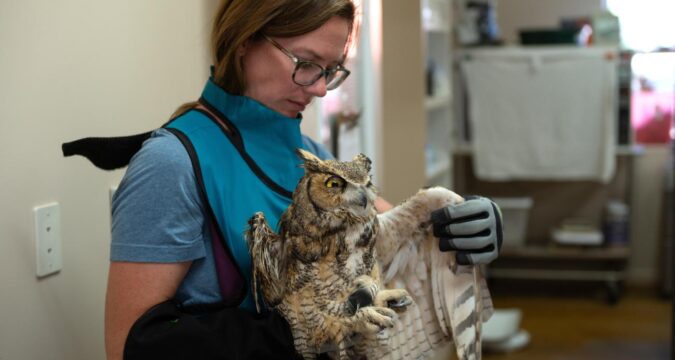
Búho parcialmente cubierto de concreto se recupera tras ser rescatado en Utah
Por SEJAL GOVINDARAO
Un búho que fue encontrado parcialmente cubierto de concreto después de meterse en una mezcladora en el suroeste de Utah podría volver a volar libre después de ser limpiado meticulosamente por los trabajadores de un santuario de animales que describieron al animal como un “luchador”.
El ejemplar de búho americano fue encontrado en el Black Desert Resort, en el suroeste del estado, y llegó al Best Friends Animal Sanctuary en Kanab, Utah, a principios de mes con el rostro, el pecho y el ala derecha cubiertos de concreto seco. Después de asegurarse de que pudiera respirar, los trabajadores del santuario pasaron días partiendo el concreto con pinzas y limpiándole las plumas con cepillos de dientes, jabón para platos y los dedos.
Dos semanas después, pudo volver a volar y continúa su recuperación en un aviario.
“Es un joven, lo que puede ser el motivo por el que terminó en una mezcladora de concreto, y creemos que es un macho porque es más bien pequeño”, afirmó Bart Richwalski, del santuario de animales.
Los búhos americanos suelen tener un recubrimiento de plumón sobre las plumas, lo que les permite volar silenciosamente mientras cazan. Pero el concreto desgastó las plumas del animal rescatado, apuntó Judah Battista, director del santuario.
Ahora produce un “siseo” al volar, y el santuario no lo liberará en la naturaleza hasta que mude sus plumas y pueda volver a hacerlo de forma silenciosa. Eso debería ocurrir la próxima primavera o verano, agregó Battista.
“Una vez que nuestro amigo búho se recupere, pensamos llevarlo de regreso cerca de donde fue encontrado, no a la obra, sino a algún lugar que sea un hábitat natural para él, y liberarlo”, indicó Richwalski.
___
Esta historia fue traducida del inglés por un editor de AP con la ayuda de una herramienta de inteligencia artificial generativa.

LeBron James debuta en temporada histórica; Lakers doblegan 140-125 a Jazz
LOS ÁNGELES (AP) — LeBron James totalizó 11 puntos y 12 asistencias en el primer partido de su inédita 23º temporada en la NBA, y Luka Doncic añadió 37 unidades y diez asistencias por los Lakers de Los Ángeles, que doblegaron el martes 140-125 al Jazz de Utah.
James, de 40 años, hizo su debut en la temporada dentro de la alineación titular de los Lakers y jugó 30 minutos después de perderse el campamento de prácticas y sus primeros 14 duelos debido a la ciática. Vince Carter era el otro jugador en la historia de la NBA que ha participado en 22 temporadas, pero James lo superó al abrir el siguiente capítulo de una carrera profesional que comenzó en 2003.
El astro no tardó en encontrar el ritmo: ofreció una cátedra de juego en equipo en la segunda mitad, y Doncic anotó 17 puntos en el tercer cuarto para que los Lakers se alejaran de Utah.
Austin Reaves agregó 26 puntos a la causa de los Lakers, que mejoraron a 11-4 con su tercera victoria consecutiva.
Keyonte George, quien nació diez días después del debut de James en la NBA, igualó su máximo número de la temporada con 33 puntos para el Jazz dos noches después de encestar el triple ganador en un emocionante partido de doble tiempo extra contra Chicago.
Lauri Markkanen facturó 31 puntos por Utah, que ha perdido cinco de siete.
James no anotó en sus primeros 11 minutos en la cancha, pero sus dos triples en la primera mitad lo colocaron por delante de Reggie Miller como el sexto con más encestes de tres puntos en la historia de la NBA.
Su hijo Bronny James jugó los últimos 3:33 minutos y encestó un triple.
_____
Deportes AP: https://apnews.com/hub/deportes
Cangrejeros pierden el invicto en Puerto Rico
Por The Associated Press
Los Gigantes de Carolina necesitaron entradas adicionales para superar el martes 6-5 a los Cangrejeros de Santurce, que perdieron por primera vez en la temporada tras acumular seis victorias consecutivas en la Liga de Béisbol Profesional Roberto Clemente.
Ezequiel Pagán bateó de 4-2 con dos carreras remolcadas, Josh Hatcher conectó un jonrón solitario y Jan Hernández añadió un doble productor para destacarse a la ofensiva por los ganadores.
En Ponce, el japonés Kazuto Taguchi lanzó cinco entradas sin permitir anotaciones, mientras que Dalton Guthrie remolcó dos carreras con un doble para guiar a los Leones a una victoria por 3-0 sobre los Senadores de San Juan.
Como locales, los Criollos de Caguas supraron 2-1 a los Indios de Mayagüez, con un cuadrangular solitario de Elijah Dunham y un sencillo remolcador de Noah Myers.
Joya de Gavin conduce a Leones a triunfo en Dominicana
Grant Gavin cumplió una salida impecable y guio a los Leones del Escogido a una victoria por 3-1 sobre las Estrellas Orientales en la Liga Dominicana de Béisbol.
Gavin lanzó siete entradas en blanco, en las que solo permitió un imparable, conectado por el veterano de Grandes Ligas Robinson Canó en el segundo episodio. A la ofensiva, se destacaron Erick González, de 3-2 con un triple y dos anotadas, y Jorge Mateo, de 4-1 con una carrera remolcada.
En Santiago, las imparables Águilas Cibaeñas aplastaron 13-6 a los Toros del Este para ratificar su posición como líderes del circuito. Alberto Rodríguez bateó de 4-2 con un jonrón y tres carreras remolcadas, J.C. Escarra se fue de 4-2 con un doble y tres empujadas, y Leody Taveras conectó de 6-2 con un cuadrangular y dos producidas.
Los Tigrs de Licey superaron 3-2 a los Gigantes del Cibao en Santo Domingo. Cal Stevenson conectó un jonrón solitario, Michael De La Cruz añadió un triple remolcador de una carrera y Gustavo Núñez empujó otra con un elevado de sacrificio.
Bravos aplastan a Águilas en Venezuela
Los Bravos de Margarita desplegaron una ofensiva de 17 imparables en ruta a una victoria por 13-7 sobre las Águilas del Zulia en la Liga Venezolana de Béisbol.
Moisés Gómez bateó de 5-2 con un doble, un jonrón y tres carreras producidas; Juan Santana conectó de 4-1 con un doble y cuatro empujadas y Ramón Cabrera se fue de 6-5 con un cuadrangular y dos remolcadas.
En Caracas, Rafael Ortega conectó un sencillo para romper el empate en la parte alta del octavo episodio y los Cardenales de Lara se impusieron 5-4 a los Leones del Caracas.
Los Caribes de Anzoátegui superaron 4-3 a los Navegantes del Magallanes en Puerto La Cruz. Herlis Rodríguez conectó un jonrón solitario en el tercer capítulo y añadió un doble remolcador en la décima entrada.
Posteriormente anotó la carrera de la victoria gracias a un sencillo de Hernán Pérez.
Los Cardenales de Lara derrotaron 5-1 a los Leones en Caracas. Yojhan Quevedo impulsó una carrera con un elevado de sacrificio, Danry Vázquez añadió otra con un sencillo y Luisangel Acuña selló el triunfo.
_____
Deportes AP: https://apnews.com/hub/deportes
https://www.chicagotribune.com/2025/11/19/cangrejeros-pierden-el-invicto-en-puerto-rico/

Asking Eric: We each grieve in our own ways
Dear Eric: My sister, Olivia, died unexpectedly about a year ago. I received the call. I in turn called my other brother and sister. Of my family, only Olivia and I were close. My brother bullied us mentally and physically during our childhood.
She has an adult son, who decided to let the state take care of things, as they were both transient. There was no service.
During that time, I worked through a tremendous amount of grief and sadness, as well as guilt.
Almost a year later, my brother dropped this bomb that my other sister and I could purchase an urn and that he would make arrangements for a mass and burial for Olivia. It was more of an order, than a request. The bully rose again.
I did not want to do this. I grieved my sister already and did not want to go through it again.
He went ahead with it. I was floored. Olivia had not been practicing in the faith for years.
My sister texted me asking for pictures for the mass. I am so angry they are guilting me into this.
I decided to provide a picture display, attend the mass and quietly leave. I will not attend the gravesite event. I couldn’t handle it.
Am I wrong about this decision?
– Grieving Sister
Dear Sister: We each grieve in our own ways. Often, especially in families, there’s an expectation that the expression of grief will be shared. People often want us to grieve in the ways that they’re grieving so that they feel validated or less alone. Communal commemoration can be very healing. But if it’s not what you need right now, it doesn’t make sense for you to force yourself to go through it for your brother’s benefit.
Your brother and sister may be feeling guilt over not being more present in Olivia’s life. That’s understandable. And it’s kind of you to help them by providing photos. But your relationship to her in life, and in death, is unique. You’re not doing her a disservice by declining to attend the gravesite event. You have and will continue to grieve her in your own way. Don’t let yourself be pressured into something that’s going to cause pain. If your brother and sister won’t take no for an answer, that’s on them. It’s not between you and Olivia.
Dear Eric: I’ve got a family party in a few weeks that I look forward to every year, but I am dreading this one. Until recently my brother was extremely overweight due to eating far too much and taking no exercise. He was also a very heavy drinker. He’s turned that around now, which is great, although he still has a lot of weight to lose.
The trouble is he’s been criticizing what others eat and drink. Just the smallest comments occasionally about the calorie content of what you eat and what drinking does to you. He even occasionally comments on my size, telling me I have big hips, or I look fat in what I’m wearing. He has a toxic personality and has always been jealous of everything I’ve done.
He doesn’t say these things to be helpful; he says them to be hurtful (if he wasn’t
criticizing what I eat and drink it would be something else).
Obviously, a party has a lot of food and drink, things that you don’t have every day, and people indulge because it’s a rare thing. I am dreading the comments he is going to make. I am self-conscious about my weight.
I intend to enjoy myself at this party and forget about it, just for one night. If I tell him to stop it the family will turn on me. It’s happened before as he is the golden child for some reason. It will be made to look like I’m picking on him. How should I deal with the inevitable comments without causing a scene?
– Wants to Party
Dear Party: It sounds like your brother has a long history of working out insecurity. Unfortunately, he chooses to work it out on others, particularly on you. This isn’t healthy and it won’t help him. But that’s a problem that’s on his side of the street.
In order to enjoy yourself, insulate yourself as much as possible. First, through self-coaching. Remind yourself that his words aren’t coming from a place of care or of truth. Every word is his own lack of self-confidence talking. Reframing the comments internally may lessen their impact slightly.
Related Articles
Asking Eric: I don’t enjoy emojis
Asking Eric: Ex-wife still visits the house
Asking Eric: Grandson embezzled more than $100,000
Asking Eric: I’m sick of small talk
Terry Savage: The toughest talk
Second, bring backup. Bring a friend, brief them on your concerns and never leave their side. This may not stop your brother from making his comments, but they may feel different when you’ve got someone right next to you who supports and affirms you.
(Send questions to R. Eric Thomas at eric@askingeric.com or P.O. Box 22474, Philadelphia, PA 19110. Follow him on Instagram and sign up for his weekly newsletter at rericthomas.com.)
https://www.chicagotribune.com/2025/11/19/asking-eric-we-each-grieve-in-our-own-ways/

África acoge su primer G20 y pide a los países más ricos más acción contra desastres climáticos
Por MICHELLE GUMEDE
JOHANNESBURGO (AP) — En el municipio más antiguo de Sudáfrica, voluntarios con trajes impermeables se sumergen hasta los muslos en las aguas del contaminado río Jukskei para desenredar una red diseñada para atrapar basura que resultó dañada por las fuertes lluvias. Sin las redes, las chozas de la zona baja de Alexandra, a las afueras de Johannesburgo, podrían sufrir inundaciones desastrosas.
Los líderes del Grupo de los 20 países más ricos e industrializados se reunirán este fin de semana en Johannesburgo para la primera cumbre del bloque en África. Sudáfrica, como anfitriona, quiere priorizar los problemas que afectan a las naciones pobres, incluyendo la respuesta a los desastres agravados por el cambio climático.
Instará a los países ricos y las instituciones financieras internacionales a ayudar más, un llamado que se repite en las conversaciones de Naciones Unidas sobre clima en Brasil.
Los más de medio millón de residentes de Alexandra viven a pocos pasos del distrito financiero más rico de Sudáfrica, Sandton. Pero las inundaciones suelen sumergir puentes, lo que impide que los niños del municipio vayan a la escuela. Es un “gran peligro”, dijo Semadi Manganye, vecino y cofundador del grupo de voluntarios, los Guerreros del Agua de Alexandra.
Devastador para los países pobres
“Los estragos del clima están directamente vinculados a los estragos de la desigualdad”, dijo a The Associated Press Binaifer Nowrojee, presidenta de las Open Society Fundations, una organización no gubernamental que promueve la democracia y la gobernanza. “Los países enfrentan la destructiva elección entre hacer crecer sus economías y tomar medidas climáticas”.
El Banco Mundial afirma que las naciones más pobres fueron azotadas por casi ocho veces más desastres naturales en la década de 2010-2020 que en la de 1980-1990.
El sur de África ha sido golpeado por fuertes tormentas tropicales en la última década, que causaron la muerte a miles de personas y unos costos de reconstrucción insoportables. El ciclón Idai, que según los científicos se vio potenciado por el cambio climático, arrasó Mozambique, Malawi y Zimbabue en 2019, dejando daños estimados en 2.000 millones de dólares, de acuerdo con el Banco Mundial. El producto interno bruto de Malawi es de apenas 12.000 millones de dólares.
El año pasado, el fenómeno meteorológico El Niño provocó una de las peores sequías en décadas en la región, devastando la agricultura a pequeña escala y empobreciendo más aún a la población.
Presión a los líderes mundiales
El financiamiento climático ha sido tema de intenso debate entre los países ricos y pobres en cumbres importantes como el G20.
Las naciones adineradas acordaron en la cumbre climática de la ONU del año pasado aportar al menos 300.000 millones de dólares al año para 2035 para ayudar a las que están en desarrollo a lidiar con los efectos del cambio climático y los desastres meteorológicos. Pero expertos independientes sostienen que se necesita mucho más, un estimado de un billón de dólares anuales para 2030.
Uno de los mayores contaminantes del mundo, Estados Unidos, no asistirá siquiera a la cumbre del G20 de este fin de semana debido a un boicot por las ampliamente rechazadas afirmaciones de su presidente, Donald Trump, de que Sudáfrica persigue de forma violenta a una minoría blanca.
Eso hace que lograr medidas sobre clima, o incluso una declaración significativa, por parte del G20 sea una tarea difícil.
Los propios fracasos de Sudáfrica
Los Guerreros del Agua de Alexandra se consideran los guardianes de su entorno desde su fundación en 2021, plantando árboles autóctonos para reducir el calor urbano y recopilando y reciclando basura del río.
Se enfrentan al tipo de retos que se ven en otros municipios y asentamientos pobres en todo el país, que es la economía más desarrollada del continente pero cuenta con algunas de las desigualdades más drásticas del mundo.
Un reporte de Amnistía Internacional publicado este mes con motivo de la cumbre del G20 señaló que el gobierno sudafricano está fallando a hasta cinco millones de personas que viven en asentamientos informales sin viviendas ni servicios adecuados y que sufren el impacto de la crisis climática. A menudo se ven obligados a vivir en zonas vulnerables y bajas cerca de ríos, agregó.
Las inundaciones registradas en junio en la provincia de Cabo Oriental causaron más de 100 muertes. Mientras el presidente del país, Cyril Ramaphosa, dijo que fueron exacerbadas por el cambio climático, las autoridades locales apuntaron que fueron más letales debido a la mala calidad de la vivienda y al deterioro de la infraestructura en una de las regiones más pobres de Sudáfrica.
Crecimiento sostenible
Ntombi Maponya es una de las alrededor de 3.000 personas que trabajan con los Guerreros del Agua de Alexandra u otros proyectos locales y que reciben una pequeña remuneración mensual de una colección público-privada de donantes que incluye a los gobiernos de Sudáfrica y Canadá.
“Cuando llega el 25 de cada mes, comienzas a sonreír”, afirmó.
La iniciativa comenzó en 2022 con apenas 250 personas.
La resiliencia climática debería verse como una estrategia para impulsar el desarrollo, indicó la economista camerunesa Vera Songwe, ex secretaria ejecutiva de la Comisión Económica para África de Naciones Unidas.
“La buena noticia… es que, de hecho, el crecimiento verde, sostenible y resiliente es un crecimiento mucho más rápido”, dijo a reporteros durante un acto sobre la crisis de la deuda antes del G20.
___
The Associated Press recibe apoyo financiero para la cobertura de salud global y desarrollo en África de la Fundación Gates. AP es la única responsable de todo el contenido. Encuentre los estándares de AP para trabajar con filantropías, una lista de patrocinadores y áreas de cobertura financiadas en AP.org.
___
Esta historia fue traducida del inglés por un editor de AP con la ayuda de una herramienta de inteligencia artificial generativa.
Photos: Chicago Blackhawks beat the Calgary Flames 5-2 at the United Center
The Chicago Blackhawks defeated the Calgary Flames 5-2 at the United Center on Tuesday, Nov. 18, 2025. Connor Bedard scored a hat trick.
Blackhawks center Connor Bedard (98) skates among hats thrown on the ice by fans after his hat trick that brought the Blackhawks up 5-2 during the third period against the Calgary Flames, Nov. 18, 2025, at the United Center. (Dominic Di Palermo/Chicago Tribune)
Blackhawks center Connor Bedard’s third goal enters the net from across the ice making the score 5-2 during the third period against the Calgary Flames, Nov. 18, 2025, at the United Center. (Dominic Di Palermo/Chicago Tribune)
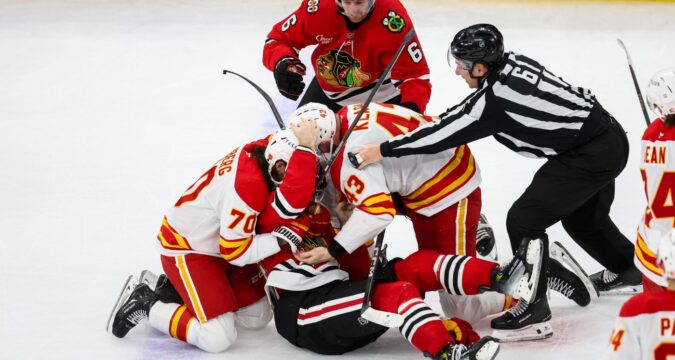
A scrum ensues between the Blackhawks and Calgary Flames within the last 30 seconds of the game during the third period, Nov. 18, 2025, at the United Center. (Dominic Di Palermo/Chicago Tribune)
A scrum ensues between Blackhawks and Calgary Flames players during the third period, Nov. 18, 2025, at the United Center. (Dominic Di Palermo/Chicago Tribune)
A scrum ensues between Blackhawks and Calgary Flames players during the third period, Nov. 18, 2025, at the United Center. (Dominic Di Palermo/Chicago Tribune)
A scrum ensues between the Blackhawks and Calgary Flames within the last 30 seconds of the game during the third period, Nov. 18, 2025, at the United Center. (Dominic Di Palermo/Chicago Tribune)
A scrum ensues between the Blackhawks and Calgary Flames within the last 30 seconds of the game during the third period, Nov. 18, 2025, at the United Center. (Dominic Di Palermo/Chicago Tribune)
A scrum ensues between Blackhawks and Calgary Flames players during the third period, Nov. 18, 2025, at the United Center. (Dominic Di Palermo/Chicago Tribune)
A scrum ensues between Blackhawks and Calgary Flames players during the third period, Nov. 18, 2025, at the United Center. (Dominic Di Palermo/Chicago Tribune)
Blackhawks left wing Andre Burakovsky (28) and Blackhawks goaltender Arvid Söderblom (40) talk while a scrum ensued between players from the Blackhawks and Calgary Flames, Nov. 18, 2025, at the United Center. (Dominic Di Palermo/Chicago Tribune)
Blackhawks center Oliver Moore (11) scores bringing the Blackhawks up 4-2 during the third period against the Calgary Flames, Nov. 18, 2025, at the United Center. (Dominic Di Palermo/Chicago Tribune)
Blackhawks center Connor Bedard (98) celebrates his second goal with teammates during the third period against the Calgary Flames bringing the Blackhawks up 3-2, Nov. 18, 2025, at the United Center. (Dominic Di Palermo/Chicago Tribune)
Blackhawks center Connor Bedard (98) celebrates his second goal with Blackhawks defenseman Artyom Levshunov (55) during the third period against the Calgary Flames bringing the Blackhawks up 3-2, Nov. 18, 2025, at the United Center. (Dominic Di Palermo/Chicago Tribune)
Blackhawks center Oliver Moore (11) and Blackhawks center Frank Nazar (91) celebrate his goal that brought the Blackhawks up 4-2 during the third period against the Calgary Flames, Nov. 18, 2025, at the United Center. (Dominic Di Palermo/Chicago Tribune)
Blackhawks goaltender Arvid Söderblom (40) makes a save while Flames right wing Adam Klapka (43) and Flames center Morgan Frost (16) try to put the puck in the goal during the third period, Nov. 18, 2025, at the United Center. (Dominic Di Palermo/Chicago Tribune)
Blackhawks defenseman Louis Crevier (46) keeps the puck away from Flames center Connor Zary (47) during the third period, Nov. 18, 2025, at the United Center. (Dominic Di Palermo/Chicago Tribune)
Flames right wing Adam Klapka (43) is taken to the penalty box for a roughing penalty during the third period against the Blackhawks, Nov. 18, 2025, at the United Center. (Dominic Di Palermo/Chicago Tribune)
Blackhawks center Oliver Moore (11) tries to steal the puck away from Flames defenseman Brayden Pachal (94) during the third period, Nov. 18, 2025, at the United Center. (Dominic Di Palermo/Chicago Tribune)
Blackhawks center Connor Bedard (98) scores his second goal during the third period against the Calgary Flames bringing the Blackhawks up 3-2, Nov. 18, 2025, at the United Center. (Dominic Di Palermo/Chicago Tribune)
Blackhawks goaltender Arvid Söderblom (40) makes a save during the third period against the Calgary Flames, Nov. 18, 2025, at the United Center. (Dominic Di Palermo/Chicago Tribune)
Blackhawks center Oliver Moore (11) scores bringing the Blackhawks up 4-2 during the third period against the Calgary Flames, Nov. 18, 2025, at the United Center. (Dominic Di Palermo/Chicago Tribune)
Blackhawks defenseman Louis Crevier (46) and Blackhawks defenseman Wyatt Kaiser (44) congratulate Blackhawks center Connor Bedard (98) on his third goal that brought the Blackhawks up 5-2 during the third period against the Calgary Flames, Nov. 18, 2025, at the United Center. (Dominic Di Palermo/Chicago Tribune)
Blackhawks center Oliver Moore (11) and Blackhawks center Frank Nazar (91) celebrate his goal that brought the Blackhawks up 4-2 during the third period against the Calgary Flames, Nov. 18, 2025, at the United Center. (Dominic Di Palermo/Chicago Tribune)
Blackhawks goaltender Arvid Söderblom (40) makes a save while Flames right wing Adam Klapka (43) and Flames center Morgan Frost (16) try to put the puck in the goal during the third period, Nov. 18, 2025, at the United Center. (Dominic Di Palermo/Chicago Tribune)
Blackhawks center Connor Bedard (98) celebrates his second goal with Blackhawks defenseman Artyom Levshunov (55) during the third period against the Calgary Flames bringing the Blackhawks up 3-2, Nov. 18, 2025, at the United Center. (Dominic Di Palermo/Chicago Tribune)
Blackhawks center Frank Nazar (91) shoots on goal while being contested by Flames defenseman MacKenzie Weegar (52) during the third period, Nov. 18, 2025, at the United Center. (Dominic Di Palermo/Chicago Tribune)
Blackhawks center Oliver Moore (11) scores bringing the Blackhawks up 4-2 during the third period against the Calgary Flames, Nov. 18, 2025, at the United Center. (Dominic Di Palermo/Chicago Tribune)
Blackhawks right wing Ilya Mikheyev (95) is taken to the penalty box for a roughing penalty during the third period against the Calgary Flames, Nov. 18, 2025, at the United Center. (Dominic Di Palermo/Chicago Tribune)
Blackhawks center Oliver Moore (11) and the Blackhawks bench celebrate his goal that brought the Blackhawks up 4-2 during the third period against the Calgary Flames, Nov. 18, 2025, at the United Center. (Dominic Di Palermo/Chicago Tribune)
Blackhawks defenseman Louis Crevier (46) congratulates Blackhawks center Connor Bedard (98) on his third goal that brought the Blackhawks up 5-2 during the third period against the Calgary Flames, Nov. 18, 2025, at the United Center. (Dominic Di Palermo/Chicago Tribune)
Blackhawks goaltender Arvid Söderblom (40) makes a save while Flames right wing Adam Klapka (43) and Flames center Morgan Frost (16) try to put the puck in the goal during the third period, Nov. 18, 2025, at the United Center. (Dominic Di Palermo/Chicago Tribune)
Fans cheer after Blackhawks center Connor Bedard’s (98) first goal that made the score 2-1 during the second period against the Calgary Flames, Nov. 18, 2025, at the United Center. (Dominic Di Palermo/Chicago Tribune)
Blackhawks defenseman Sam Rinzel (6) keeps the puck away from Flames right wing Adam Klapka (43) during the second period, Nov. 18, 2025, at the United Center. (Dominic Di Palermo/Chicago Tribune)
Blackhawks defenseman Artyom Levshunov (55) attempts to poke the puck away from Flames defenseman Yan Kuznetsov (37) during the second period, Nov. 18, 2025, at the United Center. (Dominic Di Palermo/Chicago Tribune)
Flames right wing Matt Coronato (27) scores the first goal for the Flames on Blackhawks goaltender Arvid Söderblom (40) during the second period, Nov. 18, 2025, at the United Center. (Dominic Di Palermo/Chicago Tribune)
Flames right wing Matt Coronato (27) scores the first goal for the Flames on Blackhawks goaltender Arvid Söderblom (40) during the second period, Nov. 18, 2025, at the United Center. (Dominic Di Palermo/Chicago Tribune)
Flames right wing Matt Coronato (27) scores the first goal for the Flames on Blackhawks goaltender Arvid Söderblom (40) during the second period, Nov. 18, 2025, at the United Center. (Dominic Di Palermo/Chicago Tribune)
Flames right wing Matt Coronato (27) scores the first goal for the Flames on Blackhawks goaltender Arvid Söderblom (40) during the second period, Nov. 18, 2025, at the United Center. (Dominic Di Palermo/Chicago Tribune)
Blackhawks goaltender Arvid Söderblom grabs the puck during the second period against the Calgary Flames, Nov. 18, 2025, at the United Center. (Dominic Di Palermo/Chicago Tribune)
Blackhawks center Sam Lafferty (24) raises his stick in celebration of Blackhawks center Ryan Donato’s goal during the first period against the Calgary Flames, Nov. 18, 2025, at the United Center. (Dominic Di Palermo/Chicago Tribune)
Blackhawks center Connor Bedard (98) shoots on goal during the first period against the Calgary Flames, Nov. 18, 2025, at the United Center. (Dominic Di Palermo/Chicago Tribune)
Blackhawks center Connor Bedard (98) shoots on goal during the first period against the Calgary Flames, Nov. 18, 2025, at the United Center. (Dominic Di Palermo/Chicago Tribune)
The Blackhawks celebrate center Ryan Donato’s goal during the first period against the Calgary Flames, Nov. 18, 2025, at the United Center. (Dominic Di Palermo/Chicago Tribune)
Blackhawks center Frank Nazar (91) battles for the puck with Flames defenseman Kevin Bahl (7) during the first period, Nov. 18, 2025, at the United Center. (Dominic Di Palermo/Chicago Tribune)
Blackhawks center Ryan Donato (8), right, shoots and scores during the first period against the Calgary Flames, Nov. 18, 2025, at the United Center. (Dominic Di Palermo/Chicago Tribune)
Flames defenseman MacKenzie Weegar (52) moves the puck past Blackhawks center Colton Dach (34) during the first period, Nov. 18, 2025, at the United Center. (Dominic Di Palermo/Chicago Tribune)
Blackhawks center Frank Nazar (91) and Flames center Nazem Kadri (91) defend each other during the first period, Nov. 18, 2025, at the United Center. (Dominic Di Palermo/Chicago Tribune)
Blackhawks center Ryan Donato (8), right, shoots and scores during the first period against the Calgary Flames, Nov. 18, 2025, at the United Center. (Dominic Di Palermo/Chicago Tribune)
Blackhawks left wing Landon Slaggert (84) chases the puck during the first period against the Calgary Flames, Nov. 18, 2025, at the United Center. (Dominic Di Palermo/Chicago Tribune)
Flames defenseman MacKenzie Weegar (52) moves the puck past Blackhawks center Colton Dach (34) during the first period, Nov. 18, 2025, at the United Center. (Dominic Di Palermo/Chicago Tribune)
Blackhawks left wing Landon Slaggert (84) and Flames defenseman MacKenzie Weegar (52) chase the puck during the first period against the Calgary Flames, Nov. 18, 2025, at the United Center. (Dominic Di Palermo/Chicago Tribune)
Blackhawks defenseman Sam Rinzel (6) handles the pick during the first period against the Calgary Flames, Nov. 18, 2025, at the United Center. (Dominic Di Palermo/Chicago Tribune)
Fans sing the National Anthem before a game between the Blackhawks and Calgary Flames, Nov. 18, 2025, at the United Center. (Dominic Di Palermo/Chicago Tribune)
Fans sing the National Anthem before a game between the Blackhawks and Calgary Flames, Nov. 18, 2025, at the United Center. (Dominic Di Palermo/Chicago Tribune)
James Nelson, 8, inspects a puck that he received from a Calgary Flames player while his mother Jen Nelson of Mokena looked on before a game between the Blackhawks and Calgary Flames, Nov. 18, 2025, at the United Center. (Dominic Di Palermo/Chicago Tribune)
Jett Foster, 6, middle, yells to get the attention of players while his cousin Reilly Stone, 7, left, and Andrew Stone look on before a game between the Blackhawks and Calgary Flames, Nov. 18, 2025, at the United Center. (Dominic Di Palermo/Chicago Tribune)
Mallory Guerreso of Beverly shows her son Tony Guerreso, 4, a puck they received from Flames defenseman Rasmus Andersson (4) before a game between the Blackhawks and Calgary Flames, Nov. 18, 2025, at the United Center. (Dominic Di Palermo/Chicago Tribune)
https://www.chicagotribune.com/2025/11/18/photos-chicago-blackhawks-calgary-flames/

With an assist from her dad’s dance moves, Macie Jones makes big free throws for Yorkville. ‘It’s helped me.’
For the past couple of years, Yorkville’s Macie Jones and her father, Jason, have worked on her free throws.
Jason, a former Kaneland player, would dance under the basket trying to distract her while she was shooting.
Is he a good dancer?
“No,” Macie said with a smile. “He’ll do these weird dance moves to get me out of rhythm. He’ll kick his feet and move his arms as a visual distraction.”
Jason is no Fred Astaire, but his approach has been a positive at the line for the senior guard.
“It’s helped me a lot,” Macie said.
Yorkville’s Macie Jones (4) gives Hayden Hodges (12) a playful shove after Hodges hit a shot and drew a foul against Sandburg in a nonconference game in Orland Park on Tuesday, Nov. 18, 2025. (Vincent D. Johnson / Daily Southtown)
Indeed, Jones made four big free throws in the fourth quarter Tuesday night as the Foxes rallied for a 56-55 nonconference win over host Sandburg in both teams’ season opener in Orland Park.
Jones and Aubrey Spychalski led a balanced attack with eight points apiece for Yorkville (1-0). Alayna Demas added six points, eight rebounds and three steals.
Demas also scored the go-ahead basket for the Foxes with 1:05 remaining in the game. Sydney McCabe came off the bench and scored seven points, all in the first quarter.
The Foxes were 19-11 last season. Jones, a Benedictine recruit, is the only starter back. And Yorkville coach Kim Wensits, a former Sandburg standout, will be counting on that experience.
Yorkville’s Macie Jones (4) gets into defensive position late in the game against Sandburg during a nonconference game in Orland Park on Tuesday, Nov. 18, 2025. (Vincent D. Johnson / Daily Southtown)
“I feel like I should carry the load, be a leader and help everyone learn the expectations of what the varsity is,” Jones said.
Ellie Driscoll paced Sandburg (0-1) with a game-high 28 points, The Eagles led 37-26 early in the third quarter before the Foxes staged their comeback.
Demas, meanwhile, confirmed that Jones is a perfect fit for her new role.
“Macie is a great leader and she definitely leads by example,” Demas said. “It’s just awesome having her on the team. We’ve been playing together since we were in second grade.
“I’ve grown up with her. We’re best friends.”
Yorkville’s Macie Jones (4) tries to drive past Sandburg’s Zoe Trunk (12) during a nonconference game in Orland Park on Tuesday, Nov. 18, 2025. (Vincent D. Johnson / Daily Southtown)
After Demas converted the go-ahead shot, Jones hit two free throws with 28 seconds left in the face of fans screaming. That put the Foxes ahead 56-53 and they held on.
She also made a pair of free throws after a technical foul with members of the Sandburg’s band hollering to try and distract her with 3:59 left to pull her team within three points.
“I just tuned it out,” Jones said.
Wensits also has a lot of confidence in Jones’ shooting
“She did awesome — absolutely awesome,” Wensits said of Jones, a three-year varsity veteran. “It was actually more calming to me because she knows what is expected and she knows what to do.
“She was our leading free-throw shooter last year, and I knew she was going to put the ball in.”
Yorkville’s Macie Jones (4) looks to pass against Sandburg during a nonconference game in Orland Park on Tuesday, Nov. 18, 2025. (Vincent D. Johnson / Daily Southtown)
Although none of Foxes reached double figures in scoring, Wensits loved seeing the balance as her players need to get used to each other in the early going.
“I hope we can do this all year,” she said. “We’re a very different team than we were the last two or three years. We have three kids who are now playing college basketball and they were our nucleus.
“Our JV lost only four games last year and had victory experience, but it’s a matter of who is going to step up.”
Jones believes that balance will help the Foxes. Nine players scored against the Eagles.
“We have a lot of people playing who can do a lot of different things,” she said. “We love to run. That’s our thing. We share the ball. We’re passing. We have so many to many people to use, so it’s not locking in on one person.
“Everyone is capable of scoring.”
Jeff Vorva is a freelance reporter for The Beacon-News.
https://www.chicagotribune.com/2025/11/18/macie-jones-yorkville-sandburg-ihsa-girls-basketball/
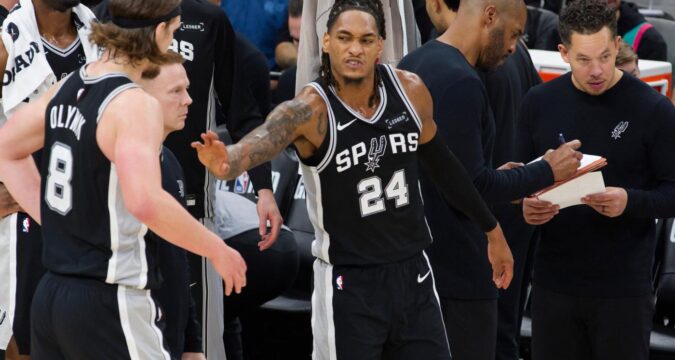
Fox y Barnes llevan a Spurs a victoria sobre Grizzlies en duelo sin astros Wembanyama y Morant
SAN ANTONIO (AP) — De’Aaron Fox anotó 26 puntos, Harrison Barnes añadió 23 y los Spurs de San Antonio escaparon el martes con una victoria de 111-101 sobre los Grizzlies de Memphis, en una batalla de plantillas plagadas de lesiones.
San Antonio no contó con el pívot estelar Victor Wembanyama y Memphis no tuvo a su máxima figura, el base Ja Morant.
Barnes acertó nueve de 14 tiros de campo, incluyendo siete puntos consecutivos mediante un gancho en carrera, una flotadora de tres metros y un triple para darles a los Spurs una ventaja de 107-101 con 53,2 segundos restantes. Keldon Johnson añadió 18 puntos al atinar ocho de 15 tiros.
Cedric Coward anotó 19 puntos y Jaren Jackson Jr. añadió 18 por Memphis, que perdió su quinto partido consecutivo.
San Antonio ha ganado dos duelos seguidos y cinco de los últimos siete.
Los Spurs también están sin los bases lesionados Dylan Harper (distensión en la pantorrilla izquierda) y Stephon Castle.
Las resonancias magnéticas revelaron que Wembanyama sufre una distensión en la pantorrilla izquierda y Castle tiene un tirón en el flexor de la cadera izquierda. Se espera que tanto Wembanyama como Castle se pierdan de dos a tres semanas.
Los Spurs tienen un récord de 18-31 sin Wembanyama y los Grizzlies padecen una foja de 76-93 sin Morant.
_____
Deportes AP: https://apnews.com/hub/deportes

Pistons logran su 11ª victoria consecutiva, su racha más larga en 18 años, 120-112 ante Hawks
ATLANTA (AP) — Cade Cunningham regresó tras una lesión con 25 puntos y diez asistencias por los Pistons de Detroit, quienes hilvanaron su undécimo triunfo, al imponerse el martes 120-112 sobre unos diezmados Hawks de Atlanta.
Jalen Duren añadió 24 puntos a la causa de los Pistons (13-2), quienes tienen su mejor inicio de campaña desde que comenzaron 15-2 en la temporada 2005-06. Ese equipo terminó 64-18 y llegó a las finales de la Conferencia Este.
Los Pistons tienen la racha ganadora más larga de la NBA en esta temporada y la más prolongada desde una de 11 partidos durante la campaña 2007-08, la última vez que ganaron una serie de playoffs. Ese equipo terminó 59-23 y también llegó a las finales del Este.
Duncan Robinson aportó 14 puntos, incluyendo tres triples en los primeros cinco minutos, para dar un impulso temprano a los Pistons, quienes vencieron a Indiana en casa el lunes.
Cunningham se convirtió en el primer jugador en la historia de los Pistons con más de 25 puntos y más de diez asistencias en cinco partidos consecutivos jugados.
Jalen Johnson sumó 25 puntos, ocho rebotes, nueve asistencias y tres robos por los Hawks (9-6), quienes rompieron una racha de cinco victorias consecutivas. Atlanta careció del alero titular Zaccharie Risacher debido a una lesión de cadera sufrida el domingo en su encuentro anterior a raíz de una caída incómoda después de una clavada.
El base estrella Trae Young y el pívot titular Kristaps Porzingis también han estado fuera por lesiones de rodilla.
_____
Deportes AP: https://apnews.com/hub/deportes
Broc Lowry and Jalen Buckley account for 5 TDs in leading Western Michigan past Northern Illinois 35-19
Jalen Buckley ran for 133 yards and two touchdowns, quarterback Broc Lowry ran for three touchdowns and Western Michigan rallied from an early deficit to beat Northern Illinois 35-19 in DeKalb on Tuesday night.
Buckley amassed his yardage total on 24 carries, Lowry ran 13 times for 100 yards and Devin Miles went over 100 yards for the first time in his career at 105.
Chavon Wright ran 21 times for 92 yards for Northern Illinois.
Lowry’s 18-yard scoring run a little past the midway point of the second quarter brought the Broncos (7-4, 6-1 Mid-American Conference) within 13-7.
Northern Illinois (3-8, 2-5) turned the ball over on downs after running six plays and gaining 20 yards. The Broncos followed that with a seven-play, 39-yard drive that ended when Buckley ran it in from the 8 with 40 seconds left before halftime for a 14-13 advantage.
Lowry ran it in from the 8 midway through the third to make it 21-13. Buckley and Lowry each added 1-yard TD runs in the fourth to seal it.
On the opening drive, Northern Illinois scored on a 43-yard touchdown run by Telly Johnson to give the Huskies a 7-0 lead. Two minutes later, Andrew Glass kicked a 39-yard field goal for a 10-0 lead.
Western Michigan snapped a three-game losing streak in the series. It was the final MAC match-up between the teams as NIU departs for the Mountain West Conference next season.
https://www.chicagotribune.com/2025/11/18/northern-illinois-western-michigan-college-football/


