Category: News

“GPUs Are Sold Out”: Nvidia Soars After Blowing Away Results, Projections
“GPUs Are Sold Out”: Nvidia Soars After Blowing Away Results, Projections
In our preview of NVDA‘s Q3 results, we said that “it’s not a question whether the company beats – they always do – but whether the “blowout” and the “smash” will be big enough to impress a market that has already priced in perfection, and beyond, for the GPU maker.”
The market was impressed.
Here is what NVDA just reported for Q3:
Adjusted EPS $1.30, beating estimates of $1.24
Revenue $57.01 billion, up +62% y/y, beating estimate $55.19 billion, and up $3BN vs guidance
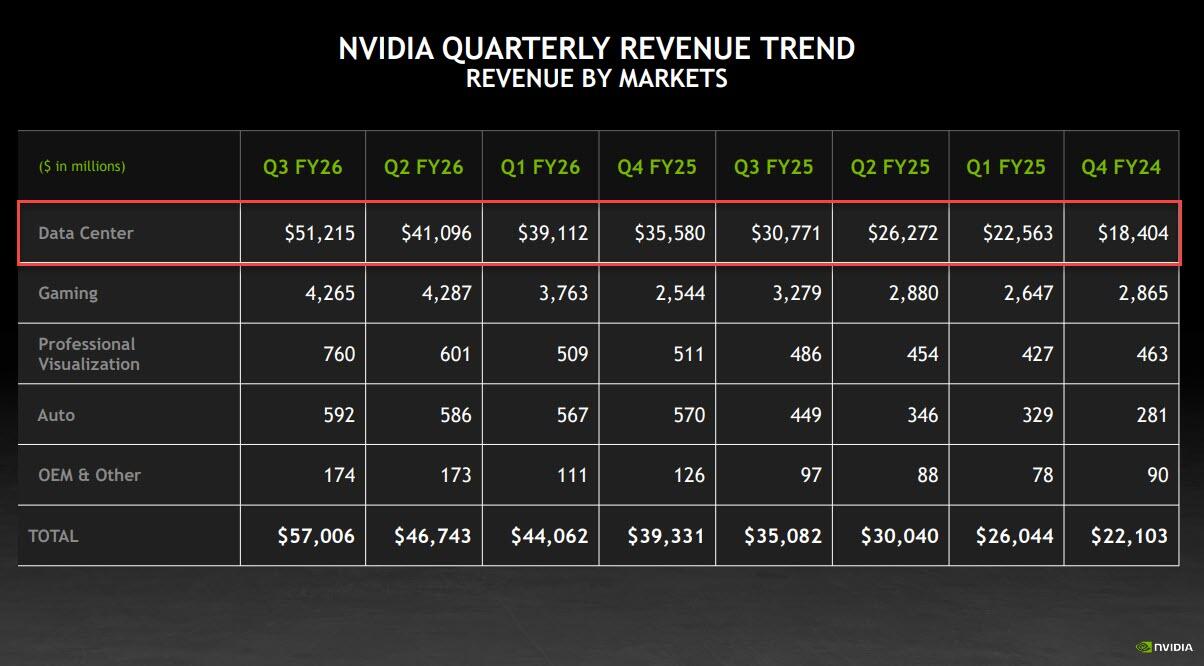
Data center revenue $51.2 billion, +66% y/y, beating estimate $49.34 billion
Gaming revenue $4.3 billion, +30% y/y, missing estimate $4.42 billion
Professional Visualization revenue $760 million, +56% y/y, beating estimate $612.8 million
Automotive revenue $592 million, +32% y/y, missing estimate $620.9 million
Adjusted operating income $37.75 billion, +62% y/y, estimate $36.46 billion
Adjusted operating expenses $4.22 billion, +38% y/y, estimate $4.22 billion
Adjusted gross margin 73.6%, missing est 74.0% and down from 75.0% a year ago.
R&D expenses $4.71 billion, +39% y/y, estimate $4.66 billion
Free cash flow $22.09 billion, +32% y/y
And visually, the stunning fact here is that Data Center rose $10BN sequentially, and up 66% YoY.
Naturally, since NVidia’s revenue is hyperscalar capex, the company has a “little” revenue concentration risk. For Q3, four direct customers with sales greater than 10% of total revenue included:
Customer A at 22%
Customer B at 15%
Customer C at 13%
Customer D at 11%
While there were some blemishes across the various segments, most notably gaming and automotive revenue which missed, these are negligible for the company considering its Data Centers revenue was a whopping $51.2BN, up 66% YoY, and smashing estimates of $49.3BN by nearly $2BN.
Going down the income statement, the one item that jumps out as not being significantly better than estimates was gross margin. Nvidia said it’s rolling out new chips and new systems and that’s pushing up the company’s costs compared with a year ago. That said, as the ramp of Blackwell picks up sequentially, so are its margins. More importantly, the company’s guidance (see below) should ease concerns here.
And if historicals were impressive, the outlook was even more blowout:
Revenue is expected to be $65.0 billion, plus or minus 2% (i.e. $63.70 billion to $66.30 billion) , smashing expectations of $61.98BN (although there were some buyside bogeys as high as $75BN which means that Huang is likely sandbagging again).
Gross margins (GAAP and non-GAAP) are expected to be 74.8% and 75.0%, respectively, plus or minus 50 basis points.
Operating expenses (GAAP and non-GAAP) are expected to be approximately $6.7 billion and $5.0 billion, respectively.
Commenting on the quarter, CEO Jensen Huang said that “Blackwell sales are off the charts, and cloud GPUs are sold out. Compute demand keeps accelerating and compounding across training and inference — each growing exponentially. We’ve entered the virtuous cycle of AI. The AI ecosystem is scaling fast — with more new foundation model makers, more AI startups, across more industries, and in more countries. AI is going everywhere, doing everything, all at once.”
Kunjan Sobhani, a senior technology analyst at Bloomberg Intelligence, also chimes in: “With a broadening AI infrastructure build-out and improving supply alignment, clarity on the $500 billion pipeline through fiscal 2027, large-scale expansion deals and competitive options will be key for sustaining sentiment”
While normally nobody looks at Nvidia’s balance sheet, maybe it’s time to start, as it is only getting stronger. NVDA ended the quarter with $60.6 billion of cash and equivalents, so “only” $320BN away from Berkshire. So it still has plenty of room to fund the adoption of AI in new parts of the economy, as it’s indicated it will.
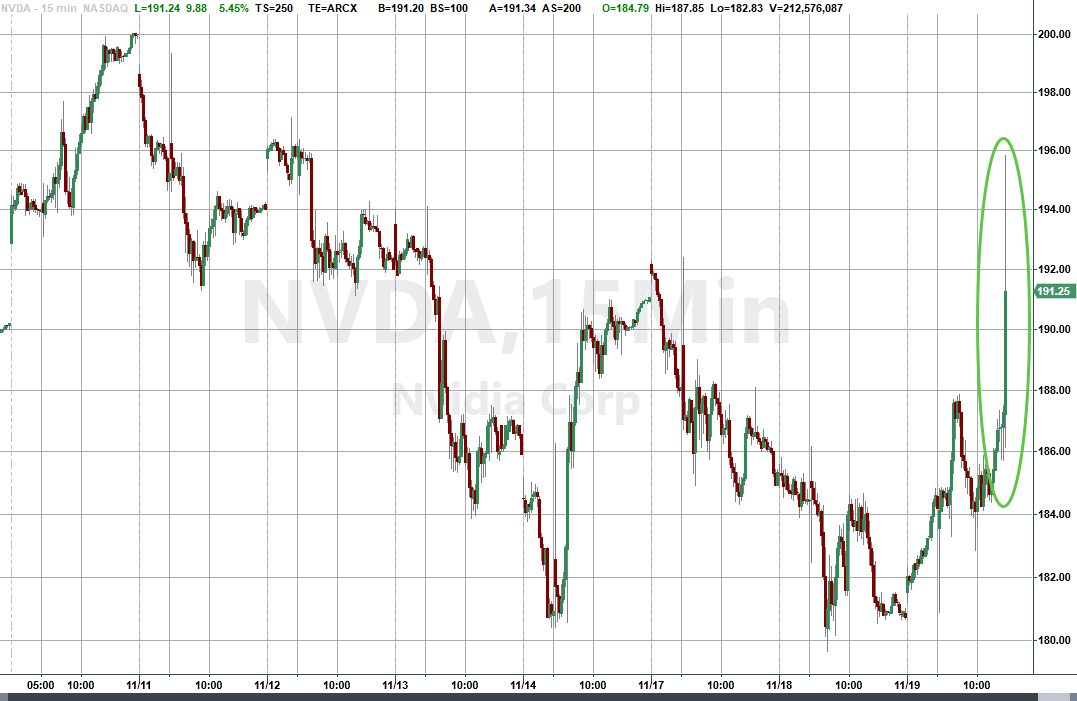
Investors’ initial reaction to Nvidia’s results — including a big beat on its 4Q revenue guidance — is good. Shares spiked more than 4% in postmarket trading.
This is important, because the fate of Nvidia’s stock determines the the AI trade, and the broader market: Nvidia holds the largest weighting in the S&P 500 Index – hangs heavily on how investors digest the results and commentary from the company.
Yet while Nvidia shares are sharply higher, the move reverses only part of a slump that saw the stock slip about 10% below a record high set at the end of October.
In any case, Nvidia’s results are strong enough to also lift shares of other stocks tied to artificial intelligence in after-hours trading: shares of CoreWeave and Nebius are up 4%, AMD is up nearly 2%, Micron is up about 2% and Broadcom shares are moving higher as well.
Goldman’s James Schneider has just pushed out his first take: “Strong quarter with upside to guidance should provide relief for the stock.” We excerpt the highlights from the note below (full report available to pro subs).
Key stock takeaways: We expect the stock to trade higher following a stronger quarter and guidance relative to the Street, and against relatively balanced expectations heading into the quarter. We believe investor expectations had been somewhat elevated heading into the quarter, given upward CapEx revisions from hyperscalers, as well as Nvidia’s own bullish 2026 outlook at GTC in late October. However, we believe the bar for stock performance has been lowered somewhat, with the stock pulling back ~6% ahead of the print. On the conference call, we expect investors to focus on : (1) incremental details on the company’s recent $500 bn Datacenter revenue forecast; (2) visibility into OpenAI deployments; (3) the timing of the Rubin product launch in 2026.
In short: Nvidia just saved the possibility of a Christmas rally.
More in the full Goldman note available to pro subs.
Tyler Durden
Wed, 11/19/2025 – 16:40

NASA revela imágenes detalladas del cometa 31/Atlas que proviene desde otra estrella
Por MARCIA DUNN
CABO CAÑAVERAL, Florida, EE.UU. (AP) — La NASA reveló el miércoles imágenes detalladas del cometa interestelar que realiza un rápido e irrepetible recorrido por el sistema solar.
Descubierto hace unos meses, el cometa conocido como 3I/Atlas es apenas el tercer objeto confirmado que visita nuestro rincón del cosmos desde otra estrella. Pasó inofensivamente cerca de Marte el mes pasado.
Varias naves espaciales de la NASA que se encuentran sobre o cerca del planeta rojo realizaron acercamientos del cometa cuando pasó a tan sólo 29 millones de kilómetros (18 millones de millas). Los dos satélites de la Agencia Espacial Europea alrededor de Marte también realizaron observaciones.
Los astrónomos están apuntando sus telescopios en dirección al cometa, el cual se encuentra actualmente a unos 305 millones de kilómetros (190 millones de millas) de la Tierra. Gianluca Masi del Virtual Telescope Project realizó un acercamiento el miércoles desde Italia.
Lo más cerca que el cometa estará de la Tierra será a 269 millones de kilómetros (167 millones de millas), a mediados de diciembre. Luego se dirigirá de nuevo hacia el espacio interestelar, para no regresar jamás.
Nombrado por el telescopio en Chile que lo avistó por primera vez, se cree que el cometa tiene un tamaño de entre 440 metros (1.444 pies) y 5,6 kilómetros (3,5 millas) de ancho.
La nave espacial Juice de la Agencia Espacial Europea, con destino a Júpiter, ha estado enfocando sus cámaras e instrumentos científicos hacia el cometa durante todo el mes, especialmente después de que hizo su paso más cercano al sol. Pero, los científicos no recibirán ninguna de estas observaciones hasta febrero, debido a que la antena principal de Juice está fungiendo como escudo térmico mientras pasa cerca del sol, limitando el envío de datos.
El cometa se puede ver desde la Tierra antes del amanecer usando binoculares o un telescopio.
___
El Departamento de Salud y Ciencia de Associated Press recibe apoyo del Departamento de Educación Científica del Instituto Médico Howard Hughes y de la Fundación Robert Wood Johnson. La AP es la única responsable de todo el contenido.
___
Esta historia fue traducida del inglés por un editor de AP con la ayuda de una herramienta de inteligencia artificial generativa.

What We’ve Lost
What We’ve Lost
Authored by Charles Hugh Smith via OfTwoMinds blog,
What we’ve lost are the foundations of a healthy standard of living / quality of life.
Amidst the constant drumbeat of tech “progress” and grandiose “solutions,” it’s a useful exercise to ask: what have we lost in the past 40 years despite all the “progress” and “solutions”? Put another way: what did we have in 1985 that we no longer have, despite all the “progress”?
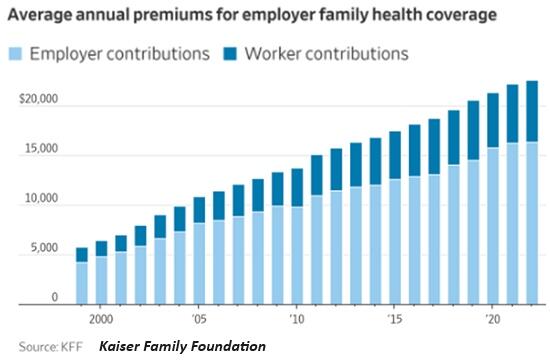
1. We no longer have affordable, functional healthcare. As I have documented, based on what I paid as an employer and self-employed worker, healthcare insurance was still affordable in 1985; this is no longer the case. By functional, I mean universally accessible and sustainable for those employed in healthcare.
Neither condition applies today. Financially marginalized Americans don’t have the same access to the care that is available to wealthy Americans and those with gold-plated insurance. For many Americans, their access to care is little better (or worse) than low-income, developed-nation standards.
As for those working in healthcare, burnout and changing jobs to increase pay and reduce overwork are now standard features of frontline employment in healthcare.
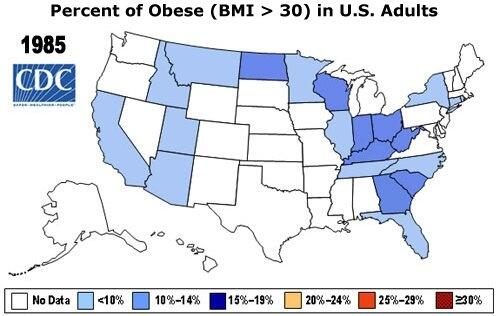
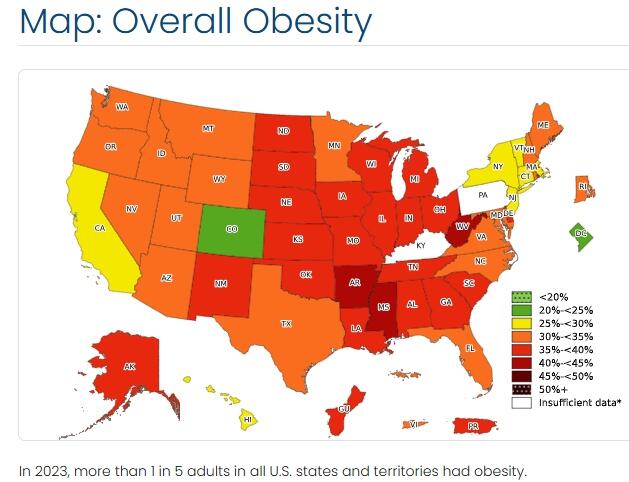
2. Our collective health is systemically worse. These charts from the Center for Disease Control (CDC) tell the story: in 1985, relatively few Americans were classified as obese (BMI of 30 or higher). While BMI is not an ideal measure, moderate BMI levels reflect a lifestyle of moderate activity and relatively healthy diet. By 2023, the situation had deteriorated to the point that by more recent metrics, almost 80% of adult Americans are overweight/obese, conditions that generate a spectrum of health risks.
3. Our public infrastructure has crumbled even as our private wealth soared. Maybe the roadways and highways are pothole-free and well-maintained in your area, and public transit is clean, reliable and cheap, but as a general rule, public infrastructure has decayed over the the past 40 years to the point that it’s often better in developing-world nations than in the US.
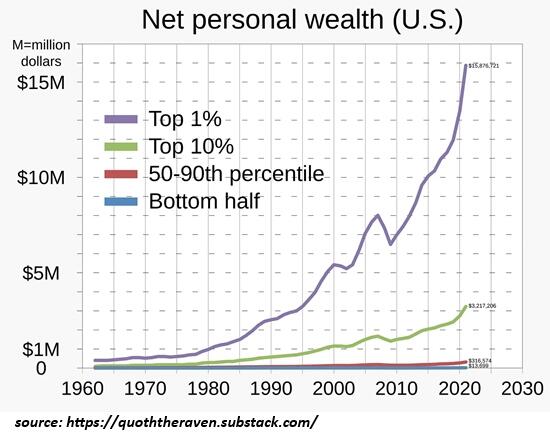
While our public infrastructure has decayed, private wealth has soared from $60 trillion in 2010 to $167 trillion in 2025. Measured by overall health and security, the top 10% are doing splendidly, having accumulated the majority of the $100 trillion in private wealth gains, while the bottom 60% are experiencing decay and decline.
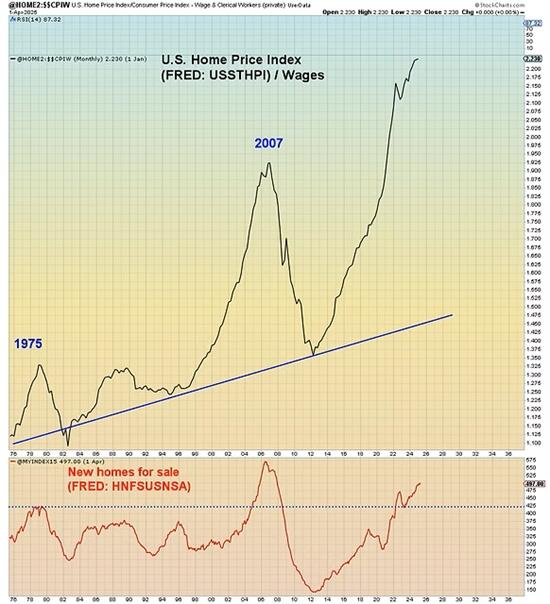
4. Housing is no longer affordable. By any legitimate measure–for example, the number of hours of work needed to buy a median-priced house–housing is no longer affordable for the bottom 80% of the populace.
5. Moral decay has rotted the foundations of our society and economy. Self-interest is now the exclusive pursuit and measure of “success”: consequences have no bearing on decisions unless they detract from one’s private gains. Since a truthful accounting of consequences is detrimental to self-interest, artifice is now the norm. Authenticity has been replaced by curation–everything is gamed, massaged, managed to present a fake image or spectacle.
Here is a chart of healthcare insurance costs. This doesn’t reflect the erosion of value generated by the expansion of co-pays, deductions and exclusions.
Here is the CDC map of obesity from 1985:
Here is the CDC map of obesity for 2023:
Private wealth has skyrocketed…
… but not everyone gained ground. As I have often noted, the bottom 50%’s share of household wealth has declined. Only the top tier benefited from The Everything Bubble.
Measured by wages, housing affordability is now worse than at the peak of the 2005-07 Housing Bubble #1.
As for moral decay, since honest appraisals are anathema, there will be no admission that the status quo is far more corrupt than it was in 1985. We all know it, but it cannot be admitted publicly, or ours is now a culture of excuses, prevarications, rationalizations, empty slogans, distractions and grandiose claims. The inability to admit that the status quo is corrupt is a measure of the depth of systemic moral decay.
What we’ve lost are the foundations of a healthy standard of living / quality of life.
* * *
My new book Investing In Revolution is available at a 10% discount ($18 for the paperback, $24 for the hardcover and $8.95 for the ebook edition) through November. Introduction (free)
Check out my updated Books and Films.
Tyler Durden
Wed, 11/19/2025 – 16:20

Heidi Stevens: After Trump’s ‘Quiet, piggy’ moment, we’re done asking why survivors don’t come forward, right?
We’re done asking why sexual assault survivors don’t come forward, right?
And when they do find the courage to come forward, we’re done asking what took them so long, right?
We’re done filtering their stories through a “what will she gain from this” lens instead of a “what will this cost her” lens, right?
We’re done pretending this culture is even remotely safe for survivors, even mildly interested in their truth, even marginally intent on their healing, let alone their justice.
Right?
Because the president of the United States, when asked about his documented friendship with a convicted sex offender, just replied, “Quiet, piggy.”
“Mr. President, what did Jeffrey Epstein mean in his emails when he said you ‘knew about the girls?’” Bloomberg White House correspondent Catherine Lucey asked the president on Nov. 14, aboard his taxpayer-funded ride.
“I know nothing about that,” President Donald Trump replied. “They would’ve announced that a long time ago.”
Then he switched the subject to Epstein’s relationship with former President Bill Clinton and former treasury secretary and Harvard president Larry Summers.
Lucey pressed ahead, asking a follow-up question about the Epstein files. Trump pointed his finger at her the way you would a misbehaving dog and demanded, “Quiet! Quiet, piggy.”
We’re done asking why survivors don’t come forward, right?
Because when asked for comment about “Quiet, piggy,” a White House official blamed Lucey.
“This reporter behaved in an inappropriate and unprofessional way towards her colleagues on the plane,” the White House official told the Daily Beast. “If you’re going to give it, you have to be able to take it.”
Because before he said “Quiet, piggy,” Trump was found liable in 2023 for sexually abusing advice columnist E. Jean Carroll and this country elected him president a year and half later.
Because before he said “Quiet, piggy,” Trump bragged about grabbing women’s genitals during an “Access Hollywood” taping, and when the recordings were made public, this country elected him president a month later.
Because before he said “Quiet, piggy,” Trump was accused by former Miss Teen USA contestants — emphasis on teen — of walking in on them undressing and saying, “Don’t worry ladies, I’ve seen it all before.” And in a 2005 interview with The Howard Stern show, when asked about Miss USA and Miss Universe, Trump talked about walking in on the contestants undressing, “and you know, no men are anywhere, and I’m allowed to go in because I’m the owner of the pageant and therefore I’m inspecting it.”
And still, when he elbowed his way onto the political stage a decade later, instead of laughing him off as wildly unqualified and truly, toxically, tremendously unworthy of representing the American people, this country elected him president. Twice.
Because the question that prompted “Quiet, piggy” was about a set of files that detail numerous incidents of sexual encounters with minors.
Because when discussing those files, podcast host Megyn Kelly had this to say about Epstein: “He was into the barely legal type, like, he liked 15-year-old girls. I’m not trying to make an excuse for this. I’m just giving you facts — that he wasn’t into, like, 8-year-olds.”
Because 15-year-old girls are children.
Because Trump and his defenders, when asked about the president’s repeated appearance throughout the vast trove of Epstein documents, continue pointing to other men’s names. Men whose politics don’t square with theirs.
As if “Democrats did it too” is any kind of comfort to survivors.
As if the files are opposition research and not tens of thousands of pages of powerful men preying on powerless girls.
As if a survivors’ trauma ebbs and flows with the political winds.
As if more men’s names lessens the obscenity of it all.
Fine. Investigate them all. Please investigate them all.
But only one of them is the president of the United States. And that matters.
At least it should.
Because if we’re going to become a nation that truly protects children, that truly values women, that truly protects its citizens from harm, that truly cultivates and benefits from the full talents, ideas, strengths, voices and contributions of the entire population, we have to stop giving a pass to sexual abusers.
And until we get serious about that, we can’t possibly expect the full breadth and depth of survivors to come forward with their stories. And without the full breadth and depth of their stories, we can’t possibly know the full breadth and depth of the problem.
And until we know the full breadth and depth of the problem, we can’t begin to arrive at a solution.
“Quiet, piggy” suggests we don’t want to.
What comes next will reveal whether that’s true.
https://www.chicagotribune.com/2025/11/19/heidi-stevens-trump-quiet-piggy/
Tom Pritzker named in latest release of Epstein documents
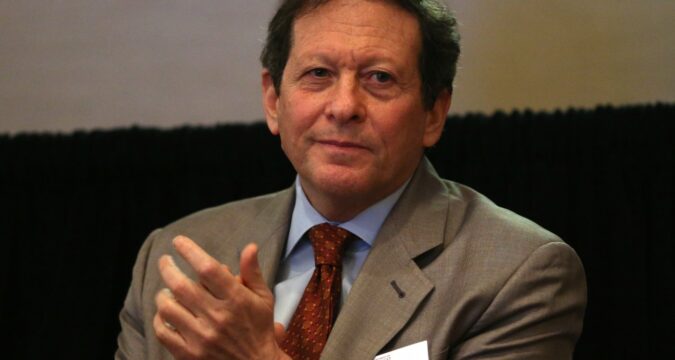
Tom Pritzker, cousin to Gov. JB Pritzker and a Hyatt Hotels magnate, is repeatedly named in documents released last week from the estate of financier and convicted sex offender Jeffrey Epstein.
The trove of more than 20,000 documents, made public by the House Oversight Committee, includes emails between Tom Pritzker and Epstein long after the late financier pled guilty to soliciting a minor in 2008.
The Chicago Maroon, the student newspaper of the University of Chicago, first reported on the billionaire’s appearance in the documents Tuesday. Tom Pritzker is an alum of the school and sits on its board of trustees.
The Pritzker Organization, the family’s investment firm where Tom Pritzker serves as chairman and CEO, did not immediately respond to a request for comment. Neither did a spokesperson for U. of C.
Tom Pritzker, 75, and Epstein corresponded as late as 2019, according to a set of emails and texts compiled by the Maroon. Over nearly a decade, the pair discussed current events, shared news articles and made plans to meet across the country.
Many of the messages seem to show they shared a close relationship. In 2013, after discussing a news article on Penny Pritzker — his cousin and former U.S. Secretary of Commerce — Epstein emailed “nice to see you, please come more often.” Tom Pritzker responded, “Always fun.” Epstein also wrote that Tom Pritzker was “like family” in 2017 in a text message to an unidentified recipient.
Tom Pritzker’s name has appeared in connection to Epstein in the past. Epstein accuser Virginia Giuffre testified in 2016 that she was coerced into having sex with him. Tom Pritzer has denied her allegation. Giuffre died by suicide in April at age 41.
After additional court documents were unsealed, a spokesperson for Gov. JB Pritzker told the Tribune in 2019 that he wasn’t aware that his cousin knew Epstein.
That same year, in an email to himself titled “radical breakthrough,” Epstein compiled a long list of names including Tom Pritzker, “donalad trup” (an apparent reference to the president) and Andrew Mountbatten-Windsor, the British royal recently stripped of his titles after details of his relationship with Epstein came to light.
Epstein included Tom Pritzker in another list of names he emailed to himself in June 2019, just months before he was arrested on federal charges for sex trafficking minors. He died by suicide while awaiting trial.
The push for more transparency into the investigation of Epstein’s sex trafficking operation has recently gained traction, after new details have emerged regarding his relationship with President Donald Trump. On Tuesday, Congress overwhelmingly voted to pass a bill forcing the Justice Department to release all of its files related to the case.
https://www.chicagotribune.com/2025/11/19/tom-pritzker-epstein-documents/

Sam Rinzel gets right back in the swing for Chicago Blackhawks after healthy scratch: ‘I’m always confident’
The Chicago Blackhawks were feeling good at the end of Tuesday’s 5-2 victory at the United Center, while the Calgary Flames were reeling from their 13th regulation loss in 21 games.
Sure, the Flames are in a place where defeats can benefit them, but seeing the loss column grow after each game can be frustrating — and that frustration boiled over in the final seconds.
Photos: Chicago Blackhawks beat the Calgary Flames 5-2 at the United Center
Flames right wing Adam Klapka threw Hawks defenseman Sam Rinzel onto the centennial logo at center ice, and Rinzel retaliated. Skaters from both sides joined the fight, and Rinzel got tangled up with Flames defenseman Brayden Pachal after Paychal dragged Rinzel by the collar.
The scuffle lasted for about a minute while “Chelsea Dagger” played in tune with the punches thrown.
What a way to return for Rinzel.
The 21-year-old rejoined the lineup against the Flames after he was a healthy scratch in the Hawks’ 3-2 win over the Toronto Maple Leafs on Saturday. Coach Jeff Blashill called it a needed reset for Rinzel to take a step back and evaluate.
“He’s shown (that) he’s a great defenseman in this league (and) he’s played great games,” Blashill said. “We just need him to get back to that level. Sometimes as a coach, you sit a guy to give him a chance to take a breath, regroup and then re-attack.”
Rinzel led the top power-play unit to start the season and skated for 20-plus minutes five times in the first 10 games. In the Hawks’ seven-defenseman lineups, he was often in the top pair with Alex Vlasic.
More recent games found Rinzel falling into a slight rut. He whiffed shots on power plays, fumbled the puck in the offensive zone and saw his blocked-shot production tumble.
His ice time went from 19:54 on Nov. 3 in Seattle to 11:29 on Nov. 12 against the New Jersey Devils. Then Blashill made the move to have Rinzel watch a game from the sideline.
“When he’s at his best, he’s controlling the puck,” Blashill said. “Part of the maturation in the NHL is when to move it (and) when to make a play, make sure he’s a guy who is making plays but also (knows) when to live another day.
“The bigger issue is sensing danger. That’s probably cost him more big chances than anything else. (I) expect (he’ll) come back and he’ll play good hockey and build his game back to where he’s been at different times this year.”
The 2022 first-round draft pick took his benching versus the Maple Leafs in stride. Rinzel’s confidence never has left, and he knows the results will come back.
Defenseman Sam Rinzel (6) and Blackhawks teammates fight with Flames players at the end of the game Tuesday, Nov. 18, 2025, at the United Center. (Dominic Di Palermo/Chicago Tribune)
“It can be really frustrating mentally going through that as a player, (but) I’m always confident in myself,” Rinzel said. “I know my game, especially when I’m playing well, is a confident game.
“I’ve just got to be better in a couple areas I know I’m relatively good at. Anytime you can watch a game, you can figure it out a little bit (and) pick up on little things that may help you.”
Rinzel had 17 shifts totaling 14:16 of ice time against the Flames. He had four giveaways and 10 penalty minutes but also had a plus-2 rating and picked up his fourth point of the season when he assisted on the first of Connor Bedard’s three goals.
Related Articles
Connor Bedard’s 2nd career hat trick sends Chicago Blackhawks to their 10th win of the season
Photos: Chicago Blackhawks beat the Calgary Flames 5-2 at the United Center
Chicago Blackhawks players call the 7-defensemen lineups ‘a learned skill,’ but see the positives as well
Colton Dach’s late goal caps Chicago Blackhawks rally for 3-2 win over Toronto Maple Leafs on special night
Photos: Chicago Blackhawks 3, Toronto Maple Leafs 2 at the United Center
It wasn’t perfect, but he’s getting back into the swing of things. Blashill saw some flashes of the early-season Rinzel.
“(Rinzel) and I looked at some clips from last year and this year where he’s been an elite player in the league,” Blashill said after the game, “and I said to him (that) we’re not hoping he can do it — we’ve seen it — and he did it at times tonight.
“I thought he was conscious of trouble when there was trouble. Those are all the things he has to keep working on, but I thought it was a good first step back after being scratched.”
Fellow defenseman Artyom Levshunov went through a similar lull early in the season. He struggled in training camp and the first two games and was scratched in the home opener versus the Montreal Canadiens. He has turned it around since then and is second on the team with 10 assists.
Rinzel doesn’t consider Levshunov’s improvement motivation for himself. He knows consistency is the key to his game.
“Anytime your guys are playing well, you’re happy for him and it’s good to see,” Rinzel said. “I’ve been in these little lows before in my life. I’m a hockey player just like everyone else, (so) it happens. Getting back to my game is the most important (and) having fun and playing hard.”
https://www.chicagotribune.com/2025/11/19/chicago-blackhawks-sam-rinzel-return/

Aurora looks to up parking prices at Metra stations in the city
The city of Aurora is looking to increase parking prices at the city’s two Metra stations.
The proposal, set to go before the Aurora City Council on Tuesday, would increase parking prices from $2 per day or $42 for a monthly pass to $3 per day or $60 for a monthly pass. City officials say the change would bring the prices in line with other parking along the BNSF-Metra rail line, in particular matching the daily rates of Naperville’s parking lots at Metra stations.
Both Naperville and Aurora have parking lots at the BNSF-Metra line station on Route 59, which borders the two cities. Aurora also has parking lots at the BNSF-Metra line station at the Aurora Transportation Center on North Broadway near the city’s downtown.
Ald. Ted Mesiacos, 3rd Ward, said at a meeting of the Aurora City Council’s Finance Committee on Nov. 13 that there was “no advantage” to keeping the daily rate at $2, as keeping the lower rate probably wouldn’t attract anyone from Naperville to park on the Aurora side.
The city is responsible for maintenance to the city’s two train stations, which is supposed to be financially self-sustaining through the collection of parking fees, according to Aurora Director of Public Facilities Derrick Winston.
Those fees haven’t increased since 2015, he told the Finance Committee on Nov. 13.
Before 2020, the fees were enough to sustain operations at the train station, but revenue dropped nearly to zero in spring 2020, Winston said. While revenue has been returning since the COVID-19 pandemic, it hasn’t risen much above half of what it was, he said.
Since the city has continued to maintain those stations despite the drop in parking revenue, it has needed to use reserve funds and to receive subsidies from other city funds, according to Winston. Even with Christkindlmarket bringing in $400,000 in parking revenue last year, he said, the maintenance operations still needed to be subsidized.
So, the increase in parking fees was proposed to rebuild those reserve funds and make those operations financially self-sustaining again, according to Winston.
City officials have been saying for months that the city’s 2026 budget is facing its own significant deficit and that the city’s current financial situation is one of the most serious it has ever faced. The city’s proposed general operating budget for 2026 has seen significant cuts throughout the process, officials have said, and it includes around 140 fewer positions.
Aurora to host town halls on proposed 2026 city budget next two Saturdays
The Aurora City Council has recently approved or seen proposals for other steps to increase or stabilize revenue in other parts of the city budget, including an approved increase to the city’s hotel tax, a proposed increase in the number of gambling machines businesses are allowed to operate and the approved local continuation of a grocery tax set to otherwise expire statewide at the end of the year.
If the proposed increase to parking fees at city lots near Metra stations is approved by the Aurora City Council at the meeting Tuesday, the new fees would go into effect on Jan. 1, according to a staff report about the proposal.
The city’s Transportation Center near downtown has three parking lots with 799 daily and 479 monthly permit parking spaces, staff said in the report. The city-owned lot at the Metra station on Route 59 has 1,538 daily and 1,028 monthly parking spaces, the report said.
rsmith@chicagotribune.com

Guadalajara y Monterrey serán sedes del torneo de repechaje del Mundial 2026
Associated Press
CIUDAD DE MÉXICO (AP) — Las ciudades mexicanas de Guadalajara y Monterrey albergarán el torneo de repechaje intercontinental para la Copa del Mundo 2026, anunció el miércoles la FIFA.
El torneo comienza el 23 de marzo y consistirá en seis equipos de cinco confederaciones que lucharán por dos lugares en la Copa del Mundo del próximo verano, que será organizada por México, Estados Unidos y Canadá.
“Estos estadios icónicos son los escenarios perfectos para lo que promete ser un evento emocionante lleno de pasión, drama y emoción”, señaló el presidente de la FIFA, Gianni Infantino.
Los estadios de Guadalajara y Monterrey también albergarán partidos de la Copa del Mundo.
Las seis naciones son Irak, Congo, Jamaica, Surinam, Bolivia y Nueva Caledonia. El sorteo se llevará a cabo el jueves en Zúrich, y el calendario de partidos se anunciará posteriormente.
En la Copa del Mundo del próximo año, el estadio de Guadalajara albergará cuatro partidos de la fase de grupos, mientras que el estadio de Monterrey será sede de tres partidos de grupo y un partido de la ronda de 32.
El otro estadio en México para recibir la Copa del Mundo es el recién renovado estadio Azteca.
___
Deportes en español AP: https://apnews.com/hub/deportes

Chicago appeals court halts order restricting use of force by immigration agents, calling it ‘overbroad’
A Chicago federal appeals court on Wednesday put the brakes on a lower court’s preliminary injunction restricting the use of force in “Operation Midway Blitz,” saying it is “overbroad” and improperly targets virtually the entire executive branch, including President Donald Trump.
In agreeing to issue a stay, however, the 7th Circuit U.S. Court of Appeals warned to “not overread” the order, saying the findings by U.S. District Judge Sara Ellis “may support entry of a more tailored and appropriate preliminary injunction” down the line.
Ellis’ preliminary injunction issued two weeks ago prohibits immigration agents from deploying tear gas or other munitions before issuing two explicit warnings, requires agents in the field to have body cameras and wear clear identification on their uniforms and forbids law enforcement from targeting journalists or interrupting their news gathering in most circumstances.
Unlike a temporary restraining order Ellis issued on Oct. 9, the preliminary injunction was to remain in effect until a final decision on the merits of the case is made, either at trial or through a settlement.
Last week, Ellis set a trial on permanent injunction for early March.
In asking the 7th Circuit for an emergency stay, lawyers for the U.S. Department of Justice wrote the case was a “perfect example” of a growing trend in the nation’s courts to issue sweeping injunctions that violate the separation of powers and “superintend law-enforcement activities under threat of contempt.”
“The predictable result is to broadly obstruct the enforcement of the nation’s laws, chill the exercise of executive power, and subvert the constitutional structure,” the 22-page filing stated.
The filing also alleged the injunction is “unworkable in practice” and illegally transforms her into a “supervisory tribunal” for deciding whether federal officers were acting lawfully in their day-to-day operations.
In its two-page order Wednesday, the appeals court said a stay was warranted because government attorneys were likely to succeed in those arguments.
“The preliminary injunction entered by the district court is overbroad,” the order said. “In no uncertain terms, the district court’s order enjoins an expansive range of defendants, including the President of the United States, the entire Departments of Homeland Security and Justice, and anyone acting in concert with them…The practical effect is to enjoin all law enforcement officers within the Executive Branch.”
Ellis’ injunction also requires to submit all future guidelines for use of force to the court for review, “a mandate impermissibly infringing on principles of separation of powers on this record,” the appeals court said.
The injunction was also too “prescriptive” in barring the “use of scores of riot control weapons and other devices in a way that resembles a federal regulation,” the appellate court order said.
Ellis issued the injunction after a marathon day of evidence that featured the sworn videotaped deposition of Border Patrol Cmdr. Gregory Bovino, the tough-talking face of the Trump administration’s immigration enforcement push, as well as live testimony from more than a half-dozen witnesses who said immigration agents pointed guns at citizens and threatened to arrest protesters who were doing nothing more than recording the agents’ activities on the street.
In her ruling, Ellis said top government officials lied in their testimony about threats that protesters posed and that their unlawful behavior on the streets “shows no signs of stopping.”
“I find the government’s evidence to be simply not credible,” Ellis said, describing a litany of incidents over the past month and a half in which citizens were tear-gassed “indiscriminately,” beaten and tackled by agents and struck in the face with pepper-spray balls. “The use of force shocks the conscience.”
The judge noted in particular that Bovino lied repeatedly in his deposition testimony about the force that his agents and he himself personally inflicted in incidents across the Chicago area.
“In one of the videos, Bovino obviously attacks and tackles the declarant, Mr. Blackburn, to the ground,” Ellis said about Scott Blackburn, who was protesting outside the Immigration and Customs Enforcement facility in west suburban Broadview. “But Mr. Bovino, despite watching this video (in his deposition) says that he never used force.”
jmeisner@chicagotribune.com

Migrantes creían que estaban en la corte para una audiencia de rutina: era trampa para deportarlos
Por JOSHUA GOODMAN y TIM SULLIVAN
La abogada del gobierno sabía lo que iba a pasar mientras se encontraba de pie en la sala del tribunal y enviaba un mensaje de texto a un agente del Servicio de Inmigración y Control de Aduanas de Estados Unidos (ICE, por sus siglas en inglés) que esperaba en un pasillo a pocos metros de distancia.
“No puedo con esto”, dijo la abogada en un mensaje de texto mientras revisaba su lista de casos. “Esto es una carga emocional nueva”.
“Lo entiendo”, respondió el agente. “Espero que nos encontremos nuevamente en mejores circunstancias”.
A poca distancia, un cubano que había vivido en Estados Unidos durante años, salió de un ascensor y entró en la sala del tribunal donde la abogada del gobierno lo esperaba para lo que el hombre creía que era una audiencia de rutina.
El hombre hacía lo que le exigía la ley y acudió acompañado de su esposa, quien es residente legal, y su bebé de 7 meses de edad.
Fue entonces que la abogada presentó rápidamente una moción para desestimar la solicitud de asilo del hombre, y que un juez concedió, lo que lo hizo elegible para una “deportación expedita”. Al salir del juzgado, el hombre se vio rodeado por agentes de inmigración vestidos de civil que lo habían estado vigilando. Se produjo un forcejeo y desde el pasillo podían escucharse los gritos de la esposa mientras la abogada pasaba al siguiente caso.
El agente respondió cuatro minutos después: “Lo tenemos”.
Escenas similares de arrestos en juzgados se repiten en todo Estados Unidos como parte de una reforma de los tribunales de inmigración bajo el mandato del presidente Donald Trump, a medida que se ejecuta su agenda de deportaciones a gran escala con tácticas inusualmente agresivas.
La promesa de campaña de Trump de endurecer las restricciones migratorias fue una de las principales razones por las que ganó un segundo mandato. Ahora que los estadounidenses han visto cómo se implementa el plan, hay indicios de que muchos piensan que se ha excedido. Alrededor del 57% de los adultos desaprueba la gestión de Trump en materia de inmigración, según una encuesta realizada este mes por The Associated Press-Centro NORC para la Investigación de Asuntos Públicos.
A lo largo de varios meses, periodistas de The Associated Press observaron procedimientos judiciales de inmigración en 21 ciudades. Las audiencias terminaron repetidamente con los casos siendo desestimados por parte del gobierno, permitiendo que agentes federales vestidos de civil realizaran arrestos en los pasillos de los juzgados en estrecha coordinación con los abogados del Departamento de Seguridad Nacional (DHS por sus iniciales en inglés).
The Associated Press tuvo acceso a capturas de pantalla de mensajes de texto de un funcionario del gobierno quien, por temor a represalias, las proporcionó bajo condición de anonimato. Los mensajes ofrecen una perspectiva poco común de cómo los 75 tribunales de inmigración del país dictan resoluciones como si estuvieran en una línea de ensamblaje, y la manera en que, para muchas personas, los juzgados se han convertido en una trampa para las deportaciones.
Arrestos en los juzgados se coordinan con antelación
En un sistema judicial con un retraso de aproximadamente 3,8 millones de casos de asilo, las familias se han visto separadas, trastocando su vida. El debido proceso queda, al parecer, en un segundo plano.
“Cuando los estadounidenses se imaginan un tribunal, tienen algunas expectativas fundamentales” de justicia, dignidad e imparcialidad, dijo Ashley Tabaddor, exjueza de inmigración en Los Ángeles y expresidenta de la National Association of Immigration Judges.
“Eso es lo que define a un tribunal —no una sala con un estrado o una persona con toga”, agregó. “Pero lo que tenemos aquí es una visión completamente opuesta”.
En los últimos nueve meses, el gobierno de Trump ha despedido a casi 90 jueces de inmigración que los aliados del presidente consideraban demasiado indulgentes, ordenó a agentes enmascarados esposar a inmigrantes en audiencias de asilo a puerta cerrada, y envió memorandos en los que giró instrucciones a los jueces de acatar las directrices.
A diferencia de los tribunales federales, donde existen reglas estrictas de procedimiento y los jueces tienen cargos vitalicios, el Departamento de Justicia administra los tribunales de inmigración, y su titular puede destituir a los jueces con mayor facilidad.
Nueve funcionarios actuales hablaron bajo condición de anonimato por temor a represalias. La mayoría de ellos expresaron profundas dudas sobre castigar a personas que habían cumplido con las reglas y se habían presentado a sus audiencias.
“Como abogado del gobierno, mi deber es hacer cumplir la ley y proteger el interés público —no asegurar la deportación o detención de forma predeterminada”, escribió un abogado del gobierno a la Asociación Estadounidense de Abogados en busca de orientación profesional.
Pero no es así como los casos se están desarrollando en la mayoría de los casos.
Las detenciones en los tribunales se coordinan con días de antelación para cumplir con cuotas, sin apenas tener en cuenta las particularidades de cada caso, según varios funcionarios federales.
En palabras de un funcionario, los abogados del DHS anotan en una hoja de cálculo qué casos son “susceptibles” a ser desestimados, permitiendo que un solicitante de asilo sea arrestado nuevamente de inmediato para someterlo a un proceso de deportación expedita. La mayoría de los detenidos son hombres que no cuentan con un abogado y entraron sin compañía a Estados Unidos, quienes se tiene previsto que comparezcan personalmente ante el tribunal. Contrario a las afirmaciones de Trump de que persigue a “lo peor de lo peor”, la mayoría de ellos no tienen antecedentes penales, según un análisis de datos del ICE por parte del Cato Institute.
El ICE revisa la hoja de cálculo y selecciona a las personas por las que quiere ir si se llega a desestimar su caso. En la fecha de la audiencia, los agentes federales se comunican directamente con los abogados del DHS, quienes actúan como fiscales en los tribunales de inmigración. El abogado suele enviar actualizaciones casi en tiempo real a los agentes que esperan fuera de la sala del tribunal.
“¿El de la camisa negra? Avísame si el juez desestimó (el caso)”, escribió un agente del ICE durante una audiencia.
Falta de independencia limita la autoridad de los tribunales de inmigración
Los tribunales de inmigración se han visto plagados por falta de recursos, autoridad e independencia judicial prácticamente desde sus inicios.
Los tribunales fueron establecidos en 1952, pero no fue sino hasta 1973 que a los “funcionarios de investigación especial” se les otorgó el título de “juez” y se les permitió vestir togas. La Oficina Ejecutiva de Revisión de Casos de Inmigración de Estados Unidos (EOIR por sus siglas en inglés) se creó en 1983, pero permaneció como parte del Departamento de Justicia, lo que le otorgaba al titular de la dependencia la facultad para revocar las decisiones.
“Éramos la Cenicienta del sistema judicial”, dijo Dana Leigh Marks, quien se jubiló como jueza de inmigración en 2021 después de 34 años de carrera. “Ningún otro tribunal del país funciona así”.
El primer gobierno de Trump implementó una serie de cambios para reducir la acumulación de casos pendientes, incluida la instrucción a los jueces de rechazar categorías enteras de solicitudes de asilo, como para víctimas de pandillas o de violencia doméstica.
También estableció un tablero de control que se convertiría en la pesadilla de muchos jueces: indicadores de color rojo, amarillo y verde miden el desempeño de cada juez en función de objetivos que van desde casos resueltos —un mínimo de 700 al año, independientemente de su complejidad— hasta el número de casos de custodia resueltos en su primera audiencia.
Para cumplir con las métricas, los jueces deben tramitar los expedientes a toda velocidad, en ocasiones dedicando apenas unos minutos a evaluar las solicitudes de asilo.
“Es como decidir casos de pena de muerte en el entorno de un juzgado de tránsito”, manifestó Marks.
El gobierno se refiere a los jueces de inmigración como “funcionarios inferiores”
Cuando Trump regresó a la Casa Blanca en enero pasado, sus aliados arremetieron directamente contra los tribunales.
Desde entonces, el Departamento de Justicia ha emitido 52 memorandos de políticas —más que el total de los seis años anteriores— para facilitar la contratación y destitución de jueces y advertir contra la parcialidad a favor de los inmigrantes.
Los memorandos dejan al descubierto la debilitada posición de los tribunales al referirse a los jueces como “funcionarios inferiores” —un término muy poco utilizado que fue tomado de la Constitución.
A principios de septiembre, el secretario de Defensa Pete Hegseth anunció que destinaría 600 abogados militares a los tribunales de inmigración —una cantidad similar a la cifra actual de jueces. El objetivo, según el gobierno, es reducir la carga de trabajo al ampliar el grupo de jueces potenciales para incluir a personas con amplia experiencia en derecho administrativo. No obstante, muchos defensores de los inmigrantes temen que los nuevos jueces carezcan de la experiencia necesaria para resolver casos de asilo.
“Tiene tanto sentido como que un cardiólogo realice un reemplazo de cadera”, dijo Ben Johnson, director ejecutivo de la American Immigration Lawyers Association.
El gobierno ha rechazado las críticas que lo acusan de tomar el control de los tribunales para acelerar sus metas de deportaciones. La portavoz del Departamento de Justicia, Natalie Baldassarre, señaló en un comunicado que el DHS decide si arrestar o no a los inmigrantes, y que la mayoría de los jueces consideran un “honor y no un insulto” que se refiera a ellos como funcionarios inferiores con atribuciones conferidas por la Constitución y trabajar a discreción del secretario de Justicia.
Baldassarre comparó el incremento récord de solicitantes de asilo durante el gobierno de Joe Biden con una “conspiración indebida entre el DHS y los tribunales de inmigración para llevar a cabo una amnistía ilegal para cientos de miles de extranjeros ilegales”. El Departamento de Justicia, agregó, ha “restablecido la integridad, la imparcialidad y la independencia de los tribunales”.
El DHS no respondió a reiteradas solicitudes de comentarios.
Abogados del gobierno temen acoso y viven atormentados
Para algunos, el trabajo en los tribunales se ha convertido en una rutina estresante y solitaria. El miedo prevalece. Actualizan sus currículums constantemente.
Un abogado del Departamento de Seguridad Nacional relató como el sonido de los grilletes de los inmigrantes a los que ayudó a detener lo atormenta por las noches. El abogado se unió al gobierno después de los atentados terroristas del 11 de septiembre de 2001, convencido de que proteger las fronteras de Estados Unidos era un deber patriótico.
Aún conserva con cariño un ejemplar firmado de “La noche”, el primer libro de las memorias de Elie Wiesel, ganador del Premio Nobel, el cual le fue entregado en un seminario de trabajo. “Piensa en grande, siente con mayor profundidad”, dice la dedicatoria del autor en el libro, que está marcado como “Material de capacitación” del DHS.
Hoy, su mensaje le atormenta.
“Ninguno de nosotros nos apuntamos para esto”, agregó.
Luego de un verano turbulento, los juzgados también empiezan a verse vacíos. Al darse a conocer las noticias de que se les ha tendido una trampa, muchos inmigrantes que tienen miedo de ser arrestados han empezado a presentar solicitudes para comparecer a través de videoconferencias o simplemente no se presentan a las audiencias.
En tanto, gerentes ambiciosos reprenden públicamente a quienes cuestionan la legalidad de encarcelar a migrantes sin antecedentes penales en instalaciones hacinadas. En un reciente foro público con Charles Wall, principal asesor jurídico del DHS, varios abogados se quejaron de la presión, las órdenes confusas y la falta de recursos, según las notas de la reunión compartidas con la AP.
Wall respondió que es probable que este ritmo continúe durante años, según las notas. Cuando un empleado federal preguntó sobre la posibilidad de llevar armas de fuego al trabajo por temor al acoso de los activistas dentro de los juzgados, Wall respondió que los jueces no deben dudar en expulsar al público. Wall no pudo ser contactado para obtener comentarios.
“Quiero regresar a mi país”
Las duras tácticas han tenido un efecto deseado por el gobierno: las salidas voluntarias de inmigrantes se han disparado y más de 14.000 personas han solicitado autorización judicial para autodeportarse en los primeros ocho meses de 2025, según datos federales recopilados por Mobile Pathways, una organización sin fines de lucro con sede en San Francisco que promueve la transparencia en los procesos migratorios. Esa cifra supera el total de los últimos cinco años. Es casi seguro que la cifra real sea inferior debido a que la mayoría de los inmigrantes no retiran su solicitud de asilo antes de dejar el país voluntariamente.
En el tribunal de inmigración de Tacoma, Washington, los detenidos se presentaron uno tras otro con la misma solicitud.
“Quiero regresar a mi país”, le dijo un venezolano a la jueza Theresa Scala.
“Quiero irme del país”, expresó un hombre originario de México.
Los inmigrantes saben a lo que se enfrentan: centros de detención con nombres ominosos —“Alcatraz de los Caimanes”, “El Encierro de Luisiana” y “Speedway Slammer” (Cárcel de Vía Rápida)—, además de redadas en centros de trabajo y operativos policiales en sus vecindarios.
Jueces destituidos por ser demasiado liberales
Tania Nemer cree que tenía la vocación para ser jueza. Desde el estrado del tribunal de inmigración de Cleveland, se enorgullecía de escuchar atentamente la solicitud de asilo de cada persona.
“Hay una sencillez en todo esto que me encantaba”, dijo a la AP. “Si puedes impartir justicia de manera eficiente, en verdad puedes ayudar a mucha gente”.
La decisión de postularse para jueza de inmigración en 2023 fue sumamente personal. Su padre huyó de las revueltas en Líbano y llegó a Ohio a los 16 años con 6 dólares en el bolsillo. Lavó autos, aprendió inglés y finalmente abrió un bar que lleva su nombre —Manny’s Pub—, el cual le permitió mantener a su familia. Cuando Nemer se casó, su regalo de bodas fueron los seis billetes de un dólar sin gastar, para que nunca olvidara sus raíces.
Pero la pasión de Nemer por el derecho se desvaneció el 5 de febrero. En plena audiencia, su supervisor abrió la puerta del juzgado y le dijo que tenía que acompañarlo.
“En cuanto dijo: ‘Toma tu identificación’, supe que me iban a despedir”, detalló.
Aún en estado de shock, se le entregó una carta de dos párrafos firmada digitalmente por Sirce Owen, el director interino de la EOIR, la cual explicaba que estaba siendo destituida porque la agencia “ha determinado que no es apropiado mantenerla en el cargo, y le agradecemos su servicio”.
No se le dio ninguna justificación. Pero cree que sabe algunas de las razones: su apellido árabe, su experiencia previa para representar a inmigrantes, y sus estudios sobre diversidad, equidad e inclusión (DEI) en la Universidad de Cornell. Presentó una queja por discriminación ante el Departamento de Justicia para descubrir por qué la despidieron; la queja fue desestimada.
Nemer fue la primera jueza despedida tras el regreso de Trump a la Casa Blanca. Pero 86 más le han seguido desde entonces. Decenas más aceptaron la oferta de renuncia del Departamento de Eficiencia Gubernamental.
La mayoría fueron contratados durante la presidencia del demócrata Joe Biden y aún cumplen períodos de prueba de dos años, según una lista de jueces despedidos obtenida por la AP.
No está claro quién ordenó los despidos ni cómo fueron elegidos. Pero los jueces destituidos concedieron asilo en porcentajes notablemente superiores a los de sus colegas —en aproximadamente la mitad de todos los casos desde agosto de 2023, en comparación con el 34% a nivel nacional, según Mobile Pathways.
Entre los destituidos se encontraban los 10 que figuraban en la Lista de Seguimiento Burocrático del DHS, un sitio web creado el año pasado con fondos de la Heritage Foundation, cuyo “Proyecto 2025” establece una visión conservadora para las decisiones políticas y de personal del segundo mandato de Trump.
La lista incluye nombres, fotos tomadas de Facebook, salarios y donaciones de campaña de quienes denomina “los burócratas de inmigración más subversivos de Estados Unidos”. Uno de los blancos fue Emmett Soper, un juez del norte de Virginia quien trabajó en la sede de la EOIR durante el gobierno de Biden.
“En cuanto vi eso, supe que las reglas estaban cambiando, que yo estaba bajo un microscopio que antes no existía”, dijo.
Tom Jones, el creador del sitio web, se negó a ser entrevistado.
Baldassarre, la portavoz del Departamento de Justicia, declaró que la agencia no va detrás de personas específicas, pero que evalúa continuamente a cada juez.
“Todos los jueces tienen una obligación legal, ética y profesional de ser imparciales y neutrales al dictar sentencia”, expresó Baldassarre. “Si un juez viola esa obligación al mostrar un sesgo sistemático a favor o en contra de alguna de las partes, la EOIR está obligada a tomar medidas para preservar la integridad de su sistema”.
La oleada de despidos y las nuevas directivas del Departamento de Justicia han tenido un efecto escalofriante. Los rechazos en las mociones para comparecer en videollamadas se triplicó después de la publicación de un memorándum en marzo pasado en el que se derogaba las directrices de la era Biden que instruían a los jueces a conceder generalmente dichas solicitudes, según datos de Mobile Pathways. La denegación de aplazamientos —que otorgan a los inmigrantes más tiempo para buscar asesoría legal— también se ha disparado, al igual que el número de casos clasificados como abandonados.
Nemer regresó en octubre a un tribunal de inmigración por primera vez desde que fue despedida para representar a un cliente mexicano a quien conoce desde hace 20 años y quien fue detenido por agentes no identificados. Mientras el hombre estaba en la cárcel, su novia, quien tenía cinco meses de embarazo, sufrió un aborto espontáneo.
La noticia del regreso de la exjueza se extendió rápidamente y un oleada de excolegas acudieron a la sala del tribunal para abrazarla y expresar consternación por su despido.
“Al tercer abrazo no pude contenerme más y simplemente comencé a llorar”, expresó.
La asistencia legal para inmigrantes se agota
Repelente contra insectos, protector solar, ventiladores y sombrillas compiten por espacio con las carpetas legales en la caja de una pickup Toyota al otro lado de la calle del tribunal de inmigración en San Antonio.
Esta es la nueva oficina de American Gateways.
El gobierno eliminó en abril pasado programas por valor de 30 millones de dólares destinados a brindar asistencia legal gratuita a inmigrantes, la gran mayoría de los cuales se representan a sí mismos ante el tribunal.
Pero los abogados de American Gateways aún vienen cuatro veces por semana y se instalan en un estacionamiento. La sala de conferencias que antes ocupaban dentro del juzgado ahora se utiliza como sala de descanso para los agentes del ICE.
La asistencia va desde ayudar a los inmigrantes a presentar mociones hasta ensayar qué dirán a los jueces. Cada que pueden, programan comparecencias virtuales para minimizar el riesgo de arresto.
Inmigrantes acuden a los tribunales federales para solicitar su liberación
El desmantelamiento de los tribunales de inmigración ha obligado a los inmigrantes a acudir al único lugar donde se preservan los estándares de independencia judicial: las cortes federales.
Desde que comenzaron las redadas en los juzgados, el pasado 15 de mayo, los inmigrantes han presentado más de 3.000 peticiones de habeas corpus —para determinar si una persona está detenida legalmente— en las que solicitan su liberación.
La avalancha de peticiones amenaza con saturar aún más al sistema federal, el cual tiene poca autoridad en casos de inmigración.
“El gobierno intenta acelerar el proceso a una velocidad poco razonable sin respetar el debido proceso”, dijo Annelise Araujo, abogada de inmigración con sede en Boston.
Una petición, presentada en Miami, era la de un hombre cubano detenido el mismo día en que él, su esposa estadounidense y su hija de 10 meses de edad se mudaron a su primera casa. Varios de los solicitantes afirmaron que sobrevivieron a la torturas de las pandillas en México, Ecuador y Venezuela.
Otro desafío legal surgió a raíz de la detención de un hombre brasileño con VIH cuatro días después de que su esposo falleció de un infarto. Mientras el cuerpo del esposo de Frederico Abreu aún se encontraba en la agencia funeraria, agentes del ICE tocaron a su puerta diciendo que tenían documentos del difunto.
Un padre apartado de su familia
Para quienes no pueden costear un abogado para presentar una demanda ante un tribunal federal las opciones pocas.
Uno de ellos era un hombre de Honduras quien se presentó ante un tribunal de inmigración del norte de Virginia acompañado de su esposa y su bebé. Otro de sus hijos, con discapacidad motriz, se impulsaba en una silla de ruedas adornada con luces intermitentes de colores. La familia pidió no ser identificada por miedo a nuevos problemas migratorios.
El juez rechazó la solicitud del gobierno para deportar al hombre. Pero segundos después, al salir de la sala del tribunal, fueron detenidos por cuatro agentes del ICE.
La esposa rompió en llanto mientras se aferraba al brazo de su esposo y suplicó en español: “Por favor, por favor”.
El esposo sostenía el portabebés con su bebé dormido. Su hijo jugaba con un celular.
“Necesito que se despida”, le dijo un agente al hombre. Entre lágrimas, él se arrodilló para abrazar a su hijo, quien se aferró a su padre y gritó repetidamente: “¡Papá! ¡Papá!”.
Finalmente, el padre logró separarse y comenzó a caminar con los agentes de ICE. El niño intentó ir tras ellos, pero uno de los agentes sujetó la parte trasera la silla de ruedas mientras el niño agitaba los brazos inútilmente.
El Departamento de Seguridad Nacional confirmó su arresto en julio. La familia dijo que fue deportado posteriormente. El DHS afirmó que el hombre aceptó abandonar el país voluntariamente y regresó a Honduras el 8 de octubre, luego de permanecer detenido durante tres meses.
—-
Goodman informó desde Cleveland y Sullivan desde Minneapolis; los periodistas de la AP Cedar Attanasio, en Nueva York; Martha Bellisle, en Seattle y Tacoma, Washington; Jacques Billeaud, en Phoenix; Kate Brumback, en Atlanta; Eric Gay, en San Antonio, Texas; Valerie Gonzalez, en Harlingen, Texas; Aaron Kessler, en Washington; Gisela Salomón, en Miami; Rebecca Santana, en Annandale y Sterling, Virginia; Lea Skene, en Baltimore; Hannah Schoenbaum, en Salt Lake City; Colleen Slevin, en Denver; Elliot Spagat en San Diego; Sophia Tareen, en Chicago e Indianápolis; Amy Taxin, en Santa Ana, California; y Julie Watson, en San Diego, contribuyeron a este despacho.