Category: News

El head coach Shane Steichen reconsidera sus decisiones tras la derrota de los Colts en Kansas City
Por MICHAEL MAROT
INDIANÁPOLIS (AP) — El entrenador en jefe de los Colts de Indianápolis, Shane Steichen, estudió el video, reconsideró sus decisiones de jugadas durante la derrota en tiempo extra 23-20 el domingo en Kansas City y reconoció el lunes.
Si hubiera manejado el reloj, las situaciones y sus propias decisiones de manera diferente, los Colts podrían no haber desperdiciado una ventaja de 11 puntos en los últimos nueve minutos del tiempo reglamentario, ni haber fallado en conseguir un primer down en el tiempo extra. Y si los Colts (8-3) tienen la intención de romper una sequía de playoffs de cuatro años, Steichen sabe que necesita mejorar.
“Siempre vuelves y te autoevalúas en esas situaciones”, afirmó Steichen. “Realmente pensé que en esa última serie en el tiempo reglamentario cuando fuimos pase, pase, pase, podría haber llamado algunas jugadas de carrera allí. Absolutamente podría haber consumido algo de tiempo allí, pero, ya sabes, en retrospectiva, simplemente no funcionó, y me miro a mí mismo primero y ante todo en esas situaciones para mejorar para nuestros muchachos”.
No es la primera vez esta temporada que Steichen critica sus propias decisiones, pero esta ciertamente dolió, dado que la ventaja desperdiciada de los Colts permitió a Jacksonville (7-4) y Houston (6-5) acercarse un juego más a los líderes del Sur de la AFC mientras Indianápolis se prepara para enfrentarse a ambos en las próximas dos semanas.
Pero la toma de decisiones fue poco característica para un equipo que entró al juego con solo 19 despejes en toda la temporada mientras convertía 17 de sus 21 intentos en cuarta oportunidad. Los Colts habían tenido tanto éxito que a principios de esta temporada Steichen admitió haber desarrollado una inclinación por mantener a la ofensiva en el campo casi a toda costa en lugar de despejar.
Esta vez, sin embargo, todo cambió.
En lugar de permitir que el mejor corredor de la liga, Jonathan Taylor, consumiera tiempo y desgastara la defensa de los Chiefs, Indy lanzó nueve veces en sus últimas 12 jugadas y despejó las cuatro veces, sin conseguir otro primer down. Indy se convirtió en solo el segundo equipo desde al menos el año 2000 en tener cuatro o más posesiones en el cuarto período o tiempo extra y salir tres y fuera cada vez.
Así no fue como Steichen llevó a los sorprendentes Colts cerca de la cima de la clasificación de la AFC, y tampoco es probable que sea así como se mantendrán allí.
Steichen lo sabe y después del domingo, parece que ha aprendido una valiosa lección para el futuro: Mantente fiel a tu filosofía.
Está funcionando
Presión al pasador. Durante tres cuartos, los Colts mantuvieron a Mahomes en modo de escape. Estaba esquivando a los defensivos, fallando receptores y sin anotar touchdowns. Pero cuando más importaba, Mahomes se escapó y movió las cadenas. Si los Colts continúan presionando a los quarterbacks que no son MVP de esta manera, la defensiva podría estar en gran forma para la recta final.
Necesita ayuda
Defensa contra la carrera. Aunque los Colts permitieron solo 3,6 yardas por acarreo, nuevamente tuvieron dificultades para detener sin el tackle defensivo del Pro Bowl DeForest Buckner (cuello). Kareem Hunt corrió 30 veces para 104 yardas mientras conseguía primeros downs continuamente. El resultado: Kansas City tuvo una ventaja de 17 minutos en la posesión del balón que desgastó a los Colts al final.
___
Deportes en español AP: https://apnews.com/hub/deportes

The Mystery Of Intuition: Where Gut Feelings Really Come From
The Mystery Of Intuition: Where Gut Feelings Really Come From
Authored by Makai Allbert via The Epoch Times (emphasis ours),
We’ve all experienced intuition in some form or another. The hunch of knowing without understanding why; the sense that something is right—or terribly wrong—before conscious thought catches up. Or a simple instinct that something is off about a stranger.
Illustration by The Epoch Times, Shutterstock
Intuition goes beyond superstition, serving as a sophisticated form of intelligence operating largely beneath conscious awareness.
The phenomenon raises a question that has intrigued scientists, philosophers, and everyday decision makers: Where do gut feelings really come from?
Knowing Without Knowing How
Studies have found that when chess grandmasters are given just five seconds to evaluate a position, they can make accurate predictions despite lacking time for conscious analysis.
Due to the thousands of hours of experience under their belts, their brains can make rapid decisions through pattern recognition, without requiring deliberate thought. This experience, similarly reflected among experts across many fields—doctors, military personnel, and firefighters—points to the possibility that intuition may emerge from a rich substrate of prior experience.
Emma Seppälä, psychologist and science director at Stanford University’s Center for Compassion and Altruism Research and Education, told The Epoch Times that in these instances, intuition is “a fast, instinctive form of intelligence that operates separately from our conscious thoughts.”
Yet, this kind of intuitive, rapid processing isn’t limited to professional skills. Going with your gut may be especially true in complex situations in your own life. Research shows that when people face complex decisions, such as selecting a home or making major life choices, those who focus on their feelings rather than painstakingly analyzing every detail often make better decisions and, perhaps even more importantly, are more satisfied with the outcome.
Illustration by The Epoch Times
Kamila Malewska, who studies intuition in managerial decision-making at Poznań University of Economics and Business, believes intuition is invaluable in situations with multiple alternatives, no clear criteria, insufficient information, and unique problems without precedent.
The Biology of Gut Feelings
We often say we have a “gut feeling,” and research now shows the phrase carries both a metaphorical and biological truth.
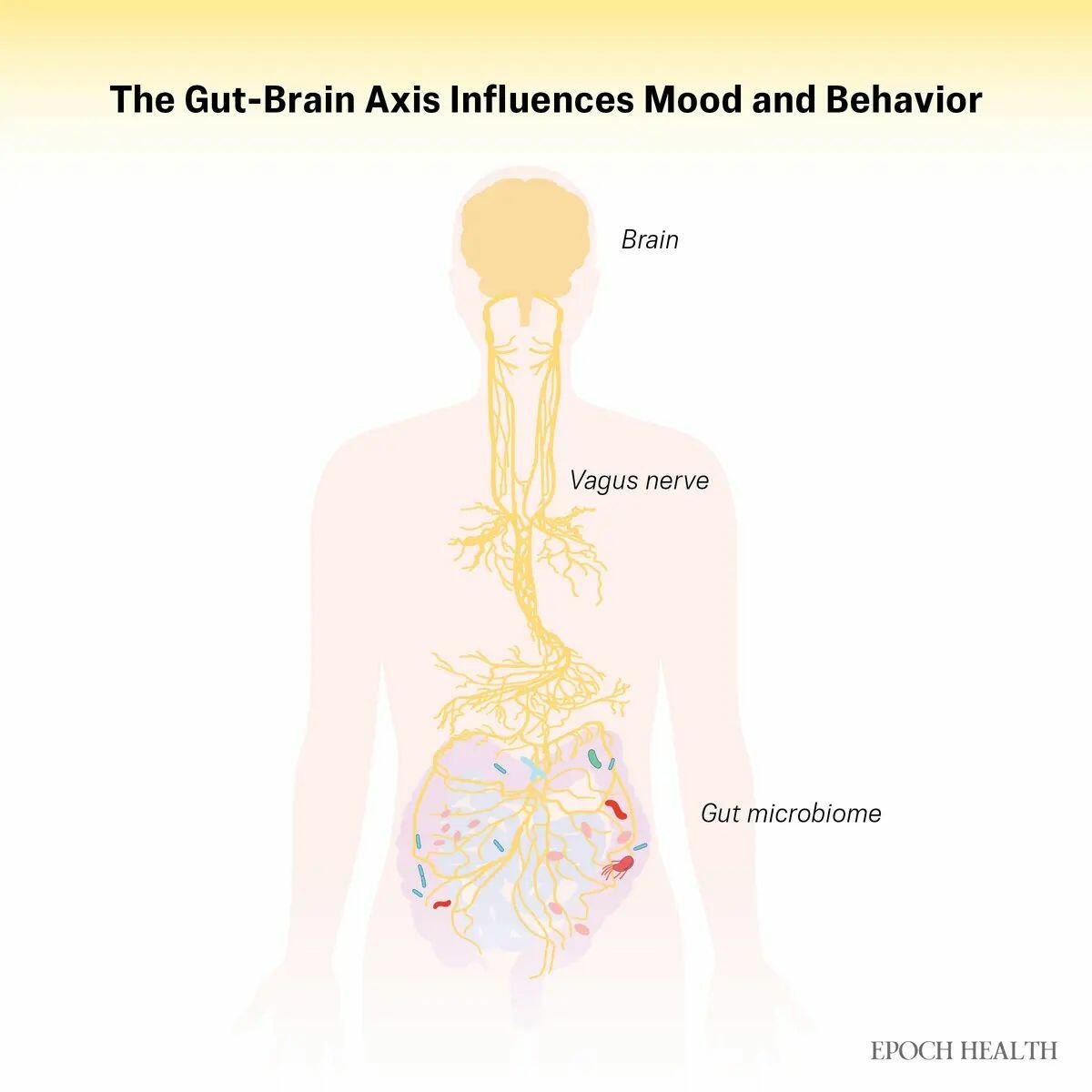
The gut has what scientists refer to as a “second brain,” comprising more than 200 million neurons. These neurons send signals back and forth with the brain through the vagus nerve, forming the gut-brain axis. This system creates a feedback loop that affects how we feel physically and emotionally.
Illustration by The Epoch Times, Shutterstock
Moreover, the health of the gut microbiota, which comprises approximately 38 trillion bacteria, can affect feelings of urgency, emotions, and even memory, as it produces chemicals that affect the brain. In mouse experiments, tweaking the gut microbiota balance can alter brain neurochemistry, making mice more bold or anxious. Notably, in humans, approximately 90 percent of serotonin, a key neurotransmitter that influences mood and decision-making, is produced in the gut. This indicates that emotional states and intuitive feelings may be influenced by the gut-brain axis.
This connection isn’t new. The vagus nerve may have helped our predecessors find food and avoid danger through gut-based intuitive signals. Today, the gut-brain system still functions, albeit in a different manner. When you feel butterflies in your stomach before a big decision, or a sinking feeling when something seems wrong, you may be experiencing this ancient communication system at work.
Unconscious Gestalt
Besides the gut-brain axis, neuroscientists have found other brain processes that may explain intuition.
One way to understand intuition is to examine how memories form.
Don Tucker, a neuroscientist who studies consciousness and memory, explained that memory occurs before you are aware of it.
“Memory is organized from an implicit level where general meaning is not fully articulated into conscious access, but is still very powerful in providing a sense of the gist of the information,” Tucker told The Epoch Times.
In other words, before we consciously remember or notice something, our brains, especially our limbic system, rapidly sort out experiences, picking up the important bits and giving a holistic level of understanding.
This process relates to another psychological concept called gestalt: the brain’s tendency to perceive patterns rather than individual parts, and to create closure to make sense of incomplete information.
Consider a manager interviewing a seemingly perfect candidate. Their resume seems impeccable, their answers are satisfactory, but something still feels wrong. Only later does the manager realize subtle inconsistencies in the candidate’s story, a shift in eye contact during discussions of previous employment, and a mismatch between verbal and nonverbal expressions. The cues may not have been noticed in the moment, but the brain assembled them into an intuitive warning—into an unconscious gestalt.
Neuroscience supports these ideas. The right hemisphere of the brain is good at spotting patterns and noticing things that don’t fit, even if we’re not aware of it. The hippocampus compares what we see now with past experiences, while the orbitofrontal cortex integrates emotional memories with present sensory input. The result appears as a feeling rather than a thought.
The process of unconscious becoming conscious is driven by what is called predictive processing.
Rather than passively receiving stimuli and then reacting, predictive processing theory suggests that the brain actively generates predictions about what it should perceive based on its experience. When these predictions detect a mismatch—something that does not fit the expected pattern—the result manifests as intuitive unease or “knowing.”
According to Tucker, consciousness develops from this primitive, intuitive level through a process of articulation. A vague feeling—a sense of “no, I shouldn’t do that”—gradually becomes more conscious and explicit as the brain works to understand why the feeling arose.
Could intuition also come from somewhere else?
Perhaps, instead of merely reacting to the present, intuition offers us a glimpse of the future.
Memories From the Future
In the mid-1990s, Dean Radin at the University of Nevada, Las Vegas, designed an experiment to test whether awareness could transcend time. He had participants connected to an EEG machine and placed in front of a computer screen. The computer randomly selected and displayed pleasant or disturbing images after a brief pause.
Radin noticed that people’s brains became more active just before seeing disturbing images, but not before positive ones. It was as if the brain could sense something bad was coming, even seconds before it happened. This effect was called “presentiment.”
The results were statistically significant, and other researchers, such as Daryl Bem at Cornell University, found similar effects in their own experiments.
A 2012 meta-analysis of 26 studies spanning three decades found that experiments like Radin’s and Bem’s suggest that human physiology can distinguish between randomly delivered emotional and neutral stimuli occurring one to 10 seconds in the future.
This isn’t precognition in the traditional sense—a psychic power of seeing future events—participants aren’t consciously predicting them. Instead, their autonomic nervous systems—heart rate, skin conductance, and brain activity—show measurable arousal before encountering emotionally significant stimuli. According to the 2012 meta-analysis, the effect size may be small. Still, it’s statistically significant across multiple laboratories and researchers, with the probability of the effect being a coincidence estimated at one in a trillion. That’s the equivalent of flipping a coin and getting heads 40 times in a row.
Julia Mossbridge at Northwestern University, who led the meta-analysis, said when the study was released: “The phenomenon is anomalous, some scientists argue, because we can’t explain it using present-day understanding about how biology works.”
Read the rest here…
Tyler Durden
Mon, 11/24/2025 – 20:55
https://www.zerohedge.com/medical/mystery-intuition-where-gut-feelings-really-come

Perú niega que contemple incursión a embajada de México para detener a exprimera ministra asilada
LIMA (AP) — El primer ministro del Perú, Ernesto Álvarez, negó el lunes que el gobierno contemple un ingreso forzoso a la residencia de la embajada de México en Lima para detener a la exprimera ministra Betssy Chávez, quien permanece en esa sede con asilo diplomática, un día después que el presidente interino, José Jerí, declaró que consideraba esa posibilidad.
“No es posible tratar de sustraer del ámbito de la sede diplomática a una persona por más emotividad o por más que sea requerida por la justicia peruana”, dijo Álvarez a la prensa.
Chávez, quien fue primera ministra del gobierno del izquierdista Pedro Castillo, es acusada por la Fiscalía de ser coautora del presunto delito de rebelión contra los poderes del Estado a raíz de su participación en los hechos del 7 de diciembre de 2022, cuando el entonces gobernante dispuso la disolución del Congreso y el cierre temporal de las instituciones constitucionales, lo que finalmente derivó en su destitución.
La exprimera ministra recibió asilo a inicios de noviembre, lo que llevó a Perú a romper relaciones diplomáticas con México alegando que era una “injerencia” en los asuntos internos del país sudamericano, lo que el gobierno mexicano rechazó.
La presidenta de México, Claudia Sheinbaum, ha rechazado la posibilidad de una incursión a la sede diplomática de su país en Lima, advirtiendo que, de ocurrir algo así, Perú incurriría en una violación del derecho internacional.
“Lo que está en cuestión es si se cometería una irregularidad internacional, una violación a la soberanía. Podemos tener diferencias, pero siempre dentro del marco de la ley internacional. Ya ocurrió algo similar en Ecuador”, refirió la mandataria mexicana.
Aludió a la incursión de la policía ecuatoriana en la embajada de México en Quito para arrestar a Jorge Glas, el exvicepresidente de la nación andina, en abril de 2024.
“El derecho de asilo de esta mujer (Chávez) es el derecho de asilo reconocido por las leyes internacionales”, agregó.
El lunes, el primer ministro Álvarez pareció hacer un esfuerzo por matizar la declaración de Jerí y negó una posible intervención a la sede diplomática mexicana.
“El presidente Jerí lo que ha hecho es expresar el sentimiento de la mayoría de los peruanos. No es posible que una persona que está siendo investigada por un delito común… que ha sido evidenciado en la televisión y que está siendo juzgada por un proceso regular, por jueces imparciales… pueda sustraerse a la justicia y burlarse”, señaló.

Ukraine Rejects Key Aspects Of Trump’s Peace Plan, Won’t Cede Territory
Ukraine Rejects Key Aspects Of Trump’s Peace Plan, Won’t Cede Territory
On Monday the Zelensky government laid out its red lines concerning the US-proposed peace plan with Russia, which demands that Kiev agree to territorial concessions in the eastern Donbas region.
Ukraine’s senior political leaders and lawmakers, including President Volodymyr Zelensky, set firm non-negotiable conditions for any future peace agreement with Russia, coupled with a warning that Moscow is attempting to force the international community to accept its territorial seizures, according to Ukrainian media.
Kyiv Post cited parliament speaker Ruslan Stefanchuk as making clear that Ukraine will not accept “any form of legal recognition of Russia’s occupation,” nor will accept that restrictions be placed on its armed forces, given the US 28-point plan calls for just that. The statement is said to also express with will of the presidential office.
Most importantly, the Zelensky government has said it will reject outside attempts to control its future alliances, which is a reference to the US plan’s call for a commitment that Ukraine never join NATO.
Additionally, frozen Russian assets should serve as the “cost of aggression” – speaker Stefanchuk made clear. The current US draft plan envisions that merely some – possibly about one-third of what’s been frozen in European banks – would be used for war reparations.
The so-called European counter-plan currently being floated in leaked draft format is actually more consistent with these demands of Kiev. President Putin has said that Trump’s plan could form the basis of a future peace, but the Kremlin is unlikely to see anything workable in the European plan.
Meanwhile President Zelensky is still trying to walk a fine line between pleasing Trump while showing willingness to work toward an end to the conflict, and sticking to a firm ‘pro-Ukraine’ wartime stance.
In a Sunday Truth Social post Trump had blasted Zelensky and the Ukrainians for showing “zero gratitude” for the US efforts.
But in follow-up, Zelensky is trying to make nice, pledging in his own response post that Ukraine would “never be an obstacle to peace” – but also emphasized the importance of his country remaining independent and sovereign.
Zelenskyy responded to Trump’s latest post about “zero gratitude” from Ukrainian leadership. pic.twitter.com/IdQ1j1qkeY
— Kate from Kharkiv (@BohuslavskaKate) November 23, 2025
“Everyone is offering support, giving advice, providing information — and I am grateful to each and every person who is giving this help to us, to Ukraine. It is important to ensure that the steps to end the war are effective, and that everything is doable,” Zelensky explained. “Ukraine has never wanted war, and we will never be an obstacle to peace.”
Tyler Durden
Mon, 11/24/2025 – 20:30

Former CPD detective accused of crafting ‘sadistic’ interrogation plan used at Guantanamo
Hundreds of miles from his normal stomping grounds, a former Chicago police detective was in a cell in the notorious Guantanamo Bay detention center, allegedly screaming at a prisoner who had been waterboarded with saltwater until he threw up.
“I told you not to f––– with me,” Detective Richard Zuley reportedly yelled. “I told you not to f––– with me.”
During an unusual evidentiary hearing Monday at the Leighton Criminal Court Building, former Guantanamo detainee Mohamedou Ould Slahi described the scene while giving testimony from the Netherlands via video. He accused the retired detective of orchestrating a horrific program of torture that resulted in him falsely confessing to planning to attack a Canadian tower he said he had never actually heard of at the time.
As Chicago continues to grapple with a legacy of torture by some detectives, Zuley’s record as an interrogator at one of the country’s most infamous sites for human rights abuses is drawing renewed scrutiny by defendants challenging convictions they say were coerced.
In particular, Zuley’s time on a special assignment there, called into duty as a lieutenant in the Navy Reserve, in the early 2000s is critical to a claim of innocence by a Chicago man who is seeking to overturn his murder conviction, alleging that he was tortured by Zuley and a crew of detectives here in his home city.
Anthony Garrett, 67, was convicted of murdering Dantrell Davis, a 7-year-old boy who was shot in the Cabrini-Green housing complex while walking to school with his mother on Oct. 13, 1992.
Dantrell Davis, 7, died Oct. 13, 1992, after being shot on the way to school. (Chicago Tribune archive)
During the evidentiary hearing before Judge Adrienne Davis, Garrett’s attorneys drew connections between the investigation into the boy’s tragic killing and torture at the U.S. detention center in Cuba — particularly in the case of Slahi’s well-known story, which was adapted into a Hollywood movie starring Jodie Foster.
“Over 30 years ago, Anthony Garrett falsely confessed to murder of Dantrell Davis,” said Garrett’s attorney, Jennifer Blagg, in her opening statement. “Why did he do that? Because he was tortured.”
But Cook County prosecutors, defending the conviction, said Garrett is guilty and called Slahi a “sworn enemy” of the United States.
“The People want you to know the rest of the story, judge,” Assistant State’s Attorney William Aring Meyer said.
Testifying for more than two hours, Slahi, a Mauritanian national who was detained at Guantanamo between 2002 and 2016, recounted, at times vividly, his early years at Guantanamo, saying that, at first, he was questioned by the FBI and treated relatively well.
That all changed, though, he said, when the FBI interrogations failed to yield results and Zuley’s team took over.
In court, Slahi identified a photograph of Zuley, who went by “Captain Collins” in the detention center.
While detained, Slahi said he was beaten and sexually assaulted by members of Zuley’s team. He was kept in rooms where they blared music on a loop and played strobe lights.
Former Guantanamo prisoner Mohamedou Ould Slahi at s news conference in Nouakchott on Oct. 22, 2016. Slahi wrote a best-selling book about his experiences at Guantanamo and said he forgives those who tortured and detained him without trial for 14 years. (Stringer/Getty-AFP)
He almost died once, he said, when the team was pouring water on him in a freezing cold room.
“(The interrogator) told me he would not stop until I talked to him,” Slahi said. “Little did he know, I could not talk because I was frozen. My lips were frozen.”
At one point, he testified, Zuley told him the U.S. government had arrested his mother and put her in a prison for men.
“We cannot guarantee her safety,” Slahi said Zuley told him.
During this time, he was slowly losing his mind, he said, hallucinating that his mother and sister were speaking in his cell.
Eventually, he said, he confessed to planning to attack Toronto’s CN Tower after the location was fed to him by another interrogator.
Slahi was never charged with a crime, though, and was eventually released from Guantanamo after a lengthy legal battle. He authored a memoir about his experience that was made into the 2021 film “The Mauritanian.”
Mohamedou Ould Slahi’s younger brother Yahdih Ould Slahi, left, and U.S. attorney Nancy Hollander with a copy of Mohamedou’s prison memoir ‘Guantanamo Diary’ open to show pages that were redacted by the U.S. government in London on Jan. 20, 2015. (Ben Stansall/Getty-AFP)
During cross-examination, Meyer asked Slahi about his time fighting in Afghanistan in the early 1990s.
Slahi testified that he had previous associations with Al-Qaeda but cut ties long before the Sept. 11 terrorist attacks.
“Did you get training in terrorism while you were there in Afghanistan?” Meyer asked.
“No,” Slahi replied.
Meyer also noted that Slahi could not say whether Zuley actually touched him. Slahi testified that he was often blindfolded.
Years earlier, Zuley was assigned to investigate 7-year-old Dantrell’s killing in the now demolished housing complex.
Police had arrested Garrett on a tip, according to a motion for post-conviction relief filed by Garrett, even though a security guard told police, during the arrest: “You have the wrong guy. He was with me.”
A Chicago police officer guards the scene as an investigator photographs the area where Dantrell Davis was shot and killed at 502 W. Oak St. on Oct. 13, 1992, in Chicago. (Eduardo Contreras/Chicago Tribune)
Garrett was interrogated for almost two days by retired Chicago police Detective Richard Zuley, along with then-Cmdr. William Callahan, Detective John Murray and other officers.
He eventually confessed, but he alleges in his motion that it was only after a period of intense physical and emotional coercion.
Zuley handcuffed Garrett to a wall, he alleges, then left the interrogation room while other officers beat him on the legs with a rubber hose.
“After the beating ended, Detective Zuley came back into the room and asked Garrett if he was “ready to tell us now,” the motion alleges.
During her opening statement, Blagg said that Zuley usually played the role of “good cop.”
Garrett was beaten again, the motion says. He later asked for an attorney, but Zuley said he didn’t need one, according to the motion.
After he was convicted by a jury and sentenced to 100 years in prison, Garrett told a judge: “Your Honor, I would like to say that my regrets goes out to Annette Freeman about her son, but they’ve convicted the wrong man.”
In 2023, the Illinois Torture Inquiry and Relief Commission, a body that reviews claims of police abuse, referred Garrett’s case to a Cook County judge for an evidentiary hearing, finding credible evidence of torture.
For years, Zuley has been the subject of allegations of torture in lawsuits and motions seeking to vacate convictions. Zuley could not be reached for comment, but he may be called to testify in the hearing, attorneys said.
Blagg told the judge eight men have been exonerated in connection to Zuley’s cases.
Meyer, though, argued to the judge that Garrett had no sign of bruises after his interrogation. Garrett told police, according to Meyer: “I beat a homicide in 1981 and I’ll beat this one too.”
But Garrett’s attorneys argue that Zuley has a demonstrated pattern of abuse and coercion across multiple cases, a practice that he then brought with him to Guantanamo.
“It is now known that the detectives and officers at Area 6, including Detective Zuley, used psychological manipulation, lies, threats, physical violence, and unreliable or made-up informants to elicit false confessions or coerce witness’s statements to ‘solve’ some of the City’s most high-profile cases,” Garrett’s motion says. “After that, the United States government exported Zuley’s coercive tactics to Guantanamo Bay, where he crafted a sadistic interrogation plan for Mohamedou Ould Slahi.”
https://www.chicagotribune.com/2025/11/24/guantanamo-testimony-cpd-detective/

“It’s A Tinder Box”: GOP Members Consider Following MTG Into Retirement, Say White House Treats Them ‘Like Garbage’
“It’s A Tinder Box”: GOP Members Consider Following MTG Into Retirement, Say White House Treats Them ‘Like Garbage’
Following the surprise announcement by Rep. Marjorie Taylor Greene (R-GA) that she’s retiring from Congress in 42 days – claiming that President Trump and House Republicans have abandoned America First priorities, it appears that others within the GOP are looking for the exit as well.
According to Punchbowl News, they received several messages over the weekend from disaffected Republicans who may follow MTG’s lead.
One particularly pissed Republican told Punchbowl:
“This entire White House team has treated ALL members like garbage. ALL. And Mike Johnson has let it happen because he wanted it to happen. That is the sentiment of nearly all — appropriators, authorizers, hawks, doves, rank and file. The arrogance of this White House team is off putting to members who are run roughshod and threatened. They don’t even allow little wins like announcing small grants or even responding from agencies. Not even the high profile, the regular rank and file random members are more upset than ever. Members know they are going into the minority after the midterms.
“More explosive early resignations are coming. It’s a tinder box. Morale has never been lower. Mike Johnson will be stripped of his gavel and they will lose the majority before this term is out.”
The outlet does note that MTG has “never been representative of the House Republican Conference writ large,” and “clearly has a bone to pick with Trump and the leadership.”
While she denied rumors that her early retirement means she’s running for president in the next election, some have suggested that she may be running for Georgia governor.
Johnson, meanwhile, points out that they have “impossibly small margins” and say they’re doing the best they can with “the hand they were dealt.”
If Republicans lose another House member to death, retirement or illness, the GOP could even end up in the minority in 2026.
Punchbowl does the math:
Republicans have 219 seats and Democrats have 213. There’s a special election in Tennessee on Dec. 2 to fill former Rep. Mark Green’s (R-Tenn.) seat. Democrats and Republicans are pouring piles of money into that district, which Trump won by more than 20 points.
If Republicans win, their margin will remain the same after MTG’s retirement.
But Democrats will gain a seat in Houston at the end of January when voters choose the late Rep. Sylvester Turner’s (D-Texas) replacement. And on April 16, New Jersey voters will choose Gov.-elect Mikie Sherrill’s replacement. That’s a seat that former Vice President Kamala Harris won by nine percentage points in 2024.
Let’s say Democrats are able to steal the Tennessee seat based on subpar GOP turnout — unlikely but possible — Johnson would have 218 members to Democrats’ 214. Texas and New Jersey would bring Democrats to 216. If any members retire or fall ill, Johnson would be sunk.
House retirements and resignations are common after holidays. How appealing is it to return to the Capitol when the House spends most of its time voting on censure resolutions or meaningless messaging bills?
Meanwhile, government funding runs out again Jan. 30, and House lawmakers are privately acknowledging that there will be another battle with the Senate. And with so many pissed off Republicans in the House, Johnson is facing a slew of discharge petitions on health care, Russia sanctions, and a likely DP to ban stock trading in Congress. Discharge petitions are notably how the rank and file lodge their complaints with leadership – and it’s so bad that Johnson has floated the idea of changing House Rules to make it harder to file them.
Tyler Durden
Mon, 11/24/2025 – 20:05

St. Charles North’s Haley Burgdorf is the 2025 Beacon-News/Courier-News Girls Volleyball Player of the Year
Last Friday, St. Charles North’s Haley Burgdorf took a visit to Penn State, which will be her college home, to watch a Big Ten match between the Nittany Lions and Michigan State.
As she took in the three-game sweep and hung out with her future teammates, one thing kept popping into her head.
“I was talking to all the girls and I was like, ‘I literally can’t wait to get there,’” Burgdorf said.
The 2025 Beacon-News/Courier-News Girls Volleyball Player of the Year doesn’t have to wait much longer. Burgdorf, a three-time player of the year, leaves for Happy Valley on Jan. 8.
For players of her caliber — Burgdorf, ranked 29th nationally, is the top recruit from Illinois for the 2025 class — it’s not uncommon to graduate early and get a head start on the college level.
Burgdorf made that decision shortly after she verbally committed to Penn State in summer 2024.
St. Charles North’s Haley Burgdorf (23) passes the ball after the host Hilltoppers during a Class 4A Glenbard West Sectional semifinal match in Glen Ellyn on Tuesday, Nov. 4, 2025. (James C. Svehla / The Beacon-News)
“I was always on the fence, even before recruiting started,” Burgdorf said. “The more I looked into it, I asked if there was a way I could graduate early. I had all of the credits.”
St. Charles North coach Lindsey Hawkins pointed out, in order for Burgdorf to have a chance to play as a freshman, this was the best decision.
“Not a lot of girls do it, but at that level, most of the kids have been going early and getting a semester under their belts training with the team,” Hawkins said. “It gives you the extra advantage of getting on the court as a freshman.”
That’s her goal — put herself in position to immediately contribute to a perennial national powerhouse program.
St. Charles North’s Haley Burgdorf (23) reacts after scoring a point against the host Redhawks during a Class 4A Naperville Central Regional championship match on Thursday, Oct. 30, 2025. (Sean King / The Beacon-News)
After finally becoming the oldest player on the team as a senior, Burgdorf goes right back to essentially playing up a level, which she has done ever since she was 11 years old.
Only this time, she’s competing with other All-Americans.
“It’s crazy I have to start school all over again, but the mentality is when I get the opportunity to take it and be confident the whole time,” Burgdorf said. “You have to work for the position.
“Once they see I have it and know when they put me out there I can be a star, I’ll get a chance.”
St. Charles North’s Haley Burgdorf (23) bumps the ball against the host Redhawks during a Class 4A Naperville Central Regional championship match on Thursday, Oct. 30, 2025. (Sean King / The Beacon-News)
Hawkins confirmed that Burgdorf shines brightest when faced with a challenge.
“She’s always been kind of an underdog trying to compete with older kids,” Hawkins said. “It wasn’t until her junior year that she was one of the upperclassmen. I think she has a mentality of, ‘Oh, you don’t think I can do it? Let me show you.’
“She’s always had a chip on her shoulder.”
It would be foolish to count her out. Burgdorf graduates as the best player in program history for the North Stars. A first-team all-state selection and two-time DuKane Conference Player of the Year, she finished her career with 1,658 kills, 758 digs and 162 aces, all program records.
“The likelihood of getting to coach that caliber of athlete again is unlikely,” Hawkins said. “It’s so rare. The person she is, my kids have such a special relationship with her. That’s been awesome.
St. Charles North’s Haley Burgdorf (23) puts away a kill past the block of Rosary’s Emily Eissens (6) during a nonconference match in Aurora on Monday, Aug. 25, 2025. (Mark Black / The Beacon-News)
“They’re already talking about how they’re going to Penn State to watch her play. It’s more than just volleyball. It’s who she is and what she means to my family. It’s definitely going to be hard.”
Burgdorf couldn’t ask for a stronger bond than she has with Hawkins.
“She’s someone I can always go to,” Burgdorf said. “She’s almost like my second mom.”
A trip to Orlando on New Year’s Day for the Under Armour All-American game will be the last hurrah before Burgdorf starts the next chapter of her journey.
“It’s sad,” she said. “I can’t believe I was a freshman four years ago. I can’t believe it’s ending, but I will definitely keep in touch.”
Paul Johnson is a freelance reporter for The Beacon-News.

CTU agrees to provide financial audits to congressional committee
The Chicago Teachers Union has agreed to submit complete financial audits to the House Committee on Education and Workforce following a probe by policymakers.
The Republican-led committee issued a letter Thursday to CTU President Stacy Davis Gates requiring the union to submit meeting minutes documenting any member requests for audits since September 2020 and all written requests for audits submitted since that time along with CTU’s responses, in addition to entire financial audits.
“We will respond to the House Committee on Education and Workforce and cooperate with any legitimate requests,” the union wrote in a letter shared with the Tribune. “We are confident that our responses will fully answer any legitimate questions and address the allegations contained in your letter.”
While CTU officials declined to comment on the matter, they made their response to the congressional committee available to the Tribune.
According to the committee’s letter, CTU leadership has not provided members with full audit records for more than five years, despite repeated requests for transparency. This omission violates the union’s bylaws, the committee wrote.
“Failure to disclose financial information strips dues-paying members of their basic right to understand how their money is spent,” the committee wrote.
Union members can access financial audits in various ways, including by appointment and through the union’s official membership platform, Memberlink, the union announced earlier this year.
The union emphasized this in their response to the committee, detailing other concerns they had about the committee’s letter. One of the main concerns for union leaders was that the committee’s inquiry mirrors allegations from a recent civil lawsuit against the union.
Beyond the immediate requests, the committee wrote that CTU’s response may help them better understand not only what is going on internally but potentially reform the Labor-Management Reporting Disclosure Act, since the committee has jurisdiction over it.
“Every dollar paid by workers should serve their interests, not those of a select few operating in the shadows,” the committee wrote.
After speaking with committee staff, CTU negotiated a new date for turning in documents. Instead of Dec. 8, the union will now have until Dec. 22 to file the requested information.
The committee did not specify in its letter what the consequences would be if the union fails to submit documents by that date.
https://www.chicagotribune.com/2025/11/24/ctu-financial-audit-congressional-committee/

Los Eagles deben decidir si el coordinador ofensivo Kevin Patullo es el adecuado para el puesto
Por DAN GELSTON
FILADELFIA (AP) — Echa un vistazo a las transacciones en la NFL y podrías ver tantos coordinadores despedidos como movimientos que involucran a jugadores.
Este fin de semana, Las Vegas despidió al coordinador ofensivo Chip Kelly y los Giants de Nueva York cesaron al coordinador defensivo Shane Bowen.
Aunque apoyar que alguien pierda su trabajo puede ser de mal gusto, ha sido parte del ADN de los aficionados al deporte desde siempre, y el lunes, algunos fanáticos de los Eagles esperaban que el coordinador ofensivo Kevin Patullo se uniera a la lista de entrenadores despedidos después de uno de los peores colapsos en la historia de la franquicia.
Otra opción que podría calmar el descontento: despojar a Patullo de sus responsabilidades de mandar las jugadas. O cualquier movimiento que asegure que Patullo nunca tome una decisión significativa en la ofensiva después de que los Eagles se quedaran de brazos cruzados en Dallas y vieran cómo una ventaja de 21-0 se convertía en una derrota de 24-21 el domingo.
Los Eagles (8-3) no pueden correr con el balón. No pueden obtener producción de sus receptores élite durante los 60 minutos completos. Jalen Hurts ha sido el blanco de críticas anónimas dentro de la organización en parte porque sigue las llamadas de Patullo, y Patullo solo sigue el plan de juego y la estrategia del entrenador Nick Sirianni, mientras las posibilidades de los Eagles de repetir el Super Bowl parecen cada vez más condenadas.
Sirianni dejó claro el lunes que no ha considerado hacer un cambio con Patullo.
“Siento que tenemos a las personas adecuadas”, dijo Sirianni. “Como jugadores, como entrenadores, que han tenido éxito. Todos estamos buscando respuestas para hacerlo más consistente”.
Después de construir esa ventaja de 21-0 en tres posesiones, los Eagles solo lograron un primer down más hasta el cuarto período. La última vez que los Eagles desperdiciaron una ventaja de 21 puntos y perdieron fue en el primer juego de Andy Reid como entrenador en 1999 (lideraban 21-0 en una derrota 25-24 ante Arizona). En sus series después de ir adelante por tres touchdowns, tuvieron cuatro despejes consecutivos, un gol de campo fallido, un balón suelto y un despeje. Tuvieron 14 penalizaciones para 96 yardas.
Alguien suele pagar en la NFL por este tipo de ineptitud. Sirianni degradó al coordinador defensivo Sean Desai a finales de la temporada 2023 antes de que finalmente fuera despedido. Así que el precedente está ahí. Es solo cuestión de cuándo Sirianni aprieta el gatillo antes de que la ofensiva, que combinó para anotar 26 puntos en los dos juegos anteriores, ambas victorias, no pueda salir de su bache y le cueste a los Eagles en la postemporada.
“Siempre estamos buscando respuestas”, dijo Sirianni. “Nunca estamos en asignar culpas. Se trata de buscar respuestas”.
Está funcionando
La defensiva tuvo sus momentos mientras intentaba valientemente mantener una ventaja de 21 puntos mientras Hurts y la ofensiva entraban en hibernación. Zack Baun recuperó un balón suelto, Reed Blankenship tuvo una intercepción en la zona de anotación, y hubo una buena detención en cuarta oportunidad con los Cowboys en la zona roja al final del juego.
Dak Prescott aún lanzó para 354 yardas contra la unidad de Vic Fangio, que solo pudo hacer tanto para evitar la derrota.
Necesita ayuda
Ver arriba. Si la ofensiva no mejora, los Eagles no repetirán como campeones del Super Bowl.
___
Deportes en español AP: https://apnews.com/hub/deportes

Grupos médicos molestos por plan de gobierno de Trump para reducir acceso a préstamos estudiantiles
Por COLLIN BINKLEY y JOHN SEEWER
WASHINGTON (AP) — Una coalición de organizaciones de enfermería y otras también en el campo de la atención médica están muy molestas por un plan del gobierno de Estados Unidos que podría limitar el acceso a préstamos estudiantiles en algunos casos.
Bajo este plan, los estudiantes que cursen posgrados académicos en enfermería, terapia física, salud pública y algunos otros campos enfrentarán límites más estrictos para obtener préstamos estudiantiles federales, ya que no los considera títulos profesionales.
La reforma forma parte del “Proyecto de Ley Grande y Hermoso” del presidente Donald Trump, que fue aprobado por el Congreso.
Si bien hasta ahora los estudiantes podían pedir préstamos por la totalidad del costo de su título, las nuevas reglas fijarán topes con base en si dicho título se considera un programa de posgrado o profesional.
El Departamento de Educación define las siguientes áreas como títulos profesionales: farmacéutica, odontología, medicina veterinaria, quiropráctica, derecho, medicina, optometría, medicina osteopática, podología y teología.
Quedan fuera los programas de enfermería, fisioterapia, higiene dental, terapia ocupacional y trabajo social, así como áreas fuera del ámbito de la salud, como arquitectura, educación y contabilidad.
Aunque aún se trabaja en detalles del plan, los nuevos topes a los préstamos estudiantiles entrarían en vigor en julio del próximo.
¿Por qué ocurre esto ahora?
El gobierno de Trump dice que se necesitan límites a los préstamos estudiantiles para quienes cursan estudios avanzados para reducir los costos de matrícula. Cree que poner un tope los préstamos estudiantiles impulsará a las universidades que cobran matrículas más altas que el promedio a considerar reducir el precio.
Para definir qué se considera un programa profesional, el Departamento de Educación recurre a una ley de 1965 que regula la ayuda financiera estudiantil. La ley incluye varios ejemplos de títulos profesionales, pero agrega que no es una lista exhaustiva. La propuesta del gobierno de Trump, en cambio, establece que sólo los títulos detallados en la nueva regulación pueden considerarse títulos profesionales.
Una de cada seis enfermeras registradas del país tenía una maestría en 2022, según la Asociación Estadounidense de Facultades de Enfermería.
Los detalles del plan se definieron recientemente en un proceso de reglamentación federal.
Qué significa esto para los estudiantes
Algunos futuros estudiantes podrían encontrar que es más costoso o difícil obtener un grado especializado. Bajo el nuevo plan, los estudiantes de programas profesionales podrían solicitar préstamos de 50.000 dólares al año y hasta 200.000 dólares en total.
Otros estudiantes de estudios avanzados, como los de enfermería y terapia física, tendrían un límite de 20.500 dólares al año y hasta 100.000 dólares en total.
El gobierno de Trump dice que el impacto será mínimo
El Departamento de Educación informa que sus datos muestran que el 95% de los estudiantes de enfermería, por ejemplo, cursan programas que no se verán afectados por los nuevos límites. El departamento refirió que la gran mayoría de los estudiantes cursan programas que cuestan menos del límite de 100.000 dólares propuesto para los préstamos federales para estudiantes.
Los estudiantes ya matriculados en programas avanzados quedarían sujetos a los límites de préstamo actuales.
Grupos de salud afirman que cambio agravará escasez de personal
Una coalición de organizaciones de atención médica ha instado al Departamento de Educación a cambiar de rumbo, y argumenta que los títulos de posgrado en atención médica necesarios para obtener la licencia o la certificación deberían considerarse un título profesional.
También dicen que los campos que se excluyen son ocupados en gran medida por mujeres y tienen una alta demanda. Según un informe de la Oficina del Censo de Estados Unidos de 2019, las mujeres representaban aproximadamente tres cuartas partes del personal sanitario a tiempo completo y durante todo el año en el país, y representan una proporción mucho mayor en puestos como asistentes dentales y asistentes médicos.
Las organizaciones sostienen que poner un límite a los préstamos federales estudiantiles agravará aún más la actual escasez de personal de enfermería, obligará a los estudiantes a buscar préstamos privados más caros y pondrá en peligro la atención al paciente.
La Asociación Estadounidense de Facultades de Enfermería dice que, si se concreta la propuesta, “el impacto sería devastador en nuestra ya de por sí limitada fuerza laboral de enfermería”.
Dar a los enfermeros la oportunidad de continuar su formación y progresar en sus carreras ha atraído a los jóvenes a la profesión, comentó la enfermera Susan Pratt, quien también preside un sindicato que representa a los enfermeros en Toledo, Ohio.
Pero dificultar esto podría alejar a futuros aspirantes de enfermería, agregó.
“Es simplemente un golpe bajo”, expresó Pratt. “Cuando estábamos en la pandemia, los enfermeros se hicieron presentes, y este es el agradecimiento que recibimos”.
___
Seewer informó desde Toledo, Ohio.
___
La cobertura educativa de The Associated Press recibe apoyo financiero de múltiples fundaciones privadas. La AP es la única responsable de todo el contenido. Consulte los estándares de la AP para trabajar con organizaciones filantrópicas, una lista de patrocinadores y las áreas de cobertura financiadas en AP.org.