Category: News
JP Morgan, Who Had No Issues Banking Epstein, Abruptly Closes Strike CEO Jack Mallers’ Account
JP Morgan, Who Had No Issues Banking Epstein, Abruptly Closes Strike CEO Jack Mallers’ Account
JPMorgan Chase abruptly closed Strike CEO Jack Mallers’ personal accounts last month, giving him no warning and offering only a cryptic explanation, according to Yahoo Finance.
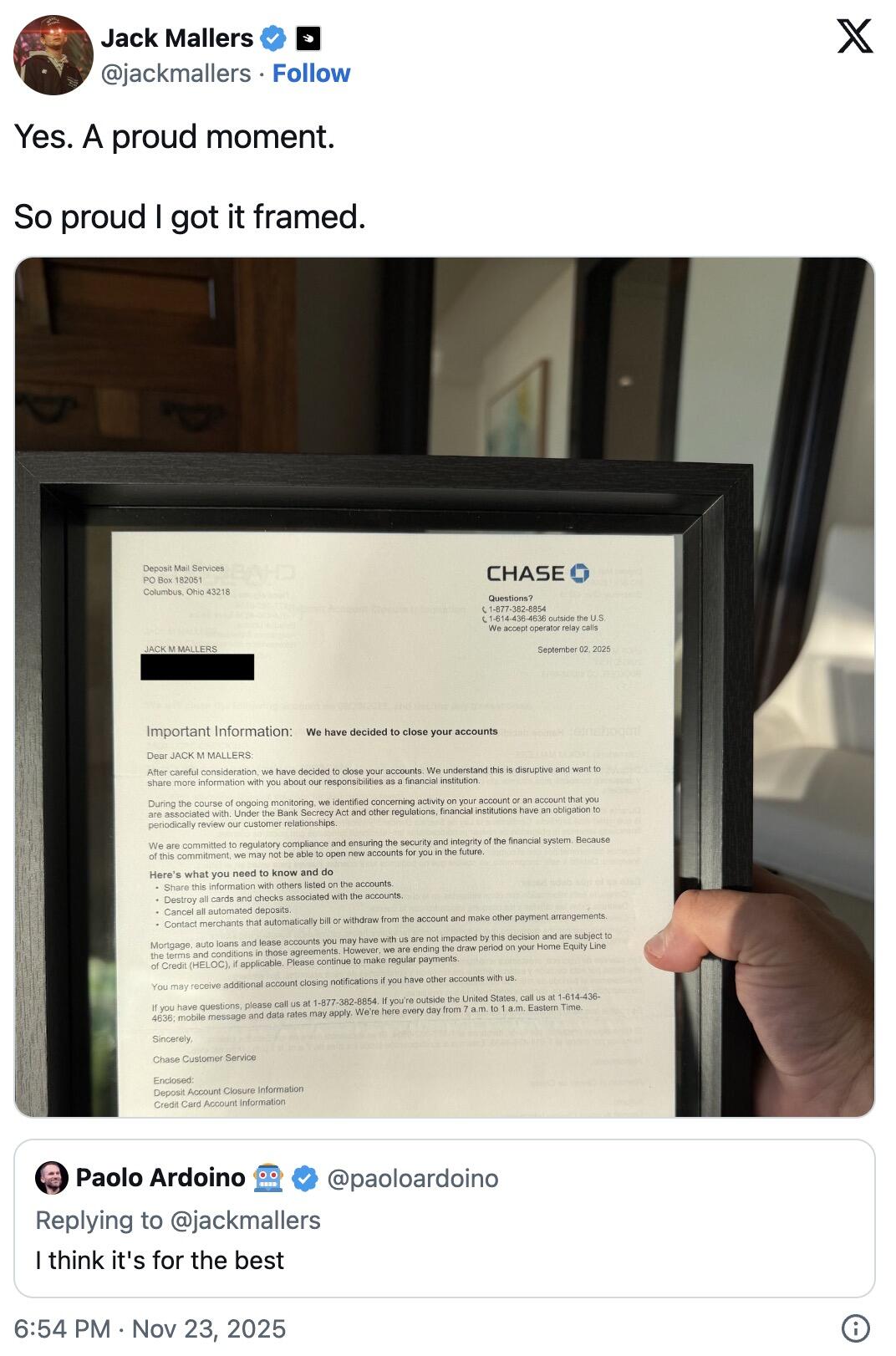
Mallers posted on X that “Last month, J.P. Morgan Chase threw me out of the bank,” noting how odd it was given that “My dad has been a private client there for 30+ years.” When he asked why, the bank told him only: “We aren’t allowed to tell you.”
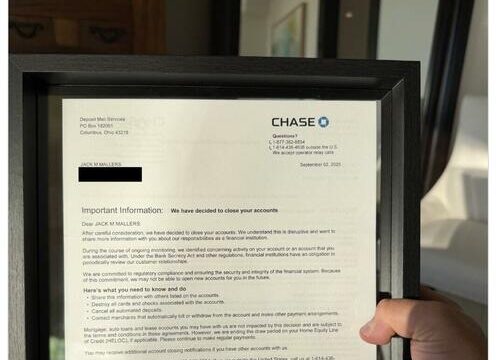
Yahoo writes that he even framed the closure letter, which accused him of unspecified “concerning activity” and warned the bank “may not be able to open new accounts for you in the future.”
The incident reignited concerns that the alleged Biden-era “Operation Chokepoint 2.0” is still lurking in the background, despite Trump’s new executive order aimed at penalizing firms that debank crypto businesses. Critics online immediately connected the dots, suggesting regulators and banks are still quietly squeezing crypto-aligned companies and founders.
JPMorgan’s move sparked a broader backlash from Bitcoin advocates like Grant Cardone, Max Keiser, and others who are already furious over the bank’s perceived hostility toward Bitcoin and its recent push to delist companies with heavy BTC exposure. Many publicly closed their JPMorgan accounts, accusing the bank of targeting the crypto sector while having no trouble maintaining far more questionable clients in the past. (Apparently “concerning activity” was never a problem back when they were happily banking Epstein.)
Tether CEO Paolo Ardoino replied to Mallers that the whole ordeal is “for the best,” later adding that organizations trying to undermine Bitcoin “will fail and become dust.” Meanwhile, JPMorgan insists it’s just protecting the “security and integrity of the financial system”—a claim that might land better if the bank’s compliance radar didn’t seem to activate only when the customer is a crypto CEO rather than, say, a notorious sex-trafficking financier.
Recall just days ago we wrote that the bank is now under fire from Florida officials over its cooperation with the Biden DOJ’s anti-Trump investigation known as “Arctic Frost,” – providing sensitive banking information to Biden prosecutor Jack Smith.
Also we noted US regulators are examining whether JPMorgan Chase has denied customers fair access to banking, as pressure grows over debanking decisions that were made against conservative figures, according to reporting from Financial Times and the company’s 10-Q filing.
In its quarterly filing, the bank noted it was “responding to requests from government authorities and other external parties regarding, among other things, the firm’s policies and processes and the provision of services to customers and potential customers”.
JPMorgan linked the scrutiny to an August executive order from Donald Trump directing regulators to review possible “politicised or unlawful debanking”. The bank said related inquiries include “reviews, investigations and legal proceedings,” without identifying the agencies involved.
Tyler Durden
Mon, 11/24/2025 – 22:10

Brandon Ingram anota 37 puntos y Raptors vencen 110-99 a Cavaliers para su octava victoria al hilo
TORONTO (AP) — Brandon Ingram anotó 15 de sus 37 puntos, la cifra más alta de la temporada, en el tercer cuarto, Scottie Barnes sumó 18 unidades y 11 rebotes, y los Raptors de Toronto vencieron a los Cavaliers de Cleveland 110-99 el lunes por la noche para su octava victoria consecutiva.
Sandro Mamukelashvili anotó 12 tantos e Immanuel Quickley tuvo 11 para Toronto, que ha ganado 12 de 13.
Dos de las victorias de los Raptors en su racha han sido contra los Cavaliers. Toronto barrió la serie de la temporada por primera vez desde la campaña 2019-20.
Por los Cavaliers Donovan Mitchell tuvo 17 puntos pero lanzó seis de 20, acertando tres de 12 triples.
Jaylon Tyson anotó 15, mientras Evan Mobley y Nae’Qwan tuvieron cada uno 14 para Cleveland. Lonzo Ball lanzó tres de 15, fallando diez de 12 intentos desde larga distancia para terminar con ocho unidades.
Toronto cerró la primera mitad con una racha de 13-2 para liderar 57-54 en el descanso.
Los Raptors jugaron sin RJ Barrett, quien tiene un esguince en la rodilla derecha. Barrett dejó la victoria del domingo sobre Brooklyn en el tercer cuarto después de aterrizar de manera incómoda en una volcada en un contraataque. Las pruebas no revelaron una lesión grave, dijo el entrenador Darko Rajakovic.
Ingram conectó seis de 12 intentos en el tercero. Su última canasta, un triple con 1:20 por jugar en el período, le dio a Toronto su mayor ventaja con 88-74.
Darius Garland de Cleveland (dolor en el dedo gordo del pie izquierdo) y De’Andre Hunter (descanso) se sentaron en la segunda noche de juegos consecutivos. Jakob Poeltl de Toronto regresó después de no jugar el domingo debido a un dolor en la parte baja de la espalda. Poeltl tuvo 13 rebotes.
Jarrett Allen, quien se perdió su tercer juego consecutivo debido a un dedo torcido en su mano derecha, fue uno de los siete jugadores de los Cavs fuera por lesiones.
___
Deportes en español AP: https://apnews.com/hub/deportes
Google Denies Claims That It’s Reading Gmails To Train Its AI
Google Denies Claims That It’s Reading Gmails To Train Its AI
Authored by Jack Phillips via The Epoch Times (emphasis ours),
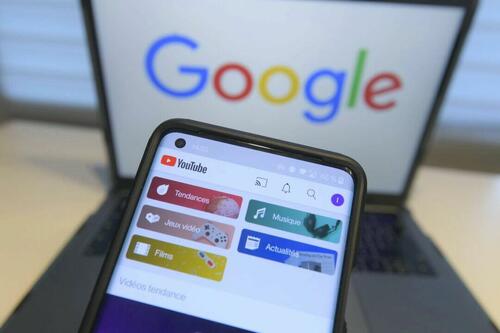
Google is denying viral claims that private Gmail emails are being used to train its AI models.
The announcement follows multiple reports this past week that the company has rolled out such features.
In a post issued on Nov. 21, Gmail said that it wanted to “set the record straight on recent misleading reports.” It listed several points, saying, “We have not changed anyone’s settings,” Gmail’s “smart features” have existed for years, and, “We do not use your Gmail content to train our Gemini AI model.”
“We are always transparent and clear if we make changes to our terms [and] policies,” Google said.
The claims about Google included a post from cybersecurity company MalwareBytes, about which the company later issued a correction. Separately, a post on X from a YouTube content creator received around 150,000 likes. It contained similar claims that users were automatically opted into allowing Google to use Gmail emails to train its AI models.
“We’ve updated this article after realizing we contributed to a perfect storm of misunderstanding around a recent change in the wording and placement of Gmail’s smart features,” MalwareBytes said in its correction.
“The settings themselves aren’t new, but the way Google recently rewrote and surfaced them led a lot of people (including us) to believe Gmail content might be used to train Google’s AI models, and that users were being opted in automatically.”
The company noted that “after taking a closer look at Google’s documentation and reviewing other reporting, that doesn’t appear to be the case.”
Google has maintained on several of its blogs that it would protect user privacy regarding its Gemini AI models.
“Your data stays in Workspace,” says a company policy page. “We do not use your Workspace data to train or improve the underlying generative AI and large language models that power Gemini, Search, and other systems outside of Workspace without permission.”
It adds that for some features, including “accepting or rejecting spelling suggestions, or reporting spam,” suggestions are rendered anonymous or aggregated and could be used in “new features we are currently developing, like improved prompt suggestions that help Workspace users get the best results from Gemini features.”
“These features are developed with strict privacy protections that keep users in control,” the company says.
The smart features program for Gmail allows automated email filtering or categorization, automated composition of text in email, or suggests quick replies to emails, according to the company.
To determine whether the features are turned on or off, users can open Gmail on a desktop or mobile app and click on the gear icon before proceeding to See All Settings on desktop or Settings on mobile.
Then they can go to a section called smart features in Gmail, Chat, and Meet. To turn the features on or off, users can check or uncheck the box that says “Turn on smart features in Gmail, Chat, and Meet.”
Tyler Durden
Mon, 11/24/2025 – 21:45
https://www.zerohedge.com/technology/google-denies-claims-its-reading-gmails-train-its-ai

Rusia ataca la capital de Ucrania pese a esfuerzos de paz de EEUU
KIEV, Ucrania (AP) — Rusia lanzó una ola de ataques contra la capital de Ucrania el martes, impactando edificios residenciales e infraestructura energética, según imágenes de video y autoridades locales.
Un edificio residencial en el distrito central de Pechersk y otro en el distrito oriental de Dniprovskyi, en Kiev, resultaron gravemente dañados, afirmó el alcalde Vitalii Kitschko.
Imágenes de video publicadas en Telegram mostraban un gran incendio que se extendió por varios pisos del edificio de nueve plantas en Dniprovskyi. Al menos cuatro personas resultaron heridas, manifestó el jefe de la administración de la ciudad de Kyiv, Tymor Tkachenko.
El ministerio de energía de Ucrania indicó que la infraestructura energética había sido afectada, sin especificar el tipo o el alcance del daño.
El ataque ruso se dio tras las conversaciones del domingo entre representantes de Estados Unidos y de Ucrania en Ginebra sobre un plan de paz promovido por Estados Unidos y Rusia.
Oleksandr Bevz, un delegado del lado ucraniano, dijo a The Associated Press el lunes que las conversaciones habían sido “muy constructivas” y que ambas partes pudieron discutir la mayoría de los puntos.
El portavoz del Kremlin, Dmitry Peskov, expresó el lunes que no había visto el plan actualizado.
___
Esta historia fue traducida del inglés por un editor de AP con la ayuda de una herramienta de inteligencia artificial generativa.

New details emerge about fatal shooting at Two Brothers Roundhouse in Aurora
The two people who died during a fatal shooting at Two Brothers Roundhouse in Aurora Saturday have been identified, according to the Aurora Police Department and Kane County Coroner’s Office.
At around 9:10 p.m. Saturday, Aurora police received multiple 911 calls for shots fired at the restaurant at 205 N. Broadway, police said. Officers arrived to find multiple people suffering from gunshot wounds, and began life-saving measures before Aurora Fire Department paramedics took two of the people shot to area hospitals.
Detectives from the Aurora Police Department’s Investigations Division responded to the scene, as did evidence technicians, to begin an investigation, a news release Monday from the Aurora Police Department and Kane County Coroner’s Office said.
The coroner’s office was requested to the scene as the investigation progressed, officials said.
The preliminary investigation indicates that the two people who died include the suspect — who has since been identified by the Kane County Coroner’s Office as Bryan Heineman, 43, of Naperville — and Jazmine Barclay, 24, of Aurora, who had been in a dating relationship, Monday’s news release said.
On Saturday, Barclay and a man, 33, were together on the upper-level balcony of the Roundhouse’s music room when Heineman entered the business, the release said. Evidence suggests he went there to confront them and may have learned about their location from social media, according to the release.
Shortly after approaching them, Heineman allegedly opened fire, striking both individuals and then turning the gun on himself, the release said.
Barclay was taken to Mercy Medical Center in Aurora and pronounced dead, while the man, 33, remains in critical condition, per the release. Heineman was pronounced dead at the scene. No bystanders were struck by gunfire or injured, police said.
A firearm was recovered near Heineman, in addition to other evidence consistent with witness statements, according to the news release.
“This was a deeply traumatic event for the victims, their families, the employees and patrons who were there and the community as a whole,” Aurora Police Chief Matt Thomas said in the release. “People simply trying to enjoy their night out were suddenly confronted with targeted violence. Our hearts are with the victims, their families, and every member of our community who is still processing what they experienced.”
The department said individuals seeking assistance can contact the Aurora Police Department Crisis Intervention Unit at 630-256-2483, but officials noted in the release that it is a non-emergency line and may not be monitored around the clock. Anyone experiencing a mental health crisis or needing immediate help should call 988 or 911, police officials said.
The investigation remains ongoing, according to the news release. The police department is asking anyone with information to call the Aurora Police Department Investigations Division at 630-256-5500.
Rev. Jesse Jackson discharged from Northwestern Memorial Hospital, family says
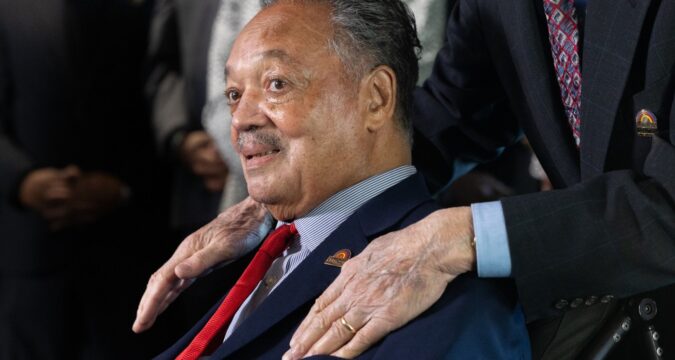
After nearly two weeks spent hospitalized for a rare neurological disorder, the Rev. Jesse Jackson has been discharged from Northwestern Memorial Hospital, according to his family.
The civil rights leader and Rainbow/PUSH coalition founder had been under observation at Northwestern since Nov. 12 for progressive supranuclear palsy or PSP.
The Jackson family announced the reverend’s discharge in a statement Monday issued by Rainbow/PUSH. His condition remains stable, they said.
“Our family would like to thank the countless friends and supporters who have reached out, visited and prayed for our father,” Jackson’s son Yusef Jackson said in the statement.
The announcement comes days after Jackson, 84, welcomed a visit from former President Bill Clinton and former Secretary of State Hillary Clinton and a week after he was moved out of intensive care.
For over half a century, Jackson has been one of the nation’s foremost civil rights leaders and a central figure in national politics, twice running for president.
This is the latest in a series of health setbacks that Jackson has experienced in recent years. In 2013, Jackson was diagnosed with Parkinson’s disease. However, his diagnosis changed to PSP in April.
PSP is a rare neurological disorder caused by damage to nerve cells in the brain that affects body movements, walking, balance and eye movements, according to the National Institute of Neurological Disorders and Stroke.
In recent months, Jackson’s relatives, including sons U.S. Rep. Jonathan Jackson and Jesse Jackson Jr., a former Illinois congressman who recently announced he was seeking office again, have been providing him 24-hour care in shifts, The Associated Press reported.
“We humbly ask for your continued prayers throughout this precious time,” Yusef Jackson said Monday.
https://www.chicagotribune.com/2025/11/24/jesse-jackson-discharge-hospital-chicago/

Gramma, la tortuga de las Galápagos más longeva del zoológico de San Diego, muere a los 141 años
Por JAIMIE DING
LOS ÁNGELES (AP) — Gramma, la querida tortuga de las Galápagos y la residente más antigua del Zoológico de San Diego, ha fallecido luego de más de un siglo de disfrutar en cautiverio de sus alimentos favoritos, como la lechuga romana y la tuna.
Gramma nació en estado silvestre y se calcula que tenía alrededor de 141 años, según funcionarios del zoológico. Falleció el 20 de noviembre.
Se desconoce la fecha exacta en que la tortuga llegó al Zoológico de San Diego, pero funcionarios del zoológico señalaron que vino del Zoológico del Bronx en 1928 o 1931 como parte de su primer grupo de tortugas de las Galápagos.
Mientras el mundo cambiaba a su alrededor, Gramma deleitaba a los visitantes con su dulce y tímida personalidad. Vivió durante dos Guerras Mundiales y el mandato de 20 presidentes de Estados Unidos.
Sus cuidadores la llamaban cariñosamente “la Reina del Zoológico”. Padecía de condiciones óseas relacionadas con su avanzada edad que progresaron recientemente hasta que tuvo que ser sacrificada, indicó el zoológico.
Muchos visitantes comentaron en redes sociales que visitaron por primera vez a Gramma siendo jóvenes y pudieron volver a verla años después acompañados de sus hijos.
Cristina Park, de 69 años, dijo que uno de sus primeros recuerdos de la infancia fue ir al Zoológico de San Diego cuando tenía 3 o 4 años y montar en el caparazón de una tortuga. Eso ya no está permitido, pero la experiencia la inspiró a tener una pequeña tortuga del desierto como mascota y aprender más sobre la conservación de estos animales.
“Es increíble que hayan logrado vivir tanto tiempo”, dijo Park. “Y aún así, siguen ahí”.
Las tortugas de las Galápagos pueden vivir más de 100 años en la naturaleza, y cerca del doble en cautiverio.
La tortuga de las Galápagos de mayor edad de la que se tenga conocimiento se llamaba Harriet y vivió en el Zoológico de Australia hasta la edad de 175 años. Fue recogida de las Islas Galápagos en 1835 cuando tenía apenas el tamaño de un plato, según el zoológico. Esto significa que nació alrededor de 1830 y murió en 2006.
Las tortugas de las Galápagos incluyen 15 subespecies de tortugas de las islas, tres de las cuales están consideradas extintas. El resto se encuentran en la lista de animales vulnerables o en peligro crítico, según la Unión Internacional para la Conservación de la Naturaleza.
En las últimas décadas se han realizado esfuerzos concertados para criar en cautiverio a este tipo de tortugas, liberando a más de 10.000 crías en estado silvestre desde 1965, según Galapagos Conservancy. Algunas subespecies han sido rescatadas del borde de la extinción.
Cuatro tortugas de las Galápagos nacieron en abril en el Zoológico de Filadelfia de padres primerizos que tenían unos 100 años de edad, un hecho sin precedentes en la historia del zoológico. En junio, Goliath, una tortuga de las Galápagos residente del Zoológico de Miami se convirtió en padre por primera vez a la edad de 135 años.
___
Esta historia fue traducida del inglés por un editor de AP con la ayuda de una herramienta de inteligencia artificial generativa.

Más de 100 casas dañadas por un tornado cerca de Houston
HOUSTON (AP) — Más de 100 casas resultaron dañadas después de que un tornado tocara tierra en una zona residencial a las afueras de Houston, informaron las autoridades en Texas el lunes.
No se reportaron heridos.
Fotos y videos de drones publicados en Facebook por el alguacil del distrito 3 del condado de Harris mostraban techos con tejas arrancadas. Algunos escombros bloqueaban los caminos.
El daño afectó al vecindario de Memorial Northwest, según la oficina de Mark Herman, el alguacil.
El Departamento de Bomberos de Houston envió a cinco miembros de su equipo para cortar y retirar árboles caídos, expresó el portavoz Rustin Rawlings.
El Servicio Meteorológico Nacional emitió una alerta de tornado para el sureste de Texas, incluyendo Houston, hasta la 1 de la mañana del martes. También emitió una alerta de tormenta eléctrica severa para partes del sureste de Texas.
___
Esta historia fue traducida del inglés por un editor de AP con la ayuda de una herramienta de inteligencia artificial generativa.
https://www.chicagotribune.com/2025/11/24/ms-de-100-casas-daadas-por-un-tornado-cerca-de-houston/

Will Hooks looks for more than just points or rebounds for Sandburg. He can pass, too. ‘Help out my teammates.’
Sandburg’s Will Hooks has the classic size and interchangeable game for his position.
The 6-foot-4 senior forward does what comes naturally, but he also doesn’t fit into a typical box. And he has put in the offseason work to check off every possible list for versatility and utility.
“Last season, I was more of a rebounder who spaced the floor,” he said. “I always worked hard on defense. Now, I’m trying to have more of a leadership role and be able to pass and shoot more,
“And help out my teammates.”
Hooks provided a helping hand Monday, scoring 10 points to go with five rebounds and three assists in a 69-43 win over Chicago Christian at the Reavis Thanksgiving Tournament in Burbank.
Ten players scored for the Eagles (1-0), who led by as many as 37 points. Twin brothers Will and Jonah Johnson, both senior forwards, finished with 13 and nine points, respectively.
Sandburg’s Will Hooks (4) drives into the lane against Chicago Christian during the Reavis Thanksgiving Tournament in Burbank on Monday, Nov. 24, 2025. (Vincent D. Johnson / Daily Southtown)
Junior guard Garrett Murphy scored 13 points to lead Chicago Christian (0-1). Soccer standout Casey Lenarz, a senior forward, added 11 points.
Hooks, meanwhile, combines size, length and a nose for the ball in shaping his approach to the game. Those skills are enhanced by scrappy, dogged play, according to senior guard Liibo Debela.
“He definitely brings defense,” Debela said of Hooks. “He’s very much a team-first player. He crashes the boards, plays hard and he finishes his chances at the rim.
“He doesn’t always have to be scoring to be effective out there. He rotates on defense and he’s very vocal. Defensively, everyone knows he has our back.”
Chicago Christian’s Garrett Murphy (3) dribbles past Sandburg’s Liibo Debela (2) during the Reavis Thanksgiving Tournament in Burbank on Monday, Nov. 24, 2025. (Vincent D. Johnson / Daily Southtown)
Hooks, who’s in his second year on varsity, wants to impact the game in a wide range of ways.
“He gives us a lot of flexibility,” Sandburg coach John Daniels said of Hooks. “He’s going to start some games and he’s going to come off the bench. He attacks the rim and does a really good job of rebounding and pushing the ball.
“He’s very positive and he’s just hungry.”
Hooks showed off his versatility by both protecting the rim and starting Sandburg’s transition.
Sandburg’s Will Johnson (3) puts up a shot against Chicago Christian during the Reavis Thanksgiving Tournament in Burbank on Monday, Nov. 24, 2025. (Vincent D. Johnson / Daily Southtown)
“I feel like I’m a lengthy and athletic player out there,” he said. “I feel like I can run with any of my teammates out there. Our team is super fast and athletic.
“Our coaches gave us a great game plan to be able to play an amazing style that fits us.”
Nine of the players who scored against Chicago Christian were either starters or part of the rotation last season for Sandburg, including Hooks.
That familiarity and comfort with each other allowed Hooks to flourish.
“We’ve been playing together for four years now and I feel like we work together every day,” he said. “This is also my second year out there, so everything is just more exciting.
“Everything has just really come together.”
Sandburg’s Will Hooks (4) lays the ball up over a pair of players against Chicago Christian during the Reavis Thanksgiving Tournament in Burbank on Monday, Nov. 24, 2025. (Vincent D. Johnson / Daily Southtown)
Hooks spends his time away from the game either hanging out with his friends or working out. He’s rarely stationary, and that shows on the basketball court.
“I like to play fast,” Hooks said. “What I love the most is winning, so wherever the coach puts me, in the starting lineup or coming off the bench, I’m going to do whatever our team needs to win.”
Growing up, he loved basketball, especially those Chicago Bulls teams with Derrick Rose, Jimmy Butler and Pau Gasol. He took to the game, which brought out his already ebullient personality.
The flow and rhythm fits his open, playful manner.
“My personality is loud, maybe even a little silly,” Hooks said. “My lifestyle is more of just being free out there and trying to be loose.
“Whenever I’m doing something in real life, I’m just trying to put forward my best stuff.”
Patrick Z. McGavin is a freelance reporter for the Daily Southtown.
Argentina: Racing derrota a River Plate con un gol agónico y lo elimina del Clausura
Por HERNÁN ALVAREZ
BUENOS AIRES (AP) — Con un gol en los descuentos en un partido vibrante, Racing Club venció por 3-2 a River Plate en Avellaneda el lunes por los octavos de final del torneo Clausura del fútbol argentino.
Santiago Solari a los tres minutos, Lucas Martínez Quarta en contra a los 72 y Gastón Martirena a los 92 marcaron los goles racinguistas. Ian Subiabre a los 62 y Juanfer Quintero a los 63 anotaron los tantos riverplatenses.
Se terminó así un mal año para el equipo de Marcelo Gallardo que no logró ganar ningún título.
La Academia encontró el primer gol muy tempranamente. En el primer ataque profundo, Gabriel Rojas sacó un centro para un cabezazo violento de Solari que se metió en la portería de Franco Armani.
Los millonarios lograron revertir el marcador con futbolistas ingresados en el segundo tiempo en sólo dos minutos. Subiabre disparó violento en el área y consiguió el empate.
En la jugada siguiente, Quintero encontró un hueco y remató con precisión desde la medialuna.
Racing se lanzó entonces en busca del empate y lo consiguió con un rebote. Adrián “Toto” Fernández entró al área rival y disparó. El balón pegó en Martínez Quarta y se metió en el arco riverplatense.
Sobre el final, La Academia encontró el tercero. Martirena cabeceó, Armani despejó, pero a medias. Le quedó otra vez al uruguayo que tocó en la puerta del arco para el festejo de la parcialidad local.
“Muy contento por mis compañeros. Por Santi (Sosa que jugó con una máscara después de una grave lesión facial) que le quedan 20 días y jugó igual. Hoy me quedó a mí”, dijo Martirena post partido a la TV. “Mucho compromiso, mucho corazón. Siempre tenemos algo”.
“(Fue) Un partido inolvidable. Ganamos un partido importantísimo”, comentó Sosa. “Quería estar como sea. Juego con el corazón”. “Somos candidatos”, expresó.
En el otro encuentro del día, Barracas Central venció a domicilio por 1-0 a Deportivo Riestra. El partido fue muy chato entre dos conjuntos que no cuentan con grandes recursos ofensivos.
El tanto de la victoria visitante fue marcado por Nicolás Blandi a los 114, en el segundo tiempo extra. El delantero punteó el balón de aire tras una gran jugada de Tomás Porra.
Barracas jugó con un hombre menos parte del partido por la expulsión de Iván Guaraz a los 82.
Más tarde jugaban Unión frente a Gimnasia La Plata.
El domingo, Boca Juniors derrotó por 2-0 a Talleres en La Bombonera. En tanto, Estudiantes superó por 1-0 a Rosario Central en el Gigante de Arroyito.
La AFA de Claudio Tapia le otorgó el jueves pasado un título a Central por haber terminado primero en la tabla anual. Una medida arbitraria tomada después de terminada la fase de grupos.
En el partido entre canallas y pincharratas, los auriazules salieron al campo y esperaron un pasillo de parte de los visitantes. El once de Estudiantes le realizó un pasillo previsto por protocolo, pero de espaldas.
Por esta actitud de los jugadores rojiblancos se le abrió un expediente disciplinario a Estudiantes.
El sábado, Argentinos Juniors venció por 2-0 a Vélez Sarsfield en el José Amalfitani. Mientras, Central Córdoba (Santiago del Estero) derrotó por 2-1 a San Lorenzo.
Boca se medirá con Argentinos y Central Córdoba con Estudiantes en la instancia de cuartos de final.
Los octavos se cerrarán con el cotejo entre Lanús, campeón de la Copa Sudamericana en Asunción el sábado pasado, ante Tigre.