Category: News

Gulf Energy Shock Spreads To Global Plastics As War Sparks Force Majeure Wave
Gulf Energy Shock Spreads To Global Plastics As War Sparks Force Majeure Wave
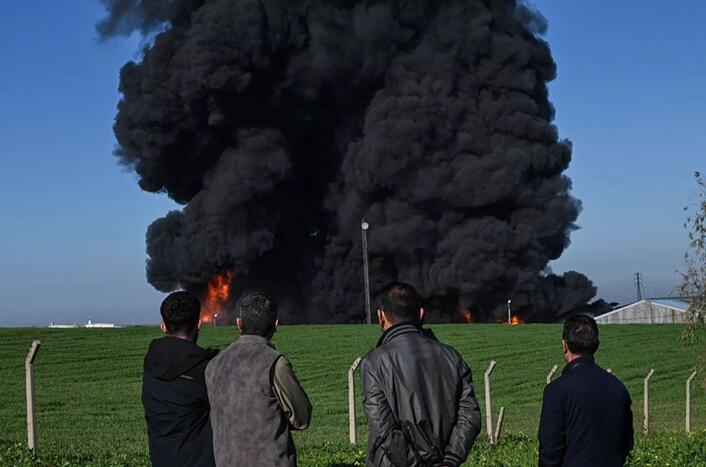
Building on our earlier “Global Demand Destruction” note, which mapped how the Gulf energy shock is spreading globally and the immediate effects of rationing, price controls, and fuel shortages, another second-order disruption is quickly emerging: supply chain disruptions in critical plastic feedstocks.
Plastics are core to the modern economy, and a troubling new Bloomberg report indicates that several producers of monoethylene glycol (MEG) and purified terephthalic acid (PTA) have declared force majeure, as tanker flows through the Strait of Hormuz remain heavily disrupted.
For context, MEG and PTA are the two primary feedstocks used to produce polyethylene terephthalate (PET) and polyester fibers. These petrochemicals are critical to the production of everyday consumer goods that make life in the developed world convenient, including plastic bottles, food packaging, clothing, home furnishings, and a wide range of consumer and industrial goods.
More specifically, MEG is used in the production of polyester yarn, polyester staple fiber, PET resin, and PET film. It also plays a critical role in antifreeze, coolants, adhesives, coatings, and enamels.
In other words, MEG and PTA are foundational petrochemical building blocks for the modern economy. Any sustained disruption to these flows would be detrimental to the global economy.
Which brings us to the supply alarm bells already beginning to ring, courtesy of Bloomberg:
Oriental Union Chemical Corp. warned US customers it would temporarily suspend MEG shipments for early March. The suspensions would persist until conditions stabilize, the Taipei-based company wrote in a customer letter. After March 11, shipments to customers continued as normal, with monthly pricing adjusted to reflect higher crude costs: Spokesperson Daniel Yu Ethylene oxide and ethylene glycol sales are mainly for customers on long-term contracts, he added. As disruptions mount across the industry, Taiwan has moved to boost capacity for ethylene output, according to a report by the semi-official Central News Agency.
Hainan Yisheng Petrochemical Co. declared force majeure “for affected contracts/orders/delivery obligations,” according to a letter sent to US customers. The Chinese maker of PET and PTA flagged disruptions stemming from the Hormuz shutdown.
Indorama Ventures said in an early-March letter from its US and Canada regional sales team that it would raise prices on PET resin by 10 cents a pound across all businesses, citing higher feedstock costs and supply-chain disruptions linked to the Middle East conflict. The company said in a letter sent the following week that it would add an additional temporary 5-cent war surcharge. The company has also declared forces majeures on shipments from two PET units in Europe, S&P Global’s Chemweek reported.
Saudi Basic Industries Corp. last week told customers it would invoke force majeure for MEG and diethylene glycol. The duration of the disruptions “cannot be reasonably determined given the evolving nature of the circumstances,” the company said, citing “unforeseen supply chain disruptions in the Strait of Hormuz.”
The market response has already seen a surge in US spot prices for ethylene, methanol, and polymer-grade propylene. This will likely translate into higher prices for everyday consumer goods, including trash bags, cleaning products, tires, food containers, and more.
Last week, Dow CEO Jim Fitterling warned that Gulf petrochemical flows could take upwards of nine months to normalize if the Hormuz chokepoint were to open up in the near term.
“Snacks, frozen foods and fresh protein products will be impacted first,” EGC Consulting CEO Jonathan Quinn warned, adding, “The potato chip bag — that alone is going to see an increase of a nickel, a dime. Everything you buy is going to be impacted.”
Let’s remind readers that China is the world’s largest plastics consumer and producer, as per OECD data. Any supply disruption would ripple through the industrial base of the world’s second-largest economy.
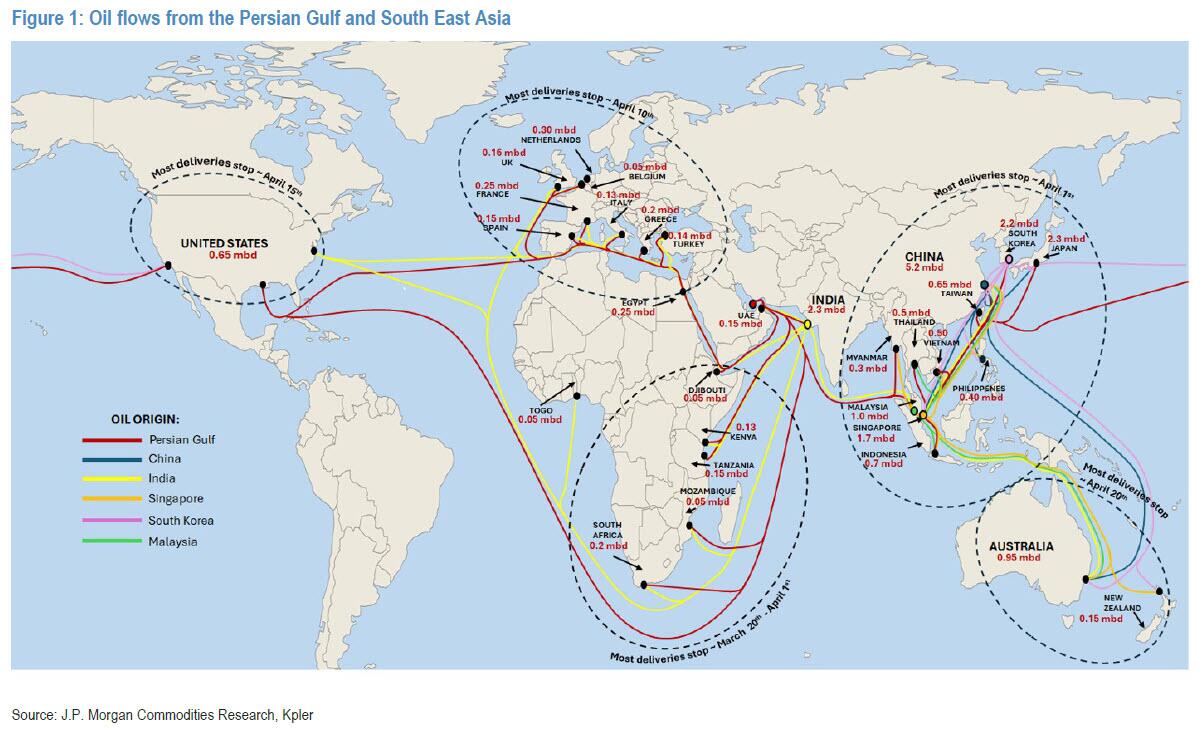
Separately, JPMorgan analysts mapped out how the energy shockwave from the Iran war spreads across the world, hitting Asia first, then Africa and Europe, before settling on the US – primarily California.
President Trump’s speech on Wednesday night sparked a global risk-off move because, as Goldman analyst Peter Bartlett explained, the president “was more escalatory than not.” This suggests the global energy shock is likely to worsen (unless Iran capitulates) in the weeks ahead, with plastics emerging as the next major problem facing the global economy.
Tyler Durden
Thu, 04/02/2026 – 11:30
April Fools And The Last Supper
April Fools And The Last Supper
By Benjamin Picton, senior market strategist at Rabobank
Wednesday saw the unusual occurrence of three Anglosphere heads of government delivering televised addresses to their respective nations within 24 hours of each other. When news broke that Australia’s PM Albanese, Britain’s PM Starmer and US President Trump would all be interrupting regular programming to speak to their people, reactions ranged from jubilant speculation that the war is about to end all the way through to nervousness that Operation Iranian Freedom was about to be announced.
Judging by the price action in markets, the latter was certainly seen as the less likely of the two as stocks rose sharply across Asia, EMEA and the Americas, while Brent crude briefly dipped below the $100/bbl mark. Singapore gasoil spot prices fell by 22.7% – it’s largest daily move (up or down) of the war so far.
Those moves are now revealed as an April Fool’s rally as Donald Trump’s address to the nation has sent oil bid, bond yields surging, high-beta FX lower and early rallies in Asian stocks have now turned deeply negative. Trump declined to announce that the USA is packing up and going home, instead declaring that “we are going to finish the job.” He said that the US owed it to 13 soldiers who have died in the conflict to complete the mission by ensuring that Iran would not have the capability to obtain a nuclear weapon, that it would no longer have the ability to project power beyond its borders, and by severely degrading its drone and missile stocks and the industrial base used to produce those conventional weapons.
Trump says there is still time for Iran to make a deal to end the war but that the US is willing to leave without a deal and will eliminate key targets on their way out, pointing specifically to Iran’s electricity plants. He reiterated his previously expressed timeline of 2-3 weeks to conclude operations in Iran, but markets will be nervous about that as those timelines have a tendency to stretch.
Critically, Trump also seemed to confirm rumors that the US is willing to leave without first securing freedom of navigation in the Strait of Hormuz, instead leaving that task to other countries (though he says the US will help) on the justification that they are far more reliant on Persian Gulf oil than the US is. Trump said that the Strait will ultimately re-open naturally when the war concludes as Iran will rely on oil sales to rebuild, but in the meantime he advises other countries to buy their oil and gas from the United States.
The market optimism of the last 24 hours was always likely to be misplaced. The subtext of Trump’s remarks is that NATO and the GCC states must get involved in the war to re-open the Strait, or else suffer the consequences of US withdrawal for the world economy. Some – like the UAE – have expressed willingness, but most have not. If nobody steps up the war may grind on for longer (bad), escalate (worse), or the US may simply leave with Hormuz unresolved (worst). While the latter is a clear and present danger for world hydrocarbon markets and civilisation in general, it would also be a heavy blow for US hegemony and reserve currency status as American tactical victories sum to strategic defeat and Iran continues to operate the Strait as a toll road settled in CNY.
Hours before Trump’s address, Australian viewers were left somewhat nonplussed by their Prime Minister’s primetime appearance. Given that Prime Ministerial addresses to the nation are incredibly rare, Australians were perhaps bracing for some grave Menzian announcement (“My fellow Australians. It is my melancholy duty to inform you…”) but were instead wished a happy Easter holiday period, warned that the months ahead may be hard and told to conserve fuel by taking public transport and resisting the urge to stockpile. Some commentators have cheekily observed that this one could have been an email, but in the aftermath of Trump’s address Albanese’s well wishes for the Easter holidays are feeling a bit more like the last supper as speculation mounts that Australia could be headed for fuel rationing as early as next week.
Keir Starmer struck a slightly different tone to his antipodean counterpart by focusing more directly on Britain’s efforts to re-establish freedom of navigation in the Strait of Hormuz. Starmer noted that he had convened captains of industry from the shipping, finance and insurance sectors earlier in the week at Downing Street, and that they had told him the issue in Hormuz is not one of insurance, but of safety and security of passage. Starmer says that foreign ministers of 35 nations will meet later this week to explore diplomatic and political avenues to end the war and re-open the Strait, to be followed by a meeting of military leaders.
Starmer was at pains to reiterate his message that this was not Britain’s war. The PM is currently between a rock and a hard place because involvement in the war upsets anti-war constituencies at home and draws the ire of the Iranian regime, while not becoming involved draws the ire of the US President. It is becoming very difficult to straddle these two imperatives as Trump tells NATO allies “I broke it, you bought it.”
As a consequence of being faced with only bad choices, Britain has had a muddled approach of refusing US access to bases and then granting it, delaying deployment of HMS Dragon to the Eastern Mediterranean and then deploying it, and refusing requests to assist with naval escorts in the Strait – but is surely now forced to consider it. Combining this indecision with Spanish, French and Italian refusals to allow US access to bases, and suggestions that the war runs contrary to international law, the European relationship with the USA suddenly looks more strained than ever.
This has severe implications for NATO, which Keir Starmer noted that Britain remains committed to, but Donald Trump and Marco Rubio have recently said the US may consider withdrawing from. This in turn has implications for the flow of US aid to Ukraine, where the United States may tell the EU “your problem now”, and also for the status of Greenland. Denmark and the EU were able to defuse Trump’s assertive stance on controlling Greenland last year by providing assurances that the US would have access to bases as it needs, but now that it has been refused access to bases in Europe for the Iran war, everything is back on the table.
There is a reshuffling of strategic dependencies now occurring in real time. Starmer used his address to tell his people that Brexit had done deep damage to the British economy, and that Britain now had to draw closer to the EU to strengthen its economic and security relationships in its immediate geography. The subtext here is that Britain will pivot to the EU from the US, which puts the ‘Special Relationship’ on life support alongside NATO.
This has implications elsewhere, especially in Australia where plans to acquire nuclear-propelled submarines rely on cooperation with and between Britain and the United States. As many Australian defence commentators have argued in the recent past, there is no Plan B if AUKUS falls apart, and Australia is already faced with a submarine capability gap as it’s 1990s-era Collins class submarines are looking very long in the tooth.
Given its own geography, and the fact that it is so far down the AUKUS road, Australia may have no choice but to stick by the USA while other allies coalesce around Europe or chase Mark Carney’s ‘variable geometry’ system of alliances down the path of incongruent current accounts. Might we see an Australian Hobart class in the vanguard to answer Trump’s call to re-open the Strait?
Tyler Durden
Thu, 04/02/2026 – 11:15
https://www.zerohedge.com/markets/april-fools-and-last-supper
Rumors Of Pam Bondi Ouster A-Swirlin’
Rumors Of Pam Bondi Ouster A-Swirlin’
Leaky little sharks are circling in DC – telling the NY Times and CNN that Pam Bondi may soon be out as Attorney General, and replaced with EPA Administrator Lee Zeldin.
The frustration, per sources close to the White House cited by The New York Times and CNN, centers squarely on Bondi’s catastrophic mishandling of the Jeffrey Epstein files – a saga ZeroHedge has chronicled in excruciating detail as one of the most embarrassing self-inflicted wounds of the second Trump term. Recall Bondi’s infamous February 2025 Fox News appearance where she claimed the “client list” was literally “sitting on my desk right now to review.” Fast-forward months later: no list, endless redactions for “national security,” millions more pages “discovered” at the 11th hour, and zero indictments of any high-profile co-conspirators.
Beyond her disastrous testimony in front of the House Judiciary Committee in February – the House Oversight Committee has also subpoenaed her over the “troubling disappearance” of documents, with her deposition still looming on April 14. Even Trump ally and White House Chief of Staff Susie Wiles admitted Bondi “completely whiffed” the response.
News: The president has informed Pam Bondi that her time as AG is nearing an end, multiple sources tell me.
Formal announcement hasn’t yet come aka all the normal caveats that he could change his mind apply; he’s been speaking with advisors on a possible replacement in recent…
— Shelby Talcott (@ShelbyTalcott) April 2, 2026
Trump is also reportedly pissed that Bondi has an apparent allergy to actual justice – namely, her failure to deliver on promises to go after his political foes (former FBI Director James Comey or New York AG Letitia James). Bondi’s DOJ has also been dragging its feet on broader accountability: no real movement on COVID-era prosecutions despite the obvious targets, a bizarre pivot toward “hate speech” crackdowns that even drew fire from the right, and a general pattern of not prosecuting what many see as a laundry list of potential criminals from the prior regime. Perhaps it was all by design. Either way, looks like Pam’s time is short.
A person familiar with the situation tells me that Pam Bondi will be out as AG imminently, confirming scoops from @CNN and @nytimes.
When Trump met EPA boss Lee Zeldin on Tuesday to discuss last year’s California wildfires, Trump also discussed the potential of tapping him for… pic.twitter.com/zXj6MInr6B
— Dasha Burns (@DashaBurns) April 2, 2026
What’s more, Bondi’s DOJ has been actively sabotaging the Trump coalition by maintaining Biden-era policies in court – repeatedly mooting litigation on key issues rather than letting judges deliver precedent-setting knockout blows, defending outdated gun control measures like the 1934 National Firearms Act in suppressor cases, and choosing temporary tactical retreats over permanent wins that would prevent future Democrat administrations from simply flipping the switch back on.
Bondi’s nightmare before Congress was more or less the crescendo of her implosion. On February 11, she was hauled before the House Judiciary Committee for what was supposed to be a straightforward oversight hearing – and instead delivered one of the most disastrous performances in recent memory. As we reported live, Bondi exploded into a full-blown shouting match with Rep. Thomas Massie and top Democrats, dodging more than a dozen direct questions on why – after months of “reviewing” the files – the DOJ still had zero indictments of Epstein’s high-profile co-conspirators.
🚨Massie: “This goes over four administrations. You don’t have to go back to Biden. Let’s go back to Obama. Let’s go back to George Bush. This coverup spans decades, and you are responsible for this portion.”pic.twitter.com/mZoCGOoEtD
— Derrick Evans (@DerrickEvans4WV) February 11, 2026
She hemmed and hawed over the selective redactions (victims’ names left exposed while alleged abusers were blacked out), the sudden “discovery” of a million more pages, and the complete lack of accountability for the powerful men who enabled the operation. At one point she even whipped out what insiders called a “burn book” of lawmakers’ search histories in a desperate whataboutism that backfired spectacularly, drawing jeers from Epstein survivors seated in the gallery. So basically an angry stonewalling with clips that went absolutely viral. The base watched in real time as the woman tasked with draining the swamp instead looked like she was guarding it.
Massie: “Here is an email that was sent by the victims’ lawyers to the DOJ. It was a list of names not to release. What did the DOJ do with this email? They released it! Literally the worst thing you could do the survivors you did.” pic.twitter.com/oSzA1dV2jj
— Aaron Rupar (@atrupar) February 11, 2026
The timing is telling. Rumors of Bondi’s exit have swirled for months, but they intensified this week after Trump met with Zeldin (a reliable MAGA foot soldier who ran New York and has been showered with praise by the president for his EPA work). Bondi was still glued to Trump’s side yesterday – riding in the motorcade to Supreme Court arguments and sitting in the audience for his primetime Iran address – but the non-denial denial from the White House speaks volumes: “Attorney General Pam Bondi is a wonderful person and she is doing a good job.” AKA – “you’re on thin ice.”
Zeldin, for his part, has zero of the Epstein baggage and a track record of hawkish loyalty during Trump’s first term. If the move happens, it would mark the second high-profile Cabinet shakeup of the term after Kristi Noem’s ouster at DHS – a clear signal that even Trump is no longer willing to tolerate the kind of institutional inertia and base-alienating fumbles that defined too much of his first go-around.
For now, Bondi remains in place… but the clock is ticking. As one person familiar with the discussions put it, the Epstein fallout has become a genuine political liability.
* * *
Click link, stock up. Free shipping over $500 + sale + looming boots on the ground = now’s a great time.
Tyler Durden
Thu, 04/02/2026 – 10:55
https://www.zerohedge.com/political/rumors-over-pam-bondi-ouster-swirlin
“Everything About This Market Is Wild”: European Diesel Futs Top $200 As Global Scramble Accelerates
“Everything About This Market Is Wild”: European Diesel Futs Top $200 As Global Scramble Accelerates
The global tug-of-war for fuel looks set to accelerate, with traders scrambling to secure supplies even more aggressively after President Trump showed no signs of an end to hostilities (and a reopening of the Strait) any time soon.
The longer the Strait of Hormuz remains closed, the more intense the competition is likely to become. Traders have warned that Europe is at risk of diesel shortages in the coming weeks.
“Everything about this market is wild,” said Philip Jones-Lux, a senior oil analyst at energy analytics firm Sparta Commodities.
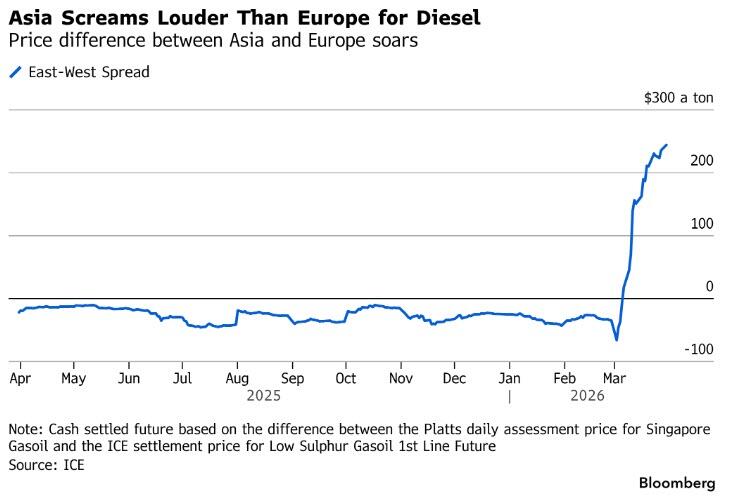
“Europe is still short of diesel, but the situation in Asia is so much more acute that prices there are pulling barrels halfway around the world.”.
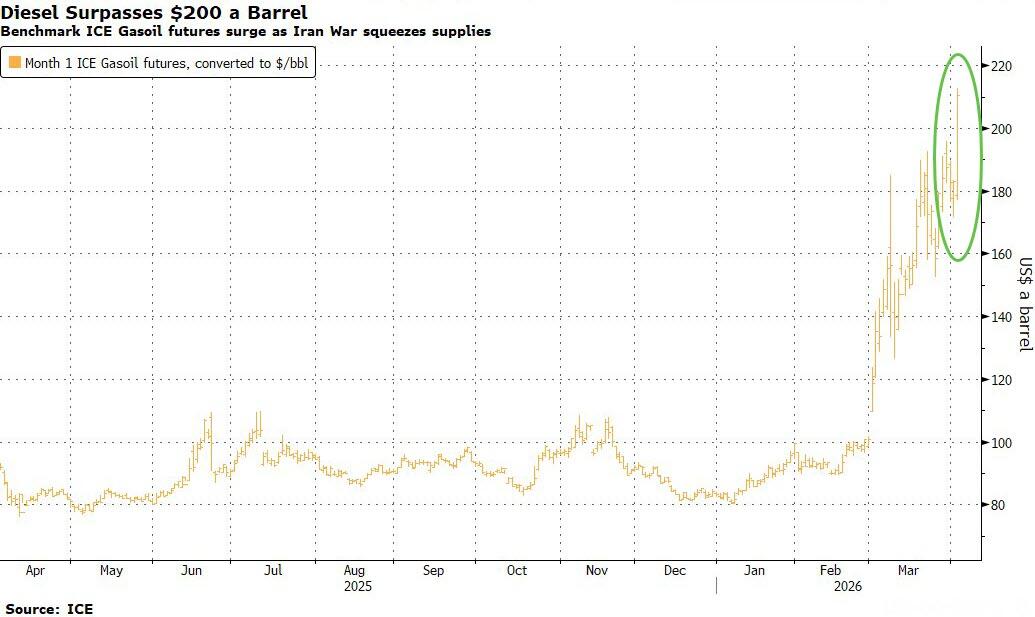
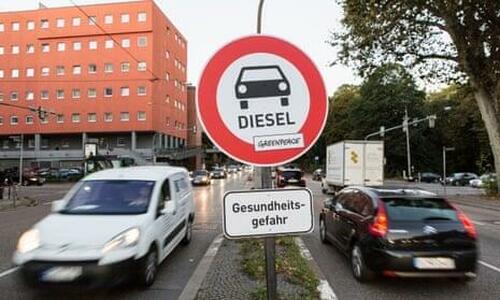
Nevertheless, Europe’s diesel futures rose to the highest level since 2022, as the Iran war hits supply of the fuel that powers the global economy.
As Bloomberg reports, futures traded as high as $1,498 a ton, or more than $200 a barrel, as they surged as much as 9.7% in London.
Prices have almost doubled since the war in the Middle East started over a month ago with US and Israeli attacks on Iran, and Tehran’s retaliation resulting in an effective closure of the vital Strait of Hormuz.
As Goldman futures trader, Robert Quinn notes (pro subs can read Quinn’s full note here), the onset of the Iran War forced substantial producer short covering in European Diesel.
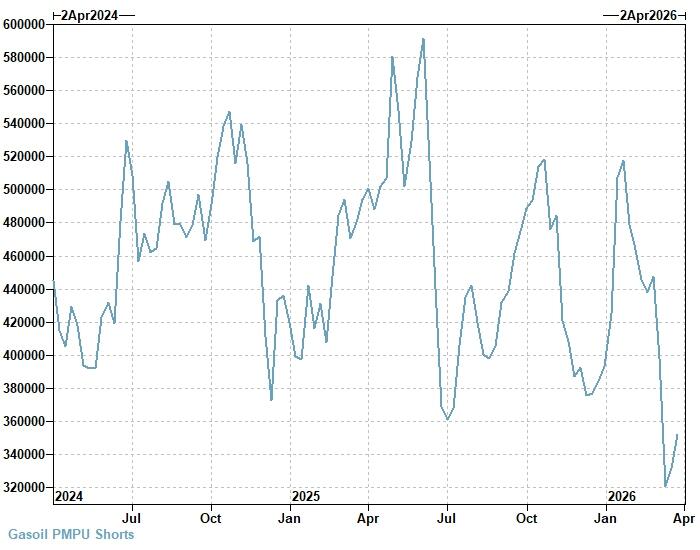
According to Commitment of Traders, Gasoil Producer, Merchant, Processor, and User (PMPU) shorts tumbled -$13bn during February 24th – March 10th.
This marked the largest 2 week decline since Russia attempted to invade Ukraine.
But PMPU downside eventually reinitiated, albeit slowly. Over March 10th – 24th, PMPU shorts rebounded +$3.9bn.
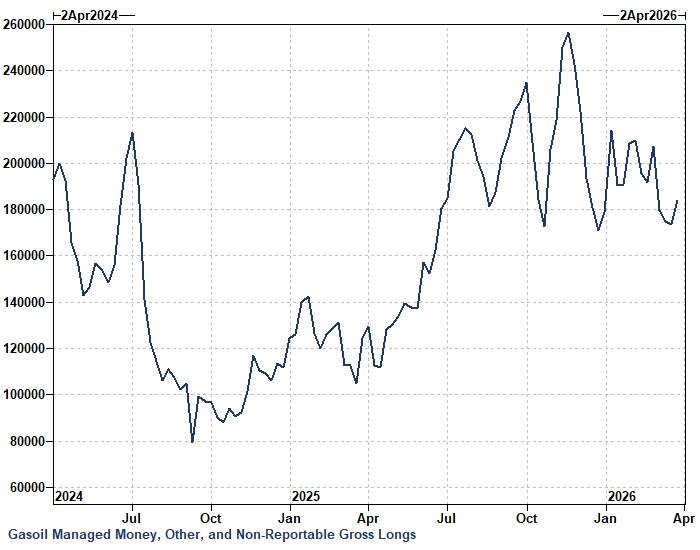
And speculators resumed long purchases. After generally liquidating throughout the initial price rally, Managed Money, Other, and Non-Reportable bought +$1.3bn of gross longs from March 17th – 24th.
As questions surrounding the conflict’s sustainability surfaced, general risk reduction ensued.
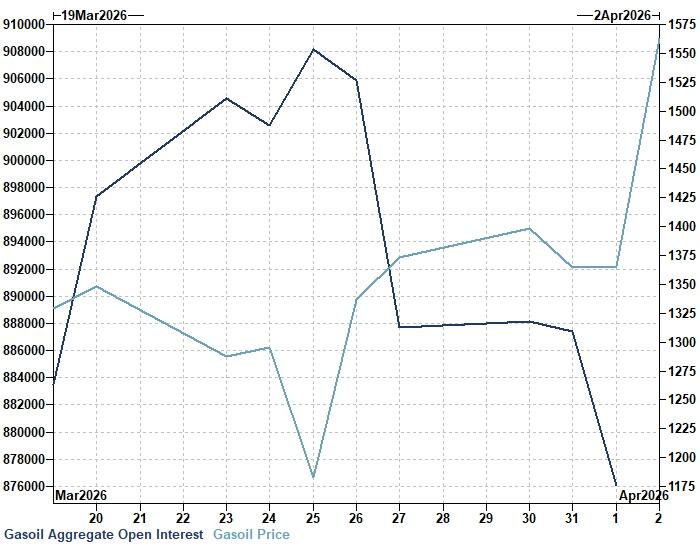
Over March 24th – April 1st, which included the administration’s initial signaling for an end to the fighting, Gasoil aggregate open interest shed -$3.7bn.
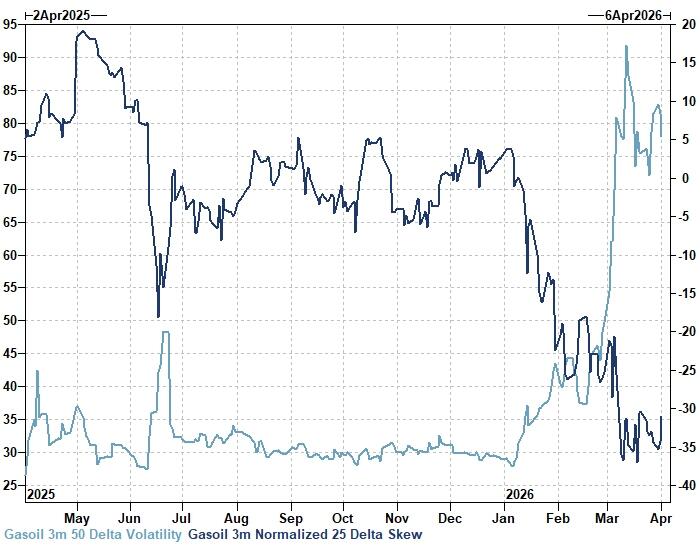
Notably, 3 month implied volatility and normalized 25 delta put-call skew retraced from their respective max and min.
Thus Trump’s recent vow to strike Iran “extremely hard” has conceivably prompted more speculative gross long buying and/or producer short terminations.
Europe generally produces less diesel than it consumes and relies on imports.
But, interestingly, even as the ‘normal’ flow is into Europe, there is massive demand from the rest of the world – most notably Australia – where panic buying, especially in rural areas, has driven up demand and left some service stations out of fuel.
The government has urged conservation, blaming the shortages on hoarding rather than underlying supply disruptions.
As Bloomberg concludes, with little sign of when the Hormuz waterway might be fully reopened, pressure is increasing on diesel markets.
The fuel is the lifeblood of the global economy – used to power everything from trucks to construction equipment – and rising prices risk driving up inflation around the world.
The secondary (and tertiary) impact of Trump’s war in Iran are just getting started.
Tyler Durden
Thu, 04/02/2026 – 10:40

“A Defining Moment”: Nano Nuclear Submits Construction Permit For Kronos Reactor In Illinois
“A Defining Moment”: Nano Nuclear Submits Construction Permit For Kronos Reactor In Illinois
Nano Nuclear submitted a Construction Permit Application (CPA) to the U.S. Nuclear Regulatory Commission (NRC) for their Kronos microreactor project at the University of Illinois. The filing marks the latest step in a project we’ve tracked since site characterization began last fall.
Watch: Modular Energy Pioneer Nano Nuclear Begins Drilling First Reactor In Illinois https://t.co/hUcFvtXfaD
— zerohedge (@zerohedge) October 24, 2025
Kronos is a high-temperature gas-cooled reactor (HTGR) engineered for commercial deployment. It delivers 15 megawatts of carbon-free baseload power using meltdown-resistant TRISO fuel and helium coolant. The design emphasizes walk-away safety, autonomous operation during grid outages, and scalability through multiple units. Intended uses include powering artificial intelligence data centers, industrial electrification, military bases, and remote communities.
Nano Nuclear acquired the technology in 2024 from Ultra Safe Nuclear Corp. and positioned it as one of the first commercially ready microreactor platforms.
The University of Illinois partnership targets the first full-scale Kronos research reactor deployment. We detailed the October 2025 launch of geotechnical drilling and site characterization work, followed by a ceremonial groundbreaking. Those steps built on state support from Illinois Governor J.B. Pritzker and positioned the campus project as the lead effort in Nano’s broader commercialization roadmap. The company has since expanded discussions for additional deployments in Texas, South Korea, and at U.S. federal sites.
Under the NRC process, staff will first review the application package for completeness and docketing. Once accepted, the agency will conduct a formal technical and environmental evaluation. Nano estimates this formal review phase will take approximately 12 months, after which the NRC could authorize construction. The timeline aligns with recent agency efforts to streamline advanced reactor licensing while maintaining rigorous safety standards.
Company executives described the submission as validation of years of engineering and pre-application engagement. Chief Technical Officer Florent Heidet called it “a defining moment” that separates ready projects from those still in early development.
The milestone keeps Nano on track for initial test operations at Illinois by the late 2020s and supports its goal of factory-built, fleet-scale microreactor production.
Tyler Durden
Thu, 04/02/2026 – 10:10

When Will This Sh*t Stop?
When Will This Sh*t Stop?
Authored by Steve Watson via Modernity.news,
A career criminal with 23 prior arrests and 70 charges was allowed to roam free until she stabbed a pregnant woman in broad daylight outside a Harris Teeter in Charlotte’s Cotswold Village Shopping Center on March 18.
The 38-year-old victim was loading her car with her three-year-old child nearby when Marvina Marie Hardy (also known as Marvina Marie Hardy-Butler), 40, of Waxhaw, attacked her with a steak knife, stabbing her in the sternum.
The victim fought back. Both she and her unborn baby are expected to recover.
🚨 HOLD JUDGES ACCOUNTABLE — RIGHT NOW.
Career criminal with 23 prior arrests and 70 charges just stabbed a pregnant woman in a North Carolina parking lot.
She should’ve been locked up for life years ago.
Mercy to the guilty is cruelty to the innocent pic.twitter.com/cW3vQUzVvV
— Gunther Eagleman™ (@GuntherEagleman) March 31, 2026
Hardy was tracked to Flagler County, Florida, after public tips and surveillance video from inside the store helped identify her.
She now faces extradition to North Carolina on charges of assault with a deadly weapon with intent to kill/inflict serious injury and battery of an unborn child. The motive remains unknown.
This preventable horror is the direct result of a revolving-door justice system that treats violent repeat offenders like minor nuisances.
The same deadly pattern has repeated across blue cities and states. In Chicago, a man fresh out of jail threatened to kill white people with hammers on a CTA train, ranting racial threats just two days after release.
That city’s transit system has faced the same chaos, with officials scrambling to meet federal demands after repeated attacks — including one where a career criminal with 72 prior arrests set a woman on fire on the Blue Line.
Even more grotesque is the case of a cannibal axe murderer released back into society despite his sick crimes. In 2012, Tyree Smith hacked a homeless man to death with an axe in Bridgeport, Connecticut, then ate portions of his brain and eyeball.
Found not guilty by reason of insanity, he was committed to a psychiatric hospital — only for the Connecticut Psychiatric Security Review Board to grant him conditional release after just over a decade, citing “clinical progress” through medication.
As we have highlighted, there are so many examples of recurring failures occurring weekly:
These stories expose the same broken system: activist judges and soft-on-crime policies that rack up dozens of arrests and charges for predators, then slap them with low bonds or early releases.
From pregnant women in parking lots to transit riders, random innocents pay with blood while officials chase “rehabilitation” and “equity.”
The public stepped up with tips that helped catch Hardy in Florida. That same energy must now demand real accountability from judges who keep unleashing monsters. Law-abiding Americans deserve to shop, ride trains, and walk streets without fear.
Your support is crucial in helping us defeat mass censorship. Please consider donating via Locals or check out our unique merch. Follow us on X @ModernityNews.
Tyler Durden
Thu, 04/02/2026 – 09:50
Tesla Delivers 358,023 Vehicles In Q1, Missing Wall Street Expectations For Second Consecutive Quarter
Tesla Delivers 358,023 Vehicles In Q1, Missing Wall Street Expectations For Second Consecutive Quarter
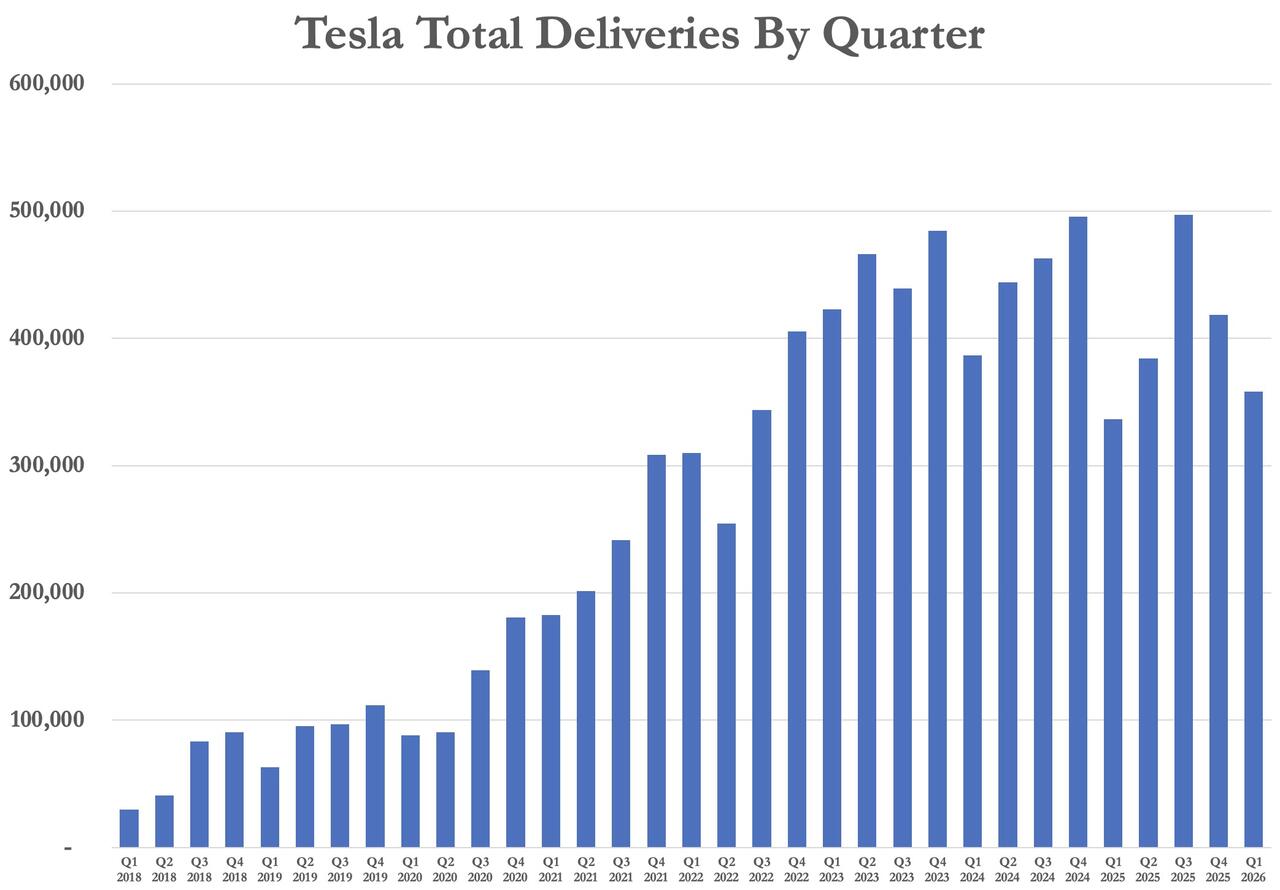
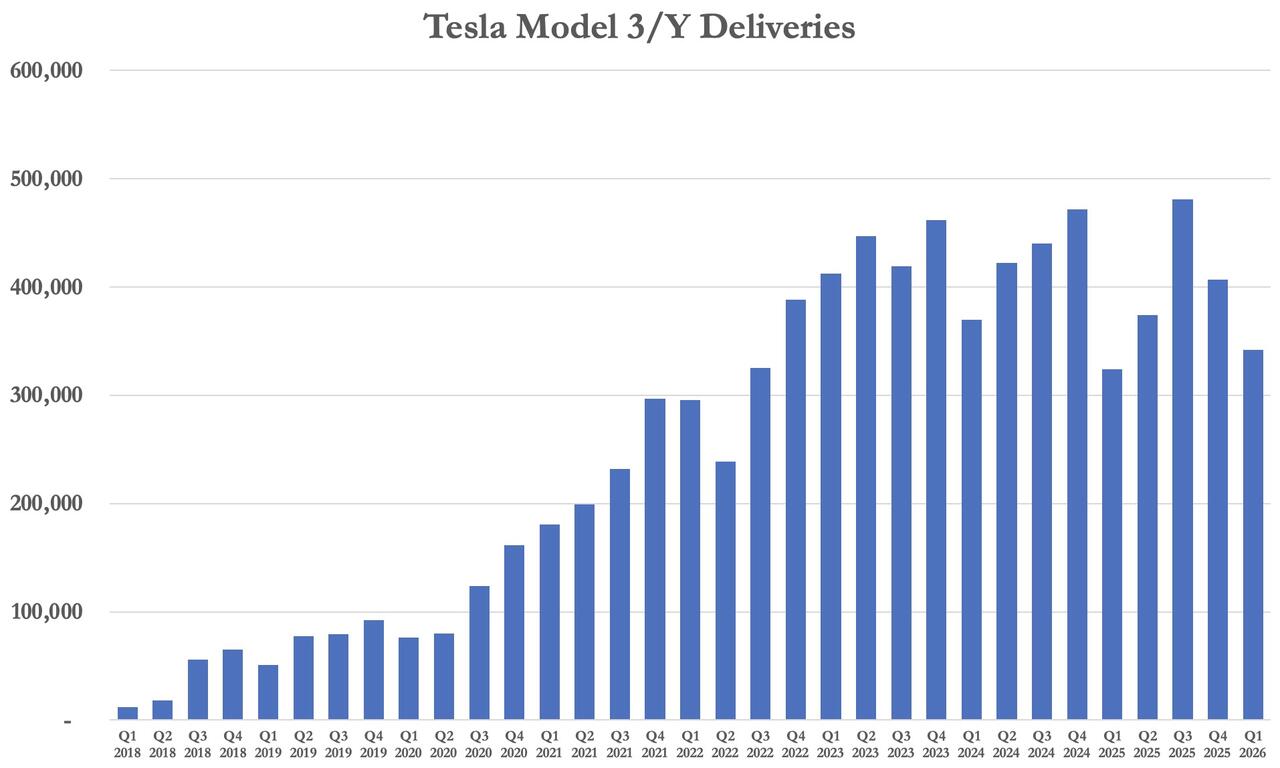
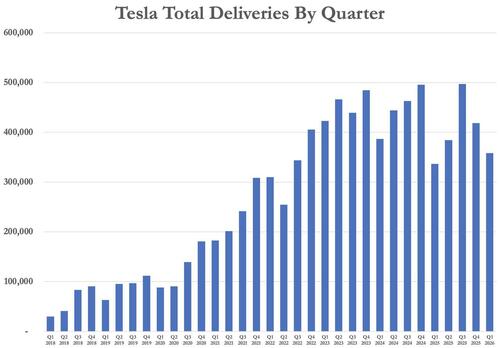
Tesla reported a disappointing first quarter, delivering 358,023 vehicles worldwide, falling short of Wall Street expectations of about 372,000, according to Bloomberg-compiled estimates and the company’s own release.
The miss marks Tesla’s second consecutive quarter below forecasts, underscoring continued pressure on its core automotive business as it navigates slowing electric-vehicle demand and a more competitive global market.
Despite the shortfall, deliveries were still up 6.3% year over year, benefiting from an easier comparison period when production of the Model Y was temporarily paused across multiple factories and the company faced consumer backlash tied to CEO Elon Musk. Even so, the results highlight the growing challenges Tesla faces in sustaining growth in its main revenue-generating segment, even as investor focus has increasingly shifted toward its longer-term bets on artificial intelligence, autonomous driving, and robotics.
As Bloomberg noted this week, a slower pace of growth may persist. Demand for EVs is cooling globally, US buyers no longer benefit from federal tax credits, and Tesla’s lineup is narrowing as Models S and X are phased out, all while competition intensifies.
“If they can show that there’s stability in the numbers without the tax credit — and they can, at least with the delivery number — I think that that would be a win,” said Gene Munster.
Notably, just days before reporting, Tesla had circulated a company-compiled consensus estimate suggesting deliveries of around 365,645 vehicles for the quarter.
That figure was based on forecasts from a wide range of sell-side firms, including Daiwa, Deutsche Bank, Cowen, Canaccord, Baird, Wolfe, Exane, Goldman Sachs, RBC, Evercore ISI, Barclays, Mizuho, Bank of America, Wells Fargo, Morgan Stanley, Truist, UBS, Jefferies, JPMorgan, Needham, HSBC, Cantor Fitzgerald, and William Blair.
At the time, Tesla emphasized that it does not endorse analysts’ projections, noting that the figures represent aggregated estimates rather than company guidance, with only prior quarters reflecting actual reported results.
Elon Musk said in a post on X on Wednesday that orders for the Model S and Model X have effectively ended, though some remaining inventory is still available. He added that there will be an official event to mark the close of the era, noting that he has a deep appreciation for those vehicles.
“We will have an official ceremony to mark the ending of an era. I love those cars,” Elon Musk said at the time.
Tyler Durden
Thu, 04/02/2026 – 09:35

Private Credit Bank Run Begins: Blue Owl Gates After Shocking 41% Of Tech Fund Investors Ask For Their Money
Private Credit Bank Run Begins: Blue Owl Gates After Shocking 41% Of Tech Fund Investors Ask For Their Money
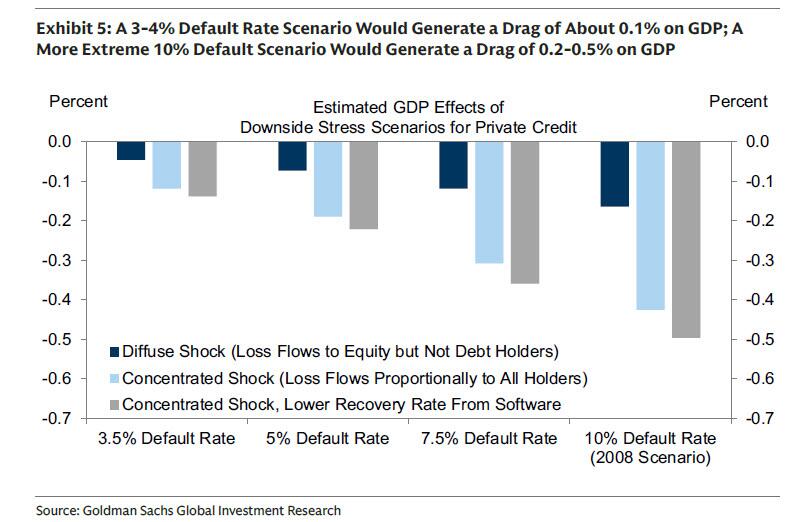
A week ago, in an attempt to calm the market, Goldman’s economists published a lengthy, if at times disjointed, report discussing why a crisis in private credit would not lead to another financial crisis.
We may be about to find out.
Recall that in mid-March, while attention was understandably focused on the Iran war, we explained why Blue Owl’s February decision to commence liquidations of loans in its three core private credit funds to fund current and future redemptions, was the industry’s “Margin Call” moment, to wit:
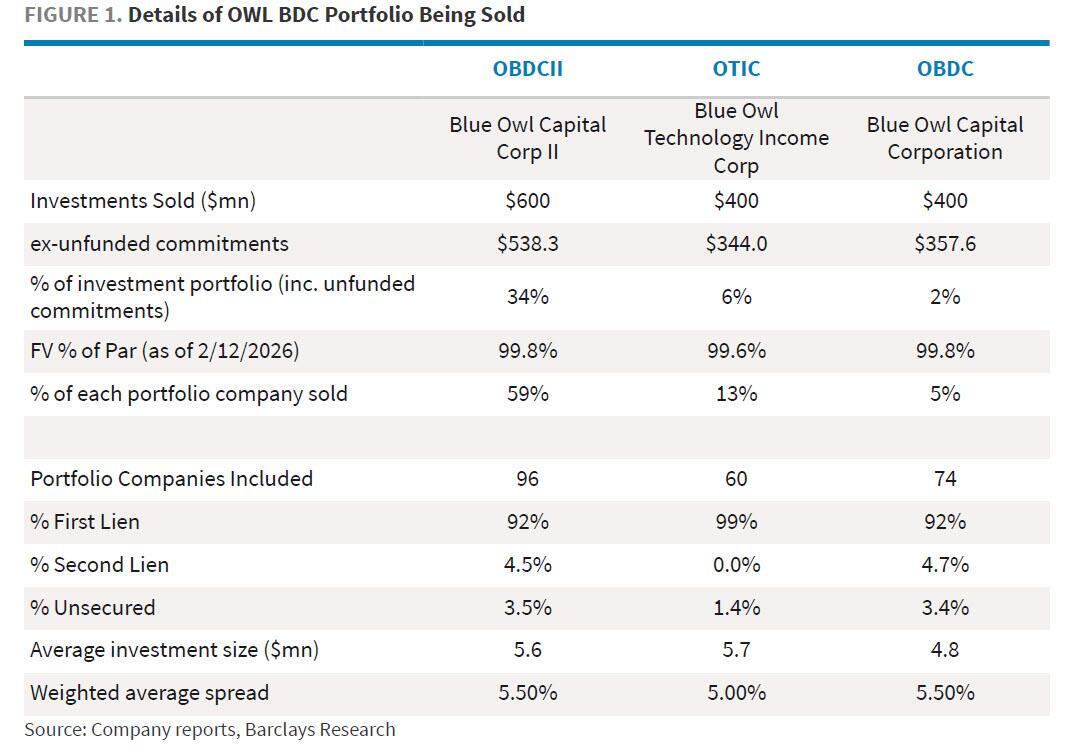
First it was Blue Owl, the largest pure play Private Credit fund with over $300 billion in AUM. The company, the first to face massive redemption demands, refused to gate investors and instead announced it would sell $1.4 billion in private loans (it was unclear which loans were sold, but Goldman suggested that these are likely the best ones so as to find willing buyers, leaving the company with the toxic sludge) from its three BDCs (OBDCII, OBDC and OTIC) at 99.7 cents (a number which was meant to inspire confidence yet was laughable, especially since once of the “buyers” was a related-party insurance company, Kuvare, also owned by Blue Owl), to satisfy redemption requests.
In our February 19 article describing the Blue Owl transaction, we said that “while it is unclear how deep the secondary market for private credit assets is, to the extent demand is relatively scarce, a transaction of this size could dry up market liquidity. If that assumption is true, other BDCs looking to exit portfolio investments could be jeopardized. Recall the immortal line from Margin Call: “Be First, Be Smarter, or Cheat.”
We then said that “this could very well be Blue Owl’s “Be First” moment… “Sell it all, today” especially if it were to later emerge that the secondary market is only deep for higher quality private credit assets, like the ones in the portfolio OWL is selling. In a concurrent report, Barclays warned that “if this transaction dries up secondary liquidity for private credit assets (or proves that the bid is only there for higher quality assets), it could be negative for other BDCs exploring portfolio sales.”
In retrospect, this is precisely when the “Margin Call moment” of the private credit sector happened, because what happened next would make the market’s head spin.
And unfortunately for Blue Owl, however, while the firm’s catastrophic practices and financial engineering was indeed the snowflake that started the avalanche in the broader private credit sector, it has now boomeranged on the company itself and may have well led to its demise when two months after desperately seeking to avoid gating redemptions, the private credit giant announced it will in fact limit redemptions from two of its private credit funds after facing a historic surge in withdrawal requests that is unprecedented among major firms in the $1.8 trillion market.
Redemption requests in Blue Owl’s marquee $36 billion Credit Income Corp. fund, one of the industry’s largest, soared to 21.9% in the three months ended March 31, according to an investor letter, up from “only” 5.2% in the prior period. But it was the smaller Blue Owl Technology Income Corp, which was at the center of the February turmoil, that was the real shock after its shareholders asked for a shocking 40.7% back, compared with 15.4% three months earlier, according to a separate letter.
Both funds had previously met the requests in excess of its 5% tender offer. This time, though, Blue Owl – whose actions sparked the crisis that is now sweeping across pricvate credit – said it would join industry peers in capping redemptions at that level, “in accordance with the fund structure, reflecting our commitment to balancing the interests of both tendering and remaining shareholders.”
For the bigger fund, OCIC, that amounts to $988 million of redemptions honored and about $3.2 billion remaining in the fund, while for OTIC it means redeeming $179 million and keeping roughly $1 billion of investors’ cash, according to Bloomberg.
Craig Packer, Blue Owl’s co-president, said in an investor update that he believed the uptick in redemptions reflected a “period of heightened negative sentiment toward the asset class that has intensified as peers have reported tender results”.
And why would their tender results be intensified one wonders? Would it have something to do with that pinnacle of financial engineering where Blue Owl dumped many of its best loans to a related entity? Maybe Craig thinks that his investors are all idiots, but as he just found out, they may be far smarter than him.
“While we believe market perception has driven elevated tender activity, underlying credit fundamentals across our portfolio have remained resilient,” he added. “We continue to observe a meaningful disconnect between the public dialogue on private credit and the underlying trends in our portfolio.”
In the letters, OCIC said 90% of its shareholders chose not to tender, reflecting concentrated withdrawal demands, which means it was driven by institutions not retail investors who have been frequently blamed for all the ills plaguing private credit.. OTIC said its redemption pressure “was amplified by the fund’s more concentrated shareholder base, particularly within certain wealth channels and regions, and its specialized investment mandate.”
Both Blue Owl funds, which have returned more than 9% annualized since inception (not all too different from how Bernie Madoff generated double digits returns until his ponzi scheme collapsed), said they’re in a “strong position” to meet the 5% redemption requests and future tenders. OCIC and OTIC had $11.3 billion and $1.3 billion, respectively, across cash, available borrowing and liquid Level 2 assets as of the end of February, according to the letters.
While Blue Owl joins industry peers including Apollo Global, Ares Management and BlackRock in sticking to their redemption threshold on non-traded business development companies, the staggering magnitude of the requests underscores how Blue Owl has found itself squarely in the middle of worries about private credit.
The limitation on outflows highlights the risks to individual investors who had flocked to so-called non-traded private credit funds over the past three years in periods of stress. Those wealthy individuals had been promised access to higher-yielding investments in exchange for limited liquidity. Now they are regretting it.
Private credit asset managers have diverged in how they have dealt with redemption requests, with some going to great lengths to cash out investors, while others have stuck to their limit. Still, no major manager has disclosed facing the percentage that Blue Owl’s BDCs were asked to pay back.
And with Blue Owl’s private credit business now effectively in wind down mode, and mothballing the entire private credit industry, one wonders where so many crappy small and medium (mostly tech) companies will get the funding to exist. But before that, one wonders more just how wrong Goldman’s analysis is that a private credit crisis won’t impact the broader economy. We’ll find out very soon.
Tyler Durden
Thu, 04/02/2026 – 09:18
Globalstar Soars On Amazon Buyout Report Amid Satellite Constellation Race
Globalstar Soars On Amazon Buyout Report Amid Satellite Constellation Race
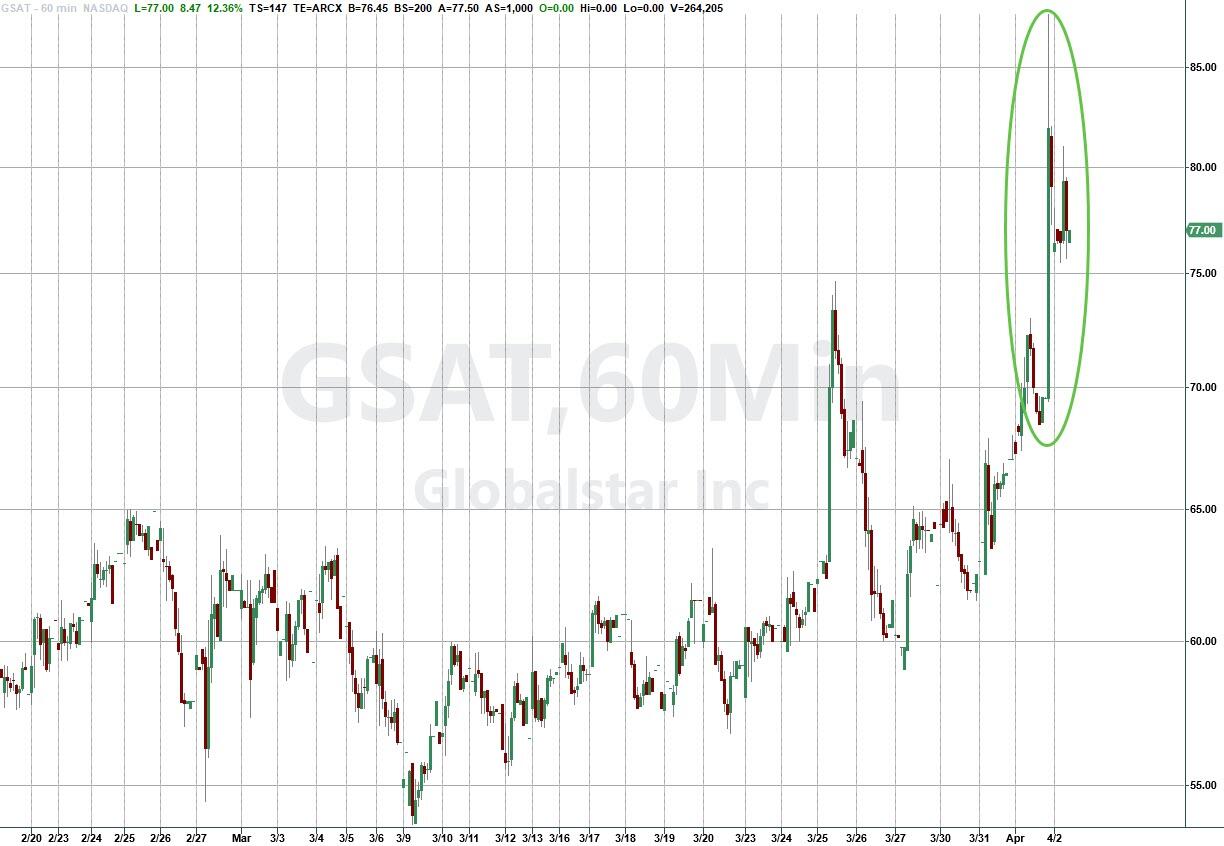
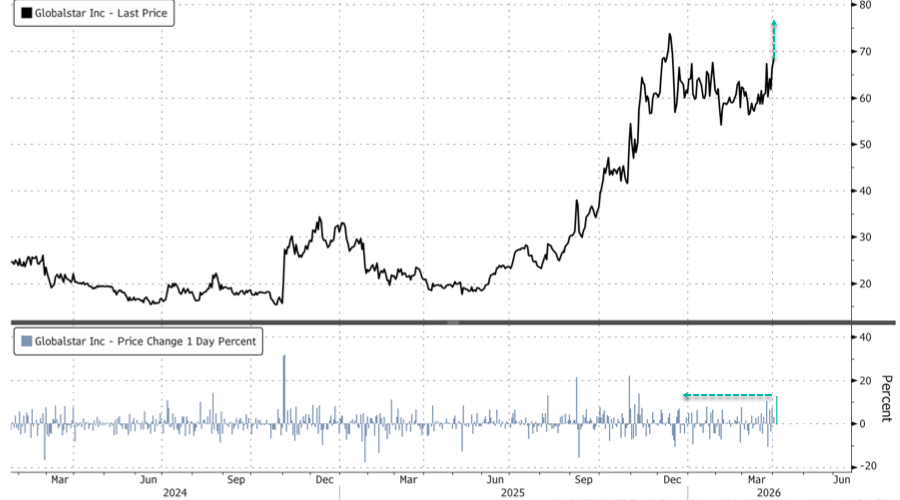
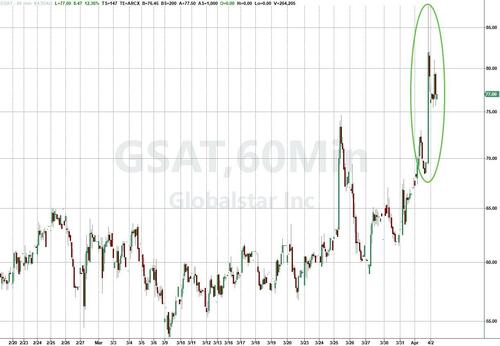
Globalstar shares surged 12% in premarket trading in New York…
…marking their biggest jump in nearly five months, after the Financial Times reported overnight that Amazon is in talks to acquire the satellite operator, a move that would certainly intensify the race to build satellite constellations.
The FT cited people familiar with the Amazon-Globalstar talks and said both sides are still negotiating over “some of the complexities,” including the fact that Apple owns a 20% stake in the satellite communications company, which operates 24 satellites in low Earth orbit, arranged in a Walker-24 configuration, and sells services for emergency messaging, asset tracking, remote voice/data links, and IoT connectivity in places where cell coverage is weak or nonexistent.
Globalstar powers Apple’s emergency satellite feature on iPhones, but that system is far more limited than the high-speed broadband network offered by SpaceX’s Starlink.
Amazon has deployed around 200 internet satellites into orbit as part of its Leo program, formerly called Project Kuiper. This is dwarfed by the more than 10,000 active satellites operated by Starlink, which provides high-speed internet to more than 10 million customers worldwide.
The rationale for Amazon buying Globalstar’s older, higher-orbit satellite constellation was not immediately explained in the FT report or by its sources familiar with the deal talks.
But our view is that a potential buyout of Globalstar could give Amazon a faster path to more infrastructure, customers, and operational know-how to scale its Leo program and become a real competitor to Starlink, which is years ahead of any competition and even nation-states.
Tyler Durden
Thu, 04/02/2026 – 09:15
Oil Nears War-Highs As Iran’s ‘Highest Bridge In Middle East’ Destroyed After Trump’s ‘Back To Stone Age’ Threat
Oil Nears War-Highs As Iran’s ‘Highest Bridge In Middle East’ Destroyed After Trump’s ‘Back To Stone Age’ Threat
Summary
Oil prices surge after no mention of ceasefire while vowing to keep hitting Iran ‘extremely hard’ in Wed. night Trump speech
US intelligence assessments say Iran is not ready to negotiate given it believes it has the strategic upper-hand, and doesn’t believe Trump is ‘serious’ about talks: NYT
Highest bridge in Iran, connecting Tehran and Karaj, destroyed – amid reports of expanding attacks on civilian infrastructure
UK’s Starmer chairs virtual summit of over 30 countries to discuss methods of how to reopen Hormuz Strait
* * *
Oil Prices Surge After Trump Vows To Hit Iran ‘Extremely Hard’ In Speech
“Tonight, Iran’s navy is gone, their air force is in ruins, their leaders, most of them… are now dead. Their command and control of the Islamic Revolutionary Guard Corps is being decimated as we speak,” President Trump stated in his address from the White House last night. “Their ability to launch missiles and drones is dramatically curtailed, and their weapons factories and rocket launchers are being blown to pieces, very few of them left.” Trump said further that the United States is “on the cusp of ending Iran’s sinister threat to America and the world.“
He declared that Israel and the United States are nearing their main goals in the war against Iran and that the conflict would end soon, though he gave no clear timeline. He repeatedly emphasized the war was close to finishing in his address, but didn’t define what ‘mission accomplished’ would look like exactly. The key thing is that no concrete timeline was given.
In the speech, Trump highlighted the “swift, decisive and overwhelming” blows delivered to Iran over the past four weeks, calling them “victories like few people have ever seen before.” He did not specify when operations would end but said the US would strike Iran “extremely hard” over the next two-three weeks while negotiations continue. There was more talk of sending Iran “back to the stone age” – after in the past declaring that the US would “help” them:
“We are going to hit them extremely hard over the next two to three weeks. We’re going to bring them back to the Stone Ages, where they belong.”
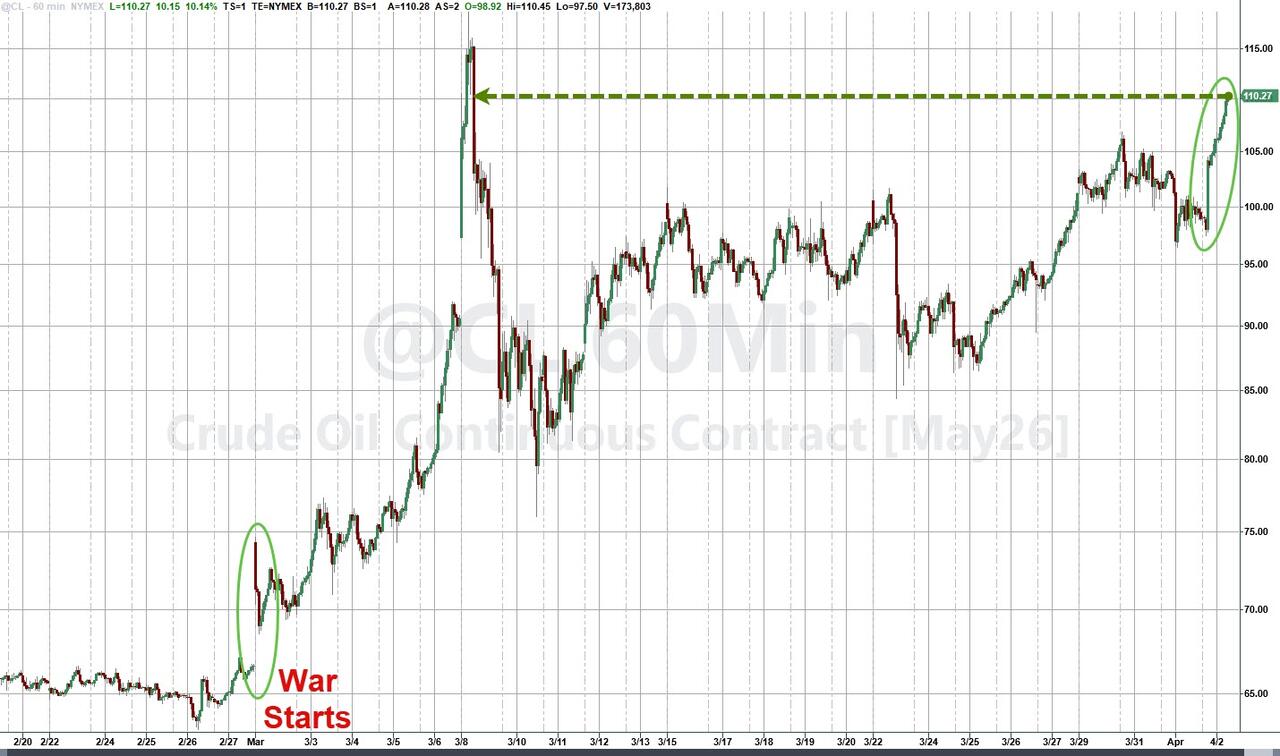
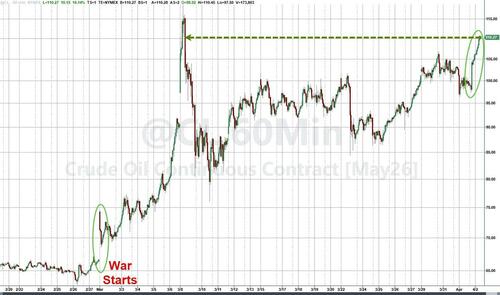
The result of all this was to send oil prices back near the highs since war started…
Iran is continuing to target US bases and assets across the region – even in Jordan and Israel (tech companies):
⚡️Insane video shows Iranian missile striking a US base in Jordan. pic.twitter.com/A56X10tSuq
— War Monitor (@WarMonitors) April 2, 2026
NYT: US Intelligence Contradicts Trump, Says Tehran Not Ready to Negotiate
The New York Times has meanwhile reported that several US intelligence agencies believe Iran is currently unwilling to engage in serious negotiations. “The assessments say the Iranian government believes it is in a strong position in the war and does not have to accede to America’s diplomatic demands, the officials said. And while Iran is willing to keep channels open, they said, it does not trust the United States and does not think President Trump is serious about negotiations,” NYT says.
However, there’s a glimmer of hope, per the report: “The Iranian government could engage diplomatically under the right conditions, said two Iranian officials and a Pakistani official. Tehran wants to see that Washington is willing to talk seriously about ending the war and not just negotiate a temporary cease-fire, they said. They added that the language in public statements from Iran has been harsher than that of private messages it has passed to the United States.”
More shifting war aims and objectives…
Three days ago Rubio omitted nuclear capabilities from the list of war aims. Now they are back on. Every day is an adventure. https://t.co/3LtzZ49kA5 pic.twitter.com/YBSAk0ewSD
— Shashank Joshi (@shashj) April 2, 2026
‘Highest Bridge in Middle East’ Hit by Airstrikes
There’s more evidence of US-Israeli attacks on Iran civilian infrastructure, as it’s being reported Thursday that fresh airstrikes hit a highway bridge connecting Tehran and Karaj, according to Fars News Agency. Several people were injured, and multiple areas of Karaj were also struck. The bridge was actually just constructed, having been inaugurated earlier this year.
Fars stated that the B1 bridge, dubbed the highest bridge in the Middle East, opened earlier this year. Tehran also continues to get pummeled hard, amid reports that the prior 24 hours saw the biggest wave of Iranian missiles and cluster munitions on Tel Aviv to date.
B1 bridge in Karaj has been hit in US-ISRAELI attacks.
This bridge is reportedly the “highest bridge in West Asia.” pic.twitter.com/rZUhmeT9ph
— Alireza Akbari (@itsalireza_akb) April 2, 2026
Operation Epic Fury seems to now be going after buildings and centers which play a vital role in terms of civilian infrastructure and maintaining day-to-day life in the country…
Established in 1920, the Pasteur Institute of Iran in Tehran is historically significant as the oldest leading public health and vaccine production center in the Middle East – Now its bombed pic.twitter.com/6ATW7wlmr8
— Alex Vatanka (@AlexVatanka) April 2, 2026
UK Gathers Over 30 Countries to Discuss How to Open Strait of Hormuz
Nearly three dozen countries are holding virtual meeting Thursday to coordinate diplomatic and political pressure to reopen the Strait of Hormuz. But notably the United States will not be represented in the virtual summit.
British Prime Minister Keir Starmer said the meeting, chaired by Foreign Secretary Yvette Cooper, “will assess all viable diplomatic and political measures we can take to restore freedom of navigation, guarantee the safety of trapped ships and seafarers and to resume the movement of vital commodities.”
Iranian attacks on commercial vessels and continued threats have halted nearly all traffic through the waterway linking the Persian Gulf to global oceans, cutting off a critical oil route and driving petroleum prices sharply higher – with some 16 or more tankers having been attacked so far, per Bloomberg estimates.
Aftermath of Wednesday drone strike on oil warehouse in the Kani Qirzhala area on the outskirts of Erbil, northern Iraq:
Meanwhile Qatar has submitted another letter to the UN demanding that Iran “provide compensation for all damages” and to cease its attacks on Gulf countries.
Tyler Durden
Thu, 04/02/2026 – 09:05