Category: News
Today in Chicago History: Chicago Bears suffer only loss of 1985 season to Miami Dolphins
Here’s a look back at what happened in the Chicago area on Dec. 2, according to the Tribune’s archives.
Is an important event missing from this date? Email us.
Weather records (from the National Weather Service, Chicago)
High temperature: 71 degrees (1982)
Low temperature: Minus 1 degree (1942)
Precipitation: 4.47 inches (1982)
Snowfall: 5.6 inches (1991)
Chicago Bears halfback Beattie Feathers in an undated photo. (Chicago Tribune historical photo)
1934: Chicago Bears rookie Beattie Feathers became the first professional to rush for 1,000 yards in a season (1,004), leading the NFL.
Enrico Fermi at the controls of a 100 million-volt betatron at the University of Chicago on May 2, 1950. (Chicago Tribune historical photo)
1942: Italian physicist and Nobel Prize winner Enrico Fermi and a team of physicists successfully tested a nuclear explosion under the grandstand of University of Chicago’s football stadium.
Vintage Chicago Tribune: The Atomic Age is born at the University of Chicago’s football stadium
A squash court under Stagg Field’s stands was available for the covert operation, the university having given up football. It was an appropriate site for initiating the Manhattan Project, the crash course that Franklin D. Roosevelt’s administration had decreed.
Chicago’s Dick Allen acknowledges the crowd on May 4, 1973, during a pregame ceremony in which the White Sox slugger was presented with the Most Valuable Player award for last season’s performance. With Allen is baseball writer Ed Munzel, center, and Sox Vice President Stu Holcomb. (Ed Feeney/Chicago Tribune)
1971: The Chicago White Sox traded pitcher Tommy John and infielder Steve Huntz to the Los Angeles Dodgers for Dick Allen.
In his three years with the White Sox, Allen hit .307 with 85 home runs and 242 RBIs, including a .308 average with 37 home runs, 113 RBIs, 99 walks and a .603 slugging percentage during his MVP season. He earned seven All-Star selections, including three with the Sox.
Allen, who died in 2020 at age 78, had 351 home runs, 1,119 RBIs and a .292 career average during a 15-year major-league career with the Philadelphia Phillies (1963-69, 1975-76), St. Louis Cardinals (1970), Los Angeles Dodgers (1971), Sox (1972-74) and Oakland Athletics (1977). During his 11-year peak (1964-74), Allen’s 165 OPS+ was the top in baseball.
He was elected to the National Baseball Hall of Fame in December 2024.
Edward Scholl, the former 41st Ward alderman and former state senator, at the Federal Building in Chicago on July 25, 1975. (Arthur Walker/Chicago Tribune)
1975: Chicago 41st Ward Ald. Edward Scholl was convicted of taking $6,850 in bribes from a contractor to permit zoning changes in his ward.
The Dishonor Roll: Meet the public officials who helped build Illinois’ culture of corruption
Scholl pleaded guilty in 1975 to filing false tax returns in 1971 and 1972 that were tied to accusations he took bribes from a contractor to permit zoning changes in his Far Northwest Side ward. He was sentenced to 18 months in prison. Scholl was a rare successful Republican politician in Chicago and was the youngest member of the Chicago City Council when he was first elected in 1963 at age 25. He was reelected in 1967 and 1971 before being elected to the state Senate in 1972. He lost a reelection bid for Senate in 1974.
The beginning of the final judging of Aberdeen Angus at the International Livestock Exposition in 1948 in Chicago. (Chicago Herald-American)
Also in 1975: The International Livestock Exposition closed at the International Amphitheatre for the last time. Lack of funds and diminishing attendance were given as reasons for the demise of the annual event, which began in 1900. It was considered the oldest annual convention in Chicago.
A rare Ross’ gull — “the rarest bird ever sighted in Chicago,” according to the Tribune — appeared at North Avenue Beach on Dec. 2, 1978. (Chicago Tribune)
1978: Bird watchers flocked to North Avenue Beach to catch a glimpse of a Ross’ gull, an extremely rare Siberian bird that had only been spotted once previously in the continental United States.
Snowy owls’ unusually early visit to Chicago lakefront could signal migratory boom
Another Ross’ gull appeared in Chicago in March 2023.
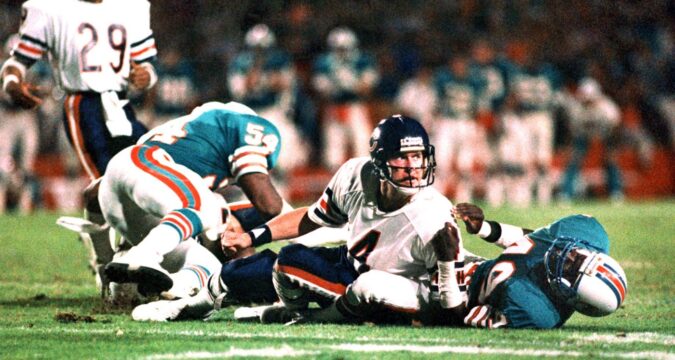
The Bears lost to the Dolphins 38-24 on Dec. 2, 1985, at the Orange Bowl in Miami. It was the Bears’ only loss of the season. (Chicago Tribune)
1985: The Miami Dolphins stopped the Bears’ bid for an undefeated season, winning 38-24 on one of the most-watched-ever “Monday Night Football” games. The game did a 29.6 rating and 46 share, meaning nearly half the nation’s televisions were tuned in.
Walter Payton set an NFL record with his eighth-straight 100-yard game, but the stat was lost in the loss.
Want more vintage Chicago?
Subscribe to the free Vintage Chicago Tribune newsletter, join our Chicagoland history Facebook group, stay current with Today in Chicago History and follow us on Instagram for more from Chicago’s past.
Have an idea for Vintage Chicago Tribune? Share it with Kori Rumore and Marianne Mather at krumore@chicagotribune.com and mmather@chicagotribune.com
https://www.chicagotribune.com/2025/12/02/chicago-history-december-2/

How A Generation of Women Was Misled About Hormone Therapy
How A Generation of Women Was Misled About Hormone Therapy
Authored by Jingduan Yang via The Epoch Times (emphasis ours),
“Was I misled?”
That’s the question I hear most from my patients lately—asked with anger, exhaustion, and the quiet devastation of women who wonder if they lost years of their lives to menopause symptoms they were told were untreatable.
The answer came earlier this month when the U.S. Food and Drug Administration announced it would remove “black box” warnings from hormone therapy products after 23 years. For many women, the reversal is an admission that arrives decades too late.
What Happened in 2002
In July 2002, preliminary data from the Women’s Health Initiative (WHI) were published in JAMA, showing that combined hormone therapy (estrogen and progestin) increased the risk of breast cancer, stroke, and pulmonary embolism. Major media outlets interpreted early signals from the study as definitive danger, and the announcement led to an instant and dramatic decline in the use of hormone therapy.
Women who had been sleeping well for the first time in years suddenly poured their medications into the trash. Pharmacies fielded calls from panicked patients demanding immediate discontinuation. Primary care doctors, most of whom had never been trained deeply in menopause management, told their patients to “stop now and ask questions later.”
Women did stop, and many suffered in silence for the next 20 years.
The FDA’s Historic Reversal
On Nov. 10, the FDA announced that it is initiating the removal of broad “black box” warnings referencing risks of cardiovascular disease, breast cancer, and probable dementia from hormone replacement therapy products for menopause.
When FDA Commissioner Dr. Marty Makary spoke publicly about the shift, he didn’t mince words. He said the media had frightened women away from a potentially life-changing therapy, and he noted the difference between estrogen-only therapy and synthetic combination regimens. He acknowledged, openly, that the “fear machine” had begun long before the scientific data had been fully understood.
He also said something that struck many women deeply: “After 23 years of dogma, the FDA is stopping the fear that has steered women away from this life-saving treatment.”
For many of my patients, that sentence felt like a validation they had waited half a lifetime to hear.
The Devil Is in the Details
The details that matter most sat quietly in the medical literature for years—in the 2002 article and the two follow-up studies published in 2011 and 2020 in JAMA.
The Study Population Was Older
Women recruited in the WHI study were all postmenopausal, aged 50 to 79 years, with an average age of 63—more than a decade past the onset of menopause. Most had not used hormones before, and many had cardiovascular risk factors.
The Hormones Were Synthetic
The adverse results found among older women taking combined conjugated equine estrogen and medroxyprogesterone acetate—both older, synthetic formulations developed in a different era—were generalized to all hormone therapy types and all age groups.
Estrogen-Only Therapy Showed Different Results
The estrogen-only group in the WHI study—women who had hysterectomies and therefore received estrogen without synthetic progestins—had a lower rate of breast cancer.
In the storm of fear that followed, no one wanted to hear nuance.
The Critical Factor
Yet even in the early 2000s, there were physicians who paused, confused because something about the reporting didn’t align with what they were seeing clinically. The hormones used in the WHI study weren’t the bioidentical estradiol and progesterone that many clinicians were already prescribing with good results. More importantly, the women who seemed to benefit most from hormone therapy were those who began it near menopause—not in older age.
Timing is critical. The body responds to estrogen very differently pre-menopause versus a decade post-menopause. After years of low estrogen, the blood vessels lose their flexibility, plaque accumulates, and metabolic changes settle in. The risk-benefit balance is fundamentally different for women who initiate hormone therapy at different ages.
This is what we in medicine now call the “timing hypothesis”—a concept that should have been central to every headline but was lost entirely.
And for two decades, women lived inside that headline and endured the consequences of fear and misinformation.
What Women Lost
The point is not that hormone therapy is perfect or appropriate for everyone. It’s that women were never given the chance to make an informed choice.
Women who begin hormone therapy earlier—ideally within 10 years of menopause—tend to experience improved sleep, reduced anxiety and irritability, and protection against bone loss.
Many report better cognition, improved cardiovascular markers, and enhanced sexual health and relationship well-being. Although spoken about more quietly, perhaps the most profound benefit is the simplest one: the return of themselves.
Takeaways
The new FDA guidelines do not signal a new fad or a sudden reversal. They mark a return to evidence-based medicine—the kind that millions of women should have received all along.
Hormone therapy is not appropriate for every woman, and it is not a cure-all. However, it is a powerful tool, and for the right woman at the right moment, it can restore a quality of life she thought she’d lost forever.
Our job now—as clinicians, as journalists, as a society—is to give women back what fear took from them: clarity, choice, and control.
Everything that follows in this series of columns will build on that mission.
Tyler Durden
Tue, 12/02/2025 – 05:00
https://www.zerohedge.com/medical/how-generation-women-was-misled-about-hormone-therapy

Hong Kong hará una investigación independiente sobre incendio mortal ante la presión pública
Por CHAN HO-HIM y KEN MORITSUGU
HONG KONG (AP) — Hong Kong formará un comité independiente de investigación encabezado por un juez para determinar la causa de un incendio mortal en un bloque de apartamentos que conmocionó a la ciudad y para hacer recomendaciones que eviten que una tragedia similar vuelva a ocurrir, afirmó su líder el martes.
John Lee, el jefe de gobierno de la región china, se comprometió a superar los intereses creados y lograr un cambio sistémico en la industria de la construcción. La policía informó el martes por la tarde que el número de muertos había aumentado a al menos 156 personas después de que se encontraran más cuerpos. Alrededor de 30 personas siguen desaparecidas.
“Debemos descubrir la verdad, asegurar que se haga justicia, permitir que los fallecidos descansen en paz y brindar consuelo a los vivos”, dijo a los periodistas en una conferencia de prensa semanal. “Queremos asegurarnos de que evitaremos que una tragedia así vuelva a suceder”.
El incendio comenzó el miércoles pasado en los andamios en el complejo Wang Fuk Court en el distrito de Tai Po y se extendió a siete de las ocho torres del complejo. Allí vivían más de 4.600 personas y muchas han quedado sin hogar. Cuarenta personas permanecen hospitalizadas, dijo Lee.
Hasta ahora, al menos 14 personas han sido arrestadas por el organismo anticorrupción de la ciudad y la policía, incluidos contratistas de andamios, directores de empresas y un consultor de ingeniería, mientras las autoridades investigan la sospecha de corrupción y negligencia en un proyecto de renovación en el complejo de viviendas.
La investigación inicial se ha centrado en por qué el incendio se expandió tan rápidamente, superando los esfuerzos de extinción.
Lee se negó a comentar sobre los reportes de los medios de comunicación sobre detenciones el fin de semana pasado en lo que algunos vieron como un intento de sofocar las críticas al gobierno, incluida una persona que supuestamente estaba involucrada en una petición que pedía responsabilidad gubernamental y fue arrestada bajo sospecha de incitar a la sedición. Lee solo dijo que “no toleraré ningún delito, especialmente los delitos que explotan la tragedia que enfrentamos ahora”.
Las autoridades han citado tanto los fuertes vientos como los materiales de baja calidad utilizados para el trabajo de mantenimiento.
Se descubrió que los contratistas estaban utilizando redes de baja calidad, dijeron las autoridades el lunes. Entre las 20 muestras de redes que los investigadores recolectaron en el complejo, se encontró que siete no cumplían con los estándares de seguridad.
Lee dijo que los responsables habían mezclado redes de baja calidad con materiales homologados para engañar a los inspectores.
Todo el sistema de renovación de edificios en Hong Kong será reformado, prometió.
John Burns, profesor honorario de política y administración pública en la Universidad de Hong Kong, dijo que los resultados de la investigación probablemente serán creíbles ya que el gobierno busca tranquilizar al público.
“Es de interés para todos que el proceso y los resultados de las investigaciones sean creíbles”, dijo Burns. “La transparencia es crucial para restaurar la confianza”.
Lee dijo que 2.500 personas han sido trasladadas a unidades de vivienda transitoria, algunas en viviendas del gobierno y otras en hostales y hoteles. Alrededor de 20 personas permanecen en refugios que albergaron a cientos en la primera noche.
___
Moritsugu informó desde Beijing.
___
Esta historia fue traducida del inglés por un editor de AP con la ayuda de una herramienta de inteligencia artificial generativa.

Rick Steves’ Europe: Oslo, where Norway’s nature, history and culture mix it up
A big statue of a tiger sits in front of the train station of Norway’s capital, Oslo. A local once explained that Oslo is nicknamed “Tiger City” because, in the 19th century, when country boys would visit this wild and crazy “New York City of Norway,” it would “make a mark on their soul.”
I find Oslo more of a kitten than a tiger. Its mix of grand Neoclassical facades, boxy ’60s-style modernism, pastoral parks, and homogenous culture have always felt a bit tame for my taste. But dig deeper, and you’ll find more texture here – from wild new buildings on its people-friendly harborfront to troubled artists.
The city’s grand boulevard, Karl Johans gate, cuts from the train station through the center of town to the Royal Palace. It’s lined with restaurants, parks, and landmarks – including Oslo Cathedral, Parliament, and Stortorvet Square, with its lively flower and produce market.
A boulevard highlight is the venerable Grand Café, once the meeting place of Oslo’s intellectual and creative elite. At the back of the café, a mural shows Norway’s literary and artistic clientele enjoying this fine hangout, from playwright Henrik Ibsen (who came in every day at 13:00) to Edvard Munch, Norway’s most famous and influential painter.
Munch’s work is featured on Oslo’s waterfront, in the new Munch museum – the biggest art museum in Europe dedicated to a single artist. Munch helped to pioneer a new style, Expressionism, using lurid colors and bold lines to “express” inner turmoil and the angst of the modern world. His most iconic painting is The Scream, which he described as“ the work of a madman.”
The Munch building is one example of Oslo’s efforts to make its fjord more people-friendly. In the past, you would have dodged several lanes of traffic to get here – but now, most traffic has been diverted through tunnels. As in many European cities, residents are reclaiming their waterfront.
Next door to Munch is the marble Opera House, which seems to rise like an iceberg from the sea. This is the only opera house in the world that doubles as a public plaza, with a roof designed to be a theater itself – where locals gather to enjoy the sun, fjord views, and concerts. Opened in 2008, this creative cultural venue is a huge hit. I once joined 8,000 others on the rooftop to watch a fast-rising pop band perform on…the water. (Their stage was a raft anchored just offshore.)
Further west along the harbor stands Oslo’s striking City Hall, famous for hosting the Nobel Peace Prize ceremony. Completed in 1950 to celebrate the city’s 900th birthday, the building was an avant-garde thrill in its day. Entering here, I’m reminded that in this most highly taxed corner of Europe, city halls (rather than churches) are the dominant buildings. While the state religion is Lutheran, people rarely go to church. Instead, they seem to almost worship good government… In fact, the main hall actually feels like a temple.
Walking – or cycling – along Oslo’s harbor is a great way to enjoy the city’s fjord-side setting and re-envisioned harborfront. A series of info kiosks creates an inspiring DIY tour route, celebrating how Oslo turned an industrial wasteland into a thriving, green, and welcoming residential district.
The fjord itself is another top attraction. There are plenty of expensive private cruise options, but the best deal is just to hop on a ferry. These public boats do a roughly hour-long loop of the Oslo fjord, and you can decide whether you want to stay on for the whole thing (this works great with a picnic lunch), or hop off to explore any of Oslo’s five islands. If you’re short on time, Hovedøya, featuring the ruins of a 12th-century Cistercian Abbey, is the most worthwhile. Rides are just $4 (free with the Oslo City Pass), and depart from in front of City Hall.
Once you’ve docked back in Oslo proper, head to Frogner Park – a short tram ride away. This not only offers a great peek at locals at play, but also features a fine sculpture garden showcasing a lifetime of work by Norway’s greatest sculptor, Gustav Vigeland.
From 1924 to 1943, Vigeland created a world of bronze and granite statues – around 600 nude figures in all. The centerpiece is a teeming monolith of life, with 121 figures carved out of a single block of stone rocketing skyward. Vigeland left his beloved city a park filled with stoney and thought-provoking insights into the bittersweet cycle of life.
Related Articles
Travelers without Real ID will incur $45 fee, TSA says
Airlines work to fix software glitch on A320 aircraft and some flights are disrupted
Bruce Goff is having a moment
Rick Steves’ Europe: The sips and sounds of a Greek taverna
The shutdown is over. Flights have resumed. Thanksgiving travelers might wonder: What now?
Norwegians don’t get much summer, so they practically live outdoors when the weather finally turns nice. And, from its new people-friendly waterfront to spacious Frogner Park, Oslo has made it easy for locals and travelers alike to enjoy a delightful urban mix of the city’s unique story and great outdoor spaces.
(Rick Steves (www.ricksteves.com) writes European guidebooks, hosts travel shows on public TV and radio, and organizes European tours. This column revisits some of Rick’s favorite places over the past two decades. You can email Rick at rick@ricksteves.com and follow his blog on Facebook.)

The Kitchn: The secret to impossibly fluffy Southern-style biscuits
Southern biscuits are the perfect fictional device for telling the narratives of Southern families. One cook makes his biscuits with White Lily flour only because that’s how his Maw Mae did it. Another swears by lard, as her family never had the funds for high-dollar butter or shortening. Most Southern cooks bake biscuits at least once a week — a ritual and rite of passage as the recipe is handed down through the generations.
My biscuit recipe is much the same. As a transplant to the South, and married into a Southern family, I felt a steep sense of duty in making the perfect Southern biscuit. Truth be told, I don’t think I’ll ever truly master it, but 10 years after taking biscuits to task, I’ve landed on a reliable recipe that I can replicate here in the South or anywhere else in the country with ease. My biggest piece of advice: Don’t take biscuit-making too seriously, but try to make them regularly. The ingredients are relatively inexpensive and the results are always edible, despite any mishandling.
Why you’ll love these biscuits
They’re tender and flaky. These Southern-style biscuits walk the line of being both tender AND flaky.
They’re light, yet sturdy. The biscuits are also sturdy enough for breakfast sandwiches or for dunking into soup.
What are Southern-style biscuits?
The terms “tender” and “flaky” are often used together to describe baked goods like pie dough and biscuits (although very few biscuits are both). Here are the key differences.
Tender biscuits: Tender describes a small tight crumb, similar to a muffin. A tender biscuit requires a relatively wet dough that can be hard to knead, so much so that tender biscuits are almost exclusively drop biscuits.
Flaky biscuits: Flaky biscuits, on the other hand, bring to mind the biscuits from a can that can be peeled apart into distinct layers. Homemade flaky biscuits are folded onto themselves repeatedly until the layers are developed, making them decidedly tougher than tender biscuits.
The best Southern-style biscuits are both tender AND flaky, using a combination of techniques and ingredients like buttermilk. Buttermilk is commonly used in Southern-style biscuits for its tangy flavor, plus buttermilk helps biscuits rise when paired with baking soda.
What type of flour should I use for Southern-style biscuits?
In the past, I relied on the recipe on the back of the bag of White Lily self-rising flour. It felt like a cheat at first, but I started to learn that biscuit-making was much less a recipe than a technique, and a practice in balancing being both gentle with the dough, yet working it enough to get a high rise and a few flaky layers.
Now that I’ve got the technique down, I’ve moved away from using White Lily self-rising flour and mostly keep King Arthur all-purpose flour on hand for baking. I think my biscuits are better with an everyday all-purpose flour plus leavening agents like baking powder and baking soda.
Key ingredients in Southern-style buttermilk biscuits
All-purpose flour: Use the all-purpose flour you have on hand.
Baking powder and baking soda: These are the leavening agents that make the biscuits light.
Unsalted butter: Freeze the butter beforehand so that you can grate it easily.
Buttermilk: The baking soda reacts with the acid in buttermilk to help the biscuits rise.
Tips for making Southern-style buttermilk biscuits
When the dough is folded onto itself into a smooth dough, this is where the magic happens. By striking a balance between folding and patting the dough, you can turn a tender dough into a flaky biscuit. Here are some tips for making the best Southern-style buttermilk biscuits.
Keep the butter as cold as possible. This is why I call for frozen butter to be grated on a box grater. Room temperature varies widely in the South, but I can count on frozen butter to be cold and stay cold while I make the biscuits.
Use whatever flour you have on hand. I’ve moved away from using White Lily and mostly keep King Arthur on hand for baking. I think my biscuits are better with an everyday all-purpose flour than any special flours.
Work quickly. Biscuits are a quick everyday bread. If it takes you longer than 20 minutes to get your biscuits in the oven, you’re probably doing something extra that you don’t have to do.
Southern-Style Buttermilk Biscuits
Makes 6 large biscuits
2 cups (10 ounces) all-purpose flour, plus 1/4 cup more for dusting
2 teaspoons baking powder
1/2 teaspoon baking soda
1/2 teaspoon kosher salt
1 stick (4 ounces) unsalted butter, frozen
1 cup buttermilk
1. Arrange a rack in the middle of the oven and heat to 450 F.
2. Whisk 2 cups (10 ounces) all-purpose flour, 2 teaspoons baking powder, 1/2 teaspoon baking soda, and 1/2 teaspoon kosher salt together in a medium bowl; set aside.
3. Place a box grater over a small piece of parchment paper. Grate one stick (4 ounces) frozen unsalted butter on the large holes of a box grater. When you get down to a small nub of butter, chop that nub into five to six small pieces.
4. Use the piece of parchment paper to transfer the butter to the dry ingredients. Use your fingers to sift the butter into the flour and break up any clumps of grated butter.
5. Pour in 1 cup buttermilk and beat it in with a wooden spoon until the dough comes together and pulls away from the sides of the bowl.
6. Transfer the dough to a lightly floured cutting board. Pat the dough into a 1-inch-thick rough rectangle. Sprinkle the dough with a little more flour, if needed.
7. Fold the dough in half from top to bottom, then pat it back down into its original shape.
8. Repeat with the folding and patting, alternating folding from each side, the bottom, and the top until you have completed a total of eight folds. At the end, the dough should be a little springy to the touch.
9. Pat the dough into a 1-inch thickness. Use a 3-inch round cutter to cut the dough into six biscuits. If you don’t get 6 the first time around, refold and pat down the excess dough and cut more as needed. Discard the scraps of leftover dough.
10. Arrange the biscuits in a 10-inch cast iron skillet so that the biscuits touch each other, but not the sides of the pan. Put the skillet in the oven and increase the oven temperature to 500 F. Bake until the biscuits are golden-brown, 15 to 18 minutes.
11. Remove the skillet from the oven and immediately remove the biscuits from the pan to a clean tea towel.
Recipe notes: Leftover biscuits can be stored in an airtight container at room temperature for up to three days. Warm in a low oven or toast in a toaster oven.
(Meghan Splawn was the food editor for skills content for TheKitchn.com, a nationally known blog for people who love food and home cooking. Submit any comments or questions to editorial@thekitchn.com.)
©2025 Apartment Therapy. Distributed by Tribune Content Agency, LLC.
https://www.chicagotribune.com/2025/12/02/southern-style-biscuits/

Incertidumbre y suspicacia en Honduras por conteo electoral a cuentagotas
Por MARLON GONZÁLEZ
TEGUCIGALPA (AP) — A medida que pasaban las horas y que el Consejo Nacional Electoral (CNE) en Honduras seguía sin divulgar el total del escrutinio de la elección presidencial del domingo, crecía la incertidumbre entre los electores.
Dos días después de los comicios, todavía no había un resultado claro en los comicios presidenciales, dilatado por el mecanismo del ente electoral para contabilizar las actas de la votación.
El último corte de resultados se emitió el lunes al mediodía y luego la consejera presidenta del CNE, Ana Paola Hall, anunció el cierre del Sistema de Transmisión de Resultados Electorales Preliminares (TREP). La institución tiene un plazo de 30 días para contabilizar los datos definitivos.
El último resultado divulgado por el CNE mostraba que, con el 57.03% de las actas contabilizadas, dos candidatos opositores, los conservadores Nasry Asfura y Salvador Nasralla, mantenían un empate técnico.
Asfura, de Partido Liberal, presentaba 749.022 votos (39.91%), lo que representa una ligera ventaja de 515 votos sobre Nasralla, del Partido Liberal, que obtenía 748.507 votos (39.89%).
En tercer lugar aparecía la candidata oficialista del partido de izquierda Libertad y Refundación (Libre), Rixi Moncada, quien obtenía 359.584 votos, lo que representa apenas el 19.16%.
Los candidatos a la cabeza de la votación exigieron por separado al CNE que no siga reteniendo los resultados.
“Hay un 47 por ciento (de las actas) que no han ingresado”, dijo Nasralla, que atribuyó a un problema técnico el retraso en la actualización.
Sin embargo, dijo que él tenía en su poder las actas que demuestran su triunfo sobre el candidato nacionalista.
De su lado, Asfura también aseguró tener las actas que lo dan como ganador, pero llamó a sus seguidores a esperar.
“Tengamos calma, los datos van a salir… y cuando salgan van a ser iguales a los que nosotros manejamos”, dijo Asfura, conocido como Papi a la Orden.
El conteo a cuentagotas también ha comenzado a generar suspicacia y a revivir el miedo que generan los fantasmas del pasado.
Durante las elecciones generales de 2017 Nasralla se presentó como candidato presidencial y perdió contra el candidato del Partido Nacional Juan Orlando Hernández, en unas votaciones marcadas por las denuncias de fraude.
Tras divulgarse los primeros resultados de la votación que mostraban a Nasralla a la cabeza, se registró un apagón en el servicio de electricidad en el país y tras ese percance Hernández emergió en la delantera del escrutinio y terminó cantando victoria.
A la incertidumbre que hay en el país, se sumó un nuevo comentario del presidente de Estados Unidos, Donald Trump: “Parece que Honduras intenta alterar los resultados de sus elecciones presidenciales. ¡Si lo hacen, se armará un escándalo!”, escribió en su cuenta de Truth Social.
“Es imperativo que la Comisión termine de contar los votos. Cientos de miles de hondureños deben contar sus votos. ¡La democracia debe prevalecer!”, añadió.
No obstante, las autoridades del CNE explicaron que todas las actas serán divulgadas y cotejadas posteriormente con las que tienen los partidos en contienda.
Según explicaron los resultados que se dieron a conocer, es decir, el 57,03%, corresponde solo a las actas que fueron escaneadas y transmitidas vía internet al centro de acopio del CNE.
El 47 por ciento que falta por contabilizar corresponde a las actas que fueron escaneadas y no pudieron ser transmitidas al CNE o que definitivamente no pudieron ser escaneadas.
Todas esas actas tendrán que llegar al Centro Logístico Electoral (CLE), donde se realizará un escrutinio especial y luego un escrutinio general.
El CNE tiene un plazo de 30 días para contabilizar, procesar y subsanar inconsistencias en todas las actas electorales, previo a presentar la declaratoria final de las elecciones.
“Debemos guardar calma, tener paciencia y esperar que como CNE terminemos de contabilizar actas”, expresó Hall en X.
De su lado, la consejera del CNE Cossette López, explicó que ese organismo recibirá los datos, como lo harán todos los partidos políticos que participaron en los comicios.
“Hay que aclarar que nosotros hacemos variaciones de importancia con la ley, a veces los partidos políticos suman actas que tiene inconsistencias, mientras que nosotros no lo hacemos y tenemos que subsanar todo eso antes de hacer una sumatoria que podemos reportar a la población con contundencia”, expresó López.
Sobre el proceso electoral en general, la Misión de Observación Electoral de la Organización de los Estados Americanos (MOE/OEA), felicitó al CNE y a la población por el buen desarrollo de los comicios.
Entre otras de sus recomendaciones, pidió a Honduras “robustecer la infraestructura para la divulgación de resultados con recursos eficientes, para evitar la denegación de servicios, intermitencias y caídas de la página web, garantizando la disponibilidad del servicio”.

Which Countries Prescribe The Most & Least Antibiotics?
Which Countries Prescribe The Most & Least Antibiotics?
World Antimicrobial Resistance (AMR) Awareness Week ended last week.
Antimicrobials are medicines used to prevent and treat infectious diseases. These can be used on humans, animals and plants and come in the forms of antibiotics, antivirals, antifungals and antiparasitics.
Although resistance to these medicines occurs naturally, due to genetic changes in pathogens over time, this process can be exacerbated when humans use antimicrobials too frequently or do not finish a course fully. The result can be deadly, with dangerous strains of bacteria endangering lives and threatening the ability to treat common infections and, as a result, to perform life-saving procedures from cancer chemotherapy to caesarean sections.
As Statista’s Anna Fleck details below, a recent report by the OECD highlights significant disparities in antibiotic prescribing practices across countries.
You will find more infographics at Statista
Among those providing data, Greece had the highest prescription rate in 2023, with 26.7 defined daily doses (DDDs) per 1,000 people.
This is well above the OECD average of 16 DDDs and nearly three times the level seen in Sweden and the Netherlands, where the rates were 8.7 and 8.8 DDDs per 1,000 people, respectively.
While the volume of antibiotics prescribed has generally decreased across most OECD countries, Finland (-5.8 DDDs/1,000) and Canada (-5.6 DDDs/1,000) have shown the greatest reductions since 2013.
The OECD states that antibiotics should only be prescribed when supported by clear evidence.
Antibiotic resistance can also build up through more indirect means, such as via eating the meat of live feed that has been treated with antibiotics, or consuming meat or dairy products contaminated with antibiotic resistant pathogens.
Data from 2020 shows that countries such as Thailand, China and Australia rely on the practice of giving animals antibiotics far more heavily than nations including Norway, Sweden and the United Kingdom.
Tyler Durden
Tue, 12/02/2025 – 04:15
https://www.zerohedge.com/medical/which-countries-prescribe-most-least-antibiotics

Los asesinatos masivos en EEUU alcanzan su nivel más bajo desde 2006
Por REBECCA BOONE
Un tiroteo el fin de semana pasado que dejó cuatro muertos en una fiesta de cumpleaños infantil en California fue el 17mo asesinato en masa de este año, el número más bajo registrado desde 2006, según una base de datos mantenida por The Associated Press y USA Today en colaboración con la Universidad Northeastern.
Los expertos advierten que el descenso no significa necesariamente que los días más seguros hayan llegado para quedarse y que podría simplemente representar un retorno a niveles promedio.
“Sir Isaac Newton nunca estudió el crimen, pero dice ‘lo que sube debe bajar’”, James Alan Fox, criminólogo de la Universidad Northeastern, afirma. “El actual descenso en los números es más probablemente lo que los estadísticos llaman una ‘regresión a la media’”, dijo, lo que supone un retorno a niveles de crimen más promedio después de un aumento inusual en los asesinatos en masa en 2018 y 2019.
“¿Veremos una disminución en 2026? No apostaría por ello” dijo Fox. “Lo que baja también debe volver a subir”.
Los asesinatos en masa, definidos como incidentes en los que cuatro o más personas son asesinadas en un período de 24 horas, sin incluir al asesino, se rastrean en una base de datos mantenida por The Associated Press y USA Today en colaboración con la Universidad Northeastern. Fox, quien gestiona la base de datos, dice que los asesinatos en masa disminuyeron alrededor de un 24% este año en comparación con 2024, lo que también representó una caída de aproximadamente un 20% en comparación con 2023.
Los asesinatos en masa son inusuales, y eso significa que los números son volátiles, dijo James Densley, profesor de la Universidad Estatal Metropolitana en Minnesota.
“Debido a que solo hay unas pocas docenas de asesinatos en masa en un año, un pequeño cambio podría parecer una ola o un colapso” cuando en realidad es solo un retorno a niveles más típicos, apuntó Densley. “2025 se ve realmente bien en un contexto histórico, pero no podemos pretender que eso signifique que el problema ha desaparecido para siempre”.
Sin embargo, hay algunas cosas que podrían estar contribuyendo a la disminución, dijo Densley, como un descenso general en las tasas de homicidio y crimen violento, que alcanzaron su punto máximo durante la pandemia de COVID-19. Las mejoras en la respuesta inmediata a los tiroteos masivos y otros incidentes de víctimas masivas también podrían estar desempeñando un papel, dijo.
“Tuvimos el horrible tiroteo en la Escuela de la Anunciación aquí en Minnesota en agosto, y ese caso ni siquiera encajaría en la definición de asesinato en masa porque solo hubo dos personas muertas pero más de 20 heridas”, comentó. “Pero sé por la respuesta en el terreno aquí, que la razón por la que solo murieron dos personas es por el control de hemorragias y la respuesta al trauma por parte de los servicios de emergencias. Y sucedió a las puertas de algunos de los mejores hospitales infantiles del país”.
El crimen es complejo, y los académicos no son muy buenos para evaluar las razones detrás de los cambios en las tasas de criminalidad, dijo Eric Madfis, profesor de justicia penal en la Universidad de Washington-Tacoma.
“Es multicausal”, dijo Madfis. “Nunca va a ser solo una cosa. La gente todavía debate por qué las tasas de homicidio bajaron en los años 90. Es cierto que la violencia armada y las muertes por violencia armada han disminuido, pero todavía tenemos tasas y números extremadamente altos de tiroteos masivos en comparación con cualquier otro lugar del mundo”.
Más estados están dedicando fondos a evaluaciones de amenazas escolares, con 22 estados que han ordenado esa práctica en los últimos años, dijo Madfis, y eso podría estar previniendo algunos tiroteos escolares, aunque no tendría un impacto en los asesinatos en masa en otros lugares. Ninguno de los asesinatos en masa registrados en la base de datos hasta ahora en 2025 tuvo lugar en escuelas, y solo se registró un asesinato en masa en una escuela en 2024.
Aproximadamente el 82% de los asesinatos en masa de este año involucraron un arma de fuego. Desde 2006, 3.234 personas han muerto en asesinatos en masa, y el 81% de ellas fueron víctimas de disparos.
Christopher Carita, un exdetective del Departamento de Policía de Fort Lauderdale y especialista en capacitación senior de la organización de seguridad de armas 97Percent, dijo que la Ley de Comunidades Más Seguras aprobada en 2022 incluyó millones de dólares de financiamiento para programas de protección contra la violencia armada. Algunos estados usaron el dinero para crear apoyos sociales a personas en riesgo de cometer violencia, y otros lo usaron para cosas como programas de seguridad y evaluación de amenazas. Esa flexibilidad ha sido clave para reducir las tasas de violencia armada, dijo.
“Siempre se ha enmarcado como un ‘problema de armas’ o un ‘problema de personas’ y eso ha sido muy polémico. Siento que por primera vez, estamos viendo la violencia armada como un problema de ‘ambos, y’ a nivel nacional”, apuntó Carita.
Emma Fridel, profesora asistente de criminología en la Universidad Estatal de Florida, advirtió que centrarse en eventos extremos como los asesinatos en masa corre el riesgo de “no ver el bosque por mirar los árboles”.
“Si miras las muertes por armas de fuego, tanto en homicidios como en suicidios, los números son asombrosos” afirmó. “Perdemos la misma cantidad de personas cada año por violencia armada que el número de bajas que experimentamos en la guerra de Corea. La causa número uno de muerte para los niños son las armas”.
“Los asesinatos en masa deben verse como una parte del problema, en lugar del efecto de interés”, dijo.
___
Esta historia fue traducida del inglés por un editor de AP con la ayuda de una herramienta de inteligencia artificial generativa.
Britain Is Lost
Britain Is Lost
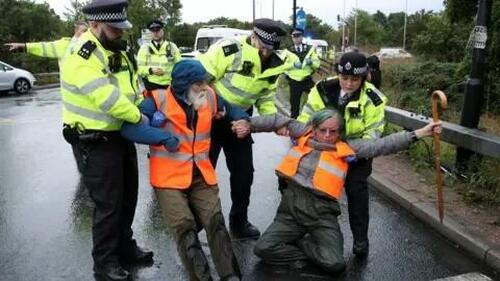
A recent interview Tucker Carlson had with George Galloway, a long-time member of the British Parliament and with a show himself in Britain, who was recently detained at the border under terrorism charges for, apparently, the opinions broadcast on his show.
No nation has fallen quicker or more completely than Britain into the totalitarian mindset.
It’s why we highlighted this aspect of modern Europe into the film Deconstruction.
Britain, as long as it pursues the same oppression of free speech as the Soviet Union, can not be called or considered an ally of the United States.
This is what we have to decide as a people, the American people, who will and who will not be our allies. Governments, especially now, are poor judges of character. They will hold onto traditional alliances, when those alliances have long been strained, simply because they would be unsure of what that would do to international relationships. If we lose Britain, France and Germany as allies, what effect does that have on NATO?
My question, however, is what damage does continued alliances with nations who punish their people for what they have said, posted or broadcast do to international perception? Are we not tarnished by their brush? Yes. It also signals that the United States is not determined to uphold the right to free speech. That in order to maintain these alliances will betray their own people.
As Britain, France and Germany turn toward implementing a police state to support immigrants who rape and kill their sons and daughters, put protesters in jail and silence not only their own citizens, but any who arrive through the internet, can they still be considered allies of a free nation? No. So, how free is that “free” nation? It is not free as it supports and continues alliances with nations diametrically opposed, not only to free speech, but a series of democratic principles.
The battle taking place within the European nations draw a stark contrast to the Central and Eastern European nations, formerly Soviet client states, who distance themselves from European Union dictates that promote illegal migration and the silencing of objectors.
The whole idea of democracy comes from the idea that the people have a say in who governs them and the policies they impose. When freedom of speech is so blatantly outlawed and only approved narratives permitted, there is no democracy. I don’t know what sort of government Britain has, but it is not a democracy as it claims. Yes, I know it’s technically a Monarchy, but the King or Queen has nowhere near the political power they once held.
All of this centers around illegal migration, it’s where people like Keir Starmer intend to derive their power, in the end. If he supports the replacement population when it is unpopular to do so, they might look kindly on him when the Islamists take full control of the politics, but he is a useful idiot.
They continue to put forth the idea that a declining birthrate is the reason for the importation of these migrants, but if European and American birthrates are dropping, as it is in all Western societies, it would seem that the logical conclusion would be to outlaw abortion, not import rapists and murderers.
But that’s not the reason. It isn’t the birthrate, it’s an attempt to forever change politics that eliminates the right, the Christians. This point was made clear by Viktor Orban in the film Deconstruction that’s coming out soon.
Communists and Islamists work well together. They have the same goal, supremacy through murder and imprisonment of an uncompliant populace. Democracies must tolerate the naysayers, the critics, that’s the difference. It won’t be long and the UK will be an Islamic nation, just as Iran became an Islamic nation. Are they still allies of the US? If so, why are not all Islamic nations allies? Because Islamic nations are at war with the US. “Death to America” does not seem like the pronouncement of an ally. Will it be heard across Britain, while we still consider it a close ally? Of course.
The United States had better figure this out, too. The only true allies the US has in Europe are the Central and Eastern European nations.
They are also the ones that need more protection from Russia and China, because, as smaller economies, they can’t afford to be too choosy about who they do business with and the more that the United States can be a better economic partner, the stronger we will all be.
The world is changing rapidly and our government is incapable of keeping up with the pace. It has to be led by the people.
The film Deconstruction makes this point.
Here’s a trailer that we’ve produced that gives one a sense of where we’re going with the message of the film.
It’s important, because a lot of changes are coming down the pike and if we don’t build some sort of resistance mechanism by which the people will have an increasing say in what policies our government promotes, all is lost. Governments can’t understand issues as quickly as the people can. When the internet came along, the government did not prevent corporations from using and selling information required to establish an account. They did nothing, now it’s just a land of pillage and plunder, unless one spends an inordinate amount of time protecting oneself from it.
AI is coming and the government is not in a position to be able to control it, or protect its citizens from being victimized. Already, I get AI solicitations for marketing my books. No human has read the books and has come up with the information about them. I delete those, even though they are quite complimentary about my work. I don’t want anything to do with AI, or as little as I can tolerate. I don’t want anything to do with AI film production, even though it can be a lot cheaper and quick to produce.
There’s value in simply rejecting what is obviously detrimental to the people. Who gains form AI? Just corporations. Yes, it might be slightly more convenient, but is that worth the ultimate sacrifice of a doomed economy, soaring electric costs and depleted water resources? Not to me.
The need to fight back is urgent. And I expect my warnings to go unheeded, as always. The average person is much too willing to give up, to not fight it when everyone in a position of power decides something. This was illustrated during the pandemic. A lot of us knew it was a false flag, that what they were saying was untrue, that masks didn’t help, that the vaccine wasn’t even a vaccine, but a DNA altering injection. Yet, everywhere I went, people just lined up and took it, accepted the ridiculous distancing and mask wearing.
We’re now in for a lot of that, because it was not ridiculed out of existence from the very beginning. That’s the power of the people, the ability to ridicule nonsense. Finally, slowly, the whole transgender nonsense is losing potency due to that very ridicule that we all possess naturally. Use it.
Views expressed in this article are opinions of the author and do not necessarily reflect the views of ZeroHedge.
Tyler Durden
Tue, 12/02/2025 – 03:30

El impacto de la IA podría agravar las brechas entre ricos y pobres, según informe de la ONU
Por ELAINE KURTENBACH
BANGKOK (AP) — Detrás del revuelo en torno a las promesas de la inteligencia artificial se encuentran realidades difíciles, como la forma en la que esta tecnología podría afectar a las personas ya desfavorecidas en un mundo impulsado por datos.
Un nuevo reporte del Programa de las Naciones Unidas para el Desarrollo señala que la mayoría de los beneficios de la IA probablemente serán aprovechados por las naciones ricas, a menos que se tomen medidas para utilizar su poder para ayudar a cerrar las brechas en el acceso a necesidades básicas, así como a conocimientos avanzados.
El informe publicado el martes compara la situación con la “Gran Divergencia” de la revolución industrial, cuando muchos países occidentales experimentaron una rápida modernización mientras otros se quedaban atrás.
Las preguntas sobre cómo las empresas y otras instituciones utilizarán la IA son una preocupación casi universal, dado su potencial para cambiar o reemplazar algunos trabajos realizados por personas con computadoras y robots.
Pero mientras gran parte de la atención dedicada a la IA se centra en la productividad, la competitividad y el crecimiento, la pregunta más importante es qué supondrá para las vidas humanas, señalan los autores.
Es un problema para las comunidades donde la mayoría de las personas todavía tienen problemas para acceder a capacitación, energía eléctrica y conectividad a internet, como es el caso de personas mayores, personas desplazadas por la guerra, el conflicto civil y los desastres climáticos. Al mismo tiempo, estas personas pueden ser “invisibles” en datos que no las tendrán en cuenta, dijo el informe.
“Como tecnología de propósito general, la IA puede aumentar la productividad, impulsar nuevas industrias y ayudar a los rezagados a ponerse al día”, señaló el reporte.
Aplicaciones como mejores consejos sobre agricultura, análisis de radiografías en segundos y diagnósticos médicos más rápidos, pronósticos meteorológicos más efectivos y evaluaciones de daños resultan prometedoras para las comunidades rurales y áreas propensas a desastres naturales.
“Los sistemas de IA que analizan la pobreza, la salud y los riesgos de desastres permiten decisiones más rápidas, justas y transparentes, convirtiendo los datos en aprendizaje continuo y valor público”, apuntó el documento.
Aun así, incluso en naciones ricas como Estados Unidos, el potencial de los centros de datos para consumir una parte demasiado grande de electricidad y agua ha generado preocupaciones. Aumentar la generación de energía para satisfacer una mayor demanda puede obstaculizar el progreso en la limitación de las emisiones de carbono de la quema de combustibles fósiles que contribuyen al calentamiento global, al tiempo que causan riesgos para la salud.
La tecnología plantea preocupaciones éticas, de privacidad y ciberseguridad: los investigadores han encontrado hackers que utilizan la IA para automatizar partes de los ciberataques. También existe el problema de los deepfakes, montajes a partir de imágenes de personas reales que pueden desinformar o facilitar actividades delictivas.
Naciones asiáticas como China, Japón, Corea del Sur y Singapur están bien posicionadas para aprovechar las herramientas de IA, señala el informe, mientras que lugares como Afganistán, Maldivas y Myanmar carecen de habilidades, energía confiable y otros recursos necesarios para aprovechar el potencial informático de la IA. Las desigualdades entre regiones dentro de los países significan que algunos lugares, incluso en economías avanzadas, son propensos a quedarse atrás.
Aproximadamente una cuarta parte de la región de Asia-Pacífico carece de acceso a internet, dice el informe. Si no se cierran estas brechas, muchos millones pueden quedar excluidos de los tipos de dispositivos, sistemas de pago digital, identificaciones digitales y educación y habilidades que se requieren para participar plenamente en la economía global. Pueden quedar “varados en el lado equivocado de una economía global impulsada por la IA”, dice.
Otros riesgos incluyen la desinformación y la información errónea, la vigilancia que viola los derechos a la privacidad y los sistemas que pueden actuar de forma opaca, reforzando los prejuicios contra minorías u otros grupos. Por lo tanto, la transparencia y regulaciones efectivas son salvaguardas cruciales para garantizar que la IA se utilice de manera justa y responsable, dice.
“La IA se está convirtiendo en la próxima infraestructura esencial de la región, como la energía, las carreteras y las escuelas, con beneficios más rápidos y riesgos más agudos”, dice el informe, instando a los gobiernos a invertir más en proporcionar infraestructura digital, educación y capacitación, competencia justa y protecciones sociales.
“El objetivo”, dice, “es democratizar el acceso a la IA para que cada país y comunidad pueda beneficiarse mientras se protege a aquellos más en riesgo de disrupción”.
___
Esta historia fue traducida del inglés por un editor de AP con la ayuda de una herramienta de inteligencia artificial generativa.