Category: News

Review: ‘Jacob Marley’s Christmas Carol’ leans into Dickens’ language and the supernatural
Mix Dickens with Dante, then sprinkle in some offbeat celestial humor à la “Good Omens,” and you’ll get something like “Jacob Marley’s Christmas Carol.” Written by Tom Mula, this solo play follows the travails of Ebenezer Scrooge’s late business partner as he navigates the afterlife, which involves a surprising amount of paperwork. Now onstage at Lifeline Theatre, this minimalist production blends the snarky, the sweet and the supernatural.
Solo retellings of classics are in vogue across the Anglophone theater world (see Andrew Scott’s “Vanya,” Eddie Izzard’s “Hamlet” and Sarah Snook’s “The Picture of Dorian Gray”), and I’ve grown somewhat skeptical of this genre’s dramatic value. No matter how well done, such adaptations often seem intended to showcase the star’s acting prowess rather than shed new light on an old story.
Happily, that’s not the case with this production, in which Lifeline ensemble member Phil Timberlake reprises the 19 roles that earned him a Jeff Award nomination last season. To be sure, Timberlake impresses with his range of dialects, facial expressions and physicality as he nimbly hops between characters, but this feat never feels self-indulgent. Rather, the simple staging evokes the Victorian oral tradition of telling ghost stories at the holidays, a prime example being Dickens’ own public readings of “A Christmas Carol.” Plus, Mula’s script offers enough idiosyncrasies and plot twists to be engaging on its own merit, even if built on familiar scaffolding.
Given that Mula first wrote this story as a novella (published in 1995 by Adams Media) and NPR later broadcast an audio version, it makes sense that the stage adaptation, which premiered at the Goodman Theatre in 1998, relies more on language than visuals. With plenty of evocative descriptions in the dialogue, this production requires a vivid imagination from audience members — a refreshingly analog, aural experience in our digital-oriented, image-saturated world. Indeed, the only credited designer is production manager and lighting designer Diane Fairchild, whose effects range from soft starlight to ghastly greens.
When Marley awakens in the afterlife, he encounters a setting that’s oddly familiar to the former moneylender: a dreary counting house, where a decrepit record keeper informs the dead man that he’s deep underwater on the contract he was meant to fulfill in life. Readers of Dickens’ novella may recall that Marley’s ghost despairingly declares that, in life, “Mankind was my business,” a realization that comes too late for him. Mula takes this metaphor to its logical end, envisioning a comedically bureaucratic purgatory and hell in which Marley is given one last chance to redeem his own soul: before the next daybreak, he must effect a sincere change of heart in Scrooge.
With the companionship of an impish spirit, who prefers the archaic moniker of “bogle,” Marley sets out on this seemingly impossible task. When an initial visit to Scrooge in his own ghostly guise doesn’t do the trick, Marley returns in the form of a Cockney boy and claims to be the Ghost of Christmas Past. That’s right: in this play, ghosts can shapeshift, and Marley is present, in some way or another, with each of Scrooge’s otherworldly guests.
Mula clearly tries not to rehash too many scenes of Christmases past, present and future from the original, and one of his more creative solutions is to take Marley on a journey through his own past while Scrooge is separately engulfed in his respective memories. The plot meanders and the pace lags a bit in the second act, but the Bogle’s sassy commentary and the fast-approaching dawn ultimately keep Marley on track.
While Mula leans into Dickens’ supernatural elements and retains his wholesome themes, his world-building is altogether more fantastical and whimsical. There’s a delightfully folkloric quality to the Bogle and the universe he inhabits that reminds me of Susanna Clarke’s “Jonathan Strange & Mr Norrell” or Oliver Darkshire’s “Isabella Nagg and the Pot of Basil,” one of my favorite fantasy novels of the past year. I could almost swear that Mula, a longtime Chicago artist who starred as the Goodman’s Scrooge in the 1990s, moonlights as a British fantasy author.
All this to say: tonally, “Jacob Marley’s Christmas Carol” was a pleasant surprise to me, and it’s a clever twist on a well-trod story. I suspect the show would benefit from a shorter runtime with no intermission, but nevertheless, what Mula and Timberlake achieve here is quite charming.
Emily McClanathan is a freelance critic.
Review: “Jacob Marley’s Christmas Carol” (3 stars)
When: Through Dec. 21
Where: Lifeline Theatre, 6912 N Glenwood Ave
Running time: 1 hour, 55 minutes
Tickets: $45 at lifelinetheatre.com
https://www.chicagotribune.com/2025/12/03/review-jacob-marley-carol/

2025 Holiday Cookie Contest winners announced
For the 39th annual Tribune Holiday Cookie Contest, 32 readers submitted recipes for sweet treats, including biscotti and shortbread, bars and balls, and classic chocolate chip and sugar cookies. Some recipes were decades old, passed down from grandparents, aunts, neighbors and friends, and tweaked as the years have gone by.
We saw takes on viral flavors, such as Dubai chocolate, and classic holiday flavors, including gluhwein and eggnog. Some entries included more nontraditional cookie ingredients, such as avocado and hummus, while others embraced classic seasonal spices, such as nutmeg and cinnamon. Some recipes had roots in Jewish, Czech and Italian traditions.
More than 1,800 readers cast over 3,800 votes to decide the 12 finalists that Tribune staffers baked for judging. Guest judges Justin Lerias of Del Sur, Reema Patel, previously of Sarima Cafe, and Asa Balanoff Naiditch of Blame Butter selected Janet Lapen’s Pracny-Inspired Nut Crescents as this year’s top cookie.
“Many people may not be familiar with the pracny cookie,” Balanoff Naiditch said, “so it could be a new experience for a lot of people.”
She praised the cookie’s versatility, noting that bakers could customize it to their preference by using different nuts or flavored sugar.
“It’s a homey cookie that you eat and feel warm inside,” Patel said. “It’s a well-done classic cookie, the texture and flavor are perfect, and I could eat five with a coffee.”
For the second-place treat, an Eggnog Crème Brûlée Cookie by Lauren Wagner, the judges praised the cookie’s concept, with Balanoff Naiditch noting that it perfectly captured festive winter vibes of snowflakes with the glaze and a cozy fireplace with the torched sugar topping.
“It’s a unique cookie that you could find in a bakery,” Lerias said. “I liked the texture, the crack of the creme brulee top and the soft cookie underneath. It was so obvious what it was and the flavor was there.”
For the third-place recipe, Elyse Tish’s MMMM Cookies (Mom’s Mandelbread modified for Marty), the judges praised the flavor combination of chocolate and orange.
Thank you to all the readers who submitted recipes and voted in this year’s contest. We love this cozy holiday tradition, and hope these recipes are a delicious addition to your gatherings this holiday season and beyond.
— Kayla Samoy, food editor
The 12 finalists
Mutty’s Holiday Hug Cookies by Carl Ioos of Vernon Hills
Apricot Squares Cookies by Gail Schneiderman of Wilmette
Cinnamon Pumpkin Pillow Cookies by Sarah McLoud of Gurnee
Cinnamon Sugar Cookies Decorated with Almond Royal Icing by Tracy McDonald of Plano
Pracny-Inspired Nut Crescents by Janet Lapen of Downers Grove
Eggnog Crème Brûlée Cookies by Lauren Wagner of Joliet
Decadent Almond Bars by Janet Malone of Munster, Indiana
Christmas Holiday Biscotti by Raymond Orsolini of Villa Park
Chocolate Surprise by Cathy Lenkaitis of Peru
Sharon’s Dark Chocolate Toffee Bars by Sharon McHugh of Chicago
Grandma Viola’s Christmas Jewish Butter Cookies by Jeff Hale of Chicago
MMMM Cookies (Mom’s Mandelbread Modified for Marty) by Elyse Tish of Glenview
First place
Janet Lapen: Pracny-Inspired Nut Crescents
The 39th annual Tribune Holiday Cookie Contest first-place winner Janet Lapen, of Downers Grove, with her Pracny-inspired nut crescents. Lapen learned the recipe when she was 6 and has been making the cookies for over 60 years. (Dominic Di Palermo/Chicago Tribune)
“It’s a spice cookie,” said Janet Lapen of Downers Grove, our first-place winner. “With clove and cinnamon, and a little bit of cocoa.”
Her recipe for the winning Pracny-Inspired Nut Crescents was adapted from a childhood holiday cookie called pracny, pronounced PRATS-ny, in Czech.
Lapen, 68, has been making the original recipe for more than 60 years with her best friend and neighbor Marion Nyhoff. It was Nyhoff’s mother, Blanche Mohus, who taught the girls how to bake pracny when they were 6 years old, in their old neighborhood in Forest Park.
“The recipe was like a pound of butter, a pound of nuts, a pound of powdered sugar,” said Lapen, a retired operating room nurse. “What made them so special were the molds.”
A neighbor lady had a collection of little individual metal cookie molds, which they all borrowed. Mohus herself learned how to make the traditional cookie as a young girl from that neighbor.
The dough had to be made a day before, then pressed into a thin layer to line the molds. The pracny would bake into crisp, fragrant and nutty shells.
The cookie molds were so treasured that they were willed to Mohus, who would pass them on to her daughter. She still has the molds, and bakes with her best friend, along with their daughters, who remember the woman who became known as Grandma Blanche.
But Lapen wanted to create a recipe that’s easier and doesn’t require inherited cookie molds.
“I tried with this cookie two years ago,” she said. That recipe for Grandma Blanche’s Deconstructed Pracny Cookie was a finalist in 2023. “And I kind of just zhuzhed it up a little bit for this year’s cookie.”
The Tribune holiday cookie contest first-place winner, the Pracny inspired nut crescents by Janet Lapen of Downers Grove. (Brian Cassella/Chicago Tribune)
The pracny she once made is not the same cookie that her recipe has become.
“I chop the nuts a little bit coarser instead of finely grinding them,” said our baker, who uses walnuts instead of the original hazelnuts, and simply shapes the dough into a crescent. “It’s crunchy and just a lovely texture.”
Her Pracny Inspired Nut Crescents are a wholly different cookie, she added, but the flavors have stayed the same.
“I’m so very humbled by it all,” said Lapen, mother to two adult daughters. Kaitlyn Lapen is a doctor, and Chloe Lapen is a 3D artist. Our baker’s husband, Bob Lapen, died of cancer at 59 in 2013.
“And I’m a five-year cancer-free survivor too,” she said.
This year for her holiday treats, she’s planning to make a pecan square, a fudge and the date nut breads for which she’s been known among family and friends, that is, until her first-place winning recipe.
“I’m tickled pink about the whole thing,” said Lapen. “I feel like I’m going to be immortal now.”
— Louisa Kung Liu Chu
Second place
Lauren Wagner: Eggnog Crème Brûlée Cookies
Lauren Wagner, of Joliet, with her Eggnog Crème Brûlée Cookies on Nov. 17, 2025, was awarded second place in the 39th annual Tribune Holiday Cookie Contest. (Terrence Antonio James/Chicago Tribune)
Inspired by her husband’s random purchase of a blowtorch, Lauren Wagner did what any proper home baker would do: Create a recipe just to use the blowtorch.
Wagner, a Joliet resident and mental health therapist, loves using eggnog in her baked goods as an ode to her family’s favorite Christmastime drink. But she hadn’t nailed down an eggnog-inspired cookie yet. When her husband turned up with a torch, she immediately thought, “I could brûlée the tops!”
“I tied together (the flavors of) creme brûlée with eggnog with a crackly caramelized topping for the cookies — it’s a fun one,” Wagner, 33, told the Tribune.
The cookie contest gave her another excuse to bake, she said, noting that she often uses baking as a way to unwind and decompress. As a young girl, Wagner said she spent countless hours in the kitchen with her mom, who would bring home tools and techniques from her Wilton baking and decorating classes. Wagner’s grandma was always around, too, effortlessly throwing together layer cakes and fruit pies.
The Tribune holiday cookie contest second-place winner, the Eggnog Crème Brûlée Cookies by Lauren Wagner of Joliet. (Brian Cassella/Chicago Tribune)
Wagner’s second-place winning cookie captures the cozy flavors Wagner grew up with — sweet, creamy, warm with a touch of spice. In addition to the usual flour, leavening agents, sugar and butter, the soft cookie has a dash of nutmeg and a one-fourth cup of eggnog. Rum extract is optional, but Wagner said she loves the addition. For the creme brûlée element, a couple tablespoons of eggnog are whisked into powdered sugar to create a glaze, which is then sprinkled with a sugar and nutmeg mixture before the blowtorch treatment. (If you don’t have a blowtorch, Wagner suggests popping the cookies under an oven broiler for a minute or less.)
Wagner said the recipe reminded her that traditions don’t have to stay the same to be special.
“It’s a blend of my family’s favorite winter drink and my love of baking, a recipe that bridges generations,” she said. “When I crack through the brûlée top and taste the creamy sweetness underneath, I’m right back in that kitchen — three generations laughing, baking and sharing a glass of eggnog on a cold winter day.”
— Zareen Syed
Third place
Elyse Tish: MMMM Cookies (Mom’s Mandelbread Modified for Marty)
Elyse Tish, of Glenview, the third-place winner of the 39th annual Tribune Holiday Cookie Contest, on Nov. 18, 2025 with her MMMM cookies. (Terrence Antonio James/Chicago Tribune)
After her husband, Marty, described her mother’s favored mandelbread recipe as “hard enough to pound nails,” Elyse Tish took on a challenge to develop the recipe she entered this year.
Our judges awarded her Mom’s Mandelbread Modified for Marty third place for its classic orange-and-chocolatey flavor combination. They suggested elevating its profile by infusing espresso powder.
But Tish said her husband doesn’t drink coffee. He likes Pepperidge Farm’s orange-flavored Milano cookies, so she modeled the flavor after them. Her mandelbread cookie is soft, dense and leagues away from hammer-like, tough or crunchy: “The MMMM recipe melts in your mouth,” she wrote in her recipe submission essay.
The Glenview resident was nervous for her first entry to face stiff competition in the cookie contest, yet she made an effort on social media to encourage friends and family to vote her into the top 12 finalists.
“I actually have been playing with this recipe for years,” Tish said. “This is because I don’t bake cookies regularly. I’m not a regular homemaker. I’m a retired lawyer. I work as a lifeguard.”
Tish, 63, keeps herself busy beyond lifeguarding. She’s involved with her synagogue and the League of Women Voters, takes continuing education classes and has been married to Marty, who’s also a lawyer, for 35 years. They have a 30-year-old son who lives in Evanston.
She thinks her recipe is the kind a casual home baker can manage well, and it’s not too exotic or complicated, save for finding candied orange peel.
The icing is the latest addition to the recipe that took five years to perfect. Orange zest infused in the icing lends to the cookie’s fruity profile and adds a touch of sweetness, and a simple swirl makes it look pretty on a cookie tray, Tish said.
The Tribune holiday cookie contest third-place winner, the MMMM cookies, Mom‘s Mandelbread modified for Marty, by Elyse Tish of Glenview. (Brian Cassella/Chicago Tribune)
She suggests icing the mandelbread after thawing and baking if preparing the recipe ahead of time. The icing part can be done in less than five minutes to make it fancier for a spontaneous visitor.
“I also think that makes it very special, because nobody, nobody puts icing on mandelbread. That is not a thing,” she said.
Though the chocolate mandelbread is not at all like the traditional Jewish cookie, or the one her late mother Blossom Skolnick made, she said she bakes it to remember her at her best, when she’d host neighbors over for coffee for hours on end at her home in Skokie.
“What my mother was really good at was making people feel welcome,” Tish said. “That idea that if somebody drops by, there’s always cookies in the freezer that you can just thaw out.”
“Now I’m sharing this little piece of that hospitality with another generation,” she said.
— Lauryn Azu
Recipes
The cover of the Chicago Tribune’s book “Holiday Cookies, Second Edition.” (Chicago Tribune)
To get the recipes for this year’s winning cookies, read our story here. For more winning cookie recipes from all four decades of the Tribune’s Holiday Cookie Contest, grab a copy of our cookbook, “Holiday Cookies, 2nd Edition,” at chicagotribune.com/holidaycookies.
Big screen or home stream, takeout or dine-in, Tribune writers are here to steer you toward your next great experience. Sign up for your free weekly Eat. Watch. Do. newsletter here.
https://www.chicagotribune.com/2025/12/03/2025-cookie-contest-winners/
Letters: Don’t blame President Donald Trump for border crosser’s avoidance of deportation
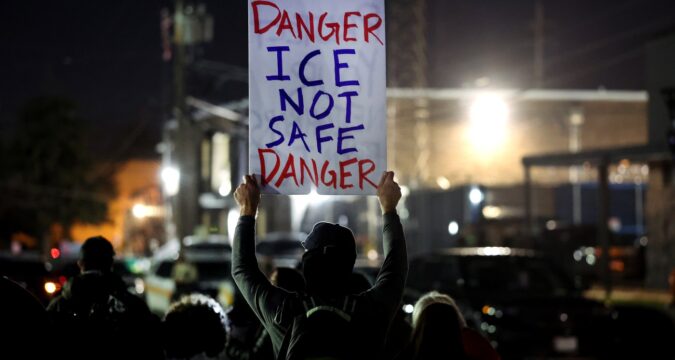
Regarding the article “A border crosser. An execution killing. And political theater.”: I cannot believe the lengths reporters Joe Mahr and Gregory Royal Pratt go to to try to somehow blame President Donald Trump for not getting this accused killer off the street. It’s a hit piece that makes no sense whatsoever.
They state that ”Democratic policies for sure helped him stay on the streets,” and then in the next sentence, they state: ”But so did choices made by the Trump administration in its first five months before the killing, including not seeking a warrant that could have forced local cops to hold him.” This is ridiculous. Basically, their illogical argument is that even though the state and city have kept federal agents from arresting immigrants, it is Trump’s fault because he did not act fast enough to jump though the impediments put up by sanctuary policies. Meanwhile, local governments and police could have easily gotten this guy deported.
It’s very simple. If the state and the city used their resources to work with Immigration and Customs Enforcement rather than fight ICE, then there would have never been an Operation Midway Blitz. I believe these sanctuary policies are exactly what caused the “collateral” arrests that our Illinois politicians purportedly abhor and have made it extremely difficult for ICE to actually find the criminals who are in clear view of the police.
— Philip Milord, Western Springs
Carrying ‘papers’
With continuing immigration angst and an increasing felt need to carry “papers” whenever out in public, I anticipate that need will soon become widespread. Even more important than phone, purse, keys and driver’s license, I never leave home without my papers: a copy of the Constitution of the United States.
— Mary Voiland, Naperville
Lying under oath
Based on the many articles I have read, it seems that Border Patrol Cmdr. Gregory Bovino and other federal agents have lied while testifying in court.
My last civics course was decades ago, but doesn’t this qualify as contempt of court and merit criminal charges? We must hold our public servants to high standards and expect them to obey the laws, not just make up the law as they go along.
For those who believe divine law is higher than human law, I would point to the commandment “Thou shalt not bear false witness.”
Any way you look at it, this is wrong and should be stopped.
— Deborah Himelhoch, Northbrook
US attorney’s job
If the Tribune’s reporting on Operation Midway Blitz is accurate, then Border Patrol Cmdr. Gregory Bovino lied while testifying under oath in U.S. District Judge Sara Ellis’ courtroom and in depositions. He admitted to doing so in subsequent testimony. Yet, there is no indication that the United States attorney has taken any steps to investigate, let alone indict, Bovino for his admitted perjury. Why?
— Roger J McFadden, Chicago
World AIDS Day
Among the latest erasures of our collective history and humanity is the federal discontinuation of observing World AIDS Day. Founded in 1988, this international observance on Dec. 1 unites us to raise public awareness, honor those who have died from HIV-related illnesses, support those living with HIV/AIDS, and promote education, prevention and care. For many of us, World AIDS Day is not abstract. It is personal.
My former student who became a close friend, Dino, was a funny, smart, creative, deeply compassionate young man with a twinkle in his eyes that could warm the hardest heart. In 1995, while working as a professional actor, he returned home to spend his final months surrounded by family and friends. He asked me to help him create an AIDS education program at the suburban high school where I still taught. The lessons I learned from him — about courage, clarity and humanity — remain with me still.
Since then, I have known men, women and children whose lives have been extended and strengthened by decades of research and medical progress. But the fight is not over. Continued attention, funding and innovation in prevention, care and potential cures remain essential. That progress cannot be taken for granted — yet it now stands at risk.
This year’s World AIDS Day theme, “Overcoming disruption, transforming the AIDS response,” resonates painfully in a political climate defined by sweeping cuts to education, research and quality health care. These reductions jeopardize lives today and threaten to reverse hard-won progress into the future. Thoughtful rebuilding of systems is one thing; thoughtless disruption is something else entirely.
World AIDS Day exists because remembering matters, science matters and people’s lives matter. Discontinuing its federal observance does not erase the history — it only diminishes our commitment to a future in which fewer families lose someone like Dino.
— Barbara Turner, Darien
Tenant farming
The Friday article “Soybean farmers struggle with trade war, rising costs” was an eye-opener on the status of Illinois agriculture. If only one-quarter of Illinois farmland is family-owned, the outlook of consolidating farms for corporate investment is obvious. Investment platforms such as AcreTrader facilitate the purchase of bankrupted farms by investors who are not part of the community. Are we headed for tenant farming on a big scale?
The yearly cost of renting Illinois farmland has doubled to $269 per acre. That reminds me of the similarity to the plight of my great grandfather, a tenant farmer of County Mayo, Ireland.
In the 17th century, England used a system of land consolidation to take over small Irish farms, which led to tenant farming. The famine and emigration added to the poverty of tenant farmers who could never get ahead or never got reimbursed for improving the land by absentee owners. Illinois farmers are struggling, and the tariffs are running them out of business.
Did you know Vice President JD Vance has invested in AcreTrader? The Tribune should inform us about that side of the land grab.
— Colleen Oenning, Park Ridge
Targeting boats
Inasmuch as our country has had an overwhelming share of drug cartels pushing drugs into our country for far too long, it is understandable that something needed to be done. Taking aim at and blowing up what appear to be recreational boats out of the water indiscriminately doesn’t follow our reasonable rule of law.
First, are we 100% positive that the targeted boats did in fact have illegal drugs on board? Are we 100% sure that these boats were headed for United States waters with the intent to illegally distribute into our country? Does our presumptive premise give us the right to take military action in foreign waters?
There must be a better way that is perfectly legal and within our rights. To deliberately kill people based on an assumption, without any legal process, is plain-and-simple wrong. We do not operate that way. We hold that every human being is innocent until proven guilty. The people operating the boats may or may not be aware of what the cargo is. If they were ignorant of the cargo but were paid to drive the boat to a particular destination, do they deserve to lose their life by actions of the United States military? Where is the due process?
While it could very well be true that these boats were carrying illegal drugs, how do we positively know that these boats’ intended destination was the United States? The actions directed by President Donald Trump cannot be rationalized as proper and just in any measure. It is so wrong on so many levels.
If we have irrefutable evidence that would prove without any reasonable doubt that these boats and people were destined to enter our waters with the intent to distribute, then capture the boats, people and drugs; charge them with crimes; and allow our justice process to be applied. It is not only the appropriate and fair method but also the human thing to do.
— Dave Roberts, Frankfort
Future havoc?
Afghan refugee Rahmanullah Lakanwal deserves nothing less than death if he is convicted of targeting and ambushing National Guard members Sarah Beckstrom, 20 and Andrew Wolfe, 24. Beckstrom was killed, and Wolfe is clinging to life in critical condition.
But in the meantime — and especially with the increase of anti-Donald Trump rhetoric — we have to wonder how many more people are waiting for just the right moment to wreak havoc in our country.
— JoAnn Lee Frank, Clearwater, Florida
Submit a letter, of no more than 400 words, to the editor here or email letters@chicagotribune.com.
https://www.chicagotribune.com/2025/12/03/letters-120325-ice-donald-trump-chicago/
Elizabeth Shakman Hurd: Northwestern’s deal with the federal government is not about antisemitism
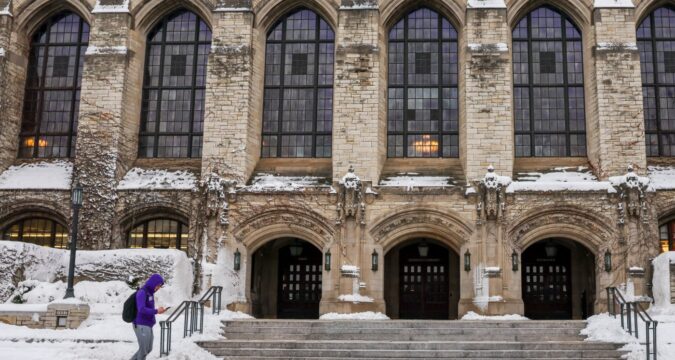
Reading week is quiet at Northwestern University. It’s a time for students to write papers and study for exams and for professors to grade and prepare new courses for winter quarter. But right now, it’s a different kind of quiet. On Friday evening, Northwestern announced a “deal” with the federal government. Media reports thus far have made it seem like a no-brainer — why didn’t we do this sooner? The university will pay $75 million over three years and in return will receive 10 times that amount in the form of suspended grants that will be restored. The university will take steps, already in process, to stamp out the scourge of antisemitism on campus. What could go wrong?
Despite the matter-of-fact tone of the reporting on the terms of the deal, in fact it is not and never has been about antisemitism. It is about punishing universities and the higher education sector. It is about repressing political opponents. At times, the two overlap.
The bottom line is that the agreement, strongly opposed by many faculty members, chips away at the values and rights that have made universities such as Northwestern the envy of the world. These include academic freedom, free inquiry, free speech and expression, openness to new ideas and new conversation partners, and, most crucially, the right to dissent. The agreement is a direct hit on all these protections.
For years, members of the current U.S. administration have depicted professors as the “enemy” of the American people. In a 2021 speech, now-Vice President JD Vance stated that “we have to honestly and aggressively attack the universities in this country.” Why? Because universities are spaces in which there is freedom to think, to dissent, to change one’s mind and to learn. Students may disagree with the actions and policies of the U.S. government (and other governments). To this administration, such dissent is unacceptable. To oppose the ideas of President Donald Trump is to become his enemy. As Trump baldly stated in September at a memorial for Charlie Kirk: “I hate my opponent, and I don’t want the best for them.”
First and foremost, then, the deal reflects the administration’s long-standing goal of crushing political opponents regardless of the cost. Those designated as “opponents” include many leftists and progressives, but this label also includes anyone who disagrees with the president.
The suppression of political dissent and concentration of power are hallmarks of authoritarianism. This deal contributes to its consolidation.
The deal is also about support for the state of Israel, though not in the straightforward way one might assume, equating protection for Jews with support for Israel. Northwestern has ensured the government that it will make the campus safe for Jews. Of course, there is nothing wrong with the campus being safe for all communities including Jews. But it was never unsafe. And the presumption that it was, and that it perhaps remains unsafe, is a pretext that is being used to justify repression of free speech and dissent against U.S. and Israeli government policy at Northwestern and on other campuses around the country, as documented by the advocacy group Concerned Jewish Faculty & Staff.
Jewish faculty members at Northwestern have spoken up to oppose the manipulation of their collective identity for purposes of political repression. As reported in The Daily Northwestern, in late April, a group of over 100 NU Jewish faculty members signed a letter protesting the use of antisemitism as a smoke screen for repression of political dissent. “To punish Northwestern financially or to limit academic freedom in the name of protecting Jewish students could itself spark antisemitism — and would be an injustice to those very students and an injury to American society at large,” the statement reads in part.
Philosophy professor Sandy Goldberg told The Daily Northwestern that “as a Jewish faculty member, the one thing that’s really important to me (is) I don’t want the federal government acting in my name. They are using antisemitism as a cudgel to beat elite universities into submission, and that’s deeply disturbing to me.” History professor and director of Jewish and Israel studies David Shyovitz insisted that the public perception of Northwestern in the media is “dramatically disconnected” to his experience on campus. The director of Jewish and Israel studies said that Northwestern’s besmirched reputation is being used to justify policies that are counterproductive to combating antisemitism.
And this is the twisted and dispiriting takeaway of the deal: Policies that are alleged by the Trump administration to protect Jews on campus are creating the conditions for the suppression of free speech and action for the entire Northwestern community, Jewish and non-Jewish.
Singling out Jews in the agreement may seem like a way of protecting them. It isn’t. Singling out the state of Israel for special protection as a state exclusively for Jews may seem like a way of protecting Jews. Those premises and promises are up for debate. And should remain so.
For the government to punish dissent and debate on our campus protects no one. It is a sad day for Northwestern, and for the United States.
Elizabeth Shakman Hurd is a professor and chair of religious studies and a professor of political science at Northwestern University.
Submit a letter, of no more than 400 words, to the editor here or email letters@chicagotribune.com.
https://www.chicagotribune.com/2025/12/03/opinion-northwestern-deal-federal-government-funding/
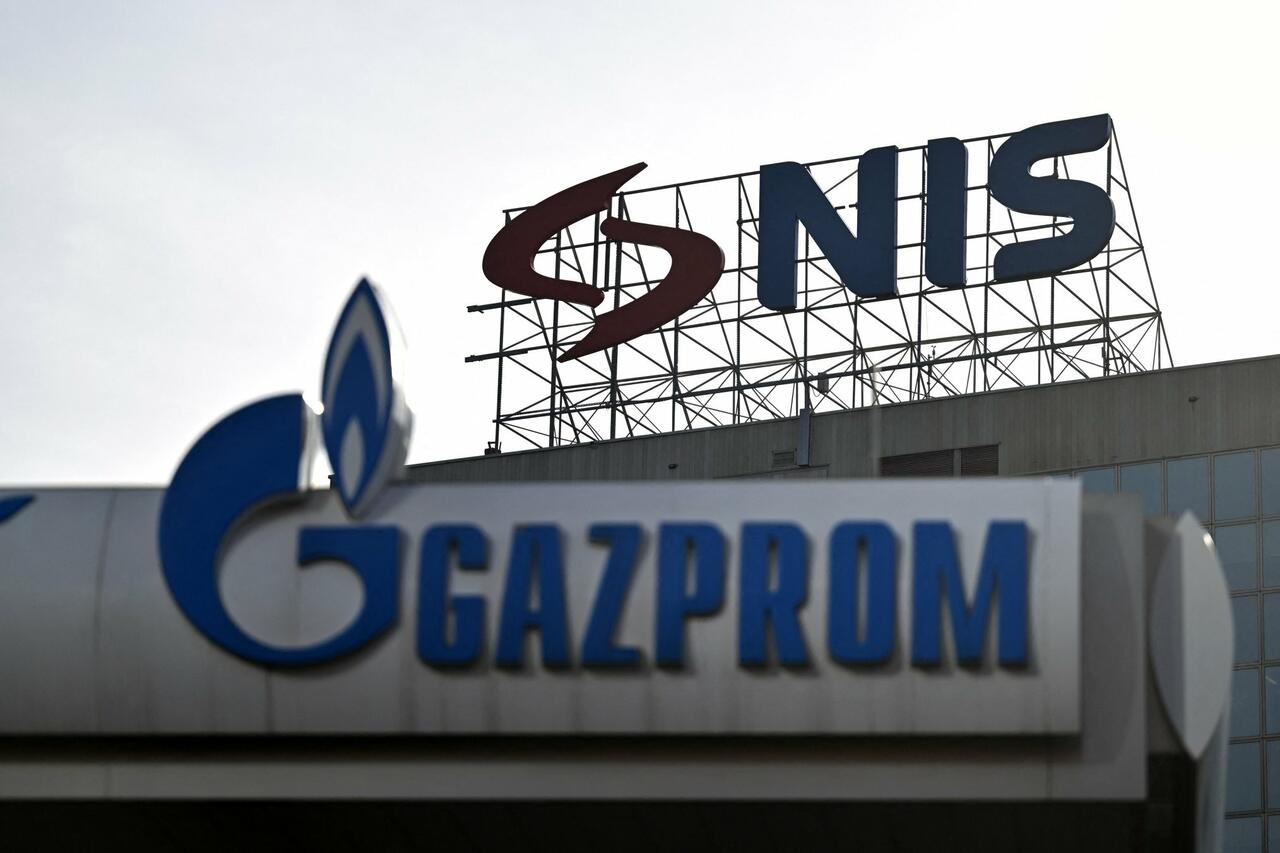
Serbia Faces ‘Lights Out’ As US Denies Sanctions Waiver To Russian-Owned Oil Refinery
Serbia Faces ‘Lights Out’ As US Denies Sanctions Waiver To Russian-Owned Oil Refinery
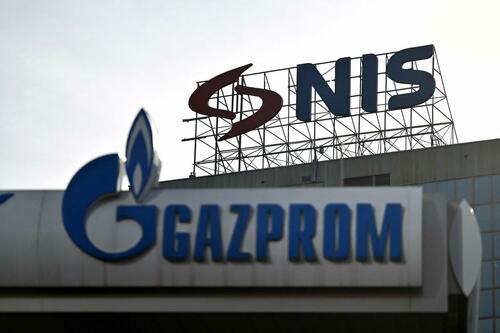
In the wake of the recent US sanctions on Russia’s two biggest energy giants, Serbia is in desperate need of a sanctions-waiver if the country hopes to keep the lights on.
Serbia’s government is this week warning it could slide into a severe energy and economic crisis unless Washington grants a 90-day exemption from US sanctions. Officials are essentially begging for enough time to enable the Abu Dhabi National Oil Company (ADNOC) to take temporary control of the country’s only refinery, NIS, as it finalizes its purchase of Russia’s majority share.
The US sanctions had cut NIS, which is part of Russia’s Gazprom Neft, off from US dollar transactions and blocked crude shipments that normally arrive through Croatia. This has left the 4.8-million-ton refinery operating at a fraction of its capacity. Crucially, NIS produces around 80% of Serbia’s refined petroleum products, filling fuel needs across various vital sectors, including aviation and diesel.
Belgrade officials are seeking a three-month grace period for the plant to resume under the Gulf-based non-Russian operator, without which Serbia risks a chain reaction of fuel shortages and industrial disruptions. This could be politically destabilizing, leaders have warned.
Washington has already granted similar, and some might argue more extensive, waivers to nearby EU members Hungary, Romania, and Bulgaria.
President Aleksandar Vučić’s government has also long been seen as one of the Trump White House’s closest partners in the Balkans. As of Tuesday he met with energy ministry officials, after which he said “We do not have good news, we did not receive a positive decision from the United States regarding NIS.”
He announced that the waiver request has been denied, at least for now. “I am not only disappointed, but also surprised, because I don’t see what they gained from it,” the Serbian president said.
According to more via Interfax:
Serbia has made a decision to completely suspend operations at the refinery in Pancevo, and NIS will subsequently decide when it will be stopped, Vucic said.
NIS said on Tuesday evening that the Pancevo Oil Refinery had started suspending the operation of its production units due to the lack of crude oil for processing purposes as a result of the U.S. sanctions. “The activities in the Pancevo Oil Refinery during the operation suspension process are organized so as to have the refinery’s units ready to restart once the relevant conditions are met, i.e. as soon as the information on crude oil availability is received. During suspension of the refinery’s operations, the employees will be engaged to perform the tasks they carry out during scheduled shutdowns. NIS is continuing to supply the domestic market with petroleum products without interruption, owing to the stocks secured earlier,” NIS said in a press release.
The statement added, “NIS sincerely hopes that regular operations will be reestablished in the shortest time possible in the Pancevo Oil Refinery. The company remains staunchly committed to the efforts to be removed as soon as possible from the U.S. Ministry of Finance’s SDN list or to obtain a new special license which will ensure its unhindered operation, in which course of action it is strongly supported by the Republic of Serbia’s authorities.”
Belgrade is likely growing frustrated and running out of patience, also given Vučić has already aligned himself with Washington on policy toward Ukraine, despite Slavic Serbia being historically seen as an ally of Moscow.
Serbia has even supplied significant quantities of arms to Ukraine forces since the start of the war. This is why the Kremlin previously charged that Serbia had “forgotten who their real friends and enemies are.”
Tyler Durden
Wed, 12/03/2025 – 05:45

UK Agrees To Pay More For US Medicines After Trade Negotiations
UK Agrees To Pay More For US Medicines After Trade Negotiations
Authored by Lawrence Wilson via The Epoch Times,
The UK’s National Health Service will pay 25 percent more for new, patented U.S. medicines under the terms of a new trade agreement between the two nations.
The deal is the latest in a series of agreements in which the United States has leveraged tariffs to secure concessions on prescription drug prices. This is the first deal reached with a nation rather than with pharmaceutical manufacturers.
In return for this concession, the United States will forego tariffs on UK-made pharmaceuticals, pharmaceutical ingredients, and medical technology, as well as refrain from further pharmaceutical price negotiations during U.S. President Donald Trump’s term.
The commitments arose from the U.S.–UK Economic Prosperity Deal, signed in June, in which British Prime Minister Keir Starmer and Trump agreed to address the imbalance of pharmaceutical trade between the two nations.
The UK also agreed to not undercut the new, higher prices by demanding concessions from manufacturers under a previous discount agreement with the pharmaceutical industry.
U.S. Secretary of Commerce Howard Lutnick said the agreement would strengthen the U.S. supply chain and cement America’s place as a leader in life sciences innovation.
“This deal doesn’t just deepen our economic partnership with the United Kingdom—it ensures that the breakthroughs of tomorrow will be built, tested, and produced on American soil,” Lutnick said in a Dec. 1 statement announcing the terms of the agreement.
U.S. Health and Human Services Secretary Robert F. Kennedy Jr. said the agreement will bring “long-overdue balance” to U.S.–UK pharmaceutical trade and strengthen global innovation.
UK Officials Hail Deal
The UK government said in a Dec. 1 statement that the agreement would benefit tens of thousands of patients and expand access to vital drugs.
Liz Kendall, UK secretary of state for science, innovation, and technology, said the agreement “will ensure UK patients get the cutting-edge medicines they need sooner, and … world-leading UK firms keep developing the treatments that can change lives.”
Health Minister Zubir Ahmed said: “This represents new hope and the possibility of treatments that could transform and even save lives.
“This package of changes will bring the best of pharma to the UK for the benefit of our patients, our [National Health Service] and our economy.”
The 25 percent price increase is accompanied by an equivalent rise in the cost-benefit calculation that the UK’s National Institute for Health and Care Excellence uses to decide whether to provide a particular drug to a patient. The move appears aimed at ensuring that medicines remain available to patients despite the additional cost to taxpayers.
“Today’s announcement is an important step to ensure that patients can access innovations as quickly as possible,” said Nicola Perrin, chief executive of the Association of Medical Research Charities.
Active Ingredient Imports
The development and manufacture of medications is a global industry, and active pharmaceutical ingredients (APIs) and other components of a drug are often sourced outside the United States.
Just 15 percent of the APIs for brand-name medications sold in the United States are produced domestically, according to U.S. Pharmacopeia, a global supply chain research group. The European Union is the largest supplier of such ingredients to U.S. manufacturers, accounting for 43 percent of the supply. More than half of the APIs for prescription medicines in the United States are made in India and the EU.
The Trump administration imposed a 15 percent tariff in August on pharmaceuticals and pharmaceutical ingredients imported from Europe.
That tariff is waived for the UK under the terms of the agreement announced on Dec. 1.
Most Favored Nation Plan
Trump had long said that other countries have been taking advantage of the United States by negotiating low prices for pharmaceuticals through their national health plans, driving manufacturers to raise prices for U.S. customers.
“The United States has less than five percent of the world’s population and yet funds around three-quarters of global pharmaceutical profits,” Trump said in an executive order in May.
“This egregious imbalance is orchestrated through a purposeful scheme in which drug manufacturers deeply discount their products to access foreign markets, and subsidize that decrease through enormously high prices in the United States.”
The administration initiated a most favored nation prescription drug pricing policy, which refers to the lowest price available in any developed nation.
In combination with tariffs imposed on imported medications and trade negotiations with other nations, the administration has entered drug price agreements with drugmakers Eli Lilly, Novo Nordisk, EMD Serono, and AstraZeneca over the past three months.
The drug makers agreed to offer their products to the Medicaid program at the most favored nation price and to offer all new medications within the United States at the most favored nation price.
The manufacturers also agreed to sell some medications directly to U.S. consumers at the most favored nation price and to invest in the United States any additional revenue received from increasing prices in other countries.
Each company received a waiver on tariffs on imported pharmaceutical products in exchange for its commitment to honor the four points of Trump’s most favored nation prescription drug pricing plan.
These manufacturers and some others have pledged to participate in TrumpRx.gov, a clearinghouse site that will help private customers find low-priced medications for direct purchase.
Commenting on the UK deal, Chris Klomp, director of Medicare and deputy administrator of the U.S. Centers for Medicare and Medicaid Services, said, “When nations fairly share the burden of producing and paying for life-saving medicines, every citizen gains, and the fight against global disease becomes one we can actually win together.”
Tyler Durden
Wed, 12/03/2025 – 05:00
https://www.zerohedge.com/geopolitical/uk-agrees-pay-more-us-medicines-after-trade-negotiations
China-Japan Spat Looks To Be Boon For Russian Tourism & Industry
China-Japan Spat Looks To Be Boon For Russian Tourism & Industry
In yet another sign of deepening Russia-China ties on all levels, which has also included cooperation on the military front in the context of the Ukraine war, President Vladimir Putin signed an executive order on Monday temporarily lifting visa requirements for visitors from China.
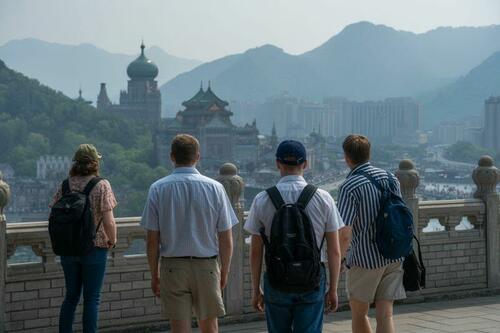
Chinese travelers can now enter Russia without a visa for up to 30 days, either for tourism or short-term employment purposes. This move mirror’s the Chinese government’s earlier decision to grant visa-free entry to Russian citizens.
Both countries already had in place policies which allowed visa-free entry for group tours. The new rule will remain in place until September of 2026 and is being widely referred to as a pilot program.
President Putin had last week called the step “good and positive breakthrough in the development of our relations” during meetings in Moscow with Chinese Premier Li Qiang.
The timing is interesting as it comes amid an escalating diplomatic spat between Japan and China, which has resulted in Chinese government authorities publicly dissuading Chinese citizens from traveling to Japan.
Lately even concerts by Japanese artists which were set for places like Shanghai have been canceled, and the rift is beginning to be felt among the common populace. The prediction is that there could be a quick influx of Chinese tourists in Russia as a result:
According to market analysts who spoke with The Moscow Times, Putin’s announcement — combined with heightened diplomatic tensions between China and Japan — has led to a sharp increase in travel searches and bookings from China to Russia.
In a Monday statement Chinese foreign ministry spokesperson Lin Jian urged Japan to “learn the lessons of history, do soul searching, take seriously what it has heard from the Chinese side, simply retract the erroneous remarks as it should and take practical steps to honor its political commitments to China.”
Amid reports of curbs on seafood imports from Japan, the restaurant scene is also being impacted:
Diners once had to book weeks in advance to secure a table at Toya, a popular Japanese restaurant in Beijing.
But business has taken a sharp turn, with more than 60 reservations cancelled since mid-November, said owner Kazuyuki Tanioka, who has served omakase menus in the Chinese capital for over a decade.
Things are deteriorating fast on every level after Japan suggested it could defend Taiwan in the event of a Chinese invasion…
China just declared the San Francisco Peace Treaty “illegal and invalid.”
But here’s the catch: the moment China rejects SFPT, the entire post-WWII map of Asia breaks — and China is the first country to lose territory.
Why?
Because SFPT isn’t just a US–Japan treaty.
It’s the… pic.twitter.com/B5Fq2L03m2
— The Great Translation Movement 大翻译运动 (@TGTM_Official) December 2, 2025
And film releases are being postponed:
The spat has also led to the postponement of Japanese film releases in China, the abrupt cancellation of concerts by Japanese musicians and the suspension of official exchanges.
A frequent traveller to Japan, Yan Jun, faced a dilemma when China advised its citizens to avoid visiting Japan. Chinese airlines proceeded to cut hundreds of Japan-bound flights this month.
Again, if this China-Japan spat persists, it could present and immediate and even potential long-term boon for Russian tourism and industry.
Tyler Durden
Wed, 12/03/2025 – 04:15
https://www.zerohedge.com/economics/china-japan-spat-looks-be-boon-russian-tourism-industry

Letter Bombs And Hammer Attacks – US Adds European Antifa Groups To Terror List
Letter Bombs And Hammer Attacks – US Adds European Antifa Groups To Terror List
Authored by Janice Hisle and Savannah Hulsey Pointer via The Epoch Times,
An official U.S. terrorist list dominated by jihadist groups and a clutch of cartels has its first European additions in more than two decades: four Antifa groups.
Designating groups as foreign terrorist organizations (FTOs) empowers U.S. federal authorities to investigate the groups’ supporters, prosecute them, and seize their assets.
The European groups, which were added to the list on Nov. 20, include Italian anarchists who carried out a letter-bomb campaign against EU leaders, a German hammer-wielding gang accused of targeting right-wing party members, and two Greek anti-capitalist groups.
The designations reflect President Donald Trump’s commitment “to uproot Antifa’s campaign of political violence,” Secretary of State Marco Rubio wrote when announcing the designations on Nov. 13.
Short for “antifascist,” Antifa seeks to silence people whose viewpoints it defines as “fascist,” and vows to do so “by any means necessary”—a popular Antifa rallying cry.
Here is what to know about the four foreign groups and how, according to one former CIA operative, the designation helps the Trump administration confront Antifa on U.S. soil.
Italy, Home of ‘World’s Largest Anarchist Network’
One of the newly declared FTOs hails from Italy, where fascism originated under dictator Benito Mussolini in the 1920s.
The group is called the Informal Anarchist Federation, also known as the International Revolutionary Front.
The Informal Anarchist Federation “is likely the world’s largest anarchist network and the one that claims the highest number of attacks,” according to a March 2024 report published by the International Centre for Counter-Terrorism.
The group has claimed responsibility for attacks in Italy, Greece, Spain, Germany, the United Kingdom, Indonesia, Chile, Brazil, and Mexico, the report said.
Since 2003, the organization has committed violence, bombings, letter-bombs, and other attacks against places it deems “capitalist institutions,” the State Department said in a Nov. 13 fact sheet. Although it mostly operates in Italy, the group has “self-proclaimed affiliates across Europe, South America, and Asia,” the fact sheet said.
The Informal Anarchist Federation declares that “armed struggle” is necessary against nation-states and “The Fortress Europe,” according to the State Department.
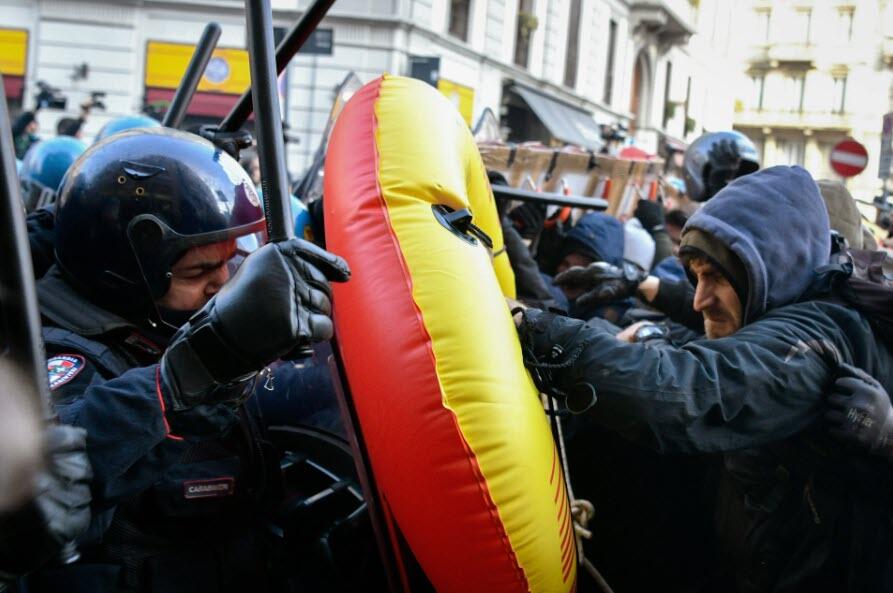
Police officers and demonstrators clash during an anti-fascist and anti-racist march to protest against a Lega Nord party general election campaign rally on Piazza Duomo in Milan on Feb. 24, 2018. Francesca Volpi/Getty Images
In 2014, as Antifa was growing globally, West Point, America’s first military academy, published a profile of the Informal Anarchist Federation.
The report said the group served as a sign that Italy had become “the birthplace of a new threat that has spread to other countries,” the article said.
By then, the Informal Anarchist Federation had been responsible for “dozens of attacks” over a 25-year span in Italy and elsewhere—a trend that Italian authorities had “underestimated” partly because the attacks caused no fatalities, the West Point report said.
However, this type of “insurrectionary anarchism … has become the most dangerous form of domestic non-jihadist terrorism in the country,” the article said.
The Informal Anarchist Federation “has ideological and solidarity ties with Greek anarchist groups,” the report said.
Greek Anti-Capitalist Groups
Revolutionary Class Self-Defense and Armed Proletarian Justice are two newly designated FTOs that are based in Greece.
Both claim to be “anti-capitalist” and are known to use improvised explosive devices in attacks against Greek governmental targets.
Revolutionary Class Self-Defense has been outspoken in its solidarity with Palestine’s conflicts with Israel; the group dedicated two recent attacks to the Palestinians.
In February 2024, an explosive device targeted the Greek Ministry of Labor, but officials evacuated the area, resulting in no injuries.
In April 2025, Revolutionary Class Self-Defense claimed responsibility for that attack and also for an explosion at the Hellenic Train offices, saying railway safety concerns motivated the attack.
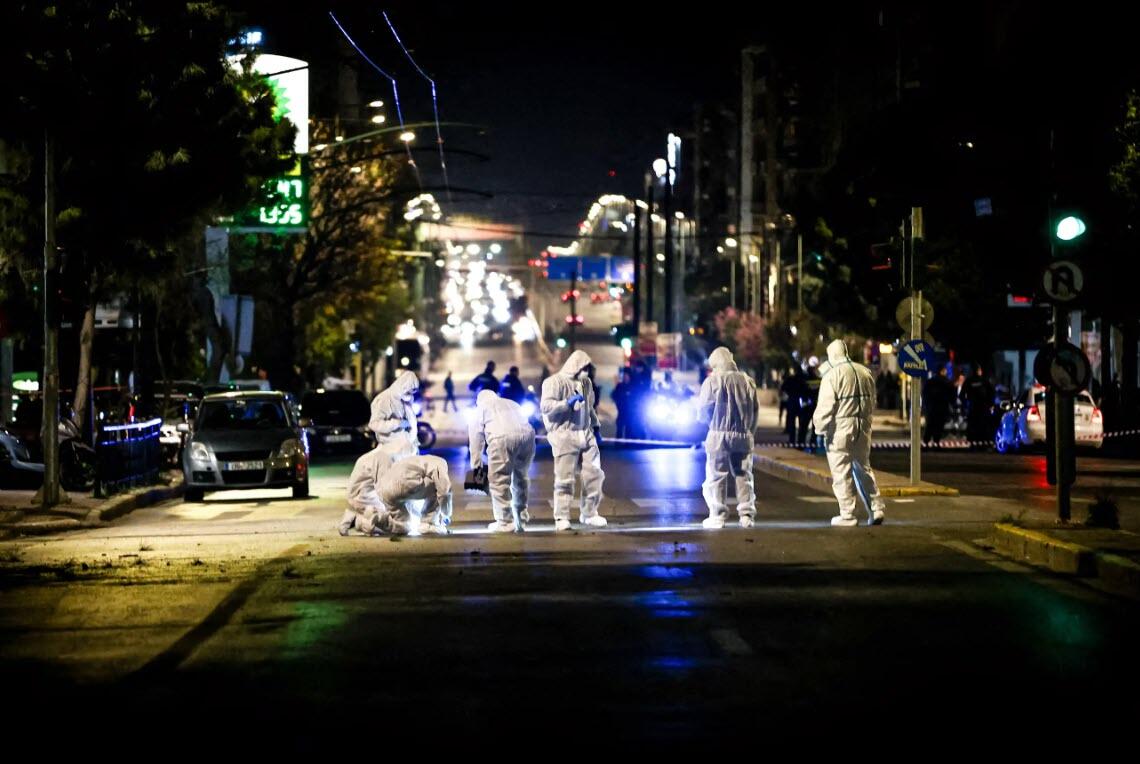
Members of the Greek police counterterrorism unit investigate the area outside Hellenic Train offices after a bomb exploded in Athens on April 11, 2025. The U.S. State Department designated both the Greece-based Revolutionary Class Self-Defense and Armed Proletarian Justice groups as foreign terrorist organizations. Aris Oikonomou/SOOC/AFP via Getty Images
The other Greek group, Armed Proletarian Justice, claimed responsibility for a 2023 bombing attempt at a police headquarters in Athens.
In a public post on an anarchist website, the group said: “You were lucky this time, the same will not apply next time. We dedicate our action to those who have been murdered, tortured, beaten and raped by the Greek Police.”
Germany’s Hammer Gang
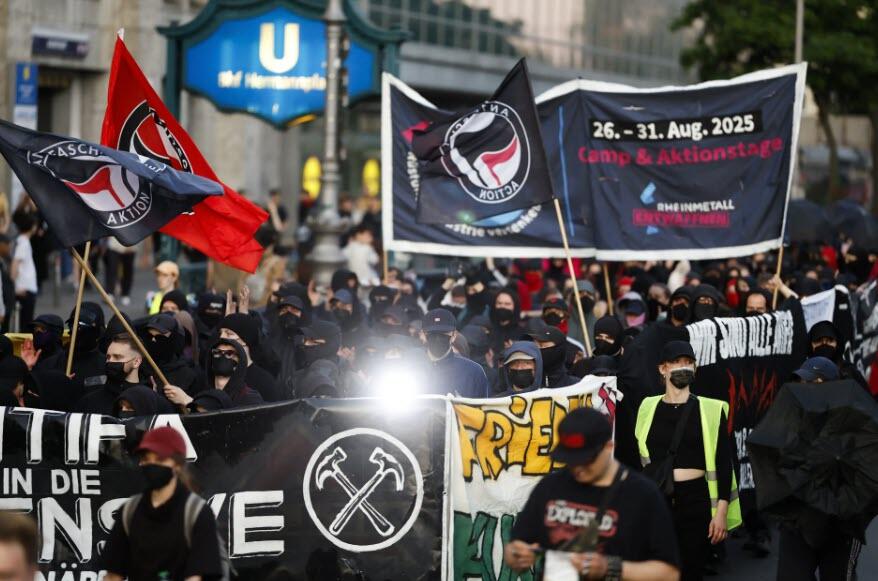
After antifascism took hold in Italy, some people in Germany also became early adopters of antifascist ideology; Germany is often considered the cradle of the Antifa movement as we know it today. That’s partly because it was the origin of flags and other symbols still in use, along with the “black bloc” protest method, in which participants don black masks and clothing to avoid being identified.
A group known as Antifa Ost, German for “Antifa East,” stands out among the four new FTO designees partly because of its methods.
As its nickname, the Hammerbande—German for “Hammer Gang”—implies, Antifa Ost has been known to bludgeon its victims with hammers. Hammer attacks have been carried out in broad daylight, online videos show.
Seven members of the group began standing trial in Germany Nov. 25 for attempted murder and other charges. From 2018 to 2023, the group attacked people it regarded as fascists, German prosecutors said.
However, at the time of the FTO designation, German authorities downplayed the threat that Antifa Ost might pose.
Interior Ministry spokesperson Sarah Fruehauf told reporters that the group’s leaders and most-violent members were either in custody or imprisoned.
German government spokesperson Steffen Meyer said Washington acted without influence from Berlin in declaring the group a terrorist organization.
The U.S. designation of Antifa Ost as an FTO followed Hungary’s decision to impose that label on the group.
In 2023, outrage spread among Hungarians after Antifa Ost members were accused of injuring nine people at a right-wing gathering in Budapest described as “extremist” in the European press. At least one person was a passerby who was singled out for the attack because he wore camouflage-print clothes, marking him as a potential fascist to the attackers, Hungary Today reported.
Demonstrators hold antifa flags and banners during a Revolutionary May Day march in the Neukoelln district in Berlin on May 1, 2025. The Trump administration designated the German group Antifa Ost as a foreign terrorist organization; it is also known as “Hammerbande,” German for “Hammer Gang.” Odd Andersen/AFP via Getty Images
Prosecution of one suspect, Italian citizen Ilaria Salis, was interrupted in 2024 after she won a seat in the European Parliament, granting her immunity.
A social media account under the name “antifaost” states in its profile, “Action against the far right in eastern Germany. Never again fascism!”
What Power Does FTO Label Give US?
Simply put, the FTO designation makes it illegal for anyone in the United States to conduct business with the groups, or to provide material support or resources to them.
FTO designation falls under section 219 of the Immigration and Nationality Act and Executive Order 13224.
The FTO designation was made after Trump signed an executive order in September naming Antifa a “domestic terrorist organization.”
Trump’s order commanded agencies to “investigate, disrupt, and dismantle any and all illegal operations—especially those involving terrorist actions—conducted by Antifa or any person claiming to act on behalf of Antifa.”
FBI Director Kash Patel told The Epoch Times, “With our partners in Treasury, we are following the money and mapping out this entire network and treating them as a terrorist organization under the authorities the president has given us.
“In the turn of the new year, you’re going to see some very righteous prosecutions and investigations being publicized,” the director added.
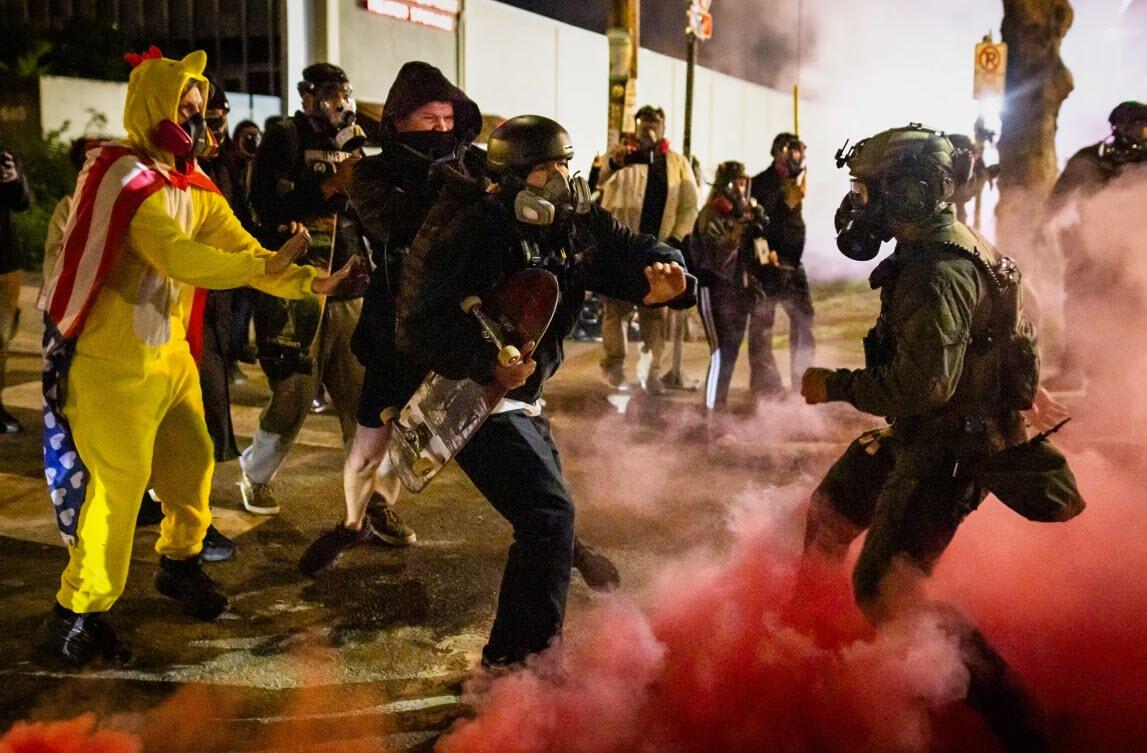
An Antifa demonstrator kicks a smoke bomb back toward federal officers outside Immigration and Customs Enforcement offices in Portland, Ore., on Oct. 5, 2025. John Fredricks/The Epoch Times
US Antifa ‘Networked With Foreign Antifa’
J. Michael Waller, a former CIA operative who now serves as a senior analyst at the Center for Security Policy, said Trump’s FTO declarations have “energized the fight against domestic violent extremism by bringing ironclad existing federal laws into play.”
“These foreign groups and domestic Antifa communicate back and forth. There are degrees of collaboration,” he told The Epoch Times. “The FTO designation gives authorities here more tools to crack down on domestic extremists in ways that have already been settled in court.”
While federal laws define FTO, there is no such definition for “domestic terrorist organization.” That designation might face a court challenge.
“However, it narrows the dangerous, anti-free-speech ‘countering violent extremism’ designation” that originated under President Barack Obama, Waller said.
Trump’s “domestic terrorist” label relies on laws that define terrorism, while Obama’s “violent extremism” label lacked such legal underpinnings. Therefore, the Obama-era label could easily be applied in a “random and arbitrary” way, he said.
Together, the domestic and foreign designations weaken U.S-based groups. “American Antifa is networked with foreign Antifa, and so this is a way to go in and to use foreign terrorism-support laws against American terrorist groups,” Waller said.
Some people harbor misconceptions about Antifa, Waller said. Observers may accept that fascism is bad. So, because the groups say they’re “antifascist,” people perceive “they must be good guys,” he said, and that violent or unruly protests result from “youthful frustration.”
“They’re not just out there to smash windows … Their goal is to overthrow our government,” Waller said, perhaps one city at a time.
Antifa employs tactics and ideology espoused by Russian dictator Josef Stalin, Waller noted.
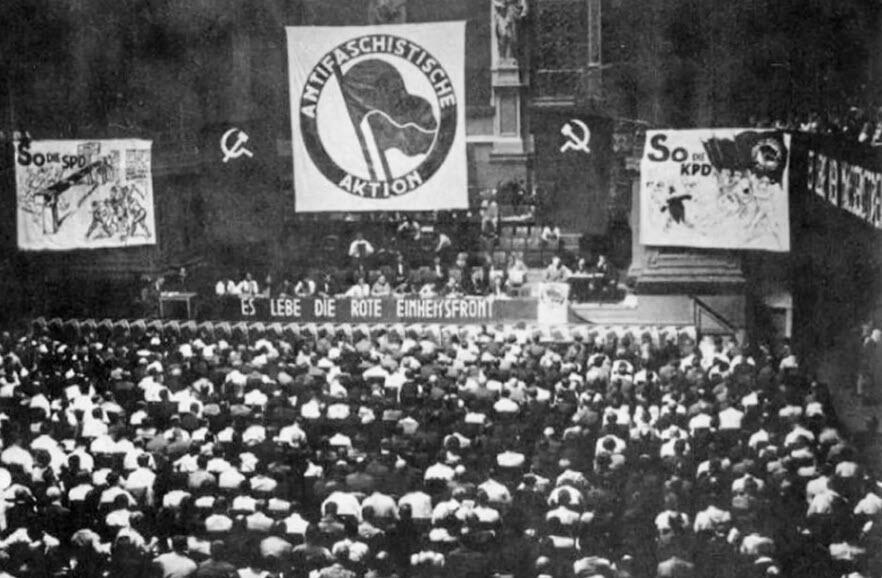
Post-World-War-I, the goal of German Antifa, established in 1932 under Stalin’s influence, was to “tear out” political centrists and polarize the nation. Communists joined anarchists on one side, opposing Nazis on the other. That polarization is what brought German dictator Adolf Hitler to power, Waller said.
The Unity Congress of Antifa at the Philharmonic Opera House, organized by Germany’s Communist Party in response to Benito Mussolini’s rise in the 1920s, in Berlin on July 10, 1932. Public Domain
Future Ramifications
Waller called the FTO designations “a really smart move” to prevent the groups’ adherents from spreading propaganda in the United States or entering the country. The designation also blocks access to domestic bank accounts.
It is vital for Trump to take action to halt Antifa, Waller said. “This has to be smashed—now. He can’t have a successful presidency and leave us to inherit this mess any further.”
Five recent guilty pleas in a Texas Antifa terrorism case will strengthen future prosecutions, Waller said.
In that case, the Department of Justice (DOJ) “worked with outside groups to formulate a very fine and legally bulletproof definition of what Antifa is as an organization—not just a nebulous idea like we had been led to believe,” he said.
He called that strategy “brilliant.”
With those plea agreements, “the DOJ has just proven under law that [Antifa] is an organization,” he said, a definition that might have taken years to prove in court otherwise.
Additional defendants still face charges in that case, which arose from a July confrontation at an immigration-detention center; an officer was shot but survived.
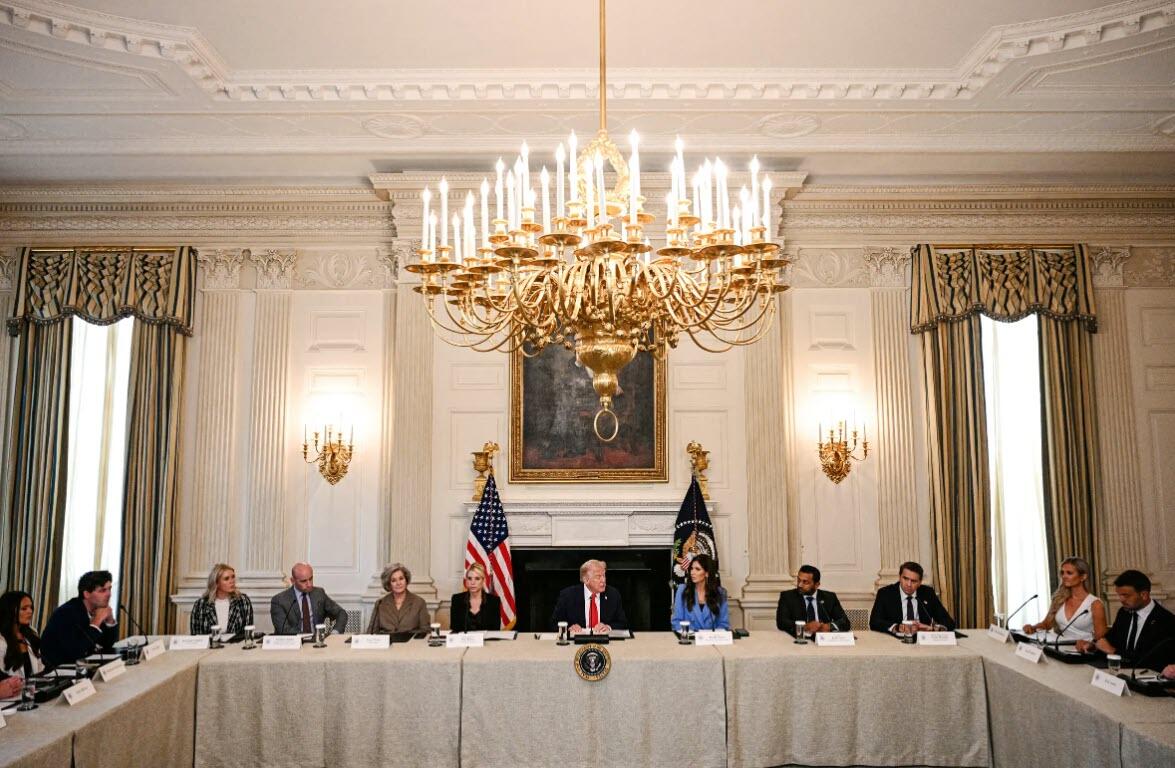
President Donald Trump (C) chairs a roundtable about Antifa in the State Dining Room of the White House on Oct. 8, 2025. The foreign terrorist organization designation followed Trump’s September order labeling Antifa a domestic terrorist organization. Jim Watson/AFP via Getty Images
Prior to Trump’s orders, the FBI “had no reason to monitor” or even learn about Antifa cells, Waller said.
Trump’s directives changed that. “This is a priority presidential order for them, and suddenly there’s a whole lot of interest in it,” Waller said, adding, “This is just the beginning of a very long term, very well-thought-out strategic plan.”
Tyler Durden
Wed, 12/03/2025 – 03:30
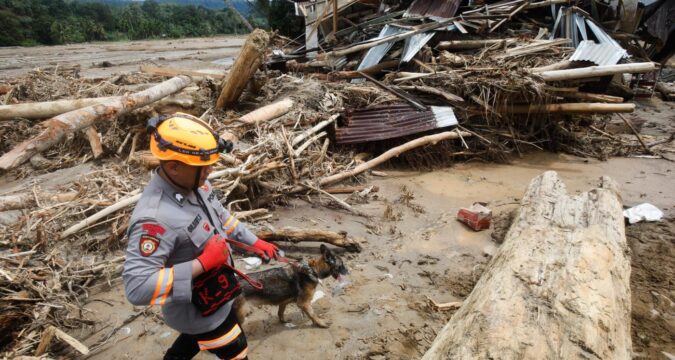
Suben a más de 1.400 los muertos por inundaciones en Indonesia, Sri Lanka, Tailandia y Malasia
Por BINSAR BAKKARA
BATANG TORU, Indonesia (AP) — Partes de Asia estaban conmocionadas luego de que las lluvias torrenciales causaran inundaciones y deslaves catastróficos la semana pasada, matando a más de 1.400 personas en Indonesia, Sri Lanka, Tailandia y Malasia. El desastre también ha dejado al descubierto las marcadas disparidades económicas en la región.
Indonesia fue el país más afectado con al menos 753 fallecidos. Por detrás estaba Sri Lanka, con 465, pero su presidente, Anura Kumara Dissanayake, dijo que era demasiado pronto para determinar el número exacto de muertos. Las autoridades han confirmado además al menos 185 decesos en Tailandia y otros tres en Malasia.
Los equipos de rescate luchaban el miércoles contra el reloj para llegar a las comunidades aisladas, mientras más de 1.000 personas siguen desaparecidas y hay aldeas que continúan enterradas bajo el barro y los escombros en medio de cortes de energía y de las telecomunicaciones.
El presidente de Indonesia, Prabowo Subianto, visitó una de las zonas afectadas el lunes y prometió ayudas y apoyo para la reconstrucción, aunque aún no declaró la emergencia nacional ni solicitó asistencia internacional como sí ha hecho su homólogo en Sri Lanka.
Indonesia y Tailandia, dos economías de ingresos medios con una capacidad fiscal comparativamente más fuerte, han podido poner en marcha amplias operaciones de rescate, desplegar recursos militares y canalizar fondos de emergencia, mientras que Sri Lanka responde al desastre en unas condiciones mucho más difíciles.
Su primera ministra, Harini Amarasuriya, se reunió con diplomáticos la semana pasada para instarlos a respaldar los esfuerzos gubernamentales en materia de asistencia y reconstrucción.
Aún en proceso de recuperación tras una profunda crisis económica, Sri Lanka cuenta con unos recursos limitados, escasez de divisas y unos servicios públicos debilitados, lo que hace que la respuesta a un desastre a gran escala sea significativamente más difícil y aumenta su dependencia de la ayuda externa.
Las autoridades en Indonesia señalaron que la destrucción causada por los días de lluvias torrenciales y una inusual tormenta tropical que azotó la isla de Sumatra fue el desastre más letal desde el terremoto y tsunami de Sulawesi en 2018, que se cobró la vida de más de 4.300 personas.
Las carreteras destrozadas, los puentes colapsados y los continuos deslizamientos de tierra han dificultado el acceso de los equipos de rescate a algunos de los lugares más castigados, y la Agencia Nacional de Gestión de Desastres afirmó que todavía hay alrededor de 650 personas desaparecidas en las devastadas provincias de Sumatra del Norte, Sumatra Occidental y Aceh, donde miles de residentes en pueblos anegados se vieron obligados a refugiarse en tejados y copas de árboles a la espera de ser rescatados en días anteriores.
La agencia dijo el miércoles que más de 1,5 millones de residentes se han visto desplazados por el desastre que dañó decenas de miles de hogares e instalaciones públicas. Con unos 2.600 heridos y los hospitales desbordados, el gobierno envió tres buques-hospital a las provincias afectadas.
En Sri Lanka, se espera que las inundaciones tengan repercusiones significativas en la economía, que se había estabilizado recientemente después de una crisis sin precedentes. La nación insular está actualmente bajo un programa de rescate del Fondo Monetario Internacional que requiere que conserve divisas para pagar la deuda externa en mora a partir de 2028.
Aunque aún se evalúa el alcance total de los daños económicos, es probable que el costo de reconstruir la infraestructura, restaurar los medios de vida y reactivar la actividad económica ejerzan una presión severa sobre el tesoro público.
Con vastas regiones arroceras y la zona montañosa, principales proveedores de vegetales, devastadas por la calamidad, Sri Lanka podría verse obligada a agotar sus escasas reservas de divisas.
Países como India, Pakistán y Emiratos Árabes Unidos ya han puesto en marcha iniciativas de ayuda, mientras que otros diplomáticos extranjeros que se reunieron con la primera ministra del país han prometido apoyo adicional.
En Tailandia, la portavoz del gobierno, Rachada Dhnadirek, dijo el miércoles que los esfuerzos de recuperación en el sur del país avanzan a buen ritmo y que el agua y la electricidad han sido restauradas en casi todas las áreas afectadas.
El gobierno ha entregado más de 1.000 millones de baht (31,3 millones de dólares) en compensación a más de 120.000 hogares afectados por las inundaciones, agregó.
___
Los periodistas de Associated Press Jintamas Saksornchai en Bangkok, Tailandia; Krishan Francis en Colombo, Sri Lanka; Eranga Jayawardena en Sarasavigama, Sri Lanka; y Eileen Ng en Kuala Lumpur, Malasia, contribuyeron a este despacho.
___
Esta historia fue traducida del inglés por un editor de AP con la ayuda de una herramienta de inteligencia artificial generativa.
Bomba en carretera mata a tres policías en el noroeste de Pakistán
Associated Press
PESHAWAR, Pakistán (AP) — Una poderosa bomba caminera que estaba dirigida a un vehículo policial mató a tres agentes en el noroeste de Pakistán el miércoles, informó la policía, el tercer ataque de este tipo en otros tantos días.
La explosión ocurrió en Dera Ismail Khan, un distrito en la provincia de Khyber Pakhtunkhwa cerca de la frontera afgana, señaló el policía Sajjad Khan. No dio más detalles y dijo sólo que había una investigación en marcha.
Ningún grupo reclamó de inmediato la responsabilidad del ataque, pero el ministro del Interior, Mohsin Naqvi, en un comunicado culpó al Talibán paquistaní por el ataque.
El Talibán paquistaní, conocido como Tehrik-e-Taliban Pakistán, es un grupo separado pero aliado del gobierno talibán de Afganistán. El grupo ha intensificado su campaña contra las fuerzas de seguridad en los últimos años.
Pakistán ha visto un aumento constante en la violencia armada, profundizando las tensiones con Afganistán. Islamabad acusa al TTP de usar el territorio afgano como refugio seguro desde la toma de poder del Talibán en 2021, una acusación que Kabul niega.
El atentado del miércoles ocurrió al día siguiente de que milicianos emboscaran un vehículo que transportaba a un administrador del gobierno en la ciudad noroccidental de Bannu, matándolo a él, a dos de sus guardias y a un transeúnte.
Las relaciones entre Pakistán y el vecino Afganistán se tensaron en octubre después de que el gobierno liderado por los talibanes acusara a Islamabad de llevar a cabo un ataque con drones el 9 de octubre en Kabul. Posteriores enfrentamientos transfronterizos mataron a decenas de soldados, civiles y milicianos antes de que Qatar mediara un alto el fuego el 19 de octubre.
La tregua sigue en pie, aunque las recientes conversaciones entre las partes en Estambul terminaron sin avances.
___
Esta historia fue traducida del inglés por un editor de AP con la ayuda de una herramienta de inteligencia artificial generativa.