Category: News

Jueza emite orden que limita arrestos migratorios sin orden de detención en Washington D.C.
Por SUDHIN THANAWALA
Un jueza federal emitió el martes una orden que impide a las autoridades federales realizar arrestos migratorios generalizados en la capital del país sin una orden judicial o causa probable de que la persona sea un riesgo inminente de fuga.
La jueza Beryl Howell, en Washington, concedió una orden preliminar que los grupos defensores de los derechos civiles y de los derechos de los inmigrantes solicitaron en una demanda contra el Departamento de Seguridad Nacional de Estados Unidos (DHS por sus iniciales en inglés).
La agencia no respondió el martes a un correo electrónico enviado fuera de horario laboral en busca de comentarios.
Por lo general, los agentes que realizan arrestos civiles de inmigración deben contar con una orden administrativa. Según la Ley de Inmigración y Nacionalidad, pueden realizar arrestos sin una orden únicamente cuando existe causa probable para creer que la persona se encuentra en Estados Unidos sin autorización legal y es probable que escape antes de que se pueda obtener una orden, según el fallo de Howell.
La Unión Americana de Libertades Civiles (ACLU por sus iniciales en inglés) y otros abogados de la parte demandante argumentaron que los agentes federales patrullaban frecuentemente vecindarios con gran cantidad de inmigrantes latinos en la capital del país, donde instalaban puntos de control y luego detenían y arrestaban a personas indiscriminadamente.
Proporcionaron declaraciones juradas de personas que, según ellos, fueron arrestadas sin una orden judicial o una evaluación requerida del riesgo de fuga y mencionaron declaraciones públicas de funcionarios gubernamentales que, según ellos, mostraban que el gobierno no estaba utilizando el estándar de causa probable.
Los abogados del gobierno negaron que existiera una política que permitiera tales arrestos.
Howell, quien fue nominada al tribunal por el presidente Barack Obama, un demócrata, dijo que los demandantes habían “establecido una probabilidad sustancial de una política y práctica ilegal por parte de los demandados de realizar arrestos civiles de inmigración sin órdenes judiciales ni causa probable”.
“El fracaso sistémico de los demandados en la aplicación del estándar de causa probable, incluida la falta de consideración de riesgo de fuga, es una violación directa” de la ley de inmigración y las regulaciones de implementación del Departamento de Seguridad Nacional, dijo la jueza.
Además de bloquear la implementación de la política, ordenó que cualquier agente que realice un arresto civil de inmigración sin contar con una orden judicial en Washington documente “los hechos específicos y particulares que respaldaron la causa probable previa al arresto por parte del agente para creer que es probable que la persona escape antes de que se pueda obtener una orden”.
Howell también exigió al gobierno que presente esos documentos a los abogados de los demandantes.
El fallo es similar a otros dos que se han alcanzado demandas federales que también involucraron a la ACLU, una en Colorado y otra en California.
Otro juez había emitido una orden de restricción que prohibía a los agentes federales detener a personas basándose únicamente en su raza, idioma, trabajo o ubicación en el área de Los Ángeles después de determinar que llevaban a cabo detenciones indiscriminadas, pero la Corte Suprema levantó esa orden en septiembre.
___
Esta historia fue traducida del inglés por un editor de AP con la ayuda de una herramienta de inteligencia artificial generativa.
This Chemist May Have Cracked America’s Rare Earth Problem
This Chemist May Have Cracked America’s Rare Earth Problem
Authored by Eva Fu & Jan Jekielek via The Epoch Times (emphasis ours),
One flash is all it takes.
That’s how James Tour said the United States can tackle China’s rare earth dominance.
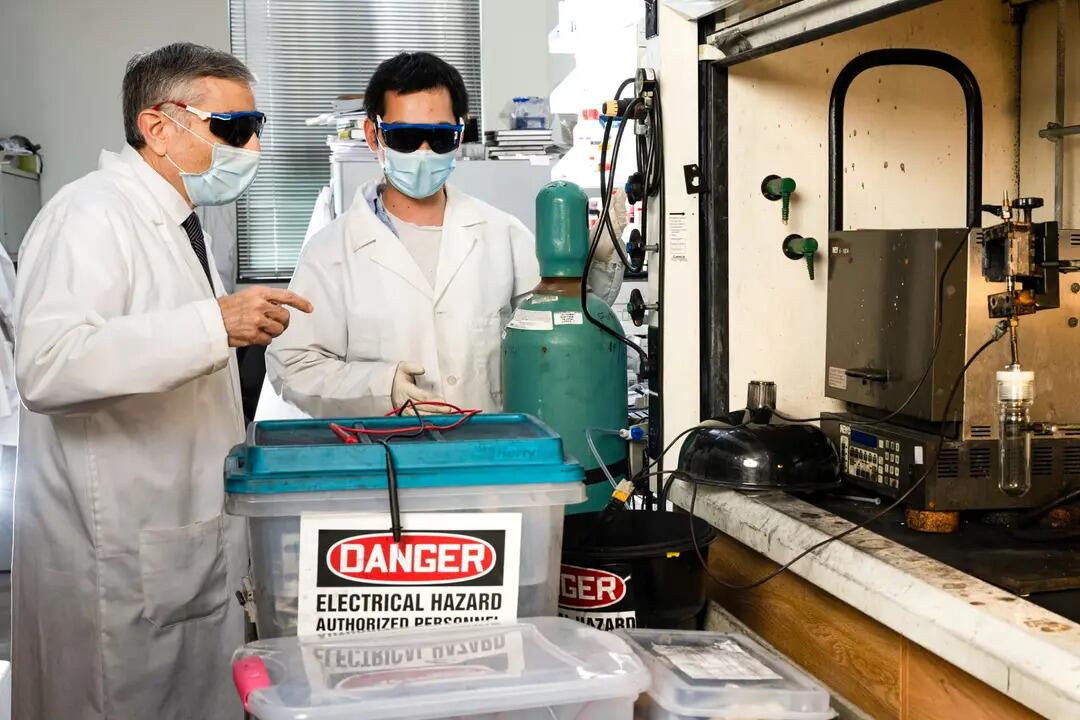
James Tour, chemist and nanotechnologist at Houston’s Rice University, in Scottsdale, Ariz
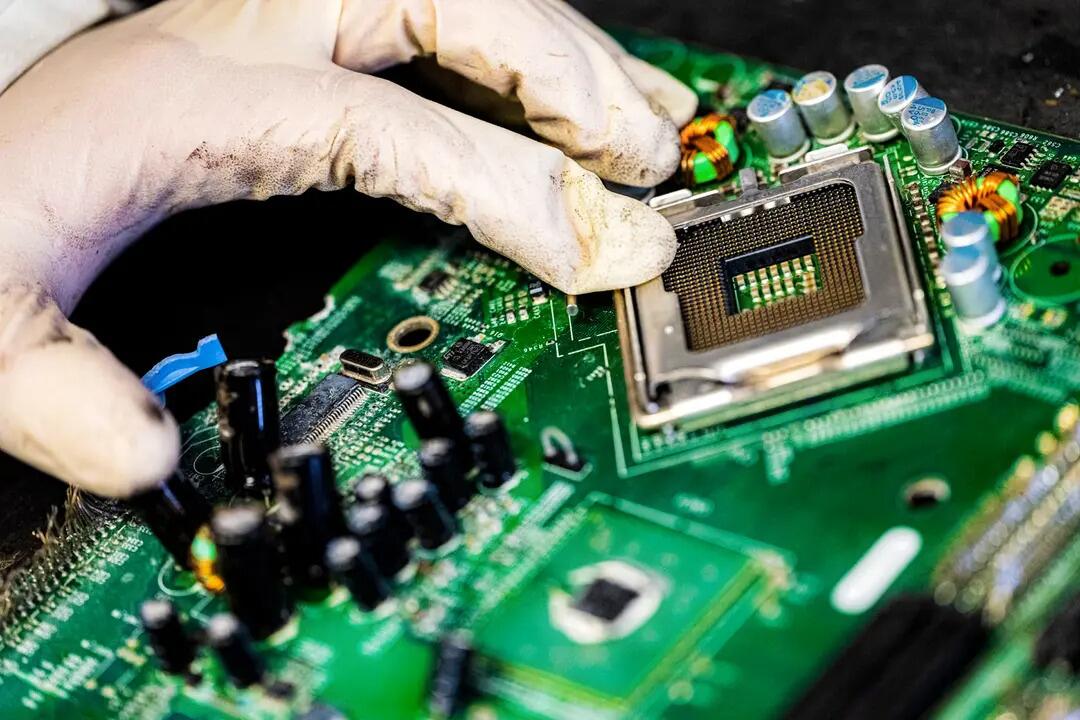
All he needs is discarded electronics—of which the United States has mountains. And from these scraps, the Rice University chemist and nanotechnologist has pioneered a way to quickly extract rare earth metals.
“We can pull out one metal and then the next,” he told The Epoch Times. “It’s really that simple.”
Tour’s solution is flash Joule heating: rapidly heating up the materials to thousands of degrees to vaporize the metals. Mixed with chlorine gas, the vapors turn into chlorides that emerge at different temperatures.
Just like in an incandescent light bulb, the technique works by passing an electric current through the raw material, Tour said. But whereas the former channels a steady electric current to create a perpetual glow, in treating metals, the energy arrives in short bursts, dialing up heat in milliseconds.
“Metals are infinitely recyclable,” he said.
And whereas the traditional way of distilling metals is rather “messy,” Tour said, what he proposes is all about simplicity—“you flash and you’re done.”
Speed is now more critical than ever. The United States is racing against time to reshore rare earth production, spurred in part by China’s October threat to dramatically curtail access.
With a one-year truce in hand, Washington now has a short window to close the gap. Getting a mine up and running can take 15 years.
Tour said his technology would put the United States on a faster track.
“It would give us a map to get independent,” he said.
“You can get these things going for a few tens of millions of dollars. That’s not very much when it comes to this type of manufacturing.”
US Dominance Lost to China
Rare earths, a subgroup of 17 critical minerals, are essential components in electric vehicles, wind turbines, smartphones, and missiles.
China currently sits at the center of this vital global production chain. It makes more than 90 percent of the world’s rare earth magnets, according to International Energy Agency data. China is also the sole supplier for certain elements, such as samarium, used in fighter jets and nuclear reactors for its high heat resistance.
This dominance comes from decades of strategic investment, lavish state subsidies, and aggressive market manipulation that stifled foreign competition.
Decisions made in the United States also played a part.
Until 1991, the country was a leading producer of rare earth minerals; the Mountain Pass mine in California supplied most of the world. Environmental troubles then shuttered the mine for years at the same time China began to gain a foothold.
Against the Pentagon’s objections, the U.S. government greenlit the 1995 sale of Magnequench, then the industry leader in rare earth magnets, to a Chinese front group, effectively handing over critical defense technology and manufacturing to China.
In 2004, Magnequench closed its Indiana plant and moved operations to China. Beijing started taxing exports of rare earth minerals the following year.
Twenty years later, the United States is beholden to Chinese minerals.
“We didn’t realize that we were selling something that turned out to be very important to our country,” Tour said.
Waste to Treasure
As early as 1976, the United States had a law regulating electronic waste disposal.
In the years that followed, the ballooning electronic waste created a whole recycling industry that still struggles to catch up. It’s now the fastest-growing type of waste, rising five times faster than recycling, according to the United Nations.
The United States produced 7.2 million tons of electronic waste in 2022—about one-eighth of the world’s total, the latest U.N. data show. That’s about 46 pounds for every American.
“We have these mountains of tailings that we can access, and we have these constant mountains of printed circuit boards,” Tour said.
Tour said that their method could clean up this spiraling nightmare of waste sites and turn it into a “treasure.”
Lucas Eddy, technology development manager for Metallium’s Texas subsidiary Flash Metals USA, said he is now seeing the idea being put into practice.
“The real reason a waste product is a waste product isn’t because it’s bad, it’s because it can’t be used,” he told The Epoch Times.
Here’s where flash Joule heating shines, according to Eddy, whose Texas factory has licensed the method for metal recovery.
Old Tech Reimagined
Joule heating—passing an electric current through a conductor to produce heat—has been around since the 1840s. It’s now an integral feature of every household, in toasters, electric heaters, ovens, and hair dryers.
Until now, no one had thought to use it for electronic waste.
The spark for Tour’s team began with reading a scientific paper describing using the flash Joule heating technique to make metallic nanoparticles.
The researchers tested the technique on carbon and found that it was a quick way to make high-quality graphene at low cost. They next began exploring its potential in extracting the much-needed rare earth metals.
Eddy, a 2025 Tour lab graduate, joined the project in early 2021 just as this shift began.
“It’s really live chemistry in action,” he said. “You see a rainbow of colors coming off.”
Each change of color represents one metal element that has separated out. Rare earths, usually with some of the highest boiling points, tend to come out last—often as a white powder, he said.
The project drew interest from the Defense Advanced Research Projects Agency, which asked them to make it more industrially applicable, Tour said. Under a federal contract, the team worked on lowering boiling points, experimenting with fluorides and chlorine in various forms, and eventually settled on chlorine gas.
That step was “revolutionary,” Eddy said.
Read the rest here…
Tyler Durden
Tue, 12/02/2025 – 23:25
https://www.zerohedge.com/commodities/chemist-may-have-cracked-americas-rare-earth-problem

Barnes anota 28 puntos y Raptors vencen a Trail Blazers por 121-118
TORONTO (AP) — Scottie Barnes anotó 28 puntos para ayudar a que los Raptors de Toronto superaran el martes 121-118 a los Trail Blazers de Portland.
Barnes atinó diez de 18 disparos de campo. También consiguió siete rebotes, siete asistencias y dos tapas.
Immanuel Quickley sumó 23 puntos con ocho asistencias por Toronto, que había perdido dos duelos seguidos. Brandon Ingram anotó 21 puntos, y el suplente Gradey Dick terminó con 14.
Portland desperdició una sólida actuación de Deni Avdija, quien aportó 25 unidades, 14 asistencias y ocho rebotes. Toumani Camara añadió 21 puntos y siete rebotes, mientras que el suplente Shaedon Sharpe —originario de London, Ontario— anotó 23 tantos.
RJ Barrett de Toronto permaneció fuera debido a un esguince en la rodilla derecha. El alero cayó de manera incómoda después de una volcada el 23 de noviembre, en la victoria de Toronto por 119-109 sobre los Nets de Brooklyn.
Sharpe convirtió dos tiros libres para reducir la ventaja de Toronto a 117-115 con 1:18 minutos por jugar. Pero Ingram logró una volcada y dos tiros libres en los segundos finales por los Raptors.
_____
Deportes AP: https://apnews.com/hub/deportes

Herzog Admits A Netanyahu Pardon Would Spark Outrage, Destabilize Israeli Society
Herzog Admits A Netanyahu Pardon Would Spark Outrage, Destabilize Israeli Society
Israeli President Isaac Herzog acknowledged this week that Prime Minister Benjamin Netanyahu’s request for a pardon in his corruption trial is generating significant debate and division within Israeli society. Herzog said that Netanyahu’s formal petition for the charges and case to be dismissed “will be addressed with full care and precision,” and pledged his decision will be guided solely by “the good of the state and Israeli society.”
He in the Monday comments admitted that Netanyahu’s move “unsettles many people across different sectors of the public and has sparked considerable debate.”
But Herzog tried to calm rising public anger, dismissing aggressive or heated public discourse as having “no impact” on his judgment.
PM Netanyahu formally submitted the pardon request to Herzog on Sunday, sparking opposition backlash demanding that the president quickly shoot it down. Local media says that Netanyahu’s request immediately unleashed a firestorm of controversy, as it was accompanied with another denial that’s he’s guilty:
As if the country were not already laboring under enough legal and constitutional crises, Prime Minister Benjamin Netanyahu took Israel into a new minefield on Sunday when he filed a request to President Isaac Herzog asking for a pardon for the criminal charges against him in the three cases for which he is currently standing trial.
In a brief, personal letter to Herzog, Netanyahu made the case that bringing the trial to a close would benefit the public by ending national divisions over his prosecution.
He then published a message pledging to heal the nation’s divides should his trial be halted, but in the same breath enflamed the rift by arguing that not only is he innocent but that the he’d been framed and the indictment against him was concocted by hostile elements in law enforcement agencies.
Indeed he took the denial further by saying he’d been ‘framed’ by his political enemies. Thus if Herzog were to suddenly go along with dismissing the case, outrage among the opposition as well as long-running anti-Netanyahu protests in the streets related to handling the hostage crisis in Gaza would explode.
Times of Israel concludes of the dilemma, “Rather, experts say, it is Netanyahu’s glaring omission of an admission of guilt or wrongdoing that puts his request on legally shaky ground, making it highly unlikely that president will grant him an outright pass, and inviting the possibility of court intervention if he does.”
Back in January, Netanyahu began interrogation sessions connected to a series of cases – all of which he’s asserted his innocence in. For a review:
Case 1000 concerns allegations that Netanyahu and his wife accepted luxury gifts, such as cigars and champagne, from wealthy businessmen in exchange for political favors.
Case 2000 involves claims that Netanyahu negotiated with Arnon Mozes, publisher of Yedioth Ahronoth, to secure more favorable press coverage.
Case 4000 — viewed as the most serious — centers on accusations that Netanyahu provided regulatory and financial benefits to Shaul Elovitch, the former owner of the Walla news site and Bezeq telecommunications, in return for positive media treatment.
Netanyahu has also long faced accusations of war crimes and crimes against humanity – but pressure over this has mainly been on the international and European front, related to international criminal court probes. President Trump has still firmly had his back, and has weighed in vocally in the case, asking Israel to dismiss all charges.
Tyler Durden
Tue, 12/02/2025 – 23:00
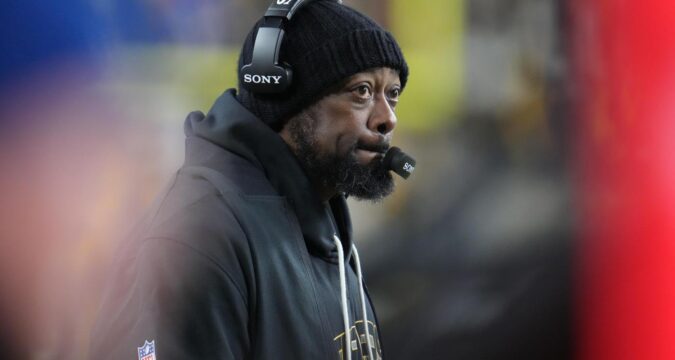
Mike Tomlin comparte la frustración de fanáticos de Steelers con foja de 6-6: ‘No me gusta’
Por WILL GRAVES
PITTSBURGH (AP) — Mike Tomlin no es inmune al coro de abucheos que persiguió a los Steelers hasta el vestuario después de la paliza sufrida ante Buffalo el domingo.
De hecho, el entrenador con más años en la NFL se sintió de la misma manera después de ver superado a su equipo, que perdió por quinta vez en siete duelos.
“En general, estoy de acuerdo con ellos, desde esta perspectiva: el fútbol americano es nuestro deporte, estamos en un negocio de entretenimiento deportivo”, dijo Tomlin el martes. “Y si apoyas a los Steelers, entretenerlos es ganar. Y cuando no estás ganando, no es entretenido”.
Y no ha sido entretenido últimamente para Pittsburgh, que no había sido convincente pese a liderar su división durante la mayor parte de los últimos dos meses. El descontento dentro del Acrisure Stadium estalló en el último cuarto, cuando la multitud abucheó en cuanto comenzó a sonar la canción “Renegade” de Styx, un elemento básico de los finales de partido, diseñado para animar a la defensa.
“Si has estado en este negocio, entiendes eso, y por eso lo respeto”, dijo Tomlin. “Comparto las frustraciones, entiendo qué hace que esto funcione, y ganar es lo que hace que esto funcione”.
Tomlin no fue el único en la línea lateral de los Steelers cuyas frustraciones se desbordaron mientras los Bills acumulaban 249 yardas por tierra y retenían el balón durante casi 42 minutos.
El experimentado capitán defensivo Cam Heyward recibió una penalización por enfrascarse en un altercado con el mariscal de campo de los Bills, Josh Allen, después de un pase de touchdown en el tercer cuarto a Keon Coleman que puso a Buffalo arriba 16-7. Heyward luego dijo que estaba respondiendo a un incidente anterior en el partido, en el que Allen lo habría golpeado intencionalmente en la ingle.
El liniero defensivo suplente de Pittsburgh, Esezi Otomewo, recibió un castigo por rudeza innecesaria en los minutos finales para ayudar a extender una serie que resolvió el encuentro.
“Asumo la responsabilidad de asegurarme de que estos muchachos entiendan que un componente de ser un equipo difícil de vencer es no vencernos a nosotros mismos”, dijo Tomlin. “Tuvimos algunas penalizaciones y ciertamente vas a tener castigos cuando juegas. Pero las penalizaciones de 15 yardas, la pérdida de compostura y cosas de esa naturaleza no han sido parte de nosotros. Y eso necesita corregirse de inmediato”.
Es necesario si los Steelers quieren tener alguna oportunidad de salir de una racha que les ha robado las buenas vibraciones producidas durante un inicio de 4-1. Tres de las últimas cinco derrotas de Pittsburgh han sido por al menos diez puntos, las tres ante equipos con aspiraciones de playoffs.
Tomlin sigue siendo optimista sobre las perspectivas de su equipo, incluso sin mucho en qué basarse últimamente.
“Ciertamente, nuestra última actuación no estuvo a la altura, pero no creo que disminuya nuestra confianza en nosotros mismos o nuestra capacidad para rendir individual y colectivamente en el futuro”, dijo.
Cuando se le preguntó si siente que su equipo tiene una identidad tres meses después de que comenzó la temporada, Tomlin se rió.
“Sí, 6-6, y no me gusta”, dijo.
_____
Deportes AP: https://apnews.com/hub/deportes

Republicano Matt Van Epps gana elección especial por escaño de Tennessee en Cámara de Representantes
Por JONATHAN MATTISE
NASHVILLE, Tennessee, EE.UU. (AP) — El republicano Matt Van Epps ganó el martes una elección especial en Tennessee para un escaño en la Cámara de Representantes federal, manteniendo el control de su partido en el distrito con la ayuda del presidente Donald Trump.
Van Epps, un veterano militar y excomisionado de servicios generales del estado de Nashville, derrotó a la representante estatal demócrata Aftyn Behn para representar al 7mo distrito legislativo.
En un mensaje de victoria, Van Epps afirmó que estará “totalmente comprometido” con Trump en el Congreso.
“Alejarse de Trump es como se pierde. Acercarse a Trump es como se gana”, expresó. “Nuestra victoria fue impulsada por un movimiento de habitantes de Tennessee que están listos para el cambio. Estamos agradecidos con el presidente por su apoyo inquebrantable que trazó este movimiento y nos catapultó a la victoria”.
Trump felicitó a Van Epps, diciendo en una publicación en redes sociales que fue “otra gran noche para el Partido Republicano”.
Los demócratas dijeron estar orgullosos de su desempeño en la contienda.
“Los resultados de esta noche dejan claro: Ninguna reelección de un republicano en la Cámara de Representantes debería considerarse segura el próximo noviembre”, manifestó CJ Warnke, director de Comunicaciones del House Majority PAC.
Con alrededor de 95% de los votos contabilizados, Van Epps llevaba la ventaja por menos de 10 puntos porcentuales. El anterior republicano que ocupó el escaño ganó por 21 puntos porcentuales el año pasado.
Los demócratas ganaron recientemente por amplios márgenes en Nueva Jersey, Virginia y otros lugares, y esperaban que un fuerte desempeño en Tennessee pudiera dar más impulso al partido antes de las elecciones de mitad de periodo del próximo noviembre.
“El impulso ha estado de nuestro lado”, dijo Behn a MS NOW el martes por la noche. “Estamos superando en lugares donde necesitamos estar, y perdiendo menos en otros lugares”.
___
Esta historia fue traducida del inglés por un editor de AP con la ayuda de una herramienta de inteligencia artificial generativa.
___

Republican Matt Van Epps Wins Tennessee Special Election
Republican Matt Van Epps Wins Tennessee Special Election
Republicans will hold onto Tennessee’s 7th Congressional District despite a push by Democrats to flip the deep-red seat, the Associated Press projected Tuesday, as Republican candidate Matt Van Epps was set to defeat Democrat Aftyn Behn.
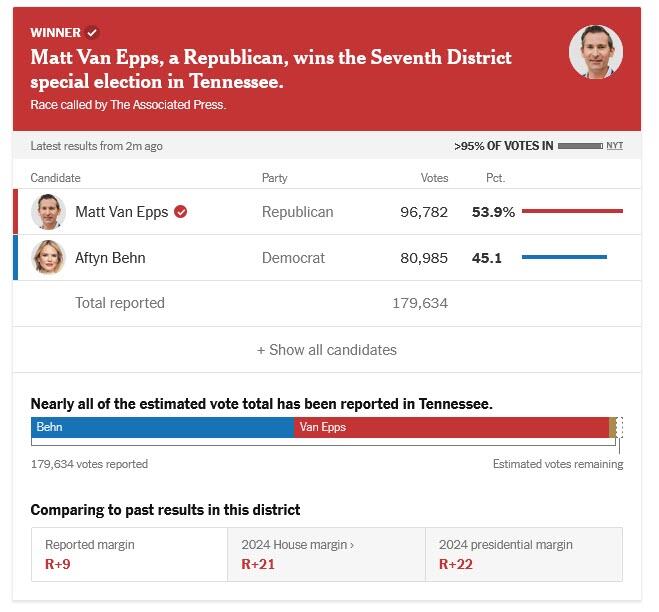
The former state commissioner and Army helicopter pilot defeated the Democratic nominee, Aftyn Behn, with 53.9 percent of the vote in the highly publicized race, according to The Associated Press as of 9:45 p.m. ET. Behn had 45.1 percent, with nearly all votes counted.
The high-stakes election was neck and neck ahead of election day, as an Emerson College Polling/The Hill survey released on Nov. 26 showed Epps slightly ahead with 48 percent of voter support in the district and Behn with 46 percent. As always, the highly biased, vote suppressing poll came out largely in favor of the Democrat who is set to lose by almost 10 points.
Tuesday’s special election, held after the resignation of Republican Rep. Mark Green, drew nationwide attention and was widely viewed as a referendum on President Trump. The president endorsed Van Epps during the primaries, participated in a phone rally for the GOP candidate on the eve of the election and congratulated him on Tuesday evening.
More than 43,000 ballots were submitted during the early voting period, according to the Tennessee Division of Elections.
The congressman-elect, originally from Ohio, will represent 14 counties in Middle Tennessee—including downtown Nashville—after the seat was left vacant by Rep. Mark Green (R-Tenn.), who retired over the summer to take a job in the private sector.
Tuesday night’s win in the Deep South, which President Donald Trump won by more than 20 points in 2024, helps the Republicans maintain hold of their slim majority in the U.S. House, which is expected to shrink once again on Jan. 5, 2026, when Rep. Marjorie Taylor Greene (R-Ga.) resigns. Before the Trump-endorsed candidate was elected, the 119th Congress had 219 Republicans, 213 Democrats, and three vacancies.
The result is a boon for Trump and his party, which had worried that its narrow House majority would grow even slimmer. But the relatively tight margin in such a deep-red district nonetheless represents a warning shot about the party’s vulnerabilities heading into the 2026 midterm elections.
Trump carried the seat by 22 percentage points a little over a year ago. The Seventh Congressional District, which stretches from Kentucky to Alabama and includes part of downtown Nashville, had been drawn by G.O.P. state lawmakers specifically to elect a Republican.
As the Epoch Times reports, Epps’s win comes after the GOP flooded Tennessee with a multi-county, boots-on-the-ground effort to gain as much support as possible in the 24 hours ahead of the election.
On Monday, Epps headlined a morning rally in Franklin and an evening rally in Clarksville, which featured appearances by party powerhouses such as Speaker of the U.S. House Mike Johnson (R-La.), Republican National Committee Chairman Joe Gruters, and Sen. Marsha Blackburn (R-Tenn.).
Epps’s win comes after the GOP flooded Tennessee with a multi-county, boots-on-the-ground effort to gain as much support as possible in the 24 hours ahead of the election.
On Monday, Epps headlined a morning rally in Franklin and an evening rally in Clarksville, which featured appearances by party powerhouses such as Speaker of the U.S. House Mike Johnson (R-La.), Republican National Committee Chairman Joe Gruters, and Sen. Marsha Blackburn (R-Tenn.).
Epps promised to advance Trump’s MAGA agenda, fix the economy, bring manufacturing back to America, secure borders, keep transgender athletes out of women’s sports, and protect farmers.
Tyler Durden
Tue, 12/02/2025 – 22:31
https://www.zerohedge.com/political/republican-matt-van-epps-wins-tennessee-special-election

Energy Secretary: Backup Generators At Commercial Sites Could Unlock 35 Nuclear Plants
Energy Secretary: Backup Generators At Commercial Sites Could Unlock 35 Nuclear Plants
Energy Secretary Chris Wright has floated an unusual but very creative plan to quickly expand U.S. grid capacity: tapping the industrial diesel generators already sitting at data centers, big-box retailers, and other commercial sites. The proposal comes as multiple regional grids strain under the explosive power demand driven by the data-center boom. Leveraging these idled generators could serve as a short-term bridge until new generation comes online.
Bloomberg quoted Wright on Tuesday morning at the North American Gas Forum in Washington, where he said that tapping the nation’s idled fleet of industrial diesel generators could add the equivalent of about 35 nuclear power plants’ worth of electricity and help bridge the country until new natural-gas and nuclear generation comes online in the coming years.
Wright emphasized the scale of the opportunity, saying, “We’re going to unleash that 35 gigawatts of capacity that sits there today,” though he noted that pollution rules have historically limited generator use.
He argued that the massive data-center buildout over the next few years could be primarily supported by these existing generators, avoiding the need for dozens of new power plants.
These generators, he said, are already deployed at data centers and commercial sites nationwide. “They’re all around the country. It’s going to start with communicating to everyone that these assets exist.”
Wright and the Trump administration understand that power grids are stretched thin in the era of data centers. The push for dispatchable backup generation is a short-term solution for all the missing power needed for the AI boom…
Wow:
“In 2025-28, we project ~57 gigawatts (GW) of US data center power demand, and we quantify available power capacity to serve this demand as: near-term grid access of ~12-15 GW, plus ~6 GW of data centers under construction, resulting in a ~36 GW shortfall of US power… pic.twitter.com/4PArdYY9qO
— zerohedge (@zerohedge) December 16, 2024
Perhaps by the time the 2030s arrive, new natural-gas generators and other reliable sources will finally add enough capacity to meet booming demand. Nuclear remains more of a next-decade story. And now, Wright may truly be onto something.
Tyler Durden
Tue, 12/02/2025 – 22:10

Colombia: Padre del político asesinado Miguel Uribe Turbay desiste de su aspiración presidencial
Associated Press
BOGOTÁ (AP) — Miguel Uribe Londoño, padre del senador Miguel Uribe Turbay que fue asesinado mientras hacía campaña electoral en Colombia, desistió el martes de postularse a la presidencia luego de que su antiguo partido lo apartó de la lista de precandidatos.
“Me veo obligado a renunciar irrevocablemente, pues ya no puedo seguir siendo parte de esta organización de la que, repito, soy miembro fundador”, dijo Uribe Londoño a la prensa en referencia al partido derechista Centro Democrático. “Esta sí es mi personalísima renuncia”.
El partido dirigido por el expresidente Álvaro Uribe (2002-2010) informó el lunes en un comunicado que continuaría que continuaría con su proceso de selección con tres aspirantes para encontrar a un candidato para las elecciones de mayo de 2026, excluyendo a Uribe Londoño.
Según el partido, recibió información que indicaba que Uribe Londoño quería declinar a sus aspiraciones para sumarse a la campaña del abogado Abelardo de La Espriella, un derechista que no pertenece al Centro Democrático.
Uribe Londoño negó esa versión y aseguró que no había renunciado a sus aspiraciones presidenciales aunque, como parte de su campaña política, sí había conversado con otros candidatos de derecha como De la Espriella, “para explorar caminos de unión y así derrotar a este desastre y reconstruir la democracia”.
En Colombia hay cerca de un centenar de precandidatos que aspiran reemplazar en las próximas elecciones a Gustavo Petro, el primer presidente de tendencia izquierdista en gobernar el país.
Los partidos están depurando a sus aspirantes y definiendo posibles alianzas. Centro Democrático detalló el lunes en un comunicado que escogería a dos candidatos mediante una encuesta digital entre los militantes del partido.
Uribe Londoño reclamó que al parecer se convirtió en un “factor incómodo” para el partido, precisamente en momentos en que “estaba ganando esa competencia interna de manera amplia y contundente”.
Uribe Londoño lanzó su aspiración presidencial tras la muerte de su hijo, quien fue asesinado a tiros en un mitin político en junio como parte de su precandidatura presidencial.
“El sacrificio de mi hijo en esta campaña del Centro Democrático le costó su vida; hoy, a mí, por honrar ese sacrificio, me intentan clavar el puñal del asesinato político”, reclamó Uribe Londoño.

Tyrese Maxey anota 20 de sus 35 puntos en el 3er cuarto y 76ers arrollan 121-102 a Wizards
FILADELFIA (AP) — Tyrese Maxey anotó 20 de sus 35 puntos en el tercer cuarto, Andre Drummond sumó 12 unidades y diez rebotes, y los 76ers de Filadelfia arrollaron el martes 121-102 a los Wizards de Washington.
Maxey, quien venía de una actuación de 44 puntos, acertó 13 de 26 tiros de campo para anotar más de 20 tantos por vigésimo partido consecutivo esta temporada. También registró seis asistencias y cuatro robos en 29 minutos.
Filadelfia vio su ventaja de 66-54 al medio tiempo reducida a cinco tantos después de que Washington anotó los primeros siete puntos del tercer cuarto. Pero los 76ers anotaron 11 de los siguientes 13 para reconstruir una delantera de dos dígitos, 77-63.
Maxey anotó 20 puntos en el tercer cuarto, mientras que los Wizards solo lograron 23 tras acertar siete de 22 disparos de campo. Maxey no jugó en el cuarto periodo.
Los Sixers alcanzaron los 100 puntos con 32,1 segundos restantes en el tercer cuarto gracias a un tiro libre de Maxey. Ampliaron la ventaja a 115-79 tras comenzar el cuarto periodo con una racha de 14-2.
Washington cayó a 1-11 como visitante esta temporada.
_____
Deportes AP: https://apnews.com/hub/deportes