Category: News
Trump tendrá papel destacado en un gran fin de semana en el Kennedy Center
Por STEVEN SLOAN y HILLEL ITALIE
WASHINGTON (AP) — El viernes por la tarde, el Kennedy Center, conocido principalmente por su teatro, ópera y ballet, será el inesperado centro del mundo deportivo cuando se anuncie allí la composición de los grupos del Mundial 2026. Para el domingo, en un rápido vuelco, el lugar asumirá su papel más tradicional como anfitrión del programa anual de premios que honra a algunos de los principales artistas en Estados Unidos.
El cambio cultural tiene una cosa en común: el papel protagónico del presidente Donald Trump.
Trump fue fundamental al trabajar con el presidente de la FIFA, Gianni Infantino, para trasladar el sorteo al Kennedy Center después de que se esperaba ampliamente que se realizara en Las Vegas. La FIFA podría reconocer aún más a Trump en el evento con un premio de la paz recién creado. Infantino no ha confirmado que Trump será el destinatario, pero los dos han forjado una relación notablemente cercana y Trump ha hecho campaña abiertamente por el Premio Nobel de la Paz. El mismo día del mes pasado en que la FIFA dijo que emitiría el nuevo premio, Infantino describió a Trump como un “amigo cercano” que tiene “una energía increíble”.
Si la perspectiva de un premio de paz no es suficiente atención, Trump asumirá un papel desempeñado en el pasado por la leyenda de la radiodifusión Walter Cronkite y otras luminarias al presentar la gala de honores, si los planes actuales se mantienen. Cuando Trump anunció a los homenajeados en el Kennedy Center en agosto, se presentó a sí mismo como asumiendo a regañadientes las funciones a petición de su jefe de gabinete.
“Me han pedido que sea el anfitrión”, señaló. “Dije, soy el Presidente de los Estados Unidos. ¿Son tontos al pedirme que haga eso? Señor, obtendrá calificaciones mucho más altas. Dije ‘No me importa’”.
Hay pocos paralelismos recientes con el fervor que está a punto de descender sobre el Kennedy Center. Cuando Estados Unidos fue anfitrión del Mundial por última vez en 1994, el sorteo se llevó a cabo en Las Vegas y Bill Clinton, el presidente en ese momento, no asistió. Cuando los presidentes participan en la gala de honores del Kennedy —Trump se saltó el evento durante su primer mandato— generalmente permanecen en su palco, saludan al público y aplauden a los homenajeados.
Los eventos de esta semana sirven como recordatorio de que para Trump —un presidente de dos mandatos, autor de bestsellers y ex estrella de la televisión de realidad— su papel favorito es el de showman. Y la transformación de Trump del Kennedy Center de uno de los espacios relativamente apolíticos de Washington en una especie de extensión de su Casa Blanca le brinda un escenario natural.
Un cambio que comenzó temprano en el segundo mandato de Trump
El cambio en el Kennedy Center comenzó rápidamente después del regreso de Trump a Washington a finales de enero. En un mes, destituyó a la dirección de la institución, llenó la junta de fideicomisarios con sus partidarios y anunció que había sido elegido presidente de la junta.
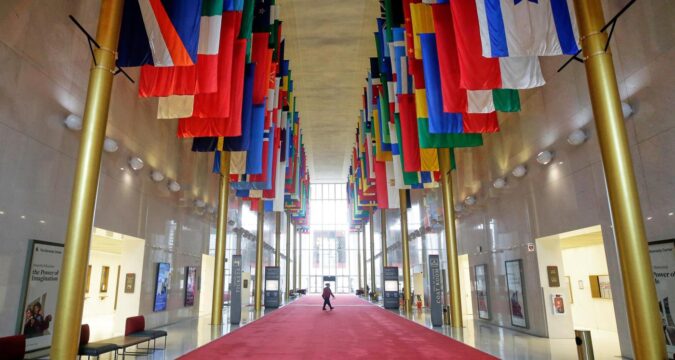
Trump y sus asesores criticaron la programación del Kennedy Center como “woke” y acusaron a la dirección anterior de mala gestión financiera y de descuidar el edificio. Algunas renovaciones han estado en marcha en las últimas semanas, incluyendo el uso de pintura blanca sobre columnas que anteriormente eran doradas.
Deborah Rutter, quien fue despedida como presidenta del Kennedy Center, dijo en un comunicado en mayo que las acusaciones de mala gestión financiera eran “falsas” e insistió en que cuando se fue, “el Kennedy Center estaba financieramente sólido”.
Pero las repercusiones han sido intensas con musicales prominentes como “Hamilton” cancelando presentaciones. La actriz Issa Rae y la autora Louise Penny también cancelaron su presencia, mientras que consultores como el músico Ben Folds y la cantante Renée Fleming renunciaron. Algunos artistas han expresado una sensación de tristeza por los cambios.
“Siempre fue un placer ser invitado a actuar en el Kennedy Center”, dijo Jane Alexander, actriz y ex presidenta del National Endowment for the Arts, a The Associated Press.
Por su parte, la nueva dirección del Kennedy Center ha dicho que se está enfocando en una programación que atraiga a un público amplio y no pierda dinero. El presidente del Kennedy Center, Richard Grenell, ha enfatizado una programación de “sentido común”.
Pero los demócratas en el Congreso investigan si la nueva gestión está costando dinero al Kennedy Center. El senador Sheldon Whitehouse, el principal demócrata en el Comité de Medio Ambiente y Obras Públicas, publicó documentos el mes pasado que muestran que el centro firmó un acuerdo que otorga a la FIFA el uso “exclusivo” de la instalación del 24 de noviembre al 12 de diciembre sin costo, argumentando que el lugar estaba en riesgo de perder millones en ingresos potenciales debido al acuerdo.
Roma Daravi, vicepresidenta de relaciones públicas del Kennedy Center, dijo a la AP que se estaba pagando 7,4 millones de dólares para realizar el sorteo, incluyendo una donación de 2,4 millones de la FIFA junto con oportunidades de patrocinio y gastos. En respuesta a Whitehouse, Grenell dijo que ha recaudado 117 millones este año.
El Kennedy Center tiene una historia bipartidista
La noción de que el Kennedy Center terminaría en una disputa con el Congreso habría sido impensable hace solo unos años. La historia del lugar está arraigada en la cooperación bipartidista cuando el presidente republicano Dwight Eisenhower trabajó con los demócratas que controlaban el Congreso en ese momento para aprobar una legislación que crearía un centro cultural nacional.
Desde entonces, la instalación que se convertiría en el Kennedy Center se convirtió en un lugar donde las diferencias políticas se ponían en pausa en su mayoría. Antonin Scalia y Ruth Bader Ginsburg, jueces de la Corte Suprema en polos ideológicos opuestos, asistieron juntos a la ópera.
La gala de honores del Kennedy Center, que se estableció en 1978, ha reconocido a una amplia gama de artistas y, hasta el primer mandato de Trump, presidentes de ambos partidos políticos asistieron a la ceremonia.
El conservador Charlton Heston fue honrado durante la administración de Clinton mientras que el liberal Warren Beatty recibió un premio mientras el entonces presidente George W. Bush observaba.
Los destinatarios son típicamente elegidos por una comisión bipartidista, aunque Trump dijo este año que estaba “aproximadamente un 98%” involucrado en las selecciones. Algunos de los ganadores de 2025 tienen un historial de apoyo a Trump, incluyendo a Sylvester Stallone, el actor de “Rocky” que calificó a Trump como “el segundo George Washington” y Ace Frehley, el miembro fundador de la banda de rock Kiss que respaldó a Trump en 2020, llamándolo “el líder más fuerte que tenemos”.
Pero algunos detractores de Trump también serán reconocidos. Tal es el caso de Paul Stanley, otro integrante de Kiss. Y aunque la cantante Gloria Gaynor no ha criticado públicamente al presidente, su éxito disco de los años 70 “I Will Survive” es tanto un favorito de Trump como un himno para feministas y la comunidad LGBTQ.
Cuando Las Vegas fue anfitrión del sorteo, Vanessa Williams y James Brown fueron las estrellas principales. La FIFA anunció el martes por la noche que la supermodelo Heidi Klum, el comediante Kevin Hart y el actor Danny Ramirez estarán presentes el viernes junto con actuaciones de Andrea Bocelli, Village People, Robbie Williams y Nicole Scherzinger.
El gran fin de semana del Kennedy Center culmina lo que ha sido un año difícil para Washington, ya que Trump ha retratado a la ciudad como plagada de crimen incluso cuando la tasa de delitos violentos ha disminuido. El presidente ordenó la movilización de la Guardia Nacional en la ciudad y dos miembros fueron baleados —una fatalmente— la semana pasada muy cerca del Kennedy Center.
El turismo ha sufrido un golpe con la firma de investigación de viajes Tourism Economics prediciendo una disminución del 4,3% en las visitas internacionales a Washington en 2025. Eso es ligeramente inferior a una proyección anterior, dando a los funcionarios locales la esperanza de que eventos como el sorteo puedan dejar a los turistas potenciales con una mejor imagen de la ciudad.
“Para nosotros como destino, tal vez esto nos dé la oportunidad de recibir algunos comentarios positivos”, dijo Elliott Ferguson, presidente y CEO de Destination DC, la organización de marketing de la ciudad.
___
Italie informó desde Nueva York.
Deportes AP:
Zelensky’s Meeting With US Envoy Cancelled After No Real Progress In 5-Hour Moscow Talks
Zelensky’s Meeting With US Envoy Cancelled After No Real Progress In 5-Hour Moscow Talks
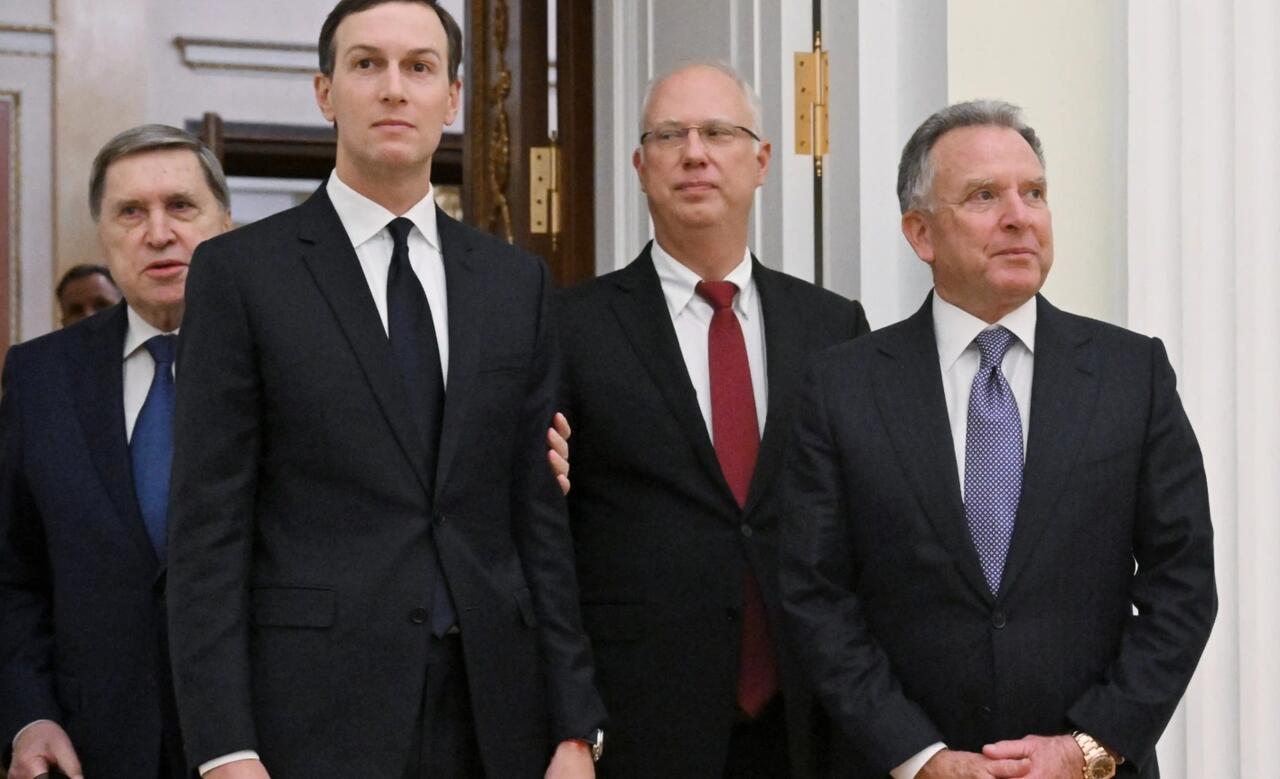
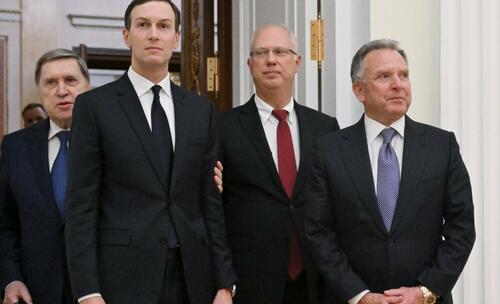
The Russian-US negotiations on the Ukraine conflict concluded in the Kremlin after some five hours of intense negotiations, which had reportedly gone late into the night. Russian presidential aide Yury Ushakov indicated the US side of Steve Witkoff and Jared Kushner presented four more documents concerning the peace settlement during the Kremlin talks; however, a sticking point remains territory.
“Some American proposals are acceptable to Russia, while others are not,” the aide stated bluntly. Crucially he at one point responded to a question of whether peace had become closer or further following these talks, to which Ushakov responded, “Definitely not further.”
“Territorial issues were discussed specifically, without which we do not see a resolution of the crisis,” Ushakov told reporters immediately after the meeting. “Of course, the enormous prospects for future economic co-operation between the two countries were also discussed.”
This latter point of cooperation between the US and Russia has “vast potential” – Ushakov said, suggesting the Kremlin doesn’t see the peace deal as where it wants it to be in terms of territorial settlement. The US-backed draft peace plan offers that Crimea, Luhansk and Donetsk would be recognized “as de facto Russian, including by the United States.” However, Ukraine and other countries would not need to recognize Russian control by law, but Moscow legally sees them as part of the Russian Federation after the wartime ‘popular referendums’ held in the fall of 2022.
The draft also calls to freeze the front lines of fighting where they are in the southern oblasts of Kherson and Zaporizhzia, with Russia having relinquish other areas such as the Kharkiv and Sumy regions in the northeast, as well the Mykolaiv region in the south. Overall the lengthy session was deemed by the Russian side as “productive” – with Ushakov also saying “We discussed the substance, not specific wording and solutions. The parties see enormous potential for cooperation.”
“As for a possible meeting at the presidential level, that will depend on the progress we’re able to make through the persistent work carried out by our aides and representatives,” Ushakov said. And more on US-Russia relations: “But this time, we emphasized that if we genuinely want to work together — and there are enormous opportunities — then it’s time to show some real commitment,” the Kremlin official said.
While the negotiations were happening or about to proceed, President Trump in Washington had admitted it’s not “an easy situation” to settle, but that “Our people are over in Russia right now to see if we can get it settled. Not an easy situation, let me tell you. What a mess.” He reiterated in a cabinet meeting: “It’s a war that never would have happened if I were President.”
As for the initially announced firm deadline of Thanksgiving Day for Ukrainian President Volodymyr Zelensky to accept the US 28-point peace plan, President Trump appears to have backed down from that, given all of this back-and-forth is still proceeding.
I think we might take a minute to ask why the American government has sent a real estate developer and the president’s son in law to negotiate directly with Vladimir Putin, rather than – say – the secretary of state, or a professional diplomat, or indeed anyone with training. https://t.co/6GoRkeMNUR
— Shashank Joshi (@shashj) December 2, 2025
One interesting development is Axios reported that Witkoff was slated to meet with Zelensky and brief him on the talks with Putin. Zelensky has demanded this much, also given Kiev feels largely cut out of the US plan and negotiations. Trump also last week made clear he’s not ready to meet with either Zelensky or Putin until a peace deal is in the final stages.
The expected Witkoff meeting with Zelensky has been canceled, and the US delegation is en route back home to Washington instead, in perhaps another slap in the face to Zelensky which further sidelines him once again. According to the UK Times:
A meeting between President Zelensky and a US delegation planned for Wednesday has been cancelled after talks in Russia on the war in Ukraine concluded without a breakthrough.
Steve Witkoff, President Trump’s special envoy, and his son-in-law, Jared Kushner, spoke to President Putin and other Russian officials in Moscow for five hours on Tuesday but failed to make any headway on a peace deal.
The US negotiators were due to debrief Zelensky in Brussels after the talks. However, Witkoff and Kushner left Moscow on Tuesday night for Washington, the Kremlin said.
Meanwhile the Kremlin on Wednesday has followed up with further explanation of its stance. “We proceed from the fact that in this case it is better for these negotiations to be conducted in silence,” Putin spokesman Dmitry Peskov has been quoted in state media as saying. He added that Russia is “not a supporter of megaphone diplomacy.”
Some aspects of the US plan are likely welcomed by Moscow…
Peskov explained that “it would be wrong” to say Putin had turned down the American proposals after the talks in Moscow. He described the first direct exchange on the plan as being that “some things were accepted, some were marked as unacceptable,” and that this is part of a “normal negotiation process” and “a search for compromise.”
Having just announced it’s taken military control of Pokrovsk, amid a string of steady advances in the east, Moscow knows it is firmly in the driver’s seat – yet the proxy war continues its dangerous path of escalation.
Tyler Durden
Wed, 12/03/2025 – 08:45
Futures Rise As Bitcoin Extends Rally For 2nd Day, Copper Hits Record
Futures Rise As Bitcoin Extends Rally For 2nd Day, Copper Hits Record
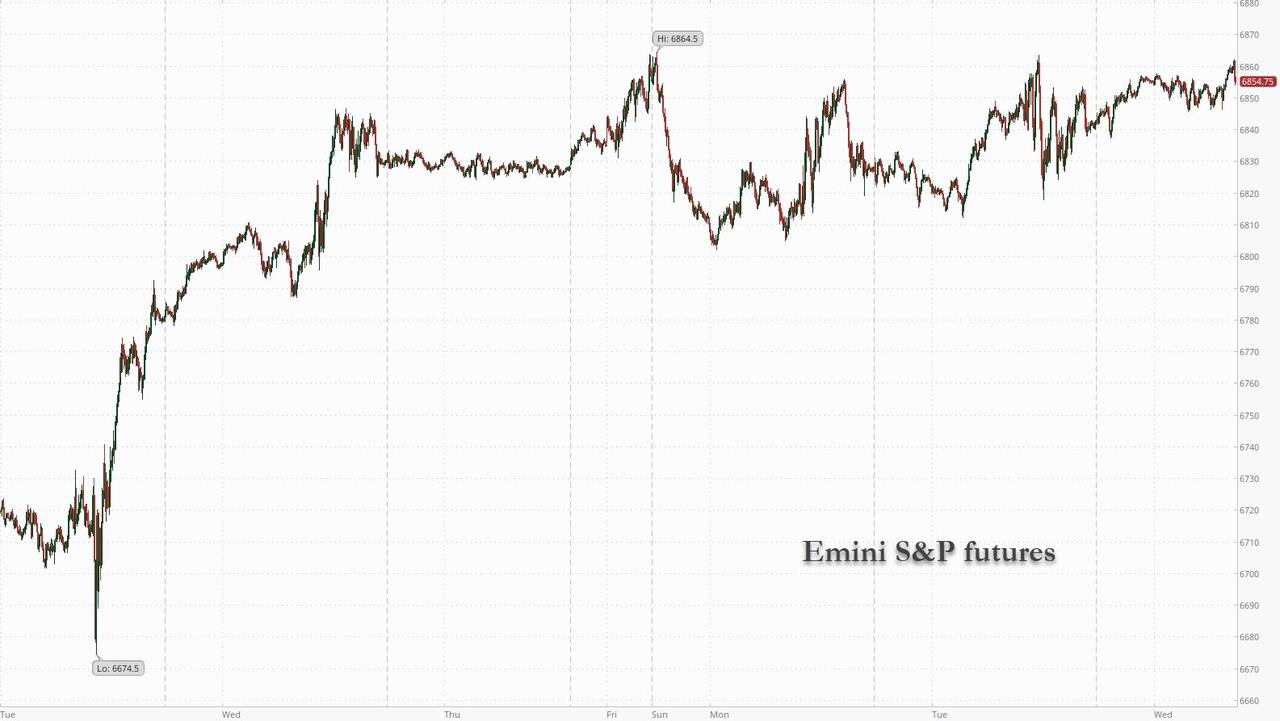
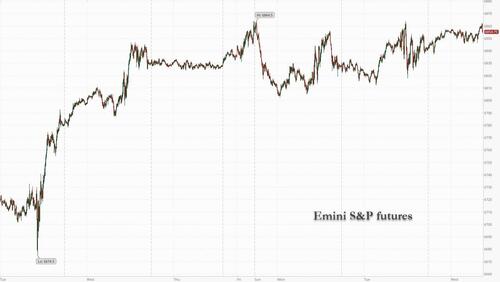
US equity futures are higher again, led by small cap stocks. As of 8:20am ET, S&P futures are up 0.2% (they dropped following a very ugly ADP print at 8:15am), the same as Nasdaq 100 futs, with Mag 7 stocks mostly higher premarket led by NVDA (+0.4%) and AMZN (+0.3%); MRVL is up +10% post-earnings given the robust long-term guidance. Europe’s Stoxx 600 is also higher led by tech and energy sectors. Bond yields are lower, the move accelerating after the ADP print; the USD is also lower. Commodities are mixed: Oil higher, while copper hit a fresh record high above $11,350/ton following the largest surge in orders since 2013. Bitcoin extended a tentative rebound on Wednesday, rising as high as $94,000, though sentiment remains fragile. On the news front, increment updates were relatively muted overnight except for MRVL’s positive earnings that trigger the rebound in global tech. The US economic calendar includes November ADP employment change (8:15am), September import/export price index (8:30am), September industrial production (9:15am), November final S&P Global US services PMI (9:45am) and November ISM services (10am).
In premarket trading, Mag 7 stocks are mostly higher (Nvidia +0.8%, Amazon +0.4%, Alphabet +0.3%, Tesla +0.1%, Microsoft -0.1%, Apple +0.04%, Meta +0.06%)
Acadia Health (ACHC) slumps 29% after the psychiatric-hospital chain cut its adjusted earnings per share guidance for the full year.
American Eagle (AEO) surges 12% after the apparel retailer raised its comparable sales guidance for the full year and reported net revenue for the third quarter that topped the average analyst estimate.
Astera Labs (ALAB) rises 7% as analysts note that Amazon’s AWS Trainium artificial intelligence chip is a positive for the semiconductor manufacturing company. Amazon’s cloud unit raced to get the latest version of its AI chip Trainium3 to market and unveiled Trainium4.
GitLab (GTLB) falls 8% after the software company’s results and forecast were seen as underwhelming. Bloomberg Intelligence wrote that the report reinforces concerns about AI.
Marvell Technology (MRVL) rises 9% after the chipmaker’s CEO assuaged investor concerns with positive trends at its custom chip-design unit. The company also announced plans to acquire startup Celestial AI for about $3.25 billion.
Microchip (MCHP) is up 2% after the semiconductor device company forecast adjusted earnings per share for the third quarter that beat the average analyst estimate.
Oracle (ORCL) gains 1.6% as Wells Fargo starts coverage of the tech giant with a recommendation of overweight, describing the firm as an “emerging leader in the AI super-cycle.”
Okta (OKTA) is down 4% after the software company’s results and forecast were seen as underwhelming.
Pharvaris (PHVS) jumps 18% after the drug developer said a late-stage trial of its investigative therapy for hereditary angioedema (HAE) — a rare genetic condition that causes severe swelling — met its main goal
Pure Storage (PSTG) declines 14% after the computer hardware and storage company reported higher operational expenditure in the third quarter.
Stocks rose for a second day, but eased back after ADP reported that US companies shed payrolls in November by the most since early 2023, adding to concerns about a more pronounced weakening in the labor market. Private-sector payrolls decreased by 32,000, according to ADP Research data released Wednesday. Payrolls have now fallen four times in the last six months. The median estimate in a Bloomberg survey of economists called for a 10,000 gain.
The data may add some support for the December rate-cut case, although markets are already treating a cut as a sure thing. Trump said he plans to announce his selection to lead the Fed in early 2026 and teased chief economic adviser Kevin Hassett as his possible choice. Traders are piling into bets that a new chair will support Trump’s calls for lower rates.
As Fed policymakers gather next week, the debate among officials will largely center on the job market and whether rates should be reduced for a third straight time. While the latest government report showed a larger-than-expected rise in payrolls, the gain was concentrated in just a few industries. The unemployment rate ticked up to an almost four-year high, and there’s been a steady drumbeat of layoff news from companies.
“Right now, the data argues for additional Fed funds rate cuts. US labor demand is weak, consumer spending is showing early signs of cracking, and upside risks to inflation are fading,” said Elias Haddad at Brown Brothers Harriman.
Also due today are ISM services data for November, as well as delayed import price index and industrial production numbers for September.
Elsewhere, traders continue to weigh conflicting signals in the AI story. The AI story and how much further it can power the market, continues to be top of mind. Marvell shares are soaring after its prediction for data center revenue to grow 25%, with further fuel to bulls coming from AI-power darling Vistra, which was raised to investment grade by S&P.
At the same time, Oracle credit default swaps closed at the highest level since the financial crisis. And Sam Altman seems to be worried about competition — he was said to declare a ‘code red’ to speed up improvements to OpenAI’s ChatGPT.
The SEC is said to have issued a flurry of warning letters to nine providers of highly-leveraged ETF plans, effectively blocking the introduction of such products. CME is working to improve client communications after Friday’s outage that disrupted multiple financial markets. Crypto giant Binance appointed co-founder Yi He as co-CEO.
European stocks are broadly firmer with the Stoxx 600 index up 0.2%. The FTSE 100 is lagging, trading lower by 0.2% alongside a firmer pound and losses in index-heavyweight HSBC. Here are some of the biggest movers on Wednesday:
Stellantis gains as much as 8.4% after UBS analyst Patrick Hummel raised his recommendation on the carmaker to buy from neutral and following a report that the White House will announce new fuel efficiency standards for automobiles.
European semiconductor stocks with data‑center and 5G exposure advance after US peer Marvell Technology reassured investors that its custom chip-design unit is winning repeat orders, signaling continued growth as the company benefits from runaway spending on AI computing.
European defense stocks rise on Wednesday morning. The Kremlin said President Vladimir Putin held “very useful” talks with US envoys Steve Witkoff and Jared Kushner, though the sides failed to reach agreement on a plan to end Russia’s war in Ukraine.
Inditex rises as much as 8.9% after releasing third-quarter results that beat consensus estimates.
Cosmo Pharmaceuticals shares soar as much as 24% after the company said two late-stage studies of its experimental treatment for male hair loss reached statistically significant endpoints.
Tomra shares advance as much as 6.3% as Pareto Securities flagged that the Norwegian recycling equipment company’s upcoming fourth-quarter earnings due on Feb. 13 “could be the inflection point,” with current consensus overlooking margin effects from recent changes.
Bloomsbury Publishing shares rise as much as 5.2% after the firm struck a new strategic collaboration with Google on AI-powered learning and core publishing infrastructure. Berenberg said this is another example of the benefits AI is having on the publisher.
Hugo Boss slumps as much as 11% after the luxury branded-clothes retailer announced its strategy plan through 2028.
Eutelsat shares slump as much as 9.6% after Softbank, the satellite firm’s fifth biggest shareholder, offered rights at a discount as it opts not to take up more shares in the French company.
Spire Healthcare shares drop as much as 15% after the private UK hospital operator gave a forecast for 2026 adjusted Ebitda that RBC called a “substantial” profit warning.
Trainline falls as much as 12% as the online train ticketing platform receives its only sell-equivalent rating following a JPMorgan downgrade to underweight from neutral.
Earlier in the session, Asian stocks traded in a narrow range as investors awaited key data that will provide clues on the global economic outlook. The MSCI Asia Pacific Index edged down 0.1%, weighed by Alibaba and Tencent. TSMC and some Japanese tech firms were among the biggest boosts for the gauge. Stocks advanced in South Korea and Taiwan, while benchmarks in Hong Kong and India declined. The MSCI Asia gauge has been trading sideways over the past week, though it is still on track to cap its best year since 2017. The outlook for the artificial intelligence trade that has contributed much to the region’s gains in 2025 got a fresh tailwind from Marvell’s upbeat projections. Tech investors also digested details of Amazon.com’s new chip and continued to be enthusiastic over Apple’s AI advances.
In FX, the pound sits near the top of the pile with an upward revision to final UK PMIs giving the currency an additional boost. The Bloomberg Dollar Spot Index is down 0.3%.
In rates, 10Y Treasuries are a touch firmer extending Tuesday’s advance and outperforming European bond markets with no real bias on the US curve. Yields are richer by 2bp-3bp, keeping curve spreads within a basis point of Tuesday’s closing levels. 10-year is near 4.06%, about 2bp richer on the day and outperforming bunds by 1.5bp. Gilts are marginally outperforming US and German peers. IG dollar bond issuance slate empty so far and expected to slow following a strong start to the week. Eight firms sold a combined $5.65 billion Tuesday — the second-straight session with that many borrowers — taking the weekly haul past dealers’ forecasts of around $20 billion. Focal points of US session include November ADP employment and services PMI gauges, along with anticipation of US government labor-market data releases that were held up by the shutdown and US President Trump’s announcement of Fed Chair Powell’s successor. In commodities,
In commodities, copper has hit a fresh record high above $11,350/ton following the largest surge in orders since 2013. Spot gold trades flat around $4,200/oz. WTI crude oil futures are up 1.4% as traders weigh continued talks between the US and Russia that have so far failed to end the war in Ukraine. Bitcoin extended a tentative rebound on Wednesday, rising as high as $94,000.
Today’s US economic calendar includes November ADP employment change (8:15am), September import/export price index (8:30am), September industrial production (9:15am), November final S&P Global US services PMI (9:45am) and November ISM services (10am).
Market Snapshot
S&P 500 mini +0.2%
Nasdaq 100 mini +0.1%
Russell 2000 mini +0.3%
Stoxx Europe 600 +0.3%
DAX +0.3%
CAC 40 +0.3%
10-year Treasury yield -1 basis point at 4.08%
VIX -0.1 points at 16.51
Bloomberg Dollar Index -0.3% at 1214.12
euro +0.3% at $1.1657
WTI crude +1.5% at $59.54/barrel
Top Overnight News
Trump posted that “Any and all Documents, Proclamations, Executive Orders, Memorandums, or Contracts, signed by Order of the now infamous and unauthorized “AUTOPEN,” within the Administration of Joseph R. Biden Jr., are hereby null, void, and of no further force or effect. Anyone receiving “Pardons,” “Commutations,” or any other Legal Document so signed, please be advised that said Document has been fully and completely terminated.”
Marathon Russia-U.S. Meeting Yields No Ukraine Peace Deal: WSJ
Kremlin says Putin accepted some US proposals on Ukraine and is ready to continue talking: RTRS
Republican Wins Closely Watched House Special Election in Tennessee: WSJ
US paused all immigration applications filed by immigrants from 19 countries it restricted from travel to the US earlier this year: NYT.
Trump’s Aides Cancel Fed Chair Interviews as President Homes In on Pick: WSJ
Trump Says He Doesn’t Want Somali Immigrants in U.S. as ICE Plans Operation: WSJ
US judge blocked the Trump admin from enforcing a law depriving Planned Parenthood of Medicaid funding in 22 states.
Airbus Sees Setbacks and Boeing Rebounds as Script Quickly Flips: BBG
The AI frenzy is driving a new global supply chain crisis: RTRS
A Newly Confident China Is Jockeying for More Global Clout as Trump Pulls Back: WSJ
HSBC Names Chairman After Yearlong Search: WSJ
Harvard’s Big Wager on Bitcoin Came Right Before the Bust: WSJ
Nvidia’s Fat Margins Are Google and AMD’s Opportunity: WSJ
BofA Total Card Spending (w/e Nov 29th) +0.2% (prev. +2.4% avg. in October); highlights that the slowdown was broad based and higher core goods inflation meant real spending was ever weaker.
Trade/Tariffs
US President Trump said they will give refunds out of the tariffs and believes they won’t have income tax to pay in the near future.
US President Trump thanked Chinese President Xi for soybean purchases. It was separately reported that at least six shipments of US soybeans for China are to load at Gulf Coast terminals through mid-December, while the first US sorghum cargo to China since March is also loading at the Gulf Coast terminal, and a second cargo is due next week.
US President Trump posted that he had a very productive call with Brazilian President Lula and “Among the things discussed were Trade, how our Countries could work together to stop Organized Crime, Sanctions imposed on various Brazilian dignitaries, Tariffs, and various other items.” Trump added he believes “it set the stage for very good dialogue and agreement long into the future… Much good will come out of this newly formed partnership!”
EU is said to be pushing for 70% of critical goods to be made in Europe, according to FT.
Annual negotiations between Chinese copper smelters and Antofagasta (ANTO LN) have not progressed, as Chinese smelters remain determined to avoid negative fees, via Bloomberg citing sources
A more detailed look at global markets courtesy of Newsquawk
APAC stocks were mixed, with the region only partially sustaining the positive momentum from Wall St, where tech and crypto rebounded. ASX 200 traded marginally higher but with gains limited as participants also reflected on disappointing Australian GDP data. Nikkei 225 rallied to back above the 50k level as it benefitted from tech-related momentum. Hang Seng and Shanghai Comp declined after the Chinese tech giants failed to join in the spoils seen in global peers and after the PBoC continued to drain liquidity through its daily open market operations, while participants also digested the latest Chinese RatingDog Services and Composite PMI data, which continued to show an expansion in activity, albeit at a slower-than-previous pace.
Top Asian News
China was reported to unveil a plan to boost tourism and aviation sectors and will strengthen inbound tourism air routes, while it will continue to ease entry and travel for foreign tourists and will boost tourism through coordinated consumption policies.
DigiTimes reports that memory spot prices surged in November, despite Samsung Electronics’ (005930 KS) RDIMM release marginally easing shortages, as suppliers hiked contract prices significantly. “Some industry insiders reveal that after Samsung halted pricing quotes in October, it resumed DRAM chip quotations mid-November with average contract price increases of 30-40%.” “Sources indicate US-based NAND giants raised prices repeatedly, with November quotes 100-150% above October.” “Expectations point to even steeper hikes in the first quarter of 2026.”
“Samsung Electronics’ (005930 KS) final HBM4 samples are scheduled to undergo 2.5D packaging and finished product testing starting this month,” via zdnet citing sources
China is reportedly likely to maintain the annual growth target of around 5% in 2026, via Reuters citing sources; some advisors cited proposed a 4.5-5.0% target
India’s Chief Economic Adviser says he’s not losing sleep over the INR weakening
European bourses (STOXX 600 +0.4%) opened with modest gains, following on from a positive session on Wall St. in Tuesday’s session. Price action this morning has been mixed, with a few indices trading rangebound whilst others have gradually edged higher. European sectors are split down the middle. Retail leads the pile (buoyed by Inditex +8.50% post-earnings), whilst Energy and Tech complete the top three. Sentiment for the latter has been boosted after positive results from Marvell, which gains in pre-market trade. To the downside resides Insurance, and Optimised Personal Care.
Top European News
French Parliamentary debate on the increases to the General Social Contribution on capital income, part of the Social Security Financing Bill (PLFSS), will be discussed later this week after the revenue component, Politico reports.
ECB’s Lane says they have a clear orientation for monetary policy conduct. On inflation “…a sufficiently large and persistent deviation from the target requires a monetary policy response, regardless of its origin”. “In summary, this discussion has emphasised that the appropriate monetary policy response to an inflation deviation from the target is context specific and requires a careful analysis of a broad set of considerations. Of course, the capacity to consider “looking through” some types of inflation deviations depends on a strong institutional commitment to delivering the symmetric inflation target over the medium term, underpinning firmly-anchored medium-term inflation expectations”.
FX
DXY is softer today and trades towards the lower end of a 98.99 to 99.30 range. G10s are mostly stronger vs the Dollar, albeit to varying degrees. For the USD specifically, all focus has been on Fed developments, and in particular, President Trump hinting that White House NEC Director Hassett as the “potential” next Fed Chair. Moreover, it was reported in the WSJ that Trump aides have cancelled a number of Fed Chair interviews, after the POTUS said he had made up his mind. JD Vance was reportedly scheduled to meet with more candidates today, though those were cancelled, with the WSJ sources suggesting that it was currently unclear if they would be rescheduled. Odds of a Hassett chair nomination currently reside around 86% vs 75% earlier this week, on Kalshi. Ahead focus turns to US ADP National Employment and then ISM Services.
EUR firmer and trades at the upper end of a 1.1622 to 1.1663 range. Benefiting from the weaker Dollar and softer energy prices. The single currency was little moved on EZ Final PMI metrics, which were revised slightly higher; the internal report said that the ECB will likely continue to communicate holding steady on rates. Most recently the EUR has notched fresh peaks, but without a clear catalyst; potentially a factor of a slight bounce in EUR/GBP, which gave the EUR/USD a bid.
Elsewhere, GBP was initially gaining modestly vs the USD, before catching a recent bid, taking Cable to a fresh 1.3279 peak where it currently resides, lifting GBP/JPY closer to the key 207.20 mark and weighing on EUR/GBP. No catalyst for that upside. Thereafter, the GBP took another leg higher on the upwardly revised PMI metrics.
Uneventful trade for USD/JPY this morning, and ultimately moving at the whim of the Dollar. Currently trading at the lower end of a relatively narrow 155.52 to 155.90 range, awaiting key US data later.
Earlier, CHF was pressured after a cooler-than-expected inflation report which saw Y/Y printed below expected at 0.0% whilst the M/M printed in-line. In an immediate reaction, EUR/CHF lifted from 0.9332 to 0.9339; the upside was ultimately fairly muted given there were a number of analysts also expecting a 0.0% Y/Y print (which would be in-line). Moreover, traders will look towards the SNB meeting next week; policymakers have significantly raised the bar for a sub-0% policy rate, and while today’s outturn factors on the dovish side, it is unlikely to warrant a return to NIRP, focus instead on inflation forecast adjustments and FX language. Though, a move back to NIRP cannot be ruled out.
Fixed Income
For the most part, a session of modest gains for fixed benchmarks, ranges limited, awaiting newsflow later in the session. More recently, benchmarks have reverted back to lows and are threatening a move into the red, potentially amid yield upside on continued Crude gains.
USTs got to a 113-01+ peak, firmer by just under five ticks at best. Yields lower across the curve at first, but the long end moving higher as the morning continues and the steepening bias extends. The main driver being the WSJ reporting that the final Fed Chair interviews have been cancelled and Trump announcing that he will make an announcement early-2026, steepening began as Trump referred to Hassett as the “potential” next Fed Chair.
Bunds off best in a 128.25-41 band. The benchmark has been firmer for the entire morning, saw some fleeting pressure on upwardly-revised Final PMIs, but for the most part has been choppy and directionless in the mentioned band, before succumbing to what appears to be energy-induced pressure in recent trade.
A similar story for Gilts. No move to the region’s own PMIs, revised higher. Internal commentary was downbeat, though we wait to see how this shakes out in the post-Budget metrics. Commentary also pointed to wage pressure, a point that factors against BoE easing in December, though a cut appears increasingly likely barring a shock in the November CPI print due just before the December announcement. Off highs but firmer by around 10 ticks in a 91.22-50 band.
UK sells GBP 4.75bln 4.00% 2029 Gilt: b/c 3.10x (prev. 3.06x), avg. yield 3.855% (prev. 3.845%), tail 0.4bps (prev. 0.4bps)
Commodities
WTI and Brent dipped to a low of USD 58.38/bbl and USD 62.19/bbl, respectively, in the early hours of the APAC session. They have gradually trended higher throughout the European session thus far, as traders react to the lack of significant progress from the Putin-Witkoff meeting in Moscow. Benchmarks have steadily bid c. USD 1.00/bbl from its session lows and are currently trading back above USD 59/bbl and USD 63/bbl. Brent Feb’26 currently trading at the upper end of a USD 62.18-63.37/bbl range.
Dutch TTF has failed to bid higher following the reports that the EU have reached a deal on phasing out Russian gas imports by 2027. The deal is caveated with a possible extension to the ban implementation in case of difficulty filling gas storage. After opening the session at EUR 28.15/MWh, Dutch TTF has fallen lower and is currently trading near session lows at EUR 27.74/MWh.
Spot XAU has traded on both sides of the unchanged mark, as the yellow metal struggled to find direction at the start of the European session. XAU followed on from the bid higher in Tuesday’s US session and peaked at USD 4229/oz in the early hours of APAC trade. As the European session got underway, the yellow metal dipped back below USD 4200/oz as the market continues to digest the possibility of Kevin Hassett as the new Fed Chair.
3M LME Copper has started the European session on the frontfoot and is currently trading at USD 11.41k/t, extending to fresh ATHs. This comes as demand for the red metal continues to grow, shown by the spike in requests to withdraw inventories from LME warehouses. Supply disruptions and front-running of possible import tariffs into the US have been the theme in 2025 that has driven Copper to record highs.
Ukraine has hit Russia’s Druzhba oil pipeline in the Tambov region, according to Reuters sources.
Geopolitics: Middle East
Israel’s COGAT says the Rafah crossing will open in the coming days for Palestinians to exit from Gaza to Egypt.
Russia’s Kremlin says it would be wrong to say that President Putin rejected the US’ peace plan, adds that Russia highly values US President Trump’s political will and are trying to find a resolution.
Geopolitics: Ukraine
Russian President Putin’s envoy Dmitriev described talks with the US in Moscow as productive after Russian President Putin’s meeting with US Special Envoy Witkoff and Jared Kushner lasted for five hours.
Russian Kremlin aide Ushakov said the conversation between Russian President Putin and US Special Envoy Witkoff was useful, constructive and meaningful and that they discussed several options for Ukraine’s settlement plan, although he stated that they are no closer to resolving the crisis in Ukraine, and there is much work to be done. Ushakov said Putin asked to convey a number of important political signals to Trump and they agreed with their American colleagues not to disclose the substance of the negotiations that took place with the discussion confidential. Furthermore, he said American representatives will return to the US, present their findings to President Trump and contact the Russian side, while they also discussed prospects for economic cooperation between Russia and the US.
European Commission is to make a legal proposal this week to use Russia’s frozen assets for a Ukraine loan, according to sources cited by Reuters.
German Foreign Minister Wadephul says they are to procure an additional USD 200mln worth of military equipment for Ukraine across two packages
EU Ambassadors meeting has been moved forward to 13:30GMT (prev. 17:45GMT), regarding the use of frozen Russian assets for a Ukraine reparation loan, via Politico. Diplomats cited say that Commission President von der Leyen intends to use Article 122, “solidarity in economic emergencies”; elaborating that this means the clause could be deployed to extend the sanctions renewal period from six months to three years, potentially bypassing the unanimity requirement.
Belgium Foreign Minister says, re. the use of frozen Russian assets, “the texts the Commission will table today do not address our concerns in a satisfactory manner. It is not acceptable to use the money and leave us alone facing the risks”.
Geopolitics: Other
US President Trump signed into law a measure forcing the State Department to review guidelines for the country’s engagement with Taiwan, according to the White House.
South Korean President Lee said communication is completely cut off between South Korea and North Korea, while he added that North Korea keeps refusing our efforts to talk. Lee also commented that South Korea can look into the issue of joint exercises with the US to help create grounds for dialogue between the US and North Korea, as well as stated that they will not veer off the road towards denuclearisation of the Korean peninsula.
US Event Calendar
7:00 am: Nov 28 MBA Mortgage Applications, prior 0.2%
8:15 am: Nov ADP Employment Change, est. 10k, prior 42k
8:30 am: Sep Import Price Index MoM, est. 0.1%, prior 0.3%
8:30 am: Sep Import Price Index YoY, est. 0.45%, prior 0%
9:15 am: Sep Industrial Production MoM, est. 0.05%, prior 0.1%, revised -0.08%
9:15 am: Sep Capacity Utilization, est. 77.2%, prior 77.4%, revised 75.84%
9:45 am: Nov F S&P Global U.S. Services PMI, est. 55, prior 55
9:45 am: Nov F S&P Global U.S. Composite PMI, prior 54.8
10:00 am: Nov ISM Services Index, est. 52, prior 52.4
DB’s Jim Reid concludes the overnight wrap
Markets showed signs of stabilising yesterday, with the S&P 500 (+0.25%) posting a modest increase after its selloff at the start of the week. US futures are up around the same amount again this morning as we type. Europe’s STOXX 600 (+0.07%) also edged higher, whilst the 2yr Treasury yield (-2.1bps) inched lower as expectations that Kevin Hassett would be nominated for the Fed Chair role continued to solidify. To be honest though, signs of caution still abound, particularly given the backlog of US data. So there is some element of consolidation ahead of next week’s FOMC meeting with the equity market already having run up on the back of pricing moving from a 24.5% probability of a cut just under two weeks ago, to now well over 90%. One asset class that did see ongoing volatility was crypto, with Bitcoin (+5.97%) posting its best day since May as it recovered from Monday’s slump. It’s up another couple of percent this morning.
However, the broader lack of volatility could soon change, as we’ve got a few private US surveys that are attracting more attention than usual. That includes the ADP’s report of private payrolls today, which markets have been more reactive to since the shutdown began, not least because we won’t get the usual jobs report this Friday. Our US economists expect that to come in at +50k in November, which would imply a further 11bps deterioration in the year-on-year growth rate of private employment to 0.62%. So in their view, that would reinforce most Fed officials’ view that the labour market is still gradually cooling. Then shortly after that, we’ll get the ISM services print, where the prices paid component will be in focus given it’s been strongly correlated to US inflation with a lag. That prices paid component hit a 3-year high of 70.0 last month, so it’ll be in focus given we don’t have the official inflation data for October or November yet, and markets are proving much more sensitive to anything else that can provide a steer on what’s happening.
Ahead of those releases, there was little for markets to react to yesterday. So the S&P 500 (+0.25%) only made a modest gain, with the Magnificent 7 (+0.52%) posting a slight outperformance. To be fair, there were some big individual movers, and Boeing (+10.15%) was the top-performer in the S&P after their CFO said they expected to generate positive free cash flow in the low-single digits next year. But more broadly, there was little to provide much positive traction, with most of the S&P constituents lower on the day and defensive sectors struggling in particular, including energy (-1.28%) and utilities (-0.72%).
In the meantime, we did hear some news on the search for a new Fed Chair. The initial headline was the lack of news, as President Trump said they‘d be announcing the new Chair “probably early next year”, a bit later than many had anticipated as Treasury Secretary Bessent previously said that there was “a very good chance” we’d get an announcement by Christmas. However, Trump later referred to NEC Director Kevin Hassett as a “potential” Fed Chair and then last night the Wall Street Journal reported that the Trump administration had cancelled interviews with a group of finalists for the role that were set to start this week. So the Polymarket probability of Hassett getting the job moved higher after an initial drop, reaching 87%. Yesterday I published an AI generated CoTD that showed that only 2 out of 15 Fed Chairs have stayed on as Governor after their term as Chair ended. I highlighted that the most recent one to do so, Marriner Eccles, stayed on in 1948 for over 3 years as he was worried about Fed independence in a period the Fed were pegging interest rates to finance WWII debts. Once the Fed Treasury accord was signed, he resigned in the knowledge he had completed his mission. Is there a parallel this time around? If someone is appointed Chair that is perceived to threaten Fed independence could Powell stay on? See the CoTD here for more. Also see DB’s Peter Hooper’s take on the same topic here for additional insight.
Back to yesterday, as expectations for Fed rate cuts inched higher, 2yr US Treasury yields were down -2.1bps to 3.51%, whilst the 10yr yield was unchanged at 4.09%. They are both another basis point lower this morning.
Over in Europe, bonds put in a slightly stronger performance, despite the Euro Area flash CPI print for November coming in above expectations. It showed headline inflation at +2.2% in November (vs. +2.1% expected), whilst core inflation was steady at +2.4% as expected. However, there was more dovish news on the labour market, as the Euro Area unemployment rate came in at 6.4% in October (vs. 6.3% expected). So by the close, yields on 10yr bunds (-0.1bps) just about managed to inch lower, whilst yields on 10yr OATs (+0.6bps) and BTPs (-0.4bps) also saw little movement.
That underperformance for French OATs comes as the National Assembly have now begun debating the social security bill, with the leader of “Horizons” stating that his members couldn’t approve the Social Security budget. They’re officially in the government coalition, so their lack of approval makes a difference in terms of the final outcome. As a reminder, a vote in the National Assembly is scheduled for December 9, but the previous issue remains in that the Assembly is fragmented between different political groups where no one has a majority. So investors are still keeping a close eye, with the Franco-German 10yr spread (+0.7bps) moving back up to 74bps. France’s CAC 40 (-0.28%) also lost ground yesterday, in contrast to Germany’s DAX (+0.51%) and the Europe-wide STOXX 600 (+0.07%). For more details, our economist has more on the budget process and hurdles ahead in his report on the social security bill.
In geopolitical news, yesterday saw Trump’s envoy Steve Witkoff meet Russia’s President Putin in Moscow to discuss US proposals to end the war in Ukraine. Putin’s chief foreign policy advisor Ushakov said the talks were “constructive and very informative” but that “a compromise hasn’t been reached yet” on territorial questions and that joint talks would continue. Earlier, NBC News reported that there were three points on which the Kremlin was unwilling to compromise, specifically control of all of the Donbass region, a limit on Ukraine’s armed forces and recognition of Russian-controlled territories by the US and Europe.
In Asia the Nikkei (+1.63%) is leading regional gains, driven by technology and real estate stocks, while the KOSPI (+1.18%) is also seeing a notable increase. The S&P/ASX 200 (+0.18%) is registering slight gains after the Australian economy expanded less than anticipated in the September quarter (details below), but with much stronger details below the surface which has increased expectations of rate hikes. Elsewhere the Shanghai Composite (-0.23%) is lower but with the Hang Seng (-1.10%) trading notably lower.
Turning back to Australia, GDP increased by +0.4% quarter-on-quarter for the three months ending September 30, falling short of the +0.7% growth expectations and slowing from the revised +0.7% rise observed in the previous quarter, as weak net trade and a significant reduction in inventories counterbalanced robust domestic demand. On a year-on-year basis, GDP grew by +2.1% in Q3, compared to expectations of 2.2% and growth of 2.0% in the preceding quarter. Markets have seen it as a hawkish release due to the big inventory miss and one of the strongest final demand prints in the last 10-15 years.
Indeed, yields on the policy-sensitive 2-year government bonds have risen by +5.7bps, settling at 3.91%, while 10-year yields have increased by +3.1bps, trading at 4.64% as we prepare to publish. Elsewhere, 10 and 30yr JGBs are up by +2.8bps and 4.3bps respectively ahead of a 30yr auction tomorrow.
Separately, in China, a private survey indicated that growth in the services sector has slowed to a five-month low in November, with the services PMI declining to 52.1 from 52.6. This slowdown is attributed to weaker new orders and ongoing job contractions, despite a modest improvement in export activity.
To the day ahead now, and US data release include the ISM services index for November, the ADP’s report of private payrolls for November, and industrial production or September. Otherwise, we’ll get the final services and composite PMIs for November from the US and Europe. Finally, from central banks, we’ll hear from ECB President Lagarde, the ECB’s Lane, and the BoE’s Mann
Tyler Durden
Wed, 12/03/2025 – 08:37
https://www.zerohedge.com/markets/futures-rise-bitcoin-extends-rally-2nd-day-copper-hits-record

Trump Administration Officially Halts Immigration Processing From 19 Countries
Trump Administration Officially Halts Immigration Processing From 19 Countries
Authored by Kimberley Hayek via The Epoch Times,
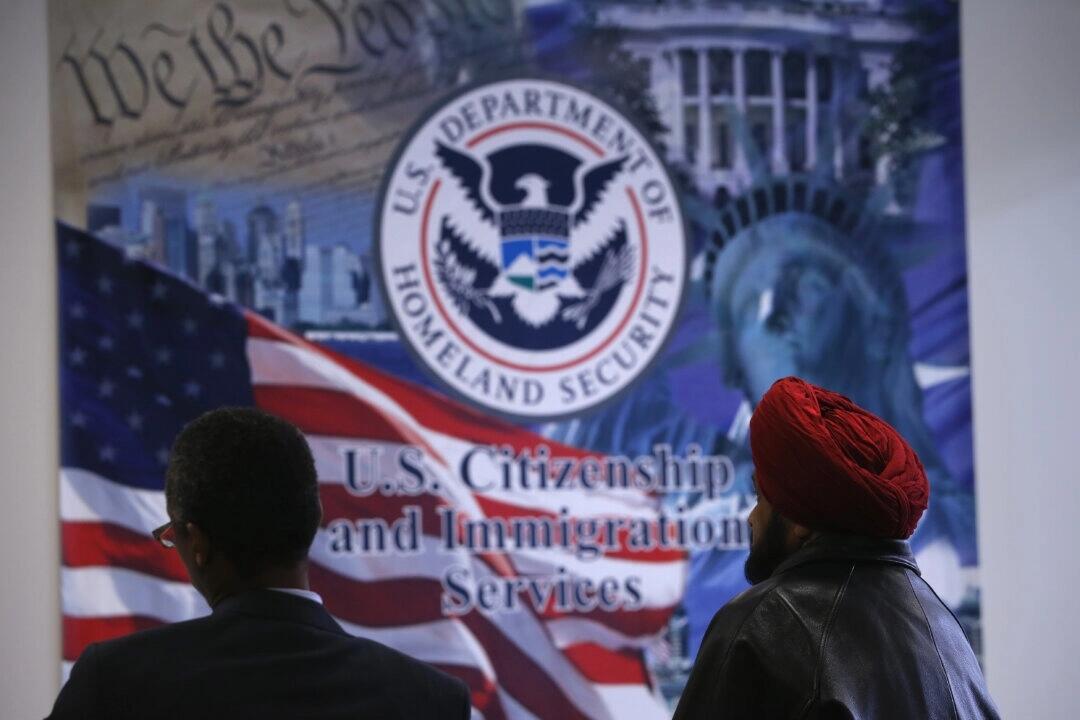
The Trump administration announced Tuesday it has suspended the processing of all immigration applications from 19 countries, including Afghanistan and Somalia, citing national security and public safety concerns.
The action comes a week after an Afghan national was arrested for shooting two National Guard soldiers near the White House, killing one and critically wounding the other.
The action includes processing for green cards and U.S. citizenship, according to a memorandum. Nations affected include Myanmar (Burma), Chad, the Republic of the Congo, Equatorial Guinea, Eritrea, Haiti, Iran, Libya, Sudan, Yemen, Burundi, Cuba, Laos, Sierra Leone, Togo, Turkmenistan, and Venezuela.
The memorandum places a hold on all Forms I-589 (Application for Asylum and for Withholding of Removal), regardless of the applicant’s country of nationality. It also places hold on pending benefit requests for individuals from the impacted countries, and conducts a comprehensive review of approved benefit requests for aliens from impacted countries who entered the country on or after Jan. 20, 2021.
“This memorandum mandates that all aliens meeting these criteria undergo a thorough re-review process, including a potential interview and, if necessary, a re-interview, to fully assess all national security and public safety threats along with any other related grounds of inadmissibility or ineligibility,” the memo announcing the changes reads.
The policy also follows a partial travel ban implemented in June on a similar list of nations.
The new memo cited the shooting of two National Guard soldiers in Washington last week, where the male Afghan suspect has pleaded not guilty, as an example of public safety and national security concerns.
“Recently, the United States has seen what a lack of screening, vetting, and prioritizing expedient adjudications can do to the American people,” states the memo.
“USCIS [United States Citizenship and Immigration Services] plays an instrumental role in preventing terrorists from seeking safe haven in the United States and ensuring that USCIS’ screening and vetting and adjudications prioritize the safety of the American people and uphold all U.S. laws.”
The new directive stops ongoing applications and requires immigrants from the targeted countries to be completely re-evaluated.
Border czar Tom Homan has highlighted shortcomings in the screening of Afghans.
“It’s the biggest national security failure in the history of the nation,” Homan told Fox News in an interview on Nov. 30.
Sharvari Dalal-Dheini, who serves as the senior director of government relations for the American Immigration Lawyers Association, told Reuters the organization had received details of cancelled oath ceremonies, naturalization interviews, and adjustment of status interviews for individuals from nations named on the travel ban list.
Trump said the pause on asylum decisions might last indefinitely and would target “third world countries,” saying it was necessary for the U.S. immigration system to fully recover.
“We don’t want those people. We have enough problems,” the president told reporters aboard Air Force One on Nov. 30.
“I don’t think they are all third world, but in many cases they are third world. They are not good countries. They are very crime-ridden countries,” he added. “And we frankly, don’t need their people coming into our country telling us what to do.”
Tyler Durden
Wed, 12/03/2025 – 08:35
Chile aprueba un proyecto de ley que prohíbe el uso de teléfonos celulares en las escuelas
Por NAYARA BATSCHKE
SANTIAGO (AP) — La Cámara de Diputados de Chile aprobó un proyecto de ley que regula y prohíbe el uso de dispositivos móviles electrónicos de comunicación personal, como celulares, en todas las escuelas a partir de 2026.
En una votación la noche del martes los diputados aprobaron las modificaciones que el Senado había realizado al proyecto, por lo que la iniciativa queda ahora a la espera de la promulgación por parte del presidente Gabriel Boric.
“Aprobamos la ley que prohíbe el uso de celulares”, celebró el ministro de Educación, Nicolás Cataldo, en un vídeo subido a X tras conocer la decisión.
El ministro explicó que la iniciativa consiste en la prohibición del uso de teléfonos móviles en todo el sistema educativo de Chile, aunque contempla la posibilidad de “adecuaciones” en casos específicos, como problemas de salud o situaciones de emergencia que ocurran de manera imprevista.
La medida, que ya había sido avalada en agosto por el Senado, tiene el objetivo de mejorar la convivencia escolar y el rendimiento de los estudiantes disminuyendo las distracciones en las salas de clases.
Con la promulgación de la ley a partir del próximo año todos los establecimientos parvularios, básicos y medios del país deberán prohibir el uso de celulares durante las actividades curriculares.
Este año un colegio de Santiago ya había adoptado la medida como parte de un proyecto piloto en sus dependencias, en una apuesta por reintegrar a la comunidad escolar e incentivar el bienestar de los estudiantes en tiempos de hiperconexión.
La última prueba PISA —un estudio internacional coordinado por la Organización para la Cooperación y el Desarrollo Económicos (OCDE) que evalúa las competencias de los estudiantes en áreas clave como lectura, matemáticas y ciencias— mostró que Chile lideró los indicadores educativos en Latinoamérica, pero aún no ha alcanzado el promedio del organismo.
En su última evaluación, divulgada en diciembre de 2023, más de la mitad de los estudiantes chilenos dijeron distraerse al usar dispositivos digitales, lo que supera el porcentaje promedio de los países de la OCDE.
“Con la regulación del uso de celulares en las aulas, estamos avanzando en un cambio cultural para niños, niñas y adolescentes que hoy día necesitan, más que nunca, volver a verse las caras, socializar en los recreos y recuperar la concentración para impulsar aún más los aprendizajes”, agregó el ministro Cataldo.
Un estudio de 2021 elaborado por investigadores de la universidad King’s College del Reino Unido halló que los jóvenes que se consideraban adictos a sus teléfonos celulares tenían el doble de probabilidades de manifestar síntomas de ansiedad y el triple de sufrir depresión.
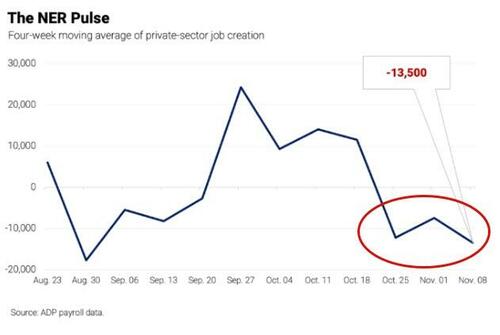
Small Business Job Losses Soar In November; ADP
Small Business Job Losses Soar In November; ADP
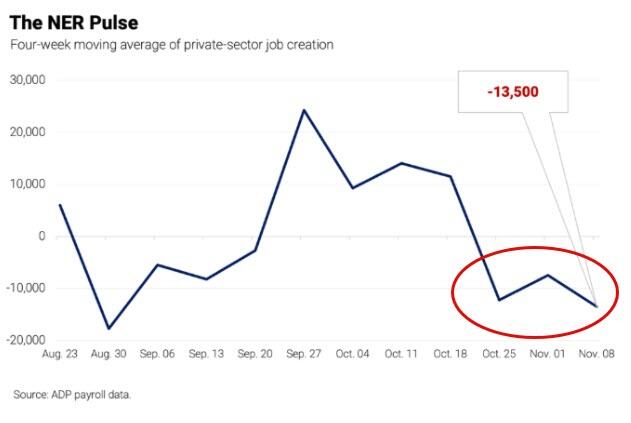
Following the last three weeks showing job losses (for ADP’s new weekly model)…
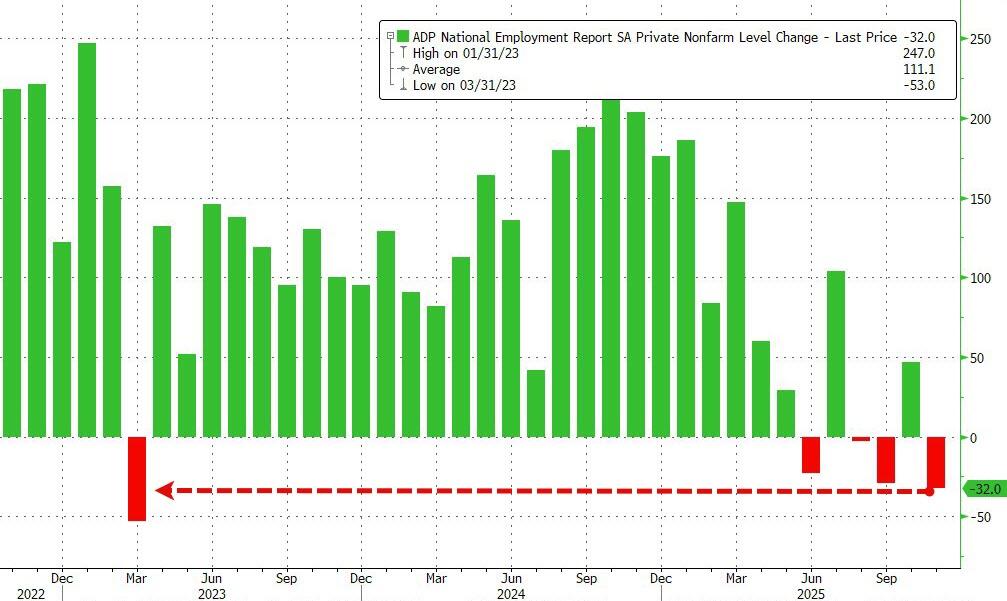
The official ADP report confirmed this weakness, printing 32k job losses in November (far worse than the +10k expected) and well down from the +47k revised for October…
Source: Bloomberg
That is the biggest job loss since March 2023.
Job creation has been flat during the second half of 2025 and pay growth has been on a downward trend.
“Hiring has been choppy of late as employers weather cautious consumers and an uncertain macroeconomic environment,” says Dr. Nela Richardson, Chief Economist, ADP.
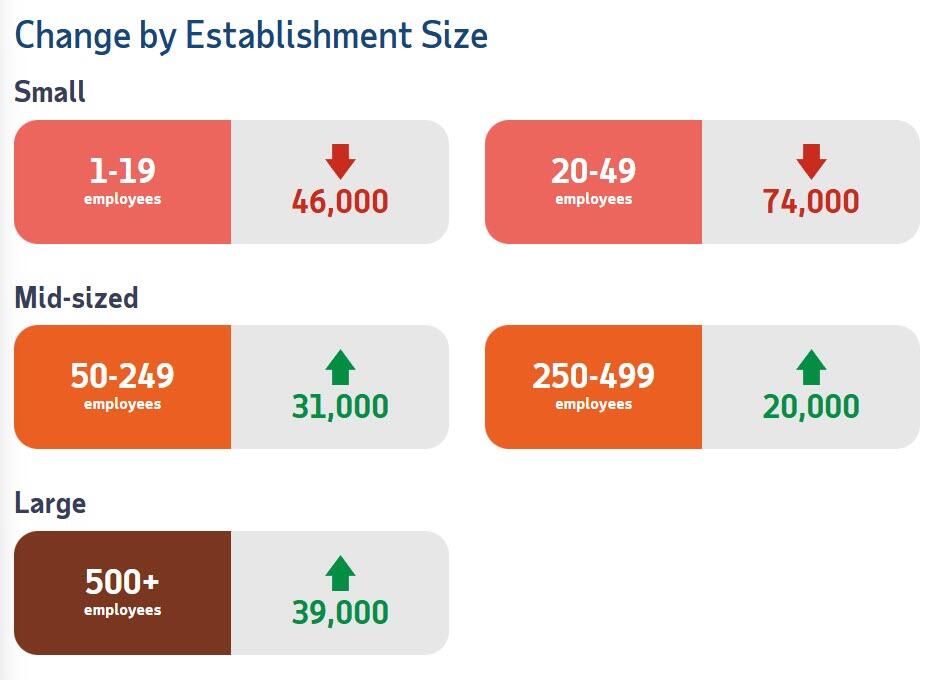
“And while November’s slowdown was broad-based, it was led by a pullback among small businesses.”
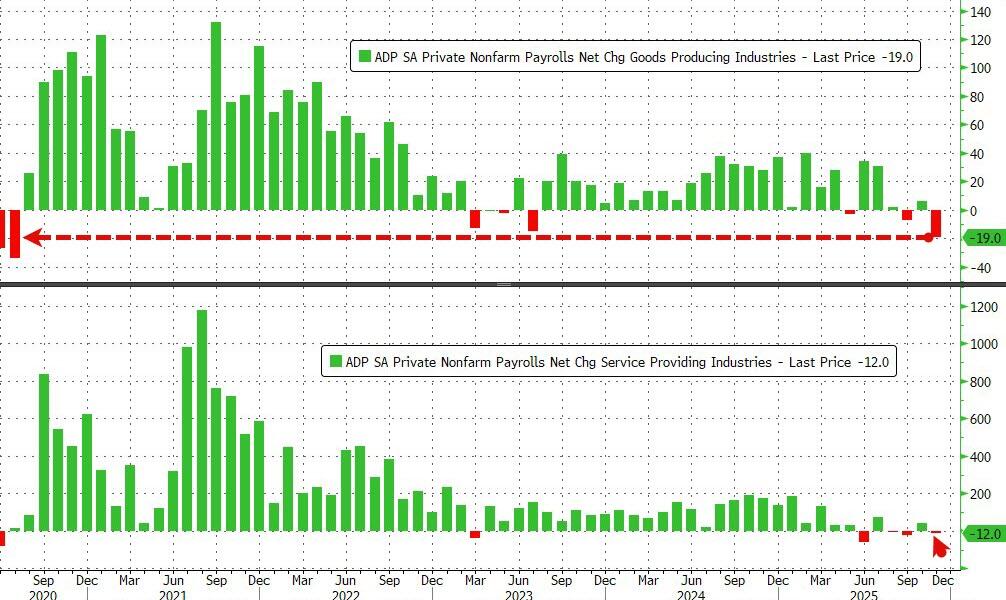
Labor market dispersion is rising with an increasing number of industries seeing losses with Goods-Producers suffering their biggest job loss since COVID…
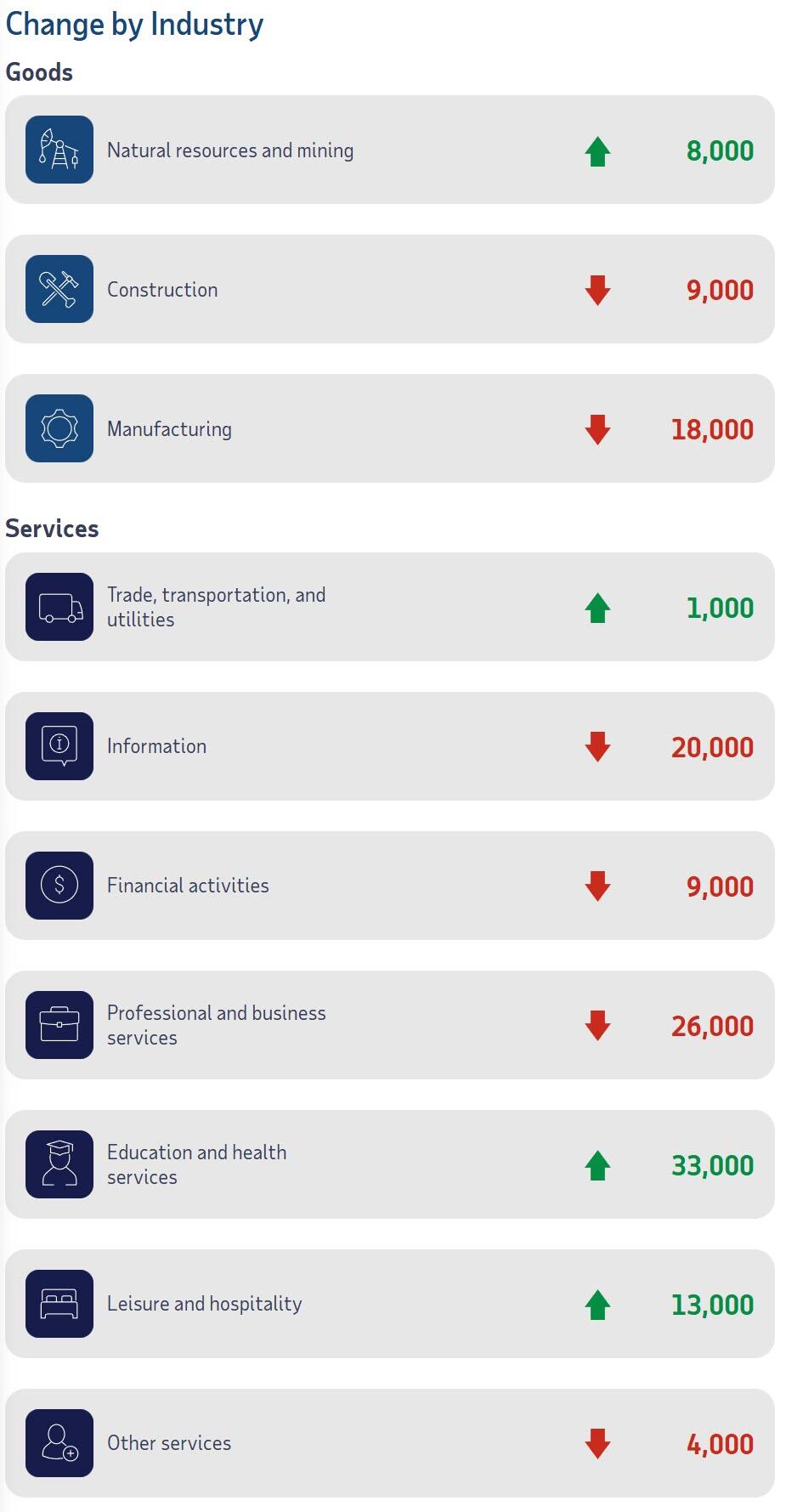
November hiring was particularly weak in manufacturing, professional and business services, information, and construction.
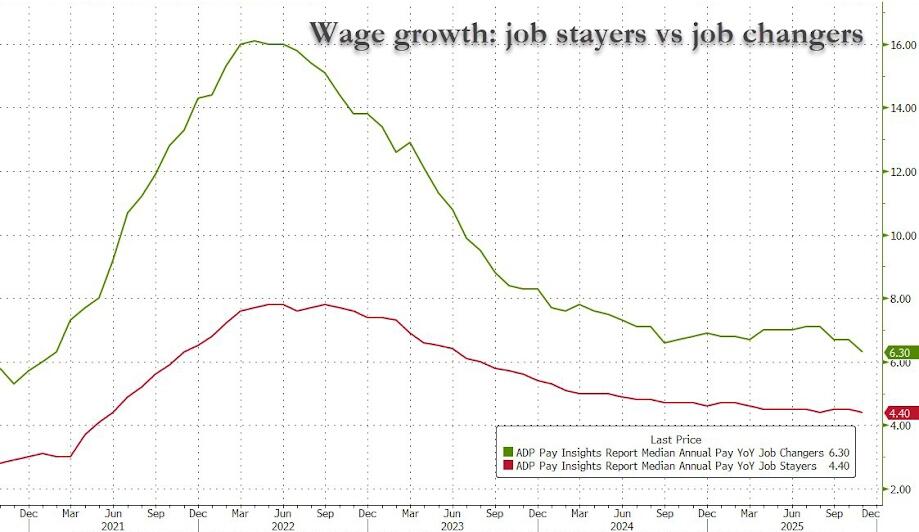
Year-over-year pay for job-stayers rose 4.4 percent, down from 4.5 percent growth in October. For job-changers, pay was up 6.3 percent, slowing from 6.7 percent growth the month prior.
While not the ‘official’ BLS data, this information definitely supports a tilt towards a dovish rate-cut next week (rather than the hawkish cut expected).
Tyler Durden
Wed, 12/03/2025 – 08:24
https://www.zerohedge.com/personal-finance/small-business-job-losses-soar-november-adp

Macy’s registra sorprendente ganancia y ventas más fuertes en tres años
Por ANNE D’INNOCENZIO
NUEVA YORK (AP) — Macy’s registró una sorprendente ganancia en el tercer trimestre y sus ventas comparables más fuertes en más de tres años, ya que una extensa renovación de la tienda comienza a resonar con los compradores.
Después de publicar sus aumentos trimestrales consecutivos en ventas comparables el miércoles, Macy’s elevó su pronóstico financiero para el año. Sin embargo, incluso la guía de ventas emitida el miércoles estuvo por debajo de las cifras de ventas anuales del año pasado, enviando una nota de precaución sobre el ánimo del consumidor estadounidense.
Las acciones cayeron un 2% antes de la apertura del mercado.
Las ventas comparables, un buen barómetro de la salud de un minorista, han sido una señal ominosa en Macy’s durante varios años, sirviendo cada trimestre como un recordatorio de que la cadena de grandes almacenes tenía un largo camino por recorrer.
Sin embargo, el miércoles, Macy’s registró un sólido aumento del 3,2% para el trimestre que finalizó el 1 de noviembre, tras un aumento del 1,9% durante el segundo trimestre. La cifra incluye negocios con licencia como cosméticos.
“A medida que entramos en la temporada navideña, estamos bien posicionados con nuevos productos atractivos y una experiencia de cliente omnicanal que ofrece tanto inspiración como valor”, declaró el presidente y CEO Tony Spring en un comunicado.
“Con una estrategia arraigada en la hospitalidad, nuestros equipos están enfocados en impulsar un crecimiento rentable a largo plazo”, agregó.
El sólido desempeño de Macy’s es notable porque todos los minoristas están navegando un entorno desafiante con consumidores que se retraen a medida que los precios suben en medio de una guerra comercial iniciada por Estados Unidos. Sin embargo, los compradores han permanecido resilientes y han dado un fuerte comienzo a la temporada de compras navideñas que comenzó durante el fin de semana de Acción de Gracias.
Bajo la dirección de Spring, quien asumió el cargo hace casi dos años, Macy’s ha cerrado tiendas no rentables mientras invierte fuertemente en modernizar su marca homónima. La compañía, que también opera su cadena de lujo Bloomingdale’s y Bluemercury de cosméticos, ha reforzado el servicio al cliente en las áreas de prueba, así como en el departamento de calzado. También ha estado tratando de diferenciar su negocio de lujo de sus rivales al agregar mercancía exclusiva.
Esos cambios parecen estar dando frutos.
Macy’s reportó un ingreso neto de 11 millones de dólares, o 4 centavos por acción, para el trimestre. Las ganancias ajustadas por acción fueron de 9 centavos, sorprendiendo a los analistas de la industria que esperaban una pérdida de 13 centavos.
El año pasado, la compañía ganó 28 millones de dólares o 10 centavos por acción.
Las ventas netas cayeron ligeramente a 4.710 millones de dólares, desde 4.730 millones, reflejando el cierre de tiendas con bajo rendimiento. Pero eso aún superó las proyecciones de 4.550 millones de los analistas.
Las tiendas que ha renovado, 125 de ellas, registraron un crecimiento en ventas comparables del 2,7%, superando el ritmo cuando se incluyen todas las tiendas.
Macy’s ahora espera ganancias anuales por acción de entre 2 y 2,20 dólares, muy por encima de su guía anterior de entre 1,70 y 2,05 dólares por acción. También proyectó ventas anuales para 2025 en el rango de 21.470 millones a 21.620 millones de dólares, por encima de su guía anterior de entre 21.150 millones a 21.450 millones.
Wall Street había estado proyectando ganancias de 2 dólares por acción sobre ventas de 21.300 millones de dólares, según FactSet.
___________________________________
Esta historia fue traducida del inglés por un editor de AP con ayuda de una herramienta de inteligencia artificial generativa.

Crown Point’s Ava Punak hasn’t played basketball for very long. But she has ‘potential’ to play much longer.
Crown Point junior forward Ava Punak has progressed at a rapid rate in a relatively short amount of time.
Punak didn’t begin playing basketball until middle school.
“Seventh grade,” she said. “Not very young. My dad was like, ‘You should try out for the basketball team.’ I was like, ‘You know what, why not?’ The tryout in seventh grade was the first time I ever touched a basketball.”
But the 5-foot-11 Punak is already a key player for the Bulldogs (8-0), who are ranked No. 15 in the state coaches poll under first-year coach Brad Stangel. She was averaging 8.7 points, which is the second-highest mark on the team behind sophomore guard Ava Richie‘s 18.0, along with a team-best 5.6 rebounds and 3.0 steals before Crown Point’s win over Lowell on Tuesday.
“She has 21 steals and 28 deflections and 39 rebounds — she just always gets her hands on the ball,” Stangel said. “It’s one of those things, all of a sudden, all of the numbers are filled. She doesn’t just score. She’s done a nice job. She just is really, really a very good basketball player.”
Punak was primarily a soccer player when she was younger. She played for the Bulldogs during her freshman and sophomore years as well as for a travel team. But she opted not to play this past season in order to focus on basketball.
“It was a tough decision because I’ve played soccer my whole life,” Punak said. “But it was a lot on my body. This year with a new coach, I really didn’t want to miss workouts.”
After spending most of her freshman season on the junior varsity team, Punak secured a spot in the Bulldogs’ lineup last season and averaged 6.5 points, 4.9 rebounds, 1.8 assists and 2.8 steals.
“Coming in my sophomore year, I was coming off JV, and I wasn’t very confident yet,” she said. “My sophomore year was more about building my confidence.
“Now that I’m an upperclassman, I’m trying to help the underclassmen build their confidence because that’s what I needed coming in. We only have three seniors, so I have to step in and be a bigger leader. I try to have a big presence on defense.”
Crown Point’s Ava Punak, left, guards Bishop Noll’s M’Aliyah Lewis during a nonconference game in Crown Point on Tuesday, Nov. 12, 2024. (Kyle Telechan / Post-Tribune)
Crown Point junior forward/center Ivy Henderson believes Punak has been succeeding on those fronts.
“Ava is a force on defense and is always in the right spot to get the steal,” Henderson said. “She’s also good at creating space and driving to the basket on offense.
“She is very funny and is always there to crack a joke and lighten up the mood, whether we’re at practice or preparing for a game.”
Crown Point sophomore guard/forward Sidney Hale agreed.
“She has a big impact on the team,” Hale said of Punak. “She’s a good leader. When she’s doing well, she can lift up other people and bring energy into the team. She’s really confident, which is good to have.”
Punak has earned that level of confidence with her dedication to the sport.
“Just wanting to put in the extra work, not only what was needed,” she said. “Just wanting to do better. And the weight room too — I’ve gotten way stronger from my freshman year and even last year. And I feel like my shot has gotten more accurate too. It’s just wanting to put in the extra work.”
Crown Point’s Ava Punak, left, drives against Bishop Noll’s Quinn Fehr during a nonconference game in Crown Point on Tuesday, Nov. 12, 2024. (Kyle Telechan / Post-Tribune)
Stangel, whose five seasons with the Andrean boys basketball team included the 2019 Class 2A state title and four seasons with the Hanover Central boys basketball team included a 2025 Class 3A sectional title, thinks Punak has even more room to develop.
“Ava has a lot of potential to be a great basketball player,” Stangel said. “She’s growing into her role here. She’s playing with a lot more confidence as our season goes. She’s unique. With her size and her athleticism and her strength, she’s a very difficult matchup. Because she can guard all five positions, there really isn’t a bad matchup for her defensively. She can always play. If you don’t have someone who’s the same size as her, she’s going to be quicker than your big or bigger and stronger than the small one you’re going to put on her. She can guard both of them. She’s unique in that sense.
“When I used to coach college basketball, those were the players that we were looking for, the ones that could guard both bigger than them and smaller than them and just be able to play. We’ve asked her to play on the perimeter a little bit more than maybe she’s used to, and she’s adapted really well.”
Punak, who could envision continuing to play basketball in college, is enjoying the fruits of her labor but knows she has more to do.
“Everyone’s excited,” she said. “We’ve been working really hard. But the biggest thing is just staying consistent, just putting in that work every day and not letting up and not getting too comfortable.”
https://www.chicagotribune.com/2025/12/03/basketball-crown-point-ava-punak/

Evanston church’s Nativity depicts baby Jesus zip-tied by ICE agents
Mother Mary wearing a respirator mask to protect herself from tear gas. Baby Jesus with zip-tied hands, wrapped in a thin blanket that looks like aluminum foil. Masked centurions with sunglasses and green vests labeled “ICE.”
This is how the Lake Street Church of Evanston chose to assemble its Nativity scene for the Christmas season. The church and its leaders have been vocal critics of the Trump administration’s Operation Midway Blitz and expressed a message with their holiday decorations.
“Enforcement terror does not discriminate by documentation status,” the church wrote on its Facebook page on Nov. 25.
The organizer of the nativity scene, Associate Minister Jillian Westerfield, told Pioneer Press that in the months prior to organizing it, she has been reflecting on the impact of Operation Midway Blitz, in which hundreds of immigrants have been detained, the overwhelming majority of which do not have criminal histories that have a “high public safety risk,” the Chicago Tribune found.
“For me at least, I have experienced seeing the face of Christ in the people who are suffering,” Westerfield said, pointing to arrests, detainments and altercations in Evanston and Chicago. “We just really saw a parallel between the ICE forces and the centurions.”
“Of course it’s political,” but the set is not up for political interpretation, Westerfield said.
A figure of Baby Jesus in a Nativity set shows him covered in a blanket with his hands zip-tied at the Lake Street Church of Evanston. The church’s leadership chose to depict the Nativity scene as an homage to people facing Immigration and Customs Enforcement’s Operation Midway Blitz. (Jillian Westerfield)
“This is what the Bible says happened to Jesus, and we use our contemporary imagery to illustrate that,” she said. “I do feel like it’s a pretty straightforward representation of what the Bible says happened to Jesus’s family.”
According to Biblical texts, King Herod, fearing that a rival had been born to usurp his power, tried to kill infant Jesus by ordering the murder of all baby boys in Bethlehem. Jesus’ father Joseph acted quickly to take his wife Mary and baby Jesus and flee Bethlehem to avoid the bloodshed.
Most traditional, popular renditions of the Nativity depict peaceful scenes of the newborn Jesus lying in a manger with his parents, angels, shepherds and their animals prayerfully looking on.
The Lake Street Church of Evanston’s leadership depicted the Holy Family in this Christmas season’s nativity display as protestors against ICE and federal immigration officers. In this rendition, Mary wears a mask to protect herself from tear gas deployed by centurions depicted as ICE agents. (Jillian Westerfield)
Westerfield said the feelings about ICE, the U.S. Immigration and Customs Enforcement agency, are not just shared by the church’s leadership, but also its congregation. “This is who we are, and this is what’s important to us. And we would be much more afraid to hold back, because ultimately, we feel like we answer to God, not to anyone else,” Westerfield said.
Outside of the reaction from the church’s congregants, Westerfield said there are always concerns about reactions from outside forces, but that they will not let themselves cower from expressing themselves. If someone is really upset by the nativity set, “I hope that what happens is they examine why they’re upset and maybe find within their own conscience a change of heart,” she said.
According to Biblical texts, centurions were ordered by King Herod to kill Jesus. An Evanston church is drawing parallels between the nativity story and people arrested and detained by U.S. Immigration and Customs Enforcement during Operation Midway Blitz. (Jillian Westerfield)
Rev. Michael Woolf, a frequent protestor of Operation Midway Blitz and the lead pastor for the Lake Street Church, told Pioneer Press, “Christians have to look at the birth story — not just a sort of a rosy sort of tale that we can just read in scripture — but actually sort of wrestle with its coming into being in context.”
“We don’t speak for all Christians, but we certainly speak for a certain strand of community that’s trying to take that message and say, ‘If Jesus were born in America right now, what would this nativity set look like?’” Woolf said.
Lake Street Church and Westerfield have previously organized nativity sets with political messages. In 2023, the church organized a nativity set with only Baby Jesus surrounded in rubble, as an homage to the people trapped in the war in Gaza.
In the 2023 Christmas season, the Lake Street Church of Evanston designed a “Rubble Nativity” to honor the lives of Palestinians trapped in or killed in the war in Gaza. In 2025, the nativity display depicts immigration agents detaining the Holy Family. (Jillian Westerfield)
“We were all very, and still are of course, very concerned about the situation in Gaza, and the suffering of people all over the world,” Westerfield said. The reception the church received then was largely positive, she said. The church also held an outdoor prayer vigil for Palestine then.
https://www.chicagotribune.com/2025/12/03/evanston-nativity-baby-jesus-zip-tied-ice-agents/

Daywatch: Illinois settles suit against Monsanto for $120 million
Good morning, Chicago.
Illinois reached a settlement of at least $120 million with Monsanto Co., the largest producer of now-banned PCBs, to address longstanding contamination across the state.
Illinois Attorney General Kwame Raoul sued Monsanto in 2022 over its denial of the health and environmental harms of the hazardous synthetic chemical, known as polychlorinated biphenyls. The lawsuit alleged Monsanto knowingly concealed the dangers of PCBs and continued to produce and distribute it for decades.
Under the agreement, the state will receive $80 million by March 31, which will be disbursed to Chicago and nine surrounding cities of Evanston, Lake Forest, North Chicago, Zion, Beach Park, Glencoe, Lake Bluff, Winnetka and Winthrop Harbor.
Here are the top stories you need to know to start your day, including: what to know about a new law on Illinois vaccine guidelines, what happened at Wieners Circle when hungry Bears fans lined up at 5 a.m. and a look at the winners of the 2025 Holiday Cookie Contest.
Today’s eNewspaper edition | Subscribe to more newsletters | Asking Eric | Horoscopes | Puzzles & Games | Today in History
U.S. Sen. Dick Durbin, the ranking member, talks during a Senate Judiciary Committee hearing on Feb. 12, 2025, at the Dirksen Senate Office Building in Washington, D.C. (Brian Cassella/Chicago Tribune)
Sen. Dick Durbin demands answers from Homeland Security regarding U.S. citizens caught up in immigration raids
U.S. Homeland Security Secretary Kristi Noem recently claimed that no United States citizens have been caught up in Trump administration immigration raids.
But that is false, U.S. Sen. Dick Durbin said in a six-page letter to Noem that demands answers about the department’s detention of U.S. citizens and cites Chicago Tribune reporting.
After ominous signs from 7th Circuit, attorneys abruptly move to dismiss lawsuit restricting use of force by immigration agents
‘Shocked’: Chicago appeals judge rips lower court’s ruling to release immigration arrestees
Gov. JB Prtizker holds Illinois House Bill 767 after signing it on Dec. 2, 2025, at the Illinois Department of Human Rights office in Chicago’s West Loop. The legislation formally establishes a process for state-level vaccine guidelines and expands pharmacy access to COVID-19 and other shots for young children across Illinois. (Dominic Di Palermo/Chicago Tribune)
Gov. JB Pritzker signs law on Illinois vaccine guidelines amid ongoing tumult with Trump administration
Gov. JB Pritzker signed legislation that formally establishes a process for state-level vaccine guidelines and expands pharmacy access to COVID-19 and other shots for young children across Illinois.
Resident Travaris Ivy leads the media through the apartment building at 7500 S. South Shore Drive in Chicago on Dec. 2, 2025. (Eileen T. Meslar/Chicago Tribune)
First, ICE raided their Chicago apartment building. Now, they’re being forced to vacate it.
On a freezing Tuesday morning after Chicago’s snowiest November day on record, residents of a building that made international headlines after a federal immigration raid earlier this year decried a recent court-ordered mandate to vacate their homes at 7500 South Shore Drive.
Mayor Brandon Johnson speaks during a ceremony at Malcolm X College on Dec. 2, 2025, in Chicago. (John J. Kim/Chicago Tribune)
Aldermen call for garbage fee and liquor tax increases instead of corporate head tax
A City Council majority came out with a budget plan that raises garbage collection fees and liquor taxes while eliminating Mayor Brandon Johnson’s corporate head tax entirely for 2026, hours after he delivered a stinging rebuke to opponents of his controversial levy proposal.
Downtown alderman wants teen curfew compromise after meetup shootings
Shoppers stroll around Gurnee Mills on a Thursday afternoon. (Joe States/Pioneer Press)
Village approves chipping in for new Gurnee Mills store: IKEA?
Gurnee Mills will soon have one less vacancy after the Gurnee Village Board voted to approve an agreement to renovate vacant tenant space.
While Jocelyn Gubler, the vice president of development at Simon Property Group, didn’t specify what store would be moving into the space, but shared hints. “This retailer has been launching smaller format stores, as a complement to its larger standard-size, warehouse-type of environment that’s in 27 states and territories in the U.S.,” she said. “[One] of these stores just opened in San Marcos, Texas, earlier this year.”
Fenwick’s Logan Schultz (77), Jake Thies (8) and Mike Murphy (5) celebrate with the trophy after defeating East St. Louis in the Class 6A state championship game in Normal on Dec. 2, 2025. (Vincent D. Johnson/for Pioneer Press)
Jake Thies’ interception is one more moment to remember for a ‘great player’ as Fenwick wins 6A state title
Capping an impressive performance that included two touchdown runs, Jake Thies returned an interception 39 yards to East St. Louis’ 3-yard line with 2:30 left, all but sealing Fenwick’s second state title. Senior quarterback Jamen Williams Jr. scored on the next play as the Friars won 38-28 at Illinois State’s Hancock Stadium.
Providence’s Xavier Coleman (2) tries to shake a St. Francis defender during the Class 5A state championship game in Normal on Dec. 2, 2025. (Vincent D. Johnson / for the Daily Southtown)
Big catches. Big plays. Just another day at state office for Providence’s Xavier Coleman. ‘Kudos to my team.’
Xavier Coleman hauled in four catches for 107 yards and a touchdown, but the Celtics came up just short in the final seconds, losing 39-35 to Wheaton St. Francis in the Class 5A championship game at Illinois State’s Hancock Stadium.
With center Drew Dalman (52) blocking, Bears quarterback Caleb Williams throws a pass in the first quarter against the Eagles on Nov. 28, 2025, at Lincoln Financial Field in Philadelphia. (Chris Sweda/Chicago Tribune)
Stats show troubling trend in Caleb Williams’ accuracy, but Ben Johnson says to ‘throw those out the window’
Bears quarterback Caleb Williams had a pair of “oh, no” throws Friday that would have been the talk of the week had the Bears not beaten the Philadelphia Eagles on a national stage.
Are the 9-3 Bears the best team in the NFC? 5 pressing questions after Week 13.
Bears’ Week 16 matchup with Green Bay Packers scheduled for prime-time kickoff
Nora Riordan picks up a free hot dog as Bears fans line up, Dec. 2, 2025, at The Wieners Circle in Chicago’s Lincoln Park neighborhood after coach Ben Johnson took his shirt off in a postgame celebration for a win over the Eagles. (Brian Cassella/Chicago Tribune)
Chicago Bears fans line up again for free Wieners Circle hot dogs, cheering ‘thank you, Ben Johnson’
It happened again. A line of hyper and hungry Bears fans started forming outside The Wieners Circle at 5 a.m. yesterday, despite the bitter 23-degree temperature. It was all in the name of free hot dogs, courtesy of Chicago Bears head coach Ben Johnson, who rose to the hot dog stand’s challenge and took off his shirt after Friday’s win against the Philadelphia Eagles.
Column: When a shirtless coach and a free hot dog rallied an entire city. Only in Chicago.
The Tribune holiday cookie contest winners. (Brian Cassella/Chicago Tribune)
2025 Holiday Cookie Contest winners announced
For the 39th annual Tribune Holiday Cookie Contest, readers submitted recipes for sweet treats, including biscotti and shortbread, bars and balls, and classic chocolate chip and sugar cookies. Some recipes were decades old, passed down from grandparents, aunts, neighbors and friends, and tweaked as the years have gone by.
More than 1,800 readers cast over 3,800 votes to decide the 12 finalists that Tribune staffers baked for judging. Guest judges Justin Lerias of Del Sur, Reema Patel, previously of Sarima Cafe, and Asa Balanoff Naiditch of Blame Butter selected this year’s top cookie.
Tribune’s 2025 Holiday Cookie Contest: Get the winning recipes