Category: News

EEUU lanza redada migratoria en Nueva Orleans
Por JACK BROOK
NUEVA ORLEANS (AP) — Las autoridades migratorias estadounidenses lanzaron el miércoles un operativo contra la inmigración en Nueva Orleans, afirmando que apunta a criminales violentos y ampliando el fenómeno que se ha visto en otras ciudades del país.
El objetivo de la operación es capturar a inmigrantes que fueron liberados después de sus arrestos por delitos como invasión de hogar, robo a mano armada y violación, declaró la subsecretaria del Departamento de Seguridad Nacional, Tricia McLaughlin, en un comunicado.
No mencionó cuántos agentes serían desplegados bajo la operación. Luisiana se ha estado preparando durante semanas para un operativo que el gobernador republicano Jeff Landry ha dicho que recibiría con agrado.
“Las políticas de santuario ponen en peligro a las comunidades al liberar a extranjeros criminales ilegales y obligar a las fuerzas de Seguridad Nacional a arriesgar sus vidas para remover a criminales ilegales que nunca debieron haber sido puestos de nuevo en las calles”, afirmó McLaughlin.
La administración Trump también lanzó operativos de represión de inmigración en Los Ángeles, Chicago y Charlotte, Carolina del Norte. Landry es un aliado cercano de Trump que ha buscado alinear la política estatal con la agenda de la Casa Blanca.
___________________________________
Brook participa en el programa Associated Press/Report for America Statehouse News Initiative. Report for America es un programa sin fines de lucro que designa periodistas en salas de redacción para reportar temas de poca cobertura.
___________________________________
Esta historia fue traducida del inglés por un editor de AP con ayuda de una herramienta de inteligencia artificial generativa.
https://www.chicagotribune.com/2025/12/03/eeuu-lanza-redada-migratoria-en-nueva-orleans/

Futures Tumble on Report Microsoft Lowers AI Software Sales Quotas
Futures Tumble on Report Microsoft Lowers AI Software Sales Quotas
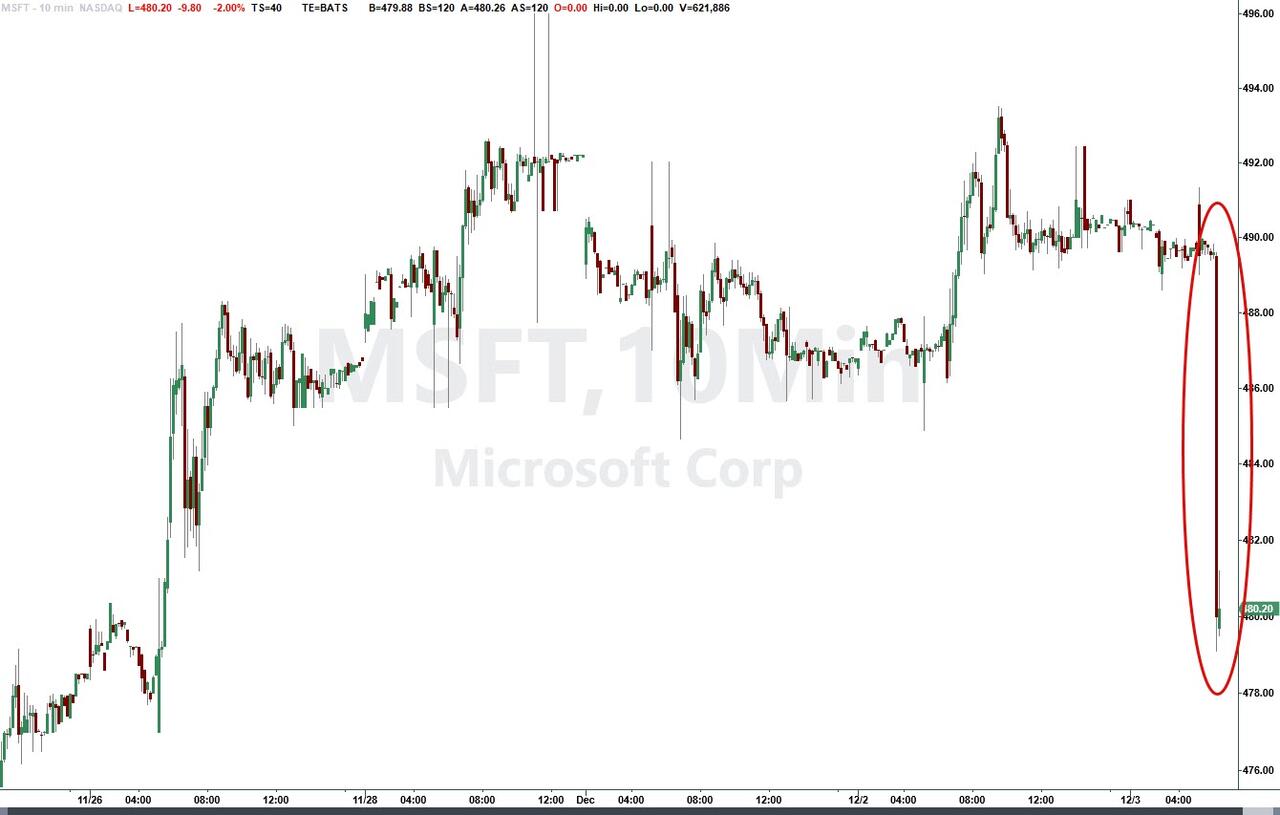
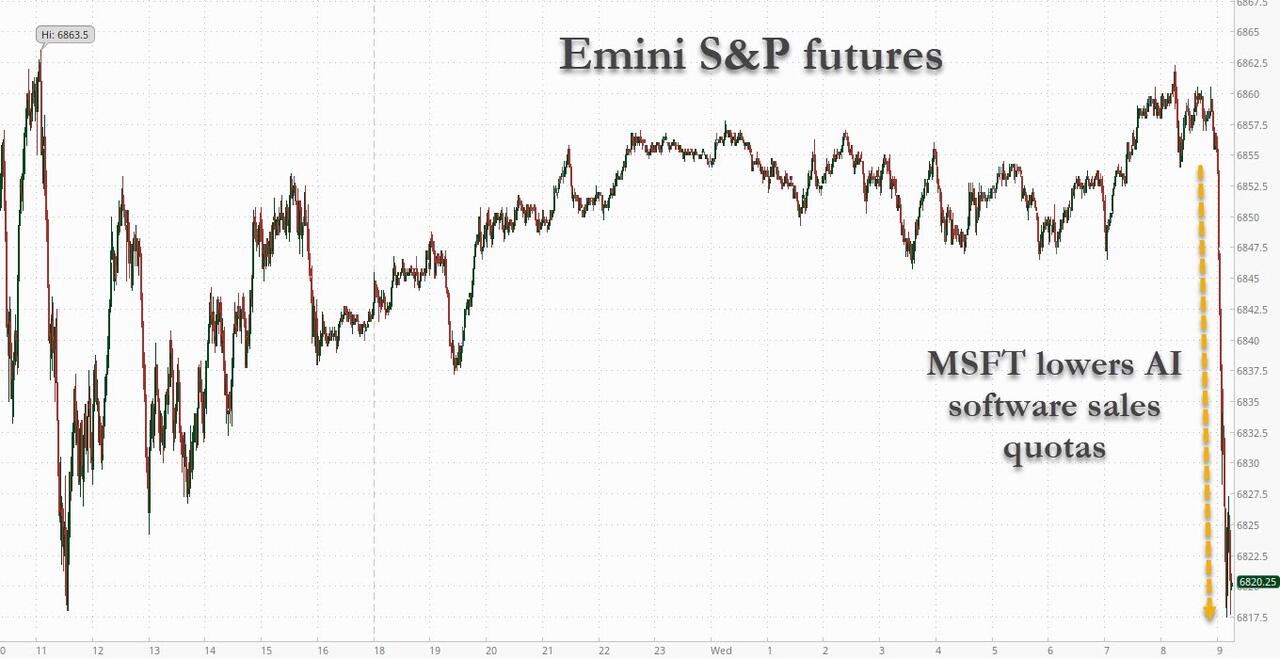
Futures suddenly tumbled just after 9am ET, when Bloomberg blasted a report from the Information, according to which Microsoft has lowered expectations for how quickly it can get customers to spend money on newer AI products, known as agents, after many salespeople missed sales-growth goals.
Corporate customers have complained that it’s hard to measure the savings from using AI technology and that it can be difficult to get the AI to work perfectly in certain cases. This is important for those trying to quanity the IRR from AI: it appears to still be at or just above zero.
According to the report, multiple MSFT divisions lowered how much salespeople are supposed to grow their sales of certain AI products after many of them missed sales-growth goals in the fiscal year that ended in June, according to two salespeople in Microsoft’s Azure cloud unit; they added that “It’s rare for Microsoft to lower such quotas for specific products.”
Microsoft is adjusting to resistance from companies to pay more for AI, but AI has been a major boon to Microsoft’s business, thanks to new spending by AI firms and Microsoft’s sales of AI software.
The news hammered both MSFT…
… and spoos, which instra-tumbled about 40 points on the report.
Tyler Durden
Wed, 12/03/2025 – 09:18
https://www.zerohedge.com/markets/futures-tumble-report-microsoft-lowers-ai-software-sales-quotas

Doctor to be sentenced for selling Matthew Perry ketamine before ‘Friends’ star’s overdose death
LOS ANGELES — A doctor who pleaded guilty to selling ketamine to Matthew Perry in the weeks before the “Friends” star’s overdose death is set to be the first of five people sentenced in the case on Wednesday.
Perry’s family and possibly others affected by his death will have a chance to make a statement in federal court in Los Angeles before the sentencing of Dr. Salvador Plasencia.
Prosecutors are asking U.S. District Judge Sherilyn Peace Garnett to sentence Plasencia, 44, to three years in prison after a plea agreement where the doctor admitted to illegally selling Perry large amounts of ketamine. He was not accused of selling the actor the dose that investigators say killed him on Oct. 28, 2023.
Perry had been taking the surgical anesthetic ketamine legally as a treatment for depression. But when his regular doctor wouldn’t provide it in the amounts he wanted, he turned to Plasencia, who admitted to illegally selling to Perry despite knowing he was a struggling addict. He texted another doctor that Perry was a “moron” who could be exploited for money, according to court filings.
“Rather than do what was best for Mr. Perry — someone who had struggled with addiction for most of his life — defendant sought to exploit Perry’s medical vulnerability for profit,” the prosecution’s sentencing memo said.
Plasencia’s lawyers tried to give a sympathetic portrait of him in their memo, as a man who rose out of poverty to become a doctor beloved by his patients, some of whom provided testimonials about him for the court.
The attorneys called his selling to Perry “reckless” and “the biggest mistake of his life.”
“Remorse cannot begin to capture the pain, regret and shame that Mr. Plasencia feels for the tragedy that unfolded and that he failed to prevent,” the memo said.
But, the lawyers wrote, “a sentence of imprisonment is neither necessary nor warranted. He has already lost his medical license, his clinic, and his career. He has also been viciously attacked in the media and threatened by strangers to the point where his family has moved out of state for their safety.”
Plasencia’s lawyers said he has moved to Arizona with his wife and 2-year-old son, for whom he is a loving caretaker.
“I want him to be proud of his father,” Plasencia said in a video he and his lawyers made for the judge. “I made mistakes, but I want him to know that I tried to make better choices after my mistakes.”
Plasencia pleaded guilty in July to four counts of distribution of ketamine. Prosecutors agreed to drop five different counts. The agreement came with no sentencing guarantees, and legally Garnett can give him up to 40 years.
Perry’s mother Suzanne Perry and his stepfather, “Dateline” journalist Keith Morrison, have attended previous hearings. They could be among those given a chance to speak before Plasencia is sentenced.
The other four defendants who reached deals to plead guilty will be sentenced at their own hearings in the coming months.
Perry struggled with addiction for years, dating back to his time on “Friends,” when he became one of the biggest stars of his generation as Chandler Bing. He starred alongside Jennifer Aniston, Courteney Cox, Lisa Kudrow, Matt LeBlanc and David Schwimmer for 10 seasons from 1994 to 2004 on NBC’s megahit.
https://www.chicagotribune.com/2025/12/03/doctor-sentenced-matthew-perry/
La mitad de Cuba amanece sin electricidad
Por ANDREA RODRÍGUEZ
LA HABANA (AP) — La mitad de Cuba amaneció el miércoles sin electricidad luego de una caída del sistema energético que abarcó desde las provincias de Mayabeque y Artemisa hasta Pinar del Río.
El incidente se produjo luego de varios días con cortes –algunos programados y otros sorpresivos— en medio de la inestabilidad de toda la red.
Los cubanos que residen del centro hacia el occidente de la isla, incluida La Habana, amanecieron sin energía, constató The Associated Press.
La estatal Unión Eléctrica (UNE) informó en una nota en redes sociales que el colapso se produjo sobre la cinco de la madrugada.
Según el funcionario del Ministerio de Energía y Minas —de la cual depende la UNE—, Lázaro Guerra, una falla en una línea de transmisión que enlaza las centrales de Santa Cruz del Norte con Guiteras provocó una sobrecarga y la caída del sector occidental del sistema energético.
“Ya se restablecieron los protocolos de la zona más occidental del país, que es un proceso más rápido que cuando se cae el sistema completo”, explicó Guerra a medios estatales locales. El regreso de la corriente será progresivo, agregó.
La caída del sistema ocurre luego de dos días de desabastecimiento de energía en las horas pico a nivel nacional que superaron el 55% de déficit.
El lunes, por ejemplo, la UNE pronosticó un requerimiento de 3.250 megavatios y una cobertura de 1.325. En septiembre se produjo un colapso nacional que tardó días en recuperarse.
La falta de energía, que se volvió crónica en los últimos años, no sólo afecta a la iluminación, pues en Cuba muchas personas cocinan con energía eléctrica que también se utiliza para el bombeo de agua. Además del impacto en la industria y la producción.
Cuba atraviesa una dura crisis económica que se profundizó durante la pandemia coronavirus –que paralizó al clave sector del turismo— y se agudizó por una reforma financiera interna fallida para unificar la moneda y un incremento de las sanciones de Estados Unidos.
https://www.chicagotribune.com/2025/12/03/la-mitad-de-cuba-amanece-sin-electricidad/

3 dead and several injured in Calumet Park accident
Illinois State police reported at least three people were fatally injured and several injured in a crash shortly after midnight in south suburban Calumet Park.
The fatal crash happened about 12:05 a.m. on northbound I-57 south of 120th Street. Troopers responded to a report of a three-vehicle crash. Another crash occurred when a separate vehicle struck people standing outside of the initial crash, police said. Those victims were pronounced dead at the scene, police said.
A traffic backup lingers after clean up from a fatal crash in the northbound lanes of I-57 near 119th Street, Dec. 3, 2025. (Antonio Perez/Chicago Tribune)
At least five other occupants were taken to a local hospital after suffering non-life-threatening injuries, police said.
All lanes were shut down and traffic was diverted to the 119th Street exit ramp while police conduct an investigation.
https://www.chicagotribune.com/2025/12/03/calumet-park-accident/
Pete Hegseth faces deepening scrutiny from Congress over boat strikes
WASHINGTON — Pete Hegseth barely squeaked through a grueling Senate confirmation process to become secretary of defense earlier this year, facing lawmakers wary of the Fox News Channel host and skeptical of his capacity, temperament and fitness for the job.
Just three months later, he quickly became embroiled in Signalgate as he and other top U.S. officials used the popular Signal messaging application to discuss pending military strikes in Yemen.
And now, in what may be his most career-defining moment yet, Hegseth is confronting questions about the use of military force after a special operations team reportedly attacked survivors of a strike on an alleged drug boat off the coast of Venezuela. Some lawmakers and legal experts say the second strike would have violated the laws of armed conflict.
“These are serious charges, and that’s the reason we’re going to have special oversight,” said Sen. Roger Wicker of Mississippi, the Republican chair of the Senate Armed Services Committee.
The scrutiny surrounding Hegseth’s brash leadership style is surfacing what has been long-building discontent in Congress over President Donald Trump’s choice to helm the U.S. military. And it’s posing a potentially existential moment for Hegseth as the congressional committees overseeing the military launch an investigation amid mounting calls from Democratic senators for his resignation.
Hegseth vowed a ‘warrior culture,’ but lawmakers take issue
Since working to become defense secretary, Hegseth has vowed to bring a “warrior culture” to the U.S. government’s most powerful and expensive department, from rebranding it as the Department of War to essentially discarding the rules that govern how soldiers conduct themselves when lives are on the line.
Hegseth on Tuesday cited the “fog of war” in defending the follow-up strike, saying that there were explosions and fire and that he did not see survivors in the water when the second strike was ordered and launched. He chided those second-guessing his actions as being part of the problem.
Yet the approach to the operation was in line with the direction of the military under Hegseth, a former infantry officer with the Army National Guard, part of the post-Sept. 11 generation, who was deployed to Iraq and Afghanistan and earned Bronze Stars.
During a speech in September, he told an unusual gathering of top military brass whom he had summoned from all corners of the globe to the Quantico Marine Corps Base in Virginia that they should not “fight with stupid rules of engagement.”
“We untie the hands of our warfighters to intimidate, demoralize, hunt and kill the enemies of our country,” he said. “No more politically correct and overbearing rules of engagement, just common sense, maximum lethality and authority for warfighters.”
But now lawmakers and military and legal experts say the Sept. 2 attack borders on illegal military action.
“Somebody made a horrible decision. Somebody needs to be held accountable,” said Sen. Thom Tillis, a North Carolina Republican who in January held out support for Hegseth until only moments before casting a crucial vote for his confirmation.
“Secretary Talk Show Host may have been experiencing the ‘fog of war,’ but that doesn’t change the fact that this was an extrajudicial killing amounting to murder or a war crime,” said Sen. Chris Van Hollen, D-Md. “He must resign.”
Rep. Don Bacon, a Republican who served 30 years active duty in the Air Force, finishing his career at the rank of brigadier general, said he hasn’t been a fan of Hegseth’s leadership. “I don’t think he was up to the task,” Bacon said.
Will Hegseth keep Trump’s support?
Trump, a Republican, has largely stood by his defense secretary, among the most important Cabinet-level positions. But the decisions by Wicker, alongside House Armed Services Chair Mike Rogers of Alabama and the top Democrats on the committees, to open investigations provide a rare moment of Congress asserting itself and its authority to conduct oversight of the Trump administration.
Senate Majority Leader John Thune, R-S.D., who shepherded the defense secretary’s nomination to confirmation, has said the boat strikes are within Trump’s authority as commander in chief — and he noted that Hegseth serves at the pleasure of the president.
“I don’t have, at this point, an evaluation of the secretary,” Thune said at the start of the week. “Others can make those evaluations.”
But Hegseth also has strong allies on Capitol Hill, and it remains unclear how much Republicans would actually be willing to push back on the president, especially when they have spent the first year in his administration yielding to his various demands.
Vice President JD Vance, who cast a rare tiebreaking vote to confirm Hegseth, has vigorously defended him in the attack. And Sen. Eric Schmitt, another close ally to Trump, dismissed criticism of Hegseth as “nonsense” and part of an effort to undermine Trump’s focus on Central and South America.
“He’s not part of the Washington elite,” said Schmitt, R-Mo. “He’s not a think tanker that people thought Trump was going to pick. … And so, for that reason and others, they just, they don’t like him.”
Tension between some Republican lawmakers and the Pentagon has been rising for months. Capitol Hill has been angered by recent moves to restrict how defense officials communicate with lawmakers and the slow pace of information on Trump’s campaign to destroy boats carrying drugs off the coast of Venezuela.
As he defends his job, Hegseth has spoken to both Wicker and Rogers, the top lawmakers overseeing the military. Rogers said he was “satisfied” with Hegseth after that conversation, while Wicker said that he told Hegseth that he would like him to testify to Congress.
Hegseth at first tried to brush aside the initial report about the strike by posting a photo of the cartoon character Franklin the Turtle firing on a boat from a helicopter, but that only inflamed criticism of him and angered lawmakers who felt he was not taking the allegations seriously.
Senate Democratic leader Chuck Schumer of New York called Hegseth a “national embarrassment,” adding the defense secretary’s social media post of the cartoon turtle is “something no serious leader would ever think of doing.”
What information will Congress get?
Later this week, the chairs of the armed services committees, along with the top Democrats on the committees, will hear private testimony from Navy Vice Adm. Frank “Mitch” Bradley, who the White House has said ordered the second strike on the survivors.
Republicans have been careful to withhold judgment on the strike until they complete their investigation, but Democrats say that these problems with Hegseth were a long time coming.
Sen. Tim Kaine, a Virginia Democrat, pointed back to Hegseth’s tumultuous confirmation hearing, at which issues were raised with his management of nonprofits, as well as allegations of a sexual assault and abuse, and drinking on the job. Hegseth had vowed not to consume alcohol if confirmed.
“You don’t suddenly change your judgment level or change your character when you get confirmed to be secretary of defense,” Kaine said. “Instead, the things that have been part of your character just become much more dire and existential.”
https://www.chicagotribune.com/2025/12/03/pete-hegseth-boat-strikes/

Federal border agents launch immigration crackdown in New Orleans
NEW ORLEANS — A federal immigration crackdown began Wednesday in New Orleans under an operation that a Homeland Security official said would target violent criminals, expanding the Trump administration’s sweeps that have unfolded in other U.S. cities.
The aim of the operation is to capture immigrants who were released after their arrests for crimes such as home invasion, armed robbery and rape, Homeland Security Department Assistant Secretary Tricia McLaughlin said in a statement.
She did not say how many agents would be deployed under the operation. Louisiana has been preparing for weeks for an immigration crackdown that Republican Gov. Jeff Landry has said he would welcome.
“Sanctuary policies endanger American communities by releasing illegal criminal aliens and forcing DHS law enforcement to risk their lives to remove criminal illegal aliens that should have never been put back on the streets,” McLaughlin said. “
The Trump administration also launched immigration crackdowns in Los Angeles, Chicago and Charlotte, North Carolina. Landry is a close Trump ally who has moved to align state policy with the White House’s enforcement agenda.
https://www.chicagotribune.com/2025/12/03/immigration-crackdown-new-orleans/

Spotify Wrapped 2025 is here and Bad Bunny has dethroned Taylor Swift as most-streamed artist
NEW YORK — The holiday season is here, and with it, a present for fans of end of year data and marketing: Spotify Wrapped is here! And Puerto Rican superstar Bad Bunny has been named its most-played artist for a fourth time, dethroning Taylor Swift.
On Wednesday, the streaming giant unveiled its annual overview of individual listening trends as well as trends from around the world. Users can now access their top artists, songs, genres, albums and podcasts, as well as uncover which artists had the biggest year on the platform.
Here’s what you need to know.
Chart-topping performers continue to dominate
The reggaetón-and-then-some artist was 2025’s most-streamed artist globally, having earned more than 19.8 billion streams. He is followed by Swift, The Weeknd, Drake and Billie Eilish, in that order.
For the last two years, Swift has commanded the top spot, globally — claiming it in 2023 and holding it for 2024 — having dethroned Bad Bunny. He held the coveted title for three years in a row beginning in 2020. Now, he’s back on top.
In the U.S., the most-streamed artist list looks somewhat similar: There, Swift leads, followed by Drake, Morgan Wallen and Kendrick Lamar. Bad Bunny is in the fifth spot.
The most-streamed album globally was, of course, Bad Bunny’s “Debí Tirar Más Fotos” followed by the “KPop Demon Hunters” soundtrack and three releases from 2024: Billie Eilish’s “Hit Me Hard and Soft,” SZA’s “SOS Deluxe: LANA” and Sabrina Carpenter’s “Short n’ Sweet,” in that order.
In the U.S., it differs slightly. The most-streamed album is Wallen’s “I’m The Problem,” followed by SZA, Bad Bunny, the “KPop Demon Hunters” soundtrack and Lamar’s “GNX.”
Globally, the most-streamed song title goes to Bruno Mars and Lady Gaga’s collaboration, “Die with a Smile,” which has racked up over 1.7 billion streams. Then it’s Eilish’s “Birds of a Feather,” Mars’ and Rosé ‘s “APT.”, Alex Warren’s “Ordinary” and Bad Bunny’s “DtMF.”
Lamar and SZA’s “Luther” was the most-streamed song in the U.S., followed by “Die with a Smile,” “Ordinary,” “Birds of a Feather” and in fifth, Lamar and Lefty Gunplay’s “TV Off.”
What’s new with Spotify Wrapped this year?
Like every year, there are a few new features. Those include the introduction of “Top Albums,” a fan leaderboard to show users where they stack up in an artist’s streams, a “Listening Age” feature that compares a user’s streaming habits to those in their age range and much more.
There is also something called “Wrapped Party,” an interactive feature which allows users to compare their Wrapped with other Spotify users.
These additions differ from last year, when some Spotify users complained on social media that Wrapped, which undergoes design changes every year, was minimalist in 2024. They said it lacked previous features like “Top Cities,” “Audio Auras” and “Top Genres.” The latter has been reinstated for 2025.
Other revisited features in 2025 include “Top Songs,” which now will allow users to see how many times they streamed their top 100 tracks and a “Top Song Quiz.”
Spotify Wrapped in a streaming economy
The biggest artists, globally, continue to earn top spots on Spotify Wrapped. And that should come as no surprise — they’re featured prominently across the streaming service, including on its highly influential playlists, in addition to boasting loyal, dedicated fanbases. For independent artists who may appear on an individual listener’s Wrapped, accessing a top spot on the global list would require billions of streams.
Streaming accounts for most of the money generated by the music industry — 84% in the United States, according to the Recording Industry Association of America.
Spotify is the largest platform of all — making up roughly 31% of the total market share — with a reported 713 million users and 281 million subscribers in more than 180 markets. That’s up from 626 million users and 246 million subscribers from this time last year, respectively.
https://www.chicagotribune.com/2025/12/03/spotify-wrapped-2025-bad-bunny/
The Bull Case (Is That Nothing Matters Anymore)
The Bull Case (Is That Nothing Matters Anymore)
Submitted by QTR’s Fringe Finance
As far as my macro outlook goes, I think I’ve been pretty clear: over time, I expect nominal prices of everything to drift—no, march—higher as governments and central banks eventually capitulate to the obvious: their only escape route from the irresponsible, slow-motion debt disaster they engineered is to quietly (or, recently, not so quietly) brutalize the middle and lower classes through inflation.
It’s not elegant, it’s not moral, but it’s historically reliable and gets politicians and bankers off the hook of taking actual responsibility—so of course it’s the easy choice.
That said, for the last year or two I’ve also argued that once the consumer and the broader economy finally run out of steam, we’ll see a sharp deleveraging event. A quick, violent move lower—one that unwinds years of easy money, risk-free speculation, and the hilariously reckless funding of things that, in hindsight, will look indistinguishable from hot air. (Think: Fartcoin, Dogecoin, Ethereum treasury companies, cash burning SPACs or any other asset whose primary utility is generating memes. This blog excluded, of course.) The tidal wave of hubris and euphoria that’s defined the last decade eventually gets taken out back and put down. Frankly, it’s years overdue.
But—because I try not to permanently live inside my own echo chamber no matter how luxurious and genius-shaped it feels—I found myself thinking today about the “what if I’m wrong” bull case. Everyone knows the long-term bull case. I’m talking about the very short-term bull case. Is it possible we dodge the sharp deleveraging here and actually finish this year, and maybe even next year, much higher? Sure. The whole question boils down to how quickly the next wave of forced deleveraging hits and how long it actually lasts.
The common-sense part of me says: to clear out the crypto bubble, the AI bubble, frothy valuations, and the delusional optimism embedded in markets, we’d need at least six to twelve months of misery. That’s the time it would realistically take for bubbles of this size—in both asset prices and investor psychology—to deflate. Plus, monetary policy operates on a lag: even the fastest bailouts take months before they show up in actual economic data.
But here’s the flaw in that logic: stupid, dumbass me is still pretending that the economy and economic data shares even a single fucking molecule of relevance to stocks. If I’m wrong anywhere, it’s probably right here. The Fed can bail out anything—credit markets, real estate, equities, your cousin’s failed NFT project—basically overnight. When “creating liquidity” is literally just adding zeros to a spreadsheet, the Fed could send the Dow to 100,000 tomorrow if it felt like it. So maybe I’m the naïve one for assuming reaction times measured in months rather than hours.
The Lighning Round: Do dumb things, faster.
Anyway, the stock market doesn’t respond to macroeconomic data in any way that resembles reality anymore, so why would it suddenly morph into a disciplined, data-driven adult after the Fed fires a liquidity hose the size of the Hoover Dam at it? Is the market going to patiently wait for ISM surveys or manufacturing reports to bottom out? Hell no. It doesn’t wait now—why would it start waiting once $20 trillion1 in new liquidity is lighting a fire under everything?
And then this morning I see the headline about Michael Dell tossing $6 billion toward building investment accounts for children—$250 a pop. Bill Ackman then chimes in approvingly, saying “compounding can save us all”. And it hits me again: we’ve surrendered, fully and unapologetically, to the religion of compounding and the passive bid. The belief that markets must always go up isn’t just an article of faith—it’s a structural necessity. The Fed, the economy, and the stock market are now fused into one giant nominally priced Ponzi machine extracting life force from the lower and middle classes. It only reveals its true nature when the Fed tilts the scales too sharply in either direction. So far, it hasn’t done it badly enough to spark genuine civil unrest. But eventually, it might.
🔥 50% OFF FOR LIFE: Using this coupon entitles you to 50% off an annual subscription to Fringe Finance for life: Get 50% off forever
So let me be my own biggest critic for a moment. While I still believe a sharp 12- to 18-month deleveraging is coming, there is a very real chance I’m wrong. And even though I do have some short exposure, most of my strategy these last couple of years has focused more on where it’s still smart to be bullish. Last year in my 25 Stocks I’m Watching For 2025, that meant gold and silver miners, plus uranium. As of last check, my 25 Stocks I’m Watching For 2025 are beating the S&P by a little more than 45% this year still. Going forward for my 26 Stocks I’m Watching For 2026, I’ll keep hunting for ignored, undervalued sectors—because the opportunities will always be there, even in a warped market.
And working through these scenarios reminds me of something else: whenever we do get the sharp downturn I expect, the bottom will almost certainly form earlier than I think. That was the case in the COVID crash—my timing was better than expected, but even then, the bottom came fast. The next big crash probably won’t wait around for a dramatic “everything is burning” 2008-style catharsis before reversing. I’m also not convinced we’re going back to old-school valuation norms. Expecting P/Es to revert to 8x or 10x like they did in past eras might be a fool’s errand. The market structure has mutated.
Ever since Greenspan, the liquidity spigot has effectively been left on, and comparing today’s market to the 1980s is like comparing turtles to Teenage Mutant Ninja turtles. Today’s market isn’t a measured, professional forum for guys in suits to hash out conservative deals and discover true prices. It’s that market, which once existed in the 1980s, but then super-saturated in radioactive goo for 40 years and reborn at a post-apocalyptic Rammstein concert being performed live from Satan’s asshole.
Which is to say, thinking this market is the same as it ever was — and will act accordingly — may be a huge mistake.
QTR’s Disclaimer: Please read my full legal disclaimer on my About page here. This post represents my opinions only. In addition, please understand I am an idiot and often get things wrong and lose money. I may own or transact in any names mentioned in this piece at any time without warning. Contributor posts and aggregated posts have been hand selected by me, have not been fact checked and are the opinions of their authors. They are either submitted to QTR by their author, reprinted under a Creative Commons license with my best effort to uphold what the license asks, or with the permission of the author.
This is not a recommendation to buy or sell any stocks or securities, just my opinions. I often lose money on positions I trade/invest in. I may add any name mentioned in this article and sell any name mentioned in this piece at any time, without further warning. None of this is a solicitation to buy or sell securities. I may or may not own names I write about and are watching. Sometimes I’m bullish without owning things, sometimes I’m bearish and do own things. Just assume my positions could be exactly the opposite of what you think they are just in case. If I’m long I could quickly be short and vice versa. I won’t update my positions. All positions can change immediately as soon as I publish this, with or without notice and at any point I can be long, short or neutral on any position. You are on your own. Do not make decisions based on my blog. I exist on the fringe. If you see numbers and calculations of any sort, assume they are wrong and double check them. I failed Algebra in 8th grade and topped off my high school math accolades by getting a D- in remedial Calculus my senior year, before becoming an English major in college so I could bullshit my way through things easier.
The publisher does not guarantee the accuracy or completeness of the information provided in this page. These are not the opinions of any of my employers, partners, or associates. I did my best to be honest about my disclosures but can’t guarantee I am right; I write these posts after a couple beers sometimes. I edit after my posts are published because I’m impatient and lazy, so if you see a typo, check back in a half hour. Also, I just straight up get shit wrong a lot. I mention it twice because it’s that important.
1 or whatever the f*ck it’s going to wind up being
Tyler Durden
Wed, 12/03/2025 – 09:05
https://www.zerohedge.com/markets/bull-case-nothing-matters-anymore

‘A great athlete,’ soccer commit Grace Harper returns to Stevenson basketball after starring in flag football
Stevenson senior Grace Harper couldn’t stay away from basketball any longer.
A multisport athlete who has committed to play soccer at Washington University, Harper just played flag football for the first time. But she hadn’t played basketball for two years.
“I missed the sport,” she said. “I grew up in a very close-knit basketball team, so that’s where my love for the sport grew. I had such a strong bond and loved my coach from the start of playing basketball. It was easy for me to pick it up again.”
Playing varsity basketball for the first time, the 5-foot-7 Harper shook off some rust in the first few games of the season to make a more obvious impact during Stevenson’s North Suburban Conference opener against Zion-Benton on Monday. She recorded 10 rebounds, four assists and three steals in the Patriots’ 66-22 road win.
Stevenson coach Regan Carmichael, who had just two returning starters, is happy to have Harper back on the court.
“Grace has been doing great on varsity,” Carmichael said. “She’s such a great athlete and brings an energy and fearlessness to our team. Coming from flag football, she felt a bit out of sorts the first few weeks, but she’s found her footing and groove.
“Overall, she does the little things really well. She fills up the stat line with hustle plays, diving on the ground, and has such a burst of energy and is a difference-maker for us.”
Stevenson’s Grace Harper (24) passes the ball during a North Suburban Conference game against Zion-Benton in Zion on Monday, Dec. 1, 2025. (Mark Ukena / News-Sun)
Harper made the decision to rejoin the basketball team over the summer but played wide receiver and defensive back for the flag football team in the meantime. An instant success, Harper finished with 66 catches for 1,531 yards and 26 touchdowns, 40 carries for 403 yards and four touchdowns, 87 tackles and three interceptions. She was named all-conference and all-state.
“One of my teachers asked me to come out to practice,” Harper said. “I loved it immediately. It was an easy sport to pick up and have fun with. It was a really cool experience.”
Of course, Harper is a standout soccer player too. She was named all-conference last season. Carmichael appreciates Harper’s experience in that sport.
“I had a chance to coach high-achieving soccer players at New Trier,” Carmichael said. “I love the way they see the floor and have spatial awareness with soccer via spacing and cutting, which quickened her learning curve.”
Stevenson senior center Alexa Karcz, one of the returning starters for the Patriots (2-4, 1-0) along with sophomore forward Reese McLelland, said Harper’s athleticism is a great addition to the team.
“Grace’s experience as a multisport athlete allows her to view the game from a broader perspective and excel on both sides of the court,” Karcz said. “With soccer as her main sport, she brings incredible speed and intensity to our defense and has become a key contributor in recent games.
“Grace is always hustling, always giving her best, and her sense of humor brings light to every situation.”
Stevenson’s Grace Harper, right, chats with teammate Sienna Dirks during a North Suburban Conference game against Zion-Benton in Zion on Monday, Dec. 1, 2025. (Mark Ukena / News-Sun)
McLelland echoed Karcz.
“Grace brings such a natural humor to basketball that really adds some fun back into the game,” McLelland said.
Harper, who said she has a 4.4 GPA, participates in the Best Buddies program and is president of Free the Children at Stevenson, is focused on helping the basketball team win.
“I’ve picked up so many sports, but soccer is the one I’ve always come back to and chose over any other sport,” she said. “With basketball, I’m just focusing on being a good teammate and a good player on the court.”
Bobby Narang is a freelance reporter.
https://www.chicagotribune.com/2025/12/03/basketball-stevenson-grace-harper/