Category: News

Edgecombe anota y Maxey bloquea para que 76ers derroten a Warriors diezmados
FILADELFIA (AP) — El novato VJ Edgecombe hizo el tiro decisivo con 0,9 segundos restantes, Tyrese Maxey corrió para una tapa salvadora y los 76ers de Filadelfia superaron el jueves 99-98 a unos diezmados Warriors de Golden State.
Maxey anotó 35 puntos pero falló un tiro en suspensión cuando los 76ers perdían por un tanto. Edgecombe lo desvió, pero los Warriors rápidamente lanzaron un saque a De’Anthony Melton, quien había corrido hacia la canasta.
Justo antes de que el tiempo expirara, Maxey regresó para bloquear el tiro contra el tablero.
Joel Embiid anotó 12 puntos en su regreso a la alineación de los 76ers.
Pat Spencer anotó 16 puntos por los Warriors, quienes remontaron un déficit de 24 puntos a pesar de jugar sin sus dos máximos anotadores, Stephen Curry (contusión en el cuádriceps izquierdo) y Jimmy Butler (dolor en la rodilla izquierda).
Perdieron además a Draymond Green por una lesión en el pie derecho al final del segundo cuarto.
El triple de Maxey puso el marcador 67-43 con 8:06 minutos por jugar en el tercer cuarto. Pero los Warriors se valieron de una racha de 15-0 al inicio del cuarto periodo para volver al partido.
Tomaron una ventaja antes de que Edgecombe robara un saque con 8,2 segundos por jugar.
_____
Deportes AP: https://apnews.com/hub/deportes

Donna Vickroy: Remembering how Marshall Field’s was a gift to beleaguered holiday shoppers
Gather round, young cyber shoppers, and I’ll tell you a tale of Christmastime past, when gifts under the tree required a massive undertaking of physical prowess, change counting expertise and psychological endurance.
Call me sexist, but in my experience, this seasonlong workout was endured primarily by women.
It began each year on the day after Thanksgiving, moms and sisters and girlfriends and daughters would rise before dawn, peruse the local newspapers for budget-stretching coupons and leave the quiet of their warm, comfy homes to spend what seemed like a lifetime, Walking. The. Mall.
If her departure seemed lonely, it was quickly reversed when she turned into the parking lot and realized she’d have to walk half a mile, through slushy snow, to the nearest entrance. This always presented a dilemma: leave the coat in the car and risk frostbite on the way in, or wear it and suffer the arm strain that came from bending one’s elbow for hours.
A typical strategy began at an anchor store, such as Sears or JC Penney or Montgomery Ward, which often offered steep discounts on things like woks and toaster ovens. Then, after circling the store several times to ensure there was nothing better to be had, she’d haul those puppies out to the car, lock them in the trunk and trudge her way back into the war zone.
There were 70 more stores to peruse.
Among them were the walls of chaos known as the toy store. Securing Cabbage Patch dolls, Furbys and Game Boys often meant going mano-a-mano with other shoppers. Combat skills translated to Christmas morning delight.
After that, it was on to teen treasures — roller blades, Walkmans and anything emblazoned with the words Lisa Frank. Almost every adult list included a watch, from Casio to Seiko, none of which could track your daily steps, which for shoppers would have been considerable.
Christmas shopping caused a traffic jam in the Chicago Loop in December 1952 as thousands of shoppers converged on downtown stores, including Mandel Bros., in background, at the corner of State and Madison streets. (Chicago Herald American)
Savvy gifters often devised a grab bag system or took advantage of lay-away, a kind of reverse credit card system of making payments in advance.
In their attempt to cash in on the season, retailers would overstuff shelves and aisles, allowing only single file passageways. Many a shopper was horrified when her bag or backside derailed a display. The claustrophobia was compounded by the agonizing strains of “Grandma Got Run Over by a Reindeer” on a loop.
Ah, these were the days before online shopping, next-day shipping and speedy e-gift card purchases. Back then, even a gift certificate demanded the buyer show up to the designated shop during store hours, stand in line and wait while the cashier filled out the paperwork.
While shopping with others had its advantages — someone to hug you when the whole thing became too much — it also meant you had to go in search of their coveted items, too, making the day even longer and the load even heavier.
Needless to say, the experience was both exhilarating and exhausting, bonding and damning. On the one hand, it was Christmas. On the other were 30 pounds of unwieldly plastic bags.
The season required the strength of Mr. Universe, the stamina of a long-distance runner and the bladder of a surgical nurse.
Several hours in, the depleted shopper’s mission would change to survival.
After enduring the long line at the mall restroom, she’d head to the Food Court. This is where having a shopping partner came in handy. One person would become food seeker, while the other the protector of the table, fending off aggressive attacks on “saved” chairs.
It all sounds horrible on paper, but most of the women I knew merrily rose to the challenge of getting the behemoth called Christmas off the ground.
Perhaps because it included a stop at what I called the Emerald City of department stores.
Marshall Field and Co. was an oasis in the chaos, a veritable mirage at the end of the mallway.
The lighting seemed calmer, the music softer, the displays more organized. And, of course, the staff, from cashier to janitor, seemed kinder and gentler.
Other shoppers, too, seemed to become less aggressive when they stepped into Field’s, as if the store demanded civility.
Purchases, from sweaters to baubles, were treated like treasures, neatly folded in tissue and gently placed in keepsake shopping bags. Boxes were a given freely. Gift wrapping? Why, of course.
Even if a shopper could only afford to buy a box of Frangos, she was deserving of the best customer service.
If the lure of a suburban Field’s was strong, a trip to the flagship store in Chicago’s Loop was an intoxicating family affair.
Oh, the festive windows. How merry to ride the escalator up and down the poshly decorated floors. Don’t forget a picture in front of the big tree at the Walnut Room.
A trip to Field’s seemed to soften the madness of a retail Christmas.
It was a reminder that the memory of material gifts and shopping madness would come and go.
But the warm feeling of being treated kindly would last forever.
Donna Vickroy is an award-winning reporter, editor and columnist who worked for the Daily Southtown for 38 years. She can be reached at donnavickroy4@gmail.com.
https://www.chicagotribune.com/2025/12/04/vickroy-christmas-shopping-malls-fields/
Netanyahu Pleads ‘More Support’ From Trump To Secure Pardon In Corruption Case
Netanyahu Pleads ‘More Support’ From Trump To Secure Pardon In Corruption Case
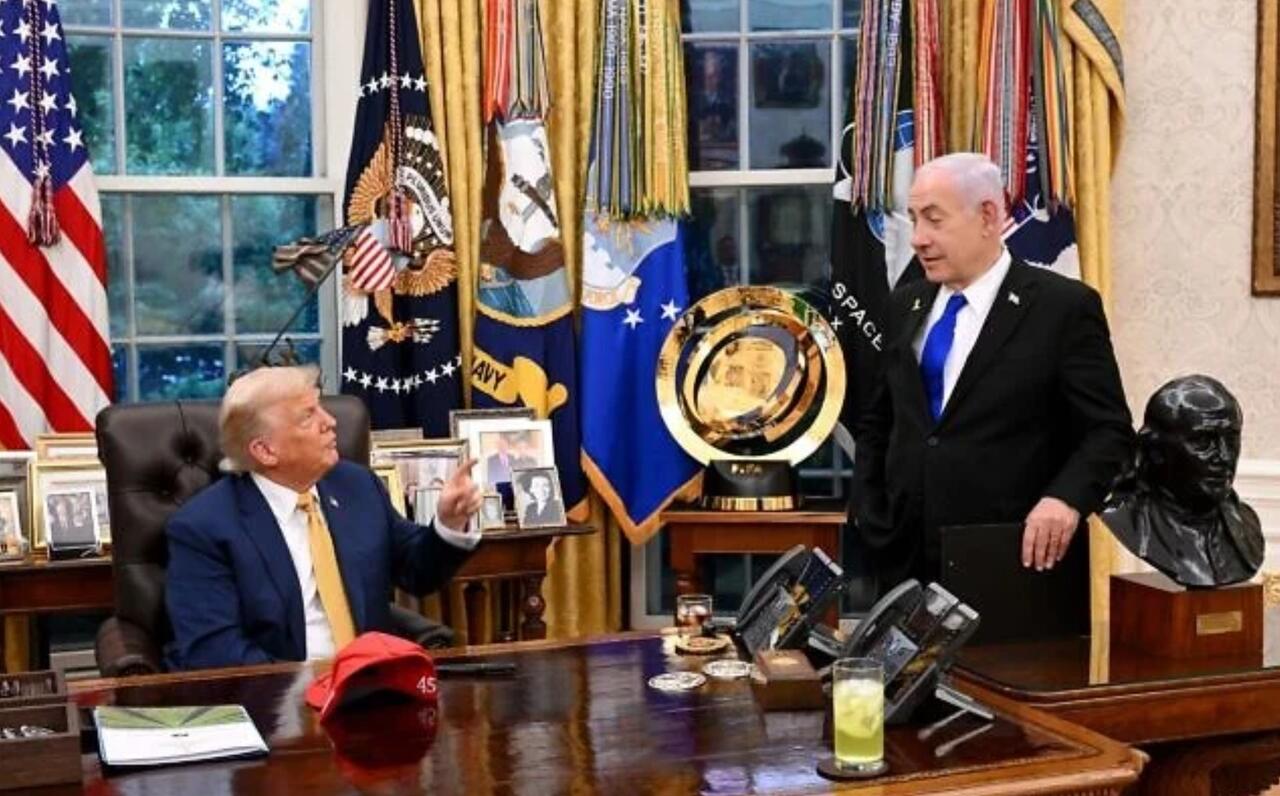
Israeli Prime Minister Benjamin Netanyahu has asked US President Donald Trump for more help to receive a pardon from Israel’s president, Axios has reported this week.
Netanyahu made the request during a lengthy phone conversation with Trump on Monday, Axios wrote, citing two US officials and one Israeli official familiar with the matter. The two leaders also discussed Israel’s ongoing occupations of Gaza and Syria.
Netanyahu’s trial on multiple corruption charges began in May 2020, but the drawn-out proceedings were halted in October 2023 due to the start of Israel’s genocide of Palestinians in Gaza. The trial resumed this week, with prosecutors questioning Netanyahu in the Tel Aviv District Court in Wednesday’s session.
In the most serious case, prosecutors say the prime minister provided regulatory and other benefits to the owner of the Walla news site and the telecommunications firm Bezeq, in exchange for favorable media coverage.
Last month, Trump sent an official letter to Israeli President Isaac Herzog calling on him to issue a pardon for Netanyahu.
On Sunday, Netanyahu’s lawyer sent an official letter and 111 pages of documents to Herzog formally requesting a pardon. The Israeli prime minister claims he needs a pardon to lead Israel’s ongoing low-intensity wars in Gaza, Syria, and Lebanon. Herzog said he is reviewing Netanyahu’s request, but the process of reaching a decision could take two months.
During Monday’s call, “Trump told Netanyahu he thinks the pardon will work out but didn’t commit to any further steps,” Axios wrote, citing a US official. “Netanyahu wants Trump to do more, but the president has done all he can do,” a second US official added.
During the call, Trump allegedly told Netanyahu he should be “a better partner” in implementing the peace agreement with Syria. Trump also allegedly told Netanyahu to “take it easy” in Syria after Israeli strikes killed 13 people in the village of Beit Jinn earlier this month.
“The president told Netanyahu that the new leadership in Syria is trying to make it a better place,” one of the US officials said. Since coming to power one year ago with Israeli assistance, Syria’s new government has carried out a series of major massacres against the country’s minority Alawite and Druze populations.
On Wednesday, Israel carried out additional strikes in Syria, this time on the outskirts of Beit Jinn in the western Damascus countryside near Mount Hermon.
PM Netanyahu shares a video in English about his lawfare trial…
I want to share something with you >> pic.twitter.com/cLFxWI6igh
— Benjamin Netanyahu – בנימין נתניהו (@netanyahu) December 4, 2025
Trump also questioned the Israeli prime minister’s decision last month to kill 40 Hamas fighters trapped in tunnels in the Israeli-controlled areas of Gaza rather than allowing them to surrender, as Trump had asked.
Trump had allegedly encouraged Netanyahu to give some 200 trapped Hamas fighters amnesty in exchange for surrendering, seeing it as a model for disarming Hamas throughout the strip and as a way to advance the ceasefire.
On Wednesday, Israeli drone strikes killed five Palestinians, including two children, in the Al-Mawasi tent camp in Gaza. Since the start of the genocide in October 2023, Israel has killed at least 70,112 Palestinians, according to Gaza sources, including at least 357 since a US-backed ceasefire went into effect in October of this year.
Tyler Durden
Thu, 12/04/2025 – 22:35
El Salvador anuncia primera fase de modernización de puertos en el Pacífico con inversión turca
Associated Press
SAN SALVADOR (AP) — El Salvador anunció el jueves la construcción de un nuevo muelle en el puerto de Acajutla, en el Pacífico, con una inversión de 659 millones de dólares como parte de un acuerdo más amplio con una empresa turca que implica la inyección de 1.615 millones para modernizar las dos terminales portuarias más importantes del país centroamericano.
La modernización de los puertos de Acajutla y La Unión, también en el Pacífico, se llevará a cabo en varias etapas a través de La Unión Portuaria del Pacífico (UPDP), la cual asumió la operación de las terminales desde el 16 de diciembre de 2024 mediante una sociedad mixta formada por la estatal Comisión Ejecutiva Portuaria Autónoma (CEPA) y la firma turca Yilport Holdings Inc. El acuerdo implica la modernización y operación de esos puertos durante 50 años.
La empresa Yilport invertirá 1.615 millones de dólares en la modernización de ambos puertos. Este paquete se estructuró por etapas: la fase inicial de 50 millones para atender necesidades a corto plazo; la fase uno con 659 millones y la fase dos con 906 millones.
El gerente general de la UPDE, Luis Canto, explicó que el comienzo de la fase uno consiste en la construcción de un nuevo muelle de contenedores de 510 metros de largo, 17,5 metros de profundidad y cinco o seis grúas de última generación en Acajutla. Esta infraestructura tendrá capacidad para atender al barco más grande que se ha construido a la fecha, de 21.000 contenedores, añadió.
Detalló que el nuevo muelle triplicará la capacidad de carga de contenedores en Acajutla, y duplicará la capacidad de carga general. Aseguró que El Salvador contará con un puerto moderno para los próximos 20 o 30 años.
“Generará un montón de trabajo en la zona y va a posicionar al puerto, a El Salvador, como un hub. El lugar donde vienen las mayores líneas y de acá se distribuye a los otros países”, agregó Canto.
Refirió que cuando asumieron la operación del puerto de Acajutla había hasta 25 barcos en espera para descargar, la cual se logró reducir a un solo barco en las aguas salvadoreñas.
El puerto de Acajutla está ubicado en el departamento de Sonsonate, a 76 kilómetros al occidente de la capital, y es la principal plataforma marítima de El Salvador para la exportación e importación de materias primas y productos terminados. En la zona también se encuentra una planta de gas natural licuado.
En el Puerto de la Unión, construido en 2008 en la zona oriental del país, se efectuará una obra de dragado para recibir barcos de gran calado y activar la terminal, además de adquirir equipo moderno como grúas, cargadores y retroexcavadoras.
El presidente de la estatal CEPA, Federico Anliker, calificó a la empresa turca Yilport como un “socio internacional que ha demostrado compromiso serio con El Salvador” y afirmó que a un año de este trabajo en conjunto “ya es totalmente palpable, y visible, para todos los sectores”.
Trump’s Next National Strategy Will Center On Humanoid Robots
Trump’s Next National Strategy Will Center On Humanoid Robots
President Trump’s national industrial strategy centers on expanding U.S. dominance in semiconductors, AI, rare earth production, clean technology, space, and other emerging technologies expected to dominate the global economy in the 2030s. Following the administration’s push to accelerate AI data center buildouts and power grid upgrades, Politico now reports that the next major focus is poised to be humanoid robotics.
Commerce Secretary Howard Lutnick has been meeting with the heads of major tech companies and is weighing an executive order next year to spur domestic development and production of humanoid robots, while the Department of Transportation is setting up a robotics working group, according to Politico sources.
https://t.co/tPmp2Hq1mw pic.twitter.com/VChAa8p7j9
— Brett Adcock (@adcock_brett) December 4, 2025
The timing is notable: Elon Musk’s Tesla is preparing to scale production of its Optimus robot to one million units by the end of next year. Earlier this fall, Tesla reportedly placed a massive order for linear actuators from China, suggesting that Optimus production is set to ramp up in the near term.
Tesla Optimus Robot’s incredible progress after only 2.5 years. pic.twitter.com/ESTXSofJha
— Nic Cruz Patane (@niccruzpatane) December 2, 2025
A Department of Commerce spokesperson told the outlet: “We are committed to robotics and advanced manufacturing because they are central to bringing critical production back to the United States.”
Politico explains more about Trump’s emerging national robotics strategy that could be unveiled early next year:
There’s growing interest on Capitol Hill as well. A Republican amendment to the National Defense Authorization Act would have created a national robotics commission. The amendment was not included in the bill. Other legislative efforts are underway.
Related:
Goldman Finds “Inflection Point” With Humanoid Robots; We Tested Unitree’s Robodog
Goldman’s Chat With Top Robotics Firm Reveals Skynet Humanoid Timeline
China Humanoid Robotics Index Jumps After Unitree Debuts “Stellar Hunter”
Latest reports:
Humanoid Robot Roundup: Auto Industry Poised To Lead First Wave Of Adoption
China Issues Rare Bubble Warning Forming In Humanoid Robotics
The Trump administration understands that this period is a transformational moment in human history, and a point where a national strategy is essential to rapidly boost industrial capacity and position the U.S. as the leader in AI, robots, drones, and chips as the world fractures into a bipolar state amid a technological superpower race with China that goes into hyperdrive over the next decade.
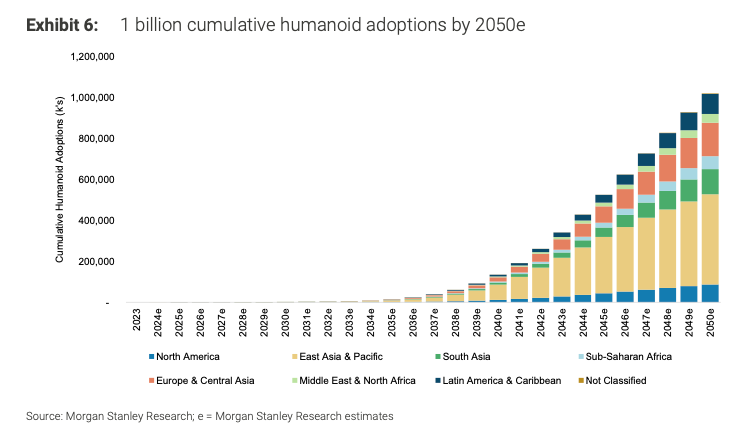
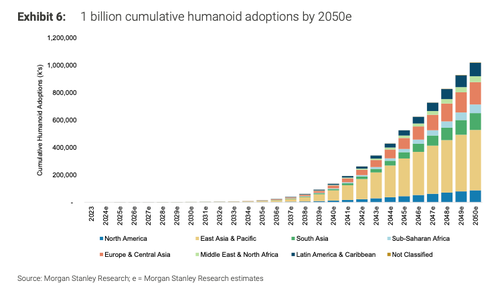
Last week, Morgan Stanley analyst Shawn Kim showed clients that adoption of humanoid robots will top 1 billion units by 2050.
Kim explained:
In their Global Insight report published earlier this year, Morgan Stanley’s global Autos and Industrials teams estimated that global cumulative humanoid adoption could reach 1 billion by 2050. They generally assume a relatively slow pace of adoption until the mid-2030s, after which they believe the pace will begin to materially accelerate into the late 2030s and 2040s, given (1) technological progress across both hardware and AI foundation models, which may take over a decade to create “true” general-purpose humanoids capable of doing the vast majority of useful tasks; (2) price declines as technologies mature and supply chains develop; and (3) greater societal/political acceptance.
ZeroHedge Pro subs can read the full MS report in the usual place. It’s loaded with deeper inudstry analysis and charts that lay out where the whole industry is headed through 2050 as the Trump administration prepares to unveil its national strategy – this report is a must-read.
What Trump is doing today is preparing the nation for the 2030s. Supply chains must be localized, rare earths must be plentiful, and the U.S. must have the industrial capacity to build these innovative technologies domestically or on friendly shores. What you see today is proper stewardship of the nation, versus the previous administration that was so obsessed with nation-killing globalist policies.
Tyler Durden
Thu, 12/04/2025 – 22:10
https://www.zerohedge.com/technology/trumps-next-national-strategy-will-center-humanoid-robots

White anota 30 puntos, Celtics propinan a Wizards su peor derrota de la temporada: 146-101
WASHINGTON (AP) — Derrick White anotó 30 puntos, su máximo número de la temporada, Jordan Walsh añadió 22, un récord personal, y los Celtics de Boston aplastaron el jueves 146-101 a los Wizards de Washington, pese a jugar sin Jaylen Brown.
White sumó nueve asistencias y siete rebotes para ayudar a que los Celtics mejoraran a 13-9. Han ganado ocho de los últimos diez partidos.
C.J. McCollum lideró a Washington con 22 puntos. Khris Middleton añadió 15, pero la derrota por 45 puntos fue la peor de la temporada para los Wizards, que se hundieron a una foja de 3-18.
Fue la décima derrota consecutiva de Washington ante Boston.
Brown anotó el martes 42 puntos, su máxima cifra de la temporada, en un duelo contra los Knicks de Nueva York. Esta vez estuvo ausente debido a una enfermedad.
Peyton Pritchard contabilizó 20 puntos y ocho asistencias por Boston. Neemias Queta anotó 17 puntos, y Afrernee Simons añadió 16.
_____
Deportes AP: https://apnews.com/hub/deportes

EEUU prioriza visas para aficionados que viajan al Mundial, Juegos Olímpicos y otros eventos
Por MATTHEW LEE
WASHINGTON (AP) — El gobierno estadounidense ha instruido a sus embajadas y consulados en todo el mundo priorizar las solicitudes de visa para quienes deseen venir a invertir en el país o asistir a la Copa del Mundo 2026, los Juegos Olímpicos de 2028 u otros eventos deportivos importantes.
Al mismo tiempo, la administración ha añadido nuevos criterios para los trabajadores extranjeros altamente calificados que apliquen para una visa en particular. Las nuevas reglas negarían la entrada a aquellos considerados como responsables o participantes en la censura de ciudadanos estadounidenses en las redes sociales a través de iniciativas de moderación de contenido que han surgido en toda Europa y otros lugares para combatir el discurso extremista.
En una serie de cables enviados esta semana a todas las misiones diplomáticas de Estados Unidos que fueron obtenidos por The Associated Press, el Departamento de Estado dijo que las solicitudes de visa para empresarios que consideren “inversiones significativas” en el país deberían estar en la parte superior de la lista de consideración junto con las solicitudes de aquellos que deseen viajar “para eventos deportivos importantes que muestren la excelencia estadounidense”.
Es el último esfuerzo de la administración del presidente Donald Trump para reducir la inmigración o la entrada de cualquier extranjero. Pero con eventos deportivos importantes planeados en Estados Unidos, la administración busca asegurar que los fanáticos puedan asistir a esas competiciones. Las políticas están recibiendo una atención especial antes del sorteo del Mundial el viernes.
Enfocándose en el deporte
Como parte de una iniciativa más amplia para controlar la entrada de extranjeros, el Departamento de Estado ha dicho que todos aquellos que requieran visas para ingresar al país deberán someterse a una entrevista en persona y a un examen para evaluarlos por posibles riesgos de seguridad nacional.
Esto ha llevado a largos tiempos de espera en muchas embajadas y consulados para entrevistas para solicitar lo que se conoce como visas “B1” y “B2” a pesar de un aumento en el personal consular.
El mes pasado, Trump anunció una nueva iniciativa, denominada “FIFA Pass”, para los extranjeros que viajan a Estados Unidos para la Copa del Mundo que les permitirá obtener entrevistas para visas más rápidamente. No obstante, aún los alentó a solicitar sus visas “de inmediato”.
El secretario de Estado Marco Rubio dijo que la administración había enviado más de 400 empleados consulares adicionales alrededor del mundo para manejar la demanda de visas para el Mundial y que en aproximadamente el 80% del mundo, los viajeros a Estados Unidos pueden obtener una cita para visa dentro de 60 días, algo reflejado en el cable.
Las medidas van más allá de la iniciativa FIFA Pass para agilizar las solicitudes de aquellos que buscan viajar a Estados Unidos para los Juegos Olímpicos y otros eventos deportivos importantes.
Los puestos diplomáticos “deben asegurar una capacidad de citas suficiente para acomodar a los espectadores y otros fanáticos que viajan para eventos relacionados con el torneo (de la Copa del Mundo)”, dijo uno de los dos cables enviados el martes. “Estos deberían tener prioridad sobre todas las demás solicitudes B1/B2, excepto aquellas relacionadas con la reindustrialización estadounidense”.
Otros que deben ser priorizados incluyen diplomáticos extranjeros, funcionarios gubernamentales que viajan por negocios oficiales, trabajadores agrícolas temporales, trabajadores religiosos, médicos y enfermeras, y estudiantes que asisten a instituciones académicas con menos del 15% de matrícula extranjera.
“Las oficinas consulares deben asegurar que los solicitantes de grupos de mayor rango tengan prioridad sobre los solicitantes de grupos de menor rango, independientemente de la demanda de los solicitantes de menor rango”, decía el cable. “Los puestos pueden reducir significativamente el número de espacios de citas disponibles para grupos de menor rango para acomodar la demanda de grupos de mayor rango”.
Nuevas pautas de visa para trabajadores altamente calificados
Un segundo cable enviado el martes a todas las embajadas y consulados estableció nuevos criterios para considerar las solicitudes de visa H-1B, instruyendo a los diplomáticos a “estar atentos” a aquellos que puedan haber sido o sean “responsables o cómplices en la censura de estadounidenses” en línea y en otros lugares.
Estas visas permiten a las empresas estadounidenses traer personas con habilidades técnicas que son difíciles de encontrar en Estados Unidos, y el presidente Donald Trump ha dicho que impondría una tarifa anual de 100.000 dólares sobre ellas.
El departamento indicó que la evidencia de esto podría llevar a la denegación de la visa. Definió dicha información como “adoptar políticas de moderación de contenido globales inconsistentes con la libertad de expresión, cumplir con demandas de moderación de contenido o censura global de una entidad extranjera y proporcionar acceso a datos privados de ciudadanos estadounidenses en relación con la moderación de contenido”.
La prueba de esto podría obtenerse del currículum del solicitante, historial laboral, perfiles y publicaciones en redes sociales, y declaraciones o escritos públicos, dice el cable, añadiendo que el Departamento de Estado estaba desarrollando herramientas para facilitar y acelerar estas evaluaciones.
Señaló que todos los solicitantes de visa están sujetos a estos criterios, pero que los solicitantes de H-1B deberían ser examinados más de cerca “ya que muchos trabajan o han trabajado en el sector tecnológico, incluidas empresas de redes sociales o servicios financieros involucradas en la supresión de la expresión protegida”.
“Debe explorar a fondo sus historiales laborales para asegurar que no haya participación en tales actividades”, dice el cable, añadiendo que “si descubre evidencia de que un solicitante fue responsable o cómplice de la censura o intento de censura de la expresión protegida en Estados Unidos, debe determinar que ese solicitante no es elegible” para una visa.
___
Deportes AP: https://apnews.com/hub/deportes

‘They Saw People Getting Away With It’: How Minnesota’s Somali Fraud Exploded
‘They Saw People Getting Away With It’: How Minnesota’s Somali Fraud Exploded
Authored by Janice Hisle via The Epoch Times,
When 200 federal agents raided dozens of Minnesota homes and businesses on Jan. 20, 2022, policy analyst Bill Glahn took notice. So did a lot of other people—at first.
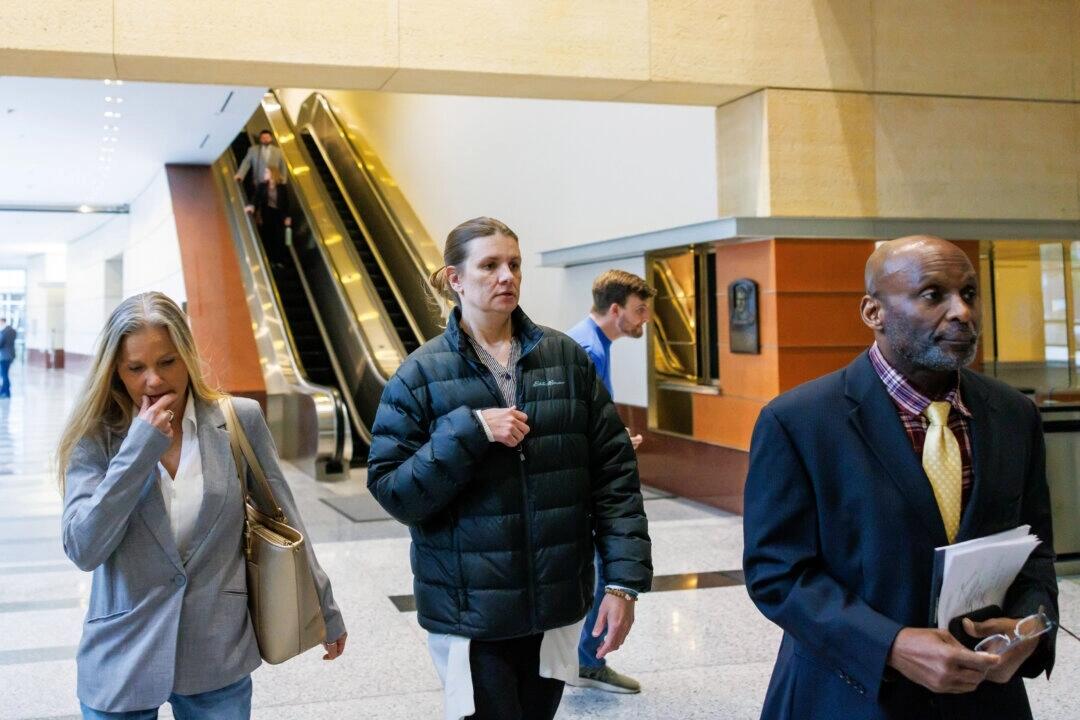
Aimee Bock (C), founder and executive director of the nonprofit organization Feeding Our Future, arrives at the Minneapolis federal courthouse with her attorney, Ken Udoibok (R) in Minneapolis on March 19, 2025. Kerem Yücel/Minnesota Public Radio via AP
An initial blast of news coverage trumpeted an emerging multimillion-dollar welfare-fraud scandal. Then “it just vanished from the radar” of most media outlets and public consciousness, Glahn told The Epoch Times. “The stories just dried up,” and reporters moved on to cover other topics.
Glahn, however, said it was obvious to him that “this was a pretty big deal … something to keep an eye on.”
Thus, for nearly four years, Glahn and a few independent journalists continued digging into what he calls “a whole portfolio of fraud.” He has documented nearly $662 million in fraud losses on the “Minnesota scandal tracker” for his employer, Center of the American Experiment, a public policy nonprofit in Minneapolis.
Yet federal prosecutors say welfare-fraud schemes have reaped billions of dollars in taxpayers’ money. Most of the defendants charged are of Somali heritage—a fact that has been taboo to report, Glahn said, even after dozens of Somalis were convicted in Minnesota welfare-fraud cases.
Fear of facing allegations of “racism” deterred whistleblowers, news outlets, and public officials who dared to raise concerns about fraud among Somalis, he said. Thus, the problem didn’t get the attention it deserved.
While hundreds or even a couple thousand Somalis may have been wrapped up in the schemes, Glahn emphasized that many Somalis are just as outraged as other taxpayers are; they have cooperated with him and with authorities to expose the fraudsters.
Thus, he said, “There is a Somali-fraud problem in Minnesota, but that doesn’t mean there is a Somali problem in Minnesota.”
Terror Allegations
In recent weeks, the schemes that had gone largely unnoticed on the national stage began to attract national attention.
City Journal—a publication of the Manhattan Institute for Policy Research—produced a bombshell story that prompted President Donald Trump to cut off deportation protections for Somalis in Minnesota.
The article asserted that, when Somali fraudsters sent stolen funds back to their homeland, the Somali terror group, Al-Shabaab, had been taking a “cut,” perhaps unbeknownst to the original sender.
Glahn, a former Federal Reserve systems analyst, told The Epoch Times he believes “with 100-percent certainty” that Al-Shabaab is receiving the money, most likely despite the senders’ intentions to benefit their friends and relatives back home.
He bases that declaration on multiple factors, including his knowledge of the money-transfer process, information he gathered from Somalis, and evidence disclosed in court cases.
On Dec. 1, Treasury Secretary Scott Bessent announced that his office is investigating the fraud-for-terror allegation.
Glahn hopes that the increased scrutiny on multiple fronts will remedy welfare-system problems that have persisted for years.
The fraud cases also have political implications. Gov. Tim Walz appears to be facing headwinds over the scandals as he seeks reelection to a third term in office.
Bill Glahn, a policy fellow with Center of the American Experiment. Courtesy of Bill Glahn/Center of the American Experiment
A newly released Thinking Minnesota Poll shows that 56 percent of respondents “don’t think he’s done enough to prevent fraud in Minnesota.” And half of the respondents said “fraud will be a major factor in their vote for governor next year.” Walz has in the past denounced fraudulent use of welfare dollars, but has made no comments about the recent firestorm, other than taking jabs at Trump for his action.
Public records, along with statements from Glahn and a former fraud investigator, help show why Somali welfare-fraud snowballed in the North Star State despite early efforts to halt it.
‘A Green Light for Fraud’
After the 2022 federal raids, Glahn looked back at earlier scandals. He believes they set the stage for schemes that eventually emerged. The scope is now so overwhelming that federal prosecutors admit they lack the manpower to charge everyone involved.
Concerns over the federal Child Care Assistance Program being vulnerable to fraud date to 2009, according to a 2019 Minnesota report.
Specific concerns about Somali-run childcare programs in Minnesota exploiting those weaknesses surfaced around 2016, Glahn said.
By 2018, a Minnesota whistleblower and some media organizations were reporting that up to $100 million was being stolen via fraudulent childcare billing.
Those reports also alleged the stolen money was funding terrorist organizations in Somalia.
The Office of the Legislative Auditor was able to prove that about $6 million a year was lost to fraudulent child-care billing. The special review was unable to substantiate the terrorism-funding allegation, but cited factors that showed it was plausible.
“Federal regulatory and law enforcement agencies are concerned that terrorist organizations in certain countries, including Somalia, obtain and use money sent from the United States by immigrants and refugees to family and friends in those countries,” according to the special review.
The report also pointed out: “Federal prosecutions have convicted several individuals in Minnesota of providing material support to terrorist organizations in foreign [countries].”
People who alleged that Somalis were committing fraud were branded “racist,” Glahn said.
Perceptions spread throughout the Somali community and beyond. “They saw people getting away with it,” he said, so they thought they would try it, too.
“It seemed to be a ‘green light’ for fraud.”
“It totally emboldened people,” Glahn said, so they branched into other types of fraud.
Former Investigator Says Racism Claims a Factor
Kayseh Magan, a Somali American who formerly investigated Medicaid fraud for the Minnesota Attorney General, acknowledged in a 2024 Minnesota Reformer column an “uncomfortable” truth: Nearly all the defendants in the Feeding Our Future scandal were from the Somali community.
Feeding Our Future was a nonprofit that disbanded after authorities charged dozens of its affiliates with falsely claiming to provide meals to needy children. At least 78 people have been accused. Nearly 60 have been convicted. The stolen funds are estimated at $240 million or more.
Since then, more suspects have been charged in two more recent scandals. One case involves alleged theft of Medicaid money that was supposed to help the homeless. The other scandal centers on allegedly false claims that children with autism were receiving therapy. Instead, children were receiving fake “autism” diagnoses, and their parents were getting kickbacks for cooperating in the scheme, authorities said.
Magan explained that Somalis, fleeing civil war and famine in the 1990s, were drawn to Minnesota despite its “unforgiving winters.”
“Word spread that Minnesota is an inviting place, with generous social programs and a history of welcoming immigrants,” Magan wrote. Thus, Minnesota became home to the nation’s largest Somali community.
The group makes up only about 1 percent of the population but has been growing in political influence, partly because of the prominence of leaders such as Somali-born Rep. Ilhan Omar (D-Minn).
Minnesotans quietly wondered why so many Somalis were caught up in fraud, Magan acknowledged. His response: “My experience as a fraud investigator has taught me that fraud occurs when desire meets opportunity.”
People who are poor or out of work become desperate; professionals whose credentials aren’t recognized in the United States are stuck with “menial jobs,” he said, yet they must support their families here and in Somalia financially.
“That covers the desire, and here’s where opportunity comes into play: Minnesota’s public programs don’t adequately guard against organized fraud,” he wrote.
Fraud-catching systems “are mostly designed to root out recipient fraud,” he said.
“It is exceedingly difficult to guard against providers who collude with recipients, which is the type of fraud most pervasive in the Somali community.”
Fraudsters also took advantage of “the feckless fear that establishment politicians and state agencies show when confronted with charges of racism or Islamophobia,” he wrote in that column last year.
In his most recent op-ed, Magan said that backlash over publicity about alleged childcare fraud in 2018 gave politicians “license to ignore warnings about fraud in public programs.”
However, in that same column, Magan denounced the City Journal report, saying it “appears to be little more than an effort by the right-wing propaganda machine to whip up hatred against Somali Americans.”
He also expressed skepticism over the article’s claim about ill-gotten gains ending up in Al-Shabaab’s coffers.
The Epoch Times sought comment from Christopher Rufo, a co-author of the City Journal article, but received no reply prior to publication time.
However, in a Nov. 25 City Journal article entitled “It’s Not ‘Racist’ to Notice Somali Fraud,” Rufo pushed back against attacks on the expose.
“Progressives have suggested that our reporting and the subsequent policy change were ‘racist,’” Rufo wrote. “While many of those indicted in these schemes are Somali, these critics argue, the federal government should not hold Minnesota’s Somali community corporately responsible for the actions of individuals.
“The truth is that numerous members of a relatively small community participated in a scheme that stole billions in funds,” Rufo wrote, saying this raises implications for American immigration policy, which “has favorably treated Somalis relative to other groups” for more than 30 years. He said cultural differences might help explain reasons for the extent of the Somali fraud networks.
“It is more than fair to ask whether that policy has served the national interest,” Rufo said. “The fraud story suggests that the answer is ‘no.’”
Tyler Durden
Thu, 12/04/2025 – 21:45

5 years later, authorities arrest a suspect in Washington pipe bomb case. Here’s what to know.
WASHINGTON — The FBI has arrested a suspect five years after an unidentified person placed two pipe bombs outside the headquarters of the Republican and Democratic national parties in Washington.
Agents arrested Brian J. Cole Jr., 30, of Woodbridge, Virginia, on explosive charges. Calls to relatives of Cole listed in public records were not immediately returned.
The mystery behind the person’s identity has bedeviled law enforcement and helped fuel conspiracy theories about Jan. 6, 2021, and the Capitol riot by a mob of President Donald Trump’s supporters.
Here’s what to know about the arrest:
Why now
The FBI and Justice Department declined to elaborate on what led them to the suspect. But authorities attributed the arrest to a reinvigorated investigation and a fresh analysis of already collected evidence and data.
Attorney General Pam Bondi said there was no new tip or witness that led officials to Cole. “Just good, diligent police work and prosecutorial work,” she said.
Investigators have, over the years, sought the public’s help in identifying a person shown in surveillance video taken the night before the riot.
They struggled to determine answers to basic questions, including the person’s gender and motive. They didn’t know whether the act had a clear connection to the riot at the Capitol a day later, when supporters of Trump stormed the building in a bid to halt the certification of the Republicans’ 2020 election loss to Democrat Joe Biden.
Pipe and kitchen timer purchases
Law enforcement officials used credit purchases of bomb-making materials, cellphone tower data and a license plate reader to zero in on Cole, according to an FBI affidavit filed in the case.
His bank account and credit card information showed he bought materials in 2019 and 2020 consistent with those used to make the pipe bombs, according to court papers. This included galvanized pipes and white kitchen-style timers, according to the affidavit. The purchases continued even after the devices were placed.
The two explosive devices found at the scenes were each roughly 1 foot (0.3 meters) long and packed with gunpowder and metal, according to two law enforcement officials familiar with the investigation.
Cole owns a 2017 Nissan Sentra with a Virginia license plate, the affidavit says. Around 7:10 p.m. on Jan. 5, 2021, Cole’s vehicle drove past a license plate reader less than a half mile from where the person who placed the devices was first spotted on foot around 7:34 p.m. that night, the document says.
Nike shoes
Surveillance video showed the person wearing a light sweatshirt, dark pants and sneakers, with a dark backpack slung over one shoulder. Investigators have long said the gait suggested the person was a man, but their face was obscured by a surgical mask and a hood.
Investigators focused some attention on the suspect’s shoes, believed to be Nike Air Max Speed Turfs. Nike told investigators thousands of pairs had been distributed through more than two dozen retailers and so agents filed subpoenas for credit card records from Foot Locker and other chains to narrow down potential buyers.
Motive unclear
Authorities didn’t disclose why they think Cole may have placed the explosives at the offices of the Democratic and Republican national committees.
Other questions also remain, including whether the act was connected to the assault on the Capitol the following day by Trump’s supporters.
Classmate called suspect ‘well-behaved and quiet’
Cole lived with his mother and other family members in a five-bedroom house on a quiet Virginia cul-de-sac about 30 miles (about 48 kilometers) south of the U.S. Capitol. He has no criminal record and was not registered to vote.
One of four children, he worked in the office of his father, a bail bondsman. His mother works as a realtor.
A high school classmate who lived in the same neighborhood and rode the bus with Cole described him as friendly but said he didn’t speak much.
“He didn’t stand out,” said the classmates, who spoke on condition of anonymity out of concern for having their name associated with the suspect in a politically charged criminal case. “As far as I remember, he was well-behaved and quiet.”
Court records show Cole’s parents divorced in October 2020, just a couple of months before authorities allege he planted the bombs.
Associated Press writers Eric Tucker, Alana Durkin Richer, Mike Balsamo, Michael Biesecker and Brian Witte contributed to this report.
https://www.chicagotribune.com/2025/12/04/washington-pipe-bomb-case-what-to-know/

Naperville City Council adopts $685M budget for 2026
With little fanfare, the Naperville City Council adopted a $685.34 million budget for next year, nearly 6.8% more than the $641.15 million spent this year.
Naperville’s budget totals a little more than what had recommended by city staff due to changes in the capital improvement expenses and the last-minute addition of a mobile crisis intervention team (MCIT), a policing initiative focused on mental health crises.
Over the course of months-long deliberations, Munch described budget planning for next year as more challenging than usual.
Earlier this year, city staff were staring down a $6.5 million deficit caused by the elimination of the state grocery tax as well as a $4 million hole caused in part by skyrocketing health insurance costs and a decline of certain city revenue sources. The city has found ways to plug both but staff noted that this year’s budget calls for few new initiatives and personnel.
At the third and final city budget workshop in November, Councilman Ian Holzhauer proposed adding MCIT into the city budget, arguing that the service is essential for addressing mental health crises. The program had been part of the 2025 city budget but was put on hold because of the uncertainty surrounding the grocery tax and contract negotiations with the police and firefighters.
The council voted 7-2 to add the $1.17 million MCIT program to the budget, which includes funding for six full-time dedicated officers, a K-9, and additional equipment and training. Council members Nate Wilson and Josh McBroom voted against the addition, arguing that it was a financially risky move.
MCIT will be funded as a recurring expenditure in the city’s general fund, although there will be some one-time expenses for the program coming out of the city’s capital projects fund.
Salaries and benefits for the full MCIT program cost $854,589. Equipment will cost $58,600 and training $18,585. Purchasing the K-9 will be about $10,000 and vehicles for the program will cost $230,700.
“For the general fund to support the MCIT program, the corporate (city services) portion of the property tax levy will need to increase by 9.0% to $10,079,751,” Munch said in a memo. The city’s property tax rate remains lower than in previous years, he said.
The new tax rate with the six officers is 0.5595, an increase from the prior projected rate of 0.5506 but still lower than the current rate of 0.5960. A median-valued home in Naperville is about $580,000, which means adding the full six officers will create a tax bill increase of $16 next year.
The council will hold a hearing and adopt property tax levies for next year’s budget at its Dec. 16 meeting.
One Naperville resident spoke against adding the MCIT program at Tuesday’s public hearing, arguing that the city should avoid raising property taxes and find places to cut in the budget. He pointed to cities like Syracuse, New York, and Eugene, Oregon, as examples of similarly sized cities that have reduced spending.
“Additionally, a well-known source of mental health crises or domestic disputes is financial stress and rather than getting to the heart of any medical mental health issues, this planned solution was to contribute to family’s financial stress,” the resident said. “People cannot continually be nickel and dimed, especially in an age of inflation.”
On the other side, another Naperville resident submitted a written comment in support for the program.
“Naperville’s commitment to safety and public service is well known across the state and country, which contributes to our consistent rankings as a desirable community to live in and a safe community to live in,” wrote Rhonda Ansier. “It is of utmost importance that we continue to grow and evolve with the increased knowledge and understanding of how to serve our most vulnerable.”
Munch also wrote in his memo that the fire department’s capital expenses budget decreased by $400,000, public works was down by $500,000 and the library by $60,000. These adjustments were made for various reasons, including funding that was no longer needed or renovations that were delayed.
SECA grant funding
In addition to the budget approval, the council also voted 6-3 to raise the funding cap for the Special Events and Community Arts (SECA) program from $2.14 million to $2.51 million. Money for SECA is collected through the city’s 1% food and beverage tax. The cap was raised to fulfill a funding request from nonprofit community television station NCTV17 while also keeping up with inflation.
As people continue to cut the cord on cable, reducing NCTV17’s income, the station has been forced to find new revenue sources. While it already receives some funding from the city, the station asked for an additional $200,000 from the city this year. In order to meet the request and maintain a balanced budget, staff suggested raising the SECA cap.
Mayor Scott Wehrli, McBroom and Wilson voted against the new cap. They previously cited issues ranging from the station becoming too reliant on city funding to broader concerns over raising the SECA funding cap.
cstein@chicagotribune.com
https://www.chicagotribune.com/2025/12/04/naperville-budget-increase-mental-health/