Category: News
Consumer Credit Below Expectations On Slowdown In Student, Auto Loans; Credit Card APRs Back To All Time High
Consumer Credit Below Expectations On Slowdown In Student, Auto Loans; Credit Card APRs Back To All Time High
After several months of wild swings, moments ago the Fed published the latest consumer credit report (G.19) and it was quite tame by recent volatile trends.
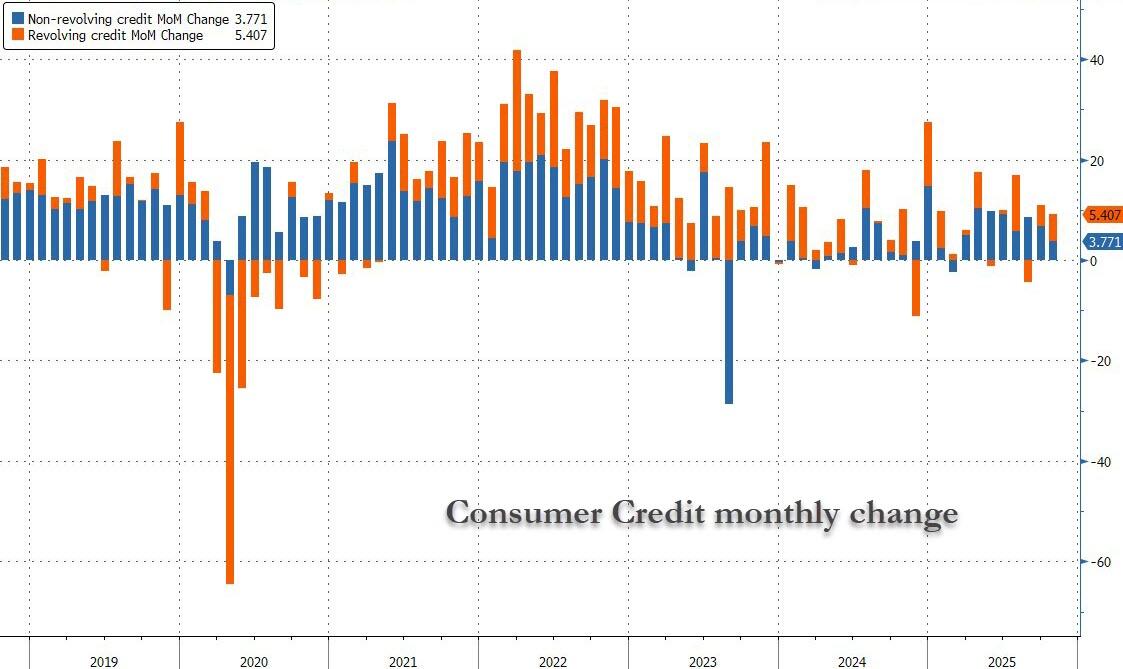
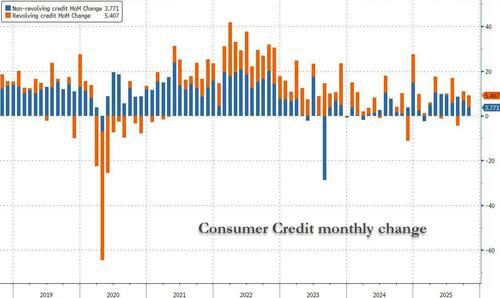
Total consumer credit rose by $9.178BN in October (which is more contemporaneous than more other data points we have received in recent weeks thanks to the govt shutdown), which was down from a downward revised $11.0BN in Sept ($13.09BN pre-revision), and below the $10.48BN median estimate. The latest monthly increase pushed the total to a new all-time high of $5.084 trillion.
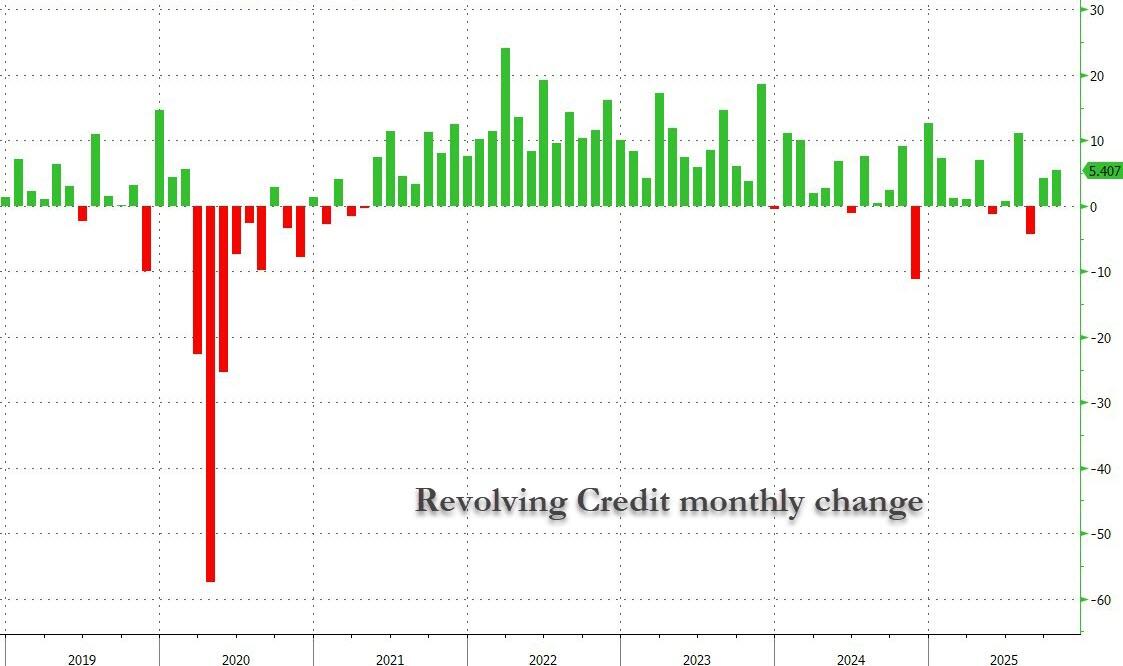
Looking at revolving credit (i.e., credit cards), the increase was $5.407BN to $1.317 trillion, the biggest monthly increase since July, if on the low side compared to the $8.7 billion average monthly increase from 2021 until the end of 2024.
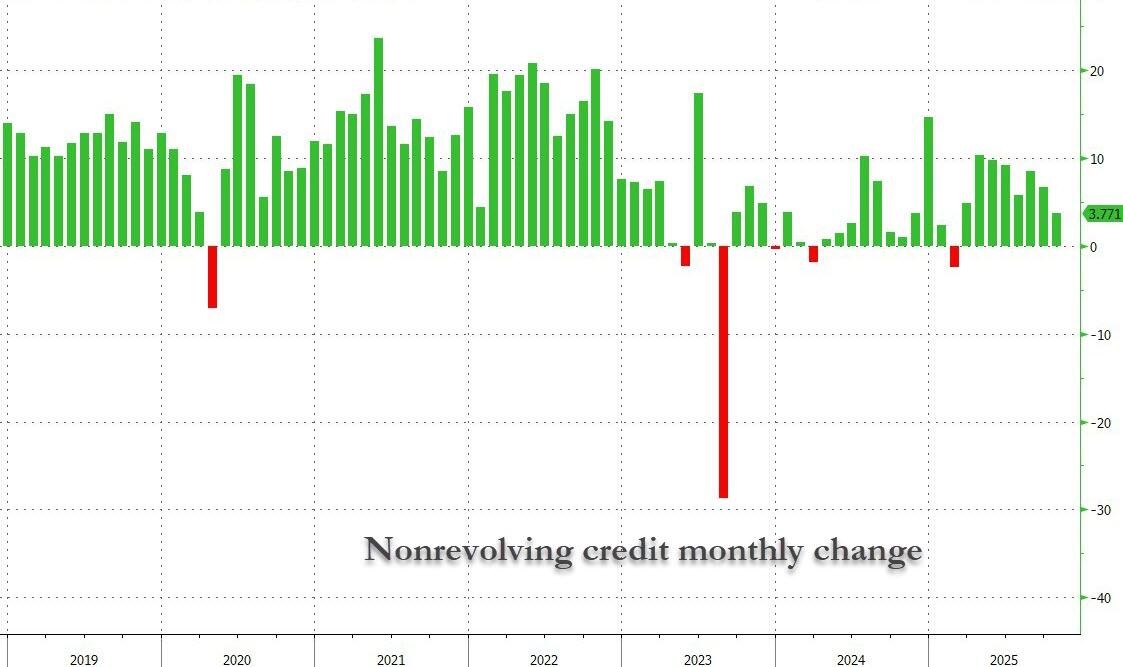
Non-revolving credit (primarily auto and student loans), rose by $3.771BN, the lowest increase since February when we saw a decline of $2.4 billion. This increase brought the total nonrevolving credit to $3.767 trillion, a new record high.
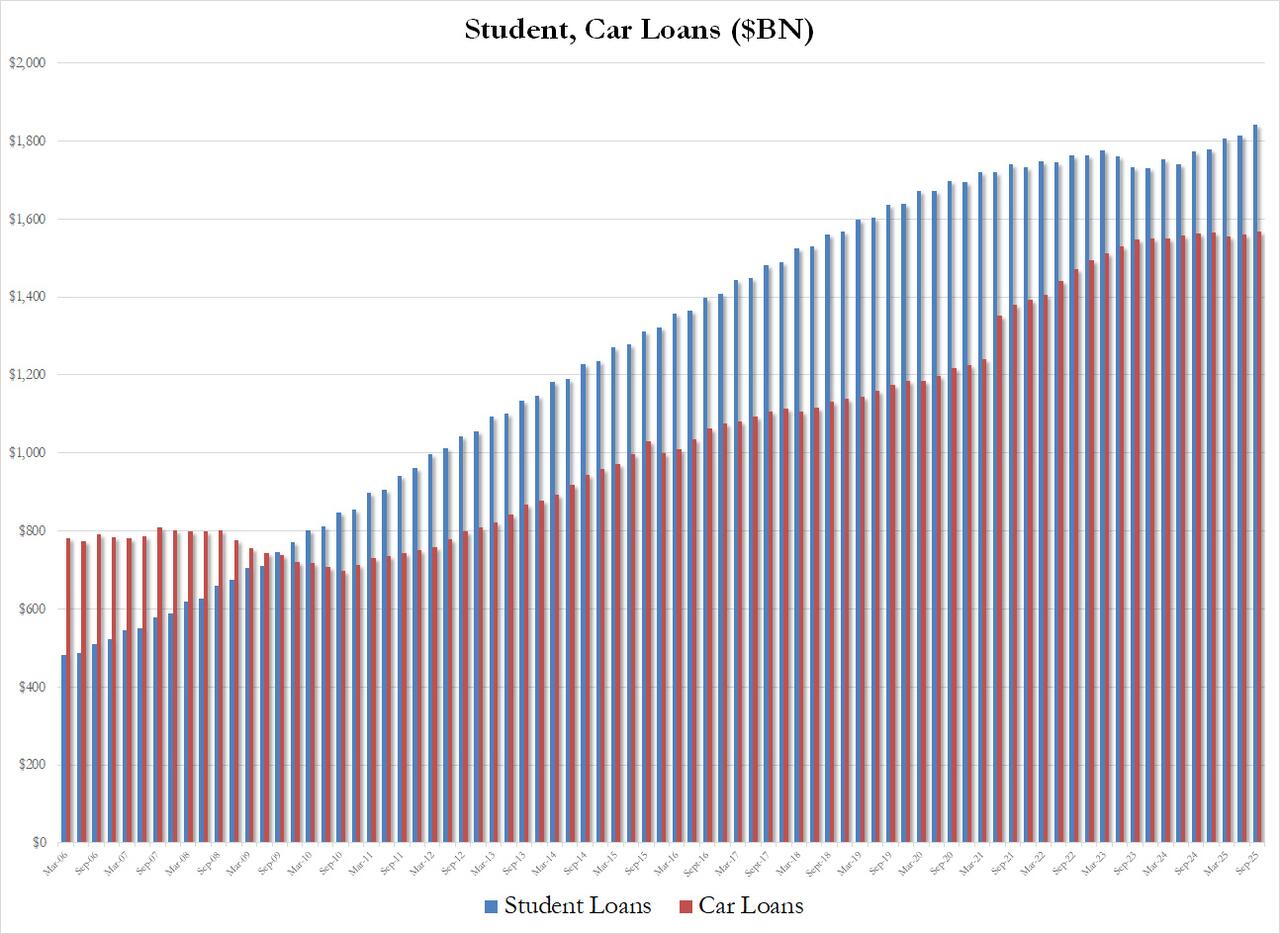
While there was no detailed breakdown for October, the historical data showed that when broken down by components, student loans – now that the repayment moratorium is over – surged by $27.4 billion in Q3 to a record $1.841 trillion. As discussed previously, student loans have a magical capability of being abused for everything but college, which is why enterprising “students” binge on them any time they can to fund all their other purchases, except education-related. Meanwhile, car loans rose by a far more modest $4.0 billion to $1.564 trillion.
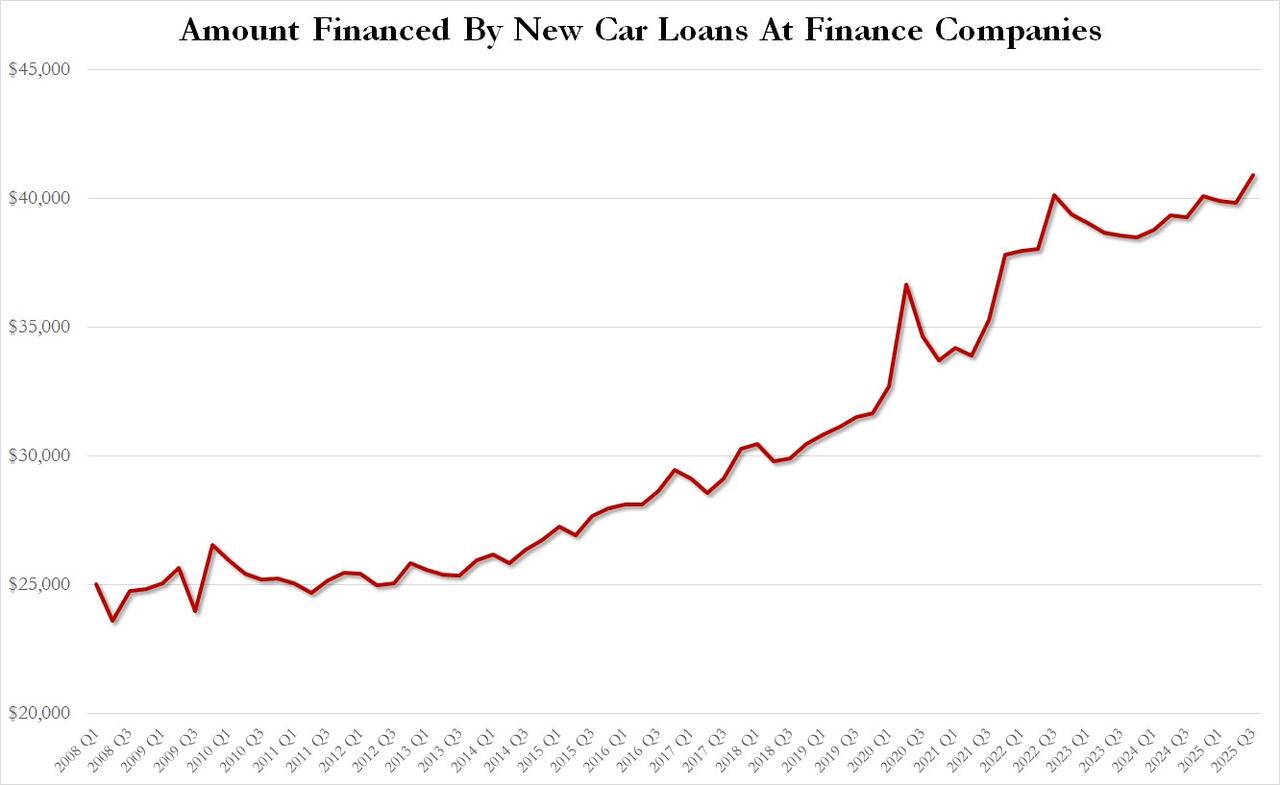
A few weeks ago Kelley Blue Book reported that the average new car price hit $50,000 for the first time ever. Well, as the next chart shows, there’s a reason why: it’s because the amount finance by new car loans also hit a new record high of $41K.
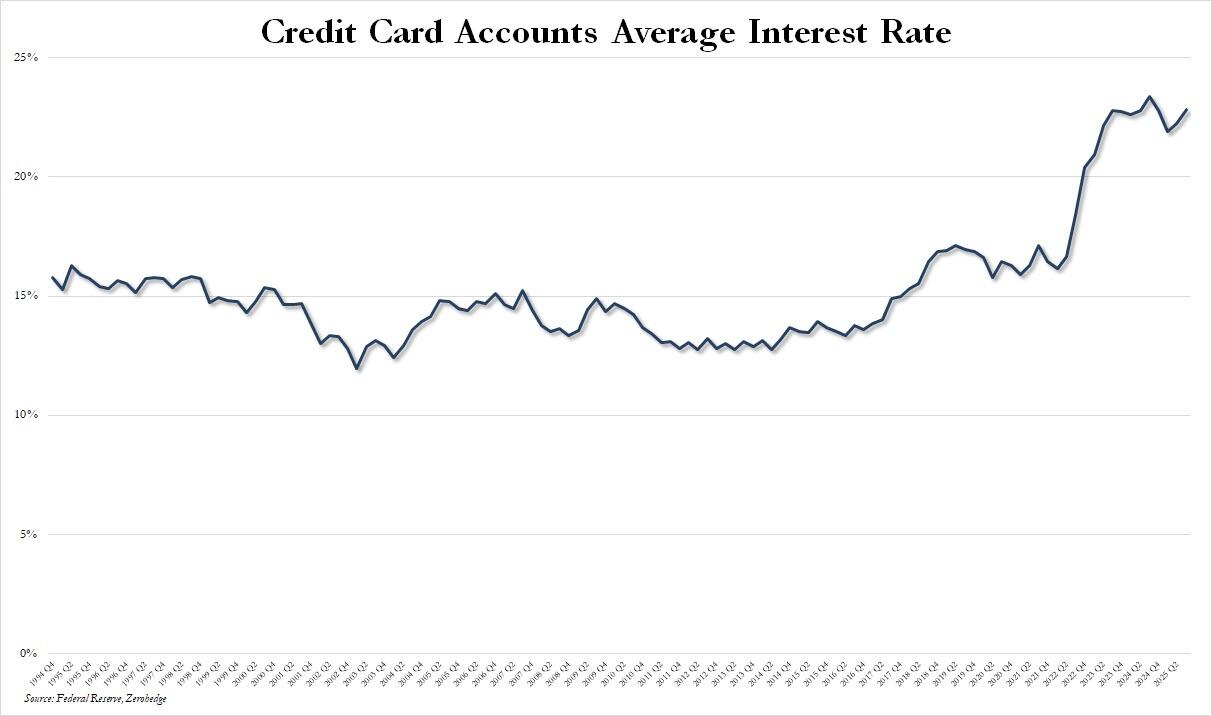
Finally, and this will come as a surprise to nobody, despite 1.50% in rate cuts by the Fed since last September, we can now confirm that rates on credit cards have gone… higher, as banks continue to bleed US consumers dry: at the start of 2025 the average rate on credit card accounts was 22.80%… and on Sept 30 the number was higher at 22.83%, just barely below the all time high of 23.37% set one year ago.
Tyler Durden
Fri, 12/05/2025 – 15:30

‘This is the dream job’: New Valparaiso University president meets with the community
Rev. Brian Konkol, Valparaiso University’s incoming president, said Friday that growing up in the tiny town of Amherst Junction, Wisconsin, Valpo was always on his radar.
“This is a dream opportunity for me,” said Konkol, whose bow tie and spectacles give him a glancing resemblance to Orville Redenbacher, the city’s revered popcorn entrepreneur. “This is the dream job.”
During a meeting with local media after a meet and greet in the community room of the Christopher Center Library that drew more than 100 people, Konkol, who starts in his new role Jan. 1, said he sees the opportunity as the university’s 20th president to be “both rooted and reaching.”
Rooted in the Lutheran tradition, he explained, and reaching to educate young people not for a career, but a calling. “And Valpo provides that,” Konkol added.
The challenges faced by the university over the past few years, including faculty and staff cuts, national attention over the selling of cornerstone artwork from the campus museum, and enrollment struggles, can be overcome with the power of momentum.
“Momentum is real and sometimes it starts with relatively small moments, and it’s about recognizing those moments and moving forward,” he said.
“To me, adversity doesn’t necessarily build character. It reveals character, and the character of this place is strong.”
Carter Hanson, an English professor at the university for 26 years who met with Konkol during the meet and greet, said his hopes for Konkol’s tenure include a new leadership vision.
“I think everyone at the university is looking for stability and an embrace of our core values as an institution,” he said. “We’re a Lutheran institution of higher education, and I think President Konkol is going to bring a very strong engagement with our Lutheran heritage.
“We have a lot of alumni who are looking for a clear expression of our Lutheran values, and I think our students are looking for that as well.”
Newly-appointed Valparaiso University President Rev. Brian Konkol, on left, speaks with English professor Carter Hanson during a meet and greet event on Friday, Dec. 5, 2025. (Kyle Telechan/for the Post-Tribune)
From his experience in the classroom, Hanson said a lot of the university’s students come to Valpo to serve others.
“President Konkol comes here with a strong ethos to serve others,” Hanson said. “I think that people are excited.”
Alex Pawlowski, an English major from Logansport who also met briefly with Konkol, said he thinks Konkol will do a lot to focus on the university in its entirety.
As someone involved in the arts, Pawlowski said, it seems as though that’s gotten the short stick the past couple of years, particularly with the sale of cornerstone pieces of artwork from the Brauer Museum to fund dorm renovations for first-year students.
Newly-appointed Valparaiso University President Rev. Brian Konkol, on right, speaks with junior Alex Pawlowski during a meet and greet event on Friday, Dec. 5, 2025. (Kyle Telechan/for the Post-Tribune)
“It really felt like art was being treated as a commodity and not something for our students to appreciate,” he said.
Konkol comes to Valparaiso University by way of Syracuse University, where he was a vice president, dean and professor, and is a member of the Chancellor’s Executive Team. During his tenure, he led a transformational strategic plan and oversaw a 933% increase in student participation at Hendricks Chapel, expansion of more than 2,000 annual programs, and the development of a nationally recognized model for spiritual, ethical, and interfaith engagement in higher education, according to a statement from the university’s board of directors.
Before his tenure at Syracuse, Konkol served in Lutheran-based institutions around the world, including as chaplain of Gustavus Adolphus College, co-pastor at Lake Edge Lutheran Church, and pastor and country coordinator for the ELCA in Guyana and South Africa, deepening both his global perspective and his commitment to Lutheran higher learning and service.
President José Padilla in January announced his retirement at the end of this calendar year per his five-year contract.
Valpo’s national presidential search, launched in March, was led by a nine-member committee representing trustees, faculty, staff, alumni, and the broader campus community, with support from the firm Academic Search, the board said in its announcement about Konkol.
Valparaiso University’s new President, Rev. Brian Konkol, speaks with visitors during a meet and greet event on Friday, Dec. 5, 2025. (Kyle Telechan/for the Post-Tribune)
“What I would be willing to bet is, there were many other people they could have chosen, which gives me pause. Why is it me?” Konkol said. “I have to believe it’s about deepening our roots.”
Konkol said that’s why the search committee selected a reverend, and “a small-town kid who’s lived around the world.”
Being from a small town provides strong community connections, and traveling the world reveals the power and possibility of education and the treasure of American education, Konkol said.
Within three minutes of the board’s announcement that Konkol was the university’s president-elect, he began receiving emails from people with suggestions. He wants to hear from people, he said, and harness their energy, passion and optimism.
“I’m aware of the challenge facing higher education. I’m aware of the challenges specific to Valparaiso University, but we do have something special,” he said. “There’s no place like Valparaiso University. It’s a blessing, and I’m excited to invite students into it.”
alavalley@chicagotribune.com
Gobierno de Bolivia informa que fugó a Brasil exejecutivo de estatal petrolera acusado de corrupción
Associated Press
LA PAZ, Bolivia (AP) — El expresidente de la estatal petrolera boliviana Armin Dorgathen huyó a Brasil cuando era investigado por la justicia por un presunto negociado millonario en la importación de combustibles, informó el viernes el gobierno.
El ministro de Gobierno, Marco Antonio Oviedo, responsabilizó a un juez que le concedió la libertad a Dorgathen luego de que fuera detenido. Agregó que sobre él pesaba una “alerta migratoria” que le impedía salir del país.
Dorgathen fue presidente de Yacimientos Petrolíferos Fiscales Bolivianos (YPFB) durante el gobierno de Luis Arce (2020-2025) y era el exfuncionario de más alto rango investigado por presunto daño económico al Estado que inicialmente las autoridades han estimado en 56 millones de dólares.
El presidente Rodrigo Paz, quien asumió el 8 de noviembre, denunció el presunto robo de 15.000 millones de dólares al Estado producto de la corrupción durante los casi 20 años de gobierno de Movimiento al Socialismo (MAS) de Evo Morales (2006-2019) y Arce (2020-2025) y anunció la conformación de una comisión para investigar ambas gestiones.
Paz dijo que heredó una economía en ruinas y un Estado en “bancarrota”.
Tan pronto el gobierno confirmó la huida Dorgathen el diputado Carlos Alarcón, quien investigó el caso, dijo que solicitará que la cancillería gestione la “expulsión” del exfuncionario de Brasil.

Lake Station grieves loss of dedicated officer “Billy” Taylor
The city of Lake Station is mourning the passing of Assistant Police Chief William “Billy” Taylor, who died Wednesday following surgery.
Taylor was 57. He’s survived by wife Jennifer; three daughters and a stepdaughter; mother Linda Taylor; and three siblings.
“Assistant Chief Billy Taylor was one of those rare people whose presence made every room a little brighter and every day a little better,” said Mayor Bill Carroll. “He had a warm heart, a generous spirit, and a way of making people feel seen and valued.”
His sister, Kim Frizzell, said she and her brother “played cops” as kids and he grew up in Lake Station aspiring to be a police officer.
A burly man who became a champion powerlifter, Taylor was described by relatives as a “teddy bear and gentle giant.” His family worried he wouldn’t have the temperament to work in law enforcement.
Frizzell said her brother joined the New Chicago Police Department in 1990 and became a Lake Station police officer about 1993. He became assistant chief about two years ago.
One of Taylor’s passions was weightlifting. Frizzell said her brother became a champion powerlifter and held many records.
She said what she’ll remember most is his affection for his community and friends.
“I feel like he’s the George Bailey of ‘It’s a Wonderful Life,’” she said of Jimmy Stewart’s character in the popular Christmas movie.
“You could have a bad day and you’d meet my brother and he’d make you feel good. He would do anything for anyone. He has the biggest, kindest heart.”
Lake Station Police issued a statement saying it “encourages the community to honor Officer Taylor’s memory, celebrate his contributions, and continue to uphold the values he exemplified throughout his life.”
Carroll said in grief the community can hold on to the ways Taylor touched their lives through his compassion, honesty and loyalty.
“Those qualities don’t fade; they live on in every life he helped, every memory he left behind, and every person who was better for having known him.
“May his legacy bring comfort and may the love he shared continue to shine through all who carry his memory forward,” Carroll said.
Visitation for Taylor will be from 2-9 p.m. Tuesday at the Robert J. Sheehy & Sons Funeral Home, 9000 W. 151st St. in Orland Park, Illinois.
Funeral services are at 11 a.m. Wednesday at Jubilee Worship Center, 415 Hobart Road in Hobart.
Carole Carlson is a freelance reporter for the Post-Tribune.
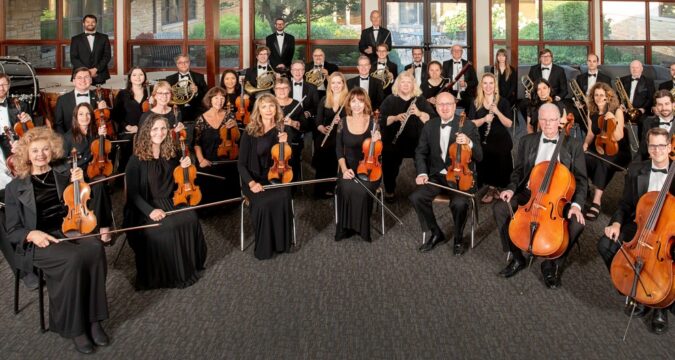
Lake County Symphony Orchestra founder says he was ousted: ‘(A) story of lies and deceit’
In a recent email, the founder of the Lake County Symphony Orchestra says he was forced out several months ago due to an “incredibly negative set of circumstances,” and encourages members not to donate to the organization.
The email, sent to several hundred people, was from the now former executive and artistic director of the orchestra, Ron Arden. In the message, he alluded to an internal controversy and takeover of the orchestra’s board, describing it as a “story of lies and deceit.”
Arden said he resigned in August, “in response to the unreal betrayal of board members” he had recruited, “trusted and thought had integrity.”
“I cannot in good faith recommend the orchestra to you as a place for your generosity, but that is ultimately for you to decide and I respect that,” the email said.
Arden alleges the previous board president and secretary were fired in August as well, prior to his resignation. However, an LCSO statement said the former board president’s term had ended and that they were voted out, with the former secretary choosing to resign voluntarily.
The LCSO website currently lists Noah Mendez and Nathan Ward as the board president and secretary, respectively.
According to LCSO’s statement, the board accepted Arden’s resignation “based on internal concerns regarding administrative alignment, organizational expectations and long-term governance needs.”
“These components were reviewed in the context of ensuring the stability and compliance of the LCSO as a 501(c)(3) organization,” the statement said.
Lauren Moldenhauer is currently serving as interim executive director. According to an archived version of the website, she was previously a website manager for the orchestra.
According to the LCSO statement, her professional background includes experience in nonprofit arts administration, ensemble management, logistics and performance. She also has “long-standing relationships” with the group’s musicians, partners and community.
During the interim period, LCSO said its priorities are “institutional stability, transparent communication and consistent, uninterrupted operations across administrative, financial, and artistic domains.”
Any appointment of directors or staffing of vacancies will include, “a formal process and the evaluation of candidates by an established committee.”
The orchestra plans to proceed with all scheduled performances, with its December plans “fully on track.” Holiday performances are planned for Dec. 12 and 13 at the James Lumber Center in Grayslake, conducted by Jim Stephenson and featuring guest vocalist Sara Sheffield.
“The organization continues to benefit from an engaged board of directors and a committed roster of musicians who are ensuring both artistic continuity and operational stability,” the statement said.
In reference to Arden’s letter, the LCSO said statements circulating online represent his personal views, and that the LCSO, “does not concur with those characterizations”.
The LCSO “remains fully committed to compliant governance practices, the support of its musicians, and the continued presentation of high-quality symphonic music to the Lake County community,” the statement said.
Arden said he issued the statement after being contacted by several people about his absence from the upcoming concerts.
Arden, the group’s founder who celebrated the orchestra’s 20th anniversary last year, said the orchestra has been “ripped” from underneath him, describing it as an emotionally stressful and draining experience.
The email included Arden’s plans to start a new orchestra, with potential performances starting as early as February, and he said he would reach out to people with more information in the near future.
“I have learned a great deal about my expectation and perception of relationships, and I’m making some serious changes,” he said. “The next venture is going to be based on business and talent.”
https://www.chicagotribune.com/2025/12/05/lake-county-symphony-orchestra/

Lake County council urges legislature to increase 911 fee
The Lake County Council is poised to pass a resolution that would ask for 911 services to be added to the Indiana General Assembly’s upcoming legislative agenda.
The council discussed the resolution in a Thursday study session ahead of its Tuesday meeting.
According to council documents, the resolution asks for a $2 increase to state 911 fees and enhanced prepaid wireless telecommunication service charges to be added to the agenda.
“It’s been about 10 years since it increased, and costs have gone up, and funds are needed,” said Council President Christine Cid, D-5th. “We want some legislation at session, and we want to get that out as soon as possible.”
Indiana Code currently has a $1 911 service wireless charge, according to resolution documents, and the state 911 board can only increase the fee once between April 30, 2023, and July 1, 2026. The increase cannot exceed $0.10, according to Indiana Code.
The state 911 board distributes funds to county treasurers, which helps with property development, operation and maintenance of the statewide emergency system.
“911 services have grown both in geographic scope and in the level of service provided,” council documents said. “The revenue used to fund 911 services consists almost entirely of fees and surcharges on wireline, wireless, Voice-over-Internet-Protocol telephone lines. These fees and surcharges generate billions of dollars each year, but 911 service revenues still fall short of estimated annual costs. Expenditures for personnel and for technology maintenance and upgrades have also increased over time…”
An interlocal agreement consolidated emergency 911 services for Lake County’s cities and towns, according to Post-Tribune archives. The consolidation occurred in January 2015, but dispatchers weren’t brought together until October 2015.
Lake County Councilman Randy Niemeyer, R-7th, said Thursday that he has met with State Treasurer Daniel Elliott and his team about the resolution.
“The state treasurer is in charge of statewide 911, and he requested this resolution to be able to advocate to the General Assembly on behalf of Lake County for that increased fee … because it is an act of legislation … that allows this to happen,” Niemeyer said. “This is an important item for us to be able to bring a little more sustainable revenue stream for the service.”
The State Treasurer’s office was unable to immediately respond to a request for comment about the resolution.
The Lake County Council is expected to vote on the resolution on Tuesday.
https://www.chicagotribune.com/2025/12/05/lake-county-council-urges-legislature-to-increase-911-fee/
Biggest NatGas Quarterly Spike In Decades As Deep Freeze Slams U.S. East
Biggest NatGas Quarterly Spike In Decades As Deep Freeze Slams U.S. East
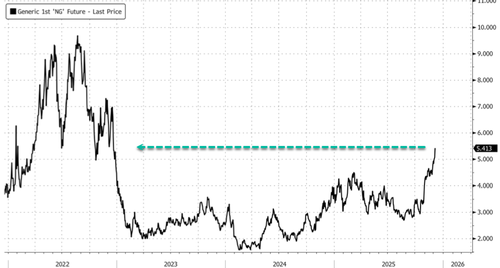
U.S. natural gas futures spiked nearly 7% by late morning, hitting their highest level in almost three years as traders braced for another blast of deep cold across the eastern U.S. through the midpoint of the month.
From the $2.70 per MMBtu low in August to the $5.41 per MMBtu high around lunchtime in New York, prices have doubled and are now on track for their highest level since December 2022.
Colder-than-normal forecasts for the Lower 48 have pushed the quarterly gain to 62.5%, marking the strongest quarterly increase since the fourth quarter of 2005.
What sparked today’s price spike, according to Bloomberg:
Atmospheric G2 warns of significantly colder-than-normal temperatures across the eastern U.S. Dec. 10–14, with the pattern likely persisting into the following week.
NOAA’s 6–10 day outlook shows broad below-average temperatures across the East.
Forecasted Lower 48 average temperatures for the next two weeks will be well below the 30-year average.
As a result, heating demand soars…
Snow in the Mid-Atlantic today.
For Washington D.C. this is a major snow accumulation because any snow is major heading into the second quarter of the 21st Century. ❄️ pic.twitter.com/D1zEk8zYqs
— Ryan Maue (@RyanMaue) December 5, 2025
Related:
Polar Vortex Threat Sends US NatGas Futs To Highest Level Since 2022
What meteorologists are saying:
Co-sign https://t.co/pWtNdrP8gt
— BAM Weather (@bam_weather) December 5, 2025
The 2nd and the first half of the 3rd week of December (~Dec 8-17) offers some shift in the pattern over North America.
We currently expect an active Clipper pattern with bouts of cold and snow for the Northern tier of the U.S. through next week, and *maybe* a brief moderation… https://t.co/mJwAZHwm7U pic.twitter.com/J3bM61yeuN
— Weather Track US (@weathertrackus) December 5, 2025
Bundle Up on your way to school or work today! 🧣
Lots of single digit temperatures out there 🥶 #wxtwitter #wxX #NYwx #VTwx #PAwx pic.twitter.com/FKHYe93thG
— Mark Margavage (@MeteoMark) December 5, 2025
A parade of clippers keeps us chilly and snowy through early next week. We’ve got @JMichaelsNews in the snow in Richmond VA this morning on @weatherchannel ❄️ pic.twitter.com/mGoyPgkTl7
— Kelly Cass (@kellycass) December 5, 2025
Scott Sabol, Meteorologist CBM/CCM@ScottSabolFOX8 For pointing out monster SOI crash in the face of the La Nina Base state as phase 8 MJO develops. Same kind of thing happened in Dec 1983 before major arctic attack pic.twitter.com/QGnXLylLql
— The American Storm (@BigJoeBastardi) December 5, 2025
Please “Make Global Warming Great Again”…
Tyler Durden
Fri, 12/05/2025 – 15:20

Lake Central junior shortstop Parker Robinson commits to Oklahoma
Lake Central junior shortstop Parker Robinson has committed to play baseball at Oklahoma.
Robinson, who announced his decision on social media on Thursday, batted .341 with a .946 OPS, 12 doubles, 18 RBIs and 25 runs scored last season.
He also started at short during his freshman season, when the Indians won the Class 4A state title.
https://www.chicagotribune.com/2025/12/05/baseball-lake-central-parker-robinson-commits-oklahoma/

Afternoon Briefing: 10 people reported injured in Humboldt Park building fire
Good afternoon, Chicago.
The Chicago-based American Medical Association is blasting a federal vaccine advisory committee’s decision today to no longer recommend that all babies get the hepatitis B vaccine when they’re born.
The committee’s decision “is reckless and undermines decades of public confidence in a proven, lifesaving vaccine,” said Dr. Sandra Adamson Fryhofer, an American Medical Association trustee, in a statement Friday morning. “Today’s action is not based on scientific evidence, disregards data supporting the effectiveness of the Hepatitis B vaccine, and creates confusion for parents about how best to protect their newborns.”
Here’s what else is happening today. And remember, for the latest breaking news in Chicago, visit chicagotribune.com/latest-headlines and sign up to get our alerts on all your devices.
Subscribe to more newsletters | Asking Eric | Horoscopes | Puzzles & Games | Today in History
Residents pick up their belongings following an overnight fire in the 1500 block of North Karlov Avenue in Chicago’s West Humboldt Park on Dec. 5, 2025 which sent at least 10 people to the hospital. (Antonio Perez/Chicago Tribune)
10 people reported injured in overnight fire at Humboldt Park apartment building
At least 10 people were taken to five area hospitals after a fire broke out Friday at an apartment building in the Humboldt Park neighborhood, officials reported. Read more here.
More top news stories:
Arab American activists to continue protest after Oak Lawn settlement of lawsuit accusing cop of beating teen
Harvey family grieves 19-year-old musician Jair Ortega after fatal crash with train in Blue Island
Liquid steel is poured into a steel-making unit at Granite City Works in Granite City, Illinois, on June 28, 2018. (Abel Uribe/Chicago Tribune)
US Steel to resume steel production at southern Illinois plant shut 3 years ago
The company shut down the last blast furnace there in 2023, and it even moved to wind down its steel processing mill there in September. Read more here.
More top business stories:
Netflix to acquire Warner Bros. studio and streaming business for $72 billion
Wall Street flirts with its all-time high
Bears players stand during the national anthem before playing the Packers at Lambeau Field on Jan. 5, 2025, in Green Bay, Wisconsin. (Armando L. Sanchez/Chicago Tribune)
5 things to watch in the Chicago Bears-Green Bay Packers game at Lambeau Field — plus our Week 14 predictions
It’s not like the semiannual grudge match between the Bears and the Green Bay Packers needed higher stakes, but the football gods bestowed them anyway. Read more here.
More top sports stories:
Connor Bedard scores for a 3rd straight game in the Chicago Blackhawks’ 2-1 win over the Los Angeles Kings
Big Ten football: Ohio State and Indiana clash in rare title game featuring nation’s top-ranked teams
Composer Matthew Aucoin and soprano Julia Bullock embrace following the world premier of Aucoin’s “Song of the Reappeared” at Symphony Center in Chicago on Dec. 4, 2025. (Chris Sweda/Chicago Tribune)
Review: A chilling CSO premiere, magnificently led
At the Chicago Symphony this week, poet Raúl Zurita’s verses become “Song of the Reappeared,” a 20-minute work for soprano and orchestra by Matt Aucoin. Read more here.
More top Eat. Watch. Do. stories:
Review: The storytelling less than magical in ‘100 Nights of Hero’
Steve Cropper, guitarist and member of Stax Records’ Booker T and the M.G.’s, has died at age 84
The CDC Advisory Committee on Immunization Practices meets in Atlanta on Dec. 5, 2025, to consider changes in hepatitis B vaccine recommendations for infants. (Ben Gray/AP)
US vaccine advisers say not all babies need a hepatitis B shot at birth
A loud chorus of medical and public health leaders decried the actions of the panel, whose current members were all appointed by U.S. Health Secretary Robert F. Kennedy Jr. — a leading anti-vaccine activist before this year becoming the nation’s top health official. Read more here.
More top stories from around the world:
Donald Trump awarded FIFA’s new peace prize at 2026 World Cup draw
5 years later, authorities arrest a suspect in Washington pipe bomb case. Here’s what to know.
Supreme Court Will Hear Trump Birthright Citizenship Case
Supreme Court Will Hear Trump Birthright Citizenship Case
Authored by Matthew Vadum via The Epoch Times (emphasis ours),
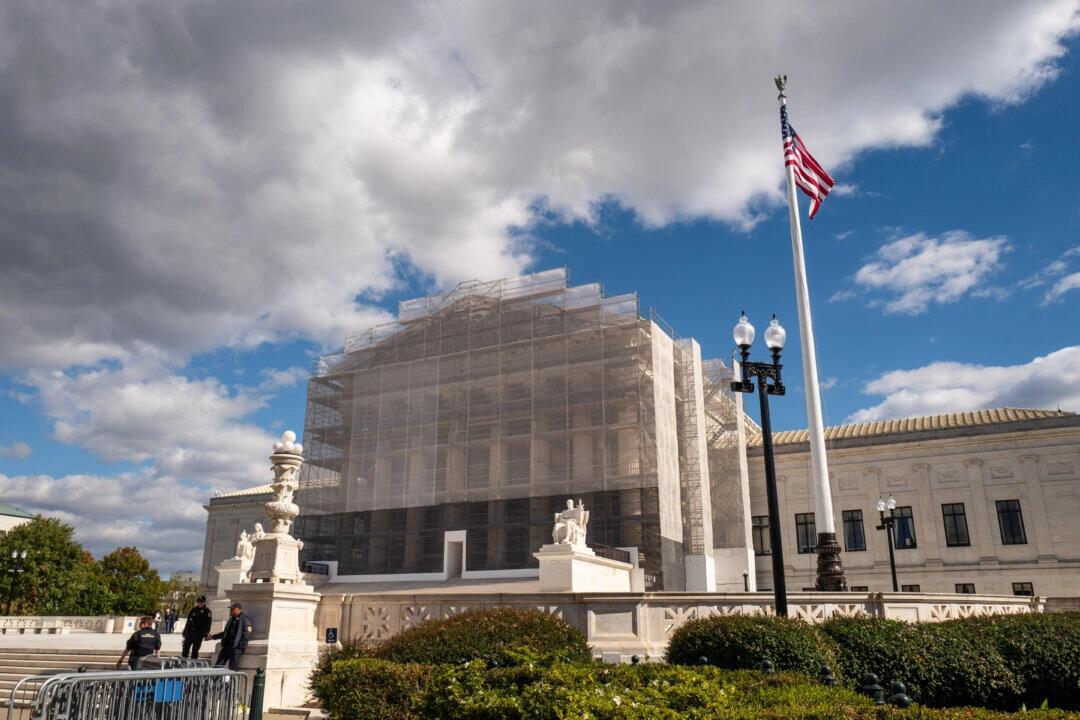
The U.S. Supreme Court decided on Dec. 5 to review whether President Donald Trump’s executive order ending birthright citizenship is constitutional.
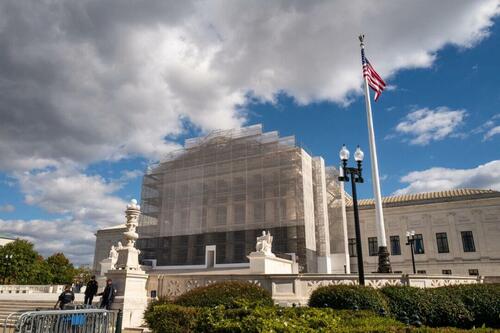
The Supreme Court in Washington on Oct. 20, 2025. Madalina Kilroy/The Epoch Times
The court’s decision took the form of an unsigned order without comment. No justices dissented. The case is known as Trump v. Barbara.
Trump’s Executive Order 14160, signed on Jan. 20, states that “the Fourteenth Amendment has never been interpreted to extend citizenship universally to everyone born within the United States.”
According to the order, an individual born in the United States is not “subject to the jurisdiction thereof” if that person’s mother was unlawfully present in the country and the individual’s father was not a U.S. citizen or lawful permanent resident at the time of the person’s birth.
It also states that the privilege of U.S. citizenship does not apply to an individual whose mother’s presence was lawful but temporary and whose father was neither a citizen nor a lawful permanent resident at the time of that individual’s birth.
The executive order has prompted debate over the meaning of the 14th Amendment’s citizenship clause, which states, “All persons born or naturalized in the United States, and subject to the jurisdiction thereof, are citizens of the United States and of the State wherein they reside.”
A three-judge panel of the U.S. Court of Appeals for the Ninth Circuit ruled on July 23 that the executive order was “invalid because it contradicts the plain language of the Fourteenth Amendment’s grant of citizenship to ‘all persons born in the United States and subject to the jurisdiction thereof.’”
Before that, the U.S. District Court for the Western District of Washington ruled against the executive order on Feb. 6. That court granted a preliminary injunction blocking the order because it “subjects” the states challenging the order to “immediate economic and administrative harms.”
That court said the executive order would compel the states to disqualify many people it considers citizens and, in the process, cause them to lose federal funds they would otherwise be eligible to receive. The states are likely to succeed on their claim that the executive order violates the 14th Amendment, the court added.
No oral argument in the case has yet been scheduled.
This developing story will be updated.
Tyler Durden
Fri, 12/05/2025 – 15:00
https://www.zerohedge.com/political/supreme-court-will-hear-trump-birthright-citizenship-case