Category: News

Work starts on new home for agency that serves the disabled: ‘Everyone’s part of our community’
A key step of demolition is expected to begin this month at 799 Central Avenue, as nonprofit Keshet — which provides services for children and adults with mental and physical disabilities — builds its new permanent center in Highland Park.
Structures related to the building’s previous bank tenant will be removed, according to a news release. Interior renovations are expected to be finished in the fall of 2026. The 210,000-square-foot building, which also has several offices and salons, will see about 40,000 square feet transformed into the Kersten Campus and Justin Coe Center, CEO and President Jen Phillips said.
The multi-million dollar renovation work will provide a new home to an organization that has “hopped around” the community for decades, Phillips said.
Started in 1982 by a group of area parents who wanted to help their children with disabilities, Keshet has grown in scope and scale, providing a variety of services and activities for about 560 children and adults with physical and intellectual disabilities.
Keshet has various recreation and art programs, including weekend trips, camps, day schools for a range of ages, and adult day programs, with offices and facilities in rented spaces. Now, the new location will be “universally designed,” Phillips said, to go “beyond accessibility” and have a building for people with various disabilities.
The organization has grown in recent years, necessitating the new facility, she said.
“The board laughed at me five years ago when I said that we needed to get a bigger business office space,” Phillips said.
The new facility will have a variety of spaces, including a music therapy room with its own recording studio, training kitchens, Keshet’s consolidated offices, and a gymnasium. The building has immediate access to a neighboring park and a parking garage.
Renovations will cost about $10.5 million, Phillips said, roughly half of the $20 million raised to buy and update the building. The fundraising campaign’s success reflected the community’s investment in the organization, she argued.
“I really, truly believe Keshet has impacted so many people,” she said. “It’s not just about the people who are receiving services. Everyone’s part of our community, and has been touched by it.”
Amy Cutler is a Deerfield mother whose oldest daughter, Hannah — who turns 12 in January — was diagnosed with cerebral palsy as a baby.
“We knew that she was going to need some adaptive recreation activities and support in her daily life,” Cutler said.
Cutler had known about Keshet already, having worked for the organization in college. She knew her daughter would need accommodations, Cutler said, and Keshet has kept Hannah active and social. Her daughter plays baseball, bowls, and goes to Sunday school and day camp.
“She needs a lot of support in all aspects of her life, but particularly physically,” Cutler said.
One of the big things for families who have kids with disabilities is trust, she said. Signing up their child who needs extra support and can’t necessarily advocate for themselves can be worrisome. And for Hannah specifically, her physical disability means many facilities aren’t accessible. Cutler praised Keshet’s new facility.
“Sometimes she can get in the front door, but there’s nowhere for her to use the toilet or be changed if she needs to,” Cutler said. “Having accessible facilities adapted so that everybody can use them, I think, is going to be really exciting.”
Cutler reflected on how attitudes around physical and mental disabilities have shifted over the years, even within her daughter’s lifetime. Today, people are much more committed to being inclusive, she said.
“It’s definitely changed. It’s still a ways to go, I would say, but definitely better,” she said.
https://www.chicagotribune.com/2025/12/05/highland-park-keshet-home/
Corte Suprema de EEUU decidirá si orden de Trump sobre ciudadanía por nacimiento es constitucional
Por MARK SHERMAN
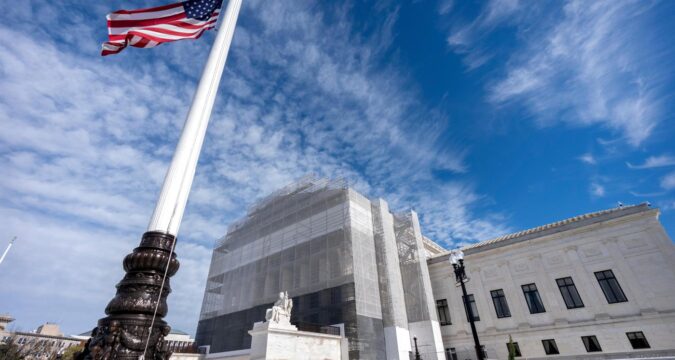
WASHINGTON (AP) — La Corte Suprema de Estados Unidos acordó el viernes abordar la constitucionalidad de la orden del presidente Donald Trump sobre la ciudadanía por nacimiento, según la cual los niños nacidos de padres que están en Estados Unidos de manera ilegal o temporal no son ciudadanos estadounidenses.
Los jueces escucharán la apelación de Trump a un fallo emitido por un tribunal inferior que anuló las restricciones de ciudadanía. Estas no han entrado en vigor en ninguna parte del país.
Los alegatos del caso se presentarán en la primavera. Se prevé un fallo definitivo para principios del verano.
La orden sobre la ciudadanía por nacimiento, que Trump firmó el 20 de enero, el primer día de su segundo mandato, forma parte de la amplia imposición de medidas contra la inmigración de su administración republicana. Otras acciones son el aumento en las medidas de aplicación de la ley de inmigración en varias ciudades y la primera invocación en tiempos de paz de la Ley de Enemigos Extranjeros del siglo XVIII.
El gobierno enfrenta múltiples impugnaciones judiciales, y el máximo tribunal ha enviado señales mixtas sobre las órdenes de emergencia que ha emitido. Los jueces detuvieron el uso de la Ley de Enemigos Extranjeros para deportar rápidamente a presuntos miembros de pandillas venezolanas sin audiencias judiciales. Pero la Corte Suprema permitió la reanudación de paradas de inmigración masivas en el área de Los Ángeles después de que un tribunal inferior bloqueara la práctica de detener a personas únicamente por su raza, idioma, trabajo o ubicación.
Los jueces también analizan la apelación de emergencia del gobierno para que se le permita desplegar tropas de la Guardia Nacional en el área de Chicago con el fin de emprender acciones de aplicación de las leyes de inmigración. Un tribunal inferior ha impedido indefinidamente el despliegue.
La ciudadanía por nacimiento es la primera política de Trump relacionada con la inmigración que llega a la corte para un fallo definitivo. Su orden cambiaría más de 125 años de consenso con respecto a que la 14ta Enmienda de la Constitución confiere la ciudadanía a todas las personas nacidas en suelo estadounidense, con excepciones limitadas para los hijos de diplomáticos extranjeros y aquellos nacidos de una fuerza de ocupación extranjera.
En una serie de decisiones, los tribunales inferiores han anulado la orden ejecutiva por considerarla inconstitucional, o probablemente inconstitucional, aun después de un fallo que la Corte Suprema emitió a finales de junio, en el que limitó el uso de medidas cautelares a escala nacional por parte de los jueces.
La Corte Suprema, sin embargo, no descartó otras órdenes judiciales que podrían tener efectos a nivel nacional, incluidas las demandas colectivas y las presentadas por estados. Los jueces no decidieron en ese momento si la orden de ciudadanía subyacente era constitucional.
Todos los tribunales inferiores que han examinado el tema han concluido que la orden de Trump viola o probablemente viola la 14ta Enmienda, destinada a asegurar que las personas negras, incluidos los antiguos esclavos, tuvieran ciudadanía. La ciudadanía por nacimiento convierte automáticamente a cualquier persona nacida en Estados Unidos en ciudadano estadounidense, incluidos los niños nacidos de madres que están en el país ilegalmente, según las reglas establecidas desde hace mucho tiempo.
El caso bajo estudio proviene de Nueva Hampshire. En julio, un juez federal bloqueó la orden de ciudadanía en una demanda colectiva que incluye a todos los niños que se verían afectados. La Unión Estadounidense de Libertades Civiles (ACLU, por sus siglas en inglés) encabeza al equipo legal que representa a los menores y sus padres que han impugnado la orden de Trump.
“Ningún presidente puede cambiar la promesa fundamental de ciudadanía de la 14ta Enmienda”, dijo en un comunicado Cecillia Wang, directora legal nacional de la ACLU, y añadió que “Esperamos dar por terminado este asunto de una vez por todas en la Corte Suprema en este periodo”.
La administración también había pedido a los jueces que revisaran un fallo del Tribunal Federal de Apelaciones del 9no Circuito en San Francisco. También en julio, ese tribunal, dictaminó que un grupo de estados gobernados por demócratas que demandaron por la orden de Trump necesitaban una medida cautelar a escala nacional para prevenir los problemas que causaría que la ciudadanía por nacimiento estuviera en efecto en algunos estados y no en otros. Los jueces no emprendieron ninguna acción en el caso del 9no Circuito.
El gobierno ha afirmado que los hijos de no ciudadanos no están “sujetos a la jurisdicción” de Estados Unidos y, por lo tanto, no tienen derecho a la ciudadanía.
“La Cláusula de Ciudadanía de la Decimocuarta Enmienda fue adoptada para otorgar la ciudadanía a los esclavos recién liberados y a sus hijos, no… a los hijos de extranjeros que se encuentran ilegal o temporalmente en Estados Unidos”, escribió el principal abogado del gobierno ante la Corte Suprema, D. John Sauer, al instar a la revisión del alto tribunal.
Veinticuatro estados gobernados por republicanos y 27 legisladores de ese partido, incluidos los senadores Ted Cruz de Texas y Lindsey Graham de Carolina del Sur, apoyan los argumentos del gobierno.
___
Esta historia fue traducida del inglés por un editor de AP con la ayuda de una herramienta de inteligencia artificial generativa.

From the Farm: Celebration of Polish traditional Christmas Eve dinner includes symbolism, preparation
The holiday span of November and December is a time of celebration but peppered with the
memories of loved ones who have passed while precious memories remain.
This fall, Oct. 12 marked the one-year passing of our dear farm friend from down the road, Joann
Scamerhorn. She loved all of the holidays, but Christmas was extra special because she loved baking and cooking paired with the opportunity to entertain family and friends.
Joann and her parents lived in Chicago until she was 5 years old, and then her family moved to a rural farm in North Judson, bringing their Polish traditions and recipes with their packed pantries.
“The Christmas Eve meal is probably the most important of the Polish year,” Joann said when she kindly agreed to be interviewed in December 1992. “It’s very family-oriented and has a lot of religious significance. It was also a day of fasting on Christmas Eve before everyone gathered around the dining room table for the big evening feast.”
The multi-course, meatless Christmas Eve traditional meal is called “the Willia,” which is from the Latin word “vigilare,” meaning “to watch.”
Joann would remind that the menu might extend from seven courses to as many as nine or even 11.
Selections passed around the table include a broth-based soup with dried mushrooms, flat wafers called “oplatek,” pickled herring, assorted filled pierogi, cauliflower cooked with butter and breadcrumbs, a fried fish course, sauerkraut, and for dessert, poppyseed cake roll.
“I can still recall as a little girl that salted herring would be sold in wooden kegs,” Joann explained.
“After much anticipation, the Christmas Eve dinner would be served when night arrived and the first star of the evening could be seen.”
Joann’s daughter Ann Scamerhorn continues her mother’s legacy, spreading traditions of a Polish family.
Last week, Ann reminded me of a previous column I published in May 2024 featuring cooks Stasia
Podczerwinski and her sister-in-law Zosia Podczerwinski, based in Merrillville as the Our Lady of
Czestochowa Shrine caterers. They previously shared their delicious recipe for “klopsy,” which are Polish meatballs with dill gravy.
These kitchen angels are busy preparing to host an early version of this Polish dinner, which they are calling “Oplatek with the Salvatorian Fathers” on Sunday, Dec. 14, in the gathering hall of Our Lady of Czestochowa Shrine at 5755 Pennsylvania St. in Merrillville.
I’m told Polish mass will be celebrated at noon, followed by the opportunity to sample the traditional Polish Christmas menu selections such as mushroom soup, cabbage rolls aka golabki stuffed with barley and mushrooms, breaded fried fish, sauerkraut with yellow peas and assorted desserts.
The incredible “Panorama of the Millennium of Christianity in Poland,” comprised of nearly 50 life-size animated figures, will also be open in the church sanctuary following mass. The “Polskie Kwiaty,” or “Little Polish Flowers” children’s dance group will entertain guests in the hall after the meal.
Fr. Ireneusz “Irek” Bem, SDS, the superior of the Salvatorian Fathers who ministers to the Polish-American diaspora at the Our Lady of Czestochowa Shrine in Merrillville, likes to cook, including a delicious appetizer of peeled avocado wedges wrapped in prosciutto. (Photo courtesy of Fr. Irek Bern)
The church service and dinner are both open to all. Reservations are $60 per person and are due by Dec.10 by calling Zosia at 708-267-5603 or Stasia at 708-205-8324.
Zosia and Stasia also take orders for holiday to-go dinners for orders placed by Dec. 22. The food items are packaged “warm” and then reheated at home. Available menu items include “devolaj,” which is a Polish version of the classic chicken Kiev, pork loins stuffed with prunes, beef roulades, mashed potatoes, potato dumplings, sauerkraut, apple-beet salad and broccoli-cauliflower salad. Order pick-up time will be from 10 a.m. until 2 p.m. on Dec. 25 in Millennium Hall, located on the Our Lady of Czestochowa Shrine grounds, 5755 Pennsylvania St. in Merrillville. The cost is $20 per meal, with a minimum order of 10 required by calling the same telephone contacts above.
This week’s recipe is from Fr. Ireneusz “Irek” Bem, SDS, the superior of the Salvatorian Fathers who ministers to the Polish-American diaspora at the Our Lady of Czestochowa Shrine in Merrillville.
Born and raised in Silesia, a southwest region of Poland known for its coal mining and heavy industry, Fr. Irek performed four years of pastoral work in Poland following his priestly ordination in 1987 before transferring to Canada, where he served the Catholic community for more than 30 years from the east to west coasts. His assignment to Merrillville began this past August as his first ministry in the U.S.
Next to playing golf, Fr. Irek’s favorite hobby is cooking.
An appetizer of peeled avocado wedges wrapped in prosciutto is a light yet satisfying snack or party prelude menu pick. (Photo courtesy of Fr. Irek Bern)
“I considered becoming a professional chef until I received the calling to the priesthood,” he said.
“I learned this particular recipe for these elegant appetizers I’m sharing today from some Italian
members of my former parish in Halifax, Nova Scotia, in Canada. Serve with your favorite French or sourdough bread and perhaps a glass of good red wine.”
Columnist Philip Potempa has published four cookbooks and is a radio host on WJOB 1230 AM. He can be reached at PhilPotempa@gmail.com or mail your questions: From the Farm, PO Box 68, San Pierre, Ind. 46374.
Fr. Irek’s Avocado-Wrapped Prosciutto Appetizers
Makes 8 appetizers
1 large ripe avocado
8 thin slices of prosciutto
1 or 2 tablespoons chopped fresh parsley
1 or 2 small cloves of garlic, finely chopped
Olive oil, approximately 2 tablespoons or to taste
Juice of 1/2 lemon
Black pepper, to taste
Directions:
1. Peel avocado and remove pit; cut into 8 even vertical wedges.
2. Wrap the center of each avocado wedge with a slice of prosciutto. Arrange each wedge on a
serving plate and evenly sprinkle parsley and chopped garlic over them.
3. Drizzle wedges with olive oil and a generous amount of lemon juice; sprinkle with black pepper
to taste and allow ingredients to “blend” for a short while before serving.

World’s Billionaire Population Surges To New Record High: UBS
World’s Billionaire Population Surges To New Record High: UBS
Authored by Andrew Moran via The Epoch Times (emphasis ours),
The ultra-rich grew even wealthier this year and the world has more billionaires than ever, according to Swiss bank UBS.
Global billionaire wealth hit a record $15.8 trillion in 2025, up by 13 percent from 2024, UBS said in its 11th Billionaire Ambitions Report, published on Dec. 4. This is the second-largest annual increase, after 2021, “lifted by existing tech billionaires’ appreciating wealth and the number of new billionaires across a range of sectors,” the report reads.
UBS’s analysis includes cash, securities, corporate ownership interests, property, and other material assets.
“In a highly uncertain time for geopolitics and economics, entrepreneurs are innovating at scale across a range of sectors and markets,” UBS Global Wealth Management executive Benjamin Cavalli said. “They’re creating wealth as they do so.”
Inheritance was also a factor in the growth of the billionaires’ ranks.
In the 12 months through April, 91 people became billionaires through inheritance, receiving almost $298 billion, and the trend is likely to continue as the great wealth transfer intensifies.
The bank calculated that at least $5.9 trillion will be inherited by billionaire children over the next 15 years, “either directly or indirectly through spouses who inherit it first and then pass it on.”
A majority of respondents, 82 percent, said they hope that their children develop the skills and values necessary to succeed on their own without “relying solely on inherited wealth.”
The number of billionaires rose by 8.8 percent in 2025, to 2,919 from 2,682 a year earlier.
The United States has the most billionaires worldwide, with 924 individuals owning approximately $6.9 trillion. This is followed by mainland China, where 470 billionaires own about $1.8 trillion. India (188 billionaires), Germany (156), and the UK (91) rounded out the top five.
UBS said this could change, as billionaires have become more mobile amid geopolitical concerns, tax policy changes, and living standards.
Debating the Wealth Tax
For years, U.S. and European governments have debated the idea of a wealth tax, or an annual levy on net worth, to be imposed once assets minus debts exceed a threshold.
In 2024, Sen. Elizabeth Warren (D-Mass.) and Rep. Pramila Jayapal (D-Wash.) introduced legislation—the Ultra-Millionaire Tax Act—to implement a wealth tax on individuals with more than $50 million.
“All my bill is asking is that when you make it big, bigger than $50 million dollars, then on that next dollar, you pitch in 2 cents, so everyone else can have a chance,” Warren said in March 2024.
The bill stalled in both chambers. Overseas, politicians and voters have been reluctant to back similar schemes.
Nearly 80 percent of Swiss voters recently turned down a proposed 50 percent tax on inherited fortunes greater than 50 million Swiss francs ($62 million).
The French Parliament rejected a proposed 2 percent tax on wealth greater than 100 million euros ($116 million) in October. Although the UK has not adopted a formal wealth tax, it has announced plans to impose higher taxes on wealthier residents.
Economists have presented divergent opinions on the concept in general. Proponents say it can improve governments’ deteriorating fiscal health and address income inequality. Critics have said that it would disincentivize wealth creation.
In June 2024, a study by French economist Gabriel Zucman estimated that a Group of 20 motion to slap a minimum 2 percent tax on the ultra-wealthy could generate $250 billion in additional revenue.
Nobel Prize-winning economist Joseph Stiglitz, speaking at a 2020 virtual event, argued that the United States needs a wealth tax.
“Where we are today in the 21st century, a basic middle-class life is not accessible to very large portions of America,” Stiglitz said. “I think a wealth tax is a good idea because we have so much inequality in wealth … [that] even a moderate rate like 3 percent on billionaires and 2 percent on those over $50 million … [would raise] an enormous amount of revenue.”
Economist Ludwig von Mises wrote in “Human Action” that a wealth tax would be a detriment to capital accumulation and a hindrance to wealth creation, since it would disincentivize the building of wealth.
“Capital levies, inheritance and estate taxes, and income taxes are similarly self-defeating if carried to extremes,” Von Mises wrote. “The power to tax is, as Chief Justice [John] Marshall pertinently observed, the power to destroy.”
Years later, economist Milton Friedman also said a wealth levy would punish saving and investment because it would incentivize the affluent “to dissipate wealth.”
“Where do you get the factories?” Friedman said during a university lecture in the 1970s. “Where do you get the machines? Where do you get the capital investment? Where do you get the incentive to improve technology?”
According to Friedman, a wealth tax would be on top of all the other taxes wealthier households already pay.
The Tax Foundation concluded in 2024 that wealth taxes would produce unintended consequences, including job destruction, reduced capital and innovation, slower economic activity, and higher administrative costs. This would result in little revenue being generated, it said.
Tyler Durden
Fri, 12/05/2025 – 14:40
https://www.zerohedge.com/political/worlds-billionaire-population-surges-new-record-high-ubs
Colombia creará zona especial para ubicar al Clan del Golfo, que negocia su desmovilización
Associated Press
BOGOTÁ (AP) — El gobierno colombiano y el Clan del Golfo, el mayor cártel activo del país, acordaron el viernes establecer zonas especiales para ubicar a los integrantes de ese grupo ilegal en el marco de las negociaciones que buscan su desmovilización.
El acuerdo fue firmado y anunciado en Doha, Qatar, donde los voceros de las partes se reunieron por segunda vez para continuar la negociación que se instaló formalmente en septiembre pasado.
El documento, divulgado por el gobierno, indica que serán tres las zonas especiales de ubicación en Belén de Bajirá, Unguía y Tierralta, municipios de alta influencia del Clan del Golfo que se ubican en los departamentos de Chocó, en el este, y Córdoba, en el norte del país.
Las zonas especiales de ubicación son una figura que está siendo usada por el gobierno para que se asienten miembros de grupos ilegales temporalmente cuando participan en procesos de tránsito a la legalidad, donde queda suspendida la ejecución de las órdenes de captura contra ellos.
El acuerdo con el Clan del Golfo especifica que también serán suspendidas las órdenes de captura con fines de extradición. Detalla que se ubicarán integrantes a partir de marzo de 2026 de manera progresiva, sin especificar el número.
El Clan del Golfo tiene presencia en cerca de un tercio del país, según la estatal Defensoría del Pueblo, y aproximadamente 9.000 integrantes, configurándose en la estructura ilegal más numerosa en la actualidad.
El documento divulgado dice que se comprometen a definir los protocolos de funcionamiento de las zonas de ubicación, así como su seguridad, logística y el material de guerra. No menciona si los miembros del Clan del Golfo conservarán las armas dentro de la zona especial.
La verificación de los compromisos alcanzados la hará la Misión de Apoyo al Proceso de Paz en Colombia de la Organización de Estados Americanos (MAPP-OEA).
“Colombia da hoy un paso importante para la paz. Saludamos los nuevos acuerdos alcanzados”, indicó la MAPP-OEA en la red social X.
La negociación “sociojurídica”, como se denomina por las partes, cuenta con el apoyo de países mediadores como Qatar, España, Noruega y Suiza.

North Chicago woman pleads guilty in son’s shower-related death
The North Chicago woman accused of forcing her young son to stay in a cold shower until he became so ill that he died has pleaded guilty in Lake County to first-degree murder.
Jannie Perry, 42, agreed to a partially negotiated plea in the death of her son, Damari, who died on or about the eve of his sixth birthday on Dec. 29, 2021. After his death, his brother dumped the child’s body in a Gary, Indiana, neighborhood, according to police.
Perry will be sentenced in late January.
In return for her pleading guilty, prosecutors agreed to drop some of the counts she faced, and they agreed to cap their sentencing recommendation at 45 years, a spokesperson for Lake County State’s Attorney Eric Rinehart said Friday.
The usual range for first-degree murder is 20 to 60 years, with life in prison possible under certain circumstances.
Two of Perry’s children were also charged in connection with Damari’s death. Jeremiah Perry, 24, is awaiting trial; another was charged as a juvenile.
Authorities said Damari Perry was forced to remain in a cold shower as a punishment for misbehavior until he vomited and became unresponsive. He died later that night at the family home in the 1700 block of North Sheridan Road.
Police said the family did not seek medical attention for the boy. An autopsy determined that he died from hypothermia.
After the boy’s death, his brother drove Damari’s body to a neighborhood in Gary, where he tried to burn the corpse, police said.
In the days after Damari died, his family reported him missing and told police that he might be in Skokie, but investigating officers determined that the family’s story was false. Jannie Perry and two of her children were taken into custody two days later, in early January of 2022.
Damari Perry was literally born into the state’s foster system, the Illinois Department of Children and Family Services said in 2022. Jannie Perry, who had seven children, lost custody in 2014, and still had not regained it at the time of Damari’s birth in late 2015.
She regained custody in 2017, DCFS said.
Perry has been held in lieu of bond since her arrest. The nearly four years in custody will be credited toward whatever prison sentence she receives.
Her sentencing hearing is scheduled for Jan. 30. Jeremiah Perry is scheduled to go on trial in Lake County on Feb. 9.
https://www.chicagotribune.com/2025/12/05/jannie-perry-murder-plea/

La confianza del consumidor en EEUU mejora pero sigue baja, dice la Universidad de Michigan
Por PAUL WISEMAN
WASHINGTON (AP) — El ánimo de los consumidores en Estados Unidos mejoró ligeramente este mes, aunque siguen las preocupaciones sobre la inflación.
El índice de confianza del consumidor de la Universidad de Michigan, publicado el viernes subió a 53,3 en diciembre comparado con 51 en noviembre. El índice superó la marca de 52 que los economistas pronosticaron, pero ha bajado considerablemente desde 71,7 en enero.
La evaluación de los consumidores sobre las condiciones económicas actuales disminuyó ligeramente, pero sus expectativas para el futuro se iluminaron un poco.
Las expectativas de inflación para el próximo año bajaron a 4,1% desde 4,5% el mes pasado, al nivel más bajo desde enero, cuando Donald Trump regresó a la Casa Blanca y comenzó a subir los aranceles a las importaciones de países de todo el mundo. Los economistas advierten que los importadores pagan los aranceles y luego trasladan el costo a sus clientes dando precios más altos.
Trump ha alcanzado varios acuerdos con los principales socios comerciales de Estados Unidos, incluida la Unión Europea y Japón, que redujeron sus aranceles desde los niveles punitivamente altos que el mandatario estadounidense había amenazado en la primavera. Aun así, la tasa promedio de aranceles en Estados Unidos subió de 2,4% en enero a 16,8% el mes pasado, la más alta desde 1935, según cálculos del Budget Lab de la Universidad de Yale.
Joanne Hsu, quien dirige las encuestas económicas de Michigan, afirmó: “El tono general de las opiniones es ampliamente sombrío, ya que los consumidores continúan citando la carga de los altos precios”.
La inflación ha caído desde los máximos alcanzados a mediados de 2022, pero sigue obstinadamente por encima del objetivo del 2% de la Reserva Federal.
______
Esta historia fue traducida del inglés por un editor de AP con la ayuda de una herramienta de inteligencia artificial generativa.

Record-Long Gov’t Shutdown Forces Southwest To Cut Guidance As Airline Warnings Pile Up
Record-Long Gov’t Shutdown Forces Southwest To Cut Guidance As Airline Warnings Pile Up
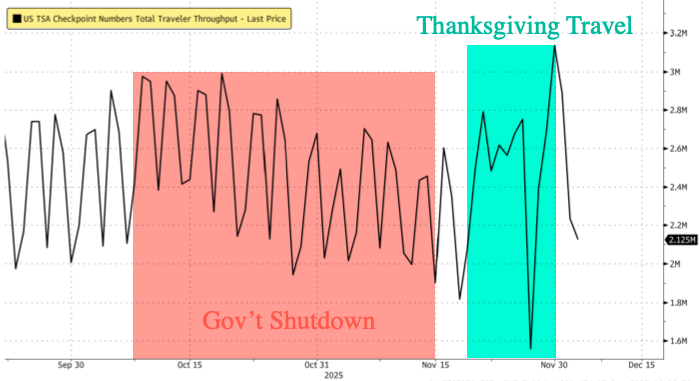
First, Delta Air Lines warned that the record 43-day government shutdown last month, which throttled air traffic at 40 major airports, would slash its fourth-quarter profit by about $200 million. Now Southwest Airlines is following suit, cutting its full-year profit guidance as the shutdown’s ripple effects continue to weigh on major carriers.
Southwest revealed in a new SEC filing:
“As a result of lower revenue due to the government shutdown, and the impact of higher fuel prices, the Company now expects its full-year 2025 EBIT to be approximately $500 million, compared with its prior expectation of $600 million to $800 million. Following the temporary decline in demand related to the shutdown, bookings have returned to previous expectations.”
The good news is that the shutdown’s impact didn’t spill over into December. Southwest noted in its filing that bookings have already bounced back:
Following the temporary decline in demand related to the shutdown, bookings have returned to previous expectations.
Southwest shares are down about 1.5% in premarket trading following the earnings outlook downgrade. Year-to-date (as of Thursday’s close), shares are up 6.5%. The float is short 6.56%, or about 33.5 million shares.
Delta Air Lines and Alaska Air Group, which owns Alaska Airlines and Hawaiian Airlines, both disclosed Wednesday that the shutdown’s disruption would dent earnings this quarter.
“When you’ve got the Transportation Secretary telling people, ‘We don’t have controllers,’ questioning the safety at some level of travel, which has never before happened, people said, ‘Whoa, I’m going to hold up on making decisions,'” Delta Chief Executive Ed Bastian said Wednesday at a conference.
Last month, the Federal Aviation Administration restricted flights at major US airports in response to the government shutdown, which sent some federal transportation workers home. More importantly, air-traffic controllers called out sick, causing widespread disruptions and prompting Transportation Secretary Sean Duffy to reduce flight volumes nationwide to prevent chaos across airports.
Tyler Durden
Fri, 12/05/2025 – 14:20

Harvey family grieves 19-year-old musician Jair Ortega after fatal crash with train in Blue Island
Erica Ortega, a Harvey resident, said when talking with her cousin on Thursday, their conversation drifted off, and they noticed how unusually quiet Ortega’s house felt. She said they knew who usually filled that silence.
Ortega said her younger brother, Jair Ortega, had a knack for cracking a joke at exactly the right moment and making everyone laugh. He also filled the house with music, she said, as a talented musician who recently signed with a recording label. He saw music as an avenue to connect and share joy with others, she said.
More than 100 people gathered Thursday at the Hope Center in Blue Island to grieve and remember Jair Ortega, a 19-year-old who died in a vehicle crash with a freight train Nov. 26.
The crash occurred at about 6 p.m. the day before Thanksgiving near Broadway Street in Blue Island, police said. Ortega was pronounced dead on the scene, and the driver, one of his close friends, was taken to a hospital in critical condition, and is still recovering, according to Erica Ortega.
Jair Ortega was a graduate of Bremen High School, but spent most of his high school years attending Back of the Yards High School. He was involved in the church and music community in Blue Island and the greater Chicago area.
He is survived by his father, Raymundo Ortega, his mother, Dulce Ramirez; sisters, Erica, 21, Victoria, 18, Valeria, 16, Naret, 4, and Karina Ortega; a niece, Miranda Daylin; and grandparents Raymundo Ortega, Felix Hernandez, Abel Ramirez and Carmen Carrillo.
Friends, family and coworkers listened to Jair’s music, repeated prayers, exchanged long hugs and heard his fellow musicians perform songs in his memory.
More than two dozen friends said Jair was a light who always had his guitar on hand, even in class, the cafeteria or on phone calls.
“He was the light in every room,” said Abilene Valenzuela, a family friend said. “He made you laugh and he was always there for you, and we could go months without talking, but if I texted him that I needed something, he would show up at our doorstep.”
Valenzuela said she will never forget when he performed at her baby shower last year, when he arrived late and needed food, but started his performance with a happy birthday song. She said he was the first person that day to remember it was her birthday.
“I didn’t even have to ask him for that,” she said. “He was just that kind of guy, like he just knew.”
Several friends said Ortega was the first person to wish them a happy birthday every year and would often serenade them, no matter where they were.
More than 100 people gather Thursday at The Hope Center in Blue Island for the visitation of Jair Ortega, who was killed Nov. 26 in a crash. (Addison Wright/Daily Southtown)
Josselyn Rojas, one of his childhood friends and classmates, said he not only played “Las Mananitas,” a traditional Mexican birthday song, for her birthday, but he also played her favorite songs when she was feeling down and even serenaded his classmates during lunch.
She said she would carry his lunch tray to the trash with him in high school so he could play his guitar on the way, which he would continue into the classroom with some scolding from his teachers.
But when teachers got onto him for playing his guitar in class, she said, he had a way of rallying his classmates to join in and cheer him on.
“He would be like, ‘another song, another song,’ and everybody would just scream and yell ‘another song, another song’ to cheer him on,” Rojas said. “He was very joyful, very grateful and very funny.”
Valenzuela said Ortega had committed to becoming a musician, signing a record deal with the label Money Don’t Sleep and playing shows across the Chicago area. His sister Erica said Ortega recently formed a band in the Blue Island area, and she wasn’t sure if it would continue.
Ricardo Castillo, one of Ortega’s fellow musicians, said Ortega was the reason that he and a lot of other musicians joined the record label.
“He basically made the brand go up, if anything, he was their artist, he still is, and he’s the start of everything,” Castillo said.
Even much older artists looked up to him, Castillo said. Eduardo Bravo, another one of Ortega’s fellow musicians, said Ortega had a way of getting people to put their ego aside and pushing them to be better, all the while with a contagious smile. He said Ortega was also the first person to arrive to practice and gigs every time, and he would often get people to stay after performances and jam out together.
“Music ran through him, and he made it run through everybody else,” Bravo said.
Bravo and Castillo said the day after the crash, their network of musicians dropped everything and came together to play music.
“You never know when it’s your last call, you gotta put everything aside and just connect,” Bravo said.
Ortega’s recording label plans to release an album of the last songs he recorded, along with songs they’re writing in dedication to him, on his birthday, Dec. 11, according to Bravo and Castillo.
Even outside of music, people described Ortega as a happy, good soul. Several of his coworkers at AutoZone said they saw him like a brother and would have tacos with his family.
Erica Ortega said since the day of the accident, there have been a lot of people in her family’s house. She said family and friends have stopped by and spent hours with them, and her cousins stayed over every night. She said it’s been helpful to fill the house and said she is still struggling to process that he’s gone.
“Even after seeing him right now, I still like, I feel like I’m going to go home, and I’m still going to think the same thing, that he’s still playing a gig somewhere else,” she said.
Family and friends held a burial ceremony Friday at St. Augustine Parish, in Midlothian. A GoFundMe was also created in support of the family.
Ortega’s music can be found under his name, Certez, on most streaming platforms.
awright@chicagotribune.com
https://www.chicagotribune.com/2025/12/05/harvey-jair-ortega-crash-blue-island/

World Cup draw: US starts against Paraguay — while Argentina and Lionel Messi to open against Algeria
WASHINGTON — Argentina and Lionel Messi will play Algeria to open its World Cup title defense as part of a group that also includes Austria.
The United States was drawn Friday to start against Paraguay at Inglewood, California, on June 12, a day after Mexico hosts the opener against South Africa. The U.S. reached the semifinals at the inaugural World Cup in 1930 and has gotten as far as the quarterfinals only one other time, in 2002.
U.S. President Donald Trump, Mexican President Claudia Sheinbaum and Canadian Prime Minister Mark Carney selected the balls of their own countries from bowls during a ceremony at the Kennedy Center for the Performing Arts. The show was almost as long as a soccer match, with the actual draw for the expanded 48-nation tournament starting in the 87th minute.
Donald Trump awarded FIFA’s new peace prize at 2026 World Cup draw
On a wintry day with snow falling, soccer officials and celebrities filled the hall, 189 days before the expanded 48-nation, 104-game tournament.
There were long lines outside the complex even at 7 a.m. as workers and media filed through with Secret Service agents securing the area.
Earlier in the ceremony, FIFA awarded its first peace prize to Trump, who has campaigned to win the Nobel Peace Prize.
FIFA President Gianni Infantino gave Trump a large gold-colored trophy and a gold-colored medal hanging from a blue ribbon, which Trump hung around his neck. Standing next to Trump, Infantino lavished praise.
“This is truly one of the great honors of my life,” Trump said.
A red carpet was laid outside the arts center, taken over this year by Trump and his supporters. Retired stars Tom Brady of the NFL, Shaquille O’Neal of the NBA and Wayne Gretzky of the NHL along with three-time AL MVP Aaron Judge were to assist in a ceremony run by former England captain Rio Ferdinand.
All 11 of the highest-ranked teams were in the draw, with No. 12 Italy among 22 nations competing in playoffs for the final six berths to be decided March 31.
All games from the quarterfinals on will be in the U.S., which is using 11 NFL stadiums. Sites for most games and kickoff times are to be announced Saturday.