Category: News
“Open The F**kin’ Strait”: Trump Blasts Iran As IEA Head Warns Of Panic Fuel Hoarding In Asia
“Open The F**kin’ Strait”: Trump Blasts Iran As IEA Head Warns Of Panic Fuel Hoarding In Asia
International Energy Agency chief Fatih Birol told the Financial Times this weekend that governments must avoid panic hoarding and refrain from imposing fuel export bans as the Gulf energy shock ripples outward to Asia, Africa, Europe, and eventually reaches the US West Coast.
“I urge all countries not to impose bans or restrictions on exports,” Fatih Birol emphasized in the interview. “It is the worst time when you look at the global oil markets. Their trade partners, their allies and their neighbors will suffer as a result.”
The FT noted that Birol was “careful not to name China directly,” but made very clear his warning was likely aimed at Beijing, which has already moved to restrict exports of critical refined products, including gasoline, diesel, and jet fuel.
Birol said that “major countries in Asia who hold major refineries” should reconsider their current bans, adding, “If those countries continue to restrict or totally ban exports, the impact on the Asian markets will be dramatic.”
Birol’s hoarding warning in Asia comes shortly after the IEA’s coordinated release of 400 million barrels from emergency reserves. Such hoarding by major countries would directly undercut efforts to stabilize global energy markets. He also warned that if the disruption in the Strait of Hormuz persists, losses of crude and refined products in April could reach roughly double the levels seen in March.
Early in the US-Iran conflict, energy economist Anas Alhajji joined UBS analysts on a call in which he warned of panic hoarding risks in the oil market. He said that he questioned back in January why the Trump administration was hoarding Venezuela’s oil after the Maduro raid, instead of bringing it to market.
Alhajji noted then, “I’m not talking about conspiracy theories. We were criticizing the Trump administration, companies, and trading houses that bought Venezuelan oil, and asking why they weren’t able to sell it to end users and why they were hoarding it. Now we know.” He was implying that this hoarding was in preparation for Operation Epic Fury.
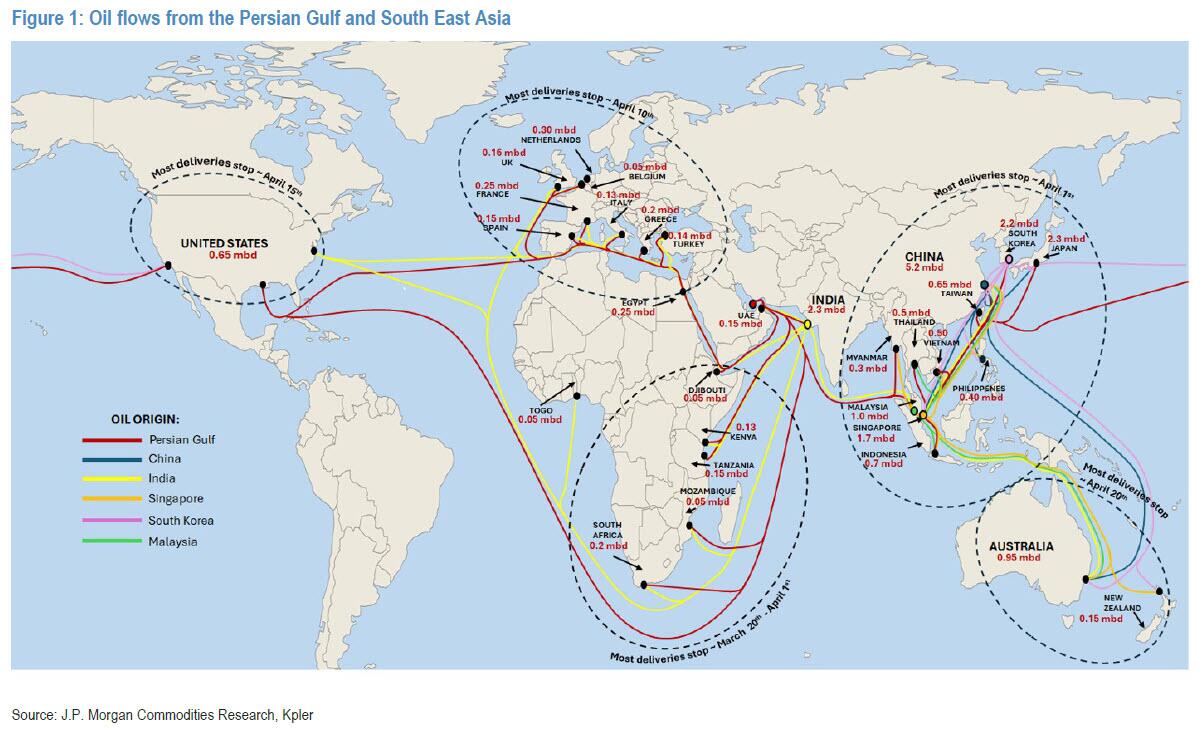
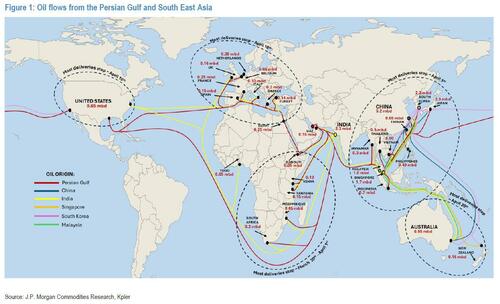
Asia has been hit hardest so far. JPMorgan’s top commodities expert warned about the falling dominoes of how the energy shock transmits from Asia, then spreads to Africa and Europe, before reaching the US, especially California, shortly thereafter.
“Unfortunately, we see that some countries are adding to their existing stocks during our coordinated oil stock release,” Birol said. “They are stocking up. This is not helpful. In my view, this is a time for all countries to prove they are responsible members of the international community.”
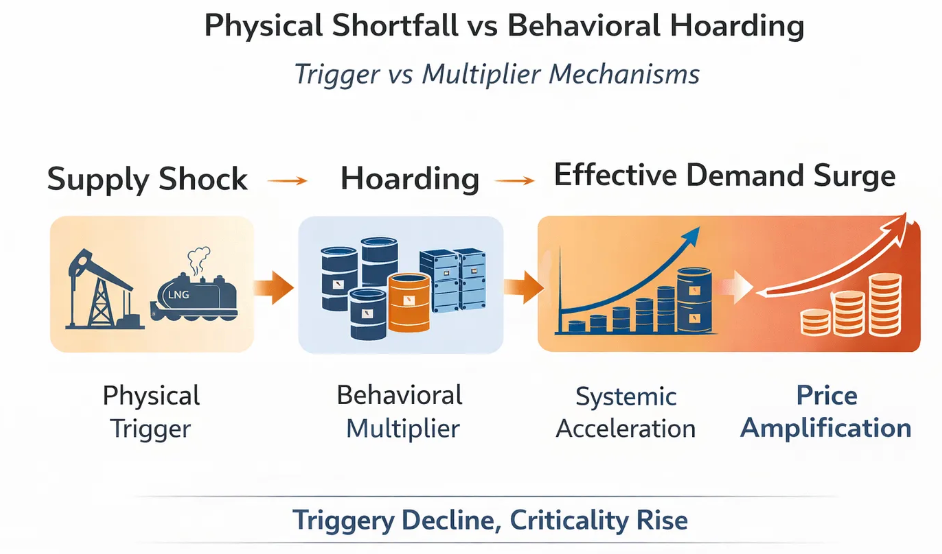
Jeff Currie of Carlyle recently outlined the hoarding risks in a note titled “A Crude Awakening“: “The physical shortfall is the trigger; the behavioral response is the multiplier.”
Earlier on Easter morning, President Trump unleashed a fierce message on Truth Social: “Tuesday will be Power Plant Day, and Bridge Day, all wrapped up in one, in Iran. There will be nothing like it!!! Open the Fuckin’ Strait, you crazy bastards, or you’ll be living in Hell.”
Is the pressure building on Trump from the rest of the world (and domestically) to end this ‘operation’? And/or are we getting closer to quagmire-inducing boots on the ground?
Tyler Durden
Sun, 04/05/2026 – 09:20
Third Order Effects Begin: U.S. Airlines Hike Bag Fees As Jet Fuel Prices Spike
Third Order Effects Begin: U.S. Airlines Hike Bag Fees As Jet Fuel Prices Spike
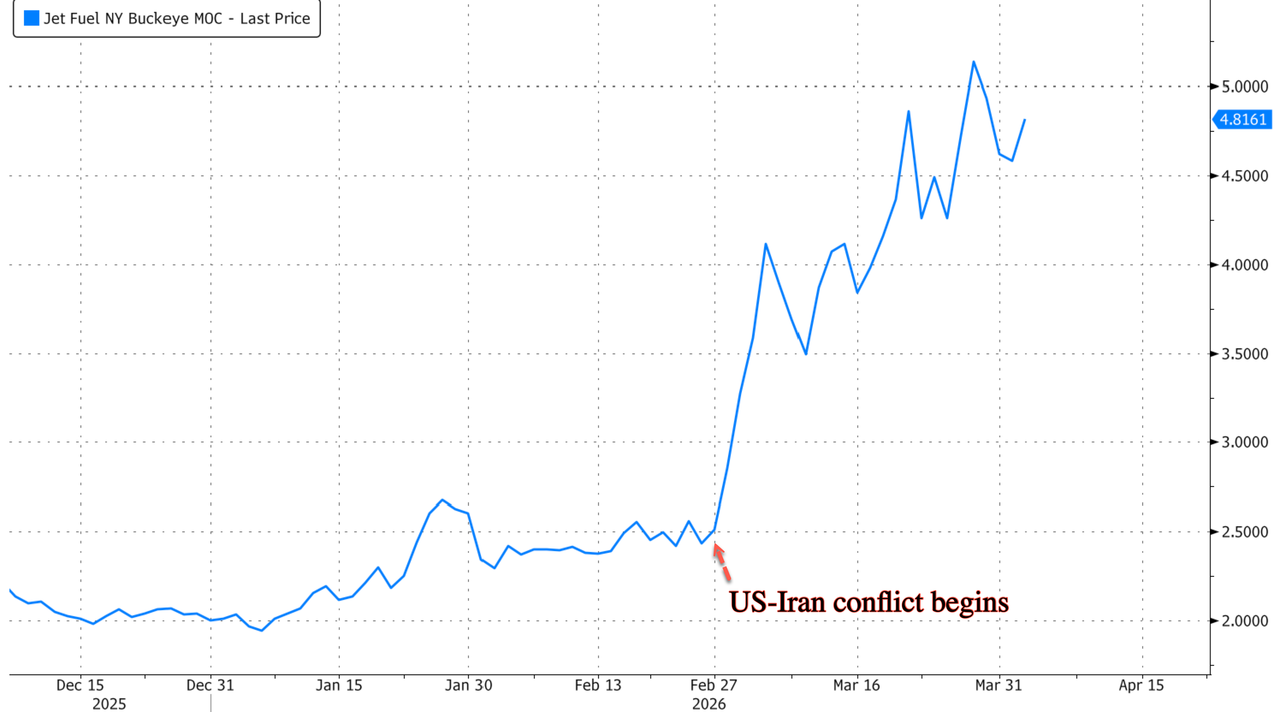
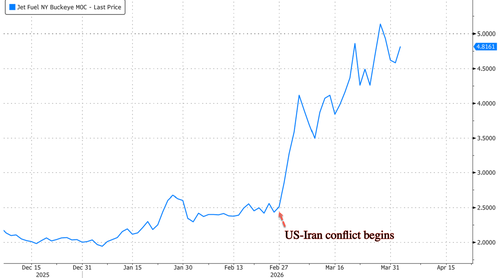
The New York Harbor jet fuel benchmark has doubled in just five weeks as the aviation fuel crisis spreads from airport to airport worldwide following ongoing disruptions at the Hormuz chokepoint. The third-order effects of that energy shock began to materialize this past week, with major U.S. airlines raising checked-bag fees to offset soaring fuel costs.
United Airlines and JetBlue Airways, two major U.S. carriers, raised checked-baggage fees for domestic travel this week as they begin to figure out ways to address the impact of surging jet fuel prices without causing ticket sticker shock for customers.
On Monday, JetBlue raised first-checked-bag prices by $4 to $9, depending on the timing and travel date. Later in the week, United raised its checked-bag fee by $10 for new bookings, pushing some domestic economy bag fees as high as $50.
Both airlines said the increased fees are uncommon, with JetBlue citing higher operating costs and United noting it was the first increase in two years.
“United is raising first and second checked bag fees by $10 for customers traveling in the U.S., Mexico, Canada, and Latin America beginning with tickets purchased Friday, April 3,” the airline said.
There have been no other indications (yet) from American Airlines, Delta Air Lines, Southwest Airlines, or Frontier Airlines on whether they will follow, but we suspect similar measures are approaching if jet fuel prices remain elevated through the end of this month.
Wall Street analysts have noted that raising baggage fees may be a better near-term option than aggressively hiking ticket prices, allowing airlines to shore up eroded margins hit hard by the fuel shock while limiting customer backlash.
United CEO Scott Kirby has already warned that ticket prices may need to rise by as much as 20% to offset the surge in fuel costs. He has urged travelers to lock in fares before prices move higher.
Last month, analysts at Deutsche Bank and UBS both warned that airlines may have to cut capacity to absorb the spike in jet fuel prices. Reduced capacity, combined with higher fuel costs, points to possible demand destruction in travel this summer as consumers face sticker shock at the checkout screen.
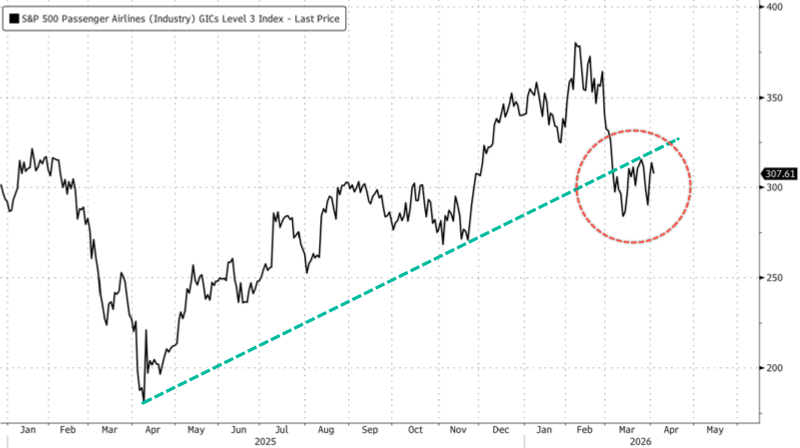
The S&P 500 Airlines Index has not fared well during the five-week Middle East conflict. The index is already showing a technical breakdown as analysts begin to worry about margin erosion.
That said, UBS analyst Atul Maheswari believes a possible bottom may be forming. We will see about that …
Tyler Durden
Sun, 04/05/2026 – 08:45

Czech Government Caps Fuel Prices And Cuts Diesel Tax To Combat Surging Costs At The Pump
Czech Government Caps Fuel Prices And Cuts Diesel Tax To Combat Surging Costs At The Pump
By Thomas Brooke of RMX news,
The Czech government has moved to cap fuel prices and slash diesel taxes in an effort to curb rising costs due to the ongoing international energy crisis, announcing a system that will see the state set maximum daily prices for fuel across the country.
Prime Minister Andrej Babiš said the intervention follows concerns that fuel retailers were charging excessive margins, despite earlier pressure from the government to bring prices down voluntarily.
Under the new system, the Ministry of Finance will determine a maximum fuel price each day, applying to all gas stations nationwide. Officials estimated that diesel, if the cap came into force on Thursday, would currently be capped at 46.43 Czech crowns per liter, or around €1.89.
“We monitored the margins and at the beginning of the conflict they were within the norm, but gradually they became excessive,” Babiš said, adding that negotiations with distributors had only partially reduced prices. “We decided to intervene.”
The government will also introduce a cap on retailer margins, setting the maximum allowable profit at 2.50 crowns (€0.10) per liter for both petrol and diesel.
Alongside the price controls, ministers approved a targeted tax cut on diesel fuel. Excise duty will be reduced by 1.939 crowns per liter, equivalent to 2.35 crowns (€0.10) including VAT, in a move officials say is permitted under EU rules. The Ministry of Finance estimates the measure will cost the state budget around 1 billion crowns (€40.8 million).
Finance Minister Alena Schillerová said the combined approach of price caps and tax cuts was designed to immediately lower costs while preventing excessive pricing behavior in the market.
“It is calculated as the average of wholesale indices from Čepro, Orlen, and MOL, plus a margin of 2.50 crowns and VAT,” she said, outlining how the daily maximum price will be set.
The ministry will publish the price each weekday at 2 p.m. for the following day.
Schillerová added that the margin cap was based on historical data adjusted for inflation, with the aim of eliminating what she described as disproportionately high pricing by retailers.
The measures will formally take effect on April 8.
Tyler Durden
Sun, 04/05/2026 – 08:10
All German Men Aged 17-45 Must Now Obtain Army Approval For Trips Abroad Lasting Over 3 Months
All German Men Aged 17-45 Must Now Obtain Army Approval For Trips Abroad Lasting Over 3 Months
All German men aged between 17 and 45 now need approval from the Bundeswehr – i.e., the German army – for longer stays abroad. Under the new Military Service Act, this applies to trips abroad lasting more than three months, the Defence Ministry has announced. The daily Frankfurter Rundschau was the first to report on the change.
The rule is part of what is known as the Military Service Modernisation Act, which came into force on 1 January 2026. The law is intended to ensure that the Bundeswehr is fit for the future in terms of personnel and organization. Plans include, among other things, a more attractive form of voluntary military service, broader registration of young men and new legal instruments to enable faster action if needed.
What the new law says
Specifically, this concerns paragraph 3 of the Conscription Act, which governs the scope and duration of compulsory military service in Germany. Paragraph 1 states: “Compulsory military service is fulfilled by military service or […] by civilian service.” The provision applies to all men of conscription age between 18 and 45.
The newly worded paragraph 2 now says: “Male persons who have reached the age of 17 must obtain approval from the competent Bundeswehr careers centre if they intend to leave the Federal Republic of Germany for longer than three months […].”
As long as military service remains voluntary, this approval is deemed to have been granted, a ministry spokesman said. The aim, he added, was to find a straightforward arrangement for people travelling abroad. For as long as military service is voluntary, approval is in principle regarded as granted.
🇩🇪BREAKING | Starting January 1, 2026, all men aged 17 to 45 must obtain permission from a Bundeswehr career center if they plan to leave Germany for more than three months — whether for studying abroad, work, or extended travel — Berliner Zeitung.
This requirement is now in… pic.twitter.com/g8U4GhjzpN
— Visioner (@visionergeo) April 3, 2026
However, the necessary administrative regulations have not yet entered into force. In theory, therefore, it still formally applies that ‘approval from the competent Bundeswehr careers centre must be obtained’ before travelling abroad for more than three months. The spokesman stressed, however: ‘Since, under current law, military service is based exclusively on voluntary service, such approvals are in principle to be granted.’
The reasoning and the back story
Since Russia’s attack on Ukraine around four years ago, the defence of Europe has once again moved more sharply into focus. Against this backdrop, the previously suspended system of conscription is also being hotly debated once more.
At the beginning of this year, the Military Service Modernisation Act came into force. In future, young men are once again to be systematically registered and called up for assessment. The federal government aims thereby to increase the strength of the Bundeswehr from the current roughly 184,000 to between 255,000 and 270,000 service personnel by 2035.
A spokeswoman for the Defence Ministry told IPPEN.MEDIA: “In an emergency we need to know who is potentially staying abroad for a longer period.”
The impact is ‘profound’, ministry admits
This far-reaching encroachment on personal autonomy previously applied only in exceptional cases – namely in a state of tension or defence – that is, when an attack by another country is highly likely.
Now, however, paragraph 2 has been revised. It now additionally states: “Outside a state of tension or defence, sections 3 […] apply.” This means that the rule set out in paragraph 3 now applies as a matter of principle.
The Defence Ministry acknowledges that the impact is “profound”. Young men who, for example, want to spend a semester abroad or take a gap year must first obtain approval from a Bundeswehr careers centre. For this reason, “more detailed rules governing exemptions from the approval requirement are currently being drawn up at the Federal Ministry of Defence”.
It is still unclear what consequences people face if they fail to obtain approval before a longer stay abroad, although in a country where the wrong retweet gets you a prison sentence we can only imagine.
According to RND, a large newspaper chain, the Defence Ministry initially declined to explain why the public had not been clearly informed about the new rules.
Tyler Durden
Sun, 04/05/2026 – 07:35
Time For Europe To Defend Itself
Time For Europe To Defend Itself
Authored by J.B. Shurk via American Thinker,
Americans shouldn’t fight for a suicidal continent.
Four years ago, the Biden administration was working with the United Kingdom and the European Commission to pay for diminutive comedian Volodymyr Zelenskyy’s war with the Russian Federation over territories where supermajorities of the population identify as Russian. We were told that the Russian-speaking people of Ukraine “belonged” to Ukraine and that the only way to “preserve democracy” was to deny those people a democratic vote to join the Russian Federation.
“Democracy” also apparently requires the installation of a Ukrainian dictator, a complete crackdown on an independent press, widespread censorship of public debate on social media, the denial of religious freedom, and a brutal campaign of press-ganging men into military service to die as cannon fodder for a corrupt Ukrainian regime that launders money from U.S. and European taxpayers into the bank accounts of the West’s political and financial elites.
Just as globalists in the United States, Canada, Australia, the United Kingdom, and across Old (and increasingly Islamic) Europe turned the “Reign of COVID Terror” into an opportunity to bilk taxpayers, enrich elites, and grow the totalitarian national security State, the same globalist scum quickly turned the Ukraine conflict into another “emergency” requiring more taxes, censorship, and public sacrifice. All of a sudden, anything criticizing the official public policies of Western governments was labeled “Russian disinformation.” If you disagreed with whatever the West’s vaunted “experts” said, you were dismissed as “Putin’s puppet.” Pro tip for information warfare enthusiasts: When government authorities identify dissent as “propaganda,” that’s propaganda!
The COVID propaganda project gave us a chorus of World Economic Forum buffoons posing as national leaders all singing, “We must ‘Build Back Better.’” When that schtick got old — or, rather, when ordinary citizens across the West started to show signs of resistance against their imperial rulers — the West’s globalists turned Ukraine’s Chief Munchkin into a “freedom fighter” battling the pernicious authoritarianism of Russia’s Vladimir Putin. The same yahoos — Biden, Trudeau, Macron, Queen Ursula, and the rest of the WEF’s rump-kissing claque — who screeched like wounded cockatoos, “Build Back Better,” now all huffed in unison, “Ukraine! Ukraine! Ukraine!” It never ceases to amaze me that the day after Canada’s “Freedom Convoy” protests against COVID “vaccine” mandates came to an end, the official launch of the new hit television drama, “WAR: Ukraine,” began. It’s almost as if Western globalists yank us commoners along by the leash from one spectacular production of nonsense to the next (just to see how much money they can steal from our pockets when their hands aren’t busy groping small children).
Some people in the U.S. and Europe were made to really care about a country that has long been considered so incorrigibly corrupt that other corrupt countries can’t help but blush. Lemmings who had been walking around with multiple paper masks over their faces to magically protect themselves from viruses that don’t fear masks all of a sudden waved Ukrainian flags with gusto as if they could identify Dwarf-King Zelenskyy’s money-pit-proto-nation on a map! Nobody wanted to admit that the same übermenschen from sub rosa groups such as Bilderberg and the Trilateral Commission — who have made a financial killing from “green energy” and mRNA “vaccines” over the years — had simply returned to their favorite investment of all: actual killing. War brings new taxes, new regulations, new forms of censorship, new military investment, and new ways to exploit asymmetric information for financial gains. In short, wars bring profits! And what better place for corrupt globalists to make tons of money than to take advantage of the corrupt swindlers putatively governing the traveling circus known as Ukraine!
The United Kingdom (still smarting from its misadventures in the Crimean War one hundred and seventy years ago) demanded that Russia hand back Crimea to its MI6-managed Ukrainian friends. Queen Ursula of the pan-European (and increasingly Islamic) empire demanded that Russia respect the right of Europeans to overthrow any Ukrainian governments that Brussels doesn’t like (see the U.S.-E.C.-organized 2014 coup d’état in Ukraine, or what Western propagandists still shamelessly call the “Revolution of Dignity”). BlackRock and other multinational investment firms selflessly volunteered to help finance the war, purchase Ukraine’s assets on the cheap, and invest heavily in the subsequent reconstruction projects of a destroyed nation. Google and Facebook promised to censor all public debate averse to globalists’ interests as “Russian propaganda.”
Oh my, what a magnificent war! It has had everything globalists adore! It managed to turn a mad midget who plays piano with his penis into Winston Churchill! It justified blowing up the Nord Stream pipelines and forcing Europe’s peasants into using much more expensive “green energy”! It excused more government money-printing and spending that conveniently inflated the value of assets owned by the 1% of the 1%! It allowed the titular leaders of European nations to strut about on the world stage as if they were courageous military generals rallying troops on the front lines — while really doing nothing but callously dropping vulnerable Ukrainian lads into a meat grinder that has made the rich wealthier and the poor fertilizer. European elites have demonstrated their virtue and bravery one dead Ukrainian at a time. The whole bloody affair has had all the pomp and circumstance of old, flatulent monarchs dining on beans, broccoli, cabbage, and cheese.
European gentry never wanted a real war — one in which they might risk life and limb. They simply wanted a war that would cause their investment portfolios to fatten up while they prattled on about bravery and sacrifice. How do we know? Because the moment that President Trump began incinerating the mad mullahs of Iran, Europe’s globalists tucked tail and ran…or at least hightailed it to the closest water closet for fresh underpants.
After cutting off oil production in the North Sea in the name of “climate change” and banning Russian energy supplies in the name of “democracy,” Europe depends quite a bit on Middle Eastern oil to stave off economic death. However, Europe is also right now transitioning from a Western to an Islamic civilization. Europe’s political elites are so afraid of Islamic immigrants that they would rather permit them to rape their youngest daughters than cause a scene. They certainly can’t be seen going to war against an Islamic country! Wealthy Europeans don’t mind sacrificing the continent’s peasants to mass slaughter, but they have no interest in seeing a scimitar up close themselves. Yes, yes, best to wear the white feather of cowardice as if it were a symbol of European principle. America’s courageous cowboys will surely save Old Europe from itself!
Except…maybe not this time. President Trump is not happy that our so-called NATO “allies” have refused to support America’s mission in Iran. U.K. Prime Minister Keir Starmer says, “This is not our war. We will not be drawn into the conflict.” Starmer wants to decouple from the U.S. and rejoin the E.U. France, Spain, Italy, and the U.K. have now denied the U.S. military permission to use European bases or airspace. Europe’s NATO members collectively insist that Iran is not NATO’s concern.
To which President Trump has appropriately pointed out that Ukraine is not a NATO member and therefore not America’s concern. Both the president and Secretary of State Rubio believe that if European members of NATO cannot be persuaded to protect their own economic interests in the Strait of Hormuz, then it is time for the U.S. to reconsider its NATO commitments to European security. “Allies” in name only aren’t really allies at all. For those of us tired of Europe’s crusty aristocracy leeching off of American military muscle while habitually grousing, the possibility of cutting off the Old World’s freeloaders is pleasant news. Americans shouldn’t fight for a continent that has no interest in defending itself.
Views expressed in this article are opinions of the author and do not necessarily reflect the views of ZeroHedge.
Tyler Durden
Sun, 04/05/2026 – 07:00
https://www.zerohedge.com/geopolitical/time-europe-defend-itself
Ex-CIA Analyst: Trump’s Claim About Obliterated Iranian Air Defenses Was Premature
Ex-CIA Analyst: Trump’s Claim About Obliterated Iranian Air Defenses Was Premature
Authored by former CIA officer Larry Johnson
During his Wednesday night speech, Donald Trump made the following claim about Iran’s air defenses: “They have no anti-aircraft equipment, their radar’s 100% annihilated, we are unstoppable as a military force.”
The White House followed this Friday, with a statement from a spokesperson, Anna Kelley, who further emphasized, “Here are the facts: Iranian ballistic missile and drone attacks are down 90 percent, their navy is wiped out, two-thirds of their production facilities are damaged or destroyed, and the United States and Israel have overwhelming air dominance over Iran,” she said.
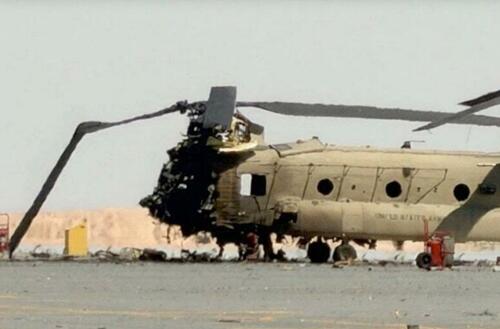
It appears that President Trump was a bit premature. The US Air Force had a difficult day on Friday:
F-15E (48th Fighter Wing) — Shot down in southwestern Iran. Pilot rescued; WSO still missing.
A-10C Thunderbolt II — Shot down and crashed into the Persian Gulf. Pilot reportedly recovered.
2X HH-60G Pave Hawk — Hit during CSAR mission, one crash-landed across the border in Iraq. All crew reportedly rescued.
KC-135R Stratotanker — Emergency squawk 7700 around 10:00 UTC near Tel Aviv.
F-16CJ “Wild Weasel” (F-16C Block 50/52, SEAD configuration) — Emergency squawk 7700 over Saudi Arabia near the Iraqi border around 15:00 UTC; later disappeared from FlightRadar.
KC-135R Stratotanker — Emergency squawk 7700 around 19:00 UTC near Tel Aviv.
It appears that Iran has no centralized air defense C2 or any kind of joint engagement zone (JEZ) anymore.
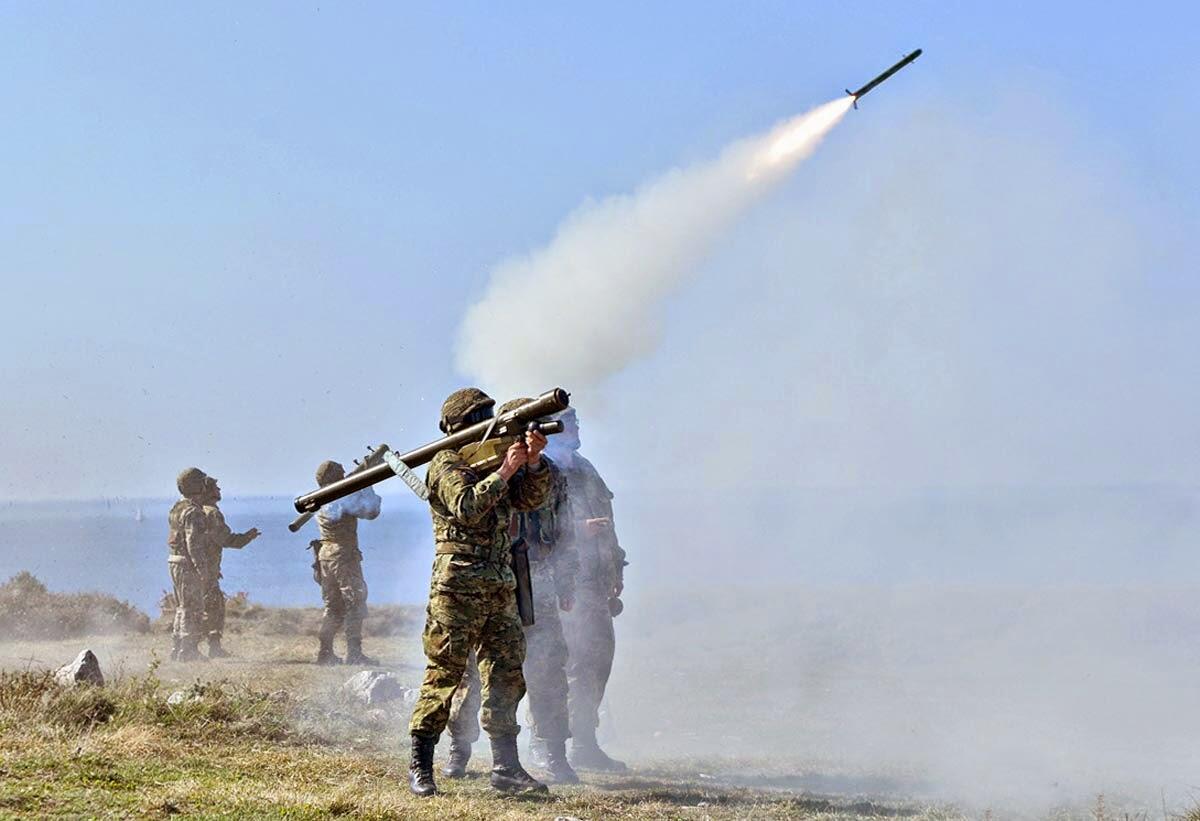
However, as evidenced by the incidents above, Iran appears to be relying on Vietnam-style guerrilla tactics of shoot-and-scoot air defense with their passive and highly tactical indigenous system… The IR-SA-7’s (pronounced “Ur-sah-seven”).
SA-7, Illustrative via Falcon Lounge
These Some are specially developed missiles that can loiter at altitude, almost like a glider, completely passive, that lie in wait for one of the US older generation fighters, tankers or other support aircraft to wander too close and then hone-in. While the US can claim “air supremacy” this does not mean that US aircraft can fly over Iran without incurring the risk of being shot down.
I wonder if the Russians are paying attention to Iran’s information operations? Iran is proving to be quite clever and creative in producing videos that take trolling to new heights.
Tyler Durden
Sat, 04/04/2026 – 23:55

Forget Temu’s “Bugatti” Knockoff. Texas Man 3D-Printed A Lamborghini Aventador Body
Forget Temu’s “Bugatti” Knockoff. Texas Man 3D-Printed A Lamborghini Aventador Body
Forget ordering a $30,000 “Bugatti” knockoff from Chinese e-commerce websites like Temu.
A private seller in Texas is now offering what appears to be a fully 3D-printed Lamborghini Aventador body on Facebook Marketplace, highlighting how 3D printing is revolutionizing custom vehicle manufacturing.
“This is a fully 3D-printed Lamborghini Aventador project that gives you a huge head start. It includes the complete body, front frame, rear frame, and monocoque already printed and sized to Aventador dimensions,” the listing stated.
The 3D-printed Aventador body is listed for $5,000. But the price jumps to $7,500 if buyers want the exterior and interior all glued together, or $8,500 if they want the frame pieces included in the gluing.
To complete the build, the seller says the body will still need to be reinforced with fiberglass, mounted to a steel frame, and fitted with a drivetrain, suspension, and interior (view listing here).
Automotive website Jalopnik was the first to report the listing, offering its take:
I may have some ideas about 3D print strength that friends of mine call “overly conservative” or “downright anxious,” but I still don’t think I’d trust a car with a tub that’s been glued together out of various 3D prints. The seller doesn’t even specify what kind of plastic they’re using. ABS is an option, but ever-popular PLA filament will degrade under the kind of constant UV exposure that a car sees.
Well, this certainly beats the “Bugatti” knockoff from Temu.
* * * Order by midnight! Now with cheaper shipping
Tyler Durden
Sat, 04/04/2026 – 23:20

The Tyranny Of Compelled Speech
The Tyranny Of Compelled Speech
Authored by George Ramsay via The Epoch Times (emphasis ours),
While censorship is often the main focus of discussions about free speech, there’s a related phenomenon that can do just as much damage to a free society. Not by preventing people from saying things they believe in, but by forcing them to say things they do not.
Compelled speech requires people to use certain words or phrases, or to partake in upholding certain ideological beliefs. It is just as dangerous to free expression as overt censorship.
The constant recitation of indigenous “land acknowledgements” illustrates Canada’s shift towards enforced mass-compliance on complicated social issues. These statements have become ubiquitous in Canadian public life: at schools, workplaces, government functions, ceremonies, and sporting events. Institutions display them on websites, documents, email signatures, and social media. A busy person in Canada may come across dozens of land acknowledgements per day in various contexts.
Although framed as optional gestures of respect, many organizations now have policies mandating land acknowledgements; in other circumstances, social pressure can make them seem obligatory even if they’re not.
Land acknowledgements have morphed well beyond a simple sharing of history into something much more problematic: they have become a sort of sacred ritual with near-spiritual implications, tying certain ethnic groups to ownership over nature itself. When unpacked, there is a lot being said between the lines.
Stepping out of line on land acknowledgements can set off a variety of hostile reactions, ranging from social condemnation to significant legal consequences. Geoffrey Horsman is a biochemistry professor at Wilfrid Laurier University in Waterloo, Ont. As a parent of three children in the local school system and a member of his local school’s parent council, he noted the growing politicization of the regional school system. Of particular concern was the practice of opening every meeting with a land acknowledgement, which took up valuable time and reinforced what he considers a divisive premise.
“I don’t think there is anything good that can come out of the idea that a certain ethnic group are the true inheritors of this land,” Horsman said in an interview. But when he raised his objections about the practice, he encountered immediate resistance. In a series of meetings with Waterloo Region District School Board staff, he was told that even discussing the issue was off the table. He has since brought a legal case against the board.
Catherine Kronas, the mother of a student attending Ancaster High Secondary School in Hamilton, Ont., actually lost her position as an elected member of her school council last year after she politely disagreed with land statements being read out loud before meetings. “School councils should decide what gets said in their meetings, and we shouldn’t have to recite something mandated by the government,” she told me. Kronas was reinstated only after threatening legal action.
Horsman’s and Kronas’s cases are both about indigenous land acknowledgements, but the issues they raise run deeper. They could have been challenging any form of imposed ideological speech. In fact, many Canadian governments and institutions are developing a worrying track record of legally enforcing ideological language on a number of topics.
The B.C. Human Rights Tribunal, for example, recently levied an astonishing $750,000 fine against Barry Neufeld, a former school board trustee, after he was critical of the integration and facilitation of transgenderism within public education. Neufeld says he will appeal the fine, which clearly aims to punish him financially for expressing his lack of belief in what the tribunal seems to think is an unquestionable truth.
Compelled speech, or compelled support for any position, quells discourse and creates a type of moral injury. Whether you support the notion of land acknowledgements or not, there is a contradiction at the core of the concept: how can words be respectful if they are coerced?
Most Canadians consider themselves polite, kind, and caring, a usually laudable set of characteristics that has lately been weaponized. How might we begin to move on from the current cultural climate of tension and towards a freer and more relaxed Canada?
Retired Manitoba judge Brian Giesbrecht has some suggestions. In an interview, Giesbrecht agrees that today’s land acknowledgements “create a divisive form of belief in which some people only have rights as ‘settlers.’” To shift this situation, he offers a list of possible ways Canadians can object to compelled speech. His list includes making a written complaint, standing up and objecting in public, walking out of a meeting, and using legal channels to challenge attempted ideological coercion.
The future of a prosperous, functional, united Canada depends on being able to say what you believe and having the freedom to remain silent when you do not. This Canada can and must be restored. Next time you encounter a belief you do not feel eager to participate in, consider abstaining or politely pushing back. If we all resist these pressures, it will no longer be an act of bravery to conduct oneself genuinely and truthfully.
George Ramsay is a recent kinesiology graduate from Victoria, British Columbia. This is an edited version of his grand-prize-winning entry in the 3rd Annual Patricia Trottier and Gwyn Morgan Student Essay Contest first published by C2C Journal.
Views expressed in this article are opinions of the author and do not necessarily reflect the views of The Epoch Times or ZeroHedge.
Tyler Durden
Sat, 04/04/2026 – 22:45
https://www.zerohedge.com/political/tyranny-compelled-speech
GOP Senator Opposes More Than 60 Days Of War On Iran Without War Declaration
GOP Senator Opposes More Than 60 Days Of War On Iran Without War Declaration
In what could become a key milestone in an unpopular US-Israeli war on Iran that has the world on the edge of economic catastrophe, a Republican senator from one America’s reddest states has announced his opposition to continued action against Iran beyond 60 days from the Feb 28 commencement of hostilities — unless Congress approves it.
“I support the president’s actions taken in defense of American lives and interests,” wrote first-term Sen. John Curtis in an opinion piece published by the Desert News. “However, I will not support ongoing military action beyond a 60-day window without congressional approval.”
I stand by the President’s actions taken in defense of our national security interests in the Middle East. But we must be clear-eyed about history and the Constitution. While I support maintaining our readiness and replenishing stockpiles, I cannot support funding for further…
— Senator John Curtis (@SenJohnCurtis) April 3, 2026
Walking a careful and arguably untenable line as he represents a reliably red state that Trump won by 22 points in 2024, Curtis gave full backing to Trump’s unilateral commitment of US forces to war in concert with the State of Israel. Curtis goes so far as to declare that “Iran’s consistent and increasingly disruptive behavior presents exactly the kind of threat the War Powers Resolution envisions.”
Note, he didn’t refer — as some others have — to an impending retaliation against US forces in the region if Israel had acted alone (an argument that itself ignores America’s theoretical power to order Israel to stand down). Instead, Curtis argued that Iran’s decades of actions in the region somehow cleared the War Powers Resolution’s hurdle of “a national emergency created by attack upon the United States, its territories or possessions, or its armed forces.”
A Reuters/Ipsos poll found that about two-thirds of Americans want the U.S. to end its involvement in the Iran War quickly, even if it means not achieving its goals.
Only 27% support continuing the war until objectives are met. pic.twitter.com/dJpFv1YboL
— Clash Report (@clashreport) March 31, 2026
Curtis argues, however, that the Constitution clearly assigns responsibility for authorizing sustained war to the Congress:
“The Constitution assigns Congress the responsibility to “provide for the common defense,” and in that context, it gives Congress the corresponding power to declare war. It would be an act of disrespect to our Constitution if we were to accord the president the right to make war without any declaration of war; the Framers deliberately described a substantive power to declare war and assigned that power to Congress.”
In addition to justifying his position the need for post-60-days congressional approval on constitutional grounds, Curtis also pointed to the grim history of the US war in Vietnam, emphasizing that what began in 1950 with the dispatching of just “thirty-five men” to assist the French in training Vietnamese troops would evolve into a peak of more than a half-million American soldiers in the country, with nearly 60,000 dying in an undeclared war.
The Iran War Powers Resolution narrowly failed, but we put everyone on record.
We’re being told this military action could last months. That’s the exact circumstance in which the Founders intended for Congress to authorize war, but sadly we’ve now abdicated that responsibility. pic.twitter.com/lE8HOLXUpc
— Thomas Massie (@RepThomasMassie) March 5, 2026
Curtis didn’t say whether he would vote to declare war on Iran, focusing instead on his opposition to “funding for continued military operations without Congress having the opportunity to weigh in.” There have already been several attempts to block further military action without congressional approval — all of them have been thwarted. To this point, only a few Republicans have backed these war-power resolutions: Kentucky Sen. Rand Paul joined Democrats in supporting a Senate measure, while Kentucky Rep Thomas Massie introduced one in the House, and was joined by Ohio Rep. Warren Davidson, who is a former Army Ranger.
Way back on March 5, House Speaker Mike Johnson said such resolutions “play right into the hands of the enemy.” He also claimed “we are not at war. We have no intention of being at war. This is a limited operation.” That “not a war” argument is belied not only by a common-sense assessment of whether a massive bombing campaign on a foreign state constitutes “war,” but also by repeated characterizations of the United States being in a state of war by President Trump, Defense Secretary Pete Hegseth and others in the administration.
NOW – Trump on Iran War: “It’s for legal reasons I say military op, because as a military operation I don’t need any approvals. As a war you’re supposed to get approval from Congress, something like that. So I call it a military operation.” pic.twitter.com/gk0MEt0YOI
— Disclose.tv (@disclosetv) March 27, 2026
There are other cracks in the GOP’s support for the war. On March 19, Colorado Rep. Lauren Boebert recoiled at the Pentagon’s wish for a $200 billion supplemental funding to pay for the war on Iran.
“I’ve already told leadership, ‘I am a no on any war supplementals. I am so tired of spending money elsewhere. I am tired of the industrial war complex getting all of our hard-earned tax dollars. I have folks in Colorado who can’t afford to live…We need America First policies now, and that –– I’m not doing that.”
At the time, Boebert said it was “up to the president” whether the war with Iran should stop. Increasingly, it looks like it’s up to Ayatollah Khamenei.
Tyler Durden
Sat, 04/04/2026 – 22:10
Iran Allows Iraqi Ships To Use Strait Of Hormuz As Total Weekly Transits Reach HIghest Since War Began
Iran Allows Iraqi Ships To Use Strait Of Hormuz As Total Weekly Transits Reach HIghest Since War Began
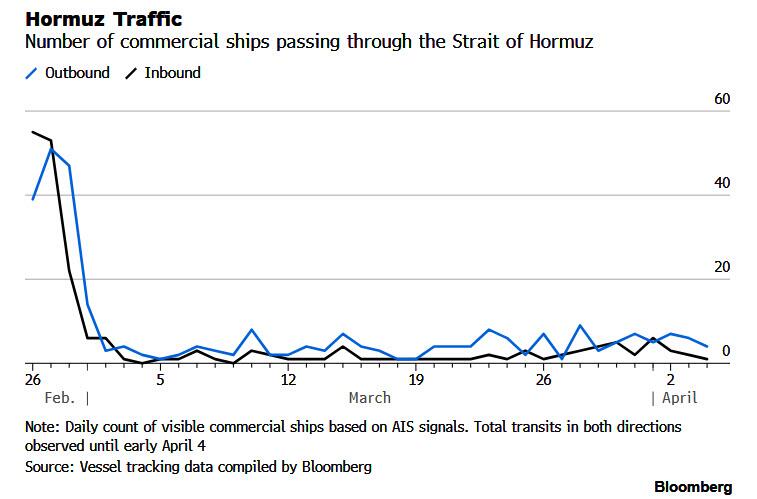
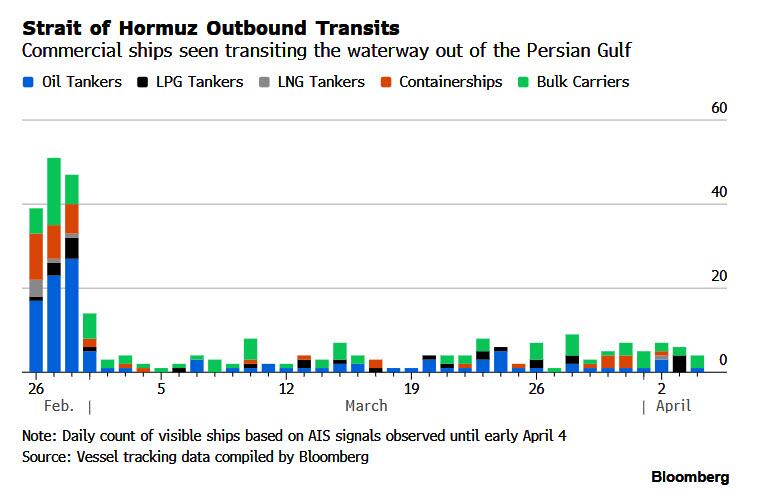
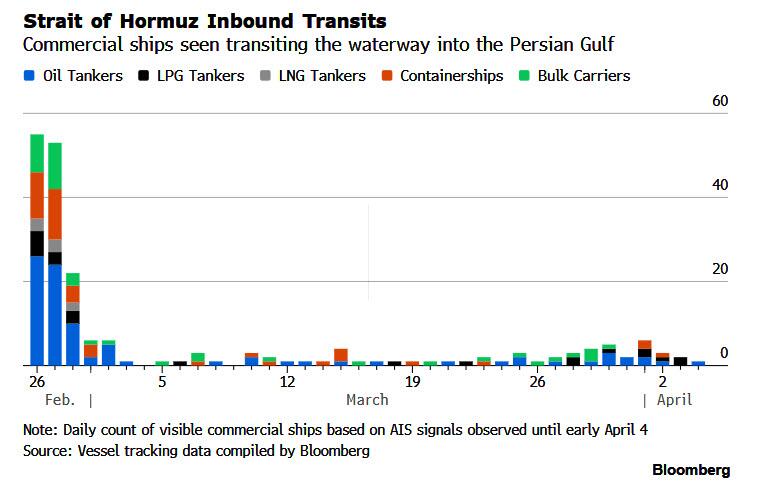
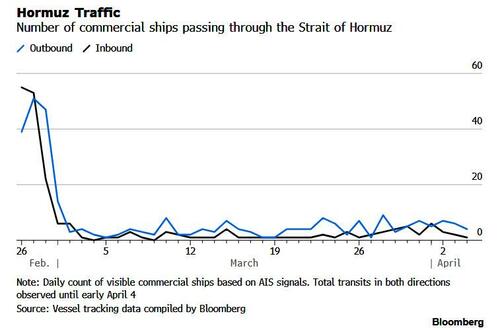
Over the past two weeks we have been chronicling the increased rate of crossing across the “blockaded” strait of Hormuz as a growing number of ships from friendly nations – whether untolled Chinese tankers or toll-paying Indian, Japanese and Korean vessels – have been making the passage. And as traffic through the Hormuz strait has been picking up in the past week, the seven-day rolling average for transits on Friday reached the highest since the war started, according to Bloomberg.
More vessels are crossing, including those with no clear links to Iran or China, as nations negotiate with Tehran to get their ships through. Transits over the past day were led by liquefied petroleum gas carriers, including one headed to India and others with Iranian affiliations.
Per Bloomberg calculations, a total of 13 ships have crossed since Friday morning, with 10 exiting the Persian Gulf and three entering from the open seas, according to vessel-tracking data compiled by Bloomberg. To be sure, that’s still a trickle compared with the numbers before the war began on Feb. 28: in normal times, about a fifth of the world’s oil and liquefied natural gas passes through the strait every day.
Recent crossings included a French container ship and a Japanese-owned LNG tanker, seemingly the first such transits since the war began. It’s not clear whether those journeys were a result of diplomatic outreach or negotiations by shipping companies and their intermediaries.
Outbound traffic included five bulk carriers and one oil-product tanker joined the four LPG tankers in exiting the Persian Gulf since Friday morning. Three of the bulkers and the fuel tanker sailed on Saturday morning. Apart from the Indian LPG vessel, the others are linked to Chinese or Iranian interests.
On the inbound side, two LPG carriers and one fuel tanker with Iranian affiliations were among the inbound transits recorded since Friday morning.
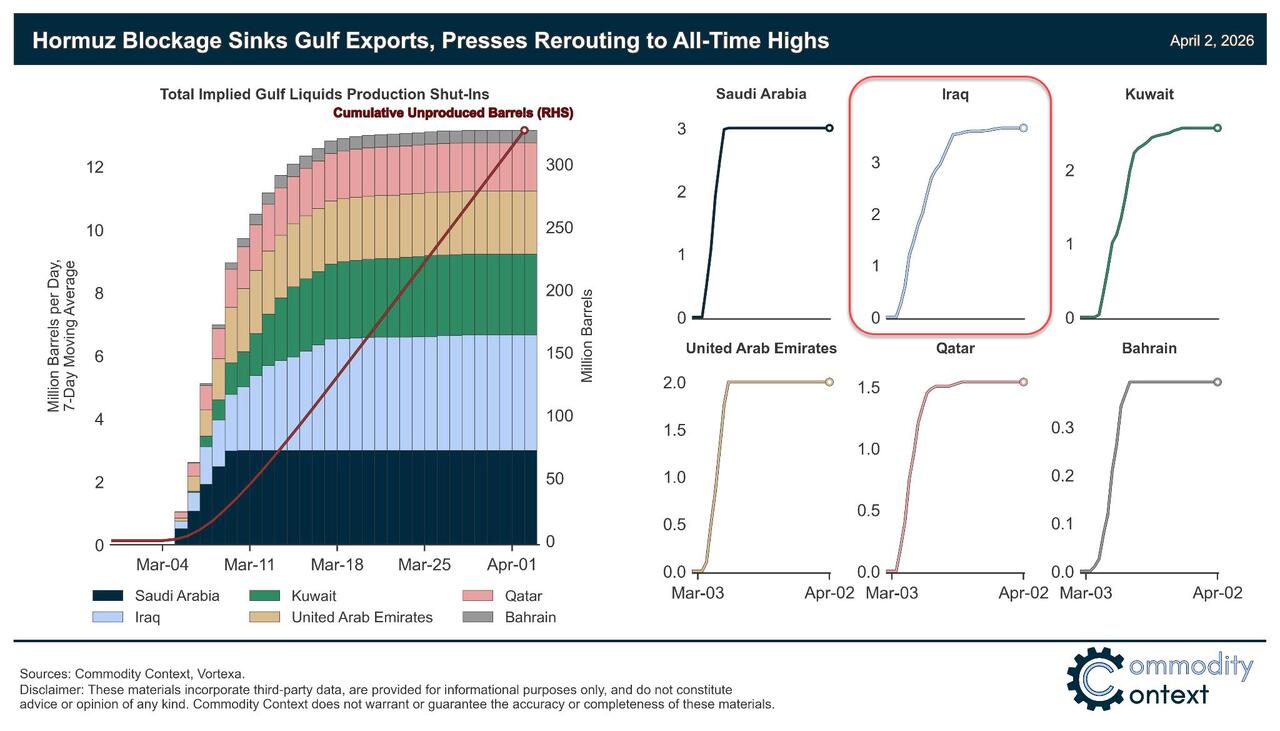
But while traffic is slowly but surely rising, a potential gamechanger for energy flows and oli supplies through Hormuz was unveiled today when the Iranian military said major oil producer Iraq is exempt from shipping restrictions in the Strait of Hormuz.
“Brotherly Iraq is exempt from any restrictions we have imposed on the Strait of Hormuz,” Iran’s military spokesman said in an Arabic-language video statement published by state-run Islamic Republic News Agency.
The restrictions are imposed only on “enemy countries,” said Ebrahim Zolfaghari, a spokesman for Iran’s Khatam al-Anbiya Central Headquarters. Iran’s control of the strait has become its biggest leverage in the conflict.
The declaration has the potential to unleash as much as 3 million barrels a day of Iraqi oil cargoes. An Iraqi official, however, cautioned that the usefulness of the exemption will depend on whether shipping companies are willing to risk entering the strait to collect cargoes.
It’s not immediately clear if the exemption will apply to all Iraqi oil or just the nation’s tankers, or indeed how it will be enforced.
Separately, officials in Iran’s Khuzestan province said the Shalamcheh international border crossing with Iraq has reopened after a brief closure. Lofteh Derokvandi, deputy governor of Khuzestan and special governor of Khorramshahr, told Iran’s state news agency IRNA that crossings had resumed for pilgrims and traders, with commercial activity continuing without disruption.
Tyler Durden
Sat, 04/04/2026 – 21:57