Category: News

Fallece Rafael Ithier, gigante de la salsa de Puerto Rico
Por DÁNICA COTO
SAN JUAN (AP) — Rafael Ithier, un querido músico y fundador de la legendaria banda de salsa El Gran Combo de Puerto Rico, cuyos éxitos han inspirado a Bad Bunny y a otros íconos del territorio de Estados Unidos y más allá, ha fallecido. Tenía 99 años.
Un abogado de la familia Ithier, Víctor Rivera, confirmó la muerte del músico a la estación de radio WKAQ el sábado por la noche. La causa de la muerte no estaba clara.
“Puerto Rico pierde a un gigante, un hombre cuya vida estuvo dedicada a elevar nuestra identidad a través del arte y el ritmo que nos distingue ante el mundo”, declaró Marlese Sifre, alcaldesa de Ponce.
“Rafael Ithier Natal no solo fue fundador y director musical de uno de nuestros pilares culturales, El Gran Combo de Puerto Rico, sino que fue también ejemplo de disciplina, excelencia y amor profundo por nuestra tierra”, añadió.
Ithier fue un pianista autodidacta, arreglista, compositor, productor musical y director de orquesta de lo que muchos consideran la mejor orquesta de salsa del mundo.
Nacido en San Juan y criado en la comunidad trabajadora de Río Piedras, Ithier perdió a su padre a los 8 años.
Abrazó la música a una edad temprana, aprendiendo a tocar la guitarra a los 10 años, la cual tocaba en una tienda de la esquina a cambio de propinas, según la Fundación Nacional para la Cultura Popular, una organización sin fines de lucro local.
A los 14 años, dejó la escuela por razones económicas y encontró trabajos donde pudo. Un año después, se unió a su primer grupo musical, Conjunto Hawaiano, y aprendió a tocar el tres cubano y el contrabajo. Más tarde aprendió a tocar el piano y se enseñó a sí mismo a leer partituras.
A mediados de sus 20 años, Ithier se unió al Ejército de Estados Unidos y fue destinado a Corea. Más tarde viajó a Nueva York y formó “The Borinqueneers Mambo Kings”, nombrado en honor al 65º Regimiento de Infantería de Puerto Rico, la renombrada unidad del Ejército totalmente hispana y segregada que recibió medallas por su servicio en las Guerras Mundiales I y II y la Guerra de Corea.
Ithier eventualmente regresó a Puerto Rico y se unió a Cortijo y Su Combo, solo para casi abandonar su carrera musical después de que su legendario cantante, Ismael Rivera, fuera arrestado.
Ithier planeaba estudiar derecho, pero fue convencido de lo contrario por dos hermanos cubanos que ayudaron a fundar El Gran Combo. En la noche de apertura del grupo, en mayo de 1962 en el Rock’n Roll Club en Bayamón, Ithier se sentó al piano y el resto es historia, según la Fundación Nacional para la Cultura Popular.
Ithier dirigió El Gran Combo durante más de medio siglo con su característica sonrisa y bigote negro. Confesó al periódico Primera Hora en una entrevista de 2016 a los 90 años que era tímido respecto a las celebraciones.
Ithier atribuyó el éxito de la orquesta no solo a la suerte, sino a la disciplina que aprendió mientras estaba en el Ejército.
“Aprendí a ser hombre y a obedecer una orden. Esa disciplina es la que aplico a mi vida y en la que baso mi vida”, se le citó diciendo.
Bajo su dirección, El Gran Combo atrajo a tantos músicos que eventualmente se hicieron famosos que fue apodado “la Universidad de la Salsa”. Entre los legendarios cantantes que formaron parte de la orquesta estaba Charlie Aponte, quien escribió en las redes sociales que “Para mí Rafa fue y seguirá siendo como un padre nos enseñó y nos exigió responsabilidad, disciplina y profesionalismo en nuestro trabajo, si querías pertenecer al grupo tenías que cumplir con eso. Nos convirtió a todos en mejores seres humanos”.
La orquesta tocó en cinco continentes, lanzó más de 40 álbumes y se hizo conocida por éxitos como “Jala Jala”, “Me Liberé”, “Y No Hago Más Ná” y “Un Verano en Nueva York”, que inspiró una de las canciones más populares de Bad Bunny, “Nuevayol”.
Los fanáticos de la salsa estaban de luto el domingo mientras se difundía la noticia de la muerte de Ithier.
“Ithier es uno de esos inmortales que ha cubierto de gloria a nuestro país. Hombre ejemplar, autodidacta, de recia y franca personalidad, que le imprimió su estilo campechano a todas sus luchas, gestas y hazañas”, declaró Agustín Montañez Allman, secretario del gobierno de Puerto Rico para asuntos de veteranos.
La gobernadora de Puerto Rico, Jenniffer Colón, también lamentó la muerte de Ithier al anunciar que la isla pronto tendrá una fecha oficial de luto.
“Su legado trasciende fronteras y vive en varias generaciones. Gracias por tanto, maestro”, dijo en un comunicado.
Ithier deja atrás a una esposa y cinco hijos.
___________________________________
Esta historia fue traducida del inglés por un editor de AP con ayuda de una herramienta de inteligencia artificial generativa.
https://www.chicagotribune.com/2025/12/07/fallece-rafael-ithier-gigante-de-la-salsa-de-puerto-rico/

Denmark Cuts Ukraine Aid Nearly In Half Amid Corruption Scandal
Denmark Cuts Ukraine Aid Nearly In Half Amid Corruption Scandal
Denmark plans to scale back its military assistance to Ukraine next year, and the amount cut is being widely reported as a huge amount – up to almost half of what’s it’s been since 2022.
According to Danish Broadcasting Corporation, the tiny northern European country has long stood out for its exceptionally high contributions that it made earlier in the conflict, but now the Danish government wants other countries should shoulder more of the burden.
The country’s Defense Minister Troels Lund Poulsen has informed parliament that the government intends to allocate 9.4 billion kroner (around $1.5 billion) in aid to Ukraine in 2026.
This marks a decrease from the 16.5 billion kroner (about $2.6 billion) provided this year and the nearly 19 billion kroner (roughly $3 billion) distributed the prior year.
Danish media has described that this is partly the result dwindling resources in the Ukraine Fund, which is a dedicated pool established in 2023 with broad political support among European allies.
In total, since the start of the war in early 2022 Denmark has provided a whopping nearly $11 billion in military aid to Kiev. It has also provided F-16 jets and hosted fighter pilot training programs for Ukrainians.
Simon Kollerup, a member of the Denmark’s Defense Committee, has stated that “it is natural that we are seeing a stabilization of the level of support being provided”.
“We decided to be one of the countries that took the lead at the beginning of the war by providing large-scale support. I also think it is fair to say that this support somewhat exceeds what is actually dictated by the size of our country. Therefore, I find it quite natural that the support is decreasing,” Kollerup added.
This comes at a time that Washington is also withdrawing much of its outsized support to Ukraine, with Trump’s preferred scheme being to sell weapons to Europe, which will in turn sell or transfer them to Kiev.
The timing of Denmark’s announced major reduction in aid also comes as the Zelensky government is mired in a corruption scandal which goes straight to the presidential office itself (with top aides having been dismissed and investigated), so perhaps some EU countries are finally wising up, and no longer wish to act in a blank check manner.
Ukraine’s top donor Denmark to nearly halve military aid in 2026
It will be $1.5bn next year, down from $2.6bn spent this year. It was $3bn in 2024.
Denmark sees that their $11bn weapons support incl. F-16 did not yield a win.
The Danes hate corruption more than Russia. pic.twitter.com/RQjR1HxWIr
— Alternative News (@AlternatNews) December 7, 2025
Even the NY Times has just acknowledged in a report that “President Volodymyr Zelensky’s administration has stacked boards with loyalists, left seats empty, or stalled them from being set up at all. Leaders in Kiev even rewrote company charters to limit oversight, keeping the government in control and allowing hundreds of millions of dollars to be spent without outsiders poking around.”
Tyler Durden
Sun, 12/07/2025 – 11:05

Jueces rechazan intento del Departamento de Justicia de presentar nueva acusación contra Comey
Por ERIC TUCKER
WASHINGTON (AP) — Un juez federal ha asestado un revés a los esfuerzos del Departamento de Justicia para buscar un nuevo proceso contra el exdirector del FBI James Comey, prohibiendo temporalmente a los fiscales utilizar pruebas en las que se habían basado cuando inicialmente aseguraron cargos criminales.
El fallo del sábado por la noche de la jueza Colleen Kollar-Kotelly no impide que el departamento intente nuevamente pronto acusar a Comey, pero sugiere que los fiscales pueden tener que hacerlo sin citar las comunicaciones entre Comey y un amigo cercano, el profesor de derecho de la Universidad de Columbia Daniel Richman.
Comey fue acusado en septiembre de mentir al Congreso cuando negó haber autorizado a un asociado para servir como fuente anónima para la cobertura mediática sobre el FBI. Al perseguir el caso, los fiscales citaron mensajes entre Comey y Richman que, según ellos, mostraban a Comey alentando a Richman a interactuar con los medios para cierta cobertura relacionada con el FBI.
El caso fue desestimado el mes pasado después de que un juez federal diferente dictaminara que la fiscal que presentó los cargos, Lindsey Halligan, fue nombrada ilegalmente por la administración Trump. Pero ese fallo dejó abierta la posibilidad de que el gobierno pudiera intentar nuevamente buscar cargos contra Comey, un antiguo adversario del presidente Donald Trump.
Después de que el caso fuera desestimado, los abogados de Richman buscaron una orden judicial que prohibiera a los fiscales el acceso continuo a los archivos de su computadora, que el Departamento de Justicia obtuvo a través de órdenes de registro en 2019 y 2020 como parte de una investigación de filtración de medios que luego se cerró sin cargos.
Pero Richman y sus abogados dicen que al preparar el caso criminal contra Comey, los fiscales se basaron en datos que excedían el alcance de las órdenes, retuvieron ilegalmente comunicaciones que deberían haber destruido o devuelto y realizaron nuevas búsquedas sin orden judicial.
Kollar-Kotelly el sábado por la noche concedió la solicitud de Richman de una orden de restricción temporal, instruyendo al departamento “a no acceder a los materiales cubiertos una vez que sean identificados, apartados y protegidos, ni a compartir, difundir o divulgar los materiales cubiertos a ninguna persona, sin primero buscar y obtener el permiso de este Tribunal”.
Dio al Departamento de Justicia hasta el lunes por la tarde para certificar que está cumpliendo con la orden.
“El peticionario Richman también ha demostrado que, en ausencia de una orden judicial, sufrirá un daño irreparable por la violación continua de su derecho de la Cuarta Enmienda contra incautaciones irrazonables derivadas de la retención continua por parte del Gobierno de la imagen de su computadora y materiales relacionados”, escribió.
Un portavoz del Departamento de Justicia declinó comentar el domingo sobre el fallo y lo que significaba para los cargos contra Comey.
No es seguro que el Departamento de Justicia pueda asegurar nuevos cargos contra Comey incluso si puede usar las comunicaciones de Richman. Los abogados de Comey han dicho que el plazo de prescripción para tal caso —el testimonio ante el Congreso en cuestión se dio el 30 de septiembre de 2020, o hace más de cinco años— ha expirado.
Un intento separado del Departamento de Justicia para presentar una nueva acusación contra la fiscal general de Nueva York Letitia James, otra adversaria percibida de Trump que también fue acusada por Halligan, fracasó la semana pasada cuando un jurado preliminar se negó a aprobar los cargos.
___________________________________
Esta historia fue traducida del inglés por un editor de AP con ayuda de una herramienta de inteligencia artificial generativa.
Al menos 18 migrantes mueren al hundirse bote inflable al sur de Creta
ATENAS (AP) — Al menos 18 migrantes que intentaban cruzar el mar Mediterráneo murieron cuando su bote inflable se volcó al sur de la isla de Creta, informaron las autoridades griegas el sábado.
Un barco mercante turco que pasaba por la zona localizó el bote medio hundido, según las autoridades. Dos sobrevivientes fueron rescatados y se lanzó un operativo para encontrar más personas.
Grecia es un punto de entrada importante para personas que huyen de conflictos y pobreza en el Oriente Medio, África y Asia y que buscan entrar a la Unión Europea. Los accidentes fatales comunes.
El corto pero peligroso viaje desde la costa de Turquía hasta las islas griegas cercanas en botes inflables o pequeñas embarcaciones, a menudo en malas condiciones, solía ser la ruta principal hasta que el aumento de patrullas y devoluciones redujeron los intentos de cruce. En los últimos meses, las llegadas desde Libia a Creta han aumentado.
Las autoridades aún no han determinado de dónde provenía el bote.
Un barco y un avión de la agencia fronteriza europea Frontex, un helicóptero de la Guardia Costera griega y tres buques mercantes están participando en la operación de búsqueda.
___________________________________
Esta historia fue traducida del inglés por un editor de AP con ayuda de una herramienta de inteligencia artificial generativa.

Israeli Prime Minister Benjamin Netanyahu says Israel and Hamas will enter ceasefire’s second phase soon
TEL AVIV, Israel — Israeli Prime Minister Benjamin Netanyahu said Sunday that Israel and Hamas are “very shortly expected to move into the second phase of the ceasefire,” after Hamas returns the remains of the last hostage held in Gaza.
Netanyahu spoke during a news conference with visiting German Chancellor Friedrich Merz and stressed that the second phase, the disarming of Hamas and the demilitarization of Gaza could begin as soon as the end of the month.
Hamas has yet to hand over the remains of Ran Gvili, a 24-year-old police officer who was killed in the Hamas-led Oct. 7, 2023, attack that sparked the war. His body was taken to Gaza.
The ceasefire’s second stage also includes the deployment of an international force to secure Gaza and forming a temporary Palestinian government to run day-to-day affairs under the supervision of an international board led by U.S. President Donald Trump.
Netanyahu says second phase will be challenging
The return of Gvili’s remains — and Israel’s return of 15 bodies of Palestinians in exchange — would complete the first phase of Trump’s 20-point ceasefire plan.
Hamas says it has not been able to reach all remains because they are buried under rubble left by Israel’s two-year offensive in Gaza. Israel has accused them of stalling and threatened to resume military operations or withhold humanitarian aid if all remains are not returned.
Merz said Germany, one of Israel’s closest allies, is assisting with the implementation of the second phase by sending officers and diplomats to a U.S.-led civilian and military coordination center in southern Israel, and by sending humanitarian aid to Gaza.
Netanyahu said few people believed the ceasefire’s first stage could be achieved, and the second phase is just as challenging.
“As I mentioned to the chancellor, there’s a third phase, and that is to deradicalize Gaza, something that also people believed was impossible. But it was done in Germany, it was done in Japan, it was done in the Gulf States. It can be done in Gaza, too, but of course Hamas has to be dismantled,” he said.
Germany says support for Israel is unchanged
Merz said Germany will “always stand up for Israel’s existence and security” after the atrocities of the Holocaust: “This is part of the unchanging core of our relationship. This applies today, it applies tomorrow and it applies forever.”
The chancellor also said Germany still believes that a two-state-solution is the best possible option but that “the German federal government remains of the opinion that recognition of a Palestinian state can only come at the end of such a process, not at the beginning.”
The U.S.-drafted plan for Gaza leaves the door open to Palestinian independence. Netanyahu has long asserted that creating a Palestinian state would reward Hamas and eventually lead to an even larger Hamas-run state on Israel’s borders.
Netanyahu also said that while he would like to visit Germany, he hasn’t planned a diplomatic trip because he is concerned about an arrest warrant issued by the International Criminal Court, the U.N.’s top war crimes court, last year in connection with the war in Gaza.
Merz said there are currently no plans for a visit but he may invite Netanyahu in the future. He added that he is not aware of future sanctions against Israel from the European Union nor any plans to renew German bans on military exports to Israel.
Germany had a temporary ban on exporting military equipment to Israel, which was lifted after the ceasefire began on Oct. 10.
Israel kills fighter in Gaza
The Israeli military said it killed a fighter who approached its troops across the so-called Yellow Line that divides the Israeli-controlled majority of Gaza from the rest of the territory.
Gaza’s Health Ministry says Israeli forces have killed more than 370 Palestinians since the start of the ceasefire, and that the bodies of six people killed in attacks had been brought to local hospitals over the past 24 hours.
In the original Hamas-led attack in 2023, the group killed around 1,200 people and took more than 250 others hostage. Almost all the hostages or their remains have been returned in ceasefires or other deals.
Israel’s offensive in Gaza has killed at least 70,360 Palestinians, according to Gaza’s Health Ministry, which operates under the Hamas-run government. The ministry does not differentiate between civilians and combatants, but says that nearly half the dead have been women and children. The ministry is part of Gaza’s Hamas government and its numbers are considered reliable by the U.N. and other international bodies.
Grieshaber reported from Berlin.
https://www.chicagotribune.com/2025/12/07/israel-hamas-ceasefire-2/

Soon no Pearl Harbor survivors will be alive. People turn to other ways to learn about the bombing.
HONOLULU — Survivors of the 1941 Japanese bombing of Pearl Harbor have long been the center of a remembrance ceremony held each year on the military base’s waterfront.
But today only 12 are still alive — all centenarians — and this year none is able to make the pilgrimage to Hawaii to mark the event, scheduled for Sunday.
Lou Conter, last survivor of USS Arizona from Pearl Harbor attack, dies at 102
That means no one attending will have firsthand memories of serving during the attack, which killed more than 2,300 troops and catapulted the U.S. into World War 2. The development is not a surprise and is an evolution of an ongoing trend. As survivors fade, their descendants and the public are increasingly turning to other ways of learning about the bombing.
“The idea of not having a survivor there for the first time — I just, I don’t know — it hurt my heart in a way I can’t describe,” said Kimberlee Heinrichs, whose 105-year-old father Ira “Ike” Schab had to cancel plans to fly in from Oregon after falling ill.
Survivors have been present every year in recent memory except for 2020, when the Navy and the National Park Service closed the observance to the general public because of coronavirus pandemic health risks.
“I can still see what was happening.”
The ceremony begins with a moment of silence at 7:55 a.m., the same time the attack began on Dec. 7, 1941. Solemn rituals follow.
Fighter jets fly overhead in “missing man formation,” in which one jet peels off to symbolize those lost. Survivors present wreaths to honor the dead, though active duty troops have assumed this job in recent years. Survivors rise to salute active duty sailors who themselves salute as their ship passes the USS Arizona Memorial, which sits above submerged hull of the battleship sunk in the attack.
About 2,000 survivors attended the 50th anniversary event in 1991. A few dozen have showed in recent decades. Last year, only two made it. That is out of an estimated 87,000 troops stationed on Oahu that day.
Many survivors were jovial despite the occasion, happy to catch up with old friends and pose for photographs. Even so, harrowing recollections were seldom far from their minds.
In 2023, Harry Chandler gazed across the water while telling an Associated Press reporter how he was raising the flag at a mobile hospital in the hills above the base when he saw Japanese planes fly in and drop bombs. Chandler and his fellow Navy hospital corpsmen jumped in trucks to help the injured.
He spoke of seeing the Arizona explode, and of hearing sailors trapped on the capsized USS Oklahoma desperately tapping on their ship’s hull to summon rescue. He helped care for Oklahoma sailors after crews cut holes in the battleship.
“I can still see what was happening,” Chandler said. He died the next year at a senior living center in Tequesta, Florida.
The attack on Pearl Harbor silenced a burgeoning ‘America First’ movement
Lessons from the past
The bombing has long held different meanings for different people, the historian Emily S. Rosenberg wrote in her book “A Date Which Will Live: Pearl Harbor in American Memory.”
Some say it highlights the need for a well-prepared military and a vigilant foreign policy. To some it evokes then-President Franklin D. Roosevelt administration’s “ineptitude or deceit” and the unfair scapegoating of the military. Others focus on the “treachery” of Japan or the heroic acts of individual troops, she wrote.
Asked what he wanted Americans to know about Pearl Harbor, Chandler said: “Be prepared.”
“We should have known that was going to happen. The intelligence has to be better,” he said.
Lou Conter, who was the Arizona’s last living survivor when he died last year at 102, told the AP in 2019 he liked to attend to remember those who lost their lives.
“It’s always good to come back and pay respect to them and give them the top honors that they deserve,” Conter said.
Heinrichs’ father has been six times since 2016. The former tuba player on the USS Dobbin likes to go not only to remember those killed but also in place of his late band mates; his three brothers who fought in World War II; and the now-deceased Pearl Harbor survivors he has met.
Recording the remembrances before the survivors are gone
Retired National Park Service Pearl Harbor historian Daniel Martinez said the circumstances resemble the early 20th century when Civil War veterans were dying in increasing numbers. Awareness grew that soon they wouldn’t be able to share their stories of Gettysburg and other battles, he said.
Martinez knew something similar could happen with Pearl Harbor survivors and recorded their oral histories. During a 1998 convention, he conducted interviews 12 hours a day for three days. The Park Service today has nearly 800 interviews, most on video.
“They remain as a part of the national memory of a day that changed America and changed the world,” Martinez said.
The Park Service shows some in its Pearl Harbor museum and aims to include more after renovations, said David Kilton, the agency’s Pearl Harbor interpretation, education and visitor services lead.
The Library of Congress has collections from 535 Pearl Harbor survivors, including interviews, letters, photos and diaries. Over 80% are online. They are part of the library’s Veterans History Project of firsthand recollections of veterans who served in World War I onward. Many were recorded by relatives, Eagle Scouts and other amateurs interested in documenting history.
The Sons and Daughters of Pearl Harbor Survivors gives presentations in schools and marches in parades to share the stories of their families. The California chapter has added six new members this year, including two great-grandchildren of survivors.
“When they’re all gone, we’re still going to be here,” said Deidre Kelley, the group’s president. “And it’s our intent to keep the memory alive as long as we’re alive.”
https://www.chicagotribune.com/2025/12/07/pearl-harbor-survivors-bombing/
As The Year Ends, What Does 2026 Hold
As The Year Ends, What Does 2026 Hold
Authored by Lance Roberts via RealInvestmentAdvice.com,
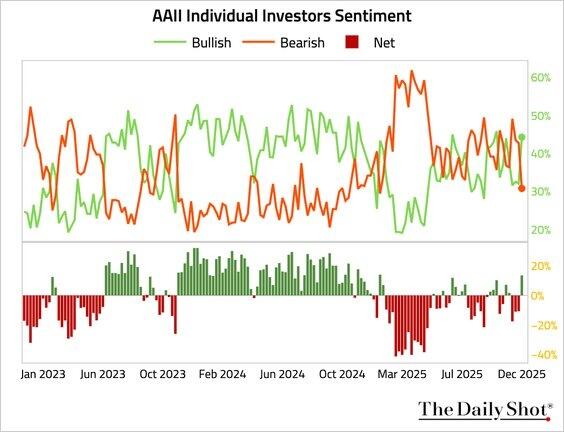
Markets opened in December with a surge in optimism as retail investors regained their “bullish spirit.” That improvement continues to build on the bullish case we discussed last week:
“Seasonality, positioning, and trend still lean in favor of the bulls. December is historically one of the stronger months for equities, particularly when the market is already up by double digits year-to-date. Expectations for a December Fed rate cut, and a gradual cooling of inflation, support the “soft-landing” narrative, while corporate buybacks and under-invested managers create fuel for a “chase into year-end” if resistance gives way. With volatility easing and breadth improving, the path of least resistance near term remains higher if key support zones are maintained.”
The increase in optimism is also attributable to the significant policy pivot from the Federal Reserve. On December 1, the Fed officially ended its quantitative tightening (QT) program. The halting of the runoff of its balance sheet and the injection of fresh liquidity into financial markets are essential. We will discuss this more momentarily. But for investors, this change removed a persistent headwind and reignited expectations for a more accommodative stance in 2026.
Speaking of Fed policy, the next FOMC rate decision is this coming week. The CME futures markets now reflect a very high probability of a 0.25% rate cut. Furthermore, expectations for further rate cuts in March of next year have risen. However, as discussed in last week’s brief, seasonality, dip-buying, and institutional positioning are already in play, and the removal of QT adds fuel to that narrative, helping to lift asset prices.
Notably, there has been a shift away from stretched growth names toward lagging sectors, such as energy, financials, and healthcare, which has improved market breadth. That improvement is a necessary component of a more sustainable rally. However, much of the action still appears technical and remains inconsistent with bullish markets.
Next week, the focus will shift toward confirmation as the markets closely scrutinize the Fed’s commentary for clues on the timing and scope of further rate cuts. Liquidity indicators in repo markets and short-term funding will also be critical. If those stay stable, the rally could continue. Lastly, economic data, particularly inflation and employment figures, the first since the Government shutdown, will also play a role in shaping expectations.
For now, the rally has legs, but once we enter 2026, the fundamentals will need to improve to sustain it.
Markets have reached a crossroads.
Investors are staring down two sharply opposing narratives as 2025 comes to a close. On one side, there’s optimism: the Federal Reserve has ended quantitative tightening, liquidity is rising, and key sectors are flush with capital. On the other hand, significant risks remain unresolved: narrow market leadership, elevated valuations, growing household stress, and deepening concerns in the credit market.
These are all things we have discussed previously, but the split reflects more than market noise. It’s a clash between structural bullish support and underlying economic fragility. While both cases are grounded in data and each carries significant implications for asset allocation, risk management, and long-term investment outcomes, they are equally essential to consider.
As we will discuss, the bull case leans heavily on liquidity, fiscal support, and renewed investment. The return of easy monetary conditions, a shift in political leadership favoring tax cuts and increased spending, and massive capital expenditure commitments by the largest U.S. companies paint a picture of continued upside. If those forces hold, equities could continue to grind higher, lifting all sectors or at least sustaining current valuations.
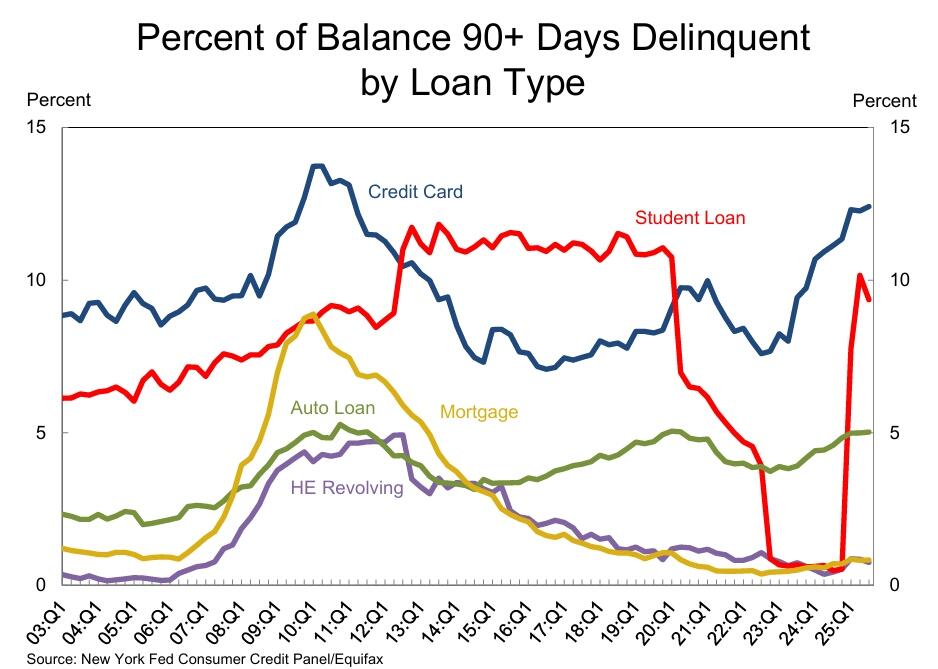
Conversely, the bear case warns that the fundamentals are fraying beneath the surface. Household debt is rising, delinquencies are increasing across income brackets, and private credit markets are displaying early warning signs. Meanwhile, the rally remains narrowly focused on a few mega-cap stocks tied to artificial intelligence. If those names falter, the broader market could quickly give up its gains.
In today’s analysis, we will examine both arguments and outline the most likely path for markets in 2026. Whether the market skews bullish or breaks bearish, investors need a plan. What matters now isn’t conviction in one narrative. What matters is readiness for either outcome.
Let’s get into it.
Bull Case: Why the Market Could Push Higher
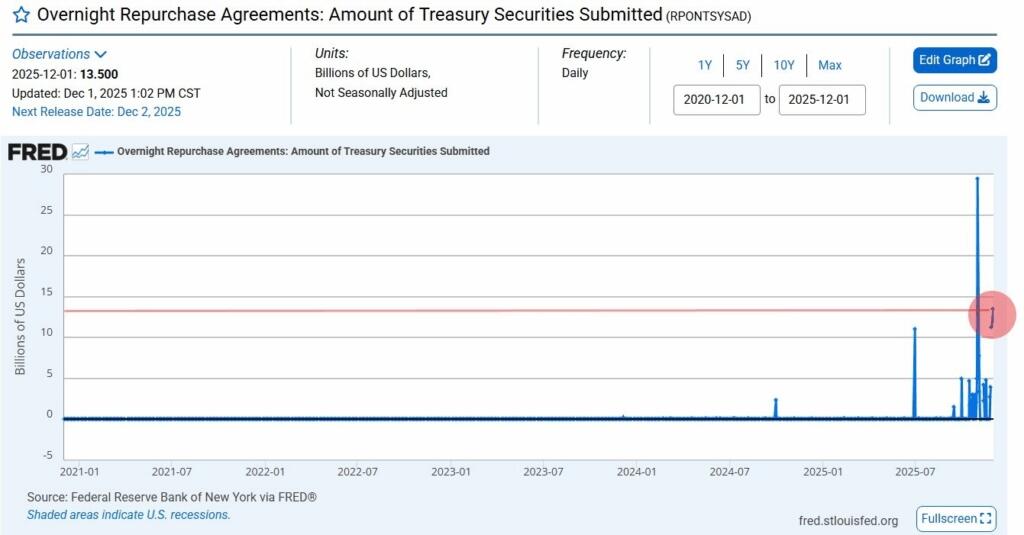
Liquidity has shifted significantly more favorably for risk assets and equities. On December 1, 2025, the Federal Reserve (Fed) officially ended its quantitative tightening (QT) program and is scheduled to cut overnight lending rates by another 0.25% next week. The Fed has simultaneously conducted a large overnight repurchase agreement injection of approximately $13.5 billion into the banking system, which is the second-largest liquidity injection since the COVID-19 era began.
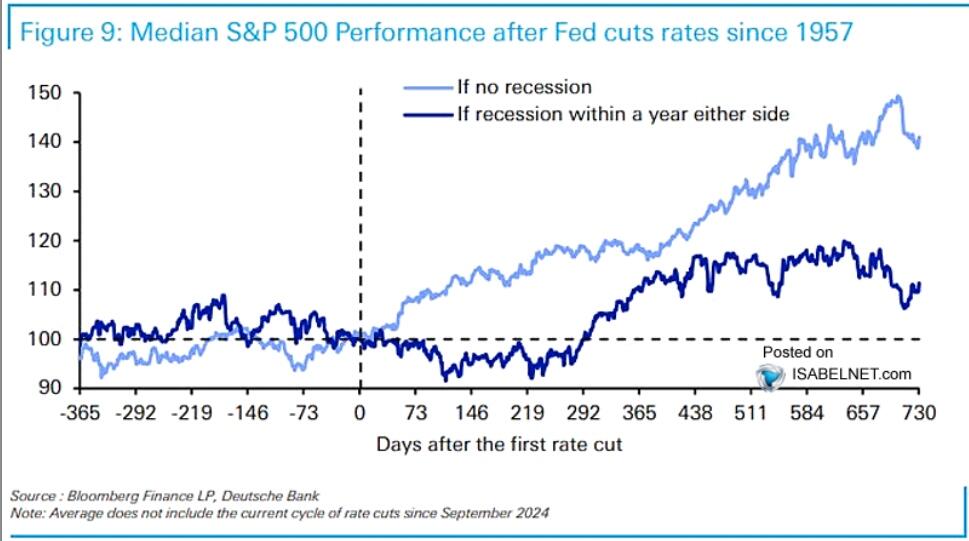
That signals the Fed is done draining cash from the system and may even be ready to begin loosening again. Furthermore, that shift removes a significant structural drag on equities. Furthermore, as noted, adding to that backdrop are further expected rate cuts, as early as next week. As shown, the market performs well during periods of a Federal Reserve rate-cutting cycle when the economy is not in a recession. Currently, although economic data remains weak, recession risks are muted.
With easier liquidity, investors are likely to return to riskier assets. Historically, when QT ends and liquidity returns, equities have tended to rally, and the renewed cash flow may support not only large-cap stocks but also corporate cap-ex, buybacks, and broader credit-based investments. The return of liquidity breathes new life into the structural bull arguments of a fresh technology cycle, substantial capital expenditure by major firms, corporate buybacks, and deregulation or capital easing.
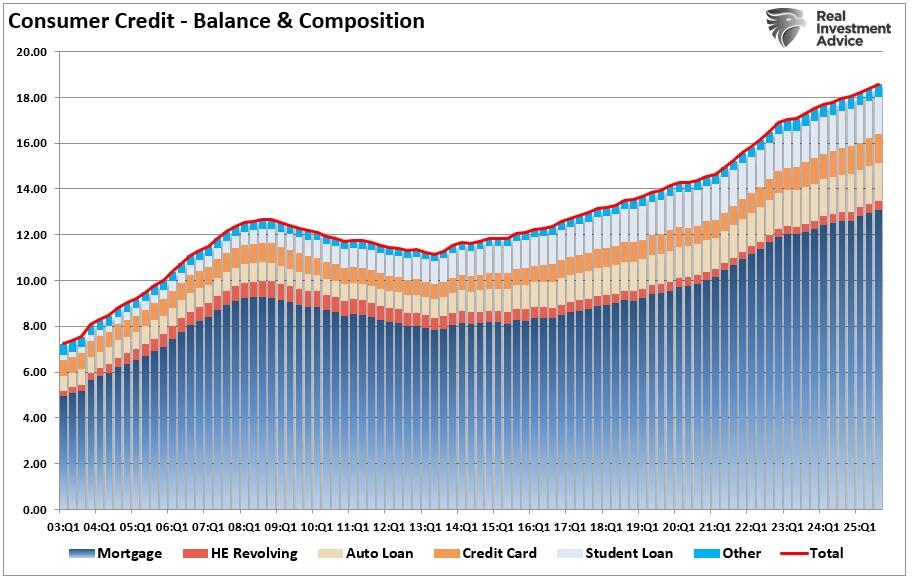
Furthermore, on the consumer side, while household debt rose modestly in Q3, overall borrowing increased in a controlled way. Total U.S. household debt reached about $18.59 trillion as of Q3 2025, a 1 percent increase over the prior quarter and up about $642 billion year‑over‑year. That rise was reflected in mortgages, credit cards, student loans, HELOCs, and auto loans. Notably, mortgage balances alone rose by $137 billion, bringing the total mortgages to $13.07 trillion.
Despite this, delinquency rates for mortgages remain relatively stable, while student-loan and unsecured debt are showing increased levels of strain. This suggests that households are still serviceable on their debt, which in turn could provide further support to corporate earnings in the near term. Again, I am not dismissing the rise in credit card and student loan delinquencies, but these have not yet morphed into broader economic stress…yet.
Given liquidity, consumer balance‑sheet resilience (at least in aggregate), and the potential for renewed capital expenditures and buybacks, the environment favors further upside. Stocks that had lagged or sectors outside of narrow, “hot” themes may attract renewed interest as investors seek value and diversified exposure.
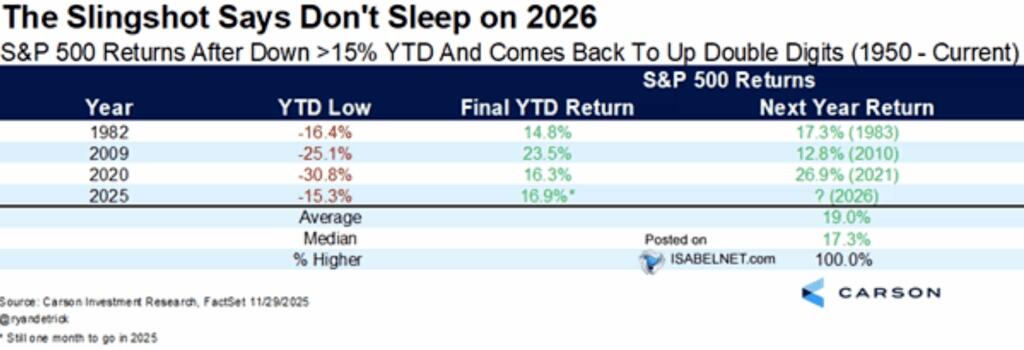
Statistically, there is also a bullish case to be made. As shown in the table below, many have forgotten about the ~20% decline we saw in March and April this year. That “reset” was necessary as 20% corrections, while they happen, are more “severe” events that reverse overly bullish sentiment and positioning. However, more notable was the sharp reversal from the April lows. Such a selloff and reversal has only occurred four times since 1950. While there is still roughly one month left in 2025, if returns hold at their current levels, it suggests that 2026 could have a positive year as bullish momentum continues.
But not everything is “bullish” heading into 2026.
Bear Case: Why the Rally Could Falter
While a bullish outlook for 2026 is present, numerous and growing risks are also present. Many of the powerful catalysts that drove the post‑pandemic rally now show signs of fatigue or overhang. However, before we delve into those, let’s begin with overall performance. Over the last three years, the market has delivered extraordinarily high returns of 20% or more consecutively. That is not unprecedented, but it does lean to the more unusual side of the statistical ledger. As we noted yesterday in our #DailyMarket Commentary:
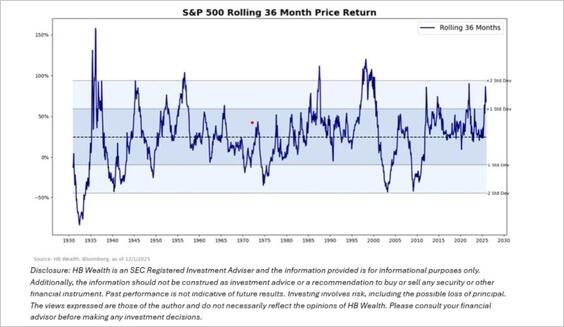
“The S&P 500 has posted a strong three-year price return of approximately 76.7 percent, excluding dividends. That translates to an annualized return of 20% to 22%. This is well above the long-term average annual return of roughly 10% to 11% with dividends reinvested. Such elevated returns over a short period suggest that the market is trading well above its historical trend. Historically, when the S&P 500 rolling 3-year return is two standard deviations above its three-year moving average, the market is statistically extended. This deviation typically precedes a shift in volatility and return outcomes. In other words, when markets reach this level of extension, two patterns emerge: increased volatility and weaker forward returns.”
While many expect 2026 to be a continuation of 2025, we should always respect the most powerful force in investing: the principle of “reversion to the mean.”
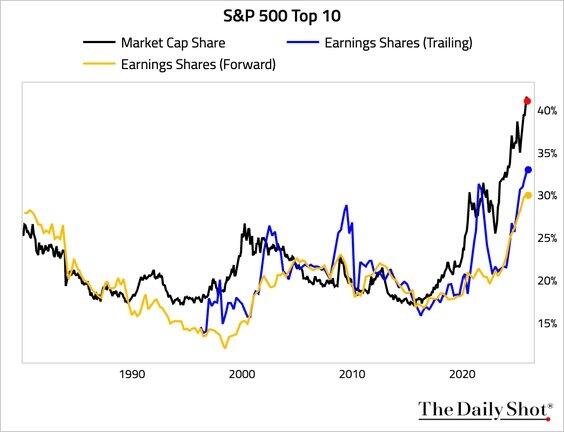
However, adding to that concern is the continued fact that the market remains extremely narrow. Gains have concentrated heavily among a small group of high-growth companies with strong ties to AI and technology. If optimism around AI, tech investment, or “transformational technology” cracks, even slightly, whether due to earnings disappointments, regulatory headwinds, or shifting investor sentiment, the broader market could struggle. The narrow leadership leaves little margin for broader weakness, and given that the vast majority of earnings growth has come from a handful of companies, it suggests that “disappointment risk” could be a significant factor next year.
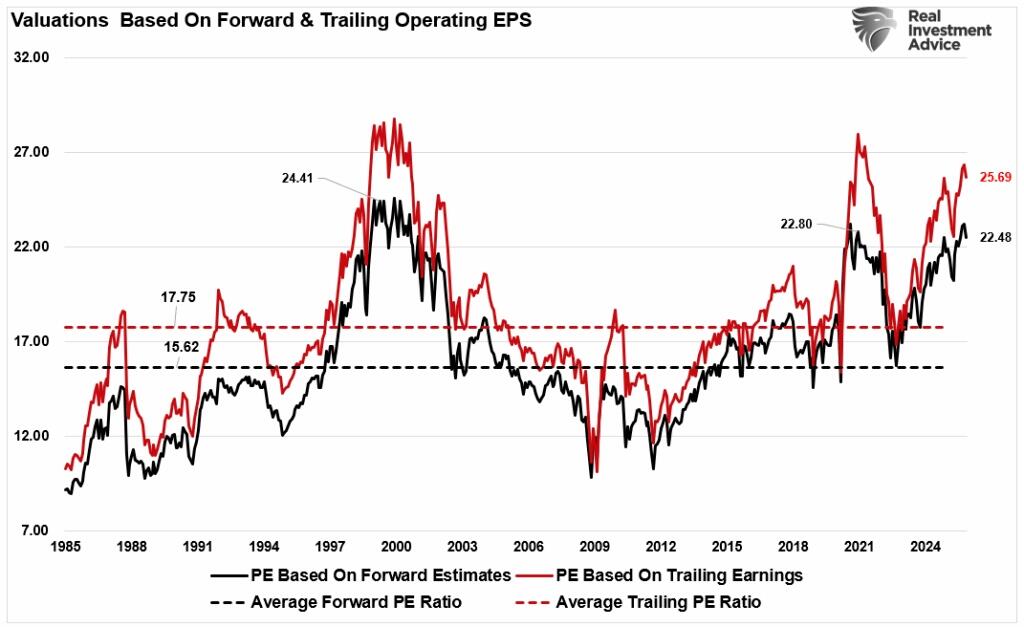
Valuations remain elevated. With forward price‑to-earnings (P/E) multiples for the broad market stretched, there is little buffer for disappointments in earnings growth, macroeconomic slowdown, or credit stress. Overpaid valuations amplify the downside if growth or liquidity fails to meet expectations.
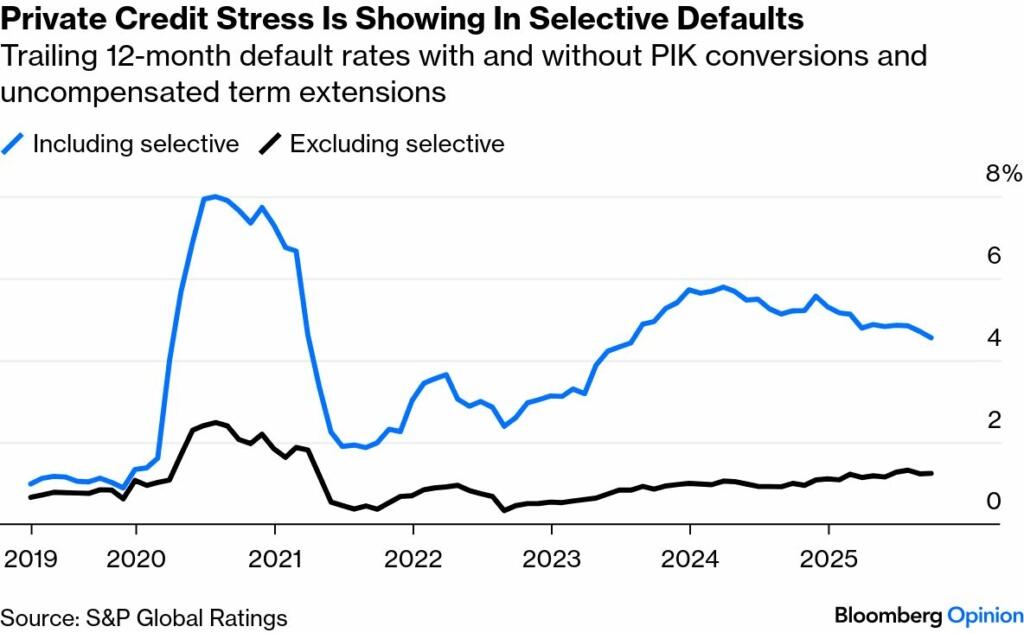
Credit‑market vulnerabilities are rising. The rapid growth of non-bank “private credit” as an alternative to traditional lending is now drawing scrutiny. Investors are increasingly withdrawing from publicly listed funds that hold such private credit instruments. That suggests waning confidence and potential repricing of private debt risk. If borrowers across corporate or household sectors struggle, losses could reverberate through credit markets and spill into equities.
One caveat to the bear case is that while these are all very valid factors that could negatively impact stocks, they are also dependent on a more macro-type shock to “ignite the fuse.” Yes, valuations are high, but there must be an “event” to cause a rapid repricing of forward earnings estimates. Yes, debt is problematic, but only when a recession triggers job losses, leading to sharp increases in defaults across all categories.
So, yes, while these factors are essential, I do not expect them to occur over the span of the next week, month, or even quarter.
However, with that being said, what should investors expect heading into next year?
In 2026, there is a growing possibility that investors may experience both bull and bear markets. As noted, the “bear case” is predicated on longer-term, macro events that will take some time to mature. However, the “bull case” is more focused on short-term factors, such as liquidity, which, although plentiful today, can evaporate tomorrow. Given the data and dynamics, the most likely near-term outcome is a continued bull market, which may lead to increased volatility and potentially bearish outcomes later in the year.
Key Catalysts Next Week
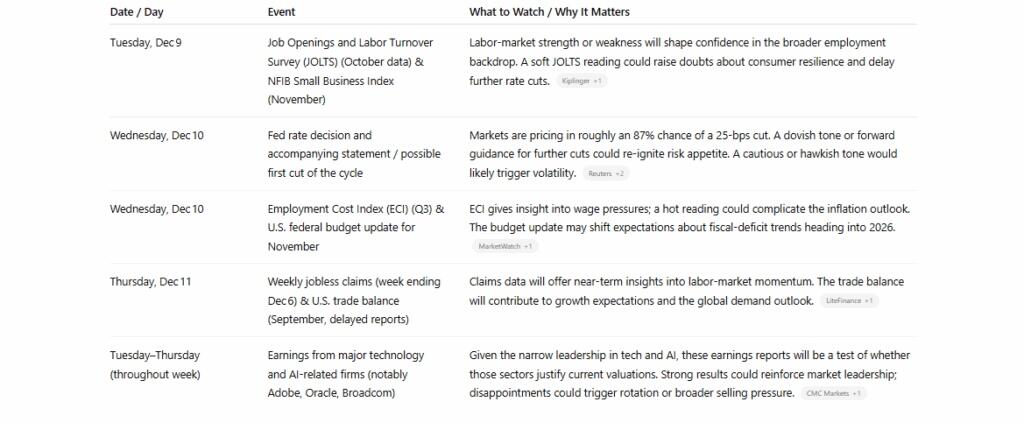
Markets enter this week with elevated expectations. With the recent end of quantitative tightening, investors are now watching a cluster of important events that could define whether the year-end rally broadens or stalls. The most significant driver will be the upcoming meeting of the Federal Reserve (Fed). But a series of economic data releases and significant corporate earnings will also test optimism.
What Investors Should Focus On
The Fed meeting on December 10 looms as the central anchor. A well‑telegraphed 25‑bps cut, or even the possibility of a path of cuts, could reopen risk‑asset flows. If the Fed soft‑pedals, expect volatility and potential rotation out of overvalued sectors.
Labor market data from JOLTS and weekly jobless claims will indicate whether employment remains resilient or is starting to exhibit cracks, which has direct implications for consumer spending and credit risk.
Earnings from big tech and AI firms (ORCL, ADBE, and AVGO) will continue to test whether growth expectations baked into valuations are realistic or overly optimistic.
The mix of budget, trade, and cost data will inform broader macro narratives, including growth, inflation, and fiscal/credit conditions.
This week offers a high‑stakes test of sentiment. If liquidity (through the Fed’s policy) aligns with solid economic and earnings data, the rally could broaden beyond mega‑caps and extend into 2026. If not, this “year‑end bounce” risks fading or turning into a broader reassessment.
Support and Resistance Zones
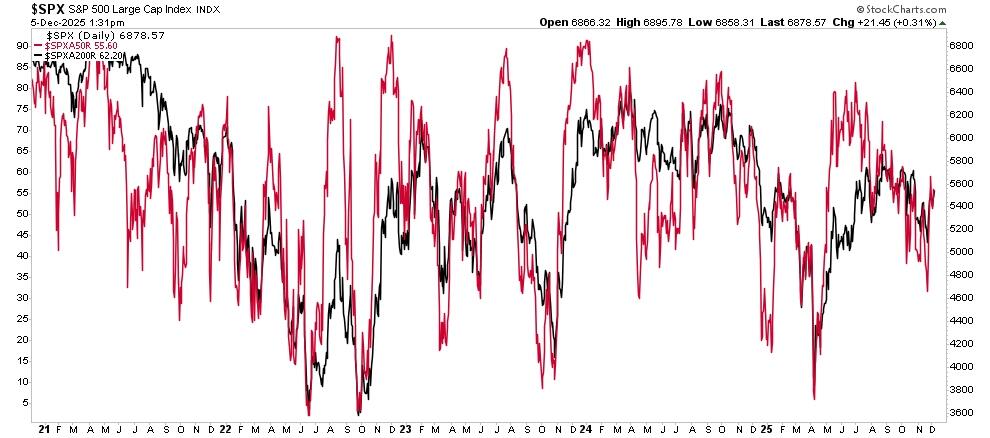
Based on the 6,878 close and the latest available pivot‑point and technical data, key zones to watch in the coming sessions:
Immediate support: ~ 6,744 – 6,757 (20- and 50-day moving average cluster)
Secondary support: ~ 6,598 (100‑day moving average) — a zone that, if broken, would signal weakening of the broader uptrend.
Critical Support ~6,195 (200-day moving average) – if this level fails, the market will be facing a larger corrective action.
Near‑term resistance: ~ 6,885 – 6,900 as markets approach previous rally peaks and all-time highs
Major resistance/breakout zone: ~ 6,920–6,940 would clear previous all-time highs moving next resistance to top of current trend line near ~7,000
The rally this past week showed signs of expanding beyond just the most significant growth and AI‑related names. As discussed last week, some underappreciated sectors, such as value and cyclical-linked areas, registered relative gains. That diversification in participation tends to support the durability of a bullish uptrend.
Caution flags also emerged and are worth paying attention to.
While the market gained ground, volume was modest, suggesting many investors remain hesitant and are not fully committing. If this remains the case, the risk of a rally built primarily on liquidity and short-term positioning, rather than broad conviction, is susceptible to swift reversals in investor sentiment. Additionally, with prices exceeding the 200-day averages, the risk of a correction also increases.
Overall, the technical backdrop is bullish but is not devoid of risk. Continue to maintain a disciplined approach, respect support and resistance levels, and manage risk exposures accordingly.
Tyler Durden
Sun, 12/07/2025 – 10:30
https://www.zerohedge.com/markets/year-ends-what-does-2026-hold

Marcador con impactos de bala que conmemora linchamiento de 1918 se exhibe en Atlanta
Por MICHAEL WARREN
ATLANTA (AP) — El letrero que conmemora un linchamiento de 1918 y que fue repetidamente vandalizado en los últimos años ahora se exhibe de manera segura en Atlanta en una exposición que se inaugura el lunes.
Conmemora un evento que algunas personas en el sur rural de Georgia han intentado arduamente borrar: el asesinato de Mary Turner por una turba blanca que estaba decidida a silenciarla después de que ella exigiera justicia por el linchamiento de su esposo, Hayes Turner, y al menos otras 10 personas negras.
Marcado con agujeros de bala y agrietado en su pedestal por un vehículo todoterreno, el marcador de la Sociedad Histórica de Georgia dice en parte: “Mary Turner, con ocho meses de embarazo, fue quemada, mutilada y asesinada a tiros por una turba después de denunciar públicamente el linchamiento de su esposo el día anterior. … Nunca se presentaron cargos contra los participantes conocidos o sospechosos de estos crímenes. Desde 1880 hasta 1930, hasta 550 personas fueron asesinadas en Georgia en estos actos ilegales de violencia de turba”.
Ahora cada palabra dañada por las balas se proyecta en una pared, y los visitantes escuchan esas palabras pronunciadas por algunos de los descendientes de seis generaciones de Turner.
“Me alegra que el memorial haya sido tiroteado”, declaró Katrina Thomas, bisnieta, el sábado por la noche después de su primera visita a la exposición en el Museo Nacional de Derechos Civiles y Humanos.
“Millones de personas van a aprender su historia. Que su voz continúe años y años después muestra que la historia no desaparece. Vive y sigue creciendo”, añadió.
Los estadounidenses se enteraron de estos linchamientos en 1918 porque fueron investigados inmediatamente después por Walter White, quien fundó el capítulo de Georgia de la Asociación Nacional para el Progreso de las Personas de Color y se convertiría en una voz influyente por los derechos civiles a nivel nacional. Un hombre negro de piel clara que podía pasar por blanco, entrevistó a testigos presenciales y proporcionó nombres de sospechosos al gobernador de Georgia, según su informe en la publicación de la NAACP, The Crisis.
Georgia fue uno de los estados más activos en linchamientos, según el catálogo de la Iniciativa de Justicia Igualitaria de más de 4.400 linchamientos documentados de terror racial en Estados Unidos entre la Reconstrucción y la Segunda Guerra Mundial. La organización ha colocado marcadores en muchos sitios y ha construido un monumento a las víctimas en Montgomery, Alabama.
La primera legislación nacional contra el linchamiento se introdujo en 1918 en medio de la reacción nacional a las muertes de Mary y Hayes Turner y sus vecinos en los condados de Brooks y Lowndes en Georgia. Se aprobó en la Cámara en 1922, pero los senadores del sur la obstruyeron y pasaría otro siglo antes de que el linchamiento se convirtiera en un crimen de odio federal en 2022.
“La misma injusticia que le quitó la vida fue la misma injusticia que siguió vandalizándola, año tras año”, indicó Randy McClain, sobrino nieto de los Turner.
Creció en la misma área rural donde ocurrieron los linchamientos, pero no sabía mucho sobre ellos ni descubrió su conexión familiar hasta que fue adulto.
“Aquí se siente como un espacio muy seguro. Ella finalmente está en paz, y su historia puede ser contada. Y su familia puede sentir una cierta sensación de reivindicación”, añadió McClain.
___________________________________
Esta historia fue traducida del inglés por un editor de AP con ayuda de una herramienta de inteligencia artificial generativa.

Zoológico en la isla de Java publica fotos del primer cachorro de panda nacido en Indonesia
Por EDNA TARIGAN
YAKARTA, Indonesia (AP) — Un zoológico en la isla de Java publicó fotos del primer cachorro de panda gigante nacido localmente en Indonesia e informó que el cachorro macho mostraba signos de estar en buen estado de salud.
La madre, Hu Chun, de 15 años, dio a luz a Satrio Wiratama —apodado Rio— el 27 de noviembre en las instalaciones del zoológico en Cisarua, provincia de Java Occidental.
El nombre simboliza la esperanza, la resiliencia y el compromiso compartido de Indonesia y China en la protección de especies en peligro de extinción, anunció Taman Safari Indonesia en un comunicado el domingo.
“Este nacimiento es el resultado de un programa de cooperación internacional a largo plazo que ha estado en marcha durante una década, desde la llegada de los pandas gigantes Hu Chun y Cai Tao a Indonesia en 2017 como parte de una asociación de conservación de diez años con China”, afirmó el comunicado.
Rio está en condición estable y bajo monitoreo las 24 horas por el equipo del zoológico, mostrando signos tempranos de salud como una vocalización fuerte, lactancia efectiva y un aumento constante de peso. En los próximos uno o dos meses, debe desarrollar mejor control de temperatura, crecimiento de pelaje, abra los ojos y comience los primeros movimientos motores, declaró el zoológico.
“En esta etapa temprana, el bebé panda aún no es accesible al público. Taman Safari Indonesia continuará priorizando la salud y el bienestar de la madre y su bebé, e invita al público a unirse en oración por el desarrollo del bebé panda para que se mantenga sano y salvo en las primeras etapas de su vida”, se indicó.
El presidente indonesio Prabowo Subianto anunció el nombre del bebé panda el jueves y mostró su foto cuando se reunió con Wang Huning, un destacado asesor político chino y principal ideólogo.
Cai Tao y Hu Chun, un par de pandas gigantes que llegaron a Indonesia en 2017, viven en un hogar “como un palacio” que fue construido para ellos en el zoológico Taman Safari, que se encuentra a unos 70 kilómetros (43 millas) de Yakarta.
Los pandas son ampliamente considerados como el símbolo nacional no oficial de China y su programa de préstamo de pandas gigantes con zoológicos en el extranjero ha sido visto durante mucho tiempo como una herramienta de la diplomacia de poder blando de Beijing, también conocida como “diplomacia de panda”.
Los pandas gigantes tienen dificultades para reproducirse y los nacimientos son particularmente bienvenidos. Hay menos de 1.900 pandas gigantes en sus únicos hábitats silvestres en las provincias chinas de Sichuan, Shaanxi y Gansu.
___________________________________
Esta historia fue traducida del inglés por un editor de AP con ayuda de una herramienta de inteligencia artificial generativa.
Goldman Reveals Housing “Affordability Illusion” When Factoring Other Costs
Goldman Reveals Housing “Affordability Illusion” When Factoring Other Costs
Affordability has surged into the news cycle and is almost certain to dominate the coming midterm election cycle. And when voters talk about “affordability,” they’re most concerned about the basic cost of living. Beyond food and healthcare, nothing hits harder than housing costs.
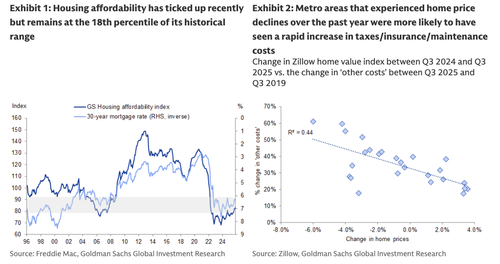
Goldman analysts led by Arun Manohar have some bad news on the housing affordability front: even with lower mortgage rates and slower home-price growth, it’s largely an “illusion of affordability” once other ownership costs, such as taxes, insurance, and maintenance, are factored in.
Manohar explained more in a recent note to clients:
The most important topic of discussion in the housing market remains the challenging affordability situation. The recent decline in mortgage rates and the weak pace of HPA has resulted in housing affordability climbing to the highest level since 2022 (Exhibit 1). However, affordability remains low at the 18th percentile over the past 30 years. Although affordability has climbed, it is important to note that the standard affordability metrics do not capture all the costs of homeownership such as taxes, insurance and maintenance (collectively referred to as ‘other costs’). To capture the effect of ‘other costs,’ we rely on estimates from Zillow for the monthly mortgage payment and total monthly payment on a new home purchased with the average interest rate of the month. The difference between the two series accounts for homeowner’s insurance, property taxes, and maintenance costs. We find that metro areas that have experienced home price declines over the past year have generally witnessed greater increases in the ‘other costs’ over the past few years (Exhibit 2). Although falling home prices would typically make a home more affordable, prospective buyers may experience only partial relief since overall homeownership costs are not decreasing at the same rate as property values. With the median age of the US housing stock being over 40 years old, nationwide insurance premiums and maintenance expenses could increase further.
Mortgage rates are unlikely to decline enough to provide a significant boost to affordability in 2026.
Manohar’s view on President Trump’s newly proposed 50-year mortgage:
50-year mortgages: Short-term affordability boost, but with long-term consequencesRecently, the administration and the FHFA Director have explored the feasibility of introducing a 50-year mortgage product to help improve mortgage affordability. The 30-year fixed rate mortgage available in the US is already among the longest in the developed world. We see four key issues with a 50-year mortgage. First, while monthly payments decline slightly, the increase in the lifetime cost of homeownership can be prohibitive. Using the example of a $400k mortgage at 6.25% interest rates, we note that if the term were to be extended to 50-years, the monthly principal and interest payment would be about 11% lower than that if the term remained at 30-years. However, the total lifetime interest would climb 87% (Exhibit 4). Second, the above calculation assumes mortgage rates are the same for 30-year and 50-year mortgages. In reality though, the longer term will likely translate into higher mortgage rates and hence lower savings in monthly payments. It is quite likely that a 50-year mortgage would receive a rate that is at least 50bp higher than that on a 30-year mortgage (Exhibit 5). Using the same example of a $400k mortgage and the assumption that a 50-year mortgage receives a 50bp higher rate than the 30-year mortgage, the savings in monthly payment drops to just 5%, and the total lifetime interest would more than double. A mortgage rate that is 95bp higher than the prevailing 30-year mortgage rate of 6.25% would result in parity in monthly payments, completely nullifying the benefits of extending the term to 50 years. Third, with a 50-year mortgage, borrowers would build equity at an even slower pace than that with a 30-year mortgage during the initial years, which increases default risks in a housing downturn scenario. Finally, a sudden boost to affordability risks increasing home prices, as potential homebuyers would compete for the same limited inventory. Therefore, any improvement in housing affordability would be short lived.
In a recent Fox News interview, Vice President JD Vance blamed the affordability crisis on lingering effects of failed policies from the Biden-Harris years.
“A lot of young people are saying, housing is way too expensive. Why is that? Because we flooded the country with 30 million illegal immigrants who were taking houses that ought by right go to American citizens,” Vance told Fox News’ Sean Hannity last month. And at the same time, we weren’t building enough new houses to begin with, even for the population that we had.”
ZeroHedge Pro subs can read the full note in the usual place. It’s packed with a lot more housing market charts.
Tyler Durden
Sun, 12/07/2025 – 09:55