
Category: News
La policía noruega detiene a sospechoso tras disparos en un centro comercial. No se reportan heridos
Associated Press
OSLO, Noruega (AP) — Un hombre estaba detenido en Noruega tras hacer disparos en un un centro comercial en la capital, Oslo, según la policía. No se reportaron heridos de inmediato y el establecimiento había reabierto tras el incidente.
La policía indicó en un comunicado que el centro comercial era seguro después de que el autor del ataque, quien parecía haber actuado solo, hiciera al menos un disparo en el interior. ___
Esta historia fue traducida del inglés por un editor de AP con la ayuda de una herramienta de inteligencia artificial generativa.

Professors: Here are the life-and-death stakes of the debate over Affordable Care Act subsidies
The government shutdown may be over, but Congress still hasn’t solved the biggest problem left on its plate: Extend the expiring Affordable Care Act subsidies to avoid a doubling of insurance premiums or replace them with something new altogether. Lawmakers have committed to a vote in December.
While public debate about the issue has centered on dollars and deficits, the stakes are actually far greater: Access to comprehensive health coverage can determine whether people live or die.
A new idea is now gaining traction among some lawmakers: Let the subsidies expire and replace them with federal deposits into health savings accounts. These deposits wouldn’t lower the cost of buying a plan. Instead, the proposal assumes that people would purchase cheaper, limited coverage — such as high-deductible or catastrophic plans, which often come with deductibles around $6,000 — and then use the HSA funds to help pay the medical bills those plans don’t cover.
But HSA deposits do nothing to prevent the real harm. The health consequences of losing insurance — or of having insurance that is difficult to affordably use — are well documented. A substantial body of research shows a clear relationship between lack of comprehensive coverage and higher death rates.
The U.S. Supreme Court once observed that “the power to tax involves the power to destroy.” In the context of health insurance, the converse is true: Withdrawing support for comprehensive coverage can be destructive as well. It affects not just how people pay for care but also whether they receive care at all.
One of the clearest demonstrations of this comes from a randomized study in which researchers partnered with the Internal Revenue Service to send informational letters about health insurance to millions of households. Only some households received a letter, and because the letters significantly increased enrollment, the researchers could reliably measure the effect of gaining coverage.
The findings were striking: For every 52 people who gained health insurance, one life was saved. Scaled to the 3.8 million people projected to lose insurance by the expiring subsidies, the potential death toll reaches into the tens of thousands — even if the real-world effect is only a fraction of the study’s estimate.
Why does comprehensive health insurance matter so much? There are several proven ways that having meaningful coverage improves health.
One is the ability to seek timely care when something feels seriously wrong. Studies show that people without coverage often delay or avoid going to the hospital when they have serious symptoms such as chest pain or shortness of breath because of cost. These delays can be deadly: Timely treatment for heart attacks, strokes and other emergencies is one of the most consistent ways insurance reduces mortality.
Even when emergencies are covered after the deductible, the fact that patients must pay thousands of dollars out of pocket first leads many to avoid seeking care altogether — and catastrophic plans would amplify this effect. Studies of high-deductible health plans show enrollees delay evaluation of chest pain, avoid emergency departments for concerning symptoms, and experience worse outcomes in heart attacks and diabetic crises.
Insurance also plays a crucial role in catching serious diseases while they are still treatable. People are far more likely to seek preventive care when insurance makes it affordable (or as our own research has found, when insurance makes it free). A JAMA Oncology study of 177,075 women found those without private insurance were much more likely to be diagnosed with late-stage cancer, resulting in survival rates far lower than women with comprehensive coverage.
Just as important is what happens in the day-to-day management of chronic conditions. A large body of research — including our own — shows uninsured and underinsured people often delay or skip this routine care because of cost, even when they know it will worsen their health. High deductibles re-create this dynamic: Patients routinely forgo essential medications, diabetes management or blood-pressure checks until they meet thousands of dollars in out-of-pocket expenses.
Federal HSA deposits help only at the margins; a modest contribution cannot meaningfully offset a $6,000 deductible. Cost-sharing continues to shape behavior, leading many, and especially those with limited means, to postpone care until it is too late.
As Congress approaches its December vote, it is essential to consider not only the budgetary implications but also the extensive evidence linking insurance to health and survival. The research record is clear: The affordability of real, comprehensive insurance is not an abstract policy question. It has direct, measurable effects on life and death.
Wendy Netter Epstein is a professor of law and the former faculty director of the Mary and Michael Jaharis Health Law Institute at DePaul University. She is a public voices fellow of The OpEd Project. Christopher Robertson teaches law and public health at Boston University and Harvard University. His most recent book is “Exposed: Why Our Health Insurance Is Incomplete and What Can Be Done About It.”
Submit a letter, of no more than 400 words, to the editor here or email letters@chicagotribune.com.
https://www.chicagotribune.com/2025/12/08/opinion-aca-subsidies-obamacare-congress-vote/
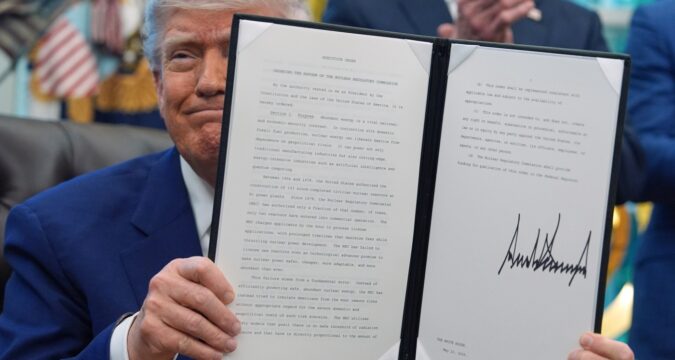
Editorial: President Trump’s brand of socialism has no place in a revival of America’s nuclear power industry
This page has long supported the responsible use of nuclear power to generate electricity. Illinois was the birthplace of the first-ever reactor at the University of Chicago, after all, and now has more reactors than any other state.
Today, we’re optimistic that modern nukes using up-to-date technology could pull off a comeback. America needs more juice, not least because President Donald Trump’s administration has attacked wind and solar projects — putting the U.S. out of step with the rest of the world and short-circuiting economic growth.
Westinghouse, a nuclear pioneer, has announced plans to build 10 large reactors in the U.S., with construction to begin by 2030. Each of its AP1000s could supply 750,000-plus homes or, alternately, some of the power-hungry data centers coming online to fuel the artificial intelligence boom.
Trump issued executive orders in May that aim to quadruple the use of nuclear power in the U.S. by 2050, including a “wholesale revision” of Nuclear Regulatory Commission regulations. So far, so good, as government red tape is a glaring reason why just a few new reactors have come online since the 1980s.
Unfortunately, Trump’s otherwise welcome support of nuclear power comes with a catch. And it’s a potentially ruinous one.
Instead of staying in its lane by updating regulations and providing incentives to help jump-start the private sector, the administration reportedly is demanding a piece of the action. Its current plan appears to put taxpayers on the hook for tens of billions while giving the government an ownership stake.
So, the U.S. would pick the winning company to carry out its policy and then exert direct control over the company’s management. That is the opposite of letting the free market do its job. Yet turning independent businesses into state-owned enterprises is becoming a pattern under Trump.
Earlier this year, unchecked by a subservient Congress, Trump forced Japan’s Nippon Steel to give the government a so-called golden share in exchange for approving its takeover of U.S. Steel. The move will give politicians veto power over rational economic decisions at a storied player in the American steel industry.
Similarly, chip-maker Intel was forced to make the U.S. its biggest shareholder, and the government also has taken equity stakes in a handful of mining companies that are on the hunt for scarce minerals. Meantime, Nvidia and AMD agreed to hand over 15% of certain sales revenue from China in exchange for permission to sell their cutting-edge computer chips there. In effect, those companies bought federal approval, even though their sales to China could threaten national security.
These deals strike us as un-American.
As Chicago Tribune columnist Steve Chapman wrote earlier this year, America’s brand of capitalism requires companies to provide valuable goods and services at prices customers will pay. “Firms that fail at this relentless obligation go out of business sooner or later, freeing up resources that can be used more productively.”
The recent examples of government interference with private enterprise undermine that basic function of capitalism, resulting in a “noxious form of socialism,” Chapman wrote.
When it comes to nuclear power, the concerns extend beyond political corruption and cronyism to life-and-death. For all the assurances about today’s newfangled reactors being clean, efficient and reliable, nuclear facilities are inherently dangerous. They create the deadliest waste imaginable and can be high-risk targets for terrorists and others looking to do harm.
The lack of a national repository for this toxic waste also has meant that each nuclear station has doubled its own hazardous-waste storage site. That appears it will be the case for perpetuity.
Nukes also are freakishly expensive. They require a fortune for construction. Cost overruns and lengthy delays are the norm. Those risks get magnified when politicians can call the shots about where and how these projects proceed.
The proposed Westinghouse deal is difficult to evaluate because its details remain uncertain. At least some funding is supposedly coming from Japan, because of trade war concessions, which recalls Trump’s phony promise that Mexico would pay for a border wall.
The Canadian firms that jointly run Westinghouse today are said to be under pressure to spin off their subsidiary to facilitate the U.S. government becoming a big shareholder. Under the deal, Westinghouse presumably will be able to draw on taxpayer funds for its reactor projects, bypassing the discipline imposed on those seeking investment funding in the open market.
A conference call with Westinghouse investors last month left unanswered questions, even as executives celebrated the “wonderful alignment” between the company and the U.S. government. You could almost hear cash registers ringing in the background.
Before this nuclear scheme goes farther, Congress needs to start doing its job and put all these squirrelly deals under a microscope. There’s no reason why Comrade Trump’s brand of socialism will work better than any other kind.
Submit a letter, of no more than 400 words, to the editor here or email letters@chicagotribune.com.

Rob Karr: Elimination of the penny will cost us as merchants and consumers
As the U.S. Treasury phases out the use of the penny, it’s creating a host of new challenges for businesses and consumers that could cost all of us a good chunk of change.
That’s because eliminating the 1-cent piece is more complicated than it seems, creating a two-tier system that treats customers who pay with cash differently than customers who pay electronically, whether that be with a debit or credit card or a digital wallet. This raises a host of legal and regulatory concerns, from unequal treatment of consumers to proper tax collection. While there’s still a lot to figure out, the bottom line is clear: We’ll all be paying more when it comes time to check out.
The crux of the problem is rounding. As pennies exit circulation, it is becoming increasingly difficult for retailers to make exact change for cash transactions. Without pennies, cash transactions will have to either be rounded up to the nearest 5 cents or down to the nearest 5 cents. Because federal and state officials have not provided guidance on the issue, businesses are left to set their own rounding policies.
The law of uniform distribution tells us that over many transactions, there are likely to be as many transactions that are rounded down as rounded up. But this scenario disproportionately affects consumers who rely on cash, the majority of whom come from lower-income households or are adults over the age of 55, according to Federal Reserve Financial Services.
There are still implications for customers who pay with a card or electronic payment, however. If rounding only applies to cash transactions, consumers paying with a card may be penalized as they are required to pay the exact amount while those paying with cash may have their transactions rounded down to the nearest nickel, depending on the total cost of a transaction.
This uneven treatment not only raises questions of fairness, but the lack of guidance from federal and local government also leaves retailers at risk of violating sales and excise tax collection rules and consumer protection regulations. It’s an untenable and unfair position for businesses, even as retailers do their part to adjust to the exit of the penny responsibly, including communicating with customers about what they should expect at the register.
Consider this real-world scenario: Under federal law, those receiving Supplemental Nutrition Assistance Program benefits cannot be treated differently than non-SNAP recipients. Because SNAP benefits are loaded onto debit cards, they are processed as an electronic transaction. That means SNAP recipients will pay the exact amount for an item, whereas their non-SNAP counterparts paying with cash may have their total rounded down.
This puts retailers in direct conflict with federal law. Though the Illinois Retail Merchants Association is working to educate state and federal officials on needed policy updates caused by the phaseout of the penny, it will take time before changes can be put in place. In the meantime, retailers are being forced to take on costly regulatory and compliance risks.
Meanwhile, as more consumers choose to pay electronically rather than with cash to avoid the hassle of rounding, they’ll also be on the hook for more payment processing fees. That’s because each time a card is swiped or tapped, retailers are charged fees by card processing companies. In 2023 alone, these companies collected more than $172 billion in payment processing fees, most of which is passed on to consumers in the form of higher prices.
Our association has led the way in limiting these fees — securing passage of the first law in the nation to prohibit banks and credit card companies from charging processing fees on the tax and tip portion of a transaction — but Wall Street banks, credit card companies and card processors are fighting these consumer protections in court. Regardless of the outcome of that case, the transition away from the penny will only increase the use of digital payment methods and the accompanying fees.
Eliminating the penny may seem like a small change, but businesses and customers will feel the impact long after the coin disappears.
Rob Karr is president and CEO of the Illinois Retail Merchants Association.
Submit a letter, of no more than 400 words, to the editor here or email letters@chicagotribune.com.
https://www.chicagotribune.com/2025/12/08/opinion-penny-elimination-costs-merchants-consumers/

Christmas Walk a holiday tradition in Geneva: ‘It’s kind of a Hallmark movie’
Friday night was a bit chilly in Geneva, but Lara Sisto insisted that hearts and spirits were still warm thanks to the annual Christmas Walk going on in the city’s downtown.
“I’m from Geneva and I come to this every year,” she said at the Christmas Walk. “If it’s the holidays I have to be here. I moved here in 2012 and I’ve been here every year since. I haven’t missed a year. It just feels very joyful – a lot of small-town community.”
The Geneva Chamber of Commerce sponsored the annual Christmas Walk on Friday, an event that continues to bring thousands to the downtown area in order to take part in a tradition that has spanned nearly seven decades.
Chamber staff added that there were no changes this year to the holiday event and that the traditions of the Candy Cane Parade and offering the first candy cane of the season to Mayor Kevin Burns, as well as the arrival of Santa Lucia – the Swedish symbol of the season who each year lights the Great Tree – were again celebrated Friday night, followed by the arrival of Santa Claus.
The Candy Cane Parade continues a tradition begun back around 2010 when the late Bob Untiedt, owner of Graham’s Chocolates in Geneva, began Bob’s Candy Cane Parade. It has continued every year since except once during the pandemic.
Untiedt’s daughter, Jayni Wunderlich, now the CEO of Graham’s Chocolates, said Friday before the walk that it remains a special moment for her and her family.
“While the parade has been around a while, we, as a shop, started pulling candy canes 31 years ago and it’s such a fun night, such a great way to celebrate Advent and the beginning of the Christmas season,” she said. “Geneva does such a good job of making such beautiful and fun events. Our candy cane pull has usually had the biggest crowd draw because of the iconic look of these canes being pulled in the old-fashion way.”
People wait to get into Graham’s Chocolates to get a free candy cane during the annual Christmas Walk in downtown Geneva on Friday night, Dec. 5, 2025. (David Sharos/For The Beacon-News)
A local author, Susanna Palmer, has written a children’s book called “Jingle Hands” that celebrates the Geneva Christmas Walk and the candy cane pull. The book is dedicated to Bob Untiedt and includes Wunderlich as a character called Harmony the Elf.
Johanna Patterson, communications director for the Geneva Chamber of Commerce, spoke before the event and said the Christmas Walk “is something people put on their calendar. It’s kind of a Hallmark movie or a Norman Rockwell picture and you feel like you’re stepping back in time.”
“The merchants are open late, the town comes together, there’s chestnuts roasting and carolers on the street,” Patterson said. “There’s something for everyone, and I think the town just kind of comes alive. It’s only one night, and just feels like the opening of the holiday season.”
In the past few years, the event has drawn as many as 5,000 to 6,000 people, organizers said.
Shops and restaurants were open along Third Street in downtown Geneva offering special treats during the event on Friday evening.
Rachel Chiesa of Lincolnshire said her sister lives in Geneva and that coming to the local Christmas Walk “is a tradition.”
“We have to get a candy cane and then we do the Christmas tree lighting and we have to go shopping and also there is a snowball fight that the kids have to do,” she said. “We make a night of it every year.”
Bridgette Dawson of Geneva and her husband Joel said they have come to the event for “over 20 years.”
“We love the nativity, the parade, going to Graham’s obviously for the candy cane pull. It’s a lot of fun and going to the shops and getting to see everybody,” Bridgette Dawson said.
David Sharos is a freelance reporter for The Beacon-News.
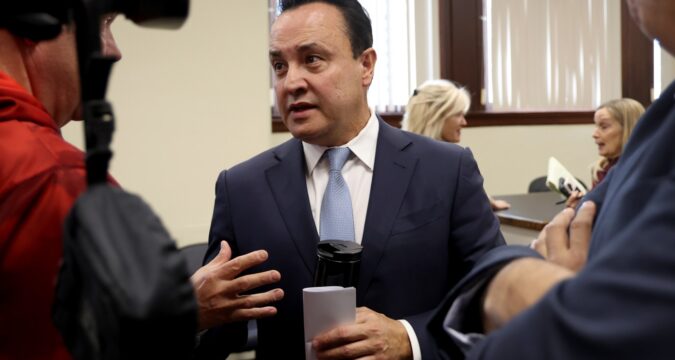
Political veteran George Cardenas fighting to stay on March primary ballot
George Cardenas has been a fixture in Southwest Side politics for decades, a consummate insider who followed five Chicago City Council election wins with another victory that took him to the obscure but powerful Cook County Board of Review.
But now he finds himself in a fight befitting a novice, after a challenge to the petition signatures his campaign collected left him 273 short of what he needs to run for reelection in March’s Democratic primary. On Friday, seated across from a foot-tall stack of evidence, his legal team began the painstaking, line-by-line rebuttal to try to claw Cardenas’ way back onto the ballot.
In cutthroat Cook County politics, gathering good petition signatures is the first hurdle for any would-be candidate. It’s a campaign organizational test that tends to reward longtime elected officials who can lean on employees and volunteers they’ve built up over the years to do the shoe leather work on their behalf.
Cardenas and challenger Juanita Irizarry need 4,941 valid signatures to get on the ballot. Rather than a clash of ideas or an appeal to voters, elections like this one are often decided by arguments between lawyers in fluorescent-lit rooms over whether names scrawled on sheets are legitimate.
For Cardenas, who rose up through one of the most vaunted political operations in the city’s modern era to represent the 12th Ward on the council and spent more than two decades navigating electoral gauntlets, his potential elimination for failing that test would make for an especially surprising end. And it would underscore how traditional Chicago machines have fallen off from their heights of decades ago.
Cardenas is one of three members of the county’s Board of Review, an appeals body that can drastically reduce or opt not to change property tax assessments for homeowners and big businesses — sometimes resulting in big breaks on bills.
Even with the city’s various political organizations significantly weakened, the board has still been dogged by recent allegations of nepotism, conflicts of interest, and a culture that harked back to the office’s patronage heyday when governing and politics worked in tandem.
Patronage workers’ job security in Cook County was long linked to whether they delivered for their bosses during campaign season, either by gathering petition signatures or helping build legal challenges to opponents’ petitions in the hopes of getting them kicked off the ballot.
But Cardenas’ top petition passer — an analyst who works for him at the Board of Review and who gathered more than 1,700 signatures — turned in many pages that Cardenas’ opponent has argued were fraudulent fillers that should nullify both his and his boss’s chance to keep their jobs.
That Board of Review employee, Carlos Sanchez, submitted dozens of pages of signatures containing duplicates, records show. The same names appearing four, five, 13, 16, 21 or 22 times.
Two of those repeat signatories lived at the same address as Sanchez.
Ed Mullen, the attorney for Irizarry, made a novel argument in front of the county’s electoral board on Friday: that the number of duplicates showed an intent to both evade election rules and “defraud the Clerk by submitting signatures that were intentionally repeated.”
“I acknowledge that there is no case law addressing this specific question,” Mullen said. In his 15 years as an election attorney, “I also acknowledge I’ve never made this argument, but that’s because I’ve never seen this before.”
Cardenas’ lead attorney, Ross Secler, agreed the duplicates should have been struck, but argued that Irizarry’s team failed to prove a broader pattern of fraud. The hearing officer, Laura Jacksack, said the duplicates would be struck but Sanchez’s other valid signatures could stay.
Thousands of others, Irizarry claims, are either from voters who are not registered, live outside the district, or are “not genuine,” meaning not signed by the actual voter. Several of the sheets Cardenas personally gathered were challenged nearly in their entirety.
Cardenas declined comment and referred questions to Secler.
Juanita Irizarry stands near Lake Michigan at the Calumet River in Chicago on Feb. 25, 2021. At the time, she was executive director of Friends of the Parks. (Erin Hooley/Chicago Tribune)
Irizarry’s campaign manager, Tenoch Rodriguez, said in a written statement ahead of Friday’s hearing that “Cardenas is substantially below the minimum signatures required, and we are confident he will remain below the threshold once all evidence is heard. His petitions are filled with egregious errors, duplicate signatures, and signature fraud, demonstrating a pattern of misleading Cook County residents.”
“Homeowners deserve fairness and integrity from the officials who make (property tax appeals) decisions,” the statement concluded.
Secler’s rebuttal included a line-by-line forensic analysis comparing the petition signatures against the ones on the voters’ registration as well as 549 affidavits from those voters attesting that their signatures were legitimate. Three other staff members from the firm Odelson, Murphey, Frazier & McGrath were present Friday to back Secler up.
Because of the likelihood of problems with the sheets, candidates typically submit two or three times the amount of names they need to boost their chances of surviving challenges like these.
Cardenas indeed boasted nearly 12,000, but according to a tally completed by the county clerk’s staff just before Thanksgiving, only 4,668 were valid.
Signatures can be ruled invalid if the person who signs is not a registered voter, if the address they signed with doesn’t match their voter registration, if they live outside the district, or if they sign more than once. Circulators — the people who pass the petitions — can also have their entire sheets of signatures thrown out for similar reasons, or if their pages are not notarized or properly dated.
The hearing on Cardenas’ signatures will reconvene at 9 a.m. Monday. Jacksack’s final recommendation will go up to the county’s electoral board, which is hoping to wrap up by Friday.
Irizarry also faced a petition challenge, but survived with 9,016 valid signatures intact, well above the minimum to make the ballot.
For several hours on Friday, Secler and Mullen peppered a forensic writing expert with questions about various letter formations, styles, and “terminations,” of challenged signatures to determine whether struck ones could be restored.
If Cardenas’ team fails, Irizarry would be alone on the ballot in the March primary and the overwhelming favorite in the November general election.
A former 26th Ward aldermanic candidate, Irizarry is best known as the former executive director of Friends of the Parks, which under her leadership fought the construction of the Lucas Museum of Narrative Art along the lakefront.
She previously held positions at the Latino Policy Forum and the Chicago Community Trust. She also worked for former Gov. Pat Quinn as a housing coordinator working on long term care reforms.
Irizarry launched her campaign with support from U.S. Rep. Jesús “Chuy” García, who is the fulcrum of one of the few potent political organizations left in the city. A recent controversial example: Garcia’s team managed to collect enough petition signatures in one weekend to get his chosen successor on the ballot for Congress.
Cardenas was first elected alderman of the 12th Ward in 2003 with the help of the Hispanic Democratic Organization, Mayor Richard M. Daley’s then-powerful machine that helped turn out Latino voters and elect dozens of allies to various posts throughout the state. The organization largely dissolved amid the 2008 “Hired Truck” scandal.
Other machine organizations throughout Chicago have waned thanks in large part to so-called Shakman oversight ordered by federal judges that curbed political considerations in government hiring.
The Board of Review has never had a Shakman monitor, however, and for years its leaders resisted calls from reformers to adopt hiring plans that would enshrine Shakman policies. Even after the board adopted an employment plan, the county’s inspector general dinged Cardenas for hiring political allies and violating the employment plan when he first joined the board in 2022. He won that year by defeating Tammy Wendt, who was weakened by a nepotism scandal.
https://www.chicagotribune.com/2025/12/08/george-cardenas-fighting-stay-march-primary-ballot/

Clarence Page: President Donald Trump’s obsession with Somali immigrants takes a sinister turn
Sometimes, one crisis seems to lead to another for President Donald Trump — and he’s got plenty of trouble brewing.
For months now, Trump’s approval rating has taken a beating for the knock-on effects of the government shutdown and the ongoing fiasco over the Jeffrey Epstein files. In November, his administration came under fire over newly reported details about the airstrikes on drug-trafficking suspects in the Caribbean, which seem to indicate that wounded people were deliberately killed in violation of the conventions of war. Trump also responded to the shooting of two National Guard members in Washington — allegedly by an Afghani refugee who had formerly worked with American intelligence in Afghanistan — by suspending all Afghani immigration cases, leading many critics to decry the move as collective punishment.
Amid all this anguish, Trump took the opportunity at a Cabinet meeting Tuesday to advance collective punishment against another immigrant group that he doesn’t like: Somalis.
On Nov. 21, Trump posted on social media that he was revoking temporary protected status for Somalis living in Minnesota.
“They contribute nothing,” Trump told reporters in a rambling tirade in a Tuesday Cabinet meeting. “I don’t want them in our country.”
Trump further averred that the war-torn East African country from which they fled “stinks” and that they are “garbage.”
Even for Trump, who once infamously dismissed African nations and other developing nations as “shithole countries,” the malevolence and vulgarity of his anti-Somali outbursts was stunning.
Related Articles
Clarence Page: Border Patrol decamps from Chicago to create disorder elsewhere
Clarence Page: Jeffrey Epstein case exposes divisions in MAGA unity
Clarence Page: When federal authorities disrupt the peace in the name of preserving it
Clarence Page: Pete Hegseth’s war on ‘woke’ is an assault on American history
Clarence Page: Barack Obama challenges President Donald Trump’s remap power grab
And what end did he imagine they served?
Casting a broad shadow of suspicion on immigrants from other nations, especially nonwhite and Islamic ones, has been a yearslong pattern for Trump and his deputy chief of staff for policy, Stephen Miller.
But the Somali angle likely has much to do with the recent Trump administration tack of punishing blue states and Democratic political leaders. The largest Somali expatriate community in the U.S. resides in Minnesota, home to U.S. Rep. Ilhan Omar and Gov. Tim Walz, two favorite subjects of Trump invective.
Some 80,000 people of Somali birth or ancestry reside in the state, and the vast majority are U.S. citizens. Omar emigrated from Somalia in 1995 as a child.
Minnesota’s Somali community has taken a public relations hit recently following reports of the U.S. Department of Justice’s prosecution of individuals involved in a wide-ranging scheme to defraud Minnesota and federal government programs during and after the COVID-19 pandemic.
It’s a major issue, and more than $1 billion in taxpayer money has been stolen, according to The New York Times. The DOJ investigation, started during the Biden administration, centers on a nonprofit group called Feeding Our Future, which worked with the Minnesota Department of Education and U.S. Department of Agriculture to distribute meals to children.
The defendants, who are mostly but not all members of the Somali community, submitted false invoices and meal count sheets, set up bogus programs for autistic children, and took or gave kickbacks for participation in the fraud.
It’s disgraceful behavior, and it’s good that the fraudsters are being prosecuted. However, Trump could not help himself from taking the outrage across the line of collective calumny.
Picking up on allegations by Christopher Rufo, a senior fellow at the conservative Manhattan Institute, and Ryan Thorpe, a reporter for the institute’s City Journal, that money stolen from Minnesota programs has gone to al-Shabab, an al-Qaida-linked militant group that controls parts of Somalia, Trump branded the Minnesota Somali community “a hub of fraudulent money laundering activity” and vowed to send them “back to where they came from.”
“We can go one way or the other, and we’re going to go the wrong way, if we keep taking in garbage into our country,” Trump said. “Ilhan Omar is garbage. She’s garbage! Her friends are garbage!”
In response to the president, Omar fortunately kept her cool. “I hope,” she said graciously, “he gets the help he desperately needs.”
From your lips to God’s ear, Congresswoman.
Email Clarence Page at cptimee@gmail.com.
Sign up to receive Clarence Page’s column in your inbox each week.
Submit a letter, of no more than 400 words, to the editor here or email letters@chicagotribune.com.

Editorial: A snazzy new State Street station. But, seriously, $444M and 3 more years?
State Street is a great street. So it certainly deserves a splashy station, especially one promising room to move, natural light shining through a glass canopy and elevated vistas allowing Chicagoans to check whether or not there are people there doing things they don’t do on Broadway.
But $444 million? And a construction time of three years, beginning Jan. 5? That’s not a concept-to-opening time, but simple demo and construction. To build a design that was unveiled four years ago.
When this new station, designed by TranSystems and Skidmore, Owings & Merrill, was announced in 2021 by Mayor Lori Lightfoot, the cost was announced as $180 million. Now, we’re told, it’s a mind-blowing $444 million. For one previously existing station. Stunning. We doubt your paycheck increased at that rate.
We like the pizzazz of the new State and Lake, at least on paper, and perhaps all of that highly visible glass will improve safety. Still, it’s a very contemporary style arguably at odds with the historic nature of many of the other Loop stations.
Quincy, a lovely historic station in the Loop, was renovated in classic style in 2016 for, wait for it, a very reasonable $18 million, which is less than 5% of what is being spent on State and Lake. “The improvements will preserve the original appearance of the Loop ‘L’ station while upgrading the station with the addition of two elevators to make the station accessible to customers with disabilities,” the CTA said at the time, noting that the renovation would also feature “stair replacement, painting, lighting improvements and more.” We use Quincy often as it is by our office. It’s a real charmer with elevators that are easy to use, if need be.
When it was pushing the new Quincy the CTA was touting its history. Explaining State and Lake, we’re now told a 130-year-old station just can’t do the job. Not a problem a few blocks away.
Obviously time has gone on and no two stations are identical, but there is one heck of a difference between $18 million and $444 million, even allowing for the romance of State Street, which we fully embrace. Pretty much the same trains, after all, stop at both Quincy and State and Lake, although the busier latter also has the Green Line trundling through.
We wonder if, with hindsight, this plan was just a tad too luxe for a financially strapped city. And, yes, we know the bulk of the money behind the new station is coming from the feds; that does not change our view.
For CTA riders who use State and Lake, alternates are not far away, but drivers, bus passengers, cyclists and pedestrians also are likely to see closures and tie-ups around the busy area of the station for, yes, three years. How about some new project czar, reassigned but not hired by the city, knocks a few heads together and suggests that two years is all a city exhausted from the Kennedy reconstruction can handle? And maybe knocks off another million from the construction costs while doing so.
We’re not surprised this start-of-construction announcement came after the so-called fiscal cliff crisis, when numbers like $444 million in construction costs might well have raised some eyebrows in Springfield, given that the RTA was eventually saying its budget deficit for 2026 was $250 million, little more than half the cost of this one station. And, yes, we know these are different pots of money, but most of our readers will see our point.
Smart political timing is not what matters; it’s quick, efficient and cost-effective construction we care about here.
Submit a letter, of no more than 400 words, to the editor here or email letters@chicagotribune.com.
https://www.chicagotribune.com/2025/12/08/editorial-state-and-lake-street-cta-station-project/

Letters: Christkindlmarket is one of the engines of Chicago’s holiday economy
Thank you to the Tribune Editorial Board for calling out the city’s mishandling of the Christkindlmarket capacity limits (“Chicago’s capacity limits for Christkindlmarket are a terrible idea. Here’s why this issue matters.,” Dec. 2). This is not a minor paperwork tweak but a warning sign about how Chicago is treating some of its most important cultural and economic assets.
What the city did to the vendors looks like a bait and switch. Organizers say they were told about the drastic new capacity cap only about 12 hours before the market opened. That gave vendors no realistic chance to adjust staffing, inventory or travel plans, even though many of them come from overseas and invest heavily to be here. If they had known earlier that their customer base would be sharply reduced, some might reasonably have chosen not to come at all. The timing took that choice away.
Christkindlmarket is one of the engines of the downtown holiday economy. Organizers estimate that it generates roughly $190 million in economic impact each season and supports close to 2,000 jobs. That spending spills into hotels, restaurants, theaters and retail when the Loop badly needs visitors.
There has been no wave of safety incidents at the market to justify an emergency crackdown. What changed was the city’s interpretation of code, not the nature of the event. For nearly 30 years, crowds were simply allowed to flow in and out of Daley Plaza.
More troubling, this is not an isolated misstep. Under the current leadership at the Department of Cultural Affairs and Special Events, we have seen other decisions that undervalue the people who depend on these events. Back in April, more than 140 artists and cultural leaders signed a letter to the mayor describing “dysfunction” at DCASE, with high staff turnover and delayed grants. Taste of Chicago was pushed from July to September to make room for NASCAR, a move widely criticized as bad for business. Grant Park concessionaires have also said they are struggling to survive under the current special events schedule.
If crowding at Christkindlmarket is truly the concern, there are constructive options. Move it to a larger site such as Millennium Park, add additional satellite markets such as the one in Wrigleyville or experiment with timed reservations so families are not stuck in freezing, hourlong lines. Chicago’s holiday economy and its reputation as a welcoming winter destination deserve better than last-minute rules that help no one.
— Brett Barnes, Chicago
Use Columbus Drive
As a 25-year resident of the Loop, I have witnessed Christkindlmarket morph from a festive European-style holiday market held at the base of the city’s Christmas tree in Daley Plaza to an overcrowded event, the hallmark of which is now lines winding around the block for entry and, once in, shoulder-to-shoulder crowds waiting in even more lines to purchase food, drinks and merchandise. In other words, it just isn’t much fun anymore.
A Dec. 3 article laments the problem (“Chicago officials ease capacity limit for Christkindlmarket”). A number of solutions have been proposed, none of which would do anything other than exacerbate the problem.
During the same 25 years, I have also witnessed Maggie Daley and Millennium parks mature into urban oases that provide the city with a veritable winter wonderland, complete with ice skating rink and ribbon. The city’s holiday tree and caroling events have also been relocated to Millennium Park.
Why not move Christkindlmarket to Columbus Drive between the two parks? The city has never shied away from closing Columbus Drive, and in fact, it seems that it is closed for better than half of the summer, usually for private events.
Moving Christkindlmarket to this location would provide the following benefits:
More space for vendors and attendees.
A backdrop of two beautiful parks and the city skyline.
Room to install picnic benches for attendees to enjoy purchased food and beverage.
Nearby parking at Grant Park and Millennium Park garages.
Easy access to Maggie Daley and Millennium parks.
— Catherine Bremer, Chicago
Show some integrity
Once again, the Brandon Johnson administration demonstrated its complete lack of executive functioning skills in its last-minute drastic reduction in the capacity permitted at Christkindlmarket. The Tribune Editorial Board said it best when it referred to the last-minute limitation as “a classic Johnson administration decision entailing a solution in search of a problem.” As it stated further, “the actual solution is not even a solution.” Agreed.
I’m sure I have plenty of company when I say that I’m sick and tired of seeing people suffer the consequences of this administration’s mistakes, poor decisions, you name it! Like any other event of this magnitude, Christkindlmarket required plenty of advance planning and preparation, not to mention the financial investment required of every vendor. The Johnson administration’s decision effectively pulled the rug out from under them.
In my view, the only fair thing to do at this juncture — because the damage has already been done — is to refund whatever fees the city charged these vendors to participate. Frankly, integrity dictates that.
Furthermore, the people responsible for this incredibly poor decision should be the ones to foot the bill. Why should we taxpayers bear the burden resulting from their incompetence and complete lack of concern or consideration for those affected by their decision?
— Paul N. Eichwedel, Chicago
Lessons to be learned
I really like the editorial board’s suggestion to move Christkindlmarket to Millennium Park next year after this year’s capacity debacle. If that is a possibility, the city would have to decide and announce it immediately. I’m sure many of the vendors are already looking for another location for next year and possibly signing contracts.
The questions then become: Will these vendors ever trust this city and its government again? What message does this arbitrary anti-business decision have on others considering setting up a business here? Will it impact future tourism for the people who have had a bad experience here?
There are lessons to be learned. The mayor should not be making decisions without consulting those affected by them.
— Joyce Porter, Oak Park
Why capacity limits?
I applaud the Tribune Editorial Board’s support of expanding the space for Christkindlmarket. What I haven’t seen anywhere and don’t see in this editorial is why the city wanted to reduce the market’s size in the first place. What’s the rationale?
— Scott Pemberton, Evanston
Maybe we’ll return
Well, Christkindlmarket is off our list, and we will save a few dollars we would have spent downtown. My wife and I have taken the trip into the city every couple of years to enhance our Christmas joy. Much like visiting Marshall Field’s as a kid and as an adult, joining the crowd at Christkindlmarket was an event we enjoyed, and the size of the large crowd made it fun.
Yes, it could be crowded. But ask yourself: The times you have been at a party with a few people or the one where people are crowded into every corner, which one was more fun and enticing?
As the saying in Chicago sports goes: Maybe next year, if the vendors do decide to return.
— Jay Murphy, Geneva
Come to Tennessee
A Christkindlmarket is supposed to be crowded! I have been to these markets in England, Germany and other places, and they are crowded. The only time limits placed on crowd size are inside a building or if seating is involved.
The vendors love a crowded Christkindlmarket, as do the people attending. The Christmas spirit is alive at these places, and it is wonderfully exciting! What was the reason for the city’s limit?
Maybe Mayor Brandon Johnson needs to go to the Christmas market and get some Christmas spirit. If you don’t like crowded places, don’t go.
I guess Scrooge and the Grinch have come to Chicago! I never expected that. Even though I don’t physically live there, I still consider the Chicago area my home, and at the end of my life, I will be back. And I do own property in Illinois.
I follow what is happening in Chicago through the online edition of the Tribune. I know that the downtown is not what it was when I lived there and took the bus and the “L” all over. I never worried about flash mobs or shootings there.
If the city has something that is bringing the area back to life, don’t squash it. I wonder if the vendors might want to come to Tennessee? We might not have the cold, but we do have the Christmas spirit.
— Kathie Haber, Petersburg, Tennessee
Submit a letter, of no more than 400 words, to the editor here or email letters@chicagotribune.com.
https://www.chicagotribune.com/2025/12/08/letters-120825-christkindlmarket-chicago-capacity-limits/

Illinois researchers say versatile grass could be used for sustainable fuel, building materials and more
When you look across a field of miscanthus, it’s “hypnotically beautiful,” says Emily Heaton, whose family farm has for two decades grown the first commercial field of this grass in Illinois. Dense, sun-loving and often called “giant,” it blooms in late summer to fall with a showy silver flower.
Just like cornstalks across the Midwest, this crop grows several feet tall as it reaches up to the sky. And similar to soybean cultivation in the last century, annual production of miscanthus — mostly grown on tens of thousands of acres in the eastern U.S. — is projected to skyrocket to millions of acres by 2050.
The versatile grass has a multitude of end products and uses, including compostable packaging, livestock bedding and erosion control. It can also be used as a solid fuel for electricity and heating, like coal, wood and municipal waste. Scientists are hoping it will open doors to new markets, such as renewable natural gas, sustainable aviation fuel, building materials, and chemicals for household and industrial products.
One variety in particular, Miscanthus x giganteus, has demonstrated “unsurpassed productivity” in the Midwest, according to researchers.
“Miscanthus is a really exciting crop that’s just on the cusp of emerging as a force of the ag-biotech sector,” said Heaton, a professor of crop sciences at the University of Illinois Urbana-Champaign. “As someone who grew up in Illinois, in downstate Illinois, I’m very excited about the opportunities this brings for rural job creation, for rural technology development and community enhancement.”
And it has a smaller carbon footprint than the two row crops that have for decades dominated agriculture in Illinois.
Researchers, growers and industry experts believe in the crop’s potential to strengthen U.S. energy independence, a mission the Trump administration has, for the most part, used to roll back renewable and clean energy incentives, investment and research. It also presents an opportunity for farmers who, affected by tariffs, need additional revenue streams.
“We’re really excited about the prospect of creating domestic supply chains,” said Andrew Leakey, professor of plant biology at the U. of I. and director of the Center for Advanced Bioenergy and Bioproducts Innovation, or CABBI, one of four bioenergy research centers funded by the U.S. Department of Energy, which is studying the possibilities of miscanthus for the country’s agricultural bioeconomy.
For instance, part of the team is working on a new technology to break down miscanthus and convert some of its components into chemicals and oil products for paints, plastics, aerosols, and even into the materials needed for aircraft windows and the hyperabsorbent part of diapers.
All of these are currently made out of petroleum, Leakey said, which is imported.
Since the center’s start eight years ago, Leakey said, scientists from the U. of I. and 19 partner institutions have leveraged and developed technologies to sequence the crop’s genome, genetically engineer and edit it, and use artificial intelligence to more efficiently measure its traits — and turn miscanthus into “a true 21st-century crop.”
A complement, not competition
Despite its growing popularity in the United States, the many benefits and uses of miscanthus are not recent discoveries: It’s an ancient plant that hails from Asia.
“It’s been used for millennia for different bioproducts, everything from forages for animals, but also for roofing materials. And so that was intriguing for us,” both scientists and farmers, Heaton said.
The plant is nonnative throughout North America, where it arrived in the late 1800s, brought in as an ornamental plant.
It spread aggressively in some areas as an invasive, but the commercial kind being grown in the country is a sterile hybrid of the original Chinese silver grass or Miscanthus sinensis and of the Amur silvergrass or Miscanthus sacchariflorus, meaning it doesn’t have seeds and is thus not invasive.
While miscanthus is being studied for use in biofuel, it likely won’t compete with corn production, which has been finely tuned and profitable, for the country’s ethanol market. A third of the corn grown in Illinois is used to make ethanol.
“So we’ve targeted other markets that are more profitable, and they include the (solid) fuel markets,” Heaton said, referring to fossil fuels like coal for energy generation and heating, as well as sustainable aviation fuel.
As EV popularity grows, Illinois corn farmers turn to aviation as a possible market for ethanol
Miscanthus not only requires little upkeep, but it can also be grown on less desirable farmland.
In Minooka, Billy Murdoch’s business partner Al Kuda bought some land five or six years ago that flooded easily and used to be corn and soybean fields without good yields. After meeting Travis Hedrick, CEO of North Carolina-based AGgrow Tech, the largest producer of miscanthus grass in the country, the pair decided to do a trial run of growing miscanthus on 4 acres.
“We liked the idea of having something sustainable,” Murdoch said. “We’re going to try to give back a little bit, from an environmental point of view, because farm equipment does use a lot of diesel and gasoline.”
Now, the crop covers over 125 acres at their Minooka farm. As vice president of operations at AEC Supply, which sells building and landscaping materials, Murdoch began using the harvested grass encased in netting as an erosion control product to absorb water.
Albert and Donna Kuda, from left, the owners of AEC Supply, and Billy Murdoch, vice president of operations at AEC Supply and Schaefer Greenhouses, run a miscanthus grass farm in Minooka. The Kudas’ company has a program for erosion control and a greenhouse program that both use miscanthus fiber as an input. (Dominic Di Palermo/Chicago Tribune)
If planted on the margins of food crops, miscanthus crops in Illinois also “can complement the corn and soy ecosystem, not compete with it,” Heaton said. This means potential growers are not presented with an either-or choice; farmers are not forced to adapt to emerging markets at the expense of traditional crops.
“Corn and soybean are very important to Illinois, I don’t think we’re gonna stop growing them anytime soon,” Leakey said. “So we’re viewing miscanthus as something that can complement existing cropping systems, in part, because it grows well on land that is relatively unproductive for our existing crops.”
Heaton said her family farm, where they raise cattle and poultry, has benefited from the presence of miscanthus.
As a perennial, the crop keeps living roots in the ground for most of the year, which helps filter water into the ground instead of letting it flood or run off. It also uses nitrogen from fertilizer, and that is found naturally in rich Illinois soils.
Ultimately, these moisture and nutrient retention qualities improve soil health and water quality, much like cover crops grown to protect soil and prevent erosion, among other things.
“From a farm economy perspective and a rural welfare perspective, this crop is a really nice complement to the crops that we already depend on downstate, the corn and soybean production,” Heaton said. “That opens new doors and new markets for us to innovate, which is really the strength of Illinois farmers, to solve problems and innovate for new domestic abundance.”
High productivity and low risk
Miscanthus x giganteus, commonly called the “Freedom” or Illinois clone, is a hybrid developed at the U. of I. It is used today for solid fuel, animal bedding, packaging products and building materials.
Heaton said it can produce up to four times more organic matter that can be used as a fuel than other similar crops like Bermuda grass, making it economically attractive. Bermuda grass can be used to produce ethanol, among other things.
Also, since it is a perennial, miscanthus only needs to be planted once and can be harvested every year for two or three decades, adding to its cost-competitiveness. In the Midwest, once it is planted, miscanthus takes two to three years to reach full maturity.
“You plant it once, it grows over the course of summer, and then it goes dormant over the winter, and then comes back naturally the following year,” Leakey said.
That means there is only an upfront planting cost for growers, said Hedrick; since 2010, AGgrow Tech has planted over 12,000 acres across 17 states, including Illinois.
“It’s more profitable over time than traditional agricultural crops,” said Hedrick, who is also on the research center’s advisory board. “From a risk standpoint, with being a farmer, it’s just a really resilient crop that is low-risk to grow.”
Because it has a branch-like structure underground, called the rhizome, it can also store energy and nutrients over the winter — allowing it to start growing quickly again in the spring and producing leaves earlier.
“That’s a very efficient way for a crop to grow,” Leakey said, “relative to an annual crop that you have to plant and then just grow for one season, and then you have to plant again the following year.”
The crop also carries out a special kind of photosynthesis that only 10% of plants do, including corn, sugar cane and sorghum.
“You could think of it as being a sort of fuel-injected version of photosynthesis,” Leakey said. “So it doesn’t need to use as much water to make it grow, and it doesn’t need as much nitrogen nutrition, and that’s important in terms of how much it costs to fertilize.”
Hedrick emphasized that miscanthus’s resilience to extreme weather has also made it a very low-risk crop to grow.
“(In) North Carolina, we’ve had a couple hurricanes here that have gone over our farms, and the crop is still productive,” he said. “Out in the Midwest, we went through that derecho that hit a couple years ago that knocked down like 8 million acres of corn (in Iowa). Our crop just made it right through it, no issues. Continues to come back every year.”
Almost 7 million acres of corn and almost 6 million acres of soybeans in Illinois were in the path of the 2020 derecho. The Tribune reported that initial estimates indicated 3.5 million acres of corn and 2.5 million acres of soybeans had been damaged or destroyed.
Chicken and egg
The strongest market in the United States for miscanthus is currently poultry bedding — the benefits of which Heaton can attest to; livestock at her family farm love it.
“Animals are happier, gain weight better, so that they’re more profitable,” she said.
Because it’s harvested dry and it has absorbent properties, it’s very clean and doesn’t retain many germs.
“We’ve learned over the years how to process the grass, chopping it to the right consistency that animals like for bedding,” she said. “So it’s been an evolution of our understanding. But, yes, it’s a very popular bedding.”
She said existing miscanthus markets, such as animal bedding and compostable packaging, enable newer markets like sustainable aviation fuel.
“Miscanthus has so many different opportunities. SiltZero only really serves one particular, small market,” said Murdoch, referring to his erosion control business. “With our miscanthus fields, the yields increase every year, and so we never really run out. So, I mean, we’re always looking for new things to do with miscanthus.”
Leakey said the big challenge for researchers is to help pair up potential producers and potential users of the biomass. He called it a chicken-and-egg situation.
“As a farmer, you absolutely have to have someone to sell it to before you want to plant it,” he said. “But equally, as somebody who might buy miscanthus to turn into high-value products, you don’t want to invest money in a factory until you know you can get a supply.”
AEC Supply production worker Evan Carver fills a SiltZero Sock, an erosion control product, with chopped-up miscanthus grass at the company’s farm in Minooka. (Dominic Di Palermo/Chicago Tribune)
It’s not a challenge unique to miscanthus, however. As new crops are grown, producers and buyers have dealt with the same uncertainties in emerging markets.
“So I think that it’s a real challenge, but one that can be overcome, and one that people have overcome on many occasions previously,” Leakey said.
Hedrick has experienced it firsthand at AGgrow Tech, which seeks to connect farmers and landowners to various renewable biomass markets.
“For us, it’s been a challenge, early on, to get markets established. I think that’s the biggest barrier for more miscanthus production in the U.S., is just finding a customer that’s willing to utilize it,” Hedrick said. “I’ve always said farmers will grow anything if there’s a market and it’s profitable, and so for us, it’s (about) getting a market established first, and then those farmers will come along.”
AGgrow Tech’s primary market is poultry bedding, selling to companies like Mountaire Farms, Perdue Farms and Tyson Foods. They also supply to companies making pulp and paper products, as well as erosion control products. The University of Iowa has planted 15,000 acres, which it burns for electricity and heat.
“Using crops that are not only perennial in nature, but they’re also great for the environment, to help fuel our bioeconomy — that’s what we see is the future of miscanthus,” Hedrick said.
Growers like him and Murdoch, who have already bought into the crop’s benefits, are excited to continue supporting new markets for miscanthus.
“We want to see this crop succeed,” Murdoch said.
https://www.chicagotribune.com/2025/12/08/miscanthus-illinois-farming-biofuel-grass/


