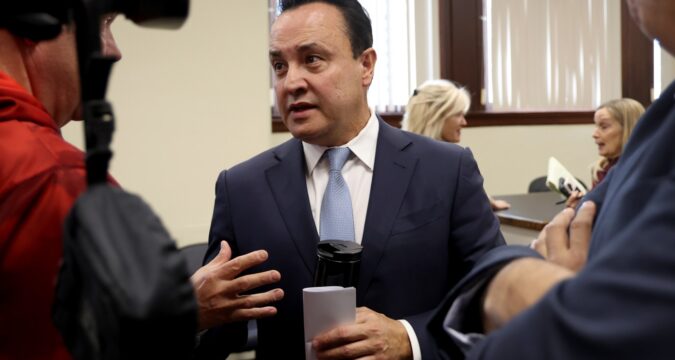
George Cardenas has been a fixture in Southwest Side politics for decades, a consummate insider who followed five Chicago City Council election wins with another victory that took him to the obscure but powerful Cook County Board of Review.
But now he finds himself in a fight befitting a novice, after a challenge to the petition signatures his campaign collected left him 273 short of what he needs to run for reelection in March’s Democratic primary. On Friday, seated across from a foot-tall stack of evidence, his legal team began the painstaking, line-by-line rebuttal to try to claw Cardenas’ way back onto the ballot.
In cutthroat Cook County politics, gathering good petition signatures is the first hurdle for any would-be candidate. It’s a campaign organizational test that tends to reward longtime elected officials who can lean on employees and volunteers they’ve built up over the years to do the shoe leather work on their behalf.
Cardenas and challenger Juanita Irizarry need 4,941 valid signatures to get on the ballot. Rather than a clash of ideas or an appeal to voters, elections like this one are often decided by arguments between lawyers in fluorescent-lit rooms over whether names scrawled on sheets are legitimate.
For Cardenas, who rose up through one of the most vaunted political operations in the city’s modern era to represent the 12th Ward on the council and spent more than two decades navigating electoral gauntlets, his potential elimination for failing that test would make for an especially surprising end. And it would underscore how traditional Chicago machines have fallen off from their heights of decades ago.
Cardenas is one of three members of the county’s Board of Review, an appeals body that can drastically reduce or opt not to change property tax assessments for homeowners and big businesses — sometimes resulting in big breaks on bills.
Even with the city’s various political organizations significantly weakened, the board has still been dogged by recent allegations of nepotism, conflicts of interest, and a culture that harked back to the office’s patronage heyday when governing and politics worked in tandem.
Patronage workers’ job security in Cook County was long linked to whether they delivered for their bosses during campaign season, either by gathering petition signatures or helping build legal challenges to opponents’ petitions in the hopes of getting them kicked off the ballot.
But Cardenas’ top petition passer — an analyst who works for him at the Board of Review and who gathered more than 1,700 signatures — turned in many pages that Cardenas’ opponent has argued were fraudulent fillers that should nullify both his and his boss’s chance to keep their jobs.
That Board of Review employee, Carlos Sanchez, submitted dozens of pages of signatures containing duplicates, records show. The same names appearing four, five, 13, 16, 21 or 22 times.
Two of those repeat signatories lived at the same address as Sanchez.
Ed Mullen, the attorney for Irizarry, made a novel argument in front of the county’s electoral board on Friday: that the number of duplicates showed an intent to both evade election rules and “defraud the Clerk by submitting signatures that were intentionally repeated.”
“I acknowledge that there is no case law addressing this specific question,” Mullen said. In his 15 years as an election attorney, “I also acknowledge I’ve never made this argument, but that’s because I’ve never seen this before.”
Cardenas’ lead attorney, Ross Secler, agreed the duplicates should have been struck, but argued that Irizarry’s team failed to prove a broader pattern of fraud. The hearing officer, Laura Jacksack, said the duplicates would be struck but Sanchez’s other valid signatures could stay.
Thousands of others, Irizarry claims, are either from voters who are not registered, live outside the district, or are “not genuine,” meaning not signed by the actual voter. Several of the sheets Cardenas personally gathered were challenged nearly in their entirety.
Cardenas declined comment and referred questions to Secler.
Juanita Irizarry stands near Lake Michigan at the Calumet River in Chicago on Feb. 25, 2021. At the time, she was executive director of Friends of the Parks. (Erin Hooley/Chicago Tribune)
Irizarry’s campaign manager, Tenoch Rodriguez, said in a written statement ahead of Friday’s hearing that “Cardenas is substantially below the minimum signatures required, and we are confident he will remain below the threshold once all evidence is heard. His petitions are filled with egregious errors, duplicate signatures, and signature fraud, demonstrating a pattern of misleading Cook County residents.”
“Homeowners deserve fairness and integrity from the officials who make (property tax appeals) decisions,” the statement concluded.
Secler’s rebuttal included a line-by-line forensic analysis comparing the petition signatures against the ones on the voters’ registration as well as 549 affidavits from those voters attesting that their signatures were legitimate. Three other staff members from the firm Odelson, Murphey, Frazier & McGrath were present Friday to back Secler up.
Because of the likelihood of problems with the sheets, candidates typically submit two or three times the amount of names they need to boost their chances of surviving challenges like these.
Cardenas indeed boasted nearly 12,000, but according to a tally completed by the county clerk’s staff just before Thanksgiving, only 4,668 were valid.
Signatures can be ruled invalid if the person who signs is not a registered voter, if the address they signed with doesn’t match their voter registration, if they live outside the district, or if they sign more than once. Circulators — the people who pass the petitions — can also have their entire sheets of signatures thrown out for similar reasons, or if their pages are not notarized or properly dated.
The hearing on Cardenas’ signatures will reconvene at 9 a.m. Monday. Jacksack’s final recommendation will go up to the county’s electoral board, which is hoping to wrap up by Friday.
Irizarry also faced a petition challenge, but survived with 9,016 valid signatures intact, well above the minimum to make the ballot.
For several hours on Friday, Secler and Mullen peppered a forensic writing expert with questions about various letter formations, styles, and “terminations,” of challenged signatures to determine whether struck ones could be restored.
If Cardenas’ team fails, Irizarry would be alone on the ballot in the March primary and the overwhelming favorite in the November general election.
A former 26th Ward aldermanic candidate, Irizarry is best known as the former executive director of Friends of the Parks, which under her leadership fought the construction of the Lucas Museum of Narrative Art along the lakefront.
She previously held positions at the Latino Policy Forum and the Chicago Community Trust. She also worked for former Gov. Pat Quinn as a housing coordinator working on long term care reforms.
Irizarry launched her campaign with support from U.S. Rep. Jesús “Chuy” García, who is the fulcrum of one of the few potent political organizations left in the city. A recent controversial example: Garcia’s team managed to collect enough petition signatures in one weekend to get his chosen successor on the ballot for Congress.
Cardenas was first elected alderman of the 12th Ward in 2003 with the help of the Hispanic Democratic Organization, Mayor Richard M. Daley’s then-powerful machine that helped turn out Latino voters and elect dozens of allies to various posts throughout the state. The organization largely dissolved amid the 2008 “Hired Truck” scandal.
Other machine organizations throughout Chicago have waned thanks in large part to so-called Shakman oversight ordered by federal judges that curbed political considerations in government hiring.
The Board of Review has never had a Shakman monitor, however, and for years its leaders resisted calls from reformers to adopt hiring plans that would enshrine Shakman policies. Even after the board adopted an employment plan, the county’s inspector general dinged Cardenas for hiring political allies and violating the employment plan when he first joined the board in 2022. He won that year by defeating Tammy Wendt, who was weakened by a nepotism scandal.
https://www.chicagotribune.com/2025/12/08/george-cardenas-fighting-stay-march-primary-ballot/


