Category: News
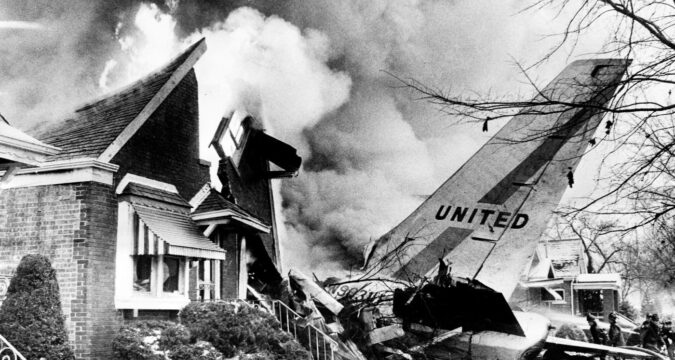
Today in Chicago History: United flight crashes into bungalows on approach to Midway, killing 45 people
Here’s a look back at what happened in the Chicago area on Dec. 8, according to the Tribune’s archives.
Is an important event missing from this date? Email us.
Weather records (from the National Weather Service, Chicago)
High temperature: 64 degrees (1946)
Low temperature: Minus 7 degrees (1882)
Precipitation: 1.21 inches (1885)
Snowfall: 6.9 inches (1977)
1902: The city passed an ordinance requiring all automobiles to display numbers, both on the backs and the front and side lights.
George McAfee (5) runs the famous “T-formation” for the Chicago Bears for a touchdown in the fabled 73-0 win over the Washington Redskins on Dec. 8, 1940. Editors note: this historic print has writing on it from long ago. (Chicago Tribune historical photo)
1940: The Chicago Bears shut out the Washington Redskins 73-0 in the 1940 NFL championship game.
Dorothy Cuculich walks with police officers at the scene of the United Airlines Flight 553 crash on Dec. 8, 1972, near Chicago’s Midway Airport. Her mother Veronica, and sister Theresa were killed. (Don Casper/Chicago Tribune)
1972: Forty-five people died when a United Airlines jet crashed into bungalows on West 70th Place while approaching Chicago’s Midway International Airport for landing. Eighteen aboard the plane survived.
The crash resulted in some bizarre theories about sabotage after it was discovered that the wife of Watergate conspirator Howard Hunt was one of the victims and she was carrying $10,000 in cash in a briefcase.
The National Transportation Safety Board found no evidence of foul play and blamed the crash on errors by the pilot, who failed to retract the plane’s spoilers, or air brakes, at the critical stage of the descent, causing the plane to stall and crash 1.5 miles short of the runway.
1995: Alejandro Hernandez was released after more than 11 years in prison for the 1983 slaying of Jeanine Nicarico. His co-defendant Rolando Cruz had been released earlier.
A Southwest Airlines Boeing 737 rests in the middle of Central Avenue on Dec. 9, 2005, in Chicago. The jetliner, trying to land in heavy snow, slid off the runway on Dec. 8, 2005, at Chicago’s Midway Airport. (Phil Velasquez/Chicago Tribune)
2005: A Southwest Airlines jet landing at Midway Airport during a snowstorm slid off the runway, crashed through a wall and onto Central Avenue, hit two cars and killed 6-year-old Joshua Woods of Leroy, Indiana.
The boy and his brothers were in the back seat of the family’s new car, eating chicken strips on the way to their grandmother’s house.
The Chicago Bulls lost on Dec. 8, 2018, at the United Center to the Boston Celtics 133-77. (Chicago Tribune)
2018: The Chicago Bulls lost 133-77 to the Boston Celtics, the franchise record for largest loss.
The Bulls shot 31-for-81 overall (38.3%), missed 18 of 24 3-pointers and scored 17 points in three of four quarters. The Celtics hit 22 of their 43 3-point attempts and shot 53.8 percent overall en route to their biggest victory.
Want more vintage Chicago?
Subscribe to the free Vintage Chicago Tribune newsletter, join our Chicagoland history Facebook group, stay current with Today in Chicago History and follow us on Instagram for more from Chicago’s past.
Have an idea for Vintage Chicago Tribune? Share it with Kori Rumore and Marianne Mather at krumore@chicagotribune.com and mmather@chicagotribune.com
https://www.chicagotribune.com/2025/12/08/chicago-history-december-8/

Today in History: Brittney Griner freed in prisoner exchange
Today is Monday, Dec. 8, the 342nd day of 2025. There are 23 days left in the year.
Today in history:
On Dec. 8, 2022, Russia freed WNBA star Brittney Griner in a high-profile prisoner exchange with the U.S. that released Russian arms dealer Viktor Bout. Griner had been detained for nearly 10 months.
Also on this date:
In 1941, the United States entered World War II as Congress declared war against Imperial Japan a day after the attack on Pearl Harbor.
In 1980, rock star and former Beatle John Lennon was shot to death outside his New York City apartment building by Mark David Chapman.
In 1987, President Ronald Reagan and Soviet leader Mikhail S. Gorbachev signed a treaty at the White House calling for the destruction of intermediate-range missiles.
In 2012, Texas A&M quarterback Johnny Manziel became the first freshman to win the Heisman Trophy.
In 2014, the U.S. and NATO ceremonially ended their combat mission in Afghanistan, 13 years after the Sept. 11 terror attacks sparked their invasion of the country to topple the Taliban-led government.
In 2016, John Glenn, whose 1962 flight as the first U.S. astronaut to orbit the Earth made him an American hero and propelled him to a long career in the U.S. Senate, died in Columbus, Ohio, at 95.
In 2017, Japanese pitching and hitting star Shohei Ohtani announced that he would sign with the Los Angeles Angels.
Related Articles
Chicago weather: How our 2025-26 seasonal snowfall compares with previous years
Soon no Pearl Harbor survivors will be alive. People turn to other ways to learn about the bombing.
Housed in an old stable, Pullman Tech Workshop works to bring stability to area housing stock, residents
Twins or dolls? The ‘Sawdust Babies’ murder trial of 1922 spread confusion in Hammond.
White Eagle in Niles closes after decades as a hub for Polish community and political powerhouses
In 2024, insurgents completed their occupation of the Syrian capital of Damascus as a half-century of Assad family rule swiftly crumbled. Russian state media reported that President Bashar Assad was in Moscow after fleeing the rebel advance.
Today’s Birthdays: Flutist James Galway is 86. Author Bill Bryson is 74. Actor Kim Basinger is 72. Commentator and columnist Ann Coulter is 64. Actor Wendell Pierce is 63. Actor Teri Hatcher is 61. Basketball Hall of Famer Teresa Weatherspoon is 60. Baseball Hall of Famer Mike Mussina is 57. Actor Dominic Monaghan is 49. NASCAR driver Ryan Newman is 48. Singer Nicki Minaj is 43. Country singer Sam Hunt is 41. Actor AnnaSophia Robb is 32.

Once Again, London Has The Most Pathetic Christmas Tree On The Planet
Once Again, London Has The Most Pathetic Christmas Tree On The Planet
Authored by Steve Watson via Modernity.news,
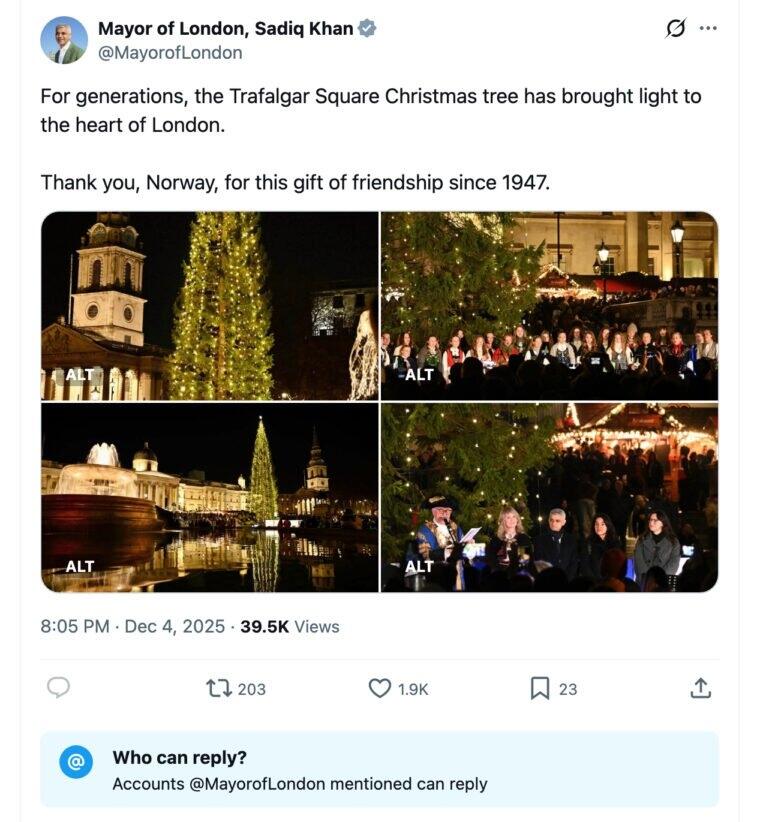
This weekend, London officially turned on it’s Christmas tree lights… Revealing once again the most tired looking pathetic tree and decorations on the planet.
The London Mayor Sadiq Khan was there, pretending to be impressed by a display into which less effort has gone than than your Dad’s half baked effort in the early 1980’s with 20 year old stuff scraped together from out of the attic.
The Christmas lights switch on and tree in Trafalgar Square, London. I was expecting better than last years diabolical cactus with bland white lighting. I guess expectations were too high. ? @MayorofLondon is a disgrace! We NEED @antmiddleton pic.twitter.com/tgaU97aoFR
— Real British Media (@RBMSteve) December 4, 2025
OK, we get it, it’s a “traditional” spruce from Norway. They’ve been sending one since 1947. But can they not send a better one?
Hope you guys over in the UK enjoy the tree this year ? This is the 79th time the City of Oslo sends a Christmas tree to London as a thank-you for the help during the Second World War. pic.twitter.com/XrmiiYvATl
— Joakim ????? (@joakial_) December 3, 2025
And get some better lights on it?
Of course the replies are closed. We all know why.
Khan also freaked out when he had to sing about Jesus.
Muslim Mayor of London Sadiq Khan nearly crashes out the moment he realizes he has to sing “Christ is born the newborn King” during a Christmas Carol event in Londonpic.twitter.com/zr6RI1ZbZN
— Jason Jones (@jonesville) December 6, 2025
Khan then actually had the gall to also post this video of a Christmas tree lighting ceremony in Covent Garden, which is PRIVATELY funded, and pass it off as his doing.
Nowhere compares to London at Christmas ?pic.twitter.com/YuNJI1TWPb
— Mayor of London, Sadiq Khan (@MayorofLondon) November 15, 2025
They HATE Christmas.
Just to confirm, the Mayor of London doesn’t pay for the Covent Garden Christmas tree or lights featured in the video & they are arranged & entirely funded by local retailers & the estate landlord.
The tree Sadiq Khan is responsible for erecting & decorating looks like this: https://t.co/DKp1PPUmY4 pic.twitter.com/OeKGThd6v6
— Ike Ijeh (@ikeijeh) November 17, 2025
What an embarrassment.
Prague – that’s how you do it!!! pic.twitter.com/GHQsQnvWDS
— Dave (@vuvazela) December 6, 2025
Even non-christian nations have infinitely better displays.
Bangkok, Thailand… Not even a Christian nation ? pic.twitter.com/98gTN4PCW1
— Pongkung (@Pongkung_eiei) December 6, 2025
Eventually they won’t even bother.
Listen to the sad clapping in London. Is it not obvious to you that the UK Christmas tree was intentionally barely lit or decorated? Remember the lavish tree decorations of the recent past? This is deliberate. Slow but deliberate. https://t.co/JDqGFwU658
— Dr. Naomi Wolf. 8 NYT Bestsellers. DPhil, Poetry. (@naomirwolf) December 7, 2025
Memo. It is all coordinated. This, the sad London Christmas tree, the attacks on Christmas markets, the no Christmas lights in South Station Boston…all of it. https://t.co/FGKNASjRaY
— Dr. Naomi Wolf. 8 NYT Bestsellers. DPhil, Poetry. (@naomirwolf) December 7, 2025
The turning on of the Christmas tree lights in London, UK compared with Warsaw, Poland.
Do not tell me that London Mayor Sadiq Khan cares about the city or about Christmas… pic.twitter.com/OIRQ58AQoI
— ??? (@AntSpeaks) December 5, 2025
2025 Christmas tree comparison:
1) Sadiq Kahn’s London tree
2) Wrowclaw’s tree (Poland)
Which way western man? pic.twitter.com/by25KYhT0V
— Samson (@SH_lotuseater) December 6, 2025
Dear Londoners,
I present London’s new £149.99 C’mas Tree.
Merry Christmas
From – Your Mayor
Sadiq Kahn
Ps. I hate you all pic.twitter.com/hrInyhvQz0
— Concerned Citizen (@BGatesIsaPyscho) December 5, 2025
??New York’s Rockefeller Center Christmas tree vs London’s Trafalgar Square tree. ?? pic.twitter.com/3369DrhjNp
— Oli London (@OliLondonTV) December 5, 2025
Wait for it… Christmas tree in Islamic London…pic.twitter.com/kY58a9pxxf
— Pippa B ????????? ? ?? ?? (@pippaisright) December 6, 2025
Not a fan of Sadiq but I have to fact check: the Trafalgar Square Christmas tree is an annual gift from Norway to London as a token of gratitude for Britain’s support during World War II. That’s why it just looks like a pine tree with lights on it, it doesn’t look super elaborate… pic.twitter.com/LliUz2J4tn
— xpfmnbvc????????? (@gdlhagg) December 6, 2025
love every year when people point out that the london christmas tree looks terrible and then get quote tweeted like ‘wow op clearly does not know that we have had terrible tree for 80 years on purpose and in fact it is culturally vital that our trees remain very bad forever’
— Adnan (@aouadnan) December 7, 2025
Your support is crucial in helping us defeat mass censorship. Please consider donating via Locals or check out our unique merch. Follow us on X @ModernityNews.
Tyler Durden
Mon, 12/08/2025 – 05:00
https://www.zerohedge.com/political/once-again-london-has-most-pathetic-christmas-tree-planet

Una mujer es condenada a 4 años en Corea del Sur por extorsionar al futbolista Son Heung-min
Associated Press
SEÚL, Corea del Sur (AP) — Una mujer ha sido sentenciada a cuatro años de prisión por chantajear al astro del fútbol Son Heung-min, informó una corte surcoreana el lunes.
La mujer, identificada solo como Yang, fue acusada de extorsionar 300 millones de wones (204.000 dólares) a Son en 2024 después de enviarle una foto de una ecografía de un bebé que afirmaba era suyo y exigir dinero a cambio de guardar silencio.
Posteriormente, conspiró con un hombre, identificado como Yong, para intentar extorsionar más dinero a Son.
El Tribunal del Distrito Central de Seúl dijo el lunes que Yang “mintió” a Son, aunque no había confirmado quién era el padre del bebé que estaba esperando.
El tribunal dijo que Yang negó los cargos de extorsión e intento de extorsión. Yong, quien confesó, fue sentenciado a dos años de prisión, según el tribunal.
Son, de 33 años, es uno de los mejores jugadores de Asia. Después de una década en el Tottenham Hotspur de la Premier League, la estrella surcoreana se unió a LAFC en agosto.
La agencia de noticias surcoreana Yonhap informó en mayo que una mujer de unos 20 años y un hombre de unos 40 habían sido detenidos bajo sospecha de intentar chantajear a Son en junio del año pasado cuando aún estaba en el Tottenham.
___
Esta historia fue traducida del inglés por un editor de AP con la ayuda de una herramienta de inteligencia artificial generativa.
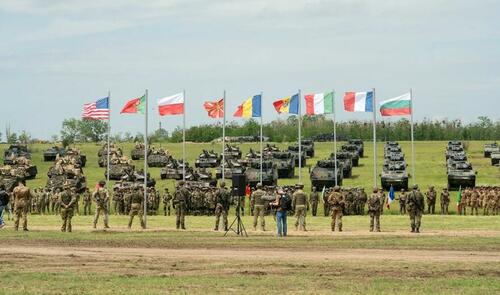
US Issues NATO’s European Members New Self-Defense Deadline
US Issues NATO’s European Members New Self-Defense Deadline
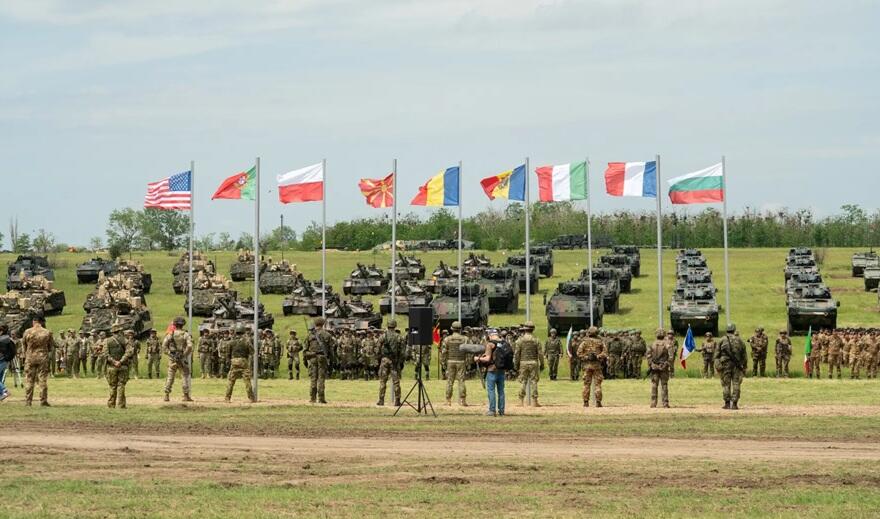
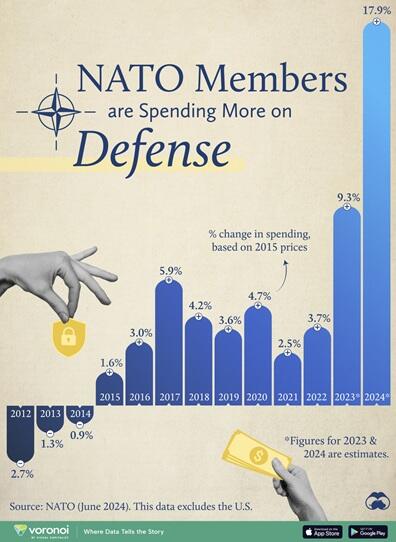
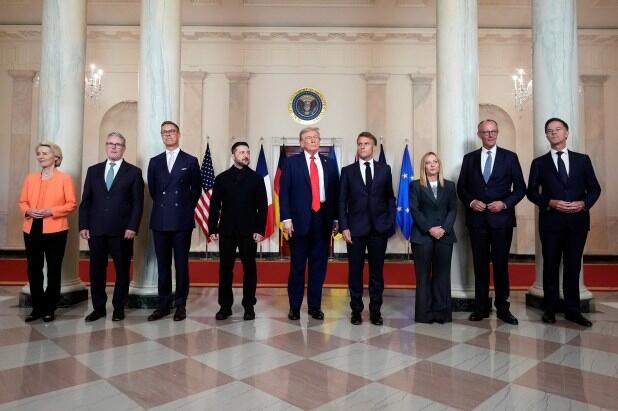
European members of NATO have been warned by Washington that they must assume greater responsibility for the alliance’s intelligence operations and missile production – which will require significantly more defense spending by 2027, Reuters has reported.
Reuters in its exclusive Friday report said that the United States “wants Europe to take over the majority of NATO’s conventional defense capabilities, from intelligence to missiles, by 2027, Pentagon officials told diplomats in Washington this week, a tight deadline that struck some European officials as unrealistic.”
“The message, recounted by five sources familiar with the discussion, including a U.S. official, was conveyed at a meeting in Washington this week of Pentagon staff overseeing NATO policy and several European delegations,” the report continued.
The directive was coupled with a warning behind the scenes, reportedly involving Pentagon officials cautioning representatives from several European nations that the US may scale back its role in certain NATO defense efforts if this target and deadline is not met.
It was noted in the report that some European officials consider the 2027 goal unrealistic, saying that rapidly substituting American military support would demand far greater investment than current plans and NATO member approved defense budgets allow.
This generally reflects the Trump administration’s long verbalized dissatisfaction with with Europe’s progress on shouldering more of NATO’s collective defense burden.
But the Reuters report also underscored that European officials were not offered tangible metrics whereby failure or success would be assessed:
Conventional defense capabilities include non-nuclear assets from troops to weapons and the officials did not explain how the U.S. would measure Europe’s progress toward shouldering most of the burden.
It was also not clear if the 2027 deadline represented the Trump administration position or only the views of some Pentagon officials. There are significant disagreements in Washington over the military role the U.S. should play in Europe.
One NATO official was cited as saying “Allies have recognized the need to invest more in defense and shift the burden on conventional defense” from the US to Europe.
As we described previously the Trump administration’s new National Security Strategy really hits out hard at Europe, stating saying “it is far from obvious whether certain European countries will have economies and militaries strong enough to remain reliable allies” to the United States.
The document further highlights that this current reality of European weakness could have certain negative implications for potential for heightened Western escalation with Russia:
“Managing European relations with Russia will require significant U.S. diplomatic engagement, both to reestablish conditions of strategic stability across the Eurasian landmass, and to mitigate the risk of conflict between Russia and European states,” the document reads.
Most analysts see the language in the document as opening the door for greater Washington meddling in European affairs.
“Washington is no longer pretending it won’t meddle in Europe’s internal affairs” Pawel Zerka, a senior policy fellow at the European Council on Foreign Relations, observed.
“It now frames such interference as an act of benevolence (‘we want Europe to remain European’) and a matter of US strategic necessity. The priority? ‘Cultivating resistance to Europe’s current trajectory within European nations‘,” he concludes.
Tyler Durden
Mon, 12/08/2025 – 04:15
https://www.zerohedge.com/geopolitical/us-issues-natos-european-members-new-self-defense-deadline
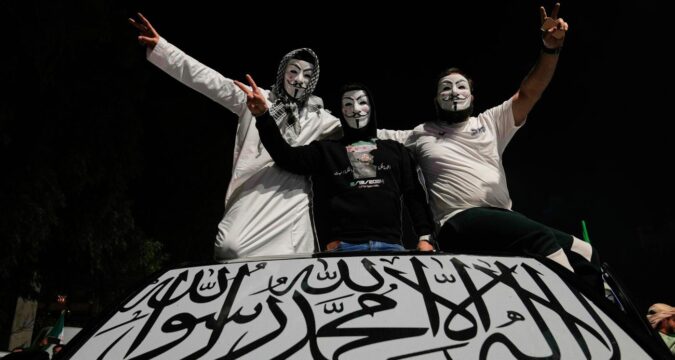
Un año después de la huida de Bashar Assad, Siria tiene problemas para cerrar heridas
Por GHAITH ALSAYED y ABBY SEWELL
HOMS, Siria (AP) — Hace un año, Mohammad Marwan salió a trompicones, descalzo y aturdido, de la notoria prisión de Saydnaya a las afueras de Damasco, cuando las fuerzas rebeldes que avanzaban hacia la capital abrieron sus puertas para liberar a los prisioneros.
Arrestado en 2018 por huir del servicio militar obligatorio, el padre de tres hijos pasó por otras cuatro cárceles antes de llegar a Saydnaya, un extenso complejo al norte de Damasco que se convirtió en sinónimo de algunas de las peores atrocidades cometidas bajo el gobierno del ahora derrocado expresidente Bashar Assad.
Recordó cómo los guardias esperaban para recibir a los nuevos prisioneros con una serie de golpizas y descargas eléctricas. “Decían: ‘No tienes derechos aquí, y no llamaremos a una ambulancia a menos que tengamos un cadáver’”, expresó Marwan.
Su regreso a casa el 8 de diciembre de 2024, a una casa llena de familiares y amigos en su aldea en la provincia de Homs, fue alegre.
Pero en el año transcurrido desde entonces ha tenido problemas para superar los efectos físicos y psicológicos de sus seis años de encarcelamiento. Sufría de dolor en el pecho y dificultad para respirar, que resultaron ser consecuencia de la tuberculosis. Tenía una ansiedad paralizante y dificultad para dormir.
Ahora está recibiendo tratamiento para la tuberculosis y asiste a sesiones de terapia en un centro en Homs enfocado en rehabilitar a exprisioneros, y Marwan dijo que su situación física y mental ha mejorado gradualmente.
“Estábamos en algo parecido a un estado de muerte” en Saydnaya, comentó. “Ahora hemos vuelto a la vida”.
Un país que lucha por sanar
El país de Marwan también trata de recuperarse un año después de que el régimen represivo de 50 años de la dinastía Assad llegara a su fin, tras 14 años de guerra civil que dejaron un estimado de medio millón de muertos, millones más desplazados, y el país golpeado y dividido.
La caída de Assad fue un shock, incluso para los insurgentes que lo derrocaron. A finales de noviembre de 2024, grupos en el noroeste del país, liderados por Hayat Tahrir al-Sham, un grupo rebelde islamista cuyo entonces líder, Ahmad al-Sharaa, es ahora el presidente interino del país, lanzaron una ofensiva sobre la ciudad de Alepo con el objetivo de recuperarla de las fuerzas de Assad.
Se sorprendieron cuando el ejército sirio colapsó con poca resistencia, primero en Alepo, luego en las ciudades clave de Hama y Homs, dejando abierto el camino a Damasco. Mientras tanto, grupos insurgentes en el sur del país se movilizaron para hacer su propio avance hacia la capital.
Los rebeldes tomaron Damasco el 8 de diciembre mientras Assad era trasladado por fuerzas rusas El exmandatario permanece en el exilio en Moscú, pero Rusia, aliada de Assad desde hace mucho tiempo, no intervino militarmente para defenderlo y desde entonces ha establecido lazos con los nuevos gobernantes del país y ha mantenido sus bases en la costa siria.
Hassan Abdul Ghani, portavoz del Ministerio sirio de Defensa, dijo que HTS y sus aliados habían realizado una importante reorganización después de sufrir grandes pérdidas en 2019 y 2020, cuando las fuerzas de Assad recuperaron el control de varias áreas antes controladas por rebeldes.
En un principio, la ofensiva rebelde en noviembre de 2024 no aspiraba a tomar Damasco, sino prevenir una ofensiva esperada por las fuerzas de Assad en Idlib, controlada por la oposición, explicó Abdul Ghani.
“El régimen extinto estaba preparando una campaña muy grande contra las áreas liberadas, y quería terminar con el asunto de Idlib”, explicó. Lanzar un ataque sobre Alepo “fue una solución militar para expandir el radio de la batalla y así salvaguardar las áreas interiores liberadas”.
Al elegir el momento del ataque, los insurgentes también buscaban aprovechar el hecho de que Rusia estaba distraída por su guerra en Ucrania y que otro aliado de Assad, el grupo político y militar libanés Hezbollah, respaldado por Irán, estaba lamiendo sus heridas después de una dura guerra con Israel.
Cuando las defensas del ejército sirio colapsaron, los rebeldes avanzaron “aprovechando cada oportunidad de oro”, dijo Abdul Ghani.
Éxitos en el extranjero, desafíos en casa
Desde su repentino ascenso al poder, Al-Sharaa ha lanzado una ofensiva diplomática cordial, tendiendo puentes con países occidentales y árabes que rechazaron a Assad y que una vez consideraron a Al-Sharaa un terrorista.
Un momento culminante de su éxito en el ámbito internacional: en noviembre, se convirtió en el primer presidente sirio desde la independencia del país en 1946 en visitar Washington.
Pero los éxitos diplomáticos se han visto contrarrestados por brotes de violencia religiosa en los que cientos de civiles de las minorías alauí y drusa fueron asesinados por combatientes suníes progubernamentales. Los grupos locales drusos han establecido ahora su propio gobierno y ejército de facto en la provincia sureña de Sweida.
Hay tensiones persistentes entre el nuevo gobierno en Damasco y las fuerzas lideradas por kurdos que controlan el noreste del país, a pesar de un acuerdo firmado en marzo que se suponía llevaría a una fusión de sus fuerzas.
Israel desconfía del nuevo gobierno liderado por islamistas en Siria, aunque Al-Sharaa ha dicho que no quiere conflicto con el país. Israel ha tomado una zona de separación anteriormente patrullada por la ONU en el sur de Siria y ha lanzado ataques aéreos e incursiones regulares desde la caída de Assad. Las negociaciones para un acuerdo de seguridad se han estancado.
Mientras tanto, la economía del país ha permanecido lenta, a pesar del levantamiento de la mayoría de las sanciones occidentales. Aunque los países del Golfo han prometido invertir en proyectos de reconstrucción, poco se ha materializado sobre el terreno. El Banco Mundial estima que la reconstrucción de las áreas dañadas por la guerra en el país costará 216.00 millones de dólares.
La reconstrucción es en gran medida un esfuerzo individual
La reconstrucción que ha tenido lugar hasta ahora ha sido en gran medida a pequeña escala, con propietarios individuales que pagan para reparar sus propias casas y negocios dañados.
En las afueras de Damasco, el otrora vibrante campamento palestino de Yarmouk hoy se asemeja en gran medida a un paisaje lunar. Tomado por una serie de grupos armados y luego bombardeado por aviones del gobierno, el campamento fue prácticamente abandonado después de 2018.
Desde la caída de Assad, un flujo constante de antiguos residentes ha estado regresando.
Las áreas más dañadas permanecen en gran medida desiertas, pero en la calle principal que conduce al campamento, poco a poco, las paredes destruidas han sido reemplazadas en los edificios que permanecen estructuralmente sólidos. Las tiendas han reabierto y las familias han regresado a sus apartamentos. Pero cualquier tipo de iniciativa de reconstrucción más grande parece estar aún muy lejana.
“Ha pasado un año desde que cayó el régimen. Esperaría que pudieran remover las viejas casas destruidas y construir torres”, dijo Maher al-Homsi, quien está reparando su casa dañada para volver a ella, aunque el área ni siquiera tiene agua corriente.
Su vecina, Etab al-Hawari, estaba dispuesta a dar un margen de maniobra a las nuevas autoridades.
“Heredaron un país vacío: los bancos están vacíos, la infraestructura fue robada, las casas fueron robadas”, comentó.
Bassam Dimashqi, un dentista de Damasco, dijo sobre el país después de la caída de Assad: “Por supuesto que es mejor, hay una especie de libertad”.
Pero sigue preocupado por la aún precaria situación de seguridad y su impacto en la economía todavía débil.
“El trabajo del estado es imponer seguridad, y una vez que impongas seguridad, todo lo demás vendrá”, dijo. “La situación de seguridad es lo que anima a los inversores a venir y hacer proyectos”.
Marwan, el exprisionero, dijo que la situación en Siria después de Assad es “mucho mejor” que antes. Pero también ha tenido dificultades económicas.
De vez en cuando, consigue trabajos que pagan sólo 50.000 o 60.000 libras sirias diarias, el equivalente a unos cinco dólares.
Una vez que termine su tratamiento para la tuberculosis, dijo, planea irse a Líbano en busca de un trabajo mejor remunerado.
——
Sewell informó desde Beirut. El periodista de Associated Press Omar Albam en Damasco contribuyó a este despacho.
___
Esta historia fue traducida del inglés por un editor de AP con la ayuda de una herramienta de inteligencia artificial generativa.
Europe’s Innovation Is Drowned In A Sea Of Government Intervention
Europe’s Innovation Is Drowned In A Sea Of Government Intervention
Authored by Mihai Macovei via The Mises Institute,
Europe became prosperous through a burst of innovation and capital accumulation during the eighteenth-century industrial revolution that allowed individual freedom to replace feudalistic rents and privileges.
A new industrial revolution based on digitalization, advanced artificial intelligence (AI) and automation is in the making, but the reputed analyst Wolfgang Münchau claims that Europe is about to miss it.
In his view, Europe has forgotten how to innovate, because it may still have the aptitude, but it has lost the right attitude to foster creative destruction.
Münchau and other analysts put down this failure on European government’s inability to pick winners like China or capitalize on military investment like the US, in order to promote cutting-edge technologies and research.
In our view this is wrong – Europe does not need more and better targeted government intervention, but considerably less.
Europe lags behind in productivity growth and innovation
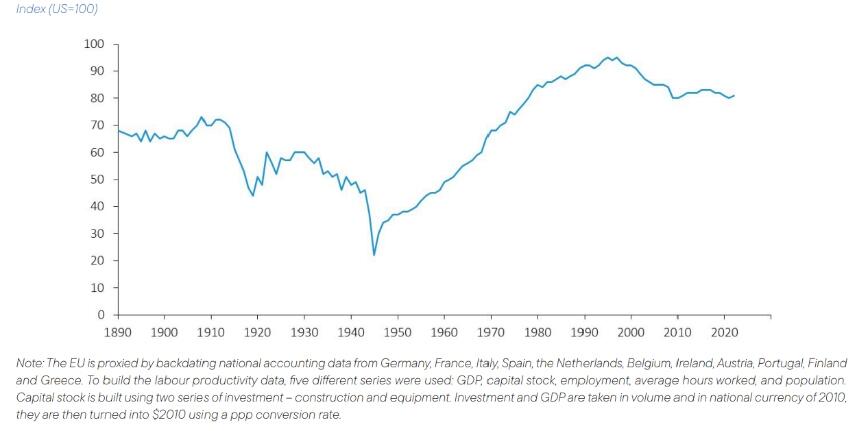
For almost four decades, Europe has been falling behind the US, and now China, in digital technology sectors, such as internet, semiconductors, ICT equipment and software, and AI. These sectors are recording the highest productivity growth rates and account for most of the widening productivity gap between the EU and the US (Graph 1).
Graph 1: EU vs US labor productivity 1890-2022
Source: The Draghi report: A competitiveness strategy for Europe (Part A)
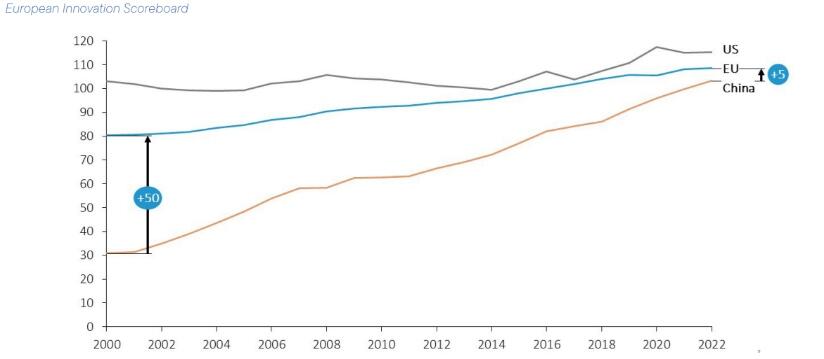
European decision makers could not just ignore the productivity growth problem and turned their attention to closing the innovation gap with the US. However, despite strong competition from China and the US, Europe still appears to retain a decent capacity to produce innovative ideas. According to Mario Draghi’s report on EU competitiveness, the EU produces almost one-fifth of the world’s scientific publications, lagging behind China, but ranking ahead of the US. It also has a strong position in patent applications with 17% of the world’s patent applications. EU’s public spending on R&D at 0.74% of GDP is slightly larger than 0.7% in the US, and 0.5% in both Japan and China. Overall, according to the European Innovation Scoreboard, the EU continues to trail the US closely in terms of scientific research (Graph 2), while China comes strongly from behind and outranked Germany in the latest Global Innovation Index 2025.
Graph 2: Innovation performance of EU, China and the US
Source: The Draghi report: A competitiveness strategy for Europe (Part B)
It seems that Europe’s main problem is not lack of scientific discoveries, but of providing the right conditions for businesses to develop them into marketable products. The links between higher education and businesses are weak. Only about one-third of the patented inventions by European universities or research institutions are commercialized. Successful commercialization in high-tech sectors is linked to innovation “clusters” of networks of universities, start-ups, large companies and venture capitalists (VCs) which are less developed in Europe.
The insufficient scaling up of tech start-ups is another key issue. Europe is creating a large number of start-ups, comparable to that in the US, but they often fail to grow. Many barriers, such as overregulation and bureaucracy, a heavy tax burden and insufficient access to finance force companies in Europe to stay small or relocate, mostly to the US. Only one in ten unicorns (i.e. start-ups with a valuation exceeding USD 1 billion) are active in Europe, relative to the US and China. According to Politico, nearly 30 percent of the bloc’s unicorns have transferred to the US since 2008. Young talent is also fleeing for the U.S. and Asia, while Europe’s economy is falling behind in modern industries.
Innovation does not work without capital accumulation
A disproportionate focus on innovation is not helpful, especially when Europe does not seem to lack innovative ideas. Ludwig von Mises explains how the scarcity of capital goods is the key factor impeding technological progress and the use of scientific knowledge. Throughout history, underdeveloped countries had relatively open access to the scientific methods used by advanced economies, but lacked the capital structure to implement them. The latter is the outcome of sustained market-oriented investment, where Europe seems to fail today.
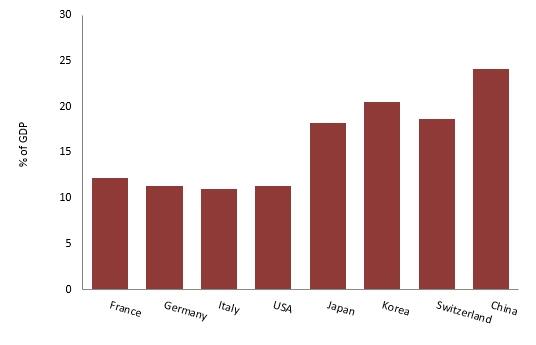
Only around 40% of European companies report that they invest in R&D, compared to 56% in the US. The overall R&D investment of the private sector in the EU was only 2.2% of GDP in 2022, compared to 3.5% of GDP in the US, 3.3% in Japan and 2.4% in China. In general, European companies invest somewhat less than the US, and considerably less than China, (Graph 3), which also explains the anemic capital accumulation and productivity growth.
Graph 3: Corporate sector investment
Source: OECD Data Explorer
Private investment in Europe is not low because of insufficient domestic savings, but because of heavy government intervention that renders the business environment unattractive. Domestic savings are actually plentiful in several old member states such as Denmark, Germany, Ireland, the Netherlands and Sweden, but are mainly invested abroad. It results in very high current account surpluses (to the tune of 5 to 12% of GDP). As regards foreign investment, France, Germany and Italy have recorded a predominantly negative and volatile net foreign direct investment (FDI) balance, while US and China remain major destinations of FDI inflows in both absolute and relative terms.
Investors complain about the high regulatory and administrative burden, not least on account of severe labor market rigidities and the intrusive green legislation. Moreover, the tax burden is one of the heaviest in the world in order to finance an over-seized welfare state. According to the OECD, France, Italy, and Germany collect more than 40% of GDP in tax revenues, compared with less than 30% in the US and China. The perverse incentives of the generous welfare systems affect both companies and workers as it discourages education and hard work. Europe has an acute shortage of skilled employees in particular in the fields of science, technology, engineering and mathematics (STEM), undermining innovation. Despite the very large public spending on education, a steep decline in the level of basic skills and top performers took place in recent years, as evidenced by falling PISA scores. In terms of labor incentives, Germans and French work about 20% less hours per year than Americans and 30% less than Chinese.
Does Europe need more or less government intervention?
European decision makers focus on strategic solutions that favor more government intervention and policy centralization at EU level, such as higher public spending for innovation and education, faster decarbonization of the industry shielded by green tariffs, higher defense spending and strategic autonomy. They also target regulatory simplification, but remain conspicuously silent about reducing the tax burden and the welfare state, the real elephant in the room. European governments took a similar approach of protecting the welfare state, when recently confronted with fiscal and growth woes, either going for higher taxation in France, the UK, or Italy, or higher government spending in Germany.
Münchau also argues for more government intervention and believes Europe should emulate China in getting better at picking winners. But, the EU is no stranger to heavily subsidizing the industrial sector to the tune of 1.5% of GDP annually. It is also the originator of an artificial market for “climate change” compliant products, such as solar panels, wind mills, large capacity batteries, electric cars, etc. Normally, EU companies should be leaders in these markets, benefitting from the advantage of the first entrant. Yet, Chinese and other Asian producers took over “green” markets because they are cheaper and more competitive. If foreign companies investing in China in the early nineties were complaining about a “forced technology transfer,” now it is the EU requiring Chinese investors to transfer advanced technology know-how to their European peers.
In conclusion, it is not true that China has proven wrong the Western economic policy consensus that governments should never pick winners. China has only proven right the classic Western capitalist mentality that economic freedom stimulates hard work and capital accumulation, fostering prosperity. A relatively unencumbered capitalist system can be very productive at creating wealth so that, within limits, governments can waste some of it by subsidizing less efficient activities. But, if government intervention and redistribution reach a point where they stifle incentives to work, save and invest, privately created wealth may not be enough to cover government misadventures. Hence, the illusion that China is better than others at picking winners, and that better calibrated socialist policies could solve Europe’s problem of too much intervention in the economy.
Tyler Durden
Mon, 12/08/2025 – 03:30
https://www.zerohedge.com/economics/europes-innovation-drowned-sea-government-intervention
Un segundo vuelo de deportados iraníes sale de EEUU con 55 personas, dice Irán
Por NASSER KARIMI y JON GAMBRELL
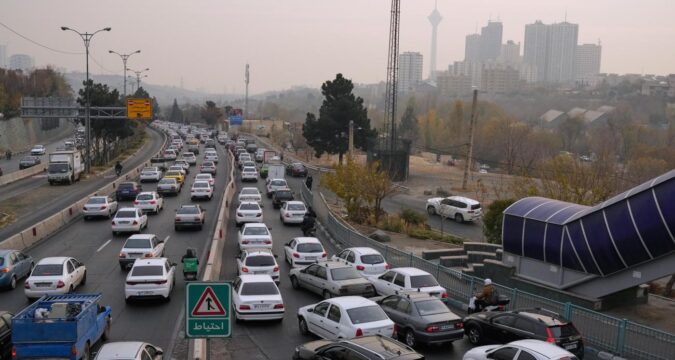
TEHERÁN, Irán (AP) — Un segundo vuelo con iraníes deportados ha salido de Estados Unidos, afirmaron funcionarios iraníes. Washington planea enviar a cientos de prisioneros de regreso a la República Islámica, según reportes.
Las deportaciones se producen en un momento de fuertes tensiones entre Teherán y Washington después de que Estados Unidos bombardeara recintos nucleares iraníes durante la guerra de 12 días de Teherán con Israel en junio. Activistas en el extranjero también han expresado su preocupación por los deportados que regresan a Irán, cuya teocracia está reprimiendo a intelectuales y ejecutando prisioneros a un ritmo inédito en décadas.
Un reporte publicado el lunes por la agencia de noticias Mizan, el portavoz oficial del poder judicial de Irán, citó al funcionario del Ministerio iraní de Exteriores, Mojtaba Shasti Karimi, reconociendo la deportación de 55 iraníes.
“Estos individuos anunciaron su disposición a regresar tras la continuación de la política antiinmigrante y discriminatoria contra ciudadanos extranjeros, particularmente iraníes, por parte de Estados Unidos”, indicó Karimi.
El portavoz del Ministerio iraní de Exteriores, Esmail Baghaei, también dijo el domingo que había planes para que 55 iraníes regresaran a la República Islámica.
Según las afirmaciones estadounidenses, señaló, “los iraníes fueron repatriados por razones legales y violación de las regulaciones de inmigración”.
El gobierno de Estados Unidos no mencionó de inmediato el vuelo de deportación y no estaba claro si el avión había llegado ya a Teherán. El Departamento de Seguridad Nacional y el Departamento de Estado de Estados Unidos no respondieron de inmediato a las solicitudes de comentarios de The Associated Press la madrugada del lunes.
Las deportaciones suponen una colisión de una de las principales prioridades del presidente Donald Trump, perseguir la inmigración ilegal, contra una práctica de décadas de Estados Unidos de acoger a disidentes iraníes, exiliados y otros desde la Revolución Islámica de 1979.
Funcionarios iraníes reconocieron en septiembre que hasta 400 iraníes podrían ser devueltos según la política del gobierno de Trump. Ese mes llegó a Teherán el primer vuelo de ese tipo.
En el período previo y después de la revolución de 1979, un gran número de iraníes huyó a Estados Unidos. En las décadas posteriores, Estados Unidos había sido comprensivo al permitir que aquellos que huían de Irán por persecución religiosa, sexual o política solicitaran la residencia. Irán ha mantenido que solo aquellos con cargos penales pendientes enfrentan enjuiciamiento, mientras que otros pueden viajar libremente. Sin embargo, Teherán ha detenido a occidentales y otros con vínculos en el extranjero en el pasado para ser intercambiados en canjes de prisioneros.
Irán ha criticado a Washington por albergar a disidentes y otros en el pasado. Fiscales federales de Estados Unidos han acusado a Irán de contratar sicarios para atacar a disidentes también en territorio estadounidense.
___
Gambrell informó desde Dubái, Emiratos Árabes Unidos.
___
Esta historia fue traducida del inglés por un editor de AP con la ayuda de una herramienta de inteligencia artificial generativa.
Can Europe Keep Ukraine Armed With Limited US Aid?
Can Europe Keep Ukraine Armed With Limited US Aid?
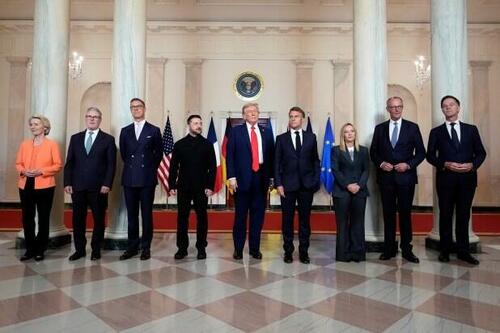
Over the past two years, Western support for Ukraine has undergone a drastic change, marked by a surge in European commitments and a notable retreat in U.S. engagement.
According to the Kiel Institute for the World Economy’s Ukraine Support Tracker, European countries have become the leading providers of government aid to Ukraine, allocating almost €50 billion from January to August 2025, including military, financial and humanitarian support.
On the other hand, the United States had committed over €100 billion in government aid under the Biden administration (2022-2024).
But as Statista’s Tristan Gaudiat shows in the chart below, the return of President Trump to office in early 2025 stalled U.S. support, the current administration having paused any new funding.
You will find more infographics at Statista
As the war enters its fourth year, Europe’s role as the primary backer of Ukraine is now clear, while U.S. aid uncertainty raises questions about the sustainability of Western support in the long term.
Tyler Durden
Mon, 12/08/2025 – 02:45
https://www.zerohedge.com/geopolitical/can-europe-keep-ukraine-armed-limited-us-aid
Trump dice que el plan de Netflix de comprar Warner “podría ser un problema” por cuota de mercado
Por DARLENE SUPERVILLE
WASHINGTON (AP) — El presidente de Estados Unidos, Donald Trump, afirmó que un acuerdo alcanzado por Netflix para comprar Warner Bros. Discovery “podría ser un problema” debido al tamaño de la cuota de mercado combinada.
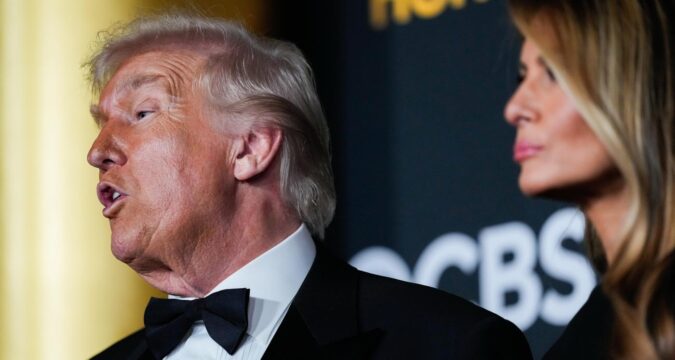
“No hay duda al respecto”, expresó Trump, respondiendo preguntas sobre el acuerdo y otros temas mientras caminaba por la alfombra roja en los Kennedy Center Honors.
El presidente republicano dijo que estará involucrado en la decisión sobre si el gobierno federal debería aprobar el acuerdo de 72.000 millones de dólares. Si los reguladores lo aprueban, la fusión pondría a dos de los servicios de streaming más grandes del mundo bajo la misma propiedad y uniría la división de televisión y cine de Warner, incluidos los estudios DC, con el vasto archivo de Netflix y su rama de producción.
El acuerdo, que podría remodelar la industria del entretenimiento, tiene que “pasar por un proceso y veremos qué sucede”, comentó Trump.
“Netflix es una gran empresa. Han hecho un trabajo fenomenal. Ted es un hombre fantástico”, dijo refiriéndose al director general de Netflix, Ted Sarandos, señalando que se reunieron en la Oficina Oval la semana pasada antes de que se anunciara el acuerdo el 5 de diciembre. “Tengo mucho respeto por él, pero es una gran cuota de mercado, así que tendremos que ver qué pasa”.
Al preguntarle si se debería permitir a Netflix comprar al gigante de Hollywood responsable de las cintas de “Harry Potter” y HBO Max, el presidente respondió: “Bueno, esa es la pregunta”.
“Tienen una cuota de mercado muy grande y cuando tienen a Warner Bros., ya saben, esa cuota sube mucho, así que, no lo sé”, dijo. “También estaré involucrado en esa decisión. Pero tienen una cuota de mercado muy grande”.
Sarandos no ofreció garantías en su reunión sobre la fusión si se aprueba, dijo Trump, agregando que el ejecutivo es una “gran persona” que ha “hecho uno de los mejores trabajos en la historia del cine y otras cosas”.
Reiteró que una fusión crearía una “gran cuota de mercado” para la empresa.
“No hay duda al respecto. Podría ser un problema”, afirmó Trump.
___
Esta historia fue traducida del inglés por un editor de AP con la ayuda de una herramienta de inteligencia artificial generativa.