
Category: News
Best dance of 2025: From Joffrey to Trinity, a year of big swings for Chicago dance
As long as I’ve tabulated this list of the best in Chicago dance, I don’t think any year has been quite as gratifying as this one. Frankly, I love an underdog. So, to witness the exhilarating culmination two people quite literally wrestling with each other for five years in the studio, or to see a company like Chicago Repertory Ballet now reaching its full potential, is such a pleasure and privilege. I hope you’ve enjoyed watching as much as I have.
“Knockout” at Steppenwolf in January: The hour-long duet, devised and performed by Erin Kilmurray and Kara Brody, was developed from a pandemic diversion exploring the art of meeting people. The result served as both a requiem and a mandate, illustrating the necessity for and messiness of algorithm-free, fully confusing and unpredictably palpable, screen-free interactions with real, live humans.
The Joffrey’s whole, entire year: It’s safe to say the Joffrey Ballet (whose New York chapter is beautifully chronicled at Wrightwood 659) could not have imagined the year they’ve had three decades ago, showing up in Chicago penniless and on the brink of closure. Against all odds (and perhaps better judgment), then-artistic director Gerald Arpino believed it would work. Apparently, he was right. Current artistic director Ashley Wheater has stretched his company to the limit this year, with some of the biggest and rangiest repertoire ever — and they’ve risen to every occasion. The delightfully wacky one-act “Princess and the Pea” came a few months before Christopher Wheeldon’s enormously ambitious “Alice’s Adventures in Wonderland.” The U.S. premiere of Liam Scarlett’s “Carmen” was mere weeks before the company’s Harris Theater debut — all capped off with a magical “Nutcracker” that’s finally found its full, glorious footing
Victoria Jaiani and Amanda Assucena in “Alice’s Adventures in Wonderland” by the Joffrey Ballet. (Cheryl Mann)
Alvin Ailey American Dance Theater at the Auditorium in March: Opening night of the Ailey company’s annual visit to Chicago was one of the more special moments in this critic’s career, marking the final time veteran dancer Vernard Gilmore would perform with the company in his hometown. Gilmore retired last season after 30 years with the organization. The joint appreciation shared between dancer and audience for a most remarkable career is something I’ll never forget. When they come again next spring, Gilmore’s front-and-center spot in “Revelations” every night will be someone else’s. And that dancer will be working under new leadership; the former head of Juilliard’s dance division, Alicia Graf Mack, has just begun her tenure as the fourth artistic director of that lauded institution.
“Children of Dharma” at the Harris Theater in March: Minneapolis-based Ragamala Dance Company has thrice visited the Harris, most recently illustrating sacred stories from the “Mahabharata” through stunning music and dance. “Children of Dharma” was less opulent than previous works shown in Chicago, but no less impactful, forcing the eye toward the dancers and the story they tell through physical gestures and emotive expressions. The gist seemed to be the reward that comes from care for the earth and each other, and how resisting material temptations will pay off in the end — an apt lesson for us all.
Twyla Tharp Dance’s 60th anniversary “Diamond Jubilee” performance at the Harris Theater in Chicago is accompanied by Chicago-based Third Coast Percussion and flutist Constance Volk. (Kyle Flubacker)
Twyla Tharp at the Harris Theater in April: The two works that made up her 60th anniversary “Diamond Jubilee” felt unexpectedly sentimental for Tharp, who revisited her 1999 tongue twister of a dance called “Diabelli” out of a desire to ensure it didn’t get lost. Even her newest work, the stunner “Slacktide,” was made in the shadow of her 1986 tour de force “In the Upper Room.” Surprising, indeed. But if I know anything at all about Twyla Tharp, it’s her ability to defy expectation again and again.
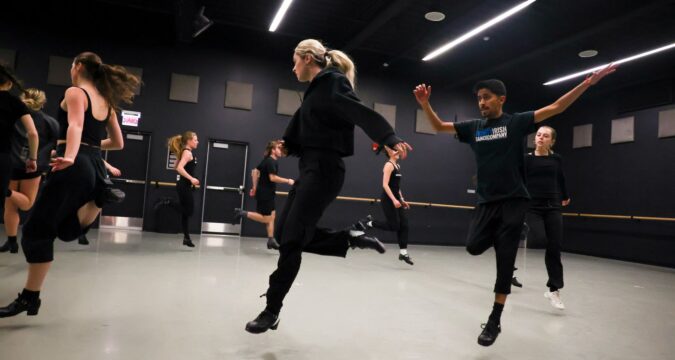
Trinity Irish Dance Company at the Museum of Contemporary Art in May: Trinity Irish Dance’s first-ever self-produced concert was small by comparison to its usual digs at the Auditorium and other big houses around the world. But for its 35th season, they brought Irish dance to spaces it’s never been. That includes both the storied dance festival Jacob’s Pillow and the MCA, where they premiered a landmark collaboration between artistic leads Mark Howard and Chelsea Hoy and contemporary dance choreographer Stephanie Martinez. Called “The Sash,” the piece is a powerful message on peace through the lens of Northern Irish composer Kevin Sharkey’s upbringing at the height of a bloody conflict between Catholics and Protestants.
Nate Kinsella and Robyn Mineko Williams in “To Leave You,” which opened the Chicago Performs festival with performances at the MCA. (Chris Strong)
“To Leave You” at the Museum of Contemporary Art in September: Part multimedia curio cabinet, part karaoke party, Robyn Mineko Williams’ deeply personal sketch was created and performed with fellow long-tenured Hubbard Street Dance Chicago alums Jessica Tong and Jason Hortin (plus inextricable contributions from composer Nate Kinsella and Manual Cinema’s Julia Miller). The trio’s post-Hubbard Street lives showed up in “To Leave You,” a piece with movement vocabulary that is perhaps more cautious than what they might have performed a decade ago, but is unquestionably gratifying and imbued with a physical place and practice that still fit like a glove — with all the complexities, curiosities and hindsight of middle-agedness added.
“The Capulets” at the Ruth Page Center in November: One of the biggest swings of the year came from Chicago Repertory Ballet, whose original full-length ballet featuring lesser-known characters from Shakespeare’s “Romeo and Juliet” was its most ambitious project to date. Ambition alone isn’t a reason to celebrate. The entire team brought this company to the next level, with an immersive multimedia setting and capable ensemble rising to the occasion — that occasion being artistic director and choreographer Wade Schaaf’s vivid imagination.
Wade Schaaf’s world premiere of “The Capulets” by the Chicago Repertory Ballet at the Ruth Page Center for the Arts. (Jorge Sigler)
Hubbard Street Dance Chicago at Steppenwolf in November: Of the three programs on view this year, the most recent stands out as clear evidence of Hubbard Street Dance Chicago’s excellence, and artistic director Linda-Denise Fisher-Harrell’s curatorial vision for her company. It’s deeper than “we do it all,” which has been a perpetual theme of Fisher-Harrell’s tenure thus far. Indeed, the presence of works by Bob Fosse, Ohad Naharin, Johan Inger and Aszure Barton on a single evening certainly seems to support that idea. But the nuance is an excavation of the company’s history and extrapolation of its long-standing ability to present dance and dancers on the vanguard.
Ensemble Español Spanish Dance Theater at the Auditorium in November: After skipping its usual summer dance series in Skokie, the Ensemble Español dancers were clearly itching to perform, finding a new gear for the company’s 50th spirited anniversary kickoff this fall. In addition to cyclical favorites by the company’s founding and current artistic directors, audiences were treated to spectacular solos by longtime company members Jose Torres, who recently stepped into a leadership role, and Claudia Pizarro-Lara, whose riveting presence has not graced Ensemble Español for several years. Having now properly celebrated the past, this great Chicago cultural institution can now turn its eyes to the future.
Ensemble Español Spanish Dance Theater performs a 50th Anniversary Celebration at the Auditorium Theatre. (Jose Calvo)
Lauren Warnecke is a freelance critic.
Homeownership Has Become A Luxury In Many US Cities: Report
Homeownership Has Become A Luxury In Many US Cities: Report
Authored by Naveen Athrappully via The Epoch Times,
Homeownership is now considered a “luxury” in most of America’s largest cities due to a shortage of homes for sale, high property prices, and elevated mortgage rates, consumer services company Bankrate said in a Dec. 8 analysis report.
A typical household, which earns nearly $80,000 per year, is far short of the $113,000 required to afford a median-priced home worth $435,000 as of July, the report said. In some cities, buyers must now have more than $200,000 to afford the median-priced home.
“Nationally, over 75 percent of U.S. homes on the market are unaffordable to the typical household,” Bankrate said.
Typical households must make at least $33,000 more to afford median-priced homes.
Out of the 34 largest American metros analyzed by Bankrate, only about a dozen have more than 30 percent of properties that a typical household can afford, the company said. This affects even markets long considered to be affordable, such as San Antonio, Charlotte, and Philadelphia.
San Francisco had the highest income requirement, with prospective buyers having to make $353,500 annually to purchase a typical home. This was followed by Los Angeles, San Diego, New York City, and Seattle, all of which require more than $200,000 in income.
Detroit was the cheapest metro area, requiring only an income of $66,700 to buy a home. This was followed by Pittsburgh and Louisville, both of which required less than $80,000.
“Anyone earning the median U.S. income will find themselves priced out of three out of every four U.S. homes on the market,” Bankrate said.
“A big reason why: there simply aren’t enough homes up for sale right now. Homeowners who locked in ultra-low mortgage rates during the pandemic have been staying put, and builders haven’t kept up with demand since the Great Recession.
“At the same time, home prices soared during the pandemic, followed by the steepest rise in mortgage rates in about two decades. With wages struggling to keep up, housing affordability has reached historically low levels in recent years.”
The average sales price of homes sold in the United States jumped from $371,100 in the second quarter of 2020 to $512,800 in the same period this year, an increase of more than 38 percent over a five-year period, according to data from the Federal Reserve Bank of St. Louis.
Moreover, the average rate on a 30-year fixed-rate mortgage was 6.19 percent for the week ending Dec. 4, according to data from Freddie Mac. This is more than double the 2.71 percent rate roughly five years ago.
Amid high housing costs, inventory growth is slowing down, real estate brokerage Redfin said in a Dec. 4 statement.
Total housing supply is losing steam, and new home listings are stalling, the brokerage said.
“The pool of buyers is small partly because we’re entering the slow season for real estate, but it’s also because houses are expensive, rates are elevated, and people are feeling cautious about their pocketbooks,” said Carlos Castillo, a Redfin Premier agent in Los Angeles.
“House hunters may be able to find a deal because there are more sellers than buyers, but I’m advising buyers to be strategic. For instance, buyers can ask for concessions and offer less than the asking price, but don’t lowball too much.”
The National Association of Home Builders (NAHB) said last month that builder confidence remained in negative sentiment in November, citing factors such as rising construction costs and economic uncertainty created by tariffs.
On the positive side, the recent decline in mortgage rates has eased affordability conditions, NAHB Chairman Buddy Hughes said.
As for what lies ahead for the housing market next year, a Dec. 4 report from real estate marketplace Zillow predicts mortgage rates will remain above 6 percent.
“U.S. home values are forecasted to grow 1.2 percent in 2026 after national values were roughly flat in 2025,” Zillow said.
“Next year’s forecast reflects expectations of gradually improving affordability and steady buyer demand.
“Mortgage costs should ease a bit in 2026, helping more buyers stay in the market and supporting modest price growth in many parts of the country.”
Tyler Durden
Wed, 12/10/2025 – 06:30
https://www.zerohedge.com/personal-finance/homeownership-has-become-luxury-many-us-cities-report

Los combates en Congo y en la frontera de Camboya y Tailandia amenazan dos acuerdos de paz de Trump
Por MATTHEW LEE
WASHINGTON (AP) — Al menos dos de varios acuerdos destinados a poner fin a conflictos globales que el presidente Donald Trump ha elogiado como evidencia de su destreza negociadora están en problemas y en riesgo de colapsar.
Menos de una semana después de que República Democrática del Congo y Ruanda firmaran un acuerdo en presencia de Trump en Washington, que tenía como objetivo detener los combates en el este de Congo, y menos de dos meses después de que presenciara la firma de un pacto de alto el fuego entre Camboya y Tailandia en Malasia para poner fin a su conflicto fronterizo, los combates han resurgido en ambos lugares.
Los acontecimientos han causado alarma internacional, lo que el martes resultó en llamados urgentes para detener la violencia renovada por parte de los países involucrados en la región de los Grandes Lagos de África y del secretario de Estado de Estados Unidos, Marco Rubio.
En cada caso, las declaraciones instaron a los combatientes a cumplir con sus compromisos en los acuerdos que Trump ha promocionado en parte como la razón para presentarse a sí mismo como el “presidente de la paz”.
Trump expresó el martes por la noche su confianza en que una vez más podría poner fin a los combates entre Camboya y Tailandia.
“Mañana tendré que hacer una llamada telefónica”, dijo Trump en un mitin en Pensilvania. “¿Quién más podría decir: ‘Voy a hacer una llamada telefónica y detener una guerra de dos países muy poderosos, Tailandia y Camboya?’”.
Preocupación por el repunte de la violencia en Congo
Una declaración conjunta emitida por el Grupo de Contacto Internacional para los Grandes Lagos expresó “profunda preocupación” por la situación en la región de Kivu del Sur en República Democrática del Congo, donde en los últimos días ha estallado una nueva violencia mortal atribuida al grupo miliciano M23 respaldado por Ruanda.
“El ICG insta al M23 y a las Fuerzas de Defensa de Ruanda (RDF) a detener inmediatamente sus operaciones ofensivas en el este de la RDC, en particular en Kivu del Sur, y pide a las RDF que se retiren del este de la RDC y al M23 que regrese a sus posiciones” como se estipula en múltiples acuerdos que culminaron con la firma de un acuerdo en Washington el jueves con los presidentes Félix Tshisekedi de Congo y Paul Kagame de Ruanda.
La Casa Blanca lo había promocionado como un acuerdo “histórico” negociado por Trump tras meses de esfuerzos de paz por parte de Estados Unidos y sus socios, incluida la Unión Africana y Qatar, finalizando un acuerdo anterior firmado en junio.
“Es un gran día para África, un gran día para el mundo”, dijo Trump entonces. “Hoy, estamos teniendo éxito donde tantos otros han fallado”, añadió.
El grupo de contacto de los Grandes Lagos —que incluye a Bélgica, Reino Unido, Dinamarca, Francia, Alemania, Holanda, Suecia, Suiza, Estados Unidos y la Unión Europea— instó a todas las partes “a cumplir con sus compromisos” bajo el acuerdo firmado la semana pasada y “desescalar inmediatamente la situación”.
El Departamento de Estado dijo que Estados Unidos “está profundamente preocupado por la violencia continua en el este de la RDC, que está provocando desplazamientos e infligiendo sufrimiento a innumerables familias”, utilizando un acrónimo para la República Democrática del Congo.
“El gobierno de Trump continúa avanzando en su compromiso diplomático sobre este importante tema, trabajando para asegurar la plena implementación de los acuerdos recientemente firmados y restaurar la estabilidad sobre el terreno”, dijo. “Estamos trabajando estrechamente con socios regionales para cumplir con los compromisos asumidos y reforzar el alto el fuego”.
El gobierno de Trump pide detener la violencia en la frontera entre Tailandia y Camboya
En una declaración separada, Rubio dijo que a Estados Unidos le preocupa un aumento en los combates entre Camboya y Tailandia a lo largo de su frontera disputada, poco más de un mes después de que los dos países firmaran un acuerdo en Malasia que fue impulsado por Trump.
“Instamos encarecidamente al cese inmediato de las hostilidades, la protección de los civiles y a que ambas partes regresen a las medidas de desescalada delineadas en los Acuerdos de Paz de Kuala Lumpur del 26 de octubre”, dijo Rubio en un comunicado.
El acuerdo entre Camboya y Tailandia ha flaqueado durante semanas, pero sufrió un gran golpe cuando estallaron los combates tras un enfrentamiento el fin de semana en el que dos soldados tailandeses resultaron heridos. Cinco días de combates desde entonces han dejado decenas de muertos en ambos lados y han obligado a evacuar a más de 100.000 civiles.
Un alto funcionario del gobierno de Trump, que no estaba autorizado a comentar públicamente y habló bajo condición de anonimato, dijo que el presidente esperaba que Tailandia y Camboya, así como Ruanda y Congo, “cumplieran sus compromisos” para detener la violencia. El funcionario dijo que la Casa Blanca sigue de cerca la situación en Congo y que Trump ha dicho a ambas partes que espera “resultados inmediatos”.
Trump ha citado repetidamente siete u ocho acuerdos, incluidos estos dos, como prueba de su éxito en poner fin a conflictos, aunque otro —un plan respaldado internacionalmente para poner fin a la guerra entre Israel y Hamás en Gaza— aún no está finalizado y está en el limbo, con combates esporádicos mientras una fase crítica sigue en proceso.
Sus esfuerzos para detener los combates entre Rusia y Ucrania hasta ahora han resultado infructuosos. Otros acuerdos en los que Trump ha estado involucrado y ha reclamado como éxitos incluyen aquellos entre India y Pakistán, Armenia y Azerbaiyán, Israel e Irán, Kosovo y Serbia, y Egipto y Etiopía.
___
El periodista de Associated Press Aamer Madhani contribuyó a este despacho
___
Esta historia fue traducida del inglés por un editor de AP con la ayuda de una herramienta de inteligencia artificial generativa.
Column: Little library keeps legacy of Aurora’s ‘Christmas Lady’ alive
It’s a small thing, really.
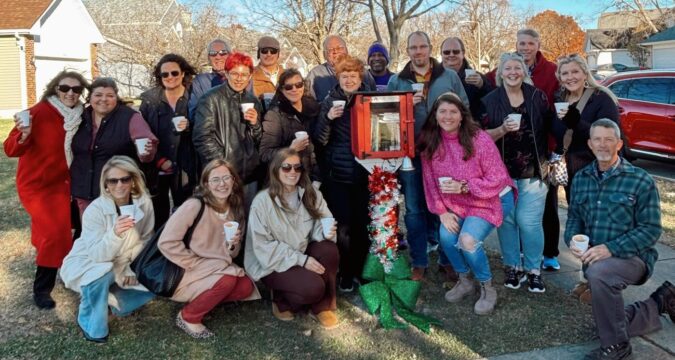
A red box planted in the ground at the corner of Canterbury Road and Deerfield Drive in Aurora, where young and old alike can take a book or leave favorite titles for others to enjoy.
But this little library in Orchard Valley subdivision’s Canterbury Park has a special significance for those who loved the woman many knew as Aurora’s “Christmas Lady.”
In the decades leading up to her death in August at age 61, Karen Bozarth had opened her and husband Jim’s home to thousands of people to enjoy a wonderland of holiday magic. Because she loved this time of year so passionately and wanted to share that joy with others, her house was decorated to the hilt, with dozens of glittering Christmas trees – nine in the living room alone – 300 snowmen and over 400 snow village buildings which included thousands of parts, many of them moving, that covered their entire basement.
Karen also worked at Scholastic Inc. at its St. Charles location for nearly 20 years, selling children’s books, learning resources and educational material to schools in multiple states. So it’s no surprise that Karen loved reading as much as she loved Christmas.
And “everyone at Scholastic, all the way up to the owners, absolutely adored Karen,” said co-worker Mary Reynolds. “She just had that way of making everyone feel like you were her best friend.”
Determined, insisted Reynolds, “not to let that light of hers dim,” Scholastic, which moved its offices to Hoffman Estates in April, decided to erect this small free library in Karen’s memory.
Even though it is officially a lending library, where people of all ages can take a book and leave one, Scholastic, which for over 100 years has specialized in children’s publishing, plans to keep it filled with brand new books for kids ages birth through 12.
A little library, erected at Canterbury Park in Orchard Valley subdivision in Aurora in memory of Karen Bozarth – who was known by many as Aurora’s “Christmas Lady” – is filled with free books from Scholastic Inc., where she worked for many years. (Faith Reynolds)
And yes they are free to anyone, especially those who might not otherwise have the money to spend on new titles for their kids.
Putting this library in place, said Reynolds, was a labor of love from coworkers and friends, who came together upon its completion Nov. 19 for a “Hot Chocolate and Sugar Cookie Cheer” gathering: a Yuletide memorial to this beloved woman who could, like Christmas itself, put a smile on everyone’s face and joy in their hearts.
Reynolds wants to give a shout-out to all those who made the project possible, including neighbor and co-worker Terry Witte who assembled the box; to the Fox Valley Park District for giving permission and digging the hole; to friend and co-worker Eva Di Martino for painting it; and to Stan Rayford and his 6-year-old son little Stan who, along with Jim Bozarth, are in charge of making sure the library – which will be festively decorated for all seasons – is always filled with new Scholastic books.
So far, an average of 20 to 25 books are going into the library at one time. And this weekend that will include Christmas titles, Reynolds said.
“Karen would have been loving all this,” she added. “It’s just who she was.”
Of course it will be a different Christmas for Jim Bozarth, who you may recall from a previous column was watching one of his wife’s beloved Hallmark movies on Aug. 7 with her when she quietly passed away.
No one knows more than her husband how much Karen loved this season. Which is why Bozarth is finding it difficult to put up one tree this year, never mind the dozens he used to help trim that glittered in every room of their home.
Jim Bozarth, shown last December with his late wife Karen, opened their elaborately decorated Aurora home each holiday season to the enjoyment of hundreds of people. Karen died in August but Scholastic, where she worked for nearly 20 years, has erected a little library in her memory that will feature new books from the publishing company. (Bozarth family)
This first holiday without her will be especially hard, Bozarth said, adding that he and Karen even got engaged on Christmas Day. While driving past the red box in the park brings him “some comfort,” it is also a reminder that “she is not here” to enjoy it.
Still, as the memorial plaque on the library’s little door points out, there is “never a final chapter.”
“A huge part of the Christmas season is keeping alive those memories with loved ones,” Bozarth told me, adding that he and Karen “have many,” including decades of good cheer when their home was opened to visitors from near and far.
“This little library,” he insisted, “is just a continuation of her giving spirit.”
dcrosby@tribpub.com

Edward Keegan: Frank Gehry’s generous and democratic architecture
I first met Frank O. Gehry, who died Dec. 5 at his California home, in November of 1982 when I was an undergraduate architecture student at the University of Virginia. He was known at the time for his own home in Santa Monica — a roller coaster of a design that slashed plywood, corrugated metal and chain link through the carcass of a modest traditional bungalow. Assuming that he had his own version of the lit-crit-based theories of architecture that were popular at the time, my nascent architectural mind wanted to know something of the arcane personal theory behind it. “What’s the deal with the asphalt floor in your dining room,” I asked. “It’s functional,” Gehry replied. “We move the table and chairs out and hose it down.” I was so floored by his direct and unassuming response that I have no memory of what we discussed next. But I understood that he was somebody worth watching.
In Chicago, Gehry is best known for the Jay Pritzker Pavilion in Millennium Park, completed just over two decades ago. My first direct experience of a Gehry space was at a 1987 exhibit in Houston. It had been mounted by the Walker Arts Center in Minneapolis and was the first major overview of his work and it included a fish sculpture you could walk through. The small structure displayed eccentric wood framing clad in shingles that convincingly represented scales. In hindsight, it suggested much of what was to come, although those developments were still unknown.
It led directly to a much larger fish sculpture atop a seaside building in Barcelona that was completed in 1992 as part of a larger complex designed by the Chicago office of Skidmore Owings & Merrill. Gehry’s office developed the design with software used by the aeronautics industry — which unlocked the ability to realize these unusual shapes with accuracy and within budget. It also created a relationship between Gehry and Skidmore Owings & Merrill’s Chicago-based structural engineers who would help him build the Guggenheim Museum Bilbao and the Pritzker Pavilion in Millennium Park.
More than a quarter century after its opening in 1997, Gehry’s Guggenheim Museum Bilbao remains his most celebrated work and the quintessential building of its time.
The Guggenheim Museum, designed by architect Frank Gehry, in Bilbao, Spain, on Jan. 10, 2001. (Rafa Rivas/AFP-Getty)
Rafael Moneo compared it to the great cathedrals. Gehry molds and forms masonry, steel and glass — the essential materials of architecture — into forms previously explored solely in sculpture. While observers always acknowledge connections between Gehry and the contemporary artists who were his friends — Robert Rauschenberg, Richard Serra and others — he also drew on the deep well of art history including the medieval sculptor Claus Sluter whose 500-year-old work provided the architect with a seemingly endless series of draped and hooded forms that became galleries and conference rooms within various projects. The Guggenheim’s soaring central space features a series of interior towers often compared to Fritz Lang’s 1927 film “Metropolis” and Constantin Brancusi’s Paris studio, but I see affinities with Ludwig Mies van der Rohe’s early unbuilt towers from the same period as well. Gehry’s building pieces— some curved, others faceted — evoke the entire history of art and architecture while also drawing from Bilbao’s unique physical landscape.
The building connects the handsome quarters of the city’s 19th century district with the riverfront, which in the 1990s was a desolate post-industrial hellscape. He brilliantly inverted the typical museum entry; rather than ascending monumental stairs, Gehry brings visitors down broad steps to reveal the riverfront. And his seemingly obtuse forms draw on the immediate context. A long gallery slips under an existing bridge and appears as the beached hull of a ship, now displaying some of the largest pieces of contemporary art. At the other end of the building, a stack of masonry boxes recalls the vast railyard of containers that were still adjacent to the structure when I first visited in 1999.
That was 18 months or so after its much-lauded opening. I originally visited to get a glimpse of what Millennium Park had in store. At the time, it was known that he would be involved in the project, but the scope was still evolving. I was highly skeptical of the almost universal praise that had greeted the building. “The word is out that miracles still occur, and that a major one has happened here,” Herbert Muschamp had written in the New York Times shortly before the building opened.
But Gehry surprised me, much as he had done on our first meeting almost two decades earlier. “The Guggenheim Museum Bilbao is as good as you’ve heard; in fact, it’s better,” I reported for Chicago Public Radio following my 1999 visit. “And therein lies the dilemma. While good architecture can be described in words, great architecture demands actual physical experience. If you care about architecture, you’ll just have to go see the Guggenheim Museum Bilbao yourself.”
Closer to home, Gehry was working on his contribution to Millennium Park. One of his initial designs for the Jay Pritzker Pavilion was distinctly un-Bilbao, an homage to Mies van der Rohe with a simple metal cover that looked like a piece of silver paper laid gently over the trellis. The civic powers-that-be quickly rejected that scheme.
As built, Gehry’s Pritzker Pavilion band shell is the late 20th century answer to Louis Sullivan’s late 19th century Auditorium — both exuberant displays of unbounded architectural ambition that provide other artists with a strong frame for their work.
Most attention has always been paid to the band shell itself whose forms were quite typical of his work during the period. But his design contains three very distinct elements — the band shell, the trellis and the bridge — and the last two are actually quite different within his oeuvre and responsive to the particular needs of the overall park.
While his forms could seem casual and arbitrary, Gehry was an amazing planner who always produced concise and effective floor plans that smartly organized his buildings so that they were easier to navigate than many seemingly simpler structures. For all its remarkable shapes and flourishes, Bilbao is simple to explore with a central organizing space that leads to three linear wings of galleries.
Much of his development came through watching the work of artists more than architects. His drawings are fascinating — gestural doodles that seem indecipherable until you see them next to a completed building — at which point you understand exactly what he was drawing. But the drawings were always a means to an end — and that end was the building.
Related Articles
Edward Keegan: Frank Lloyd Wright’s chairs get a thoughtful presentation in Wisconsin
Edward Keegan: Architecture becomes real through construction at Revolution Workshop
Edward Keegan: Columbus, Indiana’s architecture festival embraces the spirit of Chicago improv with ‘Yes And’
Edward Keegan: The Obama Presidential Center promises to be a very un-Chicago building
Edward Keegan: It is unclear what the Chicago Architecture Biennial is shifting to
While Gehry personified the “starchitects” who received so much attention at the turn of the century, he really was at his best when working with others. The so-called “Bilbao Effect” often focused all the attention on Gehry, but his Guggenheim was just one of a collection of major design commissions in that city during the same period including Norman Foster’s Metro system, and a bridge and airport terminal by Santiago Calatrava. Similarly, Millennium Park’s Pritzker Pavilion plays well with Anish Kapoor’s Cloud Gate, Jaume Plensa’s Crown Fountain, and Kathryn Gustafson and Piet Oudolf’s Lurie Garden.
Gehry’s work was at once bright, shiny and new while pulling on all sorts of historical references — the swooping masonry of John Wellborn Root’s Monadnock Building, the tall soaring glass of Mies’ towers, the curving metal arcs of Serra, among others.
The BP Bridge in Chicago’s Millennium Park, as seen from the Aon Center building on April 28, 2023. (Antonio Perez/Chicago Tribune)
It’s easy to think of Gehry as an episodic architect, but nothing could be further from the truth. Indeed, his best works stand out and at a quick glance can seem out of place. But his talent as a planner, with the ability to draw things together, was nothing short of astonishing. In Millennium Park, the BP Bridge is an obvious connector, but it was essentially a bridge to nowhere when he proposed it. And the trellis above the Pritzker Pavilion’s lawn was simultaneously a brilliant solution to provide the acoustician with the broadest number of speaker locations to provide superior sound at an outdoor venue, but the stubby columns around the lawn and the shallow vaults of steel help connect the performers on stage, the audience in fixed seating and those on the lawn within a single — and singular— outdoor space.
This is an architecture of democracy and generosity. And it certainly reflects my experience with Gehry as a person.
When my wife and I got engaged, we chose a simple Gehry-designed ring from Tiffany’s. A few months later, I told Frank about her and the ring at a dinner and asked that he meet her. He immediately responded, “I’ll give her a hug!” and proceeded to do just that. His simple thoughtful and gracious gesture remains with us years later. And so do his buildings for which we can all be grateful.
Edward Keegan writes, broadcasts and teaches on architectural subjects. Keegan’s biweekly architecture column is supported by a grant from former Tribune critic Blair Kamin, as administered by the not-for-profit Journalism Funding Partners. The Tribune maintains editorial control over assignments and content.
Submit a letter, of no more than 400 words, to the editor here or email letters@chicagotribune.com.
https://www.chicagotribune.com/2025/12/10/column-frank-gehry-millennium-park-keegan/
Editorial: Why we continue to support, and worry about, community violence intervention in Chicago
Chicago is at the forefront nationally of a highly promising method of reducing gun violence that doesn’t rely on arrests, prosecutions and incarcerations.
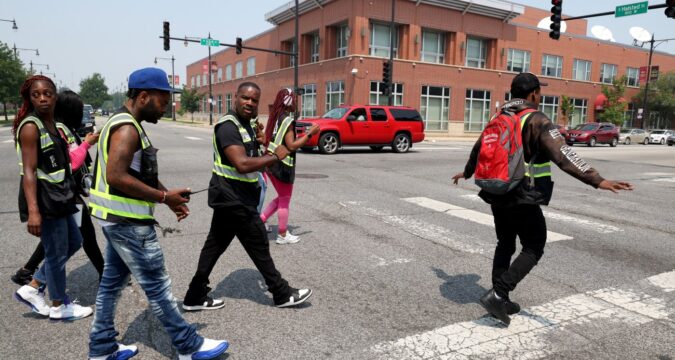
Community violence intervention is a multipronged anti-violence strategy. It employs “violence interrupters,” also referred to as “peacekeepers,” to defuse arguments that can turn quickly into shootings and killings in neighborhoods where many people are carrying guns. CVI also intervenes in the lives of young men otherwise on the road to lives of crime, helping them step by step into learning how to reorder their lives and become productive members of society.
This is labor-intensive and even dangerous work, but CVI in Chicago has demonstrated positive results to date. As Arne Duncan, former U.S. education secretary, founder of Chicago CRED and CVI’s most prominent advocate, writes today in the Tribune, there is a growing body of research attesting to the effectiveness of CVI in reducing shootings and homicides as well as arrests.
No one has had to convince Chicago’s business community.
Led by the late Jim Crown, that community stepped up with $100 million in collective donations to allow Duncan and a host of aligned organizations scale up efforts that previously had been confined to pilot-level size over several years. The state of Illinois and Cook County did their part as well, contributing $30 million and $20 million, respectively.
Arne Duncan greets people as community leaders gathered to celebrate a state-funded anti-violence program, April 17, 2025, at the Pullman Community Center. (Brian Cassella/Chicago Tribune)
The laggard has been the city of Chicago itself, the municipal body with the most at stake in addressing the unacceptable level of violent crime in neighborhoods largely populated by Black and Hispanic residents. Mayor Brandon Johnson’s administration pledged to contribute $40 million to the effort this year and came up with about $19 million.
Johnson should have taken ownership of the city’s struggles to follow through. Instead, over this contentious budget season, the mayor has sought to deflect the blame to corporate Chicago, saying the business community hasn’t put enough “skin in the game” and thus should be taxed on each person they employ in the city in order to fund CVI (among other things). The stance is disingenuous and insulting, as we’ve written before. The business community has done more in this arena than any other player — and that’s on top of paying one of the highest state corporate income tax rates in the country and some of the nation’s highest property taxes as well.
An alternative budget framework put forward by aldermen opposed to Johnson’s corporate head tax includes $30 million for CVI. They have arrived at that figure without penalizing job creators and reinforcing the city’s worsening reputation for being business-unfriendly.
Readers may wonder why these CVI efforts require so much money given that they have well over $100 million at their disposal now as it stands. These programs are multi-year efforts, we’re told. To be effective, they must work at scale in neighborhoods over five years. The funding in hand bankrolls five-year campaigns in four city neighborhoods — Austin, North Lawndale, Humboldt Park and Little Village.
But there are plenty more neighborhoods plagued by violence that could use the help.
These programs are difficult to manage given the inevitability that participants — both workers and those getting the assistance — are intimately aware of street life in Chicago’s grittiest neighborhoods. Most don’t come by that knowledge without having been involved somehow or another in activities that are unsavory, whether criminal or otherwise.
Cook County State’s Attorney Eileen O’Neill Burke, who met with the editorial board on Tuesday, recounted for us riding with one of the CVI groups and watching as an unarmed worker leaped out of their car to break up a heated face-off on the street in which at least one man was wielding a gun. “It definitely has utility,” she said of CVI.
She made the point at the same time that “some organizations do this (work) better than others.”
We agree and a few months ago called on the CVI sector, for lack of a better term, to strengthen its management controls.
That said, combating violent crime in Chicago, a scourge that has held the city back in multiple ways, is a complicated effort. The battle requires law-and-order measures, but it also entails making would-be criminals aware there are alternatives and there’s help available in pursuing them.
On making Chicago safer, it’s time for the city’s political class once again to link arms with the city’s business community — not with the threat of economically destructive new taxes — but as collaborators. If the city holds up its end of the bargain, we’re confident corporate Chicago will step up again.
Submit a letter, of no more than 400 words, to the editor here or email letters@chicagotribune.com.

Editorial: When young women would prefer to move abroad, America’s future is at risk
You could field a 16-inch softball league with the celebrities who’ve threatened to leave the U.S. if their presidential pick wasn’t elected in recent years.
What’s more striking today is that it isn’t only the Hollywood set floating the idea of relocating. Increasing numbers of ordinary Americans — especially younger women — say they’re thinking about moving abroad, not because of a single election outcome but because they doubt the country’s direction, economic prospects and social climate.
That shift should worry all of us.
For the second year, about 1 in 5 Americans indicated they’d like to move abroad permanently if given the option, according to Gallup. What their data uncovered is that this spiking trend is being driven primarily by younger women, between the ages of 15 and 44.
Among that group, a stunning 40% said they’d leave the U.S., compared with just 10% a decade ago. These aren’t people who’ve actually left, of course — but their interest itself is telling. Gallup notes the same phenomenon isn’t playing out in other advanced economies.
This isn’t about hypothetical moving plans. It’s about a generation of women questioning whether the United States is a place that values them, keeps them safe or offers a future worth building. If young women stop believing the country is on their side, that undermines everything from civic cohesion to the nation’s economic and demographic future.
Gallup noted the first dramatic upward shift in young women’s dissatisfaction in 2016, during the last stages of Barack Obama’s presidency and ahead of President Donald Trump’s first term. A desire to flee is not escalating among Gen X and boomers. Just 14% of women 45 and older and 8% of men who are 45 and older would leave. And just 19% of younger men would seek their fortunes elsewhere.
This misalignment of worldviews between younger men and younger women also is causing much-observed tensions in the dating pool, driven by a mismatch of values and core beliefs. Yet even married women and women with children are expressing a growing desire to leave.
Numbers like these may seem like outliers, but they’re often warning signs of fixable problems.
Gallup offers some insight into what’s driving these results, and notes that as this trend has emerged, young women’s faith in institutions has fallen sharply. Over the past 10 years, young women’s confidence in the courts has dropped from 55% to 32%, a shift Gallup speculates may be tied to the Supreme Court’s 2022 decision to overturn Dobbs v. Jackson Women’s Health Organization. Politics undoubtedly plays a part, and it’s worth noting that 59% of younger women identify as or lean Democrat, compared with just 39% of younger men.
Even if few of these disgruntled women ultimately leave, and no doubt few of them will, that’s not the real danger. We’re creeping uncomfortably close to half of young women reporting they’d prefer to build their future somewhere else, and the message is unmistakable: American institutions are failing at persuading its next generation of women that this is a place where they will thrive.
A nation that wants stronger families, a more stable workforce and a healthier democracy can’t afford a future built on resignation or escape. Our challenge now isn’t to dismiss these findings as fantasy, but to make this a country young women still want to call home.
Submit a letter, of no more than 400 words, to the editor here or email letters@chicagotribune.com.
https://www.chicagotribune.com/2025/12/10/gallup-young-women-move-abroad/

Original ‘Rent’ star will appear in ‘Follies’ by Porchlight Music Theatre
Anthony Rapp, an original Broadway star of “Rent,” will appear as Benjamin Stone in the upcoming Porchlight Music Theatre production of Stephen Sondheim and James Goldman’s “Follies,” to be performed concert-style at Chicago’s historic Studebaker Theater. Originally seen in 1971, “Follies” follows a reunion of aging former showgirls and is set in a crumbling Broadway theater. Recently restored, the Studebaker is hardly crumbling, but suggests an appropriate ambiance.
Others slated to appear in what is shaping up as quite a notable reunion of long-standing Chicago talent include the veteran Chicago actors Dale Benson, Felicia P. Fields, Susie McMonagle, Mary Robin Roth, Honey West and James Harms, among others.
They’ll be joined by the Broadway performer and musical director Alexander Gemignani, as well as Michelle Duffy, also a familiar Broadway face, and the well-known Chicago performer Angela Ingersoll.
The remainder of the creative team has yet to be announced.
April 25-26, 2026, in the Studebaker Theater in the Fine Arts Building, 410 S. Michigan Ave.; tickets $24-$110 from the Studebaker box office at 312-753-3210 or PorchlightMusicTheatre.org
Chris Jones is a Tribune critic.
cjones5@chicagotribune.com

Arne Duncan: Community violence intervention is working in Chicago
While gun violence has steadily declined all across America over the last four years, Chicago has the second-largest drop among the 10 largest cities and will likely end this year with the fewest number of homicides since 1965. Since 2021, we have cut in half the number of homicides from around 800 to 400. Over the same period, the total number of shootings has dropped from more than 4,400 to under 2,000.
The decline in gun violence in our city is a great story we can all celebrate, but a related and important story is that arrests are also down compared to the previous decade. In fact, the annual number of arrests dropped from more than 90,000 in 2019 to about 53,000 today.
The logical conclusion to draw from these two trends is that many high-risk individuals for whom gun violence was an everyday fact of life are putting down their guns and choosing to live more safely. These changes in behavior point to the positive impact of the men and women working in the field of community violence intervention (CVI).
Today, a network of more than two dozen CVI organizations serve nearly half of Chicago’s 77 neighborhoods. Collectively, we enroll or employ several thousand people, many of whom have been in jail or prison, representing one of the largest reentry programs in the entire country. Neighborhoods where CVI is most active, including Austin, North Lawndale, Little Village and Englewood, have some of the largest declines in gun violence in the city.
A large body of research from the Center for Neighborhood Engaged Research and Science (Corners) at Northwestern University affirms the positive impact of our programs among our participants. One study found that those who complete our program are 73% less likely to be rearrested.
Another study attributes a 41% drop in shootings at the city’s most dangerous locations to the state-funded Peacekeepers Program, which is administered through CVI organizations and uses participants to mediate conflicts and deter gun violence. A third study estimates that a consortium of CVI organizations known as Communities Partnering 4 Peace prevented nearly 400 shootings and 600 arrests between 2018 and 2023.
These studies help us get better and hold ourselves accountable. They also help us build the case for continued investment from the public and the private sectors. The case has never been stronger and there are many people to thank, starting with the private sector.
In 2016, several local foundations formed the Partnership for Safe and Peaceful Communities (PSPC) and began investing in CVI. Since then, the partnership has invested about $215 million for CVI and adjacent community-building initiatives.
The business community, through the Civic Committee of the Commercial Club, joined with PSPC and other donors to raise more than $100 million for a bold strategy called Scaling Community Violence for a Safer Chicago (SC2). Under SC2, we are testing the theory that CVI “at scale” can not only make individuals safer but can drive down violence in whole communities. The program is just getting started, but the progress, so far, is promising.
The public sector has also stepped up. The state of Illinois has invested several hundred million dollars in CVI and adopted our approach in other cities across the state. Cook County has been a reliable funding partner and has now expanded CVI into the suburbs.
The city of Chicago has also invested in CVI, although we hope the city does more in the years ahead because the city has the most to gain. Every shooting avoided not only spares victims loss of life and extreme trauma, but also reduces policing, criminal justice and health care costs, while generating new economic activity as neighborhoods get safer. Over time, the return on investment in CVI will be billions of dollars.
We are also grateful to Chicago police Superintendent Larry Snelling, who has embraced CVI as a crucial piece of Chicago’s public safety strategy. There is growing awareness, in Snelling’s own words, that police “can’t do it alone.” As another former police chief, Charlie Beck, said about CVI: “My job is the last homicide. Your job is stopping the next homicide.”
We still have a long way to go. Our per-capita homicide rate remains about four times higher than New York’s. Recent mass shootings downtown and in the neighborhoods are chilling reminders that, in a world with so many guns, none of us can ever be totally safe.
To be on par with the safest cities in America, Chicago must further reduce the number of homicides and shootings by at least half the current levels. For that to happen, CVI must become a permanent, fully funded feature of Chicago’s public safety infrastructure.
As Chicago closes out the year, we are grateful to everyone contributing to the positive trends in our city, from police and elected officials to community, business, foundation and faith leaders. But we especially salute the thousands of CVI participants and employees who have put the street life behind them. They are the solution.
Arne Duncan is the founder of Chicago CRED.
Submit a letter, of no more than 400 words, to the editor here or email letters@chicagotribune.com.
https://www.chicagotribune.com/2025/12/10/opinion-chicago-community-violence-intervention-crime/
President Barack Obama visits Chicago to check on progress of center, greets students
With his namesake center due to open in just over six months, former President Barack Obama is in Chicago this week to see how construction is coming along — plus make a few other stops to promote and preview the multimillion-dollar endeavor, including a surprise visit to a South Side school.
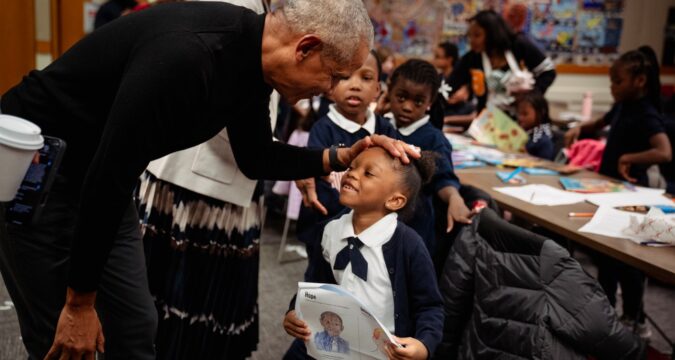
On Tuesday, a group of 24 students from Washington Park’s Burke Elementary School on a field trip to the Bessie Coleman branch of the Chicago Public Library in the Woodlawn neighborhood were welcomed by the former president, who entered a community room wearing a red Santa hat and a smile, according to a pool report of the visit.
“Everybody seems to be working hard,” Obama greeted the students, who were participating in a story time and coloring activity as he walked in. “I thought we were gonna have a little Christmas party, and everybody’s doing their homework. What’s happening?”
The students ranging from kindergarten through second grade exclaimed “Barack Obama!” as he approached.
Obama has been in town for the past couple of days checking on the progress of his Obama Presidential Center, according to the Obama Foundation. The visit comes after Obama recently announced that the center, which has been in the making for a decade, would open next June.
“So that y’all don’t have to bring your coats up,” Obama said last week during a visit to the Crystal Bridges Museum of American Art in Arkansas.
Spanning 19 acres, the $850 million center in Jackson Park will feature a main building and museum; a forum building that includes an auditorium, media suite and other programming rooms; a Chicago Public Library branch; and farther south, a 45,000-square-foot multipurpose athletic center.
Dubbed “Home Court,” the athletic center is the first of the center’s four buildings to wrap up construction. The foundation hosted events at Home Court Sunday and Monday for board members and supporters from the corporate, political and nonprofit world, including Mayor Brandon Johnson, House Speaker Emanuel “Chris” Welch and longtime associates John Rogers and Arne Duncan.
Events included a private “fireside chat” featuring Chicago native Jennifer Hudson, according to a social media post from Welch. Obama was also set to address a private Commercial Club meeting Tuesday night.
Discussing his hopes for the center as it starts to take shape after years of delays and legal fights, Obama in Arkansas last week put forward a vision for “a place where the public gathers for a range of things that puts them face-to-face with each other.”
“(Where they’ll) meet and be in dialogue and conversation and exposed to new ideas with each other,” he said.
Obama especially highlighted the center’s focus on investing in civic leadership among young people.
“Our job and the center’s job is to train them,” he said.
That vision was in full display as he visited with students on Tuesday.
Related Articles
Holiday gifts from museum shops let you wrap a bow on Chicago culture
Column: In ‘American Prophets,’ how writers feel about religion and spirituality
‘Wizard of Oz’ collection goes on display at the Driehaus museum
Walking in the Loop? Look down. You may be passing new markers of city’s Race Riot of 1919.
Fedora man unmasked: Meet the teen behind the Louvre mystery photo
The event served as a preview of programming planned for the center’s new public library branch, the foundation said in a news release.
Telling the students he stopped by because he heard they’d been doing a lot of reading, Obama sat down to read them a story. Perched in a low chair while the youngsters settled onto the floor, Obama read Karyn Parsons’ “Flying Free: How Bessie Coleman’s Dreams Took Flight.” The book was purchased from Call & Response, a Black woman-owned bookstore in the Hyde Park neighborhood.
Through the reading, Obama fielded queries from his audience. He also paused for his own questions, asking the students if anyone would like to learn how to fly a plane and what they wanted to be when they grew up. To the latter, aspirations spanned from veterinarian to firefighter — and even president.
“You’ve got a long way to go,” Obama said, “but I think you could be a president … it’s possible.”
The Tribune’s A.D. Quig contributed.
https://www.chicagotribune.com/2025/12/10/barack-obama-presidential-center-chicago-visit/



.png)