Category: News
Pro-Iranian Hackers Breached US Infrastructure, Feds Say
Pro-Iranian Hackers Breached US Infrastructure, Feds Say
Authored by Troy Myers via The Epoch Times (emphasis ours),
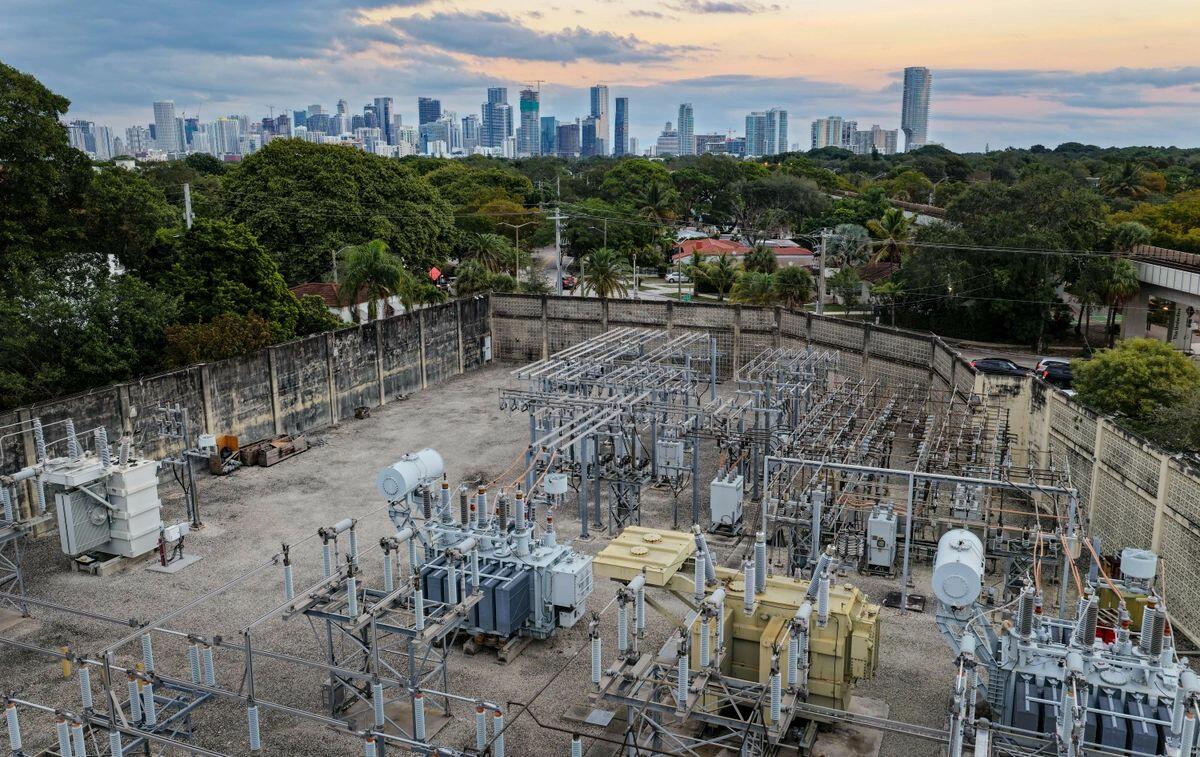
Pro-Iranian hackers have breached critical U.S. infrastructure, according to a joint warning issued Tuesday by several federal agencies.
The advisory came only hours ahead of President Donald Trump’s Tuesday deadline for Iran, warning that “a whole civilization will die tonight” if Iran refuses to open the Hormuz Strait to oil traffic. Trump later suspended the attack following negotiations mediated by Pakistan.
Iranian cyberattacks targeting U.S. organizations have increased recently with the ongoing war against Iran, the advisory said.
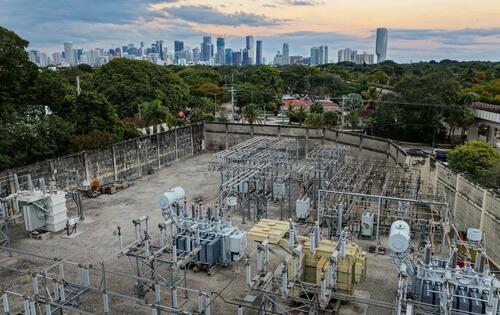
In the latest breach, hackers caused disruptions through “malicious interactions” on project files and data displays in organizations across multiple U.S. critical infrastructure sectors, including government services and facilities, local municipalities, water and waste systems, and energy infrastructure.
Hackers exploited vulnerabilities in internet-connected devices used to control machinery in the key U.S. sectors.
“In a few cases, this activity has resulted in operational disruption and financial loss,” reads the advisory, which was issued by the FBI, the Cybersecurity and Infrastructure Security Agency, the National Security Agency, the Environmental Protection Agency, the Department of Energy, and U.S. Cyber Command’s Cyber National Mission Force.
U.S. entities that use the impacted devices, including programmable logic controllers (PLCs) from Rockwell Automation’s Allen Bradley brand, are advised to check their cyber defenses, apply safety measures listed in the warning, and review activity on their networks for indications that they were compromised to avoid the risk of further breaches.
Although the agencies specifically named the Rockwell Automation devices, they said other brands could have been affected as well.
“Due to the widespread use of these PLCs and the potential for additional targeting of other branded [operational technology] devices across critical infrastructure, the authoring agencies recommend U.S. organizations urgently review the tactics, techniques, and procedures and indicators of compromise in this advisory,” the advisory reads.
If U.S. organizations discover they were breached, they are advised to contact appropriate federal agencies for support, risk mitigation, and investigation assistance.
The joint notice Tuesday listed IP addresses that hackers used within specific time frames. The IP addresses were provided so U.S. companies can check against their own logs for indications of a breach by Iranian-backed threat actors.
“The authoring agencies recommend continually testing your security program, at scale, in a production environment to ensure optimal performance,” the warning reads.
This latest breach is not the first time Iran-backed hackers have breached critical U.S. infrastructure. In November 2023, a cyber group called “CyberAv3ngers” compromised at least 75 U.S.-based PLC devices.
Iran has also engaged in “malicious cyber activity” against key U.S. government officials and others involved in political campaigns, according to a September 2024 advisory.
“The cyber actors working on behalf of the IRGC gain access to victims’ personal and business accounts using social engineering techniques, often impersonating professional contacts on email or messaging platforms,” the 2024 notice reads.
Additionally, Iran-backed hackers targeted Trump during his 2024 presidential campaign and tried to deliver information they extracted to former President Joe Biden’s campaign.
The FBI and other agencies said in a statement that the hackers also tried sending the stolen Trump data to media organizations.
Tyler Durden
Thu, 04/09/2026 – 08:05
https://www.zerohedge.com/political/pro-iranian-hackers-breached-us-infrastructure-feds-say
Iran’s Tolling Regime On Hormuz Chokepoint Would Set “Dangerous Precedent,” IMO Warns
Iran’s Tolling Regime On Hormuz Chokepoint Would Set “Dangerous Precedent,” IMO Warns
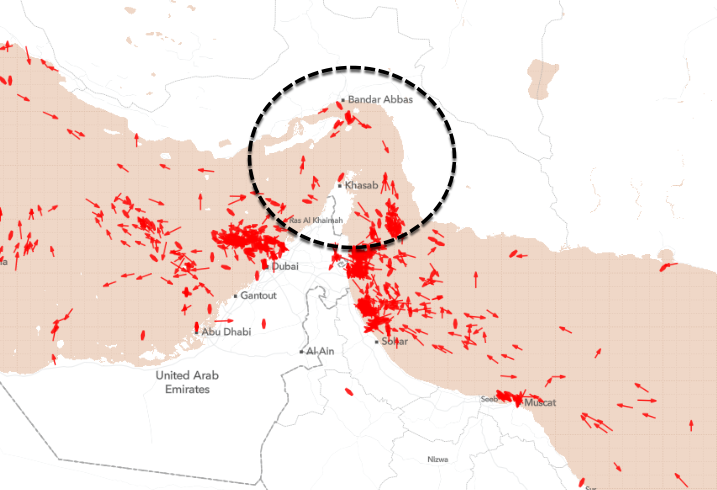
The ceasefire deal in the six-week US-Iran conflict remained in doubt by late week, as Israel intensified its bombardment of Beirut, Tehran kept the Hormuz chokepoint closed, and negotiators prepared to meet on Friday even as both sides declared victory.
Reports of attacks on one of Saudi Arabia’s Red Sea ports, alongside the continued closure of Hormuz, did little to reassure traders in the overnight session. Risk sentiment remained fragile on Thursday morning, with equities across Asia and Europe trading lower and U.S. equity futures subdued. Brent crude hovered around $98 per barrel.
With the Hormuz chokepoint now in continued focus, reports have circulated that Iran may demand cryptocurrency payments from shipping companies for oil tankers transiting this critical waterway.
Hamid Hosseini, a spokesperson for Iran’s Oil, Gas and Petrochemical Products Exporters’ Union, told the Financial Times on Wednesday that Iran wanted to collect toll fees from tankers passing through the strait and inspect each vessel.
“Iran needs to monitor what goes in and out of the strait to ensure these two weeks aren’t used for transferring weapons,” said Hosseini. “Everything can pass through, but the procedure will take time for each vessel, and Iran is not in a rush.”
He said the transit toll for the critical waterway would be $1 per barrel of oil, adding, “Once the email arrives and Iran completes its assessment, vessels are given only a few seconds to pay in bitcoin, ensuring they can’t be traced or confiscated due to sanctions.”
According to Arsenio Dominguez, head of the International Maritime Organization, imposing tolls at the maritime chokepoint would set a dangerous precedent and break with established international maritime norms, he told Bloomberg TV earlier.
“This is a dangerous precedent,” Dominguez said.
“What we cannot have is a different or parallel approach where another country introduces a mechanism that is not in line with international practice, and we don’t even know if it guarantees the safety of ships.”
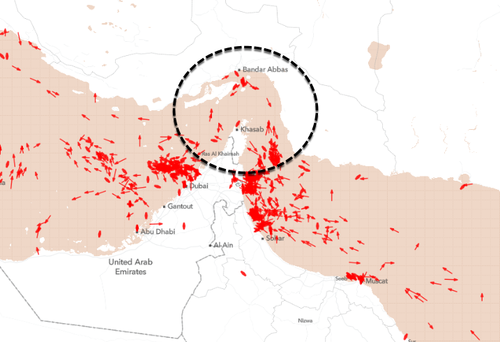
He also said maritime traffic through the strait remains largely halted, while the IMO is working to restore the prewar transit rules based on the international traffic separation scheme.
“The Strait of Hormuz is not open,” says Sultan Al Jaber, the CEO of Adnoc
The US and Iran have agreed to a two-week ceasefire in exchange for Tehran reopening the Strait of Hormuz. But there has also been little change in traffic since that truce pic.twitter.com/d11G4jlg0S
— Stephen Stapczynski (@SStapczynski) April 9, 2026
Related Strait News:
Iran Gives Approved Hormuz Shippers “Few Seconds” To Submit Payment In Bitcoin
First Two Ships Pass Through Strait Of Hormuz Since Ceasefire As Iran Demands Payment In Crypto
Morgan Stanley No Longer Expects Strait Of Hormuz To Reopen In April
Has Concern Over Hormuz Made Us Forget The Red Sea?
Such a precedent would almost certainly not go unnoticed by Iran-aligned Houthi rebels in Yemen, who already have a history of launching missiles and low-cost, one-way attack drones at vessels transiting the Bab el-Mandeb chokepoint between Yemen and the Horn of Africa.
Any copycat tolling regime there would only deepen maritime bottlenecks and compound the risks for global shipping.
Tyler Durden
Thu, 04/09/2026 – 07:45

Even A 1% Bitcoin Allocation Can Drastically Reshape Portfolio Risk, Schwab Finds
Even A 1% Bitcoin Allocation Can Drastically Reshape Portfolio Risk, Schwab Finds
Authored by Micah Zimmerman via BitcoinMagazine.com,
A new research note from Charles Schwab is challenging a simple question many investors still ask: how much cryptocurrency is “right” for a portfolio.
The answer, the firm argues, is less about prediction and more about psychology—specifically, how much volatility an investor can realistically live with.
The report focuses on exposure to Bitcoin and Ethereum, two of the most widely held digital assets. While they often enter portfolios as small “satellite” positions, Schwab finds they can behave like much larger holdings once risk is taken into account.
Even allocations as low as 1% to 3% can meaningfully reshape portfolio behavior, the analysis shows. That shift is not just about returns. It is about how a portfolio feels during stress. In sharp market declines, crypto does not sit quietly in the background. It moves first, and often further than traditional assets.
“Any allocation to cryptocurrency is likely to increase a portfolio’s volatility,” the report notes, pointing to historical drawdowns that have exceeded 70% for both Bitcoin and Ethereum in past cycles.
Schwab: Steady allocations vs. risk budget
The core message is not a warning to avoid crypto, but a reminder that its role changes depending on how it is used.
Schwab outlines two frameworks investors tend to rely on.
The first is familiar: build allocations using expected returns, volatility, and correlations with stocks and bonds. In practice, this method breaks down quickly because assumptions about future crypto returns vary widely.
A second approach shifts the focus. Instead of forecasting returns, investors set a “risk budget,” deciding how much total volatility they are willing to let crypto contribute. Under this lens, portfolio construction becomes less about conviction in price targets and more about tolerance for loss.
The firm stresses that there is no single correct allocation. That uncertainty, it argues, is part of the asset class itself. Crypto behaves differently across cycles, and those differences can be uncomfortable when markets turn.
In more conservative portfolios, even a small Bitcoin position can account for a disproportionate share of total risk. That dynamic forces a tradeoff: modest allocations may limit upside, but larger ones can overwhelm the stability of the broader portfolio.
Schwab also emphasized in the report that digital assets remain speculative. They are not backed by central banks, and they lack many of the protections found in traditional securities. Liquidity, custody, and fraud risks remain part of the equation.
The report did not dismiss the asset class. Instead, it places the decision back with the investor. The question is not whether crypto belongs in a portfolio in theory, but what level of uncertainty an investor is willing to accept in practice—and how much of that uncertainty they are willing to see reflected in every market swing.
Last week, Charles Schwab announced plans for a new “Schwab Crypto” account that would let clients buy and sell bitcoin directly through its platform, marking a deeper push into spot crypto trading.
The offering, developed under Charles Schwab Premier Bank and currently on a waitlist pending regulatory approval, would put the firm in closer competition with platforms like Coinbase, Robinhood, and Webull.
Tyler Durden
Thu, 04/09/2026 – 07:20

Iryna Zarutska’s Accused Killer Found Incompetent To Stand Trial In Charlotte Stabbing
Iryna Zarutska’s Accused Killer Found Incompetent To Stand Trial In Charlotte Stabbing
In a development that has reignited outrage over North Carolina’s handling of violent repeat offenders and the mentally ill, the man accused of savagely murdering Ukrainian refugee Iryna Zarutska on a Charlotte light-rail train – saying “I got that white girl” – has been declared “incapable to proceed” with his state murder trial.
Decarlos Brown Jr., a 35-year-old homeless man with a long criminal history and diagnosed schizophrenia, was evaluated at Central Regional Hospital on December 29, 2025. Court filings made public this week reveal that mental-health experts determined he lacks the capacity to understand the proceedings or assist in his own defense. A motion filed April 7 by his state public defender in Mecklenburg Superior Court formally disclosed the findings and requested a 180-day delay of an upcoming competency hearing originally set for April 30.
The ruling throws the state first-degree murder case into limbo. Under North Carolina law, if Brown is formally ruled incompetent, the charges could eventually be dismissed without prejudice – meaning they could be refiled only if and when he is restored to competency. But restoring competency in cases like this often takes a year or more because of severe shortages at state psychiatric facilities. Brown remains in federal custody, where he faces separate charges that could still carry the death penalty.
A random horror caught on camera
The killing occurred on the evening of August 22, 2025. Twenty-three-year-old Iryna Zarutska, still wearing her black baseball cap from her shift at Zepeddie’s Pizza, boarded the Lynx Blue Line light-rail train heading home. She took a seat. Seconds later, Brown—already seated directly behind her—pulled a pocketknife from his hoodie and stabbed her three times in the neck and upper body in a sudden, unprovoked attack.
Surveillance video, which quickly circulated online, captured the gruesome moment: Zarutska’s desperate attempts to fight back as blood poured from her wounds, while other passengers initially failed to intervene. Brown stood, wandered through the train leaving a trail of blood, and exited at the East/West Boulevard station. He was arrested on the platform minutes later. Investigators say he told officers he believed the young woman had been “reading his mind.”
Zarutska, who had fled the Russian invasion of Ukraine in 2022 seeking safety and a new life in America, died at the scene. Friends and family described her as vibrant, hardworking, and full of hope. Heart-wrenching videos later shared by loved ones showed her laughing, cooking, and enjoying simple moments with friends—images that stood in heartbreaking contrast to the brutality of her final minutes.
A suspect with a long trail of red flags
Brown was no stranger to the justice system. Court records and family statements show he had amassed more than 14 arrests in North Carolina since 2007, including charges for assault, firearms violations, and felony robbery.
Two years after he was released from a five-year sentence for robbery, the same year Zarutska fled Ukraine, Brown was arrested again for assaulting his sister, who did not pursue charges.
His mother and sister have publicly described a sharp decline in his mental health after a prison stint, including violent outbursts, delusions, and refusal to take prescribed medication for schizophrenia. Despite multiple attempts by his family to have him involuntarily committed, he was repeatedly released – most recently on cashless bail after what authorities described as a bogus 911 call.
Critics have pointed to these repeated failures of the mental-health and criminal-justice systems as the reason Brown was free to board that light-rail train.
Dual tracks: state case stalled, federal case moves forward
While the state murder prosecution now faces indefinite delay, federal authorities are not bound by the same competency ruling. In October 2025, a federal grand jury indicted Brown on charges of committing violence resulting in death on a mass transportation system – a statute that carries the possibility of life in prison or the death penalty. President Donald Trump publicly called for capital punishment in the case shortly after the killing.
Brown’s federal defense team has also raised competency concerns, and psychiatric evaluations in the federal system are ongoing or have been extended. He is currently being held in federal custody, reportedly in Chicago.
Defense attorney Daniel Roberts confirmed to reporters that Brown’s location in federal custody is one reason the state competency hearing needs to be postponed.
Following Zarutska’s murder vigils were held in Charlotte and beyond. The graphic video of the attack fueled widespread anger over “soft-on-crime” policies, cashless bail, and the revolving door for mentally ill offenders. Within two months, North Carolina Gov. Josh Stein signed “Iryna’s Law,” a sweeping criminal-justice reform package that ends cashless bail for certain violent and repeat offenders and strengthens background checks for those with serious mental-health histories.
The case also spotlighted broader failures in civil commitment laws. Brown’s family had tried—twice—to have him hospitalized against his will. The first attempt failed because he was not deemed an imminent danger to himself or others under state criteria. The second resulted in a two-week stay and medication, but he was discharged over his mother’s objections. He soon stopped taking his pills and spiraled again.
What happens next?
For Zarutska’s loved ones, the latest court development feels like another cruel delay in seeing justice done. Her boyfriend and family have spoken out repeatedly, slamming the system that allowed a man with such a clear record of violence and mental instability to roam the streets.
Brown’s state case is now effectively on ice. If he is never restored to competency – a real possibility given the backlog of psychiatric beds—the state charges could be dropped permanently. The federal case, however, remains active and could still result in a trial and severe punishment.
Tyler Durden
Thu, 04/09/2026 – 06:55

Is The Dollar Collapsing? 8 Key Indicators You Can’t Ignore
Is The Dollar Collapsing? 8 Key Indicators You Can’t Ignore
Authored by Nick Giambruno via InternationalMan.com,
There are eight key indicators to watch as the US government falls deeper into the self-perpetuating debt spiral.
Indicator #1: Federal Budget Deficits
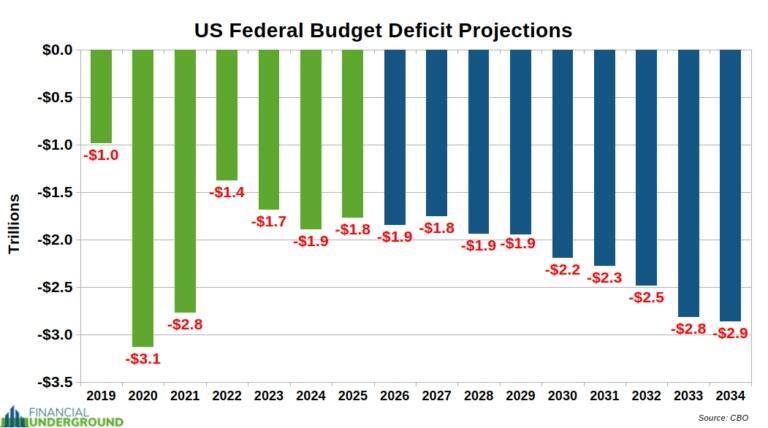
The chart below shows the actual and projected federal budget deficits.
It’s important to note that these projections rest on the ridiculous assumption that there will be no wars, recessions, or other events that drive additional federal spending. That assumption is already out the window with the Iran war: the Pentagon has requested an additional $200 billion, for starters.
Even with this rosy and unrealistic forecast, the US government is projected to run a cumulative deficit of over $22 trillion over the next ten years—deficits that will have to be financed by issuing more debt, a significant share of which will likely be bought by the Federal Reserve with “money” it creates out of thin air.
Indicator #2: The Federal Debt
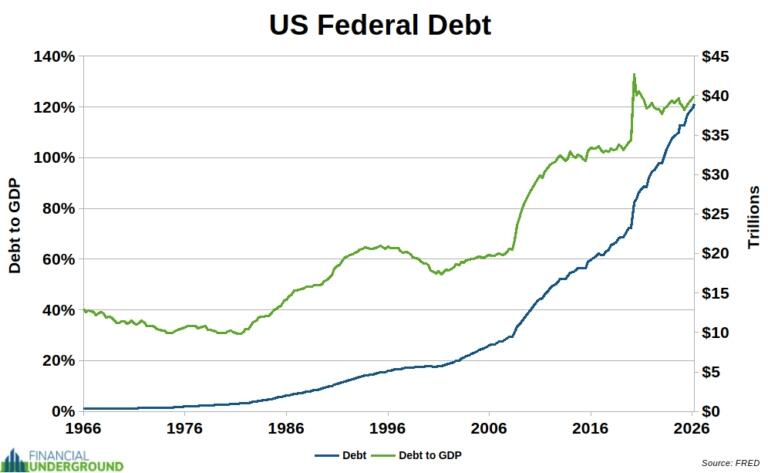
The federal debt has exceeded $39 trillion, representing more than 124% of GDP.
It’s important to remember that GDP is a flawed statistic. For example, it counts government spending as a positive. A more honest measure would count government spending as a big negative, as it compounds the debt spiral. In the US, government spending accounts for at least 37% of GDP.
In other words, the amount of debt relative to the productive economy is much more than the official numbers suggest.
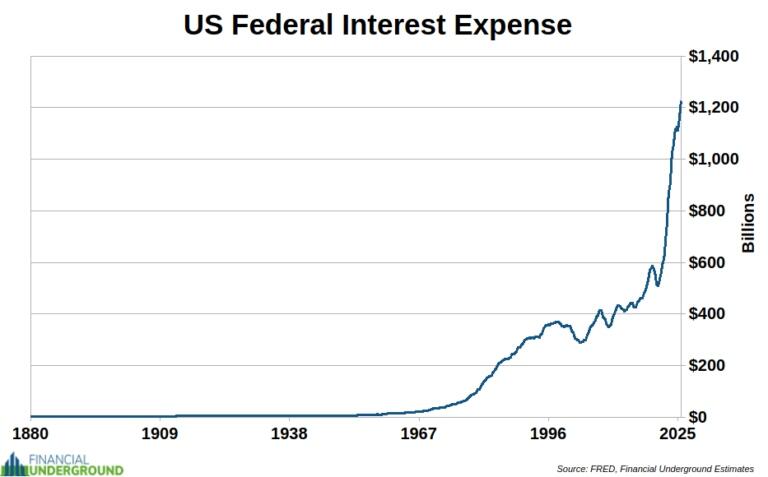
Indicator #3: The Federal Interest Expense
Annualized interest on the federal debt exceeds $1.2 trillion and is surging higher. That means more than 23% of federal tax revenue is going just to service interest on the existing debt.
The interest cost on the federal debt is already the US government’s second-largest outlay. It’s set to exceed Social Security and become the biggest federal expenditure in a matter of months.
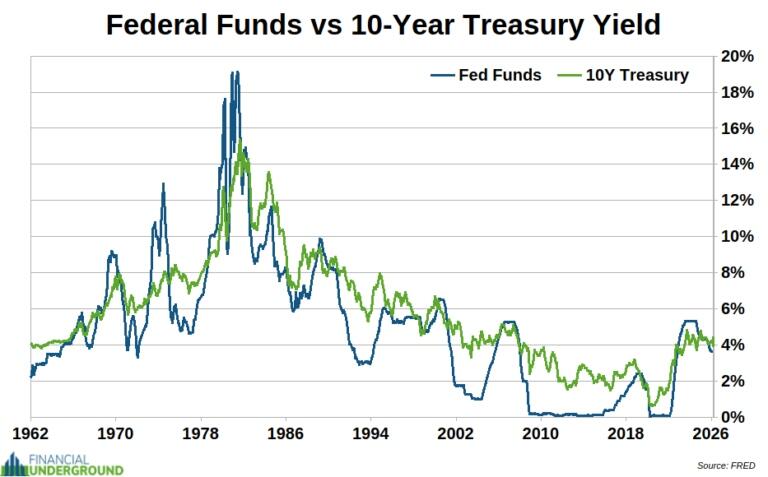
Indicator #4: The Federal Funds Rate and the 10-Year Treasury Yield
Whenever discussing the Fed or central banks, it’s essential to keep the basics in mind.
You have to start with the most fundamental concept: central planning doesn’t work. That’s the first principle.
Central planning of shoes doesn’t work. Central planning of wheat doesn’t work. And central planning of (fake) money doesn’t work.
Central banks in general—and the Fed in particular—are on a mission impossible. They don’t know what the interest rate should be. Nobody does. That’s something only a voluntary market of savers and borrowers, dealing in honest money, can determine.
A politburo can’t centrally plan interest rates any more than it can potatoes. They are inevitably going to fail—and cause significant damage in the process.
It’s also crucial to remember that central banks have nothing to do with the free market. They are, in fact, the antithesis of it.
In Karl Marx’s Communist Manifesto, central banking is the fifth plank.
With that important context in mind, consider the following.
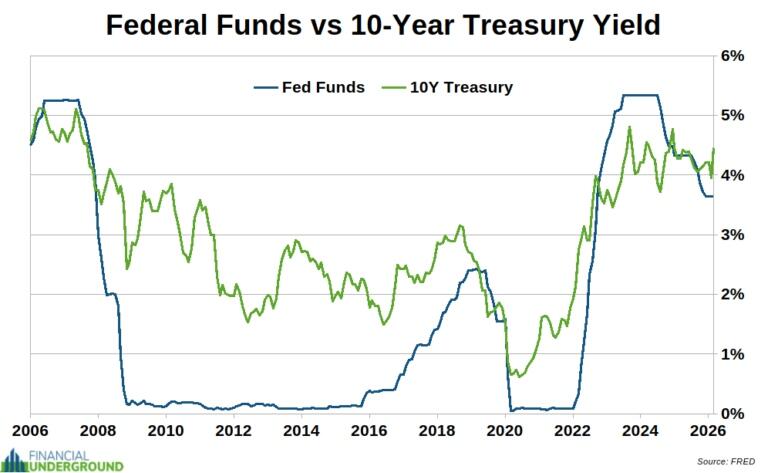
In the wake of the 2008 financial crisis, the Fed brought interest rates to roughly 0% and held them there for years.
Then, in late 2015, they started a rate-hiking cycle that lasted until the repo market turmoil in late 2019.
After the outbreak of the Covid hysteria in early 2020, the Fed brought interest rates back down to around 0%.
Inflation subsequently hit 40-year highs in 2022, forcing the Fed into another rate-hiking cycle, one of the steepest in history.
In just 18 months, the Fed hiked rates from around 0% to over 5%.
The Fed has now pivoted back to monetary easing and rate cuts without having defeated inflation.
The Federal Reserve essentially controls short-term interest rates, such as the Federal Funds rate, which is the interest rate at which banks lend to each other overnight.
Long-term interest rates, like the 10-year Treasury yield, work differently. These rates are shaped by a much larger market influenced by various factors beyond the Fed’s control.
While the Fed has significant influence and can impact long-term rates by purchasing bonds like the 10-Year Treasury, other market dynamics also play a role. In short, the Fed can exert some influence over long-term rates but does not fully control them.
The 10-year Treasury yield reflects the annual return an investor can expect if they purchase a 10-year US Treasury bond today and hold it until maturity.
The 10-year Treasury yield is perhaps the most important financial benchmark in the global fiat system, as it drives valuations and market trends worldwide. It is widely (and erroneously) thought of as the risk-free rate of return.
The 10-year Treasury yield can be thought of as a key barometer of the US dollar-based fiat system—a critical measure akin to its “beating heart.”
Bond yields move inversely to bond prices. When bond prices fall, bond yields rise.
A rising 10-year Treasury yield signals trouble for the US dollar because it indicates that investors are selling off bonds, which increases the US government’s borrowing costs.
Indicator #5: The Fed’s Balance Sheet
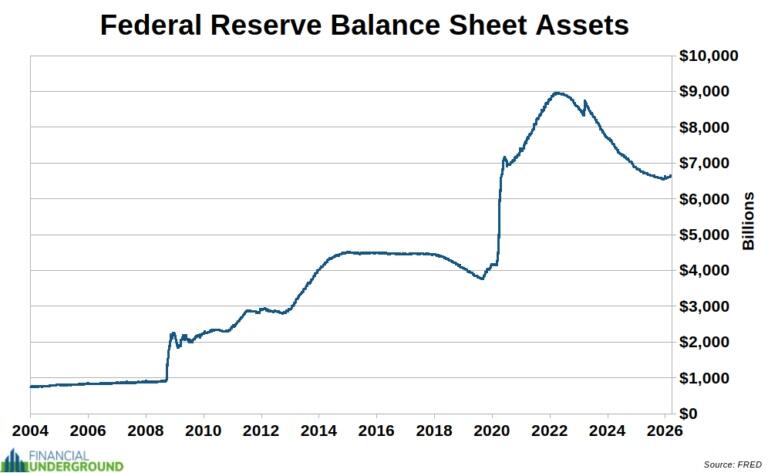
The Fed recently announced that it has ended the shrinking of its balance sheet and will now begin expanding it again.
The Fed insists this isn’t quantitative easing, calling it “reserve management” and pointing out that it isn’t explicitly targeting long-term Treasuries. That’s just wordplay. Buying Treasuries with newly created money is money printing, regardless of what label they attach to it. The Fed’s balance sheet is expanding again. A new printing cycle has begun.
We’ve seen this pattern repeatedly. The Fed expands its balance sheet, then tries to shrink it. Something eventually breaks in the financial system, and the Fed pivots right back to easing and money creation. Each time this happens, the balance sheet never returns to its prior level. It ratchets permanently higher with every cycle of debasement.
What makes the current situation especially telling is that the Fed is entering another balance-sheet expansion phase even though the balance sheet is still more than 50% larger than it was before the Covid mass psychosis.
Before 2020, the Fed’s balance sheet was roughly $4 trillion. It exploded to nearly $9 trillion during the Covid response. Even after so-called “quantitative tightening,” it remains nowhere near its pre-Covid level.
This completely contradicts the Fed’s long-standing claim that programs like QE are temporary.
Remember when former Fed Chair Ben Bernanke promised the balance sheet would eventually normalize after the 2008 financial crisis? That promise was made nearly 15 years ago, when the Fed’s balance sheet was around $2.5 trillion and was supposed to shrink back toward pre-crisis levels below $1 trillion. Instead, today the balance sheet is more than double what it was when Bernanke made that pledge — and now the Fed is entering yet another expansion cycle that threatens to push it even higher.
The long-term trend is obvious. The balance sheet only goes one direction: up. And the implication is unavoidable. Every time the Fed expands its balance sheet, it debases the currency. This isn’t an accident or a temporary policy error — it’s the core feature of the system.
If you’re wondering what comes next, look at the chart below—and note what followed the last time the Fed shifted from shrinking its balance sheet to expanding it.
We are now in the top of the first inning of what may become the most aggressive balance sheet expansion cycle in the Fed’s history.
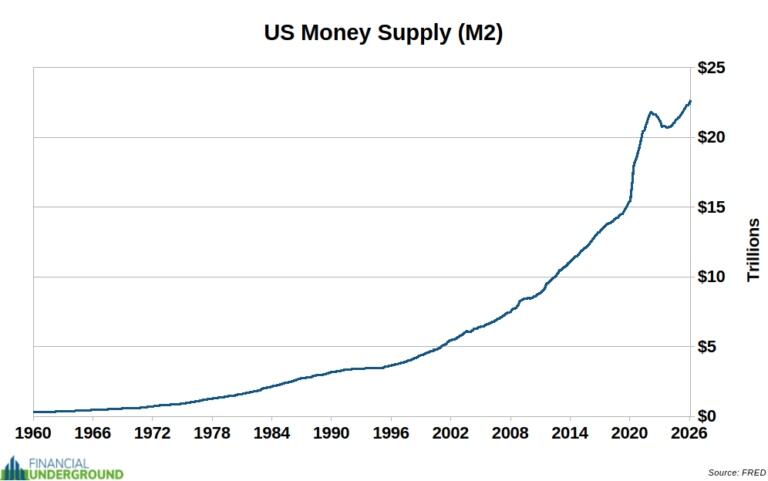
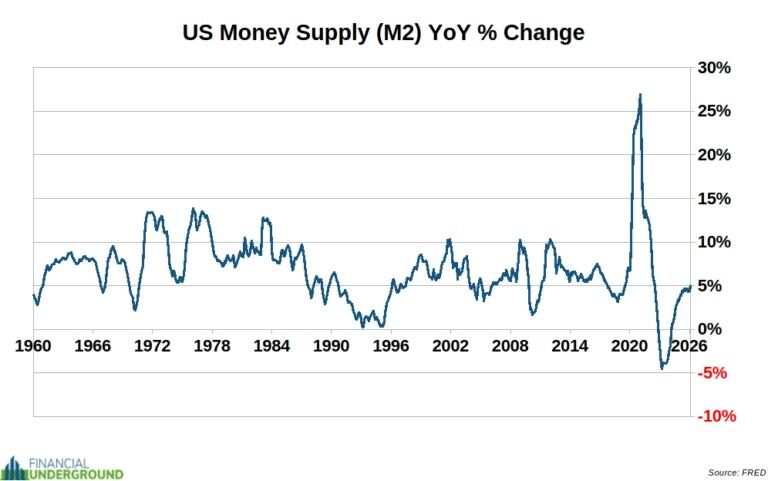
Indicator #6: Money Supply
Imagine working 9 to 5 for 50 years, only for the Federal Reserve to print 40% of the money supply and inflate away 20 years of your hard work.
You don’t have to imagine—it actually happened during the COVID mass psychosis, as governments worldwide indulged in a frenzy of currency debasement.
I have no doubt that something like this or much worse will happen again soon.
Remember, the Fed has only two tools in its toolbox: currency debasement and gaslighting.
The skyrocketing interest expense forces the Fed to implement interest cost control policies, which inflate the money supply. These include buying Treasuries with money the Fed creates out of thin air and similar measures.
No matter what the Fed calls it, the only way they can try to control interest costs is to inflate the money supply.
However, that is ultimately self-defeating because it creates inflation, which causes bond investors to demand high interest rates to compensate for.
Regardless, the Fed inflates the money supply anyway in a misguided attempt to control interest costs because that is the only thing it can do.
The long-term average YoY change in the money supply is 6.8% per year.
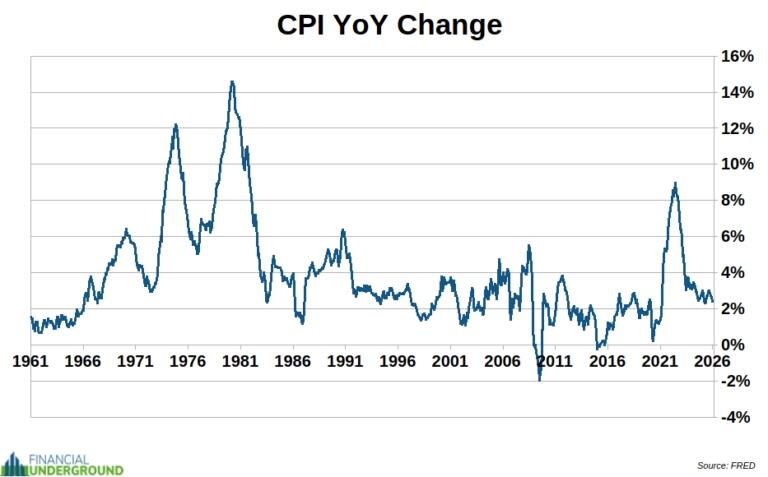
Indicator #7: Consumer Price Index
The Consumer Price Index (CPI) is the most politically manipulated statistic in all of government. That is saying something because many government statistics are completely manipulated, but inflation, as measured by the CPI, is probably the most manipulated.
The CPI is a basket of prices trying to measure the average price changes for 340 million Americans.
It’s an impossible task because every individual has a different price basket. Consider someone who lives in New York City compared to someone who lives in rural Montana. They have totally different price baskets.
Using the CPI as a measure of price increases for 340 million people is even more preposterous than taking the average temperature across 50 states in the US as a meaningful statistic to determine what clothes you should wear today.
Further, the government gets to cherry-pick what items go in the CPI basket and their weightings. It’s like letting a student grade his own paper.
In short, the CPI is misleading government propaganda intended to conceal the government’s atrocious currency debasement.
All that being said, it is useful to monitor the CPI, not as a meaningful metric to gauge inflation, but as a metric to analyze the Fed’s actions and gaslighting.
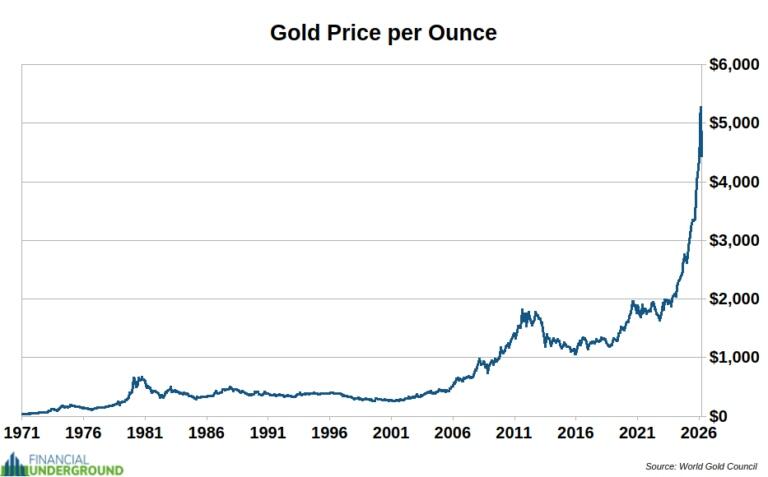
Indicator #8: The Gold Price
Gold is mankind’s most enduring form of money—for over 5,000 years—because of its unique characteristics that made it best suited to store and exchange value.
Gold is durable, divisible, consistent, convenient, scarce, and most importantly, the “hardest” of all physical commodities.
In other words, gold is the one physical commodity that is the “hardest to produce” (relative to existing stockpiles) and, therefore, the most resistant to debasement.
Gold is indestructible, and its stockpiles have built up over thousands of years. That’s a big reason why the growth of new gold supply—typically 1-2% per year—is insignificant.
In other words, nobody can arbitrarily inflate the supply.
That makes gold an excellent store of value and gives the yellow metal its superior monetary properties.
People in every country of the world value gold. Its worth doesn’t depend on any government or any counterparty at all. Gold has always been an inherently international and politically neutral asset. This is why different civilizations around the world have used gold as money for millennia.
From a historical point of view, using fiat currency as money is a relatively new concept. As it fades, I expect people will rediscover the world’s premier money: gold.
This trend is already well underway.
I expect the price of gold, which is already hitting record highs, to soar as this all plays out.
These eight indicators all point in the same direction: more debt, more money printing, and more damage to the dollar’s purchasing power.
To see what this could mean for your financial future—and the three practical moves you can make now—I recommend reading a free special report I just published before the next stage of the crisis unfolds. Click here to get the free report now.
Tyler Durden
Thu, 04/09/2026 – 06:30
https://www.zerohedge.com/personal-finance/dollar-collapsing-8-key-indicators-you-cant-ignore
Meteorologists Warn About Super El Nino Event
Meteorologists Warn About Super El Nino Event
Weather forecasters are sounding the alarm about what could become a “super” El Niño event, potentially one of the strongest on record.
“Strongest El Niño on record this year?!” meteorologist Ben Noll wrote on X. Noll said the latest ECMWF outlook indicates a 75% chance of a super El Niño by October, with “some scenarios suggesting the most intense event in more than a century.”
Strongest El Niño on record this year?!
New ECMWF guidance shows a *75% chance of a super El Niño* by October, with some scenarios suggesting the most intense event in more than a century.
It will bring wide-reaching weather impacts that last into 2027 🧵 pic.twitter.com/cRZrxGCxAa
— Ben Noll (@BenNollWeather) April 6, 2026
Noll said, “El Niño forming by May, potentially becoming strong by August — new ECMWF seasonal modeling.”
Latest El Niño odds:
22% chance of a super El Niño by August
80% chance of a strong event
98% chance of a moderate event
El Niño forming by May, potentially becoming strong by August — new ECMWF seasonal modeling.
By the numbers:
• 22% chance of a super El Niño by August
• 80% chance of a strong event
• 98% chance of a moderate event
That’s according to data from 50 ensemble members. pic.twitter.com/LDOogrRcEC
— Ben Noll (@BenNollWeather) March 6, 2026
Meteorologist Ryan Maue noted:
New maps causing meteorologists to lose their minds in disbelief at massive heat build-up in the Equatorial Pacific
The oceans will not literally be boiling red 🔴 in the early autumn, but the Super El Niño will drive unprecedented global extreme weather events. pic.twitter.com/cEAmGIHuFI
— Ryan Maue (@RyanMaue) April 7, 2026
Impacts for agri traders:
As we get into the middle/end of the growing season, the influence of a Super El Niño will need to be monitored going forward in all outlooks. Check out the SST Anomalies for August!
Come chat with us about this as we continue to tweak summer outlooks: https://t.co/FOJHGVeXkc pic.twitter.com/GgTB4XXNJn
— BAM Weather (@bam_weather) April 7, 2026
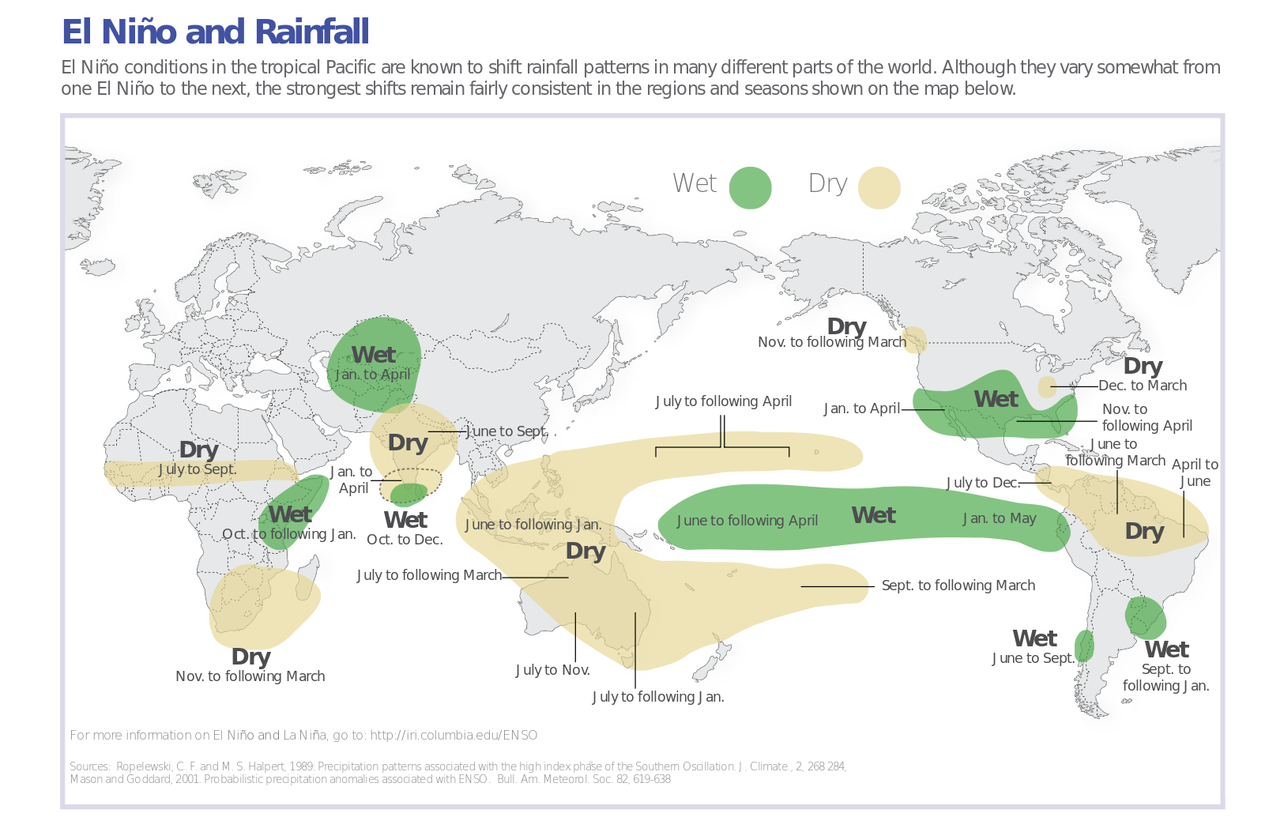
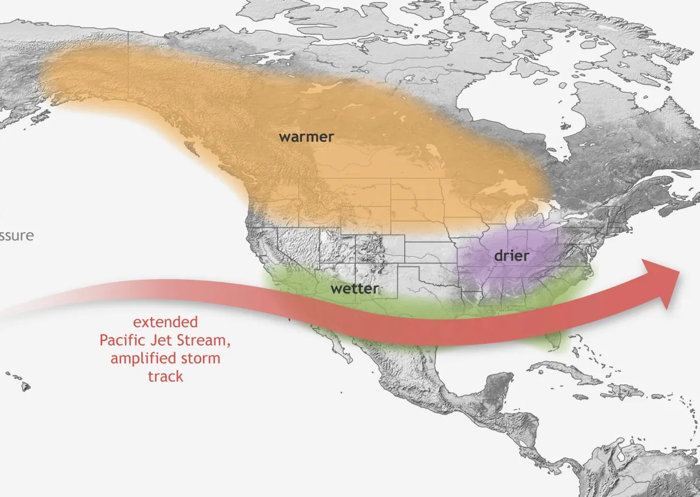
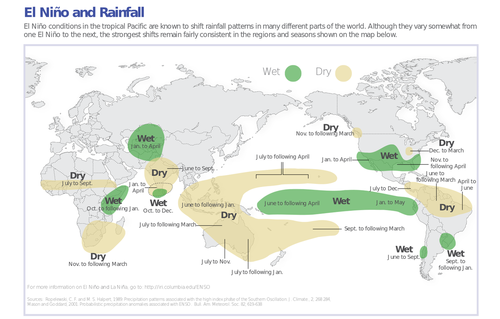
If that scenario materializes, it could shift weather patterns worldwide, increasing the risk of flooding in some regions, drought and wildfires in others, and further raising global temperatures. An El Niño event typically strengthens the Pacific jet stream and redistributes heat and moisture globally.
Across the U.S., an El Niño influences seasonal rainfall, especially during winter. The stronger, more active jet stream typically shifts south, bringing wetter-than-average conditions to the southern U.S., including California, the Gulf Coast, and the Mid-South.
The good news is that El Niño reduces Atlantic hurricane activity.
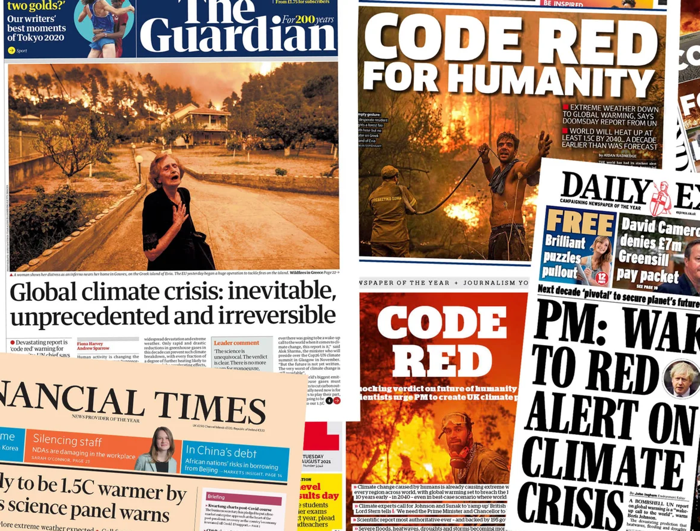
Remember, left-wing corporate media is just a few months away from firing up the “hottest ever” global warming headlines to peddle junk climate science.
Global warming doomers, such as Greta, have shifted more recently from climate alarmism to Palestine activism. It is all about following the money.
Tyler Durden
Thu, 04/09/2026 – 05:45
https://www.zerohedge.com/weather/meteorologists-warn-about-super-el-nino-event
Will Europe Have Its Own FBI? Polish MEP Sounds Alarm Over EU’s Planned Expansion Of Powers For Europol
Will Europe Have Its Own FBI? Polish MEP Sounds Alarm Over EU’s Planned Expansion Of Powers For Europol
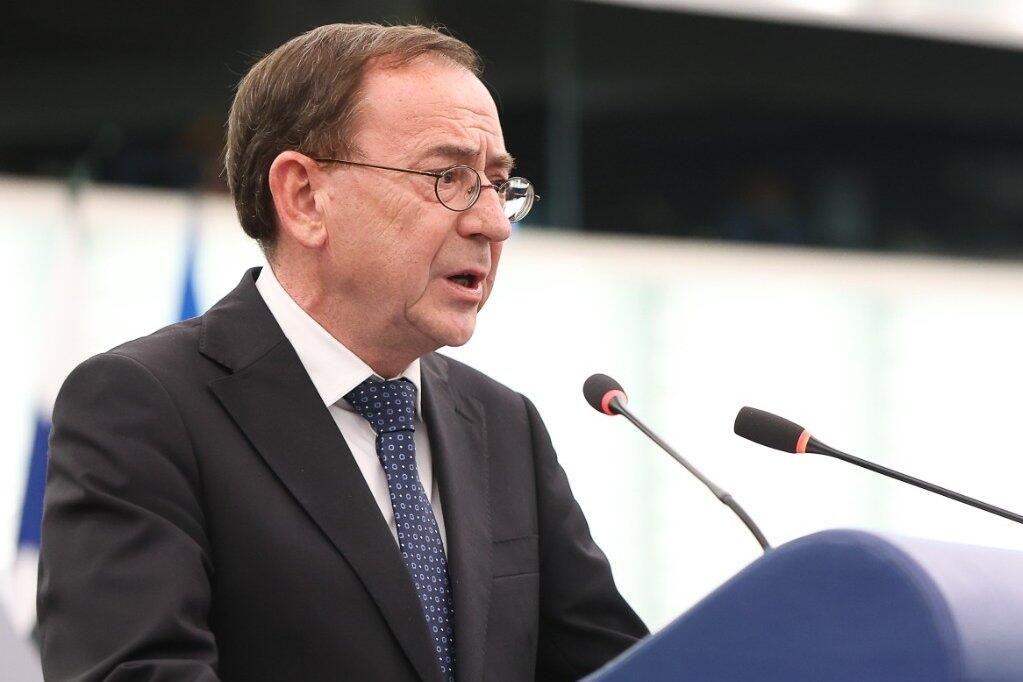
Polish Law and Justice (PiS) MEP Mariusz Kamiński raises alarm about the European Commission’s plans to change Europol’s operations, warning that “the European Commission is quietly building EU law enforcement agencies,” reports Do Rzeczy. There are now fears that Europe could have its own FBI, with vastly expanded and centralized powers.
“The European Public Prosecutor’s Office has already been established, and now the European Commission wants to turn Europol into a ‘truly operational EU police agency.’ This means that citizens of member states will be able to become the target of investigations and operational activities of European law enforcement agencies, bypassing national authorities. This would be a real ‘milestone’ in the construction of a centralized European state. A very dangerous situation!” wrote the former interior and administration minister on X.
Kamiński sent a letter to the European Commission questioning the activities described and defending Europol as it stands.
The agency has been in operation since Jan. 3, 1994.
He notes that “Europol’s success is based on cooperation, supporting member states, and coordinating the fight against cross-border crime. Europol’s activities are particularly important in combating drug crimes, human smuggling, and VAT fraud. This model is a good example of effective cooperation at the European level.”
“Therefore, I oppose the announcements of transforming Europol into a fully operational police agency, which have been met with criticism from many experts and member states. During the LIBE meeting on March 19, 2026, Commissioner Brunner concluded his statement by saying that it will not be a European FBI, which can be interpreted as a departure from the Commission’s radical announcement,” he continued.
The PiS MEP asks: “How does the Commission understand the concept of a ‘truly operational police agency’?” and about safeguards to ensure that Europol “remains an agency supporting member states and not an authority exercising direct police powers.”
Tyler Durden
Thu, 04/09/2026 – 05:00
Cost Of Living Dominates Many Nations’ Biggest Worries
Cost Of Living Dominates Many Nations’ Biggest Worries
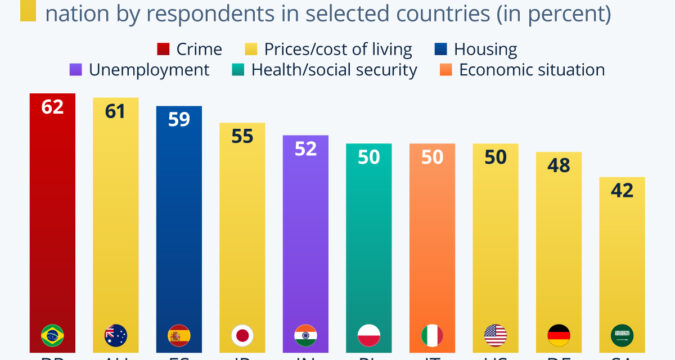
According to Statista Consumer Insights, prices and the cost of living are considered the biggest challenge in around half of the 32 countries included in a recent survey.
This is also true for United States, where the issue ranks first among the 18 surveyed options, with 50 percent citing it as a main concern.
As Statista’s Katharina Buchholz shows in the chart below, the issue is also collectively seen as the biggest problem facing Australia, Japan, Germany and Saudi Arabia.
You will find more infographics at Statista
However, this is not the case everywhere.
In Spain (59 percent) and the Netherlands, the availability of housing is perceived as a significantly more pressing challenge.
The same applies to crime in Brazil (62 percent) and other Latin American countries as well as to the economic situation and unemployment cited most often in Italy and India (50-52 percent of respondents).
Poles meanwhile saw health and social security services as the most central problem, with half of respondents picking this issue.
Tyler Durden
Thu, 04/09/2026 – 04:15
https://www.zerohedge.com/personal-finance/cost-living-dominates-many-nations-biggest-worries
Germany’s Energy Crisis And The National-Conservative Turn
Germany’s Energy Crisis And The National-Conservative Turn
Submitted by Thomas Kolbe
If the Union had been waiting for a favorable moment to save face and quietly escape the energy-policy fiasco, that moment has probably arrived. On Thursday, the European Parliament formed a broad coalition of the Union-backed EPP faction with the national conservatives. The goal: initiate a migration turnaround, prevent citizen chat controls, and soften the grotesque Supply Chain Act.
Among the national-conservative parties in the EU Parliament is also the AfD faction, showing that the firewall against this party is a German phenomenon—a product of hysterical left-green media makers and bloated politicians of the firewall cartel, who fear competition for their privileges.
Never has the opportunity been more favorable to leave the paralyzing logic of the firewall behind once and for all and to form national-civic coalitions than today.
Time is pressing. Germans face a wave of inflation already visible at gas stations and in heating costs. Citizens are approaching a defining initiation moment of truth. Since the beginning of the Iran crisis, fuel prices in Germany have risen by up to 25 percent on average. Gas prices rose another 20 percent in the same period. Going back to 2005, electricity prices in Germany rose a staggering 70 percent—an undeniable proof of the catastrophic failure of the Energiewende.
What the green central planners have left behind can hardly be called energy-market design in the proper sense. On the ruins of a once well-oiled, highly complex structure and the blown-up cooling towers of nuclear plants, a system with built-in fragility has arisen. In a crisis, there are neither sufficient reserves nor systemic resilience against blackouts and the looming economic super-disaster. Above it all hangs the Damocles sword of potential crises that could erupt anywhere in the world at any time and directly hit Germany.
Hormuz reveals the extent of this fragility and exposes the unbelievable hypocrisy behind the green transformation. The story of sun and wind bringing free energy was from the start a bitter fairy tale for anyone not drunk on Trittin, Habeck, and Merkel’s chatter. A mood is brewing, ranging from deep anger to utter contempt for the cult-like transformation ideology.
It is no longer hideable: green transformation is a code word for establishing a vulgar, aggressive extraction mechanism fueled by climate apocalypse fears and moralizing degrowth ideology.
A turn toward modern forms of nuclear energy and the development of Germany’s own enormous gas reserves must now be undertaken—never has public willingness to accept fracking been greater, as the economic crisis sinks into general awareness. Reasonable policy would return to the negotiating table with Russia to urgently discuss resuming gas deliveries. Belgium’s Prime Minister Bart de Wever also called for this. He is far from alone in this view. Hungary, Slovakia, and Italy are forming a real opposition that Brussels will have to reckon with.
But for now, paralysis dominates in the face of economic fallout.
It is painfully clear: Friedrich Merz and his economic minister Katherina Reiche have so far not grasped the extent of the crisis. They rely on the continuity of the green transformation and do not understand that this very construct is both the cause and the end point of the crisis. The bridge that they could now cross together with the AfD has so far been ignored. Reiche did discuss the strategic errors of German energy policy surprisingly openly last week. A possible extension of coal use is suddenly back on the table. But largely, the course remains. Together with Environment Minister Carsten Schneider, Reiche helped secure existing climate policy. Another eight billion euros will be pumped into the green patronage economy. The CO2 market and the ban on combustion engines are held fast.
Beneath it all, green hippie politics shines through like a monolith, blocking any reform effort. Strategic thinking is now needed, beginning with an honest stocktaking to make citizens aware of the true weight of political errors over the past decades. Everyone must understand: there is no simple solution. Politically induced artificial scarcity in the energy sector cannot be erased by chancellor decree.
Or will we possibly start a course correction and dare a 180-degree turn in energy policy? Ideology must give way to reason, green bubble politics to economic prudence, state interventionism to real market design. These are the pillars of the bridge that would then need strengthening and expansion.
But Friedrich Merz is not the Pontifex Maximus we need. He resists all criticism of Brussels’ transformation policies, defends the CO2 certificate trade to the bitter end, and is now preparing, together with his socialist SPD allies, a massive tax hit on the middle class. This man, along with the Union’s leadership team, stands in the way of the future. Merz is the antagonist of the national-conservative turnaround, one of many executors of green hippie politics.
Future national-conservative or national-liberal governments will waste no time fully exposing fiscal fraud, deception, and ideological madness—such as the climate complex. Restoring balance to Germany’s budget, halting Ukraine aid, ending transfers to the green complex, Brussels, and NGOs worldwide will be easy. Necessary social-state reforms, including programs to return illegal migrants, will follow.
As the crisis deepens in the coming years, patriots will gain massive support. This includes libertarians and European cultural patriots, who express their passion for homeland, their will to repair past economic damage, and their desire to preserve Europe’s cultural diversity authentically.
The willingness of people to embrace a reform course, when recognized as contributors to society again, will be overwhelming. Politicians like Katherina Reiche will regret not being part of this turnaround. No bridge will be built for today’s fence-sitters and opportunistic turncoats into future political responsibility.
* * *
About the author: Thomas Kolbe is a German graduate economist. For over 25 years, he has worked as a journalist and media producer for clients from various industries and business associations. As a publicist, he focuses on economic processes and observes geopolitical events from the perspective of the capital markets. His publications follow a philosophy that focuses on the individual and their right to self-determination
Tyler Durden
Thu, 04/09/2026 – 03:30
https://www.zerohedge.com/markets/germanys-energy-crisis-and-national-conservative-turn
Sea Change: ‘Very Unfavorable’ Views of Israel Triple Among US Adults
Sea Change: ‘Very Unfavorable’ Views of Israel Triple Among US Adults
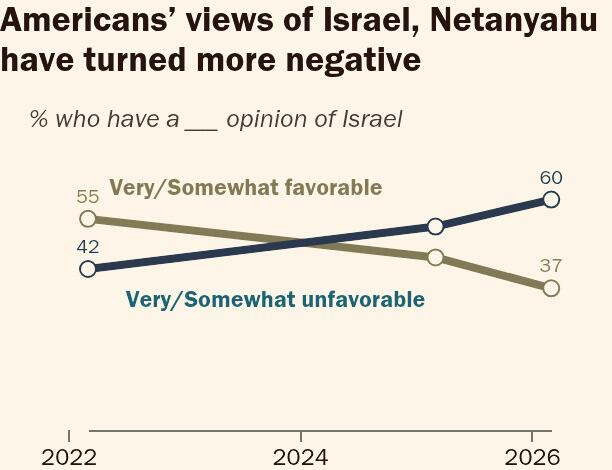
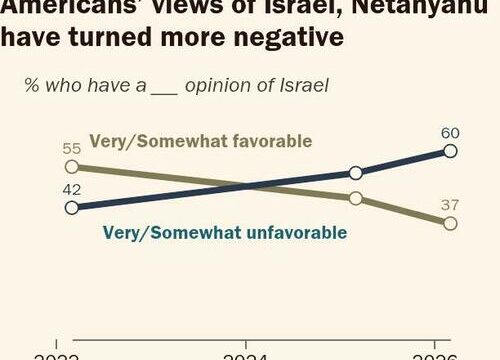
Amid a major war on Iran waged in partnership with the United States, Israel’s reputation among Americans has continued to deteriorate, with 60% of US adults viewing Israel unfavorably. That’s a hefty 18-point increase from 2022, according to a new survey from Pew Research. Over the same stretch, Israel’s “favorable” share cratered by 18 points.
While the top-line unfavorable rating is bad news for Israel, things are even worse when you look under the hood: The proportion of Americans who have a very unfavorable view of Israel now stands at 28% — triple what it was in 2022.
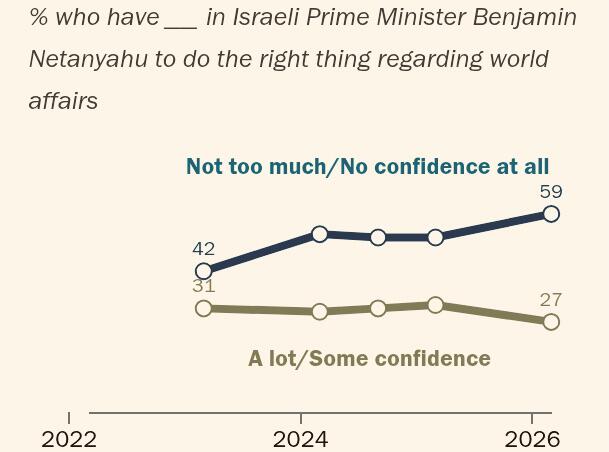
Alongside his country’s sagging standing with the US public, Prime Minister Benjamin Netanyahu is also increasingly unpopular, as 59% of American adults have little or no trust that he will “do the right thing regarding world affairs,” also a seven-point worsening from last year’s finding.
Pew conducted the survey during the week of March 23-29, roughly a month into the US-Israeli war on Iran, but a few weeks before this week’s brinksmanship –which had many fearing a years-long global economic catastrophe if President Trump followed through on his threats to eradicate Iran’s “whole civilization” and Iran carried out its promised destruction of energy and water infrastructure around the Persian Gulf.
There continue to be significant differences between Americans who associate themselves with the Democratic Party and those who are Republicans or Republican “leaners.” A whopping 80% of Democrats have an unfavorable or very unfavorable view of Israel, almost doubling the 41% of Republicans who feel that way. In what may be the most significant sub-trend in US-Israeli politics, a solid 57% majority of Republicans under age 50 now have a negative view of Israel. Unless that turns around, this suggests that the GOP’s status as a fortress of Israeli support will soon be a thing of the past. Republicans are split on Netanyahu: 45% have some or a lot of confidence in him, while 44% have little or no confidence.
There are also interesting contrasts by religious affiliation. Here’s the percent that have mostly positive views of Israel:
White Evangelical Protestants: 65%
Jewish Americans: 64%
White Non-Evangelical Protestants: 39%
Catholics: 35%
Black Protestants: 33%
Unaffiliated/Atheist/Agnostic/”Nothing In Particular”: 22%
As for Trump’s handling of the US-Israel relationship, 55% lack confidence in him to make good decisions. Here again, party differences are huge: Only 16% of Democrats are confident in Trump’s management of the relationship, compared to 73% of Republicans. Here again, a huge difference within the GOP across age cohorts: Only 52% of Republicans under 30 are confident in Trump’s decision-making vis a vis Israel, compared to an overwhelming 93% of those 65 and older.
While Pew didn’t explore the drivers of Israel’s steadily-sagging standing with Americans, it’s safe to say that Israel’s wholesale destruction of Gaza and skepticism over the rationale for US-Israeli warfare on Iran last summer and again this year have played a big part.
Tyler Durden
Thu, 04/09/2026 – 02:45