Category: News

Israel Lifts Restrictions At Jerusalem Holy Sites, Ben Gurion Airport Fully Reopened, Normalcy Returns
Israel Lifts Restrictions At Jerusalem Holy Sites, Ben Gurion Airport Fully Reopened, Normalcy Returns
Israeli cities have suffered heavy bombardment under Iranian and Hezbollah missiles over the past many weeks going back to the start of Trump’s Operation Epic Fury on February 28, but the start of the fragile Iran ceasefire has seen the bombs halted, at least for now.
A sense of normalcy is finally returning across Israeli society, after millions of citizens have on a daily basis had to scramble to get to bomb shelters. Emergency restrictions have been lifted across most parts of the country, and even holy sites in Jerusalem are being opened back up, after Israeli authorities starting last month severely restricted access.
Near the Church of the Holy Sepulchre, Jerusalem. Shutterstock
Jerusalem police on Thursday announced the removal of all restrictions and deployed hundreds of officers and volunteers across the city.
Access to Christian, Jewish, and Muslim holy sites was either fully prohibited or limited to small groups, amid the prior daily barrage of Iranian missile and drone attacks.
The Al-Aqsa Mosque compound has been reopened too. It had remained closed for much of Ramadan and the Eid al-Fitr holiday, which was somewhat unprecedented in recent history. This created immense tensions between Palestinian Muslims and Israeli security forces.
Roman Catholics and Western Christians were severely limited during last weekend’s Easter observances at the Church Of The Holy Sepulchre in Jerusalem’s Old City.
However, the Iran ceasefire and reopening coincides with upcoming Orthodox Christian Easter (Pascha) celebrations on Sunday.
Typically tens of thousands of Christian pilgrims from Russia, Greece, Eastern Europe and elsewhere descend on Jerusalem ahead of Orthodox Holy week, however, travel difficulties and the threat of renewed war have had a chilling effect, and much fewer are expected to attend.
Greek Orthodox Patriarch of Jerusalem Theophilos III led a group of clergy members to the Church of the Holy Sepulchre for prayers on Palm Sunday, following restrictions on gatherings in large groups in Jerusalem’s Old City pic.twitter.com/vTDupzFQEb
— Reuters (@Reuters) April 5, 2026
Israeli police may still move to limit gatherings, and typically they set up barricades in various parts of the Old City in and around the Christian quarter in the name of imposing greater security.
Still, there’s a sense of optimism, but Israeli raids in Lebanon have kept things unpredictable. Iran has been warning against ongoing Israeli strikes on Beirut and elsewhere, and so the war could be renewed at any moment.
Tyler Durden
Thu, 04/09/2026 – 18:00

ChatGPT Accused Of Aiding Florida State Mass Shooter
ChatGPT Accused Of Aiding Florida State Mass Shooter
Authored by Steve Watson via modernity.news,
Big Tech’s leading AI faces growing accusations of enabling violence rather than preventing it.
Attorneys representing the family of Robert Morales, killed in the April 17, 2025, Florida State University shooting, announced plans to sue OpenAI and ChatGPT. The law firm Brooks, LeBoeuf, Foster, Gwartney and Hobbs stated the suspected gunman, Phoenix Ikner, was in “constant communication” with the chatbot leading up to the attack.
Ikner opened fire outside the FSU student union, killing Morales, a 57-year-old Aramark worker and father, and Tiru Chabba, 45, a vendor from South Carolina. Six others were wounded. Court records list more than 270 images of ChatGPT conversations as exhibits.
BREAKING: Florida State University gunman had 270+ chats with ChatGPT right before the shooting that left 2 people dead.
Victims’ attorney just said it “may have advised the shooter how to commit these heinous crimes.”
ChatGPT acted as mass murder consultant. pic.twitter.com/odQYv9LOg8
— DogeDesigner (@cb_doge) April 7, 2026
The firm declared: “We have reason to believe that ChatGPT may have advised the shooter how to commit these heinous crimes. We will therefore file suit against ChatGPT, and its ownership structure, very soon, and will seek to hold them accountable for the untimely and senseless death of our client, Mr. Morales.”
A mass shooter used ChatGPT to plan the FSU shooting, killing 2 and injuring 5.
ChatGPT advised the shooter on executing the deadly shooting on a college campus.
There are more than 270 ChatGPT conversations listed as exhibits in the case.
This is now the 20th death tied to…
— Katie Miller (@KatieMiller) April 8, 2026
Recent coverage also notes newly released chat logs where Ikner reportedly asked ChatGPT about school shootings and the busiest times on campus.
One post referenced details such as the chatbot informing him the Student Union was busiest between 11:30am and 1:30pm, with the shooting occurring at 11:57am.
The New York Post reported the claims in detail.
ChapGPT helped Florida State University gunman plan mass shooting, victim’s attorney claims https://t.co/NDv8zx2Zbg pic.twitter.com/m2tavLoLAx
— New York Post (@nypost) April 8, 2026
OpenAI responded by saying they identified an account believed to be associated with the suspect after the shooting, proactively shared information with law enforcement, and cooperated fully. They claim to build ChatGPT to respond safely and continue improving safeguards.
Yet the body count linked to such interactions keeps rising, while the company’s selective enforcement and post-incident cooperation fail to reassure victims’ families preparing legal action.
This incident follows another high-profile case. In February 2026, Canadian trans shooter Jesse Van Rootselaar carried out a deadly attack at Tumbler Ridge Secondary School.
OpenAI employees were alarmed by his disturbing ChatGPT messages and discussed alerting authorities, but the company chose not to notify police beforehand, instead banning the account.
Canadian trans shooter’s disturbing ChatGPT messages alarmed employees – but company never alerted cops https://t.co/Jl8KhxKZeo pic.twitter.com/Mi8BNrsRFZ
— New York Post (@nypost) February 21, 2026
They only contacted law enforcement after the shooting. A family has already sued OpenAI over that incident as well.
FAMILY SUES OPENAI: “CHATGPT HELPED PLAN MASS SHOOTING”
A lawsuit says the Tumbler Ridge shooter used ChatGPT to help plan the attack, and that employees allegedly flagged the chats as an imminent risk before anyone got hurt.
Source: NewsForce pic.twitter.com/SulETFiGtR
— NewsForce (@Newsforce) March 11, 2026
These developments echo earlier warnings. ChatGPT once provided detailed suicide instructions and drug-and-alcohol guidance when prompted as a fake 13-year-old.
Studies have found that as many as one in four teens now rely on AI therapy bots for mental health support, raising questions about vulnerable users interacting with systems that appear inconsistent on harm prevention.
ChatGPT’s selective ideological programming has also been repeatedly called into question. For example, it once refused a hypothetical request to quietly utter a racial slur even to save a billion white people.
Americans expect technology that upholds safety and individual responsibility, not systems that lecture on ethics while allegedly guiding violence. The mounting lawsuits and documented failures demand accountability from OpenAI and scrutiny of the priorities embedded in its models. Until Big Tech prioritizes preventing real-world harm over narrative control, these tragedies risk becoming a grim pattern rather than isolated failures.
Your support is crucial in helping us defeat mass censorship. Please consider donating via Locals or check out our unique merch. Follow us on X @ModernityNews.
Tyler Durden
Thu, 04/09/2026 – 17:40
https://www.zerohedge.com/ai/openais-chatgpt-accused-aiding-florida-state-mass-shooter
ChatGPT Accused Of Aiding Florida State Mass Shooter
ChatGPT Accused Of Aiding Florida State Mass Shooter
Authored by Steve Watson via modernity.news,
Big Tech’s leading AI faces growing accusations of enabling violence rather than preventing it.
Attorneys representing the family of Robert Morales, killed in the April 17, 2025, Florida State University shooting, announced plans to sue OpenAI and ChatGPT. The law firm Brooks, LeBoeuf, Foster, Gwartney and Hobbs stated the suspected gunman, Phoenix Ikner, was in “constant communication” with the chatbot leading up to the attack.
Ikner opened fire outside the FSU student union, killing Morales, a 57-year-old Aramark worker and father, and Tiru Chabba, 45, a vendor from South Carolina. Six others were wounded. Court records list more than 270 images of ChatGPT conversations as exhibits.
BREAKING: Florida State University gunman had 270+ chats with ChatGPT right before the shooting that left 2 people dead.
Victims’ attorney just said it “may have advised the shooter how to commit these heinous crimes.”
ChatGPT acted as mass murder consultant. pic.twitter.com/odQYv9LOg8
— DogeDesigner (@cb_doge) April 7, 2026
The firm declared: “We have reason to believe that ChatGPT may have advised the shooter how to commit these heinous crimes. We will therefore file suit against ChatGPT, and its ownership structure, very soon, and will seek to hold them accountable for the untimely and senseless death of our client, Mr. Morales.”
A mass shooter used ChatGPT to plan the FSU shooting, killing 2 and injuring 5.
ChatGPT advised the shooter on executing the deadly shooting on a college campus.
There are more than 270 ChatGPT conversations listed as exhibits in the case.
This is now the 20th death tied to…
— Katie Miller (@KatieMiller) April 8, 2026
Recent coverage also notes newly released chat logs where Ikner reportedly asked ChatGPT about school shootings and the busiest times on campus.
One post referenced details such as the chatbot informing him the Student Union was busiest between 11:30am and 1:30pm, with the shooting occurring at 11:57am.
The New York Post reported the claims in detail.
ChapGPT helped Florida State University gunman plan mass shooting, victim’s attorney claims https://t.co/NDv8zx2Zbg pic.twitter.com/m2tavLoLAx
— New York Post (@nypost) April 8, 2026
OpenAI responded by saying they identified an account believed to be associated with the suspect after the shooting, proactively shared information with law enforcement, and cooperated fully. They claim to build ChatGPT to respond safely and continue improving safeguards.
Yet the body count linked to such interactions keeps rising, while the company’s selective enforcement and post-incident cooperation fail to reassure victims’ families preparing legal action.
This incident follows another high-profile case. In February 2026, Canadian trans shooter Jesse Van Rootselaar carried out a deadly attack at Tumbler Ridge Secondary School.
OpenAI employees were alarmed by his disturbing ChatGPT messages and discussed alerting authorities, but the company chose not to notify police beforehand, instead banning the account.
Canadian trans shooter’s disturbing ChatGPT messages alarmed employees – but company never alerted cops https://t.co/Jl8KhxKZeo pic.twitter.com/Mi8BNrsRFZ
— New York Post (@nypost) February 21, 2026
They only contacted law enforcement after the shooting. A family has already sued OpenAI over that incident as well.
FAMILY SUES OPENAI: “CHATGPT HELPED PLAN MASS SHOOTING”
A lawsuit says the Tumbler Ridge shooter used ChatGPT to help plan the attack, and that employees allegedly flagged the chats as an imminent risk before anyone got hurt.
Source: NewsForce pic.twitter.com/SulETFiGtR
— NewsForce (@Newsforce) March 11, 2026
These developments echo earlier warnings. ChatGPT once provided detailed suicide instructions and drug-and-alcohol guidance when prompted as a fake 13-year-old.
Studies have found that as many as one in four teens now rely on AI therapy bots for mental health support, raising questions about vulnerable users interacting with systems that appear inconsistent on harm prevention.
ChatGPT’s selective ideological programming has also been repeatedly called into question. For example, it once refused a hypothetical request to quietly utter a racial slur even to save a billion white people.
Americans expect technology that upholds safety and individual responsibility, not systems that lecture on ethics while allegedly guiding violence. The mounting lawsuits and documented failures demand accountability from OpenAI and scrutiny of the priorities embedded in its models. Until Big Tech prioritizes preventing real-world harm over narrative control, these tragedies risk becoming a grim pattern rather than isolated failures.
Your support is crucial in helping us defeat mass censorship. Please consider donating via Locals or check out our unique merch. Follow us on X @ModernityNews.
Tyler Durden
Thu, 04/09/2026 – 17:40
https://www.zerohedge.com/ai/openais-chatgpt-accused-aiding-florida-state-mass-shooter
Massachusetts Governor Uses Donut Holes To Explain The State Energy Crisis She Caused
Massachusetts Governor Uses Donut Holes To Explain The State Energy Crisis She Caused
The Democrat tendency to talk down to their constituencies as if they are children has become a mainstay of American political discourse in the past several years. This behavior is rooted in a simmering arrogance among the political class, but it also tends to expose their lack of understanding when it comes to some of the more basic economic and industrial concepts.
In other words, Democrats treat people as if people are dumb because they are, in fact, dumb.
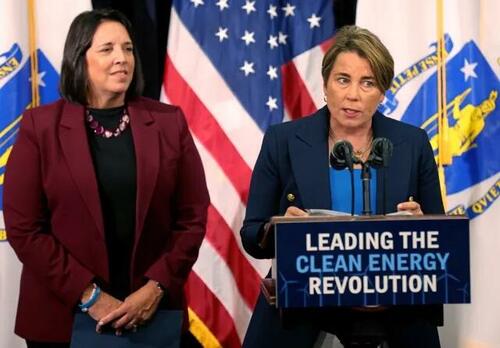
I just signed an Executive Order to bring enough energy into Massachusetts to power 2 million homes — and save families and businesses $10 million.
So how does our all-of-the-above energy strategy actually lower your bills?
Let’s break it down in terms everyone understands:… pic.twitter.com/BijgHM5XTB
— Governor Maura Healey (@MassGovernor) April 6, 2026
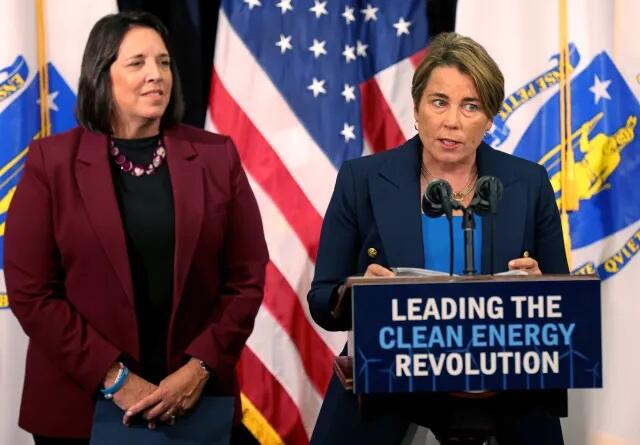
Maura Healey, the Governor of Massachusetts, has been in office since 2023. A Democrat, she boasts of being the first woman and first “openly LGBT” person elected to the position. Her administration’s focus is dedicated to climate change issues, which plays a large part in the reasons why MA is currently facing record high power prices and an overall energy crisis.
As Attorney General and Governor, Healey has pursued a lawsuit against Exxon for “not disclosing” climate risks caused by their products to investors and consumers through marketing campaigns. Of course, there are no “climate risks” caused by Exxon’s products. Why would they disclose a risk that doesn’t exist?
In November 2024, Healey signed “Clean Energy” legislation which includes reforms to prevent natural gas expansion by limiting gas utility investments that conflict with climate change mandates. This disrupts the creation of new fossil fuel infrastructure in an attempt to “phase down” public reliance on gas and redirect focus toward green energy. Critics argue that these policies hinder gas reliability and raise long-term costs for citizens of MA.
Since Healey took office, gas heating prices in MA have risen by 35%-50% and electricity prices are listed among top five most expensive states in the US. Massachusetts already had high energy rates before Healey, but they surged after her climate change policies were implemented.
Green energy, as everyone knows, is far less efficient than oil, gas or coal (20% to 60% less efficient depending on the source). State programs that prioritize green tech while suppressing carbon based energy usually result in higher prices for everyone while also creating a bottleneck and shortages during weather related disasters or global supply chain disruptions.
When Healey holds up donut holes as a representation of Massachusetts’ limited energy resources, what she doesn’t mention is that, unlike donut holes, not all energy sources are the same. Wind power or solar power is far less reliable and efficient compared to natural gas. Electric vehicles often still rely on power generated by coal and natural gas. Around 75% of MA’s energy output comes from natural gas because it is by far the most reliable and affordable source.
Healey’s solution for storage (green tech, batteries, etc.) is far less practical and far more expensive. Natural gas storage is vastly superior in terms of cost and energy output. Massachusetts doesn’t have below ground storage for gas, but relying on storage in other states is still cheaper than the billions of dollars they would need to build battery-based storage in MA.
The Governor then, of course, goes on to blame Donald Trump’s opposition to green tech development as the cause of higher prices. Keep in mind, prices exploded in MA well before Trump took office in 2025. Furthermore, Trump’s criticisms are completely reasonable.
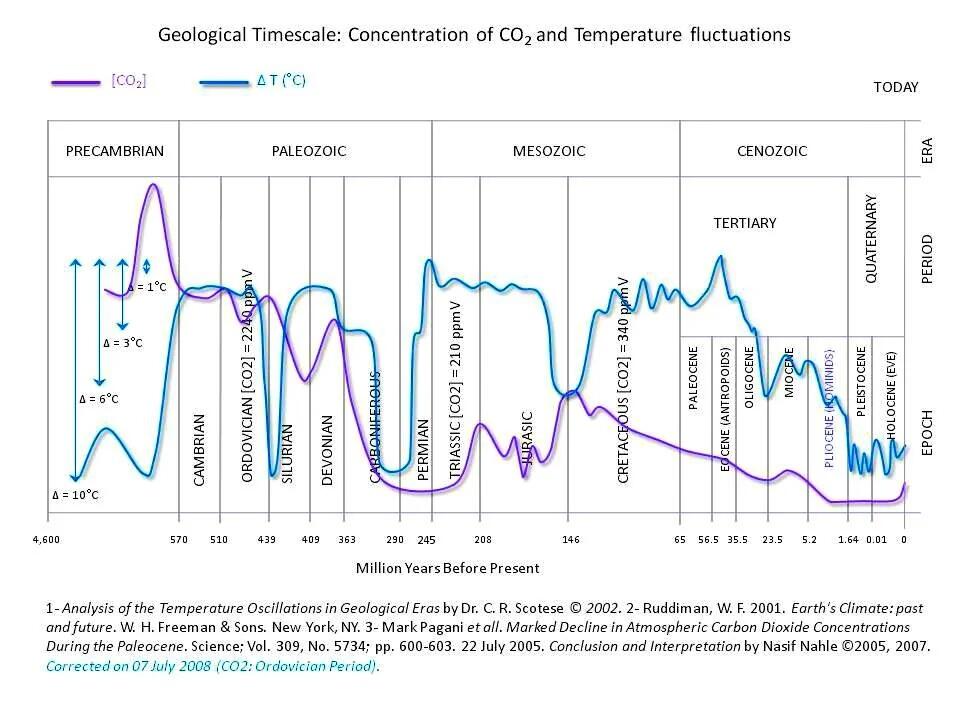
First, climate change theories are a sham. There is no concrete evidence of a causation relationship between carbon, human industry and global warming. None. In fact, the atmospheric carbon record for the past 400 million years doesn’t match the temperature record in the slightest.
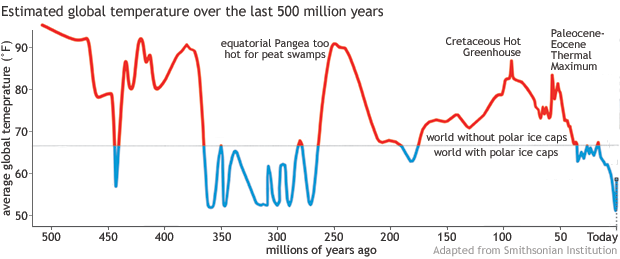
And, temperatures today are far cooler than they have been in the past. That is to say, we are nowhere near record high temperatures for the Earth. Climate scientists make these claims based on records that only go back around 140 years, which is an extremely narrow time window.
Meaning, the pursuit of green tech in the name of saving the planet is pointless, and it’s causing economic suffering for the citizenry. Green energy might one day be efficient enough to supply ample power to the world, but for now it has hobbled legitimate energy production. Today, most financial resources should be put into oil, coal, gas and perhaps nuclear (nuclear plants take 6-10 years to build, plus another 5 years for approval).
Climate obsessed Democrats like Healey are the primary cause of high energy prices in blue states. It is undeniable.
Tyler Durden
Thu, 04/09/2026 – 17:20
Massachusetts Governor Uses Donut Holes To Explain The State Energy Crisis She Caused
Massachusetts Governor Uses Donut Holes To Explain The State Energy Crisis She Caused
The Democrat tendency to talk down to their constituencies as if they are children has become a mainstay of American political discourse in the past several years. This behavior is rooted in a simmering arrogance among the political class, but it also tends to expose their lack of understanding when it comes to some of the more basic economic and industrial concepts.
In other words, Democrats treat people as if people are dumb because they are, in fact, dumb.
I just signed an Executive Order to bring enough energy into Massachusetts to power 2 million homes — and save families and businesses $10 million.
So how does our all-of-the-above energy strategy actually lower your bills?
Let’s break it down in terms everyone understands:… pic.twitter.com/BijgHM5XTB
— Governor Maura Healey (@MassGovernor) April 6, 2026
Maura Healey, the Governor of Massachusetts, has been in office since 2023. A Democrat, she boasts of being the first woman and first “openly LGBT” person elected to the position. Her administration’s focus is dedicated to climate change issues, which plays a large part in the reasons why MA is currently facing record high power prices and an overall energy crisis.
As Attorney General and Governor, Healey has pursued a lawsuit against Exxon for “not disclosing” climate risks caused by their products to investors and consumers through marketing campaigns. Of course, there are no “climate risks” caused by Exxon’s products. Why would they disclose a risk that doesn’t exist?
In November 2024, Healey signed “Clean Energy” legislation which includes reforms to prevent natural gas expansion by limiting gas utility investments that conflict with climate change mandates. This disrupts the creation of new fossil fuel infrastructure in an attempt to “phase down” public reliance on gas and redirect focus toward green energy. Critics argue that these policies hinder gas reliability and raise long-term costs for citizens of MA.
Since Healey took office, gas heating prices in MA have risen by 35%-50% and electricity prices are listed among top five most expensive states in the US. Massachusetts already had high energy rates before Healey, but they surged after her climate change policies were implemented.
Green energy, as everyone knows, is far less efficient than oil, gas or coal (20% to 60% less efficient depending on the source). State programs that prioritize green tech while suppressing carbon based energy usually result in higher prices for everyone while also creating a bottleneck and shortages during weather related disasters or global supply chain disruptions.
When Healey holds up donut holes as a representation of Massachusetts’ limited energy resources, what she doesn’t mention is that, unlike donut holes, not all energy sources are the same. Wind power or solar power is far less reliable and efficient compared to natural gas. Electric vehicles often still rely on power generated by coal and natural gas. Around 75% of MA’s energy output comes from natural gas because it is by far the most reliable and affordable source.
Healey’s solution for storage (green tech, batteries, etc.) is far less practical and far more expensive. Natural gas storage is vastly superior in terms of cost and energy output. Massachusetts doesn’t have below ground storage for gas, but relying on storage in other states is still cheaper than the billions of dollars they would need to build battery-based storage in MA.
The Governor then, of course, goes on to blame Donald Trump’s opposition to green tech development as the cause of higher prices. Keep in mind, prices exploded in MA well before Trump took office in 2025. Furthermore, Trump’s criticisms are completely reasonable.
First, climate change theories are a sham. There is no concrete evidence of a causation relationship between carbon, human industry and global warming. None. In fact, the atmospheric carbon record for the past 400 million years doesn’t match the temperature record in the slightest.
And, temperatures today are far cooler than they have been in the past. That is to say, we are nowhere near record high temperatures for the Earth. Climate scientists make these claims based on records that only go back around 140 years, which is an extremely narrow time window.
Meaning, the pursuit of green tech in the name of saving the planet is pointless, and it’s causing economic suffering for the citizenry. Green energy might one day be efficient enough to supply ample power to the world, but for now it has hobbled legitimate energy production. Today, most financial resources should be put into oil, coal, gas and perhaps nuclear (nuclear plants take 6-10 years to build, plus another 5 years for approval).
Climate obsessed Democrats like Healey are the primary cause of high energy prices in blue states. It is undeniable.
Tyler Durden
Thu, 04/09/2026 – 17:20

FCC Set To Vote on Easing Satellite Power Rules, Boosting SpaceX’s Starlink
FCC Set To Vote on Easing Satellite Power Rules, Boosting SpaceX’s Starlink
Authored by Kimberly Hayek via The Epoch Times (emphasis ours),
The Federal Communications Commission (FCC) announced Wednesday it will vote on an order to revamp satellite spectrum-sharing rules that would benefit low-Earth orbit broadband providers – and SpaceX stands to gain the most.
“By discarding last century’s satellite regulations, we could see billions of dollars in benefits for the American economy and broadband speeds many times faster than what is available today,” FCC Chairman Brendan Carr said in a statement.
“This overdue rethinking of space spectrum sharing rules will bring greater competition to the broadband marketplace and reduce the number of satellites needed to serve a given area.”
The vote on April 30 could reshape how tens of millions of Americans, particularly those in rural communities, connect to the internet from space.
The proposed order would raise the power levels that low-earth orbit (LEO) operators are permitted to use in frequency bands shared with incumbent geostationary orbit systems. For SpaceX, whose Starlink network already spans more than 10,000 satellites, the change would mean substantially faster and more reliable service.
Not everyone is on board. Geostationary operators, including Viasat, SES, and DIRECTV, have opposed the move, arguing that allowing Starlink to transmit at higher power would cause damaging interference to their own networks.
In a filing submitted Tuesday, DIRECTV told the agency that SpaceX’s interference studies contain “significant unresolved questions.”
SpaceX has dismissed those concerns as a defense of the status quo.
“The question of whether the [equivalent power flux density] framework harms consumers by unnecessarily constraining [LEO] services has been definitively resolved: it does,” SpaceX wrote last month. The company added that the current rules unfairly favor what it called outdated satellite systems while leaving rural users underserved.
The FCC appeared to agree. The agency said in its release that “government-imposed overprotection of GSO systems has meant that American households and businesses—most critically in rural and remote areas—do not receive the fastest space-based broadband American innovation has available.”
The international power limits at the center of the dispute were established in the 1990s and were designed to shield geostationary satellites from interference caused by lower-orbiting constellations. At the time, LEO broadband networks like Starlink did not yet exist.
The FCC took an early step toward reform in January, when it approved 7,500 additional second-generation Starlink satellites and granted SpaceX a temporary waiver from the power restrictions while the agency’s broader rulemaking proceeded.
SpaceX has argued that the existing Equivalent Power Flux Density (EPFD) limits rely on obsolete computer models that fail to account for modern beamforming and interference-mitigation technologies now standard in newer satellite systems.
As of March, Starlink’s constellation comprised more than 10,020 satellites in low Earth orbit, accounting for roughly 65 percent of all active satellites worldwide, with more than 10 million subscribers reported as of February.
A formal vote on the new power rules would mark the most consequential shift in satellite spectrum policy in a generation.
Tyler Durden
Thu, 04/09/2026 – 17:00

Beijing Cries Foul Over Chinese Scientist’s Death Following Alleged US Interrogation – Feds Tight-Lipped
Beijing Cries Foul Over Chinese Scientist’s Death Following Alleged US Interrogation – Feds Tight-Lipped
China is accusing U.S. federal authorities of “hostile questioning” by US law enforcement following the death of a groundbreaking Chinese semiconductor researcher who fell to his death inside a University of Michigan building last month, while American law enforcement and university officials remain tight-lipped about any federal involvement.
Danhao Wang, an assistant research scientist in the University of Michigan’s College of Engineering, died after falling from an upper level inside the George G. Brown Building on the Ann Arbor campus around 11 p.m. on March 19. University police responded to the scene and pronounced him dead. The incident is being investigated as a possible act of self-harm, with no indication of foul play or any ongoing threat to the campus community.
GG Brown Building Addition (Architect Magazine)
Chinese officials, including the embassy in Washington and the consulate in Chicago, have strongly linked Wang’s death to what they describe as “unwarranted” interrogation by U.S. law enforcement just before the incident. Beijing has lodged multiple “solemn representations,” accusing the U.S. of overstating national security concerns, engaging in political manipulation, and subjecting Chinese scholars to discriminatory practices that create a “chilling effect” on academic exchanges.
The Chinese Foreign Ministry and embassy spokespeople have publicly demanded a full investigation, a “responsible explanation” to Wang’s family, and an end to such alleged harassment. The embassy confirmed Wang died by suicide and has been assisting his family.
U.S. authorities have offered no confirmation or denial of any questioning. The FBI’s Detroit field office cited its longstanding policy of neither confirming nor denying investigations involving specific individuals. University police and administrators have released only basic details about the fall while the case remains active.
The University of Michigan, as we learned in June and November of last year, is full of China’s operatives. Danhao Wang could have been another one of them. https://t.co/Diw9HnUyiP
— Gordon G. Chang (@GordonGChang) April 7, 2026
Wang had worked in Prof. Zetian Mi’s lab since 2022, focusing on wide-bandgap III-nitride semiconductor materials and devices. His research centered on emerging wurtzite ferroelectric nitrides — advanced materials with unique polarization properties that could revolutionize electronics.
Groundbreaking Research
Wang’s most significant contribution was as co-first author on a landmark 2025 paper in Nature titled “Electric-field-induced domain walls in wurtzite ferroelectrics.” The work solved a long-standing puzzle: why these ferroelectric nitrides remain stable despite extreme polarization discontinuities that should theoretically tear the crystal apart.
Using transmission electron microscopy and density functional theory, the team discovered that when an electric field reverses polarization, “domain walls” form at the interfaces. These walls feature a unique buckled hexagonal atomic arrangement – never observed before – where dangling bonds with negatively charged electrons precisely compensate the positive charge buildup, stabilizing the material.
Critically, these domain walls also create highly conductive pathways – roughly 100 times more charge carriers than in standard gallium nitride transistors. The conductivity is electrically tunable: it can be turned on/off, moved, or adjusted in strength using the same field that controls polarization.
The breakthrough has sweeping implications for the semiconductor industry:
Ultra-low-power computing and AI: Ferroelectric field-effect transistors (FeFETs) could integrate non-volatile memory and logic in the same material, slashing energy use in AI chips, edge devices, and data centers.
High-power and high-frequency electronics: Domain-wall transistors promise superior performance in RF devices, power amplifiers, and next-generation power electronics.
Neuromorphic and memory tech: The materials support brain-like synaptic behavior and energy-efficient non-volatile memory.
Broader applications: Sensors, MEMS devices, quantum photonics, and hybrid optoelectronic systems all stand to benefit from the tunable ferroelectric properties.
University of Michigan Engineering Dean Karen Thole called Wang “a promising and brilliant young mind” whose work represented a landmark advance in uncovering the switching and charge compensation mechanisms of these emerging nitrides.
Tyler Durden
Thu, 04/09/2026 – 16:40

The Economic Destruction Of Trump’s War Goes Far Beyond High Gas Prices
The Economic Destruction Of Trump’s War Goes Far Beyond High Gas Prices
Authored by Connor O’Keeffe via the Mises Institute,
For the past six weeks, as this US-Israeli war with Iran has played out, the economic impact of the conflict has gotten a lot of attention. And rightfully so.
As anyone who’s consumed any news about this war knows well by now, the Strait of Hormuz is a major energy chokepoint, the Iranian government did exactly what they said they were going to do if Trump and Netanyahu ordered this attack and started blocking ships tied in any way to the government’s attacking them from passing through the Strait, and the US, Israeli, or really any other government have not been able to do anything about it.
However, throughout all of this, most of the discourse about the economic impacts of the war has focused on the rising prices drivers are facing at the gas pump. That isn’t surprising, as gas prices are an early cost that impact consumers directly.
But the emphasis on pain at the pump threatens to badly understate the economic damage of this war. And it helps feed the false impression that, if this new attempt at a ceasefire holds and the war ends somewhat quickly, gas prices will fall back down as fast as they rose, and then all the global economic turmoil the world’s been worrying about will be avoided.
It won’t. A lot of economic pain has already been locked in by this war. But to really understand it, it’s necessary to keep a few important economic truths at the front of our minds.
First is the fact that the entire purpose of the economy is to produce goods and services that consumers value enough to pay for. All of the production happening anywhere in the economy is geared towards that end.
That’s relatively straightforward with the production of consumer goods. A commercial brewer, for example, chooses to produce specific beers because they think consumers will value those beers enough to pay more money than the brewer spent producing them, making it a profitable production.
But it’s also true for all the production that is not directly tied to a finished consumer good—which is, in fact, most of the production happening in the economy. Businesses produce capital goods like industrial stainless-steel mixing tanks, rubber tractor tires, plastic packaging, or the ingredients of fertilizer because there’s demand for those goods from other businesses that produce later-stage goods and, ultimately, consumer goods.
So, returning to the brewing example, all the production that results in that finished bottle of beer doesn’t begin with the brewer. It requires grain that is planted, grown, harvested, and transported to the brewery. It also requires fermenters, Brite tanks, mash tuns, and canning or bottling systems—all of which need to be produced with other capital goods like stainless steel, which itself requires other capital goods like iron ore.
Every consumer good can be viewed as the end of a long chain of production stretching all the way back to the cultivation of raw materials like iron or timber, or the creation of basic components like resins or plastics. Economists call those basic capital goods at the beginning of the chain higher order goods.
And what’s important to remember about higher order goods is that, first, almost all of them are used in many different lines of production. Iron ore is not exclusively used to help eventually produce beer, it’s used to make a lot of goods that are themselves used to make a lot of other goods. It’s what’s called a non-specific factor of production. Any change in the production of iron ore has widespread consequences across the economy.
And second, production takes time. That’s true for the production of any given good, but it’s especially true if we look across that entire chain of production. The higher order goods that are currently being produced won’t help bring about finished consumer products until months or even years down the road.
All of this is important to understand and keep in mind because the war with Iran is, so far, primarily impacting the production of higher order goods. And it goes far beyond oil.
About 8 percent of the world’s aluminum travels through the Strait. And aluminum is used across many sectors, including construction, manufacturing, and technology. Nearly a third of the world’s helium supply comes from Qatar, which is an important component in semiconductor production as well as MRI systems.
Polyethylene and other kinds of plastics and resins are also greatly affected. More than 40 percent of the world’s polyethylene is exported from the Middle East. And these are used in all stages of production in all sorts of industries—packaging, auto parts, medical equipment, consumer containers, industrial components, electronics, and much, much more.
And there are other often-neglected but extremely important hydrocarbon products being held up, such as petroleum naphtha, which is critical for refining gasoline and producing solvents for cleaning agents and paints. Natural gas condensate is another liquid hydrocarbon used in refining and to dilute other denser hydrocarbons to make them easier to transport. There’s also liquified petroleum gas, or LPG, which is mostly composed of propane and butane. These components are also important for refining as well as residential cooking and heating in many parts of the world. Much of the world’s supply of all these products is produced in the Middle East and exported through the Strait of Hormuz.
Another often-neglected yet critical higher-order good is sulfur. About half the world’s seaborne sulfur trade moves through the Strait. It’s important for refining petroleum and minerals like copper, nickel, and zinc, which are widely used in everything from electronics to medicine.
But the other major use of sulfur is as an ingredient in fertilizer. The sulfur supply shock—along with adjacent shocks in the supply of ammonia and urea, other key fertilizer components primarily exported through the Strait of Hormuz—has created a time bomb in global food markets.
Which brings us to another economic concept that is extremely important to understand if we want to fully comprehend the situation we’re now in. The problem is not merely a rise in prices but, specifically, the destruction of supply. The strikes on production facilities and the severing of supply lines mean there is now not enough supply of the components I laid out above available to meet current levels of demand. And because, again, these higher order goods are demanded for the production of lower order and consumer goods, that means, eventually, fewer consumer goods. The rising prices are a symptom of the fact that there is now less stuff available for everyone who wants it than there was before.
The fertilizer shortage provides a good example. The fact that producers cannot get their hands on the supply of ingredients like sulfuric acid, ammonia, and urea they need to meet demand means they are forced to produce less fertilizer than their customers need. Which, in turn, means those customers—industrial and family farmers—have less fertilizer to use during this year’s spring planting season. Which means they produce fewer crops. This leads to less animal feed for livestock and produce overall, resulting in an unavoidable drop in the food supply.
Those of us who are fortunate enough to live in developed countries above the poverty line will primarily experience the shortage as higher food prices. But for the millions of people who are already struggling to secure the food they need, this drop in supply may force them to go without.
That is not a choice forced on all of us by some greedy companies, it is an unavoidable consequence of the economic destruction brought about by this war.
And that same basic process is at play with all the other commodities and higher order goods I mentioned, as can be seen in the dramatic price increases. Aluminum prices have already surged by 10 percent. Import prices for helium have jumped 50 percent. Polyethylene prices are up 37 percent. Polypropylene is up 38 percent. And the price of petroleum naphtha has tripled since February.
Remember, these price increases are not the whole story. They are the symptom of supply shortages that will work their way through all relevant lines of production and result in fewer consumer goods down the road—all from production disruption that will be slow to start back up again, even when the war is fully over.
That means fewer containers available for goods like nail polish and, yes, beer. It means fewer medical supplies, like IV bags, syringes, and sterile packaging, all of which rely on petrochemical plastics. Also, delays in construction projects as it becomes harder to source asphalt, plastics, and aluminum inputs. And dangerous health issues going undetected because of limited MRI machine availability, and much more.
And that’s not to mention, of course, the oil and LNG shortages that people are already sufficiently focused on. These commodities power nearly all stages of all lines of production and help produce the diesel and jet fuel used to physically move everything in the economy to where it needs to be.
Unlike gas prices, these effects will take some time to develop—especially in the US, where our supply chain is momentarily protected from the initial impacts. And they won’t be as clearly tied to the war in the minds of most people. But the costs of all this economic destruction are real, they are substantial, and they are already locked in.
Tyler Durden
Thu, 04/09/2026 – 16:20
https://www.zerohedge.com/political/economic-destruction-trumps-war-goes-far-beyond-high-gas-prices
No Storybook Ending: Disney Plans Another Round Of Layoffs
No Storybook Ending: Disney Plans Another Round Of Layoffs
Disney turned a new chapter earlier this year when Josh D’Amaro took over the century-old entertainment giant from Bob Iger as chief executive. But the closely watched succession has occurred against the troubling backdrop of recent reorganization and a questionable turnaround effort, leaving Wall Street analysts with mixed feelings.
The Wall Street Journal reports that D’Amaro is set to continue the layoffs that started under Iger’s watch, with a new round of approximately 1,000 workers that could be announced in the near term.
For those employees, there is no happy storybook ending to Disney’s next round of layoffs, which will impact the recently consolidated marketing department.
Iger, who returned to save the sinking Disney ship in 2022, launched major restructuring efforts that included the elimination of more than 8,000 jobs. Most of the cuts centered on entertainment, ESPN, and corporate units, while parks and cruise operations have largely remained untouched and continued to expand.
The report continued:
Disney has been consolidating long-siloed operations to cut costs and coordinate its efforts across divisions, particularly online. The company combined marketing for entertainment, experiences and sports under a single chief marketing officer, Asad Ayaz, for the first time, in January. Ayaz’s plan to unite the marketing group and reduce expenses is code-named Project Imagine, according to people familiar with the matter.
Disney is also combining the staff of its Disney+ and Hulu streaming services as it goes about merging both brands into one app. The company has been working with consultants from Bain & Co. to strategize its cost-cutting.
The decision to reduce headcount reflects broader pressure across Hollywood (death of Hollywood in charts), where traditional TV profits have softened, box-office returns remain muted, and streaming has become increasingly unprofitable. Disney is also trying to free up capital for faster-growing digital businesses.
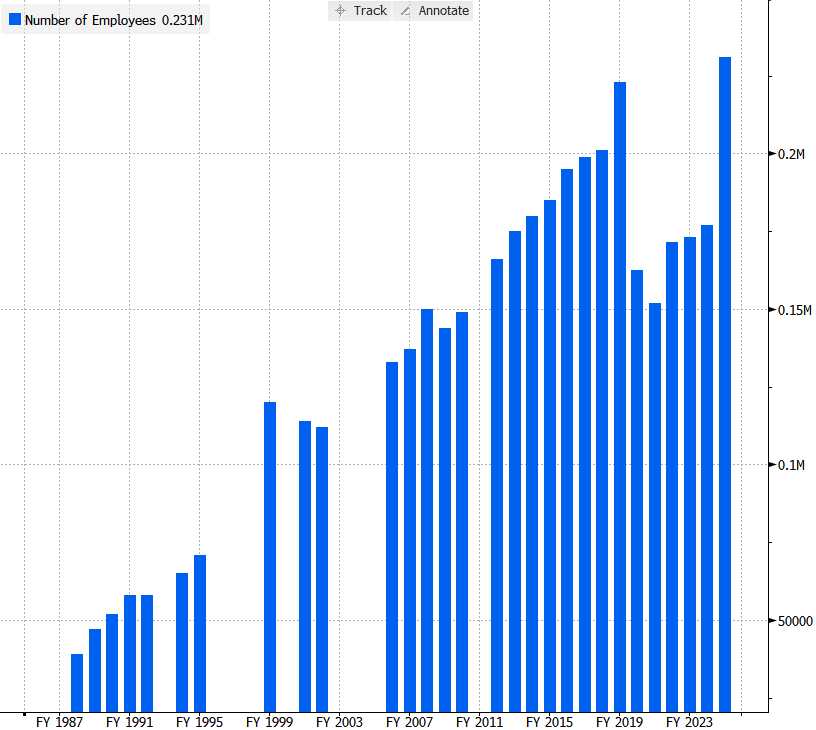
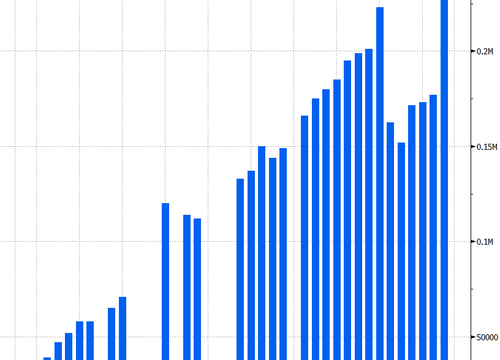
The latest Bloomberg data shows Disney’s overall workforce consists of 231,000 full- and part-time employees.
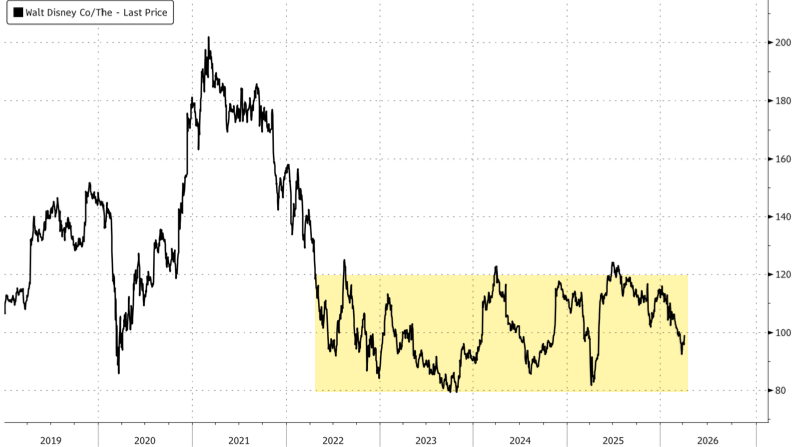
Reshaping Disney to appease shareholders comes as the stock is down nearly 13% for the year (as of Wednesday’s closing). Shares trade at Covid lows and have been locked in a trough since mid-2022.
“This transition comes at a moment when the world is changing faster than ever. While that can feel daunting at times, it is also exciting,” D’Amaro said earlier this year in a statement.
Perhaps cutting all woke propaganda sneaked into entertainment under Disney brands to indoctrinate children would also be a start toward regaining the trust of households that have gravitated to other studios for media consumption.
Whether D’Amaro can stabilize Disney remains an open question.
* * *
Tyler Durden
Thu, 04/09/2026 – 15:40
https://www.zerohedge.com/markets/no-storybook-ending-disney-plans-another-round-layoffs

Texas Pacific Land Crashes After Largest Shareholder Dies
Texas Pacific Land Crashes After Largest Shareholder Dies
Land-and-royalty company Texas Pacific Land Corp. crashed the most since early Covid after the head of its largest shareholder unexpectedly died.
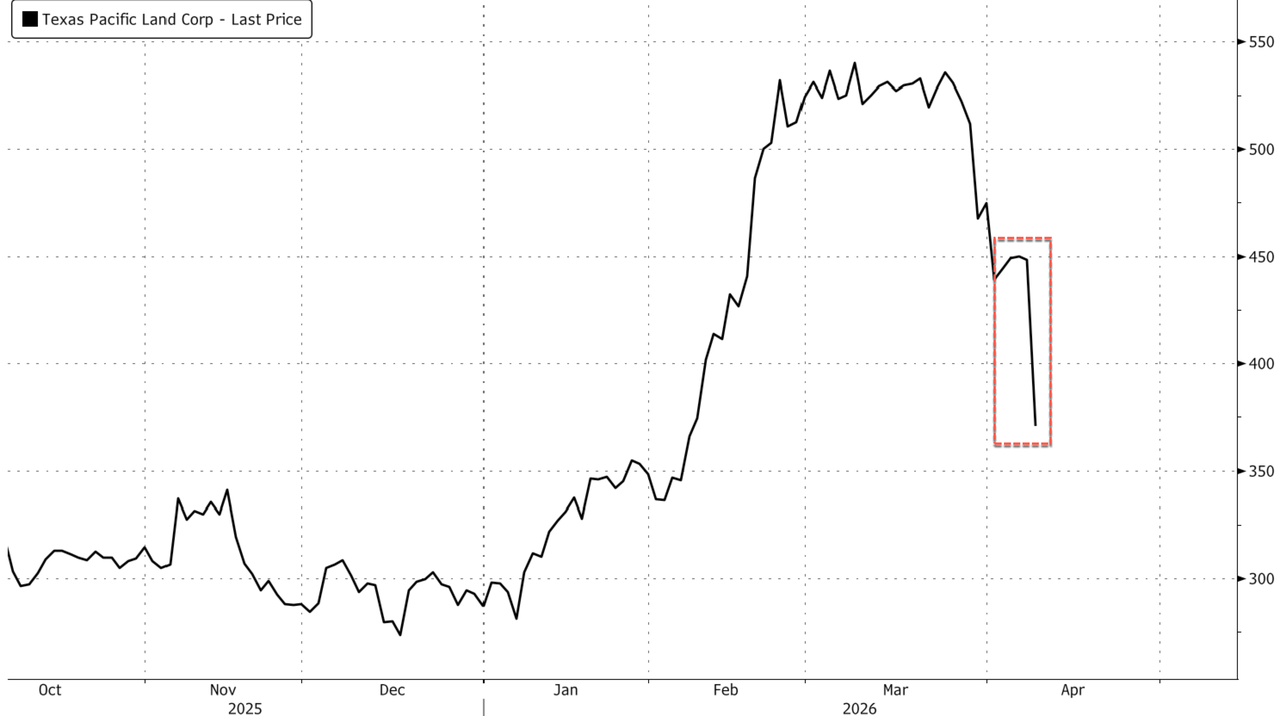
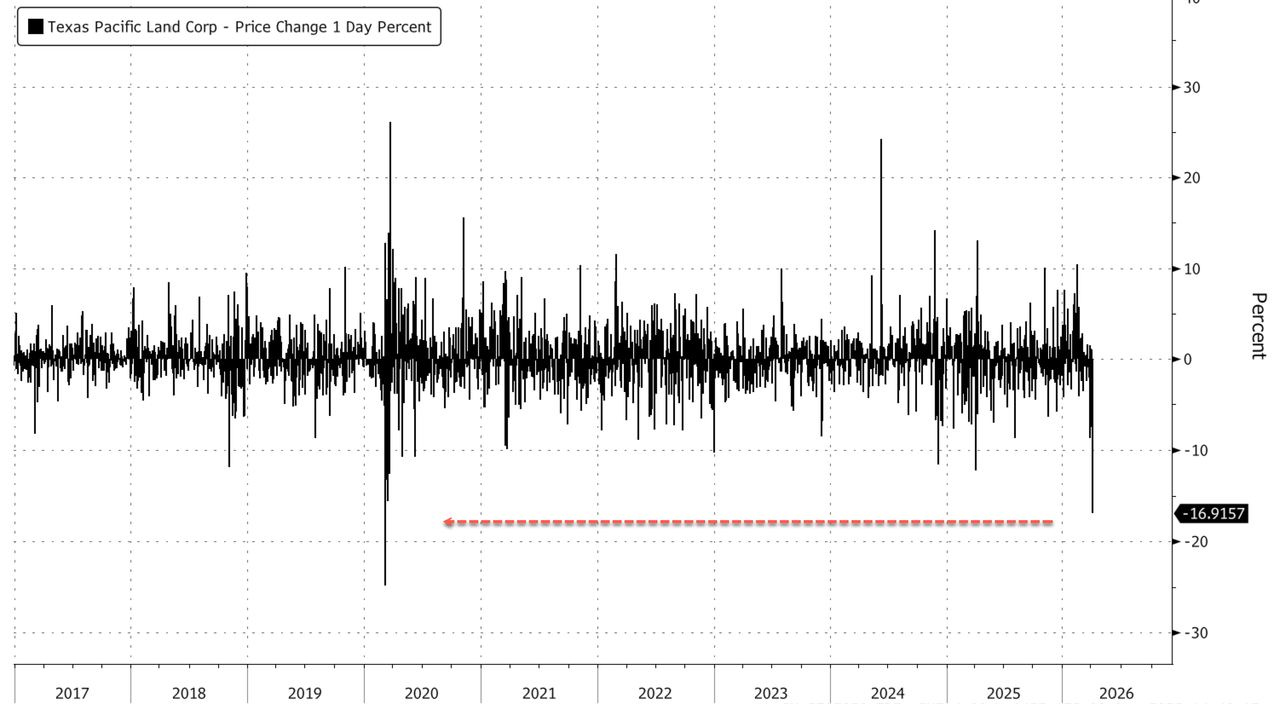
Bloomberg reports that Murray Stahl, CEO of Horizon Kinetics and a TPL board member, died on Thursday, sending shares spiraling lower by 17% in late-afternoon trading.
This marked the largest intraday decline in the stock since early 2020.
Stahl was described as a longtime believer in TPL, one of the largest private landowners in Texas, with most of its acreage concentrated in the oil-rich Permian Basin of West Texas.
TPL generates revenue by owning land, collecting oil and gas royalties from activity on that land, and selling or managing water-related services tied to drilling and production.
“His firm, Horizon Kinetics, along with its predecessors, had been TPL’s largest shareholder for many decades. Murray believed in the Company when it was still a thinly-traded, little-known trust that simply owned some land in west Texas,” TPL CEO Ty Glover wrote in a press release.
Bloomberg data show that Horizon Kinetics is TPL’s largest shareholder, owning 10.3 million shares, or about 14.99% of the tradable shares outstanding.
The cause of death was not immediately released by the family or TPL’s CEO.
The plunge in TPL shares following the death of its largest shareholder likely reflects uncertainty about the company’s future direction, as well as the possibility that Horizon could eventually reduce its stake. The volatility may also result from TPL’s tight float and thin trading, which can amplify price swings when unexpected news hits.
* * *
Tyler Durden
Thu, 04/09/2026 – 15:00
https://www.zerohedge.com/markets/texas-pacific-land-crashes-after-largest-shareholder-dies