Category: News
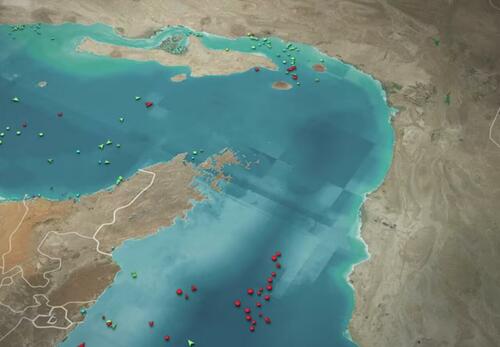
Iran To Allow No More Than 15 Vessels Per Day Through Hormuz: Russian Media
Iran To Allow No More Than 15 Vessels Per Day Through Hormuz: Russian Media
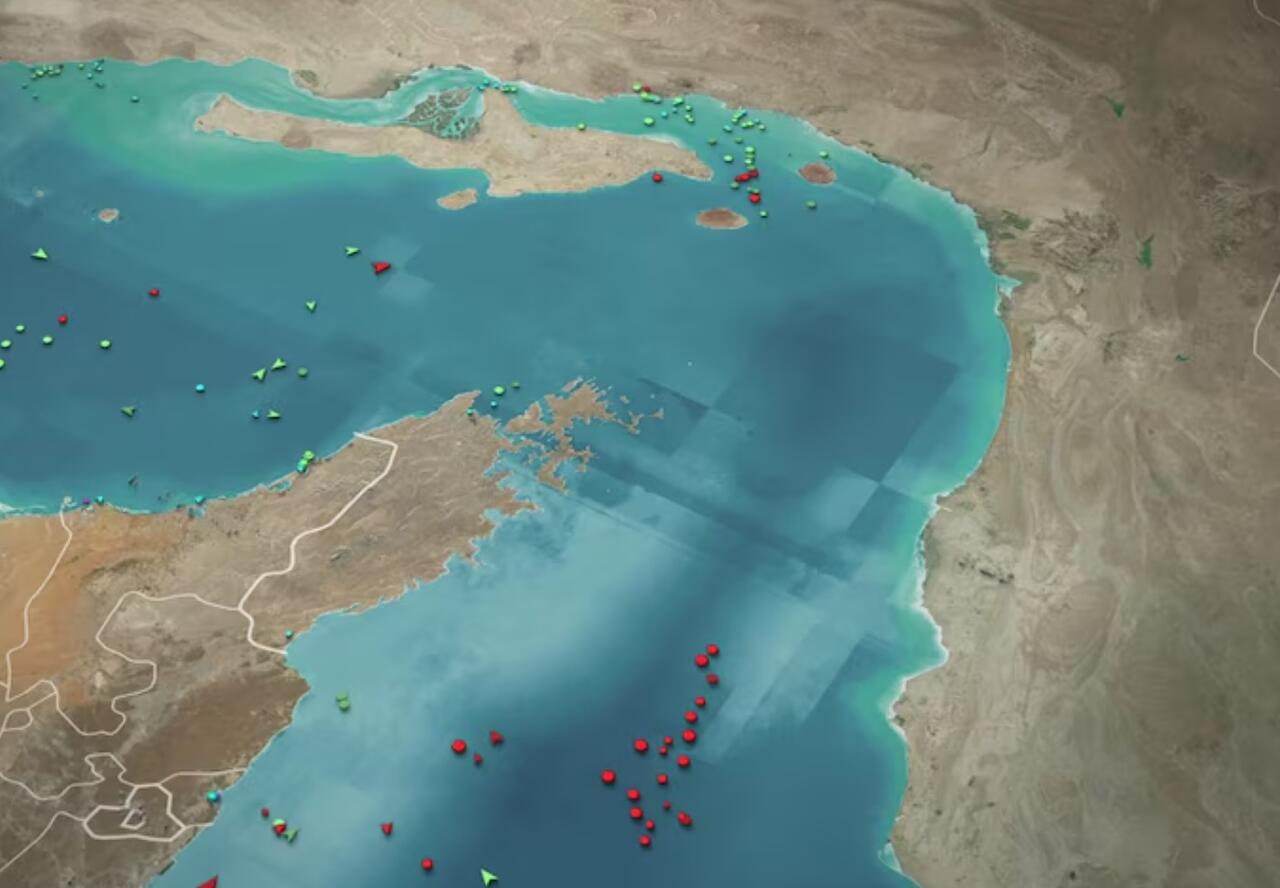
Despite the positive development of a shaky US-Iran ceasefire holding, the reality is that Tehran still maintains de facto control over the vital Strait of Hormuz waterway. A mere few vessels passed without incident on Wednesday, before Iran’s military closed the strait again, citing Israel’s massive attacks on Lebanon.
The Associated Press has emphasized Thursday, “Iran’s approval system for ships granted safe passage – after vetting by the Islamic Revolutionary Guards Corps – remains unchanged despite US President Donald Trump’s demand for the strait to be reopened.”
“Last week was the busiest week since the start of the war with 72 passages, still 90% below normal volumes, Lloyd’s said,” the AP report continues. “Most of the vessels allowed through are connected to Iran, although some Indian vessels have gotten through with diplomatic intervention by the Indian government.”
There are currently few indicators revealing Iran’s intent for what comes next, and it could be that much gets determined on whether Israel will cease its attacks on Lebanon. Tehran has threatened to renew its ballistic missile attacks of Israel’s anti-Hezbollah actions and massive airstrikes on Beirut persist.
Russia, which is an ally of Iran, has in its media published sources saying that Iran will allow no more than 15 vessels per day through Hormuz.
While this has not been confirmed officially by the Islamic Republic or IRGC, the following comes via TASS on Thursday:
Under the ceasefire agreement, Iran will allow no more than 15 vessels per day to pass through the Strait of Hormuz, a senior Iranian source told TASS ahead of talks in Islamabad.
“Under the current ceasefire, fewer than 15 ships per day are permitted to transit the Strait of Hormuz. This movement is strictly contingent upon Iran’s approval and the enforcement of a specific protocol. This new regulatory framework, operating under the supervision of the IRGC, has been officially communicated to regional parties. There will be no return to the pre-war status quo,” the source said.
The same source additionally indicated that “the unfreezing of Iran’s blocked assets is a critical executive guarantee that must be realized within this two-week timeframe.”
Also, Iran is demanding that the end of the war must be formalized in a resolution of the United Nations Security Council: “If the termination of the war is not codified into a UN Security Council resolution based on our stipulated terms, we are fully prepared to resume combat against the US and the Zionist regim —just as we have over the past 40 days, and with even greater intensity,” the source told TASS. Iran is further saying the US cannot build up more forces in the region during the two week ceasefire interim.
As for Iran’s protocol for allowing passage, which reportedly could include up to a $2 million fee per vessel payable in cryptocurrency, Lloyd’s list outlines the following on where things stand:
Vessels transiting the chokepoint must coordinate with the IRGC Navy
Iran’s latest guidance explicitly warns of anti-ship mines in the main traffic zone of the strait
IRGC Navy continues to vet all traffic passing through the strait on the basis of geopolitical affiliation
All of this means that the Iranian delegation in Pakistan will possess real leverage when it meets with the US side led by Vice President JD Vance this weekend. The White House has said talks are set to begin Saturday.
Tyler Durden
Thu, 04/09/2026 – 10:45
https://www.zerohedge.com/energy/iran-allow-no-more-15-vessels-day-through-hormuz-russian-media
Shmeasefire
Shmeasefire
By Molly Schwartz, cross-asset macro strategist of Rabobank
The trouble with ceasefires is that they often require both sides to agree to a set of terms, and then actually cease fire. However, if the set of terms are not comprehensively established and neither side can be held accountable to pause hostilities, then the so-called “ceasefire” loses all meaning.
Yesterday morning, Secretary of War, Pete Hegseth spoke about the Iran war ceasefire in a press conference. According to Hegseth, the US has achieved a “historic and overwhelming victory.” We have previously highlighted that in order for the US to achieve its stated goal of ending Iranian nuclear programs, regime change plays a fundamental role.
Hegseth has explicitly said that regime change has been achieved, echoing Trump who posted on social media that Iran “has gone through what will be a very productive Regime Change!” However, the rhetoric out of the IRGC and the continued execution of Iranian protestors may indicate otherwise. Hegseth also said that Iran will “never have nuclear weapons” and that the Strait of Hormuz was indeed open for business.
At around 1:00pm ET yesterday, it was announced that the Strait of Hormuz was closed amid dispute over ceasefire terms. When a ceasefire is typically negotiated, this includes some formal written agreement. While that may be the case with the current “ceasefire”, the public has yet to see one. A lack of clearly defined and agreed upon terms leaves room for confusion.
Just to show how much of a shitshow this whole thing is:
Qalibaf says that restraining Israel from attacks in Lebanon was the “first clause” of the 10-point proposal, but it wasn’t the first clause in versions published by Iran’s state news agency or IRGC-affiliated Tasnim… https://t.co/a3hbA8nNf7
— Gregg Carlstrom (@glcarlstrom) April 8, 2026
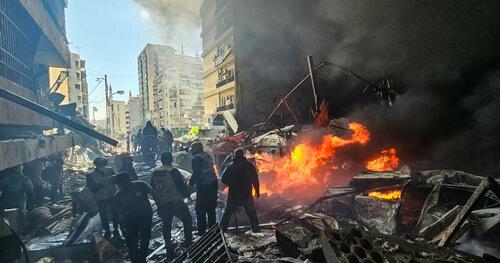
Israel conducted what was referred to as the “largest attack yet” on Hezbollah in Lebanon yesterday, with Israeli PM Netanyahu asserting that Lebanon and Hezbollah were not included in the ceasefire agreement. Netanyahu also provided his view on the ceasefire, declaring that this ceasefire is not the end of the war, but rather a “station en route to achieving aims.”
The war certainly does not seem to be over, given Iran’s decision to close the Strait of Hormuz again, citing Israel’s “breach.” While the ceasefire announcement laid out by Iran does clearly state that the ceasefire extends to “Lebanon and other regions” (which may call into question the Iranian attacks on Israel, Kuwait, and the Saudi Arabia East-West pipeline in the ceasefire aftermath), the statement from the US does not, and Trump backed Netanyahu’s interpretation that Hezbollah was still fair game.
Closing the Strait of Hormuz, of course, also breaches the US stipulations for the ceasefire, including the “COMPLETE, IMMEDIATE and SAFE OPENING of the Strait of Hormuz.” Crucially, US Press Secretary Karoline Leavitt clarified that this also means Iran must operate the passage free of tolls or other duties.
EU players also released a statement to say that they “welcome the two-week ceasefire” and that their “Governments will contribute to ensuring freedom of navigation in the Strait of Hormuz.” The US Administration seemed skeptical of the EU’s commitment with Leavitt saying that over the course of the past few weeks, “they [the EU and NATO] were tested, and they failed.”
But the EU and NATO may have an opportunity to redeem themselves in Trump’s eyes. Iran’s Speaker of the Parliament, Mohammad-Bagher Ghalibaf, said on X that three clauses of Iran’s 10-point proposal had been violated, these being the aforementioned “ceasefire everywhere, including Lebanon and other regions,” as well as the “entry of an intruding drone into Iranian airspace,” and finally the “denial of Iran’s right to [uranium] enrichment.”
As Iranian Minister of Foreign Affairs, Abbas Araghchi said on X yesterday, the ball is now in the US’ court. Everyone, but the US right now, is still lobbing missiles. So will the US hold up its commitment to halt offensive measures or put an official end to the ceasefire?
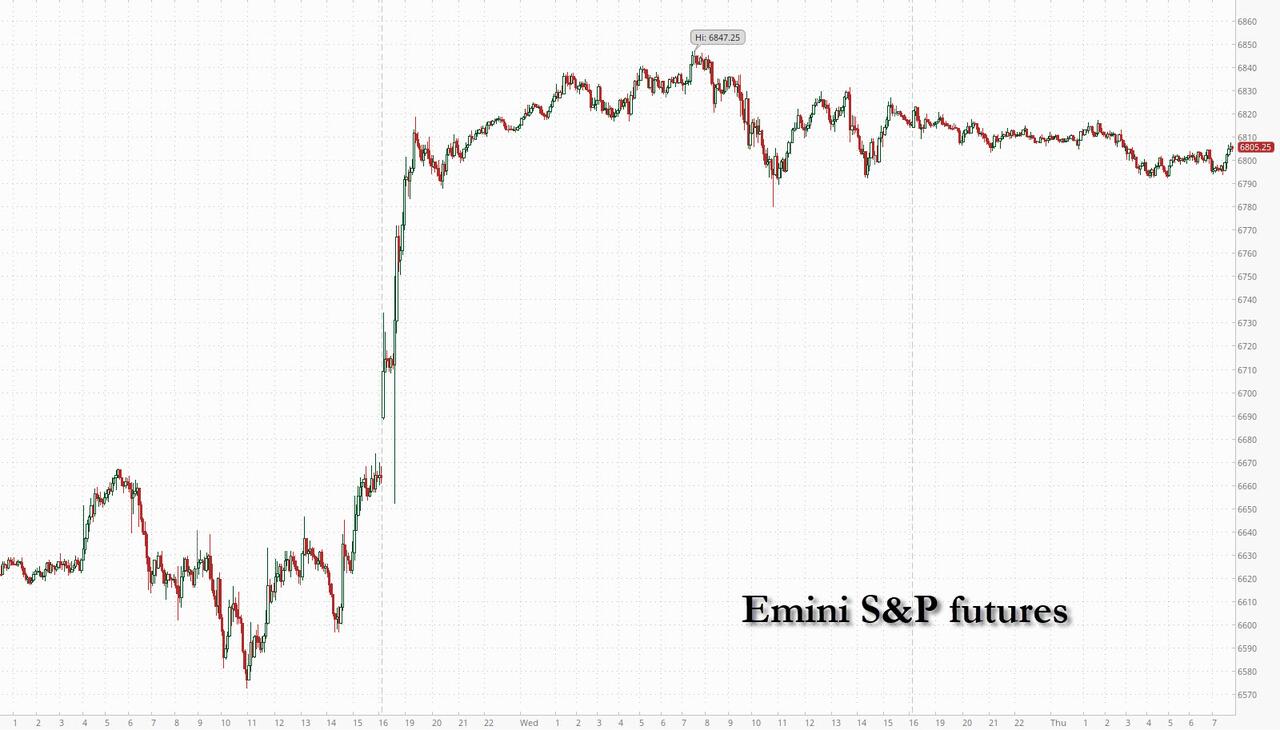
Markets are awaiting a response from the White House as well. Financial markets eagerly digested the ceasefire news from Tuesday in earnest, with the S&P 500 jumping 2.4% yesterday on the open, and trading around the $6,750-6,790 level all day, despite headline fury.
Global macro markets were a little more sensitive to (war) hawkish headlines. While US Treasury yields gapped lower at the open, 2 year Treasury yields spent the day creeping higher 6bp to 3.79% from open, and 10 year yields up 3bp to 4.29%. But the market that (surprisingly) barely moved yesterday was crude oil. Crude one month futures fell more than $16 to $94/bbl after the news of a ceasefire first broke, but the Strait reclosing and the fragility of the ceasefire exposed resulted in minimal price action, with crude closing at around $96/bbl.
These market moves may provide some insight into the US Administration’s logic in attempting this ceasefire in the first place. While one school of thought suggests that a ceasefire is a way to walk back Trump’s pugnacious rhetoric from Tuesday morning, the Administration may also be banking on the temporary market reprieve. We have suspected that prior so-called “TACO” trades from the Trump Administration were partially driven by negative market reactions, like the stress in US Treasuries after Liberation Day in April of 2025, or last summer when Trump threatened to fire Fed Chair Powell.
A ceasefire announcement that is well-received by the market could soothe markets and inflationary expectations, as well as depress the price of oil—which it has done for the time being. Should the Trump Administration choose to ramp up offensive measures in two weeks (or even today), it’s possible that the jump in prices may be somewhat mitigated, as we’re bouncing off of a “suppressed” crude level of $94/bbl, as opposed to the $110/bbl level we were at earlier in the week. While the moving parts here are extremely complex and there is likely much more at play here than just “because markets,” the markets angle is still something to think about.
In other markets-related news, yesterday the Fed released the Minutes from the March 18 meeting. According to said Minutes, “most” FOMC board members said that a “protracted war could hit jobs” and “warrant rate cuts.” On the other hand, “many” board members said “inflation higher for longer could call for hikes.” These very insightful and directional comments maintained US OIS pricing expectations at no hikes nor cuts this year.
Tyler Durden
Thu, 04/09/2026 – 10:10
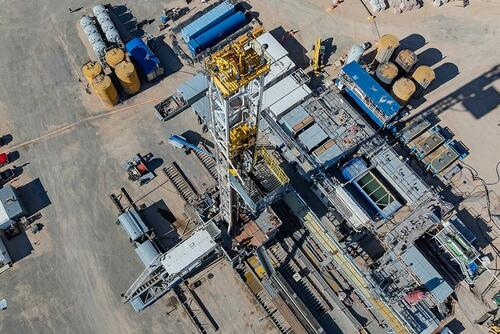
“Build Geothermal At Scale”: Fervo Energy Locks In 1.7 GW Turbine Supply Deal With Turboden
“Build Geothermal At Scale”: Fervo Energy Locks In 1.7 GW Turbine Supply Deal With Turboden
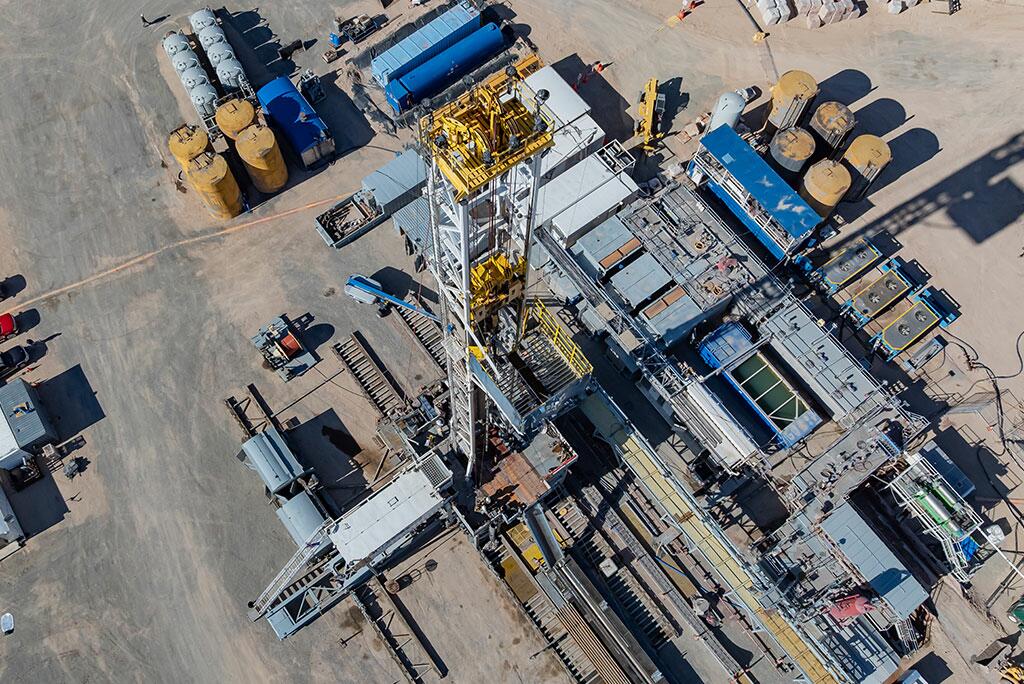
Fervo Energy and Turboden, part of the Mitsubishi Heavy Industries Group, announced a three-year framework agreement to supply Organic Rankine Cycle (ORC) turbines for up to 35 of Fervo’s standardized 50 MW GeoBlocks. The deal totals 1.7 gigawatts of carbon-free, dispatchable baseload power, marking a major step toward scaling next-generation geothermal across the United States.
The agreement builds directly on an earlier pact covering three GeoBlocks at Fervo’s Cape Station project in Utah, where Phase I commissioning is now in advanced stages with startup expected later this year. By locking in supply chain capacity and shortening lead times for Turboden’s proprietary ORC technology, the framework strengthens domestic manufacturing resilience and accelerates project timelines at a moment when U.S. power demand is surging from data centers and AI infrastructure.
ORC units efficiently convert geothermal heat into electricity, delivering the firm 24/7 power that intermittent renewables struggle to match. Fervo CEO Tim Latimer called the collaboration with Mitsubishi Heavy Industries a key move to “strengthen the supply chain needed to build geothermal at scale.”
This announcement arrives as interest in geothermal and nuclear power intensifies. With electricity demand exploding from AI and data centers, the market is showing a growing distaste for intermittent renewables that cannot guarantee reliable baseload power when needed most.
We hope nobody has forgotten how (not) helpful renewable energy was during Winter Storm Fern…
There’s a difference between what wind and solar promise, and what they can deliver.
During Winter Storm Fern, these energy sources failed to deliver the reliable power our communities needed. It’s time for Democrats to realize our grid requires coal, natural gas, and nuclear… pic.twitter.com/mZWFpohqW0
— Energy and Commerce Committee (@HouseCommerce) February 10, 2026
We first highlighted Fervo’s potential in the geothermal revolution reshaping America’s energy mix, where enhanced techniques and big-tech backing are turning the Earth’s heat into a practical solution for exploding electricity needs.
This latest supply deal also comes just weeks after we covered the DOE’s $171 million push for next-gen geothermal field tests.
With over 470 Turboden plants operating worldwide, the partnership positions Fervo to deliver reliable megawatts wherever the grid needs them most.
In an era of relentless demand growth, that kind of firm capacity looks increasingly indispensable.
Tyler Durden
Thu, 04/09/2026 – 10:00
https://www.zerohedge.com/energy/fervo-energy-locks-17-gw-geothermal-turbine-supply-deal-turboden
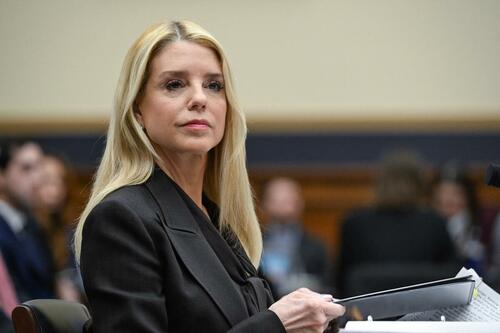
House Democrats Threaten Contempt For Bondi If She Doesn’t Testify In Epstein Probe
House Democrats Threaten Contempt For Bondi If She Doesn’t Testify In Epstein Probe
Authored by Jacob Burg via The Epoch Times,
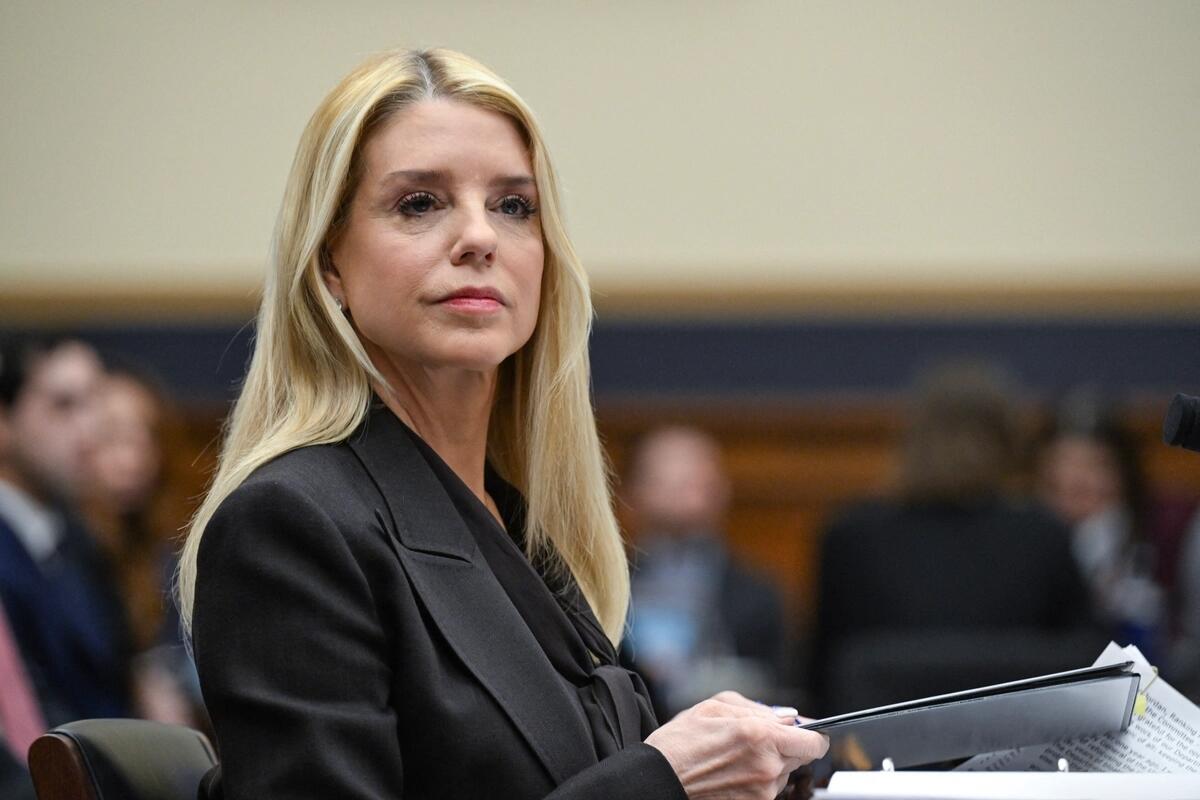
Democrats on the House Oversight Committee on April 8 threatened to file contempt of Congress charges against former Attorney General Pam Bondi if she doesn’t testify before the House as part of its ongoing investigation into deceased sex offender Jeffrey Epstein.
The House Oversight Committee confirmed to The Epoch Times on Wednesday that the Justice Department had said Bondi would no longer appear for a congressional deposition on April 14 “since she is no longer Attorney General and was subpoenaed in her capacity as Attorney General.”
“The Committee will contact Pam Bondi’s personal counsel to discuss next steps regarding scheduling her deposition,” the committee said in a statement.
Ranking Member Robert Garcia (D-Calif.) said in a statement that if Bondi “does not come in to testify, we will begin contempt charges in Congress.”
“Our bipartisan subpoena is to Pam Bondi, whether she is the Attorney General or not,” Garcia said.
Committee Chair James Comer (R-K.Y.) issued a subpoena to Bondi on March 17 to order her testimony regarding the Justice Department’s handling of the Epstein files.
Democrats and several Republicans have accused her of violating the Epstein Files Transparency Act through the Justice Department’s piecemeal release of documents, and for redacting alleged co-conspirator names while leaving some victim names un-redacted.
Enacted late last year with bipartisan support, the Epstein Files Transparency Act mandates that the Justice Department publicly release all non-classified records related to the investigation and prosecution of Epstein and his convicted co-conspirator, Ghislaine Maxwell.
Rep. Nancy Mace (R-S.C.) moved in early March to subpoena Bondi to testify before Congress. Four other Republicans—Reps. Lauren Boebert (R-Colo.), Tim Burchett (R-Tenn.), Michael Cloud (R-Texas), and Scott Perry (R-Pa.)—joined Democrats on the House Oversight Committee to support Mace’s motion.
Bondi has repeatedly defended the Justice Department’s handling of the Epstein files and denied Democrats’ allegations that she was obstructing congressional oversight.
The Justice Department called the subpoena “completely unnecessary” at the time.
On Wednesday, Mace reacted to the news that Bondi will no longer appear at next week’s deposition and suggested the Oversight Committee may still subpoena her, now that the former attorney general is a private citizen.
“Pam Bondi cannot escape accountability simply because she no longer holds the office of Attorney General. Our motion to subpoena Pam Bondi, which was passed by the Oversight Committee, was for Bondi by name, not by title,” Mace wrote on social media.
“She will still have to appear before the Oversight Committee for a sworn deposition. The American people deserve answers, and we expect her to appear as soon as a new date is set.”
The House Oversight Committee also recently enforced subpoenas ordering former President Bill Clinton and former First Lady Hillary Clinton to testify regarding Congress’s investigation into Epstein.
Tyler Durden
Thu, 04/09/2026 – 09:40
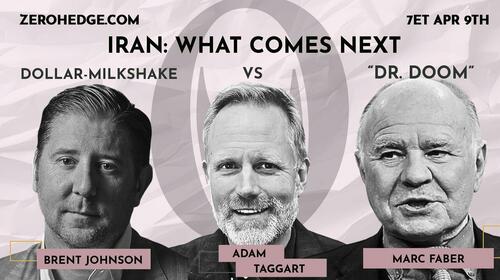
Marc Faber Vs Brent Johnson On What’s After Iran War: Utopia Or Crash
Marc Faber Vs Brent Johnson On What’s After Iran War: Utopia Or Crash
As the dust begins to settle from the latest escalation in the Iran conflict, markets are left to grapple with a more complicated question: what comes next? Is this the beginning of a reset toward stability, another leg up in markets, and lower inflation -or- are the early stages of a broader economic unraveling tied to supply shocks, currency stress, and geopolitical fragmentation? Not to mention… is the Straight of Hormuz even open? Reports are that Iran is only allowing passage after a hefty payment in either cryptocurrency or Chinese Yuan.
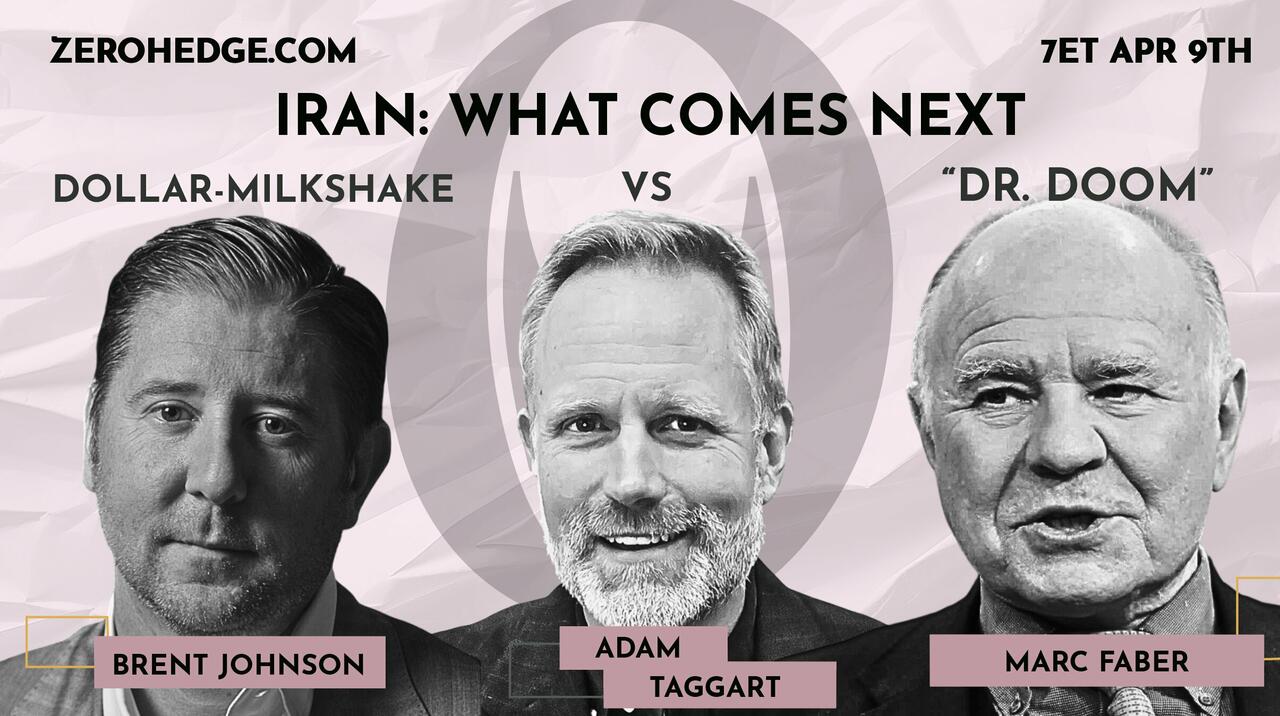
Tonight at 7pm ET, longtime market commentator Marc “Dr. Doom” Faber squares off against Brent Johnson, with Adam Taggart of Thoughtful Money moderating.
Faber is an OG dollar bear while Johnson is critical of the “US Empire is doomed to fail” crowd.
Remember when KSA was going to pivot from the west to the BRICS…? https://t.co/N34E8RiY4S
— Santiago Capital (@SantiagoAuFund) March 28, 2026
Nonetheless Johnson has warned, in a recent post on his research blog, that “rationing hits next. And the downstream effects…energy prices, manufacturing inputs, food prices…follow on a timeline that stretches months, not days.” He says consequences are largely baked in, as most ships take 10 to 45 days to reach their destination and are just leaving now.
“What’s actually happening right now is slower, quieter, and more consequential than anything in the financial press.”
Faber has consistently bashed paper money, in all its forms, as destined to fall to zero against the price of gold:
— ZeroHedge Debates (@zerohedgeDebate) April 8, 2026
Where he and Johnson might agree is that it is unlikely for the Euro or the Japanese Yen to unseat the dollar. But could the Chinese Yuan or a basket currency put forth by BRICS? Especially if backed by gold (or advertised as such), might other countries begin making the switch?
Iran has long known the risks of dealing in U.S. dollar-denominated assets that may be frozen unilaterally. However, the country has also now learned the consequences of challenging U.S. (or perhaps more accurately in their case, Israel) regional hegemony. So, if more countries announced their intention to de-dollarize, would the American government strike such initiatives down by force a la Libya? And even if the U.S. tries, does it become too many impossible fires to put out? Global market forces could usher in a return to gold whether the Pentagon likes it or not.
Taggart, Faber, and Johnson will answer these questions tonight, here on the ZeroHedge homepage at 7pm ET.
Tyler Durden
Thu, 04/09/2026 – 09:25
https://www.zerohedge.com/economics/marc-faber-vs-brent-johnson-whats-after-iran-war-utopia-or-crash

Artemis II Astronauts Prepare For Re-Entry, Splashdown
Artemis II Astronauts Prepare For Re-Entry, Splashdown
Authored by T.J.Muscaro via The Epoch Times,
When Artemis II crew members wake up at 11:35 a.m. ET on April 9, they will begin their last full day in space and start preparing the cabin for their return home.
NASA’s Reid Wiseman, Victor Glover, and Christina Koch, and Jeremy Hansen of the Canadian Space Agency, continue to fall back to Earth on a free return trajectory aboard their Orion spacecraft, Integrity, targeting a splashdown in the Pacific Ocean at about 8:05 p.m. ET on April 10.
Over the past eight days, those astronauts became the first people in more than 50 years to leave Earth’s orbit and cross the proverbial channel of deep space to fly around the moon.
They ventured farther from Earth than any other human expedition in history. They saw areas and aspects of the lunar surface that no other humans had ever been able to see with their own eyes, and they became the first humans ever to observe a full solar eclipse from lunar space.
They captured striking images of their home planet, and shared a call with their colleagues onboard the International Space Station, marking the first time in spaceflight history that a crew in deep space communicated directly with a crew in low Earth orbit.
But now, it’s almost time to come home.
On April 8, the crew started preparing their capsule for arrival, storing equipment and securing items for the upcoming comet-like ride through the Earth’s atmosphere.
They started reinstalling their seats into the configuration for launch and reentry, and they tested their orthostatic intolerance garments.
Those special garments are worn underneath the astronaut’s spacesuits to help “maintain blood pressure and circulation during the transition back to Earth’s gravity,” NASA explained.
“After extended time in microgravity, some astronauts experience orthostatic intolerance, a condition that can make it difficult to stand upright without dizziness or fainting. The garment applies lower‑body compression to counteract this effect and support a safe return.”
The crew was also supposed to demonstrate deployment of an emergency radiation shield inside the cabin, a procedure developed in case astronauts encounter a high dose of radiation beyond Earth orbit. But mission teams decided to forego the demonstration to prepare Integrity for reentry.
The spacecraft also executed short course correction burns on April 7 and April 8, and a third was scheduled for April 9. Also on April 8, the crew took manual control of their ship one last time, turning it around to point the tail end toward the sun.
Throughout April 9, the crew was scheduled to continue working to get Integrity into its reentry configuration.
Images, audio logs, and other data collected by the crew during their mission continue to be downlinked to mission control.
The Artemis II crew will have one more sleep period aboard Integrity beginning at 3:05 a.m. on April 10. They’ll wake up at 11:35 a.m., and then, if all goes well, they’ll fall asleep for the first time in 10 days beneath the blanket of Earth’s gravity.
Artemis II is scheduled to reenter Earth’s atmosphere at about 7:53 p.m. ET on April 10 and splash down off the coast of San Diego less than 15 minutes later.
On April 7, the mission’s recovery ship, the USS John P. Murtha, left port and set sail toward the designated recovery zone.
Tyler Durden
Thu, 04/09/2026 – 09:10
https://www.zerohedge.com/technology/artemis-ii-astronauts-prepare-re-entry-splashdown
Continuing Jobless Claims Tumble To 2-Year Lows
Continuing Jobless Claims Tumble To 2-Year Lows
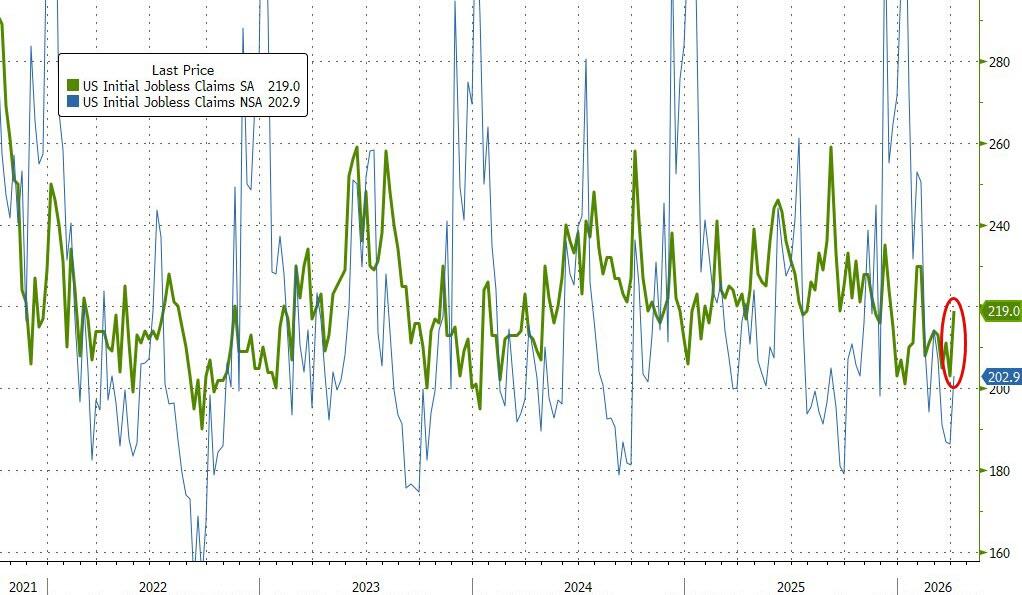
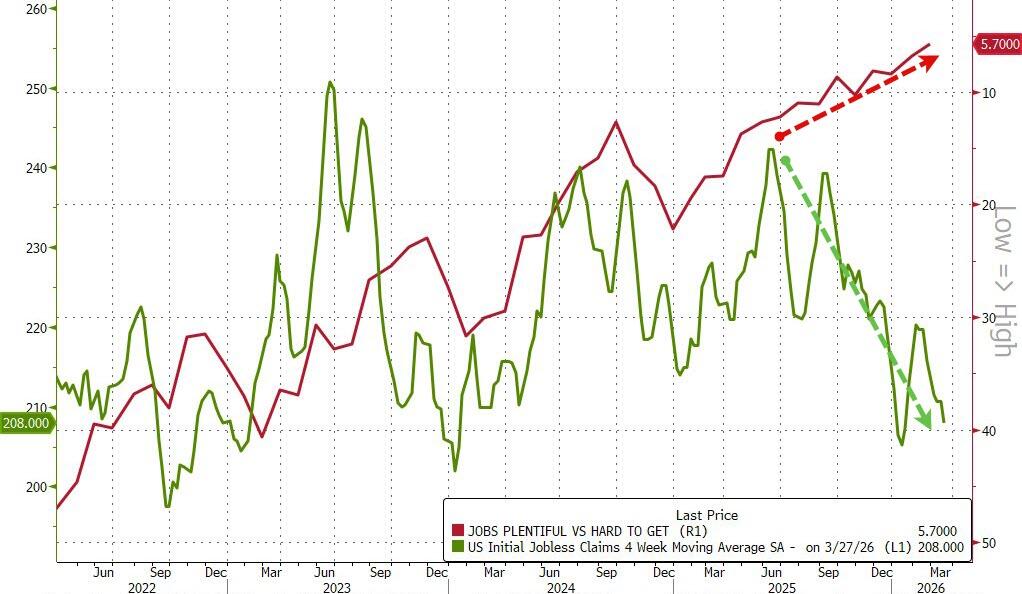
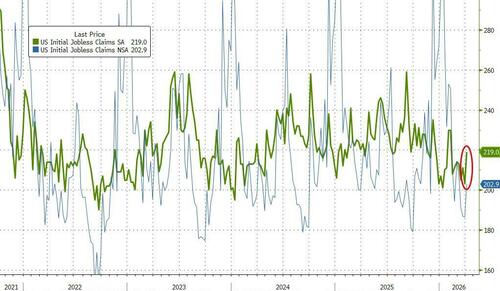
The number of Americans filing for jobless benefits for the first time rose from 203k to 219k last week (higher than the expected 210k), but still hovering within the low-low range of the last four years…
Source: Bloomberg
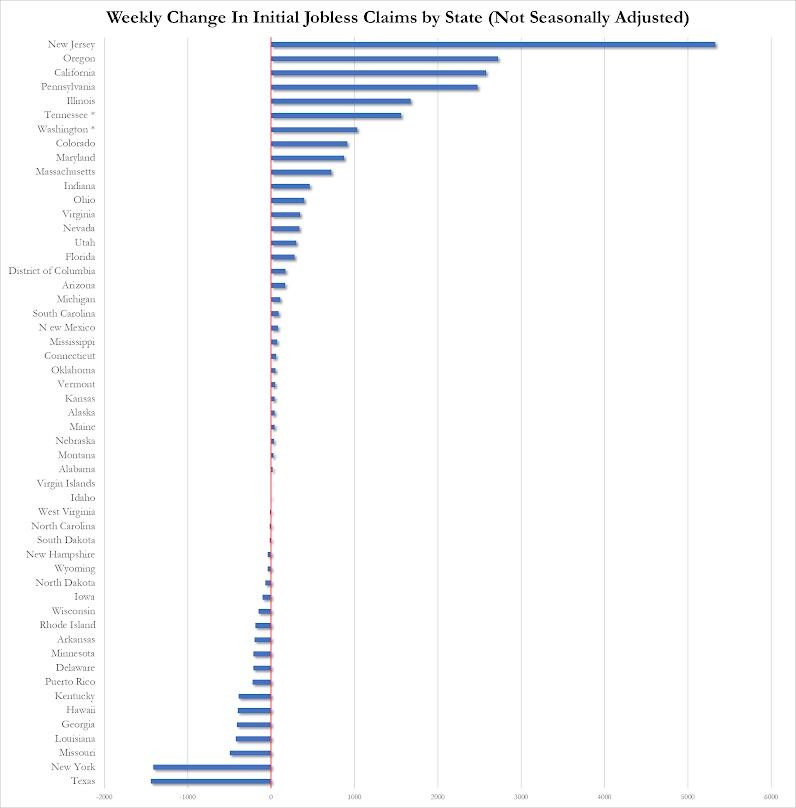
New Jersey and Oregon saw the largest WoW rise in initial claims while Texas and New York saw the biggest decline…
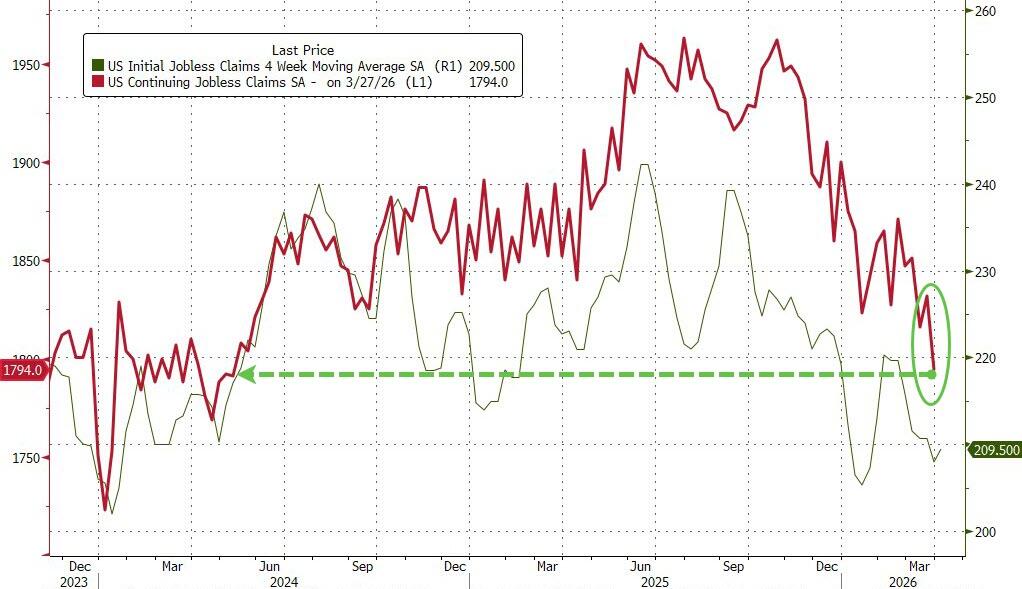
But, while initial claims rose, continuing jobless claims tumbled to the lowest level since May 2024…
Source: Bloomberg
Soft survey data continues to signal a stressed labor market, while hard claims data says – all clear…
Source: Bloomberg
The bottom line is the ‘no hire, no fire’ economy remains firmly in place with policy-makers holding their breath for March’s inflation data to make a decision.
Expectations for The Fed’s moves in 2026 currently price in 25% odds of a single 25bps rate-cut this year.
Tyler Durden
Thu, 04/09/2026 – 09:03
https://www.zerohedge.com/markets/continuing-jobless-claims-tumble-2-year-lows
Trump Warns Of Action If Iran Fails To Uphold ‘Real’ Ceasefire, But Optimism Persists As Bombing Largely Subsides
Trump Warns Of Action If Iran Fails To Uphold ‘Real’ Ceasefire, But Optimism Persists As Bombing Largely Subsides
Summary:
WH confirms Vice President Vance will lead Kushner-Witkoff delegation in Pakistan, seen as positive in Tehran and Islamabad.
Trump warns of more military action if Iran doesn’t uphold ‘real’ ceasefire deal, after disagreement over Lebanon truce status as part of deal.
Despite some last-minute shots in Lebanon by Israel, bombs go largely silent across Gulf and Middle East.
Over 250 killed and 1,000+ wounded in Lebanon from Wednesday surprise attack by Israel’s military. UAE, Pakistan, and even EU (Kallas) condemn.
Hormuz Strait still effectively controlled by Iran: only a few vessels had passed on Wednesday.
Trump announces end of military operations against Iran by April 15th?
Yes 9% · No 92%
View full market & trade on Polymarket
* * *
Optimism: Bombs Largely Go Quiet
Asia One journalist Anas Mallick writes that “To my understanding, By tomorrow, first break of light, is when both delegations of US and Iran will be in Islamabad to hold talks.”
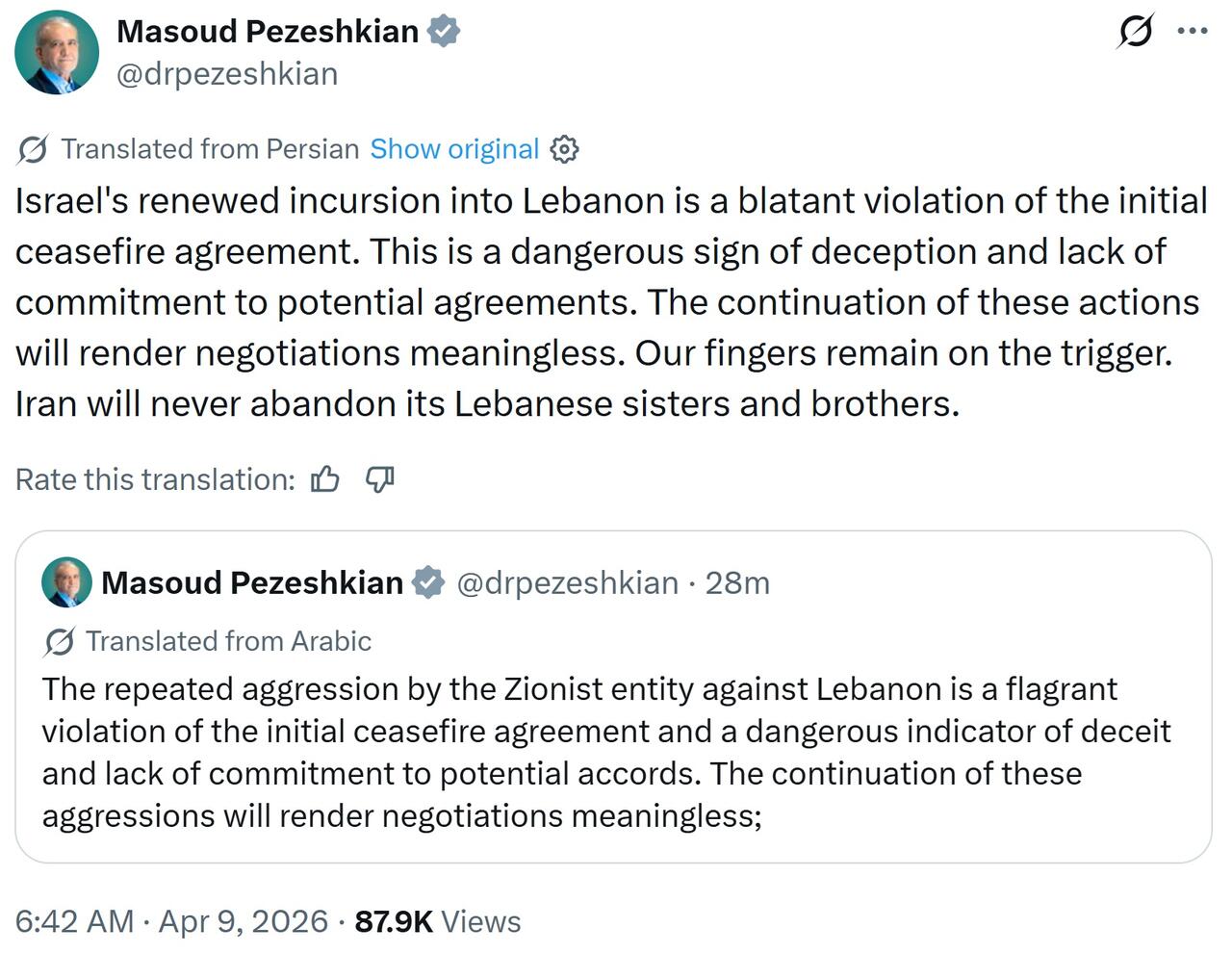
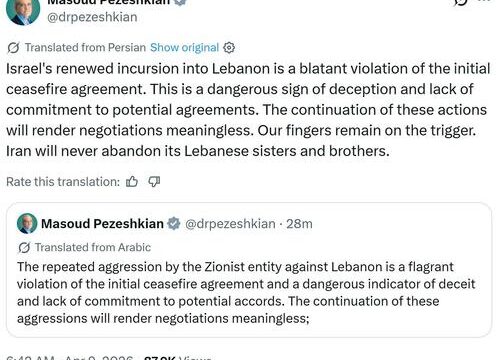
There’s some optimism regarding the US-Iran ceasefire holding, as it’s been relatively quiet in the Middle East overnight into Thursday, despite Israel getting some final shots on Lebanon in. On this, Iran’s president has made clear Tehran’s position that Israel’s renewed incursion into Lebanon and against Hezbollah violates the ceasefire, warning that these actions could make talks moot before they even begin.
Reuters observes, “Even as the U.S. and Iran seek to cement a ceasefire, Israel is seizing more territory from its neighbors in preparation for a long, drawn-out conflict across the Middle East. Israel’s creation of ‘buffer zones’ in Gaza, Syria and now Lebanon reflects a strategic shift after the attacks of October 7, 2023, one that puts the country in a semi-permanent state of war.”
Still, Gulf countries like the UAE have stated that no air threats have been detected or are inbound in the past hours, which is a rare positive development. There has been a decline in Iranian attacks across Arab states in the Persian Gulf region. Also, Israeli society has begun to return to normalcy, with emergency and shelter in place measures lifted across most parts of the country, and Ben Gurion airport in Tel Aviv having resumed operations as of midnight.
The reality of who actually controls the Hormuz Strait, told in one awkward WH press exchange:
Q: As of today, who controls the Strait of Hormuz?
LEAVITT: We expect that the strait will be opened immediately
Q: Who controls the strait right now?
LEAVITT: *refuses to answer* pic.twitter.com/eqDzxLTRAP
— Aaron Rupar (@atrupar) April 8, 2026
Over 250 Killed In Lebanon on Single Day
But the reality remains that on Wednesday – the first day of the fragile ceasefire – a mere few tankers were allowed passage through the Strait of Hormuz before Iran shut down traffic again, citing the heavy Israeli attacks on Lebanon, which were the largest and deadliest of the war to date.
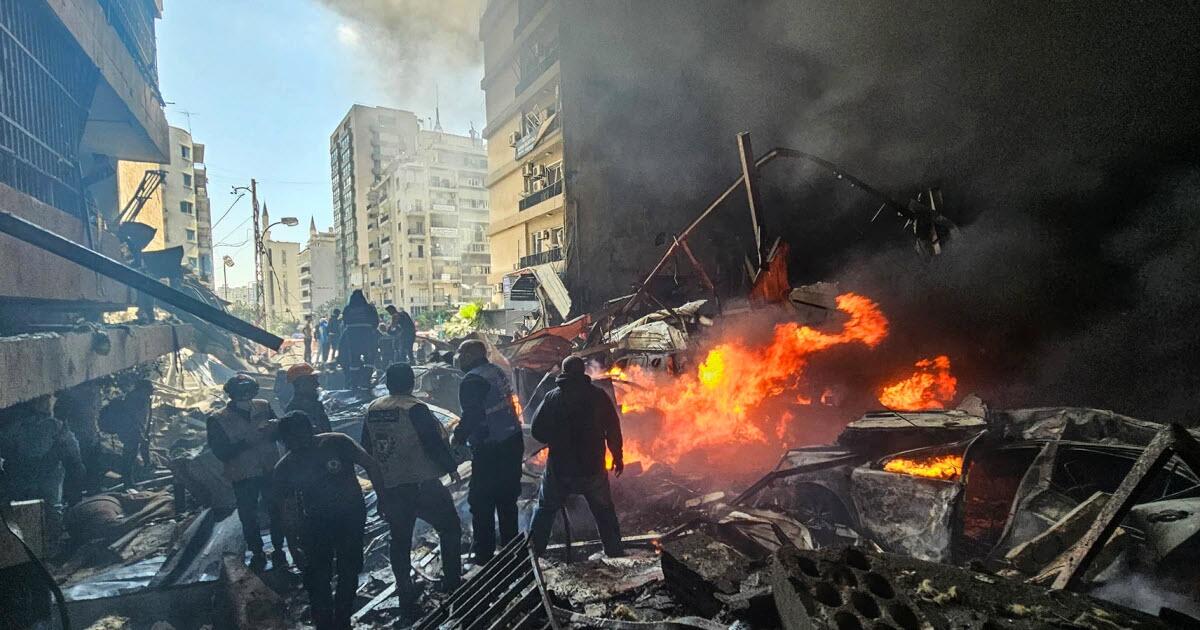
Sky News reports that at least 254 people were killed by the Israeli strikes across Lebanon on Wednesday, citing government health authorities. In Beirut alone, at least 91 people were killed, amid ongoing rescue efforts and treatment of the wounded in area hospitals. Over 1,000 Lebanese were wounded and injured. The Lebanese government has declared a day of mourning.
Trump To Renew Attacks if Tehran Fails in ‘Real’ Ceasefire Deal, Oil Rises
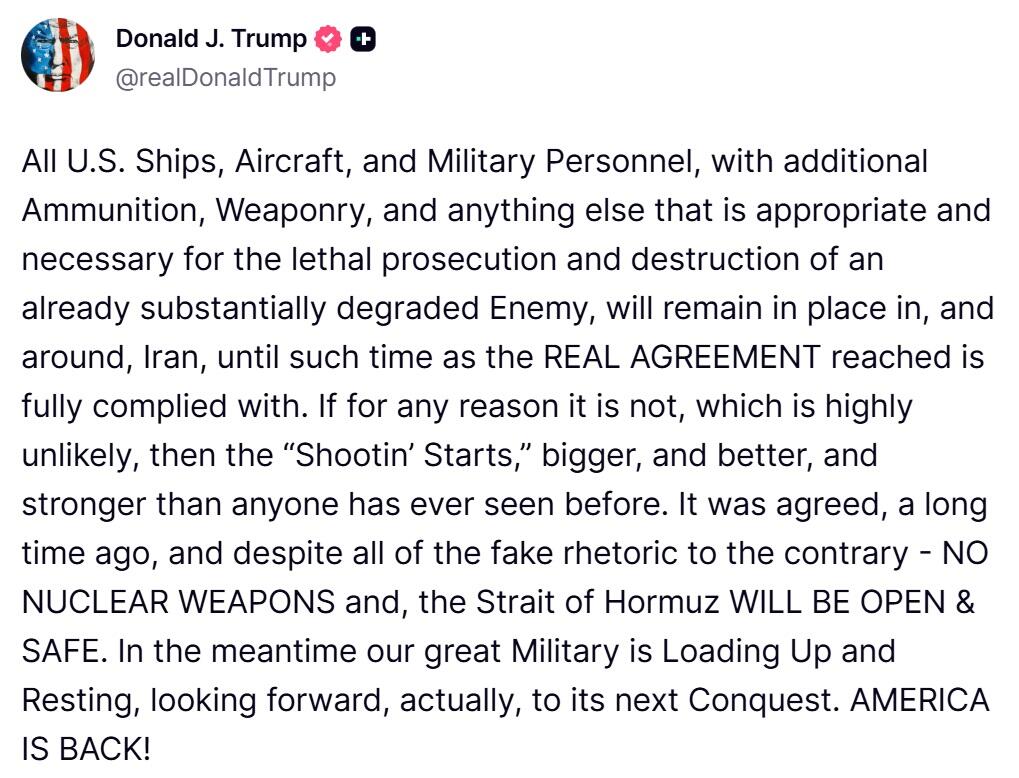
Meanwhile President Trump in a Truth Social message issued overnight says that “all US ships, aircraft, and military personnel” will remain in place around Iran until the “real agreement” on a ceasefire “is fully complied with” – warning of more US military action to come if not.
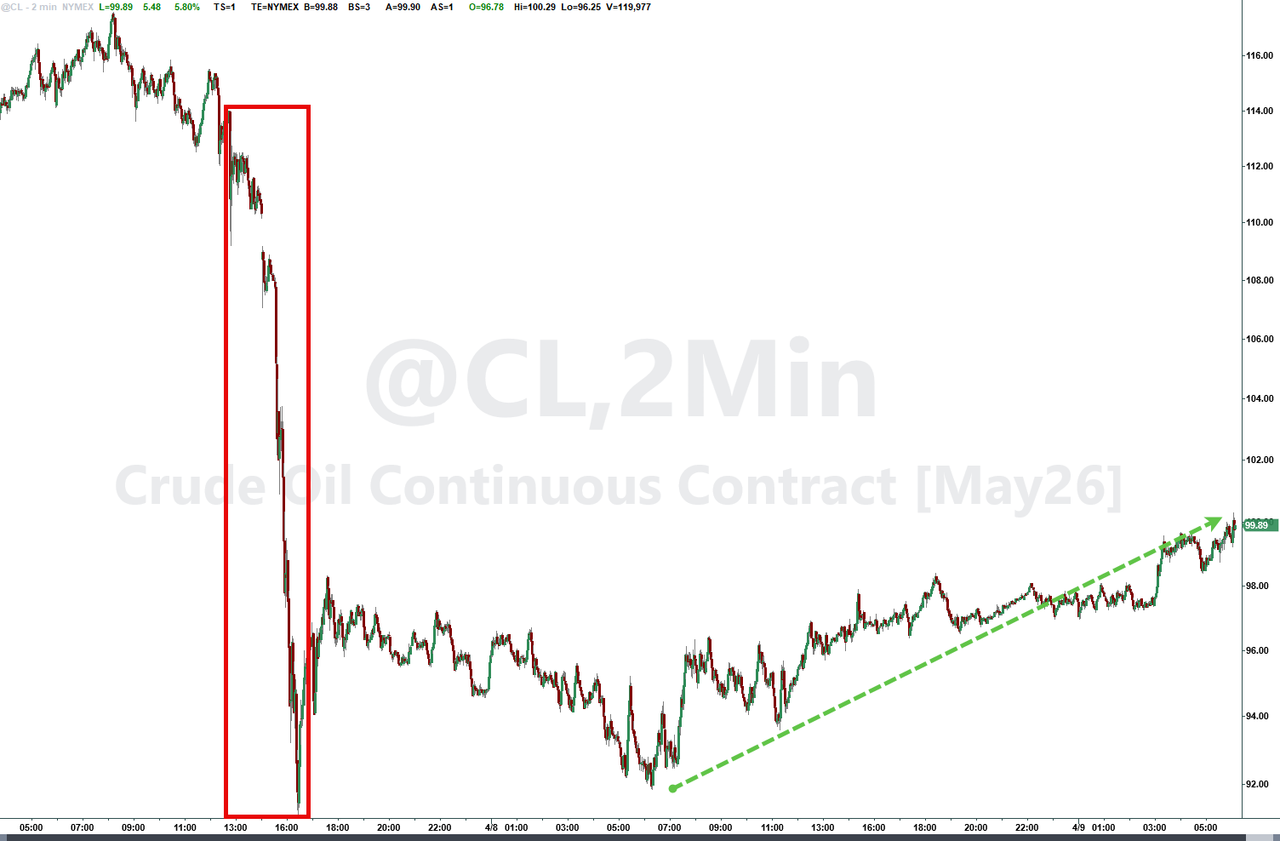
The renewed threats have pushed WTI back above $100…
Here’s president Trump’s full Truth Social statement wherein he warns that the shooting can start again “bigger, better, and stronger than anyone has ever seen before”:
Iran’s leadership has meanwhile been insistent on Lebanon being part of the Iran ceasefire, and has on this basis accused Washington of already violating at least three clauses of the ten point plan. It too has serious cards to play – especially while still de facto controlling Hormuz, and with the ability to renew attacks on energy sites in Gulf states.
— محمدباقر قالیباف | MB Ghalibaf (@mb_ghalibaf) April 9, 2026
Iran on Lebanon Violations: ‘Choose War or Ceasefire, You Can’t Have Both’
Iran’s deputy foreign minister Saeed Khatibzadeh has told CBS News Israel’s attacks on Lebanon Wednesday were “a grave violation” of the ceasefire agreement, and emphasized the US must choose “between war and ceasefire – you cannot have it both at the same time.”
“You cannot ask for a ceasefire and then accept terms and conditions, accept areas the ceasefire is applied to, and name Lebanon, exactly Lebanon in that, and then your ally just start a massacre,” Khatibzadeh said.
Netanyahu’s message has remained that Israel can strike Hezbollah whenever and “wherever” it chooses. “In Beirut, we eliminated Ali Youssef Kharshi, the personal secretary of Hezbollah terror organization Secretary-General Naim Qassem and one of the people closest to him. At the same time, overnight, the IDF struck a series of terror infrastructures in southern Lebanon: crossings used to transfer thousands of weapons, rockets, and launchers, as well as weapons depots, launchers, and Hezbollah headquarters,” Netanyahu said.
⚡️ The Israeli airstrike on Al-Basta, Lebanon pic.twitter.com/Zh1YNF529S
— War Monitor (@WarMonitors) April 8, 2026
“Our message is clear: Whoever acts against Israeli civilians will be struck. We will continue to strike Hezbollah wherever required, until we restore full security to the residents of the north.”
Meanwhile, Israeli Foreign Minister Saar: “In the last 40 days, Hezbollah has fired approximately 6,500 missiles, rockets, and drones at Israel.”
Pakistan Welcomes Vance Heading up US Delegation
WH Press Secretary Karoline Leavitt made clear Wednesday that Vice President JD Vance will head up talks for the US side in Pakistan, leading Jared Kushner and Steve Witkoff. Tehran had previously expressed its disdain for the latter two, accusing them of lying and being deceptive the first go-round before Iran suffered surprise US-Israeli attack. The pair are also accused of lacking technical know-how when it comes to talking about the nuclear issue.
Al Jazeera also freshly reports that the choice of Vance heading the US delegation is “being viewed very positively in Pakistan.” Pakistan’s former Ambassador to the UN Maleeha Lodhi says, “Politicians know the art of the possible, and therefore I think it’s a good decision by the Trump administration to have Vance lead the talks.”
Vance has stressed that Trump is “impatient to make progress” with Iran and warned that if Iranian officials don’t engage in good faith “they’re going to find out that President Trump is not one to mess around with.” The US has clamed Iran ‘begged’ for ceasefire while Tehran insists it was the other way around.
More Geopolitical Headlines
via Newsquawk…
US President Donald Trump posted: “All U.S. Ships, Aircraft, and Military Personnel….will remain in place in, and around, Iran, until such time as the REAL AGREEMENT reached is fully complied with”.
US President Donald Trump posted: “NATO WASN’T THERE WHEN WE NEEDED THEM, AND THEY WON’T BE THERE IF WE NEED THEM AGAIN. REMEMBER GREENLAND, THAT BIG, POORLY RUN, PIECE OF ICE!!!”.
The Trump administration is considering a plan to penalize NATO members viewed as unhelpful during the Iran war by relocating US troops to more supportive countries, with potential base closures in Europe, including in Spain or Germany, according to WSJ.
NATO Secretary-General Mark Rutte told President Trump that most European nations provided support.
US officials stated they do not rule out resuming fighting in Iran and confirmed Trump will not offer major concessions to reopen the Strait of Hormuz, warning Iran’s demands could trigger renewed conflict.
Iran’s deputy foreign minister stated that the speaker of parliament will lead Iran’s delegation in upcoming talks, with communication continuing through Pakistan, according to Al Jazeera.
Iran’s ambassador to Pakistan stated the delegation will arrive in Islamabad on Thursday night for “serious talks” based on Iran’s 10-point proposal.
The IRGC Navy announced alternative shipping routes to bypass potential sea mines, according to ISNA.
The IRGC stated that shipping through the Strait of Hormuz slowed sharply and then stopped following what it described as an Israeli ceasefire violation in Lebanon, according to CNN.
Iranian lawmaker Ibrahim Azizi stated: “Once again, you have proven that you do not know the meaning of a ceasefire” and “Only fire will discipline you…so wait for it”.
Saudi Arabia and Iran discussed de-escalation during a call, according to SPA.
A Pakistani Foreign Ministry source indicated the US has backed away from including Lebanon in the ceasefire with Iran, according to Al Arabiya.
Israeli Prime Minister Benjamin Netanyahu stated Israel will continue striking Hezbollah, with the IDF targeting infrastructure in southern Lebanon overnight.
Israel’s Ministry of Energy ordered the resumption of operations at the Karish gas platform after a shutdown during the war, according to Channel 12.
Hezbollah stated its attacks on Israel will continue until aggression stops and launched rockets citing ceasefire violations, according to Fars News Agency.
A missile was fired from Lebanon into northern Israel, according to Fars News Agency.
Israeli strikes in Lebanon continued despite the ceasefire with Iran, according to Anadolu Agency.
French President Emmanuel Macron spoke with Iran’s President Masoud Pezeshkian and US President Donald Trump, stating their decision to accept the ceasefire was the best course of action.
Russia launched 119 drones at Ukraine overnight, according to Ukrainian media.
* * * Top sellers
Brain Rescue – Your baseline daily brain food
Peak Focus – Nootropic ultra-focus, no jitters
GMO-Free Heirloom Seed Vault – NOT Monsanto
Tyler Durden
Thu, 04/09/2026 – 08:55
Savings Rate Slides As Fed’s Favorite Inflation Gauge Slowed In February (Ahead Of War)
Savings Rate Slides As Fed’s Favorite Inflation Gauge Slowed In February (Ahead Of War)
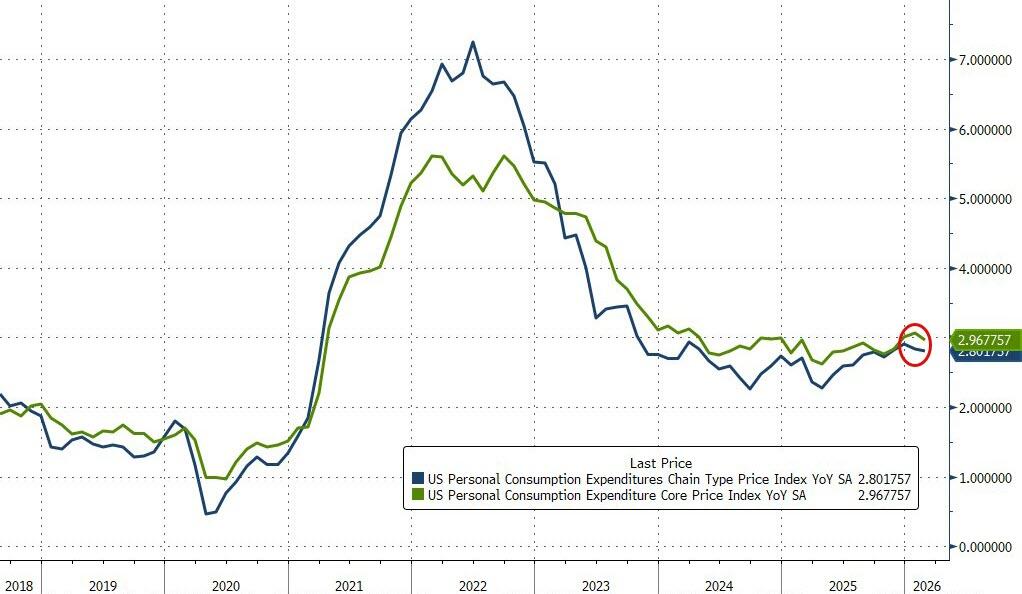
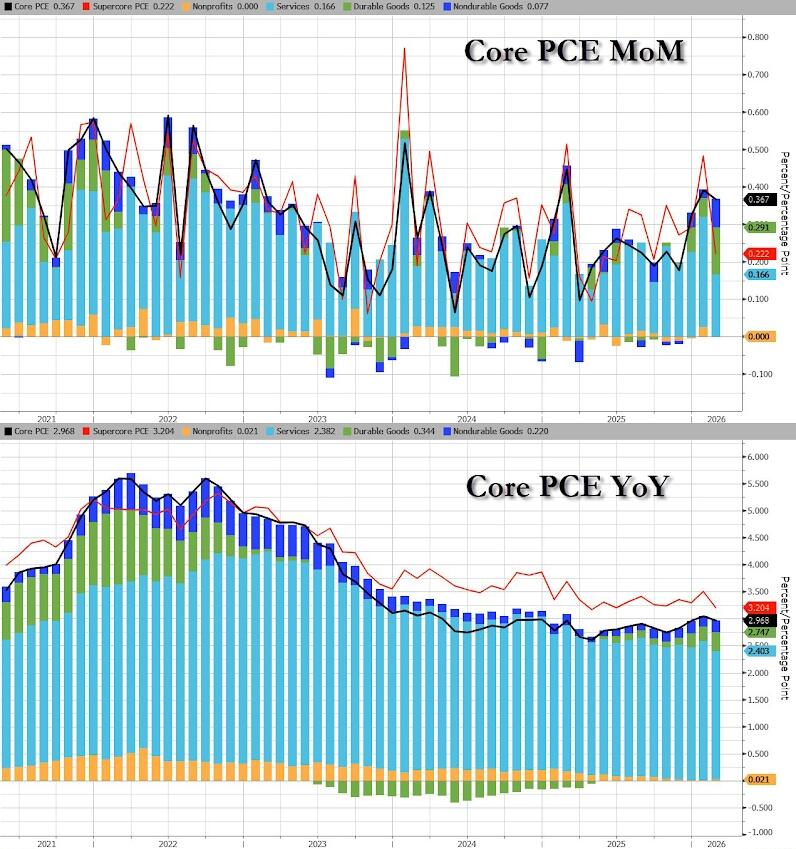
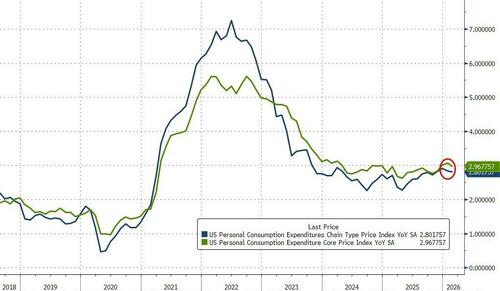
The Fed’s favorite inflation indicator – Core PCE (a measure of price changes in consumer goods and services that excludes volatile food and energy costs) – rose 0.4% MoM in February (pre-war), in line with expectations, with YoY rising 3.0% (as expected – lowest since Dec), down from January’s +3.1%…
Source: Bloomberg
The YoY Core decline is coming off January’s highest level since March 2024, with Services cost inflation slowing notably…
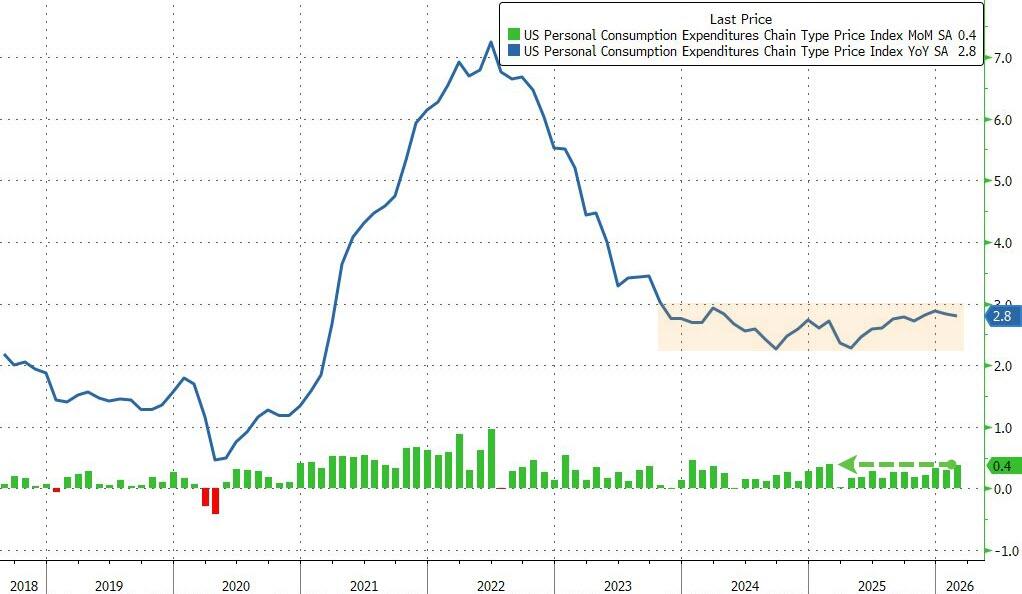
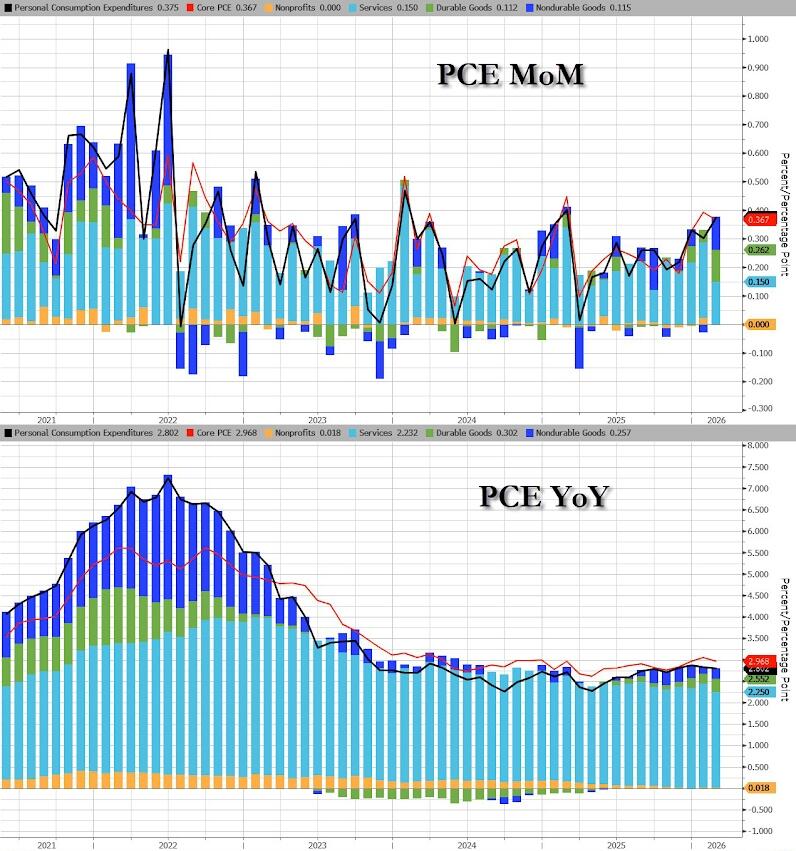
The headline PCE also rose 0.4% MoM (as expected – the biggest MoM rise since Feb 2025), up 2.8% YoY (also as expected)…
Source: Bloomberg
Under the hood, we saw a notable jump in non-durable goods prices…
Source: Bloomberg
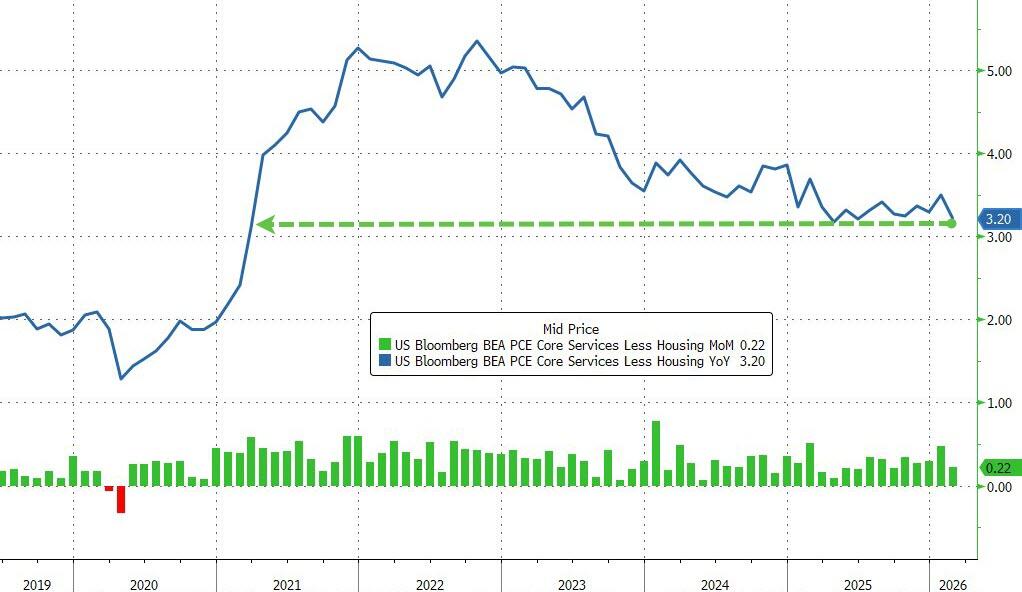
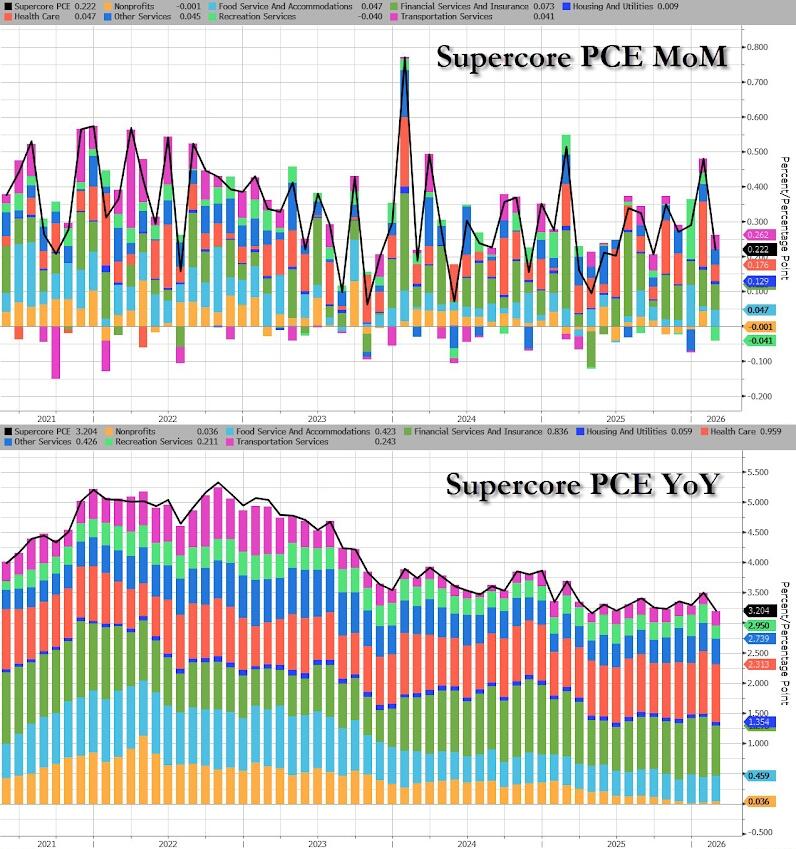
The much-watched SuperCore PCE (Services Ex-Shelter rose 0.2% MoM with the YoY rise tumbling to +3.2% – in line with its lowest level since March 2021…
Under the hood, Recreation Services and Healthcare saw the largest deceleration MoM…
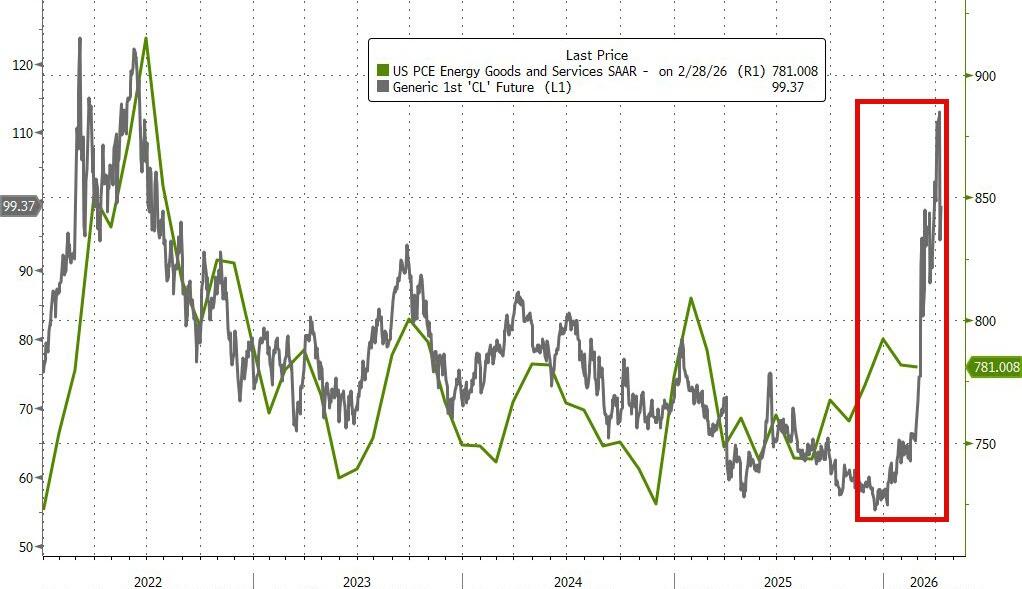
For those worried about the impact of crude oil’s recent surge (since the start of the Iran war), it appears – somehow – that PCE’s Energy component has already front-run some of the move but there’s a lot more pain to come for March…
Source: Bloomberg
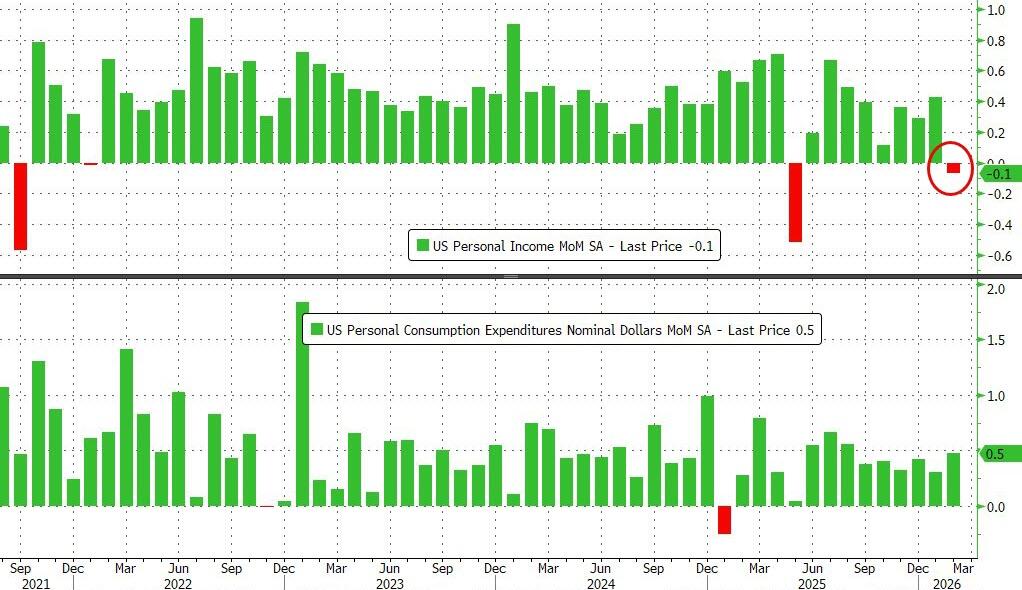
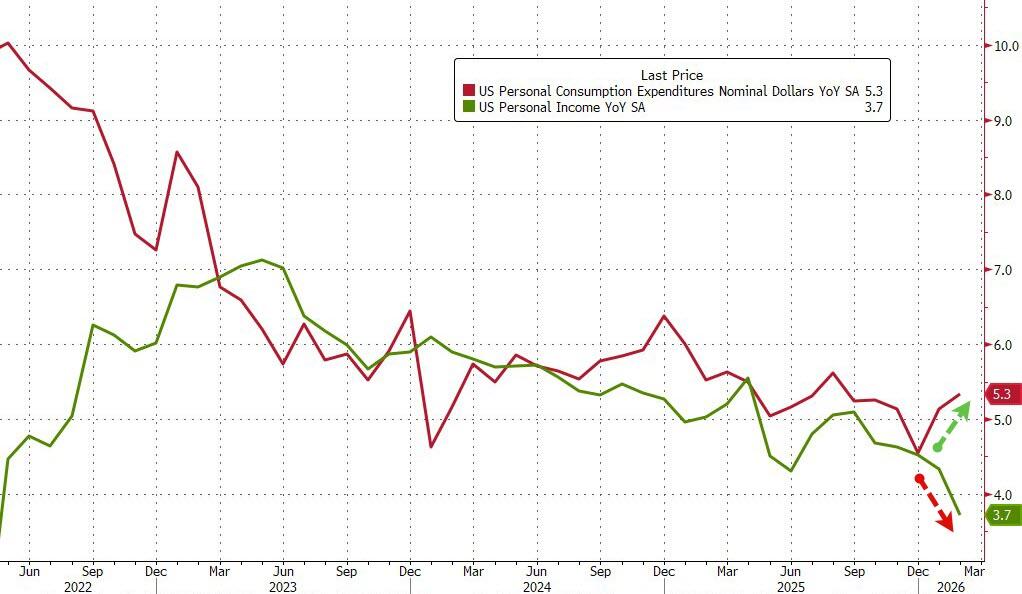
Higher prices were met with lower incomes (-0.1% MoM vs +0.3% MoM exp) and higher spending (+90.5% MoM vs +0.6% MoM exp)…
Source: Bloomberg
Income growth is slowing significantly while spending is accelerating…
Source: Bloomberg
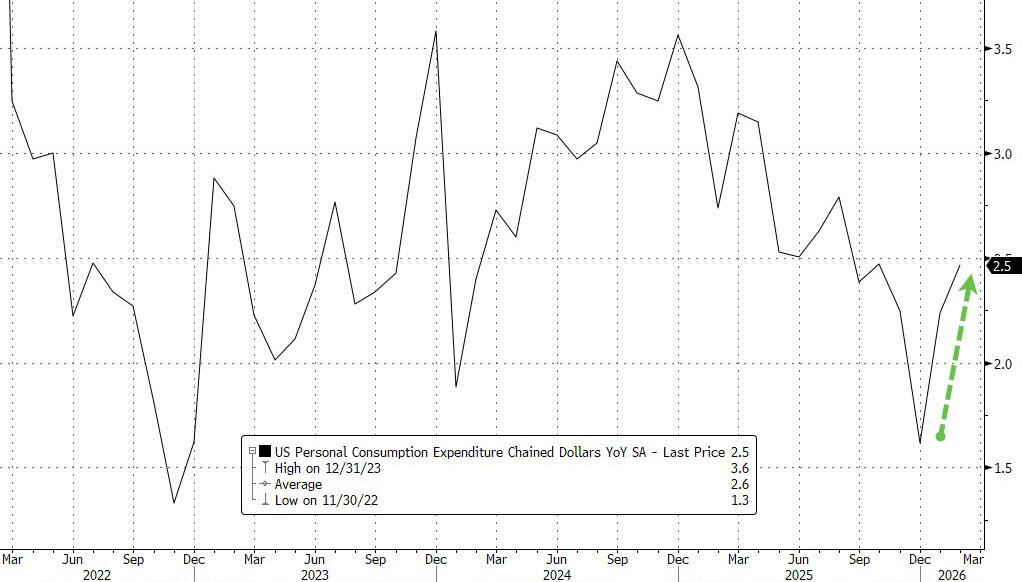
Adjusted for inflation, real spending rose 2.5% YoY – the highest since Oct 2025…
Source: Bloomberg
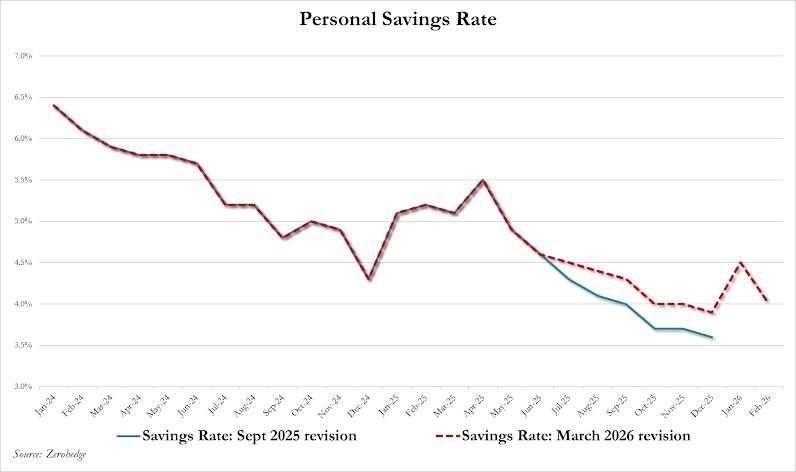
After jumping from 3.9% to 4.5% in January, Americans’ savings rate dropped back to 4.0% in Feb (after another huge revision in late 2025), basically at the weakest level since Nov 2023…
Source: Bloomberg
So spending solid as incomes fell and prices are rising… but this is all pre-war, so a large pinch of salt is required.
Tyler Durden
Thu, 04/09/2026 – 08:45
Stock Futures Slide As Doubts Over Ceasefire Send Oil Higher
Stock Futures Slide As Doubts Over Ceasefire Send Oil Higher
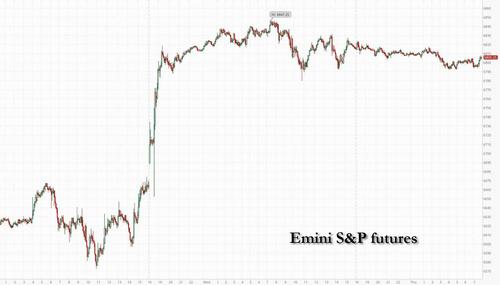
Stocks resumed their drop and oil erased about a third of its Wednesday drop as traders watched the fragile US-Iran ceasefire shatter by the hour, with both sides accusing the other of breaches while the Strait of Hormuz is still effectively closed and Israel intensified strikes on Lebanon. As of 8:00am ET, S&P futures fell 0.4% after Bloomberg strategists said a best-case scenario has already been priced in; Nasdaq futures dropped 0.3% with Mag7 stocks mostly lower. Europe’s Stoxx 600 index fell 0.7%. Emerging-market stocks slid almost 1%. The dollar ticked higher even as 10Y US YST yields dropped about 1bp; equivalent UK yields rose six basis points after tumbling almost 20 basis points on Wednesday. Brent crude jumped back to $98 a barrel on signs the Strait of Hormuz is still effectively closed. US economic data calendar includes February personal income/spending (with PCE price index), weekly jobless claims and third estimate of 4Q GDP (8:30am) and February wholesale trade sales and inventories (10am). Fed speaker slate is blank until April 14.
In premarket trading, Mag 7 stocks are mostly lower (Alphabet -0.7%, Amazon +0.8%, Apple -0.4%, Nvidia -0.7%, Meta Platforms +1%, Microsoft -0.1%, -0.3%)
Applied Digital (APLD) falls 1% after the data center operator’s third-quarter gross margins missed the average analyst estimate.
CoreWeave (CRWV) rises 6% after the cloud-computing provider reported an expanded long-term agreement with Meta to provide AI cloud capacity through December 2032 for ~$21 billion.
Marvell Technology (MRVL) rises 2% after Barclays upgraded the stock to overweight, citing demand for optical products.
Instacart (CART) climbs 2% as Raymond James upgrades to outperform, calling the grocery segment an under-penetrated e-commerce market.
Simply Good Foods (SMPL) falls 16% after the packaged-food firm forecast year net sales will be down as much as 10%.
STAAR Surgical (STAA) rises 23% after the health-care supplies firm said it expects net sales for the first quarter to exceed $90 million, up from $42.6 million in the year ago period. The estimate surpassed Wall Street’s expectations.
Texas Instruments (TXN) gains 1.6% after Stifel upgraded the stock to buy, citing “multiple tailwinds” that should support the semiconductor firm’s outlook.
Whitestone REIT (WSR) shares rise 11% after the retail-focused real estate investment trust company entered into a definitive merger agreement with Ares Real Estate funds to be acquired for $19 per share in an all-cash transaction valued at about $1.7 billion.
In AI, Anthropic employees sold some equity to investors, wrapping up a secondary share sale that started earlier this year. Meta shares are up in premarket trading, with analysts generally positive on the AI model it showed on Wednesday. PIMCO is said to be looking to sell a portion of the $14 billion of debt financing it’s providing for a massive Oracle data center in Michigan. In other corporate news, the WSJ reported that Disney is preparing to make sizable layoffs in one of the first significant moves under its new CEO. Seven & i Holdings will delay a public listing of its US convenience-store business planned for later this year.
Markets have given up some of the big moves seen Wednesday when optimism around the deal for a two-week pause in fighting spurred a relief rally. Continued fighting in the Middle East, punctuated by Israeli strikes in Lebanon, threatened to derail the fragile ceasefire deal. Iran and the US-Israeli side appeared to disagree over whether the ceasefire covers Lebanon. Yet despite the escalating rhetoric, the ceasefire was largely holding on Thursday, with a decline in attacks across Arab states in the Persian Gulf.
“There’s a fair amount of skepticism in the market about the ceasefire and the upcoming negotiations,” said Raphael Thuin, head of capital markets strategies at Tikehau Capital. “The big question is what state the global economy will be in after the crisis.”
Overnight, Trump pledged to keep US troops in the Persian Gulf ahead of talks with Iran; the first round of direct negotiations is scheduled for Saturday morning in Islamabad. Meanwhile, Goldman predicted that Brent is set to average more than $100 a barrel right through 2026 if the strait remains closed for another month.
Much of Wednesday’s move was driven by short-covering and a return to normal positioning: According to Goldman’s trading desk, hedge funds rushed to close out bets against US stocks at a pace not seen since March 2020. The ceasefire, along with upcoming earnings driving up the potential for idiosyncratic moves across equities, may mean “downward pressure on implied correlations,” according to Citi option strategists.
Even if weekend talks lead to a more permanent peace, the effects of the war will rumble on. Earnings expectations will need to be tempered because of the inflationary fallout from the war, according to BlackRock’s Helen Jewell. And in central banks, a former executive director at the Bank of Japan said the BOJ is likely to increase its benchmark rate this month to avoid falling behind on controlling inflation. Fed policymakers will get the latest reading of their preferred inflation indicator, core PCE, later, ahead of CPI data on Friday. The latter, covering March, is likely to be more interesting as it will begin to reflect the Middle East conflict.
In politics, the Justice Department’s top antitrust litigator and three senior trial attorneys are leaving the agency, according to people familiar. The US is said to consider lifting sanctions on Venezuela’s central bank to facilitate the flow of billions of dollars into the country’s battered economy.
Turning to the start of earnings season next week, expectations will need to be tempered due to the inflationary fallout from the war, BlackRock Inc.’s Helen Jewell said. “If you look at earnings forecasts at the moment for the year, they’re still well into double digits — 15, 16, 17, 18%,” said Jewell, who is international chief investment officer for fundamental equities at the world’s largest asset manager. “There’s a lot of headroom for the earnings to come down a little bit.”
On Thursday, the Fed’s preferred gauge of inflation will offer a snapshot of pre-war price pressures. Economists see the so-called core personal consumption expenditures — PCE — price index, which excludes food and energy, having risen by 0.4% for a third month in February, suggesting progress toward tamer inflation was stalling even before the conflict.
Europe’s stocks followed their Asian counterparts lower, with the Stoxx 600 down 0.7% after its best day since March 2022 on Wednesday. US equity futures also drop. Oil stocks advanced along with Brent crude. Many of yesterday’s laggards in the oil sector are today’s biggest gainers, including Var Energi, Equinor, BP and TotalEnergies. Here are the biggest movers Thursday:
ITM Power shares climb as much as 17%, the most in 10 months, after the UK government pledged to invest around £87 million in the clean energy company to drive a build out of its hydrogen technology manufacturing facility
Rexel shares climb as much as 4.1% after analysts at Jefferies raise the French electrical supplies firm to buy from hold, saying it is well positioned to outpace its guidance thanks to higher prices and growth drivers
Technip Energies shares rise as much as 4.1% to the highest level since September after the engineering firm was awarded a contract to improve the Long Son Petrochemicals complex in Vietnam
Vallourec rises as much as 5.2% after announcing a five-year supply agreement with Fervo Energy worth up to $800 million, which CIC Markets says “demonstrates the effectiveness” of the firm’s New Energies segment strategy
AG Barr rises as much as 4.7% after Bank of America initiates coverage of the UK soft drinks manufacturer with a buy rating and a street-high 850p price target. BofA cites growth potential for IRN-BRU
DCC shares rise as much as 4.1% after analysts at BNP Paribas raise their rating to outperform from neutral on the energy seller’s current valuation and the positive impact of energy prices
Melia Hotels shares rise as much as 3.9%, to the highest level since Sept. 2018, as Kepler Cheuvreux raises its recommendation on the Spanish hotel operator to hold from reduce
Abivax shares rise as much as 3.8% after Oddo BHF lifted its price target on the French biotech company, saying Crohn’s disease could represent a bigger commercial opportunity than ulcerative colitis
Alstom falls 7.2%, the most in ten months, after the French trainmaker flags currency headwinds in an earnings preview. JPMorgan (overweight) lowers estimates on FX headwinds
Man Group shares trade as much as 7.7% below their last closing price, only partly due to trading without rights to the next dividend. Deutsche Bank analysts cut their earnings estimates and price target ahead of 1Q results
Netcompany shares fall as much as 6.5%, the most in two months, after ABG Sundal Collier cut its recommendation on the Danish IT consultancy to hold from buy, seeing a “less compelling” risk/reward after a strong run for the shares
Grieg Seafood falls as much as 7.9%, the most since last May, after the Norwegian seafood and salmon company’s preliminary first-quarter earnings disappointed, leading DNB Carnegie to cut 2026 EPS estimates by 12%
Earlier in the session, Asian stocks retreated as oil prices rose again and sporadic fighting in the Middle East cast doubts over the implementation of the two-week US-Iran ceasefire deal. The MSCI Asia Pacific Index slid 1%, with South Korean chipmakers Samsung Electronics and SK Hynix the biggest drags. Most national benchmarks in the region traded lower, with the Kospi being the biggest loser followed by India’s Nifty 50. Asia’s stock benchmark jumped 5% in the previous session, the most in about a year, as global risk assets rallied on optimism over the ceasefire deal. It is up more than 8% so far in 2026.
“Headline risk remains elevated,” according to Kyle Rodda, analyst at Capital.com. “Markets aren’t necessarily out of the woods yet. There are several variables that could upend market sentiment.”
In rates, treasury yields are slightly lower, down 1bp to 4.29% and slightly richer across the curve after plying small ranges during Asia session and London morning; equivalent UK yields rose six basis points after tumbling almost 20 basis points on Wednesday. US yields are as much as 1.5bp lower led by intermediate sectors, steepening 5s30s curve by around 1bp. 10-year is down about 1bp near 4.28% with European counterparts 3bp-6bp higher on the day. European yields are broadly higher with oil prices as Strait of Hormuz traffic remains blocked: UK and German 10-year yields rise 7 bps and 4 bps respectively. US session includes PCE price gauges for February, several other US economic indicators and 30-year bond auction. Treasury’s $22 billion 30-year bond reopening has WI yield near 4.88%, about 1bp higher than result of last month’s auction, which stopped through by 0.7bp; Wednesday’s 10-year reopening tailed by 0.2bp after rallying into the bid deadline.
In FX, the Bloomberg Dollar Spot Index inches higher. The yen is the weakest of the G-10 currencies, falling 0.3% against the greenback. Gold edges up while Bitcoin is flat.
In commodities, WTI crude oil futures are up more than 5% near session highs, erasing about a third of Wednesday’s 16.4% drop; Brent crude futures rise 4% to above $98 after a more than 13% plunge to under $95 a barrel as the Strait of Hormuz remains largely blocked. Two fully laden Chinese oil tankers in the Persian Gulf were approaching the Strait, potentially putting them on track to become the first such vessels to cross since the ceasefire was announced. European natural gas futures climb 2%.
US economic data calendar includes February personal income/spending (with PCE price index), weekly jobless claims and third estimate of 4Q GDP (8:30am) and February wholesale trade sales and inventories (10am). Fed speaker slate is blank until April 14.
Market Snapshot
S&P 500 mini -0.3%, Nasdaq 100 mini -0.3%, Russell 2000 mini -0.6%
Stoxx Europe 600 -0.6%, DAX -1.2%, CAC 40 -0.7%
10-year Treasury yield little changed at 4.29%
VIX +0.4 points at 21.39
Bloomberg Dollar Index little changed at 1202.1, euro +0.1% at $1.1678
WTI crude +3.1% at $97.38/barrel
Top Overnight News
JD Vance will head the U.S. negotiating team for the peace talks with Iran on Saturday, White House press secretary Karoline Leavitt said on Wednesday. Axios
Even as the U.S. and Iran seek to cement a ceasefire, Israel is seizing more territory from its neighbors in preparation for a long, drawn-out conflict across the Middle East. Israel’s creation of “buffer zones” in Gaza, Syria and now Lebanon reflects a strategic shift after the attacks of October 7, 2023, one that puts the country in a semi-permanent state of war. RTRS
Vance said Wednesday Israel has proposed to restrain itself when it comes to strikes in Lebanon as long as the negotiations between the U.S. and Iran are taking place. Axios
The White House is considering a plan to punish some members of the NATO alliance that President Trump thinks were unhelpful to the U.S. and Israel during the Iran war, according to administration officials. The proposal would involve moving U.S. troops out of North Atlantic Treaty Organization member countries deemed unhelpful to the Iran war effort and stationing them in countries that were more supportive. WSJ
EU will still be hit by a “stagflationary shock” of low growth and rising inflation despite the US and Iran agreeing a two-week ceasefire, the bloc’s top economic official has warned. FT
BOJ Governor Kazuo Ueda said that Japan’s finance conditions remain accommodative, with the level of real rates clearly below zero. BBG
The US is said to be considering lifting sanctions on Venezuela’s central bank to facilitate the flow of billions of dollars into the country’s economy. BBG
Wealthy investors attempted to pull more than $20bn from private credit funds in the first quarter, underscoring the growing strain on the asset class. Please use the sharing tools found via the share button at the top or side of articles. The funds tracked by the FT, which collectively manage investment portfolios worth about $300bn, have honored just over half of the redemption requests they received. Many investors have been forced to wait until a redemption window opens up later this quarter to exit. FT
The Trump administration will likely extend its waiver of sanctions on Russian oil this week, former Treasury and State Department officials said — teeing up a similar move on Iranian oil. Semafor
World Bank forecasts global growth for 2027 at 2.4%, while it said investment remains subdued as firms await clearer signals on the external environment and domestic policy, which it called a binding constraint on growth.
A more detailed look at global markets courtesy of Newqsuawk
APAC stocks were lower in a mild pullback from yesterday’s ceasefire-fuelled extremes and as the widespread euphoria gradually waned amid the wide gaps between each side’s peace proposals. Furthermore, several strikes had continued in the 24 hours after the announcement, and the inclusion of Lebanon is seen as a key point of contention, while shipping in the Strait of Hormuz remains largely blocked, although a senior Iranian official stated that Iran could open Hormuz on Thursday or Friday ahead of their planned talks. ASX 200 traded little changed amid a lack of data or drivers and with resilience in energy, defensives and financials offsetting the firm losses in the tech sector. Nikkei 225 pulled back after the prior day’s stellar performance, with the index returning to beneath the 56,000 level amid very few fresh catalysts and the absence of tier-1 data to sustain the previous momentum. Hang Seng and Shanghai Comp conformed to the uninspired mood amid concerns regarding the fragility of the US-Iran ceasefire, and with weakness in Chinese tech and property stocks, while there were prior reports that the US FCC will vote on a measure that would ban Chinese labs from testing US electronics.
Top Asian News
South Korea’s Finance Minister comments that financial and FX market volatility has eased a bit.
European bourses (STOXX 600 -0.6%) have pulled back from Wednesday’s ceasefire-related surge after cracks appeared in the agreement. US President Trump announced that the military will remain in and around Iran until a real agreement is fully complied with. Furthermore, the IRGC announced a new Hormuz corridor, effectively raising risks of disruption and bottlenecks. The IBEX 35 outperforms, with the index trading near flat. On the other hand, the DAX 40 is the underperformer. European sectors echo the above bias, with the majority in the red. Energy and Chemicals are amongst the sectors in the green, highlighting its defensive characteristics, while Consumer Products and Services and Technology sit at the bottom of the pile.
Top European News
Italian PM Meloni said ruling out government reshuffle, not planning to resign; if the middle east crisis were to flare up again, Europe should consider temporary suspension of the stability and growth pact.
EU’s Dombrovskis said the bloc will still be hit by a “stagflationary shock” of low growth and rising inflation despite the US-Iran ceasefire, while European Commission is preparing to cut growth forecasts, according to FT.
FX
FX Markets are paring some of Wednesday’s optimism with crude gaining and general risk-off elsewhere as markets weigh Iran’s claims of ceasefire breaches and subsequent concerns over Hormuz following reports from state media.
DXY cautiously chugged higher throughout the European morning, supported by the key 99.00 mark. Overnight, FOMC Minutes were viewed as hawkish, with it stating many members said persistently higher oil prices could keep inflation elevated long enough to justify rate rises. Taking a look at rate expectations, markets moved to price just 7bps of easing by year-end compared to 15bps pre-minutes.
Kiwi continues to perform well, amid hawkish remarks from RBNZ Governor Breman, she said inflation is expected to increase considerably in the near-term, and they will ‘act decisively’ if core prices pick up. This marks the second day of gains against the greenback, with NZD the sole currency that outperforms a mildly stronger USD. In terms of market pricing, 75bps of easing is expected by year-end, an increase of 15bps since last week.
JPY is the worst performer in the G10, as energy prices weigh on the net importer nation. The pair marked a session low of 158.45 and sits on a 159 handle at the time of writing. Elsewhere, EUR/GBP trades a touch above the 0.87 mark. In a note this morning, ING suggests rate differentials will help the cross with EUR; rate expectations are likely to prove sticky and BoE dovish pricing potentially coming “through more smoothly” should energy prices continue to decline.
Central Banks
RBNZ Governor Bremen said more risk on inflation to the upside and inflation is expected to increase considerably in the near-term. said:. Previous rate cuts are still providing some stimulus to the economy, and a swift resolution to the conflict is expected to yield stronger growth this year. RBNZ to ‘act decisively’ if core prices pick up.
BoJ Governor Ueda said short and medium-term interest rates are clearly negative, adds accommodative financial conditions are maintained, leading to moderate increase in capex.
Fixed Income
Global fixed benchmarks are trading flat to lower, as benchmarks pull back from the extremes seen on Wednesday, and as traders begin to find holes within the current ceasefire agreement. This comes after Iran’s Parliament Speaker Ghalibaf said three clauses of the 10-point plan have been violated so far, and as such, a bilateral ceasefire or negotiations is unreasonable. Another interesting point is that Iran introduced controlled shipping routes and coordination with the IRGC, effectively shifting from free transit to monitored flows—raising risks of disruptions and bottlenecks. (Full details on the Newsquawk headline feed). This, alongside continued strikes on both Lebanon and Iran, has led to a rebound in the energy complex, once again renewing inflationary concerns.
USTs are currently flat, and mildly outperforming vs peers – currently trading within a 111-04+ to 111-10 range, and have entirely reversed the initial ceasefire-related optimism. Much of the action facilitated by the geopolitical factors mentioned above, but the complex is also weighed on by hawkish-leaning FOMC Minutes and heading into a 30yr auction later today. On the data front, markets will await weekly claims, February’s PCE data (exp. +0.4% M/M vs prev. +0.3%) and core PCE (exp. +0.4% M/M vs prev. +0.4%); final Q4 GDP stats. From a yield perspective, the 2yr has rebounded back towards 3.785% (vs Wednesday’s trough at 3.713%).
Bunds are in the red and down by around 50 ticks at this stage, and holding towards the bottom end of a 125.67 to 126.10 range. German paper did dip a tick below the high from 7th April, with market participants highlighting 125.53 as a potential area for intraday longs to be exited. Bunds are moving at the whim of energy prices this morning, but there have been some domestic updates. An interesting comment via Italy’s PM Meloni got some attention, after she suggested that the EU should consider a temporary suspension of budget deficit rules if the Iran war persists. No move in EGBs at the time, but traders will remain cognizant of any fiscal related concerns, should a suspension be enacted. From a data perspective, Industrial Production printed at -0.3% (exp. +0.9%), highlighting the turbulent recovery of Germany – even before the Iran war started.
Gilts are underperforming vs peers, after leading the fixed complex on Wednesday. As above, moving at the whim of energy prices, with UK-specific newsflow light. UK 2yr has rebounded back towards 4.237% (vs trough of 4.044% on Wednesday). UK paper currently trades within an 89.10 to 89.61 range; further pressure could see a breach below the 89.00 mark, and then the high from 7th April at 88.88.
UK sold GBP 4bln 4.125% 2033 Gilt: b/c 3.30x (prev. 3.37x), average yield 4.507% (prev. 4.075%), tail 0.2bps (prev. 0.2bps).
Spain sold EUR 5.778bln vs exp. EUR 5-6bln 2.35% 2029, 2.60% 2031 and 3.30% 2036 Bono & EUR 0.676bln vs exp. EUR 0.25-0.75bln 1.15% 2036 I/L Bono.
Japan sold JPY 1.9tln 5yr JGBs; b/c 3.58x (prev. 3.69x), average yield 1.826% (prev. 1.633%).
Unicredit (UCG IM) to sell 6-year EUR-denominated noted, guidance seen +125bps to MS.
Lloyds (LLOY LN) to sell 10-year GBP-denominated noted, guidance seen at +170bps to UK Treasuries.
Japanese Finance Minister Katayama said it is important to base JGB issuance plans on market demand, when asked about extending duration of government debt.
Commodities
Optimism over the US–Iran ceasefire faded as both sides signalled breaches and diverging terms, with Trump warning of military escalation if compliance fails and Iran’s Parliament Speaker Ghalibaf saying multiple clauses of Tehran’s plan have already been violated. Lebanon has emerged as the key fault line—while the US and Israel insist it sits outside the agreement, Iran and its allies treat it as integral, raising the risk of collapse as Israeli strikes and Hezbollah activity continue. The situation in the Strait of Hormuz adds further fragility, as Iran introduced controlled shipping routes and coordination with the IRGC, effectively shifting from free transit to monitored flows—raising risks of disruptions and bottlenecks (Full Analysis available on the Newsquawk headline feed).
Crude rebounded after Wednesday’s biggest one-day drop since April 2020, with Brent Jun’26 back above USD 97/bbl (after Wednesday’s 13% slump), as the Strait of Hormuz remained largely blocked and Israeli attacks on Lebanon raised concerns over the durability of the Middle East truce. WTI May’26 trades towards the top of a USD 96.25-98.38/bbl range and Brent Jun’26 towards the upper end of a USD 96.30-98.53/bbl parameter. Mizuho expects crude to remain near USD 90/bbl through Q2 before returning to pre-conflict levels, while CBA sees upside risks while the Strait remains largely closed and physical undersupply linked to the Iran war supports prices.
Spot gold holds above USD 4,700/oz after rising 1.5% over the prior two sessions, as traders weighed hopes for a diplomatic resolution against sporadic fighting that threatened the ceasefire. However, some flagged a technical correction after the sharp rise in front-month Comex futures. The metal trades within a narrow USD 4,699-4,733/oz range at the time of writing, with the 100 DMA at USD 4,671.57/oz. Commerzbank said gold had been supported by lower oil prices, easing inflation risks and pulling down rate expectations and bond yields, though the outlook still depends on whether a lasting US-Iran settlement emerges.
Copper futures pulled back overnight and remain weak in the European session as the heightened risk appetite from the fragile US-Iran ceasefire petered out, with 3M LME copper in a narrow USD 12,587.00- 12,678.70/oz.
Brazil court suspends oil export tax for Shell (SHEL LN), Equinor (EQNR), TotalEnergies (TTE FP) and Repsol (REP SM).
OECD has urged governments to unwind expensive fuel duty cuts, according to the FT.
Japan considers releasing an additional 20 days of oil reserves, according to Kyodo.
US mulls lifting Venezuela’s central bank sanctions with the aim of increasing oil output, according to sources.
Russia is offering sanctioned LNG to Asia via intermediaries at a 40% discount.
Goldman Sachs said Brent would average above USD 100/bbl through 2026 if the Strait of Hormuz stays closed for another month. Adds that the situation remains fluid after the start of a two-week US-Iran ceasefire, and that risks to its oil price forecast are still skewed to the upside.
Geopolitics
US President Trump posted “All U.S. Ships, Aircraft, and Military Personnel….will remain in place in, and around, Iran, until such time as the REAL AGREEMENT reached is fully complied with”.
US President Trump posted “NATO WASN’T THERE WHEN WE NEEDED THEM, AND THEY WON’T BE THERE IF WE NEED THEM AGAIN. REMEMBER GREENLAND, THAT BIG, POORLY RUN, PIECE OF ICE!!!”.
Trump admin is considering a plan to punish some members of the NATO alliance that he believes were unhelpful to the US and Israel during the Iran war, WSJ reported citing admin officials. The proposal would involve moving US troops out of NATO member countries deemed unhelpful to the Iran war effort and station them in countries that were more supportive of the US military campaign. The proposal would fall far short of President Trump’s recent threats to fully withdraw the US from the alliance, which by law he can’t do without Congress. Plans could also include closure of at least 1 US base in a European country, possible Spain or Germany.
NATO Secretary-General Rutte pointed out to US President Trump that a large majority of European nations have been helpful.
US officials say they do not rule out resuming fighting in Iran and that President Trump will not offer major concessions to Iran to open the Strait of Hormuz, adds Iran’s insistence on controlling straight reformers could lead to a resumption of fighting.
Iranian Deputy Foreign Minister said the Speaker of Parliament will lead Iran’s delegation for the talks, and the exchange of messages continues via Pakistan, Al Jazeera reported.
Iran Ambassador to Pakistan said the Iranian delegation is to arrive on Thursday night in Islamabad for “serious talks”, based on the 10 points proposed by Iran.
IRGC Navy announces alternative shipping routes to avoid possible sea mines, according to ISNA.
IRGC claimed on Thursday that shipping through the Strait of Hormuz slowed sharply and then stopped following what it said was an Israeli ceasefire violation in Lebanon, according to CNN.
Iranian Parliament’s Security and Foreign Policy Committee Chairman Ibrahim Azizi said ‘”Once again, you have proven that you do not know the meaning of a ceasefire” and “Only fire will discipline you…so wait for it”.
Saudi Arabia and Iran reportedly discussed de-escalation in a call, according to SPA.
Pakistani Foreign Ministry senior source suggests US has walked back on including Lebanon in the ceasefire with Iran, Al Arabiya reported.
Israeli PM Netanyahu says will continue to strike Hezbollah with force, overnight, the IDF struck a series of terror infrastructures in southern Lebanon.
Israel’s Ministry of Energy directs the resumption of operations at the Karish gas platform after it halted due to the war, according to Israel’s Channel 12.
Hezbollah said its attacks on Israel will continue until the aggression stops, according to Fars News Agency, while it fires rockets at Israel citing ceasefire breaches.
Missile fired from Lebanon into Northern Israel, according to Fars News Agency.
Israeli attacks continue in Lebanon, despite a ceasefire with Iran, according to Anadolu Agency.
French President Macron spoke with Iran’s President Pezeshkian and US President Trump, and told both that their decision to accept the ceasefire was the best possible one.
Russia launched 119 drones at Ukraine overnight according to UKR media.
US Event Calendar
8:30 am: United States Feb Personal Income, est. 0.3%, prior 0.43%
8:30 am: United States Feb Personal Spending, est. 0.6%, prior 0.38%
8:30 am: United States Feb PCE Price Index YoY, est. 2.8%, prior 2.83%
8:30 am: United States Feb Core PCE Price Index MoM, est. 0.4%, prior 0.4%
8:30 am: United States Feb Core PCE Price Index YoY, est. 3%, prior 3.06%
8:30 am: United States Apr 4 Initial Jobless Claims, est. 210k, prior 202k
8:30 am: United States Mar 28 Continuing Claims, est. 1828k, prior 1841k
8:30 am: United States 4Q T GDP Annualized QoQ, est. 0.7%, prior 0.7%
8:30 am: United States 4Q T Personal Consumption, est. 2%, prior 2%
8:30 am: United States 4Q T GDP Price Index, est. 3.8%, prior 3.8%
8:30 am: United States 4Q T Core PCE Price Index QoQ, est. 2.7%, prior 2.7%
10:00 am: United States Feb F Wholesale Inventories MoM, est. -0.1%, prior -0.5%
DB’s Jim Reid concludes the overnight wrap
As we go to press this morning, oil prices are creeping up again as several questions remain about the ceasefire announced on Tuesday night. A few factors have driven that, but it’s pushed Brent crude oil (+2.34%) back up to $96.97/bbl, and it’s also taken the momentum out of the market rally overnight. Indeed, Asian equities are down across the board after yesterday’s surge, whilst US and European equity futures have also stumbled. So the Nikkei (-0.75%), the KOSPI (-1.61%), the CSI 300 (-0.64%) and the Hang Seng (-0.36%) have all fallen back this morning, and S&P 500 futures (-0.21%) are also pointing towards losses after a run of 6 consecutive gains.
Those overnight losses follow several indications that the ceasefire isn’t holding quite as expected on Tuesday night. For instance, both the UAE and Kuwait said yesterday that their air defences had been intercepting drones from Iran. And on the Iranian side, their Parliament’s Speaker Ghalibaf said that three points of the ceasefire agreement had been violated. Moreover, the IRGC warned of a “regret-inducing response” if Israel’s strikes against Lebanon didn’t stop immediately, whilst the Fars news agency said that the passage of oil tankers through the Strait of Hormuz was halted because of Israel’s continued strikes on Lebanon. So collectively, that’s raised concern about how durable this ceasefire will prove, particularly with it only being a two-week truce.
In the meantime, President Trump also posted overnight that US forces would “remain in place, and around, Iran, until such time as the REAL AGREEMENT reached is fully complied with.” He also said that if it weren’t complied with, then the military action would be “stronger than anyone has ever seen before”, and that the US military was “looking forward, actually, to its next Conquest”. He also criticised NATO in a separate post overnight, saying that they weren’t “there when we needed them”, and called on people to “remember Greenland, that big, poorly run, piece of ice!!!”. So that raised concerns about a repeat of mid-January, when Trump’s call for the US to take Greenland and the threat of European tariffs drove a risk-off move in global markets.
Nevertheless, compared to 24 hours ago, the market stress has eased considerably, as the ceasefire news and hopes for a de-escalation pathway have created a lot more optimism. Moreover, there are still signs of progress, with White House Press Secretary Leavitt saying that Vice President JD Vance would lead a delegation to Islamabad, with a first round of talks scheduled for Saturday morning.
So despite the overnight newsflow, the net result is that fears have eased considerably about a stagflationary shock, with huge gains for bonds and equities as a result. Indeed, Brent crude oil prices saw a sharp decline of -13.29% yesterday, taking them to a 4-week low of $94.75/bbl. And in turn, there was an incredibly strong performance, particularly in Europe, where the STOXX 600 (+3.88%) posted its best performance since 2022, whilst 10yr bund yields (-14.1bps) saw their biggest decline since 2023. Similarly in the US, the S&P 500 (+2.51%) was also back within 3% of its record high, whilst US HY spreads (-17bps) fell beneath their pre-strike levels in late-February. So even with all the volatility of recent weeks it was another day of historic moves, and the overnight move for Brent crude this morning (+2.34%) still leaves us well beneath the pre-ceasefire oil price of around $110/bbl.
The ceasefire itself was the main driver of those moves, but they got further support from the positive tone of US officials yesterday. For example, President Trump said the US would “work closely with Iran”, and that they were discussing tariff and sanctions relief, though he also said in a subsequent post that countries supplying military weapons to Iran would face a US tariff of 50%. And later on, Vice President Vance said that “we’re on the right track” in negotiations.
So overall, even with the question marks around a ceasefire, the fact one had been agreed led to a huge wave of optimism, with investors feeling much clearer about the path to a de-escalation. Most directly, the prospect that the Strait of Hormuz might reopen led to a big decline in oil prices, with Brent crude (-13.29%) down to a 4-week low of $94.75/bbl, whilst WTI (-16.41%) fell to $94.41/bbl. Meanwhile, we saw a big decline in European natural gas, with front-month TTF futures (-14.92%) falling to €45.30/MWh, their lowest in over a month, which again eased fears about the scale of any European inflation shock. However, with persisting restrictions on Hormuz shipping, the declines were more modest further out the oil curve, with the 6-month Brent future (-2.33%) closing at $81.19/bbl, still above its levels late last week.
That backdrop of lower energy prices meant that inflation fears eased dramatically, which in tun led to a dovish repricing of central banks, especially in Europe. For instance, the 1yr US inflation swap plummeted by -12.9bps to 3.13%, and the 1yr Euro inflation swap fell by a huge -38bps to 3.11%. In turn, that saw investors price out the likelihood of rapid rate hikes, with the probability of an ECB hike this month down from 68% before the ceasefire announcement to 32% by yesterday’s close, and a further decline to 29% this morning.
All that meant yields saw dramatic declines in Europe. Indeed, 10yr bund yields (-14.1bps) were back down to 2.94%, marking their biggest daily decline since April 2023. At the front end, the 2yr German yield (-22.4bps) saw its biggest decline since March 2023, the week of Credit Suisse’s collapse, so it was another day of historic declines. And it a similar story across the continent, with 10yr OATs (-20.1bps), BTPs (-26.1bps) and gilts (-19.3bps) all posting their biggest declines since 2023 as well.
US Treasuries saw more muted moves, given yields had already fallen late in Tuesday’s session and oil prices were edging higher later in the US session yesterday. So both 2yr yields (-0.1bps at 3.79%) and 10yr yields (-0.2bps at 4.29%) were little changed by the close, having been 6-8bps lower on the day early on. We also got the minutes of the March FOMC meeting, which showed the uncertainty on how officials should respond to the war’s impact. It said that “most participants” were concerned that “a protracted conflict in the Middle East could lead to a further softening in labor market conditions, which could warrant additional rate cuts”. But it also said that “Many participants pointing to the risk of inflation remaining elevated for longer than expected amid a persistent increase in oil prices, which could call for rate increases”.
For equities, there were also dramatic moves yesterday, as the oil price slump provided a huge lift on both sides of the Atlantic. In Europe, the rally was the biggest in several years, with the DAX (+5.06%) and the STOXX 600 (+3.88%) seeing their biggest gains since March 2022. Indeed, the latest gains left the STOXX 600 just over 3% beneath its record high just before the strikes began. Then in the US, the S&P 500 (+2.51%) advanced by a slightly smaller amount, but it was still a 6th consecutive advance for the index, with the VIX index of volatility (-4.74pts) down to its lowest since the strikes began, at 21.04pts. However, the main exception to those equity gains came from the energy sector, with the S&P 500’s energy component down -3.66%.
Emerging market assets were another beneficiary amid the easing energy fears, with the MSCI EM equity index (+5.49%) posting its biggest rise since the early Covid volatility in March 2020. By contrast, the dollar index (-0.73%) fell for a third consecutive session for the first time since the strikes began.
Looking at the day ahead, data releases include US PCE inflation for February, the weekly initial jobless claims, the third estimate of Q4 GDP, and German industrial production for February. Otherwise from central banks, we’ll hear from the ECB’s Sleijpen.
Tyler Durden
Thu, 04/09/2026 – 08:18
https://www.zerohedge.com/markets/stock-futures-slide-doubts-over-ceasefire-send-oil-higher