
Category: News

KEVIIIIINNNN!!!
KEVIIIIINNNN!!!
By Stefan Koopman, Senior Macro Strategist at Rabobank
With Christmas approaching, Home Alone offers a fitting image to start this Global Daily: Kate McCallister, flying high in seats that by today’s standards look very comfy, suddenly shrieks “KEVIIIIINNNN” when she realizes she has left her son behind. Kevin Hassett’s fast climb toward the Fed chair resembles such a flight: a strong ascent, apparently some nice tailwinds, and then a moment of doubt as he may have flown too close to the sun.
Just as Icarus overreached, high visibility and scrutiny can bring Kevin Hassett down too. Recent media reports suggest the field is open again, with former Fed governor Kevin Warsh back in the running. The question is whether this Kevin represents an upgrade.
Indeed, Warsh’s record is at odds with the White House’s policy agenda. As governor, he pushed for rate hikes even as the U.S. economy plunged into recession, he opposed key tools to expand the balance sheet to deal with the financial crisis and then he warned of inflation that – if you’re generous – arrived about 13 years late. His critique of the Fed aligns with Friedman’s free-market and limited-government ideals, and also a very narrow interpretation of the Fed’s remit. While this is at least internally consistent, his calls were wrong at nearly every major turning point in the economy.
More problematically, his current fixation on balance-sheet reduction (while the Fed has shifted to an ample reserves framework) should be read less as an intellectually coherent framework and more as political positioning. It offers an easy way to sound hawkish and serious about inflation while providing cover to later advocate for the rate cuts this White House wants. His logic only works if fiscal deficits shrink substantially – and here we can think of Clinton-era Rubinomics – but Trump and Bessent have shown zero interest in deficit reduction.
Perhaps his candidacy is floated simply to make Hassett look better. Either way, everything Warsh says now must also be viewed through the lens of ambition. If appointed, the hard-money man could go soft, not out of conviction, but because doing the president’s bidding becomes part of the job. So if Hassett’s risk is proximity to the sun, Warsh’s risk is opportunism. Markets may conclude that neither choice secures the Fed’s long-term credibility on inflation expectations and central bank independence.
Meanwhile, Governor Miran offered a detailed inflation outlook to explain why he voted for a 50bp cut at last week’s meeting. He sees underlying price pressures closer to the Fed’s 2% target than the headline rate suggests, citing expected deceleration in shelter inflation as the PCE’s lagged metric catches up with flat market rents, and the way portfolio management fees are imputed from rising asset prices. He also argued against blaming tariffs for the rise in core goods inflation. While he wasn’t able to provide alternative facts, he did suggest that goods price inflation may settle at a structurally higher level than pre-pandemic norms, largely driven by efforts to strengthen supply-chain security and resilience.
Helpfully for both Kevins and Stephen, the near-term inflation picture looks more benign. Crude oil fell to a two-month low yesterday, helped by optimism around a potential deal to end the war in Ukraine that would lift restrictions on Russian flows. With WTI at $56.4 per barrel in an oversupplied market, with unemployment rising and wage growth easing, and rental inflation indeed largely flat, outside of tariffs there’s only the AI-boom that looks to keep inflation elevated in 2026. That would mean that the hawkish case to not cut rates at all in 2026 largely rests on the absence of a clear path to deceleration to the 2% target.
Day Ahead
Today is busy in terms of data.
The UK labor market data for October/November kicks off the morning. Conditions have weakened sharply in 2025: vacancies fell first, now employment is declining. Soft demand combined with rising labor supply has pushed unemployment to a four-year high of 5%, slowing private-sector pay growth. This reduces concerns about inflation persistence. If today’s report confirms the trend, the path is clear for further Bank of England easing at this week’s meeting and into early 2026.
In Europe, attention turns to the latest political psychodrama ahead of the Mercosur vote expected later this week. France is reportedly pushing to delay (or possibly derail) the process to revisit its long-standing concerns one more time, while supporters warn that another pause could kill the deal altogether. Also on the agenda this morning are the December PMIs. The Eurozone composite PMI is forecast at 52.6, slightly below November’s 52.8, but that would still indicate that the economy continues to expand modestly despite weak foreign demand. The UK reading may improve from November’s 51.2, partly reflecting the lifting of uncertainty after the Budget. Last Friday’s GDP data suggested the economy stagnated through most of the second half of 2025.
The FOMC meeting a week ago was about as market-friendly as it could reasonably get. Even so, Chair Powell reiterated that policy settings are now close to neutral, raising the bar for additional easing in the near term. Futures still price about a 60% chance of a 25bp cut in March. That stance faces a test this week as today’s November payrolls and Thursday’s CPI highlight the Fed’s conflicting mandate.
Today’s jobs report is unusual. It not only arrives on a Tuesday but also reflects distortions from the longest U.S. government shutdown. The BLS will publish October and November payrolls simultaneously, though markets will probably just focus on November. The unemployment rate, based on the household survey, covers only November. Data collection started after the shutdown’s end on November 12. The BLS warns of slightly increased standard errors due to technical issues with the sample itself, with a lot of first-time survey respondents that typically report higher unemployment rates than more experienced respondents. This suggests a small upward bias and makes the print a bit of a wildcard.
Consensus sees November payrolls slightly below trend at +50k and unemployment at 4.4–4.5%, a just-about-right print that would temper labor concerns while preserving optionality for cuts. A weaker print could spur risk-off moves: equities lower, a softer dollar, and flows into cash and Treasuries.
Finally, October retail sales are expected to rebound, with the control group up 0.4% after September’s 0.1% drop. Tariff-sensitive categories such as autos, electronics, and apparel are under pressure, while service-related spending still looks firm. For October, some retailers flagged a negative impact from the government shutdown, only reinforcing the “K-shaped” narrative Chair Powell talked about in last week’s press conference.
Tyler Durden
Tue, 12/16/2025 – 08:20
Trump Sues BBC For $10 Billion Over Misleading Jan. 6 Edits
Trump Sues BBC For $10 Billion Over Misleading Jan. 6 Edits
Authored by Troy Myers & Joseph Lord via The Epoch Times (emphasis ours),
President Donald Trump on Monday evening filed a lawsuit against the British Broadcasting Corporation (BBC) seeking $10 billion in restitution for alleged defamation in a news special that aired last year.
The BBC logo outside the BBC Broadcasting House in London on Nov. 10, 2025. REUTERS/Jack Taylor
The 33-page legal filing accuses the BBC of making “a false, defamatory, deceptive, disparaging, inflammatory, and malicious depiction of President Trump … that was fabricated and aired by the Defendants one week before the 2024 Presidential Election in a brazen attempt to interfere in and influence the Election’s outcome to President Trump’s detriment.”
The BBC aired an episode titled “Donald Trump: A Second Chance?” on Oct. 28, 2024—one week before the presidential election.
The suit claims that in its episode, produced by “Panorama,“ the BBC ”intentionally and maliciously sought to fully mislead its viewers“ by ”splicing together” clips of remarks that Trump made ahead of the Jan. 6, 2021 Capitol breach.
It asks for $10 billion in damages, citing the value of Trump’s personal brand and “the injury to President Trump’s business and personal reputation inflicted by these Defendants, and their efforts to falsely, maliciously, and defamatorily portray President Trump as a violent insurrectionist.”
The legal action was expected, coming hours after Trump announced from the White House on Dec. 15 that he planned to imminently file a lawsuit over the alleged defamatory edits.
“Literally, they put words in my mouth. They had me saying things that I never said coming out. I guess they used AI or something,” Trump said from the Oval Office on Monday.
The edits at issue center around remarks Trump made to his supporters at the Ellipse in Washington on Jan. 6, 2021.
In the BBC program, editors spliced together two clips from the speech, creating the impression that Trump had said, “We’re gonna walk down to the Capitol and I’ll be with you and we fight, we fight like hell, and if you don’t fight like hell, you’re not gonna have a country anymore.”
In reality, the clips came from separate portions of the speech, including one in which Trump said, “We’re going to walk down, and I’ll be with you … we’re gonna walk down to the Capitol,” and another 54 minutes later, in which he said, “We fight like hell. And if you don’t fight like hell, you’re not going to have a country anymore.”
The UK broadcaster said it personally apologized to Trump in a letter to the White House last month, but has said that the issue doesn’t rise to the level of legal action.
“While the BBC sincerely regrets the manner in which the video clip was edited, we strongly disagree there is a basis for a defamation claim,” the broadcaster said in a statement in November.
The BBC also admitted to the misleading edit in its Corrections and Clarifications section. The broadcaster said the episode in question would not be rebroadcast on any BBC platforms.
“We accept that our edit unintentionally created the impression that we were showing a single continuous section of the speech, rather than excerpts from different points in the speech, and that this gave the mistaken impression that President Trump had made a direct call for violent action,” the BBC wrote on Nov. 13.
The next day, the president made his original threat to sue the BBC for up to $5 billion, saying the apology was not enough.
The BBC’s director-general and CEO of news at the time resigned after the scandal broke, an act that Trump praised on Truth Social a month ago, posting they “are all quitting/FIRED, because they were caught ‘doctoring’ my very good (PERFECT!) speech of January 6th.”
Trump said he planned to raise the issue with British Prime Minister Keir Starmer, who he said was “very embarrassed” about the scandal.
“This is within one of our great allies, you know, this is supposedly our great ally,” Trump said during a Fox News interview last month.
Tyler Durden
Tue, 12/16/2025 – 08:00
https://www.zerohedge.com/political/trump-sues-bbc-10-billion-over-misleading-jan-6-edits
Futures Rebound From Session Lows Ahead Of Long Overdue Jobs Report
Futures Rebound From Session Lows Ahead Of Long Overdue Jobs Report
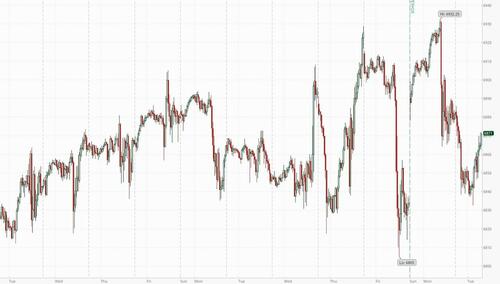
Stock futures are lower, but well off session lows, as traders await delayed jobs data that will shape the Fed’s next move. As of 7:15am, S&P 500 futures are 0.2% lower while Nasdaq 100 contracts are -0.3% with all Mag 7 names lower premarket; European equities are little changed.Treasuries are lower, pushing 10Y yields up 0.5bps to 4.175%. The Bloomberg dollar index is at session lows. Brent crude dropped 1.6% below $60 a barrel for the first time since May and gold pulled back after five days of gains. Bitcoin sank more than 1% before recovering above $87,000. The non-farm payrolls report, due at 8:30 a.m., will include more uncertainty and quirks than usual. Consensus among economists for November is at 50k, while the whisper number is 22k. On today’ calendar, Non-farm payrolls, average hourly earnings and the unemployment rate for November are due at 8:30 a.m. ET. We also get the October retail sales data at that time. December US PMIs for the manufacturing and services industries are due at 9:45 a.m.
In premarket trading, all Mag 7 stocks are lower: Alphabet -0.1%, Apple -0.2%, Amazon -0.2%, Microsoft -0.4%, Nvidia -0.5%, Meta -0.6%, Tesla -1%
Accenture (ACN) shares rise 1.9% after Morgan Stanley upgraded to overweight from equal-weight, saying the stock now trades at a compelling valuation following this year’s pullback.
Cognex (CGNX) is up 3.7% after being raised to buy from sell at Goldman Sachs, with the broker noting organic growth is at an inflection point and margin recovery is underway after several years of underperformance.
Organogenesis (ORGO) climbs 9.5% after the biotech said it plans to begin submitting ReNu, a product to treat knee osteoarthritis pain, to US regulators by the end of 2025.
The non-farm payrolls report, due at 8:30 a.m., will include more uncertainty and quirks than usual. Consensus among economists for November is at 50k,with a range of -20k to 130k, while the whisper number is 22k. The unemployment rate is expected to increase to 4.5%. Bloomberg Economics believes the US economy could have added as many as 130k jobs. The jobs report will also include an estimate of October payrolls — figures that were delayed by the federal shutdown. The stakes are high, but the huge range of estimates suggests no-one really knows what to expect (see our preview here). A print that reinforces the picture of a sluggish economy could put the stock rally back on track by supporting bets for further rate cuts, while a big miss may spook markets.
“The employment numbers would need to surprise materially — either significantly stronger or weaker than expected — to meaningfully shift market expectations,” said Mathieu Racheter, head of equity strategy at Julius Baer.
The setup is cautious going into the today’ jobs. There’s rotation out of tech, dollar weakness and declines for oil and copper. Bitcoin dropped below $86,000 for the first time in two weeks, slipping deeper into bear market territory. Still, fund managers in Bank of America’s latest survey aren’t worried — going into the new year, they’re the most bullish they’ve been since 2021.
Rate reductions and robust growth have propelled the MSCI All-Country World Index to a gain of almost 20% in 2025, notching a third straight year of double-digit increases. According to a Bank of America’ monthly Fund Managers Survey, money managers are confident about the outlook for 2026. Investor sentiment as measured by cash levels, stock allocation and global growth expectations rose to 7.4 in December on a scale capped at 10, the most bullish survey outcome in four-and-a-half years.
The improved prospects of a peace deal between Ukraine and Russia are showing up in the equity space, where European defense names underperform. Technology stocks are the worst performers in Europe, tracking a similar trend on Wall Street on Monday and Asia overnight. The Stoxx 600 falls 0.2%, with defense shares lagging while chemical stocks outperform. European defense stocks fell on the speculation around a possible ceasefire, with Germany’s Rheinmetall AG dropping as much as 4.6%, and Italy’s Leonardo SpA falling 4.5%. Here are some of the biggest movers on Tuesday:
IG Group shares jump as much as 5.6% to an all-time high, after the trading platform said it will deliver its medium-term revenue growth targets ahead of schedule in 2026.
UBS shares climb as much as 3%, touching their highest level since 2008, after Bank of America analysts said the Swiss lender is set to grow earnings per share at the fastest sequential pace of any bank globally.
Raiffeisen Bank International shares rise as much as 2.9%, to the highest level since April 2011, as Oddo BHF starts coverage at outperform and says the Austrian lender’s scope to re-rate is still being overlooked.
Aperam shares gain as much as 5.6% after Morgan Stanley says sentiment is turning more constructive on European stainless steel, with policy measures providing a floor.
Abivax shares drop as much as 8.7% after the French biotechnology company reported third-quarter financial results that Van Lanschot Kempen analysts called “uneventful.”
Saab shares sink as much as 6.6%, leading defense stocks lower, after President Donald Trump said a negotiated end to the war is “closer” than ever.
Telefonica shares fall as much as 4.7% after newspaper El Economista reports the firm is set to replace CFO Laura Abasolo.
Earlier, Asian equities fell, with South Korea leading a broad selloff as traders awaited fresh signals on the sustainability of the tech-driven rally toward the end of the year. The MSCI Asia Pacific Index fell 1.4%, the most since Nov. 21, with AI beneficiaries TSMC and Alibaba among the biggest drags. Korea’s KOSPI fell more than 2%, with benchmarks also down more than 1% in Hong Kong, Japan and mainland China. The Hang Seng Index fell 1.5%. Optimism around AI-driven growth is giving way to concerns that valuations have baked in more than companies can deliver. Investors also awaited a report on the US labor market for clues on the health of the world’s largest economy and the outlook for Federal Reserve rate cuts that have provided a further tailwind for global stocks. Uncertainty over China’s economy is also weighing on sentiment, after a lack of strong stimulus measures emerging from recent government meetings. The MSCI China Index fell as much as 2.3% Tuesday, taking its declines from an Oct. 2 high to more than 10%.
In FX, the pound tops the G-10 pile, gaining 0.3% against the greenback which is trading near session lows.
In rates, treasuries hold small losses in early US trading amid a selloff in gilts after stronger-than-expected December UK PMI readings. US yields are less than 1bp higher on the day, the 10-year near 4.175% with UK counterpart cheaper by an additional 3bp. Treasury curve spreads also are within a basis point of Monday’s closing levels, with recent steepening trend intact The US session features delayed November jobs report as well as October retail sales and S&P Global US PMIs. WTI crude oil futures extend their slide, approaching year’s low as indications grow that supply is outpacing demand. Bunds edge up after euro-area PMI was less encouraging. Treasury auctions this week include $13 billion 20-year bond reopening Wednesday and $24 billion 5-year TIPS reopening Thursday.
In commodities, Brent crude futures fall 1.6% to $59.60 a barrel on oversupply concerns and signs that Russia and Ukraine are edging closer to a ceasefire. Spot gold drops $30 to around $4,275/oz. Bitcoin rises 1% to above $87,000.
Looking at today’ calendar, US economic calendar includes November employment, October retail sales and December New York Fed services business activity (8:30am), S&P Global US manufacturing and services PMIs (9:45am) and September business inventories (10am). No Fed speakers are scheduled
Market Snapshot
S&P 500 mini -0.2%
Nasdaq 100 mini -0.3%
Russell 2000 mini -0.3%
Stoxx Europe 600 little changed
DAX -0.3%
CAC 40 little changed
10-year Treasury yield little changed at 4.17%
VIX +0.5 points at 17.03
Bloomberg Dollar Index little changed at 1205.25
euro little changed at $1.1758
WTI crude -1.9% at $55.75/barrel
Top Overnight News
Traders are weighing the prospect of a possible end to Russia’s war in Ukraine, sending oil and defense stocks lower. US negotiators offered more significant security guarantees to Kyiv as part of Trump’s renewed push to end Russia’s war, but the effort still appeared part of a bid to pressure Zelenskiy on territory. BBG
Senators in both parties are bracing for another government shutdown next year after Republicans blocked a proposal to extend expiring health insurance subsidies, the issue that triggered the 43-day closure that consumed much of the fall calendar. The Hill
US suspended implementing a technology deal it struck with the UK amid growing frustrations in Washington over progress of trade talks with London: FT.
Treasury Secretary Bessent reiterated that Congressional stock trading must end.
Nasdaq is seeking SEC approval to extend trading to 23 hours during the work week by adding a new session from 9 p.m. to 4 a.m. ET. That would be in addition to existing premarket, regular and postmarket hours. BBG
UK flash PMIs come in ahead of expectations, including services at 52.1 (up from 51.3 in Nov and above the consensus at 51.6) and manufacturing at 51.2 (up from 50.2 in Nov and above the consensus at 50.3). S&P
Eurozone flash PMIs fall short of expectations, including manufacturing at 49.2 (down from 49.6 in Nov and below the consensus forecast of 49.9) and services at 52.6 (down from 53.6 in Nov and below the consensus forecast of 53.3) while inflationary pressures strengthened. S&P
Two days of intense negotiations between Ukraine, the U.S. and European officials resulted in clear progress on security guarantees for Ukraine but left significant gaps on the issue of territory. Axios
The U.S. is offering Ukraine security guarantees similar to those it would receive as part of NATO, American officials said Monday. The offer is the strongest and most explicit security pledge the Trump administration has put forward for Ukraine, but it comes with an implicit ultimatum: Take it now or the next iteration won’t be as generous. Politico
Washington is preparing to seize more Venezuelan oil tankers as the White House ratchets up pressure on Maduro. Axios
The yen outperformed all its major peers ahead of the BOJ’s widely anticipated move to lift its benchmark interest rate this week. BBG
NFP Preview from Goldman: “We estimate nonfarm payrolls rose by 10k (70k private) in October and by 55k (50k private) in November, a touch above consensus of +50k in November but below the three-month average of +62k.”
Trade/Tariffs
US suspended implementing a technology deal it struck with the UK amid growing frustrations in Washington over progress of trade talks with London, according to FT.
China’s Commerce Ministry said China will charge tariffs of 19.8% on EU pork effective Dec 17th; Tariff range will be from 4.9-19.8%. Adds that investigation found pork products being dumped, harming Chinese producers.
A more detailed look at global markets courtesy of Newsquawk
APAC stocks were mostly lower after the weak lead from Wall Street, as the tech-related pressure rolled over into the region. ASX 200 marginally declined amid underperformance in the tech, energy and resources sectors, while data showed consumer sentiment deteriorated. Nikkei 225 fell beneath the 50,000 level amid a firmer currency, BoJ rate hike expectations and underperformance in tech and electronics stocks. Hang Seng and Shanghai Comp were hit amid the tech woes, with the sector heavily represented in the list of worst-performing stocks in the Hong Kong benchmark.
Top Asian News
China Securities Times commentary noted that China should set a positive yet ‘pragmatic’ 2026 GDP growth target with leeway, while researchers are said to be divided between an around 5% or 4.5%-5.0% growth target for 2026.
XPeng (9868 HK) has obtained a Level 3 autonomous driving road test licence in Guangzhou, via Yicai.
Japan’s FY26 initial draft budget will be in excess of JPY 120tln, via Kyodo.
European bourses (STOXX 600 -0.1%) opened broadly lower, and then some indices gradually clambered into the green, to now display a mixed/mostly lower picture. Initial pressure followed on from a downbeat mood in Asia, which in turn was weighed on by tech-related downside in the US. European sectors opened mixed, but now hold a positive bias. Chemicals leads, followed closely by Autos, whilst Tech lags. For the autos sector, sentiment has been boosted following comments by an EU Lawmaker who suggested that the EU will have a 90% reduction in CO2 emissions for auto fleet targets from 2035.
Top European News
UK financial regulator is considering a revamp of capital requirements for specialist trading firms and sees a real opportunity to make rules more proportionate and boost UK competitiveness, while options on the table include tweaking EU-aligned rules, aligning with the US approach, or allowing trading firms to use internal models.
EU Lawmaker Weber said the EU will have a 90% reduction in CO2 emissions for auto fleet targets from 2035.
EU Commission to propose extending the carbon border levy to downstream aluminium and steel products, according to Reuters detailing a draft document.
The EU is to propose a new fund to support EU industries by using 25% of revenues collect from carbon border levy, according to Reuters citing a draft proposal
FX
DXY is flat and trades within narrow 98.17 to 98.32 range, with price action incredibly lacklustre as traders count down their clocks into the US NFP Payrolls figure for October, and the full November jobs report. In brief, the November NFP is expected to show 35k jobs added, while the unemployment rate is seen at 4.4%. November’s delayed employment report will incorporate October payrolls, though October’s unemployment rate will be absent after the shutdown halted household survey collection. [Full preview in the Newsquawk Research Suite]
GBP/USD is firmer against both the EUR and USD after hawkish PMI and LFS reports, the latter which saw wage figures above consensus and the priors subject to upward revisions. Employment figures signalled continued weakening in hiring, with the unemployment rate ticking up in line with expectations and payroll change across public and private sectors remaining in contraction. Currently trading at the upper end of a 1.3356 to 1.3415 range.
JPY outperforms vs peers, in continuation of the strength seen in the prior session as markets look towards the BoJ at the end of the week where a 25bps hike is widely expected. Overnight, Japanese PMIs were mixed with surprising strength in manufacturing but weakness in services; metrics ultimately did little to move the yen. USD/JPY trades within a 154.69-155.26 range.
EUR/USD is little changed, but did chop surrounding the release of differing PMI reports across the EZ. EUR initially saw marginal strength after French manufacturing PMI surprisingly rose into expansionary territory, with the report citing the robust aviation industry – but earlier strength was then reversed on the weak German report which showed manufacturing slip further into contraction. EUR is flat against the USD in narrow 1.1745-1.1763 parameters. The next level to the upside is Monday’s high at 1.1769.
Fixed Income
USTs are trading within a narrow sub-5 tick range (112-10+ to 112-14), with price action incredibly lacklustre this morning as traders wait for the US NFP Payrolls figure for October, and the full November jobs report [Full preview in the Newsquawk Research Suite]. In brief, the November NFP is expected to show 35k jobs added, while the unemployment rate is seen at 4.4%. November’s delayed employment report will incorporate October payrolls, though October’s unemployment rate will be absent after the shutdown halted household survey collection.
Bunds have chopped and changed within a 127.49 to 127.65 range, but currently trading just off best levels. Initial action was slightly bearish, following Gilt pressure after the UK’s jobs report (see below). Thereafter, French PMI figures (which were mixed, but Manufacturing surprisingly climbed in expansionary territory), sparked modest pressure in the benchmark to a session low. This then entirely reversed on a poor German report, which missed expectations across the board, taking Bund Mar’26 to a session high. EZ PMI figures also printed below expectations, putting the blame on Germany; the inner report highlighted that “it is clear that price pressure, driven in part by wage increases, is still noticeable”.
Gilts opened near enough unchanged from the close yesterday, but then tumbled lower as markets digested the UK’s jobs report. In essence, the unemployment rate ticked higher, in-line with expectations, whilst Employment Chance was a better than feared. Focus is also on the Wages components, which topped expectations. Overall, metrics should not change much for policymakers at the BoE, with something for both the doves (cooling labour market), and the hawks (rising wages); a view also shared by analysts at Pantheon Macro, writing that “today’s data will keep the balance of views on the MPC little changed”. Money markets continue to assign a 91% chance of a 25bps reduction this Thursday. Thereafter, UK paper took another leg lower on the region’s PMI figures, which topped expectations – taking the benchmark below the 91.00 mark to a fresh tough of 90.83 vs current 90.90.
UK sells GBP 4.25bln 4.125% 2031 Gilt: b/c 3.23x (prev. 3.01x), average yield 4.093% (prev. 4.088%), tail 0.2bps (prev. 0.6bps)
Commodities
Crude benchmarks have continued to sell off with Brent dipping below USD 60/bbl for the first time since May 2025. WTI and Brent traded rangebound in a USD 56.19-56.54/bbl and USD 60.08-60.39/bbl band throughout the APAC session as the markets consolidated following Monday’s selloff. As the European traders entered, benchmarks extended lower, aided by comments from Russia’s Ryabkov stating that a resolution on the Ukraine war is near. WTI and Brent dipped to a trough of USD 55.69/bbl and USD 59.42/bbl before slightly paring back earlier losses. However, Brent continues to trade below USD 60/bbl.
Spot XAU has continued to grind lower, dipping below USD 4.3k/oz, but losses remain relatively contained compared to silver and copper. XAU peaked to a high of USD 4318/oz during the APAC session before selling off, with losses accelerating as the yellow metal broke USD 4300/oz to the downside, before buyers stepped in at USD 4272/oz. Thus far, XAU trades in a tight USD 4276-4292/oz band near lows as the European session gets underway.
3M LME Copper fell as the APAC session commenced, and as the stateside risk-off mood rolled over into Asia-Pac equities. The red metal opened at USD 11.64k/t and initially saw slight upside to peak at USD 11.68k/t before falling to a trough of USD 11.53k/t. In the European morning, 3M LME copper continues to trade near USD 11.6k/t as markets await a flurry of US data.
Geopolitics
Ukrainian President Zelensky later said there was still no ideal peace plan as of now, and the current draft is a working version, while he added the US wants to proceed quickly to peace and that Ukraine needs to ensure the quality of this peace. Zelensky said there is agreement that security guarantees should be put to a vote in Congress and said they are really close to strong security guarantees, while he hopes to meet with US President Trump when the final framework for peace is ready. He also stated that there will be no free economic zone in Donbas under Russian control and that Ukraine will not recognise Donbas as Russian either de jure or de facto, as well as noted that Ukraine will ask the US for more weapons if Russia rejects the peace plan. Furthermore, he said Ukraine and US negotiators could meet this weekend in the US, and that Ukraine and the US support German Chancellor Merz’s idea of a Christmas ceasefire, with an energy ceasefire an option.
Russia’s Deputy Foreign Minister Ryabkov said certain Ukraine war resolution is near, according to TASS. Ryabkov also said Russia has no understanding of Berlin talks outcome so far, via RIA. They are ready to make efforts to overcome disagreements relating to the Ukraine crisis, via Ria. Not willing to make any concessions re. Crimea, Donbas and Novorossiya. Russia will not agree to the deployment of NATO troops in Ukraine under any circumstances, via RIA.
Russia’s Kremlin said do not want a ceasefire which will provide a pause for Ukraine to better prepare for continuation of war. On the Ukrainian proposal for Christmas truce, said “depends whether we reach a deal or not.”. Did not see the details of the proposals on security guarantees for Ukraine yet.
Al Jazeera correspondent reports Israeli airstrikes in areas east of Gaza City.
US is preparing to seize more sanctioned oil-filled tankers off Venezuela, according to Axios citing officials. The president has many tools in the toolbox, and “this is a big one”. So far, Trump doesn’t want to move into Venezuelan waters to seize ships. “But if they make us wait too long, we might get a warrant to get them there,” in Venezuelan waters.
US military said it carried out strikes on free vessels in international waters, which killed eight people.
China’s Foreign Ministry on Japan’s comments about Chinese defence spending said Japan ‘groundlessly accused’ China and maliciously smearing China’s legitimate national defence building
US Event Calendar
8:30 am: Nov Change in Nonfarm Payrolls, est. 50k
8:30 am: Nov Change in Private Payrolls, est. 50k
8:30 am: Nov Change in Manufact. Payrolls, est. -5k
8:30 am: Nov Average Hourly Earnings MoM, est. 0.3%
8:30 am: Nov Average Hourly Earnings YoY, est. 3.6%
8:30 am: Nov Unemployment Rate, est. 4.5%
8:30 am: Oct Retail Sales Advance MoM, est. 0.1%, prior 0.2%
8:30 am: Oct Retail Sales Ex Auto MoM, est. 0.2%, prior 0.3%
8:30 am: Oct Retail Sales Ex Auto and Gas, est. 0.36%, prior 0.1%
9:45 am: Dec P S&P Global U.S. Manufacturing PMI, est. 52.05, prior 52.2
9:45 am: Dec P S&P Global U.S. Services PMI, est. 54, prior 54.1
9:45 am: Dec P S&P Global U.S. Composite PMI, est. 53.9, prior 54.2
10:00 am: Sep Business Inventories, est. 0.1%, prior 0%
DB’s Jim Reid concludes the overnight wrap
Markets have struggled at the start of this week so far ahead of a busy few days. Weak data yesterday led to a bit more concern about the 2026 outlook. So that meant the S&P 500 (-0.16%) fell back for a second day, Treasury yields generally dipped (-1.1bps for 10yr), Brent crude oil closed at a 7-month low of $60.56/bbl, whilst the US 2yr inflation swap (-5.6bps) hit a fresh one-year low. There were more headlines that may ultimately inch us towards a compromise on the war in Ukraine that likely helped oil dip. However, on the other side, Kevin Warsh has emerged as favourite for the Fed Chair for the first time on Polymarket, with Hassett losing this position after being in the lead for virtually all of the last couple of months. S&P (-0.50%) and Nasdaq (-0.74%) futures are extending declines this morning with Asian equities generally down -1.5 to -2%.
The narrative is all subject to change though, as today marks the start of a series of top-tier data releases and central bank decisions. That begins with the US jobs report for November, along with a partial report for October, which is out at 13:30 London time. For context, the shutdown meant that data stopped being collected, so even though we’ll get the payrolls numbers for both October and November, there’s only going to be an unemployment rate for November. When it comes to the data itself, these numbers are likely to be very choppy because of the shutdown, but our US economists expect that payrolls will be down -60k in October, due to early year government buy-outs all coming through this month, followed by a bounce back of +50k in November. By contrast, they think that private payrolls will have a much smoother path of +50k for both months. Meanwhile for unemployment, they see the rate ticking up to a 4-year high of 4.5% in November.
From a market perspective, the most important question is whether the report opens the door for more rate cuts in the early part of next year. As it stands, the Fed have only signalled one further cut for 2026 in the dot plot, but we’ve repeatedly seen in this cycle how a softer labour market has pushed them back in a dovish direction. Indeed, Powell had said in late-October that a December cut was “not a foregone conclusion”, but after the unemployment rate ticked up again, the cut was priced back in, which they delivered last week.
US Treasuries initially rallied ahead of the jobs report, and the move got further momentum because of the latest Empire State manufacturing survey. That fell by more than expected to -3.9 in December (vs. 10.0 expected), which was beneath every economist’s estimate on Bloomberg. So investors priced in more rate cuts for the next few months, with the likelihood of a rate cut by March ticking up to 60%, having been at 54% on Friday. However yields turned back higher late in the European session, with the 10yr (-1.1bps to 4.17%) closing nearly 3bps above the session lows, while 2yr yields were -2.0bps lower on the day to 3.50%.
The partial reversal in yields came after headlines on the next Fed Chair, as CNBC reported that Kevin Hassett’s candidacy had received some pushback from people close to Trump. The article said this was based more around promoting former Fed Governor Kevin Warsh, rather than criticising Hassett. So that article was seen as confirming the recent momentum behind Warsh, particularly after Trump recently said in a WSJ interview that “I think the two Kevins are great”. Indeed, yesterday marked the first time in nearly 3 weeks that Hassett was no longer the favourite on Polymarket, and as we go to press this morning, Warsh is pulling ahead on 48%, with Hassett behind on 40%. Meanwhile, the latest Fed commentary saw NY Fed President Williams echo Powell’s tone that policy is well positioned into next year, while Boston Fed President Collins said last week’s rate cut was a “close call” given lingering inflation risks.
The backdrop proved to be a headwind for US equities, as the weak data meant investors became more doubtful on the near-term outlook. So after futures were strong before the open, the S&P 500 (-0.16%) ended up building on its losses from last Friday, with tech stocks in the NASDAQ (-0.59%) seeing even bigger declines. That said, it was a mixed story within tech, with Broadcom (-5.59%) and Oracle (-2.66%) extending their declines from last week, but the Magnificent 7 (+0.13%) narrowly advancing, led by a +3.56% gain for Tesla. The challenging tech mood saw Bitcoin fall -2.55% to $86,204, its lowest in three weeks. It wasn’t all bad news however, with most S&P 500 constituents higher on the day, led by defensive sectors such as health care (+1.27%) and utilities (+0.88%).
As discussed at the top, Asian markets are weak this morning. Tech-heavy exchanges are seeing the biggest drops, with the Hang Seng down -2.09%, followed by the KOSPI at -1.85%, and the Nikkei at -1.47%. Chinese markets, including the CSI (-1.41%) and Shanghai Composite (-1.25%), are also falling for a second day after yesterday’s weak November activity and real estate data. That’s offsetting hopes of fresh stimulus for now. Australia’s S&P/ASX 200 is outperforming but still down -0.42%. US Treasuries have dipped down a basis point.
In earlier economic news, Japan’s manufacturing sector showed improvement in December, with the S&P Global flash manufacturing PMI rising to 49.7 from 48.7. This indicates a move closer to expansion, supported by better domestic and international demand for industrial goods and automobiles. Japan’s services sector remains strong, with the flash Services PMI at 52.5, slightly down from 53.2 but still showing solid growth driven by domestic consumption and resilient demand in service industries. Elsewhere, Australia’s private sector also continued to expand in December, albeit at a slower pace. The S&P Global flash services PMI decreased to 51.0 from 52.8, impacted by increased competition and a more moderate rise in new export business. However, the manufacturing sector proved more resilient, with its preliminary PMI increasing to 52.2 from 51.6, thanks to stronger goods demand and improved export orders.
Earlier in Europe, markets had been more consistently positive, with both equities and bonds advancing. In part, that was supported by headlines on the Ukraine peace talks. Ukrainian officials touted “real progress” from talks in Berlin with US officials reportedly offering “Article-5 like” security guarantees and Trump saying later that “we are closer now than we have been ever” to peace. Further talks are expected in the US this weekend, while the EU leaders’ summit this Thursday will discuss “reparations loans” to fund Ukraine. Peter Sidorov reviews the latest proposals and their implications for European policy in a note this morning.
Those Ukraine headlines put more downward pressure on oil prices and yields on 10yr bunds (-0.4bps), OATs (-1.2bps) and BTPs (-1.5bps) all moved lower. Meanwhile, equities advanced across Europe, with the STOXX 600 (+0.74%) closing just shy of its record high last month, and Spain’s IBEX 35 (+1.22%) hit a fresh record. The euro (+0.11%) posted a fourth consecutive advance against the US dollar to reach its strongest level since September at 1.1753. European equity futures are back down around half a percent this morning given the global overnight sell-off.
Over in Canada, sovereign bonds outperformed after their latest CPI report was beneath expectations. Specifically, headline inflation was at +2.2% in November (vs. +2.3% expected), and both measures of core CPI followed by the Bank of Canada were at +2.8% (vs +2.9% expected). That meant Canadian bonds outperformed, with 10yr yields down -2.9bps on the day.
To the day ahead now, and data releases include the US jobs report for November, retail sales for October, and the December flash PMIs from the US and Europe. Otherwise from central banks, we’ll hear from the ECB’s Villeroy.
Tyler Durden
Tue, 12/16/2025 – 07:42
https://www.zerohedge.com/markets/futures-rebound-session-lows-ahead-long-overdue-jobs-report

Daywatch: Rates of teen drinking in Illinois raising red flags
Good morning, Chicago.
Nearly 23% of Illinois high school students said they drank alcohol within the last 30 days when surveyed in 2021, according to a report released yesterday by the Illinois Department of Public Health.
Nearly 12% of the teens acknowledged binge drinking — consuming four to five drinks within a couple of hours’ time.
The findings are part of a new, first-time report released by the Illinois Department of Public Health that reveals a comprehensive view of alcohol use across the state.
The statistics about teen drinking in Illinois raise “red flags,” said Cole Forbes, an applied epidemiology fellow at the state health department.
Read the full story from the Tribune’s Lisa Schencker.
Here are the top stories you need to know to start your day, including the latest on an immigration-themed Nativity scene at an Evanston church, why the Bears may need to give Rome Odunze more time to heal and this year’s pick for Chicagoan of the Year in Classical Music.
Today’s eNewspaper edition | Subscribe to more newsletters | Asking Eric | Horoscopes | Puzzles & Games | Today in History
Rabbi Yossi Friedman speaks to people gathering at a flower memorial by the Bondi Pavilion at Bondi Beach on Dec. 16, 2025, following Sunday’s shooting in Sydney, Australia. (AP Photo/Mark Baker)
Australian police say Bondi Beach mass shooting was inspired by Islamic State group
A mass shooting in which 15 people were killed during a Hanukkah celebration at Sydney’s Bondi Beach was “a terrorist attack inspired by Islamic State,” Australia’s federal police commissioner Krissy Barrett said today.
A news conference by political and law enforcement leaders today was the first time officials confirmed their beliefs about the suspects’ ideologies. Prime Minister Anthony Albanese said the remarks were based on evidence obtained, including “the presence of Islamic State flags in the vehicle that has been seized.”
Jewish groups urge heightened security at public events after Hanukkah attack in Australia
Vandals destroyed most of the Nativity scene at Lake Street Church of Evanston that showed Roman centurions as federal immigration agents, Mary wearing a gas mask to protect against tear gas and the baby Jesus with his hands zip-tied. Church leaders said it reflected what many immigrants experienced during Operation Midway Blitz. After this photo was taken Dec. 12, 2025, the church replaced Mary with a sign indicating she was beaten and detained by immigration agents. (Jillian Westerfield)
Nativity smashed, Mary figure ‘beaten’ at Evanston church
Vandals decapitated and smashed the statue of Mary in an Evanston church’s outdoor Nativity scene Friday, and the church responded, according to an associate minister, by replacing it with a sign saying Mary was beaten and dragged away in front of her son and is being held in immigration detention.
Lake Street Church of Evanston began sparking discussion in late November when it created the immigration-themed Nativity scene, with masked Roman centurions dressed as U.S. Immigration and Customs Enforcement agents, Mary and Joseph wearing gas masks to protect against ICE tear gas and baby Jesus with zip-tied hands. The centurions were also destroyed in Friday’s vandalism, but the church rebuilt them.
Filmmaker Rob Reiner after an interview in Chicago on June 18, 2014. (Alex Garcia/Chicago Tribune)
Days after seeing Rob Reiner and wife, Gov. JB Pritzker mourns deaths and blasts Trump’s response to tragedy
Gov. JB Pritzker mourned the deaths of Hollywood filmmaker Rob Reiner and his wife this weekend, noting he was with both of them in Los Angeles just four days ago, as the governor also lambasted President Donald Trump’s reaction to the tragedy.
Killings of Rob Reiner and his wife stun Hollywood as decision on charges for their son looms
U.S. Customs and Border Protection Officer Luis Uribe, charged in a series of robberies and sexual assaults of sex workers in Chicago’s northwest suburbs, is shown in a photo in a court document allegedly meeting with a witness at a seafood buffet. (U.S. attorney’s office)
Customs and Border Protection agent ordered held without bond on rape, robbery charges
Saying she had “serious concerns” about the safety of the community, a federal judge ordered a U.S. Customs and Border Protection agent held without bond on charges he used his gun and badge to force his way into hotel rooms and rob and sexually assault at least four prostitutes in Chicago’s suburbs in 2022.
DePaul University campus, July 21, 2020. (Brian Cassella/Chicago Tribune)
DePaul lays off 114 staff members to help reduce budget shortfall
DePaul is facing a $12.6 million budget deficit for the 2026 fiscal year. To maintain long-term sustainability, the university is also aiming for a 2.5% operating margin — which means another $14.8 million in cuts.
The Dirksen U.S. Courthouse on Oct. 20, 2025, in Chicago. (Antonio Perez/Chicago Tribune)
Four Corner Hustlers boss Labar Spann convicted — again — of racketeering and murder
Reputed Four Corner Hustlers boss Labar “Bro Man” Spann is once again facing life in prison after being convicted in a retrial of racketeering conspiracy involving four gangland murders, including the infamous contract killing of Latin Kings boss Rudy “Kato” Rangel.
After a six-week trial, the jury deliberated for only about four hours before convicting Spann, 47, on all counts, including the main conspiracy charge, murder in aid of racketeering, and extortion.
Bears wide receiver Rome Odunze sits on the bench in the third quarter against the Bengals on Nov. 2, 2025, in Cincinnati. (John J. Kim/Chicago Tribune)
Chicago Bears may need to give Rome Odunze more time to heal, while Tremaine Edmunds could return this week
Coach Ben Johnson suggested the Bears might have to give Rome Odunze time for his foot injury to heal in order for the wide receiver to potentially help the team later in the season.
Why the Bears will make a playoff run — and why they won’t. 5 pressing questions for Week 16.
Bears offensive line and CB Nahshon Wright see strong support in Pro Bowl fan voting
Vanderbilt quarterback Diego Pavia (2) throws to a receiver during warmups beforean NCAA college football game against Tennessee, Saturday, Nov. 29, 2025, in Knoxville, Tenn. (AP Photo/Wade Payne)
Column: Diego Pavia’s classless behavior after Heisman Trophy loss leads to the 2025 Sports Apology of the Year
Vanderbilt quarterback Diego Pavia didn’t win the Heisman Trophy on Saturday, but he enters the final two weeks of 2025 as the leading contender for sports apology of the year.
Congrats, Diego. Your journey from inspiring college football legend to nationally known jerk will be talked about for years, writes Paul Sullivan.
Actor Anthony Geary, left, and actress Genie Francis attend The Paley Center for Media Presents “General Hospital: Celebrating 50 years and Looking Forward” at The Paley Center for Media on April 12, 2013 in Beverly Hills, Calif. (Frederick M. Brown/Getty Images)
‘General Hospital’ star Anthony Geary dies at 78
Anthony Geary, the actor who defined soap opera stardom as Luke Spencer on “General Hospital,” has died. He was 78.
Cookbooks for 2025, clockwise from top left: “Cheese Magic” by Erika Kubick, “Berries for Bloomingdale: The Serviceberry Cookbook” by Bonnie Tawse, “The Meathead Method” by Craig “Meathead” Goldwyn, “The Hoosier Mama Book of Breakfast Bakes” by Paula Haney and “Good Things” by Samin Nosrat. (Running Press Adult/Friends of the Bloomingdale Trail/Harvest/Agate Publishing/Random House)
Cookbooks 2025 gift guide: 5 notable cookbooks including the science of barbeque, the magic of cheese and more
With the holiday season coming to a close shortly, a gift guide to cooking treats and meals by some Chicago-based chefs might offer ideas for last-minute gifts.
Here’s a selection of five cookbooks that came out this year that could spark some inspiration in the kitchen.
Seth Boustead, composer and executive director of Access Contemporary Music, sits at a piano Dec. 4, 2025, at the CheckOut, a music venue which opened in a former 7-Eleven earlier this year. (Brian Cassella/Chicago Tribune)
Chicagoan of the Year in Classical Music: Seth Boustead is the musical dreamer behind CheckOut
The day the CheckOut — a cozy music venue housed in a former 7-Eleven — opened to the public, one would expect founder and proprietor Seth Boustead to be working through nerves, or frantically setting up the space.
Instead, he spent much of that morning and early afternoon down the street, playing piano for a neighborhood block party. Why? Simple, he says: “They asked.”
See the list of 2025 Chicagoans of the Year announced so far
Bill Kurtis’s memoir allows the longtime Chicago anchorman and journalist to show public another role — author
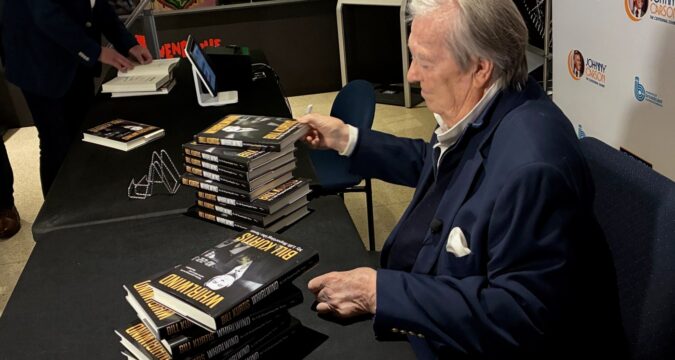
Generations of Chicagoans have known Bill Kurtis in many different ways — as a television journalist, documentary filmmaker, public radio voice, or even through his unexpected association with a hit comedy film. Now they are discovering him in yet another role: author. The longtime Mettawa resident has released a new memoir, Whirlwind: My Life Reporting the News, a reflection on crucial moments of his reporting career that shaped his life.
Kurtis became an iconic figure in Chicago during his three separate stints as news anchor at WBBM-TV and through decades of reporting that took him around the world. More recently, he has been recognizable to many through his hosting and scorekeeping duties on NPR’s Wait, Wait… Don’t Tell Me! and his narration in the Anchorman films. But he felt those high-profile entertainment roles risked eclipsing the work he considers most meaningful, and while he had written other books in the past, he decided it was time for an updated autobiography.
“The truth is I had kind of wandered off into the entertainment world with Anchorman and Wait, Wait… Don’t Tell Me!,” he said after a recent discussion and book signing at Chicago’s Museum of Broadcast Communications. “I genuinely didn’t want my reputation to hang on those two events because nobody else knew what I did before them.”
Across more than 300 pages, Kurtis, 85, revisits many of the major national and international stories he covered — notorious crimes, political unrest, natural disasters, and the continuing toll of the Vietnam War — in what he calls “the amazing order in my life.”
The title Whirlwind is no metaphor, beginning with his first major assignment: coverage of the June 1966 tornado that struck Topeka, Kansas. Then a part-time broadcaster attending law school, Kurtis was unexpectedly placed in the anchor chair as the storm approached. Fearing for viewers’ safety, he delivered the line that would define the moment: “For God’s sake, take cover.”
“I happened to be in a position to save lives and change my life’s direction,” he recalled.
Inspired, he sent videotapes of his reporting to stations around the country. Within months, he was hired at WBBM-TV. He had visited Chicago only once before but remembers being immediately intrigued.
“I walked down State Street and thought it was the most beautiful thing I had ever seen,” he said.
Kurtis completed his degree from Washburn Law School, and that legal training was crucial as he was assigned to cover some of the era’s biggest courtroom dramas: the Richard Speck murder trial, the Chicago Seven case following unrest at the 1968 Democratic National Convention, and later the Charles Manson trial after joining CBS on the West Coast in the early 1970s.
His memoir also recounts reporting from Chicago during the riots following the assassination of Martin Luther King Jr., the upheaval at the Democratic National Convention later that year, and his journey to the Chernobyl nuclear reactor inside the Soviet Union roughly two years after the 1986 explosion. He also describes a memorable 1980s interview with Muhammad Ali as concerns about the heavyweight champion’s health were emerging.
Kurtis devotes three chapters to his Vietnam reporting: his 1975 trip shortly before the fall of Saigon, his 1980 return to report on Vietnamese women raising children fathered by American soldiers, and his groundbreaking investigation into the dangers of Agent Orange.
He describes the Agent Orange story — sparked by a tip at WBBM that 12 Vietnam veterans were suffering similar health problems after exposure to a U.S. military chemical — as the most consequential of his career.
“I knew immediately this was national and international news if true,” he said.
WBBM ultimately aired an hour-long documentary that was shown before Congress, highlighting the veterans’ health issues and the birth defects affecting many of their children.
“It was like an atomic bomb because the veterans were waiting for something like this,” he said. “They were suffering and being blamed for the war. They all suffered from PTSD, and suddenly, along comes the possibility of Agent Orange being behind their illness.”
Kurtis believes at least 50 forms of cancer are connected to the defoliant. “It has been a fight for 50 years to get the government to recognize the extent of the Agent Orange poisoning,” he said.
While he dedicates one chapter to his celebrated co-anchoring years with Walter Jacobson beginning in 1973 — an era of Chicago television news that remains widely admired — most of the memoir focuses on his work outside the studio.
“Anchoring came very easy, as you read,” he said. “To me, journalism is finding stories, covering the story, writing the story, and presenting the story. That’s where I concentrated my career.”
Still, he acknowledges the power of an anchorman’s presence, especially in previous eras when viewers had far fewer options. As he signed books, many people told him how they watched him on a nightly basis.
“When they were young as teenagers or pre-teenagers, they were able to watch television,” he said. “If they would sit still alongside their parents, they could watch the news. That was their life.”
What readers will not find are negative portrayals of colleagues or many expressions of disappointment — even when writing about his short-lived move to New York in 1982 to anchor the CBS Morning News, a stint that ended in 1985 when ratings failed to improve.
“I was so interested in what I was doing in reporting and journalism,” Kurtis said. “That is what I want to do. I honestly didn’t have time for revenge. I kept the focus ahead and on stories like Agent Orange.”
Kurtis continues to live in Mettawa, where he has made his home for more than 30 years, and remains active with his production company and on Wait, Wait… Don’t Tell Me!.
“Whirlwind is a very good title because it means that from the tornado to today, I am being sent in the direction of what I want to do,” he said. “Which is journalism.”
Daniel I. Dorfman is a freelance reporter for Pioneer Press.
https://www.chicagotribune.com/2025/12/16/bill-kurtis-anchorman-journalist-memoir-author/

Lakes graduate John Sullivan becomes ‘best defensive player in the country’ for No. 1 North Central College
Before North Central College’s NCAA Division III national quarterfinal game last week, senior defensive lineman John Sullivan racked up more honors.
For the second straight season, the Lakes graduate was named the region defensive player of the year by D3football.com and an All-American by the American Football Coaches Association.
In typical Sullivan fashion, he was quick to deflect praise.
“I texted our group chat, and I said, ‘It’s not a me award, it’s a we award,’” Sullivan said. “I don’t really view it as an individual award. No individual is higher than our standard at North Central. It’s a testament to our program.”
But Sullivan could be excused for taking a little time to bask in the spotlight. After a breakout junior season, Sullivan has been even more dominant for the top-ranked Cardinals (13-0), who will play No. 9 John Carroll (12-1) in the national semifinals at Benedetti-Wehrli Stadium in Naperville at 3:30 p.m. Saturday.
Sullivan has 64 tackles, including 20 for loss and seven sacks. He also has 16 quarterback hits and seven pass deflections.
North Central College’s John Sullivan (92) tackles Bethel University’s Taye Manns (4) during an NCAA Division III national quarterfinal game in Naperville on Saturday, Dec. 13, 2025. (Troy Stolt / Naperville Sun)
“You truly have to game plan around JP,” NCC defensive coordinator Shane Dierking said. “That’s one of the things you see. The rest of our defense reaps the benefits of having him on the field.
“As a defensive coordinator, you can’t let their best offensive players beat you. They have to do that with him too.”
During defending national champion NCC’s 35-21 win over No. 3 Bethel on Saturday, Sullivan didn’t put up huge numbers, but he kept the linebackers clean. That allowed sophomore linebacker Matt Janiak, a Plainfield South graduate, to make 16 tackles, for example.
Sullivan did make two key plays, however. He combined with sophomore defensive lineman Maverick Ohle, a Naperville Central graduate, for a sack to force a three-and-out in the third quarter. Sullivan later batted down a pass on fourth-and-4 to give the ball back to the Cardinals.
“We moved him around inside so they didn’t know where he was,” Dierking said. “He still had a productive day.
“He’s extremely twitchy, really good feet, then an unbreakable mindset. He’s gone through it all. He’s had injuries, and he keeps coming back better than ever.”
That’s exactly what Sullivan intended to do.
“My goal coming into this season was to keep building from what I did last year, and I didn’t want to take any dip in what I did,” he said. “I just wanted to keep growing. All my teammates deserve that.”
North Central College’s John Sullivan (92) runs off the field with teammate Jahmar Daniel (3) after forcing a punt against Bethel University during an NCAA Division III national quarterfinal game in Naperville on Saturday, Dec. 13, 2025. (Troy Stolt / Naperville Sun)
One teammate who knows that well is junior offensive lineman Cortez Jones, a T.F. South graduate who played on the defensive line with Sullivan before this season. Jones is picking up accolades, too, and facing Sullivan in practice every day is one of the reasons.
“He’s just a phenomenal player, phenomenal athlete,” Jones said. “He just pushes us every day to get better as an offense.
“He’s the best defensive player in the country. Being able to go against him in practice is a phenomenal experience. I just get better every day.”
That’s part of the leadership that Sullivan has shown, according to Dierking.
“He’s a guy that really sets the standard by how he works,” Dierking said. “He’s really developed as a leader this year. He’s not going to be the guy that’s speaking up in front of the whole team, but he’s helped the defensive line room grow and be impactful.”
That’s all that matters to the selfless Sullivan.
“Coming into this year, we knew we had the opportunity to be one of the best defenses in North Central history,” he said. “That’s what we strive for every week. It takes a whole group to do it. We want to set a new standard for what our defense should look for in the coming years.”
Paul Johnson is a freelance reporter.
https://www.chicagotribune.com/2025/12/16/north-central-college-football-john-sullivan/
Europe Is About To Commit Financial Self-Immolation & Its Leaders Know It
Europe Is About To Commit Financial Self-Immolation & Its Leaders Know It
Authored by Gerry Nolan via The Ron Paul Institute
Italy’s decision to stand with Belgium against the confiscation of Russian sovereign assets is not a diplomatic footnote. It is a moment of clarity breaking through the fog of performative morality that has engulfed Brussels. Strip away the slogans and the truth is unavoidable: the seizure of Russian sovereign reserves will not change the course of the war in Ukraine by a single inch.
This is not about funding Ukraine, it is about whether sovereign property still exists in a Western financial system that has quietly replaced law with cult-like obedience. That is why panic has entered the room.
The European Commission wants to pretend this is a clever workaround, a one-off, an emergency measure wrapped in legal contortions and moral posturing masquerading as hysteria. But finance does not function on intentions, rage, or narratives. It functions on precedent, trust, and enforceability. And once that trust is broken, it does not return.
The modern global financial system rests on a single, unglamorous principle, that State assets held in foreign jurisdictions are legally immune from political confiscation.
That principle underwrites reserve currencies, correspondent banking, sovereign debt markets, and cross-border investment. It is why central banks like Russia’s (once) accepted euros instead of bullion shipped under armed guard. It is why settlement systems like Euroclear exist at all. Once that rule is broken, capital does not debate. It reprices risk instantly and it leaves.
Confiscation sends a message to every country outside the Western political orbit: your savings are safe only as long as you remain politically compliant.
That is not a rules-based order. It is a selectively enforced order whose rules change the moment compliance ends. What we have is a compliance cartel, enforcing law upward and punishment downward, depending on who obeys and who resists.
Belgium’s fear is not legalistic. It is actuarial. Hosting Euroclear means hosting systemic risk. If Russia or any future target successfully challenges the seizure, Belgium could be exposed to claims that dwarf the sums being discussed. Belgium is therefore right to be skeptical of Europe’s promise to underwrite such colossal risk, given the bloc’s now shattered credibility. No serious financial actor would treat such guarantees as reliable.
Italy’s hesitation is not ideological. It is mathematical. With one of Europe’s heaviest debt burdens, Rome understands what happens when markets begin questioning the neutrality of reserve currencies and custodians.
Neither country suddenly developed sympathy for Moscow. They simply did the arithmetic before the slogans.
Paris and London, meanwhile, thunder publicly while quietly insulating their own commercial banks’ exposure to Russian sovereign assets, exposure measured not in rhetoric, but in tens of billions. French financial institutions alone hold an estimated €15–20 billion, while UK-linked banks and custodial structures account for roughly £20–25 billion, much of it routed through London’s clearing and custody ecosystem rather than sitting on government balance sheets.
This hypocrisy and cowardice are not accidental. Paris and London sit at the heart of global custodial banking, derivatives clearing, and FX settlement, nodes embedded deep within the plumbing of global finance. Retaliatory seizures or accelerated capital flight would not be symbolic for them; they would be catastrophic.
So the burden is shifted outward. Smaller states are expected to absorb systemic risk while core financial centers preserve deniability, play a double game, and posture as virtuous.
This is anything but European solidarity. It is class defense at the international level.
The increasingly shrill insistence from the Eurocrats that the assets must be seized betrays something far more revealing than hysteria or resolve: the unmasking of a project sustained by delusion and Russophobic dogma, in which moral certainty did not arise from conviction, but functioned as a mechanism for managing cognitive dissonance, a means of avoiding realities that any serious strategy would already have been forced to confront.
Not confidence, but exposure. Exposure of a war Europe never possessed the power to decide, only the capacity to prolong. Exposure of a financial system discovering that money, once stripped of neutrality and weaponized, forfeits its credibility as capital. And exposure of a ruling class confronting the reality that performance, however theatrical, cannot substitute for power that has long since been exhausted – power Europe relinquished decades ago when it outsourced real sovereignty to Washington.
Looting Russian reserves will not shorten the conflict. It will not pressure Moscow into capitulation. It will not meaningfully finance Ukraine’s future. And this is not because Europe has miscalculated, it is because Europe has knowingly abandoned reality.
There is no serious actor in Europe who does not understand how wars are won. They know that Russia’s war effort is driven by industrial throughput, manpower depth, logistics resilience, and continental scale and that on every one of these axes Russia has expanded its advantage while Europe has accelerated its collapse. Russia has retooled its defense-industrial base for sustained output, secured energy and raw materials at scale, reoriented trade beyond Western choke points, and absorbed sanctions as a catalyst for growth. This is not conjecture. It is observable fact.
This move will permanently accelerate reserve diversification away from the euro, expand bilateral settlement, hasten gold repatriation, and entrench non-Western clearing systems, and it will do so immediately.
What is being exposed here is not Russian vulnerability, but Western exhaustion. When economies can no longer compete through production, innovation, or growth, they turn to banditry. Asset seizure is not a sign of strength, but he terminal behavior of a rentier system that has exhausted surplus and begun consuming its own foundations.
This decision does not defend any lingering illusion of Western dominance. It advertises its expiry. The turn toward policing speech in Europe did not happen in a vacuum.
The Digital Services Act, platform intimidation, and the policing of dissent is all about pre-emptive damage control. European elites understand that the consequences of this policy will land squarely on households.
The people who will pay for this are not sitting in Commission buildings, they are the ones whose pensions, currencies, and living standards are being quietly offered up to preserve a collapsing illusion of power.
That is why dissent had to be neutralized before confiscation could be attempted. Not after. Criticism was pre-emptively reclassified as disinformation. Debate was recoded as existential danger. Speech itself was reframed as a security threat.
In their desperation to punish Russia, Europe’s leadership is handing Moscow something far more valuable than €210 billion. They are validating every argument held by the Global Majority about Western hypocrisy, legal nihilism, and financial coercion. They are demonstrating that sovereignty within the Western system is provisional, granted conditionally, revoked politically.
Empires do not collapse because they are challenged. They collapse because they cannibalize the systems that once made them legitimate.
This seizure will not be remembered as a blow against Moscow. It will be remembered as the moment Europe told the world that property rights end where obedience begins.
Once that message is received, there is no reset.
Tyler Durden
Tue, 12/16/2025 – 07:20

Lake Forest’s Church of the Holy Spirit’s annual Christmas pageant features over 50 children
The children’s Christmas Pageant at The Church of the Holy Spirit in Lake Forest celebrates the pure joy of the holiday season.
Rev. Luke Back, rector of The Church of the Holy Spirit, said over 50 children participated this year in the pageant, which took place during the 9:30 a.m. Holy Eucharist (Rite II), on Sunday, December 14.
According to Reverend Back, dozens of angels wearing feathered wings and tinseled halos, shooting stars flying up and down the church aisles with jubilation streamers and golden crowns, herds of donkeys, calves and lambs led in by a troop of shepherds, and vividly costumed magi accompanied by kids in camel costumes.
The children’s Christmas Pageant at The Church of the Holy Spirit took place during the 9:30 a.m., Holy Eucharist (Rite II), on Sunday, December 14, at 400 East Westminster in Lake Forest. Here, Cow is played by Teddy Chung-Hall, Freddy Masterson plays Joseph, Eloise Bickford plays Angel Gabriel, Antti Sotolowski plays baby Jesus, and Wells Baasen plays Mary. (Gina Grillo/ for the Pioneer Press)
“In the end, the Holy Family is surrounded by a tableau full of creative incarnate energy, coordinated with beautiful music provided by our choir, and readings from the Gospel, all of this bringing the Christmas story to life,” Reverend Back said.
Meredith Back, pageant director, introduced the present form of the Christmas pageant at CHS seven years ago, based on St. Francis’ simple nativity, with the production being offered as part of Sunday’s service in place of the sermon.
Back says, “We want the experience to be fun and flexible for the kids, so we follow their lead regarding the roles they would like to play.
St. Gregory’s Cherub Choir assistant, Beth Hughes, with the three wise men, Oliver Godon, Andreas Bilger, and Wyatt Turner, during the children’s Christmas Pageant at The Church of the Holy Spirit in Lake Forest on December 14. (Gina Grillo/ for the Pioneer Press)
“Some years, in addition to our traditional roles, we might have a Koala bear or a turtle; this year we had a dinosaur and an octopus — you just never know what you are going to get — but everyone is welcome to participate,” Back said.
James Dean of Lake Forest attended Sunday with family.
“Kids begin their spiritual journey by learning stories from the Bible. Today’s pageant tells a story of love, hope and renewal, from this our children learn about the true meaning of Christmas,” Dean said.
Back says, in the end, the pageant aims for energetic reverence and childlike joy.
The pageant team, under Back’s direction, includes the senior director of children’s ministry, Debbie Stockert, youth ministry leader Courtney Heck, and St. Gregory’s Cherub Choir director, Keri Godon, along with countless volunteers who support the planning, costumes, sign-in, set-up, and communication for the production.
Carmen Mendoza of Lake Bluff says her granddaughter was excited to perform in Sunday’s pageant.
Reverend Back gives the Children’s blessing during the Christmas Pageant at The Church of the Holy Spirit in Lake Forest on December 14. (Gina Grillo/ for the Pioneer Press)
“Today, my granddaughter’s performance reminds me that in this church we have found a home, a place of joy and safety,” Mendoza said.
Parishioner, Lynne Atherton of Waukegan, also attended.
“The church belongs to our children, and we want it to be a place where they can access joy,” Atherton said.
Reverend Back says the parish children and youth play all the parts in the pageant, for this is the time of year when ‘a little child shall lead them,’ as a prophet of old has said.
Over 50 children participated this year in the children’s Christmas Pageant at The Church of the Holy Spirit in Lake Forest on December 14. (Gina Grillo/ for the Pioneer Press)
James DeWald of Lake Forest attended with his family.
“I think we see God in our children, in their purity of love and community, we find simplicity, unweighted by the world around us,” DeWald said.
Gina Grillo is a freelancer for Pioneer Press.
https://www.chicagotribune.com/2025/12/16/lake-forests-church-annual-christmas-pageant/

Australian police say Bondi Beach mass shooting was inspired by Islamic State group
MELBOURNE, Australia — A mass shooting in which 15 people were killed during a Hanukkah celebration at Sydney’s Bondi Beach was “a terrorist attack inspired by Islamic State,” Australia’s federal police commissioner Krissy Barrett said Tuesday.
The suspects were a father and son, aged 50 and 24, authorities have said. The older man, whom state officials named as Sajid Akram, was shot dead. His son was being treated at a hospital.
A news conference by political and law enforcement leaders on Tuesday was the first time officials confirmed their beliefs about the suspects’ ideologies. Prime Minister Anthony Albanese said the remarks were based on evidence obtained, including “the presence of Islamic State flags in the vehicle that has been seized.”
There are 25 people still being treated in hospitals after Sunday’s massacre, 10 of them in critical condition. Three of them are patients in a children’s hospital.
Also among them is Ahmed al Ahmed, who was captured on video tackling and disarming one assailant, before pointing the man’s weapon at him and then setting it on the ground.
Those killed ranged in age from 10 to 87 years old. They were attending a Hanukkah event at Australia’s most famous beach Sunday when the gunshots rang out.
Calls for stricter gun laws
Albanese and the leaders of some of Australia’s states have pledged to tighten the country’s already strict gun laws in what would be the most sweeping reforms since a shooter killed 35 people in Port Arthur, Tasmania, in 1996. Mass shootings in Australia have since been rare.
Officials divulged more information as public questions and anger grew on the third day following the attack about how the suspects were able to plan and enact it and whether Australian Jews had been sufficiently protected from rising antisemitism.
Albanese announced plans to further restrict access to guns, in part because it emerged the older suspect had amassed his cache of six weapons legally.
“The suspected murderers, callous in how they allegedly coordinated their attack, appeared to have no regard for the age or ableness of their victims,” said Barrett. “It appears the alleged killers were interested only in a quest for a death tally.”
Authorities probe suspects’ trip to Philippines
The suspects traveled to the Philippines last month, said Mal Lanyon, the Police Commissioner for New South Wales state. Their reasons for the trip and where in the Philippines they went would be probed by investigators, Lanyon said.
US Jewish groups urge heightened security at public events after Hanukkah attack in Australia
He also confirmed that a vehicle removed from the scene, registered to the younger suspect, contained improvised explosive devices.
“I also confirm that it contained two homemade ISIS flags,” Lanyon said.
The Philippines Bureau of Immigration confirmed Tuesday that Sajid Akram traveled to the country from Nov. 1 to Nov. 28 along with Naveed Akram, 24, giving the city of Davao as their final destination. Australian authorities have not named the younger suspect.
Groups of Muslim separatist militants, including Abu Sayyaf in the southern Philippines, once expressed support for the Islamic State group and have hosted small numbers of foreign militant combatants from Asia, the Middle East and Europe in the past.
Decades of military offensives, however, have considerably weakened Abu Sayyaf and other such armed groups, and Philippine military and police officials say there has been no recent indication of any foreign militants in the country’s south.
Albanese visits man who tackled shooter
Earlier, Albanese visited al Ahmed in a hospital. Albanese said the 42-year-old Syrian-born fruit shop owner had further surgery scheduled on Wednesday for shotgun wounds to his left shoulder and upper body.
“It was a great honor to met Ahmed al Ahmed. He is a true Australian hero,” Albanese told reporters after a 30-minute meeting with him and his parents.
“We are a brave country. Ahmed al Ahmed represents the best of our country. We will not allow this country to be divided. That is what the terrorists seek. We will unite. We will embrace each other, and we’ll get through this,” Albanese added.
Lifeguards praised for actions during massacre
The famous blue-shirted lifeguards of Bondi Beach attracted praise as more stories of their actions during the shooting emerged.
One duty lifeguard, identified by the organization’s Instagram account as Rory Davey, performed an ocean rescue during the shooting after people fled, fully clothed, into the sea.
Another lifeguard, Jackson Doolan, posted to his social media a photo taken as he sprinted, barefoot and clutching a first aid kit, from Tamarama beach a mile away toward Bondi as the massacre continued.
“These guys are community members and it’s not about the surf,” Anthony Caroll, one of the stars of a popular reality television show called “Bondi Rescue,” told Sky News on Tuesday. “They heard the gunshots and they left the beach and came right up the back here into the scene of the crime, into harm’s way while those bullets were being shot.”
Record numbers sign up to donate blood as Australians mourn at scene of shooting
Israeli Ambassador to Australia Amir Maimon visited the scene of the carnage on Tuesday and was welcomed by Jewish leaders.
“I’m not sure that my vocabulary is rich enough to express how I feel. My heart is torn apart because the Jewish community, the Australians of Jewish faith, the Jewish community is also my community,” Maimon said.
Thousands have visited Bondi from all walks of life since the tragedy to pay their respects and lay flowers on a mounting pile at an impromptu memorial site.
One of the visitors on Tuesday was former Prime Minister John Howard, who was responsible the the 1996 overhaul of gun laws and an associated buyback of newly outlawed weapons.
In the aftermath of Sunday’s shooting, a record number of Australians signed up to donate blood. On Monday alone close to 50,000 appointments were booked, more than double the previous record, the national donation organization Lifeblood told The Associated Press.
Almost 1,300 people signed up to donate for the first time. Such was the enthusiasm at Lifeblood’s Bondi location that appointments to give blood were unavailable before Dec. 31, according to the organization’s website.
A total of 7,810 donations of blood, plasma and platelets were made across the country on Monday, spokesperson Cath Stone said. Australian news outlets reported queues of up to four hours at some Sydney donation sites.
Graham-McLay reported from Wellington, New Zealand.
https://www.chicagotribune.com/2025/12/16/australia-bondi-beach-mass-shooting-islamic-state-group/

Killings of Rob Reiner and his wife stun Hollywood as decision on charges for their son looms
LOS ANGELES — Los Angeles police are set to present a case to prosecutors Tuesday following Nick Reiner’s arrest in the killings of his parents, Rob Reiner and Michele Singer Reiner, which stunned their communities in Hollywood and Democratic politics, where both were widely beloved.
Prosecutors are set to decide whether and how to charge 32-year-old Nick Reiner, who is being held in jail without bail. He was arrested several hours after his parents were found dead in their home in the upscale Brentwood neighborhood of Los Angeles on Sunday, police said.
Rob Reiner was the Emmy-winning star of the sitcom “All in the Family” who went on to direct films including “When Harry Met Sally…” and ”The Princess Bride” He was an outspoken liberal activist for decades. Michele Singer Reiner was a photographer, movie producer and advocate for LGBTQ+ rights. They had been married for 36 years.
Representatives for the Reiner family did not respond to requests for comment, and it wasn’t clear if Nick Reiner had an attorney who could speak on his behalf. Police haven’t said anything about a motive for the killings.
Investigators believe Rob and Michelle Singer Reiner died from stab wounds, a law enforcement official told The Associated Press. The official, who was briefed on the investigation, could not publicly discuss the details and spoke to the AP on condition of anonymity.
The killings were especially shocking given the warm comic legacy of the family. Rob Reiner was the son of comedy legend Carl Reiner, who died in 2020 at age 98.
Kathy Bates, who won an Oscar as the star of Rob Reiner’s 1990 film “Misery,” was among those paying tribute to the couple.
“I loved Rob,” Bates said in a statement. “He was brilliant and kind, a man who made films of every genre to challenge himself as an artist. He also fought courageously for his political beliefs. He changed the course of my life. Michele was a gifted photographer.”
Bill Clinton called the couple “good, generous people who made everyone who knew them better.”
“Hillary and I are heartbroken by the tragic deaths of our friends Rob and Michele Reiner,” he said in a statement. “They inspired and uplifted millions through their work in film and television.”
Three months ago, Nick Reiner was photographed with his parents and siblings at the premiere of his father’s film “Spinal Tap 2: The End Continues.”
He had spoken publicly of his struggles with addiction, cycling in and out of treatment facilities with bouts of homelessness in between through his teen years. Rob and Nick Reiner explored — and seemed to improve — their relationship through the making of the 2016 film, “Being Charlie.”
Nick Reiner co-wrote and Rob Reiner directed the film about the struggles of an addicted son and a famous father. It was not autobiographical but included several elements of their lives.
“It forced us to understand ourselves better than we had,” Rob Reiner told the AP in 2016. “I told Nick while we were making it, I said, ‘You know it doesn’t matter, whatever happens to this thing, we won already.’”
Related Articles
Days after seeing Rob Reiner and wife, Gov. JB Pritzker mourns deaths and blasts Trump’s response to tragedy
Trump levels political attack on Rob Reiner in inflammatory post after his killing
Michele Singer Reiner, photographer who influenced 1980s rom-com’s happy end, dies
Rob Reiner, son of a comedy giant who became one in turn, dies at 78
Rob Reiner was long one of the most prolific directors in Hollywood, and his work included some of the most memorable and endlessly watchable movies of the 1980s and ’90s, including “This is Spinal Tap” and “A Few Good Men.”
He met Michele Singer Reiner on the set of “When Harry Met Sally…,” and their meeting would inspire the film’s shift to a happy ending, with stars Billy Crystal — one of Reiner’s closest friends for decades — and Meg Ryan ending up together on New Year’s Eve.
The Reiners were outspoken advocates for liberal causes and major Democratic donors.
President Donald Trump on Monday blamed Rob Reiner’s outspoken opposition to the president for the actor-director’s killing, delivering the unsubstantiated claim in a social media post that seemed intent on decrying his opponents even in the face of a tragedy.
Balsamo reported from Washington. Associated Press Entertainment Writer Andrew Dalton in Los Angeles contributed.
https://www.chicagotribune.com/2025/12/16/killings-rob-reiner-wife-charges-son/





