Category: News
Pew Research’s ‘Most Striking’ Findings From 2025
Pew Research’s ‘Most Striking’ Findings From 2025
Authored by Anna Jackson and Jenn Hatfield via PewResearch.org,
As we do every year, we’ve gathered data around some of the most pivotal news stories of 2025, including President Donald Trump’s return to the White House, the changing U.S. immigration landscape and the rapid rise of artificial intelligence worldwide.
Here’s a look back at 2025 through 12 of Pew Research Center’s most striking research findings.
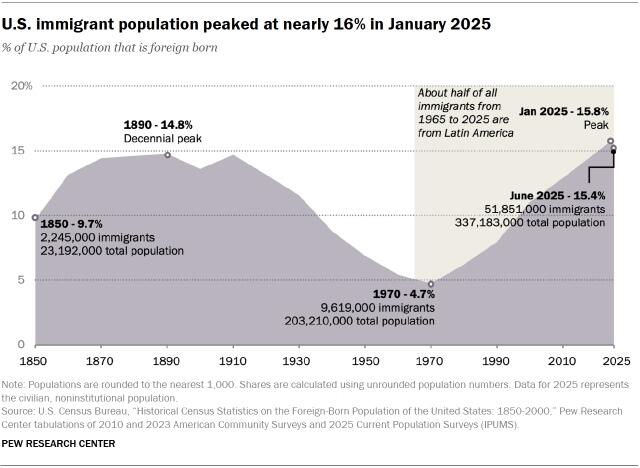
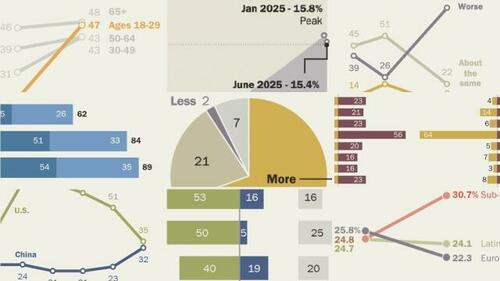
After more than 50 years of rapid growth, the number of immigrants living in the United States is on the decline. In January 2025, there were 53.3 million immigrants in the U.S., making up close to 16% of the country’s population. Both the number and the share were record highs. But by June 2025, the nation’s immigrant population decreased by more than a million, to 51.9 million. That decline has likely continued since, due to deportations, voluntary departures and fewer new arrivals.
Most immigrants are in the U.S. legally. As of 2023, 73% were either naturalized American citizens, lawful permanent residents or temporary lawful residents. The remaining 27% were unauthorized immigrants.
Views of the U.S. have worsened – and views of China have improved – across many of the 10 high-income countries we surveyed this year. Across these countries, a median of 35% of adults now say they have a favorable opinion of the U.S., while 32% say the same about China. These shares are the closest they’ve been since 2018.
There is a similar pattern when it comes to confidence in U.S. and Chinese leaders to do the right thing regarding world affairs. A median of 22% of adults in the 10 high-income countries surveyed have confidence in Trump, while 24% express confidence in Chinese President Xi Jinping. Their median confidence in former U.S. President Joe Biden was consistently higher than their confidence in Xi.
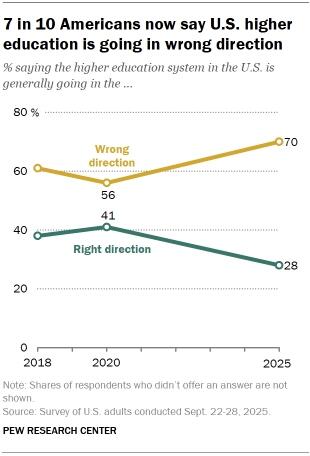
Seven-in-ten Americans now say the U.S. higher education system is generally going in the wrong direction – up from 56% in 2020. Views of the nation’s colleges and universities have turned more negative among Republicans and Democrats alike. (In this analysis, Republicans and Democrats include independents who lean toward each party.)
Many Americans give these institutions broadly negative ratings in specific areas. For example, 79% of U.S. adults say colleges are doing an only fair or poor job of keeping tuition costs affordable, and 55% say this about preparing students for jobs in today’s economy.
Americans have grown more critical of the widespread legalization of sports betting, and this is especially the case among young men.
Overall, 43% of U.S. adults say the fact that sports betting is now legal in much of the country is a bad thing for society, up from 34% in 2022. And 40% say it’s a bad thing for sports, up from 33%.
One of the biggest shifts in attitudes has occurred among men under 30. In this group, 47% say legal sports betting is a bad thing for society, an increase from 22% in 2022. For women under 30, the shift is smaller: 35% now see legal sports betting as bad for society, up from 25%.
A substantial share of men under 30 (36%) also say they have personally placed a sports bet in the past year.
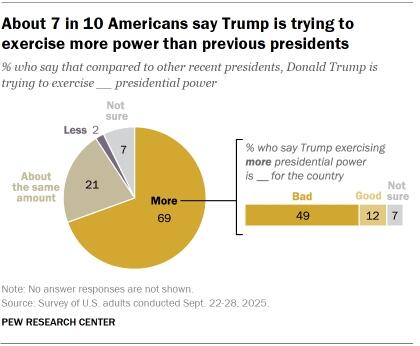
Around seven-in-ten Americans (69%) say Trump is trying to exert more power than his predecessors, according to a Center survey from September.
Most of those who say this view it as a bad thing for the country. Overall, 49% of U.S. adults say Trump is trying to exercise more presidential power than previous presidents and that this is bad for the country.
Democrats overwhelmingly say Trump is trying to exert more executive power and that this is bad (83%). Republicans are more divided: About half (49%) say Trump is trying to exert more power, and among those who say this, more say it’s good for the country than say it’s bad.
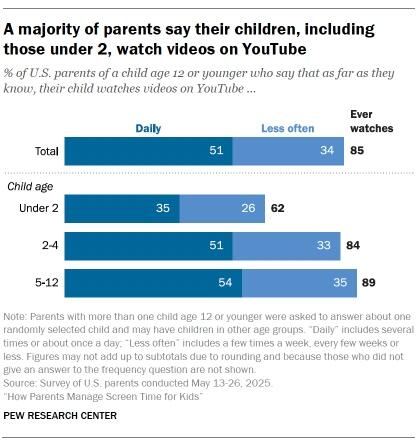
A majority of parents with a child under 2 say their child watches videos on YouTube. Some 62% of parents with a child under 2 say their child ever does this, up from 45% in 2020.
A growing share of parents with a child under 2 also say their child watches YouTube videos daily: 35% say this, up from 24% five years ago. Daily use is also up among kids ages 2 to 4, according to their parents (51%, up from 38%). But it’s stable among children in other age groups.
Google users who encounter a Google AI Overview are about half as likely as users who don’t to click on search results. Users who landed on a Google search page with an AI summary clicked on a search result 8% of the time. Those who did not encounter an AI summary clicked on a search result 15% of the time, according to our analysis of data from U.S. adults who agreed to share their March 2025 web browsing activity.
People who encountered the summaries – which Google introduced in 2024 – very rarely clicked on the sources cited, and they were more likely than those who didn’t see summaries to end their browsing session entirely.
Republicans have become much less likely to say healthy children should be required to get the measles, mumps and rubella (MMR) vaccine to attend public school. Around half of Republicans (52%) now hold this view, down significantly from 79% in 2019. The share of Democrats who support school MMR requirements (86%) has not changed.
Our broader survey on childhood vaccines found that Republicans are divided over some aspects of vaccine safety. For instance, 32% of Republicans are highly confident that the childhood vaccine schedule is safe, while 31% are not too or not at all confident. A 71% majority of Democrats are highly confident.
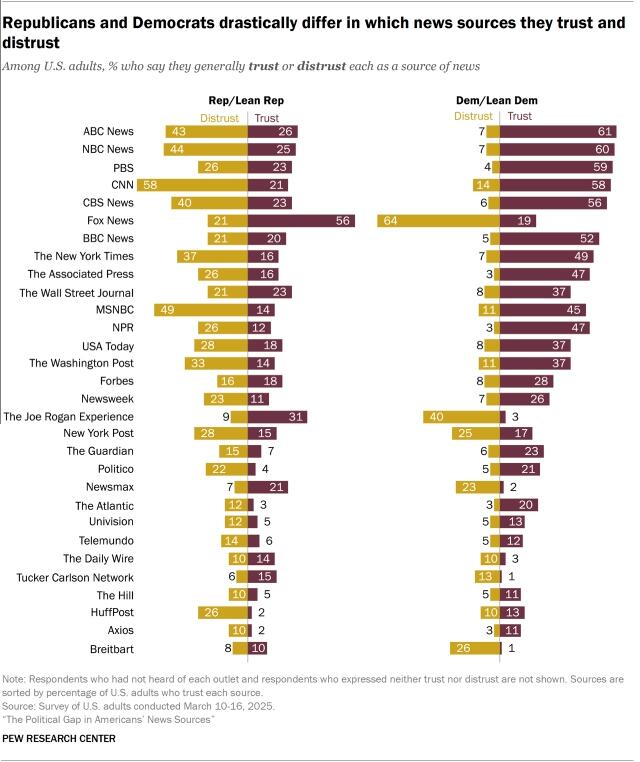
Partisans differ sharply on which news sources they trust, especially when it comes to Fox News and CNN. More than half of Republicans (56%) say they trust Fox News, but 64% of Democrats say they distrust it. The reverse is true for CNN: 58% of Democrats trust it, while the same share of Republicans distrust it.
Fox News stands out among the 30 news sources we asked about because it is the only one that a majority of Republicans trust. Democrats tend to trust a much broader range of sources.
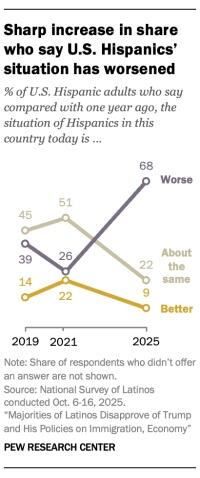
For the first time in nearly two decades of our national surveys of U.S. Hispanics, most say Hispanics’ situation in the country has worsened over the past year. About seven-in-ten Latinos (68%) now express this view, up sharply from 26% in 2021 during the Biden administration and 39% in 2019 during the first Trump administration. In the most recent survey, 9% of Latinos say their group’s situation is better than it was a year ago, and 22% say it’s about the same.
About a third of Latinos (32%) also say they’ve recently thought about moving to another country. Among those who have considered this, the most commonly cited reason is the political situation in the U.S.
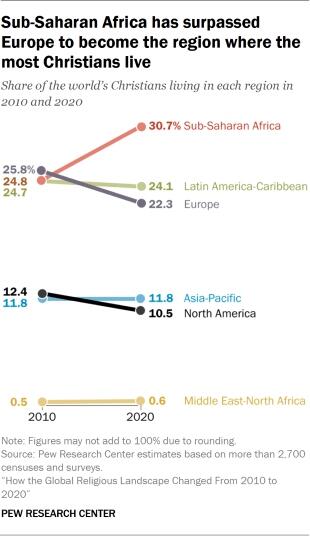
Sub-Saharan Africa is now home to more Christians than any other world region, surpassing Europe. As of 2020, about 31% of the world’s Christians live in sub-Saharan Africa, while 22% live in Europe. This change has been fueled by Africa’s much higher fertility rates, but also by widespread disaffiliation from Christianity in Western Europe.
Christianity remains the world’s largest religion. But Islam was the fastest-growing religion between 2010 and 2020, among the seven groups Pew Research Center has measured globally over time. The global Muslim population increased by 347 million people during that span (to 2.0 billion), while the Christian population grew by 122 million (to 2.3 billion).
Americans are far more pessimistic than optimistic about the effect AI will have on human creativity and connection. About half (53%) say AI will worsen people’s ability to think creatively, while 16% say it will improve this. And 50% say it will worsen people’s ability to form meaningful relationships with others, while only 5% say it will make this better.
As generative AI technology continues to improve, most Americans (76%) say it’s extremely or very important for them to be able to distinguish between content made by AI and by people. But 53% are not too or not at all confident that they can personally tell the difference; just 12% are highly confident.
* * *
This is just a small slice of the Center’s research publications this year.
Tyler Durden
Tue, 12/16/2025 – 16:20
https://www.zerohedge.com/geopolitical/pew-researchs-most-striking-findings-2025

Rapper Rod Wave makes it personal on his ‘Redemption Experience’ at the United Center
The newly Grammy-nominated rap star Rod Wave is no stranger to Chicago’s character-building cold weather. The Floridian has been bringing Chicago fans along on his journey to superstardom since he was an opener for rapper Kevin Gates in 2019. Six years and several tours of his own later, the “Tombstone” rapper returned to the United Center Monday night for the first of two concerts on his “Redemption Experience” tour, the first under his own Mainstay Touring company.
Around 17,900 of Wave’s fans endured the burning cold, waiting outside the United Center. Some pregamed with mini bottles of Don Julio before entering, while others stood patiently. Dalion Morgan, a fan who braved the weather to see him, says it means a lot for Wave to perform in Chicago despite being from St. Petersburg.
“It means a lot because he’s not from here, but he’s been able to show love to us because we love him. (I’m) just glad it can be reciprocated,” said Morgan.
Wave fans are known to be a dedicated bunch. Some traveled from across the country to hear his brand of trap soul music. The vulnerability he displays in songs he performed Monday, including “Dark Cloud,” “By Your Side” and “2018” with guest artist Sadie Jean, can deliver a unique catharsis. His fans can relate to his subjects of overcoming adversity, dealing with mental health challenges and following dreams, no matter the difficulty.
One longtime fan, Vontae Gee, traveled from Memphis to Chicago with friends to celebrate his birthday. He says Wave’s music connects with many people beyond racial or gender boundaries.
“He relates to a lot of us with the pain in his music,” Gee said. “He’s the GOAT. He’s doing what a lot of rappers are not doing, and that’s relating to his fans. A lot of folks just go in the booth and say whatever, but him — he honestly makes songs that can relate to the next person, male or female.”
Fans watch Rod Wave perform at the United Center on Dec. 15, 2025, in Chicago. (Armando L. Sanchez/Chicago Tribune)
Sanjay “Dharmic” Jain, who is part of Wave’s management team and runs Mainstay Distribution, spoke to the Tribune before the concert. To him, what separates “Redemption Experience” from previous tours is Rod owning his own company and everyone’s involvement, especially compared to his 2024 “Last Lap” tour, which was cut short.
“In the past, the shows have been incredible, but I think there was a lot of learning that needed to happen. This time, Rod and his team have been really in the weeds of putting this show together from the production, to the routing, to insurance, to every aspect,” said Jain.
The show kicked off with an animated video introduction that showed Wave driving down a road decorated with his career highlights and fondest memories. Notably, a portion of that video contained archival footage of his late uncle and manager, Dereck Lane, affectionately known as Uncle Dereck.
The eager crowd didn’t need Wave to come out to get the concert started. When “Rags to Riches” played during the video package, the whole United Center sang every word. In fact, even before Wave could make his grand entrance on stage, the crowd was singing “Already Won” so loud, you could barely hear the instrumental.
Wave appeared draped in a cream designer sweatshirt, grey distressed jeans and platinum jewelry that twinkled brighter than the lights above him. “(Expletive) is a real blessing, a real dream come true,” he said to his fans.
“Oh my god, Rod Wave!” a female fan yelled beside me.
The song “Green Light” was one of the more electrifying moments of the night. As if on command, fans flashed their green wristbands in the air to accompany the flashing green lights across the area to make a dazzling effect. The emotionally driven songs “Boys Don’t Cry” and “Girl of My Dreams” had Wave delivering some of his most powerful vocals of the night.
Rod Wave had another captivating moment when he brought out collaborator Jean, who’s become a fan favorite in her own right. The two sat underneath dueling soft purple lights and sang “Nostalgia” and “2018.”
During an intermission, a trailer was screened for his upcoming documentary “Don’t Look Down.” Much of it was video footage of his time with Uncle Dereck, a man who was a major influence on his life.
A tribute to his uncle over the confessional “Long Journey” was one of the show’s most somber, touching moments of the evening. Wave performed over a video dedicated to the flamboyant leader of his team.
Key Gabana, another longtime fan who traveled from Memphis, said the “Long Journey” tributes, which Wave also performed during “Last Lap,” were her favorite part of his tours.
“No matter what goes on, he always shows something about Uncle D,” she said.
“He really set the tone for what we’re trying to build,” Jain said about Lane. “His relationship with Rod and their conversation over the years really set the tone for where we are and what we’re trying to get to.”
Amid the bright lights, Wave turned the United Center into his own image of a church. The crowd sang every song throughout the whole two hours as if they were his choir. They were the same fans who had been captivated by his journey and his story for years.
Mark Braboy is a freelance writer.

Indiana Senate bill would allow firing squad for death penalty
A bill allowing for firing squad executions for death penalty inmates was filed in the Indiana legislature for the 2026 session.
Senate Bill 11, filed by State Sen. Michael Young, would allow for firing squad executions if medications for lethal injection can’t be obtained or the inmate chooses death by firing squad at least 30 days before the scheduled execution date.
Floodlights illuminate the razor wire topped wall of Indiana State Prison on Monday, May 19, 2025. (Kyle Telechan/for the Post-Tribune)
The firing squad would be made up of five Department of Correction officers selected by the warden. The identity of firing squad members would be kept confidential and not subject to discovery in civil or criminal lawsuits, according to the bill.
At the time of execution, four members will have guns with live ammunition and one member will have a gun with blank ammunition. The guns would be loaded without the members knowing who has what kind of ammunition, according to the bill.
Young, R-Indianapolis, said in a statement that he filed the bill because it can cost up to $300,000 per dose of pentobarbital, which is used to conduct executions by lethal injection, and “often expire before they can be used.”
“Securing the drugs to conduct lethal injections is costly and time consuming,” Young said.
Gov. Mike Braun disclosed in June that Indiana officials spent $1.175 million on lethal injection doses over the past year — $600,000 of which was spent on drugs that expired before use. The cost has been between $275,000 and $300,000 per dose, according to the Indiana Capital Chronicle.
Braun stopped short of endorsing any specific execution methods but pointed to South Carolina, which reinstated the firing squad as an option after years of delays due to its inability to obtain legal injection drugs, according to the Indiana Capital Chronicle.
The Republican governor has repeatedly suggested that the high cost and short shelf life of the drug should prompt new discussions on how the state approaches capital punishment moving forward. He called on lawmakers to debate the future of capital punishment in Indiana in the 2026 session, according to the Indiana Capital Chronicle.
In 2024, Indiana resumed executions after a nearly 15-year pause because pharmaceutical companies were hesitant to sell the drugs for executions amid growing public scrutiny, said Indiana University Maurer School of Law professor Jody Madeira.
“Once people find out the pharmacy that’s providing the drugs, bad press can ensue, which is why Indiana kept their provider secret last time. It’s just a very hard thing for states to get drugs now, so that’s why they’ve gone to single drug protocols,” Madeira said.
Three Indiana death row inmates — Joseph Corcoran, Benjamin Ritchie, and Roy Lee Ward — have been executed in the last year.
When she heard about Senate Bill 11, Madeira said she found it to be “very odd,” because Indiana has completed executions using lethal injection, so it’s hard to justify utilizing a “controversial” method like a firing squad.
The firing squad death penalty method is constitutional, but it’s likely to remain controversial, Madeira said.
Currently, five states allow for firing squad executions: Utah, Mississippi, Oklahoma, Idaho and South Carolina, Madeira said. Idaho’s firing squad law goes into effect in 2026, she said.
States approach the firing squad execution in two ways: Listing a preference in order of execution method, like lethal injection first and firing squad method last, like in Oklahoma, or allowing inmates to choose an execution method, which includes firing squad, like in South Carolina, Madeira said.
In March, Brad Sigmon, a South Carolina man who killed his ex-girlfriend’s parents with a baseball bat, was executed by firing squad. He was the first U.S. prisoner in 15 years to die by firing squad, which Sigmon chose over lethal injection.
Since then, South Carolina executed two more inmates — Mikal Mahdi and Stephen Bryant — by firing squad. In all three executions, the men had bullseye targets placed over their hearts, and three jail employees fired the shots.
Sigmon’s lawyers said he chose the firing squad because the electric chair would “cook him alive,” and he feared that a lethal injection of pentobarbital into his veins would send a rush of fluid and blood into his lungs and drown him.
Sigmon made several heavy breaths during the two minutes that elapsed from when the hood was placed over his head to the shots being fired, according to The Associated Press. His arms briefly tensed when he was shot, and the target was blasted off his chest.
He appeared to give another breath or two with a red stain on his chest, and small amounts of tissue could be seen from the wound during those breaths.
The argument for using firing squads includes the high cost of lethal injection drugs and if any other execution method is found unconstitutional then firing squad is an option, Madeira said.
“There’s these ‘full proof methods,’ and states are bargaining that execution by firing squad is one of those full proof methods because it’s not a drug protocol,” Madeira said.
Firing squads have been pitched as a more humane option, Madeira said, because it doesn’t require mixing drugs, complications of finding a vein with an IV, among other reasons, which Madeira said she disagrees with.
If Indiana were to utilize the firing squad method, it would likely unincentivize the state from purchasing the lethal injection drugs, Madeira said.
“It provides a work-around,” Madeira said. “People can bring challenges to firing squad as well, but the challenges to firing squad are a lot easier to resolve, I think, than perhaps the challenges to some of the lethal injection protocols.”
But, Madeira said she doesn’t believe Senate Bill 11 will advance because Sen. Young’s bills haven’t advanced recently. Further, Madeira said the 2026 session is a short session and “people have other business on their plate.”
The Associated Press contributed
akukulka@post-trib.com

Proposal would return historic Oak Cottage in Naperville to a private home
James Privitt grew up in Naperville near River Woods Elementary School. He would frequently visit the Greene Valley Forest Preserve and pass by the historic Oak Cottage, located at the southeast corner of Greene and Hobson roads.
“I used to drive by it all the time with my grandmother, who raised me. We would go to the (Cinemark) Seven Bridges movie theater and I would always admire it,” said Privitt, who currently resides in Texas.
While he did not understand the historical significance of housee growing up, he came to appreciate the 175-year old building as he got older. He has also developed a broader interest in historic preservation, working for groups like Naper Settlement and helping preserve historic buildings in Texas.
Now, Privitt and his family may get to live in the house he grew up admiring.
The Forest Preserve District of DuPage County Board of Commissioners voted Tuesday to enter into an agreement with Privitt to let him develop a proposal that calls for the relocation of Oak Cottage to a different property. If the board finds Privitt’s plan to be feasible, the board will take a final vote on the restoration plan at a future date.
The board action is the latest step the forest preserve district’s efforts to rehabilitate the Greek Revival-style farmhouse built in the mid-19th century and empty since 1983.
“(DuPage County is) home for me and for my family, and we love it,” Privitt said, noting that he and his wife intend to move back to the area. “And my wife absolutely loves and adores the house and (that’s) the key thing too with Oak Cottage is that it was originally … a single-family home.”
Oak Cottage was built in 1850 by William B. Greene, who first arrived in DuPage County from Vermont in 1841. Greene played a significant role in development in the area, establishing the area’s first store and post office, and helping lay the groundwork for the region’s economic development, according to a Cultural Resource Evaluation conducted on the Oak Cottage.
Members of the Greene family lived in the home until 1981. They donated the surrounding land and home to the forest preserve district in 1970 with an agreement that family could live at Oak Cottage until their passing.
In 2023, the home was listed as one of the most endangered historic places in Illinois by preservationist organization Landmarks Illinois. That same year, the DuPage forest preserve district approved the Greene Valley Master Plan, which called for a study to document the house’s history and condition and create a timeline for partnering with a third party to propose a use and long-term maintenance strategy for the structure.
In June, the district put out a call seeking statements of interest from those who wanted to revive and restore Oak Cottage. The district received two responses in October, one from Privitt and another from Naperville Outdoor Alliance.
Privitt’s statement of interest focused on restoring the Oak Cottage house into a private residence while maintaining as much of the original design as possible. While Oak Cottage would become his primary residence, Privitt also noted he was open to hosting tours and other public events at the house. He would relocate it to Naperville or Woodridge.
Naperville Outdoor Alliance’s statement of interest, on the other hand, focused on transforming Oak Cottage into an intimate gathering space for public use. It also took the preservation efforts a step further, suggesting that the Greene Farm Barn, another historic building that highlights the region’s agricultural history, also be repurposed into a multi-functional gathering space.
The Greene Farm Barn’s grounds are currently used for events, but the barn itself does not have any facilities for public use, according to the master plan for Greene Valley Forest Preserve.
Jessica Ortega, manager of strategic plans and initiatives for the district, recommended last week moving forward with Privitt’s idea since Naperville Outdoor Alliance’s plan would likely be a larger financial investment for the district and would include a more significant overhaul of Oak Cottage to make it suitable as a cultural center.
Privitt’s plan, by contrast, would be primarily self-funded and include a one-time cost for the district to help with relocation.
In an interview with the Naperville Sun, Privitt acknowledged the challenges that come with moving the house off of forest preserve land and onto another property. While Privitt has experience moving historical buildings from their original location as part of preservation efforts, including most recently for a historic house in Melissa, Texas, he understands that doing so can be a controversial decision.
That appears to be the case for Oak Cottage, with some commissioners and public speakers at the Tuesday meeting expressing concern over relocating the building, including concern over how relocation could diminish Oak Cottage’s historical context.
“One of the stated goals of the forest preserve district is to recognize and protect the significant cultural elements within its reserves, and Oak Cottage is unquestionably one of those elements,” said Philip Buchanan, speaking on behalf of the nonprofit Naperville Preservation Inc. “Keeping Oak Cottage on the property donated by the Greene family is the most respectful ways to honor that gift.”
Commissioners Linda Painter and Jeff Gahris also wanted the Oak Cottage agreement to be tabled to iron out more details, including complications that could arise with relocation, but the motion to table the agreement failed.
While Privitt acknowledged the relocating a historical building is not always an ideal outcome, and not always his first choice as a preservationist, he also said that sometimes it is necessary to ensure a building is saved at all. He is also open to working with any groups that are equally vested in ensuring Oak Cottage’s future.
“Sometimes you just have to do what has to be done to preserve it, and I think that is a preservational win,” Privitt said. “Ultimately we just want the best for the house and its history, and for that history to remain and be appreciated.”
cstein@chicagotribune.com
https://www.chicagotribune.com/2025/12/16/oak-cottage-naperville-dupage-home/
North Chicago District 187’s John Price to take over as Indian Prairie 204 superintendent in July
Indian Prairie School District 204 has officially selected its new superintendent: John Price, the current superintendent of North Chicago School District 187.
He will be taking over for District 204’s current Superintendent Adrian Talley starting July 1, when Talley’s contract with the district expires.
Talley announced in April that he would not be renewing his contract with the district, though the school board offered to renew it. He previously cited the timeline for his announcement as intended to give the school board sufficient time to select his replacement.
Since then, Indian Prairie’s school board has been searching for a new district superintendent, and had planned to select the new leader in December.
Now, Price is officially set to take over as superintendent on July 1, following a unanimous vote by the school board in support of his appointment at its meeting on Monday evening in Aurora.
Price, in an interview with The Beacon-News, said he came to a career in education “kind of by accident.”
He was finishing college, with plans to go to law school, but he didn’t want to do so immediately after graduation, he said. Then, he stumbled upon an opportunity to be a volunteer teacher in Chicago.
So, the California native began his teaching career at Our Lady of the Westside, a Catholic school in Chicago, where he taught seventh- and eighth-grade social studies and reading.
He went on to spend much of his career in Chicago Public Schools in various teaching and leadership roles, eventually serving as the leader of a network of its district schools, he explained. He then worked in Evanston as an assistant superintendent, and ultimately landed at North Chicago District 187 in 2017 as its superintendent.
There, Price said he’s most proud of the academic improvements District 187 has made during his time at the helm, pointing specifically to the increased graduation rates for the high school.
“That was a real pain point for the community when I arrived,” he recalled. “I think we were able to …make a great impact there, really turn the high school and really the opinion of the community about its schools around.”
According to data from the Illinois State Board of Education, District 187’s four-year graduation rate has seen a considerable uptick, from just over 71% in 2020 to almost 86% in 2025. When he started as its superintendent, that figure was just 56%.
In 2023, Price was recognized as Lake County’s superintendent of the year.
His time at North Chicago District 187 also taught him about “team-building” and working with senior leaders, skills he’s looking forward to bringing to Indian Prairie, he said.
Price said he became interested in the job at Indian Prairie District 204 after reading the job profile for it, which he recalled emphasizing the priorities of being a “student- and staff-centered leader,” of being present in schools and of working toward equity goals.
“And I thought, ‘That’s, that’s what I want to be held accountable to,’” he said. “And if I’ve got a board that’s pushing me in the same direction … that might just work.”
At Monday’s meeting, District 204 Board President Laurie Donahue described the search process, and noted that the selection was in part based on a survey of the characteristics the community wanted to see in the district’s new leader, things like integrity, approachability and visibility in schools and the community, care, compassion, effective communication and a value for equity.
At the meeting, Price — who was joined by his wife and two children — thanked Talley for his “time and openness” during the selection process, as well as the members of the interview teams and the board, and reflected on his time at North Chicago and the messages he’s received since announcing his upcoming resignation from his role there.
“No one has thanked me for strategic plan execution, or the increased (graduation) rate, lagging indicators or public success dashboards,” Price said. “No one has thanked me for the PowerPoints I created or even the curriculums that we purchased. The notes have thanked me for a short conversation when I asked about a child who had been sick, the time I introduced … a teacher’s son to a congressman and started him on a political career path, a scholarship that I awarded that gave a graduate the chance to pursue their dreams, or the acknowledgement of one of our teachers and their students that they received at a board meeting that made her students and her feel special and seen.”
Though things like strategic plans and data are important, he said, Price described how his departure from North Chicago has reminded him “what is indeed the most important about a leader and what makes the biggest impact on individuals.”
“What comes first and last are the ways that, as leaders, we make people feel,” Price said.
He pointed to priorities like advancing “an agenda of equity” and partnering with outside organizations like nonprofits, universities and community groups, and emphasized an approach much like the one he took on at District 187.
“I commit to beginning in Indian Prairie as I … will end in North Chicago: by showing up, especially where attention is most needed, by focusing on building relationships of trust and mutual care,” he said on Monday.
Also at the meeting, Dora King, who was the president of District 187’s Independent Authority from the time it was formed 13 years ago — when the Illinois State Board of Education took control of the district because of its unstable financial condition — until last month, spoke about Price’s impact on the district. The Independent Authority is the de facto school board of three elected members and four appointed by ISBE.
“You have no idea what a jewel that we’ve lost in District 187 and you are gaining,” King told District 204’s school board on Monday. “His community spirit, the way he loves the kids, the immediate responses that we have received for nine years.”
Indian Prairie’s student population is more than seven times that of North Chicago’s, with four times as many schools, Illinois State Board of Education figures show. Price said that will mean his job is “certainly going to be different for (his) day-to-day experience,” but pointed to his time overseeing a network of CPS schools as preparing him for the task of managing a large number of schools.
And, as he prepares to step into the new role, Price will also take on oversight of the district’s ongoing facilities overhaul. In an interview with The Beacon-News, he pointed to his own experience overseeing major construction projects, with North Chicago 187 building two new schools under his leadership.
Price’s contract with Indian Prairie extends from July 1, 2026, until June 30, 2029. For the 2026-27 school year, he will receive a salary of $335,000.
But, from now until July 1, Price will be preparing for the transition to his new role. He described the next six months as “go(ing) from one job to three” — continuing to lead District 187 through the end of the year, helping his replacement at North Chicago get acquainted with the job and transitioning into his new job at Indian Prairie.
He has a meet-and-greet at District 204 planned for Jan. 15, and said he’s already been able to meet with the district’s student advisory board in preparation for the transition.
“The students are just so interesting, so engaged, so exciting to be around,” Price said of the Indian Prairie District 204 students he’s met with thus far. “That’s what I’m most excited about, is to have a chance to work with the students in the school and get a chance to know the students better. I mean, they’re interested and involved in so many different things … The offerings that the school district has for the kids is unbelievable.”
mmorrow@chicagotribune.com

D203 board OKs tax hike, acknowledges dire financial forecast
Naperville taxpayers are expected to pay about 2.9% more on District 203’s portion of the property tax bill after the school board approved its annual levy Monday.
Some board members were reluctant to approve the levy, which passed by a 5-2 vote, saying that inflation has taken a toll on homeowners’ pocketbooks.
However, other board members said they can’t rely on the state or federal government for any additional funding, and property taxes are the primary mechanism for funding the district.
School District 203 must file their levy, which is a formal request for property taxes, with Will and DuPage counties by the end of the month.
The district is asking for $315.1 million, which includes $212.9 million for educational purposes, $43.7 million for special education purposes, nearly $32.7 for operations and maintenance and $11.8 million for transportation, among other expenses.
The levy provides the district with more than 85% of its total revenue, its chief financial officer Michael Frances has said. Property taxes are the largest source of revenue for Illinois public school districts.
For the owner of a home valued at about $400,000, the increase would be about $199 on the district’s portion of the tax bill, district officials said.
Board member Holly Blastic acknowledged that the district’s five-year financial forecast is in the red.
Last month, administrators said the fiscal year 2026 estimated budget will have about a $5.25 million deficit, while the projected fiscal year 2027 budget could have nearly a $12.6 million deficit.
“The levy is necessary because in past times we had federal stimulus dollars come in or investment money came in at a higher rate,” Blastic said. “Nothing is going to save us now. … State money is not coming in. Federal money is not coming in. This is the only thing that we can control.”
Board Vice President Kristine Gericke said the levy impacts board members as well.
“This is the way schools are funded,” she said. “I don’t know that anybody thinks this is the perfect system. I certainly don’t. … But we don’t have other avenues to raise the money that it takes to provide the education that the community expects.”
Gericke said the district values its employees and needs to be able to pay for its teachers and staff and educational programs.
“It’s a difficult decision,” she said. “I get it 100% because I will see a tax bill myself. But this is really the only option, and we do have the mechanism later to look at abatements if we find ourselves in a position to say ‘Hey, we can help out our taxpayers.’”
Board member Joseph Kozminski said the district’s citizens finance committee was supportive of the levy. A lot of the employees’ salaries are tied to the consumer price index, he said.
“The reality is we have to raise taxes in order to pay the bills, to pay the teachers, to keep the district going without going hugely in the red,” he said.
Board members Amanda McMillen and Melissa Kelley Black voted against the levy.
“I’m feeling really conflicted about approving this tax levy,” McMillen said. “I know that we have a very dire financial future, but the reality is that we continue year after year to put the burden on our taxpayers.”
She said the board needs to be mindful about the community, noting that about 15% of the residents are senior citizens.
“I would rather look at ways that we can create more efficiencies in our budget,” McMillen said.
Kelley Black said she is looking for increased fiscal responsibility.
Superintendent Dan Bridges said the board has made several efforts since 2017 for taxpayer relief.
In one example, Bridges said the board made an early payment of $9.5 million in bonds, saving $3.2 million in interest payments.
In total, the district has provide about $36.9 million in taxpayer relief between 2017 and 2024, Bridges said.
“We find ourselves in a challenging financial situation where we indeed will have to find efficiencies, we indeed will have to make reductions,” he said.
Board member Marc Willensky said if the district doesn’t raise revenue, cuts to services will be more impactful in the future.
“If we don’t do it, it’s just going to put more pressure on us in the future years to make even bigger cuts than we may be expecting to our budget,” he said.
Michelle Mullins is a freelance reporter for the Naperville Sun.
https://www.chicagotribune.com/2025/12/16/district-203-tax-levy-hike-deficits/
Tribune syndicator Walter Mahoney helped launch creatives’ careers
During a 38-year career as an executive at Tribune Media Services — now known as Tribune Content Agency — Walter Mahoney took great pride in promoting and encouraging both the talent that his agency managed, as well as working to mentor employees of his organization.
During Mahoney’s career, Tribune Media Services had hundreds of local newspaper clients around the country who purchased syndicated content — from editorial cartoonists and comics to advice columnists, the daily Jumble game and crossword puzzles.
“Walter was a mentor to me,” said Pulitzer Prize-winning editorial cartoonist Jack Ohman, whose work has been syndicated for decades by the Tribune Content Agency and before that by Tribune Media Services. “He was always very encouraging to me, and he’s somebody who literally constructed my career. He got me into 392 papers in four days at age 20, and that made me the second most-read cartoonist in America.”
Mahoney, 74. died at UChicago Medicine AdventHealth Hinsdale Hospital on Nov. 20 after being struck by a car on Ogden Avenue in Western Springs while out on a walk, said his daughter, Kathryn. He had been a Western Springs resident since 1991.
Born in 1951 in Richmond, Virginia, Mahoney grew up in Richmond and earned a bachelor’s degree in journalism from the University of Georgia. In 1974, what then was known as the Chicago Tribune Syndicate — later Tribune Media Services — hired Mahoney. He worked in sales in several locations, including Cincinnati, New York City and Orlando, Florida, where by the early 1990s he had become vice president of sales.
Mahoney worked intently to develop Ohman’s career as an editorial cartoonist. Ohman said Mahoney gave him his “sea legs.”
“Every step of the way through my career, Walter was there, helping me and supporting me,” he said.
Mahoney also championed the 1994 launch of Ohman’s comic strip, “Mixed Media,” placing it in 100 newspapers in its first week.
In 1991, Mahoney moved from Winter Springs, Florida, to Western Springs, as he shifted to working in Tribune Media Services’ Chicago headquarters office.
“He had a great way with people. He really did do a lot for people, and he did a lot of things that I had never known about (until after he died),” said Sheila Donohue, his longtime assistant. “He was a seriously great man who cared about everybody. He was like a mentor to me.”
Wayne Lown, Tribune Content Agency’s general manager, called Mahoney “people first, and employee first.”
“He really supported people and their path to success,” Lown said. “He would always have everyone’s backs and definitely stuck his neck out to make sure that everyone could be successful whatever they were in charge of.”
Mahoney oversaw Tribune Media Services’ features syndicate under the title of vice president for domestic syndication, and then he helped form an associated news service through a partnership with the Knight-Ridder newspaper chain. He continued developing that news service after Knight-Ridder was sold to the McClatchy newspaper chain in 2006, and in 2011, as a senior vice president, he began overseeing both the partnership with McClatchy and the agency’s features like comic strips, puzzles and columnists.
The organization was renamed Tribune Content Agency in 2014, shortly after Mahoney retired. Today, Tribune Content Agency fully controls both the features syndicate and the news service.
“He certainly knew every single (newspaper) publisher in the country by name, and they all respected him,” Lown said. “This was an era when you would travel to go see newspapers, shake hands and walk the newsroom. He knew everybody.”
Former Tribune advice columnist Amy Dickinson, whose “Ask Amy” advice column was syndicated by Tribune Media Services and later by Tribune Content Agency, worked closely with Mahoney.
“Walter, I thought, had the perfect disposition and temperament to do what he did, which was to take the hard work and creative talent of writers and artists in the Tribune syndication universe further out into the world, convincing other news outlets to publish our work,” Dickinson said. “I knew he was out there on the road advocating for my work and I — along with many others — would not have had a career without the work he did on our behalf. I am so grateful to him. He was a true mensch, and will be missed by many.”
After retiring from Tribune Media Services in 2012, Mahoney enjoyed tutoring high school students enrolled in a GED program and playing in the Western Springs Village Club’s golf league. He also enjoyed going on daily walks and playing with his grandchildren.
One of Mahoney’s most rewarding pursuits during retirement was volunteering as a docent at the Illinois Holocaust Museum in Skokie.
“He had a fascination with history — with World War II along with the Civil War,” Kathryn Mahoney said. “Volunteering at the Holocaust Museum aligned with a passion of his about understanding more and being able to help others learn about it.”
Mahoney’s wife of 41 years, Magda, died in 2024. In addition to his daughter, Mahoney is survived by another daughter, Sara Bordens; two grandchildren; a sister, Ann Mahoney Altherr; and a brother, Elliott Mahoney Jr.
Services were held.
Bob Goldsborough is a freelance reporter.

Naperville ArtForum proposes two temporary art installations for Riverwalk
The Naperville Park Board is considering a proposal under which local nonprofit ArtForum Naperville would place two temporary art installations along or near the Naperville Riverwalk next year.
Light Anemones are sculptures “designed to reflect natural light during the day and provide an illuminated kinetic display after dark,” Naperville Park District Executive Director Brad Wilson told the board at its meeting last week. If approved, they would be placed at the Paddleboat Quarry in October.
“The goal of the Light Anemones is to enhance the Paddleboat Quarry (with) a safe, accessible and innovative public art installation that engages visitors both day and night,” Wilson said.
Light Anemones was designed by Malte Kebbel, a German artist known for creating large-scale light and sculpture installations, ArtForum treasurer/board member Erin Franczyk said.
A Canadian company called Wireframe is responsible for curating the exhibit, which is partly how ArtForum Naperville is able to bring the international artwork to the city. Other cities that have showcased it include Singapore, Paris and Berlin.
“It is beautiful, both during the day and in the evening,” Franczyk said. “It’s kind of an introspective piece. I think everybody will see it differently and everybody will take something unique away from it.”
Illuminated scultpures called Light Anemones would be placed in the Paddleboat Quarry along the Naperville Riverwalk in October if approved by the Naperville Park Board. The proposal for the display was made by the Naperville ArtForum. (City of Naperville)
Between three and six metal sculptures with mirrored surfaces would be floated on the water, Franczyk said. During the day, sunlight will reflect off them and at night they will be illuminated in streaks of pink, blue and green.
“I think the real goal of it is to be beacon to for Naperville to kind of call people in because even though it won’t be a distraction in terms of people driving by, you’ll certainly see the glow of it and it’ll sort of call people in,” Franczyk said.
The second artwork is a “wind phone,” an interactive art piece that also has had a global reach. It was created by a Japanese garden designer named Itaru Sasaki in 2010 as a way to help him cope with the death of his cousin.
Sasaki purchased an old-fashioned phone booth that he set up in his garden to use as a means of talking with his deceased family member. Because it was not connected to anything, the idea was that he was speaking his words into the wind, hence the piece’s name.
After a deadly tsunami hit Japan in 2011 and killed thousands of people, Sasaki relocated his phone booth to a public location as a way of helping people mourn the death of friends and family members.
The wind phone at hole 11 of Canal Shores Golf Course in Evanston, Illinois in 2023. Naperville ArtForum hopes to bring a similar booth to Naperville. (File photo)
Since then, the wind phone has become a global phenomenon, with booths set up in places such as the Netherlands, Poland and South Africa.
“I think the idea here, very different from Light Anemones, is to create a way for people to find solace with maybe things that are very personal to them in a beautiful surrounding and a private surrounding, like the Riverwalk,” Franczyk said.
ArtForum Naperville embraced the idea of bringing a wind phone to the city after it was suggested by a resident, she said. One aspect the organization found particularly appealing was how it touches on mental health.
“We went through COVID. That was really difficult for a lot of people mentally,” Franczyk said. “I think that this is a way for Naperville to recognize and acknowledge that mental health is super important and give back to the community in that regard.”
If approved, part of the funding for Light Anemones would come from the city of Naperville’s Special Events and Community Arts grant program. The SECA commission voted last week to recommend a $65,000 grant for the installation, which must be approved by the Naperville City Council. Franczyk noted that ArtForum will raise the remaining $25,000.
The wind phone fee of $13,500 will be funded entirely through donations, she said. ArtForum hopes to have it installed somewhere along the Riverwalk in late spring and to keep it in place through early fall. Wilson noted that the location could change.
Park board member will revisit the proposal at a future date.
cstein@chicagotribune.com
https://www.chicagotribune.com/2025/12/16/naperville-artforum-art-riverwalk-sculptures/

Napoleon Harris to appear on ballot in Democratic committeeman race after objections struck down
A Cook County Electoral Board on Tuesday struck down objections brought against Thornton Township Supervisor and State Sen. Napoleon Harris’ candidacy as township committeeman as he seeks reelection next year.
Hearing officer Frank Tedesso previously dismissed most of the arguments brought by Keith Price and Michael A. Smith against Harris’ eligibility to appear on the March 17, 2026 primary ballot. Price and Smith are both former allies of Tiffany Henyard, the former Dolton mayor and Thornton Township supervisor.
Tedesso recommended Tuesday that Harris appear on the ballot for township committeeman after neither Price nor Smith showed up to present evidence 30 minutes after the hearing’s scheduled start time.
Harris will face former ally and township Trustee Stephanie Wiedeman, who supported Price and Smith in their objections, in the race for Thornton Township Democratic committeeman.
Wiedeman told the Daily Southtown last month that she joined Price and Smith in looking over Harris’ nominating petitions, not thinking she would find anything that could disqualify the former NFL player and longtime state senator from the local party position.
“But once we got the petitions and we started to go through them and we started to see some of the things we saw, I was just like, this is unbelievable,” Wiedeman said.
Wiedeman, Price and Smith alleged Harris’ nominating petitions included eight pages of duplicate signatures. Wiedeman said these sheets had “exactly the same signatures on them,” but were differentiated by the circulators listed and the days on which they were notarized.
Burt Odelson, attorney for both Harris and the township, looked over the contested signatures and agreed some petition sheets were copies that “shouldn’t have been in there.” But he said that excluding the copies, Harris still has enough signatures to remain on the ballot.
Stephanie Wiedeman, right, is congratulated Jan. 21, 2025, after she was elected a Thornton Township trustee during a town hall meeting in South Holland, called to allow voters to directly choose a replacement for Gerald Jones, who resigned in October 2024. (Terrence Antonio James/Chicago Tribune)
Tedesso appeared to agree Tuesday, saying Harris submitted 790 valid signatures where 754 were required.
Attorney Steve Laduzinsky, representing Harris at Tuesday’s electoral board hearing, said he had planned to block efforts for Price and Smith to present evidence at Tuesday’s hearing, as they failed to comply with a requirement to submit their evidence to the board 24 hours in advance.
“We submitted our evidence, which was a pack of affidavits and registrations. So if (Price) did get us below that number (of signatures) we could recover some,” Laduzinsky said.
The electoral board previously dismissed objections brought against Wiedeman, now settling that both candidates will appear on the ballot.
Wiedeman said she maintained a decades-long relationship with Harris and trusted he would get the township on the right track after the tumultuous term of Henyard, who remains under federal investigation.
But Wiedeman said since Harris was sworn in in May, their relationship has deteriorated, with Wiedeman being rehired within the township and quitting two weeks later.
“I don’t know what to say outside of our current leadership is selfish,” Wiedeman said Wednesday. “I really think there needs to be a community approach and I’m not seeing that.”
When asked about the desired outcome for the committeeman election, Laduzinsky said to “let the voters decide” who should prevail.
ostevens@chicagotribune.com
https://www.chicagotribune.com/2025/12/16/napoleon-harris-ballot-democratic-committeeman/

Internal FBI Memos Warned Biden DOJ ‘No Probable Cause’ To Raid Mar-A-Lago: Report
Internal FBI Memos Warned Biden DOJ ‘No Probable Cause’ To Raid Mar-A-Lago: Report
The FBI warned the Biden Justice Department that there was no probable cause to raid President Donald Trump’s Mar-a-Lago home, but prosecutors decided to do it anyway, Just the News reports, adding that AG Pam Bondi and FBI Director Kash Patel are about to turn over ‘bombshell emails’ revealing the warning.
The emails are expected to be turned over as early as today to the Senate and House Judiciary committees ahead of the planned Wednesday deposition from ex-special prosecutor Jack Smith, who took over the Mar-a-Lago classified documents case months after the August 2022 raid of Trump’s home.
According to the memos, the FBI’s Washington field office “does not believe they established probable cause” prior to the raid seeking classified documents at the request of the National Archives. They also chronicle specific concerns that Biden’s DOJ proceeded with the raid despite not meeting the standard for a search warrant, while some FBI agents disagreed with the decision altogether.
The raid became a flashpoint in the battle between Biden and Trump ahead of the 2024 election, leading to two federal indictments against Trump that were ultimately dismissed in what Republicans argue were politically weaponized acts by a Democrat-run DOJ designed to influence the 2024 election.
The House Judiciary Committee issued a subpoena recently compelling Smith to give a closed-door deposition Wednesday as part of the committee’s probe into the federal prosecutions of Trump. -Just the News
“The Committee on the Judiciary is continuing to conduct oversight of the operations of the Office of Special Counsel you led — specifically, your team’s prosecutions of President Donald J. Trump and his co-defendants,” wrote House Judiciary Chairman Jim Jordan in a letter accompanying Smith’s subpoena. “Due to your service as Special Counsel, the Committee believes that you possess information that is vital to its oversight of this matter.”
While Democrats are definitely going to protect Smith throughout the deposition, let’s not forget that the FBI’s Chris Wray authorized the use of lethal force for the raid, while court documents showed that the agency brought props to stage photos for the press, before eventually returning 33 boxes to Trump earlier this year.
As journalist Julie Kelly wrote in August;
[N]early two years later, the same Department of Justice that added the picture to a 2022 court filing for the sole purpose of ginning up media coverage, which worked like a charm, finally admitted the photo was staged.
The stunt was revealed during court proceedings last year in southern Florida in the so-called documents case. (How is it only a year ago?) In response to Trump’s accusations the FBI mishandled items taken from his home that infamous day, the DOJ—in the hands of Special Counsel Jack Smith by then—confessed FBI agents brought the colorful classified cover sheets to Mar-a-Lago.
At first, Smith said the FBI used the sheets only as “placeholders” indicating where the alleged illegal files had been found. But he finally had to fess up:
“As part of the processing of seized documents marked classified, the [evidence response team] photographed the documents (with appropriate cover sheets added by FBI personnel) next to the box in which they were located,” Smith wrote in a June 2024 brief.
But nowhere did the cover sheets indicate the attached files were evidence. In other words, the photo not only misrepresented the condition in which “classified documents” were found but proved that agents had tampered with the president’s belongings—consisting of evidence in the case—in preparation for a publicity stunt.
Tyler Durden
Tue, 12/16/2025 – 15:40