Category: News

President Donald Trump removes nearly 30 career diplomats from ambassadorial positions
WASHINGTON — The Trump administration is recalling nearly 30 career diplomats from ambassadorial and other senior embassy posts as it moves to reshape the U.S. diplomatic posture abroad with personnel deemed fully supportive of President Donald Trump’s “America First” priorities.
The chiefs of mission in at least 29 countries were informed last week that their tenures would end in January, according to two State Department officials, who spoke on condition of anonymity to discuss internal personnel moves.
All of them had taken up their posts in the Biden administration but had survived an initial purge in the early months of Trump’s second term that targeted mainly political appointees. That changed on Wednesday when they began to receive notices from officials in Washington about their imminent departures.
Ambassadors serve at the pleasure of the president although they typically remain at their posts for three to four years. Those affected by the shake-up are not losing their foreign service jobs but will be returning to Washington for other assignments should they wish to take them, the officials said.
The State Department declined to comment on specific numbers or ambassadors affected, but defended the changes, calling them “a standard process in any administration.” It noted that an ambassador is “a personal representative of the president and it is the president’s right to ensure that he has individuals in these countries who advance the America First agenda.”
Africa is the continent most affected by the removals, with ambassadors from 13 countries being removed: Burundi, Cameroon, Cape Verde, Gabon, Ivory Coast, Madagascar, Madagascar, Mauritius, Niger, Nigeria, Rwanda, Senegal, Somalia and Uganda.
Second is Asia, with ambassadorial changes coming to six countries: Fiji, Laos, the Marshall Islands, Papua New Guinea, the Philippines and Vietnam affected.
Four countries in Europe (Armenia, Macedonia, Montenegro and Slovakia) are affected; as are two each in the Middle East (Algeria and Egypt); South and Central Asia (Nepal and Sri Lanka); and the Western Hemisphere (Guatemala and Suriname).
Politico was the first to report on the ambassadorial recalls, which have drawn concern from some lawmakers and the union representing American diplomats.
https://www.chicagotribune.com/2025/12/21/trump-removes-diplomats-ambassadorial-positions/

Los Bulls vencen 152-150 a los Hawks en el juego con más puntos de la temporada de la NBA
ATLANTA (AP) — Matas Buzelis anotó 28 puntos para liderar a nueve jugadores de Chicago en cifras dobles y los Bulls superaron 152-150 a los Hawks de Atlanta el domingo en el juego con mayor puntuación de la temporada de la NBA.
Chicago estableció máximos en la campaña en puntos en una primera mitad y en un juego, y se mantuvo en los segundos finales en el primero de dos juegos consecutivos en Atlanta. Los equipos se enfrentarán nuevamente el martes por la noche.
Los Bulls superaron su récord anterior de puntos en una primera mitad al tomar una ventaja de 83-73 al descanso. Anotaron 72 unidades en la primera mitad en una derrota 128-122 en Cleveland el 8 de noviembre. Los Bulls también establecieron un récord de temporada en puntuación para un juego, superando su total en una derrota 150-147 en Utah el 16 de noviembre.
Jalen Johnson lideró a Atlanta con 36 tantos, y Trae Young tuvo un máximo de temporada de 35. Los Hawks han perdido tres seguidos y siete de nueve para volver a .500 con 15-15.
El triple de Johnson con cinco segundos restantes dio a los Bulls una ventaja de 151-150. Buzelis hizo uno de dos tiros libres con 4,2 segundos restantes antes de que Young fallara un tiro en el último segundo.
Buzelis logró un récord personal de siete triples en ocho intentos para los Bulls, que están en racha. Han ganado tres seguidos para mejorar a 13-15.
Coby White, de los Bulls, tuvo 21 puntos después de ser considerado dudoso por un dolor en el tobillo izquierdo. Josh Giddey aportó 19 unidades y 12 asistencias.
___
Deportes en español AP: https://apnews.com/hub/deportes

Liberan a 130 niños y personal escolar secuestrados el mes pasado en Nigeria, informa la policía
Por DYEPKAZAH SHIBAYAN
ABUYA, Nigeria (AP) — Unos 130 niños y miembros del personal que fueron secuestrados por hombres armados en una escuela católica de Nigeria han sido liberados, informó la policía el domingo.
Hombres armados tomaron como rehenes a por lo menos 303 estudiantes y 12 maestros en el estado de Níger, en el centro-norte de Nigeria, durante su ataque del 21 de noviembre en la Escuela Católica de St. Mary, en la comunidad de Papiri.
Cincuenta rehenes lograron escapar en las primeras horas y otros 100 alumnos fueron liberados a principios de este mes.
“El grupo restante de estudiantes secuestrados” ha sido liberado, informó el portavoz de la policía del estado de Níger, Wasiu Abiodun.
“Un total de 130 víctimas, incluidos empleados, han sido liberadas”, indicó Abiodun.
Al preguntarle sobre los 35 alumnos y maestros desaparecidos, Abiodun dijo a The Associated Press que “se darán a conocer más detalles”.
El portavoz presidencial Bayo Onanuga dijo en la red social X que “el resto de los 130 estudiantes secuestrados” han sido liberados.
Añadió que los estudiantes liberados llegarían el lunes a Minna, la capital del estado de Níger, y se reunirán con sus familias a tiempo para Navidad.
“La liberación de los estudiantes fue resultado de un operativo impulsado por inteligencia militar”, detalló Onanuga.
Sunday Dare, otro portavoz del presidente de Nigeria, Bola Tinubu, también dio a conocer la liberación de los 130 rehenes, asegurando en X que no hay más personas en cautiverio.
Ningún grupo se ha atribuido el secuestro del 21 de noviembre, pero los locales culpan a bandas armadas que atacan escuelas y viajeros en secuestros para cobrar rescates.
El ataque en el estado de Níger fue el más reciente en una serie de secuestros masivos en Nigeria, y ocurrió cuatro días después de que 25 estudiantes fueron capturados en circunstancias similares en la ciudad de Maga, en el vecino estado de Kebbi. Una iglesia en el estado de Kwara, en el sur del país, también fue atacada alrededor del mismo tiempo y los 38 feligreses secuestrados en ese incidente fueron liberados.
Bola Tinubu había estado bajo presión dentro del país y por parte del presidente de Estados Unidos, Donald Trump, quien ha alegado que los cristianos son víctimas de ataques como parte de una crisis de seguridad de Nigeria.
Las autoridades nigerianas no suelen entrar en detalles sobre los esfuerzos de rescate y los arrestos en este tipo de casos son raros. Los analistas creen que esto se debe a que generalmente se pagan rescates. Las autoridades no admiten el pago de rescates.
___
Esta historia fue traducida del inglés por un editor de AP con la ayuda de una herramienta de inteligencia artificial generativa.
AI, CEOs, Yields, And Peace
AI, CEOs, Yields, And Peace
Authored by Peter Tchir via Academy Securities,
AI largely drove the show last week on the risk front. We started poorly, as Blue Owl pulling out of a future Oracle deal triggered some fears. But we finished the week strong as Micron had a solid beat, alleviating many concerns (a nice, soft CPI print helped matters too).
This flip-flopping back and forth on the AI story fits well with last week’s themes – AI Debt Diet vs AI Spend Diet.
Bitcoin seemed to be a decent leading indicator for stocks, but the past few days watching Bitcoin’s intraday moves was about as painful as watching Elaine dance on Seinfeld.
Equity markets are hovering near important levels. I know we’ve been talking a lot more than usual about technical levels, but they often seem to play a more important role during slow, less liquid periods than normal. The Nasdaq 100 bounced, just above the 100-day moving average (like it did in November when the Fed turned dovish). It closed just above the 50-DMA on Friday, which if it holds, should let the Santa rally loose. If it fails, we could be testing the 100-DMA for the 3rd time, and that tends to not work well.
With a holiday shortened week, let’s have some fun with AI.
What If CEOs Were Being Replaced by AI?
With markets being powered by AI, it is one of the main topics of conversation. Literally, every conversation.
In general, I’m on board with the importance of AI. I use it. It is improving rapidly. Having said that, using it “hampers” learning (not searching, reading, and digesting info on my own) and creates “work” around looking for hallucinations. I’d rather do some of the original, interesting work, including going down the wrong path, than searching for ticker symbols that don’t exist, etc. I do worry about the spend versus the results, at today’s costs and usefulness.
What I’ve been wondering lately is how much demand there would be for AI if CEOs thought they were going to be replaced by AI?
First, let’s make it abundantly clear, the CEOs can be guilty of “herd mentality.” Remember when every company had to have a China strategy? When any announcement of investment in China by U.S. companies triggered stock price gains! See Free Money. The rationale was there:
The potential to sell into a market of 1 billion people, whose incomes and net worths were growing.
Even cheaper supply chains.
Yeah, yeah, there were people who questioned whether a 51% stake for China made sense. Questioned whether China would ever truly open their markets and whether Chinese consumers would ever spend much on “American” goods? Heck, some even questioned the ability to protect IP.
At the time, naysayers were drowned out and CEOs were rewarded for their skills in driving business to China. It didn’t always work out quite as planned.
I’m not arguing that the investment in AI is anything like the “need” to have a China plan, but I’m not sure that it is completely irrelevant.
But anyways, why not replace CEOs with AI?
At the moment the trend is to try to reduce jobs and hiring at lower levels in the organization.
Virtually everyone in “our industry” is talking about the ability to have fewer analysts, or do more with existing analysts (code for hiring fewer people). While I’m more familiar with what is going on in our industry, I think it is safe to say that most of the AI spend is centered around reducing labor costs at the lower end of the corporate ladder.
But why?
At today’s cost, is it really cheaper to spend on AI than to have a few more junior people?
Sure, if you can spend $100k and replace 3 junior people, it’s a huge win. But are those the numbers we are currently seeing? If it is $1 million to save 3 jobs, maybe it isn’t the correct trade off?
Why not empower junior employees? The cynical side of me (which is by far the bigger side) sometimes thinks the management consultant industry exists because CEOs prefer to pay a lot of money to be told by recent grads at the consulting firms what their own recent grads could tell them as part of their daily duties.
I will admit that perspective on the consulting industry is a bit over the top, but all too often it seems that it is difficult for people doing a job every single day, to get their own voice heard on what would make their job more effective. Maybe it is easier for AI to cancel the 10am Monday meeting, than to listen to some junior person argue that it is pointless? Maybe management is scared to empower the people who might know best what would make their jobs easier? Certainly, before embarking on AI spend, it would make some sense to see what can be done internally? I highly expect the conclusions wouldn’t be that dissimilar, but you’d have people who will grow with the organization, and the organization will be better for it in the long run.
The U.S. military, and my colleagues at Academy who have served (and in some cases are still serving in the reserves) relies heavily on NCOs. The Non-Commissioned Officer class (typically sergeants) is one of the unique features of the U.S. military relative to other militaries. Not that other militaries don’t have that rank, they just don’t empower them. General after General, Admiral after Admiral, all tell me that empowering the NCOs is one of the big advantages the U.S. military has. They carry on the culture. They mold those who serve with them (including sometimes, junior officers at the start of their career). They can take action in the field, of their own volition, in pursuit of goals and targets. Those actions often are the difference between winning and losing, which in the military, really is a matter of life or death.
Maybe I’m rambling, but I suspect we could all listen to juniors more, even as part of any AI implementation, and be pleasantly surprised how many good ideas for efficiency and growth are there, just waiting to be tapped?
The CEO’s job is extremely difficult.
No other job requires so much input. In my role at Academy, I have relatively few inputs to take into account while delivering what I deliver. As you move up the management chain, you have to deal with more and more inputs. Almost a mind boggling amount of information for a CEO of a large company. And the consequences of their decisions matter! If you hate this T-Report, you may not open the next one. That is probably the biggest downside from my decision today. Decisions to open or close business lines have far bigger impacts, ones that cannot be changed quickly.
So why isn’t AI groomed to be CEO?
The job is more difficult and requires more information to be processed, so isn’t AI better suited for that? Aren’t the “real” benefits of AI more relevant to the CEO than to the average employee? If you “fix” junior jobs, you are talking about dollars and cents. If you fix the CEO jobs you are talking about millions, and maybe billions?
I did use AI to find that in 2024 the average CEO to worker pay ratio for S&P 500 companies was 285:1. The same AI, also told me that CEOs on average made $21.45 million while employees earn on average about $51,394 – which is 400 times.
Yes, there is only 1 CEO and leadership is also a crucial role the CEO plays. Not just the decision making part, but also getting the team focused and working together. AI cannot replace leadership, and it really can’t replace leadership at junior levels, where that leadership is also critical.
Just like China strategies evolved, I expect that we could see AI strategies evolve, hopefully in a way that we maximize the Human Intelligence (HI?) while trying to be cost effective in our AI deployment.
I do think this section, as offbeat as it might seem, is something people are thinking about and may slow the AI spend, as costs continue to rise.
It will also drive the AI (and data centers) to new solutions and products to feed the evolution of the industry and the use cases.
Back to Yields
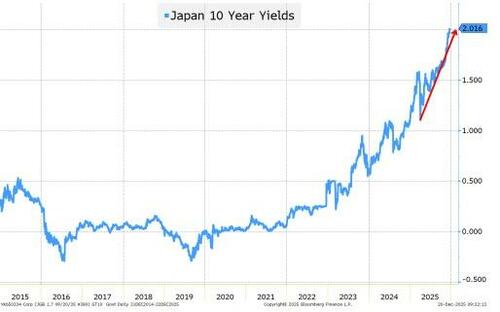
If the “scary” chart of the past couple of weeks has been Oracle CDS, it was Japanese bond yields by the end of this week. For the record, Oracle CDS finished a couple bps tighter on the week – making the end of my interview last Friday seem better than it did early in the week when it was still widening.
The Japanese 10-year bond yield broke 2% for this week. It spent most of the past decade below 0.5%.
So far this rise in Japanese bond yields has been accompanied by a weakening yen. Not exactly what the “textbook” would predict, but markets often follow narratives of their own (in theory as the yield differential decreases, the currency should appreciate, or so I read).
The yen carry trade is either some huge overriding trade that drives global markets, or it is a niche trade, where many overstate the importance of it. I’m in the latter camp, but since it is gaining a lot of attention lately, it is worth revisiting.
In theory many funds borrow in yen to fund positions in other assets. The interest rate on borrowing in yen was so low that you could “outperform” your borrowing costs (even taking FX risk). The corollary or flipside of this, is that many Japanese bond investors would buy U.S. Treasuries and attempt some currency hedges to outperform direct investments in Japanese government bonds.
That trade is less appealing on the interest rate differential. The difference between Japanese and U.S. central bank rates was 5.4% as recently as February 2024. It is down to 3.1%. Still a large differential, but it could impact the so-called “carry” trade.
A return to a strengthening of the yen would put far more pressure on the trade as many don’t hedge the FX risk. Again, this is a bit of a murky trade where some argue it is a huge driver of risk premium across the globe, while I suspect its importance is overstated. But not so overstated that we can completely ignore it.
This may go a long way to explaining why U.S. 10-year yields are still stuck between 4.1% and 4.2%.
The EU Had “One Job”
Periodically, I search the “you had one job” meme on social media. It never fails to deliver a smile.
Today, I’m not smiling.
Our assessment of what the EU can do to support Ukraine, maybe even as part of their commitment to NATO, was to seize Russia’s frozen assets and use them to purchase military equipment.
The EU does not have the military equipment or personnel to contribute, so aside from fully enforcing sanctions (which they have also been loathe to do), they could fund more equipment purchases for Ukraine.
Seizing Russia’s frozen reserves seemed to be the “easiest” way for Europe to do this:
It would not only fund the war effort, but it would also hurt Putin.
It would avoid Europe dithering for weeks or months, on issuing debt to fund some sort of purchases. Not exactly the sort of business arrangement the President likes (and I cannot blame him – we’ve argued that many of Trump’s comments seem to have laid down the gauntlet around Europe and Russia’s reserves). In any case, this time, despite the sound of it, I’m not being cynical. Sometimes what sounds like cynicism is just reality.
Without this seizure, we are seeing European bond yields rise. The “mitigating” factor is that it is probably safe to bet that Europe won’t really act. That there won’t be a deluge of European debt offerings to fund weapons purchases for Ukraine because weapons purchases won’t happen at scale.
What a “Peaceful” Ukraine/Russia Will Look Like
The consensus of the GIG is that we aren’t headed towards peace any time soon, but that Putin has the capability to outlast Ukraine, and Ukraine will ultimately come to the table.
Without the seizure of Russia’s reserves, I think Ukraine has to come to the table faster than they would otherwise.
They may not like what the U.S. is proposing, but it is “reasonably” concrete. If you were Ukraine, you could try and keep some of the U.S. proposals at bay, while waiting for Europe to come through. Whatever machinations Europe goes through, if I’m Ukraine, I’m more skeptical about any sort of game changing help from Europe. When headlines read Belgium and Putin win, you have to be nervous (the Weakest Link was almost more popular in the U.K. than in the U.S., maybe because it is the politics of the EU – the UK was part of the EU when that show was at peak popularity). Unanimous decisions within the EU are hard to reach, so appeasing every country makes it difficult to do much. And that is ignoring the hard truth that many European nations have their own economic concerns to deal with.
So, time to think a little bit more about what “peace” might look like:
Stronger security guarantees by the U.S. for Ukraine.
These will be given because Ukraine will give the U.S. (and its corporations) extremely favorable deals for years. The admin will not provide security guarantees so much to protect Ukraine, but to protect the business interests that will be generated.
The business deals with Russia will be even better for U.S. corporations.
Whatever Ukraine may have to give up, as they realize they cannot get enough support from Europe to continue, will be big for the U.S. Russia will give up even more since Europe clearly had no interest in giving them anything and they are being pushed to the brink by the U.S. It will be interesting to see what China and maybe even India have to say about any favorable treatment given to the U.S. and U.S. businesses.
Look for Poland and even Romania to thrive.
Whatever the prognosis is for lasting peace, many companies will want to stage their operations outside of Russia, and even outside of Ukraine. When deciding where to launch your expansion into Russia and/or Ukraine, both Poland and increasingly, Romania make sense. Poland has proven itself to be resilient and extremely competent during the war. Romania, in my understanding, and I’m learning more, has also played a key role and has some advantages in terms of its borders.
Much of what the admin is looking for in the region fits our ProSec™ narrative, and I think we are one step further towards seeing the admin achieve those goals.
Bottom Line
Despite signs that inflation is abating, bond yields will be a bit stubborn, because of what is happening across the globe, rather than due to our domestic policy/data. I want to buy the long end, and own flatteners, but it is still a touch early.
Credit was a little weaker than stocks this week. Fear of the calendar seems to be keeping spreads from tightening even when other risk assets do well. That will likely persist, but I think the start of the new issue season will be a sign to load up on credit. A lot of “room” has been made to absorb the supply, and if we are correct on the AI Debt Diet thesis, some fears, currently priced into the market, will dissipate.
Something looks seriously “off” in the crypto market (I cannot unsee Elaine dancing). Even with the support this admin and the regulators have for the business, it seems prudent to remain cautious. It continues to be erratic and stuck at levels that seem to make little sense given the ongoing drumbeat of positive news.
If stocks can open decently on Monday, look for strength into year-end, and then some more choppiness. If stocks cannot hold onto the gains from Friday, we will all have a far more anxious holiday season than we were hoping for, as support and “blindly” buying the dip don’t seem to be there.
The AI Debt Diet and AI Spend Diet will be key factors for the markets early next year.
Any peace with Russia and Ukraine is likely to lower commodity prices (as access is granted), but look for U.S. companies to dominate any rebuilding and look for the admin to focus on refining and processing even more than extraction.
And no, CEOs should not be replaced by AI, but we should all be figuring out the right balance and what the real cost/benefits are. I think that could drive down spend a little bit, and actually drive up productivity.
Hopefully, markets cooperate and let us enjoy the holiday season as we ramp up for what should be a busy 2026!
Tyler Durden
Sun, 12/21/2025 – 18:40
Infielder surcoreano Sung-mun Song y Padres cierran contrato de 15 millones por cuatro años
El jugador de cuadro surcoreano Sung-mun Song y los Padres de San Diego acordaron el domingo un contrato de cuatro años por 15 millones de dólares.
Song recibirá un bono por firmar de un millón en dos pagos iguales, en 30 días y el 15 de enero de 2027, y salarios de 2,5 millones el próximo año, tres millones en 2027 y 3,5 millones en 2028.
El acuerdo de Song incluye una opción de jugador de cuatro millones para 2029 y una opción mutua de siete millones para 2030 con una cláusula de rescisión de un millón.
Si Song gana un premio al Novato del Año, su salario en la temporada siguiente aumentaría en un millón. Si termina entre los cinco primeros en la votación para el Jugador Más Valioso, su salario en todos los años restantes del contrato aumentaría en un millón cada uno.
Será agente libre al final del contrato, y el equipo pagará por un intérprete y boletos de avión de ida y vuelta desde Corea del Sur.
Song bateó para .315 con un récord personal de 26 jonrones y 90 carreras impulsadas este año para los Kiwoom Heroes de Corea del Sur. Principalmente un tercera base, el bateador zurdo de 29 años tiene un promedio de .284 con 80 cuadrangulares y 454 carreras impulsadas en nueve temporadas con Nexen (2015, 2017-19) y Kiwoom (2021-25).
Bajo el acuerdo de publicación de la MLB con la Liga de Béisbol de Corea, los Padres pagarán a los Kiwoom Heroes una tarifa de publicación de tres millones. San Diego debería pagar una tarifa suplementaria del 15% de cualquier aumento activado.
___
Deportes en español AP: https://apnews.com/hub/deportes

Texas A&M volleyball wins national championship with a sweep of Kentucky
KANSAS CITY, Mo. — Logan Lednicky had 11 kills, Maddie Waak had 29 assists and Texas A&M won its first NCAA volleyball championship, sweeping Kentucky 3-0 on Sunday.
The Aggies (29-4) accomplished the rare feat of defeating three No. 1 seeds. They defeated Nebraska and Pittsburgh earlier in the tournament. They did not drop a set in the Final Four.
At 24-18 in the third set, Kentucky held off a couple of match points before the Aggies took advantage of a free ball and Cos-Okpalla delivered the championship point, crushing a set from Waak out of the middle.
Kyndal Stowers finished with 10 kills and hit .304. Cos-Okpalla added eight kills, hitting .235 and Lednicky hit .250.
Eva Hudson had a match-high 13 kills for Kentucky and Kassie O’Brien had 34 assists.
The Aggies hit .257 as a team, compared to Kentucky’s .148.
Set scores were 26-24, 25-15, 25-20.
The Aggies trailed throughout the first set until they tied it at 20-all and also saved a set point to tie it at 24. The Aggies took their first lead at 25-24 on an attack error by Kentucky’s Brooklyn DeLeye, her fifth of the set. Stowers finished off the 26-24 first-set win for the Aggies with a tip off the Kentucky block.
After taking that 25-24 lead, the Aggies did not trail at any point in the rest of the match.
Kentucky (30-3) continued to struggle at the net in the second set. The Wildcats had nine errors in the first set and six more while falling behind 19-9 in the second. The Aggies continued to dominate, winning 25-15 after outhitting their SEC rival .253—.077.
Stowers and Lednicky had eight kills each in the first two sets, with Stowers hitting .368 and Lednicky .240.
Texas A&M led 13-10 in the third set before a kill by Lednicky started a 6-1 scoring run for a commanding 19-11 lead, six points from the national championship.
https://www.chicagotribune.com/2025/12/21/texas-am-volleyball-wins-national-championship/

Los Bears demuestran que ya no son el mismo equipo con una victoria en tiempo extra sobre Packers
Por ANDREW SELIGMAN
CHICAGO (AP) — Los Bears de Chicago parecían dirigirse a otra derrota más contra los Packers de Green Bay, abajo por diez puntos en los minutos finales.
Sin embargo, estos no son los mismos viejos Bears.
Una victoria por 22-16 en tiempo extra el sábado por la noche fue solo el último recordatorio.
“Cuando es tan tarde en los juegos, simplemente, no parpadean”, dijo el entrenador en jefe Ben Johnson. “No sientes ninguna desesperación en la línea lateral de ninguna de las fases. Podrías sentirlo un poco en el estadio. Pude sentir a los fanáticos cobrar vida nuevamente una vez que tomamos un poco de impulso en el cuarto período, pero nuestros muchachos, no pierden el ritmo.
“Simplemente siguen avanzando, y saben que las cosas buenas vendrán si seguimos intentándolo”.
Las cosas buenas rara vez llegan a los Bears contra los Packers. Chicago tiene un récord de 7-30 contra Green Bay desde 2008, contando los playoffs. Pero tal vez, solo tal vez, el impulso esté comenzando a cambiar en la rivalidad más antigua de la NFL.
Los Bears ganaron en Lambeau Field en el final de la temporada pasada para romper una racha de 11 derrotas consecutivas contra los Packers. El sábado, vencieron a Green Bay en casa por primera vez desde 2018. También se vengaron de lo que sucedió en casa del eterno rival dos semanas antes, cuando brevemente cayeron del liderazgo de la división.
Caleb Williams pasó de lanzar una intercepción tardía en la zona de anotación que selló una derrota por 28-21 ante los Packers a vencerlos con un touchdown de 46 yardas a DJ Moore en tiempo extra. Y Chicago (11-4) amplió su ventaja en la división Norte de la Conferencia Nacional sobre Green Bay (9-5-1) a uno 1,5 juegos con dos restantes.
Está funcionando
Los receptores. La profundidad en los receptores se mostró incluso cuando los Bears estaban sin dos de sus principales objetivos en Rome Odunze (pie) y Luther Burden (tobillo). Sin embargo, todavía tenían a Moore. Y él se destacó por segundo juego consecutivo.
Moore atrapó cinco pases para un máximo de la temporada de 97 yardas y logró el touchdown ganador.
Necesita ayuda
Los Bears tuvieron problemas para mantener las series, logrando dos de 11 en terceras oportunidades. Los Packers, en comparación, convirtieron seis de 12 y tuvieron una gran ventaja en tiempo de posesión: 38:57 a 26:13.
___
Deportes en español AP: https://apnews.com/hub/deportes

El presidente electo Kast de Chile y el mandatario interino peruano José Jerí se reunirán en Lima
LIMA (AP) — El presidente electo chileno José Antonio Kast visitará Perú en enero para reunirse con el mandatario interino peruano José Jerí, informaron el domingo autoridades peruanas.
En un mensaje en redes sociales, la cancillería peruana indicó que Kast —que asumirá la presidencia el 11 de marzo— se encontrará con Jerí en el palacio gubernamental, pero no se dio a conocer cuándo. Después de que Kast ganó las elecciones presidenciales chilenas, Jerí lo invitó a crear un gabinete binacional en el segundo bimestre de 2026 para enfrentar de manera conjunta el crimen transnacional.
Durante su campaña el ultraderechista Kast prometió una política de mano dura contra la inmigración irregular, y anunció que expulsará a todas las personas indocumentadas que estén en Chile una vez que asuma la presidencia.
En noviembre, decenas de migrantes venezolanos intentaron ingresar a Perú desde Chile, pero la policía peruana les impidió entrar. Lima ha indicado que sólo ingresarán desde territorio chileno los migrantes que tengan documentos en regla o por motivos humanitarios.
Luego del incidente fronterizo, autoridades chilenas y peruanas crearon un comité binacional de cooperación migratoria, el cual intenta remediar la agudización de las tensiones en la frontera norte de Chile, y también acordaron incrementar la cooperación policial para enfrentar el creciente flujo migratorio en su frontera común.
Agente del ICE dispara contra un conductor cubano en Minnesota después de ser atropellado
ST. PAUL, Minnesota, EE.UU. (AP) — Un agente del Servicio de Inmigración y Control de Aduanas de Estados Unidos (ICE por sus iniciales en inglés) abrió fuego el domingo contra un inmigrante cubano que vivía sin autorización legal en el país después, de que el hombre atropelló con su camioneta a dos elementos de la agencia en la capital del estado de Minnesota, informó el Departamento de Seguridad Nacional.
El hombre también mordió a un agente del ICE mientras era sometido fuera de su apartamento en St. Paul luego de que intentó escapar a pie, informó la subsecretaria de Seguridad Nacional, Tricia McLaughlin, en un correo electrónico.
El hombre no resultó herido, y los agentes atropellados sufrieron lesiones que no ponen en riesgo su vida, aunque el detenido y los elementos del ICE fueron trasladados a un hospital para su evaluación, destacó McLaughlin.
Las tensiones han ido en aumento en el área de Minneapolis-St. Paul mientras las autoridades federales continúan con una batida migratoria. Agentes de ICE y manifestantes se enfrentaron la semana pasada en Minneapolis.
McLaughlin señaló que el hombre detenido el domingo ingresó a Estados Unidos en 2024 a través de un programa ahora descontinuado que implementó el gobierno del expresidente Joe Biden, el cual permitía que migrantes sin documentos de entrada adecuados ingresar al país en lo que se evaluaban sus solicitudes de asilo.
El incidente ocurrió el domingo por la mañana. La policía de St. Paul dijo en un comunicado que se requirió su presencia en la zona después de recibir informes de disparos, sólo para enterarse de que el responsable había sido el agente del ICE.
Los agentes de ICE vieron al hombre subirse a su camioneta, se identificaron y se acercaron, dijo McLaughlin. Cuando el hombre se negó a bajar la ventanilla, le dijeron que si no cumplía la romperían, añadió.
El hombre se alejó conduciendo, golpeando a un agente, y se dirigió al estacionamiento de su complejo de apartamentos, donde los agentes lo detuvieron nuevamente y le ordenaron salir del vehículo, detalló McLaughlin. Entonces, condujo su camioneta hacia un vehículo del ICE, impactando a un segundo agente, lo que provocó que disparara, sin alcanzar al sospechoso, añadió.
Después de embestir otro vehículo de ICE, el hombre salió de su camioneta e intentó huir hacia su apartamento, pero fue derribado por los agentes, dijo McLaughlin.
___
Esta historia fue traducida del inglés por un editor de AP con la ayuda de una herramienta de inteligencia artificial generativa.

California Faces Fuel Disaster As Refineries And Gas Stations Shut Down
California Faces Fuel Disaster As Refineries And Gas Stations Shut Down
The Democrat crusade to divert blame for the stagflation crisis triggered during the Biden Administration led them down a path of economic lies. The central theme of their narrative was that corporations were “price gouging” consumers and inflation was actually a product of “corporate greed.” In reality, helicopter money and dollar devaluation during the pandemic triggered a massive consumer demand rush as well as shortages in a variety of goods and raw materials.
The profit margins in many of these industries were paper thin as their manufacturing and labor costs skyrocketed, yet Democrats tried to scapegoat them anyway. The word “accountability” is not in the leftist vocabulary.
We are only now starting to witness the aftermath of the legislation and policies put in place by blue states as a means to control prices. California under Governor Gavin Newsom may have staged its own economic demise (the final nail in the coffin) after laws were passed requiring even greater state interference into oil refineries and gas stations.
Gavin Newsom ‘s major refinery law, ABX2-1 (signed Oct 2024), gives the state power to mandate minimum fuel storage levels and control refinery maintenance to prevent price spikes, empowering the California Energy Commission (CEC) to stabilize supply. This builds on earlier efforts (like SB X1-2) creating an oil market watchdog (DPMO) to increase oversight, aiming to stop refiners from manipulating supply for profit, while also adding data reporting requirements for companies.
In response, companies are shutting down refinery operations in the state.
Lawmakers in California at both the state and federal levels are warning that refinery closures could push prices higher while leaving the state more dependent on foreign oil. At the center of the warning is the planned shutdown of two major refineries: Valero’s Benicia facility and Phillips 66’s Los Angeles plant. Together, the closures would eliminate nearly 20% of California’s in-state refining capacity.
Experts suggest prices could go as high as $10-$12 per gallon as a result of the supply squeeze, spreading outside of CA to Arizona and Nevada. Republican lawmakers say that the loss of in-state production threatens not only consumer prices at the pump but also the state’s military readiness; a matter of national security.
The refineries make jet fuel and diesel and gasoline for military bases across California. California is home to more than 30 military bases, many of which rely on fuel refined in-state. Gavin Newsom has mostly dismissed concerns as exaggeration, asserting that foreign shipments of fuel will fill the supply gap. He argued in a recent statement:
“The claim that California policies pose a national security risk isn’t grounded in fact. The state has proactively engaged defense fuel customers throughout this energy transition, and no credible concerns have been raised about future fuel supply for the military. California is leading this transition responsibly while ensuring families have access to a safe, reliable, and affordable supply of transportation fuels…”
California law, primarily through Senate Bill 445, also mandates that all single-walled Underground Storage Tanks (USTs) and piping must be permanently closed or replaced with compliant double-walled systems by December 31st, 2025. The claims is that this will prevent leaks and environmental contamination, with significant fines for non-compliance.
The state created a program called “RUST” to supposedly help small businesses meet the deadline by providing subsidies to pay for new tanks. However, many mom-and-pop gas stations are reporting that they never received any aid from the RUST program, even though they applied far in advance. Hundreds of small business CA gas stations are set to shut down in 2026. A large number of them are rural and operate as the only gas stations for long stretches of highway.
In October, the newly created Division of Petroleum Market Oversight released its first annual report meant to discover why CA gas prices are so high. The report merely confirmed what was already known – CA prices are much higher than other states because of the differential in taxes and regulatory costs. No concrete evidence of price gouging on the part of energy companies was found.
Blue states like CA have been increasingly subjecting their citizens to an experiment in artificial energy scarcity; reducing access to “fossil fuels” while raising taxes to force consumers into the electric car market. All of this is being down in the name of stopping “man-made global warming”, a problem which does not exist. Newsom claims that he is trying to help CA citizens by lowering gas prices, but all of his actions are leading to a price explosion.
Tyler Durden
Sun, 12/21/2025 – 18:05