Category: News

Cook County property tax troubles trigger school district losses, reform demands
The due date for property tax bills has come and gone, but Cook County officials remain under siege.
On one side, a group of pastors are pressing the assessor, members of the Board of Review and the treasurer to unwind this year’s bills for South and West siders and cap future bill increases. On the other side, suburban school districts are begging to receive their share of property tax revenues to make payroll.
Caught in the middle are leaders — most of whom face reelection in less than 90 days — with only limited capacity to address their claims.
Property owners have been paying their tax bills since mid-November, but none of those dollars have yet made their way to taxing bodies such as schools, libraries and park districts.
County commissioners have been inundated with messages from suburban school district leaders whose budgets often rely heavily on property tax revenue asking when they can expect to receive their cut.
Meanwhile, costs are racking up for the public agencies that count on the money.
As the waiting game plays out, school districts have “thrown away and wasted” millions of dollars to make do, Ben Collins, superintendent of Park Ridge-Niles School District 64, testified at the County Board on Wednesday. Several have borrowed money through tax anticipation notes or warrants, tapped reserves or investment accounts, or moved cash around to cover operating costs.
On Thursday, Diana McCluskey, the chief school business official at Palatine School District 15, testified that her district borrowed $25 million. Interest, attorney and banking fees will cost them about $450,000, and lost interest from cashing out investments will cost another $700,000, she estimated.
Commissioners haven’t been able to answer when the dollars will start flowing. Those tax distributions have been stalled because of the ongoing county upgrade of property tax systems managed by Texas-based Tyler Technologies and overseen by Cook County Board Toni Preckwinkle’s Bureau of Technology. Distributions come from Treasurer Maria Pappas.
Cook County Chief Information Officer Tom Lynch gives an update on the Integrated Property Tax System project at the County Board’s Technology Committee meeting on April 9, 2025. (Terrence Antonio James/Chicago Tribune)
“I’m embarrassed and appalled that we’re not done yet, I take accountability for that, as I hope my counterparts do in the property offices. We all have to do this together,” Chief Technology Officer Tom Lynch told commissioners Wednesday.
The decade-long effort has led to cross-office clashes and open criticism of Tyler, one of the largest government tech contractors in the country. “Tyler, as I think we’ve talked about extensively, has not been a good, reliable partner,” Lynch said. “They have missed a lot of deadlines. They’ve had an awful lot of rework.”
The property tax upgrade has cost tens of millions of dollars, including ongoing payments to keep the county’s old computer system running and outside consulting expenses. The County Board this week approved an additional $1.5 million contract extension to Guidehouse, which is helping manage the project. Problems plaguing implementation of Tyler’s system across property tax offices led to this year’s late bills.
The biggest distributions to local schools, parks, libraries and villages typically start a couple weeks after the first property tax money from escrow accounts hit the county’s coffers, school superintendents say. In a normal year, that would be in early spring, then again in late summer. That late summer distribution is now months late.
High hopes that distributions could have kicked off last week were dashed after the property tax offices realized they were working with an outdated file for testing. The error wasn’t discovered until Thursday morning and set the effort back by a few days. Pappas’ office blamed Preckwinkle technology officials for providing the wrong file months ago. Preckwinkle’s office said distributions are ultimately Pappas’ responsibility.
Tyler’s media team, meanwhile, said it has been working “around the clock” for weeks to finish its piece and expected to hand off its work Thursday morning, until it learned “that county data critical to a correct distribution process had not been provided to us… our team is yet again working tirelessly to finish this work.”
Superintendents said the strain has damaged school leaders’ reputations for financial stewardship with their boards, teachers and families. The interest costs or funding lost from investments are gone, regardless of when distributions do start.
Erin Murphy, superintendent of West Northfield School District 31, told the Tribune 94% of her revenue comes from property taxes. To help maintain operations, the district issued $4.3 million in tax anticipation warrants, or TAWs. If they pay it back by the end of February, it will cost $44,238 in interest, and potentially hundreds of thousands more in lost investment income. It’s money that could have gone toward extra staffing, supplies or building up reserves, she said.
“We’ve already moved all of our funds into working cash. If we don’t start seeing money, we are also looking at a second round of TAWs,” Murphy said. “So not only have we lost the interest and investment revenue that is part of our budget, but we are also hit with additional interest and expenses to issue Tax Anticipation Warrants. I’m not even sure how much interest yet because I don’t know when we are paying it back.”
Her school district and others’ credit ratings were too high to qualify for Cook County’s Bridge Loan Fund.
Though they come from suburban elementary districts not typically considered financially strapped, Mary Gorr, superintendent for Mount Prospect School District 57 said community members have questioned “every penny we spend — and that’s their right. So being forced to waste this significant amount of money on interest and emergency borrowing, when we’ve done everything by the book, feels deeply unfair to our taxpayers and incredibly irresponsible of the county.”
Rob Grossi, an education finance consultant who has worked with districts across the county, said less affluent districts that receive evidence-based funding from the state haven’t suffered the acute cash flow issue that northern districts have. But if a cash flow problem does pop up, many south suburban schools “do not have the same credit quality as the northern Cook County school districts, so when those districts hit their tipping point and need to borrow funds it might be more challenging.”
His worst fear is that funds don’t land until mid-January, triggering borrowing demand that might overwhelm local lenders, leaving schools with lower credit with limited options.
Grossi said he was not aware of any school district in the county with low enough credit to qualify for the bridge loan. Some, such as Dolton School District 148, have been able to borrow from their school township treasurer.
School districts have had to move money around before when bills were late before. But this year has been worse, superintendents said, because of a lack of communication from county officials.
Asked about those complaints, Preckwinkle said, “part of the reason that we have been circumspect in our comments is that we face a series of challenges in terms of getting the production moving.”
Earlier in the week, a group of pastors marched between property tax offices and asked for the opposite of what school districts were clamoring for: a series of freezes or rollbacks to ease the burden of property tax hikes in their neighborhoods.
“South Side residents are being crushed by astronomical property tax increases,” the Rev. Ira Acree said, pointing to 6% property increases in communities like Lincoln Park while Englewood climbed by 82%. “This is not a shared sacrifice, this is selective punishment.”
They demanded the treasurer charge no interest for late payments, the Board of Review reverse its granted appeals for downtown properties, and the assessor roll back and freeze the increased assessments that hit the south and west sides.
The horse was already out of the barn, however.
The Rev. Ira Acree, pastor of Greater St. John Bible Church, speaks as he stands with other pastors in the lobby of the County Building on Dec. 15, 2025, to demand action to reverse increases in home property taxes. (Eileen T. Meslar/Chicago Tribune)
Their news conference was held on the last day homeowners could pay their bills for properties assessed in 2024. The state, not the treasurer, controls interest costs on late payments. Any appeals granted by the Board of Review now would only apply on 2026 property tax bills. They called for the state, too, to implement caps on property tax increases — which would also likely limit how much money local governments could raise.
Even so, the offices have been working to grant what relief they can. The board reopened its appeals window — receiving 14,864 complaints in all, the vast majority from homeowners — and hosted several outreach events in the last month. The assessor processed 11,700 missing exemptions for homeowners between Nov. 14 and Dec. 15.
“The whole property tax system is a racket and it needs to be shaken up from top to bottom,” the Rev. Marshall Hatch said.
“Everyone is saying they’re not the one to blame,” Hatch added. “And so we’re gonna blame everybody with this.”

Letters: Dismantling the National Center for Atmospheric Research is a real threat to our national security
Is there anything more threatening to our national security than the constant threat of climate change and severe weather events that have disrupted and destroyed communities, businesses and personal property throughout our country and the world this past year?
Lisa Friedman, Brad Plumer and Jack Healy, reporters for The New York Times, wrote an article published Dec. 18 in the Tribune print edition titled, “White House plans to take apart weather research center in Colo.” This article should send up red flags all over this nation. The National Center for Atmospheric Research in Colorado is “one of the world’s leading Earth science research institutions,” the article says.
This is a short must-read for any American concerned with severe weather events that have threatened our country and the world community.
Our country’s modus operandi has always been to seek out the best and brightest to take positions of leadership and authority in any and every field of our national security.
The current administration stands against scientific research and investigations that actually help protect us and our homes and businesses. Just because they disagree with practical scientific research in our educational institutions and especially in institutions as important as this one, they want to tear them down; taking away our guardrails and exposing us to unknown dangers.
How short-sighted, stupid and dangerous.
This administration’s agenda to destroy progress and our well-being by dismantling institutions such as the NCAR in Colorado is a true and real threat to our national security.
— Joe Artabasy, Glencoe
Republicans’ abdication
The Donald Trump administration says it is closing the National Center for Atmospheric Research because of its “climate alarmism.” Do these officials really believe issues go away if you stop studying them?
Even more perplexing to me is the role of Republicans in Congress. I think most of them recognize this as a bad idea, but they seem unwilling or unable to exercise the role the Constitution indisputably gives them: to provide checks and balances to prevent a president from running amok. Basic reality orientation seems like it would be one of the less controversial areas for expressing that duty.
— Mike Koetting, Chicago
Helping our neighbors
Immigration and Customs Enforcement raids have recently occurred in Evanston, Elgin, St. Charles, Geneva, Aurora and Chicago, as well as other communities. Violations of constitutional rights are increasing since the Supreme Court ruled that agents can stop and arrest individuals based on the color of their skin, the language they are speaking or their location. These detentions are devastating families, neighborhoods and businesses. People are afraid to leave their homes, to take their children to school, to go grocery shopping or even to attend church. And everyday, these actions also put police at risk.
It is hard for many Americans to believe that this can happen in our country — and our neighborhoods. We should all be outraged. It is un-American.
Fortunately, here and throughout the country, thousands of people are helping these families. Groceries, clothing and toiletries are being collected for organizations that are helping people who cannot leave their homes. Individuals, organizations and religious congregations are driving kids to school, providing legal services and money for legal defense, collecting food and more. Your help is needed.
What is happening is wrong. You can help: It is important to join the volunteers who are working to serve our neighbors. Speak out: Let local, state and national government representatives know that you want these illegal activities to stop now. Ask them to publicly support efforts to ban ICE from using municipal-owned properties for immigration enforcement activities. Tell political candidates that you will not support anyone who accepts donations from companies and organizations that are providing services to ICE.
There is much to be done. Together, we can help to protect innocent community members — and to end these raids.
— Kathy Winterhalter, St. Charles
Is the ACA affordable?
I have read several articles about the Affordable Care Act subsidies that are being debated. If this insurance is so expensive without the government paying for it, what made this affordable in the first place?
— Loren Monsess, Waterman
We can’t fail our kids
Two students at Brown University lived through school shootings as children. They were forced to relive that terror again at Brown.
As a father, I am heartbroken for the trauma these young adults and their parents are experiencing. As someone who was shot by a school shooter and survived, I deeply empathize with those whose lives have been forever altered. As a former FBI special agent and crisis negotiator, I have seen the aftermath: families waiting in trauma units and asking questions that will never have answers.
I know we can and must do better.
Too often after shootings such as the one at Brown, we offer “thoughts and prayers.” But thoughts without action are not a strategy. We have failed to translate grief into policies that save lives. We need to close loopholes that allow weapons of war into civilian hands, invest in community-based violence intervention and treat gun violence as a public health crisis.
We have seen promising steps at the state level: improved background checks, red flag laws and funding for prevention programs. Yet, national action remains stalled by political calculation and the lack of courage to prioritize people over special interests.
Our children should be safe in classrooms, not trained for active shooters. And parents should be able to send their children to school without the constant fear of “what if.” To honor those we have lost at Brown and every community scarred by gun violence, we must not accept this as normal.
With a Congress that lacks the courage to act, we will fail another generation of children if active shooter drills, fear and tragic loss continue to define our values.
— Phil Andrew, U.S. House candidate, Wilmette
Brazen Islamophobia
U.S. Sens. Randy Fine and Tommy Tuberville, in calling for the mass expulsion of Muslims from the United States, demonstrate their ignorance of the Constitution, which they’ve sworn to uphold and defend. The First Amendment guarantees freedom of religion. The fact that it is the first line of the First Amendment shows how important it was to the Framers of the Constitution: “Congress shall make no law respecting an establishment of religion, or prohibiting the free exercise thereof.”
Deporting all Muslims due to the depraved actions of one individual would be illegal, immoral, racist and anti-American. What’s next on the Republican agenda? Deport all of the Latinos, which Trump is getting a head start on, and only allow immigration of Scandinavian or Slavic supermodels?
— Larry Mayerhofer, Geneva
The Person of the Year
Nerts to Time magazine and its glorification of artificial intelligence architects. The Person of the Year for 2025 is Ahmed al Ahmed, who saved lives at Bondi Beach.
— Mac Brachman, Chicago
Inspiration for action
Following up on Sami Uddin’s letter to the editor (“Hero at Bondi Beach,” Dec. 18), Ahmed al Ahmed’s bravery will go on to inspire others to react to sudden abominations.
As the saying goes: “The only thing necessary for the triumph of evil is for good men to do nothing.”
— Terry Takash, Western Springs
Note to readers: We’d like to know your hopes for the new year. Please send us a letter, of no more than 400 words, to letters@chicagotribune.com by Sunday, Dec. 28. Include your full name and city/town.
Submit a letter, of no more than 400 words, to the editor here or email letters@chicagotribune.com.
https://www.chicagotribune.com/2025/12/22/letters-122225-atmospheric-research-climate-change/
Cocoa Prices Face Worst Annual Collapse In Six Decades As Goldman Sees “Tailwinds” For Hershey
Cocoa Prices Face Worst Annual Collapse In Six Decades As Goldman Sees “Tailwinds” For Hershey
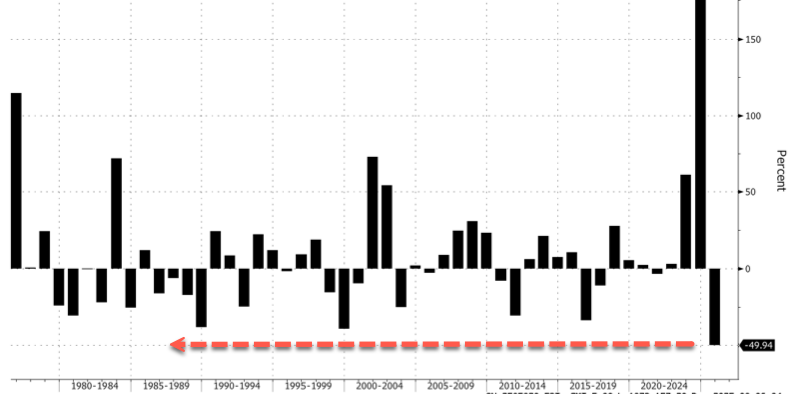
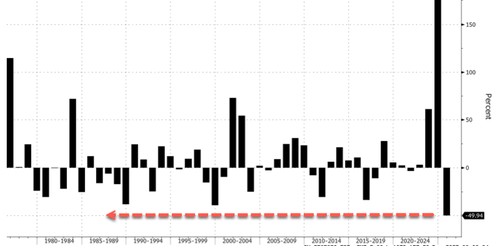
After nearly tripling last year and soaring to a record $13,000 a ton, cocoa futures are on track for their worst-ever annual decline, based on data going back more than six decades.
Cocoa futures in New York are set for a 50% decline if losses persist through the end of the year.
Prices are currently trading around $5,845 as of Friday’s close, a stark difference from the $12,000 to $13,000 range in late 2024 and early 2025.
The cocoa surge sparked a price shock and crushed margins for major food companies that relied heavily on chocolate production. Those companies include Nestlé, Hershey, and many others.
In return, supermarket prices for chocolate rose, but now Wall Street analysts don’t expect the latest declines to translate into cheaper candy until the second half of 2026.
“The prices that the chocolate industry is currently working with are very high and painful,” said Jonathan Parkman, head of agricultural sales at commodities brokerage Marex Group in London, as quoted by Bloomberg. “It’s going to take us quite a while to work through that.”
Swiss-Belgian cocoa processor Barry Callebaut has noted that supply risks in West Africa, the world’s top-growing region, persist due to underinvestment, climate stress, and disease. The processor said chocolate was “far too cheap for far too long.”
Lambertz, one of Germany’s oldest confectioners, has enough cocoa supplies to last through the midpoint of 2026, after securing them when prices were high, said owner Hermann Bühlbecker. “As far as I can remember, there has never been such a price explosion,” he said.
To cope with the price shock, many brands have responded with shrinkflation and reformulation, such as lighter bars or reduced cocoa content. Companies like Mondelez have made significant adjustments to formulation.
Last week, Bonnie Herzog, managing director and senior consumer analyst at Goldman Sachs, highlighted easing pressures in the cocoa market that could produce “tailwinds” for candy and junk food companies:
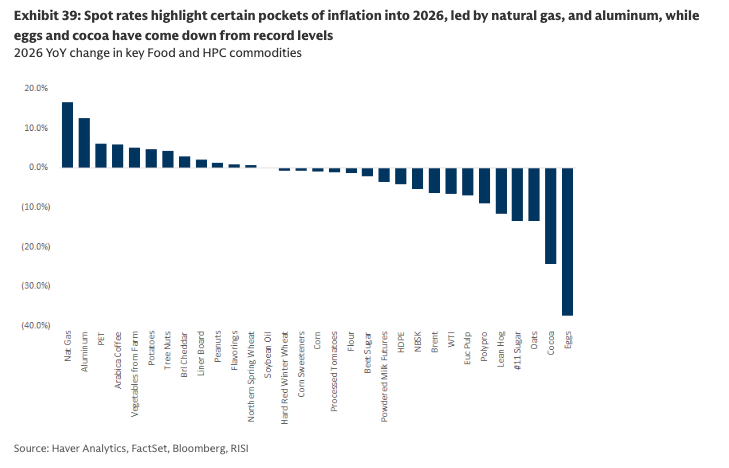
Pockets of easing commodity pressure to aid earnings growth for some. While input cost inflation has meaningfully moderated for Staples at large over the past couple of years, certain pockets (e.g., cocoa, proteins) were still inflationary and weighed on earnings. As prices continue to come down meaningfully from peak levels, we would expect benefits from an easing cost environment to aid earnings growth. However, spot rates suggest aluminum will likely see the highest inflation in 2026. Moreover, oil/natural gas prices remain volatile owing to ongoing geopolitical tensions, which, along with pressure from tariffs, could further limit the extent of gross margin expansion ahead. Ultimately, we believe the input cost environment will be much more accommodative for our Staples universe next year, which along with an increased focus on productivity (as supply chains and service levels have normalized), should support continued margin expansion and reinvestments ahead. We highlight HSY as best placed to benefit from this dynamic, where we expect gross margin expansion to drive EPS growth in 2026. We also highlight potential tailwinds for MDLZ, HRL, and SFD.
Herzog noted where inflation and deflation trends linger in the commodity market this year:
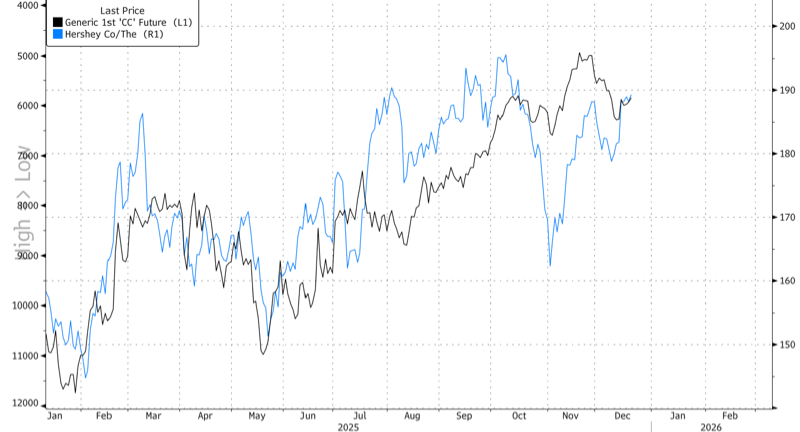
Hershey versus cocoa futures (inverted)…
Conversations so far are that any price relief for chocolate at the supermarket won’t show up until the 2H26. We’re watching Hershey next year…
Herzog also told clients to buy nicotine, energy drink, candy, and beauty stocks heading into 2026 as a stronger consumer backdrop emerges.
Tyler Durden
Mon, 12/22/2025 – 05:45

Today in History: ‘Subway Vigilante’ arrested
Today is Monday, Dec. 22, the 356th day of 2025. There are nine days left in the year.
Today in history:
On Dec. 22, 1984, New York City resident Bernhard Goetz shot and wounded four young Black men on a Manhattan subway, alleging they were about to rob him. (Goetz, a white man in what became known as the “Subway Vigilante” case, was later acquitted of attempted murder and assault charges but convicted on a weapons possession charge and served eight months of a one-year sentence.)
Also on this date:
In 1894, French army officer Alfred Dreyfus was convicted of treason in a court-martial that triggered worldwide charges of antisemitism. (Dreyfus was eventually vindicated.)
In 1944, during the World War II Battle of the Bulge, U.S. Brig. Gen. Anthony C. McAuliffe rejected a German demand for surrender, writing “Nuts!” as his official one-word reply. Allied forces, at a heavy cost, would decisively turn back the Germans’ last major offensive on the western front in Europe.
In 1990, Lech Walesa took the oath of office as Poland’s first popularly elected president.
In 2001, Richard C. Reid, a passenger on an American Airlines flight from Paris to Miami, tried to ignite explosives in his shoes, but was subdued by flight attendants and fellow passengers. (Reid is serving a life sentence in federal prison.)
In 2010, President Barack Obama signed a law allowing gay, lesbian and bisexual Americans to serve openly in the military for the first time, repealing the “don’t ask, don’t tell” policy that allowed gay and lesbian service members to serve as long as their sexual orientation was not public.
Related Articles
Must-have holiday gifts through the years, from teddy bears to Nintendo
Today in Chicago History: John Wayne Gacy arrested in suspected deaths of 33 boys and young men
Today in History: First basketball game played
Chicago Bears and Green Bay Packers have played 212 times in the past 100 years: How the rivalry has unfolded
WWII Navy veteran Ira ‘Ike’ Schab, one of last remaining Pearl Harbor survivors, dies at 105
In 2018, a 34-day federal government shutdown began in Donald Trump’s first presidency, following a stalemate between Congress and the White House on appropriations matters including funding for Trump’s proposed wall along the U.S.-Mexico border.
Today’s Birthdays: Actor Hector Elizondo is 89. Baseball Hall of Famer Steve Carlton is 81. Broadcast journalist Diane Sawyer is 80. Golf Hall of Famer Jan Stephenson is 74. Rapper Luther “Luke” Campbell is 65. Actor Ralph Fiennes is 63. Republican Sen. Ted Cruz of Texas is 55. Actor and singer Vanessa Paradis is 53. Actor Brooke Nevin is 43. Singer-actor Jordin Sparks is 36. Racing driver Josef Newgarden is 35. Rapper DaBaby is 34. Pop singer Meghan Trainor is 32.
https://www.chicagotribune.com/2025/12/22/today-in-history-subway-vigilante-arrested/

Major Israeli Strikes On Lebanon As Beirut ‘Days Away’ From Disarming Hezbollah
Major Israeli Strikes On Lebanon As Beirut ‘Days Away’ From Disarming Hezbollah
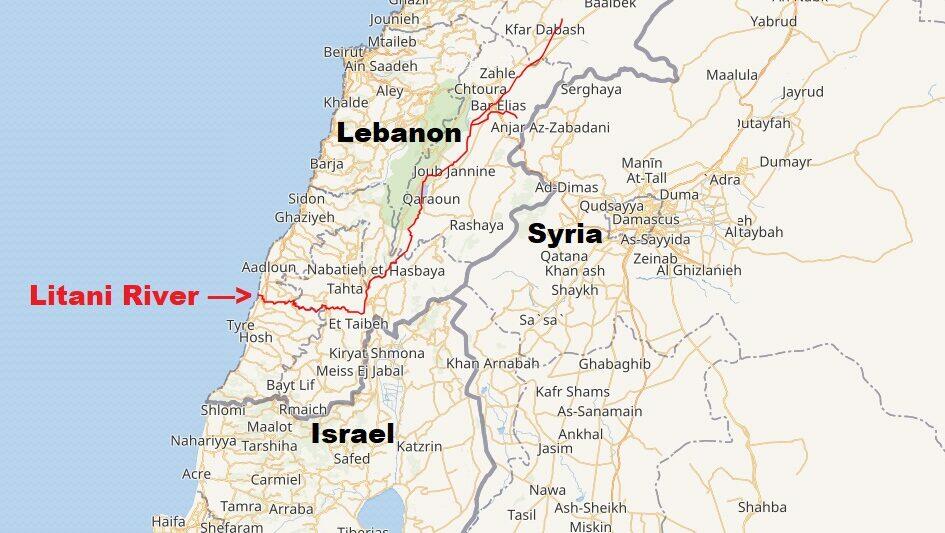
The Israeli army carried out several attacks on south Lebanon on Sunay, hours after Beirut said that the disarmament of Hezbollah in the southern Litani River area is “days away” from completion. An Israeli drone struck a car in the southern town of Yater. Minutes later, Israel bombed a motorcycle around 300 meters away from the targeted car.
The Israeli army said it “recently attacked another terrorist from the Hezbollah organization in the Yater area in southern Lebanon,” in a second statement following up on its announcement of the first strike. There were preliminary reports of casualties after the two drone strikes.
Israeli machine gun fire and artillery shelling also struck Kfar Shuba and the nearby Bastra Farm earlier on Sunday.
A day earlier, Lebanon’s Prime Minister Nawaf Salam claimed in a statement that the first phase of disarming Hezbollah is nearly complete.
“Prime Minister Salam affirmed that the first phase of the weapons consolidation plan related to the area south of the Litani River is only days away from completion,” Salam’s office said on Saturday.
“The state is ready to move on to the second phase – namely [confiscating weapons] north of the Litani River – based on the plan prepared by the Lebanese army pursuant to a mandate from the government,” it added.
The statement came after talks between Salam and Simon Karam, a former Lebanese ambassador to the US who Beirut recently appointed to hold direct talks with Israeli representatives – in violation of Lebanon’s laws and under heavy US pressure.
The Lebanese government has been vague about the direct talks, which have continued despite Lebanon’s Parliament Speaker and Amal Movement leader Nabih Berri saying recently that Beirut will not “negotiate under fire.”
So far, two direct meetings have been held as part of the ongoing discussions of the US-led ceasefire monitoring mechanism. Salam’s Saturday announcement about the weapons coincided with Israeli drone strikes on the towns of Blida and Taybeh.
In the past two months, Israel has significantly escalated deadly strikes and other violations of the Lebanon ceasefire, claiming that Hezbollah has rearmed itself.
Dozens of Lebanese have been killed since the start of last month alone. Since the ceasefire deal went into effect in November 2024, over 300 people have been killed – including scores of civilians and children.
The Lebanese army has been dismantling Hezbollah’s infrastructure south of the Litani River in line with the ceasefire deal reached last year, saying it has completed 90 percent of the disarmament process in the southern Litani area.
Under US pressure, the Lebanese government adopted a decision in August for the resistance movement’s full disarmament by the end of this year. The Lebanese army was ordered to draft a disarmament plan, which has been kept confidential.
According to reports in recent months, Lebanon has backtracked on its commitment to full disarmament by year’s end – in favor of a phased approach that would continue into 2026.
But Israel has threatened to launch a new campaign against the country unless the resistance surrenders all its arms by the end of 2025. Hezbollah has rejected disarmament, saying it will eventually respond if Israel continues to violate the truce.
Tyler Durden
Mon, 12/22/2025 – 05:00

Dinamarca pide respeto a su integridad territorial después de que Trump nombre enviado a Groenlandia
Associated Press
COPENHAGUE, Dinamarca (AP) — Las autoridades danesas insisten en que todo el mundo, incluido Estados Unidos, debe respetar “la integridad territorial del Reino de Dinamarca”, afirmó el lunes el ministro danés de Exteriores después de que el presidente Donald Trump anunciara el nombramiento del gobernador de Luisiana como enviado especial de Estados Unidos a Groenlandia.
Trump reiteró durante su transición presidencial y los primeros meses de su segundo mandato que quería extender la jurisdicción estadounidense a Groenlandia, un vasto territorio semiautónomo danés, y no ha descartado el uso de la fuerza militar para tomar el control de la isla ártica, rica en minerales y con una ubicación estratégica. El vicepresidente, JD Vance, visitó en marzo una remota base militar estadounidense en Groenlandia y acusó a Dinamarca de no invertir lo suficiente allí.
El tema había ido saliendo de los titulares, pero en agosto, funcionarios daneses convocaron al embajador de Estados Unidos tras un reporte sobre que al menos tres personas con conexiones con Trump habían llevado a cabo operaciones de influencia encubierta en Groenlandia. Dinamarca es miembro de la OTAN y aliado de Estados Unidos.
Trump anunció el domingo el nombramiento del gobernador de Luisiana, Jeff Landry, como enviado especial a Groenlandia. Dijo que “Jeff entiende lo esencial que es Groenlandia para nuestra Seguridad Nacional y promoverá firmemente los Intereses de nuestro País para la Seguridad, la Protección y la Supervivencia de nuestros Aliados, y de hecho, del Mundo”.
Landry escribió en una publicación en X que “es un honor servirles en esta posición voluntaria para hacer de Groenlandia una parte de Estados Unidos”.
El ministro danés de Exteriores, Lars Løkke Rasmussen, dijo en un breve comunicado enviado por su ministerio que “el nombramiento confirma el continuo interés estadounidense en Groenlandia”.
“Sin embargo, insistimos en que todos, incluidos los Estados Unidos, deben mostrar respeto por la integridad territorial del Reino de Dinamarca”, agregó.
A principios de este mes, el Servicio de Inteligencia de Defensa de Dinamarca dijo en un informe anual que Estados Unidos está utilizando su poder económico para “imponer su voluntad” y amenazar con la fuerza militar tanto a amigos como a enemigos.
___
Esta historia fue traducida del inglés por un editor de AP con la ayuda de una herramienta de inteligencia artificial generativa.

Trump Announces $1.3 Billion In Sales Of ‘Gold Card’ Visas Since Dec. 10
Trump Announces $1.3 Billion In Sales Of ‘Gold Card’ Visas Since Dec. 10
President Donald Trump announced Dec. 19 that his administration has sold more than $1.3 billion worth of “Trump Gold Cards,” a new immigration program offering expedited residency to high-skilled foreign talent, with proceeds going toward paying down the national debt.
In remarks to the press, Trump said that sales had exceeded $1.3 billion and described the Gold Card as a “green card on steroids.”
He said the option would allow companies to retain graduates from elite institutions, such as Harvard and Wharton, who might otherwise have to go back to their native countries upon graduation.
“They graduate from the top schools,” Trump said. “These people want to hire them. Now you’re able to buy a card and you’re able to keep people in the country.”
Trump highlighted how his immigration policy focuses on securing top talent and curbing illegal immigration.
“Under the Biden administration, 25 million people came in, and they came from prisons and mental institutions, and they were drug dealers and all sorts of people came in that shouldn’t be here. They came from the jails,” he said.
As Kimberly Hayek details below for The Epoch Times, the Gold Card allows businesses to purchase the visas for foreign workers, enabling them to stay indefinitely with work rights. The visa costs $1 million in the form of a donation to the U.S. federal government.
The program, which has been challenged legally, began accepting applications on Dec. 10.
Trump launched the Gold Card in September with an executive order and instituted a $100,000 fee for H-1B visa applicants. The H1B fee exempts current holders and renewals, according to the White House.
Trump first proposed the Gold Card visas in February, floating a $5 million price tag for residency and a path to citizenship.
“Wealthy people will be coming into our country,” he said when he proposed the program. The administration launched a dedicated website in June.
When launching the immigration Gold Card program, Trump said it would “reduce our taxes greatly and hopefully bring some great people into our country.”
Payments go straight to the U.S. Treasury. Howard Lutnick, secretary of commerce, was instrumental in launching the program, he said.
Twenty states, however, filed a lawsuit against the $100,000 H-1B fee, arguing it goes beyond executive authority.
Meanwhile, proponents say the program fixes longstanding issues with the H1-B lottery system.
Tyler Durden
Mon, 12/22/2025 – 04:15
https://www.zerohedge.com/political/trump-announces-13-billion-sales-gold-card-visas-dec-10

El nuevo cohete insignia H3 de Japón no logra colocar en órbita un satélite de geolocalización
Por MARI YAMAGUCHI
TOKIO (AP) — La agencia espacial de Japón informó que su cohete H3, que transportaba un satélite de navegación, no logró colocar la carga en la órbita prevista, un revés para el nuevo cohete insignia del país y su programa de lanzamientos espaciales.
El fracaso del lunes es el segundo para el nuevo cohete insignia de Japón después de su fallido vuelo inaugural en 2023 y seis vuelos exitosos.
La Agencia de Exploración Aeroespacial de Japón (JAXA) indicó que el cohete H3, que transportaba el satélite Michibiki 5, despegó del Centro Espacial de Tanegashima en una isla del suroeste de Japón el lunes, como parte de los planes de Japón para tener un sistema propio de posicionamiento más preciso.
El motor de la segunda etapa del cohete sufrió una interrupción prematura inesperada y no se pudo confirmar una separación posterior del satélite del cohete, explicó Masashi Okada, ejecutivo de JAXA y director de lanzamiento, en una conferencia de prensa.
Okada señaló que se desconoce si el satélite fue liberado en el espacio o dónde terminó, y que JAXA está investigando los datos para determinar la causa y otros detalles.
Jun Kondo, un funcionario del Ministerio de Educación, Cultura, Deportes, Ciencia y Tecnología, dijo a los periodistas que el fracaso fue “extremadamente lamentable” y que el gobierno había formado un grupo de trabajo para investigar la causa y tomar las medidas necesarias lo antes posible para “recuperar la credibilidad”.
El fallo del lunes es un revés para el nuevo cohete insignia de Japón que reemplazó al modelo anterior H-2A, que tenía un historial de éxito casi perfecto. También retrasa los planes de lanzamiento de satélites de Japón, incluido uno para tener un sistema de geolocalización más independiente para teléfonos inteligentes, navegación marítima y drones sin depender del sistema GPS de Estados Unidos.
El cohete H3 está diseñado para ser más competitivo en costos en el mercado espacial global. Japón considera que una capacidad de transporte espacial estable y comercialmente competitiva es clave para su programa espacial y su seguridad nacional.
Makoto Arita, gerente del proyecto H3 de JAXA, afirmó que el nuevo insignia aún está en las primeras etapas de operación, pero puede ser competitivo a nivel mundial. “Nos reagruparemos para no quedarnos atrás de los rivales. Investigaremos completamente la causa y pondremos al H3 de nuevo en marcha”, afirmó.
El lanzamiento del lunes se produjo cinco días después de que JAXA abortara el despegue apenas 17 segundos antes del lanzamiento, citando una anomalía en un sistema de rociado de agua en la instalación de lanzamiento, tras un problema anterior con el cohete.
En su vuelo inaugural en marzo de 2023, el H3 no logró encender el motor de la segunda etapa.
Actualmente, Japón cuenta con el sistema de satélites cuasi-cenital, o QZSS, con cinco satélites para un sistema de navegación regional que entró en operación por primera vez en 2018. El Michibiki 5 iba a ser el sexto de su red.
Ahora Japón depende parcialmente del GPS estadounidense y quiere tener un sistema de red de siete satélites para marzo de 2026 y una red de 11 satélites para finales de la década de 2030.
___
Esta historia fue traducida del inglés por un editor de AP con la ayuda de una herramienta de inteligencia artificial generativa.
Rubio’s Stark Warning: Europe Risks Wiping Out Shared Culture Of Western Civilization
Rubio’s Stark Warning: Europe Risks Wiping Out Shared Culture Of Western Civilization
Authored by Steve Watson via Modernity.news,
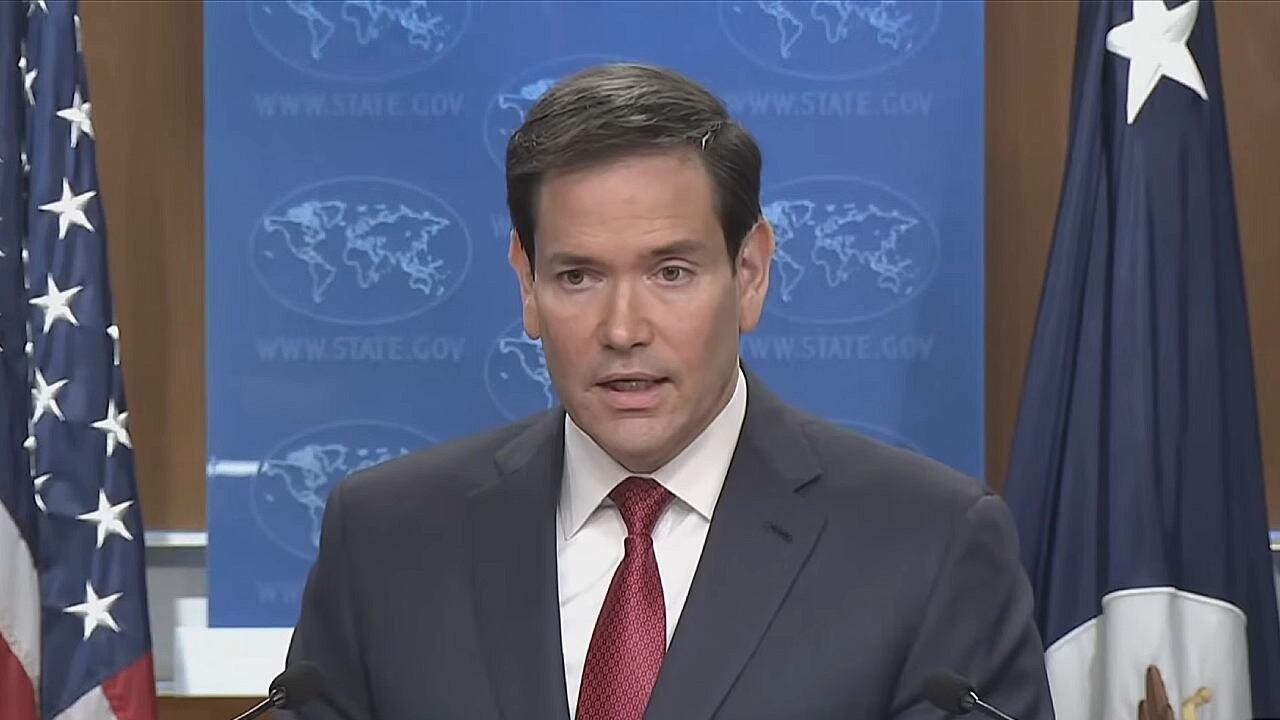
Secretary of State Marco Rubio has fired a direct shot at Europe’s globalist trajectory, warning that unchecked mass migration and erosion of core values could shatter the “shared culture” binding the West together—and weaken ties with America.
Echoing the Trump administration’s National Security Strategy, Rubio pulled no punches in highlighting how Europe’s slide toward “civilizational erasure” endangers alliances built on liberty and self-governance.
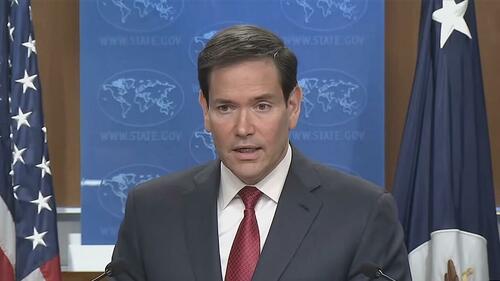
At a Department of State press briefing in Washington DC on Friday, Rubio addressed backlash from European leaders over the White House’s recent National Security Strategy, which slammed globalist policies fueling mass migration and assaults on free speech.
“You go to these NATO meetings and you meet with people, what they will tell you our shared history, our shared legacy, our shared values, our shared priorities. That’s what they talk about as the reason for this alliance,” Rubio said.
“Well, if you erase your shared history, your shared culture, your shared ideology, your shared priorities, your shared principles, then what – then you just have a straight-up defense agreement. That’s all you have,” he continued.
Rubio emphasized that the United States was founded on “Western values” such as the principles of liberty, individualism, and self-governance, noting that “many of these ideas that led to the founding of our country found their genesis in some of these places in the Western alliance.”
However, he expressed concern that “particularly in parts of Western Europe, those things that underpin our alliance and our tie to them could be under threat in the long term.”
“And by the way, there are leaders in those countries that recognize that as well. Some say it openly. Some say it privately. In the eastern and southern part of Europe, they’re much more open about it. Nonetheless, it is a factor that needs to be addressed,” Rubio added.
Turning to mass migration, Rubio cited the recent Islamist terror attack at a Jewish Hanukkah celebration on Bondi Beach in Australia as a grim example of its fallout.
“Mass migration over the last decade has been highly disruptive, not just to the United States but also to continental Europe and in some cases in the Indo-Pacific as well. So I just think this is a real challenge that multiple Western advanced, industrialized countries are facing, and I think it’s pronounced in parts of Europe as well,” he stated.
Rubio drew a clear line between controlled immigration and “mass migration,” calling the latter a “negative thing” because it is “very difficult for any society to absorb and assume hundreds of thousands if not millions of people over a short period of time, especially if they come from halfway around the world.”
“I think it’s a growing concern in Europe. I mean, there are other voices in Europe and obviously in Australia as well that have expressed concern about this. These are facts. This doesn’t make you anti-anybody. What it makes is you do have as a sovereign country the right to control how many people you absorb and how many people you allow in and who those people are. This is a very basic sovereign right,” Rubio asserted.
The remarks come amid escalating transatlantic tensions, with German Chancellor Friedrich Merz deeming parts of the U.S. strategy “unacceptable” from a European viewpoint, and EU Commission head Ursula von der Leyen urging America to stay out of European affairs.
This pushback follows the Trump team’s denial of alleged plans to pull nations like Italy, Austria, Hungary, and Poland away from Brussels’ influence.
Eurocrats have been in full meltdown mode, with globalist figures like EU Council President Antonio Costa blasting U.S. “interference” while ignoring the bloc’s own censorship crackdown, including hefty fines on X for prioritizing free speech.
As globalist elites cling to open borders and speech suppression, Rubio’s words serve as a wake-up call: sovereign nations must reclaim control or watch their heritage vanish.
Your support is crucial in helping us defeat mass censorship. Please consider donating via Locals or check out our unique merch. Follow us on X @ModernityNews.
Tyler Durden
Mon, 12/22/2025 – 03:30
The $117 Trillion World Economy In One Giant Visualization
The $117 Trillion World Economy In One Giant Visualization
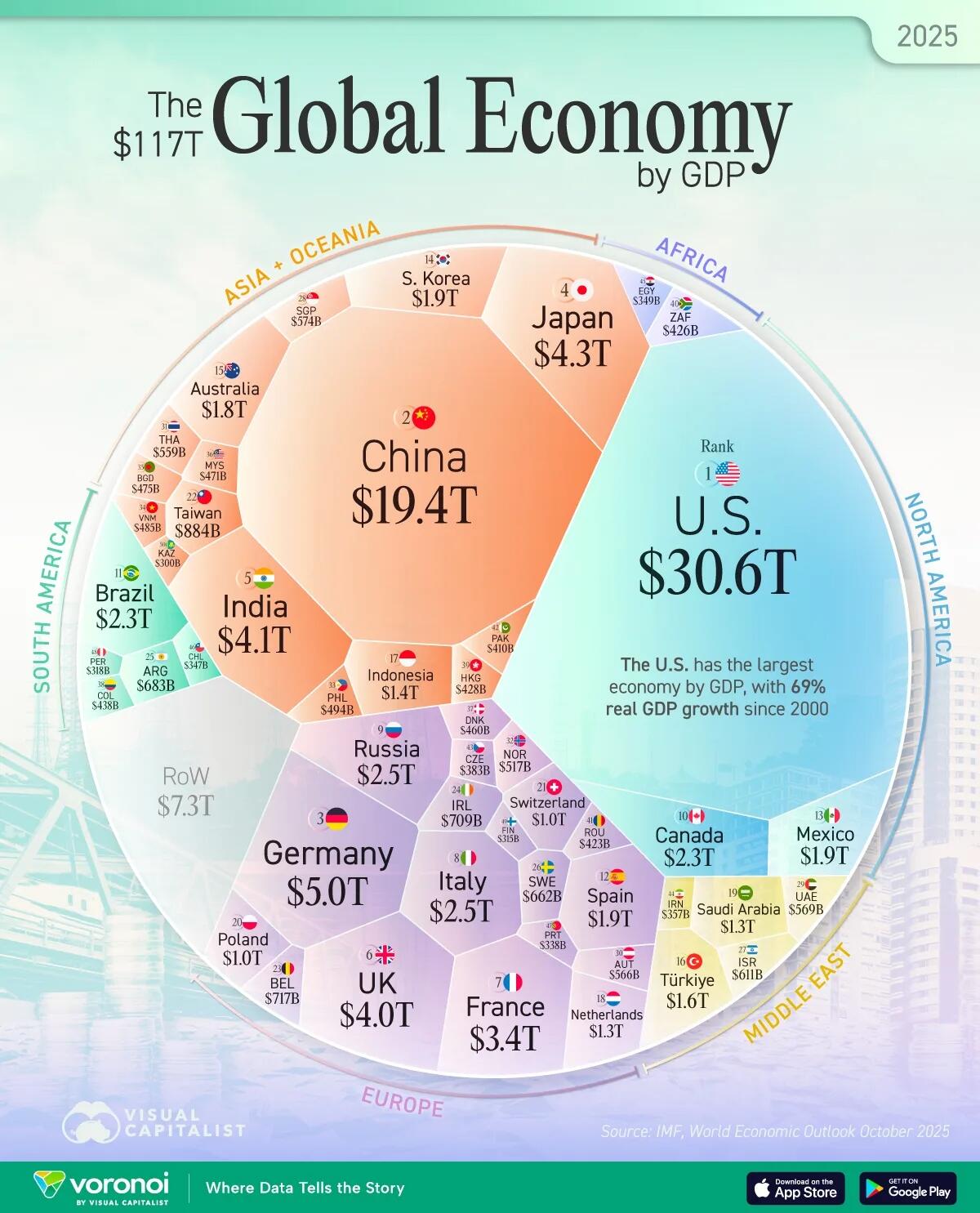
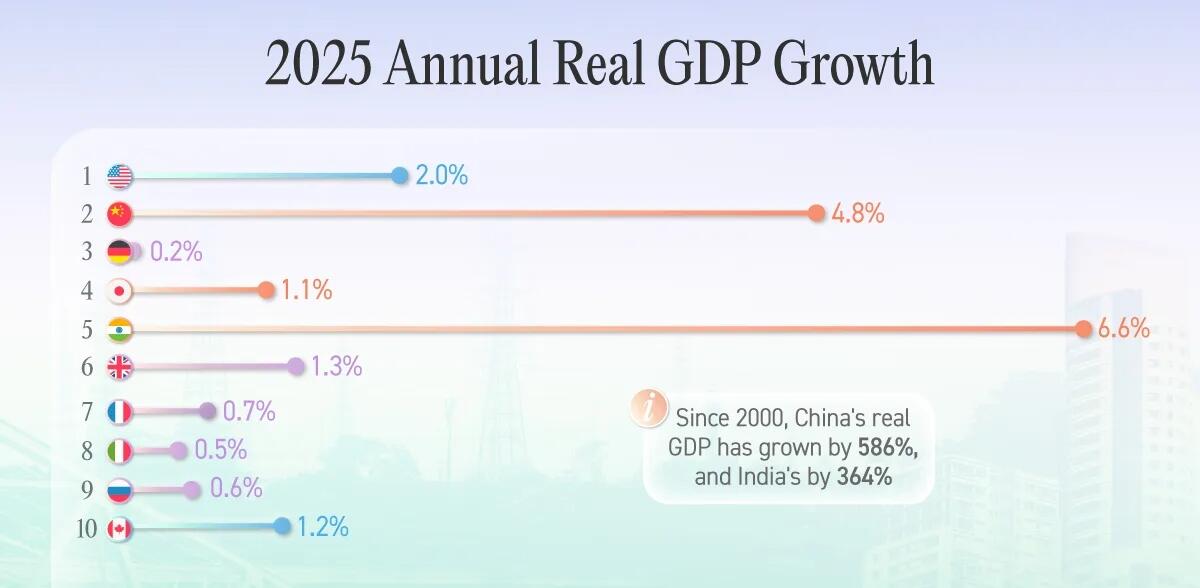
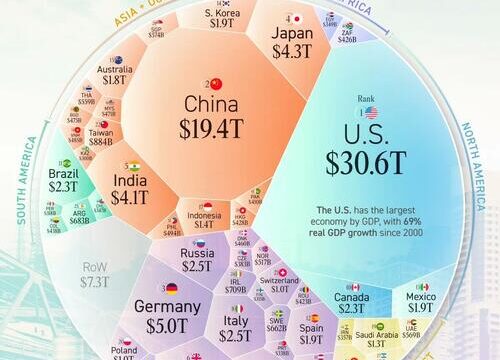
America’s $30.6 trillion economy is greater than China, Germany, and Japan combined, with real GDP set to rise 2% this year.
In comparison, India’s economy is projected to grow 6.6%, among the fastest rates across the world’s largest economies.
It is only surpassed by Ireland, as frontloading of exports is expected to expand GDP by a striking 9.1% in 2025.
This graphic, via Visual Capitalist’s Dorothy Neufeld, shows the state of the world economy in 2025, based on projections from the IMF’s latest World Economic Outlook.
Ranked: The Biggest Countries in the World Economy
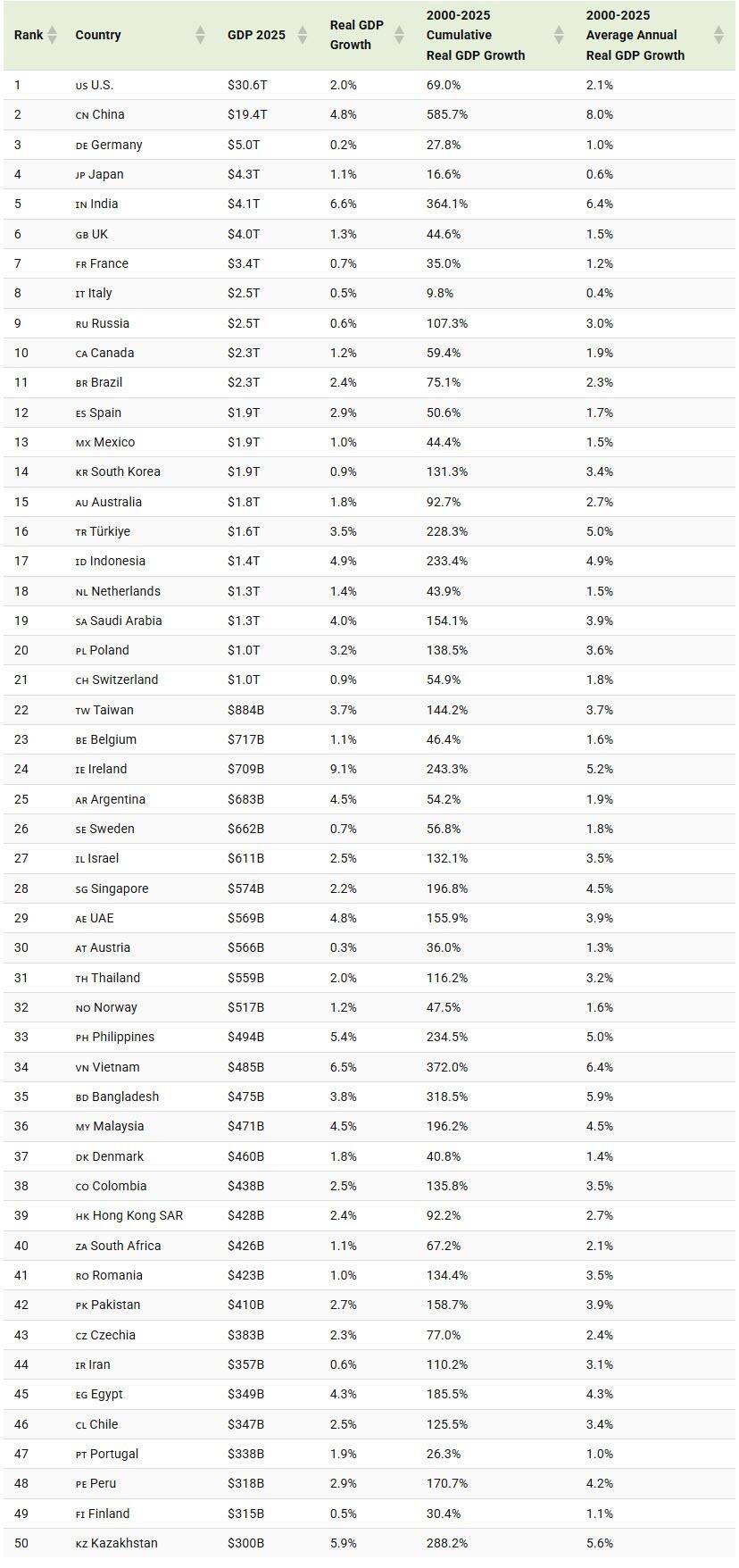
Below, we rank the 50 largest economies globally, highlighting their historical growth trends:
As we can see, the U.S. economy has grown nearly 70% in the past quarter-century, in inflation-adjusted terms. On an annual basis, the average growth rate was 2.1%, the third-fastest across the 10 largest economies today.
For perspective, India has grown at more than triple this rate over the last 25 years, helping grow its GDP to $4.1 trillion. By next year, it is forecast to surpass Japan as the fourth-biggest economy.
Germany, on the other hand, has seen notably sluggish growth for decades. In both 2023 and 2024, the economy contracted, while growth is expected to be just 0.2% this year. Along with weak productivity growth, its manufacturing sector has been in decline since 2018.
Similarly many European countries have averaged less than 2% growth over the last 25 years. Italy, the eighth-biggest economy, has averaged just 0.4% GDP growth, while in France, it has been just 1.2%.
To learn more about this topic, check out this graphic on the U.S. states with the fastest GDP growth since 1998.
Tyler Durden
Mon, 12/22/2025 – 02:45
https://www.zerohedge.com/economics/117-trillion-world-economy-one-giant-visualization