
Category: News
How this Florida barrier island community pushed back against overdevelopment
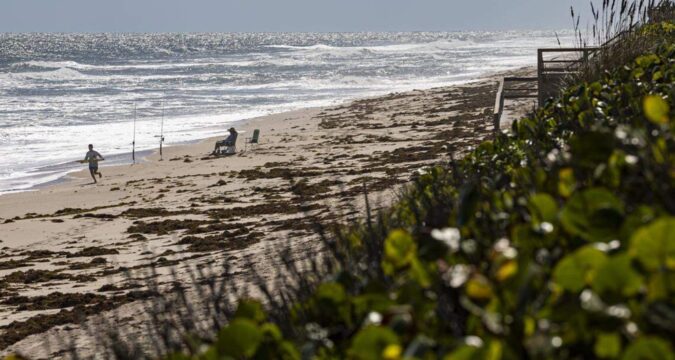
Picture this: A sandy, 25-mile stretch of beach, just a three-hour drive from Miami but devoid of grocery stores or gas stations, restaurants, bars or hotels. Instead, sea turtles nest on the beach, their hatchlings’ sense of orientation protected by dark-sky rules and by long-term residents who know to handle them with care on their extensive strolls along a quiet, windswept beach.
Welcome to Brevard County’s southern barrier island, one of the least developed areas on Florida’s Atlantic coast.
It’s a quaint, still pristine paradise to the few thousand people who settled in mostly bungalow-style homes, many of them escapees from Miami Beach, Fort Lauderdaleand other places they say were over-developed.
And it all seemed at risk just a few years ago.
In October 2022, Brevard’s commissioners voted to upzone a rural lot to four homes per acre. On paper, it seemed a benign decision, but residents who attended reacted with cries of “Oh my God” that rippled through the room. To them, it was as if the commission had just handed down a death sentence to their rural community.
In a state where developers usually hold the upper hand, they feared what would follow: Soon, their low-slung, single-story homes would be overshadowed by condos and mega-hotels, their windswept beaches packed with tourists, the dark sky fractured by lights that would disorient nesting sea turtles.
But something extraordinary happened instead. That meeting became a turning point.
If residents rolled over on the county’s decision, “we’d be like Miami Beach,” said Mark Shantzis, a longtime resident and a Miami transplant. “Or we could fight back.”
Eventually, a little grassroots group called BIPPA, the Barrier Islands Preservation and Protection Association, would secure one of the strongest protections placed on a Florida barrier island in four decades, ensuring that, unlike elsewhere across the state, construction and population growth is limited in an area increasingly at risk from worsening storms, erosion and rising seas.
“It was up to us to make sure nothing gets passed that destroys our barrier island,” said Beth Glover, a licensed real estate agent and current president of BIPPA — though at the beginning nobody had a clue just how successful they’d be.
Their victory, they say, is a roadmap to creating a bipartisan grassroots movement: Only by banding together venture capitalists and tech entrepreneurs, scientists and surfers, grandmothers and families with special-needs children — people from different backgrounds and politics — were they able to succeed.
Barrier islands across Florida have seen a population boom in the last few decades. Some 765,000 people now live on barrier islands – shifting banks of sand that are among the state’s most fragile, ephemeral ecosystems.
And Brevard’s barrier islands are currently being developed faster than anywhere else in the state — increasing the population and property value.
In an analysis of development and population growth of Florida’s barrier islands, the Miami Herald found that Miami-Dade and Brevard counties have the largest populations, with each now around 125,000. The key difference: On Miami-Dade’s barrier islands, the number of residents has gone down since 2017, while Brevard’s continues to rise.
Near Cocoa Beach, just to the north in the central part of the county, hotels with hundreds of rooms and luxurious vacation rentals are already crowding the oceanfront – the type of development residents in the south end saw creeping into their area, too. The latest, Harbor Island Beach, a cookie-cutter development of vacation rentals, was described by many as “miserable” and an “eyesore” – and a herald of what might be to come, said Glover.
Shortly after the October 2022 commission meeting, a core team of BIPPA gathered in their single-room, blue-painted headquarters, just a few feet from the shifting, untamed dunes, to figure out their next move.
To stop developers, they’d need an ally more powerful than their commissioners, and the January 2023 meeting with the area’s state legislative delegation, they figured, could present one.
Thankfully, Glover said, BIPPA had built a network of supporters who could mobilize “at the snap of our fingers.” Hundreds of them packed the room when they laid out why even a small upzoning change was a risk they couldn’t take.
Hurricane evacuation risk quickly became one of the strongest arguments. With only two bridges that were 25 miles apart, more residents meant slower escapes during storms. Already, the two-lane A1A was strained. The Indian River Lagoon, wedged between the urban mainland and the island, could not absorb more pollution, and new septic systems could jeopardize hundreds of millions in taxpayer-funded cleanup efforts.
Then there were the sea turtles — which became the heart of the fight. The island is one of the world’s prime loggerhead nesting sites and home to a growing population of greens. Tens of thousands of hatchlings emerge each year, guided by the moon toward the sea, returning decades later to lay their own nests.
Stacy Gallagher, development and policy coordinator for the Sea Turtle Conservancy, had traveled from Gainesville to make that case, and remembers feeling heartened when boisterous applause punctuated each of her points.
“It was overwhelming,” she said of the community’s support to limit development.
The entire delegation was won over. What to do about the looming development, however, was less obvious.
‘We need development that works with the environment’
Eventually, the idea of creating an Area of Critical State Concern was floated, a designation reserved for stretches of land so significant to the state that they must be protected “from uncontrolled development that would cause substantial deterioration,” according to Florida Commerce, which reviews all development projects in such areas.
Future plans to develop the barrier island would have to account for its ecological, social and safety impact, but getting the designation felt like a long shot. So far, only four such areas exist across the state – in the Florida Keys, Big Cypress, the Green Swamp and Apalachicola Bay – and the last one was granted some forty years ago.
One of the most familiar with the process was then-congressman Thad Altman, a Republican who grew up in the area and entered politics in the 1980s, motivated to protect what he considers God’s creation.
Altman remembers that era as the heyday of Republican environmentalism. Policies like the Coastal Barrier Resources Act, designed to steer investment away from vulnerable barrier islands, were starting to have an effect. On Brevard’s barrier islands, major landowners — including Disney — recognized that large-scale infrastructure expansion was unlikely and sold their plots to the state. What remained was mostly family-owned and zoned rural-residential, with no more than one dwelling per five acres.
“I thought we had a type of protection that couldn’t be undone,” Altman said. That assumption shattered in 2023 at a delegation meeting, when he realized that even the long-cherished, rural character of the southern barrier island was under threat. “It triggered me to think, ‘Oh my goodness.’”
The concept of an Area of Critical State Concern, however, immediately made sense to him. Once the bill was drafted, Altman sponsored it in the House, and his fellow Republican, Tom Wright, became its champion in the Senate.
Bipartisan support would be crucial. For that to hold, one argument had to take a backseat: Climate change. Though it was clearly reckless to build more homes and place more people on a narrow, shifting barrier island when sea levels are rising and storms intensifying, the topic has become too politically controversial to be invoked.
“Sometimes I feel like we’ve lost some environmental leverage because everything gets focused on global warming and sea-level rise, and the argument gets taken away from what we’re trying to protect immediately,” Altman said.
Instead, the Brevard barrier island case was simply framed as common sense. Adding more people would choke roads, slow evacuations and put the sea turtles at risk. It would also come as an additional cost to taxpayers, because seawalls might have to be built, and, as elsewhere, eroding beaches and dunes would need to be renourished with fresh sand worth millions of dollars.
Nobody is against development, Debby Mayfield, state senator for Brevard County, said, “but we need development that works with the environment.”
But Gallagher has seen similar common-sense efforts falter, simply because they lacked a strong advocate or got stuck in a subcommittee. “Very easily, this bill could have not gone anywhere,” she said.
That’s where the community came in. “We don’t care if you’re Republican or Independent or Democrat,” Glover said, describing one of BIPPA’s core beliefs. “We don’t talk about that. We work well together because we care about our home.”
By keeping personal politics aside and focusing on the arguments that would reach everyone, they had the numbers to keep up the ante. Their campaign for the Area of Critical State Concern was well-organized, with one person designing protest signs, another drafting email templates supporters could send to lawmakers, another hauling stacks of petitions to FedEx so hard copies landed on lawmakers’ desks. “For ten straight weeks of session, we were running a small business,” said Shantzis, who used to keep a marble bulldog labeled “tenacity” on his desk.
Any hint of political dissent in Tallahassee was met swiftly. Whenever Shantzis heard a real estate lobbyist might have sway in a committee, the group laser-focused their outreach.
Some lawmakers even called BIPPA directly to say they supported the bill, then asked if the group would please stop flooding their inbox, Shantzis said.
People in Tallahassee were taking note, Gallagher said. “At every committee meeting, members talked about the number of emails and calls they were getting,” she said.
For Gallagher, watching the bill advance was a rare and exhilarating example of a community mobilizing proactively – before damage was done – and so forcefully that SB1489 and HB1686 passed with flying colors. Not a single representative voted “nay.”
“I think the local community made it undeniable that they needed to move this forward, which is unheard of,” Gallagher said.
A new law – but not the end of the fight
On a rainy day in June 2023, less than four months after the bill was first introduced, Governor Ron DeSantis – the last of the elected officials who’d been flooded with BIPPA emails – signed it into law.
It’s a powerful tool, Senator Mayfield said, including for people like Kim Adkinson, the area’s newly elected county commissioner. Having grown up on the island, Adkinson recalls legions of blue crabs migrating from Indian River Lagoon to the Atlantic – with so many crossing she couldn’t avoid crushing some on her drive to school on the mainland. She hasn’t seen any in decades, and though she doubts they’ll come back, the turtles, dunes and community’s rural character can still be protected.
Now that the area was deemed worthy of protection not just by a small group of easily dismissed “tree hugger people,” but the state Legislature itself, Adkinson said, local politicians like herself could more easily fight over-development. The state mandate, she said “makes me more protective, and more willing to stick my neck out.”
That’s coming in particularly handy now. While the county has fully approved the plan, a new state law has unexpectedly stopped it from being implemented — for now. The law, SB 180, blocks governments across the state from adopting new, tougher development rules.
That means all the hard work pushing for fewer high rises is frozen in place in Brevard. But that could change, as the bill’s sponsor has admitted the bill needs fixes and dozens of local governments are suing the state over it.
What’s certain, Shantzis and others say, is that the community will keep pushing, and remain vigilant, to fully get the designation and all its protections implemented.
Ultimately, they hope to be a blueprint for other communities, he said. “If they don’t fight for their lifestyles in their different communities, they’ll go away, okay? Like it did in Miami,” he said.
This climate report is funded by Florida International University and the John S. and James L. Knight Foundation, in partnership with Journalism Funding Partners.
Traveling along Florida State Road A1A near Juan Ponce de León Landing Park in Brevard’s barrier island near Melbourne Beach. (Matias J. Ocner/Miami Herald)
https://www.chicagotribune.com/2025/12/25/florida-barrier-island-development/
Heidi Stevens: At the end of an imperfect year, a list that reminds us what tomorrow is for
At the start of 2025, Episcopal Bishop Mariann Edgar Budde led a prayer service at Washington’s National Cathedral. President Donald Trump had just taken the oath of office, and Budde had a plea.
“I ask you to have mercy, Mr. President, on those in our communities whose children fear that their parents will be taken away,” she said. “And that you help those who are fleeing war zones and persecution in their own lands to find compassion and welcome here. Our God teaches us that we are to be merciful to the stranger, for we were all once strangers in this land.”
The president, we now know, would not heed her call.
But as we look back on 2025, Budde’s plea was a light we can follow to better, brighter days. On my list of 25 things I’m carrying into 2026, her words sit at the top.
The other 24, in no particular order:
1. This Chicago Bears season. They beat the Green Bay Packers and clinched a playoff spot all in the same weekend, which is fun. But the unbridled, unabashed jubilation — The Wiener’s Circle deals! Shirtless Ben Johnson! DJ Moore’s cheese grater hat!— is everything.
2. Interviewing author Catherine Newman at a Glenview Public Library event and feeling the hum of love and curiosity and collective humanity that radiates from a room full of readers.
3. Watching Early Birds co-founder Susie Lee address a silent, rapt crowd gathered at the Park West for one of the dance parties she created. Lee was in a wheelchair and her voice was ravaged by cancer. She whispered into the microphone about the beauty of sisterhood and we heard her loud and clear. “Even in times of s— and despair,” she told us, “there’s always room for joy and connection.” That was her last Early Birds. She died on Aug. 3 at age 49.
4. My karaoke nights with girlfriends, in the spirit of making room for joy and connection, and in honor of our friend who narrowly survived a brain aneurysm.
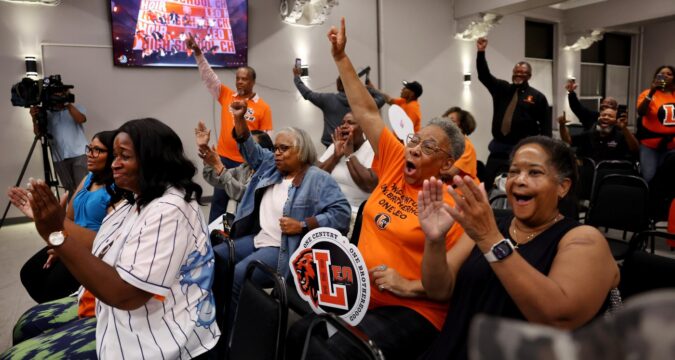
5. Watching the Leo High School choir represent Chicago so joyfully and purposefully on “America’s Got Talent” and beyond — including a visit from former President Barack Obama, who joined them in song. (Full disclosure: I joined Leo’s advisory council in January 2025.)
6. Speaking of singing: Working at a coffee shop on a stressful, deadline-packed day and hearing the baristas bust out in harmonized perfection to “Last Christmas” by Wham!
7. Speaking of coffee shops: Working at another one on another stressful, deadline-packed day and hearing a girl next to me tell her friend, “Oh my God, stop ruining your own day.” Truly epic life advice.
8. Seeing Coldplay with my kids a week after the CEO Jumbotron incident. Because what happens at a Coldplay concert is never supposed to stay at a Coldplay concert. The band’s shows are love and joy and looking out for each other and imagining a world where we remember that’s the whole point.
9. Seeing Luke Combs at Lollapalooza singing Tracy Chapman’s “Fast Car” and wearing a Ryne Sandberg jersey in honor of the beloved Cubs player who had died three days prior.
10.Cheering for my friends (and strangers) at the Chicago Marathon and being so inspired by the collective, collaborative energy that I went home and signed up to run in 2026. (With my daughter!)
11. Watching Sam, the man in charge of maintenance at my apartment building, pull a dog treat out of his shirt pocket every time I’m on an elevator with him and a dog. If we arrive at the dog’s floor too quickly, Sam holds the elevator button to keep the doors from opening until every last crumb is gobbled.
12. Your examples of small, kind things you’ve witnessed after I shared mine about Sam.
13. Demonstrators wearing inflatable costumes to protest the cruelty of the current administration. “Tactical frivolity,” it’s been dubbed.
14. Dan Savage on his podcast, reminding us: “Anyone who tells you that making time for joy is a distraction or a betrayal has no idea what they’re talking about. During the darkest days of the AIDS crisis, we buried our friends in the morning, we protested in the afternoon and we danced all night. And it was the dance that kept us in the fight because it was the dance we were fighting for.”
15. Every act of resistance that reminds us what we’re fighting for.
16. Every dollar donated to my virtual food drive for the Greater Chicagoland Food Depository. I hoped to raise $5,000 in a month. You got it to $10,000 within days.
17. Every person who stopped to ask what the heck I was doing when I swam in Lake Michigan every day of October. Strangers are rarely our enemies. They’re usually just people walking around looking for the same answers we are.
18. Every writer who signed up to send holiday cards to LGBTQ+ folks shunned by their families.
19. Operate Midway Bliss, a campaign launched by friends William McNiff and Taylor Krahl to give gifts and groceries for immigrant families in need.
20. Page 342 of Alison Espach’s “The Wedding People,” which made me gasp out loud like only a perfectly crafted sentence can.
21. Poet José Olivarez winning the Chicago Public Library Foundation’s 21st Century Award and delivering a live love letter to the Calumet City Public Library.
22. Poet Andrea Gibson’s Love Letter from the Afterlife: “Why did no one tell us that to die is to be reincarnated in those we love while they are still alive?”
23. Every sunrise, to remind me we get to keep starting over.
24. Every sunset, to remind me that the world isn’t perfect, but it’s also not done. There’s still more growing and healing and loving and protecting and hoping to do. And that’s what tomorrow is for.
Join the Heidi Stevens Balancing Act Facebook group, where she continues the conversation around her columns and hosts occasional live chats.
Twitter @heidistevens13
https://www.chicagotribune.com/2025/12/25/heidi-stevens-25-things-from-2025/
The Great 2025 Chicago Tribune holiday news quiz
The biggest and maybe the hardest news quiz of the year is here for your seasonal pleasure!
The news never stopped this year. But how closely were you paying attention?
Test your knowledge with our annual quiz and feel free to ask your loved ones for help. But no Google searches or AI prompts allowed. Friends don’t let friends use ChatGPT.
You’ll find the answers after you submit your quiz and click “view score.” If you score highly, congratulations on being well-informed. If your results disappoint, subscribe to a Tribune newsletter to better keep up with what happens in 2026.
We had a lot of material to develop this annual quiz and had much fun doing so. 2025 ushered in both chaos and change: The United States got a new president, Catholic cardinals elected a Chicago-style pope, the state of Illinois had some unwelcome federal government visitors and also found time to bail out its transit agencies, plus two Chicago sports teams delivered exciting escapes.
Want more when you are done? Try out our other quizzes — Quotes of the Week or 2024’s news quiz.
https://www.chicagotribune.com/2025/12/25/tribune-news-quiz-2025/
Homewood bookstore Beyond the Book is a dream realized for Flossmoor resident
Tenia Davis has been an executive in human resources for years. Harpo Productions, Johnson Publishing Company, and the National Opinion Research Center at the University of Chicago are but a few of the places she’s worked.
The Flossmoor resident is a leadership development expert who’s authored books on the topic to help organizations’ success. With an MBA from Loyola University, a master’s and doctorate of philosophy in values-driven leadership from Benedictine University, Davis decided to segue away from the C-suite to retail with her own bookstore, Beyond the Book, A Literary Experience.
The business opened in downtown Homewood (18063 Dixie Highway) this October. Davis smiles when she shares that the new endeavor is an item she can now mark off her bucket list.
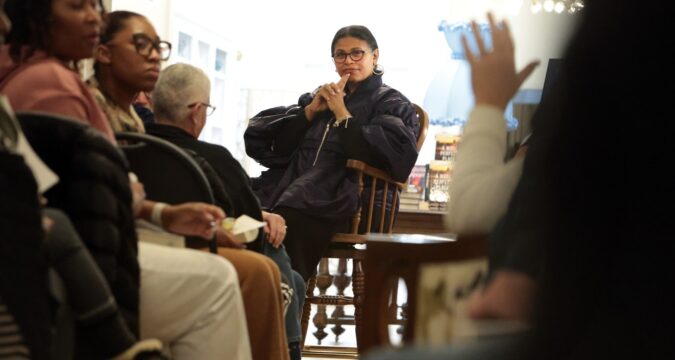
Liz Agbarah comments during the first book club meeting at Beyond the Book on Nov. 19, 2025, in Homewood. (James C. Svehla/for the Chicago Tribune)
“The landscape of corporate is changing,” she said. “I thought this would be the perfect time to leap out on faith and do something that I get excited about. I wanted to pursue my dream, and thought now was the perfect time to do that.”
Davis wants to cultivate community with Beyond the Book. As a writer herself, she plans to host writing workshops. She is looking forward to launching a summer boot camp for students in junior high to high school. She envisions her spot as a place where networking happens, podcasts are done (yes, there is a podcast studio onsite), and other literacy programs grow.
Initiatives that have already begun include a monthly book club (next meeting Jan. 21, 2026) and a chess club for kids. Davis is also working on a subscription service for the elderly (where books are shipped, if travel to the store proves difficult) and a poetry slam for February. She wants to collaborate with schools, libraries, businesses, nonprofits and neighboring bookstores to help with anything related to literacy and education.
People gather for the first book club held at Beyond the Book on Nov. 19, 2025, in Homewood. (James C. Svehla/for the Chicago Tribune)
“Having a voice in terms of writing, illustration and podcasting — that’s what I want to offer here,” Davis said. “I want to open the doors for everything voice. I want to cultivate the next generation of writers, do events and set a platform for up-and-coming authors. Additional offerings will evolve as we continue to grow with the community.”
The Homewood-Flossmoor location of Beyond the Book was intentional. Having raised her children in the south suburb, she has a connection to it. The area lost a bookstore when Bookie’s shuttered in 2022. Davis saw the community in need of a bookstore and she filled that void. She’s always seen herself as being of service, being impactful. She wants Beyond the Book to be “Cheers” for books — where everybody knows your name.
For somebody who likes curious writing styles, writing that takes one into the details, writing that takes one outside of your comfort zone, Davis is intrigued to see how the next generation of authors continues to evolve the writing landscape.
“This has been my dream,” Davis said. “I’ve helped businesses thrive. I wanted to launch one of my dreams-launch a business and make it thrive.”
https://www.chicagotribune.com/2025/12/25/homewood-bookstore-beyond-the-book/
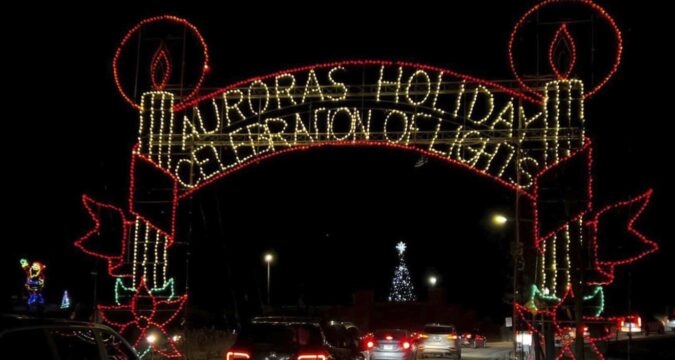
A holiday tradition in Aurora, Festival of Lights set to close for the season on Sunday
Underway since the day after Thanksgiving, the Festival of Lights at Phillips Park in Aurora is set to close for the season on Sunday, Dec. 28.
The free drive-thru show, which is open daily from 5 to 9 p.m., features dozens of light displays at the park at 1000 Ray Moses Drive.
This marks the fourth season the city of Aurora has taken on the event after it was organized for years by the Aurora Rotary Club.
Mike Nelson, director of special events for the city of Aurora, said traffic through the park has been steady during the festival.
“We’re on schedule to hit our goal which is 25,000 cars for the entire season,” he said.
Through Sunday, Dec. 21, Nelson said about 19,000 vehicles had come through the park.
“The goal is always 25,000 per season and we may even pass that,” he said. “We’ll know the final totals next week. The mild weather is absolutely drawing more people this year. This event and this display is always weather dependent and when you’ve got decent weather, traffic is always up. We’re experiencing that.”
Nelson said he has worked at the park collecting donations and has seen clear evidence of the regional draw of the display.
“There aren’t many drive-thru light displays anymore in the area and we get people from all over,” he said. “I volunteer several times a year to man the donation area and I’m always talking to people. As someone who has worked for the city for more than 10 years, I enjoy learning about people and where they are coming from. In my opinion many are coming from neighboring as well as towns that are farther away.”
Nelson said that nothing new was added this year at the festival but noted that “things are running well. It’s such a treasured tradition for so many Aurorans and so many people outside the city.”
“Our goal next year, however, is to really come out swinging with some new installations, some new music, but this year, we’re just keeping it classic,” he said. “It’s the ’90s nostalgia which is really coming back – ’90s nostalgia Christmas is now really trending in the United States and this is giving those vibes. I was a kid born in the early ’90s, so I’m kind of privy to that.”
Nelson reflected on displays that seem to slow traffic and highlighted the Weisner Ice Skating Rink display near the Phillips Park Visitors Center.
“That’s always a classic,” he said of the display. “People love that. It’s cute. It gives you the Charlie Brown aspect. It’s a fan favorite for sure. That and people love the snowflake forest that is hanging – like hundreds of snowflakes as you continue to drive on Ray Moses – people love that too.”
Donations collected as vehicles leave the park will be used by the city to maintain the current display collection as well as “add a few new items next year,” he said.
“We’re going to use a decent percentage of this year’s donations to one, maintain our current light displays, and two, make some room for some new light displays,” Nelson said. “Next year, our goal is to add several new installations including a new radio system.”
In previous years, a special radio frequency was assigned which allowed visitors to the park to tune in to a holiday soundtrack that was provided during the roughly one-mile ride through the installations.
Problems with the software which was tested before the Nov. 28 opening made that impossible this year, Nelson said.
“We had to make the decision to not move forward with it this year,” he said. “There’s quite a bit that goes into that, and we decided to let people listen to whatever Christmas music or holiday music they wanted during the experience.”
Nelson promised that next year “we’re going to have something really special – state-of-the-art music.”
Motorists are asked to enter the event on Smith Boulevard at Fifth Avenue, organizers said. For more information, go to www.aurora-il.org/FestivalofLights.
David Sharos is a freelance reporter for The Beacon-News.
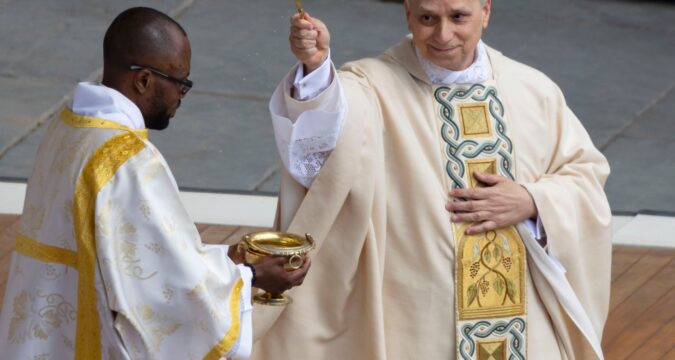
Pope Leo XIV’s historic rise forges special Vatican connections for Chicago
The experience was almost surreal.
A Chicago priest climbed aboard the iconic popemobile alongside the Holy Father, the two longtime friends traversing the cobblestone plaza of St. Peter’s Square at the Vatican as a crowd of tens of thousands cheered and waved.
During an October trip to Rome, the Rev. John Lydon of Hyde Park reunited with his former roommate, newly named Pope Leo XIV, a Chicago native whose historic election earlier this year marked the first American-born pontiff.
They shared a private talk in Leo’s apartment, reminiscing about their time together years ago as missionaries in Peru. The pope invited Lydon to join him for a ride in the famed popemobile, an electric Mercedes Benz custom-made for public appearances, after Mass on Sunday.
“It was very emotional,” Lydon recalled during a recent interview with the Tribune. “It was overwhelming, just to see the love the people have for the pope. Screaming his name. Screaming what town they were from and what country they were from and waving their flags and a million cellphones taking pictures.”
The Chicago area erupted in celebration May 8 at news that Robert Francis Prevost — born in Bronzeville and raised in south suburban Dolton — was chosen as the 267th pope and leader of an estimated 1.4 billion Catholics worldwide.
Chicago has reveled in the glory of a hometown pope who cast a divine light on the city, elevating its status on the international stage and reigniting the faith of many locals.
A clip of students at Our Lady of Mount Carmel Academy in Lakeview holding their own mock papal conclave went viral in May. Then the boys and girls, dressed as cardinals and a pope, traveled to Vatican City to meet the pontiff in person in October.
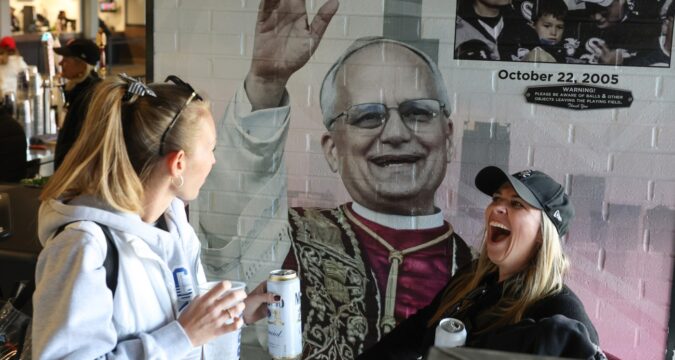
The Chicago White Sox unveiled an art installation at Rate Field near Section 140, Row 19, Seat 2, commemorating where the man who would become pope famously sat during Game 1 of the 2005 World Series, a tribute to the South Sider’s devotion as a fan.
Andrea Burns, left, and Martina Maggiore find the recently installed mural of Pope Leo XIV in Section 140 before a White Sox-Rangers game on May 23, 2025, at Rate Field in Chicago. (John J. Kim/Chicago Tribune)
Local restaurants crafted pontifical-themed menu items including a limited-time Portillo’s sandwich dubbed “The Leo,” described as “divinely seasoned Italian beef, baptized in gravy, and topped with your choice of sweet or hot peppers.”
“It made people who live in Chicago proud that we produced a pope,” recalled Cardinal Blase Cupich, who took part in the historic papal conclave that selected Prevost.
The archbishop of Chicago lamented that the reputation of the city is often equated with violence, largely by outsiders with a political agenda.
President Donald Trump, in particular, has frequently targeted Chicago, calling it a “death trap,” “war zone” and “killing field” since the start of his second term.
Yet the election of a new pope with local roots and tastes — an affinity for Aurelio’s Pizza and cheering on the White Sox, Bulls and Bears — has in many ways uplifted Chicago’s image on a global scale.
“This was a moment where we could really hold our head high,” Cupich said. “That somebody from our own neighborhoods was elected to be the successor of (St.) Peter. So I think it really was a shot in the arm to the city.”
Leo’s selection has also forged deeper ties between Chicago and Vatican City.
New York Archbishop-designate Ronald Hicks, left, walks with Cardinal Timothy Dolan to take part in a Mass for staff at St. Patrick’s Cathedral, in Manhattan, on Dec. 18, 2025. Hicks, 58, grew up in the same Chicago suburbs as Pope Leo XIV, and has led the Diocese of Joliet since 2020. (Adam Gray/The New York Times)
In his most significant U.S. appointment so far, the pope last week named Joliet Bishop Ronald Hicks, who grew up in South Holland some 14 blocks from Leo’s childhood home, as the next archbishop of New York. The two met for the first time in 2024, but they share the same childhood parish through a series of church consolidations by the Chicago Archdiocese in recent years.
“We would have played baseball in the same parks, swimming in the same public pools — and we even share a famous pizza place that’s our favorite,” Hicks said.
Numerous Chicagoans have made pilgrimages to meet the Holy Father in the past seven months, some bearing gifts of local sports memorabilia to honor their home-grown pope.
Chicago Bulls play-by-play radio announcer Chuck Swirsky traveled to Vatican City in November and presented the pontiff with an authentic Bulls jersey, inscribed with “Pope Leo” and the number 14 on the back.
“Other than the birth of my children, it was the most significant day of my life,” recalled Swirsky, a devout Catholic.
Pope Leo XIV receives a Chicago Bulls jersey bearing the number 14 from play-by-play radio announcer Chuck Swirsky at St. Peter’s Square at the Vatican on Nov. 5, 2025. (Filippo Monteforte/Getty-AFP)
The cardinal believes the pontiff’s upbringing in Chicago has helped frame both his spirituality and papal priorities, from navigating global strife and multiple wars overseas to championing care for the environment and the plight of migrants — particularly amid the Trump administration’s ongoing immigration crackdown, which has had a significant focus on Chicago.
The 70-year-old Augustinian priest and former missionary “has a universal outlook on life that in many ways is an appreciation that he gained from Chicago being an international city,” Cupich said, noting that churches across the Archdiocese of Chicago celebrate Mass in more than two dozen languages.
While the pontiff is an all-embracing leader representing the global church, Chicago’s imprint on Leo is undeniable, Lydon added.
“As everyone is, they’re marked by the culture they’re born in, the formation they received. Up to the sports teams he roots for and the foods he likes. All of that is part and parcel of where we’re born,” Lydon said. “People in Chicago can identify with him. They understand how he was raised. … It does mean something.”
The conclave
White smoke streamed from the chimney of the Sistine Chapel on May 8, a beacon to the world that a new pope was chosen.
The name sent waves of shock and joy that reverberated across Chicagoland: Cardinal Robert Francis Prevost, born at Mercy Hospital and already known to many locals as “Father Bob,” would lead the next stage of church history.
As newly elected Pope Leo XIV stepped out onto the loggia of St. Peter’s Basilica for the first time, the cardinal from Chicago looked on from an adjacent balcony and marveled at the magnitude of the moment.
Throngs of men, women and children filled St. Peter’s Square down to the Tiber River, awaiting the first glimpse of the new pontiff.
“There will never be another moment like it in my life,” Cupich recalled.
This was Cupich’s first papal conclave and he was struck by the cohesion of the decision.
White smoke rises from the chimney on the roof of the Sistine Chapel indicating that the College of Cardinals has elected a new pope during their fourth vote on the second day of the cardinals’ secret conclave on May 8, 2025, in Vatican City. White smoke was seen over the Vatican early this evening as the Conclave of Cardinals took just two days to elect Cardinal Robert Francis Prevost, who will be known as Pope Leo (Leone) XIV, as the 267th supreme pontiff after the death of Pope Francis on Easter Monday. (Christopher Furlong/Getty)
A Polish woman, center, who lives in the United States celebrates with her friends after the newly elected pontiff, Pope Leo XIV, spoke for the first time from the Vatican balcony on May 8, 2025, in Vatican City. (Mario Tama/Getty)
At a time of great conflict and discord worldwide, 133 cardinals from more than 70 different countries took part in the ancient ritual, coming to a vote in roughly 33 hours.
From Vatican City, Cupich’s thoughts drifted to folks back home in Chicago, who were watching and absorbing the reality that one of their own had been named pope.
“It was really quite remarkable, the euphoria that was celebrated in the city,” he said.
The Archbishop of Chicago anticipates Leo will continue to advocate for the most vulnerable in society — the poor and marginalized, as well as immigrants and refugees, which has been a cornerstone of his first seven months.
The pope is convening all the cardinals for a meeting at the Vatican in early January, where Cupich said he expects to learn more.
Cardinal Blase Cupich, third from left, arrives with the other cardinals as Pope Leo XIV is installed during Mass in St. Peter’s Square on May 18, 2025, at the Vatican. (Brian Cassella/Chicago Tribune)
For now, Cupich points to the pope’s first words of peace, dialogue and bridge-building.
“My hope would be that at Christmastime, people would promote peace in their own families and neighborhoods, in the state, the country and the world,” he added. “We surely need that message in this day and age.”
The inauguration
Leo’s friends and loved ones from the Chicago area flocked to the Vatican for his May 18 inauguration Mass, marking the official start of his pontificate.
Dignitaries and faith leaders traveled there from around the world. Worshippers stood shoulder to shoulder filling St. Peter’s Square, encircled by the piazza’s majestic 284-column elliptical colonnades, designed to represent the church embracing humanity.
The pope’s older brother, Louis Prevost, attended as a guest of Vice President JD Vance, a Catholic who led the American delegation to the celebration. After the ceremony, the pope broke protocol to greet his brother with a hug.
Louis Prevost, the eldest brother of Pope Leo XIV, stands with second lady Usha Vance and Vice President JD Vance during the installation Mass in St. Peter’s Square on May 18, 2025, at the Vatican. (Brian Cassella/Chicago Tribune)
Louis Prevost only wished their mother and father, both pious Catholics, had lived to see their son become the Holy Father, he told the Tribune during an interview a few days before his trip.
“There was always the belief, the support there from them,” he said.
During Leo’s homily, he lamented the increasingly divided nature of the world, while yearning for reconciliation.
Lydon was among the faithful who made the nearly 5,000-mile trip from Chicago.
Sitting with his fellow Augustinian friars, he grew emotional watching his old friend receive the sacred symbols of the papacy: the fisherman’s ring, representing the pope’s link to St. Peter, and the pallium, a white wool vestment worn on the shoulders, intended to evoke the image of a shepherd carrying the lost sheep.
“You never think someone you know is going to become pope,” Lydon said. “It’s just something that happens by the act of God.”
It wasn’t until the October visit to Rome that they met in person, inside Leo’s apartment.
The pontiff is staying in the same residence he lived in as cardinal during renovation of the papal apartments in the Apostolic Palace, following a hiatus of their use under Pope Francis, who eschewed the tradition and instead lived in the Casa Santa Marta guesthouse.
Lydon recalled Leo’s apartment was modest and simple, though well-secured by Swiss Guards who checked the priest’s identification and accompanied him up the elevator.
A portrait of Pope Leo XIII decorated an apartment wall, a tribute to one of the Holy Father’s namesakes who was known for diplomacy and supporting the rights of workers.
Leo XIV “has always lived rather simply,” recalled Lydon, who lived and worked with him when they were missionary priests in Peru in the 1990s, a period of poverty, human rights abuses and terrorism.
“I presume he will move into the more elaborate, more traditional apartments that the popes had always lived in,” he said. “They probably have paintings on the wall and frescos. None of that means anything, I think, to him other than that’s the historic place the popes lived at. And he’s very conscious of history and wants to respect the history.”
Before Lydon left, the pope signed a copy of a book the priest had written on Catholic social teaching, “Pope Leo XIV.”
Conflict, foreign wars
In the first few days of his papacy, Leo weighed in on international crises and wars, promoting the Holy See’s role in global peacemaking.
“Weapons can and must be silenced, for they do not resolve problems but only increase them,” he said a few days after being named pope.
During his first general audience in St. Peter’s Square in May, he urged humanitarian aid to be allowed into war-torn Gaza, amid reports of famine and starvation.
In Leo’s first Sunday address, he expressed sorrow for the people of beleaguered Ukraine fighting off the Russian invasion. He met with Ukrainian President Volodymyr Zelenskyy several times, including earlier this month.
Ukraine’s President Volodymyr Zelenskyy and Pope Leo XIV wave to journalists during their meeting in Castel Gandolfo, Italy, on Dec. 9, 2025. (Andrew Medichini/AP)
The pontiff recently criticized the Trump administration’s plan for peace in Ukraine, which includes huge territorial concessions for Russia, in part because it has sidelined and degraded Europe’s role.
This is one key area where Leo has deviated from the stance of his predecessor, said Anna Grzymala-Busse, professor in the department of political science at Stanford University.
“Pope Francis was under the impression that ‘peace’ involved Ukrainian concessions, and that Russia was not the main antagonist,” said Grzymala-Busse, an expert on religion and politics. “He came off as naive and uninformed, and did little to bolster the Vatican’s standing.”
Former Ukrainian first lady Kateryna Yushchenko, who was born and raised in Chicago, said Leo is appreciated in Ukraine for his “moral stance” on the war, noting he has “upheld international law and defended our country’s sovereignty — a clear contrast to those pressuring Ukraine to accept a revision of its borders.”
Finances, sex abuse crisis
Leo took the reins amid a particularly challenging time as the global Catholic church continues to grapple with its sexual abuse crisis.
The Vatican has also been plagued by persistent financial troubles, though it recently reported the first budget surplus in years, indicating a potential turnaround.
Survivors organizations have criticized the pope for his handling of two local sex abuse cases involving Augustinian priests in the Chicago area years ago. The group Survivors Network of Those Abused by Priests filed a complaint against Prevost with the Vatican last year, detailing his alleged mistakes in Chicago while he headed the Midwest Augustinian religious order and as well as later while serving as a bishop in Peru.
An official with the Midwest Augustinians previously told the Tribune that the order remains “steadfast in our commitment to the safety and well-being of the children and youth entrusted to our care,” adding that Prevost had established protocols for promoting child protection in 2001 with a record showing a “dedication to child safety.”
Earlier this month, the New Orleans Archdiocese agreed to pay at least $230 million to hundreds of victims of clergy sexual abuse under a settlement approved by a federal judge. The Archdiocese of New York also announced this month that it would establish a $300 million fund to compensate survivors of sexual abuse who have sued the church.
The Pontifical Commission for the Protection of Minors released a report in October urging financial reparations, greater accountability within the church and acknowledgement of harm as well as tougher sanctions for abusers and their enablers.
Later in October, Leo met at the Vatican with clergy abuse survivors and advocates, who pressed for a “zero-tolerance” policy on abuse in the Catholic church.
SNAP Executive Director Angela Walker, who was not part of the October meeting, said the Vatican must do more to end the scourge of clergy sex abuse.
“We want the perpetrators held to account and we want individual survivors to have and seek justice,” she said. “And we want this culture of silence that has gone on far too long within the church to be lifted.”
Chicago celebrates its pope
The image of Pope Leo XIV loomed large from the giant scoreboard in Rate Field, home of the pontiff’s beloved White Sox.
Below the screen, thousands of people in the stands eagerly awaited his message during a June 14 Mass and celebration honoring the Chicago native’s recent election and hosted by the Archdiocese of Chicago.
“Discover how important it is for each one of us to pay attention to the presence of God in our own hearts,” the pontiff said during a pre-recorded address from the Holy See. “To that longing for love in our lives. For searching, a true searching, for finding the ways that we may be able to do something with our own lives to serve others. And in that service to others, we may be able to find that in coming together in friendship, building up community, we too can find true meaning in our lives.”
Cupich believes the attendance at Mass that day was among the largest in archdiocesan history, though it was eclipsed by the famous 1979 outdoor Mass in Grant Park celebrated by Pope John Paul II, the only pontiff to ever visit Chicago.
“The only thing that’s going to surpass it is when and if (Pope Leo) comes to visit Chicago,” Cupich said, though he said he had no intel on when the Holy Father might make a trip back to his birthplace.
“He knows that he’d be most welcomed,” Cupich added.
The Rate Field celebration was emceed by Swirsky, the Bulls announcer, who called it an “unbelievable experience.”
At the time, Swirsky had no idea he’d be face-to-face with the pontiff just five months later.
Yet in November, on a whirlwind trip to Vatican City, he unexpectedly had the opportunity to give Leo the Bulls jersey in person.
“Our hands became intertwined and I kissed his ring,” said Swirsky, who serves as a Eucharistic minister and lector at Holy Name Cathedral. “For a kid growing up going to Catholic school and being taught by sisters and priests, it was just amazing. To be in the presence of the pope and what the pope in our faith signifies … it was an event that I will never ever forget.”
Swirsky recalled telling the Holy Father, “Chicago has embraced you.”
“We can’t wait for you to return,” he said to Leo. “We can’t wait for you to come to a Bulls game and a White Sox game.”
Environmental preservation
Surrounded by the lush Italian-style gardens and intricate topiaries of the vast papal summer estate, Leo held a July outdoor Mass “for the care of creation,” another key theme of his papacy.
For the service, he donned bright green and gold vestments specially designed by Chicago retailer House of Hansen Inc., a more than century-old clerical apparel business in the Irving Park neighborhood. The liturgical garments were hand-delivered to the pope by the Rev. Daniel Groody, vice president and associate provost for undergraduate education at the University of Notre Dame, who attended the Mass.
Taking in the stretches of farmland and ornate landscaping all around, the pope noted that they were worshipping in “a kind of ‘natural’ cathedral.”
Those grounds are the home of the Vatican’s vast ecological experiment called the Borgo Laudato Si’, located in the hilltop town of Castel Gandolfo, just southeast of Rome.
Pope Leo XIV leads the Mass for the Care of Creation, in Castel Gandolfo, Italy, July 9, 2025. (Yara Nardi/Reuters)
The roughly 135-acre project is designed to entwine two prime Vatican missions: environmental protection and care for often-vulnerable populations such as the poor, migrants and refugees.
Launched by Pope Francis, the site was intended to be a real-world manifestation of his landmark 2015 environmental encyclical “Laudato Si’.”
The seminal project is led by the Rev. Manuel Dorantes, a priest from the Chicago archdiocese who was born in Mexico and moved to north suburban Waukegan as a child.
“The job itself, taking the lead of this entire property and turning it into an example for the world on environmental sustainability and human dignity, the vision was grand,” Dorantes recalled in May, when he took the Tribune on a tour of the papal summer estate.
Leo formally inaugurated the Borgo Laudato Si’ during a September ceremony.
With Dorantes by his side, the pope toured the grounds and celebrated a liturgy there, reaffirming his commitment to environmental protection and the legacy of his predecessor.
The Rev. Manuel Dorantes walks the grounds of Borgo Laudato Si’ on May 20, 2025, outside Rome. Dorantes moved from serving in Chicago to Italy after being appointed by Pope Francis as the administrative management director of the Laudato Si’ Center for Higher Education in 2024. The 165-acre property next to the pope’s summer home, Castel Gandolfo, includes historic gardens, monuments and new areas for organic farming and education. (Brian Cassella/Chicago Tribune)
Next year, Chicago restaurateurs Phil Stefani and Art Smith, former private chef to talk show host Oprah Winfrey, are slated to launch the site’s first restaurant, incorporating the principles of Laudato Si’ into their business model.
Vocational training in hospitality and culinary work will be provided to local folks in need, who will later be able to work at the restaurant to gain job experience. Some of the food will derive from papal estate farmland; some will be brought in from local farms that follow sustainability practices.
Groody of Notre Dame said his university intends to host a pilot class in integral biology at the Borgo Laudato Si’ in March, another local connection to the Vatican project.
Meredith O’Connor traveled from Chicago to attend the Borgo Laudato Si’ inauguration, presenting Leo with an authentic Bears jersey with the number 14.
For loved ones and relatives back home, she brought pieces of jewelry and religious items that were blessed by Leo, including a cross and rosary for a terminally ill friend of the family who was like a second father to her.
O’Connor gave him the cross and rosary during a hospital visit, shortly before he passed away.
Rising above crosstown rivalries, the pontiff even blessed O’Connor’s Cubs hat.
Although Leo is a die-hard White Sox fan, he told her his mother rooted for the Cubs — and she used to say that if the kids didn’t cheer on her team that day, they wouldn’t get supper, O’Connor recalled, laughing.
“It was a spiritual experience,” said O’Connor, vice chairman at real estate services firm JLL. “It was like an out-of-body experience, meeting a person I never thought I’d get to meet. And he was so genuine and so kind and so authentic.”
Immigration
As the Trump administration’s immigration enforcement escalated across the Chicago area, Leo has offered a counter-message, condemning the “inhumane” treatment of immigrants in the United States and suggesting countries be more welcoming to people born outside their borders.
During an October meeting with Chicago labor union leaders in Vatican City, the pontiff encouraged them to advocate for immigrants.
“He specifically thanked us and asked us to continue the work we do for immigrants and providing support services for them, everything from food bank work and other activism that labor engages in to protect immigrant communities,” recalled Bob Reiter, president of the Chicago Federation of Labor.
Reiter said he had the honor of meeting Pope Francis years ago.
As incredible as that was, being in the presence of Pope Leo transcended the experience, he recalled.
“I was standing there meeting with the leader of the Catholic church, who is also a south suburbanite like I am,” he said. “Having all those related experiences — a kid from Lockport and a kid from Dolton are in the papal palace, talking about how we need to protect immigrants.”
The encounter was so powerful in part because it took place as Chicago was “under assault by President Trump” and the Department of Homeland Security, added Reiter, a board member of the Illinois Coalition for Immigrant and Refugee Rights.
Immigration raids and increasingly aggressive arrests have sparked terror across Chicagoland amid the ongoing ramped-up enforcement termed Operation Midway Blitz.
Leo decried the mistreatment of immigrants in the United States later in October.
“With the abuse of vulnerable migrants, we are not witnessing the legitimate exercise of national sovereignty, but rather serious crimes committed or tolerated by the state,” he said, according to the Holy See.
The pope is teaching that “every human being is a child of God and bears the image of God,” said Miguel Diaz of Loyola University Chicago, a former U.S. ambassador to the Holy See who met with Pope Leo at the Vatican in September.
“There is to be no discrimination on the basis of documentation,” Diaz added. “And that to me also summarizes part of what his papacy has already signaled and will continue to signal.”
Catholics and supporters pray at the end of the Coalition for Spiritual and Public Leadership’s Eucharistic procession outside the Immigration and Customs Enforcement facility in Broadview on Oct. 11, 2025. (Dominic Di Palermo/Chicago Tribune)
Local clergy and religious sisters have repeatedly attempted to bring Holy Communion to the Immigration Customs and Enforcement detention facility in west suburban Broadview, only to be rebuffed each time by Homeland Security officials, citing protocol and safety concerns.
The pope rebuked this denial of the Eucharist in November, stressing that those in detention still have “spiritual rights.”
Leo’s local ties, as the grandson of immigrants, give him a keen understanding of the plight of migrants in Chicago, which he’s able to relay to the world, Reiter said.
“Pope Leo embraces the fact that he’s from Chicago in a very intentional way. While he’s the pope, I think it also gives him a relatability factor that people appreciate,” Reiter added. “It has given him a platform to speak specifically on the migrant crisis we have, the attack on migrants … and his ability to step in.”
The Associated Press contributed.
https://www.chicagotribune.com/2025/12/25/pope-leo-connection-chicago-vatican/
Today in Chicago History: Stockyards open and receive first shipment of cattle
Here’s a look back at what happened in the Chicago area on Dec. 25, according to the Tribune’s archives.
Is an important event missing from this date? Email us.
Chicago’s Christmas weather: The warmest and coldest since 1872
Weather records (from the National Weather Service, Chicago)
High temperature: 64 degrees (1982)
Low temperature: Minus 17 degrees (1983)
Precipitation: 0.5 inches (1950)
Snowfall: 5.1 inches (1950)
William Thomas Cosgrave, the first president of the Irish Free State, left, and the Rev. Father William J. McNamee, of Old St. Patrick’s Church at DesPlaines and Adams Streets, shake hands during Cosgrave’s visit to Chicago on Jan. 22, 1928. Old St. Pat’s was the cornerstone of Irish culture in Chicago and was undergoing a beautifying project at the time, directed by McNamee, to add Celtic art to the historic church. Old St. Pat’s is the oldest standing church in Chicago. (Chicago Tribune historical photo)
1856: Old St. Patrick’s Church at 123 S. Desplaines St. in Chicago — the oldest public building in the city — was dedicated.
Chicago’s Union Stock Yards, long a familiar sight and smell to residents, is shown in 1956. (AP)
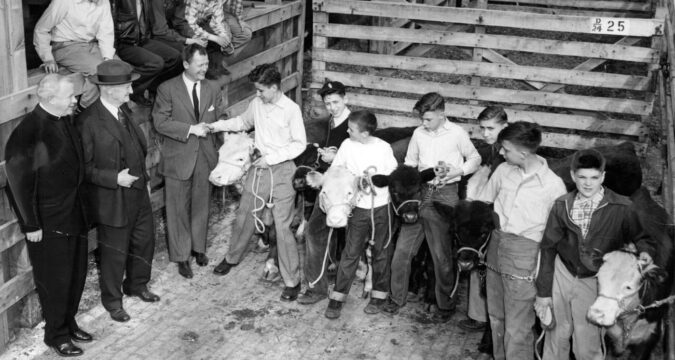
1865: Chicago’s Union Stock Yards received its first shipment of animals, and officially opened.
The yards, which covered a half square mile west of Halsted Street between Pershing Road and 47th Street, were soon filled “with so many cattle as no-one had ever dreamed existed in the world,” noted one writer. “Red, black, white and yellow cattle. Great bellowing bulls and little calves not an hour born. Meek-eyed milch cows and fierce, long-horned Texas steers.”
The Drovers’ National Bank building, one of the tallest structures in the stockyards area and housing one of its most important financial institutions, was left in ruins by the fire in May 1934. It stood at 4201 S. Halsted St. The structures in the foreground contained living quarters for stockyard workers. (Chicago Tribune historical photo)
A massive fire, which took out nearly 90% of the stockyards, erupted at the site in 1934. Fifty firefighters were injured in the blaze and hundreds of cattle were killed.
But the stockyards had moments of glory, too. Research laboratories funded by the packers turned animal byproducts into everything from medicine to cosmetics. From 1900, there was a yearly International Livestock Exposition as well as a 4-H Club show. In 1952, the Republicans and Democrats held their presidential nominating conventions at the International Amphitheatre, an exposition center located in the stockyards complex.
Vintage Chicago Tribune: The International Livestock Exposition
Called “Union” for the seven separate stockyards that contributed to build it, the stockyards opened on more than 300 acres of swamp land purchased from two-time Chicago Mayor “Long” John Wentworth. More than 18.6 million head of cattle, hogs and sheep were marketed at its peak in 1924.
The gate to the former Union Stock Yards, 850 W. Exchange Ave., in Chicago on April 27, 2016. (E. Jason Wambsgans/Chicago Tribune)
The Union Stock Yards closed on the city’s South Side in 1971.
All that remains of the stockyards is its gate, which includes a sculpted version of a prize-winning steer.
Bears running back Thomas Jones celebrates his first-half touchdown during a 24-17 victory over the Packers on Christmas Day in 2005 at Lambeau Field in Green Bay. (Jim Prisching/Chicago Tribune)
2005: The Chicago Bears’ 24-17 victory over the Green Bay Packers clinched the team’s first division title since 2001, guaranteeing a first-round bye and a home playoff game. The win also secured a season sweep of the Packers for the first time in 14 years and ended Green Bay’s three-year stranglehold on the division title.
Making his first start since Sept. 26, 2004, Bears quarterback Rex Grossman finished 11-for-23 for 166 yards and one touchdown with one interception.
Want more vintage Chicago?
Subscribe to the free Vintage Chicago Tribune newsletter, join our Chicagoland history Facebook group, stay current with Today in Chicago History and follow us on Instagram for more from Chicago’s past.
Have an idea for Vintage Chicago Tribune? Share it with Kori Rumore and Marianne Mather at krumore@chicagotribune.com and mmather@chicagotribune.com
https://www.chicagotribune.com/2025/12/25/chicago-history-december-25/

Today in History: President Andrew Johnson pardons ex-Confederates
Today is Thursday, Dec. 25, the 359th day of 2025. There are six days left in the year. This is Christmas Day.
Today in history:
On Dec. 25, 1868, President Andrew Johnson granted unconditional pardons to “every person who directly or indirectly” supported the Confederacy in the Civil War.
Also on this date:
In 1066, William the Conqueror was crowned King of England.
In 1818, “Silent Night (Stille Nacht)” was publicly performed for the first time during the Christmas Midnight Mass at the Church of St. Nikolaus in Oberndorf, Austria.
In 1776, Gen. George Washington and his troops crossed the Delaware River for a surprise attack against Hessian forces at Trenton, New Jersey, during the American Revolutionary War.
In 1926, Hirohito became emperor of Japan, succeeding his father, Emperor Yoshihito.
In 1989, ousted Romanian President Nicolae Ceausescu and his wife Elena were executed following a populist uprising.
In 2009, passengers aboard Northwest Airlines Flight 253 foiled an attempt to blow up the plane as it was landing in Detroit by seizing Umar Farouk Abdulmutallab, who tried to set off explosives in his underwear. (Abdulmutallab later pleaded guilty and was sentenced to life in prison.)
Related Articles
Vintage Chicago Tribune: Bears playoff appearances — including the ‘Sneakers Game,’ the ‘Fog Bowl’ and ‘Double Doink’
Today in History: Library of Congress devastated by fire
Today in Chicago History: Kicker Kevin Butler becomes the first Bear to score 1,000 points
Today in Chicago History: Bulls coach Phil Jackson gets his 500th career win faster than any coach in NBA history
Today in History: The Immaculate Reception
In 2021, NASA’s James Webb Space Telescope, the world’s largest and most powerful space telescope, was rocketed aloft from French Guiana in South America on a quest to see light from the first stars and galaxies and search the universe for signs of life.
Today’s Birthdays: Football Hall of Famer Larry Csonka is 79. Country singer Barbara Mandrell is 77. Actor Sissy Spacek is 76. Former White House adviser Karl Rove is 75. Actor CCH Pounder is 73. Singer Annie Lennox is 71. Country singer Steve Wariner is 71. Model and businesswoman Helena Christensen is 57. Former Canadian Prime Minister Justin Trudeau is 54. Actor Jeremy Strong is 47.
Asking Eric: I don’t want this to destroy my marriage
Dear Eric: In 2020, my now-wife and I were engaged. My mother is a nurse and has asthma and was deeply hit with mental and emotional stress from the pandemic. She would not attend most wedding planning events and would always be concerned with germs, wearing an N95 mask and keeping her distance.
My wife had a completely opposite reaction to the pandemic. It was more of a nuisance to her. In her eyes, there was no threat. My wife began to develop a feeling of abandonment from someone who was supposed to be her mother-in-law. She opened up to me about how much she was hurt, and I told her it wasn’t my mother’s fault and that she was just petrified by the pandemic and it was the only thing she could do.
My wife told me I was taking my mother’s side. Hurtful messages were sent by my wife and my mother just shut down the relationship and blocked her.
My wedding was in October 2021. My mother braved the crowd of 155 people and attended without a mask. I was so proud of her. But my wife was angry about her presence.
My wife and I are still fighting occasionally about this issue, and the spats are becoming increasingly more intense. She still says extremely hurtful things about my mother often.
My mother’s mindset was extreme but considering her working at a nursing home and having asthma, it’s totally understandable. That isn’t believable, according to my wife.
I am writing for guidance to understand how to solve this mess. Was I in the wrong for how I initially reacted toward my wife? I just don’t want this to destroy my marriage.
– Hurting Husband and Son
Dear Son: I’m rarely this blunt, but your wife is being unreasonable, and she needs to get over it. Setting aside any debate about public health policies during the first year of the pandemic, it’s unfair that your wife is holding a grudge against your mother for socially distancing during a time of mandated social distancing. Why is she taking the pandemic personally? Why couldn’t she form a relationship with your mother that considered your mother’s feelings?
How do you solve this? Suggest couple’s counseling to parse the issues between the two of you. A therapist can help you find new tools for communicating with each other.
At a certain point, it might be helpful to invite your mother to a session and try to restart that relationship. There’s something that your wife wanted and didn’t get from her. It’s understandable that she felt hurt, but she needs better, healthier strategies for addressing that hurt.
Dear Eric: A few years ago, I became very ill and had to be put into an induced coma. After I woke up, I spent two horrible months in a nursing home.
After I got home, my husband was invaluable. He was doing the day-to-day business of changing my colonoscopy bag and feeding me. I ate a lot of burnt waffles and toast, but he was there 24/7 for probably three months. Times were difficult and we were not happy with each other, to say the least. Don’t get me wrong. If he hadn’t helped me, I don’t think I would be here.
But now, it’s years later and I feel like his personal slave. I don’t drive anymore and haven’t since I got sick. He goes to the store every day for food. But now that I’m in the house all the time, I’m cooking every day. I used to enjoy cooking but now I feel like a slave. I do the laundry every day because he works out and plays pickleball. I know it’s my fault but mentally I can’t seem to find my way out. Any ideas?
– Trapped at Home
Dear Home: It’s not your fault. You and your husband have gotten into a pattern that doesn’t work for you. Maybe it’s because of the illness, maybe it’s because of underlying issues in your marriage, maybe it’s something else entirely. But blaming yourself isn’t fair and won’t get you the solution you seek.
In any relationship, marriages especially, it’s helpful to have a “state-of-the-relationship” conversation. This allows you both to check in about what’s working, what isn’t, and move toward the same goals in the future.
Related Articles
Ask Anna: The gift of coercion this holiday season
Ex-etiquette: Ex is bringing new girlfriend to New Year’s Eve party
Terry Savage: ‘Chicken money’ holders are going to be tested
The Kid Whisperer: How to reinforce positive behaviors with kids
Answer Angel: ManningCast fan?
So, talk to your husband about the way you’re feeling. Ask “how can we solve this together?” If he’s not receptive, ask for the support of a friend or a therapist to make the conversation productive. One solution may be sharing more of the household responsibilities. This is fair. You don’t owe a debt of servitude that you have to work off. Relationships don’t always feel 50/50 in terms of labor, but it’s important to point out when the imbalance feels too great.
(Send questions to R. Eric Thomas at eric@askingeric.com or P.O. Box 22474, Philadelphia, PA 19110. Follow him on Instagram and sign up for his weekly newsletter at rericthomas.com.)
https://www.chicagotribune.com/2025/12/25/asking-eric-i-dont-want-this-to-destroy-my-marriage/

New Elgin budget includes 13.2% property tax hike, fee increases
Elgin residents can expect to pay more in property taxes, water and sewer rates, and garbage fees in 2026 under the new budget approved by the Elgin City Council.
The property tax rate is going up by 13.2% — the first increase property tax hike in 11 years, officials said.
For the owner of a home or property assessed at $300,000, the city’s portion of the tax bill will go up $180.83 per year, or $15.07 per month, according to city calculations. Someone with a property valued at $400,000 will be paying an additional $246.35.
Elgin officials credited the city’s ability to maintain a flat tax rate for the decade to the concerted efforts made to diversify revenue streams. However, “inflationary pressures” made it impossible to continue without more money, City Manager Rick Kozal said during meetings at which the 2026 budget was reviewed.
One area that has increased is public safety pension obligations due to more police officers retiring, officials said.
Because of the tax increase, the city will collect about $4.2 million more from taxpayers to go toward the $407.6 million budget’s general operations. It will also help cover higher costs for capital projects, new employees, and police and fire pensions.
Among the fee hike for next year is a 9% increase in water rates as part of a long-term plan to fund water/sewer improvements and a 4% increase in sewer rates.
Garbage fees are escalating from $24.95 to $25.95 under Elgin’s contract with Lakeshore Recycling Systems. The fee, included in residents’ monthly water bills, is for regular trash, recycling and yard waste/organics collection. Garbage stickers for excess items are increasing from $4 to $4.16.
Lifelong resident David Teas credited the council at its last meeting for doing a good job of not raising property taxes for more than a decade. However, he said, a hike this year coupled with higher taxes being charged by school districts and other branches of government is making it tough on residents.
“Every year we are getting hit by taxes. It’s starting to hurt us,” said Teas, who volunteers with the Elgin Township Senior Citizens’ Services Committee. Seniors are very concerned, he said.
“We’re struggling. We’ve got to come up with other solutions,” Teas said.
The council explored the possibility of increasing other revenues, including the sales and gas taxes, but determined such a move would have a negative impact on Elgin’s economy given that people are able to go to neighboring communities to make purchases.
The 2026 budget was approved 8-1 at the Dec. 17 council meeting, with Councilwoman Diana Alfaro voting no. She also voted no on the property tax increase.
“I’ll be voting against this to be transparent with the community,” Alfaro said.
Elgin’s budget can be viewed on the city’s website, elginil.gov.
Gloria Casas is a freelane reporter for The Courier-News.
https://www.chicagotribune.com/2025/12/24/elgin-budget-tax-hike-fee-increases/


