Category: News

Mokena 4-bedroom home with custom putting green: $1.3M
Address: 21170 Sage Brush Lane, Mokena
Price: $1,325,000
Listed: Oct. 10, 2025
This four-bedroom home has five full bathrooms, hardwood floors, a custom staircase and smart home features including color-controllable smart lighting and four Next thermostats. The kitchen is equipped with a stainless-steel sink, a Kohler facet and an under-counter wine fridge. The great room features a white-washed fireplace and a custom LED chandelier imported from Ukraine. A finished walkout basement has a custom epoxy bar, a commercial three-door beverage fridge, a three-sided fireplace and a custom 500-square-foot putting green. A professionally landscaped yard with front and backyard lighting, a saltwater pool, a hot tub, a built-in bar and a fire pit complete this home.
(Manor Images)
(Manor Images)
(Manor Images)
(Manor Images)
(Manor Images)
Listing agents: Christine Wilczek and Jason Bacza, Realty Executives Elite, 708-420-2424 and 815-260-9548
Some listing photos are “virtually staged,” meaning they have been digitally altered to represent different furnishing or decorating options.
To feature your luxury listing of $1,000,000 or more in Chicago Tribune’s Dream Homes, send listing information and high-res photos to ctc-realestate@chicagotribune.com.
https://www.chicagotribune.com/2025/12/30/mokena-dream-home-putting-green/
2025 in review: The nation and the world through Tribune editorials
President Donald Trump begins a second term (was it that recently?) and Joe Biden leaves the stage. The Gaza conflict rages on as does Russian aggression. Fires roar in Los Angeles as a heinous scandal roils a British prime minister.
In this final look back at our editorials in 2025, we focus on our nation and world.
On Monday, British Prime Minister Keir Starmer, a former prosecutor with personal involvement in some of these old cases from around 2010 to 2015, was forced to squirm in front of the cameras as he tried to explain why the British establishment had failed so many of these girls. Starmer defended his prior actions as head of the Crown Prosecution Service and said to reporters that those now calling for a national inquiry on the so-called grooming gangs were seeking to “jump on a bandwagon of the far-right,” by which he mostly meant Musk.
It was a pathetic and frankly hopeless defense, given that many of the victims, then as young as 12 and 13 but now adults, simultaneously were all over the British media saying they were not protected and have not received adequate justice. Starmer can rail against the “far right” all he likes (a spokesperson walked the comment back a little on Monday), but it’s not “far right” to stand up against child abuse.
Jan. 12: Fires rage in Los Angeles. We send hope from another city familiar with fire.
A person uses a garden hose in an effort to save a neighboring home from catching fire during the Eaton Fire on Jan. 8, 2025, in Altadena, California.(Mario Tama/Getty)
Here in Chicago, historians see a fire in which one-third of people in this city lost their homes and at least 300 died as a unique catalyst for growth and reinvention, although it is often forgotten that the city got a lot of help from people outside its borders. Within little more than year, a visitor to Chicago could not see many visible signs of the prior destruction, and the roaring city had gained a fierce and lasting reputation for resilience and new opportunity.
Once the fires are out and losses mourned, LA will have a similar chance to look hard at the changing environment in which it lives, improve its services with the benefit of bitter experience and build back better.
For now, though, we stand with its people through the painful slog of recovery.
President Joe Biden and first lady Jill Biden welcome President-elect Donald Trump to the White House ahead of inauguration ceremonies on Jan. 20, 2025, in Washington. (Andrew Harnik/Getty)
Timing one’s necessary exit from power is, of course, one of life’s most vexing conundrums and Biden hardly is alone in blowing the moment. Biden had a 43-year career sweep, beginning in 1972 when he became one of the youngest people ever elected to the U.S. Senate and ending as an 82-year-old president. Inarguably, neither his presidency nor his total service to the American people should be defined exclusively as an old man allowing personal objectives and defensiveness to overtake everything. In the end, we came to know that the last-minute flurry of executive actions were unlikely to be coming from the man himself but rather from staffers trying to shove through their favored stuff at the eleventh hour. But it’s reasonable to assume that was not the case until the latter part of his term.
Overall, there were palpable achievements, not a few of which involved reminding Americans of the importance of core structural values as the maverick extremes of political discourse exploded in their influence. “I know that believing in the idea of America means respecting the institutions that govern a free society,” Biden said in his Wednesday farewell address. “Our system of separation of powers, checks and balances — it may not be perfect but it’s maintained our democracy for nearly 250 years.” Indeed it has. And Biden was right to affirm its importance.
Let’s not forget that if tyrants are allowed to send tanks rolling across borders not their own without invitation and with expansionist ambitions, the world must rise up in support of their quarry, lest said tyrants decide a few more borders could also fall with the right kind of violent coaxing. The MAGA crowd are very conscious of the movements of unauthorized migrants; why must they be so enabling of Putin’s far more dangerous excursions? It defies logic.
So when the U.S. voted with Russia against a United Nations General Assembly resolution Monday that was criticizing Russia for its aggressions against Ukraine of three years ago, we say “for shame.” All peace-loving people should want to an end to this war, and the realities of Realpolitik means that will come with a price we will have to swallow, but it’s a bridge way too far for the U.S. to formally balk at the notion that Putin started this war.
April 23: Pope Francis has died at 83. We pay tribute.
A nun holds a photo of Pope Francis while attending his funeral in St. Peter’s Square at the Vatican on April 26, 2025. (Andreea Alexandru/AP)
As the head of the church, Pope Francis exhibited leadership that was critical in maintaining the faith’s relevance and importance. In a world where people increasingly are less likely to attend church, they still listened attentively to the pope’s message. Among his most remembered quotes is a call for compassion: “A little mercy makes the world less cold and more just.”
Indeed, compassion was one of Pope Francis’ core tenets. So was unity: “Let us dream, then, as a single human family, as fellow travelers sharing the same flesh, as children of the same Earth, which is our common home, each of us bringing the richness of his or her beliefs and convictions, each of us with his or her own voice, brothers and sisters all.”
What American argument could possibly be made for prohibiting international students, at least beyond the tiny percentage employed as some kind of spy? The benefits flow both ways: loyalty to America from such graduates has long been a major source of U.S. soft power and, of course, their full tuition, typically, which boosts the local economy and often subsidizes low-income domestic students. And who beyond a xenophobe could possibly believe that one’s education is not enhanced by a classmate from elsewhere in the world, a truth that applies to kindergarten just as much as at Harvard?
California National Guard members and Marines hold back demonstrators at the Federal Building during a protest on June 14, 2025, in Los Angeles. (Noah Berger/AP)
In his latest pivot, Trump now says that he plans to focus his deportation on the unauthorized residents of major American cities (the usual suspects, including Chicago), which also happen to be where he has the most local political opposition, allowing for the kind of performative political fights he relishes.
So we will say again: There is considerable support among the American people for the deportation of criminals in the U.S. without legal permission. There is also support for focusing the nation’s immigration enforcement on recent arrivals who already have exhausted the due process afforded them by the courts. This was the approach during the Obama administration.
But we do not see support for mass, militarized operations in major cities targeting people who’ve lived productive lives here for decades and working hard to support their families.
Americans put aside their worries, prejudices and battle scars to come together for the country’s 200th birthday. A wave of patriotism and nostalgia swept the nation, ushering in a renewed commitment to the ideals of liberty and equality enshrined in the Declaration of Independence.
In his aptly named autobiography, “A Time to Heal,” President Ford accurately described the bicentennial as a moment when Americans began to recover their pride and faith in the country. That was 50 years ago.
Can it happen again next year for the 250th? Yes. The American people can come together to demonstrate their resilience and work toward a more perfect union. If that sounds impossible, consider how impossible it sounded in 1976.
Gary Rush of College Park, Maryland, holds a sign before a news conference on the Jeffrey Epstein files in front of the Capitol on Nov. 18, 2025, in Washington. (Mariam Zuhaib/AP)
Any fool knows that many powerful and well-known men were joining in Epstein’s sex trafficking activities at his homes in the U.S. Virgin Islands and elsewhere. Their names came up in the many civil cases surrounding Epstein, especially the one brought by Virginia Giuffre, who killed herself at her home in Neergabby, Western Australia, on April 25.
None of these men have admitted their guilt. Of all the men, only Prince Andrew has suffered notable reputational consequences, but even he has insisted on his innocence and remained uncharged and at liberty. Everyone else, often with the help of powerful lawyers and crisis PR firms, has been allowed to keep silent on the matter and quietly slip back into their normal lives. In some cases, the very newspapers that reported on Epstein in tones of moral outrage have then published flattering pieces about some who several victims have claimed were within Epstein’s orbit.
Justice Brett Kavanaugh, from left, Justice Amy Coney Barrett and retired Supreme Court Justice Anthony Kennedy listen as President Donald Trump addresses a joint session of Congress at the U.S. Capitol in Washington on March 4, 2025. (Win McNamee/Getty-AFP)
Here was the part of her remarks that most hit home with us: “We know how to argue, but we also know how to do it without letting it consume relationships.”
The legal profession has long operated this way. That it continues to do so despite mounting partisan pressure is an example worth noting for the rest of us. Coney Barrett, of course, is no stranger to vitriol. The justice, who joined the high court in October 2020, was called a “religious bigot” and a “monster” during her confirmation hearings. Her family, too, has endured attacks — from criticism of her adopted children to a bomb threat against her sister earlier this year. Point is, she’s dealt with fierce criticisms and personal attacks directly. Yet here she stood, speaking with all sincerity about the importance of respectful discourse.
Oct. 3: Hamas rejects a peace proposal for Gaza. We say that Hamas must end this war.
Palestinians celebrate following the announcement that Israel and Hamas have agreed to the first phase of a peace plan to pause the fighting, in Khan Younis, southern Gaza Strip, Oct. 9, 2025. Celebrations remain limited, as relief is mixed with mourning and concern for what comes next. (Jehad Alshrafi/AP)
The Trump plan has a lot going for it, and we think it is important for our readers to understand at the outset that it is different from Trump’s prior musings about U.S. control of Gaza or fanciful talk of Trump-branded resorts. This plan is substantive.
Even those who despise Trump in general and are protesting his broader immigration policies should consider this plan, clearly the work of Trump’s capable special envoy Steve Witkoff, on its own terms. Not every crucial message has an ideal messenger.
Now to the 20-point plan, which clearly states that Gaza is to be redeveloped for the benefit of its people “who have suffered more than enough,” which is the right core goal, the right description of Gaza’s suffering — and maybe even a portal for Hamas to claim victory. The plan also says that, on acceptance by Hamas, the war will immediately end.
As it should. There is no viable argument otherwise.
Submit a letter, of no more than 400 words, to the editor here or email letters@chicagotribune.com.

Rioters? Agitators? Immigration agents’ claims against US citizens mostly fall apart in court.
A week before Halloween, the Trump administration compared the alleged violence its federal immigration agents encountered on a particular day in the Chicago area to a plot ripped from a Hollywood movie about the FBI takedown of a brutal drug cartel.
The administration said U.S. citizens “stalked law enforcement, rammed vehicles, fled scenes, injured agents, and caused multiple accidents.” It called them “agitators” and “rioters.”
Agents arrested six citizens, accusing them of impeding law enforcement and — in one case — alleging that a woman vowed to put out a hit on U.S. Customs and Border Protection Cmdr. Gregory Bovino.
“And if you lay a hand on a law enforcement officer,” a news release warned, “you will be prosecuted to the fullest extent of the law.”
But, two months later, the allegations in that 24 hours have not withstood the harsh light of the federal court system. Just one of the six people has faced any federal charge. And that’s a misdemeanor ticket that agents themselves issued. It has yet to go in front of a judge.
The day is emblematic of what the Tribune found to be a broader pattern of disconnect between the U.S. Department of Homeland Security’s rhetoric of the dangers to agents during Operation Midway Blitz versus the reality borne out in the federal courts.
As federal agents swarmed the area in the aggressive immigration enforcement program, they also swept up more than 100 people, most of whom were detained during public protests, traffic altercations or on residential streets.
A Tribune analysis found that, time and again, Trump’s DHS claimed horrific abuses at the hands of protesters. Yet time and again, their allegations of abuse did not withstand the scrutiny of judicial review.
Of the 106 who could be identified as having been caught in the federal dragnet, just nine resulted in pending felony charges. The vast majority either haven’t been charged by prosecutors or, if they were, had their charges dropped — including one man jailed four days and later absolved of any wrongdoing by prosecutors.
The arrests have spurred congressional hearings and the recent filing of federal tort claims, the precursor to a lawsuit alleging negligent or wrongful acts of federal employees.
Of the others arrested, roughly two dozen were directly ordered into court on misdemeanor charges by federal agents writing tickets at the scene, instead of prosecutors choosing to file formal charges. Nearly half of the tickets have already been dismissed, while most others have yet to go before a judge.
The Tribune has interviewed more than two dozen detainees, reviewed court documents and spoken to attorneys involved in the cases, which altogether describe a federal government operating amid dysfunction and chaos.
Cases have fallen apart, sometimes in a highly public and spectacular fashion.
For example, federal grand jurors refused to indict three defendants facing felony allegations — rejections that are extremely rare in Chicago’s federal courthouse. And prosecutors opted to dismiss felony charges for several other citizens, including a 70-year-old Air Force veteran, a man with an intellectual disability and a teaching assistant at a Montessori school who survived multiple gunshots by a Border Patrol agent and later told Congress about her final moments before losing consciousness.
“I remember putting my head on the wall and thinking I was dying,” she said.
Her attorney, Christopher Parente, said the Tribune’s findings are typical of investigations during the fast-moving, aggressive Operation Midway Blitz.
“The system isn’t designed to move at a speed like a blitz,” said Parente, a former longtime federal prosecutor. “The whole point of federal prosecutions, and why they win so many cases, is because they do all the work before they charge and then once they charge a case, it’s rock solid. Here, they sort of flipped that on its head and they charge first, and investigate later. And I think that’s why you’ve seen all the problems you’re seeing.”
DHS has scoffed at the criticism of its agents and denied peddling a false narrative about citizen protesters in myriad social media posts, including the agency’s news release about that October day, entitled “Cicero or Sicario: A Day of Crashes,” which compares a Chicago suburb to the 2015 crime thriller.
In a statement issued to the Tribune, the agency doubled down on its characterization of “out-of-control violence in Chicago perpetrated by violent rioters against our agents.”
“The rhetoric and smears from sanctuary politicians and the media only contributed to this violence,” according to the statement, which concluded that agents “should be commended for the restraint they have shown.”
DHS did not directly respond to questions about how the vast majority of its arrests did not result in formal charges or survive courthouse review. Instead it referred questions about specific cases to the local U.S. attorney’s office, which said it worked long hours to “ensure justice in every case” in what was the largest enforcement operation in the district’s history.
In a statement to the Tribune, U.S. Attorney Andrew Boutros said his office “applies exacting standards before we bring federal criminal charges.”
“We carefully evaluate all facts and applicable law before making charging decisions, and in this climate, even when a crime has been committed, we must consider the concept of nullification, meaning whether a jury will convict or a grand jury will even indict,” he said.
The Trump administration’s claims of widespread Chicago chaos have underpinned the Republican president’s bid to deploy troops in the area against the wishes of Illinois’ Democratic governor. The Supreme Court this month blocked that effort, for now, while the case works its way through the appellate court in what is shaping up to be a legal showdown over whether protesters’ actions have been so rebellious that Trump could decide on his own to send troops into the streets.
While constantly complaining about the chaos its agents encounter, DHS has so far refused to release a comprehensive list of protesters it arrested during the operation. In response, a team of Tribune reporters compiled the most detailed detainment data available and conducted the first in-depth analysis of the outcomes.
The reporters’ review included a list of 92 non-immigration arrests that DHS was required, as part of a lawsuit, to submit to a federal judge. The Tribune and other media outlets successfully petitioned the court to release that record, which purportedly logs every non-immigration arrest by border agents in the operation’s first 7 ½ weeks.
The Tribune analysis added eight additional cases identified by federal prosecutors or reporters, as well as six people not arrested at a protest scene but later indicted by a federal grand jury over alleged actions at a demonstration. The list of 106 does not include anyone arrested by state or local officers called to police protests — with those cases outside the purview of DHS or federal courts.
Although federal judges have questioned the credibility of agents’ reports of danger on the streets, the Tribune did find examples of protesters screaming into the faces of agents at scenes, blocking agents’ vehicles as they tried to drive away and even trying to free people that agents had detained.
Still, many of the citizen detainees described a widespread pattern of constitutional violations, including excessive force, fabricated charges and arrests, and the denial of medical care. They detailed what they viewed as unprofessional, disorganized and downright strange treatment. Multiple arrestees said they were released without charges and then dropped off at a random gas station.
Some described being driven around for hours in unmarked SUVs, unaware of where they were being taken. None spoke of real fear that they would not make it home eventually, noting the reality that they are citizens with rights, and likely experienced far better treatment than immigrant detainees in the country without legal permission. Still, a federal judge ruled the agents’ use of force against citizens “shocks the conscience.”
‘Staged photo shoot’
Early Sept. 27, Bovino pulled into the parking lot of the Broadview Police Department and, according to court filings, issued a warning to Broadview police: Prepare for “a s–––show.”
By evening, under a dark sky, protests outside of the ICE processing facility had plunged into tumultuous scenes of violence. An agent tackled protester Aaron Hollatz to the ground, a video shows. Someone screamed: ”Get off of him!”
Border Patrol Cmdr. Gregory Bovino tells agents to force an angry crowd back from a perimeter fence outside the U.S. Immigration and Customs Enforcement holding facility in Broadview during a Sept. 27, 2025, protest. (U.S. District Court)
Demonstrators there that night — and on other days during which conflagrations broke out — told the Tribune they witnessed poor crowd control tactics and attacks by agents who seemed to be trying to provoke a confrontation.
“I’ve seen, quote, unquote, by-the-books, sort of, crowd control tactics — what cops normally do when they are not trying to cause an unsafe situation,” said Hollatz, who was detained by federal agents that day. “This was in every way the opposite of that.”
Another detainee, Ian Sampson, a 27-year-old accountant, told the Tribune he was documenting events with his camera the same day when agents emerged to move the perimeter farther away from the west suburban facility. Their commands to the crowd to move back were unintelligible, several protesters allege.
“All of a sudden they were there, in your face,” Sampson said. “So I stepped back on the grass. … I tried to move out of the way and then they just grabbed me by my backpack, pulled me down and … I had four or five guys on top of me, putting a knee in my back, smashing my head into the ground.”
Agents deployed tear gas, and arrestees who were hit described the discomfort of sitting for hours in a holding cell in the aftermath of the chemical spray. Robert Held, a 68-year-old attorney detained that day as well, said it was a pain “I do not wish on my worst enemy.”
“It blinded me,” he told the Tribune.
Less than a week later, on Oct. 3, Bovino was back at the facility — this time joined by DHS Secretary Kristi Noem in what appeared to be designed as spectacle, replete with masked agents waving from an armored truck and a far right influencer recording scenes.
When a gate opened at the facility, Elise Knaub recalled a tank rolling down the street as agents marched into the crowd in what looked like a “staged photo shoot.” The protest was otherwise fairly calm until that moment, she said.
Knaub was arrested and held for about eight hours before she was released without charges.
While detained, Knaub said agents asked her bizarre questions, including: “Who paid you to come here today?” Her husband, Michael Boyte, who said he was tackled to the ground but never detained or charged, meanwhile, waited anxiously outside as the hours ticked by, trying in vain to get his wife legal assistance.
Several detained citizens told the Tribune their request to speak to a lawyer was either delayed for hours or outright denied.
Brad Thomson, an attorney who volunteers for the National Lawyers Guild, confirmed that often happened when he and scores of other attorneys were on scene in Broadview and other neighborhoods to render legal help.
Some citizens reported that agents took DNA samples or used photo recognition software to identify them, without explaining the basis — or probable cause — for their arrest.
“It was such a farce,” said Knaub, a 36-year-old science teacher in Little Village who as a member of an anti-imperialist group also protested at the Democratic National Convention. “To me, all of this is clearly not real and made up as a way to justify their violence and wanting to make a bigger show.”
Prosecutors have not filed charges against Hollatz, Sampson, Held and Knaub. As a judge later noted, footage from a photojournalist’s livestream showed Sampson had been cooperative and compliant outside the Broadview facility prior to agents detaining him for about five hours.
Bizarre behavior
Much of the list of detainees swept up in the immigration enforcement push was made public in response to a federal lawsuit — filed by a consortium of media outlets and other plaintiffs — that became an official record of the havoc that Operation Midway Blitz caused in Chicago.
U.S. District Judge Sara Ellis, who presided over the case, highlighted what happened to Sampson and several other citizens in a scathing ruling limiting the use of tear gas or other munitions against journalists and protesters, among other restrictions.
Ellis wrote in the opinion that, over and over, the agents’ body camera footage undermined what they wrote in their use-of-force reports, rendering their statements unreliable. Of the government’s assertion that the area is “a vise hold of violence, ransacked by rioters, and attacked by agitators,” thus justifying the agents’ use of force, Ellis wrote: “That narrative simply is untrue.”
Besides the chaotic scenes outside the Broadview facility, Ellis noted detentions in several neighborhoods where citizens allege masked agents sparked car crashes, used excessive force and even forced some into unmarked cars, driving them around for hours.
The judge’s injunction ultimately was stayed by an appeals court for being “overbroad.” The plaintiffs later voluntarily dismissed the suit, citing the fact many federal agents appeared to have left Chicago, perhaps temporarily.
On a sunny and crisp Halloween afternoon, Evanston became another flashpoint setting after Border Patrol agents took three citizens into custody following a car crash involving one of them. Their detainments riled an angry crowd, which demanded the trio’s release.
Evanston police body camera footage shows officers attempt to separate angry residents from U.S. Customs and Border Protection agents on Oct. 31, 2025. (City of Evanston)
Much of the disturbance was documented on witness cellphone and police bodycam videos reviewed by the Tribune. One of the detained citizens, a young Chicago man, was captured on video being wrestled to the pavement and punched in the head, while handcuffed. Another agent, also caught on cellphone footage, pointed his handgun at protesters.
Some in the crowd later complained agents deployed pepper spray without provocation — a point DHS later disputed on its X account, saying its agents were tailgated before the crash, then physically assaulted by the man, and verbally abused by the “hostile crowd.”
Jennifer Moriarty, who lives nearby, told the Tribune an agent threw her down on the ground without warning after she approached with her cellphone to try to record as the female motorist was “literally ripped” out of her car following the crash.
Evanston resident Jennifer Moriarty in her backyard on Nov. 7, 2025. Moriarty, a U.S. citizen, was detained by Border Patrol agents after a violent altercation near her home on Oct. 31, 2025. (Richard Requena/Pioneer Press)
Moriarty said she was stuffed with the others in the back seat of an unmarked SUV without a seatbelt, while handcuffed, as another agent drove recklessly, slamming on the brakes to jostle them and nearly causing other crashes. She said agents drove her around for hours through Evanston and Rogers Park before she finally was allowed to leave — more than five hours later — after they left her at an FBI field office.
All three detainees were released without charges, according to Ellis’ ruling.
“I truly believe they were simply here to terrorize our community,” Moriarty said. “The only people who were violent were them.”
Moriarty, an attorney, said the agents “had no idea what they were doing” and failed to pat down the trio, read their rights, take fingerprints or render medical aid. “It was complete incompetence,” she said, a charge echoed by people arrested in other contexts across Chicago, amid broader criticism by policing experts that agents’ poor tactics needlessly risked everyone’s safety.
One U.S. citizen who was detained told the Tribune that agents expressed conspiracy theories and right-wing propaganda, telling her that they believed drug cartels were sending people across the border and that someone was paying protesters to oppose the government. The agents drove her from Broadview toward an FBI facility in Lombard — before they received a phone call instructing them to turn around and take her back to Broadview.
Others told the Tribune agents asked questions about where they were born, if they were in a gang, or if they were paid to protest. Many told the Tribune that after they were released from the Broadview facility, agents dropped them off at a gas station.
“Is it normal for people to be arrested without explaining what they did and then dropped off at a gas station at the end of the day? No, absolutely not,” said Josh Herman, an attorney representing a protester who was arrested but has not been charged.
Federal agents drove around with Scott Sakiyama, a 46-year-old Oak Park attorney, in their back seat Oct. 20 after alleging he had cut off their van in traffic. Sakiyama said he had trailed behind while following from Broadview to Oak Park, later honking his horn and blowing a whistle to warn neighbors of their presence.
Agents eventually detained Sakiyama near his daughter’s elementary school, prompting administrators to put the building in a more secured status. Sakiyama said he was with the agents for about an hour, most of the time sitting in the parked van outside the Broadview processing facility, before they dropped him back off at his car with a ticket for allegedly impeding their efforts. While he was with them, Sakiyama said, he saw the agents receiving texts in a group chat labeled “Chiraq Team 2.”
“They drove me back, opened the door and said have a good rest of your day,” he said. “They wrote up a citation that I cut them off, but I was behind them the entire time.”
Ticketed
The Tribune’s analysis suggests that, in the vast majority of cases, prosecutors didn’t believe they had enough evidence to support a criminal charge in cases where federal agents accused protesters of impeding their enforcement efforts.
While there is some ambiguity in the process, typically the agents consult with prosecutors, who can then decide whether to levy charges in federal court. Of the 100 known arrests that federal agents made on the streets, just 17 resulted in federal prosecutors making the choice to pursue a charge — roughly 1 in 6 arrests.
Regarding those remaining arrests — 83 of the 100 — about a third have been rejected by prosecutors. Another fourth technically have the potential to be filed, although it’d be rare for prosecutors to wait this long, with the last Operation Midway Blitz charge filed seven weeks ago.
And in the rest of the arrests — 29 — agents used their power to write violation notices, in essence paper tickets, that compel the arrested person to show up to so-called petty offense hearings at the federal courthouse.
Already, tickets against 13 arrestees have been dismissed, with the rest pending. The next bulk petty offense hearing is set for mid-January.
At a Dec. 8 initial court hearing, several of the citizen protesters who were ticketed appeared at Chicago’s Dirksen U.S. Courthouse to fight the allegations.
Among those was Rosemarie Dominguez, a Little Village community activist and elected 10th District police council member. Dominguez said agents shot pepper spray projectiles at her car and tried to push her into oncoming traffic as she trailed them Nov. 6 and alerted community members of their presence.
Dominguez said she was in custody for about four hours, released with the violation notice, then led out the front of the Broadview facility. She refused to sign the ticket.
“Absolutely not,” said Dominguez, 33. “Even as someone who knows my rights, the experience was frightening and disorienting. It showed me how easily people can be reduced to something less than human.”
Cases falling apart
Of the 100 arrests that agents made at scenes, 17 resulted in federal prosecutors filing charges, the Tribune analysis found. Only 10 were felony cases, alleging an act that could potentially match the high-octane accusations of melee in DHS news releases.
And, even then, seven of those 10 cases have since been dismissed — offering a rare rebuke of a U.S. attorney’s office that historically doesn’t file charges in cases it isn’t highly confident it would win at trial.
Marimar Martinez visits with Ponch, the manager of a truck service shop, on Dec. 26, 2025. Martinez received aid at the shop after being shot five times in October by a Border Patrol agent in Brighton Park. (E. Jason Wambsgans/Chicago Tribune)
Perhaps the highest profile reproach came in that of Marimar Martinez, who was shot in Brighton Park Oct. 4 by a Border Patrol agent and then accused of creating the circumstances that led to the shooting.
Martinez had been accused of ramming the agents’ vehicle as part of a convoy of civilians following a convoy of federal vehicles. But prosecutors dismissed the charges against her and co-defendant, Anthony Santos Ruiz, last month after it was revealed the agent, Charles Exum, bragged about his marksmanship in text messages to his colleagues, including one that said, “I fired 5 shots and she had 7 holes. Put that in your book boys.”
Martinez’s attorney, Parente, and Thomson said they aren’t surprised the cases are falling apart, which they said mirror the deficiencies they are discovering as they review official reports and other evidence.
Anthony Santos Ruiz is detained Oct. 4, 2025, as his mother, Elizabeth Ruiz, pleads with a Border Patrol agent in the 3900 block of South Kedzie Avenue in Chicago’s Brighton Park neighborhood. (Peter Tsai/Chicago Tribune)
“The arrests and prosecutions have been outrageous, unjustified and unconstitutional,” said Thomson, of the People’s Law Office, “and we’ve seen that bear out in court.”
Other serious allegations didn’t even make it past a federal grand jury. Typically, the process is a slam dunk for prosecutors. But a grand jury refused to indict Laugh Factory comedy club manager Nathan Griffin for allegedly slamming a door on an agent’s leg, as well as Ray Collins and Jocelyne Robledo, a husband and wife charged with assault after scuffling with agents.
In one opinion mentioning the latter case, U.S. Magistrate Judge Gabriel Fuentes put that into context: “A ‘no bill’ vote by a grand jury was virtually unheard of in this district until Operation Midway Blitz.”
Even in less serious cases that federal prosecutors chose to charge — the seven misdemeanor cases they filed against arrestees — three already have been dismissed. (In a fourth case — a rare arrest of a noncitizen protester — the man has been deported instead of facing the charge.)
Fuentes’ opinion centered on one of those dismissed cases of a citizen, a U.S. veteran charged with assaulting an agent. That veteran, Dana Briggs, initially was charged with a felony, had it reduced to a misdemeanor, and then prosecutors dismissed the charge after Briggs put Bovino on the witness list for a December trial.
Bovino’s credibility has repeatedly been questioned, including by Ellis, who had earlier ruled the tough-talking field general of Midway Blitz was “evasive” during sworn testimony — “either providing ‘cute’ responses” or “outright lying.” Fuentes’ opinion referenced “the extraordinary judicial determinations that DHS sworn declarations are unreliable” and he noted how unusual it is for prosecutors “to charge so hastily,” particularly with the harm it may cause to the accused.
That’s something Cole Sheridan said he knows well. Sheridan, 27, was detained for four days after Bovino accused him of shoving him, only to be cleared a month later when more complete video surfaced, prompting a federal prosecutor to say it “demonstrated to us the kid was innocent.”
Sheridan told the Tribune he was protesting with friends in Broadview on Oct. 3, the same day Bovino and Noem were at the facility. After a few hours, Sheridan said he planned to head home to prepare for work when the government’s “publicity stunt” began.
Cole Sheridan, center, is released from the Metropolitan Correctional Center to a crowd of family and friends, Oct. 6, 2025. (E. Jason Wambsgans/Chicago Tribune)
According to Judge Ellis, Bovino led a group of armed agents who walked directly to the protesters gathered in the designated protest zone. “And then they just started attacking people, grabbing people and kind of throwing them around,” said Sheridan of federal agents. “People started yelling at us to get back or we’re going to get arrested. And they started pushing us back. I said, ‘There’s people behind me, you (expletive) idiot!’”
Sheridan was held through the weekend at the Metropolitan Correctional Center in downtown. Prosecutors dropped felony charges one month later, on Nov. 3, after the fuller video surfaced.
Though relieved, Sheridan said he went through hell. From lost wages to deplorable holding conditions to his fear of the unknown. Still, he told the Tribune what happened “just proves the necessity” of why he showed up that morning to protest.
“I can’t accept that I have no voice in the horrifying things that are going on,” he said.
The fallout
The most high-profile pending case involves six people who were not arrested at a protest scene, but rather later indicted in late October by a grand jury for allegedly surrounding and damaging a federal vehicle outside the Broadview facility Sept. 26.
Called the “Broadview Six,” the defendants include four Democratic politicians, a political staffer and a garden store worker. They and their supporters have denounced the charges.
As for the 100 directly arrested by agents, one case involves that of a Lyons man accused of ramming his Ford 350 pickup into a Border Patrol vehicle Oct. 3. Prosecutors allege he then tailed the vehicle until agents fired pepper-ball rounds at it, and — and after police caught up to the vehicle an hour later — beginning a high-speed chase in which he drove through a fence.
He has pleaded not guilty.
In the other pending felony cases, prosecutors alleged a woman tried to run over a border agent and a man pushed a border agent after refusing to move off a roadway. Court records indicate prosecutors may agree to drop the woman’s charge if she completes a special probation program, while they may reduce the man’s charge to a misdemeanor.
As for the others, the list of detainees include teachers, lawyers, students, politicians, and even a Harvard data scientist. It also includes children. At least four minors were nabbed, but released without charges, in the federal dragnet, according to the list. Among them was Fidel Rico’s 15-year-old son.
The father told the Tribune he and his son were driving a box truck to get tacos Oct. 23 during a neighborhood melee in Little Village. Rico said agents pulled out him and his son with rifles in their faces.
“They couldn’t control my son so they pepper-sprayed him,” said Rico, who alleges no one offered the boy water for his eyes until the pair left Broadview detention for an FBI building, where they were released.
Earlier this month, U.S. Sen. Dick Durbin, a Democrat, in a letter to Noem demanded answers about the department’s detention of U.S. citizens and cited Tribune reporting. Durbin wrote: “In response to criticism, (DHS) representatives often have deflected, or issued defensive, misleading, or demonstrably false statements.”
And many detained citizens have begun laying the groundwork for legal action. To sue, would-be plaintiffs first must file a federal tort claim with the Justice Department, which has six months to act and then a federal lawsuit may be pursued.
Attorneys interviewed by the Tribune said a handful already have been filed. And Antonio Romanucci, a prominent Chicago civil rights attorney, said his firm represents more than one dozen detained citizens and “we are working on all the claims as we speak.”
If the detentions were meant to curb protests, many citizens who spoke to the Tribune said it actually had the opposite effect. After all, they got a glimpse inside the detention process they were protesting and said they saw, firsthand, that their fears were true.
Dominguez wept while describing a woman she briefly met who was detained for immigration reasons in Broadview. The woman was speaking on the phone, trying to tell the person on the other end of the line how to feed her child. The mother appeared to have urinated on herself, Dominguez said.
“I just see her face,” she said. “They took her to a little room after that.”
Chicago Tribune’s Jason Meisner contributed
https://www.chicagotribune.com/2025/12/30/chicago-immigration-citizen-arrests-charges/
Today in Chicago History: ‘Fireproof’ Iroquois Theatre set ablaze when light ignites curtain — more than 600 killed
Here’s a look back at what happened in the Chicago area on Dec. 30, according to the Tribune’s archives.
Is an important event missing from this date? Email us.
Weather records (from the National Weather Service, Chicago)
High temperature: 61 degrees (1884)
Low temperature: Minus 7 degrees (1909)
Precipitation: 1.69 inches (1972)
Snowfall: 5.1 inches (1927)
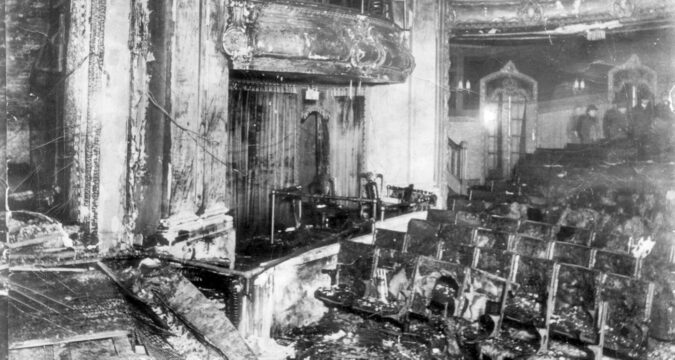
Many of those who could escape the fire at the Iroquois Theatre in Chicago on Dec. 30, 1903, found themselves navigating fire escapes, as this illustration published on Dec. 31, 1903, in the Tribune shows. (Chicago Tribune)
1903: The matinee performance of “Mr. Bluebeard” at Chicago’s Iroquois Theatre, on Randolph Street between State and Dearborn streets, was packed with an estimated 2,000 schoolchildren and families.
The dazzling Iroquois was hastily opened Nov. 23, 1903. Though the “finest, handsomest, and best equipped” theater bragged about its 35 exits, it did not have a sprinkler system, telephone, fire alarm or exit signs. The crowd included a 26-piece orchestra, a cast and crew of 400, and spectators who jammed the balconies and set up camp chairs in the aisles.
A fire that killed more than 600 people inside the Iroquois Theatre in Chicago on Dec. 30, 1903, started when an arc light set part of a curtain above the stage ablaze. (Chicago Tribune)
The second act had just begun when an arc light near the stage ignited a curtain.
“The first we knew of the fire, was when we saw a tongue of fire, which crept slowly along the red velvet curtain,” survivor Charlotte Plamondon told the Tribune. “As the fire followed the velvet curtain at the top of the stage I could see little girls and boys in the audience point to it as if it were a part of the play.”
As flame licked at the fabric and smoke curled toward the ceiling, the overcapacity crowd of more than 1,800 panicked, rushing for the exits and jammed against doors that opened inward. Some exits were locked; others were nearly impossible to open.
The Tribune told of the devastating fire at the Iroquois Theatre, published the day after on Dec. 31, 1903, where more than 600 people died. (Chicago Tribune)
Firefighters put out the fire in 30 minutes, but not before it became the worst of its kind in American history with 602 dead — more than twice the toll of the Great Chicago Fire of 1871.
Theatergoers from 13 states were killed in the disaster, which made headlines worldwide, according to Anthony P. Hatch, author of the 2003 book “Tinder Box: The Iroquois Theatre Disaster 1903.”
News accounts were chilling. In a nearby restaurant used to house the dead and dying, “Bodies were everywhere — piled along the walls, laid across tables, and flung down here and there — some charred beyond recognition, some only scorched, and others black from suffocation; some crushed in the rush of the panic,” wrote Tribune reporter Arthur Sears Henning.
The paper’s front page the next day was filled with a list of names of the dead.
The Dec. 31, 1903, front page of the Chicago Tribune after the fire at the Iroquois Theatre.
Though only one victim was buried at Montrose Cemetery, its owner Andrew Kircher established a monument there.
The Iroquois Theatre fire resulted in reforms such as fireproof scenery and stage curtains, illuminated exits and doors that open outward. It also inspired the invention of the exit-door “panic bar,” which still is in use today, and the UL Label Service.
Another theater, the James A. Nederlander Theatre (formerly the Oriental Theatre), opened on the site in 1926.
Want more vintage Chicago?
Subscribe to the free Vintage Chicago Tribune newsletter, join our Chicagoland history Facebook group, stay current with Today in Chicago History and follow us on Instagram for more from Chicago’s past.
Have an idea for Vintage Chicago Tribune? Share it with Kori Rumore and Marianne Mather at krumore@chicagotribune.com and mmather@chicagotribune.com
https://www.chicagotribune.com/2025/12/30/chicago-history-december-30/
Europe’s Ideological Paralysis Threatens AI Boom
Europe’s Ideological Paralysis Threatens AI Boom
Submitted by Thomas Kolbe
Economic prosperity is created in free markets by innovative companies. Over 50 percent of globally operating AI unicorns are located in the U.S., while Europe plays virtually no role. The race for the next future technology is already decided.
It seems that economic history is repeating itself in these months. On the stock markets, companies in the artificial intelligence and data center sectors are being traded feverishly. Massive capital flows into this technology. Much of it resembles the dot-com boom 25 years ago.
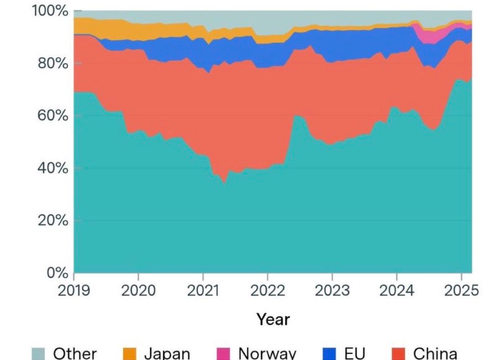
Structurally and regionally, little has changed since then: The U.S. and China are fighting for pole position, while the European Union’s economy remains largely on the sidelines, pushed into a spectator role by EU regulators.
Unicorns as a Measure of Innovation
An interesting measure of the EU’s lag in artificial intelligence is the number of so-called unicorns—private startups valued at at least one billion U.S. dollars before going public. This metric is considered a valid indicator of a region’s innovative capacity—and for the EU, the comparison with the U.S. is catastrophic.
About 1,700 such innovative companies currently operate in the U.S., while the EU has only around 280. The U.S. dominates this market with over 50 percent share, whereas the European economy lags far behind with less than ten percent of the global market.
This economic gap is also reflected in investment volume. Hyperscalers such as Amazon, Microsoft, Alphabet, and Meta invested over $320 billion in AI and corresponding data center infrastructure this year alone. More than 550 new projects—with a focus in Virginia, Texas, and Arizona—are forming the backbone of a new economy.
Data center capacity in the U.S. grew by around 160 percent this year, while Europe’s capacity increased by only about 75 percent, equaling an investment volume of just under €100 billion.
With investments of around $125 billion, China’s economy also lags far behind the American one. An interesting context—especially from the perspective of European, and particularly German, policymakers—is that nuclear power is gaining noticeable momentum in these regions.
Even if green-minded Germany refuses to acknowledge it due to its ideological stance against nuclear energy, the enormous energy demand of new technologies will in the future be covered to a significant extent by the expansion of nuclear power.
Among the few major projects in the European Union are the Brookfield project in Sweden, with an investment volume of around $10 billion, and the Start Campus in Portugal, which could also activate nearly $10 billion in investments.
Crash of Ideologies
Especially in AI, the ideological clash between the U.S. and the EU can be observed in practice and in all its consequences. While the U.S. relies on deregulation and private solutions, removing barriers for intense competition, EU Europe still adheres to the mantra of political global control. Nothing may happen unless Brussels officials have schemed it at their green table in all their wisdom.
The Draghi motto still applies here: Only massive public investments—credit-financed and centrally planned—will, in the view of EU statist planners, help overcome the enormous gap between Europe and the U.S.
In the simulations of the EU Commission’s master plan, now stretched over seven years under Ursula von der Leyen, everything seems surprisingly simple, almost simplified. The EU’s Invest-AI plan intends to borrow around €50 billion in loans and invest them in selected projects in the coming years. This is supposed to trigger private investments of €150 billion, ultimately creating four AI gigafactories.
Welcome to the socialist textbook world of “Habeckonomics”: a system in which state projects like Northvolt repeatedly fail. Yet as long as public guarantees, subsidies, and state-guaranteed purchase prices are in prospect, the small flame of political hope continues flickering in Europe’s lukewarm wind.
As usual, we also observe the typical European jungle of funding programs, subsidies, and steering projects. These include “Horizon Europe,” which is meant to strengthen computing power in science, the RAISE pilot, and the Gen-AI-4-EU initiative, together investing another billion euros in the EU’s digital infrastructure.
The Power of Competition
The ideological clash between the two major economic blocks, the U.S. and the EU, is producing strange effects. While the open capital market in the U.S. lets startups sprout like mushrooms from fertile soil, EU regulation—especially under the Digital Markets Act—has fostered a predatory mentality. That this was likely the Eurocrats’ goal from the start comes as no surprise.
Brussels imposed more than €3.2 billion in competition fines this year, mainly targeting U.S. corporations. Brussels has degenerated into a bureaucratic leviathan—a parasitic glutton absorbing economic energy and generating ossified structures and economic vacuum.
In EU Europe, the motto is: the regulatory framework matters most—and the state takes its cut. That private industry prefers other locations and withdraws capital matters little to Brussels’ extraction experts.
Against the backdrop of Europe’s massive descent into a climate-socialist dystopia, it is surprising that the roots of libertarian economic thinking originate precisely on this continent. Consider the great economist Ludwig von Mises, who repeatedly pointed out that it is the entrepreneur who drives the engine of the market economy through profit-seeking, and that without exception, decentralized processes create prosperity—while state interventions regularly derail it.
Civilization-superior models like the free market sink in the waves of ideological EU infantilism. Its repressive climate socialism promotes the growth of corporatist structures in which politics and subsidized parts of the economy carry out the extraction, eliminating competition.
The rigid adherence to centrally planned control of the new tech industry tragically mirrors the timeline of the dot-com era. What Europe fails to understand is that groundbreaking innovation inevitably triggers an investment boom, often resulting in overinvestment and a stock market crash—but ultimately leaving economically profitable structures permanently woven into the existing economy.
As with companies like Amazon, Google, or Microsoft, Europeans will look back in a few years at these months and examine this intercontinental economic bifurcation through the examples of OpenAI, Gemini, or Perplexity. The energy needed will come from French nuclear reactors and soon also from Polish nuclear power.
Tyler Durden
Tue, 12/30/2025 – 05:00
https://www.zerohedge.com/technology/europes-ideological-paralysis-threatens-ai-boom

Where Do Microplastics Come From Anyway?
Where Do Microplastics Come From Anyway?
Most people know that plastic pollution is a problem, but microplastics (the tiny fragments shed by everyday products) are much more pervasive than many realize.
Microplastics are defined as plastic particles smaller than 5 mm.
These particles are found everywhere: in oceans, soil, drinking water, food, and even the air we breathe. Yet, the origins of these particles are often invisible to consumers.
Using data from the IUCN, CSIRO, and Elsevier, this graphic, via Visual Capitalist, by Made Visual Daily breaks down what actually makes up these particles and where they come from.
A breakdown of microplastic sources, compiled from multiple environmental studies:
The chart shows that the biggest contributor to microplastics is synthetic textiles, which account for 35% of the total. Tires (28%) and city dust (24%) are also major culprits, followed by road markings (7%) and a grab bag of other sources (6%).
How Do These Microplastics Enter the Environment?
Microplastics enter the environment in two main forms: primary and secondary.
Primary microplastics are released directly into the environment at a microscopic size. These include:
Fibers shed from washing synthetic fabrics like polyester, nylon, or acrylic.
Rubber dust worn from car and truck tires during normal use.
Fragments in city dust from the abrasion of paints, soles, furniture, and building coatings.
Plastic pellets (“nurdles”) lost during plastic manufacturing or shipping.
Secondary microplastics, on the other hand, are formed when larger plastic debris—like bags, bottles, or fishing gear—breaks down over time due to sunlight, wave action, and weathering. These degrade into smaller and smaller pieces, eventually becoming microplastics.
Both types are persistent, pervasive, and increasingly found in even the most remote ecosystems. Research shows that even atmospheric currents can transport microplastic particles across continents and oceans.
The Scale of the Problem
Scientists estimate that roughly 21 million tonnes of primary microplastics have accumulated across land and sea environments, with millions of tonnes found in both agricultural soils and ocean waters. To help readers grasp the sheer scale of this invisible pollution, the graphic visualizes this total as an area filled 10 feet (3 meters) deep across a span of 2 miles (3.2 kilometers).
As highlighted in our previous breakdown of the future of the world’s plastic, the accumulation of these invisible pollutants is a growing concern, with long-term impacts still being uncovered.
What Can Be Done?
Solutions will require both technological and behavioral changes. For instance, innovations like microfiber filters in washing machines, and the development of alternative materials for tires and textiles, could help reduce the release of particles at the source.
In the meantime, understanding where microplastics come from is a critical first step. As this breakdown shows, the issue goes far beyond just plastic straws and bags.
Explore more microplastic visualizations like Visualizing The Size of Microplastics on Voronoi, our data storytelling app.
Tyler Durden
Tue, 12/30/2025 – 04:15
https://www.zerohedge.com/medical/where-do-microplastics-come-anyway
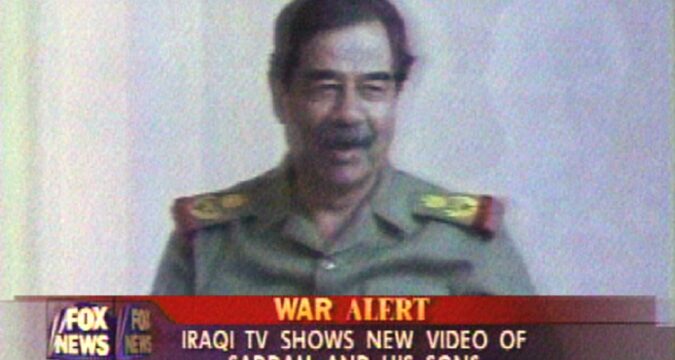
Today in History: Former Iraqi President Saddam Hussein executed
Today is Tuesday, Dec. 30, the 364th day of 2025. There is one day left in the year.
Today in history:
On Dec. 30, 2006, former Iraqi President Saddam Hussein was executed by hanging after being convicted of crimes against humanity by the Iraqi High Tribunal. Hussein was captured in 2003 by U.S. forces while hiding near his hometown of Tikrit.
Also on this date:
In 1860, 10 days after South Carolina seceded from the Union, the state militia seized the United States Army arsenal in Charleston.
In 1896, José Rizal, whose writings inspired the Philippine Revolution, was executed by Spanish army troops after being convicted of rebellion, sedition and conspiracy.
In 1903, more than 600 people died when fire broke out at the recently opened Iroquois Theater in Chicago.
In 1922, the Union of Soviet Socialist Republics (USSR) officially came into existence.
In 2009, seven CIA employees and a Jordanian intelligence officer were killed by a suicide bomber at a U.S. base in Khost (hohst), Afghanistan.
In 2015, actor and comedian Bill Cosby was charged with drugging and sexually assaulting a woman at his suburban Philadelphia home in 2004. (Cosby’s first trial ended in a mistrial after jurors deadlocked; he was convicted on three charges at his retrial in April 2018 and sentenced to three to 10 years in prison, but the Pennsylvania Supreme Court overturned the conviction in June 2021, setting Cosby free.)
Related Articles
Chicago weather: How our 2025-26 seasonal snowfall compares with previous years
Today in Chicago History: Parents arrested for leaving daughters ‘home alone’ while they took Mexico trip
Today in History: Ghislaine Maxwell convicted
Today in Chicago History: Montgomery Ward department store announces it will shut down operations
Today in History: Endangered Species Act signed
In 2020, a large explosion rocked the airport in the southern Yemeni city of Aden soon after a plane carrying the government’s newly formed Cabinet landed there. At least 25 people were killed and 110 wounded, and a later report to the U.N. Security Council attributed the blast to Houthi rebels.
Today’s Birthdays: Baseball Hall of Famer Sandy Koufax is 90. TV director James Burrows is 85. Singer-author Patti Smith is 79. Musician Jeff Lynne is 78. Actor Sheryl Lee Ralph is 69. Country singer Suzy Bogguss is 69. Actor-comedian Tracey Ullman is 66. TV commentator Sean Hannity is 64. Golfer Tiger Woods is 50. TV personality and retired pro boxer Laila Ali is 48. Singer-actor Tyrese Gibson is 47. Actor Eliza Dushku is 45. Actor Kristin Kreuk is 43. NBA star LeBron James is 41. Singer-actress Andra Day is 41. Pop-rock singer Ellie Goulding is 39.

Ukraine’s Zaporozhia Nuclear Plant Could Restart 18 Months After War Ends
Ukraine’s Zaporozhia Nuclear Plant Could Restart 18 Months After War Ends
By Michael Kern of OilPrice.com,
The Zaporizhzhia nuclear power plant in Ukraine, which has been under Russian control since early 2022, could resume operations within a year and a half after a potential end to the war, the head of the plant’s Russian operating company said on Monday.
“If this (the end of the conflict) happens tomorrow, we will be ready to start up in mid-2027,” Ramil Galiyev, CEO of the Zaporizhzhya NPP Operating Organization, said, as carried by Russia’s state news agency RIA.
The Zaporizhzhia nuclear plant is not operational and does not produce electricity, but needs power supply from external sources to cool the nuclear material and avoid a nuclear meltdown or disaster.
Zaporizhzhia is Europe’s biggest nuclear power plant in terms of installed capacity of 5.7 gigawatts (GW).
Located in Enerhodar, the nuclear power plant supplied about 20% of Ukraine’s electricity before the war.
Earlier this year, the International Atomic Energy Agency (IAEA) began a process to help restore external electricity to the power plant, following weeks of diplomatic engagement with both Ukraine and Russia after the facility again lost all access to the national grid.
IAEA Director General Rafael Mariano Grossi announced that work had begun to re-establish off-site power through repairs to the damaged 750 kV Dniprovska and 330 kV Ferosplavna-1 transmission lines.
These lines, located on opposite sides of the front line, are essential for supplying the electricity needed to cool the plant’s six shutdown reactors and spent fuel.
Last week, Russian media claimed that the Trump Administration held talks with Russia over joint management of the Zaporizhzhia nuclear power plant, including the potential to use its power for crypto mining. The discussions, which have not been independently confirmed, were allegedly held without Ukraine’s participation, and likewise proposed resuming electricity supply to Ukraine, Russian newspaper Kommersant reported on Friday.
Tyler Durden
Tue, 12/30/2025 – 03:30

Answer Angel: Plastic purses?
Dear Answer Angel Ellen: At a recent, dressy holiday party I attended, one of the guests was carrying a see-through (plastic?) evening bag and I wondered if this is a new style.
The woman with the purse appeared to be wearing an expensive Chanel suit so I figured she knew what was “in.” Did she?
–Alexandra P.
Dear Alexandra: I don’t think so. You didn’t mention whether you could see her balled up Kleenex and ratty cosmetics and other stuff that most of us carry around in our purse for nobody to see.
A clear plastic handbag (or tote) did have a style moment. An Internet search even turned up a Chanel version on the resale site poshmark.com. But the price had been slashed from the optimistic $500 to the still-hefty $199. Not so coveted anymore. So impractical. Other fashion labels that gave the clear bags a try include Michael Kors, Kate Spade, LeSportsac and Telfar.
However, nowadays you are much more likely to see these bags carried by people waiting in line for a sport or concert stadium event. Which is why some sellers advertise them as “stadium bags” or “stadium compliant” (there’s even a website, sheergear.com) because many venues limit the size of a purse or tote and and/or require see-through material so personnel can see if they hold weapons or prohibited alcoholic beverages. The bags are inexpensive and clearly not high fashion.
Here’s an obscure footnote: The late Robert Gottlieb, former editor of The New Yorker magazine and the publishing house Alfred A. Knopf, had a significant collection (400+) of mid-century Lucite (plastic) see-through and opaque plastic handbags.
Dear Answer Angel Ellen: A friend recently introduced me to a feature on vogue.com where extra extravagant weddings are covered in excruciating detail. Having been to a number of, in my view, foolishly expensive multi-day events of this kind, I’ve often wondered why otherwise intelligent (?) people are eager to spend massive amounts of money on such things when so many couples don’t even make it to the fifth — or even second — anniversary of the huge event before they split up.
What are your thoughts on such lavish spending? And why do people throw these ridiculous parties anyhow?
–Kate L.
Dear Kate: This is a good question…but I don’t have a good answer. This area of inquiry is better put to psychologists, therapists and, perhaps, wealth-management experts. I limit my advice to the realm of style, fashion, shopping, beauty and makeup.
But a confession: I just love to read stories about these massively expensive parties where the engraved invitations alone can cost more than many weddings. Vogue is definitely onto something. Call it a guilty pleasure and enjoy.
Angelic Readers 1
To the rescue for reader Maggie K., looking for recommendations on products for fine, thin, straight hair to give the appearance of volume…
Laura G. says: “My hair has always been fine, thin and straight. The best shampoo and conditioner that I have found is from the Soapbox brand. You can buy them at Target ( target.com ) I use the Biotin and Superfruit Blend Volumizing Shampoo Restore & Volume Shampoo ($7.99) and Volumizing Conditioner ($7.99) but they have several different products. I have been using this product for many years. Highly recommend!” Angela B. writes: “I recommend a conditioner bar. I’ve use Viori brand shampoo and conditioner bars for years and love it. You can order from their website ( viori.com, $13.99), amazon.com ($8.81 and up) or sephora.com ($7.99 and up). From Janice L.: “I use any WOW product from amazon.com, like the Dream Cocktail Carb Infused Leave-In Treatment for Thin Hair ($26). There is something in that product that poofs up the hair and makes it look thicker.”
Angelic Readers 2
On bed linen issues…
Related Articles
Answer Angel: ManningCast fan?
Answer Angel: Where is his belt?
Answer Angel: Just the necessities
Answer Angel: Sequins all the time? Sure!
Answer Angel: Is the hat fashionable or silly?
Jennifer S. needs reader recommendations: “As I have four pillows on my bed, I would really like to be able to buy extra pillowcases when I purchase queen bedding sets.” And Louise C. is a crisp sheet fan and has this to say: “Regarding crisp percale sheets, two words: Ralph Lauren. Positively crunchy.”
(Send your questions and rants – on style, shopping, fashion, makeup and beauty – to answerangelellen@gmail.com.)
https://www.chicagotribune.com/2025/12/30/answer-angel-plastic-purses/
Rick Steves’ Europe: Edinburgh’s Royal Mile
There’s no better introduction to Edinburgh – the historical, cultural, and political capital of Scotland – than a walk straight down the spine of the old town. Stretching from a hill-topping castle to a queen’s palace, this ramble is appropriately called the Royal Mile. Despite being crammed with tourists, it’s one of Europe’s best sightseeing walks.
I begin my stroll on the bluff where Edinburgh was born 1,300 years ago, and where a castle now stands. Over the centuries, this mighty fortress was home to many of Scotland’s kings and queens. Today it’s well worth touring to see the old buildings, stunning views, and crown jewels.
As Edinburgh grew, it spilled downhill along the sloping ridge that became the Royal Mile. Back in the 1600s, this was the city’s main street, bustling with breweries, printing presses, and banks. With tens of thousands of citizens squeezed into the narrow confines of the old town, there was nowhere to go but up. So builders lined the street with multistory residences called tenements – some 10 stories and higher. My next stop, Gladstone’s Land – a restored merchant’s house with costumed guides and an almost-lived-in, furnished interior – helps me picture those days.
Though much of the Royal Mile is now a touristic mall filled with tartans, shortbread, and Scottish kitsch, it’s still packed with history. Exploring back alleys and side lanes, it’s easy to imagine Edinburgh in the 17th and 18th centuries, when visitors scurried through these alleyways, buying and selling goods and popping into taverns.
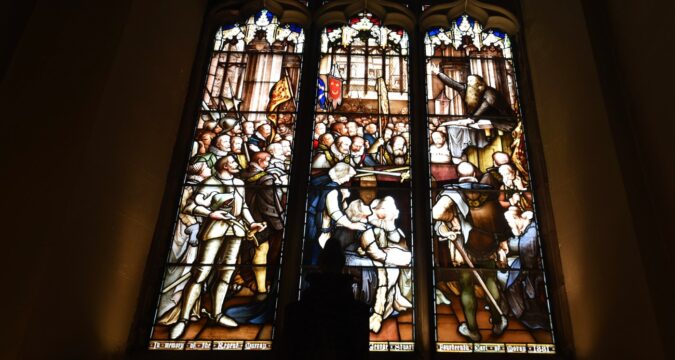
Everywhere I turn, the Royal Mile is littered with symbols of Scottish pride – from a statue of philosopher David Hume, one of the towering figures of the Scottish Enlightenment of the mid-1700s, to its very own Church of Scotland, embodied by St. Giles’ Cathedral. Filled with monuments, plaques, and stained-glass windows dedicated to great Scots and historical moments, St. Giles’ serves as a kind of Scottish Westminster Abbey.
St. Giles’ was also the home church of John Knox, whose fiery sermons helped turn once-Catholic Edinburgh into a bastion of Protestantism. Knox’s influence was huge. His insistence that every person should be able to read the word of God firsthand helped give Scotland an educational system 300 years ahead of the rest of Europe. A dramatic stained-glass window shows the commotion that surrounded Knox when he preached. With his hand on the holy book, Knox seems to conduct divine electricity to the Scottish faithful packing the church.
Just down the road from St. Giles’ is the John Knox House. Knox probably never actually lived here, but preservationists labeled the building “Knox’s house” to save it from a wrecking ball in the mid-1800s. It features atmospheric rooms, period furniture, exhibits on printing – an essential tool for early reformers – and good information on Knox and his intellectual sparring partner, Mary, Queen of Scots. I like to imagine the Protestant firebrand Knox and devout Catholic Mary sitting face-to-face in sparse rooms like these, discussing their spiritual lives and molding the course of Scotland’s religious future.
A little farther down the street is an enjoyable stop: Cadenhead’s Whisky Shop. Whisky is high on the experience list of most visitors to Scotland. While there are plenty of distillery tours, a visit to a fine whisky shop like Cadenhead’s offers a chance to gain an education and buy a small bottle filled directly from the cask of your choice.
Founded in 1842, Cadenhead’s prides itself on bottling pure whisky without watering it down or adding cosmetic coloring. Popping in, I’m shown a shelf of aged wooden casks. The shop owner explains: “A single-cask whisky is like a football team where all the players come from the same town.” Sipping this whisky with an expert, I see why Scots call this drink “a very good friend.”
Fortified, I continue down the Royal Mile. Finally, after centuries of history, I’ve reached modern times: the Scottish parliament building. After 300 years of being ruled from London, the Scots regained their own parliament in 1999, and a few years later built this striking, eco-friendly home for it. The soaring building, mixing wild angles and bold lines, seems to surge right out of the earth like Arthur’s Seat, the craggy summit visible in the distance.
My last stop is the Palace of Holyroodhouse, one of King Charles III’s official residences and the home of Scottish royalty, including James IV and Mary, Queen of Scots. The Scottish monarchs also kept a home at the top end of the Mile, but they preferred the cushier Holyroodhouse to the blustery castle on the rock.
Related Articles
Winter storm snarls US holiday travel across Northeast and Great Lakes
Rick Steves’ Europe: Epiphany in Europe
Visiting the Trevi Fountain now will cost more than just a coin toss with a 2-euro tourist fee
Travel ban extended by Trump administration
Rick Steves’ Europe: Celebrating Christmas in German
I’ve soaked up plenty of Scottish history on my walk from castle to palace. But no Royal Mile walk is complete without dropping by a pub – and there’s no shortage of them – where a bit of live music and more whisky await.
(Rick Steves (www.ricksteves.com) writes European guidebooks, hosts travel shows on public TV and radio, and organizes European tours. This column revisits some of Rick’s favorite places over the past two decades. You can email Rick at rick@ricksteves.com and follow his blog on Facebook.)
https://www.chicagotribune.com/2025/12/30/rick-steves-europe-edinburghs-royal-mile/