Category: News

These Are The World’s 5 Largest Megacities
These Are The World’s 5 Largest Megacities
By 2050, 68% of the global population is projected to live in urban centers, up from 55% today.
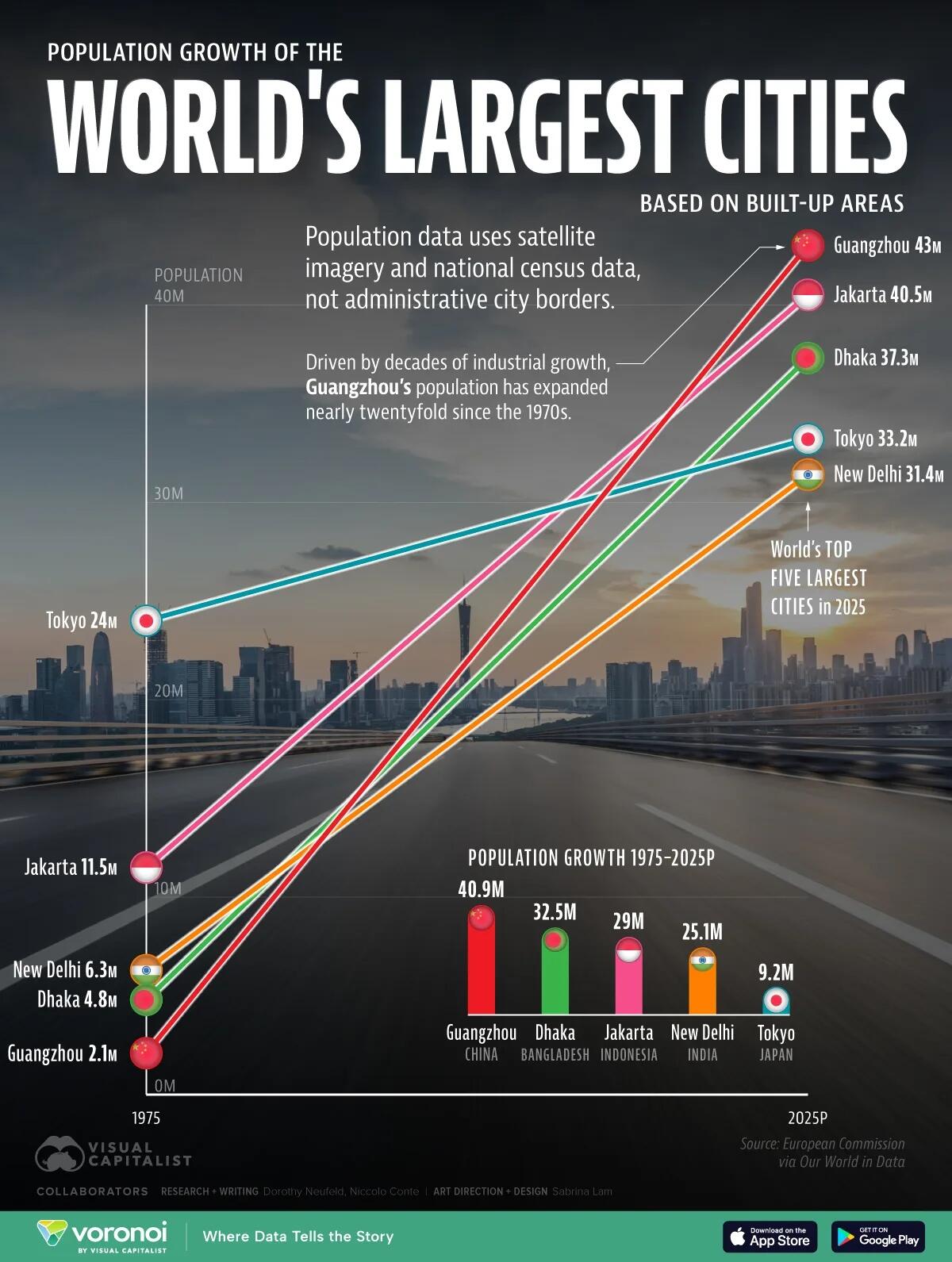
The world’s largest megacity, when measured by the combination of satellite imagery and census data, is Guangzhou, China.
Strikingly, the population has boomed by nearly 20-fold in just 50 years driven by China’s rapid economic rise.
This graphic, via Visual Capitalist’s Dorothy Neufeld, shows the growth of the world’s megacities, based on data from the European Commission via Our World in Data.
The Rise of the World’s Megacities (1975-2025P)
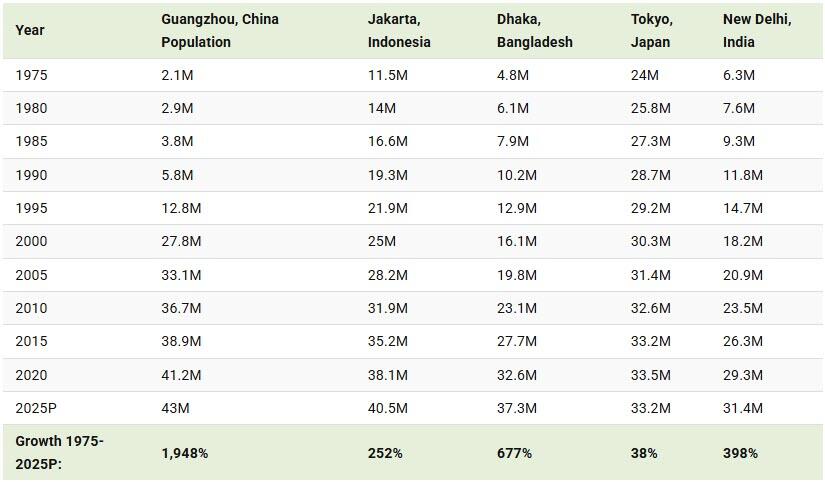
Below, we show the rise of the top five largest cities worldwide—using satellite imagery and census data—not administrative borders:
Since 1975, the population of Guangzhou has expanded by 40.9 million. It has the equivalent population of the entire country of Canada.
During the 1990s, the city’s population growth accelerated, driven by trade and industrial activity. Located on the Pearl River Delta, north of Hong Kong, it stands as a key port and transportation hub.
Jakarta, Indonesia’s capital and the economic hub of Southeast Asia’s largest economy, has undergone massive expansion. Its population has surged by 29 million over the past five decades, reaching 38.1 million today.
Meanwhile, New Delhi, India has grown 398%, supported by rising incomes and urban migration. By 2030, the city is expected to gain nearly two million more residents, spanning a population of 33.3 million.
To learn more about this topic, check out this graphic on the world’s fastest-growing economies.
Tyler Durden
Tue, 12/30/2025 – 02:45
https://www.zerohedge.com/markets/these-are-worlds-5-largest-megacities
The Beginning Of The End For Europe’s Old Security Order
The Beginning Of The End For Europe’s Old Security Order
Authored by J.Ricardo Martins via journal-neo.su,
Europe’s long-standing security framework is undergoing profound strain, increasingly overshadowed by economic instruments that shape geopolitical influence.
This analysis examines how geoeconomic logics are reshaping Europe’s strategic posture and challenging the foundations of its traditional security order.
The Unraveling: How Europe Lost Control of Its Own Security Architecture
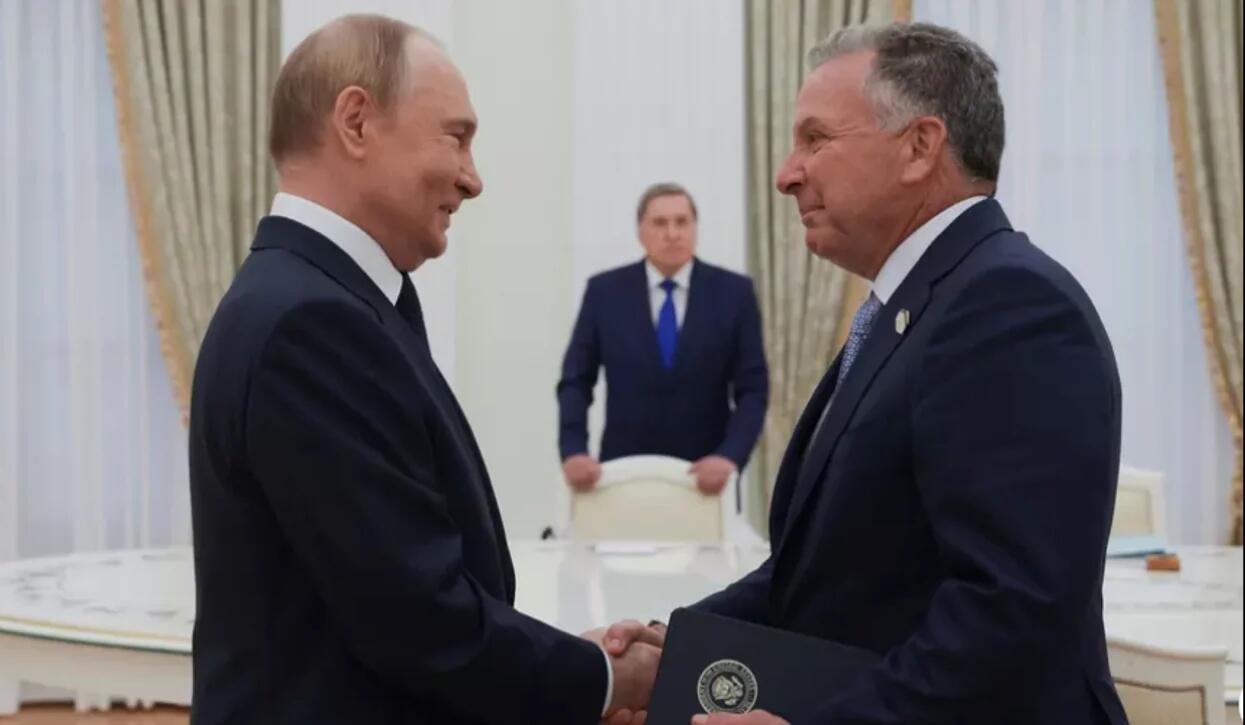
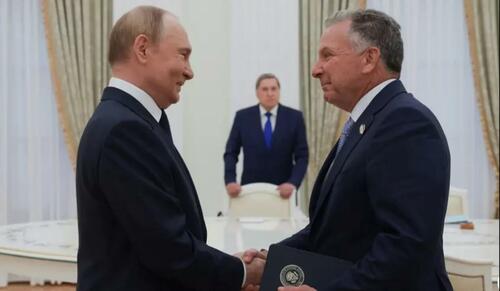
The photograph of Steve Witkoff with Vladimir Putin in Moscow is not merely another episode in the long chronicle of American informal diplomacy. It is a symbol of something far more consequential: the definitive erosion of the Euro-Atlantic security architecture that has anchored Europe since 1945. Europe now finds itself a spectator to a negotiation that directly concerns its future but in which it has no meaningful voice.
For decades, European leaders assumed that their security environment was guaranteed through three pillars: American military supremacy, NATO cohesion, and a Russia that could be simultaneously contained and marginalised. The war in Ukraine temporarily sustained this illusion. The European Union interpreted Russia’s invasion of Ukraine as validation of the post-1991 Atlantic order, proof that Europe needed more NATO, more American leadership, more defence spending, and more ideological alignment with Washington.
Europe’s tragedy is not that it is being excluded from the negotiations shaping its own future, but that it does not yet fully grasp the depth of its exclusion
But as the conflict entered its later stages, and as new political dynamics emerged in Washington, a deeper reality became visible: Europe’s vision of security was not aligned with America’s long-term strategic trajectory.
Washington seeks to contain China; Europe seeks to contain Russia. Washington looked to the Indo-Pacific; Europe clung to its Eastern frontier. Washington viewed Russia as a potential co-player in global resource extraction, Arctic development, and strategic balancing; Europe continued to frame Russia as a permanent existential enemy.
The result is a form of strategic misalignment, with Europe still operating inside an architecture that Washington no longer fully believes in.
The American Pivot, the European Panic
Donald Trump’s return to the international stage accelerated this divergence dramatically. Trump’s strategic re-imagination of Russia, as an asset rather than an adversary placed Europe in a state of near-panic. His willingness to undermine NATO commitments, his explicit distrust of European leaders, and his understanding of geopolitics as business diplomacy all contribute to Europe’s strategic anxiety.
Trump’s humiliation of Europe is deliberate. By sending Witkoff, an adviser with no diplomatic obligations, to Moscow repeatedly while ignoring Kyiv, Trump signals that the centre of gravity has moved. The peace process will not be mediated through Brussels, Berlin, or Paris; it will be mediated through a Washington–Moscow axis, bypassing European institutions entirely.
Europe’s refusal to speak with Moscow is interpreted in the Kremlin not as principled resistance but as strategic self-sabotage. And Washington, sensing opportunity, is willing to exploit this fracture.
As many analysts warned—both sympathetic and critical—Europe is discovering too late that its security cannot be maintained through moral rhetoric, sanctions, or rearmament without industrial foundations. Europe wants to contain Russia, but it no longer has the political, military, or economic tools to do so.
The Dealmakers: How Trump, Putin, and Business Networks Are Writing Europe Out of Its Own Future
Shadow Diplomacy as the New Geopolitics
Witkoff’s shuttle diplomacy represents a structural shift: diplomacy is no longer the domain of foreign ministries but of political families, corporate intermediaries, and resource-based alliances. This is why Kushner’s presence in Moscow matters profoundly. The December talks were not simply high-level negotiations; they were the emergence of a new system of geopolitical conduct, in which trust between individual power networks outweighs institutional protocols.
The Trump–Putin paradigm is built on three principles: (i) commercial logic over ideological confrontation; (ii) resource extraction as the foundation of geopolitical stability; and (iii) bilateral trust over multilateral institutions.
This is profoundly humiliating for Europe, which traditionally sought legitimacy via multilateralism. For Washington and Moscow, however, Europe’s exclusion is not an oversight but a feature. The old European security architecture depended on Europe’s centrality. The new one does not.
The Economic Heart of the New Architecture
The emerging Washington–Moscow understanding is grounded in four economic pillars:
– Arctic and Northern Sea Route Resource Extraction: Joint participation in Arctic minerals, hydrocarbons, and rare earths is central. The US is far behind Russia in icebreaker capacity and Arctic infrastructure, and cooperation is a pragmatic solution.
– Energy Corridors and Post-War Reconstruction: American investors eye Russian energy as an undervalued frontier market. Simultaneously, reconstruction of Ukraine (potentially funded by frozen Russian assets) creates massive opportunities for US construction and energy firms.
– Reintegrating Russian hydrocarbons into global markets: This is a long-term American objective, both to stabilise global energy prices and to manage China’s growing leverage over Russia.
– Replacing NATO’s military logic with economic interdependence: This is the core of Trump’s thinking: build a Washington–Moscow axis rooted in profitability, thereby reducing the incentive for armed confrontation.
Why Europeans Are Desperate
Because Europe has tied its industrial base to sanctions, decarbonisation, and American military dependency, it is now structurally weaker than both Washington and Moscow in the emerging configuration.
Europe is discovering three painful truths:
– It cannot defend itself without the US. NATO’s European pillars lack ammunition, industrial capacity, and high-end military technology.
– Sanctions have weakened Europe more than Russia. Energy-intensive industries in Germany, Austria, and Italy are relocating to the US. Deindustrialisation is underway in Europe.
– The peace negotiations will not include Europe as a co-author. Europe will receive the final document, but not be invited to shape it.
This is why European strategists are furious: the security architecture that defined the continent is being rewritten over their heads.
After Ukraine: What the New European Security Order Might Look Like
Will NATO survive as Europe’s central pillar?
NATO will not disappear. It remains too deeply institutionalised, too symbolically powerful for Europeans, and too useful for Washington’s basing structures and arms exports. But it will be downgraded, transformed from the core of the European security order into a secondary framework, increasingly dependent on: US political will, a fragmented European defence sector, reduced American enthusiasm for European commitments, and a US–Russia modus vivendi that Europe does not control.
Under a Trump presidency, NATO has become a transactional umbrella, not a strategic alliance. Its credibility will depend entirely on the personal relationship between Trump and Putin—and Europe hates this because it strips the continent of agency.
The Impact of the War and the Coming Peace on Europe’s Architectural Future
The conflict in Ukraine revealed Europe’s structural vulnerabilities: lack of ammunition, lack of production capacity, overreliance on sanctions, and strategic incoherence. The peace will reveal something even more uncomfortable: Europe cannot enforce the consequences of the settlement on its own.
If the US and Russia craft the final settlement, Europe must either accept it or refuse and confront the consequences alone. Neither Paris nor Berlin is prepared for the latter scenario.
Ukraine, tragically, will be the ultimate pressure point. Its sovereignty will be negotiated by outsiders. Europe knows this but cannot alter it.
Can Europe Hold the Architecture Without the US?
The honest answer is no, not in the short or medium term. Europe lacks nuclear deterrence autonomy, military-industrial depth, cohesive political will, strategic consensus, energy security, technological parity with the US, and the capacity to contain Russia without American leadership.
The idea of European strategic autonomy remains aspirational rhetoric. The EU has military instruments, but not a military. It has ambitions, but not the industrial base to sustain them.
The Asian Century and the Decline of Europe
The more Washington and Moscow converge economically, the more Europe’s global relevance declines. The Russia–China axis strengthens, India emerges as a balancing pole, and the BRICS expand their economic and political weight. Europe becomes a peninsula of a Eurasian supercontinent that it does not control, increasingly marginal to global power centres.
Whether Asia can provide stability depends on the trust networks forming between Beijing, Moscow, New Delhi, Riyadh, and Tehran. Europe is not part of those networks.
Conclusion: A Continent in Suspension
Europe’s tragedy is not that it is being excluded from the negotiations shaping its own future, but that it does not yet fully grasp the depth of its exclusion.
The Moscow meetings are not a negotiation between equals; it is a negotiation between systems of power. Trump and Putin understand one another because they speak the language of transactional geopolitics. Europe speaks the language of norms, laws, and bureaucratic procedures—in a world that is no longer governed by them.
A new European security architecture is being drafted, and it is not being drafted in Brussels. It is being drafted in Washington and Moscow.
Europe must confront a stark question: Can a continent that has lost strategic agency recover it before the next geopolitical cycle closes?
Tyler Durden
Tue, 12/30/2025 – 02:00
https://www.zerohedge.com/geopolitical/beginning-end-europes-old-security-order

Asking Eric: Sister still insists on buying gifts for everyone
Dear Eric: My husband’s family has a long-standing tradition of not buying Christmas gifts for adults, just the small children. It keeps Christmas less hectic and allows us to concentrate on what’s important: spending time together as a large extended family.
Years ago, I suggested to my highly dysfunctional family a similar approach. Most of them live in severe poverty and bought gifts for every single person of our extended family, which were often not thought out and promptly thrown out or given away.
I tried suggesting a gift exchange with drawn names one year and some individuals received no gift at all at the exchange, while the “gift giver” remained anonymous and accepted their gift without hesitation.
The following year I suggested no gifts for the adults, children only which has remained the norm ever since and has been fairly well received.
Unfortunately, I have a close sister that still insists on buying gifts for everyone. This makes me feel guilty and prompts me to buy gifts out of embarrassment for her, her husband and 30-something year old sons, wife and children.
I’ve asked her repeatedly to stop buying my family gifts, but every year I get a message to expect a package in the mail. I’ve described how this makes me feel anxious, guilty and embarrassed if I don’t reciprocate, yet she continues. How do I handle this?
– Feeling like The Grinch
Dear Grinch: Your feelings are understandable. Gift-giving has become a form of communication for your family (as is the case in many families). And you and your sister are miscommunicating. It’s no wonder you’re feeling guilty.
However, right now every time a gift from her arrives, it probably feels like an invoice you need to pay, rather than what’s intended. Hence the stress. Try to take a live-and-let-live approach. Your family has made an agreement; you’ve personally told your sister what you’d like to happen with respect to gifts. And she is ignoring it. This is unsuccessful communication.
It may not be malicious, but it’ll help you to think of it as something your sister is doing despite the knowledge that it makes you uncomfortable. And you may feel less stress. We can’t control the actions of others, and the actions of others can’t control our feelings, so remind yourself “my sister is doing whatever she wants but it doesn’t have anything to do with me.”
The feelings of embarrassment and guilt may still come up but also remember that they’re coming from an internal expectation, not an external fact. It may seem counterintuitive, but your sister’s gifts don’t have anything to do with you.
Dear Eric: I’m an older gay man who has been estranged from my family during my earlier years. Things were mended before my mother’s death, but family members and I rarely interact.
My mother had a tradition of giving all the children $50. After her death, I have continued this tradition which has become pretty expensive since the family has grown so large. I’m comfortable, so I don’t mind the expense really, but only one of the parents acknowledges the gift.
I hear that thank you acknowledgments have kind of gone out of style.
I’m not sure what I’m asking here because the tradition really is in honor of my mother, but should I just continue to ignore the lack of acknowledgment? I know some of the grandchildren didn’t think they got all they were entitled to in my mother’s will. They may feel that this is a small recompense.
– To Gift or Not to Gift
Dear Gift: See if you can release yourself from trying to manage anyone else’s feelings but your own. Remember that a gift, more than anything else, is a symbol of one’s well-wishes, one’s hopes for the recipient, and one’s love. How it’s received is out of your control. This is a good thing, because it means that you’re not responsible for how the grandchildren feel about the gift.
It also means that if the act of giving doesn’t have the desired impact on them or on you, you can re-evaluate it with no guilt.
“Thank you” is not a phrase that has been lost to time. We don’t need archaeologists to re-discover thank you notes, much evidence to the contrary. We don’t give in order to receive thanks, but gifts should be acknowledged. Gifts and thank you notes aren’t debts that are owed, they’re both forms of communication, which is the lifeblood of a healthy relationship.
Related Articles
Asking Eric: I’m left out of the group chat
Asking Eric: Blatant case of chutzpah
Asking Eric: Friend urges us to see her play in drum troupe
Asking Eric: I may be overreacting
Asking Eric: I don’t want this to destroy my marriage
As you noted, the relationship that these gifts connect to most is your relationship with your mother’s memory. If, in that respect, you’re getting what you need, then keep it up. But consider that there may be other ways to honor your mother that leave you feeling more fulfilled.
(Send questions to R. Eric Thomas at eric@askingeric.com or P.O. Box 22474, Philadelphia, PA 19110. Follow him on Instagram and sign up for his weekly newsletter at rericthomas.com.)

Chicago Bulls stars Coby White, Josh Giddey exit with injuries in 136-101 blowout to the Minnesota Timberwolves
The Chicago Bulls can’t survive without Coby White and Josh Giddey.
This team was built around this pairing — White’s prolific shot-making from deep, Giddey’s exhaustive playmaking with the ball in his hands. When either — or, worse, both — of those pillars are removed, the rest of the structure crumbles away. And nothing proved this point more thoroughly than Monday’s 136-101 loss to the Minnesota Timberwolves.
The Bulls took a major loss less than seven minutes into the game when Coby White came up short midway through a defensive possession. White grabbed at his right calf before attempting to return to the play, scrambling around the perimeter with a visible limp. But after trying to contest a shot by Donte DiVincenzo, the guard couldn’t gather himself enough to hobble back into the play. White headed straight to the locker room after an ensuing timeout was called and was later ruled out with a right calf injury.
Losing White was a blow — but it was one the Bulls were prepared to weather. The guard missed the first 11 games of the season, forcing Chicago to adapt to a reality without one of their central stars. But barely a minute into the second half, the Bulls seemed to suffer déjà vu.
Guard Josh Giddey pulled up awkwardly at the top of the key, tossing the ball to a teammate before grabbing at his left hamstring. Just like White, the guard headed straight to the locker room at the next whistle, shuffling awkwardly with assistance from head athletic trainer Todd Campbell. The team ruled Giddey out with a hamstring injury before the end of the third quarter.
For the Bulls, this one-two punch was lethal. Giddey averages 19.5 points and 9.2 assists per game. White averages 20.5 points and 4.9 assists per game. That roughly translates to more than a third of the team’s total offense.
The Bulls pride themselves on depth, but that didn’t seem to provide any resilience in the face of these two major injuries. The white flag went up with more than five minutes left on the clock as the Bulls cleared their bench to accept the 35-point defeat.
Here are three takeaways from the loss.
1. A big problem.
Anthony Edwards of the Minnesota Timberwolves drives to the basket against Isaac Okoro of the Chicago Bulls during the second half at the United Center on Dec. 29, 2025, in Chicago. (Michael Reaves/Getty Images)
The Bulls couldn’t lean into their double-big rotation — which has been remarkably effective in limited usage this season — against the Timberwolves due to the absence of center Zach Collins.
Collins sprained his toe in Saturday’s loss to the Milwaukee Bucks. Ahead of Monday’s game, coach Billy Donovan said the Bulls anticipate the center will be sidelined for the rest of this week’s home stand, which includes games against the New Orleans Pelicans, Orlando Magic and Charlotte Hornets. Collins has only played in 10 games this season after missing the entire first month due to a wrist fracture incurred in the final game of the preseason.
This absence was painful against the Timberwolves, who typically clobber the paint with their big man trio of Rudy Gobert, Julius Randle and Naz Reid. The Bulls didn’t have the bodies to double up on bigs — and also continued to switch on defense — which forced larger wings like Ayo Dosunmu and Isaac Okoro to lean into their physicality to survive these assignments.
Centers Nikola Vučević and Jalen Smith were still the standouts of the game for the Bulls, combining for 35 of the team’s 101 points. But that production wasn’t enough to balance out the Minnesota frontcourt, which was powered by a 33-point performance from Reid.
2. Losing control
It’s no surprise that the Bulls struggle to protect the ball without their two leading ball-handlers on the court. But Chicago’s inability to create with the ball — or keep it out of Minnesota’s hands — limited the offense, which barely cracked 100 points in the blowout loss.
The Bulls gave up 24 points off 16 turnovers in the loss. The Timberwolves, in stark comparison, turned the ball over only three times — and only once before both teams emptied their benches for the final five minutes and 30 seconds. While the loss of Giddey and White impacted the Bulls’ ability to create sustainable offense, it was this discrepancy in mistakes — also caused by the pair’s absence — that defined Chicago’s stagnancy in the second half.
3. Anthony Edwards warmed into the blowout.
Many stars prefer to ease into a game before turning on the light show — and Anthony Edwards is no different. Edwards scored only a single point in the opening quarter. But that was no problem for the Timberwolves. The star was simply biding time to turn up the heat on the Bulls.
The onslaught began toward the end of the first half. After sinking a pair of back-to-back 3s, Edwards scored eight points in the final six minutes of the first half, in addition to forcing a turnover and assisting two baskets in the final minute to send Minnesota into the locker room with a five-point lead. He finished with 23 points for the Timberwolves.
China Condemns Israel’s Recognition Of Somaliland As Taiwan Embraces Move
China Condemns Israel’s Recognition Of Somaliland As Taiwan Embraces Move
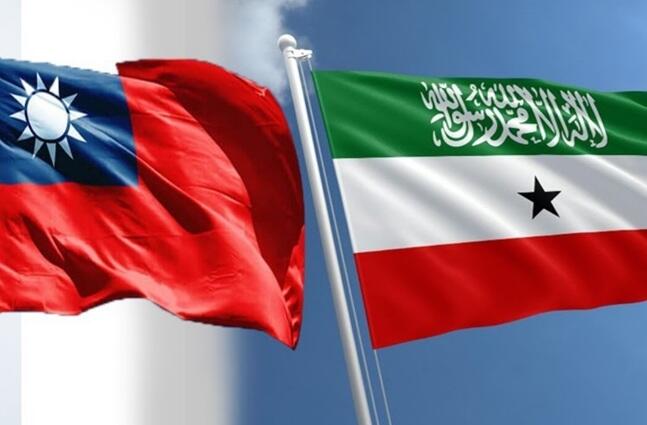
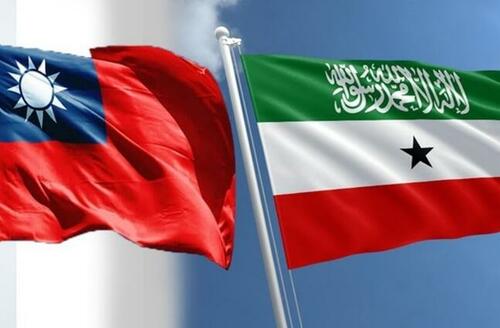
The Chinese Foreign Ministry released a statement on Monday condemning Israel’s recognition of the separatist Republic of Somaliland, after Taiwan became the first state to welcome Tel Aviv’s move.
China opposes the Israeli recognition of Somaliland as an “independent sovereign state” and the decision to “establish diplomatic relations” with it, said Chinese Foreign Ministry spokesman Lin Jian. “No country should encourage or support other countries’ internal separatist forces for its own selfish interests,” he added, while urging the country of Somalia to halt “separatist activities and collusion with external forces.”
The spokesman made the comments during a news briefing. “China firmly supports Somalia’s sovereignty, unity, and territorial integrity, and opposes any moves that undermine Somali territorial integrity,” he went on to say.
A day earlier, Taiwan became the first state to welcome Israel’s recognition of Somaliland. The Taiwanese Foreign Ministry said in a statement that Israel, Taiwan, and Somaliland are “like-minded democratic partners sharing the values of democracy, freedom, and rule of law.“
Last week, Israel became the first state to formally recognize Somaliland, which broke away from Somalia in 1991 but had never been recognized by any UN member state. Somali officials slammed the move.
The Israeli government has been aiming for Somaliland to serve as a potential destination for Palestinians that Tel Aviv aims to forcibly displace from Gaza, according to multiple reports over the past year.
Somali Prime Minister Hamza Barre said that Israel was “searching for a foothold in the Horn of Africa” and called on it to recognize and accept a Palestinian state instead.
Somali President Hassan Sheikh Mohamud referred to the move as a “naked invasion” and said it poses a “threat to regional stability.”
The Arab League, Gulf Cooperation Council (GCC), African Union, and Organization of Islamic Cooperation (OIC) also strongly rejected the Israeli recognition of Somaliland. Iran’s Foreign Ministry called the move “malicious.”
China’s rejection of the recognition coincided with a report by Hebrew newspaper Maariv, which claimed that after recognizing Somaliland, Israel is now considering recognizing the UAE-backed Southern Transitional Council (STC) in Yemen, hoping for strategic cooperation on the Red Sea coast against Ansarallah.
The secessionist STC has recently swept across large swathes of central and southern Yemen with the hopes of creating an independent state. According to recent reports, Israel and Taiwan have also been enhancing their relationship.
Taiwanese Foreign Minister Francois Wu recently made a secret visit to Israel, sources told Reuters on 11 December. In October this year, Taiwan’s President Lai Ching-te said that Israel serves as a model for the island to strengthen its defenses.
Weeks earlier, Taipei City unveiled the T-Dome system – inspired by Tel Aviv’s Iron Dome missile defense system. Taiwan and Israel do not have formal diplomatic relations. Pressure from China, which views Taiwan as one of its provinces, has left Taipei with very few diplomatic ties to other states.
Tyler Durden
Mon, 12/29/2025 – 23:25

Lung Cancer? Alarming Study Finds Ultra-Processed Foods Are Even Worse Than Previously Thought
Lung Cancer? Alarming Study Finds Ultra-Processed Foods Are Even Worse Than Previously Thought
A large U.S. cohort study has found that individuals consuming the highest levels of ultra-processed foods face a significantly greater risk of developing lung cancer, even after adjusting for smoking and other factors.
Research published in the journal Thorax analyzed data from more than 101,000 participants in the Prostate, Lung, Colorectal and Ovarian Cancer Screening Trial. Over an average follow-up period of 12 years, researchers identified 1,706 incident cases of lung cancer, including 1,473 cases of non-small cell lung cancer—the slower-growing form—and 233 cases of the more aggressive small cell variant.
Participants in the top quartile of ultra-processed food consumption, adjusted for energy intake, showed a 41% higher risk of lung cancer compared with those in the lowest quartile (hazard ratio 1.41). The associations held for both non-small cell (37% higher risk) and small cell (44% higher risk) subtypes.
Ultra-processed foods typically include items formulated with multiple industrial processes and additives, such as preservatives, emulsifiers and artificial flavors. Examples in the study ranged from ice cream, packaged sauces and confectionery to soft drinks, ready-made burgers, pizza and processed meats. On average, the energy-adjusted ultra-processed food consumption was 2.8 servings per day, with lunch meat contributing 11.1% to total UPF intake, diet or caffeinated soft drinks 7.3%, and decaffeinated soft drinks 6.6%, the study found. UPFs are described as nutritionally poor, with high energy density, low fibre, fewer micronutrients, and excessive sugars, sodium, fats and additives.
Examples:
Sugar-sweetened beverages
Processed meats
Packaged snack cakes & pastries
Instant noodles & boxed meals
Frozen prepared pizzas & entrées
Sugary breakfast cereals
Flavored/sweetened dairy products
Reconstituted meat products
Packaged refined breads & buns
Processed cheese products
The findings build on prior evidence linking ultra-processed foods to a range of adverse health outcomes, including cardiovascular disease, type 2 diabetes and reduced life expectancy. In the U.S. and Britain, such foods comprise more than half of daily caloric intake for many individuals.
“You can’t say from this study that UPFs cause cancer as it’s observational, so we’re looking at associations, not direct effects. But it does strengthen the case for looking more closely at the food environment many people are living in, where UPFs are cheap, convenient, and heavily marketed, making them a go-to for many,” Rob Hobson, author of Unprocess Your Family Life, told The Independent.
“That might mean cooking more from scratch where possible, adding in more whole foods like vegetables, beans and grains, or just becoming more aware of how often UPFs show up in your day,” Hobson added. “It’s not about being perfect, it’s about balance and understanding how your food choices could be supporting or undermining your long-term health.”
Tyler Durden
Mon, 12/29/2025 – 23:00

Your Mind Can Bend Time – Here’s How
Your Mind Can Bend Time – Here’s How
Authored by Makai Allbert via The Epoch Times (emphasis ours),
A minute is always a minute, except when it isn’t.
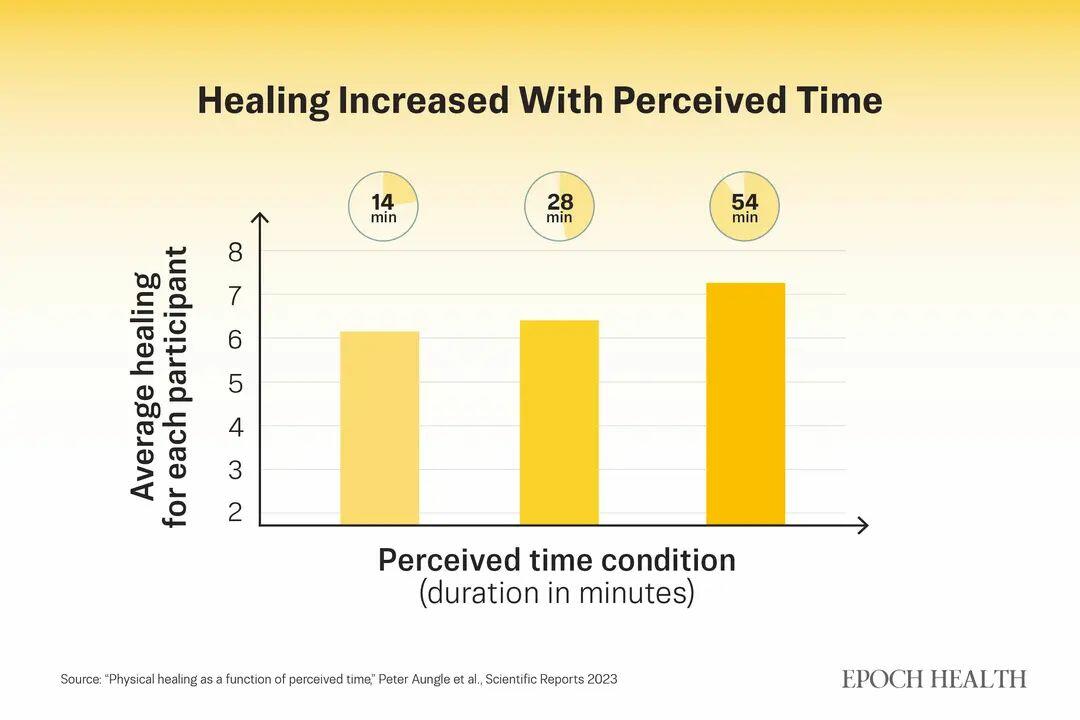
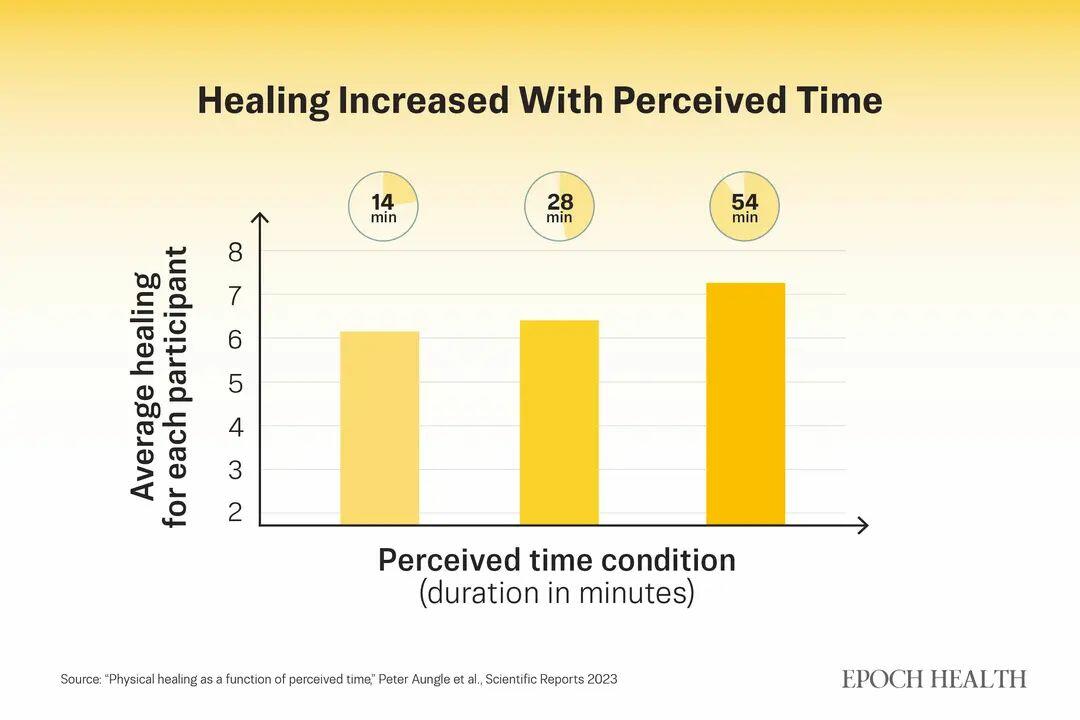
This idea was put to the test in a 2023 Harvard study. Researchers induced minor bruising on participants’ forearms and then had them sit in rooms where the clocks ran at normal speed, half-speed, or double-speed.
Illustration by The Epoch Times/Shutterstock
Crucially, the actual elapsed time was identical across all conditions—28 minutes—but the clocks ticked at different rates.
The results surprised the researchers. Wounds healed faster when people thought more time had passed, and slower when they thought less time had passed. “Personally, I didn’t think it would work,” lead author Peter Aungle told The Epoch Times. “And then it did work!”
A century ago, Albert Einstein demonstrated that time is relative—not fixed. He explained the idea with a simple, humorous example: “Put your hand on a hot stove for a minute, and it seems like an hour. Sit with a pretty girl for an hour, and it seems like a minute. That’s relativity.”
Now, psychologists and neuroscientists are finding that our sense of time is not only inherently subjective but also highly malleable.
We can’t stop the clock, but by understanding how we perceive time, we can make minutes feel longer, heal faster, and even expand our memories.
How the Mind Affects Reality
The Harvard healing experiment is a pivotal piece of evidence that mind and body are not only connected, but may be one and the same. “We weren’t really manipulating time itself. We were manipulating expectations,” Aungle said.
“If they [people] think more time has passed, they expect more healing—and those expectations can shape the body.”
Illustration by The Epoch Times.
Most people think of mind-body effects only in terms of emotion, he added. Yet, “psychology is embedded in everything the body does. I would argue the mind influences every physiological outcome to some degree.”
Expectations are not the only time bender. While believing time has sped up aids healing, high-arousal negative emotions, such as fear, significantly dilate our perception of time, making it feel slower.
In one study, participants watched frightening clips from “The Shining” or “Scream.” Afterward, a blue circle was presented in the center of the computer screen. Participants perceived that the circle lasted longer after watching frightening movies than after watching neutral or sad films.
Sylvie Droit-Volet, the lead researcher of the study, told The Epoch Times that subjective expansion is likely because “fear accelerates the internal clock, making time seem to pass more quickly and prompting action”—the fight or flight response.
Because the internal clock is ticking faster, measuring more units of time per second, the external world appears to move in slow motion. The time dilation allows the brain to process information with higher resolution during life-threatening situations.
Slowing Time
We can also make time feel longer in positive ways, such as by seeking out moments of awe.
A 2012 study published in Psychological Science found that feeling awe, whether from a story or a memory, makes time feel more abundant.
Awe acts as a reset button for the brain. It brings people intensely into the present moment. According to the “extended-now theory,” focusing on the present moment elongates time perception because we are not mentally rushing toward the future. By filling the present with vastness, awe offsets the feeling that time is slipping away, making life feel more satisfying.
The study also found that people who felt awe were less impatient, more willing to help others, and preferred experiences over material products.
We can also slow our perception of time through the practice of savoring.
“Savoring is putting a highlighter pen on our experiences,” psychologist Tamar Chansky told The Epoch Times. Savoring does not require extra duration, but rather a shift in attention.
For the time-starved, Chansky suggested taking “two more bites” of an experience—whether tasting coffee or looking out a window—to engage the brain’s awareness. This simple act creates “invisible, little expanders” within our finite days. It is a way of feeding the spirit without requiring a restructuring of one’s schedule, she said.
“We could rush through a whole day so easily … and we might feel somewhat or even very productive at the end of the day, but we might not feel good. So finding these little pockets … helps us to feel that expansion within.”
Chansky’s insight aligns with research findings that training attention, such as through meditation, can change how we perceive time.
Experienced meditators feel time passes more slowly during meditation and in their daily lives than people who do not meditate.
Being in nature also slows our experience of time.
In one study, participants overestimated the duration of a walk by nearly two minutes when it took place in nature, whereas their estimates were accurate for urban walks. Nature exposure increases mindfulness and reduces stress, states that are theoretically linked to a slowing of the internal clock. If you need to “buy” yourself a little time, you can find it in the wild. “Time grows on trees,” the study concluded.
Memories and Time
Why do childhood summers feel endless while adult years appear to fly by? The answer lies in how our brains process novelty. Our brains measure time based on how many new memories are created.
When we encounter unexpected stimuli, our brains process more information, leading to a subjective expansion of that duration. In experiments where a low-probability stimulus—called an oddball—appears in a stream of repetitive standard stimuli, the oddball, or novelty, is consistently judged to last longer.
Illustration by The Epoch Times.
“The more unique, meaningful, or changing experiences we have, the longer the stretch of time feels in memory,” Marc Wittmann, a research fellow at the Institute for Frontier Areas of Psychology and Mental Health in Germany, said. On the other hand, routine compresses time in memory by halting the recording of details it already knows. When neurons fire repeatedly in response to the same stimulus, their response diminishes; they become efficient but record less data.
Therefore, to stretch your subjective life, introduce variation.
“A fulfilled and varied life is a long life,” Wittmann told The Epoch Times. This effect is not about simply filling a schedule with busyness—it is about “deep emotional resonance with the world.” A hundred days of routine collapse into a single memory unit in the brain; a week of travel or new experiences remains distinct and expansive.
Wittmann’s recent research adds a nuance: cognitive capacity also plays a role. As we age, the perception that the last decade flew by is partly due to cognitive decline, which affects our ability to encode complex memories. However, this effect is moderate. People who stay mentally and physically fit and continue to seek novel, emotionally rewarding experiences can subjectively expand their sense of time, regardless of age.
Read the rest here…
Tyler Durden
Mon, 12/29/2025 – 22:35
https://www.zerohedge.com/medical/your-mind-can-bend-time-heres-how
These Are The Best-Selling Video Games Since 2020
These Are The Best-Selling Video Games Since 2020
Since 2020, blockbuster game launches have arrived across every major platform and in a variety of genres, from cozy life sims to sprawling open-world adventure RPGs.
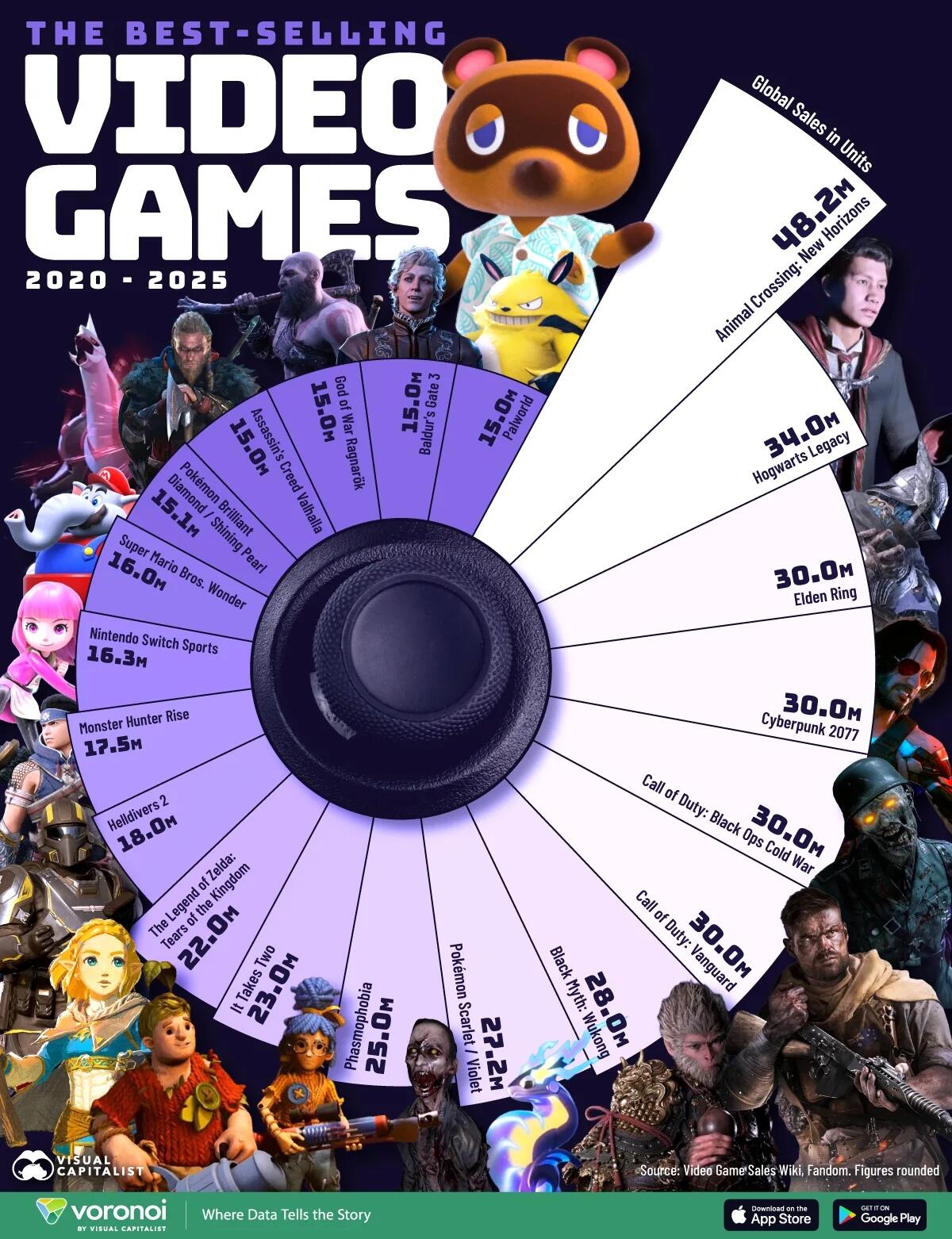
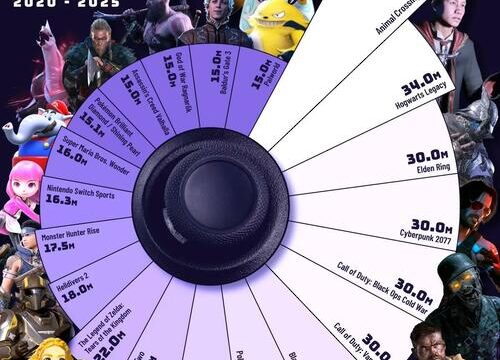
This visualization, via Visual Capitalist’s Niccolo Conte, ranks the best-selling video games from 2020 to 2025 based on global unit sales using data from Video Game Sales Wiki (Fandom).
Animal Crossing Dominates as the 2020s’ Best-Selling Game
At 48.2 million units, Animal Crossing: New Horizons stands alone at the top of the ranking.
The game released on March 20, 2020, right as much of the world began to lock down due to the COVID-19 pandemic. As such, the latest addition to the Animal Crossing series made for the perfect time-sink amidst a period of global uncertainty and inactivity.
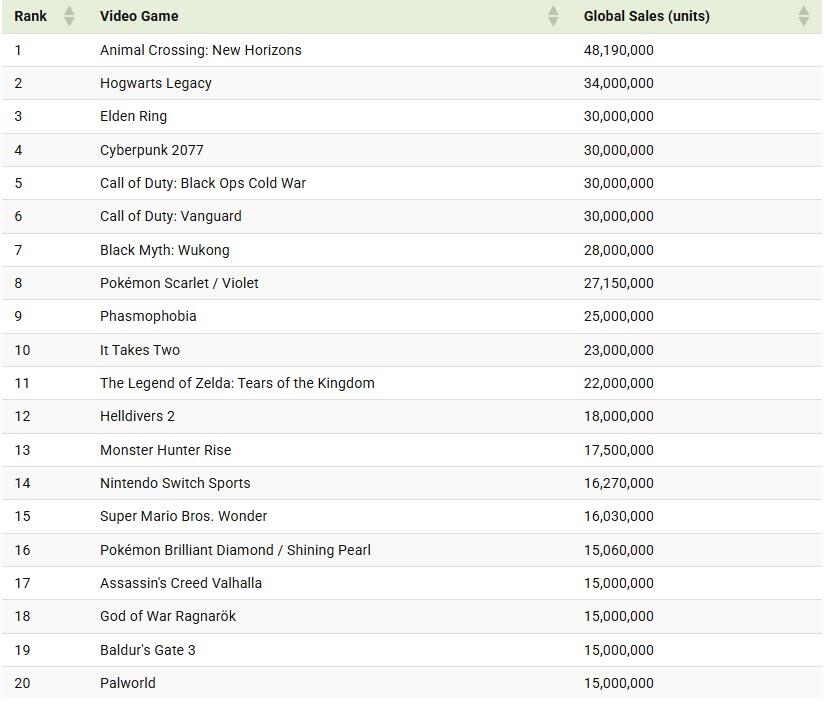
The table below shows the full ranking of the top 20 best-selling games from 2020 to 2025:
In second place is Hogwarts Legacy with 34.0 million, making the gap between #1 and #2 a sizable 14.2 million units. Hogwarts Legacy had the advantage of being tied to one of the world’s best-known franchises, Harry Potter, and delivered the open-world wizardry experience many fans had been waiting years for.
After that, the leaderboard tightens dramatically: four different games sit at exactly 30.0 million units (Elden Ring, Cyberpunk 2077, Call of Duty: Black Ops Cold War, and Call of Duty: Vanguard).
Nintendo Games Continue to Lead Sales
Several of the best-sellers are instantly recognizable Nintendo franchises. With six games in the top 20 best-sellers since 2020, Nintendo continues to be a development and publishing powerhouse in the world of gaming.
The six Nintendo titles together reached 144.7 million in sales, with no other singular publisher or developer coming close.
The company’s continued refinement of well-established franchises like Pokemon, Super Mario Bros., and The Legend of Zelda has proven fruitful, with the company still able to produce hits across genres.
With the Nintendo Switch 2 console selling well since its June 2025 launch, Nintendo’s dominance doesn’t seem like it’s fading anytime soon.
To learn more about the global video game industry, check out this graphic that breaks down video game revenue by country on Voronoi.
Tyler Durden
Mon, 12/29/2025 – 22:10
https://www.zerohedge.com/technology/these-are-best-selling-video-games-2020

Hannah Hidalgo has her 4th 30-point game of the season as No. 18 Notre Dame beats Pitt 94-59
SOUTH BEND, Ind. — Hannah Hidalgo made 13 of 23 from the field and finished with 30 points, her second consecutive 30-point game, and short-handed Notre Dame beat Pittsburgh 94-59 on Monday.
No. 18 Notre Dame (10-2, 2-0 ACC), which had just eight available players Monday, has won five in a row following a 69-62 loss at then-No. 13 Mississippi on Dec. 4.
Iyana Moore scored a season-high 23 points, which included five 3-pointers, and Cassandre Prosper added 18 points, 10 rebounds, four blocks and four steals for the Fighting Irish. Prosper is the only player in the ACC with at least four steals and four blocks in a single game this season.
Hidalgo had 30 points, 13 steals and 10 assists — the first 30-point triple-double in program history — in a 110-38 win over Bellarmine on Dec. 21. The 5-foot-6 junior has four 30-point games this season and a program-record 13 in her career.
Mikayla Johnson led Pitt (7-8, 0-2) with 22 points. Theresa Hagans and Fatima Diakhate scored 12 apiece.
Moore hit a 3-pointer to open the scoring and added another as Notre Dame jumped to a 12-3 lead just more than three minutes into the game. Moore scored in the paint to make it 27-17 at the end of the first quarter and the Fighting Irish led by double figures the rest of the way.
Hildalgo has scored 10-plus points in each game of her career. Her 78 consecutive games scoring in double figures is a program record and her 60 career 20-point games are tied with Arike Ogunbowale for most in program history.
The Irish have won nine straight against Pitt. Notre Dame leads the all-time series 38-4, 18-0 at home.
Up next
Notre Dame: At Georgia Tech on New Year’s Day.
Pittsburgh: Hosts Wake Forest on Jan. 1.
https://www.chicagotribune.com/2025/12/29/notre-dame-pitt-basketball-hannah-hidalgo/

Father of NASCAR driver Denny Hamlin dies after house fire, mother critically injured
RALEIGH, N.C. — The father of NASCAR driver Denny Hamlin died and his mother was critically injured after a weekend fire heavily damaged the North Carolina home where they lived, officials said Monday.
Firefighters arrived Sunday night at a two-story home near Stanley that was mostly engulfed in fire, with flames showing through the attic, the Gaston County Office of Emergency Management and Fire Services said in a news release.
Dennis Hamlin, 75, and Mary Lou Hamlin, 69, were found outside the home, suffering from catastrophic injuries, officials said. Dennis Hamlin later died from his injuries at a hospital, officials said.
Mary Lou Hamlin was taken to Atrium Health Wake Forest Baptist Burn Center in Winston-Salem, where she was being treated Monday, officials said.
The fire caused the structure to collapse. The cause is under investigation.
Stanley is located about 20 miles northwest of Charlotte.
The home is owned by a company called Won One Real Estate that lists Denny Hamlin as its manager, according to local property tax records and a business document filing with the North Carolina Secretary of State’s Office.
Representatives for Hamlin had not responded to requests for comment as of Monday evening.
Hamlin is one of the marquee drivers in NASCAR’s top circuit, having won 60 NASCAR Cup Series races, including the Daytona 500 three times.
The 45-year-old driver for Joe Gibbs Racing has yet to win a Cup points championship. He fell short of the title during this season’s final race in Arizona last month.
Weeks earlier, Hamlin said his father — who nearly went broke with financial sacrifices to try to get his son into NASCAR — was battling a serious illness, and that he didn’t have much time left to live.
“I know for a fact this is my last chance for my dad to see it. I don’t want him going and never getting to see the moment,” Hamlin told The Associated Press.
Hamlin also mentioned his dad in emotional testimony this month at the start of a federal antitrust trial against NASCAR brought in part by 23XI Racing, which is owned by Hamlin and Basketball Hall of Famer Michael Jordan. NASCAR, 23XI Racing and another race team reached a settlement during the trial before jurors ever deliberated.
Sainz reported from Memphis, Tennessee.
https://www.chicagotribune.com/2025/12/29/nascar-denny-hamlin-parents-house-fire/