
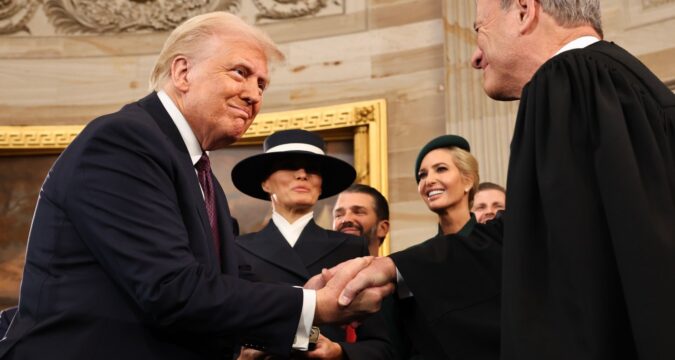
President Donald Trump begins a second term (was it that recently?) and Joe Biden leaves the stage. The Gaza conflict rages on as does Russian aggression. Fires roar in Los Angeles as a heinous scandal roils a British prime minister.
In this final look back at our editorials in 2025, we focus on our nation and world.
On Monday, British Prime Minister Keir Starmer, a former prosecutor with personal involvement in some of these old cases from around 2010 to 2015, was forced to squirm in front of the cameras as he tried to explain why the British establishment had failed so many of these girls. Starmer defended his prior actions as head of the Crown Prosecution Service and said to reporters that those now calling for a national inquiry on the so-called grooming gangs were seeking to “jump on a bandwagon of the far-right,” by which he mostly meant Musk.
It was a pathetic and frankly hopeless defense, given that many of the victims, then as young as 12 and 13 but now adults, simultaneously were all over the British media saying they were not protected and have not received adequate justice. Starmer can rail against the “far right” all he likes (a spokesperson walked the comment back a little on Monday), but it’s not “far right” to stand up against child abuse.
Jan. 12: Fires rage in Los Angeles. We send hope from another city familiar with fire.
A person uses a garden hose in an effort to save a neighboring home from catching fire during the Eaton Fire on Jan. 8, 2025, in Altadena, California.(Mario Tama/Getty)
Here in Chicago, historians see a fire in which one-third of people in this city lost their homes and at least 300 died as a unique catalyst for growth and reinvention, although it is often forgotten that the city got a lot of help from people outside its borders. Within little more than year, a visitor to Chicago could not see many visible signs of the prior destruction, and the roaring city had gained a fierce and lasting reputation for resilience and new opportunity.
Once the fires are out and losses mourned, LA will have a similar chance to look hard at the changing environment in which it lives, improve its services with the benefit of bitter experience and build back better.
For now, though, we stand with its people through the painful slog of recovery.
President Joe Biden and first lady Jill Biden welcome President-elect Donald Trump to the White House ahead of inauguration ceremonies on Jan. 20, 2025, in Washington. (Andrew Harnik/Getty)
Timing one’s necessary exit from power is, of course, one of life’s most vexing conundrums and Biden hardly is alone in blowing the moment. Biden had a 43-year career sweep, beginning in 1972 when he became one of the youngest people ever elected to the U.S. Senate and ending as an 82-year-old president. Inarguably, neither his presidency nor his total service to the American people should be defined exclusively as an old man allowing personal objectives and defensiveness to overtake everything. In the end, we came to know that the last-minute flurry of executive actions were unlikely to be coming from the man himself but rather from staffers trying to shove through their favored stuff at the eleventh hour. But it’s reasonable to assume that was not the case until the latter part of his term.
Overall, there were palpable achievements, not a few of which involved reminding Americans of the importance of core structural values as the maverick extremes of political discourse exploded in their influence. “I know that believing in the idea of America means respecting the institutions that govern a free society,” Biden said in his Wednesday farewell address. “Our system of separation of powers, checks and balances — it may not be perfect but it’s maintained our democracy for nearly 250 years.” Indeed it has. And Biden was right to affirm its importance.
Let’s not forget that if tyrants are allowed to send tanks rolling across borders not their own without invitation and with expansionist ambitions, the world must rise up in support of their quarry, lest said tyrants decide a few more borders could also fall with the right kind of violent coaxing. The MAGA crowd are very conscious of the movements of unauthorized migrants; why must they be so enabling of Putin’s far more dangerous excursions? It defies logic.
So when the U.S. voted with Russia against a United Nations General Assembly resolution Monday that was criticizing Russia for its aggressions against Ukraine of three years ago, we say “for shame.” All peace-loving people should want to an end to this war, and the realities of Realpolitik means that will come with a price we will have to swallow, but it’s a bridge way too far for the U.S. to formally balk at the notion that Putin started this war.
April 23: Pope Francis has died at 83. We pay tribute.
A nun holds a photo of Pope Francis while attending his funeral in St. Peter’s Square at the Vatican on April 26, 2025. (Andreea Alexandru/AP)
As the head of the church, Pope Francis exhibited leadership that was critical in maintaining the faith’s relevance and importance. In a world where people increasingly are less likely to attend church, they still listened attentively to the pope’s message. Among his most remembered quotes is a call for compassion: “A little mercy makes the world less cold and more just.”
Indeed, compassion was one of Pope Francis’ core tenets. So was unity: “Let us dream, then, as a single human family, as fellow travelers sharing the same flesh, as children of the same Earth, which is our common home, each of us bringing the richness of his or her beliefs and convictions, each of us with his or her own voice, brothers and sisters all.”
What American argument could possibly be made for prohibiting international students, at least beyond the tiny percentage employed as some kind of spy? The benefits flow both ways: loyalty to America from such graduates has long been a major source of U.S. soft power and, of course, their full tuition, typically, which boosts the local economy and often subsidizes low-income domestic students. And who beyond a xenophobe could possibly believe that one’s education is not enhanced by a classmate from elsewhere in the world, a truth that applies to kindergarten just as much as at Harvard?
California National Guard members and Marines hold back demonstrators at the Federal Building during a protest on June 14, 2025, in Los Angeles. (Noah Berger/AP)
In his latest pivot, Trump now says that he plans to focus his deportation on the unauthorized residents of major American cities (the usual suspects, including Chicago), which also happen to be where he has the most local political opposition, allowing for the kind of performative political fights he relishes.
So we will say again: There is considerable support among the American people for the deportation of criminals in the U.S. without legal permission. There is also support for focusing the nation’s immigration enforcement on recent arrivals who already have exhausted the due process afforded them by the courts. This was the approach during the Obama administration.
But we do not see support for mass, militarized operations in major cities targeting people who’ve lived productive lives here for decades and working hard to support their families.
Americans put aside their worries, prejudices and battle scars to come together for the country’s 200th birthday. A wave of patriotism and nostalgia swept the nation, ushering in a renewed commitment to the ideals of liberty and equality enshrined in the Declaration of Independence.
In his aptly named autobiography, “A Time to Heal,” President Ford accurately described the bicentennial as a moment when Americans began to recover their pride and faith in the country. That was 50 years ago.
Can it happen again next year for the 250th? Yes. The American people can come together to demonstrate their resilience and work toward a more perfect union. If that sounds impossible, consider how impossible it sounded in 1976.
Gary Rush of College Park, Maryland, holds a sign before a news conference on the Jeffrey Epstein files in front of the Capitol on Nov. 18, 2025, in Washington. (Mariam Zuhaib/AP)
Any fool knows that many powerful and well-known men were joining in Epstein’s sex trafficking activities at his homes in the U.S. Virgin Islands and elsewhere. Their names came up in the many civil cases surrounding Epstein, especially the one brought by Virginia Giuffre, who killed herself at her home in Neergabby, Western Australia, on April 25.
None of these men have admitted their guilt. Of all the men, only Prince Andrew has suffered notable reputational consequences, but even he has insisted on his innocence and remained uncharged and at liberty. Everyone else, often with the help of powerful lawyers and crisis PR firms, has been allowed to keep silent on the matter and quietly slip back into their normal lives. In some cases, the very newspapers that reported on Epstein in tones of moral outrage have then published flattering pieces about some who several victims have claimed were within Epstein’s orbit.
Justice Brett Kavanaugh, from left, Justice Amy Coney Barrett and retired Supreme Court Justice Anthony Kennedy listen as President Donald Trump addresses a joint session of Congress at the U.S. Capitol in Washington on March 4, 2025. (Win McNamee/Getty-AFP)
Here was the part of her remarks that most hit home with us: “We know how to argue, but we also know how to do it without letting it consume relationships.”
The legal profession has long operated this way. That it continues to do so despite mounting partisan pressure is an example worth noting for the rest of us. Coney Barrett, of course, is no stranger to vitriol. The justice, who joined the high court in October 2020, was called a “religious bigot” and a “monster” during her confirmation hearings. Her family, too, has endured attacks — from criticism of her adopted children to a bomb threat against her sister earlier this year. Point is, she’s dealt with fierce criticisms and personal attacks directly. Yet here she stood, speaking with all sincerity about the importance of respectful discourse.
Oct. 3: Hamas rejects a peace proposal for Gaza. We say that Hamas must end this war.
Palestinians celebrate following the announcement that Israel and Hamas have agreed to the first phase of a peace plan to pause the fighting, in Khan Younis, southern Gaza Strip, Oct. 9, 2025. Celebrations remain limited, as relief is mixed with mourning and concern for what comes next. (Jehad Alshrafi/AP)
The Trump plan has a lot going for it, and we think it is important for our readers to understand at the outset that it is different from Trump’s prior musings about U.S. control of Gaza or fanciful talk of Trump-branded resorts. This plan is substantive.
Even those who despise Trump in general and are protesting his broader immigration policies should consider this plan, clearly the work of Trump’s capable special envoy Steve Witkoff, on its own terms. Not every crucial message has an ideal messenger.
Now to the 20-point plan, which clearly states that Gaza is to be redeveloped for the benefit of its people “who have suffered more than enough,” which is the right core goal, the right description of Gaza’s suffering — and maybe even a portal for Hamas to claim victory. The plan also says that, on acceptance by Hamas, the war will immediately end.
As it should. There is no viable argument otherwise.
Submit a letter, of no more than 400 words, to the editor here or email letters@chicagotribune.com.


