Category: News

Movies for winter 2026: Post-apocalyptic thrillers, crime stories and gothic romance
Consider this ominous headline from late last year: “October Box Office Plunges to Three-Decade Low.” For exhibitors and studio bean counters, a down month is never good news. But let’s also consider how absurd it is that audiences are expected to just be as invested in Hollywood profits as the executives running the show.
On the other hand, according to Cinema United, the movie exhibition trade association, last year saw moviegoing by Gen Z grow by 25% — the highest increase of any demographic. Gen Z is also the first generation to have come of age during the great disruption caused by streaming. Turns out, people want what they’ve always wanted: A reason to leave the house for a couple of hours and be entertained.
The bigger financial questions surrounding the long and short-term viability of the movie industry are out of our hands, which means our only job as moviegoers is to pick and choose what we want to see. So let’s commit to a New Year’s resolution to stop talking about movies in terms of box office. What’s happening on the screen is so much more interesting anyway.
“28 Years Later: The Bone Temple”
Filmmaker Nia DaCosta’s interests as a director run the gamut, from horror (the “Candyman” remake) to popcorn films (“The Marvels”) to her recent update and reimagining of the play “Hedda Gabler.” She circles back to horror with this sequel to the post-apocalyptic “28 Years Later.” Ralph Fiennes leads the ensemble cast. In theaters Jan. 16.
From left: Matt Damon and Ben Affleck star in “The Rip.” (Warrick Page/Netflix)
“The Rip”
Old pals Ben Affleck and Matt Damon team up on screen once again, this time in a crime thriller. Here’s the official description: “Upon discovering millions in cash in a derelict stash house, trust among a team of Miami cops begins to fray. As outside forces learn about the size of the seizure, everything is called into question — including who they can rely on.” Screenwriter Joe Carnahan says the idea came out of a “deeply personal experience that my friend went through, both as a father and as head of tactical narcotics for the Miami-Dade police department.” On Netflix Jan. 16.
Dylan O’brien (bottom) and Rachal McAdams in “Send Help.” (Brook Rushton/20th Century Studios)
“Send Help”
A plane crashes and a woman (Rachel McAdams) and her jerk of a boss (Dylan O’Brien) are the only survivors, now stranded on a deserted island. Didn’t Anne Heche and Harrison Ford already do this in 1998’s “Six Days, Seven Nights”? Well, this one’s way more ominous, directed by “Spider-Man’s” Sam Raimi. In theaters Jan. 30.
“Dracula: A Love Tale”
Director Luc Besson reimagines the vampire story as a tragic romance. The movie opened in Europe late last year, with one critic describing it as Dracula meets “Pride and Prejudice”: “While it almost certainly does not work on any narrative level, it remains compulsively watchable throughout thanks to writer-director Luc Besson‘s flair for the preposterous.” In theaters Jan. 30.
From left: Harry Melling and Alexander Skarsgård star in “Pillion.” (A24)
“Pillion”
If you want the elevator pitch, this is Alexander Skarsgård’s gay biker romance, which premiered at Cannes last year, prompting this observation in Variety: “With lots of kinky gay BDSM sex scenes, elaborately choreographed orgies, full-frontal nudity and men in rubber, ‘Pillion’ has easily been among the most sexually graphic films of Cannes so far (and also one of its most warmly received).” According to co-star Harry Melling (as the submissive partner), the movie’s themes are “relatable and familiar, but maybe dealing with a subculture that people aren’t so familiar with. It’s how those two things interplay that I found so fascinating … taking romantic comedy tropes and subverting them.” In theaters Feb. 6.
From left: Jacob Elordi and Margot Robbie and “Wuthering Heights.” (Warner Bros.)
“Wuthering Heights”
Based on her resume so far, Emerald Fennell might be the most vibes-based filmmaker of the moment, judging by her visually specific but thematically shallow efforts with “Saltburn” and “Promising Young Woman.” This time she’s adapting the Emily Bronte 1847 novel about the stormy relationship between Catherine (Margot Robbie) and Heathcliff (Jacob Elordi). In theaters Feb. 13.
“Good Luck, Have Fun, Don’t Die”
A sci-fi action adventure from Gore Verbinski (“Pirates of the Caribbean”) that has artificial intelligence on the mind. A man from the future (Sam Rockwell) travels back in time to strong-arm the patrons of a diner into helping him fight a rogue AI. Variety got an early look when the film premiered last fall at Fantastic Fest, calling it “unapologetically irreverent, wildly inventive, end-is-nigh take on the time-loop movie — call it ‘Terminator 2: Groundhog Day’ — except that here, Rockwell’s dizzy protagonist knows what it takes to stop the cycle.” In theaters Feb. 13.
From left: Monica Barbaro and Chris Hemsworth in “Crime 101.” (Dean Rogers/Amazon MGM Studios)
“Crime 101”
Halle Berry and Chris Hemsworth star in this crime thriller (title sorta gave the genre away) about a burned out insurance broker (Berry) who gets caught up in a multi-million dollar heist organized by a jewel thief working one last job (Hemsworth). Mark Ruffalo plays the LAPD detective on the case. In theaters Feb. 13.
“Man on the Run”
As a pop cultural figure, Paul McCartney’s life and work has been endlessly documented. I don’t know if the world is clamoring for more, but here we are regardless. According to McCartney’s official website, the film will take viewers on an “intimate journey through Paul McCartney’s extraordinary life following the break-up of The Beatles and the formation of Wings with his wife, Linda.” On Amazon Feb. 25.
“Whitney Springs”
A live-action musical comedy from “South Park” creators Trey Parker and Matt Stone about an interracial couple: A Black guy finds out his ancestors were enslaved by the ancestors of his white girlfriend. An additional twist: He works at a living history museum as a reenactor, playing an enslaved person. The script is from “South Park” alum Vernon Chatman. Kendrick Lamar is also a producer. In theaters March 20.
“Project Hail Mary”
Adapted from the 2021 novel of the same name, Ryan Gosling stars in the sci-fi adventure as a guy who wakes up on a spacecraft with no memory of who he is or why he’s there. Slowly, he figures out that he’s the sole surviving crew member of a team searching for a solution to a catastrophic event back on Earth. Directed by Phil Lord and Christopher Miller (“21 Jump Street”). In theaters March 20.
“The Dog Stars”
Another post-apocalyptic story. So much apocalyptism these days, you think Hollywood decision-makers are feeling pessimistic? This one’s from director Ridley Scott and is based on the 2012 novel by Peter Heller. It takes place after a pandemic wipes out a chunk of the population, leaving behind a pilot (Jacob Elordi) and his dog, plus a grouchy ex-Marine (Josh Brolin). They live a lonely existence in an airplane hangar until, one day, a mysterious transmission comes through the radio. Are there other survivors? In theaters March 27.

TV for winter 2026: A new ‘Game of Thrones’ spinoff, ‘Bridgerton’ returns and Nicole Kidman leads a new series
The overriding theme defining television in recent years has been a fear of the new. Which is why reboots and spinoffs continue apace, with old titles brought back from the dead (“Scrubs”) or from the not-so-distant past (“The Night Manager”) and intellectual property milked within an inch of its life (somehow HBO has yet another “Game of Thrones” series coming our way).
It’s as if everyone in Hollywood ran out of new ideas all at once. Don’t blame writers, but executives who are rapidly shepherding their industry towards irrelevance with an over-reliance on reworked IP, while original ideas are left unproduced. In better news, the winter Olympic Games are this year, with the opening ceremony taking place Feb. 6 on NBC. (The Super Bowl is that Sunday as well.)
“The Pitt”
The Pittsburgh-set medical drama from “ER” showrunner John Wells is back for a second season, premiering almost exactly a year after it first debuted. Imagine, a streaming series returning on a reliable schedule! Dr. Robby (“ER” veteran Noah Wyle) is back once again, overseeing the managed chaos, student doctors and medical residents of his emergency department. One of the best examples of competency as comfort, something we could all use more of at the moment in real life. From Jan. 8 on HBO Max.
Tom Hiddleston in Season 2 of the spy drama “The Night Manager.” (Des Willie/Amazon)
“The Night Manager”
Stylish and prestige-y as hell, Season 1 of this Tom Hiddleston spy drama premiered (squints) eight years ago. Welp, this is how TV works today. Season 2 follows Hiddleston’s character across the UK, Spain, Colombia and France as he “races to expose a conspiracy designed to destabilize a nation.” From Jan. 11 on Amazon.
“Hijack”
The first season of this “Die Hard” ripoff starring Idris Elba took place on a seven-hour flight from Dubai to London. For the entirely unnecessary second season, the setting is now a subway in Berlin that’s been taken hostage. If Elba’s character doesn’t say “Why does this keep happening to me?!” at any point, then what are we even doing here? From Jan. 14 on Apple TV.
“Ponies”
“Game of Thrones” alum Emilia Clarke stars in this 1977-set Cold War thriller about two women (the other is played by Haley Lu Richardson) who become CIA operatives after their husbands are killed under mysterious circumstances in Moscow. The pair become “ponies” in the parlance — persons of no interest — in order to uncover the truth of what really happened. From Jan. 15 on Peacock.
Peter Claffey in “A Knight of the Seven Kingdoms.” (Steffan Hill/HBO)
“A Knight of the Seven Kingdoms”
Another “Game of Thrones” spinoff. A prequel, this one takes place a hundred years before the events of “GoT,” as two unlikely heroes wander through Westeros: “A young, naïve but courageous knight, Ser Duncan the Tall, and his diminutive squire, Egg. Set in an age when the Targaryen line still holds the Iron Throne, and the memory of the last dragon has not yet passed from living memory, great destinies, powerful foes, and dangerous exploits all await these improbable and incomparable friends.” From Jan. 18 on HBO.
“Steal”
Here I am typing “Game of Thrones” again because the show’s alum Sophie Turner returns to TV in this thriller about a heist at a British pension fund investment company: “But who would steal billions of pounds of ordinary people’s pensions and why? DCI Rhys (Jacob Fortune-Lloyd) is determined to find out, but as a recently relapsed gambling addict, Rhys must keep his own money problems at bay while dealing with the secret agendas and competing interests at the center of this far-reaching crime.” From Jan. 21 on Amazon.
From left: Fleur Geffrier and Tomohisa Yamashita in Season 2 of “Drops of God.” (Apple TV)
“Drops of God”
I really liked the first season of this emotionally engrossing drama about two young wine experts who battle for a massive inheritance. The series was also criminally underseen, likely because: 1) Apple’s approach to promotion leaves much to be desired; 2) there are no recognizable (American) stars; and 3) that title, which makes sense once you’ve seen the show, but otherwise … nope. It’s back for a second season and if you’ve been missing that frisson of discovery in your TV viewing, this one is worth seeking out. From Jan. 21 on Apple TV.
“Bridgerton”
Not a fan of this show, but plenty are, so mark your calendars. The Shonda Rhimes historical romance returns for Season 4, with a focus on the family’s second-eldest son, Benedict Bridgerton (Luke Thompson), who falls for a servant who sneaks into a masquerade ball. Netflix is chopping the season into two parts. From Jan. 29 on Netflix; the second half premieres Feb. 26.
“Dark Winds”
This adaptation of Tony Hillerman’s Leaphorn & Chee novels, with their stories of the Navajo Tribal Police in the 1970s, continues with a fourth season about a missing Navajo girl, which takes our investigators out of their usual setting and sends them to the underbelly of organized crime in Los Angeles. A tick or two better than your typical cop show, star Zahn McClarnon is reason enough to watch. From Feb. 15 on AMC.
Zack Braff (top) and Donald Faison in “Scrubs.” (Jeff Weddell/Disney)
“Scrubs”
The medical comedy from the early aughts is back, reuniting the old gang: J.D. (Zach Braff), Turk (Donald Faison), Elliot (Sarah Chalke), Carla (Judy Reyes) and John C. McGinley’s memorably tangy Dr. Cox. New cast members include Vanessa Bayer and Joel Kim Booster. The premise appears to be the same as it was, picking up where the show left off. From Feb. 25 on ABC.
“Scarpetta”
A crime thriller based on Patricia Cornwell’s book series about the forensic pathologist Kay Scarpetta, played by Nicole Kidman. According to the marketing blurb: “With skilled hands and an unnerving eye, this unrelenting medical examiner is determined to serve as the voice of the victims, unmask a serial killer, and prove that her career-making case from 28 years prior isn’t also her undoing. Set against the backdrop of modern forensic investigation, the series delves beyond the crime scene to explore the psychological complexities of both perpetrators and investigators, creating a multi-layered thriller that examines the toll of pursuing justice at all costs.” From March 11 on Amazon.
https://www.chicagotribune.com/2025/12/30/tv-for-winter-2026/

Kazakhstan Crude Production Dips 6% After Black Sea Drone Attack
Kazakhstan Crude Production Dips 6% After Black Sea Drone Attack
By Charles Kennedy of OilPrice.com,
Following the Ukrainian drone attack that damaged a key export terminal on Russia’s Black Sea at end-November, Kazakhstan’s crude and condensate production has fallen by 6% so far in December compared to the average output in November, an anonymous industry source told Reuters on Monday.
A Ukrainian attack damaged infrastructure through which the Caspian Pipeline Consortium (CPC) exports most of Kazakhstan’s oil near the Russian port of Novorossiysk on the Black Sea.
Oil has continued to flow, but at lower rates, while Kazakhstan sought to re-route some exports away from the Black Sea to keep supply relatively steady.
CPC operates the pipeline from the Caspian coast in northwest Kazakhstan to the Novorossiysk port, which handles 80% of Kazakhstan’s crude exports from giant oilfields operated by international oil firms.
Affiliates of Chevron and ExxonMobil are also minority shareholders in CPC, with the Russian Federation as its largest shareholder with a 24% stake.
As a result of the damaged infrastructure at the CPC export terminal, crude and gas condensate output from Kazakhstan dropped by 6% between December 1 and 28, down compared to an average of 1.93 million barrels per day (bpd) in November, according to Reuters’ source.
Production at the giant Tengiz oilfield on the Caspian Sea, operated by a consortium led by Chevron, has also fallen this month. Output dipped by 10% to 719,800 bpd in the period December 1 through December 28, the source told the publication.
Earlier this month, Kazakhstan said it would reroute some of the oil from at its giant Kashagan oilfield toward China.
In view of urgent repairs at one of three single-point moorings and deferred loadings, Kazakhstan works on rerouting part of its crude exports, Kazakhstan’s Energy Ministry told Reuters nearly three weeks ago.
Kazakhstan is also diverting more of its westbound exports to the Baku-Tbilisi-Ceyhan (BTC) pipeline to the Turkish Mediterranean coast after the attack, multiple industry sources told Reuters in early December.
Tyler Durden
Tue, 12/30/2025 – 06:30
https://www.zerohedge.com/markets/kazakhstan-crude-production-dips-6-after-black-sea-drone-attack

Graduates of Sandburg, Marist win gold at international fishing competition
Due to snowy and freezing weather, it took the USAngling Youth Bass team 53 hours to get home from South Africa.
It was supposed to be a mere 23-hour trip.
Once they made it home Dec. 14, they were treated to single-digit temperatures after spending a little over a week sweating in temps in the 90s.
“It was crazy,” said Orland Park’s Nate Uldrych, who is one of the 13 members of the team. “Coming back off that plane, a wave of ice came over our bodies.”
As for the rest of the trip?
“It was flawless,” he said. “Every single thing about the trip you could script out as being perfect.”
The United States won the gold medal at the Tri-Nations Cup at Loskop Dam in Mpumalanga, South Africa in early December.
This is the second year of the event. Last year, the team accepted a last-minute invitation, was not prepared and finished last.
This year was a different story as USAnglers pulled in 200-plus fish totaling more than 420 pounds, more than 100 pounds better than runner-up South Africa.
Area members of the national team were Uldrych, Adrius Stankus, Scotty Miklos and Caleb Moore.
Stankus and Uldrych and Miklos are Sandburg High School graduates from Orland Park who helped lead the Eagles to a third-place finish in the Illinois High School Association state meet at Lake Shelbyville in June.
Moore is a sophomore at Marist who is a rising star on the angling circuit.
Anglers on the team also came from Michigan, Arkansas, Georgia, Louisiana and Alabama.
The USAnglers won the Tri-Nations Cup in South Africa. (Nate Uldrych)
Sandburg coach Jason Uldrych, Nate’s father, is also the USAnglers head coach. He said it was a world of difference in 2025 compared to 2024, when it was held in Zimbabwe in uncomfortable heat and humidity that reached triple digits.
“Last year we were not able to prepare,” he said. “There was nothing online about the lake, so our hands were tied as far as knowledge goes. And we never fished in weather conditions like that. We’ve never been that close to the equator.
“But every day we got better in competition and won the last day.”
This year?
Those who think bass fishing is just dipping a line in the water don’t know these elite anglers. Technology and communication come to play big time and the USA brought the goods, including a tech foot-long map to help with strategy.
That paid off.
“We didn’t know we would slap them by 100 pounds,” Jason said of the lopsided victory.
Sandburg graduate Nate Uldrych shows off a catch during a tournament in December in South Africa. (Nate Uldrych)
Nate said using LiveScope technology, which allows anglers on the boat to see what’s under water, was a boon to the team. But communication among the boats was even more essential to finding some of the hotspots.
“It was shocking how well our team worked together,” Nate said. “Having half or our team being complete strangers and being able to work together as well as we did — we went from strangers to family overnight.”
He said team members made a vow to try to get together once a year because they enjoyed fishing with each other so much.
The competition started out with one of the organizers warning the anglers this was going to be a tough event.
“December is their hardest time of year,” Nate said. “Going into the tournament, the South African director said the fishing would be the hardest it will ever be — ever.”
They were told the area hosted multiple tournaments that pressured the fish and with the sun beating down and no clouds, the fish would not react.
That didn’t stop the USA from dominating, although it took a little while to get going.
“The first day was a grind,” Nate said. “I went 10 hours without a single bite. But I wasn’t disappointed and I kept my head up because you cannot be selfish.
“The next day, I was with my partner Adrius and we ended up catching 26 pounds. It can turn around just like that.”
It was a big year for the Uldrych family and Sandburg. Aside from the strong IHSA finish, the Eagles won their second straight Illinois Bass Anglers Sportsman Society team of the year award for its success in five events.
“We had a great season,” Jason said. “And winning the gold in South Africa was icing on the cake.”
Jeff Vorva is a freelance reporter for the Daily Southtown.
https://www.chicagotribune.com/2025/12/30/graduates-sandburg-marist-international-fishing-medal/

Forest Glen 5-bedroom home with 2 fireplaces, custom cherry built-ins: $1.2M
Address: 6420 N. Navajo Ave., Chicago
Price: $1,150,000
Listed: Dec. 2, 2025
This five-bedroom brick Colonial home has four full bathrooms, one half bath and a main-floor office with backyard views. The kitchen is equipped with white cabinetry, quartz countertops, a center island with a prep sink and seating and a bay window with a built-in bench and desk space. The family room features 11-foot ceilings, custom cherry built-ins and a fireplace. A second fireplace anchors the living room, along with detailed crown molding and oversized windows. The backyard has a brick paver patio, a seat wall and an updated irrigation system. The primary suite offers dual walk-in closets, a bathroom with heated floors and a rain shower, and French doors opening to a balcony overlooking the yard. An attached two-car garage completes this home.
Listing agent: Jarret Jarvis, Compass, 224-801-2160
(Real Vision)
(Real Vision)
(Real Vision)
(Real Vision)
(Real Vision)
(Real Vision)
(Real Vision)
(Real Vision)
Some listing photos are “virtually staged,” meaning they have been digitally altered to represent different furnishing or decorating options.
To feature your luxury listing of $1,000,000 or more in Chicago Tribune’s Dream Homes, send listing information and high-res photos to ctc-realestate@chicagotribune.com.
https://www.chicagotribune.com/2025/12/30/forest-glen-home-of-the-week-cherry/
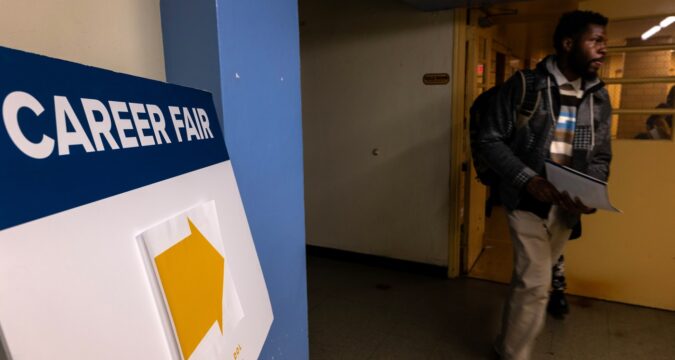
Americans facing a tough job market in 2025 won’t get a break next year
This year was a difficult one for Americans looking for work. Forecasters don’t see much improvement in their prospects coming in 2026.
The unemployment rate is set to remain elevated through almost all of next year despite solid economic growth, according to economists surveyed by Bloomberg. That unusual combination owes to the growing role of investments in artificial intelligence in powering the expansion without boosting hiring, some say.
A stagnant labor market likely means another year of limited job opportunities and cooling wage increases, exacerbating affordability concerns for American families heading into the midterm elections. It also spells an even greater reliance on the health-care sector, which accounted for nearly all job growth in 2025.
“A lot of the GDP growth we’re getting is from AI infrastructure investments, which don’t generate very many jobs, and there’s some displacement from AI,” said Diane Swonk, chief economist at KPMG. “We don’t know how much that is yet. It looks like it’s only the beginning phases of it.”
While economists say the U.S. isn’t in a recession, the second half of 2025 probably felt like it for many job-seekers. In the five months from June to November, the unemployment rate rose half a percentage point, to 4.6% — a rare development outside of business-cycle downturns.
Those with four-year college degrees were hit particularly hard, reflecting an ongoing hiring freeze across so-called white-collar occupations. While their unemployment rate remains somewhat below that for lesser-educated workers, young college graduates have seen their historical advantage in the job search disappear this year.
Hiring rates, meanwhile, looked even worse — low enough that, in decades past, they would have been consistent with even higher levels of unemployment. And layoff announcements have picked up in recent months, adding to Americans’ malaise about the job market.
Workers outside of health care, in particular, have had a difficult go of it: Excluding that sector, nonfarm payroll employment actually fell in the first 11 months of 2025.
There are some positives for the outlook. The Federal Reserve has cut interest rates this year and is expected to continue doing so in 2026, and tax cuts alongside some potential easing in the Trump administration’s trade policies — a major source of uncertainty for small businesses this year — should also help, said Michael Pugliese, a senior economist at Wells Fargo & Co.
But first, there is “probably still a little more labor-market weakening to go, whether that’s another tick or two higher in the unemployment rate,” Pugliese said.
All of that has already added up to slower wage growth as the balance of power in the labor market has continued to shift from workers to employers. It’s a sharp turnaround from 2022 and 2023, when workers had the upper hand and employers were forced to offer higher pay to attract talent.
A Harris Poll conducted for Bloomberg News in October showed 55% of employed Americans were concerned about losing their jobs, and nearly half said they thought it would take at least four months to find a new job of similar quality if they lost their current position.
Various measures of wage growth show pay is now rising at the slowest rate in four years, and low-earners are seeing pay rise by less than top earners — worsening the so-called “K-shaped economy” trend of widening inequality this year.
That’s a risk for Republicans, who were elected to majorities last year in part due to widespread anger over rising prices that exacerbated cost-of-living concerns, as they head into the 2026 campaign season.
“Overall wage growth will likely come close to the pace of inflation, and likely maybe even go a little above overall inflation,” KPMG’s Swonk said. “But the problem is the distribution of wages.”
Black unemployment
Inequality is also increasingly noticeable in who is being hired in the first place. Black Americans have seen their unemployment rate shoot higher over the last several months — to 8.3% in November, from 6% in May — and the ratio of Black to White unemployment now matches the highest level since 2019.
While some of that increase reflects more Black Americans joining the labor force, Black workers historically have been disproportionately impacted whenever the U.S. job market loses steam. The Trump administration’s efforts to shrink the federal workforce, where Black workers are overrepresented, has only added to the difficulties they’ve faced in an already-challenging employment landscape this year.
Michelle Holder, an economist who studies labor-market outcomes for Black Americans, said there is a risk Black unemployment continues to trend higher in 2026.
“Even if the overall unemployment rate continues to revolve around the same 4.6% level, trends are pointing that the fallout of a stagnant economy is increasingly falling more and more heavily on the shoulders of Black workers,” Holder said.
Economists surveyed by Bloomberg said they expect gross domestic product to grow 2% in 2026, powered by solid consumer spending and strong business investment. Yet hiring is set to remain muted as in 2025, and the unemployment rate will be higher on average next year than this year, according to the median estimate.
While respondents said they anticipate the unemployment rate could fall slightly by the end of 2026, Veronica Clark, an economist at Citigroup Inc., warned the risks are “skewed toward worse outcomes” if hiring fails to pick up.
“This has been a very prolonged period of such low hiring that until that changes, you would be worried that the next step would be larger layoffs,” Clark said.
(With assistance from Dana Morgan.)

From hoops to oysters: Inside the unexpected second acts of WNBA stars
After seven days of wind, the morning is finally calm enough on New York’s East Moriches Bay for Sue Wicks to jetty her boat to check on her oysters. Hundreds of cages pop out at odd angles from their lines, and a few float away.
The retired WNBA star and Hall of Famer admits that the aquaculture farm she started at age 50 can be anxiety-inducing and compares it to her time playing basketball.
“Some days you’re like, ‘Why am I doing this?’ You’re injured, you’re hurt, you are losing, things are going bad. And then the next day you go back and do it again because you love it,” she said.
Wicks, 59, has worked as a commentator, college basketball coach and at a fitness start-up since retiring from the WNBA in 2002, and says she feels lucky to again find a career “that works for my soul.” But the reality is that even a successful run as one of the world’s best basketball players didn’t earn her enough to fully retire.
Although the WNBA is bringing in more than ever from sponsors and ticket sales, many players still find themselves financially unsteady when the final whistle blows.
“The choice is what they do as their second career, not whether they have a second career,” said Risa Isard, director of research and insights at women’s sports marketing platform Parity. Since “women athletes get paid a fraction of what men do while they’re playing,” Isard said their next acts tend to look more like traditional career paths rather than managing substantial investment portfolios.
The average NBA salary is around $11.9 million, according to data reviewed by The Associated Press. That’s nearly 100 times what the WNBA says is the average salary of $120,000 for its players — although major differences in league size, age, profit margins and media contracts account for part of that gap.
For 2009 second overall draft pick and 2015 WNBA All-Star Marissa Coleman, the main difference between post-playing careers between WNBA and NBA players is that “most NBA guys are sitting on tens, sometimes hundreds of million dollars.” And for those who are financially savvy, working after the game is “more so curing boredom versus a necessity.”
“Most women athletes across the board have to find a career after basketball out of necessity,” Coleman said.
All this is happening against a backdrop of unresolved questions about the future of WNBA player compensation. Tensions have run high in the ongoing labor battle between the WNBA and the players’ union, although it is unclear how far apart the sides are in terms of compensation. Both parties agreed on Nov. 30 to an extension of the current collective bargaining agreement to Jan. 9 while negotiations continue.
A major sticking point has been revenue sharing: As the WNBA booms, players are looking for a larger share in that growth. They currently earn a significantly smaller fraction of the league’s revenue compared with NBA players.
When former Minnesota Lynx forward Devereaux Peters transitioned from basketball to real estate development in 2019, she said the hardest lesson was learning that working hard in her new career may not be enough to yield results quickly, or at all. After a tough game during her playing days, she could “go in the gym and shoot and work on my shot. And you’re going to see a result if you’re putting in the work.”
“That is not necessarily true in the real world,” said the 36-year-old. “You can put in a ton of work and do a lot right and not get anywhere.”
The shift away from basketball also came as a financial shock: “That transition was a little bit difficult in that I had to cut back significantly,” she said. “There was a lot of learning very quickly” given the “big gap in what I was making then and what I make now.”
For the last six years, Peters has shepherded an affordable housing project in South Bend, Indiana — home to her alma mater, Notre Dame. Red tape, politics, and myriad other logistical challenges have made the project “the hardest thing I’ve ever done in my life,” Peters said.
But she says it’s also the best: “Helping people that truly, genuinely need it” makes it all worth it. Her affordable apartment building is slated to break ground next month, and open its doors in August 2027.
For 38-year-old Coleman, the next phase of her career also unfolded far outside the paint. Alongside former teammate Alana Beard, Coleman franchised a Mellow Mushroom — a psychedelic-themed pizza chain — in Roanoke, Virginia. She also chaired a campaign to legalize sports betting in Maryland, and now leads strategy and growth for the VIP team at fantasy sports platform Underdog, with the aim of carving space for more women and people of color to access the industry.
“I knew from a very early age entrepreneurship and business were something that I was really, really passionate about,” Coleman said.
She added that she feels grateful to her parents for emphasizing the importance of education and long-term career planning. Thanks to their wisdom, she made sure to seek out mentors and explore industries that interested her throughout her basketball career.
“I knew I didn’t want to be one of those players that retired, and it was like, ‘Oh gosh, what now?’” Coleman said.
Many former athletes land in sports-related roles, such as coaching or sports broadcasting. But not all are surefooted in finding their next calling.
Jayne Appel Marinelli, SVP of player relations for the league’s union and a former center for the San Antonio Stars, counsels players on their post-basketball career path. She explained the transition remains challenging for many, even with the WNBA and union’s joint tuition assistance and internship program, and semester-long opportunity with Harvard Business School, which Coleman completed.
The players’ union has worked to further expand opportunities by adding player internship slots to licensee contracts, partnering with universities and more, according to Appel Marinelli. Athletes “sometimes need help recognizing that the skills that they have built are so easily transferable over to any role that they’re going to take on next,” she said.
That kind of support didn’t exist for Wicks’ generation at the league’s inception in 1997. There “was no stability in women’s sports,” she said. “Our victory was, we got our next paycheck, and that the lights were on and that the bus was waiting there still.”
Back then, “my dream was that the league would exist,” Wicks said. Almost 30 years later, her new dream is that players “are compensated in a way that gives them freedom to do what they want in life.”
Despite her own post-WNBA success, Peters says players could use more guidance to help them understand how to plan, save and prepare for the future.
“The general lifespan of a basketball player is not long,” she said. “You have to be prepared to not be here tomorrow or the next year.”
AP Sports Writers Doug Feinberg in New York and Tim Reynolds in Miami contributed to this report.
Retired WNBA All-Star Marissa Coleman poses for a photo in Mitchellville, Md., Tuesday, Dec. 9, 2025. (AP Photo/Allison Robbert)
https://www.chicagotribune.com/2025/12/30/wnba-stars-second-act/

The best food photos of 2025 by Chicago Tribune photographers
Photographing in some of Chicago’s finest dining establishments can be quite a contradiction to the normal day for Chicago Tribune photojournalists. In the course of a day, our photographers might start at an overnight crime scene, maybe a building fire, could go to City Hall or a school event. But when we walk into restaurants that feature Michelin-starred menus or Beard Award-winning chefs, our photojournalists really have to change gears. Food photography is an art unto itself. The quality of the light and final photographs needs to match the level of amazing dishes, drinks and servers that will be featured in Tribune dining reviews. Here’s just a sample of the food pictures our photographers produced, along with the hundreds of other daily assignments this year. For more top photographs from 2025 go to chicagotribune.com.
The Summer in Seoul martini is offered at Perilla Steakhouse on Sept. 24, 2025, in Chicago’s River North neighborhood. (John J. Kim/Chicago Tribune)
Owner Justin Lerias makes an ube oatmeal cream pie at Del Sur Bakery & Cafe on Oct. 16, 2025, in Chicago’s Ravenswood neighborhood. The modern Filipino bakery opened earlier this year. (Stacey Wescott/Chicago Tribune)
The staff goes over the evening’s details before dinner service on Nov. 20, 2025, at Feld in Chicago’s West Town neighborhood, which earned its first Michelin star this year. (John J. Kim/Chicago Tribune)
The s’mores croissant is served at Bad Butter Cafe in Chicago’s West Loop neighborhood on Nov. 22. (Dominic Di Palermo/Chicago Tribune)
Patrick Rauber samples wine over dinner at Table, Donkey and Stick in Chicago on May 1, 2025, as he and Adam Caldwell prepare for their upcoming Silvaner Summit event. (Chris Sweda/Chicago Tribune)
https://www.chicagotribune.com/2025/12/30/best-food-photos-2025-tribune-photographers/

Daniel DePetris: The foreign policy moves Donald Trump got right this year
For President Donald Trump’s supporters, 2025 has been a year of transformation. For his opponents, it’s been nothing short of a long nightmare. The holiday season is a perfect time to look back, reflect and remember the consequential moments of the past year.
As human beings, we generally fixate on the negative. Indeed, there are a ton of things not to like on the foreign policy front during the first year of Trump’s second term. For one, Trump’s decision to bomb Iran’s nuclear facilities in June risked a regional war in the Middle East for the benefit of delaying Tehran’s nuclear program by a few years. (Readers might recall that Trump withdrew the United States from a nuclear deal that kept Iran’s nuclear capabilities in a box for at least 15 years, far longer than what the U.S. bombing mission accomplished.) The ongoing U.S. military campaign against drug boats in the southern Caribbean is a performative act tailor-made for the Pentagon’s social media accounts. The Trump administration is also picking cultural war fights with Europe, partly to cater to its own base.
Yet it wasn’t all bad this year. As erratic as Trump can be, there were a few policy moves that the White House can be proud of.
Perhaps the most significant was getting a freeze in the war in Gaza. I use the word “freeze” deliberately; despite Trump’s boasts that he ended the two-year conflict between Israel and Hamas and brought peace to the Middle East, the reality is that the fighting is only suspended. Even this might be too generous of an assessment. Since the so-called ceasefire went into effect in October, more than 400 Palestinians have been killed, as well as three Israeli soldiers. While the Israeli and foreign hostages have been released, the real hard work — getting an independent Palestinian administration set up to rule Gaza; constructing an international security force to help vetted Palestinian police take control of the territory; and disarming Hamas — has only just begun.
Still, compared with the alternative of continuing a full-scale war that at its peak killed approximately 100 people a day, bringing the conflict to a lower ebb is preferable. Merely arriving at the point in which the guns are fired less often is an achievement in its own right. And it wouldn’t have occurred if Trump wasn’t willing to place pressure on Israeli Prime Minister Benjamin Netanyahu to cooperate with Washington’s peace plan.
Getting Netanyahu to play along wasn’t inevitable either. Just ask Joe Biden, Trump’s predecessor, who was consistently outplayed by the Israeli prime minister, whose war strategy was dictated less by attaining achievable objectives and more by the need to maintain his hard-right coalition government.
U.S. President Donald Trump greets Ukrainian President Volodymyr Zelenskyy at Trump’s Mar-a-Lago club Dec. 28, 2025, in Palm Beach, Florida. Trump invited Zelenskyy to his private club to work on the U.S.-proposed peace plan to end the war in Ukraine, as the conflict approaches four years since the sudden full-scale invasion by Russia on Feb. 24, 2022. (Joe Raedle/Getty)
This may sound strange given all the grief he’s received, but pushing Ukraine and Russia into a diplomatic process to end the nearly four-year war is Trump’s second smart policy play this year. Yes, there are problems associated with the Trump-facilitated diplomacy that shouldn’t be overlooked. The most obvious is Trump’s wild inconsistency, in which he’s sanctioning Russian oil companies and flirting with sending Tomahawk missiles to Ukraine one week and then demanding the Ukrainians hand over a chunk of its territory to Moscow the next. Trump’s relationship with Ukrainian President Volodymyr Zelenskyy is just as volatile, ranging from verbal fistfights in the Oval Office to respectful deliberation.
Related Articles
Elizabeth Shackelford: Donald Trump’s Black Friday approach to foreign policy
Yet as bumpy as the monthslong peace talks have been, you need to compare this to the alternative: no peace talks at all. As much as Ukraine’s boosters want the Trump administration to provide Kyiv unlimited military support to pressure Russian President Vladimir Putin into a “just peace,” they’re all pushing on a locked door. Trump was never going to do this, nor would such a policy be sustainable given all the other priorities the United States has. One must also question whether an endless war would be the best option for Ukraine, particularly when Russia has more of everything to keep a war of attrition going. Ukraine’s options are either a tough peace now or a worse peace later.
Trump also had a geopolitical win in the Middle East, a region normally associated with U.S. policy failure. More impressively, it occurred in a country that has traditionally been a U.S. adversary: Syria.
After the rapid downfall of Syrian dictator Bashar Assad’s regime, Ahmad al-Sharaa, a former al-Qaida militant who headed one of Syria’s largest anti-government militias, swept into Damascus and consolidated power. Sharaa has demonstrated a noticeable pragmatic streak during his first year in office, reaching out to the Gulf Arab states for reconstruction funds, pledging partnership with the West against remnants of the Islamic State group and taking a frosty tone with Iran, Syria’s traditional regional backer during the five-decade-long Assad dictatorship.
In Washington, there was some consternation about Sharaa’s bona fides, whether he was up to the job of unifying Syria after the worst civil war this century and whether he was truly shedding his jihadist past. Trump, however, saw post-Assad Syria as a geopolitical opportunity to bring the country out of Iran’s sphere of influence for the first time since the 1980s. The United States didn’t will this change into existence by itself; there was no love lost between Sharaa and Iran, the chief patron of the former Syrian regime that killed hundreds of thousands during the course of the civil war. To date, U.S.-Syria relations are arguably at their best in history. We can’t know if this will continue, but the fact that Washington and Damascus now see each other as counterterrorism partners is a significant starting point that many would have failed to predict.
As we travel into 2026, we can only hope that Trump builds on the policy achievements of 2025. Surely that’s a New Year’s wish we can all agree on.
Daniel DePetris is a fellow at Defense Priorities and a foreign affairs columnist for the Chicago Tribune.
Submit a letter, of no more than 400 words, to the editor here or email letters@chicagotribune.com.

Letters: Sunday report about Operation Midway Blitz has a biased tone
I am a longtime reader of the Tribune and have been following the ongoing coverage of Operation Midway Blitz the past few months. I found the lengthy Sunday article to have a surprisingly biased angle, even relative to the prior coverage of Midway Blitz (“64 days in Chicago”) .
I will provide a few examples. I found it quite overheated to suggest that people are being “disappeared” by federal agents. The term “disappeared” (desaparecidos) has a particular meaning in the context of Latin American countries. Is the Tribune meaning to suggest that Immigration and Customs Enforcement has killed people and buried them out in the woods or in the desert? I agree that conditions seem to have been bad at the Broadview facility, but we should be careful about using such hyperbolic language. Arresting people who entered the country illegally is nothing like what happened to the “disappeared” of Latin America under those governments.
Another example is the discussion of the Laugh Factory manager’s actions, which reporters describe seemingly uncritically as a “moment of resistance.” Surely, someone who slams a door on the leg of a law enforcement officer is committing a crime. Is the Tribune endorsing vigilante violence against law enforcement?
I opposed Operation Midway Blitz, to be clear, and I think many centrist types are concerned about things such as warrantless arrests, citizens being held in error and the poor conditions of some facilities. I agree the point of the operation is to be mean, anger liberals and give President Donald Trump voters what they wanted, and I do think it is a big waste of federal resources that raises many humanitarian concerns.
However, ICE agents are also federal law enforcement acting on the orders of a duly elected president, and they are within their statutory authority to arrest people who entered the country illegally.
This article makes a moderate such as me who voted against Trump wonder whether I can trust the Tribune newsroom to present me with evidence that bolsters ICE’s position and pushes back against the liberal view. I am not asking for a Reuters-like recitation of fact, but the paper should strive in its coverage to provide both the pros and cons of various policies in its coverage and leave the editorializing to the editorials!
If I can’t trust the Tribune to do this for me, whom can I trust?
— Adam Chambers, Batavia
Intolerant worldly power
Thank you for the thorough, heartbreaking report on Operation Midway Blitz. Fittingly, it was published on Dec. 28, Holy Innocents Day. This date in the Christian calendar commemorates King Herod’s massacre of innocent children in an effort to destroy the newborn Jesus.
Worldly power can never tolerate the God who comes to us in the guise of the most vulnerable.
— Barbara Newman, Evanston
Desire for global society
While reflecting on the current Immigration and Customs Enforcement occupation here in Chicago, I am filled with hope for a future in which globalist ideas are accepted and championed. I imagine a world where people, their culture and their ideas are respected no matter where they are from. I imagine a world where we rely on our international allies and neighbors to better our domestic situation instead of assuming those relationships hinder it.
During my time as an intern at The Borgen Project, via congressional outreach efforts I have been introduced to people who understand the value in human connection across borders. This community wants our government to honor our desire for a global society, a sentiment that so many Chicagoans understand.
I would encourage all Chicagoans to donate to nonprofits like the Borgen Project to make sure that the world we want to see comes to fruition.
— Shania Franklin, Chicago
Ideology over children
Our children are our future. This is not just a cliché. We need to work to ensure that all children can reach their potential because they must inherit and run our country and our world after us. We have an obligation to work toward all children having the healthiest start in life they can possibly have. The U.S. Department of Health and Human Services has terminated grants to the American Academy of Pediatrics that in the words of HHS spokesperson Andrew Nixon “no longer align with the Department’s mission or priorities.” One of the issues apparently was the language in at least one grant that mentioned “pregnant people.”
Earlier this year, cuts affected federal lead poisoning prevention efforts by eliminating staff of the Centers for Disease Control and Prevention’s Childhood Lead Poisoning Prevention Program and cutting potential funding for water infrastructure. The recently terminated grants included efforts to reduce sudden infant death, improve rural access to health care, address mental health, target early identification of autism and prevent fetal alcohol spectrum disorders.
We know now that hardships and adverse occurrences suffered during childhood can actually affect a child’s physical health as an adult, in addition to their mental health. We know that elevated lead affects children’s brain development. We know that vaccines prevent disease. And even in this day and age, all women do not have access to prenatal care, a situation that not only affects their health but also the health of their child.
The government is willing to risk children’s future and our future as a country to embrace ideological priorities instead of focusing on factors that we already know can improve children’s lives.
How can the physical and mental health of children not be within the mission and priorities of this administration?
— Icy Cade-Bell, Tinley Park
Donald Trump’s sagacity
The most remarkable, historic and meaningful news conference was held Dec. 19 on dramatically lower drug pricing. Indeed, it was carried live on Fox, Newsmax and One America News. However, unsurprisingly, CNN and MS NOW ignored it.
President Donald Trump spoke, with additional remarks by the CEOs of Merck, Sanofi, Novartis, Roche, Genentech, Boehringer Ingelheim, Gilead Sciences, Bristol Myers Squibb, GSK and Amgen.
HHS Secretary Robert F. Kennedy Jr., Centers for Medicare & Medicaid Services Director Dr. Mehmet Oz and Commerce Secretary Howard Lutnick emphasized the landmark achievement, which eluded previous administrations. It includes awarding most favored nation pricing, which will cut many drug prices in the U.S., thereby ending global freeloading on the backs of American pharmaceutical research.
Investing in America means hundreds of billions of dollars invested here with new drug manufacturing and research facilities and high-paying jobs. Many of the new drug prices will be available to patients on TrumpRx.gov.
And Trump came out with a really good idea at the end of the news conference. He asked the large health insurance companies to meet him and his team with the goal of lowering insurance premiums, just like what he did with the drug companies.
That is sagacity, with knowledge and understanding.
— David N. Simon, Chicago
Decisions causing harm
President Donald Trump chose Christmas to bomb Islamic State terrorists in Nigeria out of revenge for killing Christians. Doesn’t Christianity teach forgiveness and tolerance? Isn’t the Trump administration guilty of imprisoning tens of thousands of immigrants this year? Haven’t at least 30 people died in Immigration and Customs Enforcement facilities?
Do the countries whose citizens have died in ICE custody have the right to bomb us for these injustices? Trump’s immoral decisions are causing harm to our country and across the globe.
— Mary Maronek, Racine, Wisconsin
Submit a letter, of no more than 400 words, to the editor here or email letters@chicagotribune.com.