Category: News

12 NASA Satellite Images That Tell The Story Of Earth In 2025
12 NASA Satellite Images That Tell The Story Of Earth In 2025
From devastating wildfires to swirling cloud vortices, NASA’s fleet of Earth-observing satellites captured remarkable views of our planet throughout 2025.
As Visual Capitalist’s Nick Routley shows below, these images reveal both the beauty and fragility of Earth’s systems, documenting natural phenomena, climate events, and human impacts visible from space.
All images featured in this article come from NASA’s Earth Observatory, captured by instruments aboard a variety of satellites in orbit around Earth. Together, they tell the story of a dynamic planet in constant flux.
The Palisades Fire’s Footprint
NASA Earth Observatory/Lauren Dauphin, using Landsat data from the U.S. Geological Survey
This false-color Landsat 9 image from January 14, 2025, reveals the burn scar left by the Palisades fire in Los Angeles County.
The fire ignited on the morning of January 7 near the Pacific Palisades neighborhood and spread rapidly, consuming nearly 24,000 acres (97 square kilometers) of wildland and developed areas within one week. In this image, which combines shortwave infrared, near infrared, and visible light, unburned vegetation appears green while recently burned landscape shows as light to dark brown.
The charred areas stretch north and west of Pacific Palisades toward Malibu, where land previously burned by the December 2024 Franklin fire is also visible along the coast.
Desert Dust Streams from Iran
NASA Earth Observatory/Michala Garrison, using MODIS data from NASA EOSDIS LANCE and GIBS/Worldview
This Terra MODIS image from January 22, 2025, captures dust plumes sweeping across southeastern Iran and streaming over the Gulf of Oman toward the Arabian Peninsula.
The airborne material originates primarily from the dried bed of Hamun-e Jazmurian, an intermittent lake in one of southwest Asia’s major dust source regions. In this arid basin, some areas receive less than 10 centimeters (4 inches) of annual rainfall while evaporation rates remain high.
The dust traveled south-southwest across the water to the coast of the United Arab Emirates, where the haze reduced visibility and prompted weather warnings. Beyond disrupting transportation, such dust events pose health risks: a recent analysis found that material from Jazmurian basin storms contains heavy metals and other substances hazardous to human and ecosystem health.
Floating Solar Farm on India’s Narmada River
NASA Earth Observatory/Lauren Dauphin, using Landsat data from the U.S. Geological Survey
This Landsat 9 image from January 30, 2025, shows arrays of floating solar panels, known as “floatovoltaics,” spread across a reservoir on the Narmada River in Madhya Pradesh, India.
The geometric blue rectangles visible in the reservoir represent two floating solar projects commissioned in 2024, with a combined capacity of 216 megawatts. The reservoir, created by the Omkareshwar Dam completed in 2007, spans more than 90 square kilometers.
Floating solar installations offer an alternative to land-based systems in areas where space is limited. They can also reduce evaporation, impede algal growth, and benefit from the cooling effect of water on panel efficiency.
Swirling Skies and Melting Icebergs
NASA Earth Observatory/Wanmei Liang, using VIIRS data from NASA EOSDIS LANCE, GIBS/Worldview, and the Joint Polar Satellite System (JPSS)
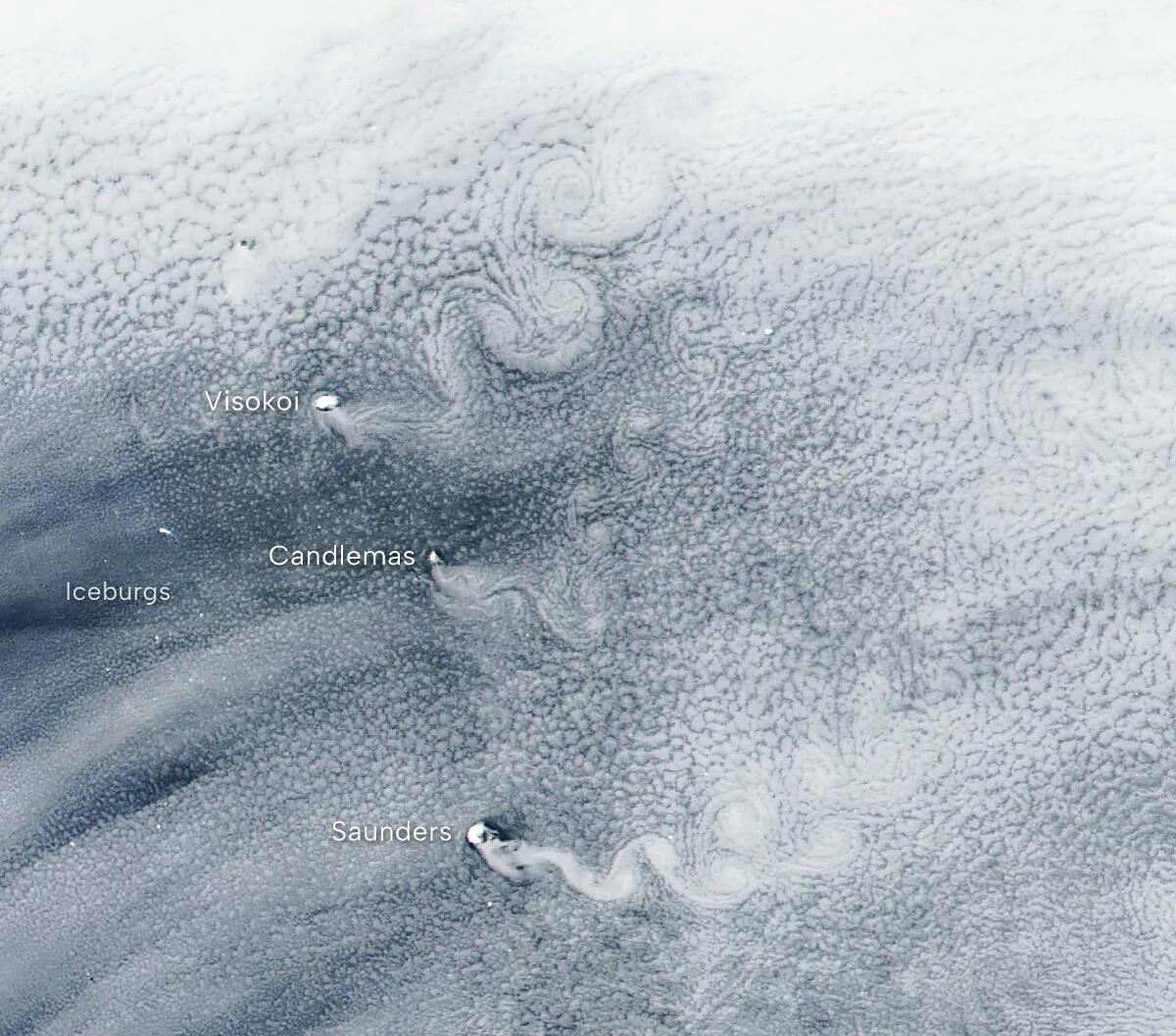
This NOAA-20 VIIRS image from February 24, 2025, captures von Kármán vortex streets forming behind three of the remote South Sandwich Islands in the southern Atlantic Ocean. The swirling cloud patterns appear when persistent westerly winds of moderate strength push marine stratocumulus clouds past the steep volcanic peaks of Visokoi, Candlemas, and Saunders islands.
Named after mathematician and aerospace engineer Theodore von Kármán, who first described these oscillating flow features in 1911, the vortices form alternating spirals that rotate in opposite directions downstream of each obstacle. The cloud trail extending from Saunders Island appears slightly brighter than surrounding clouds due to volcanic emissions from Mount Michael, which has been weakly erupting since 2014. To the west of the island chain, several icebergs drift visibly beneath thin cloud cover.
Haze Sweeps Over the Mediterranean
NASA/ISS External Camera
This photograph from the International Space Station’s external camera on April 30, 2025, provides an oblique view stretching from the Alps to Sicily, revealing layers of industrial haze drifting across the Mediterranean basin.
Much of the haze originates from the Po Valley in northern Italy and the Rhône Valley in France, where surrounding mountains trap pollutants. The Po Valley haze drifts hundreds of kilometers over the Adriatic Sea toward Greece. Astronauts have documented this atmospheric phenomenon for decades, providing a unique perspective on how geography shapes air quality across southern Europe.
Glacier Collapse Buries Swiss Village
NASA Earth Observatory/Wanmei Liang, using Landsat data from the U.S. Geological Survey
This Landsat 9 image from May 29, 2025, shows the aftermath of a catastrophic collapse of the Birch Glacier in Switzerland’s Lötschental valley.
The debris buried most of the village of Blatten, traveled 2.5 kilometers down the valley, and climbed 240 meters up the opposite valley wall before damming the Lonza River and causing flooding. Authorities began evacuating residents on May 19 after detecting instability. By May 27, the glacier was moving at 10 meters per day. Scientists believe rockfall accumulation on top of the glacier led to basal melting that reduced friction, triggering the collapse. The event was unusual in magnitude for the Swiss Alps.
Rare Snow Blankets Australia’s Northern Tablelands
NASA Earth Observatory/Wanmei Liang, using Landsat data from the U.S. Geological Survey
This Landsat 8 image from August 3, 2025, captures a rare blanket of snow across New South Wales’ Northern Tablelands, the heaviest snowfall in the region since the mid-1980s.
A powerful low-pressure system brought up to 40 centimeters (16 inches) of snow to the highlands while dumping more than 100 millimeters of rain at lower elevations. The storm stranded vehicles, closed highways, and left properties without power. Flooding triggered dozens of rescues across the region.
Phytoplankton Bloom in the Barents Sea
NASA Earth Observatory/Wanmei Liang, using MODIS data from NASA EOSDIS LANCE and GIBS/Worldview
This Aqua MODIS image from August 5, 2025, reveals a massive phytoplankton bloom swirling through the Barents Sea near Norway’s Bear Island.
The milky turquoise-blue colors indicate the presence of coccolithophores, single-celled organisms armored with calcium carbonate plates that scatter light. The green hues come from diatoms, another type of phytoplankton. The Barents Sea typically experiences two bloom seasons: diatoms dominate in May and June, while coccolithophores peak in August.
These microscopic organisms form the base of the Arctic marine food web and play a critical role in the ocean’s carbon cycle and oxygen production. Researchers are closely studying how warming Atlantic currents may be shifting the location and extent of these blooms.
Hurricane Erin Roils in the Atlantic
NASA Earth Observatory/Wanmei Liang, using MODIS data from NASA EOSDIS LANCE and GIBS/Worldview
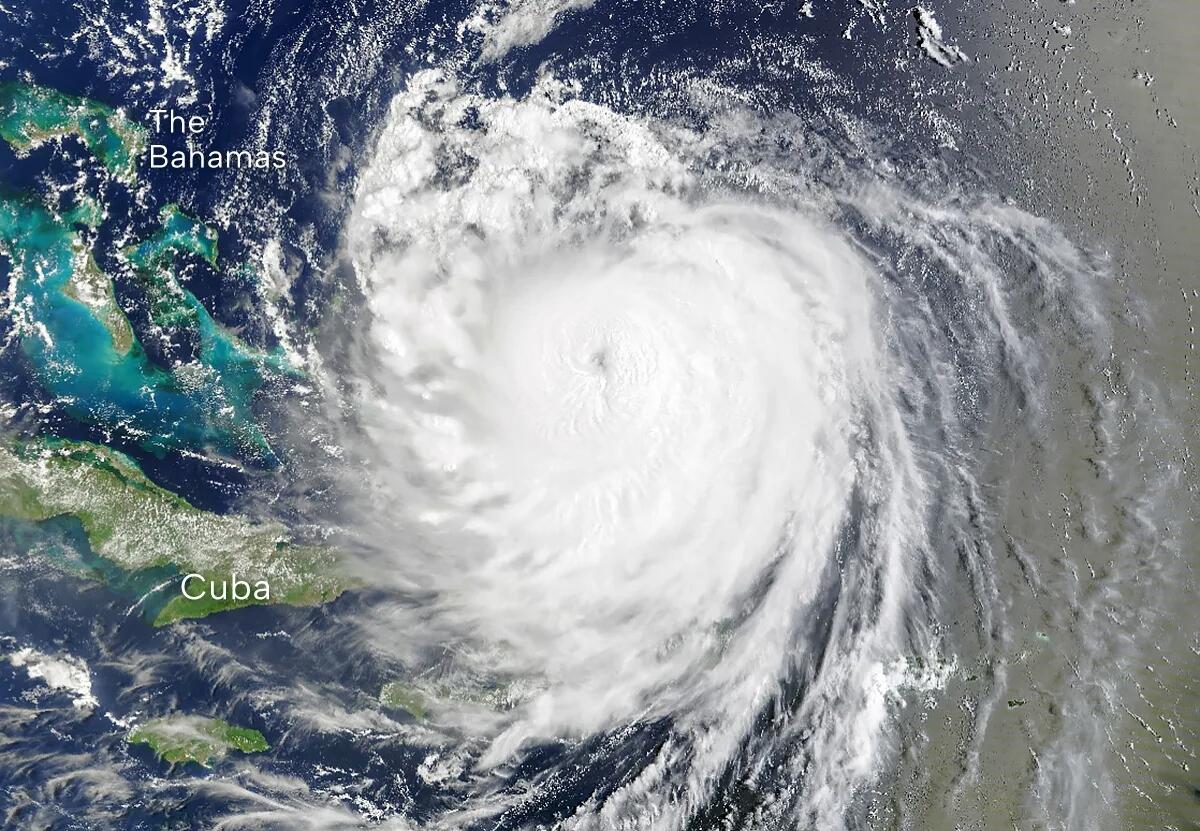
This Terra MODIS image from August 18, 2025, shows Hurricane Erin churning in the Atlantic Ocean as the first hurricane of the 2025 season.
The storm underwent rapid intensification, jumping from Category 1 to Category 5 in just 24 hours between August 15 and 16, reaching peak sustained winds of 160 mph. Erin became only the 43rd Atlantic hurricane to reach Category 5 status since 1851, and the earliest to do so at this location.
Factors contributing to its explosive strengthening included light wind shear, a compact structure, and warm sea surface temperatures. While Erin did not make landfall, it caused more than 147,000 power outages in Puerto Rico and prompted evacuation orders for North Carolina’s Outer Banks.
British Columbia Wildfires Send Smoke Skyward
NASA Earth Observatory/Michala Garrison, using MODIS data from NASA EOSDIS LANCE and GIBS/Worldview
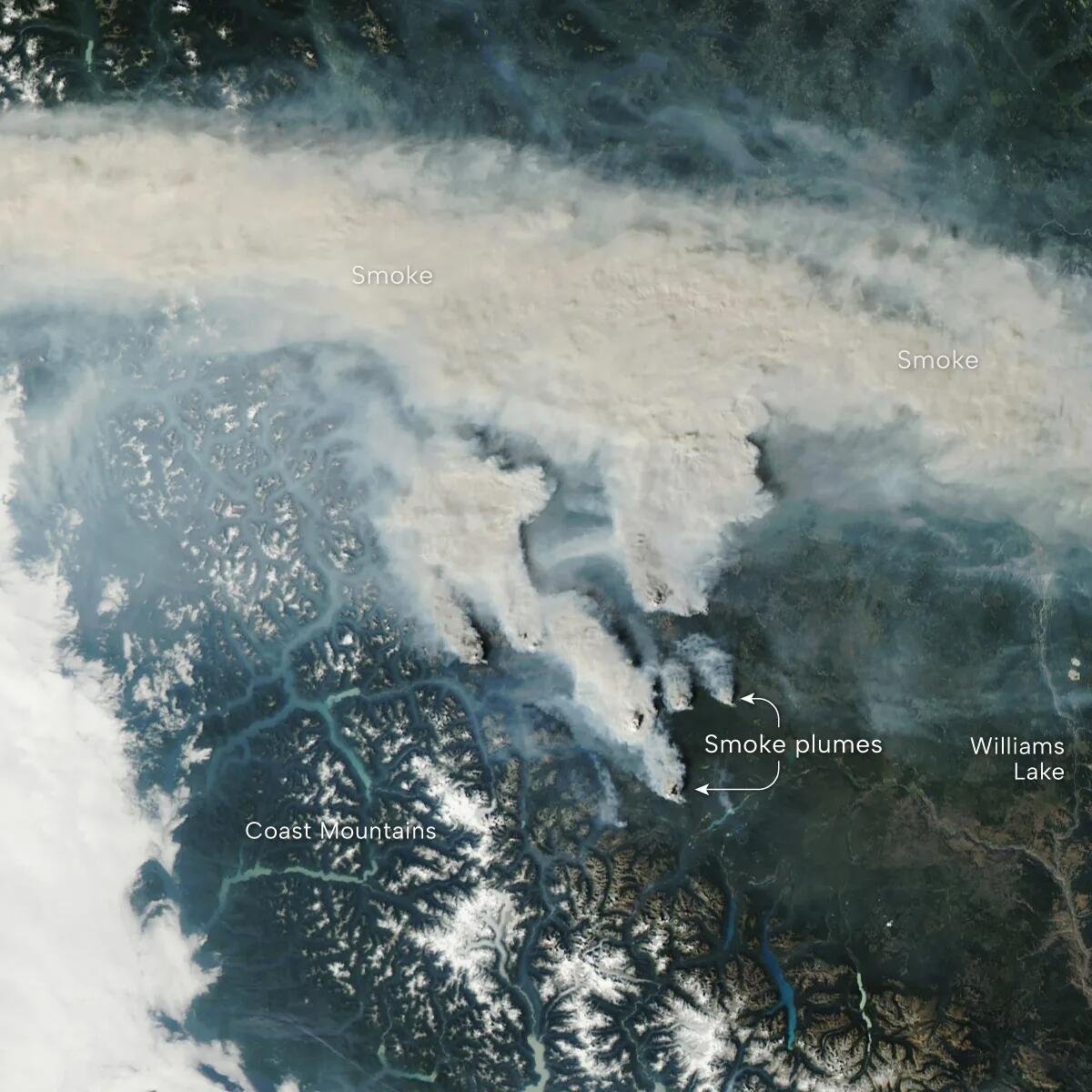
This Aqua MODIS image from September 2, 2025, captures thick smoke plumes rising from multiple lightning-ignited wildfires in British Columbia’s Cariboo region. The Itcha Lake fire had burned approximately 17,000 hectares (170 km²), while the Beef Trail Creek fire consumed around 7,800 hectares (78 km²) and the Dusty Lake fire charred about 2,800 hectares (28 km²). Evacuation orders were issued for surrounding communities.
The towering pyrocumulus clouds generated by these fires can inject smoke and particulate matter high into the atmosphere, where it can travel thousands of kilometers and degrade air quality across distant regions. By the end of the season, British Columbia had burned 732,000 hectares (7,320 km²), slightly above the 10-year average. Overall, Canada experienced one of its worst fire seasons on record, trailing only 2023.
A Desert Intersection
NASA Earth Observatory/Michala Garrison, using Landsat data from the U.S. Geological Survey
This Landsat 9 image from September 11, 2025, reveals a striking geological boundary in China’s Tarim Basin where the Mazartagh ridge meets the Hotan River. The 145 km (90 mile) ridge acts as a natural barrier, creating distinct dune patterns on either side.
The Hotan is the only river fed by glacial meltwater that maintains enough flow to cross the entire Takla Makan Desert. For centuries, this region served as an important source of nephrite jade collected along the ancient Silk Road.
Stubble Burning Shrouds Northern India in Haze
NASA Earth Observatory/Michala Garrison, using MODIS data from NASA EOSDIS LANCE and GIBS/Worldview
This Aqua MODIS image from November 11, 2025, shows thick haze blanketing northern India during the annual crop residue burning season.
Farmers in Punjab, Haryana, and Uttar Pradesh burn rice stubble between October and December to quickly clear fields before planting wheat.
On this day, air quality exceeded 400 on India’s national index, well into the “severe” category. Scientists have detected a shift in burning patterns: fires now peak from 4-6pm rather than the previous window of 1-2pm, meaning traditional satellite monitoring systems miss many fires. Estimates suggest stubble burning contributes 40-70% of particulate pollution on peak days.
The Tip of the Iceberg
These 12 images represent just a fraction of the thousands of observations NASA’s satellites make each year.
From tracking climate patterns to monitoring natural disasters, this orbital perspective helps scientists understand Earth’s interconnected systems and provides critical data for decision-makers around the world. As our planet continues to change, these eyes in the sky remain essential tools for documenting and responding to the challenges ahead.
Tyler Durden
Thu, 01/01/2026 – 09:55
https://www.zerohedge.com/geopolitical/12-nasa-satellite-images-tell-story-earth-2025

American Legal Sovereignty Threatened By Greenpeace’s Retaliatory EU Lawsuit
American Legal Sovereignty Threatened By Greenpeace’s Retaliatory EU Lawsuit
Authored by John Swallow via The Epoch Times,
The strength of the American civil legal system rests on a simple principle: those who break the law on U.S. soil answer to U.S. plaintiffs in U.S. courts. Our constitutional order depends on juries empowered to weigh evidence, judges and plaintiffs entrusted to enforce verdicts, and a system insulated from foreign interference. However, that foundation is now being tested by an activist organization determined to escape domestic accountability for domestic acts, by turning abroad and using a foreign country’s laws and courts to take another bite at the legal apple, so to speak.
In March 2025, a North Dakota jury delivered a decisive $670 million verdict against Greenpeace and its affiliates, finding them liable for extreme torts against Energy Transfer LP in the form of defamation, trespass, and conspiracy. The jurors rejected the claim that the Greenpeace activity—supporting violent demonstrations that disrupted construction of the Dakota Access Pipeline in 2016 and 2017—was protected speech, finding instead that Greenpeace orchestrated a campaign of unlawful disruption and reputational harm against Energy Transfer.
While the award has since been reduced to $345 million, the fact remains: the jury verdict was well founded.
During the trial, Energy Transfer’s lawyers presented compelling evidence showing Greenpeace’s role in orchestrating the protests. The group spent $55,000 training activists in direct action and violent protest tactics, supplied them with power tools, tents, propane, cold-weather gear, and lockboxes to chain themselves to heavy equipment, and encouraged confrontations with law enforcement. Meanwhile, its former executive director was found to have used an official Greenpeace email account to raise another $90,000 to fuel the effort.
On top of that, the jury found that Greenpeace knowingly defamed Energy Transfer by falsely accusing the company of knowingly desecrating Native American burial grounds during pipeline construction. In reality, Energy Transfer took extensive precautions to protect cultural and historical sites. Such fabricated and highly incendiary claims were found to have inflicted serious harm on Energy Transfer’s public reputation and its standing with financial institutions.
But rather than accept the ruling of the court, Greenpeace is attempting an end-run around it. Just weeks before the trial concluded, Greenpeace and Greenpeace International filed a retaliatory lawsuit against Energy Transfer in the Netherlands, invoking the European Union’s new anti-Strategic Litigation Against Public Participation (anti-SLAPP) directive. Importantly, the EU directive allows EU-based entities, such as Greenpeace International, to pursue damages against non-EU actors for cases originally brought outside the EU—expanding its reach far beyond Europe’s borders.
The Dutch lawsuit marks the first test of the new EU directive, and it appears that Greenpeace’s goal is to reframe its adjudicated misconduct as “free speech,” sprinkle in its own claims, which could and should have been raised and litigated in the North Dakota forum, and ask a foreign tribunal to essentially re-litigate, where a North Dakota court had already ruled following a full jury trial. Such tactics are abusive, costly, extra-jurisdictional, and very concerning for any company dealing with EU-based entities as no U.S. company could anticipate being hauled into an EU Court by or through its activities in the United States.
Fortunately, at least for now, Recital 29 of the directive only applies to untruthful allegations, meaning that if the claims in the original suit are proven true, anti-SLAPP protections do not apply. On that basis alone, the Dutch court should dismiss the case.
The directive was meant to protect European journalists, activists, and civic participants from frivolous lawsuits meant to silence dissent for activities on European soil. As determined in court by a jury, under the guidance of an experienced judge, the Energy Transfer/Greenpeace case was not frivolous. Nothing Greenpeace could say in a Dutch court could undermine the “truth” as found by a North Dakota jury, under state law.
However, the danger of allowing Greenpeace to relitigate facts and activities already determined by a lawful proceeding in the United States risks setting a dangerous precedent. If a foreign-based entity can lose in the United States and live to fight the same fight overseas, it creates a real incentive for bad actors to engage in tortious activities in the United States while discouraging what might be perceived as fruitless litigation. What company can afford to pay the price of a never-ending battle overseas?
The Greenpeace tactic of using the EU directive as a counterweight also raises jurisdictional questions concerning liability of a U.S. company under foreign laws when they have done nothing to justify being hauled into a foreign court. Indeed, allowing a foreign tribunal without jurisdiction over a U.S.-based company to require even a response to an EU action would open the floodgates to duplicative litigation and erode the confidence American companies should have in U.S. systems of civil justice.
Energy Transfer recently appealed a decision by the North Dakota Southwest Judicial District Court and Judge James Gion—who is overseeing the proceedings—to not enjoin Greenpeace from moving the EU lawsuit forward. The jury got the case right and the Judge got his denial of an injunction wrong. In America, courts should do all they can to respect and protect jury verdicts and those who pay the price to bring justice to those who violate American laws, even if they are foreign-based.
The stakes of the anti-SLAPP suit are too high to simply hope for the right outcome.
We should not forget that Greenpeace is not simply testing the boundaries of free expression—it is testing whether U.S. legal sovereignty and the rule of law still mean something. The answer must be a firm and resounding yes.
Views expressed in this article are opinions of the author and do not necessarily reflect the views of The Epoch Times or ZeroHedge.
Tyler Durden
Thu, 01/01/2026 – 09:20

Fire at Swiss Alpine resort bar during New Year’s celebration leaves dozens feared dead, 100 injured
CRANS-MONTANA, Switzerland — A fire ripped through a bar’s New Year celebration in a Swiss Alpine resort less than two hours after midnight Thursday, with dozens of people feared dead and about 100 more injured, most seriously, police said.
The Crans-Montana resort is best known as an international ski and golf venue, and overnight, its crowded Le Constellation bar morphed from a scene of revelry into the site of potentially one of Switzerland’s worst tragedies.
“Several tens of people” were presumed killed at the bar, Valais Canton police commander Frédéric Gisler said during a news conference.
Work is underway to identify the victims and inform their families, but “that will take time and for the time being, it is premature to give you a more precise figure,” Gisler said, adding that the community is “devastated.”
Beatrice Pilloud, Valais Canton attorney general, said it was too early to determine the cause of the fire. Experts have not yet been able to go inside the wreckage.
“At no moment is there a question of any kind of attack,” Pilloud said.
An evening of celebration turns tragic
Helicopters and ambulances rushed to the scene to assist victims, including some from different countries, officials said.
Two women told French broadcaster BFMTV that they were inside when they saw a barman carrying a barmaid on his shoulders. The barmaid was holding a lit candle in a bottle that set fire to the wooden ceiling. The flames quickly spread and collapsed the ceiling, they told the broadcaster.
One of the women described a crowd surge as people frantically tried to escape from a basement nightclub up a narrow flight of stairs and through a narrow door.
Another witness speaking to BFMTV described people smashing windows to escape the blaze, some gravely injured, and panicked parents rushing to the scene in cars to see whether their children were trapped inside. The young man said he saw about 20 people scrambling to get out of the smoke and flames and likened what he saw to a horror movie as he watched from across the street.
Officials described how the blaze likely triggered the release of combustible gases that ignited violently and caused what English-speaking firefighters call a flashover or backdraft.
“This evening should have been a moment of celebration and coming together, but it turned into a nightmare,” said Mathias Reynard, head of the regional government of the Valais Canton.
The injured were so numerous that the intensive care unit and operating theater at the regional hospital quickly hit full capacity, Reynard said.
Crans-Montana is less than 3 miles from Sierre, Switzerland, where 28 people, including many children, were killed when a bus from Belgium crashed inside a Swiss tunnel in 2012.
Resort town sits in the heart of the Alps
In a region busy with tourists skiing on the slopes, the authorities have called on the local population to show caution in the coming days to avoid any accidents that could require medical resources that are already overwhelmed.
With high-altitude ski runs rising nearly 9,850 feet in the heart of the Valais region’s snowy peaks and pine forests, Crans-Montana is one of the top venues on the World Cup circuit. The resort will host the best men’s and women’s downhill racers, including Lindsey Vonn, for their final events before the Milan Cortina Olympics in February. The town’s Crans-sur-Sierre golf club stages the European Masters each August on a picturesque course.
The Swiss blaze on Thursday came 25 years after an inferno in the Dutch fishing town of Volendam on New Year’s Eve, which killed 14 people and injured more than 200 as they celebrated in a cafe.
Swiss President Guy Parmelin said in a social media post that the government’s “thoughts go to the victims, to the injured and their relatives, to whom it addresses its sincere condolences.”
Thursday was Parmelin’s first day in office as the seven members of Switzerland’s government take turns holding the presidency for one year. Out of respect for the families of the victims, he delayed a traditional New Year’s address to the nation meant to be broadcast Thursday afternoon, Swiss broadcasters SRF and RTS reported.
Dazio reported from Berlin and Leicester reported from Paris. Geir Moulson in Berlin and Graham Dunbar in Geneva contributed to this report.
https://www.chicagotribune.com/2026/01/01/swiss-alpine-resort-bar-fire/

Naperville Police Arrests for Dec. 27-28
The following items were taken from Naperville police reports and press releases. An arrest does not constitute a finding of guilt:
A 46-year-old man from Chicago was arrested on two charges of battery at 12:27 a.m. Dec. 27 in the 1500 block of Aurora Avenue.
A 31-year-old woman from Naperville was arrested on a charge of aggravated battery at 12:31 a.m. Dec. 27 in the 1500 block of Aurora Avenue.
A 69-year-old man from Naperville was arrested on 12 warrants at 12:34 a.m. Dec. 27 in the 1500 block of Aurora Avenue.
A 46-year-old man from Chicago was arrested on charges of attempted aggravated assault on an officer, obstructing an officer and criminal damage to property between $500 and $10,000 at 12:27 a.m. Dec. 27 in the 1500 block of Aurora Avenue.
A 24-year-old man from Naperville was arrested on a warrant at 9:38 p.m. Dec. 27 in the 200 block of East Bailey Road.
A 47-year-old man from Warrenville was arrested on a charge of violating an order of protection at 1:51 a.m. Dec. 28 in the 400 block of East Bailey Road.
A 47-year-old woman, address unknown, was arrested on charges of retail theft and retail theft/switching price tag not exceeding $300 at 5:33 p.m. Dec. 28 in the 2500 block of West 75th Street.
A 48-year-old man from Aurora was arrested on a charge of endangering the health or life of a child at 9:15 p.m. Dec. 28 in the 2500 block of West 75th Street.
https://www.chicagotribune.com/2026/01/01/naperville-police-arrests-blotter-december-8/

Finnish Police Seize Russia-Linked Ship Accused Of Cutting Undersea Cable
Finnish Police Seize Russia-Linked Ship Accused Of Cutting Undersea Cable
The Europeans have taken yet more ‘counter-Russia’ actions amid widespread allegations that Moscow has sponsored sabotage campaigns targeting EU communications infrastructure.
Finnish authorities have newly detained a cargo ship suspected of damaging an undersea communications cable. The vessel has been identified as the Fitburg, and had departed St. Petersburg, Russia and was traveling toward Israel when it was intercepted by Finnish authorities.
Security officials have since confirmed, “Finnish authorities have taken control of the vessel as part of a joint operation.”
The cable in question links Helsinki with Tallinn and is operated by the Finnish telecom company Elisa. Like with other similar cable cutting allegations, officials admit there’s no smoking gun proof at this point.
Prior similar instances of Russia’s ‘shadow fleet’ supposedly engaged in cable cutting activity have generated ample headlines but nothing in the way of proof.
Bloomberg and European media have reported that fourteen crew members are currently being held by authorities – which includes nationals of Russia, Georgia, Kazakhstan, and Azerbaijan.
The Finnish police and the Border Guard have accused the vessel dragging its anchor along the seabed, after which it entered Finnish territorial waters at the request of authorities, whereupon it was taken into custody.
“At this stage, the police are investigating the incident as aggravated criminal damage, attempted aggravated criminal damage, and aggravated interference with telecommunications,” the police said.
The Finnish coast guard tracked has charged that “The ship’s anchor chain had been lowered into the water.” This after it was taken into custody.
Finland’s President Alexander Stubb says he’s closely monitoring the situation amid a pending investigation. “Finland is prepared for various security challenges and responds to them in the manner the situation requires,” he said on X.
This kind of thing has occurred in the Baltic Sea region, allegedly many times since the Ukraine war began. CNN writes that “At least 10 undersea cables have been cut or damaged in the Baltic Sea since 2023.“
Finland seizes vessel suspected of damaging underwater cable
Finnish authorities have seized the cargo vessel Fitburg off the coast of Porkkala in connection with damage to an undersea data cable between Helsinki and Tallinn. The vessel departed Saint Petersburg on December 30… pic.twitter.com/ihtJpkZVlW
— MarineTraffic (@MarineTraffic) December 31, 2025
Sometimes the vessels at the center of these controversies were already under Western sanctions, and have been boarded by authorities from various EU and NATO countries.
Tyler Durden
Thu, 01/01/2026 – 08:45

HHS Freezes Childcare Payments Nationwide After Bombshell Somali-Linked Daycare Fraud Allegations In Minnesota
HHS Freezes Childcare Payments Nationwide After Bombshell Somali-Linked Daycare Fraud Allegations In Minnesota
The Department of Health and Human Services is freezing all federal childcare payments to every state following alleged Somali-linked welfare fraud involving Minnesota daycare and autism centers. These revelations shocked the nation earlier this week after being exposed by citizen journalist Nick Shirley.
A growing army of citizen journalists is descending into corrupt, Democratic-run states this week, where additional suspected welfare fraud schemes tied to migrant networks are being uncovered – even as corporate media outlets attempt to downplay the findings and discredit those reporting them. Legacy media has acted as a public relations arm for the Democratic Party in an attempt to discredit anyone investigating suspected fraud.
By Tuesday, Shirley’s viral exposé of suspected Minneapolis daycare fraud had surpassed 100 million views on X and sparked a massive shift in public sentiment, creating broader support for HHS’ efforts to stop fraud, waste, and abuse. That public sentiment enabled HHS to take decisive action.
The action phase began Tuesday when HHS froze all federal childcare funding for Minnesota, citing rampant fraud allegations attributed to Somali-linked daycare operators. By Wednesday night, the funding suspension had been expanded nationwide.
We have frozen all child care payments to the state of Minnesota.
You have probably read the serious allegations that the state of Minnesota has funneled millions of taxpayer dollars to fraudulent daycares across Minnesota over the past decade.
Today we have taken three actions… pic.twitter.com/VYbyf3WGop
— Deputy Secretary Jim O’Neill (@HHS_Jim) December 30, 2025
ABC News was the first to report HHS’ move to cut all federal funding to daycares nationwide until operators can prove their legitimacy.
An HHS official said the funds will be released “only when states prove they are being spent legitimately.” There were no further details or more information about the paperwork proof the agency requires from the states. It is assumed this will be addressed in an upcoming memo.
HHS spokesperson Andrew Nixon told ABC News that recipients of funding who are “not suspected of fraudulent activity” are required to send HHS their “administrative data” for review.
HHS’ approach is very similar to the Small Business Administration’s move last month, when it issued letters to all contractors in the 8(a) Business Development Program, the nation’s largest DEI program, requesting financial records to root out fraud, waste, and abuse. SBA also halted grants to the state-run by what appear to be very corrupt and hinged Democrats.
Nixon said that recipients of federal funding in Minnesota, as well as those “suspected of fraudulent activity,” must provide HHS with additional records, including attendance logs, licensing documents, inspection and monitoring reports, and records of complaints and investigations.
“It’s the onus of the state to make sure that these funds, these federal dollars, taxpayer dollars, are being used for legitimate purposes,” Nixon told the outlet.
What’s shocking is that CNN is more driven to prove Shirley wrong.
Yet the truth slipped …
Related:
Obama’s Trojan Horse: How His Refugee Machine Engineered The Billion-Dollar Looting Of US Treasury
Time to revitalize DOGE and stop the looting of the US Treasury.
Tyler Durden
Thu, 01/01/2026 – 08:10

Russia’s Secretive Hypersonic, Nuclear-Ready Oreshnik Missiles Go Operational In Belarus
Russia’s Secretive Hypersonic, Nuclear-Ready Oreshnik Missiles Go Operational In Belarus
Belarus has announced that Russia’s Oreshnik intermediate-range nuclear capable ballistic missile system has been deployed on its territory, though details and specifications – including range – of the projectile remain secretive.
On Tuesday, the Belarusian Ministry of Defense released a video it claims shows the Oreshnik system being deployed inside the country. It featured Russian troops and technicians in a ceremonial flag-raising while stationed in Belarus, along with a convoy of vehicles moving into a field-based firing position before being concealed under camouflage netting.
Accompanying this was the recent emergence of satellite images indicating that Moscow is indeed positioning the nuclear-capable missiles in Belarus.
But questions have been raised as to the precise location of the missile systems, given that the undated published video features only support vehicles and doesn’t appear to including the launch apparatus itself.
Still, the video includes a senior officer informing troops that the systems have officially entered combat duty and references prior routine training and reconnaissance exercises carried out by missile crews.
Russian state media has referenced a precise date for the missile transfer to Belarusian territory, however:
Russian officials have likened its conventional destructive power to that of a low-yield nuclear strike, highlighting its dual strategic and tactical potential. By comparison, Western militaries currently lack a directly equivalent hypersonic MIRV-capable system, giving Oreshnik a unique edge in speed, maneuverability, and multi-target strike capability.
Up to ten systems are slated for deployment in Belarus under an agreement reached between Minsk and Moscow shortly after the missile’s initial combat test.
Belarusian President Alexander Lukashenko announced in a parliamentary address this month that the Oreshnik systems had arrived in Belarus on December 17. Deputy Defense Minister Pavel Muraveyko said last week the combat patrol areas are set and the system is fully operational and ready for use.
Already Belarus plays host to Russian tactical nuclear weapons – though details of this too remain shrouded in mystery and intentioned strategic ambiguity.
EuroNews: “Analysts identified a former airfield near the Russian border as a likely site.”
Russia shows nuclear-capable Oreshnik missile system in Belarus
Russia’s Defence Ministry released the first images of an intermediate-range weapon entering service. Analysts identified a former airfield near the Russian border as a likely site. pic.twitter.com/vkEv6eGP5r
— euronews (@euronews) December 30, 2025
2025 has been a big year for Moscow showcasing its military might and tech. As we reviewed earlier, in a matter of less than a year, Russian scientific know-how came up with four bangers:
1. Oreshnik: hypersonic missile, already tested in the Ukraine battleground.
2. Burevestnik: Or “Stormbringer”, with that nice Deep Purple ring. Nuclear cruise missile with unlimited range.
3. Poseidon: nuclear-powered torpedo, capable of loitering underwater, undetected, for unlimited time; then, at a command, strikes enemy coasts with a nuclear payload, provoking a radioactive tsunami. Largely exceeds the destructive power of the Sarmat, Russia’s largest ICBM.
4. Khabarovsk: nuclear sub. Call him The Messenger of Doom: capable of delivering at least 6 Doomsday-enabling Poseidons.
As for the Oreshnik, it was at a December 2024 meeting with Belarusian President Lukashenko that Putin had first unveiled plans to station Oreshnik missiles in Belarus. He indicated at the time that the deployment would occur in the second half of 2025. There are prior reports saying the hypersonic Oreshnik has already been used against Ukrainian targets to demonstrate Moscow’s ‘shock and awe’ capabilities.
Tyler Durden
Thu, 01/01/2026 – 07:40

Daywatch: Hundreds of new state laws take effect
Good morning, Chicago.
Happy New Year! With the calendar turning to 2026, roughly 300 new state laws have been ushered in, statutes that will quietly reshape daily life from grocery store checkout lines and police departments to college classrooms, hospital exam rooms and workplaces.
The laws arrive as Springfield braces for another high-stakes legislative year. Lawmakers will soon return to the Capitol to negotiate a multibillion-dollar budget amid the 2026 election as Pritzker runs for a third term and many legislators’ names will be on the ballot for reelection or bids for Congress. Democrats, who retain supermajorities in both the state House and Senate, are also preparing for potential clashes with President Donald Trump’s administration over federal funding, health care and education policy.
Read the full story from the Tribune’s Jeremy Gorner and Olivia Olander.
Here are the top stories you need to know to start your day, including President Donald Trump saying he’s dropping push for National Guard in Chicago — for now, sports betting to go on as sportsbooks drop request to halt implementation of licensing law in Chicago and what to do in Chicago this weekend.
Today’s eNewspaper edition | Subscribe to more newsletters | Asking Eric | Horoscopes | Puzzles & Games | Today in History
President Donald Trump speaks during a news conference on Dec. 29, 2025, in Palm Beach, Fla. (Alex Brandon / AP)
President Donald Trump says he’s dropping push for National Guard in Chicago — for now
President Donald Trump said he’s dropping — for now — his push to deploy National Guard troops in Chicago, Los Angeles and Portland, Oregon, a move that comes after legal roadblocks hung up the effort.
Cook County Board President Toni Preckwinkle speaks during a news conference at the John H. Stroger Hospital Professional Building, Dec. 31, 2025, about the expiration of ACA tax credits. (Eileen T. Meslar/Chicago Tribune)
As federal health tax credits end, Chicago-area leaders warn about costs to Illinois hospitals
With health care subsidies expiring in the new year, Cook County Health officials and political leaders warned yesterday the impact will not only hurt millions of Americans but also affect the county’s bottom line and hospitals around the state.
Michael McClain, a lobbyist and longtime confidant to former House Speaker Michael Madigan, and his wife, Cinda McClain, leave the Dirksen U.S. Courthouse after he was sentenced July 24, 2025. (Brian Cassella/Chicago Tribune)
Madigan confidant Michael McClain reports to prison
Former ComEd lobbyist Michael McClain, a longtime ally and confidant of disgraced former House Speaker Michael Madigan, reported to prison Monday to serve a two-year sentence for his role in what federal prosecutors have described as a sprawling bribery scheme targeting Madigan, federal prison records show.
The new entrance and visitors center under construction at the Illinois Capitol building in Springfield, Nov. 7, 2023. (Terrence Antonio James/Chicago Tribune)
$350M Illinois Capitol renovation nears completion following weather delays
It’s been about four years since construction crews began ripping through the north end of the 19th-century Illinois Capitol, the historic building’s latest modernization, which will include updated offices and enhanced security, as well as a refurbished Senate chamber finished last year.
The $350 million project, the second major overhaul of the Capitol in just over a decade, is about seven or eight months from completion, according to Andrea Aggertt, the Capitol architect overseeing the work. The renovation encompasses the building’s north wing, a new underground conference center and parking garage, extensive structural upgrades and a reimagined main entrance for visitors.
Dr. Jasmine Saavedra, medical director of pediatrics, examines 10-month-old Renata García near her mother, Lety Ixquereu, at the Esperanza Health Centers’ Brighton Park North Clinic on Dec. 31, 2025. Ixquereu brought her daughter in for her second flu shot and for a checkup because Renata was diagnosed with the flu during her last visit to the health center and she might have an ear infection, a possible complication from the flu. (Eileen T. Meslar/Chicago Tribune)
If everyone seems sick, it’s not your imagination. Flu is on the rise in the Chicago area.
Across the Chicago area and the country, people have increasingly been coming down with the flu in recent weeks. Flu activity officially jumped to high levels in suburban Cook County, and emergency department visits and hospitalizations for the flu were high in Chicago for the week that ended Dec. 20, according to the county and city health departments.
Chicago-area hospitals say they’ve seen spikes in patients with the flu. Emergency room visits related to the flu nearly tripled in suburban Cook County during the week that ended Dec. 20, said Dr. Kiran Joshi, Cook County Department of Public Health chief operating officer.
People watch sports inside the DraftKings Sportsbook at Wrigley Field on Nov. 17, 2025, in Chicago. (Armando L. Sanchez/Chicago Tribune)
Sports betting to go on as sportsbooks drop request to halt implementation of licensing law in Chicago
Sports betting will continue in Chicago after gambling companies dropped their legal fight to immediately halt implementation of the new licensing law.
The lawsuit by the Sports Betting Alliance had asked for an emergency court order to block the law, threatening to halt betting because its members hadn’t been licensed to operate in the new year under the new law.
Chicago Bears quarterback Caleb Williams looks before throwing a pass during the fourth quarter against the San Francisco 49ers at Levi’s Stadium Sunday, Dec. 28, 2025, in Santa Clara, Calif. (Armando L. Sanchez/Chicago Tribune)
Chicago Bears QB Caleb Williams on 4,000 yards: ‘I was brought here for those types of things’
When the Chicago Bears face the Detroit Lions on Sunday at Soldier Field, Caleb Williams will be staring down history. With 3,730 passing yards this season, Williams is 108 yards shy of tying Erik Kramer’s franchise record of 3,838 passing yards from 1995. He’s also 270 yards shy of becoming the first Bears quarterback ever to total 4,000 passing yards in a regular season.
A shopper walks past fully stocked shelves in the toy department as Black Friday deals are out at the Walmart Supercenter on Tuesday, Nov. 14, 2023, in Burbank, California. (Brian van der Brug/Los Angeles Times)
Toys are talking back thanks to AI, but are they safe around kids?
Stuffed animals that talk back. Chessboards with pieces that move on their own. And a chatty holographic fairy in a crystal ball.
Your next toy purchase might be powered by artificial intelligence and able to converse with your kids.
Kat Abughazaleh, center, and other protesters face off with Broadview Police near the U.S. Immigration and Customs Enforcement holding facility on Oct. 17, 2025, in Broadview. (Stacey Wescott/Chicago Tribune)
The Year Past, the Year to Come: Bowie, delivery ‘bots and Broadview
Culturally, where do we begin 2026 in Chicago? Where we ended 2025, of course. From vacant lots to crowds of ‘bots, there are places where you can feel the Earth spin forward.
Noah Berlatsky looks at paintings by Drossos P. Skyllas featured in the exhibition “Catalyst: Im/migration and Self-taught Art in Chicago” at the Intuit Art Museum on May 23, 2025, in Chicago. The painting in the center is from 1965 and titled “Little Pearl.” (Stacey Wescott/Chicago Tribune)
What to do in Chicago: ‘Amadeus,’ Bowie Ball and Through N Through
Here are our picks for events in and around Chicago this weekend.
https://www.chicagotribune.com/2026/01/01/daywatch-hundreds-of-new-state-laws-take-effect/

The Real Existential Threat Facing Europe
The Real Existential Threat Facing Europe
Authored by Nouriel Roubini via Project Syndicate,
Contrary to what far-right leaders claim, Europe’s greatest challenge is not immigration or “wokeness,” but its own economic and technological backwardness. With productivity growth lagging and innovation increasingly taking place elsewhere, Europe must confront its structural weaknesses or risk falling further behind.
US President Donald Trump’s new National Security Strategy offers a misguided assessment of Europe, long regarded as America’s most reliable ally. Unrestrained immigration and other policies derided by administration officials as “woke,” it warns, could lead to “civilizational erasure” within a few decades.
That argument rests on a fundamental misreading of Europe’s current predicament. While the European Union does face an existential threat, it has little to do with immigration or cultural politics. In fact, the share of foreign-born residents in the United States is slightly higher than in Europe.
The real threat facing Europe lies in its own economic and technological backwardness. Between 2008 and 2023, GDP rose by 87% in the US, compared to just 13.5% in the EU. Over the same period, the EU’s GDP per capita fell from 76.5% of the US level to 50%. Even the poorest US state – Mississippi – has a higher per capita income than that of several major European economies, including France, Italy, and the EU average.
This widening economic gap cannot be explained by demographics. Instead, it reflects stronger productivity growth in the US, largely owing to technological innovation and higher total factor productivity. Today, roughly half of the world’s 50 largest technology firms are American, while only four are European. Over the past five decades, 241 US firms have grown from startups into companies with market capitalizations of at least $10 billion, compared with just 14 in Europe.
These trends raise a critical question: Which countries will lead the industries of the future, and where does Europe fit in? The race for technological leadership now spans a wide range of fields, including AI and machine learning, semiconductor design and production, robotics, quantum computing, fusion energy, fintech, and defense technologies. Europe enters this race at a clear disadvantage.
Whether the US or China currently leads the industries of the future remains open to debate, but most observers agree that it’s essentially a two-horse race, with America still ahead in several key areas. Beyond that, innovation is concentrated in countries like Japan, Taiwan, South Korea, India, and Israel. In Europe, by contrast, innovative activities are largely confined to the United Kingdom, Germany, France, and Switzerland – two of which are not even EU member states.
It is hardly a surprise, then, that while the US and China dominate global technological rankings, Europe finds itself far from the top. And the outlook is anything but reassuring, given that the next wave of innovation is widely expected to be more disruptive than anything we have seen over the past half-century.
The technological gap between the US and Europe can be attributed to several factors.
First, the US has a far deeper and more dynamic ecosystem for financing startups, while Europe still lacks a genuine capital markets union, limiting the scale and speed at which new firms can grow.
Second, Europe is hampered by excessive and fragmented regulation. A US startup can launch a product under a single regulatory framework and immediately access a market of more than 330 million consumers. The EU has a population of roughly 450 million but remains divided among 27 national regulatory regimes. An International Monetary Fund analysis shows that internal market barriers in the EU act like a tariff of around 44% for goods and 110% for services – far higher than the tariff levels the US imposes on most imports.
Third, cultural attitudes toward risk-taking differ sharply. Until relatively recently, a failed entrepreneur in some EU countries (like Italy) could face criminal penalties, while in the US, a tech founder who has never failed is often seen as too risk-averse.
Fourth, the US benefits from a deeply integrated academic-military-industrial complex, while Europe’s chronic underinvestment in defense has weakened its innovation capacity. Technological leaders like the US, China, Israel, and, more recently, Ukraine spend heavily on defense, with military research often producing technologies that have civilian applications.
Despite this, many European political leaders continue to frame higher defense spending as a tradeoff between security and social welfare. In reality, free-riding on US defense spending since the end of World War II has limited the type of innovation that could have generated more of both through higher productivity. Paradoxically, sustaining Europe’s social model will require greater investment in defense, beginning with meeting NATO’s new spending target of 3.5% of GDP.
If Europe allows its technological lag to grow over the coming decades, it risks prolonged stagnation and continued economic decline relative to the US and China. There are, however, reasons for cautious optimism. Increasingly aware that Europe faces an existential challenge, policymakers have begun to advance serious reform proposals. The most notable examples are the two major 2024 reports on EU competitiveness and the single market by former Italian prime ministers Mario Draghi and Enrico Letta, respectively.
Europe also retains considerable strengths, including high-quality human capital, excellent education systems, and world-class research institutions. With the right incentives and regulatory reforms, these assets could support much higher levels of commercial innovation. With a better environment for entrepreneurship, Europe’s high per capita income, large internal market, and elevated savings rates could help unleash a wave of investment.
Crucially, even if Europe never leads in cutting-edge technologies, it could still significantly boost productivity by adopting and adapting American and Chinese innovations. Many of these technologies are general-purpose in character, benefiting both adopters and pioneers.
All of this leaves Europe at an inflection point.
As Ernest Hemingway famously observed, bankruptcy happens “gradually and then suddenly.”
So far, Europe’s technological decline has been gradual. But if it fails to confront its structural weaknesses, today’s slow erosion could give way to a sudden and irreversible loss of economic relevance.
Tyler Durden
Thu, 01/01/2026 – 07:20
https://www.zerohedge.com/markets/real-existential-threat-facing-europe

Chicago Bears by the numbers: Breaking down their potential 1st-round playoff scenarios
Sunday’s 42-38 shootout loss to the San Francisco 49ers on Sunday marked the first time in 12 years that the Chicago Bears lost when scoring at least 38 points.
The last such loss came in a 45-41 loss to Washington on Oct. 20, 2013. Before that it hadn’t happened since 1958, according to Stathead.
Here are the other numbers, stats and figures that stood out this week for the Bears.
Who will the Bears play in the wild-card round?
The simplest scenario for the Bears is to beat the Detroit Lions on Sunday and clinch the No. 2 seed in the NFC. Even if Philadelphia beats Washington, which would give the Bears and Eagles the same record, the Bears hold the head-to-head tiebreaker. That would mean a matchup with the Green Bay Packers, who are locked in as the No. 7 seed.
If the Lions beat the Bears and the Eagles beat the Commanders, the Bears would drop to the No. 3 seed and face either the 49ers or Los Angeles Rams as the No. 6 seed.
If the Seahawks beat the 49ers in Saturday night’s battle for the No. 1 seed, the 49ers will remain in a wild-card spot. If the Rams then beat the 3-13 Arizona Cardinals, the 49ers and Rams would have the same record and Los Angeles would win the tiebreaker and earn the No. 5 seed — landing the Bears a rematch against the 49ers.
If the 49ers beat the Seahawks, San Francisco would earn the No. 1 seed and Seattle would fall to a wild-card spot. The Seahawks still would have a better record than the Rams no matter what the Rams do in Week 18, so Seattle would be the No. 5 seed and Los Angeles the No. 6.
The Rams also would be the No. 6 seed if they lose to the Cardinals, regardless of what happens between the Seahawks and 49ers.
Bears coach Ben Johnson already said his team is “playing to win” in Week 18.
How important is home-field advantage?
Bears and Packers fans prepare for the game Dec. 20, 2025, at Soldier Field. (Brian Cassella/Chicago Tribune)
The Bears no longer can earn the No. 1 seed and home-field advantage throughout the NFC playoffs. The No. 2 seed, however, would guarantee them a home game not only in the wild-card round, but also in the divisional round should they advance.
“Playing at Soldier Field is absolutely one of the things that we wanted to do in the playoffs,” linebacker T.J. Edwards said.
Since 1920, according to Stathead, the Bears are 12-9 in the postseason when playing at home.
On the road — which they’ve done only once since 1995 (2020 versus the New Orleans Saints) — the Bears are 4-10 all time. They haven’t won a road playoff game since 1995 and haven’t won any playoff game since the 2010 season.
Can Caleb Williams set a franchise record? What about 4,000 yards?
Bears quarterback Caleb Williams walks on the field while warming up before playing the 49ers on Sunday, Dec. 28, 2025, at Levi’s Stadium in Santa Clara, Calif. (Armando L. Sanchez/Chicago Tribune)
Williams has 3,730 passing yards through 16 games with 25 touchdown passes and six interceptions.
He’s 109 yards shy of breaking Erik Kramer’s franchise passing record of 3,838 yards in 1995. Williams’ season low is 154 yards against the Eagles.
He’s also 270 yards shy of becoming the first Bears quarterback to throw for 4,000 yards in a season. The Bears are the only NFL franchise that never has had a 4,000-yard passer.
Williams has thrown for 270 yards or more in four games this season, including a season-high 330 on Sunday night against the 49ers.
The Detroit defense is surrendering 218.1 passing yards per game (ranked 19th), and the Lions have dealt with some significant injuries on defense. Before Christmas Day, when former third-stringer Max Brosmer and the Minnesota Vikings totaled 3 net passing yards, the Lions had given up 313.2 per game over their previous five games.
It’s not out of the question that Williams could reach 4,000 yards, but it would take one of his biggest games of the season.
It’s worth noting that Kramer also holds the Bears single-season record with 29 touchdown passes in 1995. Williams needs four to tie it. His 25 TD passes currently ranks fifth in franchise history.
Top targets share the load.
Bears tight end Colston Loveland makes a first-down reception in the fourth quarter against the 49ers on Dec. 28, 2025, at Levi’s Stadium in Santa Clara, Calif. (John J. Kim/Chicago Tribune)
All of those passing yards have to go somewhere. After big games Sunday night, wide receiver Luther Burden III and tight end Colston Loveland both surpassed 600 receiving yards on the season.
The Bears now have four pass catchers with at least 600 yards: DJ Moore (671 yards), Rome Odunze (661), Loveland (622) and Burden (617). The rookies Burden and Loveland have come on strong late in the season. Odunze was leading the pack before a foot injury sidelined him the last four games.
This is the first time since 2014 that the Bears have had four players with 600 or more receiving yards in the same season. Alshon Jeffery (1,133), Martellus Bennett (916), Matt Forte (808) and Brandon Marshall (721) did it that season, when Jay Cutler threw for 3,812 yards, second in franchise history. The Bears finished 5-11 and fired coach Marc Trestman.
According to Stathead, the 2025 and 2014 seasons are the only instances in Bears history that four players totaled at least 600 receiving yards.
How the Bears would feed all of these playmakers was one of the stories of the summer. The answer, it seems, is that each has had his moment. The distribution has been remarkably even across the board.
Moore leads the Bears with 49 receptions. Odunze, who hasn’t played since Nov. 28 in Philadelphia, still leads the team with 90 targets.
Odds and ends
The Bears have scored 30 points or more in five games this season. That’s the most since their last playoff appearance in 2020. After scoring 38 against the 49ers, the Bears have two games with 38 or more points (including the 47-42 win over the Cincinnati Bengals) for the first time since 2018.
With 54 rushing yards against San Francisco, D’Andre Swift passed 1,000 yards for the second time in his career. At 1,047, he’s 2 yards shy of his career high.
The Bears lead the NFL with 32 takeaways. The Jacksonville Jaguars, with 30, are probably the only team that can catch them in Week 18. The Bears are also best in the NFL with only 10 turnovers. The Houston Texans are next-best with 12.
Per the Bears, left guard Joe Thuney tied an NFL record for most regular-season starts in his first 10 seasons with his 162nd last week. With a start in Week 18, Thuney would pass Atlanta Falcons tackle Jake Matthews, who also started 162 games in his first 10 years. Thuney has missed only two regular-season games in his career, both in 2022 with the Kansas City Chiefs. He already holds the record for combined regular-season and playoff starts over his first 10 years with 183.
https://www.chicagotribune.com/2026/01/01/chicago-bears-numbers-playoff-scenarios/