Category: News

Home sales stuck at 30-year low in 2025 as mortgage rates, prices weighed on market
The U.S. housing market slump dragged into its fourth year in 2025 as sales remained stuck at a 30-year low with rising home prices and elevated mortgage rates keeping many prospective home shoppers out of the market.
Sales of previously occupied U.S. homes totaled 4.06 million last year, flat versus 2024, when sales sank to the lowest level since 1995, the National Association of Realtors said Wednesday. Sales have declined on annual basis every year since 2022.
The median national home price for all of last year rose 1.7% to $414,400, the NAR said.
Sales have been stuck at around a 4-million annual pace now going back to 2023. That’s well short of the 5.2-million annual pace that’s historically been the norm.
“2025 was another tough year for homebuyers, marked by record-high home prices and historically low home sales,” said Lawrence Yun, NAR’s chief economist. “However, in the fourth quarter, conditions began improving, with lower mortgage rates and slower home price growth.”
The U.S. housing market has been in a sales slump dating back to 2022, when mortgage rates began to climb from pandemic-era lows. The average rate on a 30-year mortgage was around 7% a year ago and remained elevated for much of the year until late summer, when they began to ease, falling to close to 6% by the end of the year, according to Freddie Mac.
That recent pullback in mortgage rates helped drive existing U.S. home sales in December to a seasonally adjusted annual rate of 4.35 million units, a 5.1% increase from November and the fastest sales pace in nearly three years, NAR said.
That topped the 4.14 million sales pace economists expected, according to FactSet.
Home prices also rose in December, pushing up the median sales to $405,400, a 0.4% increase from December 2024. That’s also an all-time high for any previous December and the 30th consecutive month with an annual increase in the median sales price, NAR said.
Despite lower mortgage rates, affordability remains a challenge for many aspiring homeowners, especially first-time buyers who don’t have equity from an existing home to put toward a new home purchase. Uncertainty over the economy and job market are also keeping many would-be buyers on the sidelines.

Southland crime: Road rage in Orland Park, attempted robbery in Palos Heights, and more
The following items were taken from police and court reports and news releases. An arrest does not constitute a finding of guilt.
Burbank
AGGRAVATED ASSAULT: Elmer F. Rodesno-Paz, 42, Chicago, was arrested Dec. 27 at 79th Street and Lockwood Avenue and subsequently charged with aggravated assault with a deadly weapon after brandishing a knife at another person during an argument in a restaurant parking lot in the 5400 block of 79th Street, police said.
AGGRAVATED ASSAULT: Jordan Williams was charged with aggravated assault Dec. 21 after threatening to hit an officer removing him from a restaurant in the 8600 block of Cicero Avenue, police said.
ARMED ROBBERY: A man in a ski-mask entered a liquor store in the 6800 block of 87th Street Jan 3, brandished a handgun and left on foot with an undisclosed amount of money, police said.
Crete
AGGRAVATED BATTERY: Tyler T. Adams, 26, 1300 block of Colony Drive, Crete, is scheduled to appear in Will County court Jan. 26, charged with aggravated battery to a police officer and domestic battery, according to court records online.
Ford Heights
DRUGS: Two Ford Heights men were arrested Jan. 7 after Cook County sheriff’s organized crime division investigators recovered 32.5 grams of suspected crack cocaine, six firearms including a gun without a serial number and more than $6,700 during a search in the 1400 block of Deer Creek Lane, sheriff’s police said. Jason Thomas, 49, is charged with manufacturing/delivering cocaine, possessing cocaine and being a felon possessing a weapon. Jermaine Thomas, 49, is charged with aggravated unlawful possession of a weapon, according to sheriff’s police and jail records online. Investigators also seized 18 dogs, a cross bow, two traditional bows, arrows, three knives and a machete, police said.
Homewood
FLEEING CRASH: Bryan Lopez Contreras, 20, 1200 block of Vincennes Avenue, Chicago Heights, fled a Nov. 25 stop at 183rd and Halsted streets to Thornton, where he drove off the roadway after driving 45 mph above the posted speed limit, police said. Lopez Contreras was charged with fleeing/eluding, speeding/35 mph or more, driving on a suspended license and improper lane use, police said.
DUI CRASH: Miguel Mota Bautista, 30, 1600 block of Buena Vista Avenue, Chicago Heights, was arrested Nov. 26 and charged with drunken driving, failing to reduce speed to avoid a collision, driving on a suspended license and failing to provide proof of insurance during a crash investigation at Ashland Avenue and Willow Road, police said.
Mokena
AGGRAVATED BATTERY: Garrett J. Rabka, 38, Mokena, is scheduled to appear in Will County court Jan. 15, charged with aggravated battery to a child younger than 13, according to court records online.
New Lenox
RECKLESS CONDUCT: James J. Henningsen, 37, 1700 block of Nelson Road, New Lenox, was charged Dec. 19 with reckless conduct after accidentally discharging a firearm while securing it in a closet, police said. The bullet traveled through a wall into an adjacent residence, which was unoccupied at the time, police said.
DUI CRASH: A New Lenox man is scheduled to be arraigned Jan. 23 in Will County court on charges of drunken driving, hit-and-run, fleeing, failing to reduce speed to avoid a collision, disregarding a traffic light, improper lane use and failing to provide proof of insurance, according to court records online. James W. Rossow, 23, 200 block of Pine Street, collided with a utility pole in the 300 block of Maple Street Dec. 25 and left, disregarding an officer’s orders to stop for three miles, police said.
Oak Lawn
AGGRAVATED BATTERY: Pierre P. Johnson, 32, Laflin Street, Calumet Park, was charged with aggravated battery to a police officer after grappling with an officer during a Jan. 1 traffic stop at 103rd Street and Tripp Avenue, police said.
Orland Park
ROAD RAGE: Jose M. Reyes, 37, 10800 block of Donna Lane, Orland Park, was charged with aggravated assault, reckless driving and improper lane use Dec. 19 after threatening to break another motorist’s nose while wielding a baseball bat at 159th Street and 108th Avenue, police said.
DUI CRASH: Jerry Butler, 63, 11300 block of Peach Tree Drive, Alsip, was charged Dec. 20 with drunken driving, failing to reduce speed to avoid a collision, illegally transporting alcohol and failing to provide proof of insurance after colliding with a curb in the 15400 block of 94th Avenue, police said.
RETAIL THEFT: Keyshay B. Hampton, 25, Chicago, was arrested Dec. 20 and charged with felony retail theft after under-ringing merchandise retailing for $2,388 from a department store at Orland Square mall, police said.
DEALING CHARGED: Deandre Walton, 38, was scheduled to appear in Cook County court at Bridgeview Jan. 14, charged with possessing more than 2,000 grams of cannabis with intent to deliver, aggravated fleeing and eluding, resisting arrest and multiple traffic violations stemming from a Jan. 12 narcotics investigation at his former residence in the 14100 block of John Humphrey Drive, police said. A drone-assisted search for Walton near Schussler Park resulted in his arrest, police said.
Palos Heights
DUI SPEEDING: Ramon Lewis, 30, Chicago, is scheduled to appear in Cook County court at Bridgeview March 9, charged with drunken driving and aggravated speeding in connection with his Jan. 3 arrest in the 6400 block of College Drive for driving 79 mph in a 40 mph zone, police said.
Palos Hills
ATTEMPTED ROBBERY: A resident driving into a garage in the 9900 block of 82nd Court Dec. 29 escaped an armed stranger ordering him out of the vehicle by reversing and accelerating back out of the building, police said. The intruder fled to a sedan waiting down the block, police said.
GUN POSSESSION: James H. Peoples, 28, Justice, was arrested for unlawful possession of a weapon after officers recovered a loaded 9 mm pistol and loaded magazine during a Dec. 29 traffic stop in the 10700 block of Harlem Avenue and determined his concealed carry license had been revoked, police said.
Steger
VIOLENT OFFENDER: Joyce J. Merritt, 61, 23600 block of Kings Road, unincorporated Crete Township, was arrested for failing to register as a violent offender against youth during a Jan. 6 traffic stop at Steger Road and Peoria Street, police said. Merritt, who last registered in 2015, was convicted in Will County of aggravated battery to a child when the victim was 5 and she was 49, according to state records online.
AGGRAVATED BATTERY: A Steger man accused of hitting an infant, choking the child’s mother and then running from police Jan. 10 was arrested near Richton and Kings roads after a search involving a helicopter and drone, police said. Amire D. Brazelton, 21, 400 block of 34th Street, Steger, was subsequently charged with aggravated battery to a child younger than 13, aggravated battery/strangulation and resisting arrest, according to police and Will County jail records online.
Tinley Park
SEX OFFENDER: Charles R. Miller, 69, Pontiac, was booked Jan. 9 into the Will County jail by Tinley Park police for failing to register as a sex offender, according to jail records online. Miller was convicted in Knox County of aggravated criminal sexual abuse to a 15-year-old child when he was 48, according to the state sex offender registry online.
https://www.chicagotribune.com/2026/01/14/southland-crime-orland-road-rage-palos-robbery/

FBI searches home of Washington Post reporter in classified documents probe, newspaper says
WASHINGTON — FBI agents searched a Washington Post reporter’s home on Wednesday as part of a leak investigation involving a Pentagon contractor accused of sharing classified information, the Justice Department said.
Hannah Natanson, who has been covering President Donald Trump’s transformation of the federal government, had a phone and a Garmin watch seized in the search of her Virginia home, the Post reported. Natanson has reported extensively on the federal workforce, and recently she published a piece describing how she gained hundreds of new sources — leading one colleague to call her “the federal government whisperer.”
While classified documents investigations aren’t unusual, the search of a reporter’s home marks an escalation in the government’s efforts to crack down on leaks.
“Leaking classified information puts America’s national security and the safety of our military heroes in serious jeopardy,” White House press secretary Karoline Leavitt said in a post on X. “President Trump has zero tolerance for it and will continue to aggressively crack down on these illegal acts moving forward.”
An affidavit says the search was related to an investigation into a system administrator in Maryland who authorities allege took home classified reports, the Post reported. The system administrator, Aurelio Perez-Lugones, was charged earlier this month with unlawful retention of national defense information, according to court papers.
Perez-Lugones, who held a top secret security clearance, is accused of printing classified and sensitive reports at work. In a search of his Maryland home and car this month, authorities found documents marked “SECRET,” including one in a lunchbox, according to court papers.
Attorney General Pam Bondi said the search was done at the request of the Defense Department and said the journalist was “obtaining and reporting classified and illegally leaked information from a Pentagon contractor.”
Trump’s Republican administration “will not tolerate illegal leaks of classified information that, when reported, pose a grave risk to our Nation’s national security and the brave men and women who are serving our country,” Bondi said in a post on X.
An FBI spokesperson declined to comment on Wednesday. The Washington Post said Wednesday that it was monitoring and reviewing the situation. An email seeking comment was sent to lawyers for Perez-Lugones.
The Justice Department over the years has developed, and revised, internal guidelines governing how it will respond to news media leaks.
In April, Bondi issued new guidelines saying prosecutors would again have the authority to use subpoenas, court orders and search warrants to hunt for government officials who make “unauthorized disclosures” to journalists.
The moves rescinded a policy from President Joe Biden’s Democatic administration that protected journalists from having their phone records secretly seized during leak investigations — a practice long decried by news organizations and press freedom groups.
The aggressive posture in this case stands in contrast to the Justice Department’s approach to the disclosure of sensitive military information via a Signal chat last spring involving senior Trump administration officials. A reporter was mistakenly added to that chat. Bondi indicated publicly at the time that she was disinclined to open an investigation, saying she was confident that the episode had been a mistake.
Bondi also repeated Trump administration talking points that the highly sensitive information in the chat was not classified, though current and former U.S. officials have said the posting of the launch times of aircraft and the times that bombs would be released before those pilots were even in the air would have been classified.

France Records First Peacetime Natural Population Decline As Deaths Exceed Births
France Records First Peacetime Natural Population Decline As Deaths Exceed Births
Authored by Thomas Brooke via Remix News,
France recorded a negative natural population balance in 2025 for the first time since the end of the Second World War, according to the national statistics institute INSEE, as the number of deaths exceeded the number of births over the year.
INSEE estimates that 645,000 babies were born in France in 2025, a decline of 2.1 percent compared with 2024 and 24 percent fewer than in 2010, the last peak year for births. Over the same period, 651,000 people died, an increase of 1.5 percent year on year. The result was a negative natural balance of -6,000.
The statistics institute said the increase in deaths was due in particular to a severe winter flu epidemic at the start of the year, as well as, in some areas, episodes of intense summer heat. Despite this, life expectancy at birth continued to rise, reaching 85.9 years for women and 80.3 years for men in 2025, both up by 0.1 years and at historically high levels.
The decline in births was compounded by a further fall in fertility. The total fertility rate dropped to 1.56 children per woman in 2025, down from 1.61 in 2024, and the lowest level since the end of the First World War. INSEE noted that the number of women of childbearing age has not fallen and has even increased slightly in recent years, meaning the drop in births is attributed entirely to lower fertility. The average age at which women give birth to their first child rose to 31.2 years in 2025, compared with 29.6 years in 2005.
As of Jan. 1, 2026, France’s population was estimated at 69.1 million, an increase of 0.25 percent over the previous year. This growth was driven entirely by migration, with net migration provisionally estimated at plus 176,000 people. The population included 66.8 million people in metropolitan France and 2.3 million in the overseas departments.
The demographic shift is also reflected in the country’s age composition. Some 22 percent of the population was aged 65 or over at the start of 2026, almost the same proportion as those aged under 20. By comparison, in 2006, 16.4 percent of the population was 65 or over, while 25.1 percent was under 20.
Marriage numbers continued to rise. INSEE projects 251,000 marriages in 2025, including 244,000 between people of different sexes and 7,000 between people of the same sex. The number of civil partnerships, or PACS, was almost stable in 2024 compared with 2023, at around 197,000.
🔴 Les chiffres 2025 de la natalité viennent d’être publiés par l’INSEE, et ils sont catastrophiques.
Nombre de naissances, fécondité, désir d’enfants…
En un fil, on vous récapitule ce qu’il faut savoir sur la nouvelle donne démographique française⤵️ pic.twitter.com/kuswGZlwlJ
— Hexagone – La France en chiffres (@Hexagone_org) January 13, 2026
Commenting on the figures, the outlet Hexagone described the 2025 birth data as “catastrophic,” noting that there were around 150,000 fewer births than in 2015 and calling 2025 a turning point in which, for the first time in peacetime, more people died in France than were born.
It added that even the most pessimistic fertility scenarios previously developed by INSEE and the National Institute for Demographic Studies had assumed a higher rate than that recorded in 2025.
“In 2021, INED produced 30 demographic projections for France. The most pessimistic of the 30 scenarios (the ultimate catastrophic scenario) projected an average of 1.69 children per woman in 2025. We learned today that France is at 1.56,” wrote one of its observers, Robin Nitot, on X.
A plummeting fertility rate is not an isolated problem for France; it is an existential crisis across Europe.
In April last year, Czechia reported a significant and sustained decline in its birth rate with a drop of around 12,000 births, pushing the annual total below the 100,000 mark. Its fertility rate fell to 1.66 after several years of gradual improvement.
In July, Germany also reported a rapidly declining birth rate, reaching a concerning 1.35 children per woman in 2023. However, the situation is even more critical for women with German citizenship, whose fertility rate has hit a 30-year low.
So, too, in Sweden, which recorded its lowest birthrate since 2003, with 99,000 babies born in 2024. The average age of first-time mothers was also over 30 for the first time, while in Poland, the birth rate has dropped to just 1.12.
“The total birth rate for Poland in 2024 may be the lowest in the whole of Europe (ex aequo with Spain) and amount to 1.12. This is the worst result in our modern history,” noted Andrzej Kubisiak, deputy director of the Polish Economic Institute, back in October 2024.
Tyler Durden
Wed, 01/14/2026 – 12:00

Brown Mansion to be restored with museum move to new building
Brown Mansion will be historically restored as the plan is to move the Westchester Township History Museum into a new barn-like structure to be built nearby on the old Chesterton Middle School grounds.
Jeff Schroeder, an architect with the Moake Park Group, revealed the plans to the Duneland School Board Monday in an update concerning the redevelopment of the former Chesterton Middle School campus.
The old school is being transformed into a YMCA Healthy Living Campus. Schroeder said construction is proceeding on the 15,000-square-foot Dr. John and Linnea Forchetti Wellness Center, along with renovation of some of the old school space now used by the YMCA.
The addition is located on the west side of the building, where a parking lot has already been developed. The parking lot also includes a new entrance off Porter Avenue.
A two-story gymnasium, with an elevated track, is also planned for construction on the west side.
The newest development involves the Brown Mansion, which shares the old Chesterton Middle School grounds.
The Victorian-style mansion, built in 1885, is on the National Register of Historic Places and, at one time, served as offices for the Duneland School District. The Westchester Public Library, which has run the museum inside the mansion for years, took over ownership in September 2024.
Schroeder said the plan is to restore the mansion, including the construction of a front porch, to the way it originally looked.
The museum, a gift shop, offices and storage now fill the house. All those would move into the new structure.
“Our museum curator likes to say that the house is the largest artifact of the museum. So the house becomes entirely tourable,” said Heather Chaddock, executive director of the Westchester Public Library.
Chaddock said the project is expected to cost around $5 million. She said that the Westchester Public Library has been saving money for years toward the project and “it’s finally come to pass.”
Schroeder said the project would be put out for bid in March. Berglund Construction, which is also working on the YMCA, would be the contractor for the project.
Duneland Board President Brandon Kroft said it is great to see how the YMCA and library are collaborating on the redevelopment of the grounds.
In other business, the board reviewed its strategic five-year plan, which runs through 2028.
Superintendent Chip Pettit said since the plan was adopted, the school district has suddenly had to deal with the impact of Artificial Intelligence.
The board adopted a six-point guideline on AI proposed by Donna Briggs, director of learning and teaching. The strategy includes expanding the use of AI into the curriculum, professional development of the staff in using AI, having an acceptable use policy for students, and ensuring that students are educated in the responsible use of the technology.
Board member Kirk Redman said that AI potentially could bring the biggest changes that education has ever seen in the last 125 years.
“I am happy to see that we are trying to stay ahead of that,” Redman said. “I think we’re going to see tremendous change in the next five years.”
Jim Woods is a freelance reporter for the Post-Tribune.

Aurora again finds high lead levels in drinking water of some homes
After another six months of testing using recently-heightened requirements, Aurora officials have again found high levels of lead in the drinking water of some homes.
Between July and December, the city of Aurora’s Water Production Division collected 100 samples of water and analyzed them for lead, according to a city news release. More than 10% of the samples contained lead readings above the “action level,” meaning the city is now required to take certain actions, such as replacing lead service lines, adjusting water treatment practices and implementing public education programs.
These results do not mean that all drinking water in Aurora contains lead. The water coming from the city’s treatment plant does not have lead in it plus meets all other water quality standards, city officials said in the news release.
Some houses in Aurora just have elevated levels of lead in their water, as lead can enter drinking water from the pipes that connect houses to city water mains, which are called service lines, the city news release said.
This is the second six-month period of testing since the Illinois Environmental Protection Agency instituted new water testing standards in late 2024, changes which city officials said have contributed to certain homes in the city now exceeding the action level for lead. The first six-month round of tests had similar results and required the city take similar actions, including notifying local media.
Under previous standards, only the first liter of water that came out of a faucet in a residential unit would be sampled to test for lead particles, the news release said. Now, both the first and fifth liters of water must be sampled.
Higher rates of lead were found since the fifth liter of water spent more time in the service line, which in some houses is still made out of lead, so more of those particles dissolved in the water, according to the news release. Some homes throughout the city now exceed the U.S. EPA’s action level for lead in water of 15 parts per billion, officials said.
Residents can learn what material their service line is made out of by visiting lead-service-cityofaurora.hub.arcgis.com. Those who wish to have their water tested can email the Water Production Division for help: leadtesting@aurora.il.us.
The city’s public notice about the elevated levels of lead contained several tips for how people can reduce exposure to lead in drinking water. Recommendations include using a filter certified to remove lead, cleaning a faucet’s aerator, using cold water and running water for a short time before using it to clear what sat in pipes.
Nearby construction or maintenance work may disrupt lead service lines, causing more lead to be dissolved into the water, according to the notice. When this happens, the city will provide a temporary lead filter and will also replace the disturbed lead service line for free within 30 days, the notice said.
Aurora has been working to remove lead and galvanized water lines for years. Since 2018, the city has replaced 2,988 lead service lines, with more set to be replaced in the coming years, the recent news release from the city said.
The state of Illinois is set to ramp up its lead water line replacement mandates starting in 2027, according to a presentation last year by Aurora Director of Public Works Jason Bauer. Last year’s water rate increase should cover the cost of that state mandate, but a different federal mandate may raise that requirement even further, costing the city an additional $9 million, Bauer said at the time.
Lead is toxic and can cause serious health problems, especially for children, according to the U.S. EPA.
Even at low levels, lead in a child’s bloodstream can cause developmental issues, the EPA’s website says. Lead is dangerous for adults, too, and is of particular concern for those who are pregnant because it can hurt the developing baby.
Water is not the only way people can be exposed to lead. Considering various risks of exposure, the state has identified many areas across the state, including in the Aurora area, where children are required to be tested for lead exposure.
These “Pediatric Lead Poisoning High-Risk ZIP Code Areas” can be found on the Illinois Department of Public Health’s website.
rsmith@chicagotribune.com
How Greenland Became The Most Dangerous Real Estate on Earth
How Greenland Became The Most Dangerous Real Estate on Earth
By Michael Kern of OilPrice.com
The United States will officially begin negotiations to dismantle the Western world’s operating system in just about 30 minutes or so…and oil prices are up just over 1% in anticipation.
The meeting, which will take place at the Eisenhower Executive Office Building, will include Vice President JD Vance, Secretary of State Marco Rubio, and the foreign ministers of Denmark and Greenland.
The official agenda serves up standard diplomatic fare: “Arctic security,” “strategic partnership,” and “resource development.”
But the reality in the room is far more brittle…
President Trump has made his position clear, stating on Air Force One that anything shy of U.S. control of Greenland is “unacceptable.”
He has suggested that NATO “should be leading the way for us to get it,” framing the acquisition not as a request, but as an obligation of the alliance.
Whatever the diplomats call it, the pricing model of the partnership has fundamentally changed.
For decades, the Atlantic alliance operated on a fixed-cost basis. Member states provided political alignment and base access in exchange for a predictable security guarantee. That fixed rate has now effectively floated. The new cost of doing business with Washington includes a premium to hedge against the unpredictability of the executive branch.
It’s a volatility tax, effectively.
A Variable Rate on Article 5
To understand the urgency in Brussels, you have to look at the mechanics of the security guarantee.
NATO was designed as a binary instrument: you are either protected, or you are not. Article 5 is the bedrock. But recent signals from Washington, specifically the refusal to rule out unilateral action regarding Greenland, have introduced a variable into that equation.
The “strategic patience” that characterized European responses for the last few years has evaporated. Following the capture of Venezuela’s Nicolás Maduro by the U.S. military on Jan. 3, the theoretical risk of American kinetic action has been repriced as a tangible one.
Danish Prime Minister Mette Frederiksen has been unequivocal, warning that a military move on Greenland would mean “everything stops,” signaling the effective end of the alliance.
Her concerns were echoed by EU Defense Commissioner Andrius Kubilius, who warned that such an event is “unprecedented in the history of NATO.”
“The normal rulebook doesn’t work anymore,” a former Danish MP noted regarding the discussions.
This has forced European capitals into a defensive crouch. When a German Defense Minister is compelled to discuss “options at Europe’s disposal” regarding a close ally, the alliance is no longer operating on a foundation of implicit trust. It is operating on a transactional basis.
Mining the Ice: The Myth of “Turnkey” Riches
The deal likely to emerge today relies on two pillars: security spending and resources.
The resource component, specifically the promise of critical minerals, is being framed as the “win” that could de-escalate tensions. The narrative suggests that by cutting the U.S. in on Greenland’s mineral wealth, the strategic hunger for rare earth elements can be sated.
However, from an industrial standpoint, this narrative hits a literal wall of ice.
Greenland possesses vast potential reserves. The U.S. Geological Survey estimates the island holds the world’s second-largest deposit of rare-earth oxides, including significant amounts of neodymium and dysprosium, which are critical for EV motors and F-35 fighter jets.
But potential is not production. To date, there are zero active rare earth mines in Greenland.
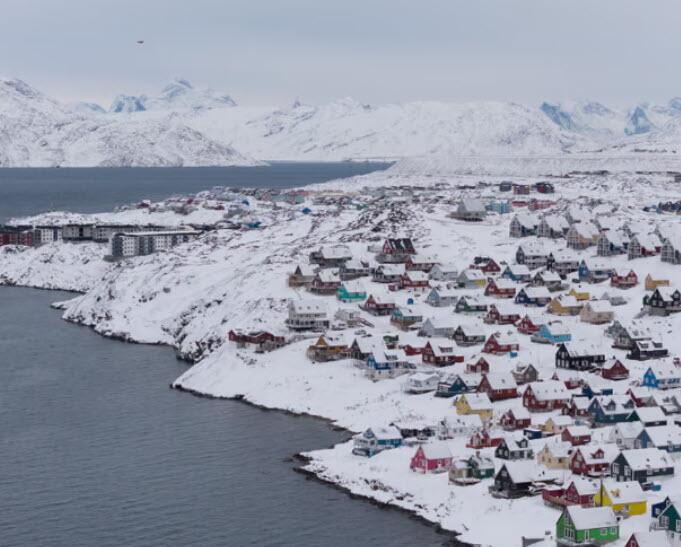
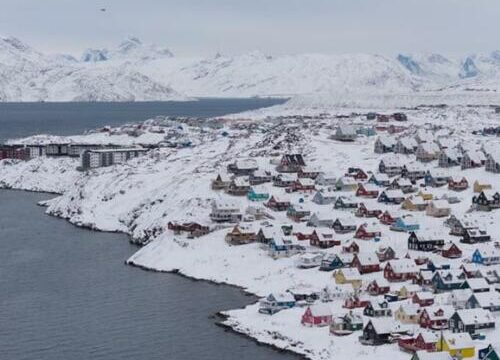
The barrier isn’t just bureaucratic; it is thermodynamic. Greenland spans 2.17 million square kilometers, 80% of which is covered by ice. The “unit economics” of mining here are atrocious compared to competitors in Australia or Brazil.
The Infrastructure Gap: There are no roads connecting Greenland’s towns. Every piece of heavy machinery must be shipped in by sea or flown in by helicopter. Industry analysis suggests that developing a mine in the Arctic incurs capital costs (CapEx) 150% to 300% higher than in temperate regions.
The Power Problem: There is no grid to plug into. A mine requires a dedicated power plant, likely importing diesel in a zone where fuel freezes, or building renewables in a place with three months of darkness.
Ian Lange, an economist at the Colorado School of Mines, put it bluntly: “Everybody’s just been running to get to this endpoint [of production]. And if you go to Greenland, it’s like you’re going back to the beginning.”
If the EU plans to double its investment in these projects to satisfy U.S. demands, it represents a massive subsidy. It is a transfer of public funds to make a project commercially viable, not because the market demands it, but because the politics require it. We are essentially watching Europe offer to build a money-losing mine to buy geopolitical stability.
Access vs. Ownership: The Strategic Paradox
The second pillar of the proposed deal is a ramp-up in Arctic security infrastructure.
Secretary General Mark Rutte has laid the groundwork, stating that the alliance is discussing ways to “bolster Arctic security.” This aligns with the long-standing U.S. demand for Europe to shoulder a greater share of the defense burden.
But a closer look reveals a paradox in the U.S. position.
If the goal is purely strategic access, denying space to Russia and China, the United States already has it.
The U.S. military operates the Pituffik Space Base (formerly Thule), a cornerstone of North American missile defense. The 1951 Defense of Greenland Agreement grants the U.S. substantial rights to operate on the island. The U.S. can already project power, monitor the GIUK gap (Greenland-Iceland-UK), and deter adversaries.
The demand for “title” or “ownership,” rather than “access,” suggests that the driver here is not purely strategic utility. It is about formalizing a sphere of influence on a map.
Inheriting a Frozen Liability
Beyond the bad math of the mines, there is a practical question of stewardship largely absent from American political discourse.
Greenland is a semi-autonomous territory with a distinct culture and a complex social safety net underpinned by Danish subsidies. If the island’s status were to change, the financial burden of that stewardship would shift to Washington.
EU Commission President Ursula von der Leyen backed this view, stating firmly that “Greenland belongs to its people,” and insisting that any decision rests with them, not foreign capitals.
Historically, the U.S. has a poor track record of managing its territories.
Places like Puerto Rico or Guam have struggled with chronic underinvestment in infrastructure and poverty rates far higher than the mainland average.
For the U.S. taxpayer, the acquisition would mean inheriting a massive, frozen liability. We would acquire a territory that requires significant annual subsidies to maintain basic services, with a return on investment that might be decades away.
Ripping Up the 1945 Contract
But the most dangerous line item on this ledger isn’t financial. It is structural.
If the United States were to coerce a NATO ally into ceding territory, whether through economic arm-twisting or the implicit threat of force, it would trigger a default on the post-war security order.
We often talk about the “Rules-Based International Order” as an abstract concept. In practice, it is a contract. The United States drafted the contract in 1945, and the core clause was simple: borders are not to be changed by force, and the sovereignty of allies is inviolable.
By threatening to seize Greenland, Washington is effectively ripping up that contract.
French President Emmanuel Macron has been one of the few leaders to speak plainly on the stakes, warning that “the law of the strongest cannot rule the world” and noting the “unprecedented consequences” if an ally’s sovereignty is violated.
Even the UK, often the bridge between Europe and Washington, has drawn a line. Prime Minister Keir Starmer reportedly told Trump to keep his “hands off Greenland,” aligning London firmly with Copenhagen.
The immediate casualty would be moral leverage.
For years, the United States has rallied the world to condemn Russian expansionism in Ukraine and Chinese assertiveness in the South China Sea. If the U.S. annexes Greenland, that moral argument evaporates.
The Solvency of the West
As the foreign ministers sit down in the Eisenhower Executive Office Building today, they are attempting to price a transaction that was never meant to be sold.
The U.S. will likely push for guaranteed mineral rights and a “security premium” funded by Europe. Denmark and the EU will offer these concessions in a desperate bid to buy another year of sovereignty.
But as the ink dries on whatever joint statement emerges, the real story is what happens next. The fixed-rate mortgage of the Atlantic Alliance is gone. We are now in a variable-rate world, and the market is volatile.
Tyler Durden
Wed, 01/14/2026 – 11:37
https://www.zerohedge.com/geopolitical/how-greenland-became-most-dangerous-real-estate-earth

Justices Ask For Definition Of Sex During Supreme Court Arguments On Transgender Students In Girls Sports
Justices Ask For Definition Of Sex During Supreme Court Arguments On Transgender Students In Girls Sports
Authored by Arjun Singh via The Epoch Times,
Three justices of the Supreme Court of the United States on Jan. 13 pressed advocates in two cases regarding transgender student participation in sports to define “sex” for the purposes of constitutional law.
“What is that definition, for equal protection purposes? What does it mean to be a boy or a girl, or a man or a woman?” asked Associate Justice Samuel A. Alito Jr. during the first round of oral arguments in the case of Little v. Hecox. In that case, Idaho’s law H.B. 500—which bans transgender individuals from participating in women’s sporting events—is being challenged by Lindsay Hecox, a transgender student at Boise State University who attempted to join the women’s track and cross-country teams.
“We do not have a definition for the court,” replied Hecox’s advocate, Kathleen R. Hartnett of Cooley LLP. Hartnett, however, argued that her side was not challenging the definition of “woman” in H.B. 500, but merely the way Idaho has applied it to his case.
“The way it applies, in practice, is to exclude birth sex males categorically from women’s teams, and that there’s a subset of those birth sex males where it doesn’t make sense to do so,” Hartnett argued.
Alito continued to press the question.
“Well, how can a court determine whether there is discrimination on the basis of sex if we don’t know what sex means, for equal protection purposes?” he said, referring to the Equal Protection Clause of the 14th Amendment to the U.S. Constitution, which requires states to ensure persons “the equal protection of the laws.”
“I think, here, we just know that,” responded Hartnett regarding the definition of sex. “Lindsay qualifies as a birth sex male and she’s being excluded categorically from the women’s teams as the statute,” she noted.
Alito then asked Hartnett if a self-identified woman could be defined as a woman.
“The person says, ‘I sincerely believe I am a woman. I am, in fact, a woman.’ Is that person not a woman?” he posed.
Hartnett responded that she would “respect their self-identity in addressing the person,” though she argued that self-identity was not at issue.
The same question, seeking the definition of “sex” and a “woman,” was repeated by Chief Justice John G. Roberts Jr. and Associate Justice Brett M. Kavanaugh during oral arguments in the next case, West Virginia v. B.P.J., where the parents of Becky Pepper-Jackson, a high school student in West Virginia, are challenging a state law that bans transgender students’s participation in school sports.
“You don’t think we should have an operating definition of ‘sex’ in Title IX?” asked Roberts to Pepper-Jackson’s counsel, Joshua Block of the American Civil Liberties Union (ACLU), who then analogized sex to race.
Block responded: “I don’t think Congress adopted a definition of race in Title VI [of the Civil Rights Act of 1964] in order to prohibit discrimination on the basis of race. I think we’re not trying to police the accuracy of the terminology.”
Kavanaugh questioned Block on whether states could adopt different definitions of the term “sex” when setting laws regarding women’s sports.
“Do you think sex and Title IX can reasonably be interpreted to allow different states to take different understandings of that in their sports leagues?” he asked.
“I don’t think the purpose of Title IX is to have an accurate definition of sex,” Block argued. “I think the purpose is to make sure that sex isn’t being used to discriminate by denying opportunities, just as I don’t think we need to define race in order to enforce Title VI.”
[ZH: Justice Brown Jackson once again went full retard…stating in shock that: “We are now looking at the definition of a girl and we’re saying only people who were girl assigned at birth qualify.”]
🚨 WTF. Ketanji Brown Jackson at the Supreme Court of the United States just said: “We are now looking at the definition of a girl and we’re saying only people who were girl assigned at birth qualify.”
Read that again. Slowly.
This is the level of confusion sitting on the… pic.twitter.com/X1PGdubK9E
— ⁿᵉʷˢ Barron Trump 🇺🇸 (@BarronTNews_) January 14, 2026
Oral arguments in both cases, held back-to-back, lasted three hours. The court is expected to deliver its opinion during the present term.
Here are some of the main takeaways from the oral arguments.
1. Reckoning With Previous Gender Precedent
One of the major precedents, or prior Supreme Court decisions, that could influence the justices’ ruling is Bostock v. Clayton County. Writing for the majority in that case, Justice Neil Gorsuch said in 2020 that an employer who “fires an individual merely for being gay or transgender” violates Title VII of the Civil Rights Act.
That law bars discrimination on the basis of sex but Gorsuch said “it is impossible to discriminate against a person for being homosexual or transgender without discriminating against that individual based on sex.”
Lower courts and attorneys have cited Bostock v. Clayton County to support left-leaning positions on gender identity, but the justices have indicated that ruling was relatively limited.
Both Gorsuch and Chief Justice John Roberts joined the majority in Bostock but seemed to suggest on Jan. 13 that they thought that precedent might not apply to women’s sports.
Gorsuch, in particular, suggested he wasn’t willing to extend the reasoning in Bostock to Title IX, which is the civil rights law at issue in West Virginia’s case. That law bars sex-based discrimination in federally funded educational institutions.
While speaking with attorney Joshua Block, who was challenging West Virginia’s law, Gorsuch suggested the sports cases were “very different than Title VII.”
Justice Sonia Sotomayor told Idaho Solicitor General Alan Hurst that he made “no sense” in one of his arguments and suggested he wanted to subject the law to an inappropriately low level of scrutiny.
2. Definition of ‘Sex’
One of the primary criticisms appeals courts leveled at the bans was that they discriminated against people on the basis of their sex.
During oral argument, multiple justices questioned how to define “sex.”
“What is that definition for equal protection purposes?” Justice Samuel Alito asked. “What does it mean to be a boy or a girl or a man or a woman?”
When Kathleen Hartnett, an attorney challenging Idaho’s law, said she didn’t have a definition, Alito expressed skepticism.
The Justice Department spoke during oral argument in support of the states. Principal Deputy Solicitor General Hashim M. Mooppan told Alito that the best way to interpret “sex” under Title IX was in reference to reproduction.
3. Reach of Decision
The justices also wrestled with how their ruling could impact other issues like locker rooms and certain activities.
Mooppan had argued that discrimination occurred when individuals were similarly situated. That wasn’t the case for men and women, he suggested, because of inherent biological differences. “That’s not discrimination, that’s a distinction,” he said.
Justice Elena Kagan suggested Mooppan’s reasoning might impact chess clubs. “I think a lot of people would say, you know, if you look at the ranks of chess grand masters, there are not a whole lot of women there.”
She added, “I think there are a lot of chess grand masters who would tell you that women, just like for whatever reason, they’re … not as good at this.”
Justice Brett Kavanaugh was more skeptical of a possible spillover effect and suggested Congress had focused Title IX on sports.
4. Concerns About Biology
One of the criticisms appeals courts had for the bans was that they applied to individuals who may not have undergone puberty, and therefore had lower levels of testosterone.
Multiple justices grappled with those concerns during oral arguments. Justice Amy Coney Barrett, often considered a swing vote, asked Hurst how his legal theory would apply to “six-year-olds, where there’s no difference between boys and girls in terms of athletic ability, testosterone levels, et cetera.”
She later asked why the court didn’t need more factual research to determine the importance of testosterone levels. “Do we have to defer to the state?” she asked, alluding to the state’s determination about the scientific evidence.
Kavanaugh seemed hesitant to issue a broad decision blocking state bans because of factors like scientific uncertainty surrounding the issue. “Why would we … jump in and try to constitutionalize a rule for the whole country?” he asked.
5. Sotomayor Worries Athlete Will Live in ‘Infamy’
It is possible that the Supreme Court won’t end up ruling on the challenge to the Idaho law because the male university student, Lindsay Hecox, who brought it asked to withdraw the case.
Attorneys for Hecox told the Supreme Court that he wished to abandon his appeal for multiple reasons, including that public scrutiny would distract from Hecox’s schoolwork.
The Supreme Court previously deferred ruling on the request to dismiss the case as moot, but Sotomayor seemed sympathetic to the request during oral argument.
“To say [Hecox] misrepresented her intent is going a little extreme when she honored all her previous intent—intents and only changed her mind when new circumstances arose, i.e., the notoriety of this case, correct?” Sotomayor asked Hurst.
Sotomayor went on to ask Hurst about Hecox’s name being on the case. “Do you dispute that having a case named after you makes your infamy … live forever?” she asked Hurst.
Idaho has urged the court not to dismiss the case, which is expected to be decided by the end of June.
The bottom line: The justices seemed inclined to back two state bans on boys’ participation in girls’ sports.
Tyler Durden
Wed, 01/14/2026 – 11:10
Crude Stocks Rise Most In Two Months As US Oil Production Finally Drops
Crude Stocks Rise Most In Two Months As US Oil Production Finally Drops
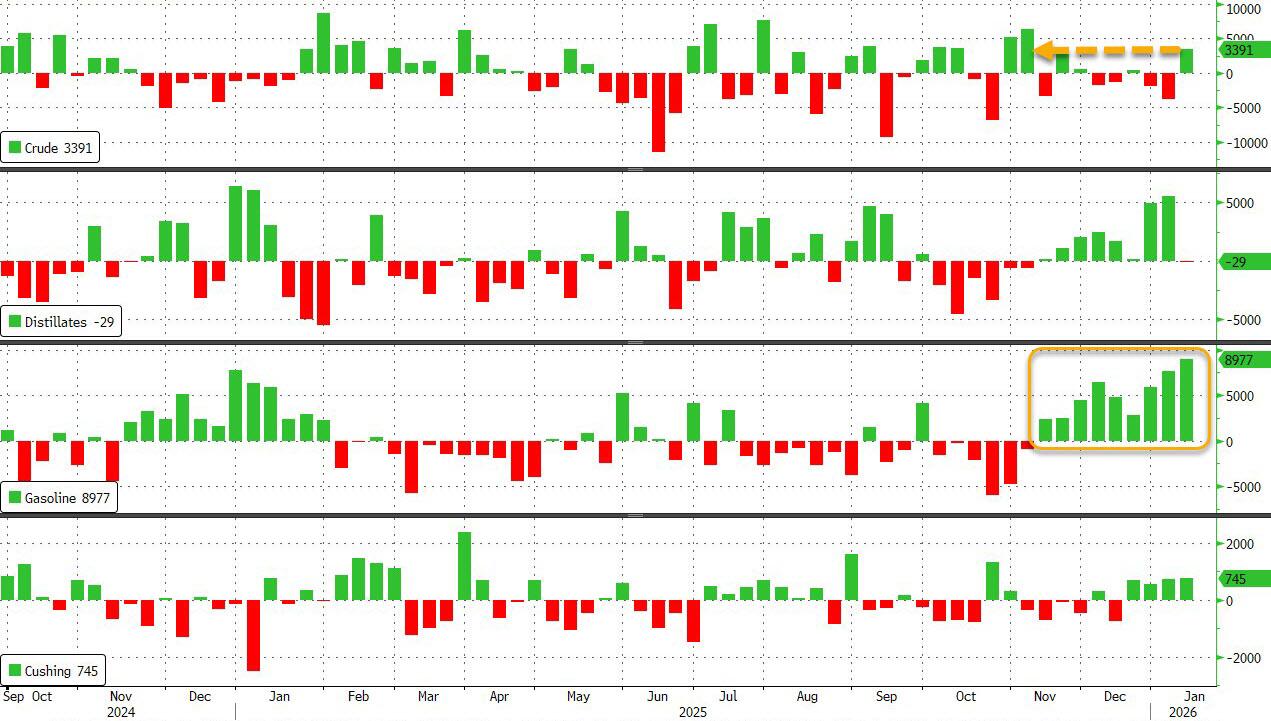
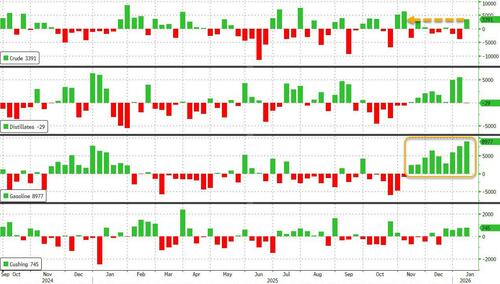
While oil prices keep rising on mounting geopolitical tensions in Iran, the production glut refuses to go away, and as today’s DOE report showed, there was a material increase across almost all products, with the exception of Distillates which were flat. Of note, amid expectations for a modest crude draw, we saw a 3.4MM barrel increase, the largest since the start of November.
Here is what the EIA reported in its weekly inventory report
Crude +3.391MM, Exp.-1.682MM
Gasoline +8.977MM, Exp. +2.0MM
Distillates -29K, Exp. -662K
Cushing +745K
Of note here is that while we saw a sizable build in most products, with Crude rising the most in two months, it was gasoline where the stocking was most notable: the nearly 9 million barrels added were the most since December 29, 2023.
Some more details:
Crude Build
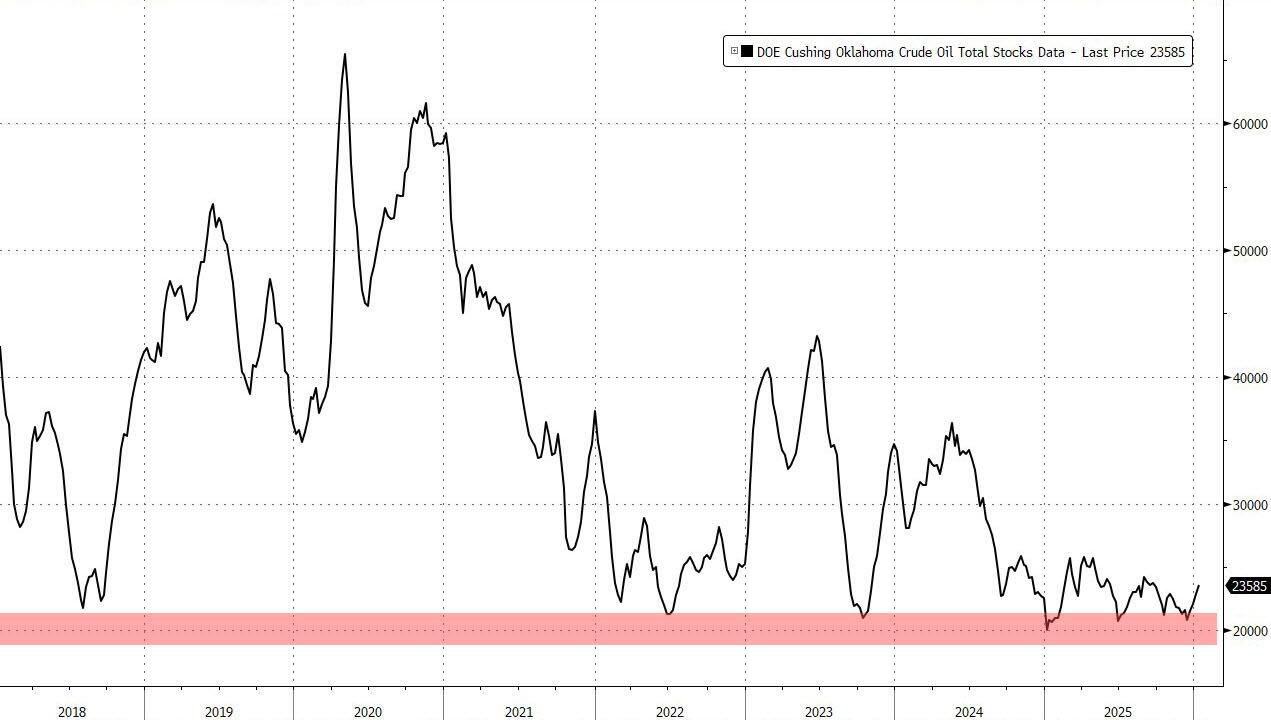
Nationwide crude stockpiles rose to 422.4 million barrels. The weekly gain of about 3.4 million barrels is the largest build since early November. Stockpiles at Cushing, Oklahoma, continue to climb. The storage hub has seen a rise in inventories for the fourth consecutive week. Stocks now sit at about 23.6 million barrels, the highest since September.
Imports
The build in crude inventories can be partly explained by an increase in imports. They rose to the highest since November of 2024. Imports from the Middle East edged higher, driven by a 62% increase in the amount of crude arriving from Iraq. Inflows from Brazil, Mexico, Colombia and Ecuador all jumped.
Refinery Runs
Refinery runs have now risen in 9 of the past 10 weeks countrywide, inching closer to the highest since the pandemic. In the Midwest, refineries are processing the most crude on record on a seasonal basis. West Coast refinery runs are now at the highest level since late-September.
While Cushing draws reversed for a 4th consecutive week, stocks remain not too far from tank bottoms.
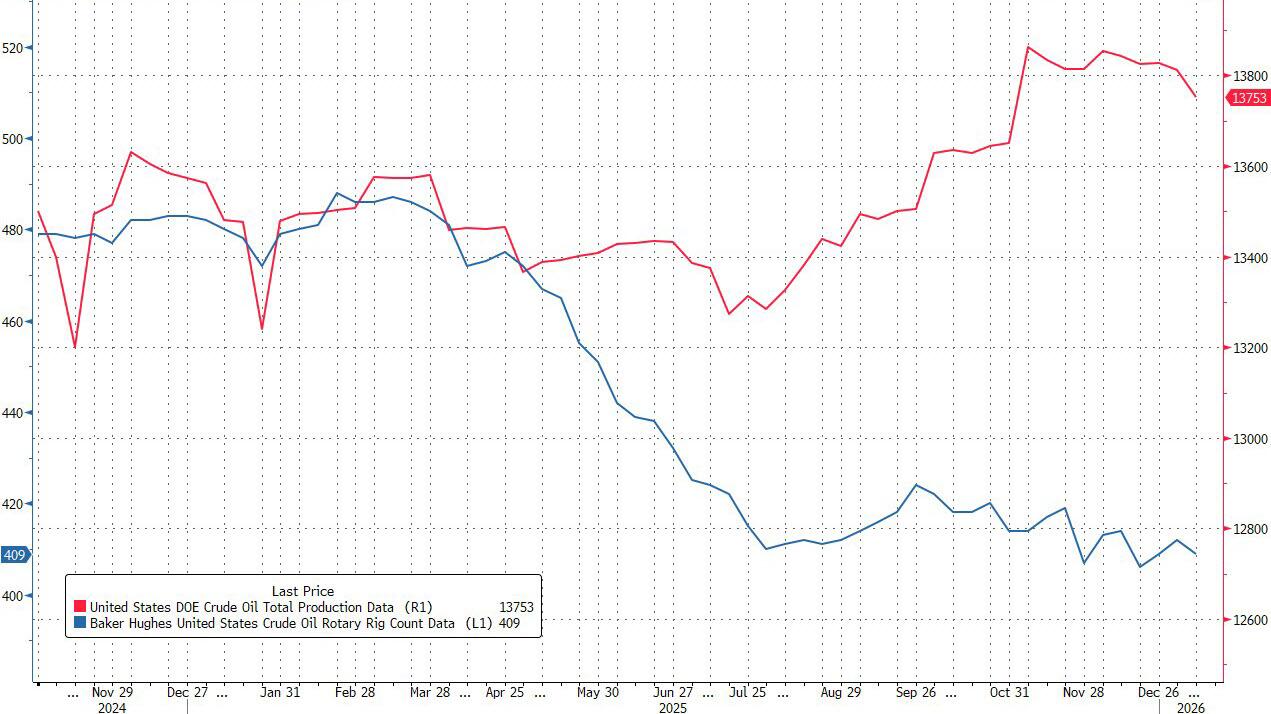
Yet there is some hope that US production is finally moderating: while US Crude production hovers near record highs despite the continuing decline in rig count, last week saw a notable drop in total production, dropping by 58K barrels to 13.753 million, the lowest since the end of October.
Despite the sizable build in crude stock, WTI is holding gains as attention remains glued to what happens in Iran next…
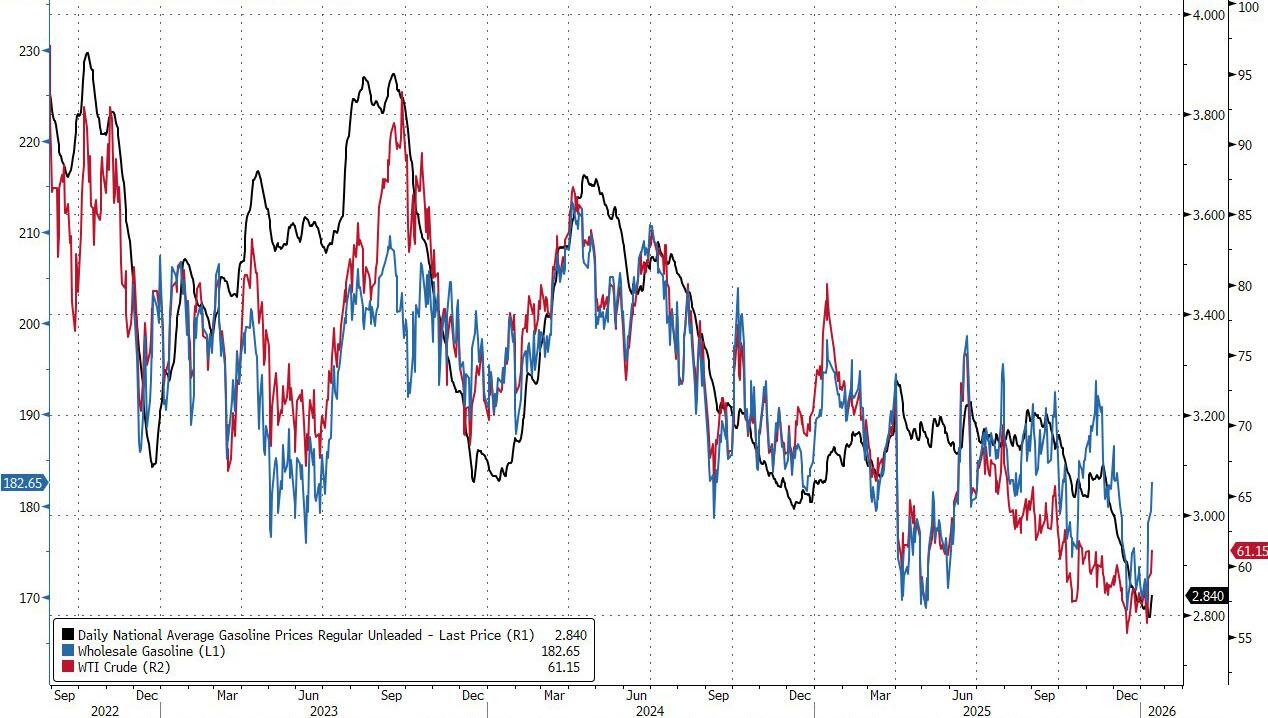
On the bright side, the broadly weaker trend on crude oil prices has dragged gas (pump) prices down to their lowest since May 2021…
While it’s not exactly ‘drill, baby, drill’, it’s certainly what Trump wanted (the question is, will the lower price push shale producers to cut production… and round and round we go).
Tyler Durden
Wed, 01/14/2026 – 11:03
https://www.zerohedge.com/energy/crude-stocks-rise-most-two-months-us-oil-production-finally-drops

3 Chicago artists are among the 2026 winners of $50,000 USA Fellowships
The Chicago-based philanthropic organization United States Artists on Wednesday announced its 2026 USA Fellowships, awarding $50,000 to 50 artists in 10 disciplines, including three artists local to Chicago: Ben LaMar Gay, Sharon Udoh and Edra Soto.
According to the announcement, the money can be used in any way to support their work, “whether towards expanding their practice, covering living expenses, accessing healthcare or investing in their communities.”
While money and artmaking can be intrinsically linked, a 2003 Urban Institute study reported that 96% of Americans value art in their lives, but only 27% value artists. United States Artists was founded 20 years ago in response to that study, according to a statement on its website. Today, USA has given some 1,000 individuals more than $53 million in direct support. The organization, founded by leaders from the Ford, Rockefeller, Rasmuson and Prudential Foundations, is funded by foundations, philanthropists and other field leaders “to create pathways of support for artists across the nation,” its website states.
Judilee Reed is at the helm as president and CEO, and the organization was Los Angeles-based until 2014, when then-CEO Carolina García Jayaram moved its headquarters to Chicago, stating that the city’s “epicenter for creative activity” is “currently experiencing an artistic renaissance.” As for the fellowships, there’s a rigorous, year-long selection process: Cultural professionals nominate artists, artists submit applications with work samples, and each year’s awardees “(reflect) the current cultural and societal moment, honoring a plurality of voices from diverse backgrounds and often-overlooked experiences, identities and perspectives,” according to the award announcement.
Chicago artist Edra Soto is the winner of a 2026 USA Fellowship Award, presented by United States Artists of Chicago. (John Michael Kohler Art Center)
Edra Soto
Inspired by her Puerto Rican roots, Soto submitted work from three recent installations: “por la señal,” “Graft” and “the place of dwelling.” Using wrought-iron screens, lawn furniture and electric fans, “the place of dwelling” peeks into the lives of the working-class community where she grew up — but not completely, as Soto would ask herself, “How do I uplift an everyday object?” Plastic chairs reupholstered with a bespectacled Bad Bunny sticking his tongue out, a golden tiger in front of palm fronds and red, white and blue spray-painted names of Puerto Rican celebrities are a few answers. But for Soto, her fellowship is about more than just her art practice.
“I have employees, and I’m renting studio space and storage space,” she said. “There’s a lot of traveling, social presentations, lectures and commitments that require my time, there’s the clothing I need to wear to do a presentation. My economy is very much connected to my artmaking.”
Musician Sharon Udoh is the winner of a 2026 USA Fellowship Award, presented by United States Artists of Chicago. (Kate Sweeney)
Sharon Udoh
Udoh composes, writes and improvises hymns. At Ravenswood’s Experimental Sound Studios, Udoh and turntablist Allen Moore formed the duo Potliquor. In one video submitted to USA, the sun is shining as Moore gently slides records out of their sleeves and places them on a nearby player while Udoh sits across from him at a piano, eyes closed, her fingers hop-skipping over keys sometimes delicately, and sometimes with force, depending on Moore’s record choice. A piano player for 40 years, Udoh was so influenced by her Christian upbringing that after hearing her music, she often gets asked, “Hey, did you grow up in church?”
“When I sing hymns, they are an opportunity to experience the deepness of one’s feelings, and to be honest. You can’t lie to God,” Udoh said.
Having used her retirement money to move to Chicago three years ago, she plans to use her fellowship funds to “(recuperate) my retirement and (make) a lot of records.” Udoh also hopes to donate to local organizations that have helped her get to where she is.
Ben LaMar Gay is the winner of a 2026 USA Fellowship Award, presented by United States Artists of Chicago. (Shanon Marks)
Ben LaMar Gay
Like Udoh, Gay is a musical improviser. The Chicago native is influenced by folklore that, he says, “comes from humans improvising, trying to understand their place between the ground and the sky.” In his “duet” with the DuSable Bridge titled “Bridge Lift,” Gay is standing in the guts of the DuSable, blowing into an Armenian brass instrument called the duduk. Two microphones angle towards the duduk to capture resonant moans, creaks, squeaks and honks akin to the bridge’s. The video cuts between Gay’s performance and pedestrians walking along the Chicago River, as the DuSable shifts slowly towards the sky.
As for his fellowship money plans? “First and foremost, the funds will help me stay afloat, just in everyday life. But it also keeps my collaborations afloat, and my collaborators,” Gay said. “If our project can stay afloat, they can benefit from it as well.”
As USA fellowship awardees, Gay, Soto and Udoh will also receive financial planning, career consulting, legal advice and personal care. The organization strives to address artists’ evolving needs, the press release states, and “remain in dialogue on how artists’ practices and livelihoods can be most effectively supported.”
“People dedicate their life to making art because it’s not only a necessity to be engaged with others and influence through ideas and the imagination, but it’s also a form of surviving,” Soto said. “Making art has saved my life.”
Ruby Rosenthal is a freelance writer.
https://www.chicagotribune.com/2026/01/14/usa-fellowships-chicago-artists/