Category: News

Scientist Claims The Universe Has Seven Dimensions
Scientist Claims The Universe Has Seven Dimensions
Authored by Steve Watson via Modernity.news,
A prominent physicist has put forward a striking proposal: our universe may not be limited to the four dimensions of space and time we experience every day. Instead, it could operate with seven dimensions in total, with three compact extra layers folded so tightly they remain invisible.
This idea emerges not from science fiction, but from an attempt to resolve one of modern physics’ most enduring puzzles—the black hole information paradox first highlighted by Stephen Hawking in the 1970s.
Richard Pinčák, a senior researcher at the Slovak Academy of Sciences’ Institute of Experimental Physics, leads the team behind the new model. The work, published in the journal General Relativity and Gravitation, explores how extra dimensions arranged in a specific geometric structure could prevent black holes from fully evaporating.
Stephen Hawking’s theory of black hole evaporation clashes with the laws of quantum mechanics. A new paper finds a way around this paradox, provided that the universe has seven dimensions. https://t.co/NR5a0HoFXQ
— Live Science (@LiveScience) April 16, 2026
The four dimensions we know—three of space and one of time—form the basis of everyday experience and Einstein’s general relativity. But Pinčák’s framework adds three more.
“We experience three dimensions of space and one of time — four dimensions in total,” Pinčák explained. “Our model proposes that the universe actually has seven dimensions: the four we know, plus three tiny extra dimensions curled up so tightly that we cannot directly perceive them.”
These hidden dimensions take the form of highly symmetrical G?-manifolds. In this geometry, a property called torsion creates a twisting effect in spacetime. At the extremely small scales reached as a black hole shrinks through Hawking radiation, this torsion generates a repulsive force.
The proposal directly confronts the information paradox. Hawking showed that black holes emit radiation and slowly lose mass, eventually evaporating completely. Yet quantum mechanics insists that information cannot be destroyed—only scrambled.
“Imagine you throw a book into a fire,” Pinčák said. “The book is destroyed, but in principle you could reconstruct every word from the smoke, ash, and heat — the information is scrambled, not lost.”
In a completely evaporating black hole, however, the information about everything that fell inside appears to vanish forever, creating a fundamental conflict between general relativity and quantum theory.
Pinčák’s seven-dimensional model offers an escape. As the black hole approaches its final stages, the torsion-induced repulsive force acts like a brake.
“This repulsive force acts as a brake, halting the evaporation before the black hole vanishes completely,” Pinčák noted.
What remains is a stable microscopic remnant, roughly 10 billion times smaller than an electron in mass. This remnant can encode the lost information through subtle oscillations known as quasinormal modes.
The same geometric structure also connects to particle physics. The torsion field in the extra dimensions produces a potential energy landscape that mirrors the one responsible for giving mass to the W and Z bosons via the Higgs mechanism.
“The same torsion field… generates a potential energy landscape that is identical in form to the one responsible for giving mass to the W and Z bosons — the carriers of the weak nuclear force,” Pin?ák said.
This suggests that particle masses could have a geometric origin tied to the hidden dimensions themselves.
The researchers emphasize that their approach does not pretend to solve quantum gravity outright. Semiclassical approximations break down near the Planck scale, where full quantum-gravity effects dominate.
“As the black hole shrinks toward the Planck scale, all existing models — ours included — must eventually confront the transition into the deep quantum-gravity regime,” Pin?ák acknowledged.
“What distinguishes our approach is that we do not claim semiclassical evaporation operates all the way down to the remnant mass,” he added. “At that point, a new physical effect … takes over and stabilises the configuration.”
The model makes testable predictions, such as the expected masses of hypothetical Kaluza-Klein particles associated with the extra dimensions—far beyond current accelerator reach but potentially falsifiable in principle.
“The important point is that the predictions are concrete — the model can be wrong, which is what makes it scientific,” Pinčák said.
While direct experimental confirmation lies well in the future, the idea builds on concepts familiar from string theory and M-theory, where extra dimensions play a central role in unifying forces. It also ties into earlier work by Pinčák’s team exploring G? geometries and their implications for symmetry breaking and particle properties.
For now, the proposal stands as a creative theoretical bridge between gravity, quantum mechanics, and particle physics. It invites fresh thinking about the hidden architecture of reality and whether the universe’s deepest secrets might be woven into dimensions we have yet to perceive.
Whether future observations of primordial black holes, gravitational waves, or high-energy particle collisions lend support remains to be seen. But the elegance of deriving both black hole stability and particle masses from the same geometric framework offers a compelling new lens on long-standing mysteries.
Your support is crucial in helping us defeat mass censorship. Please consider donating via Locals or check out our unique merch. Follow us on X @ModernityNews.
Tyler Durden
Sun, 04/19/2026 – 18:40
https://www.zerohedge.com/technology/scientist-claims-universe-has-seven-dimensions

Ruben Gallego’s Political Career May Be Toast
Ruben Gallego’s Political Career May Be Toast
Ruben Gallego spent the better part of the past year positioning himself as the Democrat who cracked the code for Democrats to start winning back Latino voters.
Gallego won his Arizona Senate seat in 2024, defeating Kari Lake by just over two points, even as President Trump carried the state with relative ease.
That narrow but meaningful victory turned him into something of a Democratic savior – proof that a certain kind of candidate, delivering a certain kind of message, could still resonate with the Latino and working-class voters the party has been hemorrhaging for years. “At a moment when the Achilles’ heel for the Democratic Party is Latinos and working-class voters, this is his opportunity to rescue our country,” said Chuck Rocha, an adviser to Gallego, speaking to The Hill earlier this year.
Gallego had mused about a 2028 run just two weeks before this spiral began, telling NBC News,” No matter who runs, even if it’s not me, the candidate that wins in 2028 is going to have to get the Latino vote back to at least 62 percent. That is the ‘Pass Go’ line, collect $200 on the Monopoly board. We didn’t hit that in 2024, and that’s why we find ourselves in this situation.”
For Democrats, Gallego wasn’t just a senator from Arizona; he was the future of the party.
That was before Eric Swalwell.
Last week, Swalwell resigned his House seat and withdrew from the California gubernatorial race following a wave of sexual assault allegations, and Gallego has been caught in the fallout. They were close friends, and he chaired Swalwell’s 2020 presidential campaign and publicly backed his gubernatorial run. When the Swalwell allegations broke, the questions about Gallego’s proximity followed almost immediately. What did he know? When did he know it? His answers have satisfied almost no one.
He held a press conference on Tuesday, attempting to distance himself from Swalwell. “I fell for it,” he told reporters, saying Swalwell “lied to all of us.”
Unfortunately, it didn’t go so well for him.
Democratic strategist Anthony Coley, a Capitol Hill veteran who once worked for the late Sen. Edward Kennedy, didn’t even try to sugarcoat it.
“If Gallego’s press conference was meant to reassure potential voters, donors and activists, it failed,” he said. “Folded arms and incomplete answers don’t shut down a story, they extend it. The party faithful will want real clarity on his relationship with Swalwell before he gets serious consideration for higher office in 2028.”
An unnamed Democratic strategist who knows Gallego personally said of his 2028 ambitions: “I think he is done.” A second anonymous strategist said Gallego’s brand – constructed around the idea of a straight-talking, authentic new kind of Democrat — “took a direct hit this week.”
The strategist continued, “He looks lost. He looks like a deer in headlights.” The same source added the observation that underscores why this moment stings so deeply for Democratic insiders: “He’s someone that Democrats were pretty invested in and that’s why it hurts.”
Despite Gallego’s growing problems, not every Democrat is ready to write him off yet. Strategist Brad Bannon argued that the Swalwell friendship “demonstrates poor judgment” but represents “not a major obstacle to the Arizona senator’s rapid rise.” Strategist Christy Setzer said Gallego “distanced himself thoroughly and effectively” from Swalwell and predicted that only Swalwell would ultimately pay a price — “unless they have similar issues of their own that have yet to be surfaced.”
And that could be a problem. Rep. Anna Paulina Luna (R-Fla.) appeared on CBS News’s The Takeout with Major Garrett and accused Gallego of his own unspecified misconduct – including allegations she described as “sexual in nature” and potential campaign finance violations.
Sen. John Thune’s office confirmed the matter was under investigation.
Thune’s office told The Hill that the material received from Luna had been referred to the Senate Ethics Committee and declined further comment. A Gallego spokesperson called the accusations “right-wing conspiracy theories being parroted by a fringe far-right member of Congress” and said that the Ethics Committee had not contacted Gallego.
The accuser Luna referenced has not yet come forward.
For now, Gallego’s relationship with Swalwell is under scrutiny, and Republicans aren’t about to let the public forget the two were tight.
White House Press Secretary Karoline Leavitt called the Swalwell allegations “despicable and disgusting” and singled Gallego out by name, challenging reporters to ask which Democrats knew about Swalwell’s behavior and stayed quiet. “I think it’s also quite plausible … that there were many other Democrats in this town on Capitol Hill who knew about his perhaps illegal behavior — certainly his disgusting and inappropriate behavior. And why they were silent for so long? I think those are questions that must be raised of the sitting representatives — including Mr. Gallego,” Leavitt said.
Gallego isn’t up for Senate reelection until 2030, which affords him time to recover. Whether that time is enough depends heavily on what comes next — and whether the accuser that Rep. Luna alluded to eventually steps forward.
Tyler Durden
Sun, 04/19/2026 – 18:05
https://www.zerohedge.com/political/ruben-gallegos-political-career-may-be-toast
Another ‘Green Dot Sunday’: Oil Jumps, Stocks Dump After Weekend Of Escalations
Another ‘Green Dot Sunday’: Oil Jumps, Stocks Dump After Weekend Of Escalations
Having gone into the weekend with stocks squeezing to record highs and oil prices plunging on euphoric hope that goldilocks was right around the corner in the Middle East – following Trump’s very enthusiastic statements all day – things have gone a ‘little bit slightly turbo’ again…
As last week’s rally extended, the market’s sensitivity to negative developments diminished.
Investors brushed aside warnings from global institutions about the economic damage. Instead, flows remained supportive and leadership broadened, with technology catching up after a rough start to the year. By Thursday and Friday, the tone had shifted to express the view that the war is all but over and the growth cycle remains intact.
That left markets heading into a critical inflection point.
But the weekend did not offer any help…
First, shortly after the ‘close’ on Friday, Iran denied most of what Trump claimed as fact with regard ‘nuclear dust’ and peace-deals.
Then came the Iranians fired upon an Indian tanker attempting to cross the Strait.
And today we have seen the US military strike and seize an Iranian-flagged cargo ship in the Gulf of Oman
On the bright side? …there are expected to be ‘talks’ on Tuesday or Wednesday (which Iran has claimed it will not attend).
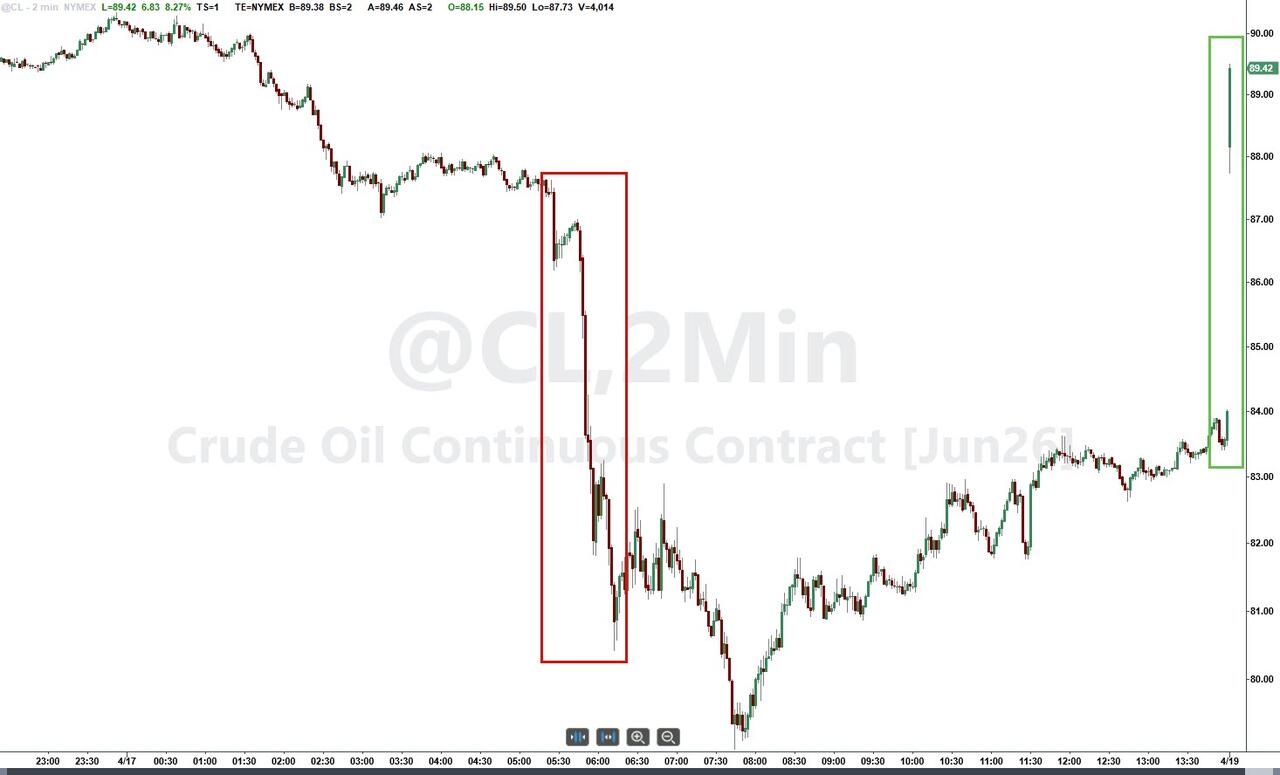
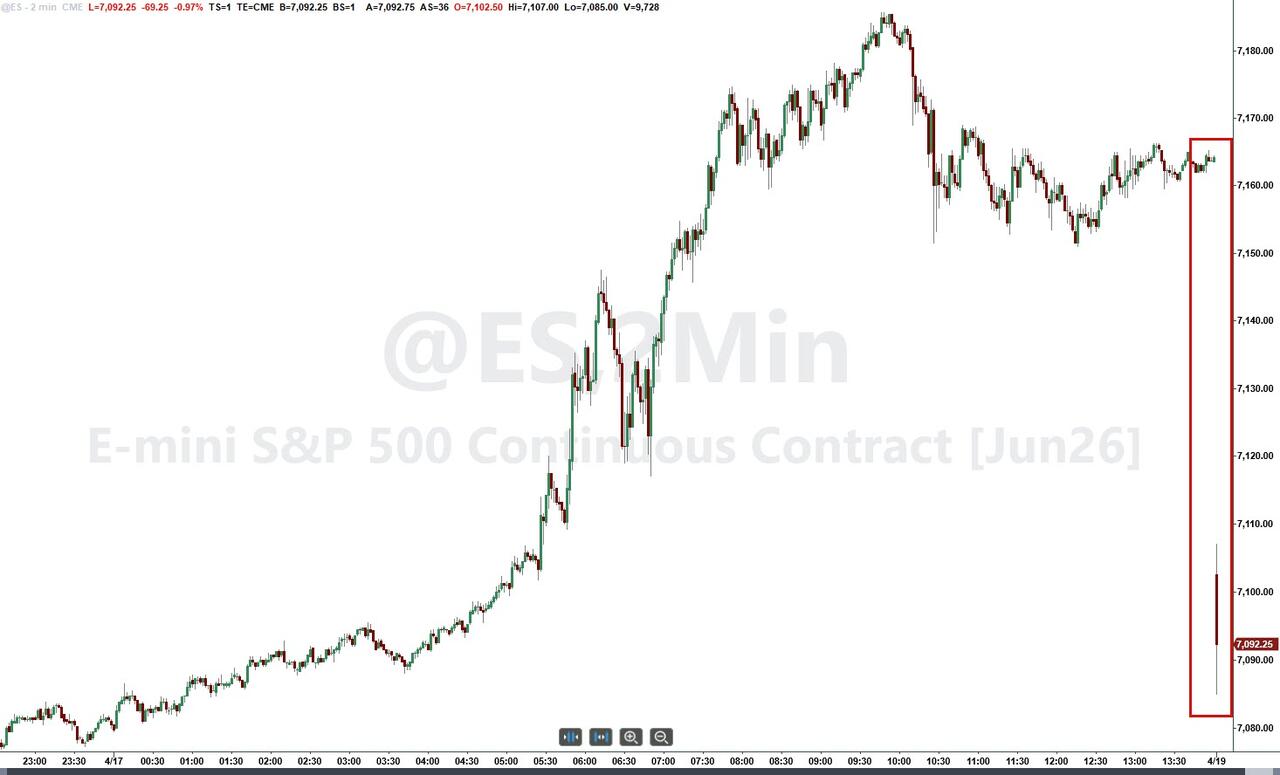
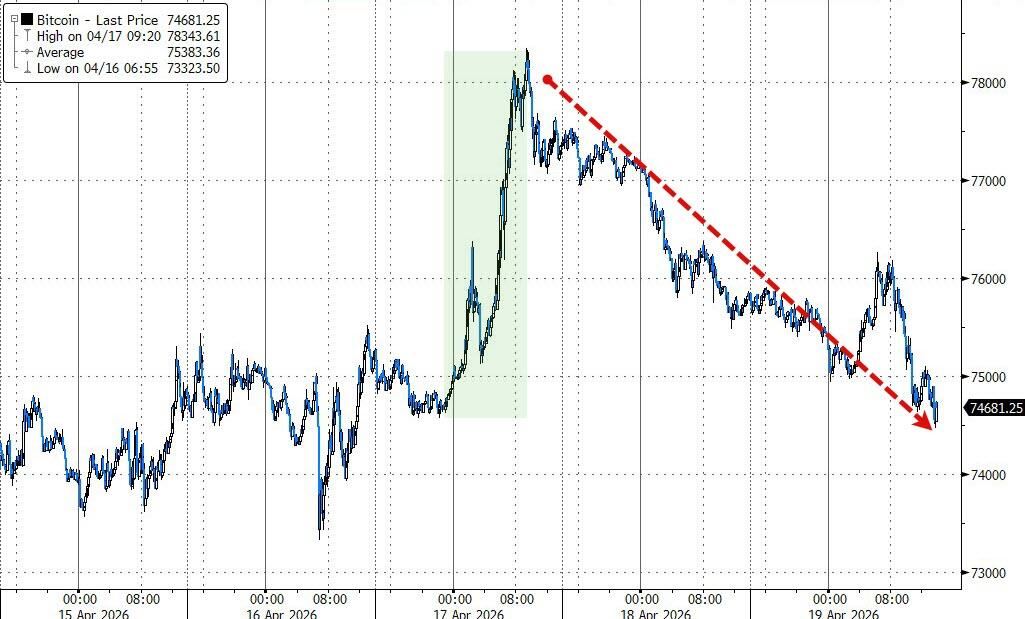
Soaking all that in left markets back in ‘Green Dot Sunday‘ mode with oil spiking, equity futures fading, and bitcoin sliding.
WTI spiked almost 9% – back up near $90…
Gas contracts are jumping in early Asian trading, setting up a nervous start for risk assets in the region
*EUROPEAN GAS RISES AS MUCH AS 9.8% AS IRAN CLOSES HORMUZ AGAIN
S&P futures are down around 1%…
Bitcoin has erased all of Friday’s gains…
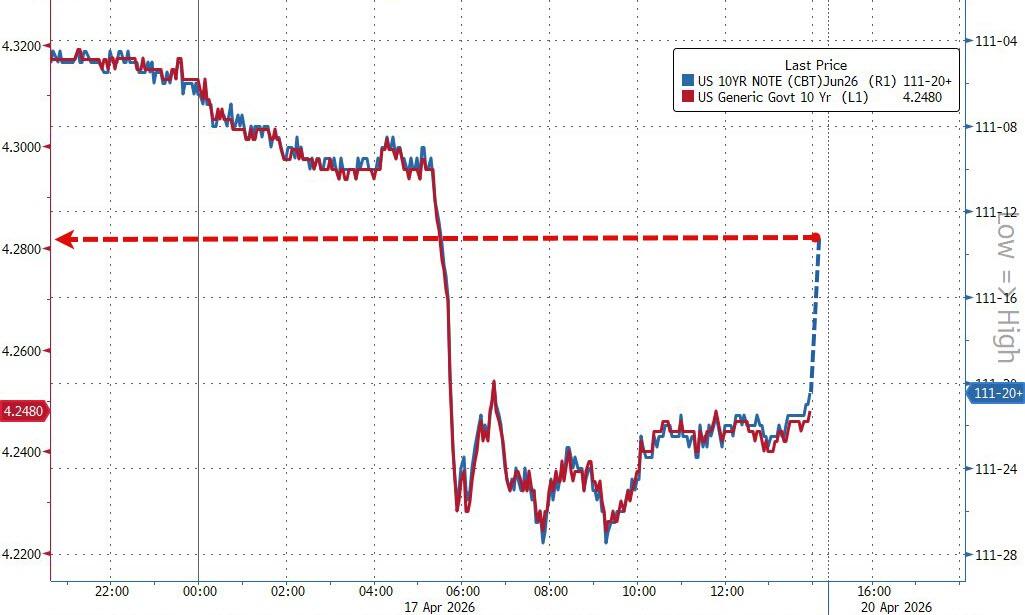
Treasury futures are down, implying around a 5bps jump in 10Y Yields…
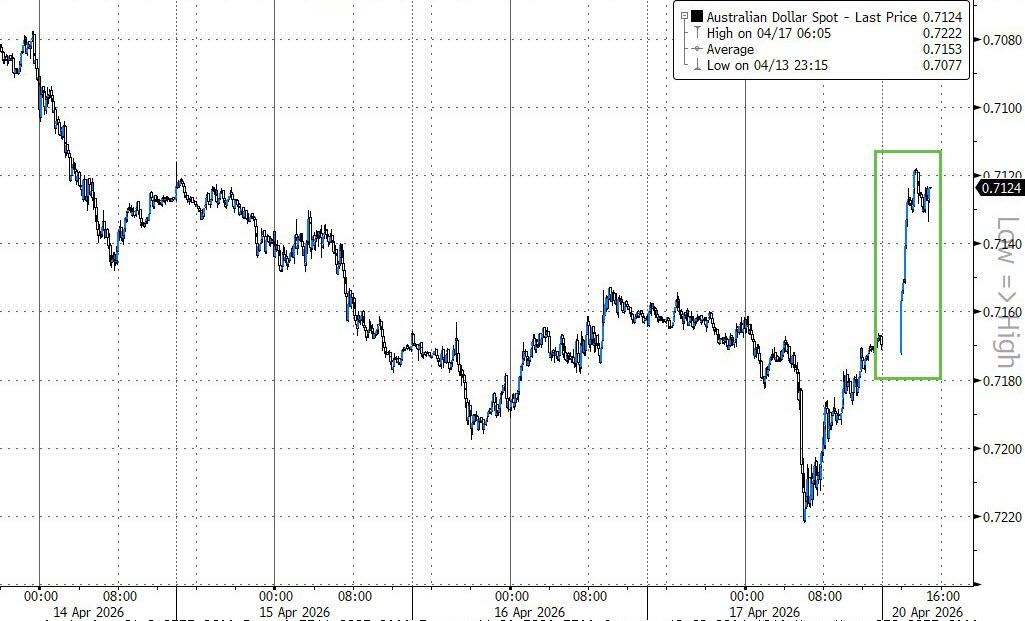
AUD is leading losses for G-10 currencies as the US dollar strengthens in early action…
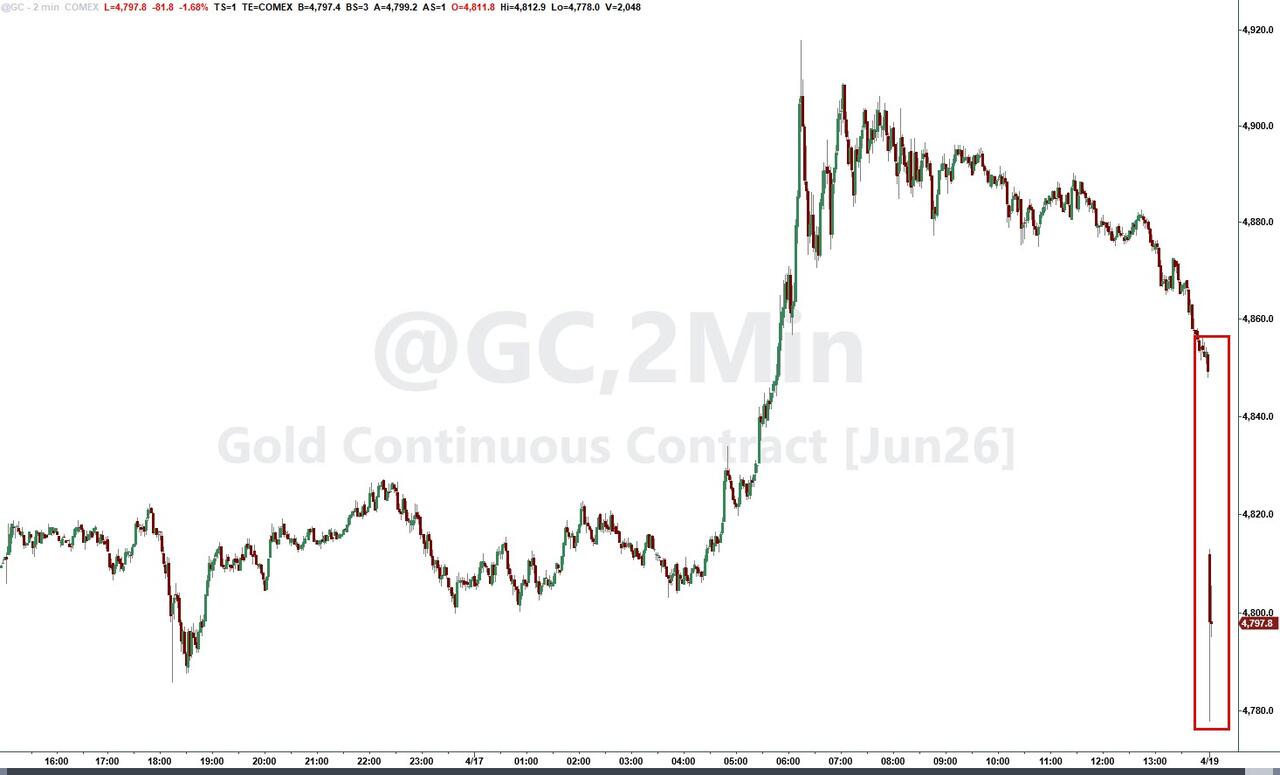
Gold is down around 1.5%…
As we noted on Friday, the OpEx was extremely call-heavy on a delta notional basis.
SpotGamma estimated the OpEx profile is about 80% weighted to calls, one of the most extreme readings in its data, after the SPX rallied 11% in two weeks.
The problem is that if traders monetize gains instead of rolling positions higher and out, negative dealer hedging flows will put pressures on spot.
Said another way, the rally increasingly looks driven by call buying, which leaves the gains more fragile if the positive narrative starts to wobble and traders rush for the exit.
The technical picture says much the same, with gamma unclenched, opening the door for more volatility (in either direction).
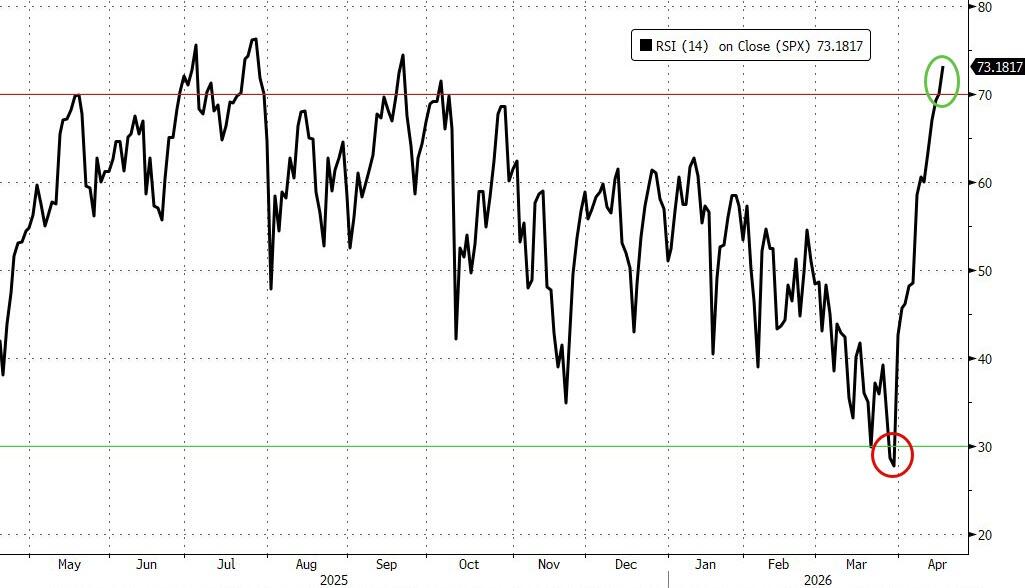
Equities went from oversold to overbought in only two weeks, a very fast reset that can often mark a real regime turn and precede a tactical consolidation that cools the momentum.
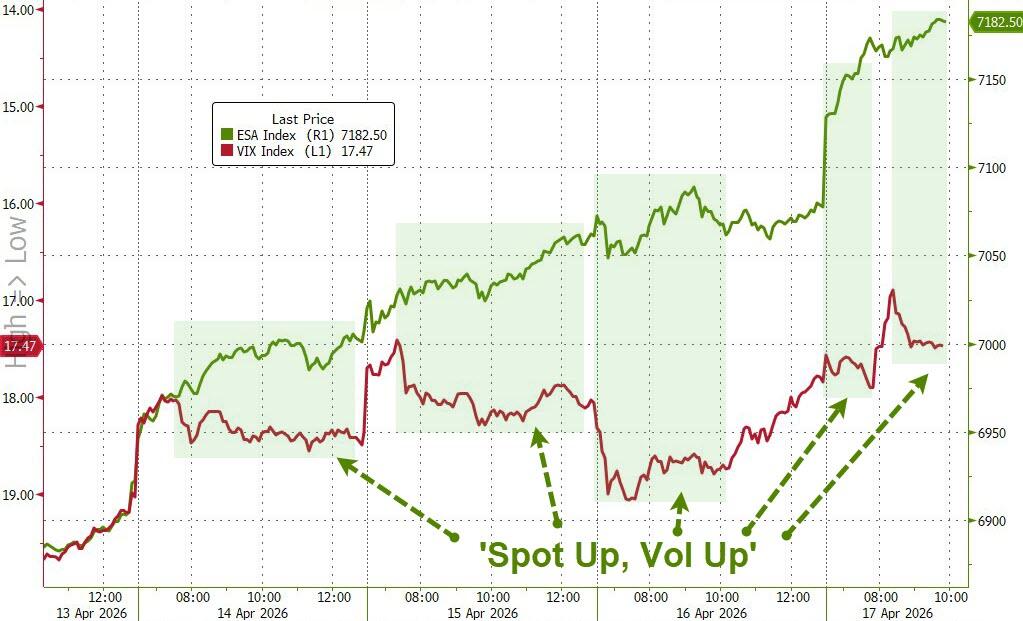
Based on recent “stock up, vol up” dynamics, and massive imbalances to call volumes vs puts, SpotGamma sees room for a modest equity correction this week.
They suggested expressing this via S&P500 put spreads.
This is not a statement on the longer term equity dynamics, but a short term overbought condition.
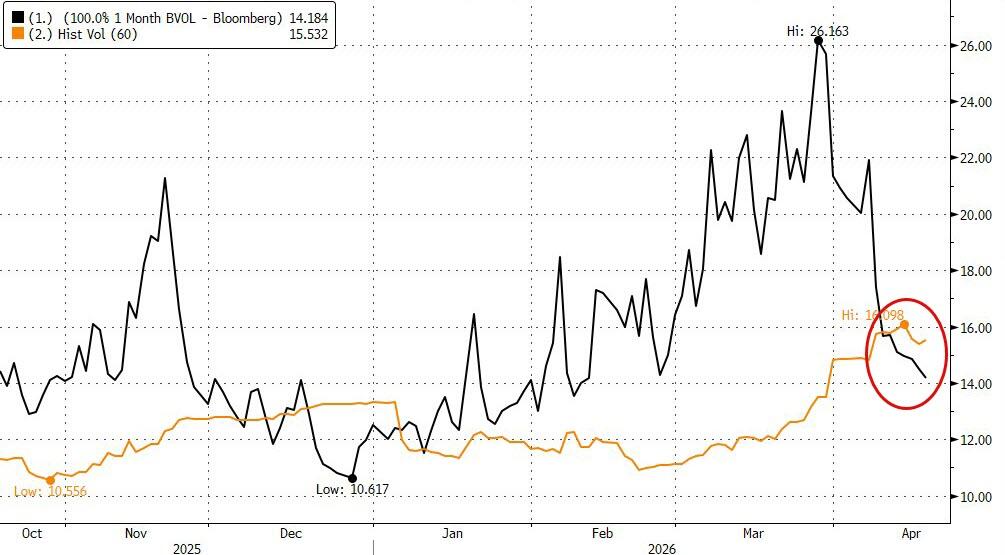
Over the past week, realized intraday SPX moves have consistently exceeded implied expectations.
This environment continues to favor long volatility structures (e.g., straddles/strangles) over short premium strategies, given the current risk/reward setup.
As Bloomberg’s Brendan Fagan noted, the bar is no longer low: With equities at records and oil back down, the peace dividend has largely been pulled forward. If talks deliver tangible progress, either a framework or a memorandum to carve out a deal, the current rally can be validated. But if negotiations fall short, the asymmetry becomes more acute.
As a reminder, this is exactly the same picture we saw last Sunday – a major gap up in oil (down in stocks) at the open after the US blockade began… which then rapidly reversed into a monster week…
However, this time is different as after a week defined by markets trading on belief rather than verification, the time to deliver on what’s in the price has arrived.
Tyler Durden
Sun, 04/19/2026 – 18:00

Open Sesame
Open Sesame
Submitted By Peter Tchir of Academy Securities
This week’s market behavior had a mythical, almost magical tone to it.
In Arabian Nights, Ali Baba was able to open a cave of riches by uttering the phrase “Open Sesame.” Markets responded to any and every sort of connotation of “The Strait is Open” by rewarding participants with riches. We started this week bright and early, kicking off Bloomberg TV, and then moving on to Bloomberg Radio, and Tom Keene’s Best Ideas.
At the time we were all trying to understand what “Blockade” meant. How and what was the U.S. going to do in terms of a blockade? Markets were jittery, but somehow, from almost the get go, markets seemed to take the combination of U.S. and Iranian snippets to mean the Strait was Open.
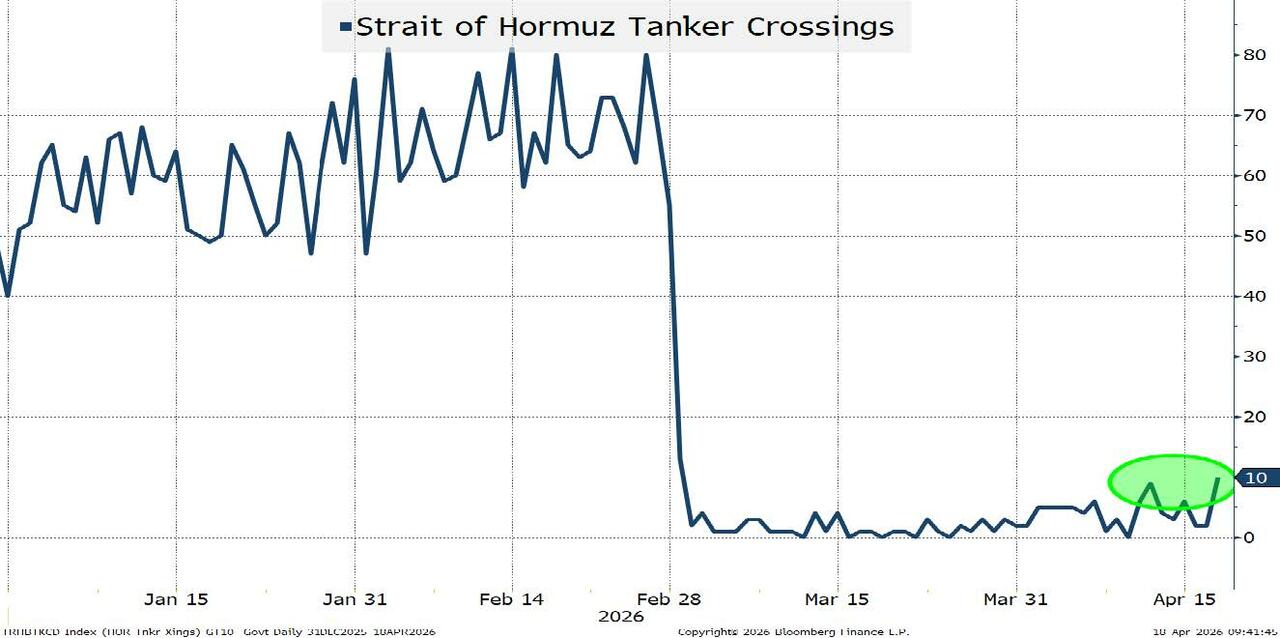
I am not sure how accurate this data set on Bloomberg is (TRHBTKCD index) given all the conflicting stories of what has transited or not, what is running without transponders, etc. But traffic remains subdued.
We have argued that a ceasefire benefited the U.S. more than Iran and that there were some very strong possible outcomes from U.S. efforts in the region. I underestimated how quickly and how big those good outcomes would be reflected in the market.
While “any option” still seemed viable, markets had moved on to not only is a deal close, but it will also be the best possible deal. A deal where Iran not only stops pursuing a nuclear weapon, but they would also provide the U.S. with all of their enhanced uranium.
As the weekend progresses, it is unclear how realistic this type of deal is. There are once again competing narratives about the Strait.
Weirdly, unless you are trading futures, you can skip the “green dot” Sunday night, as time and again, the Sunday night price action has done little to predict how markets would behave once the U.S. opens.
Just How Magical Was “Open Sesame”?
Last weekend, we went with More Than Just Iran. Academy had delivered so much content on Iran, that we wanted to highlight some of the other issues (and opportunities) facing the market.
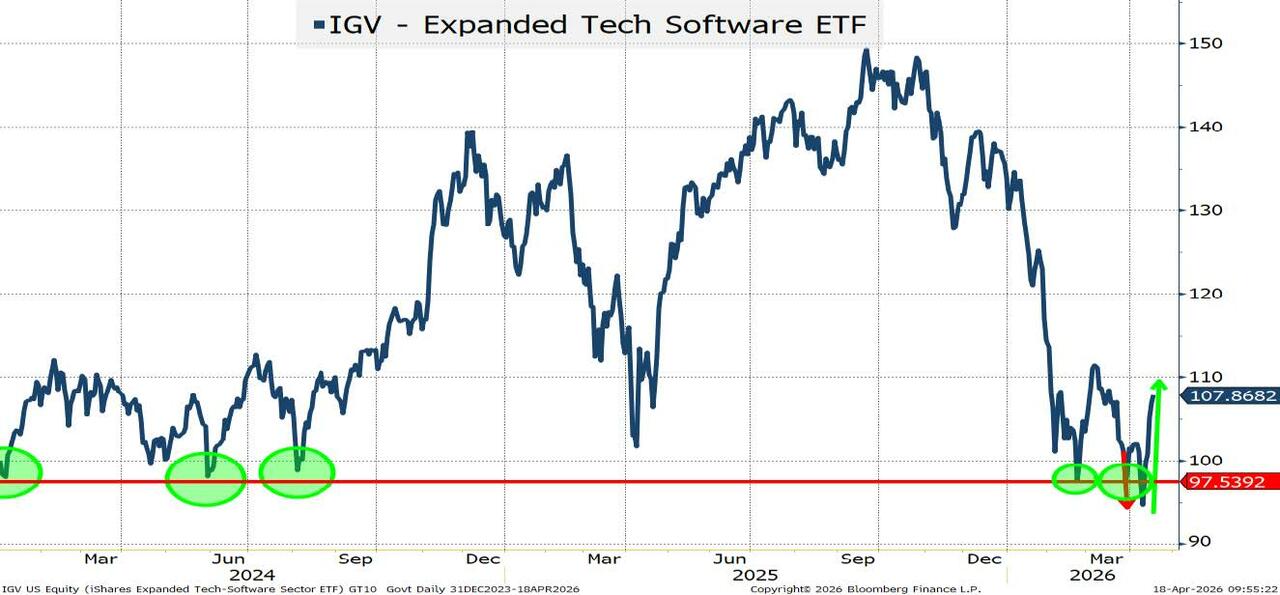
Software.
Software conclusion – Problem Solved.
IGV (software ETF) rose 14% on the week. ARKK which I use as a “proxy” for disruption, also rallied by 15%. INTC (one of the few individual tickers I’ve been vocal about in reports and the media) said “hold my beer” as it rallied 35% in less than 2 weeks! QTUM (quantum ETF) was up 25% and didn’t sell off as much in the first place – which makes some sense as investment into this area is only increasing.
Private Credit.
While the rebound hasn’t been as strong in private credit (and private credit-related companies) it started to rebound earlier. We liked it “for a trade” as it had seemed to be oversold and was trading “ok” even when bad news hit the tape.
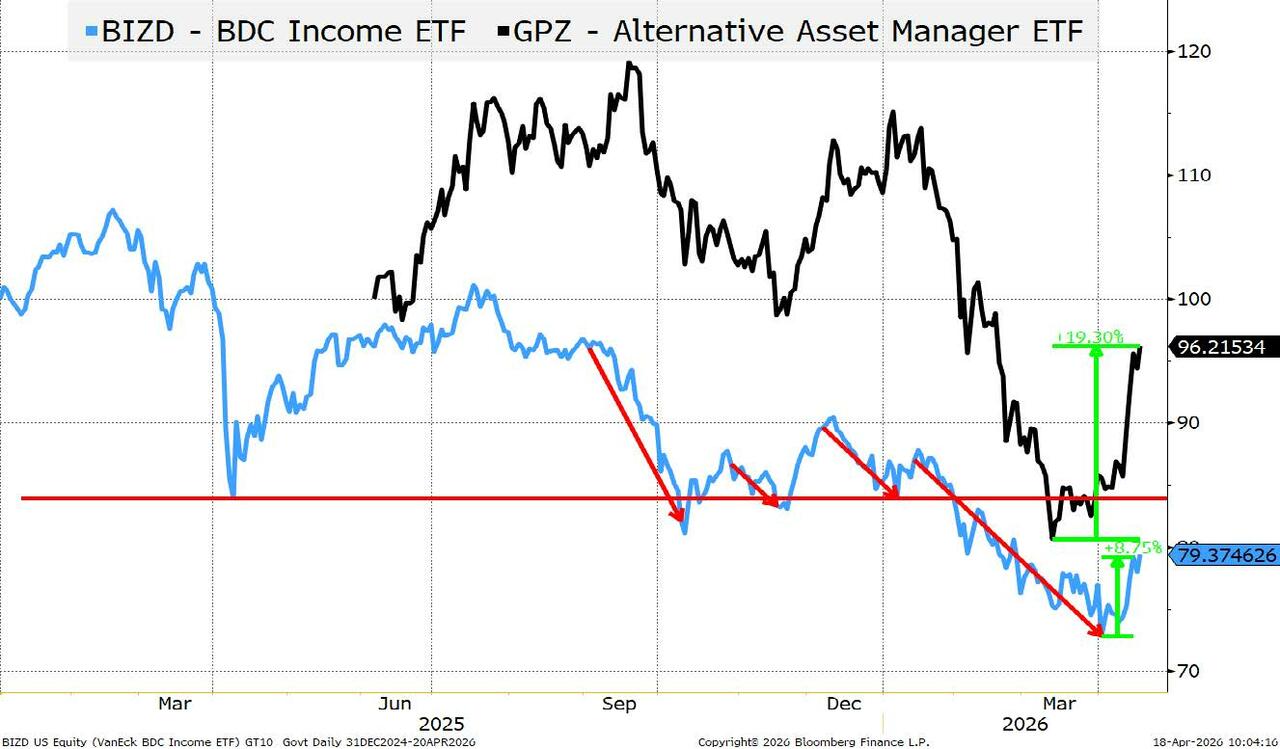
We use BIZD to reflect BDCs more broadly. It has risen “only” 9% since April 1st and despite the rally is still below its post-Liberation Day lows.
GPZ (which has seen AUM pop from just over $100 million when we first mentioned it, to over $250 million, predominantly through inflows) is an ETF that I use to highlight the performance of “alternative asset managers” which includes companies with heavy exposure to private credit. It hit the low back on March 12th, and is up almost 20% since then.
OWL, which has arguably been at the epicenter of the Private Credit discussion, rose 20% in just a week as it put its low in just last Friday.
Private Credit. While not “solved,” this market has been stabilizing for some time. Yes it was propelled higher last week, along with almost everything else, but that seemed to be only “part of the story.”
Rare Earths, Critical Minerals, and Uranium.
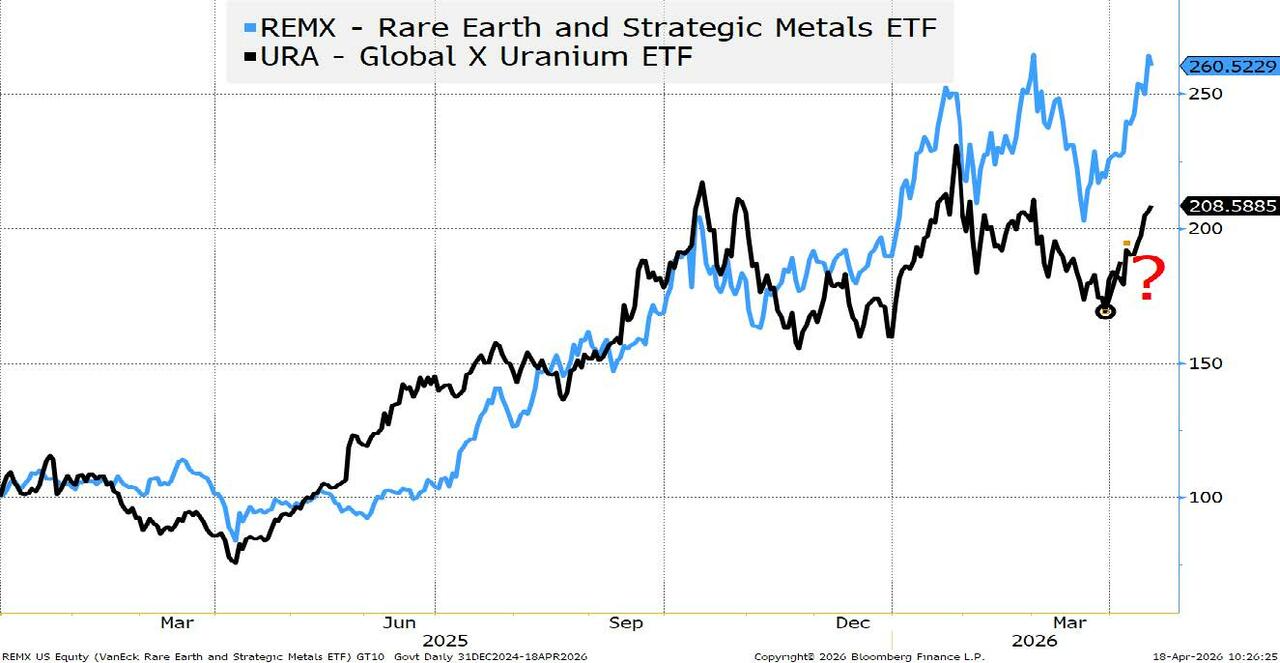
This one “confuses” me a little bit more than some of the others. Presumably, the war was going to lead to some sort of slowdown and would decrease the need for rare earths (REMX) and Uranium-related companies (URA). Maybe, but war, and more importantly, the replenishment of arsenals, probably isn’t that bad for rare earths and critical minerals.
On uranium, I guess the case could have been made about slowing global demand, but I’m really not sure why an oil shortage was bad for nuclear. One seemingly logical conclusion is that oil, once again highlighting geopolitical risk associated with it, would spur investment into nuclear. It didn’t seem to do that. I’m not sure why Iran handing over enriched uranium and possibly creating a lower risk environment in the Middle East is so good for uranium? I’m long, but can’t really say I understood the price action for the past few weeks.
Rare Earths, Critical Minerals, and Uranium. I guess the “problem” was “solved” but not sure why there was a problem in the first place?
Treasuries
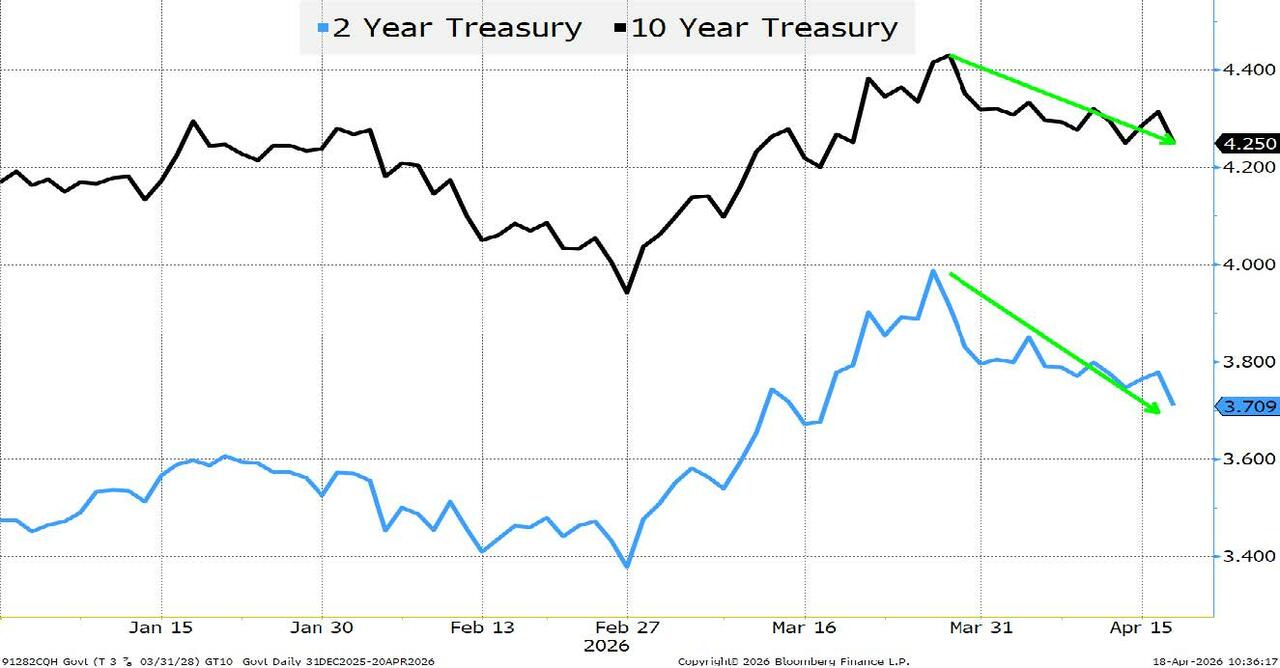
The Treasury market started performing better a few weeks ago and that has continued. We argued that while the initial response to the war would be higher yields, that had become overdone. Now the 10-year has hit our “target” of 4.25%. Our target is for 4.25% on 10s to be the midpoint of the range. If anything, that range might need to be moved lower.
The market is pricing in slightly better than a 50/50 chance of 1 cut this year. While the affordability issue (the way most non-economists now see inflation) will make it difficult to cut, I think the market will have to start pricing in at least one cut ahead of the midterms.
Treasuries. A problem, which was overdone, no longer seems to be a problem, which makes sense.
Bottom Line
Dog-years represent roughly what a dog’s age would be if it was human.
Market participants need to define Trump-years. There has been no slowing of news flow. I see no reason why that would change. In fact, if Iran starts taking up less of the administration’s time, look for the pace of headlines impacting other sectors, relationships, countries, trade, production, jobs, etc. to increase. It seems that I should be able to weave in One Thousand and One Nights into this section, as it fits the Ali Baba and the 40 Thieves theme, but I couldn’t figure out a clever way to do it. It has been a long week! A long month! And even a long year! (Is that the Friend’s theme song?)
Look for lower yields (that seems slightly contrarian here, I think).
I continue to be “pound the table” loud in favor of being heavily overweight the ProSec themes.
I was nowhere near as optimistic on the broad stock market rally as I should have been. Even today, with the benefit of hindsight, it still seems a bit “magical” (or “mechanical”) how well markets behaved in light of the actual headlines. Not the perception of headlines, but the actual headlines. The “Open Sesame” magic that “solved all problems” makes some sense, but positioning may have played a much larger role than we’d like to admit. The faux liquidity of the current trading environment seems to amplify moves.
Let’s hope markets are right and we are near the end. (The exact phrase we used in last weekend’s report).
Things almost seem “too good to be true” but as of now the ceasefire remains intact and other headwinds are being addressed/resolved/ignored which supports the market.
My biggest fears for the economy and risk markets remain affordability, jobs, and the “working poor.” That fear is why I continue to think yields drift lower.
Tyler Durden
Sun, 04/19/2026 – 17:30

Will This Atlantic Hit Piece Be The Final Straw?
Will This Atlantic Hit Piece Be The Final Straw?
Authored by Matt Margolis via PJMedia.com,
The Atlantic has a well-documented history of publishing fake hit pieces about President Donald Trump and his administration, and one wonders how many more hoaxes they can run before they get in real trouble.
Its latest effort targeting FBI Director Kash Patel may be its most reckless yet — and this time, the bureau is fighting back with lawyers.
The piece, written by reporters Sarah Fitzpatrick and Jonathan Lemire, claims that on Friday, April 10, Patel struggled to log into an internal FBI computer system while wrapping up his workday.
He quickly became convinced that he had been locked out, and he panicked, frantically calling aides and allies to announce that he had been fired by the White House, according to nine people familiar with his outreach. Two of these people described his behavior as a “freak-out.”
Patel oversees an agency that employs roughly 38,000 people, including many who are trained to investigate and verify information that can be presented under oath in a court of law. News of his emotional outburst ricocheted through the bureau, prompting chatter among officials and, in some corners of the building, expressions of relief. The White House fielded calls from the bureau and from members of Congress asking who was now in charge of the FBI.
It turned out that the answer was still Patel. He had not been fired. The access problem, two people familiar with the matter said, appears to have been a technical error, and it was quickly resolved.
The piece didn’t stop there. It also alleged Patel has been plagued by “bouts of excessive drinking,” claiming members of his security detail had trouble waking him on multiple occasions because he was seemingly intoxicated. It further alleged that breaching equipment — the kind used by SWAT and hostage-rescue teams — was requested last year because Patel had been unreachable behind locked doors.
The FBI denied every word of it before the article ever went live. Attorney Jesse Binnall sent a formal letter to The Atlantic and Fitzpatrick ahead of publication, putting them on notice that the claims were “categorically false and defamatory.”
This is the letter we sent to The Atlantic and Sarah Fitzpatrick BEFORE they published their hit piece on FBI Director @FBIDirectorKash. They were on notice that the claims were categorically false and defamatory. They published anyway.
See you in court. pic.twitter.com/Ke8cqNh8hY
— Jesse R. Binnall (@jbinnall) April 17, 2026
The bureau’s response was even more direct: “Print it, all false, I’ll see you in court — bring your checkbook.”
They printed it anyway.
Late Friday night, Patel fired back on X.
see you and your entire entourage of false reporting in court… But do keep at it with the fake news, actual malice standard is now what some would call a legal lay up. https://t.co/MfbHH8OtLv pic.twitter.com/kw5U3LrfMM
— FBI Director Kash Patel (@FBIDirectorKash) April 18, 2026
It’s worth noting that The Atlantic was apparently the only outlet willing to run this story. Other D.C. reporters chased the same tips and couldn’t verify them. They passed. The Atlantic published it. And now they’re going to be sued.
This is what The Atlantic does. They publish outlandish and bogus stories that no other outlet will touch, which accomplishes the goal of giving Democrats and their supporters reason to insist the stories are true. The outlet’s hoax piece alleging Trump didn’t want to visit the Aisne-Marne American Cemetery near Paris in 2018 because the troops there who died in battle were “losers” and “suckers” was disputed by over a dozen witnesses. Yet, the left still insists it happened—even after Jeffrey Goldberg, the editor-in-chief of The Atlantic, admitted it could have been wrong.
Sarah Fitzpatrick herself has a history of publishing bogus hit pieces lacking sources and corroboration.
By the way, @S_Fitzpatrick is also the reporter who wrote the throughly debunked hit piece that claimed Supreme Court justice Brett Kavanaugh drugged women so they could be sexually abused.
She has a history of writing hit pieces with either no sources on the record or… https://t.co/YnaE5llsJO pic.twitter.com/5HMYZVyYjl
— Megan Basham (@megbasham) April 19, 2026
White House Press Secretary Karoline Leavitt and acting Attorney General Todd Blanche both publicly defended Patel. Blanche praised Patel, noting he “has accomplished more in 14 months than the previous administration did in four years.” FBI spokesperson Erica Knight added that since being sworn in, Patel has taken just 17 days off — roughly half the time taken by former directors James Comey and Christopher Wray over comparable stretches.
The Atlantic published a “bombshell” on Director Patel tonight that every real DC reporter chased, couldn’t verify, and passed on.
Here’s reality. Since being sworn in, Director Patel has taken a grand total of 17 days off — half as much time off as Comey and Wray — and he…
— Erica Knight (@_EricaKnight) April 17, 2026
Tyler Durden
Sun, 04/19/2026 – 16:20
https://www.zerohedge.com/political/will-atlantic-hit-piece-be-final-straw

Catching Print? New Feminist Trend Proves They Have Smooth Brains
Catching Print? New Feminist Trend Proves They Have Smooth Brains
For decades insecure women have used feminism as a vehicle to crusade against “body shaming” and male objectification – Which is essentially a war on men who dare to have beauty preferences.
Nearly every feminist movement has roots in female physical insecurity, from the “fat positivity” movement, to the “slut walk” protests, to diversity requirements that are eliminating attractive women from popular media, to the “inversion” movement in which average women deliberately make themselves uglier “in rebellion” against the men who were never interested in them in the first place.
It’s no secret that female insecurity rules almost everything women do politically. One could say that feminism is essentially the weaponization of female insecurity as a means to gain power over society.
The latest trend to spew from the bowels of feminist activism is called “Catching Print” – Activists claim men are objectifying and shaming women, so women should objectify and shame men…by staring at and rating men’s junk. The problem is, these people don’t seem to understand that the vast majority of men simply don’t care.
The trend is, of course, going viral on cesspool sites like TikTok, and it is being popularized by leftist media sites like Cosmopolitan. But, it does offer a perfect opportunity to peer into the mentality of the lowest common denominator and understand why marginalizing them is necessary.
The idea that men are worried about what grotesque feminists think of them is a desperate fantasy. However, these dumpy ladies have that problem covered; they simply pretend as if men are up in arms about the trend and scrambling to hide the bulge in their pants from prying eyes. As always, feminists build a strawman on social media and then tear him down. It’s sad, but this makes them feel powerful.
Men sit with their legs spread for a reason – They’re never worried about who is looking. If anything it would appear that activist women are jealous of modern men’s ability to remain indifferent to women’s judgements. And, to be clear, the idea of women trying to shame men into conformity is not new.
Narcissistic females have been using shaming as a manipulation tactic since the dawn of time. Almost every man in the world has been accused of having a “small unit” by a woman who was trying to distract from the fact that she is wrong. Women invented body shaming, mostly to undermine other women out of jealousy. Men’s brains do not operate in the same manner.
What feminists call “body shaming” is often nothing more than men have standards and preferences in who they date. In the liberal west, women are applauded and rewarded for having extreme and often absurd preferences (6 feet, 6 figure income, 6 pack abs). Men are demonized merely for not dating fat chicks.
As for the idea of creepy men staring at women, all men know that this is subject to circumstance. If she finds the man attractive, it’s not creepy for him to leer. If she doesn’t find the man attractive, well, she should probably get over it or avoid going out in public. We have seen endless examples of what feminists consider “creepy”, which includes men doing nothing more than glancing in their general direction.
It’s time for the ladies to understand and accept the fact that they don’t get to dictate who looks at them in public. By extension, men really don’t care if women stare at them or the bulge in their pants.
A key element of the feminist agenda requires women to pretend as if they are constant victims, crying about oppression that simply doesn’t exist. They then mobilize their smooth-brained movements to attack men for this fake oppression and “flip it”. In other words, feminists falsely claim bad behavior by men as an excuse to justify their own bad behavior. It’s a classic Marxist maneuver.
However, this old tactic is not working anymore. The methodologies of feminists have been exposed in recent years and men are wise to the game. Female shaming techniques hold no power and men are shrugging off the attacks. Today, men are more likely to whip out their “print” and slap a feminist in the face with it than actually care about her opinion.
Tyler Durden
Sun, 04/19/2026 – 15:45
https://www.zerohedge.com/political/catching-print-new-feminist-trend-proves-they-have-smooth-brains
Trump’s Cryptic “The End Is Near” Post Sends Internet Into A Frenzy
Trump’s Cryptic “The End Is Near” Post Sends Internet Into A Frenzy
Authored by Steve Watson via Modernity.news,
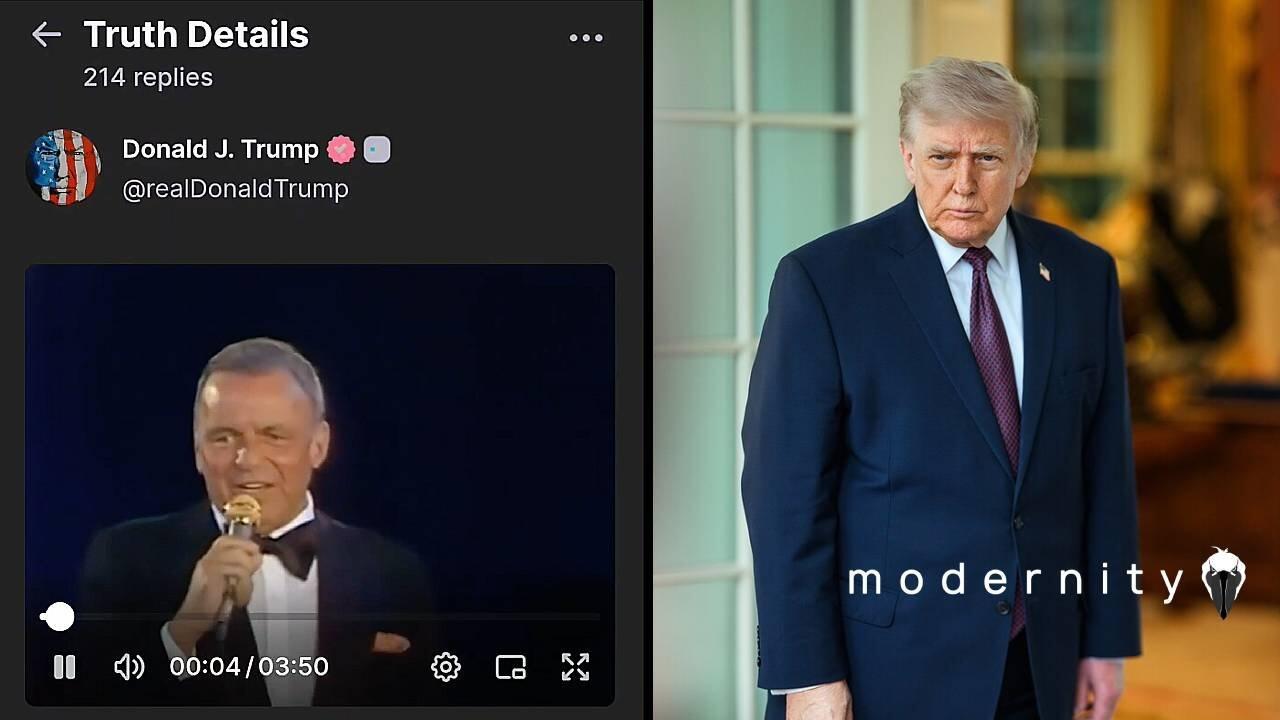
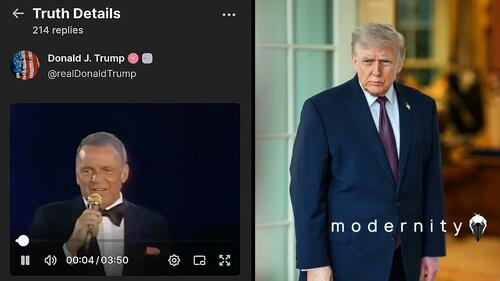
In a development that quickly fueled online speculation, President Trump posted a video of Frank Sinatra performing his signature hit “My Way” on social media with no accompanying text or explanation. The move came just hours after he convened a high-level meeting in the White House Situation Room to discuss the ongoing standoff with Iran over the Strait of Hormuz.
The post featured the classic track whose lyrics speak of independence and resolve. While Trump has long used the song at rallies, inaugurals, and even as Air Force One departed at the end of his first term, its sudden appearance amid rising tensions drew immediate attention.
Trump posted a video of Frank Sinatra performing “My Way”.
“And now, the end is near / And so I face the final curtain…
?Regrets, I’ve had a few / But then again, too few to mention…
?I did it my way.” pic.twitter.com/9y4aPnloZj
— Clash Report (@clashreport) April 19, 2026
I just woke up to this ?
Should I laugh or head to a bunker? pic.twitter.com/OLDXdQdLaZ
— Mario Nawfal (@MarioNawfal) April 19, 2026
Donald Trump posting Frank Sinatra’s “My Way” has to mean something right…
“The end is near and so I face the final curtain.”
Is he dying? Is he stepping down? Or is he just trolling us? pic.twitter.com/DtDvAYjW9Q
— Power to the People ?? (@ProudSocialist) April 19, 2026
Trump on an apparent sentimental bender last night posted Sinatra’s My Way on TruthSocial. Whoa. Get inside of his mind and listen to these lyrics. “and now the end is near…” end of everything type references. Trump dealing with his mortality? Something we should know about?? pic.twitter.com/lu9GjTfg6p
— IncarcerNation.com (@IncarcerNation) April 19, 2026
this one is far Worst than his end of the whole civilization threat. Donald Trump is becoming so erratic and unstable. pic.twitter.com/thlIdCaf8K
— Mars Jupiter (@sen_ven49488) April 19, 2026
This latest social media activity follows fresh statements from Trump on Truth Social addressing direct accusations of Iranian ceasefire violations. In the post, shared widely on X by accounts including RedWave Press, Trump laid out his position clearly:
“Iran decided to fire bullets yesterday in the Strait of Hormuz — A Total Violation of our Ceasefire Agreement! Many of them were aimed at a French Ship, and a Freighter from the United Kingdom. That wasn’t nice, was it? My Representatives are going to Islamabad, Pakistan — They will be there tomorrow evening, for Negotiations. Iran recently announced that they were closing the Strait, which is strange, because our BLOCKADE has already closed it. They’re helping us without knowing, and they are the ones that lose with the closed passage, $500 Million Dollars a day! The United States loses nothing.”
He added, “In fact, many Ships are headed, right now, to the U.S., Texas, Louisiana, and Alaska, to load up, compliments of the IRGC, always wanting to be ‘the tough guy!’ We’re offering a very fair and reasonable DEAL, and I hope they take it because, if they don’t, the United States is going to knock out every single Power Plant, and every single Bridge, in Iran. NO MORE MR. NICE GUY! They’ll come down fast, they’ll come down easy and, if they don’t take the DEAL, it will be my Honor to do what has to be done, which should have been done to Iran, by other Presidents, for the last 47 years. IT’S TIME FOR THE IRAN KILLING MACHINE TO END!”
MOMENTS AGO: President Trump on Truth Social: “Iran decided to fire bullets yesterday in the Strait of Hormuz — A Total Violation of our Ceasefire Agreement! Many of them were aimed at a French Ship, and a Freighter from the United Kingdom. That wasn’t nice, was it? My… pic.twitter.com/8s0ytsYCHE
— RedWave Press (@RedWavePress) April 19, 2026
After a U.S.-brokered 10-day ceasefire between Israel and Lebanon took effect, Iran initially announced the Strait of Hormuz was open to commercial vessels for the truce period. Oil prices dropped on the news. But the Islamic Revolutionary Guard Corps (IRGC) quickly reversed course, citing the continued U.S. blockade of Iranian ports and ships. Iranian officials, including Parliament speaker Mohammad Baqer Qalibaf, warned that without concessions the strait would remain closed.
Trump has maintained that the American blockade will stay in place until Tehran reaches a broader agreement that includes commitments on its nuclear program. He has described conversations with Iranian counterparts as productive but stressed that the U.S. position will not shift without concrete steps from the other side. No new direct talks are currently scheduled.
Saturday’s Situation Room session included Vice President JD Vance, Secretary of State Marco Rubio, Defense Secretary Pete Hegseth, and Treasury Secretary Scott Bessent. According to Axios reporting, the focus was on assessing ceasefire compliance and preparing for possible next steps in negotiations. No immediate policy changes were announced afterward.
This episode echoes dynamics we previously covered, when major outlets claimed Trump was preparing to “nuke” Iran ahead of a deadline tied to the same Strait of Hormuz standoff. The White House pushed back firmly at the time, clarifying that any potential action would be conventional strikes on infrastructure rather than nuclear weapons. Media speculation ran hot then, much as it has with today’s cryptic post.
As of this writing, U.S. representatives are set to arrive in Islamabad, Pakistan, tomorrow evening for indirect negotiations. Iran has not publicly responded to the latest Trump statement, and shipping interests continue to watch developments closely given the strait’s critical role in global energy flows.
The situation remains fluid, with both sides signaling openness to a deal while holding firm on core demands. Whether the current pressure and diplomatic track yield results or further escalation will depend on the coming days of talks.
Your support is crucial in helping us defeat mass censorship. Please consider donating via Locals or check out our unique merch. Follow us on X @ModernityNews.
Tyler Durden
Sun, 04/19/2026 – 15:10
https://www.zerohedge.com/political/trumps-cryptic-end-near-post-sends-internet-frenzy
Jeff Bezos’ Blue Origin Finally Joins Reusable Rocket Club – But Suffers Craft Issues In Space
Jeff Bezos’ Blue Origin Finally Joins Reusable Rocket Club – But Suffers Craft Issues In Space
Blue Origin’s New Glenn rocket reached space on its third flight and successfully landed its booster for the first time, but ultimately failed to place an AST SpaceMobile satellite into low Earth orbit. The booster landed on a large barge in the Atlantic Ocean, while the satellite separated and powered on but ended up in what Jeff Bezos’ rocket company described as an “off-nominal orbit.”
— Dave Limp (@davill) April 19, 2026
The New Glenn rocket, carrying AST SpaceMobile’s BlueBird 7 satellite, blasted off from the launchpad at Cape Canaveral, Florida, at about 7:25 a.m. local time. Its reusable first stage returned to Earth ten minutes later, touching down on a barge in the Atlantic Ocean.
LIFTOFF! New Glenn clears the tower at LC-36, carrying @AST_SpaceMobile’s BlueBird 7 satellite.
— Blue Origin (@blueorigin) April 19, 2026
“BOOSTER TOUCHDOWN! ‘Never Tell Me The Odds’ has done it again!” Blue Origin wrote on X, with Bezos posting footage of the now-reusable rocket touching down on the barge.
— Jeff Bezos (@JeffBezos) April 19, 2026
However, the mission yielded mixed results for the Blue Origin team, which is already behind schedule with New Glenn and is trying to establish itself as a credible competitor to Elon Musk’s booming SpaceX.
“We have confirmed payload separation. AST SpaceMobile has confirmed the satellite has powered on. The payload was placed into an off-nominal orbit,” Blue Origin wrote in a follow-up X post after the booster touched down.
In other words, “off-nominal orbit” suggests that the BlueBird 7 satellite is not at the correct altitude, speed, or trajectory it was supposed to be, and what that means for the satellite’s future remains highly uncertain.
AST SpaceMobile has partnered with several mobile network operators, the largest being AT&T, and has also worked with Verizon on direct-to-cell satellite connectivity.
Today’s launch is the first of the year for AST SpaceMobile, which started 2026 with only seven satellites in orbit. The company aims to have 60 satellites in orbit by year’s end.
Congratulations to Bezos on his first reusable first-stage rocket returning successfully to Earth, but for context, SpaceX has been doing this for years. Falcon 9 first-stage boosters have landed successfully in 598 of 611 attempts, with 573 of 579 for the Falcon 9 Block 5 version. A total of 565 reflights of first-stage boosters have all successfully launched their second stages and, all but one, their payloads.
Tyler Durden
Sun, 04/19/2026 – 14:35

Here’s Why Trump’s Hormuz Blockade Should Stoke ‘Strait Chaos’ For China
Here’s Why Trump’s Hormuz Blockade Should Stoke ‘Strait Chaos’ For China
The currently closed Strait of Hormuz, situated between Oman and Iran, connects the Persian Gulf to the Gulf of Oman and the Arabian Sea, and has emerged as a major flashpoint in the US-Iran war. The Bab el-Mandeb Strait, off Yemen’s coast, has also remained a focal point among critical maritime chokepoints, given ongoing threats from Iran-linked Houthi rebels.
While both critical chokepoints have been in sharp focus in the news cycle and among US officials, institutional research desks, intelligence analysts, observers, the OSINT community on X, and even everyday viewers watching Fox News or CNN, there is also another set of regional and transregional straits that warrant additional monitoring given their importance to global energy flows and commercial shipping.
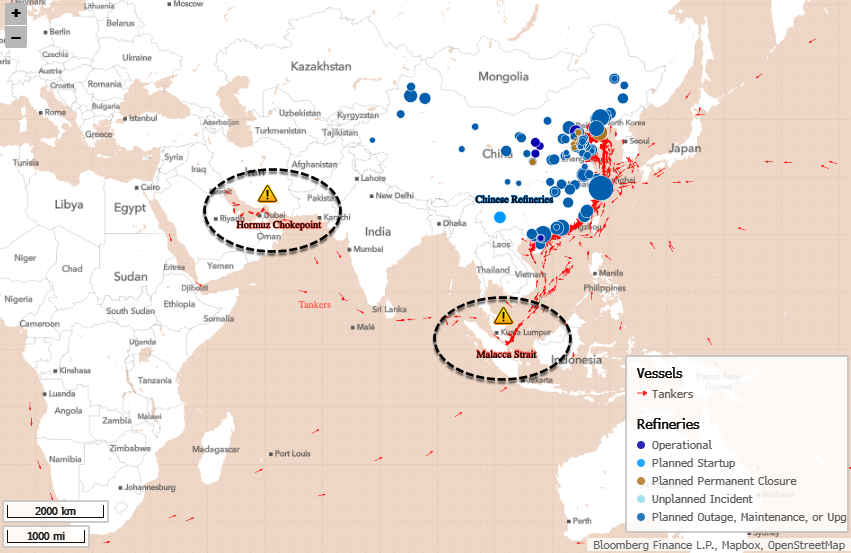
Shifting from the Hormuz chokepoint, the latest data from Bloomberg, citing AIS ship-tracking data, shows that tankers bound for China transiting from the Gulf area through the Strait of Malacca is yet another maritime chokepoint, especially for energy and trade flows into Asia.
The Strait of Malacca, at its narrowest point, is only 1.7 miles wide, creating a natural bottleneck. Most of the tankers transiting the tiny but very critical strait are hauling crude and LNG bound not just for China, but also for Japan, South Korea, and other countries in the region. This strait is a key link between Hormuz and China’s coastal refineries.
The list of narrow maritime chokepoints through which energy products flow on tankers should be very concerning to Beijing, given the US blockade of Hormuz and its potential to serve as a pressure campaign against China ahead of the Trump-Xi meeting.
Strait of Hormuz
This is the most important upstream chokepoint for China’s Gulf oil imports. A large share of Chinese crude from Saudi Arabia, Iraq, the UAE, Kuwait, and Qatar must exit through Hormuz first.
Strait of Malacca
This is China’s main downstream maritime bottleneck. Even after oil clears Hormuz, much of it still has to pass through Malacca on the way to East Asia. This is the classic “Malacca dilemma.”
Singapore Strait
Operationally linked to Malacca. Disruption here would compound any pressure on vessels transiting between the Indian Ocean and the South China Sea.
Lombok and Makassar Straits
These are major alternative routes if Malacca becomes constrained. Pressure here would matter because Chinese shipping would likely try to reroute through Indonesia.
Sunda Strait
Less ideal than Lombok, but still a secondary bypass route. It matters mainly in a broader interdiction or diversion scenario.
Bab el-Mandeb
This would affect Chinese crude and product flows tied to the Red Sea/Suez route, including some cargoes from North Africa or Atlantic Basin-linked trade. It is less central than Hormuz or Malacca for Gulf oil, but still important.
Our assessment here is that China’s crude import routes are highly vulnerable at Hormuz and Malacca, and the US can certainly throw a wrench in that system and disrupt those flows, as Hormuz has proven.
Zoltan Pozsar of advisory firm Ex Uno Plures explained it best: the Trump administration is “methodically building a portfolio of assets” to pressure China, centered on strategic energy supply nodes and maritime chokepoints that have historically supported Beijing’s cheap crude imports.
The obvious question is what happens if China doesn’t play ball with the US ahead of Trump’s upcoming Xi meeting. Beijing can clearly see the emerging pattern in which the Trump administration is willing to use US naval power, maritime chokepoints, and even the threat of blockade to generate leverage. That’s why the other straits noted above should serve as a warning to the Chinese leadership.
Tyler Durden
Sun, 04/19/2026 – 13:25
Short-Covering Rally… Or Something More?
Short-Covering Rally… Or Something More?
Authored by Lance Roberts via RealInvestmentAdvice.com,
▶ WEEK CLOSE: S&P 500 7,126.06 (+1.2%) | Nasdaq 13-Day Win Streak (longest since 1992) | Russell 2000 New ATH | Brent Crude -9.1% | VIX 17.42
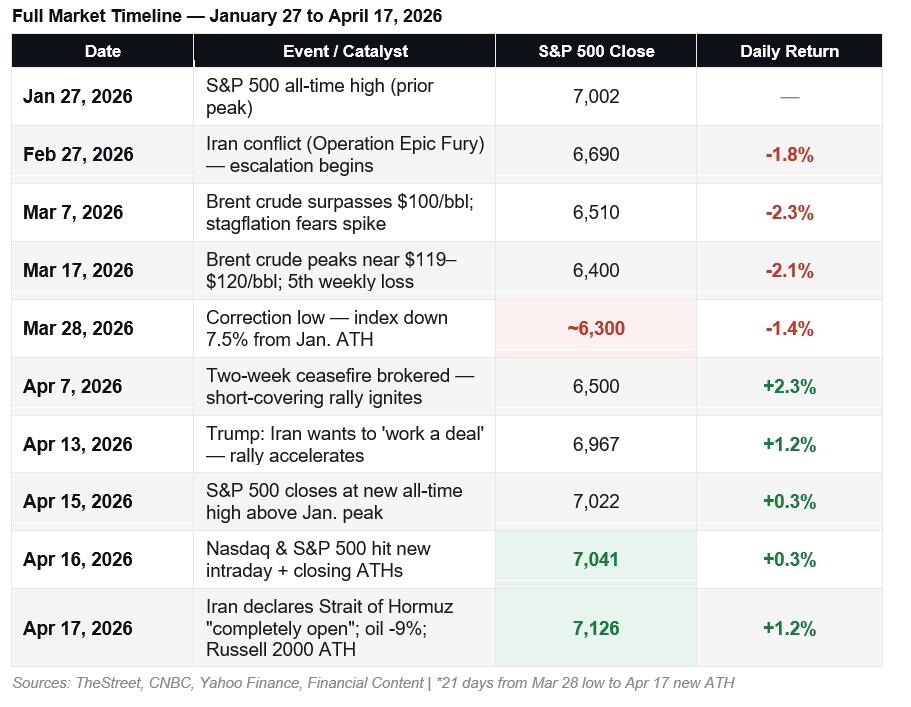
What began as a short-covering rally on April 7th has spent the last two weeks proving the bears wrong. Friday’s close at 7,126, the first finish above 7,100 in the index’s history, up 13.1% from the March lows, arrived alongside one of the most consequential single-session catalysts of the year. Iran declared the Strait of Hormuz “completely open.” Brent crude collapsed 9.1%. The Russell 2000 logged a new all-time high. The short-covering rally that skeptics said would exhaust itself in days has now run for three weeks and taken every major index to record territory.
The question every investor is asking right now isn’t whether to believe in the rally. The price action is undeniable, but the question is what kind of rally this actually is, and what investors who missed the initial short-covering rally should do about it.
The answer, as of Friday’s close, has shifted meaningfully. This no longer looks like a purely mechanical short-covering rally. The data is starting to point to something more durable. Here’s why that distinction matters, and what it means for your portfolio.
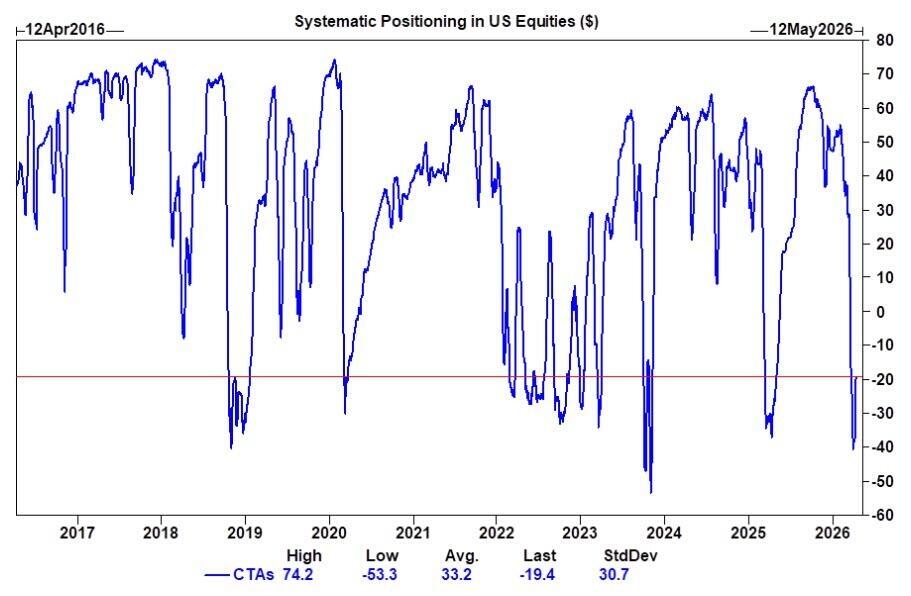
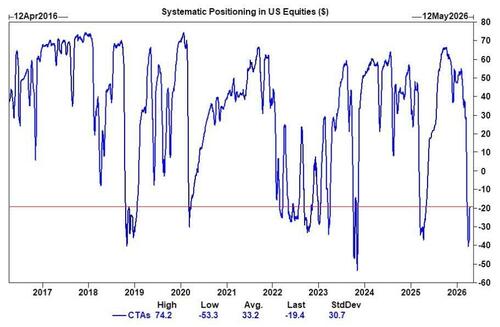
As we discussed in the #DailyMarketCommentary this past week, the recent price action felt like a release valve being pulled. Goldman’s prime brokerage flows guru, Lee Coppersmith, described a clear pivot toward risk-on, noting that sentiment has shifted toward FOMO among investors who dumped positions amid peak AI disruption fears and rising Middle East tensions.
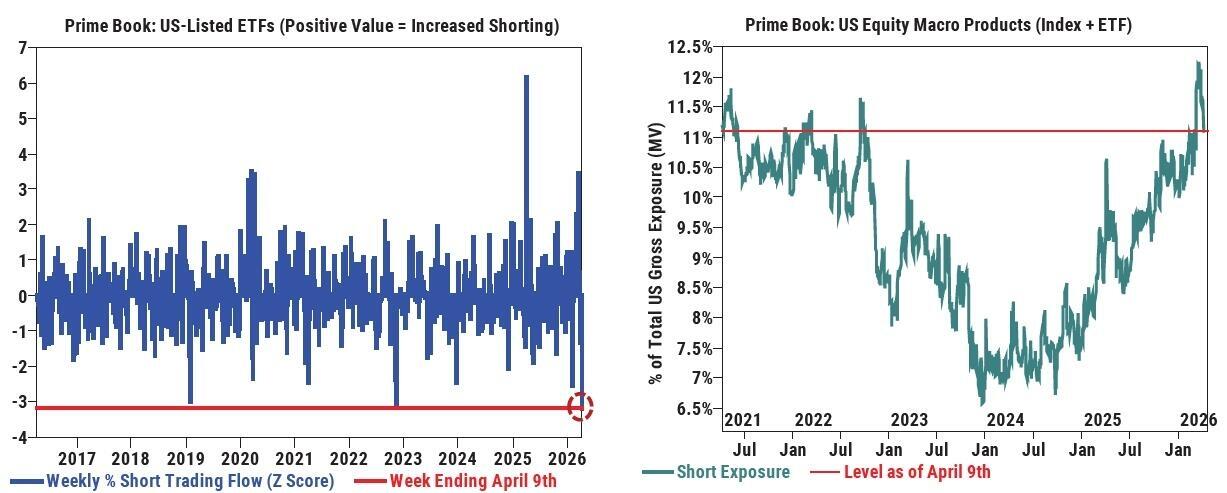
That pivot makes sense from a mechanics standpoint. Short exposure across U.S. macro products, index futures, and ETFs had climbed to the 93rd percentile over the past five years, with hedge fund gross exposure near an all-time high of 307%. When the Iran ceasefire headlines crossed, that positioning became a coiled spring. Shorts covered, hedges unwound, and global equities were net bought for the first time in eight weeks, with Goldman’s Equity Fundamental Long/Short Performance Estimate rising 4.01%, the best weekly reading since February 2021.
That’s the good news, and we’ve seen this movie before. The build-up of stress in the market gets investors overly bearish, and then “hope” arrives, relieving the pressure. The “hope” causes a rush to gain positioning, short positions unwind sharply, and the headline indices surge.
The trap, however, is confusing the “market squeeze” with a new bull leg higher. Understanding which dynamic is actually driving this market right now is the most important analytical question any investor can ask.
A Review
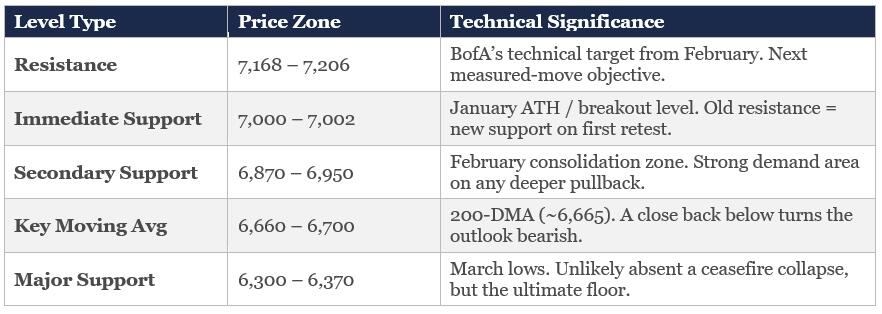
The S&P 500 peaked at 7,002 on January 27th and spent the next eight weeks coming apart at the seams. The trigger wasn’t an earnings collapse or a credit event. It was a geopolitical shock that repriced three variables simultaneously: oil, inflation expectations, and the Federal Reserve’s flexibility.
When U.S. forces launched Operation Epic Fury in late February, Brent crude surged from roughly $72 per barrel toward a peak of $119–$120 by mid-March. The stagflation trade that the market had been dismissing suddenly had a fundamental basis. JPMorgan cut its year-end price target. Recession probability estimates at the major banks rose from 25% toward 50%. Five consecutive weekly losses followed, with the index falling 7.5% from the January peak to lows near 6,300 by late March. Short interest built to multi-year highs as institutional investors layered on hedges through ETFs. The market was coiled.
What followed was initially a textbook short-covering rally. The ceasefire on April 7th lit the fuse. Trump’s April 13th comment that Iran wants to ‘work a deal’ accelerated it. And Friday’s Strait of Hormuz announcement — combined with oil’s single biggest drop of 2026 — may have completed the transition from short-covering rally to genuine bull market resumption.
The initial move off the lows was textbook, short-covering rally mechanics. Short interest at multi-year highs, extreme bearish sentiment, and oversold technicals created the conditions. All that was needed was a catalyst, and Trump’s April 13th comment that Iran wants to “work a deal” provided exactly that. Now, we have all three pillars in place to determine, potentially, what happens next.
Pillar One: The short-covering rally ignites. According to AInvest analysis, total S&P 500 component short interest was at elevated levels as the index traded near its lows, creating a concentrated pool of traders who must eventually buy back shares. When the ceasefire news broke on April 7th, the buying cascade began. What followed was a short-covering rally that sent the Nasdaq to its best multi-session run on record. The velocity was characteristic of forced covering rather than fresh conviction buying, which is precisely why the bears initially dismissed it.
Pillar Two: Geopolitical de-escalation extends the move. A pure short-covering rally typically exhausts itself within a few sessions once the most exposed shorts are covered. What extended this one was sustained improvement in the Iran narrative. Ships began clearing the Strait of Hormuz blockade. The Islamabad negotiations shifted tone from bellicose to cautiously optimistic. Vice President Vance noted the “diplomatic off-ramp is wider than it was a month ago.” That war premium embedded in equity valuations began to dissolve, giving the short-covering rally a fundamental tailwind.
Pillar Three: Earnings season anchors the move. Goldman Sachs posted EPS of $17.55 against expectations of $16.47. Morgan Stanley beat with $3.43 versus a forecast of $3.02. JPMorgan cleared the bar on nearly every metric. The financials sector handed the market a fundamental anchor at exactly the moment it needed one. As TheStreet contributor James ‘Rev Shark’ DePorre observed: “Investors are betting on the long-term strength of the U.S. economy, with AI as the primary driver. The Iran situation is being treated as a temporary distraction.”
So, who is likely right: the bulls or the bears?
Short-Covering Rally or Something More?
Every investor right now is trying to answer that question.
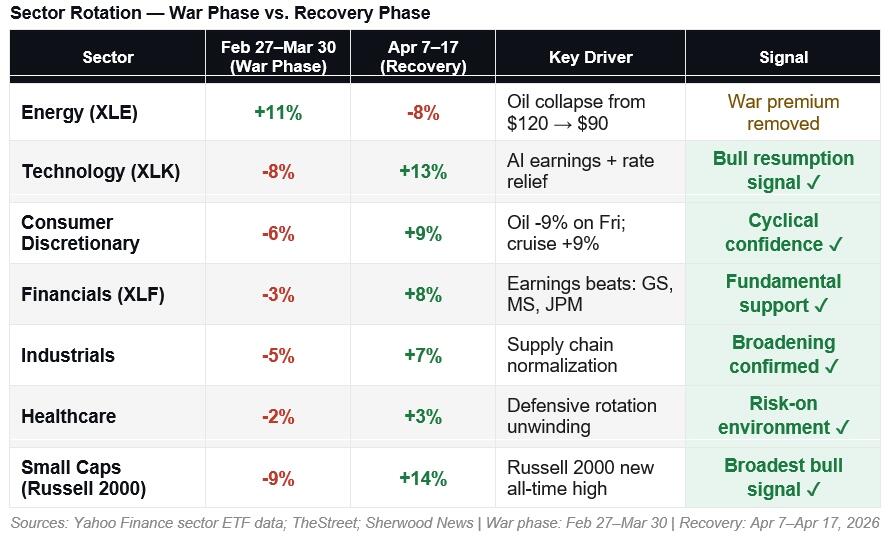
If there is a single dataset that most clearly distinguishes a short-covering rally from a genuine bull-market resumption, it’s sector rotation. Short-covering rallies tend to be narrow; they lift the most-shorted names while leaving cyclical and economically sensitive sectors behind. Genuine recoveries broaden. The sector data from the wartime selloff (February 27 to March 30) compared to the recovery (April 7 to April 17) tells a very clear story.
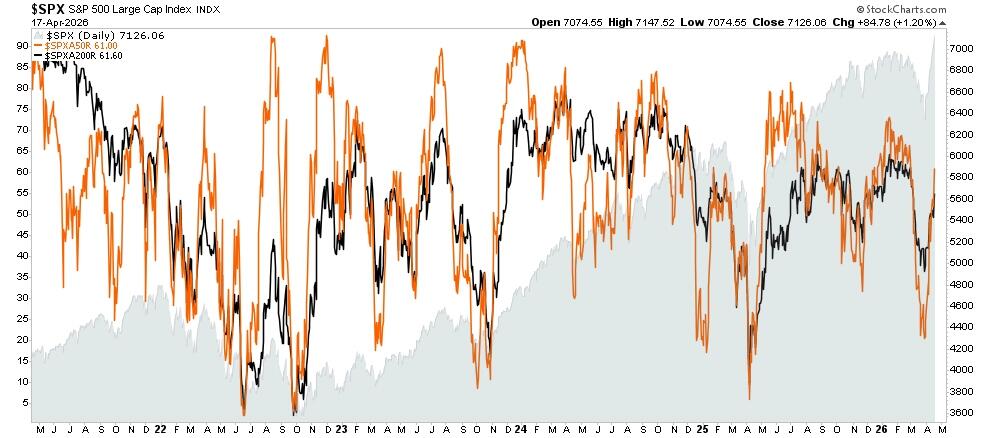
Breadth has also improved sharply, but there is certainly more room to broaden.
However, that rotation is exactly what you want to see following a geopolitical shock. Energy, the wartime beneficiary, has given back its gains. Technology has led the recovery. Consumer discretionary has followed, with Friday’s cruise sector surge (Royal Caribbean, Norwegian, Carnival all up 9%+) signaling consumers are betting on normalcy. Industrials and financials have contributed. And the Russell 2000 has outperformed the S&P 500 by a margin that argues for something well beyond a short-covering rally. That’s five of eleven sectors posting meaningful gains with genuine fundamental drivers behind each.
Another important factor right now is earnings. As we noted earlier this week, Goldman Sachs is maintaining its year-end S&P 500 target of 7,600. That target is premised on $309 per share in 2026 earnings and 12% growth, which they describe as “a fundamental floor.” In their view, this is more supportive of a bull market.
“The bull market is maturing, not ending. With 12% earnings growth acting as a safety net, the transition offers a more sustainable path.“
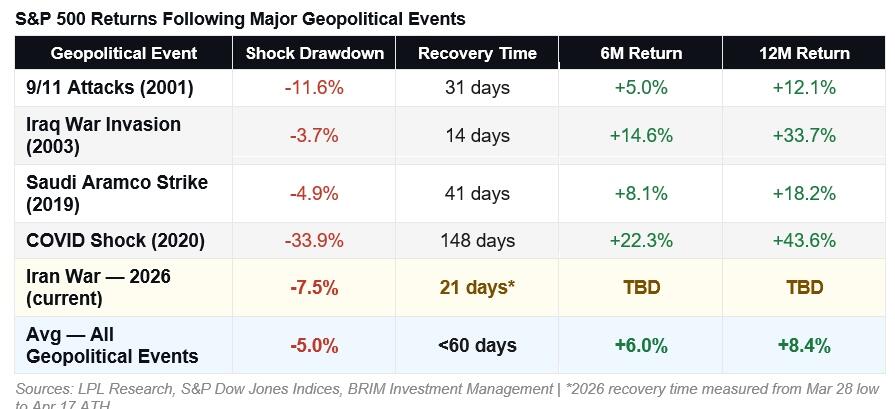
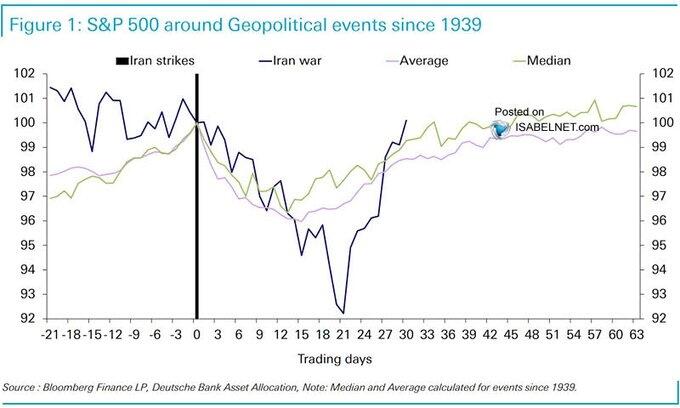
On the other hand, we must also consider the bears’ argument. The argument that this is “just a short-covering rally” with no staying power may be true, but it gets harder to sustain when you study the historical record for geopolitical shocks of comparable magnitude. Across more than 20 major events since World War II, the pattern is consistent: markets recover faster than most investors expect, and the investors who stay disciplined through the short-covering rally phase and into the recovery tend to come out ahead.
The current episode has already outpaced the average recovery time of under 60 days, completing its round-trip to new highs in just 21 days. The speed is notable, comparable to the post-Iraq War recovery of 2003, which went on to produce a 33.7% 12-month return. The COVID comparison (148 days to recover, then +43.6% over six months) is also instructive. What initially looked like a mechanical short-covering rally in April 2020 turned out to be the opening act of one of the most powerful bull markets of the modern era. The key distinction in all these cases is what’s happening beneath the surface, and in 2026, that’s increasingly constructive.
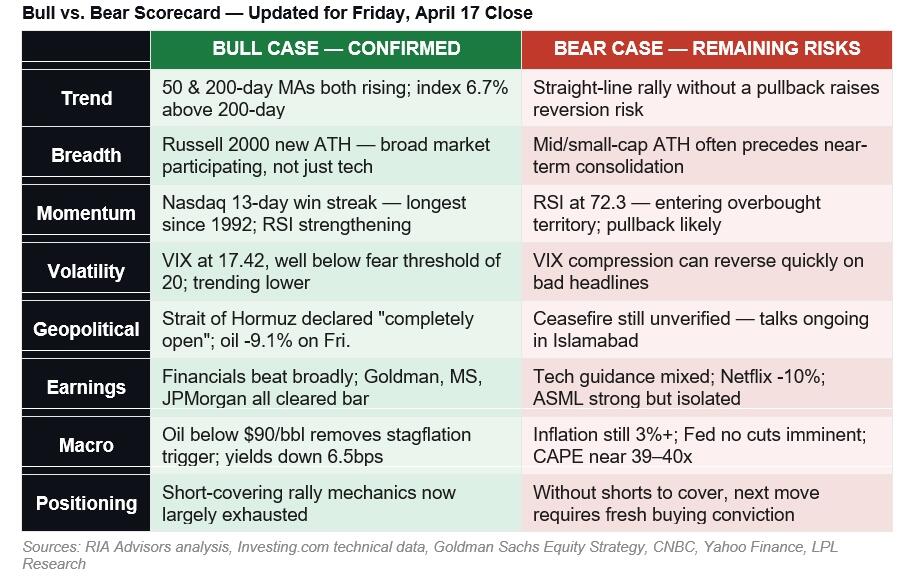
The weight of evidence has shifted. At the start of this week, our scorecard was roughly balanced — three confirmed bull signals against three legitimate bear concerns. As of Friday’s close, the bull case has added three material confirmations: Russell 2000 at a new ATH (breadth), oil’s single-session collapse (geopolitical resolution), and sector rotation into cyclicals (genuine buying, not short-covering alone). The bear case retains one critical point: RSI at 72.3 argues for near-term patience on new entries, not a reversal of the trend.
The verdict: This is no longer a short-covering rally. It was one when it started. It isn’t one anymore. The transition from a mechanical short-covering rally to a fundamental bull market resumption typically happens when:
The shorts have been largely covered,
Breadth expands,
Sector rotation confirms the recovery is economic rather than positioning-driven, and
A fundamental catalyst removes the original trigger for the selloff.
As of Friday, all four conditions have been met.
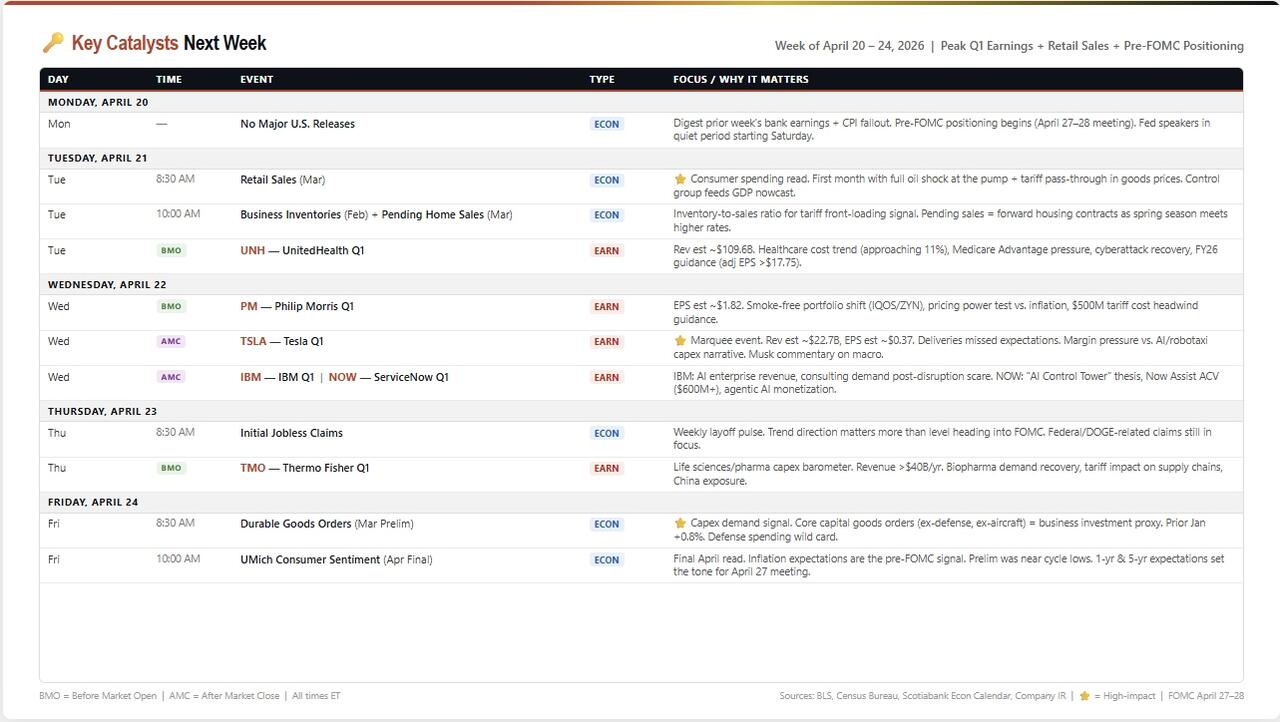
🔑 Key Catalysts Next Week
The calendar pivots from bank earnings to the consumer and Big Tech, with March Retail Sales, Tesla, and the final pre-FOMC sentiment read all compressed into five sessions. The April 27–28 FOMC meeting looms, with the Fed in its quiet period. That means every data point this week will be interpreted through the lens of what it means for rate policy under new Chair Kevin Warsh (assuming confirmation by then) or lame-duck Powell.
Tuesday’s March Retail Sales is the week’s economic anchor and the first consumer spending report to fully capture the oil price spike at the pump and the tariff pass-through into goods prices. February’s report was already soft. If the control group, which feeds directly into the GDP nowcast, contracts, the slowdown narrative hardens further heading into the FOMC. Pending Home Sales will also tell us whether buyers are pulling back as mortgage rates reverse higher. UnitedHealth reports that morning as well, and with the healthcare cost trend approaching 11% and Medicare Advantage pressure weighing on the managed care sector, a read on both healthcare inflation and corporate margins will be important.
Wednesday is the marquee earnings day. Tesla after the close is the event: Q1 deliveries already missed expectations, margins are under pressure, and the street is trying to price a company that’s spending aggressively on AI and robotaxi infrastructure while the core auto business decelerates. Musk’s macro commentary will move futures. IBM (IBM) reports the same evening that the AI enterprise revenue trajectory is critical following February’s 13% single-day plunge amid fears of disruption from Anthropic. ServiceNow (NOW) is also the SaaS bellwether, with its “Now Assist” agentic AI product now past $600 million in ACV. Philip Morris (PM) that morning tests consumer pricing power with $500 million in guided tariff headwinds.
Friday closes with a one-two punch: Durable Goods Orders for the capex demand signal, and the final UMich Consumer Sentiment reading for April. The inflation expectations embedded in UMich are the last data point the Fed will see before convening. A spike in five-year expectations above 3% would all but guarantee a hawkish hold, while a decline would crack the door for dovish language.
In a nutshell, Retail Sales will tell us if the consumer is breaking. Tesla will tell us whether the growth premium is justified, and UMich will signal the Fed’s next move. All with the FOMC one week away. Position defensively into Wednesday’s close.
What To Do If You Missed The Rally
This is the most emotionally loaded question in the room. If you have been listening to the “Perpetual Purveyors Of Doom,” you watched a short-covering rally turn into an 11% surge and a new all-time high, and now you’re wondering whether to chase it. The instinct is understandable. The discipline required to resist the “negative commentary” is what separates good investors from the rest.
Here’s what history consistently shows: most breakouts that begin as a short-covering rally, and then sustain above key moving averages, offer a secondary entry point within 4 to 6 weeks of the initial move. Markets rarely transition from correction lows to sustained new highs in a straight line. The more common path involves:
An initial surge (the short-covering rally phase),
A consolidation or shallow retest of former resistance, and
Then a continuation move. That retest is your entry.
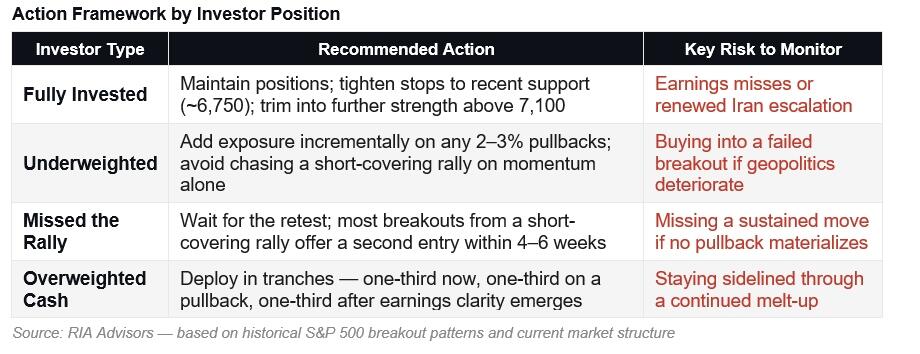
Therefore, as shown below, depending on how you are currently invested, you can take actions to navigate whatever comes next.
The macro backdrop hasn’t been cleared of all risk, as oil remains above $90 per barrel, inflation is sticky, and the Fed has no near-term rate cuts in the pipeline. The ceasefire is fragile, and the Islamabad negotiations haven’t yet produced a signature. Any deterioration on those fronts is a reason to reduce exposure, not add to it.
What we are watching most closely over the next two to three weeks isn’t the price level, it’s the breadth confirmation. We want to see the percentage of S&P 500 stocks above their 200-day moving average cross back above 60%, then 70%. We want to see volume improve on up-days and dry up on pullbacks. And we want to see earnings season deliver results that justify the multiple, not just the sentiment reset that a short-covering rally provides.
BOTTOM LINE: The S&P 500’s return to all-time highs is technically significant, but significance and sustainability are not the same thing. Yes, a short-covering rally lit the fuse, but the sustained move above the 200-day moving average, the improving VIX, and the early earnings beats suggest something more durable may be taking shape. History is clear that markets recover from geopolitical shocks faster than almost anyone expects. The investors who come out ahead aren’t the ones who chase; they’re the ones who use pullbacks to build positions in quality names, maintain discipline on stops, and resist the urge to mistake speed for safety. The next two to three weeks of earnings will tell us whether this is a new leg higher or the best exit ramp before a retest.
Trade accordingly.
Tyler Durden
Sun, 04/19/2026 – 12:50
https://www.zerohedge.com/markets/short-covering-rally-or-something-more