Category: News
Senate bill to tackle welfare fraud passes out of Indiana committee
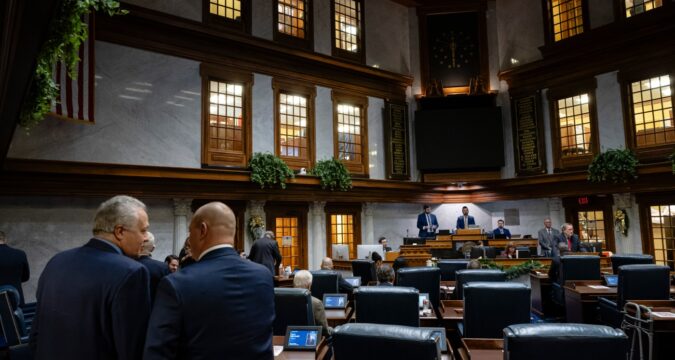
An amended welfare fraud bill passed out of the Senate Appropriations Committee Thursday in a 9-3 vote, with one Democrat voting in favor of the bill because he’d like to continue working with the bill author on amendments.
Senate Bill 1, authored by State Sen. Chris Garten, R-Charlestown, was filed to prevent fraud and contain state spending on welfare programs because “Americans are outraged by the billions of dollars of welfare fraud in our nation — and the Minnesota scandal is Exhibit A,” according to a press release.
Minnesota has been under the spotlight for years for Medicaid fraud, including a massive $300 million pandemic fraud case involving the nonprofit Feeding Our Future. Prosecutors said it was the country’s largest COVID-19-related fraud scam and that defendants exploited a state-run, federally funded program intended to provide food for children.
In 2022, during President Joe Biden’s administration, 47 people were charged. The number of defendants has grown to 78 throughout the ongoing investigation. So far, 57 people have been convicted, either because they pleaded guilty or lost at trial.
In news interviews and press releases over the summer, then-federal prosecutor Joe Thompson estimated the total loss from all fraud cases could exceed $1 billion. Thompson left the U.S. Attorney’s Office in Minnesota this week over the way the investigation of the Jan. 7 shooting of Renee Good by ICE agent Jonathan Ross is being handled, according to the New York Times and Minnesota Star-Tribune.
The 24-page bill will end the state’s participation in the use of expanded categorical eligibility within the federal Supplemental Nutrition Assistance Program, set gross income standards and countable resources for SNAP eligibility, and establish immigration eligibility requirements for SNAP.
If a SNAP applicant’s immigration status can’t be verified, the applicant’s information will be “immediately referred to the U.S. Department of Homeland Security for investigation and potential deportation proceedings,” Garten said in a release.
Undocumented immigrants are already ineligible for SNAP. The only non-citizens who may qualify are lawful permanent residents, or Green card holders; asylees; and other legal residents under temporary protected status, according to the Center for Budget and Policy Priorities.
Senate Bill 1 also establishes the time frame for Medicaid eligibility re-determinations, and requires the Secretary of Family and Social Services to transmit certain information to the federal government to prevent multiple state Medicaid enrollment.
The bill further sets income requirements for Medicaid, and modifies immigration status requirements for Medicaid, including presumptive eligibility, including an increase to 80 hours of work or volunteering per month, and the Healthy Indiana Plan, and requires the office to verify compliance of the requirements and report information to the federal government.
Under HIP, the bill modifies work and exemption requirements and requires the conditions to be met in the three preceding months before an individual applies. The bill directs the Secretary of Family and Social Services to verify compliance with the work requirements on an ongoing basis and at least quarterly.
Senate Bill 1 removes the 12-month eligibility period for HIP and requires semiannual renewal, and it sets an additional copayment for the use of an emergency room for nonemergency services and other services under HIP.
The committee amended the bill to include that candy and soft drinks can’t be purchased with SNAP benefits. The amendment further establishes the Indiana Rural Health Transformation Fund.
Senate Bill 1 is the Senate’s top priority for the 2026 session, Garten said, and ensures that the state’s “safety net” remains “sustainable for the Hoosiers who truly need it the most.” The bill would focus on “rooting out and protecting from future waste, fraud and abuse like we’re seeing in Minnesota.”
Senate Bill 1 takes three steps: ends broad-based categorical eligibility, verifies legal status and anyone found with illegal immigration status will be reported to the U.S. Department of Homeland Security, and aligns with federal Medicaid reforms, Garten said.
“Some may try to say this is cutting benefits. Let me be clear, this is about verifying benefits for those that are eligible,” Garten said. “It is about compassion for the taxpayer and fairness for the truly needy.”
State Sen. Fady Qaddoura, D-Indianapolis, asked Garten if Indiana has similar welfare fraud to Minnesota. Garten said he had “no reason to believe that,” but that Senate Bill 1 is a “proactive” bill to avoid fraud.
“We have to be extremely careful when we use certain terms such as fraud because it conveys a message to the public that Indiana has not been managing the program correctly and it’s infested with fraud,” Qaddoura said.
FSSA Secretary Mitch Roob said the agency will be returning about $466 million this biennium into the general fund.
“We believe we have identified hundreds of millions of dollars of additional waste … that we will be going after aggressively,” Roob said. “We have a lot of work left to do as we move forward with work requirements.”
When asked, Roob said he “couldn’t put a number” on the amount of waste identified. But, Roob used the examples of the state’s Applied Behavior Analysis therapy, used for children with autism, and attendant care with funds shifting over the years.
“Unfortunately, when the federal government came in and audited us on ABA therapy it found a tremendous lack of documentation in that particular space,” Roob said. “We had nobody at FSSA in charge of ABA therapy.”
The agency is interviewing candidates to oversee ABA therapy now, Roob said.
Qaddoura asked Roob how many ineligible individuals are currently on the Medicaid program. Roob said “very few.”
State Sen. Rodney Pol Jr., D-Chesterton, said the fiscal note of the bill identified that 3,000 households would be eliminated from the SNAP program under Senate Bill 1. Pol asked Roob how the state will address the removal of the households from the program.
“We will go through a redetermination process. If they meet the requirements of another categorical eligibility they will remain on the program. If they do not meet the components of that other categorical eligibility then they will be removed,” Roob said.
Emily Bryant, executive director of Feeding Indiana’s Hungry, said that undocumented immigrants “are not eligible and have never been eligible for SNAP.”
Some noncitizens, like those with a green card, could apply for SNAP after a 5-year waiting period, Bryant said.
“This bill is going to add administrative costs to taxpayers and burdens to families who are at risk of hunger,” Bryant said. “We feel what we truly need is to find ways to reduce the red tape and paperwork to streamline SNAP not just for SNAP recipients but for Hoosier taxpayers who will soon be helping to foot the bill.”
Qaddoura said he voted in favor of the bill “with a caveat” that he could work with Garten to ensure the bill won’t harm anyone who is currently on the programs.
“If I learn differently, that any provision of this bill takes benefits away from people I will reverse my vote,” Qaddoura said.
Pol said he voted against the bill because of his concerns that those eligible for benefits will have them taken away.
“I want to make sure that this is not an effort to address something akin to treating dandruff with decapitation,” Pol said. “I want to make sure this is done as cleanly and efficiently as possible.”
The bill moves forward for consideration by the Senate.

South suburban job fair seeks increase in job seekers, employers
Shaniese Stacker, a Matteson resident, said it has been hard finding a job in the south suburbs but said she intends to keep pushing.
Looking for full-time jobs, she said, has meant competing with young applicants fresh out of college and driving to the downtown Chicago area for opportunities. Stacker said she has worked part-time jobs since she lost work in a large 2023 layoff.
Stacker said she was excited when she heard there was a job fair in Tinley Park, a 15-minute commute for her, rather than in downtown Chicago which means an hour commute and parking costs.
She attended the Southwest Job Fair Thursday alongside more than 1,000 other residents and 100 employers. She said she was amazed by the number of employers interacting with participants and actually taking resumes, especially after she saw the job search process move more online after the pandemic.
Stacker said it’s important to have an in-person interaction, because so many of her job applications have been run through algorithms and get filtered out if they’re missing key words.
“It feels so good to talk with employers,” she said. “I love the face to the name type of deal.”
The annual fair at the Tinley Park Convention Center also provided opportunities to have a professional headshots taken and participate in mock interviews.
The first 100 attendees received gift cards, and participants also had the opportunity to enter a raffle for a laptop, paid for by the municipalities hosting the event.
The fair was produced by a collaboration the villages of Tinley Park and Orland Park, Orland Township and Cook County Commissioner Sean Morrison’s office.
An attendee at the 2026 Southwest Job Fair tries to break a weightlifting army record. (Addison Wright/Daily Southtown)
Ray Piattoni, director of recreation & parks in Orland Park, said Thursday’s attendance seemed the highest he has seen. About 1,200 people attended last year, he said.
He also said the number of employers and participants has grown over the years, forcing them to relocate from the Tinley Park Civic Center to the convention center.
The job fair grew by nine employers this year, said Carolyn Mitera, business retention and marketing specialist for Tinley Park.
Orland Township Supervisor Paul O’Grady said he partially attributes this growth to businesses recovering since the COVID-19 pandemic.
Orland Township Supervisor Paul O’Grady shakes hands with employers Thursday at the 2026 Southwest Job Fair in Tinley Park. (Addison Wright/Daily Southtown)
O’Grady said during the pandemic, there was a lull in employment and even the job fair was small and had to be held outside for distancing. This year, he said, more businesses appeared to be hiring and more people were getting back into the workforce.
“There was this like COVID hangover, and now we’re kind of coming out of that,” he said. “People want to get involved and are looking for better jobs.”
O’Grady also said the types of jobs have changed. He said grocery stores such as Pete’s Fresh Market have moved into the area and started attending the job fair.
He also said the number of employers from information technology, insurance and government fields appeared to increase this year.
O’Grady said it’s important for local governments to help residents get back into the workforce.
A south suburban resident who said she has been on the job search for a few months talks Thursday with a company spokesperson for Agile Cold Storage. (Addison Wright/Daily Southtown)
“It’s not just helping them with general assistance, it’s helping them get back on their feet,” he said. “There’s more to a job than just a paycheck. It’s a feeling of worth, and that’s what’s important.”
Mitera, with Tinley Park, said unfortunately there have been large business downsizes in recent years. She said it’s important to help residents find positions that are still within their community.
Viviana Obenland, human resource supervisor for Agile Cold Storage, said several people looking for jobs told her their previous company had downsized and had large layoffs.
She said she received more than 85 resumes in the first hour of the job fair.
John Omoworare, a public information specialist for the Cook County Circuit Court clerk’s office, explains the job openings and legal aid resources available to job seekers Thursday at the 2026 Southwest Job Fair. (Addison Wright/Daily Southtown)
Experts said in 2024 many south suburban towns have unemployment rates significantly higher than the state average. These areas, with predominantly Black populations, face unique challenges such as lack of transportation, disinvestment and a fluctuating job market, experts say.
Other employers handed out resources. John Omoworare, a public information specialist with the Cook Count Circuit Court clerk’s office, said several people asked him about legal resources. He said one person asked for help getting a passport.
“I was really touched by the crowd here today,” Omoworare said. “I’m grateful that people are coming out just to get something and even because they just want food sitting on the table for their family.”
awright@chicagotribune.com
https://www.chicagotribune.com/2026/01/15/south-suburban-job-fair-increased-attendance/
Ron Paul: Making Imperialism Great Again?
Ron Paul: Making Imperialism Great Again?
Authored by Ron Paul via the Mises Institute,
It did not take long for President Trump to change the reason for sending the US military to “arrest” Venezuela President Nicolás Maduro and his wife. The allegation that President Maduro ran a drug cartel was front and center in the months leading up to President Maduro’s “arrest.” Afterwards, President Trump said the invasion was about Venezuela’s oil and announced plans for the US government to send American oil companies into Venezuela.
About a week after the invasion, President Trump had a meeting with executives from American oil companies to discuss plans for Venezuela. Some of the companies’ executives at the meeting were less than enthusiastic about developing Venezuelan oil. One reason for this is that, since the Venezuelan government nationalized oil activities twenty years ago, fracking has made the US the world’s leading producer of oil and natural gas. Rebuilding the oil industry in Venezuela could cost as much as a billion dollars for an uncertain payoff. Among the complications, Venezuelan oil does not easily flow though pipelines unless it is cut with solvents, making it more expensive to transport.
In his first press conference after the Venezuelan first couple was seized, President Trump said: “We are going to run the country until such time as we can do a safe, proper, and judicious transition.” He later stated that Maduro’s successor Vice President Delcy Rodriguez would “pay a very big price, probably bigger than Maduro,” if she does not adequately fulfill the US government’s demands.
Following the invasion of Venezuela, there have been suggestions that President Trump will direct the US military to invade other countries as well. For example, Secretary of State and National Security Advisor Marco Rubio said, “if I lived in Havana and I was in the government, I’d be concerned.”
To no one’ s surprise, Senator Lindsey Graham was delighted by the possibility that Venezuela was just the first of many regime change wars President Trump will wage. Senator Graham even got President Trump to autograph a Make Iran Great Again hat. Many Iranian victims of the Shah of Iran’s secret police might disagree with Senator Graham on whether having the CIA install another puppet government in Iran will make that country great.
President Trump’s newfound love of regime change wars may be one reason why he is seeking to increase the military budget to 1.5 trillion dollars. President Trump claims that tariff revenue can fund the increase, but that is simply not possible. The majority of the increase in spending would come from other taxes, including the Federal Reserve’s regressive and hidden inflation tax.
A recent poll by the Pew Research Center found that there is much less support for an “activist” US foreign policy among Americans under 50 than among older Americans. This is the case among both Democrats and Republicans. In fact, the differing view on foreign policy among younger people was a major factor behind President Trump’s support from younger people in 2024. Continued betrayal by President Trump of his no more regime change wars pledge will cause the president and the Republicans to lose support among younger voters.
Tyler Durden
Thu, 01/15/2026 – 17:00
https://www.zerohedge.com/geopolitical/ron-paul-making-imperialism-great-again

Third person charged in Jimmijion Bailey’s death
A digital trail of texts and Google searches led authorities to charge Ralph Stokes’ relative with helping him to dispose of Jimmijion Bailey’s body in October 2024.
Antoinette Stokes, 54, was charged Wednesday with arson, obstruction of justice, altering the scene of a death, and two misdemeanors – failure to notify authorities of the discovery of a dead body and failure to report human remains.
She has not been apprehended. When arrested, she is ordered held on a $5,000 bond.
Ralph Stokes is charged with murder in 25-year-old Bailey’s shooting death on Oct. 5, 2024. The man’s decapitated body was found Oct. 11, 2024, on the 2300 block of Clay Street with his arms and knees bound with black tape.
Bailey’s relatives said previously he had just started dating a woman a few weeks earlier and Stokes, her child’s father, was jealous. The slaying happened in the woman’s apartment.
After the slaying, authorities said Stokes had help to dispose of the body.
After seizing and examining two of Antoinette Stokes’ cell phones in a court order, investigators found a 10 a.m. Oct. 11, 2024, text chain between her and co-defendant Betty Tomlinson’s phones.
“Yes, we out here again tonight though to make sure I think I need gas, though that light not strong enough,” Tomlinson’s number texted.
“Told u,” Antoinette responds.
“No, it started, but whoever closed the door suffocated it,” Tomlinson wrote.
“U been n there,” Antoinette asks her. “Its getting sloppy.”
“I’ve been upstairs to her door,” Tomlinson replies. “He said he left it half open someone closed it which caused the flames to die down. Naw, we should have used gas instead.”
“Should have been a cocktail and said (forget) it,” Antoinette wrote. “(I know.) I told u that.”
Court filings allege Antoinette Stokes made several Google searches from Oct. 9-11, including “what to spray on blood so it illuminates,” “where to buy luminol near me,” “what stops luminol from working,” and “how long does it take for lighter fluid to burn off.”
Investigators found more Google searches on Antoinette’s second cell phone – “what can I use to clean blood,” “what light do you use to check for blood,” “what is a fast accelerant,” “what burns faster kerosen (sic) or gas,” and “uv light for stains.”
Ralph Stokes’ bid for bail was denied in September. On a police interrogation video, he claimed self-defense.
Tomlinson, the ex-girlfriend’s mother, is charged with buying cleaning supplies for Stokes from a Walgreens on Oct. 6, 2024. Then, she bought two bottles of lighter fluid around 3 a.m. Oct. 11 from a Citgo gas station in Gary, charges allege.
Judge Natalie Bokota granted prosecutors’ request on Dec. 30 to do a joint trial for Ralph Stokes and Betty Tomlinson. His next hearing was scheduled for Friday.
Investigators were tipped off on Oct. 10, 2024, that Bailey was shot inside the girlfriend’s apartment. His body was moved to the bathroom for several hours. His car was taken to 9th and Roosevelt to “throw off the investigation.” The girlfriend changed her number after Bailey was killed, the affidavit states.
“Why would you do that with our child present,” the ex-girlfriend screamed.
“That’s who I am,” Stokes responded.
Two detectives went to the Stokes’ house in the 700 block of Louisiana Street, where they found the Ford Flex, silver Infiniti and black Audi, his family’s vehicles.
License plate readers showed Bailey showed up to the apartment on Oct. 5. Later, the Chrysler 200 was driven off, followed by the black Audi toward 9th and Roosevelt, to ditch Bailey’s car, before the black car headed back to the apartment.
Then, the black Audi and Ford Flex head to the 2300 block of Clay Street, where Bailey’s body was later found.
Anyone with more information can contact Detective Jason Szemes at 219-755-3855.
Post-Tribune archives contributed.
mcolias@post-trib.com
https://www.chicagotribune.com/2026/01/15/third-person-charged-in-jimmijion-baileys-death/

NBA y FIBA avanzan con planes para nueva liga en Europa, pero llevará tiempo asegura Silver
Por TIM REYNOLDS
El comisionado de la NBA, Adam Silver, reafirmó el jueves que la liga, en asociación con FIBA, está avanzando en los planes para llevar una nueva liga a Europa, pero se abstuvo de hacer anuncios formales sobre cronogramas o qué equipos podrían comprometerse a unirse.
Silver habló antes del partido entre Memphis y Orlando en Berlín, el primero de dos Juegos de la NBA en Europa; los Grizzlies y el Magic se volverán a enfrentar el domingo, pero ahora en Londres. Para Silver hablar sobre la noción de la nueva liga largamente planeada en Alemania tenía mucho sentido, dado que esa nación actualmente ostenta los títulos de la Copa del Mundo y EuroBasket.
“Somos el deporte de más rápido crecimiento en este país”, dijo Silver. “Hay, en esencia, una era dorada, diría yo, del deporte… Los Juegos Olímpicos de 1936 aquí en Berlín, fue cuando el baloncesto se introdujo por primera vez en el movimiento olímpico. De hecho, James Naismith vino aquí a Berlín para esos juegos y supuestamente lanzó la pelota para el salto inicial de los. Así que, hay una larga historia aquí.”
La pregunta más importante es cuál será el futuro del juego en Alemania y en toda Europa. El impacto de las estrellas internacionales, particularmente las estrellas europeas, en el juego de la NBA es claro en este momento, con Nikola Jokic de Serbia, Giannis Antetokounmpo de Grecia, Victor Wembanyama de Francia y Luka Doncic de Eslovenia entre las mayores estrellas del baloncesto en el planeta.
Muchos detalles para la nueva liga aún no se han finalizado formalmente, incluyendo cuándo comenzará a jugarse —el objetivo de trabajo ha sido octubre de 2027— y cuántos equipos participarán en esa temporada inaugural. Entre los modelos que la NBA y FIBA han explorado está una liga de 16 equipos, con 12 plazas “permanentes” y las otras cuatro disponibles a través de clasificación.
“Solo diría que seguimos estando enormemente entusiasmados con ello”, dijo Silver sobre la noción de una NBA Europa. “Hemos estado reuniéndonos con clubes que están interesados en participar en nuestra liga. Hemos estado en conversaciones con otros posibles interesados, incluidas empresas de medios que quisieran cubrirla, posibles socios mediáticos y patrocinadores tradicionales que quieren trabajar con nosotros en la liga. Estamos viendo la oportunidad de hacer crecer la infraestructura de arenas, no solo aquí en Alemania sino en todo el continente. Es algo que nos entusiasma enormemente.”
Los países objetivo actuales incluyen a Gran Bretaña (con las potenciales ciudades anfitrionas siendo Londres y Manchester), Francia (París y Lyon), España (Madrid y Barcelona), Italia (Roma y Milán), Alemania (Múnich y Berlín), Grecia (Atenas) y Turquía (Estambul).
Crecimiento tomará tiempo
La liga y algunos de sus socios financieros y asesores han hablado con interesados en Europa —clubes existentes, jefes de estado y otros— durante algún tiempo.
Habrá una tarifa de entrada, y será elevada. Y aquellos que esperen un retorno rápido de esas inversiones pueden sentirse decepcionados, dijo Silver.
“El financiamiento potencialmente vendría, al menos inicialmente, de los clubes miembros de la liga”, dijo Silver. “Creo que similar a cualquier empresa emergente, los participantes serían los inversores, y con el tiempo esperarían buscar un retorno. … Creo que si logramos lanzar con éxito esta nueva liga, tomará un tiempo, creo, antes de que sea una empresa comercial viable. Creo que todos los participantes reconocen que esto no es para aquellos que tienen una perspectiva a corto plazo.”
También parte del plan: se necesitarían nuevas arenas en ciertos mercados, lo que obviamente tomará tiempo y más dinero.
“Lo que estamos diciendo a las partes interesadas es que necesitan tener una perspectiva a muy largo plazo”, dijo Silver.
Postura de los jugadores
Orlando tiene tres jugadores alemanes en su plantilla que formaron parte del juego en Berlín, incluido Franz Wagner, quien ha hablado con Silver sobre la idea. También lo ha hecho Doncic.
“Creo que es de vital importancia que respetemos las tradiciones del baloncesto europeo… Estamos tratando de encontrar la mejor combinación de lo viejo y lo nuevo, tradición e innovación”, dijo Silver. “Creo que, francamente, eso es lo que la NBA aporta a la mesa. Creo que también es importante no solo tener a FIBA como nuestro socio, sino a las organizaciones de baloncesto existentes que entienden la cultura del baloncesto europeo”.
Expansión de la NBA
Es un acto de malabarismo en este momento para Silver y la NBA, tratando de llevar a cabo el posible lanzamiento de una liga en Europa con la posibilidad de expandir su propia liga más allá de los actuales 30 equipos. Las Vegas y Seattle son los principales candidatos si ocurre el crecimiento de la NBA.
“Estoy seguro de que pueden ver las bolsas bajo mis ojos”, dijo Silver. “Pero amamos el trabajo duro en la NBA.”
Silver ha dicho que una decisión sobre la expansión de la NBA llegará para finales de 2026.
___
Deportes AP: https://apnews.com/hub/deportes
Judge who blasted Operation Midway Blitz use-of-force tactics will hear new lawsuit by city, state
The federal judge who issued a landmark preliminary injunction in November limiting the use of force by immigration agents agreed Thursday to take over a new lawsuit filed by the state and city of Chicago alleging a much broader swath of illegal actions during the Trump administration’s Operation Midway Blitz.
U.S. District Judge Sara Ellis made the decision over the strenuous objection of Justice Department lawyers, who argued there were not only contrasting legal issues in the two cases but that they were at diametrically different stages of litigation.
“I just don’t think realistically you can hand wave and say all these things are intertwined,” said attorney Peter Goldstone, of the DOJ’s Civil Division.
But Ellis sided with the plaintiffs in ruling that both cases arise out of the same law enforcement action in Operation Midway Blitz. She said the two complaints also involve many of the same incidents and evidence she reviewed in issuing her injunction, including body camera footage, use-of-force reports, and declarations, depositions and testimony from Department of Homeland Security leaders.
“This court has spent countless hours already that covered the exact same operation that is now at issue in the state and city case,” Ellis said, adding that having another judge “get up to speed on the issues would be inefficient.”
By local rule, she is allowed to take on a case — rather than have it randomly assigned to another judge — if the issues are shown to be related and if doing so would substantially conserve judicial resources.
While the merits of the latest suit have yet to be challenged, having Ellis, who was nominated to the bench by President Barack Obama, presiding over the case is surely unwelcome news for the Trump administration.
In November, a DHS spokeswoman called Ellis’ ruling “an extreme act by an activist judge that risks the lives and livelihoods of law enforcement officers.”
Ellis found in her scathing opinion that not only had agents used inappropriate force, but that immigration leaders, including Border Patrol Cmdr. Gregory Bovino, had lied about it under oath. She’d also personally held Bovino’s feet to the fire by ordering him in to testify about alleged violations of her temporary restraining order, and required agents to wear body cameras at all times when interacting with the public.
Ellis’ injunction was later stayed by the 7th U.S. Circuit Court of Appeals, and the plaintiffs in that case have moved to dismiss the suit as a tactical maneuver. A hearing in that case is also set for next week.
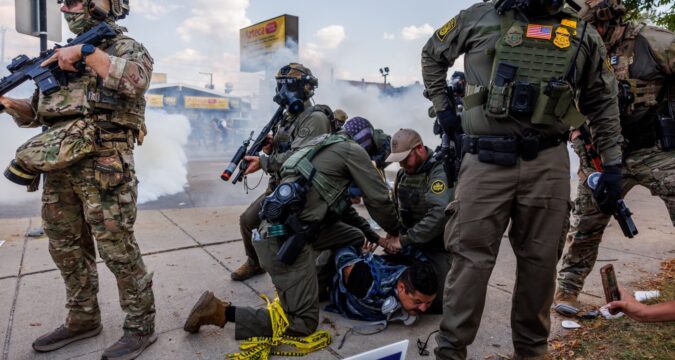
The lawsuit filed Monday, meanwhile, alleged immigration agents acted more like an occupying military force than law enforcement during Operation Midway Blitz, terrorizing neighborhoods with “roving patrols,” illegally switching out license plates, randomly stopping people to question them about their citizenship, and making warrantless arrests.
The 103-page suit, filed jointly by Illinois Attorney General Kwame Raoul and city attorneys, seeks a judicial order limiting these and other practices, including conducting immigration enforcement operations from “sensitive” areas such as schools, courthouses and hospitals, and limiting the use of “biometric” scanning of fingerprints and other personal information.
“Border Patrol agents and ICE officers have acted as occupiers rather than officers of the law,” Raoul said in a news release announcing the lawsuit. “They randomly, and often violently, question residents. Without warrants or probable cause, they brutally detain citizens and non-citizens alike. They use tear gas and other chemical weapons against bystanders, injuring dozens, including children, the elderly and local police officers.”
Illinois Gov. JB Pritzker similarly spoke out against ICE and CBP’s tactics in Chicago and said in a post on X that the state was “standing up for our people.”
Related Articles
Judge: Feds can’t allege gang ties in trial of Chicago man accused of putting bounty on Gregory Bovino
Trump threatens to use the Insurrection Act to end protests in Minneapolis
Federal officer shoots person in leg after being attacked during Minneapolis arrest, officials say
Survey of Chicagoans: 65% say President Donald Trump’s immigration crackdown has ‘gone too far’
Family of Minnesota ICE shooting victim hires Chicago law firm to investigate killing
Among those named as defendants in the suit was U.S. Department of Homeland Security Secretary Kristi Noem, ICE Director Todd Lyons, and Bovino, who has been the public face of Operation Midway Blitz and other similar operations around the country.
Earlier this week, a DHS spokesperson Tricia McLaughlin called the latest lawsuit “baseless,” and said Illinois can not legally interfere with the federal government’s deportation efforts.
“It really is astounding that the Left can miraculously rediscover the Tenth Amendment when they don’t want federal law enforcement officers to enforce federal law — which is a clear federal responsibility under Article I, Article II and the Supremacy Clause — and then go right back to federalizing every state responsibility possible when they get back in power,” Tricia McLaughlin said.
jmeisner@chicagotribune.com
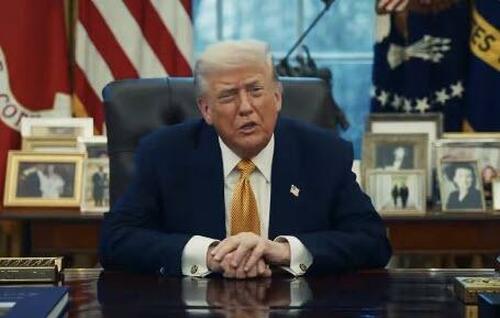
President Trump Unveils ‘The Great Healthcare Plan’
President Trump Unveils ‘The Great Healthcare Plan’
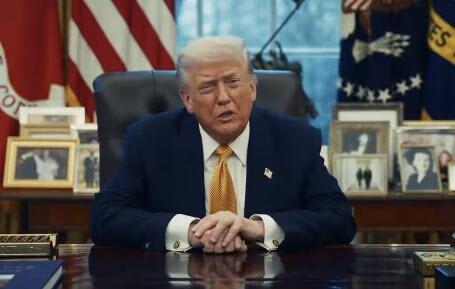
President Donald Trump unveiled what he’s calling “The Great Healthcare Plan” on Thursday morning, promising to fundamentally restructure how Americans purchase and pay for healthcare by cutting out insurance company middlemen and putting money directly into consumers’ hands.
Trump’s plan targets prescription drug prices, insurance premiums, and industry transparency. At the heart of the plan is a radical shift in how healthcare subsidies work—rather than payments flowing to insurance companies, the government would send money directly to individuals who would then shop for their own coverage.
“Instead of putting the needs of big corporations and special interests first, our plan finally puts you first and puts more money in your pocket,” Trump said in his announcement. “The government is going to pay the money directly to you. It goes to you, and then you take the money and buy your own healthcare. Nobody’s ever heard of that before, and that’s the way it is.”
A central component of the plan locks in discounts on prescription drugs through Trump’s Most Favored Nation Drug Pricing Agreement.
“Now, when you hear about that, for 40 years they’ve been trying to do it, but they never were able to do it,” Trump said. “No other president was able to do it. I got every other country to approve it.”
He added, “By the use of tariffs and other things, they all approved it. Nobody else got it. No other president got it.”
The president projected dramatic savings, stating that “prescription drugs will come way, way down” with some medications seeing price reductions of between 300-500% starting this month at TrumpRx.gov. Rather than Americans paying the highest drug prices globally, Trump promised they would now pay the lowest international rate.
“The lowest price in the world is what you’re gonna pay,” he promised. “Before you were paying the highest price in the world by far, and the politicians did nothing about it.”
Trump also took aim at Barack Obama’s Affordable Care Act.
“Obamacare was designed to make insurance companies rich,” he said.
“I call it the Unaffordable Care Act, with billions of dollars in taxpayer subsidies that helped their stock prices skyrocket over 1,700% as you paid more money for healthcare every single year. More and more, the premiums went higher and higher.”
According to Trump, his plan would redirect those subsidies from insurers to individual health savings accounts, allowing consumers to purchase their own coverage.
“You’ll make a great deal. You’ll get better healthcare for less money,” Trump promised.
Additional premium reductions would come from eliminating “giant kickbacks to insurance brokers and corporate middlemen” and fully funding the Cost Sharing Reduction program, a previously neglected provision that could cut premiums on popular Obamacare plans by 10 to 15 percent.
Another key component of the plan is mandatory transparency measures to expose industry pricing practices. The plan would require insurance companies to publish rate and coverage comparisons “in very plain English” and disclose detailed information about claim payouts versus profits.
“In other words, you will be able to watch the scam,” Trump said, suggesting the disclosures would reveal industry profiteering.
The plan would require insurers to disclose claim denial rates and appeal outcomes, while forcing any hospital or insurer that accepts Medicare or Medicaid to publicly post all prices. The goal is to eliminate surprise costs and give patients real visibility into what they’re paying for.
President Trump said transparency would let patients shop smarter. “You are never surprised, and you can easily shop for a better deal or better care,” he explained, adding that consumers would end up with “a better deal and better care.” Invoking the idea that sunlight is the best disinfectant, Trump argued that full price visibility would drive competition and push costs down.
While Trump can implement some measures through executive action, he acknowledged he can’t do this alone.
“I’m calling on Congress to pass this framework into law without delay, have to do it right now, so that we can get immediate relief to the American people, the people I love,” he said.
THE GREAT HEALTHCARE PLAN.
President Donald J. Trump unveils the Great Healthcare Plan to lower costs and deliver money directly to the American people. 🇺🇸 pic.twitter.com/VWtNZzNbQC
— The White House (@WhiteHouse) January 15, 2026
More details about the plan can be found on the White House website.
Tyler Durden
Thu, 01/15/2026 – 16:40
https://www.zerohedge.com/medical/president-trump-unveils-great-healthcare-plan
An expressway that went nowhere
There is a famous photo, taken in 1966, that shows Mayor Richard J. Daley peering at the city from the roof of a Loop building. It evokes a king looking at his kingdom below, a fitting image for a big-city boss known for his unyielding top-down leadership.
Now picture two regular Chicagoans, 60 years later, taking a walk through their Northwest Side neighborhood and looking up. What they see is a rail line, the focus of Daley’s grand but unrealized ambition for a new expressway. The two men’s vision, of a Northwest Side bike and pedestrian trail that would follow part of the same route, is doing what Daley’s plan could not: It is bringing hundreds of nearby Chicagoans to their cause.
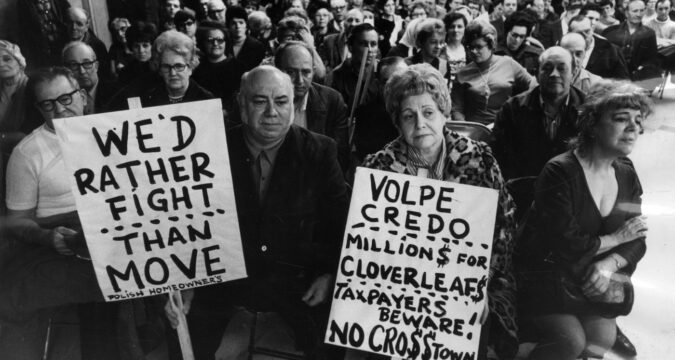
Daley’s dream, of a 22-mile north-south Crosstown Expressway that would have carved a path through the Northwest, West and South sides and displaced tens of thousands of people, in fact did quite the opposite. It provoked one of the biggest citizen revolts in the nation against a major highway project.
“That was the mindset across the country (back then). That was the era of ‘build more highways,’” said George Witchek, who with his Old Irving Park neighbor Jim Franke formed the group Friends of the Crosstown Trail last year. Their hope is to convert an underused Union Pacific rail line that runs parallel with Cicero Avenue into a 3.2-mile trail that would link the Bloomingdale Trail with the North Branch Trail, creating what Witchek calls the missing middle piece.
That same stretch of railroad, back when it belonged to the Belt Line Railway, was the focal point for the longest leg of Daley’s plans for the Crosstown Expressway, which he envisioned as “the most modern and beautiful expressway in the nation,” as the Tribune summarized it in 1967. Business and civic groups began promoting the idea for the expressway, which had its roots in Daniel Burnham’s 1909 Plan of Chicago, in the early ’60s. According to Daley’s plan, the Crosstown would have started at the Edens-Kennedy juncture, traveled to a point on the Southwest Side and then headed east to the Dan Ryan Expressway, allowing drivers to move between the Northwest Side and the Southwest Side and avoid the Loop altogether.
An early official rationale for the Crosstown was the rise in traffic on the Kennedy as drivers flocked to the newly opened Dan Ryan. As Roger Nusbaum, assistant chief overseeing Illinois’ highways, noted then: “They are overloaded, and their overload is caused in part by travel going (through) our central business district because (there) is no good belt route bypassing downtown.”
People look at possible routes for the Crosstown Expressway at a public hearing on June 29, 1974. (Roy Hall/Chicago Tribune)
Still, such reasoning was like the highway planning equivalent of Whac-a-Mole: A new expressway was attracting more cars and channeling more traffic to another expressway, so why wouldn’t the fix be yet another expressway costing hundreds of millions of dollars?
The estimated cost of the project in 1963 was $300 million; 10 years later, the projected price tag was a stunning $1 billion — or $7.3 billion in today’s dollars. Federal highway funding would have paid 90%, but the state, county and city still would have had to cough up $100 million.
Vintage Chicago Tribune: How Chicago expressways and other major roads got their names
Business groups and city leaders such as Ald. George Tourek, 23rd, insisted the expressway would be a net benefit by bringing a freeway to the “transportation-poor” Southwest Side, the Tribune reported. “The Crosstown Expressway is something Chicago desperately needs. The proposed route unquestionably is wonderful because it will displace relatively few people,” Tourek said.
The Crosstown failed to get off the ground for a host of reasons. Two contributing factors were the inconvenient energy crisis of the 1970s and Daley’s death in 1976, which proved to be a desiccant to the political will needed. But the plan’s most formidable foes were the livid and committed Chicagoans who were none too pleased at the prospect of their neighborhoods being torn asunder by an eight-lane expressway.
The messaging of Tourek and other proponents — that construction of the Crosstown would leave neighborhoods relatively unscathed — was rosy, to say the least. It was as accurate as a dentist telling a patient a root canal would just sting a little.
Bill English, from left, Joyce Zick, Margaret Sendzimer and Karen Frank, all foes of the Crosstown Expressway, urge Northwest Side residents to vote Nov. 2, 1972. (Jim Mescall/Chicago Today)
As the Tribune noted in a 1994 retrospective on the road plan, one Illinois Department of Transportation estimate from the 1970s concluded that the Crosstown would displace more than 33,000 people and more than 2,000 businesses and industries. Despite the advocacy of the business community and the assurances of elected officials, citizens were deeply alarmed by the footprint of the massive project.
The pushback against the Crosstown is considered a major turning point in the national movement against inner-urban expressways. Chicagoans from all walks of life and faith leaders whose parishes were threatened, such as the Rev. Leonard Dubi and the Rev. Albin Ciciora, linked arms to form an anti-Crosstown coalition. Members of the Citizens Action Program, which led the charge, began showing up at meetings and elected officials’ offices to push for an end to the project.
In 1972, as many as 10,000 people joined a symbolic 22-mile motorcade along the Crosstown’s proposed route to demonstrate widespread opposition to Daley’s plans. The same year, about 300 members of the coalition hosted a “people’s budget hearing” in a flick at the mayor’s notorious secrecy around his budget-making.
Citizens Action Program leader Mary Lou Wolff delivered a clear message to the aldermen at the event: “If you want to keep representing us, you’d better stop the Crosstown. We won’t take no for an answer.”
The coalition understood that a flair for the dramatic would grab attention. After Daley’s public works commissioner, Milton Pikarsky, refused to meet with residents, the coalition brought a duck to a protest to highlight the agency head “ducking” its inquiries. In the hopes of bringing the head of Chicago’s Roman Catholic community to their side, members sang a song with a lyric that alluded to the Crosstown’s imperiling of parishes: “Where will all your people go, Cardinal Cody?”
Members of the Organization of Northwest Communities carry a casket in front of City Hall on Sept. 15, 1967, to protest the proposed Crosstown Expressway. (Chicago Tribune historical photo)
Opponents gained a mighty ally in Dan Walker, an independent-minded Democrat running for governor. Walker vowed as part of his campaign to stop the Crosstown, and when he ascended to the office he set out to make good on that promise — though expressway fans in the General Assembly hatched legislative plots to neuter his ability to do so.
Ultimately, it was Daley’s successor, Michael Bilandic, who saw the writing on the wall when Walker’s successor, Gov. Jim Thompson, declared the Crosstown to be “an idea whose time has gone.” They cut a deal to divert money for the northern leg to transit projects.
Bilandic didn’t give up pursuit of the remaining leg, but one big snowstorm later, Jane Byrne assumed the mayorship and killed the Crosstown for good in 1979. (And it stayed dead, even though City Hall flirted with resuscitating it in 1986, and former Illinois House Speaker Michael Madigan in 2007 proposed making it a toll road.)
After a nearly two-decade fight, working-class and middle-class Chicagoans kept their homes, their businesses and their parishes. And the Chicago region’s mass transit system saw an immense infusion of funds: The money earmarked for the Crosstown allowed for, among other things, the extension of the Blue Line to O’Hare International Airport and the creation and reconstruction of 16 Metra stations. And scores of road projects in Chicago and Illinois were made possible, including the straightening of a curve on Lake Shore Drive.
People protest the Crosstown Expressway in the 4500 block of North Kilpatrick Avenue on July 24, 1973. (Quentin Dodt/Chicago Tribune)
In the ’60s and ’70s, ordinary Chicagoans helped galvanize a national revolt against freeway expansionism. Today, ordinary Chicagoans on the Northwest Side are coalescing around Witchek and Franke’s vision for a trail that would connect neighborhoods across a broad swath of the city — with the assistance of elected officials and not as dictated, top down, by them.
“We had a lot of momentum in ’25, and now, really, we need to turn that into a movement in ’26,” Witchek said, sounding a lot like some residents more than 50 years ago.
Colleen Kujawa is a content editor who works with the Tribune Editorial Board. She is a former Flashback (Vintage Tribune) editor.
Have an idea for Vintage Chicago Tribune? Share it with Marianne Mather at mmather@chicagotribune.com and Kori Rumore at krumore@chicagotribune.com.
https://www.chicagotribune.com/2026/01/15/vintage-tribune-crosstown-expressway-richard-j-daley/
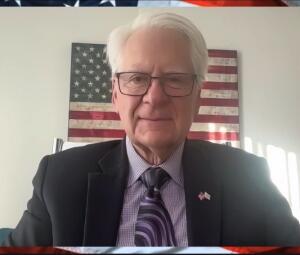
“The Left Is Coming For Us”; Larry Klayman Warns “It’s Going To Get More And More Violent”
“The Left Is Coming For Us”; Larry Klayman Warns “It’s Going To Get More And More Violent”
Via Greg Hunter’s USAWatchdog.com,
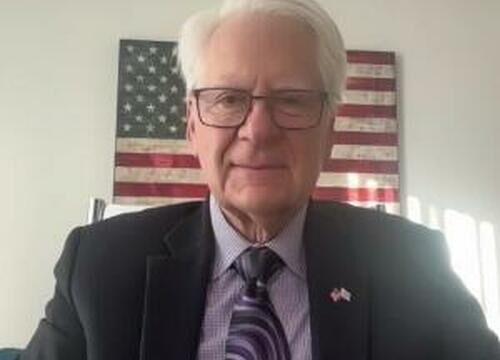
Renowned Attorney Larry Klayman, founder of Judicial Watch and later Freedom Watch USA, has long predicted (along with other top intel experts) increasing violence from the Left in a Marxist style Bolshevik Revolution.
As money is cut off by the Trump Administration and legal pressure mounts for prosecuting Democrats for everything from fraud to sedition, you can expect the Left to dramatically increase the violence to try to destabilize America. Klayman explains, “Here’s what’s going to happen…”
“Department of Homeland Security Secretary Noem has a death warrant on her. They are chanting ‘kill Kristi Noem.’
It’s going to get more and more violent. The more they are checked legally, the more set back on their heels legally, the more violent they become, that is why the American people need to arm up. They need to be prepared.
Don’t use weapons offensively, but defensively.
The Left is coming for us. . .. It’s going to get extremely violent. That is their intention.
That is their desire, and that is what’s going to happen.”
What got the Left to increase the violence? Klayman says, “I believe the trigger was Venezuela a week or so ago…”
” We knew that was going to have a ripple effect, and it means business. The President has cut off money, not just to Cuba, Iran and China with regard to oil revenues, but it shows his strength of resolve, and they frankly freak out over that.
Then there are the ICE activities in Minnesota, which is one of the most corrupt and left-leaning states in this country.
The Left is panicking, and they were always going to go to violence. That is their modus operandi.
That is the Bolshevik way of doing things. That’s Karl Marx, and the way the Soviet Union was brought down by the communists.
These people are communists. They are Islamists. There are good Muslims, but these are not those.
They are united in the form of Ilhan Omar, Tim Walz and that crazy mayor Jacob Frey. They are using Minnesota as ground zero to do this.”
Other big legal news is a grand jury empaneled in Florida, which is going to look into partisan investigations on President Trump, including an FBI raid of his home at Mar-a-Lago in 2022. Klayman says:
“We do have a grand jury in Fort Pierce, Florida, which is the same district where I practice, and it is also the same district where Judge Aileen Cannon is. She is probably the one who empaneled this grand jury.
She found President Trump did not commit any violations with regard to the documents found at Mar-a-Lago. There is a reason why it was filed in Fort Pierce.”
Klayman says some Republicans in Congress are not totally committed to stopping the fraud and crime of the Left. Klayman points out:
“Congresswoman Nancy Mace went to the oversight committee and asked for a subpoena to be issued for Ilhan Omar with regard to marrying her brother, with regard to tax fraud and all kinds of illegal acts.
Congressmen James Comer and Jim Jordan denied the request of Mace. That is unbelievable!”
There is much more in the 42-minute interview.
FreedomWatchUSA.org needs your financial support. To make a tax-deductible donation, click here:
Join Greg Hunter of USAWatchdog as he goes One-on-One with renowned lawyer and government corruption fighter Larry Klayman, founder of FreedomWatchUSA.org for 1.13.25.
Tyler Durden
Thu, 01/15/2026 – 16:20

Editorial: Happy 25th birthday, Wikipedia. We now admit to liking you.
A question comes to mind when writing an editorial about Wikipedia. Will this editorial, surely a reliable source, form part of Wikipedia’s entry on Wikipedia?
The huge online encyclopedia can sometimes feel like a Sisyphean operation, with one link leading to another and then another and then right back to where you started. And whether you are writing term papers, working in journalism or introducing a speaker, it remains the least cool source in the universe. Everybody we know uses it from time to time for most all of the above, but few admit to gleaning anything there. Too ubiquitous. And anonymous to boot.
Initially, those in jobs like ours were hardwired to resent the amateur nature of this approach to fact-based information gathering; free labor is a threat to professionalism. Craigslist, the seemingly benign classified listings operation, single-handedly destroyed the business model of most alternative news weeklies, which never recovered. But those horses bolted the stables long ago and they ain’t coming back.
So we’re not here to diss Wikipedia. We’re here to praise its commitment to fairness and neutrality and the volunteers who have preserved its integrity all these years.
We’re also here to note that, in many areas, it is now highly accurate and even authoritative. And to say that its founder, Jimmy Wales, stands out among his tech-god peers for his commitment to impartiality and his lack of interest in either algorithms or monetization. That has meant Wikipedia (unlike Twitter) has been able to arm itself against a takeover, notwithstanding its billions of users.
We had a good chat with the 59-year-old Wales the other day, in honor of Thursday’s Wiki birthday and his history as a former Chicagoan (Wales now lives in the U.K. and spoke to us over Zoom from his basement). We found him to be an interesting thinker when it comes to the alleged AI revolution soaking up so much attention, and also on the matter of how and why so much of academia and journalism is abandoning neutrality in favor of loaded language.
Although we all remember a world before Wikipedia, in many ways the site is now old-fashioned. “In a world with an enormous deluge of misinformation,” Wales said, “we just stay true to our simple concepts: We believe in quality information from reliable sources.”
Perhaps more significantly and unlike your social media feeds, Wikipedia does not serve up that information in a way as to hook you on content and then sell you goods and services. It does not seek you out; you have to go there yourself and, if you do, you see what anyone can see. Or, indeed, anyone can write: The site is penned and edited by thousands of volunteers, often experts in obscure and archaic fields (Wales noted that many are retirees). “We like volunteers with humility about what we know,” Wales said. “We have a lovely bunch of nerds.”
Said nerds, though, are intolerant of something called “POV pushing,” Wikispeak for writing about a controversial event through a particular lens. Point-of-view pushing has, of course, become ubiquitous not just in opinion sections like this one, where it has a rightful and clearly defined place, but in the news pages as well. It sells better because, alas, people generally prefer to be confirmed in their values rather than being asked to question them. Our view is that Wikipedia has done a better job policing POV-pushing language on its pages than, say, the Associated Press or most academic journals, although one person’s neutrality can be another’s POV pushing and many on the impassioned left, especially, are rendered furious by so-called “bothsidesism,” now most often used as a pejorative term. False equivalencies are a genuine trap to avoid, but “bothsidesism” is not the same thing as offering misinformation.
Wikipedia relishes the ancient craft of bothsidesism, as it does consensus building. Read some of its articles and you see that this is an obsession of the site: We went down a rabbit hole with Wales over the difference between the word “refuted” (often POV pushing and therefore mostly to be avoided) and “disputed” (more likely to be a neutral term). All of this is in service of trust-building; trust doesn’t just serve the interests of a website but a country. Without it, you are less likely to see cooperation or collaboration.
Our sense is that Wikipedia has greatly improved over its 25 years. Wales agreed only to a point: “We were never as bad as people thought we were and we’re not as good as they think we are.”
Is AI a threat to Wikipedia? Hard to say. There, Wales had a philosophy not unlike our own. We like and are proud of what we do and plan to keep doing it until we are unable to do it. Interestingly, he did note that the bots that now crawl all over the 66 million existing Wikipedia pages, day and night, use up an enormous amount of power and server space; prior to the coming of the bots, the site knew which pages would get the most traffic and adjust its engine-room resources accordingly. That now has become harder and more expensive; one of the many costs of the AI revolution being shouldered by those who can expect no financial benefit.
But we found Wales generous to a fault toward the algorithms that now run our lives and the AI companies stealing his open-source stuff. “We didn’t need algorithms to be mean to each other,” he said. “So we can still be nice to each other with algorithms.”
One can hope. There is, of course, a Wiki page for that: “an optimistic state of mind that is based on an expectation of positive outcomes with respect to events and circumstances in one’s own life, or the world at large.”
Beats the alternative.
Submit a letter, of no more than 400 words, to the editor here or email letters@chicagotribune.com.