
There is a famous photo, taken in 1966, that shows Mayor Richard J. Daley peering at the city from the roof of a Loop building. It evokes a king looking at his kingdom below, a fitting image for a big-city boss known for his unyielding top-down leadership.
Now picture two regular Chicagoans, 60 years later, taking a walk through their Northwest Side neighborhood and looking up. What they see is a rail line, the focus of Daley’s grand but unrealized ambition for a new expressway. The two men’s vision, of a Northwest Side bike and pedestrian trail that would follow part of the same route, is doing what Daley’s plan could not: It is bringing hundreds of nearby Chicagoans to their cause.
Daley’s dream, of a 22-mile north-south Crosstown Expressway that would have carved a path through the Northwest, West and South sides and displaced tens of thousands of people, in fact did quite the opposite. It provoked one of the biggest citizen revolts in the nation against a major highway project.
“That was the mindset across the country (back then). That was the era of ‘build more highways,’” said George Witchek, who with his Old Irving Park neighbor Jim Franke formed the group Friends of the Crosstown Trail last year. Their hope is to convert an underused Union Pacific rail line that runs parallel with Cicero Avenue into a 3.2-mile trail that would link the Bloomingdale Trail with the North Branch Trail, creating what Witchek calls the missing middle piece.
That same stretch of railroad, back when it belonged to the Belt Line Railway, was the focal point for the longest leg of Daley’s plans for the Crosstown Expressway, which he envisioned as “the most modern and beautiful expressway in the nation,” as the Tribune summarized it in 1967. Business and civic groups began promoting the idea for the expressway, which had its roots in Daniel Burnham’s 1909 Plan of Chicago, in the early ’60s. According to Daley’s plan, the Crosstown would have started at the Edens-Kennedy juncture, traveled to a point on the Southwest Side and then headed east to the Dan Ryan Expressway, allowing drivers to move between the Northwest Side and the Southwest Side and avoid the Loop altogether.
An early official rationale for the Crosstown was the rise in traffic on the Kennedy as drivers flocked to the newly opened Dan Ryan. As Roger Nusbaum, assistant chief overseeing Illinois’ highways, noted then: “They are overloaded, and their overload is caused in part by travel going (through) our central business district because (there) is no good belt route bypassing downtown.”
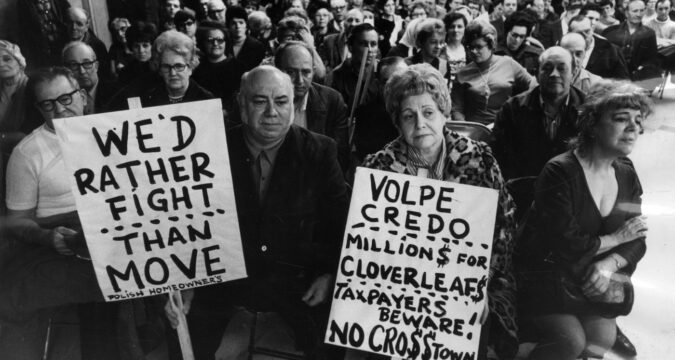
People look at possible routes for the Crosstown Expressway at a public hearing on June 29, 1974. (Roy Hall/Chicago Tribune)
Still, such reasoning was like the highway planning equivalent of Whac-a-Mole: A new expressway was attracting more cars and channeling more traffic to another expressway, so why wouldn’t the fix be yet another expressway costing hundreds of millions of dollars?
The estimated cost of the project in 1963 was $300 million; 10 years later, the projected price tag was a stunning $1 billion — or $7.3 billion in today’s dollars. Federal highway funding would have paid 90%, but the state, county and city still would have had to cough up $100 million.
Vintage Chicago Tribune: How Chicago expressways and other major roads got their names
Business groups and city leaders such as Ald. George Tourek, 23rd, insisted the expressway would be a net benefit by bringing a freeway to the “transportation-poor” Southwest Side, the Tribune reported. “The Crosstown Expressway is something Chicago desperately needs. The proposed route unquestionably is wonderful because it will displace relatively few people,” Tourek said.
The Crosstown failed to get off the ground for a host of reasons. Two contributing factors were the inconvenient energy crisis of the 1970s and Daley’s death in 1976, which proved to be a desiccant to the political will needed. But the plan’s most formidable foes were the livid and committed Chicagoans who were none too pleased at the prospect of their neighborhoods being torn asunder by an eight-lane expressway.
The messaging of Tourek and other proponents — that construction of the Crosstown would leave neighborhoods relatively unscathed — was rosy, to say the least. It was as accurate as a dentist telling a patient a root canal would just sting a little.
Bill English, from left, Joyce Zick, Margaret Sendzimer and Karen Frank, all foes of the Crosstown Expressway, urge Northwest Side residents to vote Nov. 2, 1972. (Jim Mescall/Chicago Today)
As the Tribune noted in a 1994 retrospective on the road plan, one Illinois Department of Transportation estimate from the 1970s concluded that the Crosstown would displace more than 33,000 people and more than 2,000 businesses and industries. Despite the advocacy of the business community and the assurances of elected officials, citizens were deeply alarmed by the footprint of the massive project.
The pushback against the Crosstown is considered a major turning point in the national movement against inner-urban expressways. Chicagoans from all walks of life and faith leaders whose parishes were threatened, such as the Rev. Leonard Dubi and the Rev. Albin Ciciora, linked arms to form an anti-Crosstown coalition. Members of the Citizens Action Program, which led the charge, began showing up at meetings and elected officials’ offices to push for an end to the project.
In 1972, as many as 10,000 people joined a symbolic 22-mile motorcade along the Crosstown’s proposed route to demonstrate widespread opposition to Daley’s plans. The same year, about 300 members of the coalition hosted a “people’s budget hearing” in a flick at the mayor’s notorious secrecy around his budget-making.
Citizens Action Program leader Mary Lou Wolff delivered a clear message to the aldermen at the event: “If you want to keep representing us, you’d better stop the Crosstown. We won’t take no for an answer.”
The coalition understood that a flair for the dramatic would grab attention. After Daley’s public works commissioner, Milton Pikarsky, refused to meet with residents, the coalition brought a duck to a protest to highlight the agency head “ducking” its inquiries. In the hopes of bringing the head of Chicago’s Roman Catholic community to their side, members sang a song with a lyric that alluded to the Crosstown’s imperiling of parishes: “Where will all your people go, Cardinal Cody?”
Members of the Organization of Northwest Communities carry a casket in front of City Hall on Sept. 15, 1967, to protest the proposed Crosstown Expressway. (Chicago Tribune historical photo)
Opponents gained a mighty ally in Dan Walker, an independent-minded Democrat running for governor. Walker vowed as part of his campaign to stop the Crosstown, and when he ascended to the office he set out to make good on that promise — though expressway fans in the General Assembly hatched legislative plots to neuter his ability to do so.
Ultimately, it was Daley’s successor, Michael Bilandic, who saw the writing on the wall when Walker’s successor, Gov. Jim Thompson, declared the Crosstown to be “an idea whose time has gone.” They cut a deal to divert money for the northern leg to transit projects.
Bilandic didn’t give up pursuit of the remaining leg, but one big snowstorm later, Jane Byrne assumed the mayorship and killed the Crosstown for good in 1979. (And it stayed dead, even though City Hall flirted with resuscitating it in 1986, and former Illinois House Speaker Michael Madigan in 2007 proposed making it a toll road.)
After a nearly two-decade fight, working-class and middle-class Chicagoans kept their homes, their businesses and their parishes. And the Chicago region’s mass transit system saw an immense infusion of funds: The money earmarked for the Crosstown allowed for, among other things, the extension of the Blue Line to O’Hare International Airport and the creation and reconstruction of 16 Metra stations. And scores of road projects in Chicago and Illinois were made possible, including the straightening of a curve on Lake Shore Drive.
People protest the Crosstown Expressway in the 4500 block of North Kilpatrick Avenue on July 24, 1973. (Quentin Dodt/Chicago Tribune)
In the ’60s and ’70s, ordinary Chicagoans helped galvanize a national revolt against freeway expansionism. Today, ordinary Chicagoans on the Northwest Side are coalescing around Witchek and Franke’s vision for a trail that would connect neighborhoods across a broad swath of the city — with the assistance of elected officials and not as dictated, top down, by them.
“We had a lot of momentum in ’25, and now, really, we need to turn that into a movement in ’26,” Witchek said, sounding a lot like some residents more than 50 years ago.
Colleen Kujawa is a content editor who works with the Tribune Editorial Board. She is a former Flashback (Vintage Tribune) editor.
Have an idea for Vintage Chicago Tribune? Share it with Marianne Mather at mmather@chicagotribune.com and Kori Rumore at krumore@chicagotribune.com.
https://www.chicagotribune.com/2026/01/15/vintage-tribune-crosstown-expressway-richard-j-daley/


