Category: News

Indian Prairie District 204 school board approves $2.3 million Chromebooks purchase
The Indian Prairie School District 204 board recently gave the district the green light to purchase 6,150 new Chromebooks, for a total cost of just over $2.3 million.
The cost for the new devices — HP Fortis 11 G10 Chromebooks — is accounted for in the district’s technology supplies budget for the current fiscal year, per a district memo. The quote includes things like delivery, screen protectors and a three- or four-year accidental protection plan, though Chromebook licensing will be added at a later date.
The district used to replace computers by elementary, middle and high school, but that led to major fluctuations in the district’s technology budget from year to year, the district’s Chief Technology Officer Rod Mack previously explained.
Now, the district replaces Chromebooks using a staggered system, in which it replaces some student computers every year, rather than in large chunks every fiscal year.
For example, second-, sixth- and ninth-graders in the district received new Chromebooks this year, following a similar purchase approval by the school board roughly a year ago. Students then use their Chromebooks for several years until they are due to be replaced again.
Doing so, Mack said previously, ensures there is enough money in the technology budget for regular maintenance: things like replacing copiers and updating wireless networks.
All students in District 204, aside from early childhood, have their own school computers. Kindergartners and first-graders keep them at school, while grades two and above are responsible for bringing their computers to and from school.
The Chromebooks purchase was approved by the school board as part of the consent agenda at its meeting on Jan. 12.
mmorrow@chicagotribune.com
https://www.chicagotribune.com/2026/01/20/indian-prairie-chromebooks-purchase/
UBS: Will There Be Chinese EVs In America?
UBS: Will There Be Chinese EVs In America?
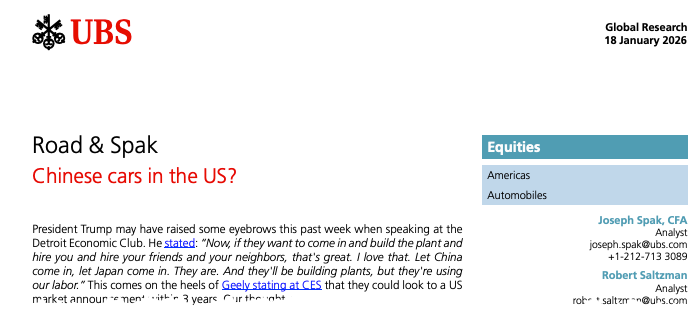
UBS analyst Joseph Spak asked clients on Sunday: Will there be Chinese cars in the US?
Spak pointed to comments from President Trump last week at the Detroit Economic Club, in which he said, “If they want to come in and build a plant and hire you and hire your friends and your neighbors, that’s great. I love that. Let China come in, let Japan come in. They are. And they’ll be building plants, but they’re using our labor.”
Trump’s comments come after Chinese automaker Geely stated at CES in Las Vegas that it could make a major announcement about a U.S. expansion within the next 24 to 36 months.
“The big question for us is when and where we will go to the U.S.A.,” Ash Sutcliffe, Geely’s global communications chief, said in an interview last week at the Autoline Network at CES.
This also follows Canada’s decision last week to allow up to 49,000 Chinese EVs per year at a low tariff rate. U.S. Trade Representative Jamieson Greer said the decision is “problematic for Canada.”
“There’s a reason why we don’t sell a lot of Chinese cars in the United States. It’s because we have tariffs to protect American auto workers and Americans from those vehicles,” Greer told CNBC on Friday.
But Trump’s comments suggest that if Geely or BYD Motors were to announce new manufacturing plants in the US, their products would avoid tariffs and be competitively priced with domestic car brands.
UBS analyst Spak offered his team’s thoughts on Chinese EVs in the US market:
Currently, there is a 100% tariff on Chinese EV imports. But of course, this wouldn’t be an issue if vehicles are built here. The bigger issue, in our view, is that the US bans Chinese software in vehicles starting in 2027, and then hardware in 2029. We believe that even for Chinese vehicles built in the US, they would want to leverage their software and hardware development.
Investors point to the recent rapid rise of Chinese vehicles in Europe, with their December share hitting 18% in the UK and 12% in Spain. For the year, Chinese share in the UK was up to 9.7% (aided by China owned MG brand which has UK heritage) from 4.8% in 2024, Italy 8.1% from 4.7%, Germany remains lower at 2.5%. But of course, this large inflection was aided by imports. And China exports grew meaningfully in 2025, to >1mm units, as they looked for global growth especially as domestic demand slowed and amid high domestic competition. In the US, the Chinese don’t have the ability to test the waters or see early gains given exports to the US are tougher.
Building factories, supplier parks, dealerships, distribution networks, and service would take some time (though many dealers we have spoken to have indicated they would welcome selling them). Rental/fleet seems like a way the Chinese OEMs could first start to get a foothold in the US and test out the market.
So, as has been our belief for a while (we wrote this in 2023), it is likely only a matter of time before the Chinese automakers are in the US, a sentiment others such as Ford CEO Jim Farley have echoed. From Ford’s 2Q25 earnings call: “We really see not the global OEMs as a competitive set for our next generation of EVs. We see the Chinese, companies like Geely and BYD.”
However, because of policy, the US OEMs likely still have a protected window for a number of years. Moreover, in our view, if/when the Chinese come, they are less likely to compete with the D3 bread and butter (and major profit driver) of large pickup trucks and SUVs. These segments have very brand loyal customers and also, for now, are less likely to be electric. Thus, smaller cars and small/midsize CUVs are more likely at risk. These are already competitive segments but also areas where Japanese/Korean brands tend to be more successful as F/GM have pulled out of many of these areas. Chinese autos in the US would also be a headwind for TSLA, RIVN. Further, China seems to be a topic US voters are more aligned on than not, so we wouldn’t expect the administration to move much on China auto investment before the mid-term elections.
And of course, there are still the political considerations as China remains a hot button topic. For instance, in response to a WSJ article which said Ford could buy batteries from BYD for hybrids for Ford factories outside the US, White House trade adviser Peter Navarro posted on X, “So @ford wants to simultaneously prop up a Chinese competitor’s supply chain and make it more vulnerable…?” Recall, Waymo recently changed the branding of their Zeekr based robo-taxi to Ojai (“ohhi”).
What about the US “back doors”? Canada just struck a deal with China to allow up to 49k Chinese EVs at a 6.1% tariff (had been a 100% tariff), and Canadian PM Carney indicated he expected the agreement would drive considerable Chinese investment into Canada’s auto sector. This is likely to draw scrutiny from the US as they review/renegotiate USMCA, where rhetoric has become more adversarial. During President Trump’s recent visit to Detroit, he called USMCA “irrelevant” and that Canada wants it but the US doesn’t need it. However, given the complexity of current supply chains, this would cause challenges for the US auto industry. We also believe that as part of the US discussions with Mexico, the US is seeking ways to limit Chinese auto investment in Mexico. That said, we believe this administration may be thinking one way to close the back doors is to eventually open the front door.
Also, we found this article that the first “dark” factory could open by 2030 (our understanding is that the Xiaomi factory is already very highly automated) interesting, since if the Chinese do come to the US, it may also be a headwind to President Trump’s stance that they will use “our labor” (though we believe US OEMs are also highly likely to continue to automate their facilities).
Key to the future of GM and F is what they do with strong profits during this period. We highlight F is still investing in their UEV platform, and GM CEO Mary Barra recently said EVs are still the end game.
Finally for suppliers, while they may claim this is an opportunity for new business, at a steady state, we believe this is at best case a neutral outcome (win with Chinese OEM replaces win with existing customer) with risk skewed to the downside as it could be a share loss, the win with the Chinese OEM could be lower content, and Chinese suppliers could also invest in the US (again political issues, but we are assuming a case where the Chinese OEMs come). That said, they may also have more time if we are right that initial Chinese vehicles in the US take share from Asian OEMs where the NA supply base tends to have less exposure.
To sum up, with Chinese EVs rapidly gaining market share in Europe and beginning to appear on roads in Canada and Mexico, it is likely only a matter of time before they reach the US. Trump suggested that building factories in the US could be their pathway to US consumers, a development that would pressure Tesla, Rivian, Lucid, and other domestic EV companies. It is likely Elon Musk would talk with Trump if there were any threat of a flood of Chinese EV imports.
Tyler Durden
Tue, 01/20/2026 – 05:45
https://www.zerohedge.com/technology/ubs-asks-will-be-chinese-evs-america
El gobernador de California dice a Europa que plante cara a Trump ante la amenaza de aranceles y “tenga agallas”
DAVOS, Suiza (AP) — El gobernador de California dice a Europa que plante cara a Trump ante la amenaza de aranceles y “tenga agallas.”

Today in History: Martin Luther King Jr. Day observed for the first time
Coretta Scott King, widow of slain civil rights leader Dr. Martin Luther King, Jr., is shown at a press conference in Atlanta, Jan. 11, 1986, to launch a 10-day celebration for the first national holiday for Dr. King. A poster depicting King is in the background. (AP Photo/Ric Feld)
Today is Tuesday, Jan. 20, the 20th day of 2026. There are 345 days left in the year.
Today in history:
On Jan. 20, 1986, the United States observed the first federal holiday in honor of civil rights leader Martin Luther King Jr.
Also on this date:
In 1841, the island of Hong Kong was ceded by China to Great Britain. It returned to Chinese control in July 1997.
In 1936, Britain’s King George V died after his physician injected the mortally ill monarch with morphine and cocaine to hasten his death. The king was succeeded by his eldest son, Edward VIII, who abdicated the throne 11 months later to marry American divorcee Wallis Simpson.
In 1937, President Franklin D. Roosevelt was sworn in for his second of four terms as president, becoming the first chief executive to be inaugurated on Jan. 20; prior to the adoption of the 20th Amendment in 1933, presidential terms began on March 4.
In 1961, in his inaugural address, President John F. Kennedy urged Americans, “ask not what your country can do for you – ask what you can do for your country.”
In 1981, Iran released 52 Americans it had held hostage for 444 days, minutes after Ronald Reagan was sworn in as president of the United States, succeeding Jimmy Carter.
In 2009, Democrat Barack Obama was sworn in as the first Black president of the United States.
In 2011, authorities orchestrated one of the biggest Mafia takedowns in FBI history, charging 127 suspected mobsters and associates in the Northeast with murders, extortion and other crimes spanning decades.
Related Articles
EC NAACP marks comeback with MLK event, commitment to justice
PNW professor urges public to embrace fullness of King’s message
Today in History: Rupert Murdoch’s media empire apologizes for hacking scandal
Today in Chicago History: ‘Tokyo Rose’ pardoned by the president
Vintage Chicago Tribune: Bears playoff appearances — including the ‘Sneakers Game,’ ‘Fog Bowl’ and ‘Double Doink’
In 2017, Republican Donald Trump was sworn in as the 45th president of the United States as protesters clashed with police blocks from the inaugural parade.
Today’s birthdays: Former astronaut Buzz Aldrin is 96. Olympic figure skating gold medalist Carol Heiss Jenkins is 86. Rock musician Paul Stanley (KISS) is 74. Comedian Bill Maher is 70. Olympic swimming gold medalist John Naber is 70. Country singer John Michael Montgomery is 61. Actor Rainn Wilson is 60. Actor Skeet Ulrich is 56. Musician Questlove (The Roots) is 55. Nikki Haley, former U.S. ambassador to the United Nations and ex-governor of South Carolina, is 54. Country singer Brantley Gilbert is 41. Actor and singer Joshua Colley is 24. Singer-songwriter Glaive is 21.

The best Sony digital camera for travel and everyday use
Which Sony digital camera is best?
If you’re ready to shoot higher-quality photos than a smartphone can achieve, but you don’t like the bulk and weight of DSLR cameras, there are other options. As a camera manufacturer, Sony focuses on the fixed lens and mirrorless interchangeable lens camera part of the market.
Sony cameras are smaller than average in size, making them a nice choice for someone who is used to shooting with a smartphone. Yet, they have a strong list of features, delivering excellent image quality.
For the best Sony digital camera, we like the Sony a6500 Mirrorless Digital Camera. It gives you 24 megapixels of resolution and fast performance levels.
What to know before you buy a Sony digital camera
When shopping for Sony digital cameras, you’ll be picking among two designs: Fixed lens and mirrorless.
Fixed lens: With a fixed lens Sony camera, the lens is built into the camera body and cannot be removed. These lenses give you optical zoom measurements, and the larger the number, the greater the image magnification. A camera with 20X optical zoom or better will give you strong magnification options.
Mirrorless: The mirrorless ILC allows for lenses to be removed and swapped out for other compatible lenses. This gives the mirrorless camera plenty of versatility. Because you have to purchase additional lenses separately, though, the cost can add up quickly.
What to look for in a quality Sony digital camera
The following are some of the most important parts of a Sony digital camera. Understanding what they do will help you compare models and find the perfect camera for your needs.
Image sensor: The image sensor measures light in the scene, creating the digital representation of the photo. Large-sized image sensors, such as the APS-C sensor found in quite a few Sony mirrorless cameras, deliver excellent image quality. Smaller sensors, such as the 1/2.3-inch sensor often found in Sony fixed lens cameras, likely will struggle with image quality in low light.
Photo resolution: The number of pixels the image sensor can record is called the resolution. A Sony camera with 20 megapixels of resolution or more will deliver high-quality images. (Megapixels, often shortened to MP, are millions of pixels.) However, the image sensor’s physical size plays a greater role in image quality than the number of megapixels it can record.
Video resolution: Sony digital cameras create videos with excellent quality. You usually can find cameras with a maximum video resolution of full HD (1920×1080 pixels). However, some Sony cameras are able to record 4K movies (3840×2160 pixels).
Flash: The majority of Sony cameras have a flash unit built into the camera body, and it usually pops out of the top of the frame. If the Sony camera has a hot shoe, you can purchase an external flash to connect to the hot shoe.
How much you can expect to spend on a Sony digital camera
If you’re shopping for a fixed lens Sony camera, expect to pay $200-$500, although some models cost as much as $1,000. For a mirrorless Sony camera, expect to pay $400-$1,000, although some models cost as much as $3,000.
Sony digital camera FAQ
Q. What items ship with a Sony mirrorless camera?
A. The mirrorless Sony camera may ship with a starter lens and a neck strap. However, you’ll often have to purchase a memory card, extra lenses, and an add-on flash separately.
Q. As a beginner, how do I choose between the fixed lens and mirrorless Sony cameras?
A. For beginners, a fixed lens camera will be easier to learn to use, and it will be cheaper. However, if you aren’t afraid to learn how to use new technology and you want to create great-looking photos, a mirrorless camera is a great option for beginners.
What are the best Sony digital cameras to buy?
Top Sony digital camera
Sony a6500 Mirrorless Digital Camera
What you should know: Works quickly, so you won’t miss a spontaneous photo, but its image quality is also well above average.
What you’ll love: Provides the ability to record 4K movies. Small camera body, yet it fits well in the hand.
What you should consider: The price is a little high. Might have too many features for inexperienced photographers to handle.
Top Sony digital camera for money
Sony HX80 Fixed Lens Digital Camera
What you should know: If you want the simplicity of a fixed lens camera at a low price, this model delivers some great results.
What you’ll love: With a 30X optical zoom lens, you’ll be able to shoot photos almost anywhere. Has a viewfinder, which is not common on fixed lens cameras.
What you should consider: Contains Wi-Fi technology, but it’s difficult to set up and use.
Worth checking out
Sony a6000 Mirrorless Digital Camera
What you should know: Considering the price, you’ll pay, the image quality and performance levels are pretty impressive.
What you’ll love: Offers 24 megapixels of resolution in a large-sized image sensor that simplifies low-light photography.
What you should consider: Battery life is a problem. Finding high-quality lenses is tough.
Prices listed reflect time and date of publication and are subject to change.
Check out our Daily Deals for the best products at the best prices and sign up here to receive the BestReviews weekly newsletter full of shopping inspo and sales.
BestReviews spends thousands of hours researching, analyzing and testing products to recommend the best picks for most consumers. BestReviews and its newspaper partners may earn a commission if you purchase a product through one of our links.
Distributed by Tribune Content Agency, LLC.
https://www.chicagotribune.com/2026/01/20/the-best-sony-digital-camera-for-travel-and-everyday-use/

The best weighted blanket for deeper, more restful sleep
What are the best weighted blankets?
Restless, uncomfortable sleep at night can cause exhaustion and increased stress in the morning, leaving you unable to fully tackle the day ahead. For those in need of help falling and staying asleep at night, or anyone who needs assistance calming down in moments of uncertainty, a weighted blanket is a worthy investment.
Namely, weighted blankets provide pressure. By wrapping yourself in what is essentially a big hug, you may be able to calm yourself and focus better. Weighted blankets are primarily used in bed but can offer protection and warmth anywhere you are.
The best option is the Gravity Weighted Blanket, though as this guide details, there are plenty of considerations and options that go into finding the best weighted blanket.
What to know before buying a weighted blanket
Weighted blanket benefits
Gentle pressure and extra weight can help calm and soothe the body and mind. The belief is that through such pressure, your body releases serotonin to help better regulate your mood.
Aside from the extra weight, these popular products still function like regular blankets, providing warmth and coziness. They can be used in bed, on the couch, outside or while traveling.
Size
Weighted blankets come in various sizes, with most options in alignment with the popular bed sizes. Smaller options exist in throw blankets, while larger ones will cover king-size beds.
It may be helpful to get an option that is slightly smaller than your bed. This can help prevent the blanket from sliding over the edge with the added weight. While two people can share a weighted blanket, most users prefer having a blanket to themselves to enjoy the full wraparound effect.
Weight
It’s crucial to find a weighted blanket that corresponds to your body size. If the blanket is too heavy, it’ll grow uncomfortable. However, if it’s too light, it won’t serve its intended purpose. Most weight blankets are offered in five-pound increments starting from 5 pounds. Typically, you should opt for a blanket that’s about 10% of your body weight, though personal preference will come into play if you want to go slightly heavier or lighter.
What to look for in a quality weighted blanket
Fabric
Weighted blankets are made in a variety of fabrics, with some options softer than others. Fleece and flannel are standard, while some users prefer something smoother, like satin. Consider your tactile preferences and whether you want a blanket that’s full and fluffy or leaner and airy.
Weighted components
Most quality weighted blankets use plastic or glass beads to create weight. They’re stitched in, so they don’t move around, maintaining an even weight distribution within the blanket. Polyester fiberfill, or polyfill, may be included to give a more natural appearance, supplementing the interior weighted components and creating a softer, fuller blanket.
Design
Weighted blankets come in all sorts of color options, and some may even sport designs, particularly options for younger users. If you have the choice, you may want to consider matching or complementing your current bedsheets or existing décor. If you’re opting for a smaller weighted blanket, an accent color may be more appropriate.
How much you can expect to spend on a weighted blanket
Most weighted blankets of average size cost between $100-$200, likely with color and fabric options. Custom options can run higher, while small, lighter models may cost less.
Weighted blanket FAQ
How safe are weighted blankets?
A. While weighted blankets can provide relief for some users, a blanket that’s too heavy can quickly become dangerous. Keep your weighted blanket away from children, small pets or elderly family members who may not possess the strength or dexterity to remove the blanket. Keep it away from the edges of beds or couches where you can pull it down.
How do I clean my weighted blanket?
A. Weighted blankets typically require extra care when washing; they will come with detailed instructions from the manufacturer that you should follow. In most cases, you’ll have to wash gently and let the blanket air dry. Some options feature or allow for a duvet cover to protect the blanket, making cleaning easier.
What’s the best weighted blanket to buy?
Top weighted blanket
What you need to know: One of the most popular and most reliable weighted blankets, this high-quality model provides instant relief and comfort.
What you’ll love: Quality construction offers longevity and even weight distribution of glass beads. It features a soft, plush duvet cover that is machine-washable.
What you should consider: There are only a few size and color options available.
Worth checking out
What you need to know: This is an innovative blanket that hides its weight through expert construction and stunning design.
What you’ll love: It’s an impressively soft, knitted blanket made from organic, sustainable cotton. Cool and breathable, it’s easy to wash by hand or machine and available in various colors.
What you should consider: It’s quite fluffy and very pricey.
Prices listed reflect time and date of publication and are subject to change.
Check out our Daily Deals for the best products at the best prices and sign up here to receive the BestReviews weekly newsletter full of shopping inspo and sales.
BestReviews spends thousands of hours researching, analyzing and testing products to recommend the best picks for most consumers. BestReviews and its newspaper partners may earn a commission if you purchase a product through one of our links.
Distributed by Tribune Content Agency, LLC.
https://www.chicagotribune.com/2026/01/20/the-best-weighted-blanket-for-deeper-more-restful-sleep/
Equipos israelíes comienzan a demoler la sede de UNRWA en Jerusalén Oriental
Associated Press
JERUSALÉN (AP) — Cuadrillas israelíes comenzaron el martes a demoler un recinto de Naciones Unidas en Jerusalén Oriental, mientras el gobierno de Israel endurece las restricciones sobre los grupos humanitarios que brindan ayuda a los palestinos.
UNRWA, la Agencia de Naciones Unidas para los Refugiados de Palestina en Oriente Próximo, dijo en X que las fuerzas israelíes habían confiscado dispositivos del personal y los habían obligado a salir de su sede en el barrio de Sheikh Jarrah.
“Este es un ataque sin precedentes no solo contra UNRWA y sus instalaciones. Constituye una grave violación del derecho internacional y de los privilegios e inmunidades de las Naciones Unidas”, afirmó.
Israel ha criticado durante mucho tiempo a UNRWA por lo que considera inclinaciones propalestinas y ha acusado al grupo de tener vínculos con Hamás, algo que la agencia de la ONU ha negado rotundamente.
El Ministerio israelí de Exteriores dijo que la demolición se estaba llevando a cabo en cumplimiento de una nueva ley que ilegalizaba la organización, acusándola de tener vínculos con grupos armados y Hamás.
El ministro de Seguridad Nacional, Itamar Ben-Gvir, expresó en un comunicado que había acompañado a las cuadrillas a la sede y lo calificó como un “día histórico”.
UNRWA mantiene infraestructura en los campos de refugiados palestinos y también gestiona escuelas y proporciona atención médica a los refugiados palestinos en Gaza y la ocupada Cisjordania, así como en Jordania, Líbano y Siria. Los palestinos dicen que es fundamental para garantizar que la gente reciba servicios básicos, pero el grupo ha sido durante décadas un objetivo de Israel.
El gobierno de Donald Trump cortó la financiación estadounidense al grupo en 2018. El parlamento israelí, el Knéset, aprobó el año pasado una legislación que prohíbe sus operaciones en lo que define como Israel, que incluye Jerusalén Oriental, donde la organización tenía su sede.
La prohibición formaba parte de esfuerzos más amplios para vetar a grupos de ayuda que operan en Gaza y la ocupada Cisjordania. Israel ha aprobado leyes que requieren que las organizaciones no gubernamentales no contraten personal involucrado en actividades que “deslegitimen a Israel” o apoyen boicots, exigiendo que registren listas de nombres como condición para poder trabajar. Israel informó a docenas de grupos que sus licencias expirarían a finales de 2025.
___ Esta historia fue traducida del inglés por un editor de AP con la ayuda de una herramienta de inteligencia artificial generativa.

Russia Restores Mothballed Soviet-Era Jets As Plane Shortage Worsens
Russia Restores Mothballed Soviet-Era Jets As Plane Shortage Worsens
Russia has throughout nearly four years of its ‘special military operation’ in Ukraine been largely successful in weathering constantly expanding US and EU sanctions. While isolated, its economy has stayed afloat, but it has been forced into desperate measures as sanctions take a toll on some key sectors.
Russian newspaper Izvestia reports that Russia’s commercial airline industry is having to call back aging, decommissioned planes in an effort to sustain passenger traffic. Soviet-made planes which are several decades old are being restored to service.
“The plan involves nine Tupolev Tu-204/214 jets, one Antonov An-148 and two Ilyushin Il-96 widebody planes delivered to carriers including Red Wings,” The Moscow Times says of the Russian media reports.
“Ten of the 12 aircraft, which are reportedly up to 30 years old, have already been returned to service, Rostec told Izvestia,” the report continues.
Out of a national fleet of over 1,100 airliners, nearly 70% are foreign-made aircraft. In 2022 soon after the Ukraine war kicked off, authorities launched a program to begin replacing foreign planes with domestically produced models.
But regional media says that the plan has failed over the past years in meeting its ambitious goals, which called for over 120 aircraft of different types to be produced between 2023 and 2025. Instead a little over a dozen have been produced.
Western sanctions have not only impacted the ability to replace parts and keep maintenance up to date, but entire factories and machines have had to retool and be revived to make up for the lack in foreign parts.
But the industry is about to find itself under even more pressure and strain, as Moscow takes drastic action in the face of isolation from the West:
In 2026, Moscow plans to slash federal aircraft and helicopter production spending by 1.6 times, from 139.6 billion rubles ($1.7 billion) to 85.7 billion rubles ($1 billion), according to Russian media citing the draft federal budget for 2026-28.
Subsidies for airlines to renew their domestic fleets will be eliminated entirely, down from 1.3 billion rubles ($16 million) in 2025. Support for aircraft maintenance is set to drop from 6.1 billion rubles ($75 million) to 3.6 billion ($44 million). Only the MC-21 medium-haul jet will see increased funding, with subsidies rising 25% in 2026.
In the meantime aviation accidents have been growing increasingly common in Russia, particularly in the recent years of the Ukraine war. While not every incident can necessarily be linked directly to sanctions, it is the case that these increasingly involve very old planes with subpar maintenance and mechanics upgrades.
Ukrainian officials have of late also pointed to cross-border drone attacks as successfully disrupting Russian oil and fuel…
⚡️⚡️⚡️BREAKING: 🇷🇺Russia’s largest private fuel supplier warns of a new aviation fuel CRISIS.
After Ukrainian drone strikes damaged over 20 oil refineries, Moscow relaxed fuel standards — allowing “winter diesel” to be made by mixing summer diesel with kerosene. That quick fix… pic.twitter.com/bm63W45a6A
— Kyrylo Shevchenko (@KShevchenkoReal) November 4, 2025
Like with most Western sanctions on ‘rogue’ states abroad, it is the common people who suffer most.
The same trend has been seen in Iran, which over the last decade has witnessed horrific aviation accidents, including the loss of a sitting president when his military helicopter crashed near Azerbaijan.
Tyler Durden
Tue, 01/20/2026 – 04:15
Equipos israelíes derriban sede de la ONU en Jerusalén Este mientras Israel endurece restricciones a grupos humanitarios
JERUSALÉN (AP) — Equipos israelíes derriban sede de la ONU en Jerusalén Este mientras Israel endurece restricciones a grupos humanitarios.
Childish Media Games: How The SPD’s “Germany Food Basket” Masks State-Driven Inflation
Childish Media Games: How The SPD’s “Germany Food Basket” Masks State-Driven Inflation
Submitted By Thomas Kolbe
Party politics today is essentially a mélange of media strategy, personality cult, and the constant struggle to expand one’s own sphere of power. At the Willy Brandt House, the Social Democrats’ command center, a two-track media strategy appears to have been agreed upon for this year: taking and giving.
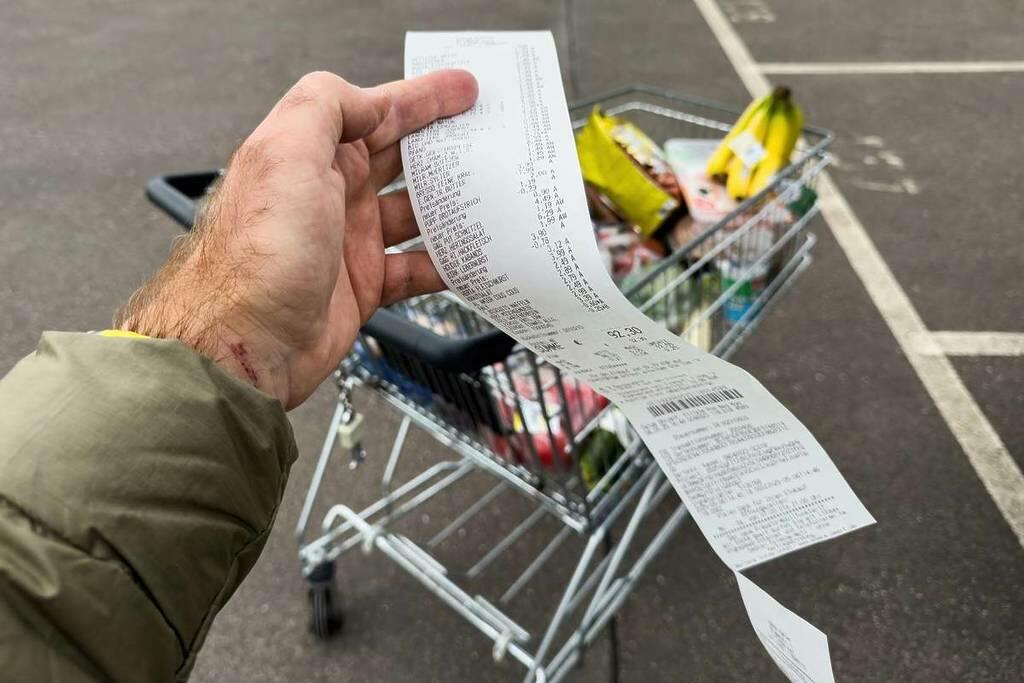
From the wealthy, the party intends to take—by expanding inheritance taxes on corporate assets—what, according to the Social Democrats’ moral code, never truly belonged to them. To the citizen, meanwhile, they want to give a basket of cheap groceries. After years of steadily rising food prices, SPD strategists believe they have discovered the perfect marketing instrument—and behold: suddenly it’s about the purchasing power of “ordinary people.”
Of “Ordinary People” and the Emotionally Unstable
Yes, you heard that correctly. The ordinary man—that obscene phrase of left-wing salon arrogance, barely concealing its deep-seated contempt for real lives—is once again being invoked in a fight for survival. Lars Klingbeil and the self-appointed champions of social justice signal a return to their roots. After years spent cultivating the woke, emotionally unstable segment of society, attention now shifts back to the core voter: the worker.
Have the Social Democrats finally struck bedrock in their deep search for a solution to inflation and the impoverishment of the lower classes? Their idea: persuade major discount chains and food retailers, on a “voluntary” basis, to include a predefined basket of basic groceries at low and stable prices. It sounds childish—and it is.
Adding patriotic undertones to this piece of neo-feudal arrogance only makes the “Germany Basket” smell unmistakably like a product pulled straight from the SPD marketing kitchen.
Imagine its creation in practice: Lars Klingbeil, himself no stranger to calorie-dense cuisine, sits one weekend with his working group—“Germany Basket: The Ordinary Man Eats Healthy”—in front of the party’s position paper. With a mid-range Chianti and a juicy Pizza Tricolore (three-pack, Mediterranean Week) from the premium section of a well-stocked discounter, young socialists, union officials, and party grandees work their way, bite by bite, toward defining the basic provisions of the archetypal precarious household.
They are informed. They listen to the people. They are always close to the pulse of the times. Why not also at the breakfast table? Didn’t Germany’s minister of the heart, Robert Habeck, run his last campaign exactly this way—approachable, in a hemp sweater, sipping mate tea at kitchen tables across the republic? Perhaps the finance minister senses that elections are won as long as the pan is hot, the pizza is in the oven, and a cold beer doesn’t cut too deeply into the weekly budget.
One kilo of floury potatoes, gluten-free pasta for allergy sufferers, of course a non-alcoholic beer—sugary drinks excluded—a bit of greenery on top, maybe some long-life milk, plain yogurt, and a nostalgic nod to good old junk food, naturally soy-based. Thus it may soon take shape: the socially just, functionary-approved food basket, complete with the finance minister’s seal of approval.
Attention to Detail Required
Fine-tuning the Germany Basket forces the working group into excursions—reenacting life at the front lines of daily economic struggle, venturing into that terra incognita of the ordinary consumer’s harsh reality. They will advance to the places where elections are decided: the meat counters, the vegetable aisles with their astonishing variety, the endless freezer sections filled with goods from all corners of the world.
It would be instructive to attach to every product its pre-COVID price. Such an existential shock might spoil the soup for one or two party officials.
Everyone can participate in the Germany Basket—from the finance minister and the labor minister to union secretaries and representatives of food NGOs. After years of disagreement, a common denominator is quickly found—and lies just a few steps away, possibly already in the freezer of the SPD canteen.
Inflation and the World of Fables
How bewildering rising prices must seem in these circles, where inflation is imagined to be nothing more than the result of entrepreneurial greed and excessive profit-seeking.
That inflation might stem from an ever-growing state apparatus financing itself to a significant extent through the printing press would never occur to them. And that Germany’s energy crisis—the ban on importing cheap Russian gas, the nuclear phase-out, and the entire climate-regulation catalogue—might negatively affect agriculture and generate immense price pressure is likewise relegated to the realm of fairy tales.
Yet the surge in prices has been massive. Since before the lockdowns, food prices in Germany have risen by nearly 40 percent. Few households have been able to offset this increase through income gains. The problems cut deeply into household budgets. At the same time, open-border policies clog the housing market while regulation and rent controls systematically prevent new construction—creating an economic situation from which fewer and fewer households can escape.
In economics, one principle is well known: the cure for high prices is high prices. They signal investors to deploy capital and eliminate scarcity. That this does not happen is also the work of these culinary-minded Social Democrats. They cling desperately to price controls like rent caps and to the regulatory machinery of the climate complex. In the bureaucracy thus created—in a dictated framework that now extends even to the refrigerator—they find their power base.
Within SPD circles, they believe they have discovered yet another trump card in the attention economy. The Germany Basket is merely another media-political low point: tasteless, undignified, ineffective. The SPD is finished.
* * *
About the author: Thomas Kolbe is a German graduate economist. For over 25 years, he has worked as a journalist and media producer for clients from various industries and business associations. As a publicist, he focuses on economic processes and observes geopolitical events from the perspective of the capital markets. His publications follow a philosophy that focuses on the individual and their right to self-determination.
Tyler Durden
Tue, 01/20/2026 – 03:30