
Category: News
Students train to be election judges at Oak Forest High School
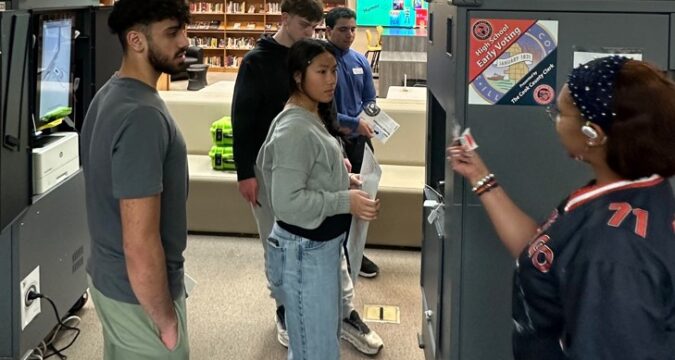
About 40 students gathered around very large ballot boxes at Oak Forest High School, said Ryan Nagle, social studies department supervisor for Bremen High School District 228.
Nagle said students were excited to be at school after hours, training to be election judges, with about 30 of the students training for the first time. Unlike some classrooms, he said, he did not see students with their heads down.
It didn’t hurt, he said, that the election training program was sponsored by the Chicago Bears and took place a few days before the team’s playoff game against the Green Bay Packers.
Those large ballot boxes will return to Cook County schools month as a part of a pilot program sponsored by a collaboration between the Cook County clerk’s office and the Bears, called Defenders of DA’Mocracy.
The program trained 150 high school juniors and seniors to be election judges during an early voting day on Feb. 26, specifically dedicated for school faculty, students and staff who live in Cook County.
Oak Forest High School hosted one of three of the program’s training sessions for students Jan. 7. Another training was hosted at John Hersey High School in Arlington Heights.
Nagle said the program allows 17- to 18-year-old students to engage in the civic process while also gaining confidence and leadership skills. He said students have trained as election judges before, but having an early election day dedicated specifically to the school is new.
“Students can sense that their roll in democracy matters now, not just like maybe in the future, because they’re actively participating in it,” he said.
Diane Mullins, elections training manager from the Cook County clerk’s office, presents a signed D’Andre Swift football to a participant in the election judge training at Oak Forest High School. (Bremen High School District 228)
Nagle said engaging young students is especially important because young people have historically voted at lower rates than older adults.
Election data shows that among Cook County voters between ages 18 to 22, fewer than 1% typically turn out to vote in municipal elections, 2% to 4% turn out for midterms and fewer than 5% cast ballots in presidential cycles, according to Deputy Clerk of Elections Edmund Michalowski.
Nagle said students learned how to encourage their peers to get involved in the election process, register to vote and understand their voting location options.
One reason students don’t participate in elections at higher rates is due to confusing registration deadlines and requirements, a lack of youth outreach and a dearth of regular curriculum that teaches young people about elections and voting in school, according to Circle research.
“It’s kind of like, knowledge is power, like students might not have known about this stuff aside from the general stuff they’re learning in their civics courses,” he said.
Nagle also said he hopes that students bring this election knowledge into conversations at home, even encouraging their parents to get out to the polls.
Nagle said the Bears senior vice president attended the training and gave an unexpected but inspiring speech about how important it is for young students to be involved in the civic process.
“It was really cool to have that out here, especially a couple days before their playoff game,” Nagle said.
Lee Twarling, Chicago Bears senior vice president, provides an introduction about the early voting pilot program and how the Bears partner with the clerk’s office to promote the democratic process. (Bremen High School District 228)
Nagle said that each student received a raffle ticket to win a football signed by D’Andre Swift, the Chicago Bears running back, upon arrival to the training. Diane Mullins, the elections training manager from the Cook County clerk’s office presented the football at the training.
Nagle said he remembers more than 20 years ago these type of civic opportunities were rarely discussed.
A sign displayed at Oak Forest High School as part of the pilot program, Defenders of DA’Mocracy. (Bremen High School District 228)
He said when he started announcing the program last fall, students who served as election judges in the past were excited and recommended it to their friends.
Nagle said that each school could only recommend eight students per school for the program, but if students still wanted to be judges on the usual election day, they could apply for separate training.
He said the pilot program also encourages voter turnout by having the specific voting day for school staff.
“To have them have that option to come down on their lunch and vote, that’s something,” he said.
awright@chicagotribune.com

El grupo Estado Islámico reivindica el ataque en restaurante de Kabul que dejó 7 muertos
Por ABDUL QAHAR AFGHAN
KABUL (AP) — El grupo Estado Islámico se atribuyó la responsabilidad de una explosión en un restaurante chino en la capital de Afganistán que mató al menos a siete personas, incluyendo a un ciudadano chino. La causa de la explosión aún estaba bajo investigación, dijeron las autoridades el martes.
El grupo armado dijo en un comunicado publicado en su agencia de noticias Aamaq el lunes por la noche que un atacante suicida entró en un restaurante frecuentado por ciudadanos chinos en la ciudad y detonó un chaleco explosivo durante una reunión. Afirmó que 25 personas murieron o resultaron heridas en el ataque, incluidos guardias talibanes. Los detalles no pudieron ser verificados de manera independiente.
Las autoridades afganas no han confirmado oficialmente la causa de la explosión del lunes, y el portavoz del Ministerio del Interior, Mufti Abdul Mateen Qani, dijo el martes que aún estaba siendo investigada.
La reivindicación del EI correspondía en estilo a las anteriores emitidas por el grupo, y los seguidores de los milicianos la compartieron ampliamente el martes por la mañana. La reivindicación incluía una amenaza adicional contra los ciudadanos chinos en Afganistán, vinculando el ataque al trato de China hacia los musulmanes uigures.
Aunque casi todas las naciones se retiraron de Afganistán tras la ofensiva talibán de 2021 que llevó a la toma de Kabul, China ha mantenido una importante presencia económica en el país. Beijing aún no ha reconocido diplomáticamente al gobierno afgano dirigido por los talibanes.
El martes, China aconsejó a sus ciudadanos no viajar a Afganistán en el corto plazo después del atentado, y pidió a los ciudadanos y empresas chinas ya en el país que refuercen las medidas de seguridad y evacúen de las áreas de alto riesgo.
“China condena enérgicamente y se opone resueltamente al terrorismo en todas sus formas y apoya a Afganistán y a los países de la región en la lucha conjunta contra todos los actos violentos terroristas”, dijo el portavoz del Ministerio de Relaciones Exteriores, Guo Jiakun, en una rueda de prensa diaria en Beijing.
Dijo que un ciudadano chino murió y otros cinco resultaron heridos. Añadió que China ha instado a las autoridades afganas “a hacer todo lo posible para tratar a los heridos, tomar medidas efectivas para proteger la seguridad de los ciudadanos chinos (y) proyectos”, y encontrar y castigar a los responsables.
El ataque ocurrió en un restaurante chino en el distrito de Shahr-e-Naw en la ciudad, según el portavoz policial Khalid Zadran. Dijo el lunes que el restaurante era de propiedad conjunta de un afgano, un ciudadano chino y su esposa.
Zadran dijo que un ciudadano chino y seis afganos murieron y varios otros resultaron heridos. La explosión ocurrió cerca de la cocina del restaurante, dijo.
La organización benéfica italiana EMERGENCY, que opera un centro quirúrgico cerca del lugar, dijo el lunes que recibió 20 víctimas de la explosión, incluyendo a siete personas que ya estaban muertas. El número de víctimas seguía siendo provisional, dijo la organización.
La emisora estatal china CCTV informó que dos ciudadanos chinos resultaron gravemente heridos y un guardia de seguridad murió. Imágenes transmitidas por la emisora afgana Tolo News mostraron a personas corriendo por la calle mientras humo y polvo se elevaban desde el área.
El presidente de Pakistán, Asif Ali Zardari, condenó la explosión, que atribuyó a una bomba, en un comunicado emitido por su oficina. Acusó al gobierno talibán de Afganistán de no cumplir con los acuerdos de alto el fuego, particularmente los compromisos de evitar que grupos armados usen el territorio afgano para llevar a cabo ataques.
Sus comentarios siguieron a un anuncio de las autoridades tayikas de que guardias fronterizos mataron a cuatro hombres armados que cruzaron al país desde Afganistán durante la noche. Funcionarios afganos dijeron que los hombres eran traficantes de drogas. Kabul ha dicho repetidamente que no permite que su territorio sea utilizado por grupos armados.
El grupo Estado Islámico ha realizado varios ataques en Afganistán desde que los talibanes regresaron al poder en 2021.
___
Samy Magdy contribuyó a este despacho desde El Cairo.
___
Esta historia fue traducida del inglés por un editor de AP con la ayuda de una herramienta de inteligencia artificial generativa.
Editorial: Why Chicago hotels have a case for taxing themselves. And why we worry.
Anyone who has stayed in a hotel in a high-tax city like Seattle or New York is familiar with how that nightly $200 hotel room turns into $235 or more once numerous taxes are added. Both U.S. states and cities from Omaha to Memphis love to smack visitors with high lodging tax rates, mostly because taxes that are not paid by locals are far less likely to receive scrutiny when elections come around.
Smarter minds, though, understand the nature of reciprocity and retaliation. We’re all nonlocals when we pay tax out of town and one increase sparks another. You may have noticed new fees for Americans to enter many countries as a tourist. They spread after the U.S. slapped fees on visitors.
Chicago already has a high hotel tax rate of 17.9% — No. 16 among the top 150 markets according to a comprehensive survey from HVS, a respected global consultancy in the lodging industry. That’s already far higher than Phoenix (12.57%), San Diego (12.50%) and Las Vegas (13.38%), at least in terms of the typical ad valorem taxes applied to room rates. These comparisons are complicated by the existence of flat fees per night in some cities, such as New York, which mean that cheaper hotels actually have higher effective tax rates there (something that would seem to go against the principals of New York’s new socialist mayor, Zohran Mamdani).
Some cities also have created special districts with their own taxes, often plowed back into the district itself or used for a convention hall or some other such tourism-related entity. That’s essentially what the city of Chicago’s tourism agency, Choose Chicago, is trying to push through City Hall.
Choose Chicago wants an additional 1.5% tacked onto guest bills of hotels with more than 100 rooms in the Central Business District, near McCormick Place and in the Illinois Medical District. During a recent meeting with us, board Chair Guy Chipparoni and recently appointed CEO Kristen Reynolds said that, after meeting with 3rd Ward Ald. Pat Dowell, they’d extended their target promotional zone farther south. This is Chicago, after all.
What would Choose Chicago do with the 1.5%? Fund itself, essentially. Currently, this destination marketing organization has about $33 million in annual revenue; with the new 1.5% tax — or “assessment” as they prefer to call it, being marketers — that revenue is projected to roughly double.
With an assist from Michael Jacobson, the all-in CEO of the Illinois Hotel & Lodging Association, the pair came armed with reasons we should support this new, ahem, tax.
Many were related to the importance of the tourism business to Chicago; we needed no convincing there, being long aware of the number of Chicago jobs (well over 100,000) tied to visitors. We’ve also long seen untapped tourism potential in Chicago, especially when it comes to European and South American tourists who tend to be infatuated with New York, Los Angeles and Orlando and could use an education on our city’s charms. We also believe that Chicago tourism has severely lagged other cities in post-pandemic recovery, especially when it comes to international visitors. We won’t bore you with all those statistics; any fool can see this is a vital industry to our toddlin’ town. And it needs a jump-start.
Choose Chicago’s other arguments for doubling its own budget (and maybe then some) involve the amount of promotional spending by competing cities. Las Vegas spends nearly half a billion dollars promoting itself each year and even after this new tax, Orlando still will spend more. As Chipparoni and Reynolds see it, this allows these competitors to steal business from Chicago, running promotions that Chicago cannot afford to duplicate and staffing offices Chicago cannot afford to open.
Chipparoni is a savvy player, and he knew he was speaking to a board that is no fan of raising taxes. So he emphasized that in this case, the hoteliers are “assessing” (LOL) themselves. The lodging folks see this as an altruistic act: Sure, their room rates go up with more visitors, but restaurants and theaters also get busier. If hotels are making this magnanimous gesture, their argument goes, they should rightly dictate how the new money gets spent. Ergo, the cash will come in and the hoteliers will oversee how it gets spent, as overseen by Choose Chicago.
We also sensed that the hoteliers quietly were implying that if they don’t raise this tax, there is a chance the city will decide to do so. And who might we better trust to ensure that the money goes to the right place? You likely can guess.
All in all, then, we think the hoteliers have a good case for their new taxing district and tax, which they say will be applied for five years, although the likelihood of it going away after that point is roughly akin to you getting an upgrade to the presidential suite, if there was one, at the Hampton Inn.
But it’s disingenuous to say that the hoteliers are the ones “paying” the assessment/tax. Certainly, in a competitive business, room rates greatly affect the choices of cash-strapped customers. But it’s the guests who are paying the bill, and in Chicago, they are not all from thousands of miles away, either. Plenty of suburbanites stayed downtown after the Sunday Bears thriller. Some Chicagoans need extra space on occasion for family or if their water pipes burst. There is shared sacrifice here.
We also wouldn’t want to see this become a Choose Chicago slush fund used, say, to double everyone’s salary. If they are going this way, rather than just writing checks, we think hoteliers must be transparent about where the money is going. They’ve promised the City Council and the media full audits and aldermen should insist on that; in the past, we’ve found Choose Chicago events heavy on the self-congratulations. If hotel taxes are rising, the city’s tourism agency should pivot to more frank annual meetings and ensure there are quantifiable results. (Our guests suggested an additional $3 billion in visitor spending in Chicago could flow from this initiative, turning $20 billion into $23 billion.) In our view, that will also mean not just volume but more effective campaigns (with better slogans than past messaging) and focusing on areas where there are numerous attractions for visitors. We’d also like to see some of the money used for tourist-friendly improvements and co-promotions that would also benefit those of us who live here.
So, we endorse this request of the City Council. And we have a kicker. Our mayor constantly argues businesses don’t pay their fair share of taxes; this will hit many of them, especially during conventions. So there you go, Mayor Johnson.
Submit a letter, of no more than 400 words, to the editor here or email letters@chicagotribune.com.

Uber, Lyft drivers could win union rights if state law changes
An estimated 100,000 rideshare drivers in Illinois could win the right to join a union under new legislation expected to be filed in Springfield this month, an effort that comes on the heels of similar campaigns in Massachusetts and California.
Because they are classified as independent contractors and not employees of companies like Uber and Lyft, gig drivers don’t have the right to unionize under federal labor law.
Even a landmark constitutional amendment passed by Illinois voters in 2022 — which enshrines the “fundamental right” to collective bargaining in the state’s constitution — protects the right of all “employees,” to unionize, not all “workers.”
The new legislation wouldn’t change drivers’ employment status, but it would give them the right to bargain with rideshare companies on an industrywide basis over wages and working conditions if enough drivers signed up with a union. State Sen. Ram Villivalam and State Rep. Yolonda Morris, both Chicago Democrats, said they intend to sponsor the legislation.
The model proposed in Illinois is similar to one approved by voters in Massachusetts, where rideshare drivers became the first in the nation to win the right to bargain as independent contractors in 2024. A similar deal came to fruition in California last fall.
The labor unions behind the Massachusetts deal, the Service Employees International Union and the International Association of Machinists, are also backing the push for the Illinois law. The legislation comes after the unions, which are organizing drivers together as the Illinois Drivers Alliance, said last summer they had reached a labor peace deal with Uber, in which the company had agreed not to fight legislation that would allow drivers to organize. That deal ended a push to hike driver pay within the city of Chicago.
Uber spokesperson Josh Gold said the company expected to be able to support new legislation in Illinois, though he emphasized Uber would need to review the bill first. “The devil’s in the details,” he said. Lyft did not respond to multiple requests for comment.
Supporters of the effort say it would allow drivers to bargain for higher wages and better working conditions.
“I support it because we have no recourse when we get screwed,” said Jim Weber, a rideshare driver who said he hasn’t been closely involved with the union drive. “Unions are our only hope.”
Deals like the kind proposed in Illinois can be controversial within the labor movement because some see them as giving up on a fight to reclassify gig drivers as employees, which would give them the right to benefits like workers’ compensation and paid time off.
But supporters of the strategy say it’s the most politically realistic way to secure bargaining rights for gig drivers right now. Furthermore, they argue, many drivers don’t want to be classified as employees, preferring the flexibility afforded to them as contractors.
“I would never want to be a regular, punch-in clock with them, no,” said Mark Balentine, an Uber driver and organizer in the union drive. “This business is meant to be the way it is.”
In a survey of about 500 Chicago-area gig drivers conducted several years ago, in 2021 and 2022, researchers found drivers were split on the employee status issue: 54% of those surveyed felt drivers should be reclassified as employees, while 46% wanted to stay classified as contractors. A full 91%, however, said app-based drivers should have the right to unionize.
Bob Bruno, one of the authors of that report and the director of the labor studies program at the University of Illinois, said he believed the best outcomes for drivers would come if they were classified as employees and also given bargaining rights.
But, he said, the Illinois strategy is “the politics of what’s possible.”
Sharon Block, a professor at Harvard Law School and the executive director of its Center for Labor and a Just Economy, said she believed that those who argue drivers are misclassified as independent contractors have a strong case.
But “there is zero chance” that the National Labor Relations Board — the body that is supposed to protect the rights of private sector workers in the U.S. to form unions — under President Donald Trump would extend the right to collective bargaining to gig drivers under federal law, she said.
That makes the Illinois approach “the only way” for now, Block said. “You can’t just leave these workers on the side,” she said.
If the legislation passes, it could also tee up a large-scale organizing contest between powerful local unions. In addition to the Drivers Alliance unions, the International Union of Operating Engineers Local 150 says it has been organizing drivers and said it has also secured a labor peace agreement from Uber.
Marc Poulos of the Operating Engineers said the union liked the sound of the IAM and SEIU-backed legislation but would not take an official position until it had reviewed it. And, Poulos said, if the proposal passes, the Operating Engineers would be looking to become the bargaining representative for rideshare drivers across Illinois.
“The workers get to choose who they want to represent them,” said Genie Kastrup, president of SEIU Local 1, one of the Drivers Alliance unions.
The Illinois law would allow a prospective labor organization to earn the right to rideshare drivers’ contact information once they secure a baseline level of support at 10%, according to Villivalam, who intends to introduce the bill in the Senate.
A labor organization seeking to represent drivers would then need the support of 30% of them to get approved as their bargaining representative. The legislation would not apply to drivers for food delivery services like Instacart or Doordash.
A new surcharge on rideshare rides would go toward enforcement of the law and help pay for bargaining representation. Villivalam’s office described the proposed surcharge as “small” but did not provide more details.
The bill, Villivalam said, would also protect workers from retaliation for organizing. “They are providing a service, getting people to their school, their doctor, and their job,” he said.
Alyssa Goodstein, a spokesperson for the Illinois AFL-CIO, said the umbrella organization for labor “absolutely support(s) organizing unorganized workers,” but is still reviewing the proposal and did not yet have an official position.
In interviews with the Tribune, drivers and their advocates said one of the biggest issues facing drivers is what they describe as “unfair” deactivations — when drivers get banned from an app, sometimes without much explanation, they say, and find they have little recourse to appeal the ban. Gig drivers have been organizing around the deactivation issue for years.
Driver Omer Togal fills out paperwork to get more information Jan. 15, 2026, about a possible a rideshare drivers union as rideshare driver Jeremy Saxon canvasses in the cellphone lot near O’Hare International Airport. (Stacey Wescott/Chicago Tribune)
“Veteran drivers of many years are being deprived of their income overnight,” said Jeremy Saxon, who drives mostly for Uber and has canvassed other drivers to support the union effort. “One of the goals of the union is to be able to create a formal process” around deactivations, Saxon said. Uber and Lyft did not comment on the deactivation issue.
Drivers also said they have little recourse to address safety incidents that happen during rides.
Saxon said that years ago, he was driving a couple on the expressway when a fight between them got physical in the back seat. Saxon said he pulled over and called the app, but ended up having to cancel the ride and didn’t get paid for the fare. “It was 45 minutes of my time that, you know, I worked for free because I felt unsafe,” Saxon said.
Drivers said they also hoped to bargain for better pay.
“They’re going to charge you $65 for a ride, but give me $22, or $21,” said Balentine, the Uber driver.
Balentine, who lives in the Riverdale neighborhood, said his grandfather was a union representative with the Pullman porters, who worked on the railroads as porters in George Pullman’s sleeper cars.
The porters’ union, the Brotherhood of Sleeping Car Porters, was the first Black union to secure a collective bargaining agreement with a major U.S. corporation. Balentine’s grandfather died before he was born. But unions, he said, are “in my blood.”
“Nothing moves without Uber and Lyft drivers,” Balentine said. “We move this city, and it’s time that we start getting some support and some respect.”
https://www.chicagotribune.com/2026/01/20/uber-lyft-rideshare-drivers-union-bill/

Food costs spiked in December while gas prices cooled. Here’s the latest look at consumer expenses.
The U.S. Bureau of Labor Statistics released its latest consumer price report last week, providing a closer look at how energy costs, grocery prices and other everyday expenses have shifted in the nearly 12 months since President Donald Trump assumed office.
Across the board, inflation accelerated last month, with prices rising 0.3% from November to December. Consumer costs are also 2.7% higher than they were a year ago, an increase driven largely by surging food prices, which saw a 3.1% hike year-over-year.
Grocery staples like milk, bread, tomatoes and ground beef all went up in December. Meanwhile, gas prices dipped 5.5%, representing the biggest percent decrease in the average nationwide cost going back at least two years.
The Tribune is tracking 11 everyday costs for Americans — eggs, milk, bread, bananas, oranges, tomatoes, chicken, ground beef, gasoline, electricity and natural gas — and how they are changing, or not, under the second Trump administration. This tracker is updated monthly using CPI data from the U.S. Bureau of Labor Statistics.
To see the average U.S. price of a specific good, click on the dropdown arrow below and select the item you wish to view.
Eggs
Egg prices have fallen for an eighth month, down another 15 cents from November to land at $2.71 for a dozen large Grade A eggs.
The continued drop-off in prices is the result of a declining number of bird flu cases in commercial and backyard flocks — particularly among egg-laying hens. From the beginning of December through the first half of January, roughly 1.8 million birds were affected by highly pathogenic avian influenza in the United States, with less than 150,000 of the birds being table egg-layers, according to U.S. Department of Agriculture data. By comparison, in January 2025, during the height of the outbreak, there were nearly 19 million cases among egg-layers alone.
The cost of eggs is currently about 35% less than it was in December 2024, before Trump’s swearing-in, and prices have plummeted 56% since March, when the nationwide average was a record-breaking $6.23 per dozen.
Milk
The cost of milk, meanwhile, jumped 5 cents month-over-month.
A gallon of fresh, fortified whole milk is now priced at $4.05 — a 1% decrease in price from this time last year.
Bread
The cost of white bread also ticked up by a few cents in December. Even so, at $1.83 per pound, the national average is 10 cents less than it was when Trump started his second term.
Bananas
Banana prices were unchanged in December, remaining at $0.66 per pound. That average is just 1 cent off the all-time high recorded in September and is nearly 7% more than it was 12 months ago.
Recent price inflation is likely a byproduct of the president’s trade war, with 10% reciprocal tariffs imposed on Guatemala, Ecuador, Costa Rica, Colombia and Honduras, and a 25% “fentanyl tariff” levied against Mexico — all of which are among the top suppliers of bananas to the U.S.
But in mid-November, Trump took action to combat rising grocery costs, announcing that some agricultural products would be exempt from reciprocal tariffs due to “current domestic demand for certain products” and “current domestic capacity to produce certain products.”
Both fresh and dried bananas were among the listed exemptions.
Oranges
It’s cold and flu season, which means stocking up on citrus. Luckily, you won’t have to pay as much for your daily dose of Vitamin C the next time you visit the grocery store.
The average price of navel oranges was $1.57 per pound in December — a 23 cent drop from September, the next most recent month of data.
This sharp decrease in cost is standard for the fruit market this time of year: Oranges are cheapest in the winter months, then increasing in price throughout the late spring and summer and eventually peaking in September or October each year.
Additionally, as with bananas, oranges are now exempt from most reciprocal tariffs, bringing down costs for foreign growers like Chile, South Africa and Australia.
Tomatoes
As of December, the cost of field-grown tomatoes was $1.84 per pound, a slight increase from the previous month but still lower than August and September.
This change is somewhat of an abnormality given the harvesting season. Typically, tomato prices spike in the fall and peak in the early winter months, but according to the USDA, softer market conditions domestically have driven cheaper retail costs — particularly for this time of year.
Prices for fresh tomatoes are down roughly 10% since Trump took power.
Chicken
After months of moderately raised prices, the cost of chicken seems to be on the decline.
Prices fell slightly for a fifth month, with a pound of fresh, whole chicken now costing an average of $2.02 nationwide. Even so, grocery store prices have stayed fairly stagnant, continuing to hover around the $2 mark for more than two years.
As a reliably cheap source of protein, there’s a reason chicken remains a staple in so many Americans’ diets.
Ground Beef
A notably less cheap source of protein? Ground beef.
Prices have been steadily climbing since last January, with ground beef costs ballooning by more than 18% — or about $1 per pound.
This can be attributed to a confluence of factors. The U.S. cattle inventory is the lowest it’s been in almost 75 years, and severe drought in parts of the country has further reduced the feed supply, per the USDA. Steep tariff rates on top beef importers have also played a part in higher prices stateside, but as of Nov. 13, high-quality cuts, processed beef and live cattle are exempt from most countries’ levies. Similarly, a 50% tariff on beef products from Brazil was lifted in late November, a huge win given the U.S. imported more beef from the South American nation than anywhere else in the world outside Australia last year.
Still, beef prices are so high that the president has taken to accusing foreign-owned meat packers of intentionally inflating costs and requested that the Department of Justice investigate the matter.
As of December, a pound of 100% ground beef chuck would set you back about $6.52.
Electricity
Electric costs are also hovering around all-time highs at approximately 19 cents per kilowatt-hour.
With the average American household using roughly 899 kWh every four weeks, that translates to a monthly bill of about $170.
Increased energy demand as a result of power-hungry data centers is a growing issue for many states — Illinois included. A recent report released jointly by three state agencies said Illinois could be five years away from chronic electricity shortages and higher monthly bills. As for Chicago, the Illinois Commerce Commission recently approved a $243 million rate reconciliation request for ComEd, the city’s primary electric utility. That hike will be passed along to customers, with a delivery charge increase of $3.10 per month starting in January.
To offset these rising costs, Gov. JB Pritzker earlier this month signed the Clean and Reliable Grid Affordability Act, and ComEd is offering state-mandated nuclear energy credits.
Still, for many Americans, relief is needed. Since last year, the average price of electricity per kilowatt-hour has risen by 7%.
Gasoline
The price at the pump saw a noticeable decrease month-over-month.
Dropping 18 cents, the average nationwide cost of gasoline registered at $3.05 per gallon of regular unleaded. Fill-ups were considerably cheaper in Chicago, too. From November to December, prices dropped by 22 cents a gallon, landing at $3.07, according to data from the U.S. Energy Information Administration.
Declining gas costs have become an oft-cited accomplishment from White House officials. In his presidential address last month, Trump highlighted the work his administration has done to lower prices, and last week, the White House X account shared a post claiming that 43 states now boast averages under $3 a gallon.
In truth, from January to December, the cost of gasoline has fallen by 5% nationwide. In that same 12-month window under President Joe Biden, prices spiked by more than 46%.
Natural Gas
Piped utility gas, or natural gas, is another expense that’s creeping up.
On average, Americans are paying nearly 12% more to heat their homes, ovens and stovetops than when Biden left office. Average prices nationwide sit at $1.70 per therm — the highest they’ve been in three years.
What’s more, both Chicago-area gas utilities, Peoples Gas and Nicor Gas, are seeking rate increases upward of $200 million. If approved, Chicagoans and suburban residents alike will see higher charges on their monthly bills.
https://www.chicagotribune.com/2026/01/20/december-us-consumer-goods-price-tracker/

Daniel DePetris: The Trump administration launches Phase 2 of the Gaza plan. Will peace materialize?
You may have missed it due to the firehose of international news over the last week. But in between the CIA director traveling to Venezuela to meet deposed dictator Nicolás Maduro’s replacement and President Donald Trump’s on-again, off-again flirtation with bombing Iran, the White House made a pretty big announcement on Gaza: The 20-point peace plan negotiated with Israel and Hamas last October is moving to the next phase.
The Trump administration is understandably giddy at the developments. U.S. special envoy Steve Witkoff, Trump’s point person on the Gaza file, delivered a declaratory statement through social media on Wednesday celebrating the conclusion of Phase 1, which resulted in some tangible achievements — the release of all living Israeli and foreign hostages from Gaza, an acceleration of humanitarian aid into the territory, a partial pullback of Israeli troops and a significant reduction in the violence.
“For the first time in Gaza in almost a long time, there’s no Palestinian Authority, and there’s no Hamas governing it,” another Trump administration official told reporters. “This really has the potential to be the beginning of a new era.”
The key word here is “potential.” Because as much as the White House would like to proclaim its policy on Gaza as a clear accomplishment, Trump’s entire peace plan still rests on a weak foundation.
First, we need to put something in perspective: What the Trump administration insisted was a ceasefire between Israel and Hamas in Gaza was in reality anything but. There was still plenty of shooting and bombing going on, just at a lower level. This was probably inevitable — for instance, when Phase 1 of the deal was signed in October, hundreds of Hamas militants underground found themselves on the Israeli side of the so-called Yellow Line, which was the point where Israeli forces deployed until other aspects of the peace plan were settled. The Israel Defense Forces continued targeting Hamas commanders in the interim, and IDF patrols, particularly near the Gazan city of Rafah, were at times being ambushed by Hamas gunmen who either didn’t get the memo or didn’t agree with the decision to stop firing to begin with.
On Thursday, the IDF killed 10 Palestinians in Gaza, including a senior Islamic Jihad commander. Eventually, the casualties piled up: More than 400 Palestinians have been killed since the supposed ceasefire was agreed to.
The continued violence, however, is only half the story. The other half is the nature and structure of the agreement Trump pushed through. None of the systemic disputes that have divided Israel and the Palestinians have been addressed yet. While this might seem like an oversight, it was actually by design. The Trump administration made the conclusion that bundling everything together into one package — in other words, solving all the problems at once — was untenable. It was highly unlikely Israel, Hamas and the Palestinian Authority would come to terms on how Gaza should be governed, when (or even if) the IDF should withdraw and when (or even if) a comprehensive peace process should be initiated. Linking the resolution of all these issues simultaneously to a ceasefire meant that large-scale fighting would persist for the foreseeable future.
There was logic in not being too pie-in-the-sky. But there was a cost to the decision as well. What the Trump administration effectively did was defer the hard issues to a later date, hoping that with time, Israel and Hamas would be able to piggyback on the positive momentum formed by the reduction in violence and prisoner releases into Phase 2. But there’s no sign of this happening.
Israel, for example, seems to be treating the Yellow Line as a new de facto border with Gaza when, in reality, it’s meant to be a temporary placeholder until a viable Palestinian security force is developed. Hamas, which is supposed to demilitarize, disarm and demobilize as a military force, is no closer to doing so today than it was last year. And if Hamas refuses to disarm, Israeli Prime Minister Benjamin Netanyahu has stated unequivocally that Israel will resume the war.
There are other problems as well. While the Trump-chaired Board of Peace and members of the technocratic Palestinian administration in Gaza have supposedly been stood up, we still don’t know which countries will be participating in the International Stabilization Force or what its mandate is. The answer to the second question will determine the answer to the first; countries such as Azerbaijan, Indonesia and Egypt that were originally interested in participating have since registered objections because they don’t want their soldiers involved in forcefully disarming Hamas.
If those objections persist and Hamas refuses to hand over its weapons voluntarily, then the Trump administration will have to spend even more time searching for, training and equipping Palestinian police officers who are willing to do the job themselves. This, of course, would be a whole lot easier if the Palestinian Authority’s security forces could be tapped for the duty, but Netanyahu is adamantly opposed to giving the West Bank-based Palestinian Authority any role in the process.
None of this even begins to account for the longer-term problems that have plagued the Israeli-Palestinian peace process since the dawn of the historical conflict. Assuming everything falls into place, Gaza becomes a Middle East version of Cancun and Hamas is erased from the map — all of which sounds fanciful at the moment — we still have the age-old dilemma of squaring an independent Palestinian state into the round hole that is Israeli domestic politics. The latter views the former as a clear and direct threat to Israel’s national security, if not to its very existence.
Trump can celebrate now. But the road to an actual peace is littered with the kinds of deep potholes that can overturn the peace train.
Daniel DePetris is a fellow at Defense Priorities and a foreign affairs columnist for the Chicago Tribune.
Submit a letter, of no more than 400 words, to the editor here or email letters@chicagotribune.com.
Column: Was tiny Walter Eckersall the city’s greatest football player?
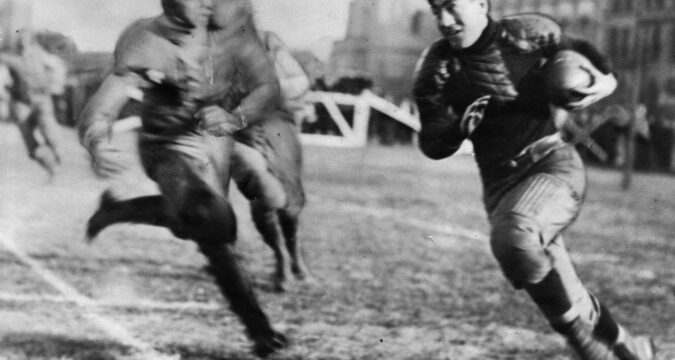
Walter Eckersall never played for the Chicago Bears. One reason is that his on-field exploits took place before the Bears were born (in 1919 as the Decatur Staleys) and, in any case, what chance could a guy who topped out at 5 feet 6 inches tall and weighed between 113-140 pounds have of playing?
You saw that right: 5 feet 6 inches and strikingly lightweight.
Now, we have had a fair share of home-grown sports stars. Baseball’s Bill “Moose” Skowron went from Weber High School to a major league slugger. Dick Butkus, from Chicago Vocational High School to NFL legend. Barney Ross, from Maxwell Street gangs to boxing championships. Cazzie Russell went to Carver High School, Isiah Thomas to St. Joseph High School in Westchester and Derrick Rose to Simeon Career Academy; all went on to NBA stardom. Lou Boudreau went from Thornton Township High School to baseball’s Hall of Fame.
There are many more, but after his athletic glory, Eckersall’s on-field exploits faded. But now his life, which also includes nearly a quarter century as an influential sportswriter for the Chicago Tribune, is colorfully detailed on the 275-some pages of “Eckie: Walter Eckersall and the Rise of Chicago Sports” (University of Nebraska Press).
“I stumbled on his name 25, 30 years ago,” says author Chris Serb. “I was volunteering for the Special Olympics and I was working some events on the South Side at Eckersall Stadium (at 2423 E. 82nd St.). I’m a North Sider, so I wondered, ‘Who is this Eckersall? Some judge? Some politician?”
Serb is a child of Rogers Park, one of the six boys and two girls of father Tom, once a communications executive, and mother Ann, a writer. A graduate of St. Ignatius High School and College of the Holy Cross, he loved to write and aspired to channel that passion into a profession, and so graduated from Northwestern University’s Medill School of Journalism. He worked for a time for Asher Birnbaum’s North Shore magazine and wrote for other publications. But seeking steady work, in 1999 he tested into a job with the Chicago Fire Department, as had some of his brothers.
Chris Serb, author of a new book “Eckie,” about former University of Chicago football great Walter Eckersall. (E. Jason Wambsgans/Chicago Tribune)
As he was rising to his current rank of deputy district chief, getting married and having kids (wife Emily and their daughters Helen and Maggie) and settling into domestic life on the Northwest Side, he wrote.
First there was 2000’s “Sam’s Boys: The History of Chicago’s Leone Beach and Legendary Lifeguard Sam Leone,” a close-to-home tale since Serb had been a lifeguard at the beach for more than a decade, and was Lifeguard of the Year in 1990. Then in 2019 came “War Football: World War I and the Birth of the NFL,” a fine and enlightening book.
Doing research for that book brought Eckersall back into his life. “I fully expected once I started learning about him, that there would be a book about this fascinating guy,” Serb told me. “There was one modest little book and a mention in a book edited by David Halberstam (1999’s “The Best American Sports Writing Of The Century”), but that was about it.”
Serb is a tireless researcher and does a marvelous job of giving us a bygone era, as the number of public high schools and students exploded across the country from about 1890 to 1920. Sports teams were often organized by students rather than teachers or administrators and Hyde Park High School was very active.
As newspapers, and there were many of them then, began to give more ink to high school sports, Eckersall became a big star at Hyde Park, so big that headlines blared such praise as “Eckersall (is) probably the best known high school athlete in the country.”
In a lively recruiting tussle, he wound up at the University of Chicago, then a serious football power, playing for the Maroons rather than for the University of Michigan Wolverines. His statistics — Serb lists many of them — were eye-popping, and those who saw him play were so impressed that even 50 years after his last game, such football titans as Red Grange and John Heisman “named him the All-Time, All-American quarterback.” Polls as late as 1951 did the same.
His most famous game came when he was a junior and led the Maroons to a national championship in 1905 by defeating Michigan in a strange game, score 2-0, but one that Serb makes exciting.
In a story peppered with such big personalities as Amos Alonzo Stagg and Knute Rockne, Serb handles Eckersall with great understanding. This was a hero, yes, but also a human being with flaws aplenty and his life was peppered with troubles — legal, financial, familial and booze-related.
Some caused him to be expelled during his senior year at the U of C, but soon enough, he was hired as a sportswriter at the Tribune and began a career that would last more than two decades and comprise more than 5,000 stories about football, yes, but also boxing, the Olympic games and other athletic diversions. His stories provided, as Serb puts it, a “lens through which Chicago readers came to understand sports.”
He also became pals, and drinking buddies, with Tribune colleague and soon to be famous bestselling author Ring Lardner, who had once felt as a native of Michigan “murderously inclined toward Eckersall” in the wake of the 2-0 Michigan defeat of his beloved Michigan Wolverines, but would years later write that “when a fellow needed a friend, there was none of be found more satisfactory than Eckie.”
Serb’s writing is pleasantly propulsive and smooth, his research deep and his understanding of his subject sensitive and mature. He gives Eckersall credit for helping create the ongoing Silver Skates speed skating competition for the Chicago Park District and the Golden Gloves boxing tournaments. He also details his highly-regarded work as a football official.
“He also was really a social justice advocate,” Serb says. “At a time when it was anything but acceptable, Eckie stood firmly and consistently against racism.”
Serb ends this terrific book by writing that, “Through his three distinct but interrelated roles over the course of 30 years, Walter Eckersall became the most pivotal figure in the rise of Chicago sports.”
He makes a passionate case for a man who died in 1930 and was buried in Oak Woods Cemetery on the South Side, within blocks, Serb writes, of “his childhood home, his grammar school and the vacant lots where he and his friends first learned how to kick a football.” In giving us the man and the legend, Serb makes this remarkable little guy a giant.
rkogan@chicagotribune.com

Burr Ridge 5-bedroom home with 2-story foyer and crystal chandelier: $2.1M
Address: 817 Lakeview Lane, Burr Ridge
Listed: Nov. 7, 2025
Price: $2,095,000
Listing agent: Christine Wilczek and Jason Bacza, Realty Executives Elite, 630-755-0600
This five-bedroom, 4½-bath brick and stone house has a two-story foyer with a crystal chandelier and a staircase with hand-forged iron spindles. The kitchen has custom cabinetry, a walk-in pantry and a butler’s pantry. The primary suite has a walk-in closet with built-in organizers. The primary bathroom has a soaking tub, dual vanities and a separate shower. The finished walkout lower level has a theater, a rec room, heated floors, a wet bar and a bedroom. A patio and deck have views of manicured grounds and a lake. The attached garage holds three cars.
This home at 817 Lakeview Lane, Burr Ridge, has a finished walkout lower level with a home theater, a rec room, heated floors, a wet bar and a bedroom. (Positive Image Photography/Raindrop Media)
This home at 817 Lakeview Lane, Burr Ridge, has a finished walkout lower level with a home theater, a rec room, heated floors, a wet bar and a bedroom. (Positive Image Photography/Raindrop Media)
This home at 817 Lakeview Lane, Burr Ridge, has a finished walkout lower level with a home theater, a rec room, heated floors, a wet bar and a bedroom. (Positive Image Photography/Raindrop Media)
This home at 817 Lakeview Lane, Burr Ridge, has a finished walkout lower level with a home theater, a rec room, heated floors, a wet bar and a bedroom. (Positive Image Photography/Raindrop Media)
This home at 817 Lakeview Lane, Burr Ridge, has a finished walkout lower level with a home theater, a rec room, heated floors, a wet bar and a bedroom. (Positive Image Photography/Raindrop Media)
This home at 817 Lakeview Lane, Burr Ridge, has a finished walkout lower level with a home theater, a rec room, heated floors, a wet bar and a bedroom. (Positive Image Photography/Raindrop Media)
This home at 817 Lakeview Lane, Burr Ridge, has a finished walkout lower level with a home theater, a rec room, heated floors, a wet bar and a bedroom. (Positive Image Photography/Raindrop Media)
This home at 817 Lakeview Lane, Burr Ridge, has a finished walkout lower level with a home theater, a rec room, heated floors, a wet bar and a bedroom. (Positive Image Photography/Raindrop Media)
This home at 817 Lakeview Lane, Burr Ridge, has a finished walkout lower level with a home theater, a rec room, heated floors, a wet bar and a bedroom. (Positive Image Photography/Raindrop Media)
This home at 817 Lakeview Lane, Burr Ridge, has a finished walkout lower level with a home theater, a rec room, heated floors, a wet bar and a bedroom. (Positive Image Photography/Raindrop Media)
This home at 817 Lakeview Lane, Burr Ridge, has a finished walkout lower level with a home theater, a rec room, heated floors, a wet bar and a bedroom. (Positive Image Photography/Raindrop Media)
This home at 817 Lakeview Lane, Burr Ridge, has a finished walkout lower level with a home theater, a rec room, heated floors, a wet bar and a bedroom. (Positive Image Photography/Raindrop Media)
Some listing photos are “virtually staged,” meaning they have been digitally altered to represent different furnishing or decorating options.
To feature your luxury listing of $1,000,000 or more in Chicago Tribune’s Dream Homes, send listing information and high-res photos to ctc-realestate@chicagotribune.com.
https://www.chicagotribune.com/2026/01/20/dream-home-lakeview-lane-burr-ridge/
Letters: With Affordable Care Act premiums skyrocketing, states such as Illinois need to step up
As January kicks off, most people are hoping the new year will bring a brighter future. But for many Americans who depended on subsidies through the Affordable Care Act (ACA) to afford their monthly health care premiums, 2026 is already looking bleaker.
The ACA subsidies introduced in 2021 and extended through the Inflation Reduction Act officially expired on Dec. 31. While Congress is attempting to reinstitute them, it is likely that any such effort would be vetoed. The result is that many premiums have more than doubled, leaving millions of Americans in the perilous position of having no health insurance to help cover the care they will undoubtedly still need.
In this national health care crisis, it is now up to the states to take action. Fortunately, Illinois has long treated health care inequity as a priority and has been proactively working for years on solutions.
In 2022, the state created the South Side Healthy Community Organization (SSHCO) — through Healthcare Transformation Collaboratives — as a free service to help uninsured patients and those on Medicaid get access to better health care in a part of the city where health outcome disparities are high. SSHCO also subsidizes providers on the South Side so that residents can access care in their own community, provides a free doula program for new mothers, and connects patients to primary care physicians, healthy food and even transportation.
Patients have completed more than 138,000 appointments with providers we subsidize since our inception. Now, our services and others like ours are even more critical to Chicagoans left in the cold by the expiration of these subsidies.
As health care costs skyrocket, SSHCO will continue to provide stability and support to these newly uninsured residents. But as state-funded organizations step up — such as SSHCO, whose funding expires in 2026 — my hope is that our state and local leaders will prioritize support for the work we do to help all Chicagoans live the healthy lives they deserve.
— Kimberly Hobson, CEO, South Side Healthy Community Organization
How to reduce our ills
Todd C. Smith’s analysis of the dramatic decline in opioid deaths in the Chicago area is beautifully nuanced and hopeful (“Who deserves credit for the drop in Cook County’s opioid overdose deaths?” Jan. 15). Yes, it takes a village for progress in protecting our children, and his outlining just how the public health, police, and private and familial components worked together to make the success happen is refreshingly supportive and points the way to how to reduce other societal ills.
— Margaret Sents, Glenview
Done without bombast
Thank you for publishing Todd C. Smith’s informative op-ed on the drop in Cook County’s opioid overdose deaths. He carefully lays out the ongoing problem; credits federal, state and local authorities for progress that has been made; and urges continued collaboration to sustain that progress.
I particularly appreciate the fact that he did so without the threatening and bombastic rhetoric I have come to expect from federal officials at all levels.
— Frank Vondrak, Oak Lawn
Strategy for the GOP
The GOP in Illinois could win north of Interstate 80 (even in Chicago) if Republicans would simply change their approach and message. Under no circumstances can a Republican candidate win in Chicagoland if they refuse to denounce the actions of the current president as un-American and unethical. While polls continue to show that voters disapprove of President Donald Trump’s actions on immigration, tariffs and other ill-timed moves across the world stage, their sentiments are directed at how they are being carried out, not necessarily on what is being done.
For too many years, Chicagoans have been under the Democrats’ thumb, and it has repeatedly beaten them down with high property taxes, bizarre financial moves (think parking meters and the Skyway leasing), a stubborn homicide rate, political corruption, and countless nefarious deals and actions, all under a party that continually pushes the failing narrative that things would be much worse if Republicans ran the show.
However true this unsubstantiated rhetoric may be, we are never given the chance to find out. If Republicans truly hope to make inroads into the northern part of Illinois, they must make their message more palatable to the conservative Democrats who would love to give them a chance but do not want the circus or the obeisance currently being stoked and shown in Trump’s White House. They must resist the urge to parrot unsubstantiated claims and seek out facts. Scaring residents about high crime levels that buttress against factual numbers that clearly show the opposite, only reeks of desperation.
Yes, taxes in the state and city are high, but how can they be lowered without disrupting services needed by the poor and vulnerable? How can gun rights be protected and expanded without feeling the need to justify military-grade weapons in the mix?
There are these and other fault lines in the Democratic landscape that can be exploited, especially in Chicago.
— Ephraim Lee, Police District councilor, Chicago
I vote for principle
Paul Miller’s op-ed (“Will 2026 be the year Illinois GOP primary voters learn politics?” Jan. 8) about Illinois GOP voters improving their lot says supporting President Donald Trump is “a must for any GOP nominee.” That’s a concern he acknowledges by adding “any disagreement with the president is regarded as a mortal sin.” Those of us favoring a two-party system want Republican success to achieve anywhere close to political parity.
Miller’s advice is for Republican voters in the primary to adhere to the Buckley Rule: “Support the rightward most viable candidate.” Even, as Miller maintains, the candidate is unlikely to win, in order to “advance your cause and ideas.”
I think the emphasis needs to be on “viable,” concentrating on the kitchen table issues rather than ideological.
Despite Miller’s practical advice, the elephant in the room, the core of the problem, can’t be ignored: Trump and his knee-jerk MAGA supporters.
I vote for principle over a Republican candidates beholden to Trump — a party of principle, not power and profit over people.
— Richard Palzer, Clarendon Hills
Pass elder parole bill
One place the Illinois General Assembly should be looking for savings to help fill the budget gap is the Illinois prison system. (See the Jan. 11 article “State lawmakers return to Capitol facing budget gap.”) We are incarcerating over 29,000 individuals at an average per-person cost of $52,000 per year, for a total annual cost of over $1.5 billion.
Senate Bill 86, now pending, would establish an “elder parole” process for about 1,150 people who are at least 55 years old and have been in prison for 25 years or more. These individuals are the least likely to reoffend as they mature and age out of crime and the most expensive to keep in prison due to the costs of medical care as they are treated for the diseases of old age and end-of-life care. Under SB86, these individuals would be able to have a hearing at which the Prisoner Review Board would decide whether they are ready to be released and rejoin society, consistent with public safety and other relevant factors.
As the members of the General Assembly look to reduce expenses, they should be seriously considering the passage of this bill.
— William J. Nissen, attorney, Chicago
Submit a letter, of no more than 400 words, to the editor here or email letters@chicagotribune.com.
https://www.chicagotribune.com/2026/01/20/letters-012026-aca-health-care/

Merger would give UP unprecedented role in Chicago and more control of rail industry, critics warn
If regulators approve its merger with Norfolk Southern, competitors warn that Union Pacific could turn the city of Chicago into a hammer for seizing even more control of the industry.
Their concern centers on two tiny Chicago railroads that have hauled freight across town for all comers since the 1890s.
The Belt Railway Co. of Chicago and the Indiana Harbor Railroad are owned separately by groups of big railroads. Their tracks run in parallel arcs roughly from O’Hare International Airport in the north to Gary in the south.
They also operate switching yards that take herds of boxcars, tank cars and auto haulers, brought continually into Chicago by the big railroads, and sort them into specific trains bound for, say, New York or Baltimore.
The merger would boost Union Pacific’s stake in the Belt Railway of Chicago to 33.3% from 8.3% today, and in the Indiana Harbor Belt to 25.2% from zero currently, according to its application to federal regulators.
That would give Jim Vena, chief executive of Omaha, Nebraska-based Union Pacific, more control of the city’s rail traffic than anyone else in Chicago history, said Earl Wacker, a former CSX executive.
“I don’t know how he leverages this, but he’s going to leverage it,” said Wacker, who now works with RINA North America, a global engineering firm with offices in Chicago. “He’s not buying it not to leverage it.”
Vena’s 33.3% stake in the Belt Railway of Chicago, for example, falls just short of what he would need to veto a big capital spending plan even if all the other voters want it.
Jim Vena, CEO at Union Pacific Railroad, speaks with Robert Greebel, managing director with Governors Lane, a New York-based hedge fund, and other analysts and reporters following his speech at the Midwest Association of Rail Shippers winter meeting on Jan. 15, 2026, in Schaumburg. (Stacey Wescott/Chicago Tribune)
In an interview, Vena accused other railroads of greatly exaggerating the competitive threat.
“If you own 30% of something, and you have 30% of the voice, you still have 70% that you have to deal with,” he said.
“We have (8.3%) of the Belt (Railway) and listen, our voices are heard. We’re all equal in there. We hire the best person to operate the Belt railroad to be efficient and to be able to move products for all of us.”
In any case, Vena said, the combined railroad will put less strain on the Belt Railway of Chicago and the Indiana Harbor Belt by running more cross-country trains that either bypass Chicago or pass straight through the city without stopping to exchange freight.
In its merger application, Union Pacific said the combined railroad would send 200 fewer cars to the Belt Railway of Chicago each day. That’s about a tenth of the Belt’s current total.
Vena and other railroad executives from Canada and the U.S. were in Schaumburg last week for the Midwest Association of Rail Shippers meeting, where Union Pacific’s merger was on everyone’s lips. Several executives spoke with the Tribune about their concerns.
Keith Creel, chief executive of Calgary, Alberta-based Canadian Pacific Kansas City Ltd., describes the Belt Railway of Chicago as the O’Hare of U.S. rail freight.
“I’m not minimizing the importance of the Kansas City terminal. I’m not minimizing the importance of St. Louis or New Orleans or Memphis,” Creel said at the shippers conference. “But if this one fails, it’s like cancer going through your whole body,” he said, referring to Chicago’s rail network.
Keith Creel, president and CEO of Canadian Pacific Kansas City, speaks at the Midwest Association of Rail Shippers winter meeting on Jan. 14, 2026, in Schaumburg. (Stacey Wescott/Chicago Tribune)
Creel pointed to the crippling blizzard of 2014 as an example of how Chicago can fail, and of how Vena could use his growing power in the city to dig himself out before anybody else.
Nearly a foot of snow started falling in Chicago on Jan. 4, 2014, and then temperatures plunged to 16 degrees below zero. The Belt Railway of Chicago stopped moving after locomotives it needed got trapped in the wrong places. Some trains couldn’t roll again for weeks, Creel said.
“What happens when you get into the mud, into the snow, into the frozen weather?” Creel asked. “You protect your own. You protect your own network.”
Creel also warned that if the combined railroad — at 43% of all U.S. rail freight — stumbles during the next blizzard, it would be big enough to take all other railroads down with it.
“Think about this elephant walking around the room. When it falls down, there is consequential damage. To stand it back up is almost an insurmountable task,” he said.
Creel said he also worries about St. Louis, Kansas City and Memphis, where a postmerger Union Pacific would own 50% or more of belt railroads, switching yards and even bridges that all railroads use to cross the Mississippi River.
The federal Surface Transportation Board could reject the merger or place limits on how Vena could wield his growing Chicago clout.
On Friday, the STB ordered the railroad to rewrite the application completely, saying it lacked key information. This could delay the STB’s final decision until the second half of 2027.
Related Articles
Union Pacific’s plan to add trains in the Chicago area raises alarms
Union Pacific says rail merger could unclog Chicago. Critics worry about costs and traffic tie-ups.
Belt Junction is a notorious bottleneck. Fixing it could increase rail capacity, but benefits to South Side residents could be mixed.
In his speech at the shippers meeting, Vena said his critics are threatened by the prospect of trains running coast to coast without stopping to exchange freight.
“There’s no way you’re going to beat us on time,” Vena said of his critics. “So what you’re going to have to do is offer a better price.”
In the war for the future of American railroading, the Belt Railway of Chicago and the Indiana Harbor Belt are critical battlegrounds.
In the Clearing neighborhood near Midway Airport, and in the southern suburb of Blue Island, Belt Railway and Indiana Harbor sort cars from all railroads and all points of the compass, using methods pioneered in Germany nearly two centuries ago.
As locomotives push the cars to the top of a small hill, or “hump” in railroad jargon, a single worker walks alongside and pulls out an inch-wide pin to detach the cars one at a time from the rest of the train.
Then, as the cars roll down the other side of the hill, they’re switched onto one of dozens of tracks below to be connected to trains bound for different cities.
Chicago’s “hump” yards are by far the country’s biggest because the city has always been the place where eastbound and westbound trains exchange the most freight.
Trains in the Clearing Yard east departure yard on Dec. 15, 2023. (E. Jason Wambsgans/Chicago Tribune)
Jerry Peck, the Belt Railway of Chicago’s president, declined through a spokesperson to comment, other than to say he expects competing railroads to pick up the slack created by Union Pacific’s shift to different routes.
John Wright, general manager of the Indiana Harbor Belt, didn’t return calls seeking comment.
In his speech, Vena bragged that his new cross-country trains will run from Los Angeles to New York at 70 miles an hour.
But in the interview afterward, he said his trains will slow way down when they reach Chicago, especially on a dilapidated set of tracks along Rockwell Avenue through North Lawndale and West Town.
In that stretch, century-old bridges and hand switches limit train speeds to less than 15 mph.
Union Pacific has contributed to a public-private partnership called CREATE, or the Chicago Region Environmental and Transportation Efficiency Program, that’s refurbishing some of the tracks.
But Vena defended his decision not to invest more in the Rockwell area, even though he’s adding 12 trains — some of them 2 miles long — to the 82 that, according to Metra and the Chicago Metropolitan Agency for Planning, use those tracks now.
The speed of trains along Rockwell Avenue, he said, “is about as good as it gets.”
Vena also said he expects to resolve a dispute with Metra over how much the regional commuter railroad should pay for access to Union Pacific tracks. He said he’s guaranteed Metra leaders he won’t boot them off his railroad, even though his lawyers have insisted in court he has the right to do so.
With the merger, Vena plans to add four trains a day to DuPage and Kane County tracks that already handle 118 commuter and freight trains each day, according to Metra and CMAP.
Metra spokesperson Mike Gillis declined to comment.
Union Pacific outlined its plans for the $85 billion merger in a 6,692-page application to the STB on Dec. 19.
Under STB rules, Union Pacific will need to show that the merger would not just preserve competition but enhance it and produce public benefits that can’t be achieved any other way.
The board adopted this higher standard after a chaotic set of mergers in the 1990s disrupted service and reduced the number of big railroads operating in the U.S to four, increasing the potential for monopoly pricing abuse.
In 1960, three dozen so-called Class 1 or major railroads operated in the U.S.
In his speech, Vena said America needs more railroads to merge than just Union Pacific and Norfolk Southern.
“(Railroads) put the money in. We invest in our rail, or ties, our infrastructure,” he said. “We don’t get the benefit of having somebody build highway systems for us, and we only pay a pittance for the use of those highways.”
When Vena was asked in the interview whether he’s taking the concentration of ownership in American railroads back to levels not seen since the Gilded Age, as Mark Twain described America’s speculative, boom-and-bust economy after the Civil War, he replied by talking about competition, not ownership.
“In the 1890s, the railroads were the way to move products across the country, or by water. Those were your two options,” he said. “There was no highway system. There were no planes.”
“You fast-forward to today … and the amount of market that we actually have of everything that moves by (rail), truck and barge, and we’re down to 12% or 13%,” he said. “So we’re not this big, big elephant in the room. We’re competing against all that.”
Someday soon, he said, railroads could be competing with trucks that not only haul freight for long distances but drive themselves.
In an interview and then her “fireside chat” with shippers, Katie Farmer, chief executive of Fort Worth, Texas-based BNSF, disagreed with Vena on several points.
BNSF will ask the transportation board, she said, to examine how much ownership and control Vena’s combined railroad would have in Chicago and other key freight hubs.
Katie Farmer, president and CEO of BNSF Railway, left, speaks with Monica Freeman, right, director of rail transportation at CHS, during a “fireside chat” at the Midwest Association of Rail Shippers winter meeting on Jan. 14, 2026, in Schaumburg. (Stacey Wescott/Chicago Tribune)
Farmer said that, after a decade of flat revenue and before that widespread service interruptions following several U.S. rail mergers, Vena is unlikely to deliver his promised double-digit volume growth three years after government approval.
When this growth fails to materialize, she said, Vena will still be on the hook for the $15 billion premium he’s promised Norfolk Southern shareholders.
As Vena pays down the premium, she said, Chicagoans can expect longer trains and more blocked street crossings, especially since Union Pacific has announced no new investments to make the merger work in the country’s most important rail hub.
Union Pacific customers can expect fewer shipping options and higher prices, she said.
BNSF, which is owned by Warren Buffett’s Berkshire Hathaway, spent $3.8 billion last year to actually maintain and expand its railroad, she said.
Everywhere she goes, Farmer said, people ask if Union Pacific’s proposed Norfolk Southern takeover will force her to merge with CSX.
“The really important thing is, ‘Why is everybody asking me that?’” she said. “It’s because of the centralization of power that would be created with this proposed consolidation.
“We don’t think we should have to be the remedy for an anti-competitive, monopolistic consolidation.”
John Lippert is a freelancer.
https://www.chicagotribune.com/2026/01/20/union-pacific-norfolk-southern-rail-merger/


