Category: News
Meet The Man Who Bought $1 Billion In Physical Silver Before The Rally
Meet The Man Who Bought $1 Billion In Physical Silver Before The Rally
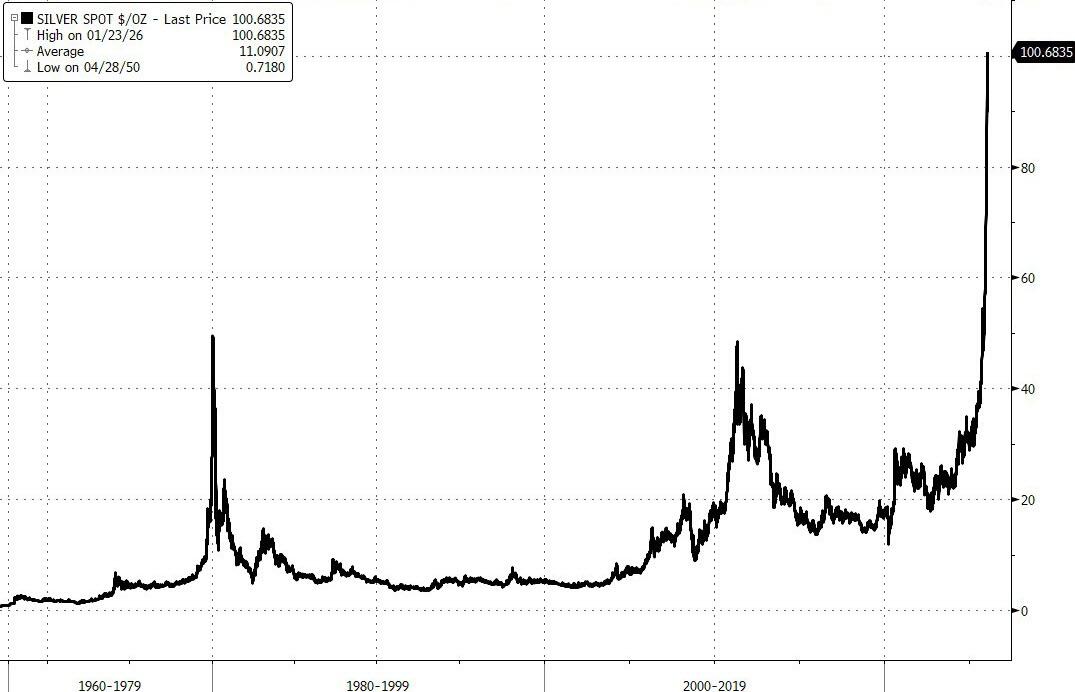
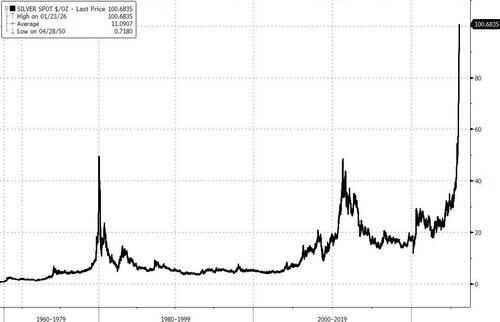
The precious metals complex resumed its upward trajectory overnight. Shortly after the US equity cash open, silver surged above $100 per ounce for the first time on record, while gold approached the $5,000 per ounce level.
As Rick Privorotsky, head of Delta One at Goldman Sachs, noted to clients earlier, flows suggest some speculative participation, but the dominant driver remains structural: “There is clearly hot money involved, but first and foremost gold is a central bank trade… a slow erosion of the dollar’s exorbitant privilege rather than a sudden loss of confidence…”
What first came to mind as silver broke above the $100 level was Warren Buffett’s late-1990s bet on the precious metal. Berkshire Hathaway accumulated 129.7 million ounces of physical silver, or about 4,000 metric tons, ahead of the Dot Com bubble crash. The position was disposed of around 2006, generating a substantial profit for Berkshire.
Fast forward to October 2024, and we rolled out the ZeroHedge silver/gold coins and bars. At the time, silver was in the low $30s, while gold hovered around $2,600.
But on an even grander scale, several months later in early 2025, David Bateman, the founder of Entrata, revealed on X that he had purchased “close to a billion dollars in precious metals over the past six months.”
To be exact, Bateman told his followers on X that he bought “1.5% of the annual global silver supply (12.69 million ounces).”
His reasons for the massive physical trade were as follows:
The global monetary system is about to collapse (The Great Reset, or Basel Endgame).
The biggest credit bubble in history will soon pop ($300T).
There is no way the US can refinance its $28T in maturing treasuries in the next 4 years without an obscene amount of printing.
Trump tariffs are hastening the collapse, and it’s by design.
Gold and silver are the only meaningful life raft. Physical possession is everything.
The whole world right now is a sophisticated game of musical chairs; the chairs are precious metals.
Crypto is a psyop. Those who purchase will have no chair when the music stops.
Real estate, crypto, stocks and bonds will all lose significantly compared to precious metals.
The banking system has been meticulously designed to seize your assets to buoy up a collapsing banking sector (see The Great Taking). You have ZERO counter party risk with precious metals.
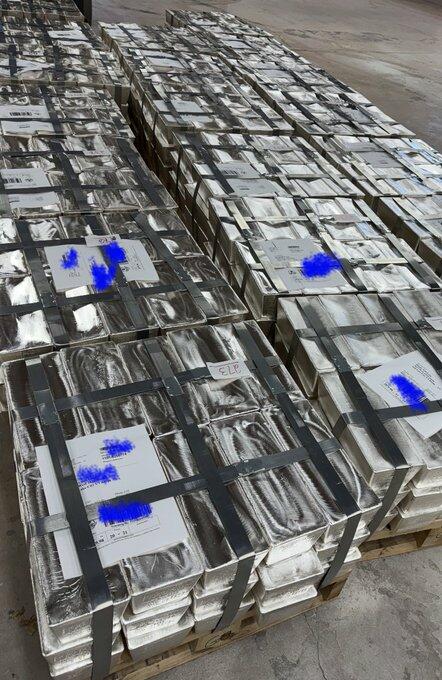
Bateman posted an image of silver bars loaded onto heavy-duty pallets when he addressed his X followers about what he described as the trade of a lifetime.
Earlier today, shortly after silver jumped above $100. He posted on X, “Congrats everyone on $100 silver. Couldn’t have happened to a better group of degenerate mildly autistic misfits.”
Congrats everyone on $100 silver. Couldn’t have happened to a better group of degenerate mildly autistic misfits 🥂
— David Bateman (@davidbateman) January 23, 2026
Bateman’s trade could easily be up more than 250%, though he did not disclose his cost basis at the time. Either way, it stands out as one heck of a trade. As for readers who purchased ZeroHedge coins and bars of gold and silver, the hedge has clearly paid off.
Tyler Durden
Fri, 01/23/2026 – 22:10
Prosecutors charge gang members with shooting Indiana judge, wife
Members of a motorcycle club and a street gang worked together in an attempt to kill an Indiana judge in hopes of derailing a domestic abuse case against one of their own, prosecutors alleged Friday, hours after police announced they had arrested five people in connection with the investigation.
Steven Meyer, a Tippecanoe County Superior Court judge, and his wife, Kimberly Meyer, were injured Sunday afternoon in the attack at their Lafayette home. Steven Meyer suffered an injury to his arm and Kimberly Meyer an injury to her hip, according to authorities.
Probable cause affidavits unsealed Friday paint a sordid picture of a plan to attack the judge that unfolded over several weeks and how surveillance video, a trail of discarded clothing, and a tip from a restaurant helped investigators piece the case together.
At the center of it all is 43-year-old Thomas Gregory Moss of Lafayette. The documents describe him as high-ranking member of Phantom MC, a Detroit-based motorcycle club with ties to the Vice Lords street gang.
Court records show Moss was charged in 2024 with beating his ex-girlfriend and firing a gun in her home. He was set to stand trial in that case Tuesday in front of Meyer.
A Lafayette woman named Amanda Milsap allegedly approached Moss’ ex-girlfriend at her home in Pennsylvania several weeks prior to Sunday’s attack. She told her that Moss and the Vice Lords wanted to pay her $10,000 not to testify against him.
Moss’ ex-girlfriend refused to accept the money. Raylen Ferguson, an affiliate of the Almighty Vice Lord Nation gang, and the woman he lives with, Zenada Greer, then traveled to Lafayette from Lexington, Kentucky, several days before the shooting, prosecutors allege.
Ferguson traveled to the Meyers’ home on Jan. 16 and knocked on the door saying he had a food delivery, but left, the records said. He returned to the home on Sunday afternoon, police said. The home’s surveillance video shows he was wearing a mask and carrying a shotgun. Investigators later determined that another Phantom MC member, Blake Smith, had purchased the gun in early January, according to the records.
Ferguson knocked on the Meyers’ door and said he was looking for his dog. When Steven Meyer told him that he didn’t have his dog, Ferguson opened fire through the door, according to the records.
Police using a search dog later found the shotgun and Ferguson’s mask and clothes discarded near the Meyers’ home. Analysts matched DNA found on the mask to Ferguson.
Investigators used the home surveillance video to zero in on the food Ferguson brought to the Meyers’ house on Jan. 16 and tracked it to restaurant where Ferguson had bought it. The restaurant’s surveillance video showed a person who was dressed and walked like Ferguson leaving the restaurant.
Police from Indiana, Pennsylvania and Kentucky as well as U.S. marshals and the FBI worked on the case before the Lafayette Police Department finally announced late Thursday that Ferguson, Moss, Smith, Milsap and Greer all had been arrested.
Moss, 43, Ferguson, 38, and Smith, 32, each face attempted murder, conspiracy to commit murder, battery and intimidation counts. Milsap, 45, faces bribery and obstruction counts. Greer, 61, was charged with helping a criminal and obstruction.
Moss’ attorney in the domestic abuse case, Ben Jaffee, did not immediately return a message left at his office Friday. Court records did not list attorneys for the other four people facing charges in connection with the judge’s shooting.
Steven Meyer issued a statement thanking police and saying that it’s important to allow the judicial process to move forward.
Indiana Chief Justice Loretta Rush also released a statement saying a special judge appointment is expected Monday.
Threats against judges have been on the rise in recent years.
Rush noted in a news release that more than 150 of 214 judges who responded to a 2023 security survey said they had been threatened.
The Wisconsin Supreme Court recorded 188 threats against judges in that state in 2024, the most recent year data was available. That compares with 232 threats in 2023 and 74 threats in 2022. Retired Wisconsin state Judge John Roemer was shot and killed in 2022 by a man he had sentenced to prison for burglary.
The head of the U.S. Marshals Service said in congressional testimony in 2024 that the number of threats against federal judges had more than doubled over the last three years.
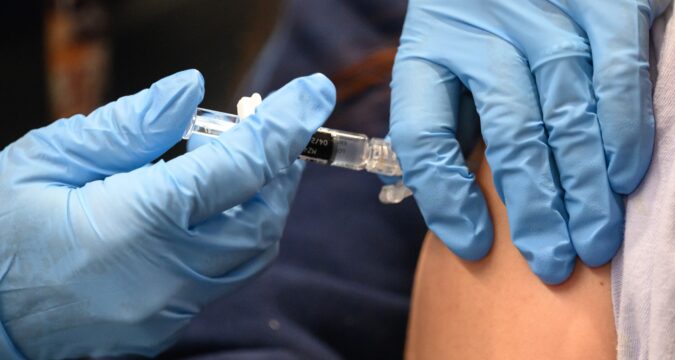
Kane County health director urges people to vaccinate themselves, their children
Michael Isaacson, executive director of the Kane County Health Department, says parents and caregivers are being bombarded with inaccurate information about the safety and efficacy of vaccines.
“This makes it harder for them to sift through all of the information and get the facts they need to make the decisions that will protect their children and the community,” he said. “Vaccines are one of the most important things that we have done to reduce death and illness.”
Isaacson’s comments come in the wake of the U.S. Department of Health and Human Services decision this month to reduce the number of recommended childhood vaccines from 17 to 11, a move that has raised red flags for some medical experts who say it’s bad guidance.
Illinois Department of Public Health Director Sameer Vohra said the state will not adhere to the changes and plans to stick with the recommendations already in place.
“As the federal government unilaterally makes changes without transparent review or evidence to support changes, Illinois will continue to promote the well-being of Illinoisans by issuing recommendations based on the full weight of scientific evidence,” Vohra said in a statement.
Reuters reported this week that the United States officially left the World Health Organization despite “a year of warnings that doing so would hurt public health in the U.S. and globally, saying its decision reflected failures in the U.N. health agency’s management of the COVID-19 pandemic.”
At the same time, the nation is seeing an increase in some diseases once considered eradicated here, particularly measles. Last year, according to the Centers for Disease Control, there were more than 2,000 reported cases of the contagious viral disease. A CNN report said that is the highest number since 1992, before doctors began to recommend two doses of the measles-mumps-rubella vaccine for children.
Almost 650 measles cases have been reported in South Carolina alone since October 2025, according to reports. The Utah Department of Health and Human Services website puts the number of cases there at 216 in its ongoing outbreak.
Michael Isaacson, executive director of the Kane County Health Department, is urging people to speak with medical professionals about what vaccinations they should get for themselves and their children rather than relying on the new federal guidelines. (Kane County Health Department)
The number of flu cases across the country and in Illinois has been high this year too.
Isaacson said that in Kane County, though, the most recent data puts flu and COVID-19 cases at moderate levels and RSV at low levels.
According to the Illinois Department of Public Health website, there were 14 measles cases in the state in 2025; 67 in 2024; five in 2023; and none in 2020, 2021 and 2022.
“It’s been more than 30 years since we’ve had a confirmed case here,” Isaacson said.
Less than 25% of the county’s population is vaccinated for the flu, Isaacson said. The number is 57% for residents 65 and older.
County school districts have reported that 95.6% of students are up to date on required vaccinations. Ten years ago that number was 97.6%.
The number of students across the county getting nonmedical vaccine exemptions for religious reasons has grown to 869 in the 2024-25 school year, up from 385 a decade ago, Isaacson said. This despite the fact that only a small number of religions forbid members from getting vaccinated, he said.
Isaacson noted there are decades of research on the efficacy of vaccinations, but things started to change with the COVID-19 pandemic. Adding to the confusion is that some CDC vaccine advisers are calling into question the need for certain shots, such as Dr. Kirk Milhoan, who recently said the polio vaccine should be optional.
“Comments like these seem to be based on opinion rather than facts and decades of data,” Isaacson said.
In addition to the potential rise in disease cases, the trend could mean reduced access to vaccinations that people might want for their children or themselves, he said. While that not be the case in Illinois, the states opting to follow the CDC’s new recommendations might result in insurance companies or Medicare/Medicaid opting not to pay for those that aren’t on the list, Isaacson said.
The Kane County Health Department wants to forestall that from happening in Illinois and has been doing outreach to the medical community about the vaccination issue, he said. It has posted vaccine-related information to its website and social media and has been manning booths at municipal events with vaccine- related information available and staff there to answer questions.
Isaacson is also recommending that those with concerns visit the Illinois Department of Public Health online for credible, data-driven information and to ask their health care providers for advice.
Given the current climate, those working in health care should take a “we’re all in this together” approach, he said.
“We want to meet caregivers and those getting care where they are and have respectful conversations with them. Parents want to get accurate information to make the healthiest choices for their children. So it’s important to engage in conversation,” Isaacson said.
Mike Danahey is a freelance reporter for The Courier-News.
https://www.chicagotribune.com/2026/01/23/kane-vaccinations-flu-isaacson-advice-federal/

Obama’s Fingerprints All Over Investigations Of Trump And Clinton
Obama’s Fingerprints All Over Investigations Of Trump And Clinton
Authored by Paul Sperry via American Greatness,
In the run-up to the 2016 Democratic Party convention, FBI Director James Comey gained access to at least eight thumb drives containing large volumes of former Secretary Hillary Clinton’s sensitive State Department emails—as well as some from President Obama—that appeared to have been compromised by foreign hackers.
Instead of investigating the explosive new batch of evidence revealed in recently declassified documents, Comey rushed ahead to close an investigation into whether Clinton improperly transmitted and received classified material from a private, unsecured server she kept in her basement. Comey also took the extraordinary step of bypassing the attorney general and personally exonerating Clinton of wrongdoing during an unusual press conference on July 5, 2016.
Just hours later, Obama invited Clinton—who would be formally nominated as the Democrats’ standard bearer three weeks later—aboard Air Force One to help launch her multicity campaign tour, during which he officially endorsed Clinton as his preferred White House successor. “I’m ready to pass the baton,” Obama declared, as he stumped for her for the first time.
Comey’s decision to remove the cloud of scandal over Clinton’s campaign, allowing the president to get on with the business of campaigning for her, is just one avenue of investigation the Justice Department is pursuing in wide-ranging probes whose targets include a figure largely unscathed by his era’s scandals: former President Barack Obama.
Attorney General Pam Bondi said prosecutors are investigating, among other things, “possible coordination between the Clinton campaign and the Obama administration to interfere with the 2016 presidential election.”
Jason Reding Quiñones, the U.S. Attorney for the Southern District of Florida, has impaneled a grand jury to hear evidence related to an alleged “grand criminal conspiracy” by Obama and Biden officials to enlist law enforcement and intelligence agencies in rigging elections and carrying out political espionage against Donald Trump.
The fate of these investigations is still unclear. Actions against former presidents—especially for conduct in office—have been exceedingly rare, with the exception of President Trump. And the courts have pushed back on the Trump administration’s recent efforts to indict other Obama-era figures, including Comey.
Nevertheless, a RealClearInvestigations look at the evidence Trump administration prosecutors are presenting to the grand jury, which includes a raft of recently declassified CIA and FBI documents, shows Obama’s deep involvement in both protecting Clinton and advancing the conspiracy theory that Trump conspired with Russian President Vladimir Putin. Drawing from thousands of pages of documents and exclusive interviews with law enforcement and intelligence officials, RCI’s analysis shows the former president was repeatedly at the center of events surrounding both the closing of the Clinton investigation and the subsequent opening of several investigations targeting the Trump campaign. Post-election, Obama also ordered the manufacturing of anti-Trump intelligence, which set Trump’s presidency up for continued investigations.
On the Tarmac
Airports played an outsized role in the 2016 election. It was former President Bill Clinton’s June 27 meeting with Attorney General Loretta Lynch on his parked plane at a Phoenix airport that reportedly convinced Comey that Lynch might appear compromised and that he should go around the proper charging officer for federal crimes to clear his wife.
About a week later, Obama signaled the all-clear after Comey’s press conference by inviting Hillary Clinton to fly to campaign rallies on Air Force One.
“I’m here today because I believe in Hillary Clinton,” Obama said during their July 5, 2016, rally in Charlotte, N.C. “I have had a front-row seat to her judgment and her commitment.”
Some presidential security experts and Secret Service sources contacted by RCI said the timing of the trip was suspicious.
They point out that the president authorizing Clinton to fly aboard Air Force One on the same day his hand-picked FBI director absolved her of crimes was almost certainly not a last-minute decision because it would have required extensive pre-planning.
“The security involved in setting up that tour took weeks of advance work, which means Obama knew she was going to be cleared and not charged,” said a veteran Secret Service official who spoke on the condition of anonymity to discuss a sensitive matter. “Obama wasn’t going to risk endorsing her and joining her on the campaign trail without her first being cleared of federal crimes,” he added. “He knew about the end of the investigation well ahead of time.”
Although the FBI did not interview Clinton about her emails until July 2, 2016, Comey had been circulating drafts of his exoneration statement at FBI headquarters for months and conveying to agents there was an “extraordinary sense of urgency” to complete the investigation, according to the declassified documents released recently by the Justice Department. Critics note that the reasoning he offered for clearing Clinton in his July 5 statement was rife with contradictions. “Although there is evidence of potential violations of the statutes regarding the handling of classified information,” Comey said, “our judgment is that no reasonable prosecutor would bring such a case.”
It is not known if any of the drafts were shared with the White House. Secret Service entry logs show Comey visited with Obama at least three times in 2016. “The timing and presumption that Clinton would eventually be the Democratic Party nominee for President was part of the defendant’s decision-making process,” according to court papers the DOJ filed in November detailing why it alleges Comey predetermined Clinton’s innocence.
Pulling Punches
The new evidence suggests that Comey wasn’t acting alone. It indicates that Obama was more involved in the Clinton probe than previously reported and that Comey, whose entire family supported Clinton, may have pulled his punches to placate the incumbent president and avoid getting on the wrong side of the woman he assumed would be Obama’s successor.
The recently declassified appendix of a 2018 report from the DOJ’s inspector general reviewing the integrity of the FBI’s investigation of Clinton found that the FBI never searched the eight thumb drives containing thousands of unexamined Clinton emails that were “exfiltrated” by foreign actors. Comey was first briefed about the cache of new evidence in May 2016 when he had begun drafting his exoneration statement, and then again a week before he unilaterally exonerated Clinton.
FBI lawyers admitted in internal written memos, also recently declassified, that the information was necessary to conduct a “thorough and complete investigation” and “assess the national security risks” associated with the breaches from Clinton’s use of a private email server, which cyber-forensic analysts had already found contained at least 2,063 classified emails, some at the “Top Secret/Special Access Program” level. They also thought it was necessary to divine “the full scope of unauthorized disclosure of classified emails found on the former Secretary’s server and to identify any potential cyber intrusions of the server.”
“They got some thumb drives that dealt with all these issues, [and] they didn’t even bother to go through [them],” said Senate Judiciary Committee Chairman Charles Grassley. “It was a complete cover-up.”
The appendix also reveals Democratic National Committee communications suggesting that Obama’s attorney general, Lynch, was secretly in communication with the Clinton campaign during the probe of her emails and had assured campaign officials that the FBI would go easy on her.
According to the communications, which U.S. intelligence analysts determined were “not fabrications,” Obama was putting “pressure” on Comey through Lynch to get rid of Clinton’s email scandal as early as January 2016. Not long after, Comey began drafting his statement exonerating Clinton—months before FBI agents had ended their investigation.
In her 2018 congressional deposition, Lynch testified that she never obstructed the probe or exerted any influence over it. But she has acknowledged that she had spoken to Comey about diminishing the probe’s significance by referring to the email investigation in the press as a “matter,” not an investigation. Lynch did not respond to requests for comment sent to her law firm.
DNC communications from March 2016 revealed that Obama also “sanctioned the use of administrative levers” to scuttle the FBI’s investigation of the Clinton Foundation. Recently declassified FBI documents show that around the same time, FBI Deputy Director Andrew McCabe had ordered field agents to back off their investigation of Clinton Foundation donors and former Secretary of State Clinton as part of a possible pay-for-play scheme. McCabe did not respond to requests for comment sent to his attorney and to George Mason University, where he is a visiting professor.
(Just months earlier, McCabe and his wife Jill met with Virginia’s then-Gov. Terry McAuliffe, a longtime Clinton ally, was at the governor’s mansion in Richmond to discuss raising money for Mrs. McCabe’s state senate race. The Clinton machine ended up pumping more than $675,000 into Jill McCabe’s Democratic campaign. McAuliffe had long maintained a seat on the Clinton Foundation board. RCI has learned, furthermore, that before moving to the D.C. area, the McCabes were 15-year neighbors of the Clintons in the hamlet of Chappaqua, N.Y., according to property records.)
Then, on July 20, just five days before the start of the Democratic National Convention, FBI headquarters shut down the Clinton Foundation investigation. “Based on the [political] sensitivities surrounding the Clinton Foundation,” a just-declassified internal FBI document reveals, agents were suddenly barred from issuing subpoenas, conducting interviews, or sharing bank information related to the case with other offices. HQ warned field offices to avoid creating “any impression we are investigating the Clinton Foundation or the Clintons.”
RCI made several requests for comment to Comey and Obama. Comey declined comment through his attorney, Patrick Fitzgerald, who successfully defended him against federal perjury and obstruction charges. The DOJ is appealing the case, which was dismissed by a Clinton-appointed judge, not on the merits, but on the grounds that the federal prosecutor who indicted him had not been appointed properly. Obama’s Washington office declined comment.
At the time, the White House insisted it had no prior knowledge of Comey’s decisions.
Trump, who was on the verge of accepting the Republican Party’s presidential nomination, did not buy it. He accused Obama and Comey of running a “rigged” investigation of his Democratic opponent.
“It was no accident that charges were not recommended against Hillary the exact same day as President Obama campaigns with her for the first time,” Trump said on July 5, 2016.
Unbeknownst to Trump, July 5 would loom large for another reason: On the very day Obama’s FBI cleared Clinton, it set its sights on him.
Using the FBI To Smear Trump
That day, the bureau received the first in a series of false reports alleging Trump conspired with Russia. The reports, authored by former British intelligence officer Christopher Steele, then working as an FBI informant, were funded by Clinton’s campaign.
Weeks later, President Obama was personally warned by the CIA that the Clinton campaign was planning to create a foreign espionage scandal falsely tying Trump to Russia to distract attention from her own espionage investigation involving her use of a private server to transmit classified emails.
A declassified memo revealed that Clinton had personally approved a plan to “smear” and “demonize” Trump as a Putin stooge, which was proposed by one of her foreign policy advisers, Julianne Smith, who had previously served as Vice President Joe Biden’s deputy security adviser. Clinton’s campaign manager, Robbie Mook, later testified in Special Counsel John Durham’s investigation that Clinton personally approved a plan to claim Trump had a back-channel to Putin through a Russian bank—an assertion that proved utterly baseless. “We discussed it with Hillary,” Mook told a D.C. court in 2022. “She agreed with the decision.”
According to the document, Smith said that the FBI, where Clinton had “supporters,” would help pour fuel on “the fire,” suggesting foreknowledge of the coming Russiagate investigation, which had not yet been formally opened. She added that they would also get help from the “IC,” or intelligence community, where Clinton had a lot of “sympathizers.”
Strikingly, there appeared to be an understanding among Clinton campaign aides that the FBI and CIA would get involved in an effort to kneecap Trump well before such an effort manifested in an official capacity.
In addition, the campaign solicited help directly from the White House.
In a July 25 text-message exchange with another Clinton adviser, Smith reached out to a special assistant to the president and National Security Council member for information about an “investigation” into Russia and Trump. “She went as far as she could” in divulging sensitive information, Smith told the other adviser. Sources say the Obama aide is believed to be Celeste Wallander, who at the time was also senior director for Russia and Eurasia on the National Security Council. Smith indicated she also contacted the “OVP,” or office of the vice president.
Smith told Durham she did not “specifically remember any such idea” to spread dirt on Trump. Wallander did not reply to requests for comment when contacted at her new position as executive director of the University of Pennsylvania’s office in Washington.
Grassley said that the new evidence, which he has fought for years to declassify, provides additional proof that “the Clinton campaign believed elements of the Obama administration would help them achieve their political ends against Trump.”
The plan to tie Trump to Russia went prime time during the DNC convention, held from July 25 to July 28.
During his nationally televised convention speech on July 27, Biden warned, “We cannot elect a man who belittles our closest allies, while embracing dictators like Vladimir Putin.” Obama pitched in during his own speech the following night, claiming that Trump “cozies up to Putin.”
Comey also knew about Clinton’s plan to manufacture a smear campaign against Trump, according to Durham. Yet on July 31, 2016, he approved the opening of the code-named “Crossfire Hurricane” espionage investigation of the Trump campaign for alleged—and since-disproven—collusion with Russia. Three months later, Comey even obtained a wiretap to spy on one of Trump’s campaign advisers, Carter Page, based almost entirely on the false allegations in the Clinton-funded Steele dossier.
The Russia probe was headed by Peter Strzok, the same FBI counterintelligence official who led the Clinton email probe. Internal FBI communications strongly suggest Strzok plotted to take a hard line against Trump.
On July 31, Strzok texted FBI lawyer Lisa Page, who worked directly under Comey’s deputy, Andrew McCabe, to discuss the difference in the two investigations. He emphasized that the Trump case mattered more than the Clinton case, and suggested that the FBI merely checked the boxes in its investigation of Clinton.
“[D]amn this feels momentous. Because this matters. The other one did, too, but that was to ensure we didn’t F something up. This matters because this MATTERS,” Strzok said. “So super glad to be on this voyage with you.”
“White House Is Running This”
Strzok would soon learn he was the nominal head of the investigation. On. Aug. 3, Obama met with Biden, Comey, and several other officials inside the White House to discuss the Clinton plan to link Trump and Putin, according to declassified records.
The next day, Strzok attended a meeting with CIA officials as part of an interagency group on Russia and Trump created by then-CIA Director John Brennan. Known as the “fusion cell,” the group was quarterbacked by CIA official Elizabeth “Liz” Vogt.
The following day, Strzok texted his FBI partner Page about the meeting. “Went well, best we could have expected,” he said, though he seemed annoyed to hear his investigation was under the control of the president. “Other than Liz’s quote, ‘the White House is running this,’” he added.
Nonetheless, their goals were aligned: Help Hillary Clinton, hurt Donald Trump.
Strzok and Page had earlier agreed to aggressively probe Trump to “stop” him from being president, in contrast to the softball approach they endeavored to take investigating Clinton. “One more thing: [Clinton] may be our next president,” Page wrote Strzok. “The last thing you need [is] going in there loaded for bear.”
“Agreed,” Strzok replied, before interviewing Clinton.
Both Strzok and Page have been subpoenaed by the recently impaneled federal grand jury hearing conspiracy evidence.
Instead of alerting the Trump campaign about the bureau’s concerns, Strzok dusted off the rarely used law, the Foreign Agents Registration Act, to open additional espionage cases targeting Trump campaign officials Paul Manafort (code-named “Crossfire Fury”), George Papadopoulos (“Crossfire Typhoon”), and Carter Page (“Crossfire Dragon”).
The following week, he used FARA to open another counterintelligence case on Trump national security adviser, Michael Flynn, under the code name “Crossfire Razor.”
In a Sept. 2, 2016, text exchange, Page wrote Strzok that she was preparing talking points for Comey to brief Obama on their progress because “Potus [President of the United States] wants to know everything we’re doing.”
Also, Obama appeared to be directing political strategy for the Democratic ticket from the White House.
In October 2016, Clinton’s running mate Tim Kaine was caught on video saying Obama had called him the prior night to warn him Trump was in bed with “fascist” Putin. In a conversation captured in the 2020 documentary “Hillary,” Kaine said the president demanded he and Clinton go hard on Trump: “Tim, remember, this is no time to be a purist. You’ve got to keep a fascist out of the White House.” Clinton is overheard saying, “I echo that sentiment,” and hints at a nefarious relationship between Trump and Russia.
A little more than a week before the election, Comey reluctantly reopened Clinton’s email case—a controversial decision he made only after New York FBI agent John Robertson blew the whistle on headquarters trying to “bury” the discovery a month earlier of more than 300,000 new Clinton State Department emails he found on a laptop Clinton confidante Huma Abedin shared with her then-husband, Anthony Weiner, a former Democratic lawmaker from New York, as RCI first reported.
“The only reason Comey reopened the investigation is that the New York office threatened to bypass FBI headquarters and go straight to the Department of Justice regarding the additional emails that were discovered as a result of the Weiner [sex crimes] investigations,” former prosecutor and assistant FBI Director Chris Swecker said in an RCI interview.
Around the same time, McCabe denied field agents potentially valuable evidence from the Weiner laptop that could have justified reopening their Clinton Foundation probes, recently declassified FBI records also reveal.
Obama Doubles Down
After Trump defeated Clinton the following month, Obama doubled down, ordering U.S. intelligence agencies to revisit their prior assessments that found no evidence the Russian government tried to hack the election for Trump.
Within just three weeks of Obama’s Dec. 9 order, the CIA came up with new evidence to conclude Putin personally launched an influence operation to help swing the race to Trump. The publicly released version of the assessment, which helped Obama and Clinton explain her shocking defeat, hid the fact that the CIA relied in part on the Clinton-funded dossier to reach its new conclusion.
Intelligence contradicting the “key judgment” that Putin helped Trump win was omitted from the assessment, known as the ICA. Career analysts objected to using the dossier, but Obama’s CIA chief Brennan overruled them. At least one senior intelligence analyst, now a whistleblower cooperating with the DOJ in its ongoing investigation of the entire scandal, said he was “threatened” by superiors to change his pre-election assessment to suggest Putin stole the election for Trump.
The Obama White House even prevented analysts preparing the new assessment from seeing the incriminating so-called Clinton Plan intelligence that exposed the plot to frame Trump as a Russian conspirator. In denying ICA drafters access to the intel, the White House spuriously claimed it was withholding the material “on grounds of executive privilege,” according to a secret congressional report that debunked the intelligence behind the ICA. (The explosive 2018 report had been locked in a safe at CIA headquarters until its declassification and release in July.)
On Dec. 15, 2016, weeks before the assessment had been finalized, Obama let it slip out in an NPR “exit interview” at the White House that his intelligence team had essentially predetermined the conclusion of the Trump-Russia assessment.
He said that no one should be “surprised by the CIA assessment that this [Russian meddling in the election] was done purposely to improve Trump’s chances [of winning].” Obama even suggested that Putin “was helping the Trump campaign.”
“So what the CIA is now assessing—which was, it was done purposefully to tilt the election in the direction of a particular candidate—shouldn’t be a surprise to anybody,” Obama added.
Standing in the wings, Susan Rice, the president’s national security adviser, sent Obama back into the room following the interview to reassert that the assessment was still under review.
“You had something to add?” asked NPR’s Steve Inskeep.
“It is worth noting that when it comes to the motivations of the Russians, there are still a whole range of assessments taking place among the agencies,” a clearly chagrined Obama said, his voice cracking. “And so when I receive a final report, you know, we’ll be able to, I think, give us a comprehensive and best guess as to those motivations.”
He stressed that “different agencies are still looking at all that stuff, gathering it together and hopefully putting [it] into a single package.” In fact, only three of the 17 intelligence agencies were involved in the process—the CIA, FBI, and NSA—and only five analysts drafted the final intel report, all of whom were handpicked by Obama’s CIA Director Brennan, who previously worked for Obama in the White House.
Obama’s intelligence czar, James Clapper, later revealed in a 2018 interview that the Obama-ordered assessment set off a chain of investigations targeting Trump and his administration over Russia.
“If it weren’t for President Obama, we might not have done the intelligence community assessment that we did that set up a whole sequence of events which are still unfolding today, notably, Special Counsel [Robert] Mueller’s investigation,” Clapper told CNN. “President Obama is responsible for that.”
Recently declassified emails reveal that after taking his marching orders from Obama, Clapper pressured the NSA, which had partially dissented from the key judgment that Putin personally intervened in the election to help Trump, to get “on the same page” and be “supportive” of the conclusion. He suggested they would all have to “compromise” their normal standards for intelligence-gathering to rush out the report to meet Obama’s deadline.
Sen. Grassley was even more emphatic: “There’s no doubt the new intelligence assessment was a political hit that had been ordered by President Obama.”
Both Clapper and Brennan have been told by federal prosecutors they are “targets” of investigation and have been subpoenaed by the grand jury looking at conspiracy charges. In a letter from his attorney, Brennan said he has cooperated with the probe, turning over documents requested for the period July 2016 to February 2017. Brennan said he stands by the ICA and complained he is the target of a “manufactured criminal investigation.” Attempts to reach Clapper for comment were unsuccessful.
Oval Office Planning Session
The first week in January 2017 was a busy time at the Obama White House.
On Jan. 5, Obama and Biden held an Oval Office meeting with Comey and other officials during which they discussed using the Logan Act, a little-used 18th-century law that criminalizes efforts by private citizens to conduct American foreign policy, against Trump’s incoming national security adviser, Michael Flynn. Later that month, Comey dispatched Strzok to the West Wing to ambush Flynn in an interview that would set a perjury trap leading to Flynn’s ouster and indictment on charges that were later dropped.
More significantly, they also discussed a plan to confront President-elect Trump with false allegations from the Steele dossier, which Comey presented as “intelligence.” On Jan. 6, Comey briefed Trump on Russia-related allegations, including those in the now-debunked Steele dossier—the same day the administration released an unclassified version of the ICA to the public.
Comey’s private briefing with Trump was later leaked to the press, lending credence to the dossier and giving Washington journalists official cover to publicize its transparently bogus rumors, starting with Buzzfeed, which published the entire Steele Dossier on Jan. 10.
On Jan. 12, still under the direction of the Obama administration, Comey also sought the renewal of a wiretap warrant to continue spying on Trump adviser Carter Page as a suspected “Russian agent”—the same day the bureau received an intelligence report warning of false information in the dossier that had put Page under suspicion. And Comey knew by that point the dossier was based on fabrications by Steele’s paid “primary subsource.”
Later that month, Comey’s investigators learned while interviewing Igor Danchenko, a former Brookings Institution analyst who worked as Steele’s primary researcher, that key allegations in the dossier were nothing more than “bar talk.” Comey nonetheless approved the affidavit—underpinned by those same dossier lies—to electronically eavesdrop on Page for another 90 days.
“With all these red lights flashing STOP, the Obama administration went full speed ahead,” Grassley said.
Some former prosecutors see a conspiracy in the unequal investigative treatment of Clinton and Trump, and they place Obama at the center of it.
“There are reasonable grounds for an investigation to determine if this was part of a broader conspiracy to protect Hillary Clinton and influence the election by smearing Trump at the same time,” said Swecker, a former prosecutor and top FBI official.
“I don’t think there’s any doubt Obama was the mastermind behind the whole conspiracy,” he told RCI. “The problem is proving it.”
Trump leveled similar allegations last year, even going so far as to accuse the 44th president of “treason.” Obama spokesman Patrick Rodenbush dismissed the accusations as “bizarre” and “ridiculous.”
Hannah Hankins, now acting spokesperson for Obama’s post-presidency office, told RCI, “I won’t have anything new to add for this story.”
Tyler Durden
Fri, 01/23/2026 – 21:45
https://www.zerohedge.com/political/obamas-fingerprints-all-over-investigations-trump-and-clinton
Court news: Gary man acquitted in attempted murder case
A Gary man was acquitted late Thursday in an attempted murder trial.
Antoine Lyons, 40, of Gary, was charged with nine felonies, including attempted murder and one misdemeanor.
Deputy Prosecutor Amy Pullen alleged Lyons and a one-time girlfriend got into a heated argument over a Facebook message and “past issues,” according to what the victim told police.
A criminal affidavit alleged he strangled the woman, slashed her hand with a knife, then forced her to jump out of a second-story apartment window while continuing to shoot.
Defense lawyer Michael Lambert called the accusations a “tall tale.”
Gary Police responded March 23, 2025, to an apartment complex on Malcolm X Drive for a domestic battery and shots fired call.
The woman told officers that she and a friend went to stay over at Lyon’s apartment. She and Lyons drank that evening and he had “used cocaine,” according to the affidavit.
Deputy Prosecutor Arturo Balcazar was also assigned. The case was before Judge Natalie Bokota.
Illinois man charged with attempted murder after ramming cops to escape arrest in undercover drug buy outside Southlake Mall
A man is charged with ten felonies after allegedly ramming cops while trying to escape arrest in an undercover drug buy outside Southlake Mall on Wednesday.
Lester “Turbo” Larkin, 37, of Markham, Illinois, is charged with two counts of attempted murder, one count of dealing in a narcotic, three counts of battery, one count of attempted battery, one count of resisting law enforcement, obstruction of justice, possession of a controlled substance and 13 misdemeanors.
He is in custody, held on a $17,000 cash bond.
Hobart Police Detective Wendell Hite wrote that police dropped off a criminal informant outside the mall to buy drugs from Larkin in a black Lincoln in the parking lot.
The encounter quickly went south.
When officers decided to pull him over and arrest him, Larkin sped off on East 83rd Avenue. As he “almost lost control,” Larkin hit a curb, and went through a red light.
As officers boxed him in, he “intentionally” rammed one cop car with an officer and police dog inside, before smashing into the back of another patrol car.
He managed to escape to Interstate 65.
He appeared to “veer” toward an officer trying to set up stop sticks. The chase went over 110 mph. During the high-speed chase, Larkin appeared to throw cash out the window.
At one point, he was boxed in again, and officers ordered him out with guns drawn. As he resisted arrest, they stuck a police dog on him and used a stun gun on him, the affidavit states.
Officers found $820 in his pocket. He later said at the jail that a green pill — MDMA, known by its street name “Molly” — was “candy.”
Police also found mushrooms and the informant bought 9 grams of fentanyl.
State Police arrest northeastern Indiana man for 1975 San Diego slaying
Indiana State Police arrested a Syracuse, Indiana man Wednesday in connection with a 50-year-old San Diego killing.
Johnnie Ray Salisbury, now 71, was linked to the case by forensic genealogy — a science that uses DNA from a family tree to narrow down a suspect.
The practice has revolutionized cold case investigations nationwide — providing law enforcement with a means to solve decades-old cases or identify long-dead murder victims. It has also stirred privacy concerns for people using popular online ancestry DNA websites.
The victim, Edmund LaFave, 34, was found dead inside his house on the 2900 block of Suncrest Dr. in San Diego on Feb. 25, 1975. Police said he had been stabbed repeatedly and “severely beaten.”
Salisbury is awaiting extradition to California.
Anyone with more information can call San Diego Police at 619-531-2293 or Crime Stoppers at 888-580-8477.
https://www.chicagotribune.com/2026/01/23/court-news-gary-man-acquitted-in-attempted-murder-case/
China Has Officially Overtaken Tesla In The Global EV Race
China Has Officially Overtaken Tesla In The Global EV Race
Chinese automakers, led by BYD, are rapidly reshaping the global electric-vehicle market and challenging long-established brands such as Volkswagen, Toyota, BMW—and even Tesla, according to the Wall Street Journal.
Once dismissed by Western buyers, Chinese EVs are now gaining wide acceptance. “These Chinese cars look fantastic,” one shopper said while browsing a BYD model in London, reflecting a broader shift in perception.
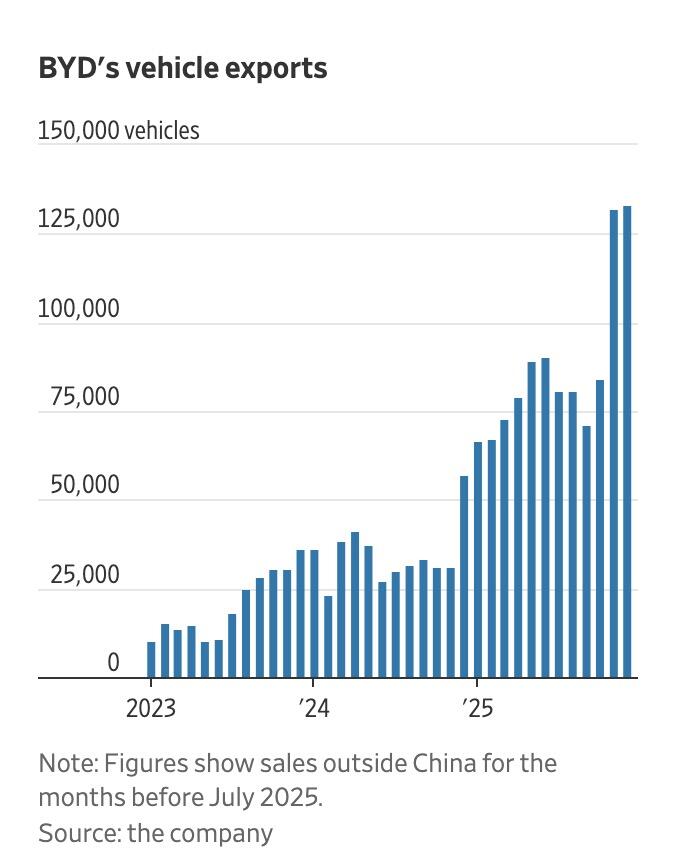
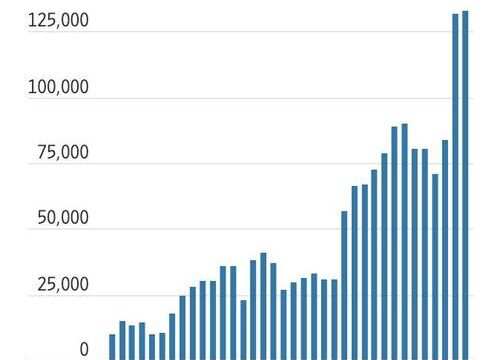
BYD has emerged as the most powerful symbol of China’s rise in electric vehicles. The company replaced Tesla as the world’s biggest EV seller and delivered more than one million vehicles outside China in 2025—more than double the previous year. China, meanwhile, surpassed Japan in 2023 to become the world’s largest auto exporter, shipping more than seven million vehicles last year.
“BYD wants to become one of the most relevant players in Europe, and in a very short period,” said Alfredo Altavilla, an industry veteran advising the company.
Chinese brands now hold about 7% of Western Europe’s auto market, selling more than 500,000 vehicles in the first three quarters of 2025. Their growing presence is putting pressure on European leaders such as Volkswagen, which has already lost ground to Chinese competitors in China and now faces them on its home turf. VW said it had “confidence in our products and our ability to innovate.”
China’s dominance is fueled by massive manufacturing capacity. The country can produce more than 46 million vehicles annually, far more than domestic demand. “You need to go global,” said Klaus Zyciora. “If you are not a manufacturer that is able to bring five million units annually to the market, you will have a hard time.”
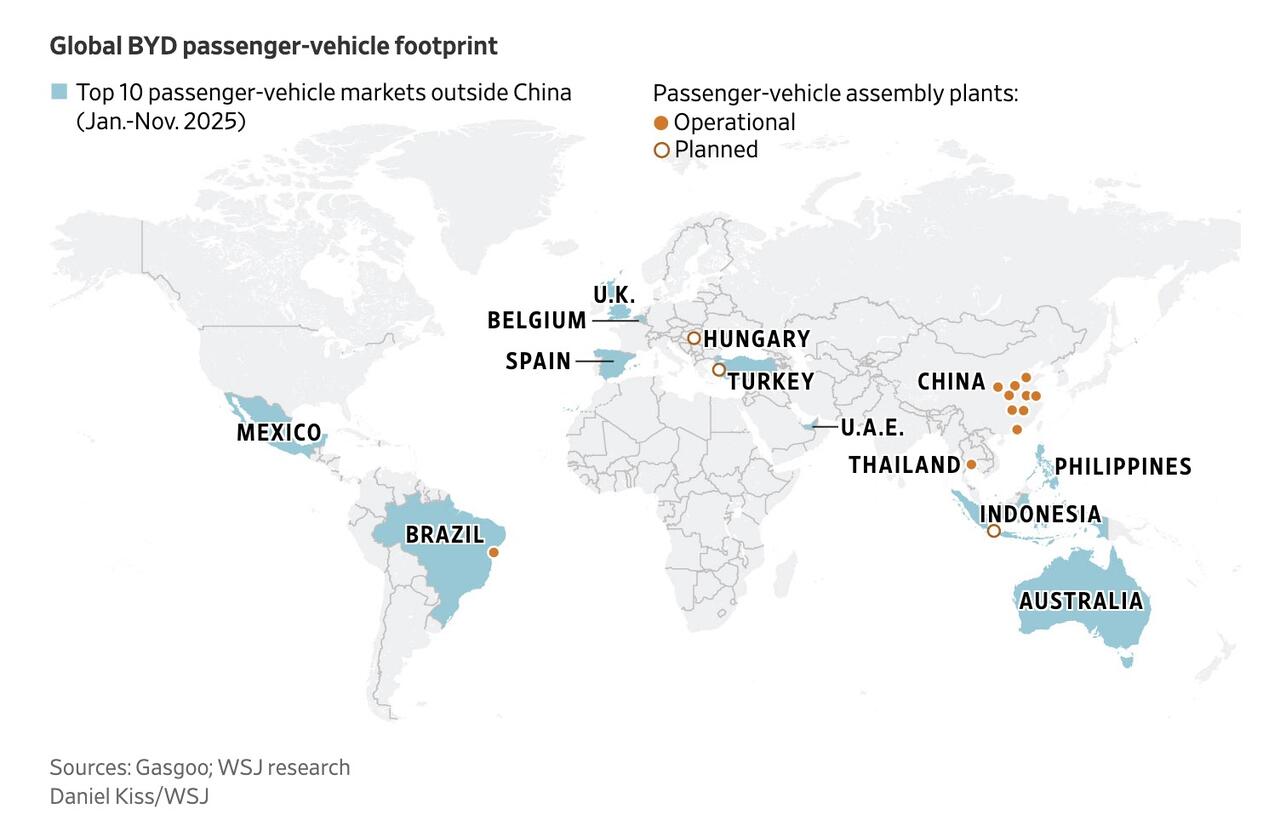
The WSJ writes that exports have become essential to absorbing this overcapacity. BYD is expanding aggressively, aiming for 2,000 European dealerships by 2026 and opening or planning factories in countries including Hungary, Turkey, Brazil, Thailand, and Indonesia. The company raised $5.6 billion to support its global push.
Political barriers remain one of the biggest obstacles. Chinese EVs face steep tariffs in the U.S., the European Union, and Mexico. In Europe, BYD vehicles are subject to duties of up to 27%. In the U.S., restrictions on Chinese software and national security concerns have effectively blocked imports.
Still, some governments are easing resistance. In Canada, officials recently reduced tariffs on Chinese EVs as part of a broader partnership with Beijing. In the U.S., President Trump signaled openness to Chinese automakers that produce locally, saying, “Let China come in.”
To bypass trade barriers, Chinese companies are increasingly building vehicles abroad. This strategy allows them to preserve access to major markets while maintaining cost advantages.
BYD’s rise has been driven not only by scale but also by strategy. After a slow start in Europe, the company shifted from premium pricing to more affordable models and recruited experienced Western executives. Local hiring and market-specific products helped accelerate growth.
“If we focus our strategy on EVs only, we will become another Tesla, with all the bumps, the ups and downs,” Altavilla said.
Chinese manufacturers are also moving upmarket. “They will learn to upgrade, and then they will come in there as well,” said Volvo CEO Håkan Samuelsson, warning that premium brands may soon face intensified competition.
In emerging markets such as Mexico, Chinese automakers have become major players by offering feature-rich, low-cost vehicles. Analysts say they are expanding demand for electric cars in regions where affordable EVs barely existed before. “They are creating a market for affordable EVs that didn’t exist,” said Justin Fischer.
BYD’s overseas growth has helped offset intense competition at home, even as profit margins fluctuate. Despite selling more than 4.6 million vehicles globally last year, the company faces pressure from rivals inside China and slowing domestic demand.
Yet the broader trend remains clear: Chinese automakers are no longer niche exporters. With scale, cost advantages, government backing, and improving technology, they are positioning themselves as global leaders.
As Altavilla put it, BYD aims to become “a real European automaker.” More broadly, China is positioning itself to dominate the next phase of the global auto industry—putting Tesla and traditional Western manufacturers under sustained pressure.
Tyler Durden
Fri, 01/23/2026 – 21:20
https://www.zerohedge.com/markets/china-has-officially-overtaken-tesla-global-ev-race

Potempa: Readers’ kind notes, memories comfort after Dad’s passing
Last week marked one month since my dad’s funeral services after his passing at age 96 on Dec. 10 at the farm.
Mom, myself, my siblings, and family are grateful and blessed for such an outpouring of cards, notes and shared memories from so many readers, in addition to our friends and neighbors.
Tracker V, a 22-pound purebred Maine coon cat owned by Chester and Peggy Potempa, is shown walking through the backyard of the family house near the base of one of the farm’s 50-year-old “dwarf” apple trees. (Phil Potempa/Post-Tribune)
In the 23 years I’ve penned this column and published the companion cookbooks, Mom and Dad, like myself, think of you, the reader, as our friends and neighbors.
As of last week, notes and other tokens continue to arrive to Mom and Dad, and we continue to be grateful for the beautiful sentiment.
Here are just a few passages from readers taken from the hundreds of cards, emails and notes, not even counting the social media attention which helped us navigate through the holidays. We miss Dad so much.
“I’m so sorry for your loss. I still have a birdhouse your dad made many years ago. Such a wonderful person and love to you all.” — Lisa Holliday of LaCrosse
A photo taken Nov. 28, 2025 shows a fallen half-century-old “dwarf” apple tree, a result of a rain and wind storm during the night at the Potempa Farm in San Pierre. (Phil Potempa/Post-Tribune)
“Sending my condolences to you and the family. No matter the age, it’s still hard to lose a parent. Your dad lived a good, long life. My mother (now passed) adored you and your columns!” — Julienne Gee of Valparaiso
“I was so sad to read Mr. Potempa’s obituary in the newspapers. What a beautiful tribute column written by you, Philip. We met him years ago at one of your family’s annual Valentine’s Day hosted charity dinners benefiting Honor Flight. It is very painful to lose a loved one, but even more so during the holiday time. In addition to all of the angels watching over you, you and your mom and family now have a very special guardian angel watching over you. My mom, Evelyn, and I extend our sympathy to you.” — Daughter Carolyn Lisek and Mom Evelyn Lisek of Hobart
“As a hunter who loved to hunt in the neighboring woods area around your farm fields, I recall getting to visit with Chester in the barn when we crossed paths. I loved those chats. God Bless Chet!” — Angelo Pampalone and Family of Valparaiso
“Condolences on the loss of your father. All these years you’ve written about your family members, we feel like we know them. Chester was clearly a good man, and we are keeping him and you and all your family in our prayers.” — Alison Skertic of Munster
Dad arrived home to the farm on Monday, Nov. 24, after three months at his rehabilitation facility following his Aug. 13 heart valve procedure at the University of Chicago. He was just in time to be around the family dinner table on Nov. 27 for Thanksgiving 2025. In the early morning hours, the day after Thanksgiving on Nov. 28, a storm with rain and wind toppled one of the remaining two of what was originally a trio of “dwarf Macintosh apple trees” in the backyard of my parents’ house. The downed tree was clearly visible from Dad’s bedroom window. Purchased by Mom and planted by Dad in the late 1960s, he had always lamented having planted the three apple trees so close together. However, they also provided generous harvest yields, as well as welcome shade to the same backyard where we played softball, badminton, and croquet for decades. (Dad had removed one of the trees a decade ago after it had died and dried up.)
It remains symbolic to me to lose one of our family apple trees planted by dad in the same window of time as Dad’s passing. Both once sturdy and strong with lifetimes that branched out to touch the world around them.
My previous columns have featured delicious apple crisp recipes, especially the one provided by Mom’s older sister, Aunt Ruby, now 96, and as featured in my original “From the Farm” cookbook, published in 2002. However, I’ve never shared my mom Peggy’s apple crisp recipe, a fall staple or winter favorite for using up stored fall apples in the cellar. Today, I’m sharing her recipe in Dad’s memory.
Columnist Philip Potempa has published four cookbooks and is a weekly radio show host on WJOB 1230 AM. He can be reached at PhilPotempa@gmail.com or mail your questions: From the Farm, PO Box 68, San Pierre, Ind. 46374.
Peggy’s Warm Apple Crisp
Makes 6 servings
4 cups peeled, cored and sliced apples
2/3 to 3/4 cup brown sugar
1/2 cup flour
1/2 cup rolled oats
3/4 teaspoon nutmeg
1/2 cup butter or margarine, chilled yet softened
Directions:
1. Place apples in greased, 8-inch square baking pan.
2. Use sugar, adjusted according to sweetness of apples when adding to oats mixture.
3. In a medium bowl, combine sugar and remaining ingredients.
4. Blend until mixed and crumbly and sprinkle over apples.
5. Bake in a 350 degree oven for 30-35 minutes.
Big changes for Elgin police — new deputy chief, commander, officers
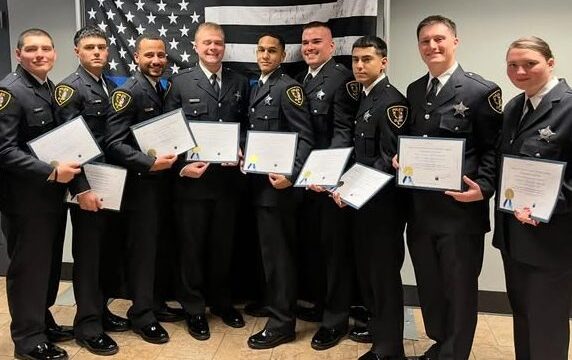
The Elgin Police Department is starting the new year with a new deputy chief, a new commander and 10 new police officers.
Tom Michael, a commander overseeing investigations, has been named deputy chief, succeeding Adam Schuessler, who retired last year.
Michael is a 23-year veteran with a bachelor’s degree in law enforcement and justice administration from Western Illinois University. In addition to his experience with the Investigative Division, he has worked with the Patrol Division, Major Investigations and Community Engagement.
Tom Michael, an Elgin Police Department commander overseeing investigations, has been promoted to replace Deputy Chief Adam Schuessler, who retired last year. (Elgin Police Department)
Scott Holmes, previously a lieutenant, is the department’s new commander of strategic initiatives and heads the community engagement, traffic and special events divisions. He’s been with department for 20 years and has previously been in charge of the traffic division, patrol and investigations.
He joins fellow commanders Heather Lencioni, who was appointed to the job in 2023 and oversees traffic, the Crime-Free Housing Unit, ROPE, Community Engagement, Collaborative Crisis Services Unit and Social Services, and Mike Martino, promoted in November 2025 and is in charge of major investigations, special investigations, crime analysis and the cold case unit.
“I’m very thankful for the opportunity,” Holmes said on Police Chief Ana Lalley’s “Friday with the Finest” radio show on WRMN-AM (1410). Lalley introduced Holmes to the community during the program.
Scott Holmes is the Elgin Police Department’s new commander of strategic initiatives and heads the community engagement, traffic and special events divisions. (Elgin Police Department)
“He’s going to do a really good job,” Lalley said of Holmes.
Ten new officers recently graduated from the Macon County Law Enforcement Training Center and are now receiving in-house training, officials said. They will start field training in a few weeks.
The new hires were needed to replace some of the 17 officers who retired last year. As of now, the department has 203 sworn officers and 75 professional support staff.
The ranks are starting to better reflect the city’s demographics, officials said. In 2018, 80% of the force was white and the rest Black, Hispanic or another race or ethnicity. Seven years later, 59% of the force is white and 41% Black, Hispanic or another race or ethnicity.
Female officers also have higher numbers than in previous years, growing from 8% in 2018 to 34% in 2025.
Lalley said during the radio show that as the department moves into a new year, it “will remain steadfast to ensure a safe community while also continuing to build a bright future for the next generation of department members and community members.”
Part of that effort is mentoring its younger officers, which she says is one of the aspects of the job that she loves, Lalley said.
“It’s so important. As I grew up in the organization, it was very rare to get that,” she said. “It’s been a conscious effort and a mission of mine. You have to give away what you learn. For mentorship to work, you have to extend your hand to someone.”
Gloria Casas is a freelance reporter for The Courier-News.
https://www.chicagotribune.com/2026/01/23/elgin-police-promotions-chief-commander-officers/

‘Saving The Family’ Should Start With Sound Money
‘Saving The Family’ Should Start With Sound Money
Authored by Jeffery L. Degner and Thomas Savidge via TheDailyEconomy.org,
In the opening week of 2026, several scholars at the Heritage Foundation published a special report titled “Saving America by Saving the Family: A Foundation for the Next 250 Years.” This 168-page document covers myriad policies that negatively impact the American family and proposes solutions to those problems. Some, largely the solutions that propose repealing and reforming existing systems, can help families. But the calls to subsidize traditional family life will come with a host of unintended consequences.
The nation is indeed facing a demographic crisis, and some of Heritage’s proposals deserve praise, while others deserve criticism. One proposed reform is mentioned but given barely any attention: a return to sound money.
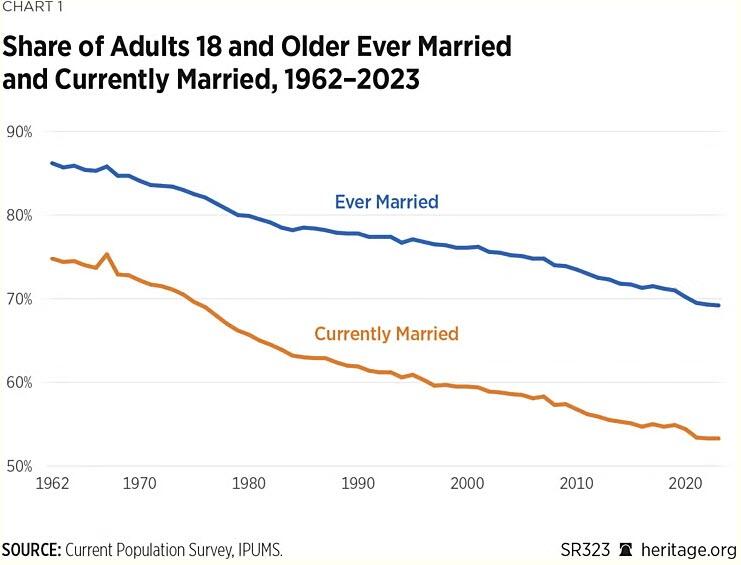
Helping the American family (broadly understood) is a laudable goal, but the patterns of later and fewer marriages, later and less-frequent reproduction, and a host of other family pathologies are themselves the result of a mountain of interventions.
The American family must be saved from government, not by government.
America’s Demographic Squeeze: Fewer Births, More Dependents
The demographic decline facing the US is less sudden than often claimed, but no less consequential. As the Heritage report notes, fertility has remained below replacement rates for years, ensuring that natural population growth is weak. In the absence of sustained immigration, population growth is likely to become population contraction.
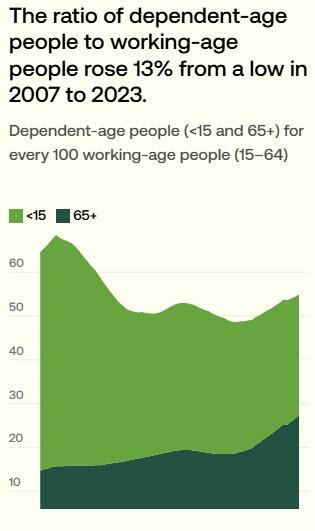
Simultaneously, the retirement of the Baby Boomer generation is steadily increasing the share of the population outside of the labor force, raising the dependency burden borne by working-age Americans and taxpayers.
These trends are already becoming visible. Slower growth or even shrinkage in the working-age population, absent significant immigration, constrains labor supply and limit economic growth potential. Meanwhile, Social Security and Medicare (the two largest expenditures in the federal budget) face rising expenditures precisely as the tax base supporting them grows more slowly. Additionally, the rise of the welfare state has greatly hampered family formation, especially among low-income families.
These changes underscore the need to remove institutional barriers to family formation and reform policies that underlie present challenges.
Remove Barriers Before Adding Benefits
Several laudable elements in the Heritage report shouldn’t be overlooked. First, it acknowledges that many policies favor traditional families. While there are indeed over 1,000 forms of federal privilege granted to married couples, these have been in place throughout the period when both marriage and fertility rates are falling. This raises the question: Why are these so-called “pro-family” or “pro-natal” policies failing to achieve their stated goals? Perhaps it’s because other measures on the books outweigh them, and actually short-circuit family formation.
The report’s authors call for a repeal of multiple policies that have been shown to deter and delay marriage, alter planned fertility, and even divorce patterns. Among them are “credits designed specifically to benefit poor single mothers,” and the structure and incentives from the Earned Income Tax Credit, which “strongly favors single parenthood over marriage.” The report also demands the elimination of “needless occupational licensure laws” that block young and lower-income earners from the labor force, undermining the early wealth-building that encourages marriage. Further, it seeks the easing of local zoning and construction regulations that make home affordability more difficult for younger, poorer households.
Heritage’s report frames the Israeli case as a model for what must be done to increase marriage and fertility rates. But the main reasons cited for (slightly) above-replacement fertility rates in Israel are religiosity, nationalism, and “Jewish communal life in exile,” all of which are summarized later as “culture, faith, and national purpose to family formation.” These specific pressures can’t, and shouldn’t, be replicated in modern, pluralistic societies. Further, the report rightfully admits, “While other nations have tried to reverse declining birthrates through financially generous family policies, none has succeeded in restoring fertility to replacement levels. This demonstrates that government spending alone does not ensure demographic success.”
Turning to Eastern Europe, the report looks to Hungary for policy solutions, interventions, and expenditures that have a more positive track record in increasing marriage and fertility. Indeed, Budapest began offering eligible brides interest-free loans, equating to over $30,000 for saying “I do” back in 2019. Moreover, the debt may be forgiven if the couple had three or more children. The report belies an important fact, however: the increase in the marriage rate is largely due to formerly cohabiting couples tying the knot. One would expect that once this initial wave of marriages has passed, the impact would be negated by other factors. In fact, just four years after the policy was introduced, the marriage rate began to fall back toward EU norms. The high cost of taxpayer-subsidized loans for cohabiting couples to make it official has had only temporary effects, and may prove, in the long run, to have produced marriages that are more apt to divorce, especially when the money runs out.
The Heritage Report correctly marks some of the causes of family disintegration: marriage penalties embedded in both welfare and fiscal interventions, especially for low-income households. The authors rightly call for their repeal. At the same time, the models they point to as ideal national cases for cultural and policy reform either can’t be replicated or are short on results. Worse still, the report’s greatest shortcoming is found in a drive-by mention of the single, foundational intervention that may actually be undermining all of traditional family life.
The Best “Pro-Family” Policy Is Price Stability
Buried within the report is a brief aside discussing the pressure a fiat monetary system and the resulting inflation has placed on families. The authors state:
High inflation can not only devastate the economy but also make it harder for families to form and grow. The US abandoned the gold standard in 1971, and the lack of convertibility of dollars to gold since then has facilitated reckless money printing and irresponsible federal spending, leading to bouts of high inflation in the 1970s, early 1980s, and the 2020s. Families rely on the dollar as a store of wealth, so the Federal Reserve must restore sound money and price stability. While many monetary rules have been proposed, the system with a proven record track record of success and stable prices is full convertibility to gold.
This passage, and its recommendation to return to full convertibility, are worth their weight in gold.
A few economists have pointed to the connection between increasing real prices in healthcare, education, and housing as key contributors to delays in marriage and lowered fertility rates.
Outside factors like regulatory pressure and geopolitical forces have doubtless contributed to rising real prices in these categories. But among these, the ongoing loss of purchasing power due to the loose money policies of the Federal Reserve and its member banks has received too little attention.
Even less attention is paid to the rise of what some have called the inflation culture. The Heritage report hints at this reality, but chalks it up to a loss of religiosity. But the decay of religious and civic life in the West has an undetected, underlying culprit. Because of the redistributive and impoverishing effects of easy money, a once-entrepreneurial and optimistic American culture has given way to a litany of social pathologies:
Short-termism or fatalism (“in the long run, we’re all dead”)
Reliance on credit and leverage to get ahead
Long-term debts functioning as barriers to family formation
A culture of “total work” that discounts family life and delays life milestones
The two-income trap contributing to absent parents
Hustle culture or “grindset” among young adults, to the exclusion of strong relationships
All are impacting family formation and family cohesion. All have their roots in the demoralization of persistent, slow-burning inflation, eating away the value of money. Younger generations hoping to live comfortably can reasonably ask: ‘Who has time for marriage and family?’ The answer: a lot fewer people than in generations past.
The damage done to the American family is likely reversible, but the Heritage Foundation’s report misses the root cause: inflation may be the most corrosive anti-family force of all. Policymakers who want to revive marriage rates and fertility should examine existing, counterproductive incentives, including new money creation and Congressional overspending. What they shouldn’t do is continue layering new interventions onto old ones, creating more bureaucracy and higher costs — but fewer weddings and babies.
Tyler Durden
Fri, 01/23/2026 – 20:55
https://www.zerohedge.com/personal-finance/saving-family-should-start-sound-money
Trump administration’s defense strategy tells allies to handle their own security
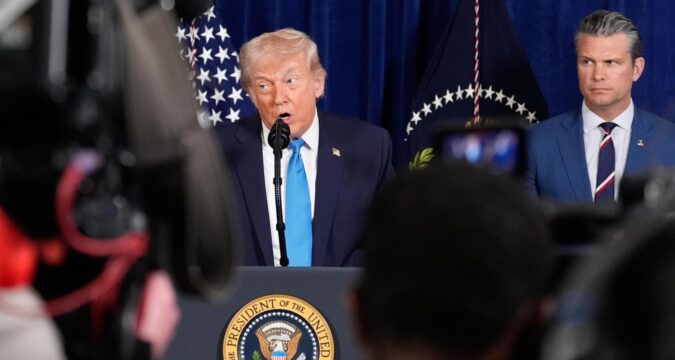
WASHINGTON — The Pentagon released a priority-shifting National Defense Strategy late Friday that chastised U.S. allies to take control of their own security and reasserted the Trump administration’s focus on dominance in the Western Hemisphere above a longtime goal of countering China.
The 34-page document, the first since 2022, was highly political for a military blueprint, criticizing partners from Europe to Asia for relying on previous U.S. administrations to subsidize their defense. It called for “a sharp shift — in approach, focus, and tone.” That translated to a blunt assessment that allies would take on more of the burden countering nations from Russia to North Korea.
“For too long, the U.S. Government neglected — even rejected — putting Americans and their concrete interests first,” read the opening sentence.
It capped off a week of animosity between President Donald Trump’s administration and traditional allies like Europe, with Trump threatening to impose tariffs on some European partners to press a bid to acquire Greenland before announcing a deal that lowered the temperature.
https://www.chicagotribune.com/2026/01/23/trump-administrations-defense-strategy/