Category: News

Europa encuentra una voz unificada para decir “no” a Trump
Por LAURIE KELLMAN
LONDRES (AP) — No más alabanzas desmedidas. No más soluciones diplomáticas educadas y de estilo antiguo. Y ahora nadie está llamando a Donald Trump “papá”.
Los líderes europeos que durante un año batallaron para averiguar cómo lidiar con un presidente estadounidense envalentonado en su segundo mandato se acercaron a decir “no”, o algo diplomáticamente similar, a su desprecio por el derecho internacional y sus demandas sobre su territorio. La promesa de Trump de apoderarse de Groenlandia y castigar a cualquier país que se resista pareció ser la prueba de fuego.
Se consideró que se habían cruzado “líneas rojas” este año cuando Trump revivió abruptamente su demanda de que Estados Unidos debía “absolutamente” gobernar Groenlandia, la región semiautónoma de Dinamarca, un aliado de la OTAN, Dinamarca. Eso empujó incluso a los diplomáticos más moderados a emitir advertencias contundentes contra Trump, a quien habían elogiado con trato monárquico y alabanzas desmedidas.
“Reino Unido no cederá” su apoyo a la soberanía de Groenlandia, expresó el primer ministro británico, Keir Starmer. Varios líderes del continente dijeron que “Europa no sería chantajeada” por Groenlandia.
El primer ministro noruego, Jonas Gahr Støre, expresó: “Las amenazas no tienen lugar entre aliados”.
La dura retórica diplomática en torno al enfrentamiento la semana pasada en Davos, Suiza, no fue el único factor que presionaba a Trump. Las elecciones al Congreso de Estados Unidos se acercan en noviembre en medio de un mercado de valores en declive y calificaciones de aprobación en caída. Los líderes europeos tampoco son los primeros en interponerse en el camino de Trump durante su segundo mandato; véase al presidente de la Reserva Federal, Jerome Powell.
Pero el cambio dramático entre la élite europea, de “apaciguar” a Trump a desafiarlo, ofrece pistas en el esfuerzo continuo entre algunas naciones de cómo decir “no” a un presidente que odia escucharlo y es conocido por tomar represalias.
“Queremos un pedazo de hielo para la protección mundial, y no nos lo darán”, dijo Trump a su audiencia en el Foro Económico Mundial. “Pueden decir que sí, y estaremos muy agradecidos. O pueden decir que no, y lo recordaremos”.
Lección 1: Hablar como uno solo
En los últimos días, Europa ofreció abundantes negativas a seguir a Trump, desde su demanda sobre Groenlandia hasta unirse a su nuevo Consejo de Paz e incluso a lo que Mark Carney de Canadá llamó la “ficción” de que la alianza funciona en beneficio de cualquier país más que del más poderoso. El momento marcó una unidad entre los líderes europeos que no lograron alcanzar durante un año.
“Cuando Europa no está dividida, cuando estamos juntos y cuando somos claros y fuertes también en nuestra disposición a defendernos, entonces los resultados se mostrarán”, expresó la primera ministra danesa, Mette Frederiksen. “Creo que hemos aprendido algo”.
Federiksen ejemplificó la curva de aprendizaje. Hace un año, ella y otros líderes estaban a la defensiva y respondían principalmente a la administración Trump. Encontró necesario decir a los periodistas en febrero de 2025: “No somos un mal aliado”, después de que el vicepresidente JD Vance dijera que Dinamarca “no estaba siendo un buen aliado”.
Trump es transaccional. Recurre poco a la diplomacia y no “necesita (el) derecho internacional”, dijo al New York Times este mes. Ahí radica la desconexión entre los líderes europeos típicamente colaborativos y el presidente republicano cuando regresó a la Casa Blanca diciendo que quería que Estados Unidos se apoderara de Groenlandia, Panamá y quizás incluso Canadá.
“En el primer mandato de Trump, Europa no sabía qué esperar e intentó lidiar con él usando las viejas reglas de la diplomacia, con la expectativa de que, si seguían hablando con él en términos mesurados, cambiaría su comportamiento y se integraría al club”, señaló Mark Shanahan, profesor asociado de compromiso político en la Universidad de Surrey.
“Es muy difícil para otros líderes que tratan entre sí con las cortesías de un sistema basado en reglas y conversación diplomática”, dijo Shanahan. “Es difícil para ellos cambiar”.
Cinco meses después de la juramentación de Trump el año pasado, con su amenaza sobre Groenlandia en el aire, los líderes europeos habían comprendido lo suficiente sobre la gestión de Trump como para llevar a cabo una reunión de naciones de la OTAN en Holanda. Los miembros de la alianza militar acordaron contribuir más y en general dieron crédito a Trump por forzarlos a modernizarse.
El secretario general Mark Rutte, conocido como el “apaciguador de Trump” en la coalición, comparó el papel del presidente en calmar la guerra Irán-Israel con un “papá” interviniendo en una pelea de patio de escuela.
Lección 2: Considerar decir no — y tomar decisiones en consecuencia
La diplomacia tradicional existe para preservar las posibilidades de trabajar juntos. Eso a menudo significa evitar decir un “no” rotundo si es posible. Pero la jugada de Trump sobre Groenlandia fue una amenaza tan clara de un miembro de la OTAN a otro que el primer ministro de Groenlandia realmente dijo la palabra.
“Basta”, dijo Jens-Frederik Nielsen dijo en un comunicado poco después de las declaraciones de Trump el 5 de enero. “No más presión. No más insinuaciones. No más fantasías sobre anexión”.
Eso jugó un papel en establecer el tono. La líder de Dinamarca dijo que cualquier invasión de Groenlandia marcaría el fin de la OTAN e instó a los miembros de la alianza a tomar en serio la amenaza.
Lo hicieron, emitiendo declaración tras declaración rechazando la amenaza renovada. Trump respondió el fin de semana pasado desde su campo de golf en Florida con una amenaza de imponer un impuesto de importación del 10% dentro de un mes a productos de ocho naciones europeas: Dinamarca, Noruega, Suecia, Francia, Alemania, Reino Unido, Holanda y Finlandia. La tasa, escribió, subiría al 25% el 1 de junio si no se llegaba a un acuerdo para “la compra Completa y Total de Groenlandia” por parte de Estados Unidos.
Lección 3: Rechazar el paradigma de gran poder de Trump
Las palabras combativas de Trump encendieron un fuego entre los líderes que llegaban a Davos. Pero también parecían reconocer que el mundo más amplio de Trump lo dejaba vulnerable.
Duncan Snidal, profesor emérito de relaciones internacionales en la Universidad de Oxford y la Universidad de Chicago, explica: “Trump estaba en una posición bastante débil porque tiene muchos otros problemas inminentes en marcha”, a nivel nacional, incluyendo una próxima decisión de la Corte Suprema sobre sus aranceles y una reacción contra las redadas de inmigración en Minnesota.
Carney de Canadá dijo que no al replantear la pregunta no como si se tratara de Groenlandia, sino de si era hora de que los países europeos construyeran poder juntos contra un “abusivo” — y su respuesta fue sí.
Sin nombrar a Estados Unidos o a Trump, Carney habló con franqueza: Europa, dijo, debería rechazar la “coerción” y “explotación” del gran poder. Era hora de aceptar, dijo, que había ocurrido una “ruptura” en la alianza, no una transición.
Sin decirlo, Snidel señaló que la ruptura era muy nueva, y aunque podría ser difícil de reparar en el futuro, hacerlo bajo reglas ajustadas sigue siendo de interés para Estados Unidos y Europa más allá de la presidencia de Trump. “Es un trato demasiado bueno para todos ellos como para no hacerlo”, dijo Snidel.
Lección 4: Ejercer precaución
Antes de dejar el podio en Davos, Trump ya había comenzado a retroceder.
Canceló su amenaza de usar “fuerza” para apoderarse de Groenlandia. Poco después, se retractó por completo, anunciando “el marco” para un acuerdo que haría innecesaria su amenaza arancelaria.
Trump dijo a Fox Business que “vamos a tener acceso total a Groenlandia”, bajo el “marco”, sin revelar qué podría significar eso.
Frederiksen presionó el botón de advertencia nuevamente. En un comunicado, dijo: “No podemos negociar sobre nuestra soberanía”.
En otras palabras: “No”.
_________
Esta historia fue traducida del inglés por un editor de AP con la ayuda de una herramienta de inteligencia artificial generativa.
https://www.chicagotribune.com/2026/01/25/europa-encuentra-una-voz-unificada-para-decir-no-a-trump/

‘In extreme pain’: Workers injured at Michigan City data center site
For about five weeks, Michael Grace has been without an income source. He’s watched his funds deplete as his needs continue to grow, struggling to pay for cat food, laundry detergent and his phone bill.
Grace can’t work, and he doesn’t know when he will work next.
Heavy equipment sits outside a data center construction site on Royal Road in Michigan City on Friday, Jan. 23, 2026. (Andy Lavalley/for the Post-Tribune)
“It’s my neck, between my shoulder blades and my lower back,” Grace, a Michigan City resident, said. “I mean, I’m in extreme pain.”
Grace said he was injured at the Project Maize data center site in Michigan City on Dec. 16, 2025, when an end dump trailer bed flipped on its side with him inside the cab. A nearby bulldozer was overloaded with earth and asphalt and caused his machine to roll.
He laid on the ground for 45 minutes, waiting for workers to notice him, telling them on his walkie talkie that he was stuck, Grace said. Once a worker came to help, Grace was “rocked around in the cab” again, making his injuries worse.
“I waited for 45 minutes,” Grace said. “All these people were just standing around there, and then they scattered like ants. … At other sites I’ve worked at, we would always stop and help someone out.”
Heavy equipment operator Michael Grace reacts after pain shoots through his neck at the Michigan City Public Library on Wednesday, Jan. 21, 2026. Grace, 54, was injured on Dec.16, 2025 while working on a new data center in Michigan City after two weeks on the job. (Andy Lavalley/for the Post-Tribune)
Grace was a non-union worker for Project Maize and said he doesn’t want to return once healed. He believes no one on-site reported the injury, even though he went to an emergency room for care afterwards.
Grace submitted a complaint to the U.S. Occupational Safety and Health Administration on Dec. 17, according to an email he sent to the Post-Tribune. The complaint is still pending.
The Michigan City resident has also asked Local 150, the International Union of Operating Engineers, for help. Grace is also in contact with other Michigan City residents, including Eileen Mark and Ashley Williams, executive director of Just Transition Northwest Indiana, who found Grace through Facebook.
“I think it’s an outrage,” Mark said. “It makes me angry. This is just a symptom of this nefarious data center project that shouldn’t even be in our community as far as I’m concerned.”
Heavy equipment sits outside a data center construction site in Michigan City on Friday, Jan. 23, 2026. (Andy Lavalley/for the Post-Tribune)
Grace hasn’t yet received workers’ compensation, and he doesn’t know why. Since he cannot work, Grace has created a GoFundMe to try to raise money.
“That would get me by,” Grace said. “I mean, I need laundry detergent, I need food for my cat. … I don’t have a family. … I go to sleep at night, and if I move the wrong way, I’m up because of the pain.”
Grace’s injury is not an isolated incident at the Project Maize site. According to a news release from Local 150, on Oct. 9, a worker allegedly fell from a roof and struck his head.
Multiple Michigan City residents have expressed concerns with workers’ safety at the site since the Oct. 9 incident.
Heavy equipment operator Michael Grace reacts after pain shoots through his neck at the Michigan City Public Library on Wednesday, Jan. 21, 2026. Grace, 54, was injured on Dec.16, 2025 while working on a new data center in Michigan City after two weeks on the job. (Andy Lavalley/for the Post-Tribune)
“I’m infuriated that justice is not being served to this community and the workers that are building this data center,” Williams said. “It shows that our lives are disposable. This is par for the course after what we’ve seen with such a bad actor, and really at this point, it’s proven. We saw this coming.”
The Post-Tribune obtained body camera footage from the Michigan City police officers at the Project Maize jobsite after the Oct. 9 incident. Officers arrived after 9 p.m. Oct. 9.
In the footage, multiple Michigan City officers are talking to workers at the job site, before entering a building to speak with security personnel.
“That’s Google money right there,” someone said to the security officer, even though the data center end user has yet to be announced.
In the body camera footage, a security officer shows the police footage of the Oct. 9 incident, where they see a man fall onto the ground, but the roof he fell off is not shown.
“He’s still moving,” someone said after watching the security video.
Later in the video, a group of workers are seen coming to the man’s aid, and he is carried off. When officers arrived at the worksite, before viewing the security video, a worker told them that the man who fell had left the site. It is alleged that fellow workers took him to an unnamed hospital.
Three officers are also seen talking in the video, saying they will alert dispatchers. Officers also said they believe that some workers at the site were undocumented immigrants.
When the footage starts, an unidentified worker also insinuated that some worksite employees were undocumented immigrants.
The security officer told police that he didn’t know if all workers were accounted for.
Councilman Vidya Kora, D-at large, at the Michigan City Common Council’s Tuesday meeting, asked representatives from Phoenix Construction to address safety concerns at the Project Maize site. The council’s meetings are livestreamed on Facebook through the Access LaPorte County page.
William Shroyer, Phoenix Construction’s representative, said at the meeting that a subcontractor at the Project Maize site fell 28 feet from a facility roof and was transported to a local hospital for evaluation before being released that evening. Shroyer did not say which local hospital.
The incident was well-documented and reported in accordance with workplace safety requirements, Shroyer said, and Phoenix “cooperated fully” with OSHA.
“Phoenix Construction also engaged an independent third-party safety and risk firm to conduct an additional assessment,” Shroyer said. “There have been some public statements and rumors regarding this event that do not accurately reflect the information reviewed by regulatory authorities. … Phoenix Construction remains committed to maintaining a safe and compliant worksite and will continue to cooperate with local officials and regulatory agencies to ensure projects in Michigan City are developed responsibly.”
Kora told Shroyer that although Project Maize isn’t a city project, the council members hear from constituents about it frequently, and he’d appreciate monthly updates to the council. Other council members said they don’t think monthly updates would be necessary, but Phoenix Construction could let the mayor know and updates could be put online.
“You can either come up here or issue some press statements and update the community on what’s going on, and be as transparent as possible,” Kora said. “It’s in the best interest of everybody. It’s in the best interest of our community, and it’s in the best interest of your business.”
Councilman Donald Przybylinski, D-at large, asked Shroyer about some resident concerns, including that the worker, on Oct. 9 who was transported to the hospital by his coworkers. Shroyer confirmed that happened, saying it “seemed like the best option at the moment.”
“In my estimation, I wouldn’t have done that,” Przybylinski said. “You generally call an ambulance when you have a major OSHA accident like that. … That’s pretty serious. And to just put someone in the backseat of a car and say, ‘OK, let’s take him to the hospital,’ I don’t feel good about it.”
Przybylinski also asked Phoenix Construction about its specific protocol when accidents occur, but Shroyer was unable to answer because the Oct. 9 incident was still a pending investigation.
A representative for Phoenix Construction responded to the workplace safety concerns in a Friday email to the Post-Tribune.
“The incident was documented and reported in accordance with applicable safety requirements,” the email said. “Phoenix Construction cooperated fully with (OSHA) and engaged an independent third-party safety firm to conduct an additional review.”
Phoenix Construction’s email also said that there have been no reports of Grace’s incident.
“With respect to claims regarding an alleged December 16 incident, there have been no reported incidents on site involving heavy equipment falling, rolling or otherwise coming into contact with any workers.”
The company also said it values workplace safety at all its construction jobsites.
“Phoenix Construction works with both union and non-union subcontractors based on project needs, and all workers on site are required to meet the same safety, training, and compliance standards,” the statement said. “Phoenix Construction remains committed to maintaining a safe and compliant worksite and will continue to cooperate with regulatory authorities.”
Local 150 Financial Secretary David Fagan told the Post-Tribune that the union is concerned that workplace injuries have occurred at the Project Maize site. The union has seen police body camera footage from the incident, Fagan said, which he believes makes it obvious that the worker sustained a “serious injury.”
Fagan also said, from the Oct. 9 video, it’s unclear whether the injured worker received medical treatment.
“We don’t know what’s true, what’s not true, but I think, from anyone’s perspective, knowing that someone may not have received medical treatment, is an injustice to everyone and anyone on a construction site,” Fagan said. “Regardless of our concerns and issues with the project, workers, regardless who they are, need to be respected, and if they’re injured, they need to receive the appropriate treatment.”
Local 150 representatives have reached out to OSHA about the Oct. 9 incident, and the workplace safety agency allegedly told the union that no evidence indicates that the employee struck their head during the fall, and no evidence supports that medical protocols weren’t handled in an appropriate manner.
The workplace agency allegedly also told Local 150 representatives that it found that the employer did not evaluate working surfaces appropriately, Fagan said, and a citation was issued.
Fagan would like to ensure that appropriate resources are used to ensure worksite safety and that workers on-site receive the appropriate safety training, he said.
Fagan heard that Grace had been injured at the Project Maize site and was unable to work. Construction workers throughout Northwest Indiana spend “a lot of time” dedicated to learning about worksite safety because the industry is dangerous, he said.
“Accidents will happen,” Fagan said. “But how do you respond to those accidents? And what you do to minimize those accidents makes all the difference in the world, and just from my perspective, I don’t see that happening in Michigan City.”
Fagan encourages anyone concerned with Project Maize’s worksite safety to talk to local and state officials.
According to Post-Tribune archives, Fagan said union members met with Phoenix Investors on Aug. 29, and were told the company would make no commitment on who they’d hire for Project Maize. The union and Michigan City residents have expressed concerns that out-of-state, non-union workers, rather than local union workers.
“Indiana tax dollars are supporting these major projects,” Fagan said. “Then the workforce is coming from out-of-state places like Mississippi and Alabama, and you don’t really know the history of these companies. Quite frankly, it undermines the economic value of these projects to the community when the local workforce is not included.”
The Michigan City Common Council, in September, passed four resolutions that would allow the construction of a more than $800 million data center at 402 Royal Road, according to Post-Tribune archives. The resolutions provided multiple tax abatements, designated the area as an economic revitalization area and approved a taxpayer agreement for Project Maize.
The data center end user has yet to be announced, but residents suspect it to be Google.
Project Maize is a private project, and Michigan City leadership isn’t involved with the construction, Kelley Smith, administrator for the Michigan City Mayor’s Office, previously told the Post-Tribune. The mayor’s office was unable to immediately respond to a request for comment about worksite safety concerns.

Kevin Huerter’s buzzer-beater lifts Chicago Bulls past Boston Celtics before Derrick Rose’s jersey retirement
Kevin Huerter made a 3-pointer just before the buzzer, lifting the Chicago Bulls past the Boston Celtics 114-111 before retiring Derrick Rose’s jersey number on Saturday night.
Coby White scored 22 points and hit five of the Bulls’ 21 3s, helping the Bulls win their fourth straight.
Related Articles
Derrick Rose celebrates his Chicago legacy as Bulls retire his No. 1 jersey: ‘It was always meant to be’
Photos: Chicago Bulls retire Derrick Rose’s No. 1 jersey
Photos: Chicago Bulls 114, Boston Celtics 111
Rose entered rarified air after the game when the Bulls sent his No. 1 to the rafters, putting the Chicago product alongside Michael Jordan, Scottie Pippen, Jerry Sloan and Bob Love as the only players with numbers retired by the team.
The Bulls gave their crowd plenty to cheer before they honored the South Side product and former MVP by squeezing out a win over the Eastern Conference’s second-place team, even though Jaylen Brown scored 33 for Boston.
The Bulls led 111-109 when White missed a driving layup and Smith missed the putback with 20 seconds remaining. Brown got the rebound and drove for a layup to tie it with 14 seconds left.
The Bulls called a timeout and worked the ball to Huerter, who nailed a 3 from the corner with less than a second remaining. Huerter arrived at United Center wearing a No. 1 jersey in honor of Rose.
Nikola Vučević scored 16 for the Bulls, and Smith and Matas Buzelis added 14 points apiece.
Anfernee Simmons finished with 21 points for Boston. Derrick White added 15 points, seven rebounds and seven assists.
Up next
Celtics: Host Portland on Monday.
Bulls: Host Los Angeles Lakers on Monday.
https://www.chicagotribune.com/2026/01/25/kevin-huerter-buzzer-beater-chicago-bulls/

Cómo usan los estadounidenses la IA en el trabajo, según nueva encuesta de Gallup
Por MATT O’BRIEN y LINLEY SANDERS
Los trabajadores estadounidenses han adoptado la inteligencia artificial en sus vidas laborales a un ritmo notable en los últimos años, según una nueva encuesta.
Aproximadamente el 12% de los adultos empleados dicen que usan la IA diariamente en su trabajo, de acuerdo con una encuesta de la Fuerza Laboral de Gallup realizada el pasado otoño a más de 22.000 trabajadores en Estados Unidos.
La encuesta encontró que aproximadamente una cuarta parte afirma que usa la IA al menos con frecuencia, lo que se define como al menos unas pocas veces a la semana, y casi la mitad dice que la usa al menos unas pocas veces al año. Esto se compara con el 21% que usaba la IA al menos ocasionalmente en 2023, cuando Gallup comenzó a hacer la pregunta, y señala el impacto del auge comercial generalizado que ChatGPT provocó para las herramientas de IA generativa que pueden escribir correos electrónicos y código de computadora, resumir documentos largos, crear imágenes o ayudar a responder preguntas.
Gene Walinski, asociado de tienda de Home Depot, es uno de los empleados que está adoptando la IA en el trabajo. Walinski, de 70 años, recurre a un asistente de IA en su teléfono personal aproximadamente cada hora durante su turno para poder responder mejor a preguntas sobre suministros con los que no está “100% familiarizado” en el departamento eléctrico de la tienda de la cadena en New Smyrna Beach, Florida.
“Creo que mi trabajo sufriría si no pudiera, porque habría muchos encogimientos de hombros y ‘no sé’ y los clientes no quieren escuchar eso”, expresó Walinski.
IA en el trabajo para muchos en tecnología, finanzas y educación
Si bien el uso frecuente de la IA está en aumento entre muchos empleados, la adopción de la IA sigue siendo mayor entre aquellos que trabajan en campos relacionados con la tecnología.
Aproximadamente seis de cada 10 trabajadores de tecnología dicen que usan la IA con frecuencia, y alrededor de tres de cada 10 lo hacen diariamente.
La proporción de estadounidenses que trabajan en el sector tecnológico que dicen usar la IA diariamente o regularmente ha crecido de manera considerable desde 2023, pero hay indicios de que la adopción de la IA podría estar comenzando a estabilizarse luego de un aumento explosivo entre 2024 y 2025.
En finanzas, otro sector con alta adopción de IA, el banquero de inversiones de 28 años Andrea Tanzi afirma que usa herramientas de IA todos los días para sintetizar documentos y conjuntos de datos que de otro modo le tomarían varias horas revisar.
Tanzi, quien trabaja para Bank of America en Nueva York, dijo que también utiliza el chatbot interno de IA del banco, Erica, para ayudar con tareas administrativas.
Además, la mayoría de aquellos que trabajan en servicios profesionales, en escuelas o universidades o en educación K-12, dicen que usan la IA al menos unas pocas veces al año.
Joyce Hatzidakis, de 60 años, profesora de arte de secundaria en Riverside, California, comenzó a experimentar con chatbots de IA para ayudar a “limpiar” sus comunicaciones con los padres.
“Puedo garabatear una nota y no preocuparme por lo que digo y luego decirle qué tono quiero”, comentó. “Y luego, cuando la releo, si no está del todo bien, puedo hacer que la edite de nuevo. Definitivamente estoy recibiendo menos quejas de los padres”.
Otra encuesta de la Fuerza Laboral de Gallup del año pasado reveló que aproximadamente seis de cada 10 empleados que usan IA dependen de chatbots o asistencia virtual cuando recurren a herramientas de IA. Aproximadamente cuatro de cada 10 usuarios de IA en el trabajo reconocieron usar la IA para consolidar información o datos, generar ideas o aprender cosas nuevas.
Hatzidakis comenzó con ChatGPT y luego cambió a Gemini de Google cuando el distrito escolar lo hizo su herramienta oficial. Incluso lo ha usado para ayudar con cartas de recomendación porque “hay muchas maneras de decir que un niño es realmente creativo”.
Beneficios y desventajas de la adopción de la IA
La industria de la IA y el gobierno de Estados Unidos están promoviendo fuertemente la adopción de la IA en lugares de trabajo y escuelas. Más personas y organizaciones necesitarán comprar estas herramientas para justificar las enormes cantidades de inversión en construir y operar sistemas de computación de IA que consumen mucha energía. Pero no todos los economistas están de acuerdo en cuánto ayudarán a aumentar la productividad o afectarán las perspectivas de empleo.
“La mayoría de los trabajadores que están más expuestos a la IA, que tienen más probabilidades de que esta interrumpa sus flujos de trabajo, para bien o para mal, tienen estas características que los hacen bastante adaptables”, dijo Sam Manning, investigador en el Centro para la Gobernanza de la IA y coautor de nuevos documentos sobre los efectos de la IA en el empleo para la Institución Brookings y la Oficina Nacional de Investigación Económica.
Los trabajadores en esos puestos mayormente basados en computadoras que implican mucho uso de IA “generalmente tienen niveles más altos de educación, una gama más amplia de habilidades que pueden aplicarse a diferentes trabajos, y también tienen mayores ahorros, lo cual es útil para sobrellevar un shock de ingresos si pierden su trabajo”, detalló Manning.
Por otro lado, la investigación de Manning ha identificado a unos 6,1 millones de trabajadores en Estados Unidos que están tanto altamente expuestos a la IA como menos equipados para adaptarse. Muchos están en trabajos administrativos y de oficina, aproximadamente el 86% son mujeres y son mayores y están concentrados en ciudades más pequeñas, como ciudades universitarias o capitales estatales, con menos opciones para cambiar de carrera.
“Si sus habilidades son automatizadas, tienen menos habilidades transferibles a otros trabajos y tienen menos ahorros, si es que tienen alguno, un shock de ingresos podría ser mucho más perjudicial o difícil de manejar”, subrayó Manning.
A pocos trabajadores les preocupa ser reemplazados por la IA
En una encuesta por separado de la Fuerza Laboral de Gallup de 2025 se encontró que, incluso cuando el uso de la IA está aumentando, pocos empleados dijeron que era “muy” o “algo” probable que la nueva tecnología, la automatización, los robots o la IA eliminen su trabajo en los próximos cinco años. La mitad dijo que era “nada probable”, pero eso ha disminuido de aproximadamente seis de cada 10 en 2023.
El reverendo Michael Bingham, pastor de la Iglesia Metodista de la Comunidad de Fe en Jacksonville, Florida, dice no estar preocupado por perder su trabajo.
Un chatbot le dio “galimatías” cuando le preguntó sobre el teólogo medieval Anselmo de Canterbury, y Bingham dijo que nunca le pedirá a una máquina “sin alma” que lo ayude a escribir sus sermones, confiando en cambio en “el poder de Dios” para ayudarlo a guiarse a través de ideas.
“No quieres una máquina, quieres un ser humano, que te tome de la mano si estás muriendo”, dijo Bingham. “Y quieres saber que tu ser querido pudo tomar la mano de un ser humano amoroso que se preocupó por ellos”.
El uso reportado de la IA es menos común en sectores basados en servicios, como el comercio minorista, la atención médica o la manufactura.
Home Depot no le pidió a Walinski que usara IA cuando consiguió un trabajo en la tienda el año pasado, luego de una carrera de décadas en el negocio automotriz. Pero el gigante de la mejora del hogar tampoco intentó detenerlo y él “no está en absoluto preocupado” de que la IA lo reemplace.
“La parte de la interfaz humana es realmente en lo que trabaja una tienda como la mía”, dijo Walinski. “Todo se trata de las personas”.
___
O’Brien reportó desde Providence, Rhode Island, y Sanders desde Washington.
___
Las encuestas trimestrales de Gallup sobre la fuerza laboral se realizaron con una muestra aleatoria de adultos de 18 años o más que trabajan a tiempo completo y parcial para organizaciones en Estados Unidos y son miembros del Panel de Gallup basado en probabilidad. La encuesta más reciente de 22.368 adultos empleados en Estados Unidos se realizó del 30 de octubre al 13 de noviembre de 2025. El margen de error de muestreo para todos los encuestados es de más o menos un punto porcentual. ___
Esta historia fue traducida del inglés por un editor de AP con la ayuda de una herramienta de inteligencia artificial generativa.
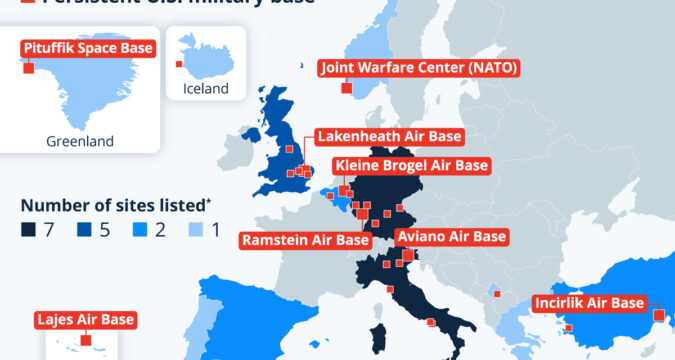
Where The US Has Military Footholds In Europe
Where The US Has Military Footholds In Europe
Since the beginning of his second term one year ago, President Trump has escalated his public campaign regarding his plans for acquiring Greenland, framing the autonomous Danish territory as a “national security necessity” due to its Arctic location, while the island is also rich in untapped mineral resources.
Trump’s rhetoric has ranged from offers to purchase the territory from Denmark, including a direct payment to its residents, to veiled threats of military intervention, having notably stated in early January: “We are going to do something on Greenland, whether they like it or not, because if we don’t do it, Russia or China will take over Greenland, and we’re not going to have Russia or China as a neighbor”.
That rhetoric appeared to peak last weekend and then drifted back into more diplomatic discussion after his flip-flop on possible kinetic action during his speech in Davos.
This push follows a pattern of assertive U.S. foreign policy, including the recent military raid in Venezuela to capture the country’s President Nicolas Maduro.
The U.S. already operates a permanent military base in Greenland: Pituffik Space Base, a Cold War-era installation now staffed by about 200 personnel, down from a peak of 10,000. The base is critical for missile defense and space surveillance, but Trump argues that full U.S. control is needed to deter Russia and China, despite existing defense agreements with Denmark that allow for expanded U.S. military presence.
As Statista’s Tristan Gaudiat notes in the map below, the U.S. also currently maintains over 50,000 troops across around thirty permanent bases in Europe (area of responsibility of the United States European Command), with important air hubs like Keflavik (Iceland), Ramstein (Germany) and Lakenheath (United Kingdom), or naval stations like Rota (Spain) and Souda (Greece).
These bases are not only tools of NATO deterrence but also leverage points for U.S. power projection around the globe.
You will find more infographics at Statista
Europe’s reliance on U.S. military infrastructure is a double-edged sword.
While European leaders have condemned Trump’s Greenland ambitions as “absurd” and a threat to NATO’s unity, some also recognize their dependence on U.S. bases and security support.
On the other hand, in response to Trump’s escalations, the EU and several member states could consider the possibility of restricting U.S. access to European bases – a move that could significantly hamper American operations in the Middle East and elsewhere.
Denmark, backed by the EU, has reaffirmed Greenland’s sovereignty and warned that any U.S. annexation attempt would “destroy 80 years of transatlantic security links”.
Furthermore, Denmark has boosted its Arctic defense budget and, alongside France, Germany and other European partners, has deployed small military contingents to Greenland for exercises, signaling unity and willingness to defend Arctic sovereignty.
Tyler Durden
Sun, 01/25/2026 – 08:45
https://www.zerohedge.com/military/where-us-has-military-footholds-europe

2026 Is The Year Of Balance Sheet Engineering In The Battery Storage Market
2026 Is The Year Of Balance Sheet Engineering In The Battery Storage Market
By Michael Kern of OilPrice.com
In the first quarter of 2026, the global energy storage market is no longer a playground for visionaries… it is a graveyard for the undercapitalized.
The data is rough. As of March 2025, QuantumScape sat on $860 million in cash against a trailing twelve-month burn rate of $331 million. This 2.6-year window is the “valley of death” made manifest in a ledger.
While the early 2020s were fueled by the speculative highs of SPAC mergers and theoretical energy density, the 2026 market has pivoted to “Balance Sheet Engineering.”
Success is now measured by manufacturing yield and the ability to exploit the U.S. Inflation Reduction Act (IRA) Section 45X.
The gap between a patent and a production line has become a chasm that physics and finance are struggling to bridge.
Lessons from the Liquidation Slow-Burn
The history of next-generation batteries is written in the records of bankruptcy courts. We see the “polysulfide shuttle” not as a chemical reaction, but as a financial sinkhole.
OXIS Energy, once the titan of Lithium-Sulfur (Li-S), entered administration in 2021 and spent four years in a liquidation slow-burn. Creditors were still waiting for “intended dividends” in September 2025. They received pennies for a dream that promised 550 Wh/kg but delivered fewer than 100 cycles before the chemistry ate itself.
Physics is indifferent to venture capital timelines… and physics usually wins.
Pellion Technologies attempted to harness the divalent power of Magnesium-Ion, offering theoretical density that dwarfed lithium. But magnesium ions move through solid hosts like sludge. When Khosla Ventures realized the drone market couldn’t fund the R&D required for automotive scale, they pulled the plug. Pellion is now “deadpooled.”
Not every failure ends in an auction of lab equipment. Ambri, the MIT-born liquid metal battery firm, utilized a Section 363 sale in 2024 to wipe its slate clean. By selling assets to a consortium led by Bill Gates’s Frontier fund, Ambri shed its legacy debt while keeping its calcium-antimony tech alive.
In energy finance, “failure” is a terminal event for the middle class… but it is merely a recapitalization event for the ultra-high-net-worth.
How Sodium Neutralized Lithium’s Edge
While Western startups navigate insolvency, China has executed a violent pivot to Sodium-Ion (Na-ion). This is the “Great Bifurcation” of 2026.
The Western strategy is a high-stakes bet on premium “leapfrog” technologies like Solid-State. The Chinese strategy is a brutal scale-up of the “good enough.”
In 2025, Lithium-Iron-Phosphate (LFP) prices in China crashed to $44/kWh due to massive overcapacity. Sodium-Ion, despite lacking the same scale, is hovering at $59/kWh.
LFP Cost (2025): $44–$52/kWh
Na-ion Cost (2025): ~$59/kWh
The Friction: Sodium is currently more expensive than the lithium incumbent it was meant to replace.
But cost is only half the story. Sodium-Ion represents a geopolitical hedge. By deploying Na-ion via brands like CATL’s “Naxtra,” China has effectively destroyed the pricing power of lithium miners. If lithium prices spike, the world’s largest manufacturer simply flips a switch to sodium.
The West is playing for performance… China is playing for control.
Subsidy Lifelines
For the survivors in the U.S., the business model is no longer about selling batteries—it is about harvesting tax credits.
Section 45X of the IRA has become the primary revenue driver for firms like Peak Energy and Lyten. The credit provides 10% of the production cost for “electrode active materials.” Because the legal definition is chemistry-neutral, it doesn’t matter if the cathode is made of expensive lithium or dirt-cheap Prussian Blue.
The Foreign Entity of Concern (FEOC) rules have created a “supply chain wall.” Because China controls 80% of the lithium refining capacity, standard Li-ion batteries are increasingly ineligible for U.S. consumer tax credits.
This has created a desperate demand for “FEOC-compliant” alternatives.
Sion Power: Secured $75M in Series A funding led by LG Energy Solution.
The Logic: LG isn’t buying a chemistry; they are buying a 50 Amp-hour large-format cell production line in Arizona that doesn’t rely on Chinese precursors.
The Shift: Hiring former GM executive Pamela Fletcher as CEO signals that the “science experiment” phase is over.
You don’t hire an automotive veteran to run a lab… you hire them to manage a supply chain.
A Solid-State Stalemate
If Sodium-Ion is the hammer, Solid-State is the ghost. Toyota, the undisputed leader in solid-state patents, has moved the goalposts again. Mass production, once promised for 2025, has been pushed to 2027 and beyond.
The technical friction remains the “yield” bottleneck.
Ceramic separators are brittle. In a laboratory, a 90% yield is a triumph. In a gigafactory, a 10% scrap rate is a financial death sentence. This is why companies like Solid Power have pivoted to a capital-light licensing model. They are letting BMW and SK Innovation take the hit on the CAPEX-heavy manufacturing while they collect royalties on the sulfide electrolytes.
The market has bifurcated into two distinct spheres:
The China-Sphere: Focused on LFP and Na-ion, driven by TWh-scale manufacturing and low-cost exports.
The Western-Sphere: Focused on High-Nickel and Solid-State, propped up by Section 45X subsidies and trade barriers.
The “PowerPoint Engineering” era is dead. The “Balance Sheet Engineering” era is here.
The winners of 2026 are not the companies with the highest theoretical energy density… they are the ones with the smartest tax lawyers and the highest manufacturing yields.
Tyler Durden
Sun, 01/25/2026 – 08:10
https://www.zerohedge.com/markets/2026-year-balance-sheet-engineering-battery-storage-market

Trump Slams Davos Elites Over “Green New Scam” As Climate Crisis Narrative Falls Apart
Trump Slams Davos Elites Over “Green New Scam” As Climate Crisis Narrative Falls Apart
President Trump used his time at the World Economic Forum in Davos, Switzerland, to denounce the globalists’ disastrous “Green New Scam” policies that have caused degrowth in parts of the West and helped spark an energy crisis with soaring power prices.
“You’re supposed to make money with energy, not lose money. Here in Europe, we’ve seen the fate that the radical left tried to impose on America,” Trump told the elites in Davos.
The Climate Hoax was created by the WEF Losers and President Trump just called them out to their faces.
“The United States avoided the catastrophic energy collapse which failed every European Nation that pursued the Green New Scam…perhaps the greatest hoax in History…” pic.twitter.com/Pq5mNDUKk6
— Liz Churchill (@liz_churchill10) January 21, 2026
Just a few years ago, Davos elites were betting big on solving their made-up climate crisis, which was used to loot taxpayers by diverting public funds into risky green energy companies and climate NGOs. But with Trump restoring common-sense energy policies centered on reliable fossil fuel power generation, and rolling back left-wing green policies that handed China and the East a competitive manufacturing edge, globalists were absolutely furious with the president this week.
Take, for instance, climate alarmist and grifter, Al Gore, on Tuesday booed Commerce Secretary Howard Lutnick during his speech at a VIP dinner in Davos.
The Financial Times reported the dinner “descended into uproar after combative remarks from Lutnick,” with European Central Bank President Christine Lagarde leaving the event early.
Gore’s behavior was just as embarrassing for the United States as Gov. Gavin Newsom’s bizarre behavior. The unhinged behavior of both Gore and Newsom – both leftist – in the public domain is merely a sign that Trump is winning against America’s left-wing.
Lutnick responded on X…
Thankfully, we didn’t come to Davos for Al Gore’s praise.
— Howard Lutnick (@howardlutnick) January 22, 2026
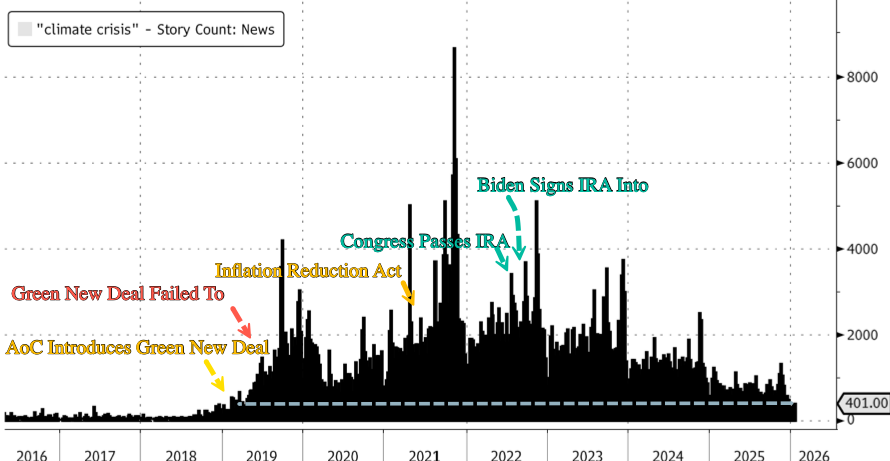
Let’s circle back to the so-called “climate crisis” narrative, which was merely an information operation to sway public sentiment polls to pass the controversial Green New Deal into law in 2019, but failed to gain legislative traction. Following that failure, corporate media helped set and amplify the narrative, unleashing what amounted to a broad psyop on the American public about a planet in crisis. Then Democrats were able to push through the Inflation Reduction Act, a massive climate and energy spending package signed by former President Joe Biden in 2022.
As shown in the Bloomberg data below, as soon as the climate bill was passed and taxpayer funds flooded the green industry and NGOs by the tens of billions of dollars, the narrative of the world on fire because of cow farts and Taylor Swift’s private jet almost disappeared.
Earlier today, Trump on Truth Social said, “Record Cold Wave expected to hit 40 States. Rarely seen anything like it before. Could the Environmental Insurrectionists please explain — WHATEVER HAPPENED TO GLOBAL WARMING???”
Of course, left-wing corporate media was furious with Trump …
Trump is correct about the climate crisis agenda and how it amounted to one giant “scam.” It served as a vehicle for Democrats to loot the Treasury, and the reckless spending that followed the IRA fueled the worst inflation storm in more than a decade, which Trump is now working to correct through common-sense energy policies that will bridge the power grid until reliable clean nuclear power comes online in the 2030s.
Tyler Durden
Sun, 01/25/2026 – 07:35

Bagdad afirma que procesará a milicianos de Estado Islámico trasladados de Siria a Irak
Por QASSIM ABDUL-ZAHRA y KAREEM CHEHAYEB
BAGDAD (AP) — Bagdad procesará y juzgará a los milicianos del grupo Estado Islámico que están siendo trasladados desde prisiones y campos de detención en la vecina Siria a Irak dentro de un acuerdo mediado por Estados Unidos, dijo Irak el domingo.
El anuncio del máximo órgano judicial de Irak se produjo tras una reunión de altos funcionarios políticos y de seguridad que discutieron la transferencia en curso de unos 9.000 detenidos de EI que han estado retenidos en Siria desde el colapso del grupo armado allí en 2019.
La necesidad de trasladarlos surgió después de que las nuevas fuerzas gubernamentales de Siria expulsaron el mes pasado a los combatientes liderados por kurdos sirios —que fueron los principales aliados de Estados Unidos en la lucha contra EI— de áreas del noreste de Siria que habían controlado durante años y donde custodiaban campos que albergaban prisioneros del grupo EI.
Las tropas sirias tomaron el extenso campo de Al-Hol —que alberga a miles de personas, principalmente familias de milicianos del EI— de la fuerza liderada por los kurdos, que se retiró como parte de un alto el fuego. Las tropas también tomaron el control el lunes pasado de una prisión en la ciudad nororiental de Shaddadeh, de donde algunos detenidos del EI habían escapado durante los combates. Medios estatales sirios informaron más tarde que muchos fueron recapturados.
Ahora, los enfrentamientos entre el ejército sirio y las Fuerzas Democráticas Sirias lideradas por los kurdos, han generado temores de que el EI active sus células durmientes en esas áreas y de que los detenidos de EI escapen. El gobierno sirio, bajo su acuerdo inicial con los kurdos, dijo que asumiría la responsabilidad de los prisioneros.
A Bagdad le preocupa especialmente que los detenidos del EI huidos se reagrupen y amenacen la seguridad de Irak y su lado de la vasta frontera entre Siria e Irak.
Una vez en Irak, los prisioneros del EI acusados de terrorismo serán investigados por las fuerzas de seguridad y juzgados en tribunales nacionales, dijo el Consejo Supremo Judicial de Irak.
El ejército de Estados Unidos comenzó el proceso de transferencia el viernes con los primeros prisioneros del EI trasladados de Siria a Irak. El domingo fueron transferidos otros 125 prisioneros, según dos funcionarios de seguridad iraquíes que hablaron con The Associated Press bajo condición de anonimato de acuerdo con las regulaciones.
Hasta ahora, 275 prisioneros han llegado a Irak, un proceso que los funcionarios dicen ha sido lento ya que el ejército de Estados Unidos los ha estado transportando por aire.
Tanto Damasco como Washington han acogido con satisfacción la oferta de Bagdad de trasladar a los prisioneros a Irak.
El parlamento de Irak se reunirá más tarde el domingo para discutir los acontecimientos en Siria, donde sus fuerzas gubernamentales están presionando para aumentar su presencia a lo largo de la frontera.
Los combates entre el gobierno sirio y las FDS se han detenido en su mayoría con un alto el fuego que se extendió recientemente. Según el Ministerio sirio de Defensa, la tregua se extendió para apoyar la operación de transferencia en curso por parte de las fuerzas estadounidenses.
El grupo Estado Islámico fue derrotado en Irak en 2017, y en Siria dos años después, pero las células durmientes del EI aún llevan a cabo ataques mortales en ambos países. Como un aliado clave de Estados Unidos en la región, las FDS jugaron un papel importante en la derrota de EI.
Durante las batallas contra el grupo, miles de extremistas y decenas de miles de mujeres y niños vinculados a ellos fueron capturados y retenidos en prisiones y en el campo de Al-Hol. El extenso campo de Al-Hol alberga a miles de mujeres y niños.
El año pasado, las tropas estadounidenses y sus combatientes socios de las FDS detuvieron a más de 300 milicianos de EI en Siria y mataron a más de 20. Una emboscada en diciembre por milicianos del EI mató a dos soldados estadounidenses y a un intérprete civil estadounidense en Siria.
___
Chehayeb informó desde Beirut.
___
Esta historia fue traducida del inglés por un editor de AP con la ayuda de una herramienta de inteligencia artificial generativa.

Column: Random thoughts on a budding Chicago sports bromance and other hot topics
Random thoughts while waiting on the release of the new Super Bowl commercials.
The sight of Cubs star Pete-Crow Armstrong and Bears star Caleb Williams hanging out together at the Blackhawks and Bulls games was a nice way to portray Chicago as the biggest small town in America. Los Angeles has its Hollywood culture and New York is the media center of the world, but nowhere are the local sports stars as big a deal as they are in Chicago.
It’s nothing new, of course. Chicago’s stars have always supported each other. When the Bears played at Wrigley Field, Bobby Hull was a season ticket holder, and Billy Williams used to get tickets for games from Bears receiver Dick Gordon.
The budding bromance of Crow-Armstrong and Williams should last a long time, or at least until the Cubs and Bears sign them to massive deals.
One of the primary requisites of the job of commissioner of a major sports league should be the ability to project strength. But the commissioners of the NFL, NBA, NHL and Major League Baseball are all weaklings, as evidenced by a report from The Athletic that Roger Goodell, Adam Silver, Gary Bettman and Rob Manfred will meet with President Donald Trump to help promote America 250, a celebration of the country’s 250th birthday.
While Trump’s jackboots instill fear in Minneapolis, Chicago and other American cities, and he embarrasses the country on the international stage, these four pretend leaders will be posing for photo-ops in the Oval Office and pretending all is right with the country. None of them has the courage to speak out against what’s happening in America.
Lucky for them, they’re only beholden to the billionaire owners of their league’s teams, not the average fans who support their respective sports.
ESPN’s Pat McAfee has always appealed to the lowest common denominator, so it’s no surprise the clueless commentator is taking on unidentified media members who point out his lame frat boy act, calling them “fat … lazy nerds” on his TV show.
McAfee also tweeted that sports journalists “hate what sports are for people (happiness). They hate what sports are for society (unifier) … they’re political journalists by nature who’ve preyed on sports because they saw it as an easier path to ‘make it.’ Their days are numbered … my show being broadcasted on ESPN 10 hours a week with ZERO creative say from any ‘journalism school’ puppets is living proof of that.”
Actually, the audience of McAfee’s show is relatively tiny, or else it would be in a better time slot than in the early afternoon, when everyone else is working. He’s already wearing thin on college football fans, and sooner or later the ratings will slide and ESPN will pull the plug and send him off to UFC analysis, where he belongs.
Illinois guard Keaton Wagler, left, drives past Purdue guard Fletcher Loyer during the first half Saturday, Jan. 24, 2026, in West Lafayette, Ind. Wagler scored 46 points in the Illini’s 88-82 win. (Michael Conroy/AP)
Illinois is having another stellar season, thanks to a deep team led by freshman Keaton Wagler. The 11th-ranked Illini are 17-3 after Saturday’s 88-82 road win over Purdue and in contention for the Big Ten title.
And when the Illini are winning, coach Brad Underwood is at his most ornery, as when he recently sparred with an Illinois reporter who praised Tomislav Ivišić for a good game against Northwestern despite what he called an “up-and-down season.”
“You guys say he’s been up and down,” Underwood shot back. “I just say his role changed. You guys create more damn narratives that are full of (bleep). That’s what he does. That’s why he’s been on draft boards. He’s big and can shoot the cover off of it. … No one has ever doubted Tommy.”
Love him or hate him, Underwood is never afraid to speak his mind.
Kudos to White Sox general manager Chris Getz for immediately spending the $20 million he saved by dumping Luis Robert Jr.’s contract, signing reliever Seranthony Dominguez to a two-year, $20 million deal. Now maybe he can move Grant Taylor into the rotation where he belongs.
Mike Berman was a professional and a hardworking sports reporter willing to work long hours at NBC-5. A Glenbrook North alumnus who grew up rooting for Chicago teams, he did his job for 10 years without calling attention to himself. His work spoke for itself.
Berman, who was let go by the station last week, deserved a better fate. Hopefully he winds up on another local station that will appreciate his work ethic.
Terry Boers, who died Friday at age 75, was remembered by most as a radio host and an original member of The Score. But he was also a great newspaperman. Boers and I competed on the Illini basketball beat for one season back in the early 1990s, when he was still at the Chicago Sun-Times. He was as good a beat writer as there was and handed me my lunch on many occasions.
Boers eventually found his way to radio, where he could put his brash personality into his job. He became a legend at WSCR-AM 670, along with the other originals such as Mike North, Tom Shaer and Dan McNeil. There will never be another quite like Boers, which is why his death has brought so many tributes from colleagues.
Manager Craig Counsell speaks during the Cubs Convention on Jan. 17, 2026, at the Sheraton Grand Chicago Riverwalk. (John J. Kim/Chicago Tribune)
Cubs manager Craig Counsell is a Green Bay Packers fan, but he assured the media he is not a Bears hater. “Look, I grew up a Packers fan for sure,” he said before the Cubs Convention. “The Bears have struggled for a while, and so when a team hasn’t done well for a whole and starts to do well, you see what it does to a city. You feel it. That part of me knows what it’s doing for the city, and you root for that a little bit.”
Asked who would be booed more in the Milwaukee Brewers ballpark — him or Bears coach Ben Johnson — Counsell cracked: “He’s catching up, isn’t he? He is. I’ll send him a (thank-you) note about that.”
It’s a tough call, but my guess is Counsell is still Public Enemy No. 1 among cheeseheads.
https://www.chicagotribune.com/2026/01/25/chicago-sports-caleb-williams-pete-crow-armstrong/

Hannah Hidalgo dominating on both ends of the court for Notre Dame — and in the record book
Hannah Hidalgo loves to watch film.
The two-time Notre Dame All-American not only studies it to see how teams could try to guard her but also to find tendencies for opposing players so she can get steals.
It has paid off, as the star guard leads the country with 5.5 steals per game while averaging 24.6 points — third in the nation.
“I watch and see how the point guard or ball handler handles the ball,” Hidalgo said in a phone interview Friday. “If they are a great ball handler, knowing how to time my steals correctly. I always try to strike fear into the ball handler any time they see me guarding them.”
Guard Hannah Hidalgo talks with Notre Dame forward Gisela Sanchez (30) and guard Iyana Moore (23) in the second half against UConn on Jan. 19, 2026, in Storrs, Conn. (AP Photo/Jessica Hill)
Hidalgo’s diligence has paid off. She took over the top spot in the Notre Dame record book, passing Irish great Skylar Diggins as the program’s career steals leader Thursday night in a comeback win over Miami. She has 388 in her career, seven more than Diggins. Hidalgo moved into 50th all time in Division I history.
“She has an innate ability, she loves defending,” Notre Dame coach Niele Ivey said. “She’s always been like that. She’d rather get steals first more than anything. I think it’s a gift. She’s so instinctive, she’s so fast. She has quick hands and feet. She’s aggressive and feisty. Now that she’s older, she’s got the IQ part of learning players’ habits.”
Hidalgo is one of the best two-way guards in the country, able to affect the game on both ends of the court.
She became the fastest player in Fighting Irish history to reach 2,000 points when she scored 27 in the victory Thursday. She needed only 86 games to do it — blowing past the previous best of 109 set by Beth Morgan. She also broke the ACC record by three games, passing Ta’Niya Latson (Florida State) and Barbara Kennedy (Clemson).
“She’s been so pivotal in our success the last couple years,” Ivey said. “She’s blossomed in college. To come on the stage as a freshman and impact the game the way she has is pretty phenomenal. She’s consistently getting better every year.”
It’s not just the scoring. Hidalgo also is an excellent passer and knows that she can help get good opportunities for her teammates.
“I know the impact I have for my team,” she said. “I think when it comes to taking over to the game, it’s not just scoring, but creating for other players. Do whatever my team needs me to do.”
It’s not just what she has done on the court for Notre Dame. Ivey has seen the junior guard improve her leadership this season.
“She’s being that vocal person for us, being that messenger,” Ivey said. “Being an extension of me on the court. She holds herself accountable. Being a leader, that’s what she really worked on.”
Hidalgo said she has made a concerted effort to get to know her teammates better off the court.
“I think for me it was being more intentional to know players outside of basketball,” she said. “Being more intentional, checking in on players during the summer time. Go out and eat with them, take them out to games. Connecting with them off the court.”
Up next: vs. Clemson, 2 p.m. Sunday, ACC Network Extra
https://www.chicagotribune.com/2026/01/25/hannah-hidalgo-dominating-notre-dame/