Category: News
Novak Djokovic avanza a cuartos del Abierto de Australia tras retiro de Jakub Mensik
Por JOHN PYE
MELBOURNE, Australia (AP) — Novak Djokovic avanzó a los cuartos de final del Abierto de Australia sin jugar después de que Jakub Mensik se retirara 24 horas antes de su partido programado de cuarta ronda debido a una lesión abdominal.
El torneo confirmó la retirada de Mensik el domingo por la noche. El partido estaba programado para el lunes por la noche en la Rod Laver Arena.
“Después de los últimos partidos, comencé a sentirme peor, y en realidad el problema es mi músculo abdominal en el lado izquierdo”, comentó Mensik en declaraciones publicadas por el torneo. “Como dije, en los últimos partidos empeoró significativamente, y creo que si mañana saliera a la cancha, sería un gran riesgo para mí en las próximas semanas, para mis próximos torneos y, en realidad, para mi salud”.
Mensik, cabeza de serie número 16, venció a Ethan Quinn en sets corridos el sábado. Fue el segundo jugador en retirarse antes de un partido debido a una lesión abdominal en tantos días, después de que Naomi Osaka informara que no disputará su partido de cuarta ronda el sábado por la noche.
Novak Djokovic ha ganado el Abierto de Australia un récord de diez veces y tiene 24 títulos de Grand Slam.
Se convirtió en el primer jugador en alcanzar 400 victorias en individuales de Grand Slam cuando venció el sábado en la tercera ronda por 6-3, 6-4, 7-6 (4) a Botic van de Zandschulp.
Djokovic estará contento con una noche libre mientras continúa afinando su intento de poner fin al dominio de Carlos Alcaraz y Jannik Sinner que han ganado todos los majors en los últimos dos años.
El exnúmero uno del mundo de 38 años ganó su último título de individuales de Grand Slam en 2023. Alcanzó las semifinales de los cuatro eventos de Grand Slam el año pasado, pero no llegó al partido por el título en ninguno.
Después de su victoria en la tercera ronda aquí, Djokovic dijo que el dos veces campeón defensor del Abierto de Australia, Sinner, y el joven de 22 años Alcaraz están “jugando a un nivel diferente en este momento (pero) todavía estoy tratando de darles a estos jóvenes una carrera por su dinero”.
Con su victoria en la primera ronda sobre Pedro Martínez, Djokovic igualó dos récords históricos del tenis al comenzar su 21mo Abierto de Australia y su 81er evento de Grand Slam, y añadió otro hito con su victoria número 100 en Melbourne Park.
Eso lo convirtió en el primer hombre en ganar 100 o más partidos en tres superficies en los Grand Slams, con sus 102 en césped en Wimbledon y 101 en arcilla en Roland Garros.
___
Deportes AP: https://apnews.com/hub/deportes
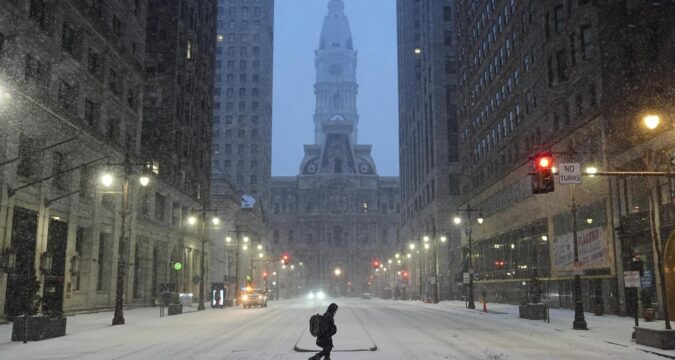
Tormenta invernal masiva en EEUU trae hielo, temperaturas gélidas y cortes de energía generalizados
Por KATE BRUMBACK y JULIE WALKER
Una enorme tormenta invernal continuó el domingo por la mañana, arrojando aguanieve, lluvia helada y nieve a lo largo del sur de Estados Unidos y hasta Nueva Inglaterra, causando temperaturas gélidas, cortes de energía generalizados y condiciones peligrosas en las carreteras.
Se espera que el hielo y la nevada continúen hasta el lunes en gran parte del país, seguidos de temperaturas muy bajas, lo que provocará que los “impactos peligrosos en los viajes y la infraestructura” persistan durante varios días, informó el Servicio Meteorológico Nacional.
Se pronosticó nieve intensa desde el Valle de Ohio hasta el noreste, al tiempo que una “acumulación catastrófica de hielo” amenaza con registrarse desde el Valle del Bajo Mississippi hasta el Atlántico Medio y el sureste del país.
“Es una tormenta única en el sentido de que es muy extensa”, afirmó en una entrevista telefónica la meteoróloga Allison Santorelli, del Servicio Meteorológico Nacional. “Estaba afectando áreas desde Nuevo México y Texas hasta Nueva Inglaterra, así que estamos hablando de una extensión de unas 2.000 millas (3.218 kilómetros)”.
Hasta la mañana del domingo, alrededor de 213 millones de personas estaban bajo algún tipo de advertencia de clima invernal, señaló. El número de clientes sin electricidad se acercaba a 840.000, según poweroutage.us, y la cifra seguía aumentando.
Tennessee fue el estado más afectado, con más de 300.000 clientes sin servicio, y Texas, Luisiana y Mississippi reportaron más de 100.000 clientes a oscuras.
Más de 10.000 vuelos ya habían sido cancelados el domingo y otros 8.000 se habían retrasado, según el rastreador de vuelos flightaware.com. Los aeropuertos más afectados hasta ahora son los de Filadelfia, Washington, Raleigh-Durham en Carolina del Norte, Nueva York y Nueva Jersey.
En el Aeropuerto Internacional de Filadelfia, las pantallas interiores registraban decenas de vuelos cancelados y se podían ver pocos vehículos llegando el domingo por la mañana.
Incluso una vez que el hielo y la nieve dejen de caer, el peligro continuará, advirtió Santorelli.
“Detrás de la tormenta, simplemente hará un frío amargo en prácticamente los dos tercios orientales de la nación, al este de las Montañas Rocosas”, subrayó. Eso significa que el hielo y la nieve no se derretirán tan rápido, lo que podría obstaculizar algunos esfuerzos para restaurar la energía y otra infraestructura.
El presidente Donald Trump había aprobado declaraciones de emergencia para al menos una docena de estados para el sábado, y se esperan más. La Agencia Federal para el Manejo de Emergencias (FEMA, por sus siglas en inglés) preposicionó suministros, personal y equipos de búsqueda y rescate en varios estados, dijo la secretaria de Seguridad Nacional, Kristi Noem.
En la ciudad de Nueva York, el alcalde Zohran Mamdani informó que al menos cinco personas murieron debido al desplome de las temperaturas el sábado, antes que llegaran las nevadas con fuerza.
“Aunque aún es pronto para determinar las causas de muerte, es un recordatorio de que cada año los neoyorquinos sucumben al frío”, escribió en X. “El peligro de este clima es innegable”.
El demócrata también anunció que el lunes será un día de clases a distancia para los estudiantes del sistema escolar más grande del país.
En Nashville y el área circundante se reportan acumulaciones de hielo de media pulgada o más, con carámbanos colgando de las líneas eléctricas y ramas de árboles sobrecargadas cayendo al suelo.
“Típicamente decimos que una vez que se empieza a ver aproximadamente media pulgada de hielo, es cuando se empieza a ver cortes de energía más generalizados”, indicó Santorelli.
La policía de Oxford, Mississippi, usó las redes sociales el domingo por la mañana para exhortar a la población a quedarse en casa, ante el grave peligro de estar afuera. Las cuadrillas de servicios públicos locales también suspendieron sus actividades durante la noche.
“Debido a las condiciones que ponen en riesgo la vida, Oxford Utilities ha tomado la difícil decisión de retirar nuestras cuadrillas de la carretera por la noche”, publicó la compañía de servicios públicos en Facebook la madrugada del domingo.
“La situación es actualmente demasiado peligrosa para continuar”, explicó. “Los árboles se rompen y caen alrededor de nuestros trabajadores cuando están en lo más alto de los camiones. Simplemente no podemos despejar las líneas eléctricas más rápido de lo que caen las ramas”.
Las carreteras heladas también hicieron que viajar fuera peligroso en el norte de Georgia.
“¡Uno sabe que la situación está mal cuando Waffle House está cerrado!!!” publicó en Facebook la policía del condado Cherokee con una foto de un restaurante cerrado. El hecho de que los restaurantes de la cadena estén abiertos se ha convertido en una forma informal de medir la gravedad de los desastres climáticos en el sur –lo que se conoce como el Índice Waffle House.
___
Brumback reportó desde Atlanta. Walker desde Nueva York. Kristin Hall y Jonathan Mattise desde Nashville. Jeff Martin contribuyó a este despacho desde Kennesaw, Georgia.
___
Esta historia fue traducida del inglés por un editor de AP con la ayuda de una herramienta de inteligencia artificial generativa.

Repricing Sovereignty
Repricing Sovereignty
Authored by Mark Jeftovic via BombThrower.,com,
Personal Freedom In The Age of Mass Compliance
What follows are a couple of excerpts from the last Bitcoin Capitalist Letter, which was a long-form piece that was a refinement of my overall long term investment thesis. It corrects for my biggest mistake in the previous model: the belief that nation states were in secular decline, and centralized government power was waning.
This may be true for the long haul, but for the next five, ten, twenty years – we’re heading into an era that numerous commentators have been identifying, and I’m looping under umbrella “State Capitalism”.
More specific to our “Great Bifurcation” thesis, what this really means is State Capitalism for the “haves” and mass compliance and (the warmth of?) collectivism for the permanent underclass. UBI is coming out of necessity, and anyone who thinks that isn’t going to be some permutation of social credit (most likely based on personal carbon footprint quotas) is ngmi.
Late Stage Globalism
A paper I came across recently was Nicolas Colin’s Late-Cyle Investment Theory, which came out in June ’25 but Colin was recently a guest on Hidden Forces.
Colin’s paper posits that we are entering the maturity phase of the computer/networking information age.
What got my attention, both from the podcast interview with Demetri Kofinas and then as I read through the paper itself, is how it explains the mechanisms by which late-cycle dynamics force governments toward what we’ve described last edition, a global march toward a kind of “state capitalism” and that “uncomfortable reality I have been grappling with for a few months, that The State and The Economy are in the process of merging”.
We’re seeing a kind of inexorable slide into state-directed capital allocation; it’s taking forms peculiar to its cultural backdrop but it’s happening all over the world.
Russell Napier calls it “National Capitalism”; he also appeared on Hidden Forces a year ago and we covered it in the December ‘24 edition.
WEF luminaries like Marianna Mazzacuto – wholly in favour of the trend – calls it “The Entrepreneurial State”; Tyler Durden over at Zerohedge calls the American expression of it “WHAM” – White House Asset Management.
My favourite version of it is George Gilder’s “Emergency Socialism”, because it captures the exigencies that are making this a priority among governments worldwide.
Colin is somewhat unique in that he argues high public debt isn’t a policy mistake but a structural feature of technological maturity (not sure I agree, tbh).
As he puts it, governments continue borrowing as if the previous growth regime still applies, even as productivity gains plateau and returns diminish.
The numbers are stark:
US public debt at 122% of GDP (255% including private sector)
France at 112% (300% total)
Japan exceeding 260% public (400% total).
Not mentioned in his paper, but I’ll add that Canada’s total government debt (all levels) is 120%, and our private debt on its own is north of 200%.
These levels dwarf anything seen during the 1970s inflation.
The options, as Colin lays them out, are brutally limited, and this shouldn’t come as a surprise to any of us here.
Governments cannot meaningfully raise taxes, any increases can only be performative and symbolic. Those who pay the lion’s share of them have already demonstrated a willingness to relocate if the “tax the rich” slogans translate into excessive action (we’re already seeing anticipatory exoduses from New York City as Mamdami comes in threatening full-on socialism).
Nor can governments cut spending, because various entitlement programs dominate budgets.
Colin thinks that they can’t outgrow the debt because technological maturity means slower productivity growth, which is the core of his thesis.
He may be right, but I don’t think governments believe that – they are looking at AI to ignite a productivity boom that can outpace the debt bubble.
Whether Colin is correct, or governments believe their own mantra about a productivity miracle in the offing, both roads lead to the same place:
There is only one politically viable path, and that is inflation.
“Run it hot”, basically.
But here’s where Colin’s analysis dovetails with our thesis: inflation has consequences.
As prices rise and real rates fall, voluntary demand for government bonds evaporates (this is why we’ve been seeing yields on sovereign debt spiking higher for over a year).
The one common denominator from those we’ve mentioned above (Colin, Napier, Gilder) is that the most likely outcome is financial repression: policies that force domestic savings into public debt through capital controls, regulatory mandates, and banking rules.
This is the merger of the state and capital that I’ve been warning about. It is a type of financial repression, but the quiet bureaucratic kind where your pension fund must hold treasuries, where capital controls prevent you from moving wealth offshore, where the rules of the game are systematically rigged to channel private savings toward public obligations.
Colin frames this as part of a broader institutional fragmentation. Trade wars, he notes (citing David Skilling), are precursors to capital wars.
States that once relied on global capital markets increasingly treat capital as a strategic resource (hence the advent of things like “Strategic Bitcoin Reserves” – my comment, not his).
The open, rules-based order many still assume to be in place is actively unravelling.
Napier talked about all this a year ago and never once uttered the word “Bitcoin”, let alone crypto.
Colin, for his part, sees crypto and stablecoins as part of the emerging new financial system (sound familiar?), and what’s fascinating is how this all maps onto The Stablecoin Standard thesis we’ve been developing.
He sees dollar-backed stablecoins as America’s attempt to extend monetary hegemony into the digital age, essentially creating a new channel for petrodollar-style recycling where foreign demand for USDT and USDC indirectly finances US government debt.
No surprise here, but it contains an inherent tension: stablecoins work precisely because they route around traditional banking, yet that same feature makes them harder to control when geopolitical pressures mount.
The implication for us is clear and it emerges in a kind of “Barbell trade” portfolio that both recognizes the reality of State Capitalism while also hedging for it via the simultaneous emergence of a parallel system (more on this below).
The big wake-up call for me, is that The State Is “The House”. I’ve spent most of my adult life thinking that it was on its last legs, that at some point a Geopolitical Minsky Moment would demolish the entire scaffolding, and then sound money and free markets would assert themselves.
I was wrong. I’ve now realized that.
The general public will never not believe in the legitimacy of “The State” (even though they may dispute who currently occupies the machinery). It’s baked in since childhood – and it won’t matter that their leaders debase the currency, leach away their wealth, send their children to die in turf wars or even load their neighbours into boxcars. The masses will always believe that The House is legitimate, inevitable and necessary.
With all that said, I still do think that there will be a geopolitical Minsky moment, a kind of global, macro “force majeure” that resets the table, simply because the fiat currency system is well past its “use by” date – but make no mistake, the only thing that happens to The House in the aftermath is that some other faction takes over the lease. And the masses will then dutifully follow the new boss.
The only antidote to this is on the individual level. Independent thinking and independent wealth. That’s it.
If you have a compassionate streak and you want to help the masses or uplift the poor, you have one way to do it: give them the means, motive and opportunities to lift themselves at an individual level – education, mentorship, motivation, angel investing, scholarships, introductions.
One may ask what the exact change in thesis is; if we’re still long Bitcoin, we’re still invested in what we think is the emerging new financial system, we’re still long picks and shovels.
Before we get to it, we have to put a couple more pieces on the table.
The picture we see emerging is this:
Increasing numbers of plebs are “checking out” of the system, trying to degen their way to wealth, and not even bothering to vote for a system that has essentially abandoned them (referring to our write up on The Prison of Financial Mediocrity in the full edition)
AI is killing not only jobs, but entire career paths. UBI is moving past being part of the conversation – I expect 2026 to be a pivotal year in turning it into reality in multiple jurisdictions.
Whoever still believes there’s a functioning system in place, does so for the simple reason that they are banking on it to save their asses: hence the growing populist surge on both sides of the political spectrum – but “democratic socialism” and collectivism seem to hold characteristically peculiar attraction for vast swaths of the public.
The final piece in all this is the unrelenting crack-up of the global financial system itself and the geopolitical scaffolding that, until recently, seemed immutable.
I reiterate my old prediction that Donald Trump will be the penultimate president of the United States as they are understood today. Whoever comes after will be the last. And then the US will morph into something else, similar to the breakdown of the USSR in the early 90s.
The same is happening in Canada – where there are now three separatist movements: Quebec, Alberta and now Saskatchewan.
it’ll be more like this pic.twitter.com/Sx4ixGUlOt
— Mark E. Jeftovic (@jeftovic) January 19, 2026
The Eurozone will likely crack up under its own internal tensions and secessionist movements are poised to gain momentum the world over.
How do we reconcile that with an era of Big Government and State Capitalism?
There will simply be more states: a multi-polar world, and different jurisdictions will govern with varying levels of heavy-handedness and interventionism.
Singapore, for example, is for all intents and purposes an authoritarian enclave – under the singular rule of the People’s Action Party since independence, and everybody who lives there seems fine with that. The trains run on time, there are very low levels of corruption and street crime is practically unheard of.
They’ll cane you for chewing gum in the subway (harsh? Try riding the TTC in Toronto without getting stabbed by a mental patient), and they’ll execute you for serious crimes, but there are no “immigration discounts” on sentencing (in November, two men were hanged for trafficking heroin, one a Singaporean, the other, Malaysian).
Singapore is no libertarian paradise, but there is also pretty well zero possibility that any purple-haired Trantifa berserkers are going to shoot up your kid’s school, or that some liberal arts soy-boy in a keffiyeh will smash your face in with a brick on New Year’s Eve.
So there’s that.
Parag Khanna, in his elite-class best-seller “Technocracy In America: Rise of the Info State”, said the governance model of the future should be some manner of Swiss-Singapore hybrid. I remember being both bemused and mortified when I first read that (it came out in 2016) …in the intervening years, I find myself thinking we may do OK with a touch of both:
“What model should post-authoritarian or newly democratic societies pursue: Swiss-style organic economic diversification or Singapore-style managed innovation?
The answer is both. Having lived for stretches in both these small countries, I’ve come to see that despite their enormous differences, what matters most is that Switzerland and Singapore are both verifiably democratic and rigorously technocratic at the same time.”
Khanna cites Harvard’s Michael Porter and Richard Rosecrance, who forecasted an emergence of a “market state” era.
Also,
“business strategist Keniche Ohmae, in his book The Next Global Stage (2005), argued that urban agglomerations of city-states resembling the medieval Hanseatic League would become the world’s power centers.”
When you take a step back, it’s not that different from the mosaic of competitive (not combative) sovereignties posited back in The Sovereign Individual (or, Snow Crash).
It just turns out that Khanna arrived as a similar conclusion from a different angle. If I’m honest, my initial reaction to it probably owed much to Khanna’s involvement with the WEF.
As a recent guest on the Canadian Bitcoiners Podcast once quipped, almost off-handedly, “the wealthy never suffer in any society”.
In places like Singapore – and the innumerable micro-sovereignties that will spring up over the coming years – there will be due process and basic rights (Singapore has a constitutional guarantee on free speech, with a lot of escape hatches for the government in cases of public order, hate, etc. – the same thing is happening here in Canada, and around the world).
But realistically, it will probably take deep pockets to be able to exercise those rights. In Canada we have an expression to describe what happens to property owners who use deadly force against violent home invaders, “The process is the punishment”.
It means if your door gets kicked in by some low-IQ imports who are already out on bail for doing this previously, and you blow their heads off with a legally owned shotgun, you will be charged and forced to stand trial. After a few years, and several hundred thousand dollars in legal fees, you’ll likely prevail in court. If you don’t have the resources to fight that battle, you’ll take a plea deal and spend some time behind bars with exactly the same types of people you just defended yourself against.
Remember our maxim: “In the future, it’ll be a lot more expensive to be free”.
Meanwhile, the bottom tiers of the wealth pyramid across most jurisdictions (the permanent underclass) are going to embrace collectivism, populism and wind up with varying degrees of authoritarianism.
The Post-Singularity Stack and the SoS Portfolio
This is the tightest wrapper I could come up with for everything I’ve been trying to set out in this issue.
Due credit goes to Addison Wiggin, from the Grey Swan Fraternity, who recently put out a piece entitled “Repricing Legitimacy”. It touches on many of the same themes we’re monitoring here: the widespread disaffection of the younger generations, and the loss of faith in legacy institutions – albeit, as we’ve noted above, somewhat ironically juxtaposed with a renewed enthusiasm for Big Government and even collectivism.
“Our job isn’t to pick a slogan or a side. It’s to recognize where legitimacy is being rebuilt, where it’s being faked, and where it’s quietly draining away.
Revolutions without plans tend to end in terror and sorrow. Systems without trust eventually seize up.
Cycles don’t care what we believe. They respond to balance. And balance, right now, is being renegotiated almost everywhere at once.“
Drawing on source material mentioned earlier, plus a few others:
Viktor Shvets’ “Twilight Before The Storm”
Jeffrey Towson’s “What Would Ben Graham Do Now?”
Daniel Bell’s “The China Model”
The common theme seems to be that they are books which filled me with revulsion and dread the first time I read them.
Shvets’ thesis is point blank: the old neoliberal capitalist consensus has collapsed and no new model has yet emerged, but all indications are that it’ll include some kind of socialism (my extension on this is that we’re headed for a two-tier system of techno-socialism for the masses, and state capitalism for the asset holders).
If you hear Shvets on any interviews, he usually blames the markets for breaking down – saying, in effect, that “the market model has been discredited”. I would beg to differ, saying that the market functioning has been completely coopted by government interventionism and fiat debasement, but at the end of the day it doesn’t matter. The dysfunction is real.
He makes frequent references to something called the “Fujiwara Effect”, a meteorological term for when multiple hurricanes converge into a single, humongous, cataclysmic storm. The analogy here is the compounding of multiple negative cycles: financial, with the debt bubble; technological, with the existential disruptions coming from AI – and he also puts “climate change” in there, which I actually view as the one thing we don’t have to worry about, at least not now.
It’s still a fitting term for what we’re headed into: some kind of transition that won’t be incremental, but “rupture”-like.
Towson, whose book is over a decade old, reframed value investing as not only a game of mental chess with “Mr. Market”, but as one where “Mr. Government” had entered the chat. Investors and entrepreneurs would henceforth have to take the ever-increasing regulatory and ideological biases of The State into account when making their allocation decisions.
Daniel Bell himself defended criticisms that he was extolling a China-style command economy, which he maintains he was not, but that the point of his book was that nobody can dispute China’s results in operating that way. It works. Or at least it did (they too, have an enormous, untenable debt bubble, just like everybody else).
If there is a common aspect to these models it’s that policy starts to crowd out price discovery.
We’ve been dancing around this realization for a long time; this is what I’ve been intuiting every time I said that shorting anything was a fool’s errand because markets are now structurally hardwired to go up – more so than at any other time in history.
That’s fiat debasement at work, and it puts the entire universe of assets on an escalator, and from there it’s a matter of picking what will outperform the rate of decay in our denominators.
Tyler Durden’s phrase “White House Asset Management” (WHAM) is telling us that intrinsic value is now a political function, at least partially so. Imagine being short MSTR only to wake up some morning and find out that Trump put out a tweet during his morning dump announcing that the US government just took a 10% stake in MSTR, MARA and HUT/ABTC.
Nobody should be surprised if that happens. Not anymore
For many years I’ve taken pains to chart a largely libertarian, if not anarcho-capitalist path, the crux of which was trying to conduct myself with no regard to who was in power or which party formed the government.
I basically tried to tune out The State. I’ve conceded that it’s become much harder to do that since COVID, but I was still making my investment and capital allocation decisions from a market forces perspective.
And that is what is changing now. Our overall thesis may be unperturbed: The Great Bifurcation, Monetary Regime Change, etc. – but I am now grudgingly acknowledging that The State is going to impact our economic calculus more than I’d care to admit.
Those above-mentioned books which filled me denial and dread when I first read them, I’m now re-reading to adjust my investment theses around them.
I’m not exactly happy about it, but here we are…
Let’s talk SOS (Sovereign vs Serfdom):
If we’re going to stipulate that The State, “Mr. Government” (or “Mr. Regime” as I began to frame it mentally) is now part of the calculus, one of the places to start is to look at the largest economy in the world – The United States – and look at what its stated, national strategic objectives are.
The “economic security” objectives include: critical supply chains (logistics) and materials, energy dominance, reviving the defence industry, and growing financial sector dominance.
We know that energy dominance doesn’t mean windmills and solar, it means nuclear, oil, and natgas.
We also know that financial sector dominance will have Bitcoin, blockchain, crypto and stablecoins baked in.
And, big surprise, more military spending.
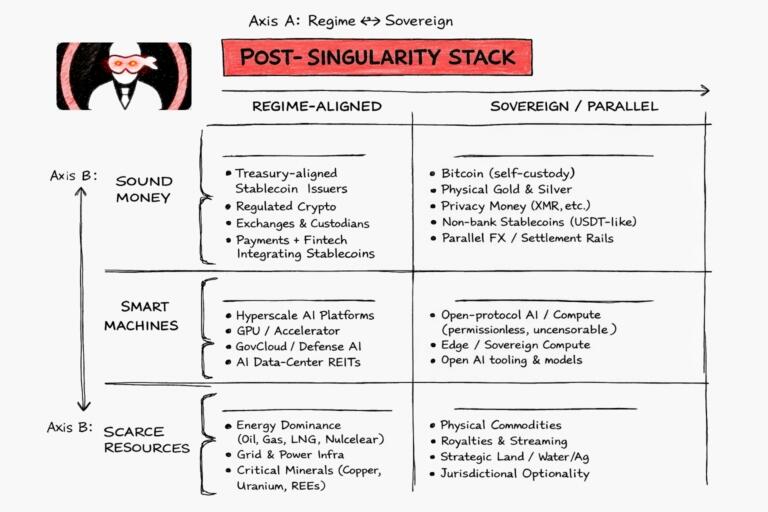
When I looked at all this and realized that all major powers are jockeying around these same themes, what came to mind for me was a kind of barbell positioning between “Mr. Regime” and a Parallel System (including “freedom tech”) across two axes:
Axis A: Serfdom vs Sovereign
Regime-aligned: are companies and assets that directly benefit from various national security strategy priorities (energy dominance, reindustrialization, defense industrial base, financial/AI leadership).
Sovereign / Parallel: Bitcoin, gold, privacy, decentralized rails and jurisdictions that hedge State Capitalism and what I sometimes call the “monetizing serfdom” trade.
These are positions that get us through whatever this is happening right now and over the next five to ten years.
Axis B: The “Post-Singularity” stack
Sound Money: Bitcoin, precious metals, future fintech
Smart Machines: AI / HPC / Big Data
Scarce Resources: energy, metals, base commodities
These are the companies and resources ushering in or underpinning “what comes next”.
Putting it all together
I touted this edition as a “major revision to the thesis”, however as I worked my way through it, what became apparent to me was that not a lot had changed within the thesis itself, except perhaps in timing:
The Great Bifurcation was coming => TGB is here
Governments and institutions are out of their depth
Bitcoin will make a place in the next financial system => Bitcoin has taken its place within the emerging financial system
If the overall components and mechanics of the thesis haven’t changed – then what exactly did? Because something sure feels different to me.
I guess the big shift is from an overall optimism that humanity was going to level up en masse through the separation of the State and money (“fix the money, fix the world”), and admitting that was extremely naive.
It comes down to two things:
#1) Big Government is waxing, not waning:
Despite our governments and institutions being legacies of the industrial age, trying to linearly extrapolate their approaches into a non-linear world, their influence is not waning – as I have been positing since the aftermath of the pandemic.
The State is asserting itself ever more into the private sphere, everywhere.
I’ve made passing references to “a last gasp of Big Government” and the Nanny State in the past, but I think I under-emphasized it. This so-called “last gasp” will persist for a long time in the context of our lives. It could be a couple of decades, or more, before this plays itself out.
#2) I’ve completely misread the public mind
Again, thinking the demise of institutional credibility and loss of faith in an unaccountable and insular ruling class coming to a head during COVID was a secular wave.
That also appears to be wrong. It was an aberration and the general public has settled back into lethargy and compliance.
The combination of these realities pushes us toward the “Mr. Regime” side of the investment thesis, which is basically monetizing servitude, and on a certain level, that just feels wrong.
Aren’t we supposed to try to educate the masses? Make them understand how screwed they are if they don’t take massive action right away?
Our better nature may say so, but let me tell you a story about that impulse… (a true one):
In 1984, an unknown social psychology professor put out a book that was intended to be a consumer awareness tool designed to “pull back the curtain” on how people are manipulated.
The author described himself as a lifelong “patsy” and “easy mark” who wanted to educate the general public on the tactics of “compliance professionals” (like salespeople, marketers, nudge units and propagandists) so that they could defend themselves.
The book flopped, his publisher going so far as to withdraw promotion and publicity funds, citing that it would be like “throwing money down a pit”.
Nobody cared.
That book was eventually discovered by the very people who it was intended to expose: the marketing industry.
Robert Cialdini’s “Influence” is now an evergreen staple of the business world, having been re-released in an expanded edition, and has sold over 7 million copies worldwide.
This anecdote is both depressing and indicative of the world we live in – a microcosm for everything.
You thought Bitcoin was going to emancipate the masses from the tyranny of central banking?
The masses don’t care. They’re busy piling onto Polymarket and betting on which Stranger Things character is going to die in the finale:
You know who does care about Bitcoin, now? JP Morgan. Wells Fargo. Citigroup.
As TFTC notes, “14 of the top 25 US banks are now building Bitcoin products”:
14 of the top 25 US banks are now building Bitcoin products pic.twitter.com/U7pMPmcRVr
— TFTC (@TFTC21) December 27, 2025
Note also how a couple are building their Bitcoin products for “HNW Clients Only.
And that’s why if we want to stay on the right side of The Great Bifurcation and have the means to chart our own paths through this period of State Capitalism, we’re going to have to do it individually – and recognize that in the future, it’ll be a lot more expensive to be free.
That’s why the revised thesis carries a cynicism that’s uncomfortable. Any remaining altruism I felt toward a public that would rather ignore, or even punish the messenger than act on the message has to be quelled, and any civic-mindedness I had left has to be channeled accordingly (mentorship, curation, lead by example, etc).
What bothers me the most about this, was that in the past there was no existential impetus to break oneself out from the crowd. Everybody had the perfectly reasonable option of simply fitting in: you could get an education or a trade, work for a living, buy a house, raise a family, put your kids through college and just live a quiet, middle class life.
My dad worked on the shop floor in a General Electric plant for over thirty years, after which they gave him a pen for his retirement and a pension that my mom collected for another 17 years after he died. My parents were probably among the last generation of truly working/middle class people to live, work, save and retire.
All that is over. A bygone era.
Serfdom or Sovereignty (“SoS”) – that’s the choice now and most people aren’t even aware of it, and when they see somebody choosing sovereignty it looks downright heretical to them.
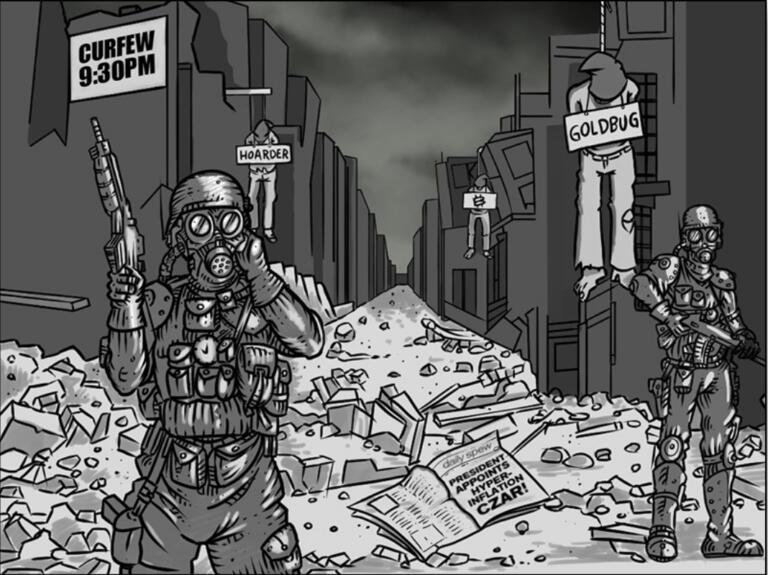
We can’t help these people, and that makes me sad, even if the majority of them would gleefully stone me to death in the street if the TV set ever tells them that the reason their livelihood is gone and their savings have been vaporized was because of “Bitcoin speculators” and goldbugs.
Most people are stupid. Especially when they act in numbers. If you’re reading this letter, you aren’t one of them.
The next edition of The Bitcoin Capitalist Letter, with more on the Post-Singularity Stack, should be out next weekend. Bombthrower readers can get a special trial offer here
Sign up for the Bombthrower Mailing List here and get a free copy of The Crypto Capitalist Manifesto.
Tyler Durden
Sun, 01/25/2026 – 10:30

American rock climber Alex Honnold reaches top of Taipei 101 skyscraper without ropes
TAIPEI, Taiwan — American rock climber Alex Honnold ascended the Taipei 101 skyscraper on Sunday without any ropes or protective equipment.
Cheers erupted from a street-level crowd as he reached the top of the spire of the 1,667-foot tower about 90 minutes after he started. Wearing a red short-sleeve shirt, Honnold waved his arms back and forth over his head.
“It was like what a view, it’s incredible, what a beautiful day,” he said afterward. “It was very windy, so I was like, don’t fall off the spire. I was trying to balance nicely. But it was, what an incredible position, what a beautiful way to see Taipei.”
Honnold, known for his ropeless ascent up Yosemite National Park’s El Capitan, climbed up one corner of Taipei 101 using small L-shaped outcroppings as footholds. Periodically, he had to maneuver around and clamber up the sides of large ornamental structures that jut out from the tower, pulling himself up with his bare hands.
The building has 101 floors, with the hardest part being the 64 floors of the middle section — the “bamboo boxes” that give the building its signature look. Divided into eight, each segment has eight floors of steep, overhanging climbing followed by balconies, where he took short rests as he made his way upward.
Honnold’s free solo climb of the iconic building in Taiwan’s capital city was broadcast live on Netflix with a 10-second delay. The ascent, originally scheduled for Saturday, was delayed for 24 hours due to rain.
Having a cheering crowd was unusual and a bit unnerving at first for Honnold, whose climbs are usually in remote areas.
“When I was leaving the ground, you’re like oh it’s kind of intense, there’s so many people watching,” he said. “But then honestly, they’re all wishing me well. I mean basically it just makes the whole experience feel almost more festive, all these nice people are out supporting me and having a good time.”
The climb drew both excitement and concern over the ethical implications of attempting such a high-risk endeavor on live broadcast.
Honnold isn’t the first climber to ascend Taipei 101, but he is the first to do so without a rope. French rock climber Alain Robert scaled the building on Christmas Day in 2004 as part of the grand opening of what was then the world’s tallest building.
Associated Press video journalist Taijing Wu and writer Ken Moritsugu in Beijing contributed. Katie Tam also contributed to this story.
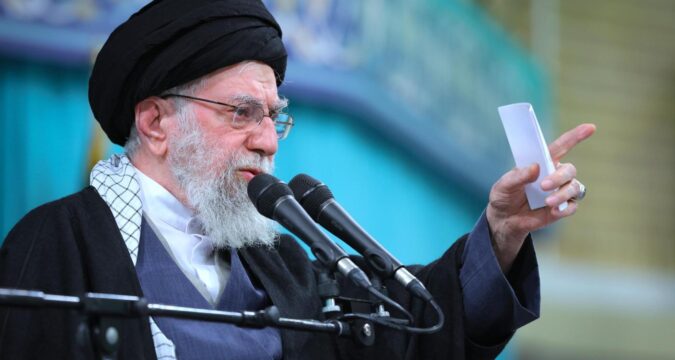
Irán revela mural advirtiendo represalias si EEUU lanza ataque militar
Por ELENA BECATOROS
DUBÁI, Emiratos Árabes Unidos (AP) — Un nuevo mural revelado en una plaza central de Teherán el domingo contiene una advertencia directa de Irán a Estados Unidos para que no intente un ataque militar contra el país.
La imagen pintada de varios aviones dañados en la cubierta de vuelo de un portaaviones lleva el lema: “Si siembras el viento, cosecharás la tempestad”.
La revelación del mural en la Plaza Enghelab se produce mientras el portaaviones USS Abraham Lincoln y los buques de guerra que lo acompañan se dirigen hacia la región. El presidente de Estados Unidos, Donald Trump, ha dicho que los barcos se están moviendo “por si acaso” decide tomar medidas.
“Tenemos una flota masiva dirigiéndose en esa dirección y tal vez no tengamos que usarla”, dijo Trump el jueves.
La Plaza Enghelab se utiliza para reuniones convocadas por el Estado, y las autoridades cambian su mural según las ocasiones nacionales. El sábado, el comandante de la Guardia Revolucionaria paramilitar iraní advirtió que su fuerza está “más lista que nunca, con el dedo en el gatillo”.
La tensión entre Estados Unidos e Irán ha aumentado tras una brutal represión de las protestas nacionales que dejó miles de personas muertas y decenas de miles arrestadas. Trump había amenazado con una acción militar si Irán continuaba matando a manifestantes pacíficos o realizaba ejecuciones masivas de los detenidos.
No ha habido más protestas durante días, y Trump afirmó recientemente que Teherán frenó las ejecuciones de unos 800 manifestantes arrestados, una afirmación que el procurador iraní calificó de “completamente falsa”.
Sin embargo, Trump ha indicado que mantiene sus opciones abiertas, diciendo el jueves que cualquier acción militar haría que los ataques estadounidenses de junio pasado a sitios nucleares iraníes “parecieran insignificantes”.
El Comando Central de Estados Unidos dijo en las redes sociales que su Fuerza Aérea F-15E Strike Eagle ahora tiene presencia en el Oriente Medio, señalando que el caza “mejora la preparación para el combate y promueve la seguridad y estabilidad regional”.
De manera similar, el Ministerio de Defensa del Reino Unido dijo el jueves que desplegó sus aviones de combate Typhoon en Qatar “en una capacidad defensiva”.
Las protestas en Irán comenzaron el 28 de diciembre, provocadas por la caída de la moneda iraní, el rial, y rápidamente se extendieron por todo el país. Fueron enfrentadas con una violenta represión por parte de la teocracia iraní, que no tolera la disidencia.
El número de muertos reportado por activistas ha seguido aumentando desde el final de las manifestaciones, a medida que la información se filtra a pesar de un apagón de internet de más de dos semanas, el más completo en la historia de Irán.
La Agencia de Noticias de Activistas de Derechos Humanos con sede en Estados Unidos informó el domingo que el número de muertos es de 5.459, con la expectativa de que aumente. Afirma que más de 40.800 personas han sido arrestadas.
Las cifras del grupo han sido precisas en disturbios anteriores y dependen de una red de activistas en Irán para verificar las muertes. Ese número de muertos supera al de cualquier otra ronda de protestas o disturbios allí en décadas, y recuerda el caos que rodeó la Revolución Islámica de Irán de 1979. The Associated Press no ha podido verificar de manera independiente el número de muertos.
El gobierno asegura que van 3.117 muertos, diciendo que 2.427 eran civiles y fuerzas de seguridad, y el resto “terroristas”. En el pasado, la teocracia iraní ha subestimado o no ha informado sobre las muertes por disturbios.
_______
Esta historia fue traducida del inglés por un editor de AP con la ayuda de una herramienta de inteligencia artificial generativa.
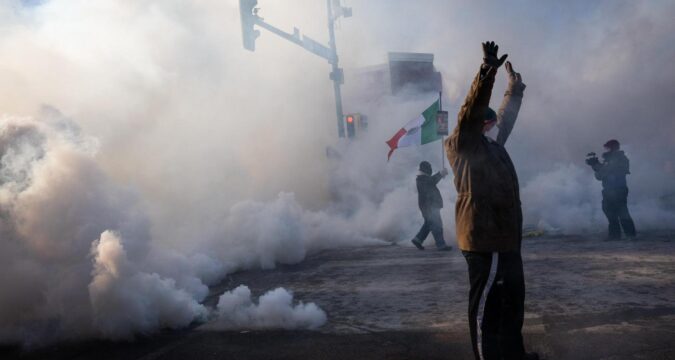
Protesters demand immigration agents leave Minneapolis after man is shot and killed during crackdown
MINNEAPOLIS — Democrats demanded that federal immigration officers leave Minnesota after a U.S. Border Patrol agent fatally shot a man in Minneapolis, drawing hundreds of protesters onto the frigid streets and increasing tensions in a city already shaken by another shooting death weeks earlier.
Family members identified the man who was killed as Alex Pretti, a 37-year-old intensive care unit nurse who protested President Donald Trump’s immigration crackdown in his city. After the shooting, an angry crowd gathered and protesters clashed with federal officers, who wielded batons and deployed flash bangs.
Man is shot and killed during Minneapolis immigration crackdown, National Guard activated
A federal judge has already issued an order blocking the Trump administration from “destroying or altering evidence” related to the shooting, after state and county officials sued.
Minnesota Attorney General Keith Ellison said the suit filed Saturday is meant to preserve evidence collected by federal officials that state authorities have not yet been able to inspect. A court hearing is scheduled for Monday in federal court in St. Paul.
“A full, impartial, and transparent investigation into his fatal shooting at the hands of DHS agents is non-negotiable,” Ellison said in a statement.
Spokespersons for the Justice Department and the Department of Homeland Security, which are named in the lawsuit, didn’t immediately respond to an email seeking comment Sunday.
Another federal judge previously ruled that officers participating in the federal immigration enforcement surge in Minnesota can’t detain or tear gas peaceful protesters who aren’t obstructing authorities, including when these people are observing the agents.
The Minnesota National Guard was assisting local police at the direction of Gov. Tim Walz, officials said. Guard troops were sent to both the shooting site and a federal building where officers have squared off with demonstrators daily.
Information about what led up to the shooting was limited, Police Chief Brian O’Hara said.
Department of Homeland Security spokesperson Tricia McLaughlin said in a statement that federal officers were conducting an operation and fired “defensive shots” after a man with a handgun approached them and “violently resisted” when they tried to disarm him.
In bystander videos of the shooting that emerged soon after, Pretti is seen with a phone in his hand but none appears to show him with a visible weapon.
O’Hara said police believe he was a “lawful gun owner with a permit to carry.”
DHS Secretary Kristi Noem said during a news conference that Pretti had shown up to “impede a law enforcement operation.” She questioned why he was armed but did not offer details about whether Pretti drew the weapon or brandished it at officers.
The officer who shot him is an eight-year Border Patrol veteran, federal officials said.
Trump blames Democrats
The president weighed in on social media by lashing out at Walz and the Minneapolis mayor.
He shared images of the gun that immigration officials said was recovered and said: “What is that all about? Where are the local Police? Why weren’t they allowed to protect ICE Officers?”
Trump, a Republican, said the Democratic governor and mayor are “are inciting Insurrection, with their pompous, dangerous, and arrogant rhetoric.”
Rep. Alexandria Ocasio-Cortez of New York was among several Democratic lawmakers demanding federal immigration authorities leave Minnesota. She also urged Democrats to refuse to vote to fund U.S. Immigration and Customs Enforcement, saying via social media: “We have a responsibility to protect Americans from tyranny.”
Senate Democratic Leader Chuck Schumer later said that Democrats will not vote for a spending package that includes money for DHS, which oversees ICE. Schumer’s statement increases the possibility that the government could partially shut down Jan. 30 when funding runs out.
Pretti was shot just over a mile from where an ICE officer killed 37-year-old Renee Good on Jan. 7, sparking widespread protests.
Pretti’s family released a statement Saturday evening saying they are “heartbroken but also very angry” and calling him a kindhearted soul who wanted to make a difference in the world through his work as a nurse.
“The sickening lies told about our son by the administration are reprehensible and disgusting. Alex is clearly not holding a gun when attacked by Trump’s murdering and cowardly ICE thugs. He has his phone in his right hand and his empty left hand is raised above his head while trying to protect the woman ICE just pushed down all while being pepper sprayed,” the family statement said. “Please get the truth out about our son. He was a good man.”
Video shows officers, man who was shot
In a bystander video obtained by The Associated Press, protesters are heard blowing whistles and shouting profanities at federal officers on Nicollet Avenue.
An officer shoves a person who is wearing a brown jacket, skirt and black tights and carrying a water bottle. That person reaches out for a man, and the two link up, embracing. The man, wearing a brown jacket and black hat, seems to be holding his phone up toward the officer.
The same officer shoves the man in his chest and the two, still embracing, fall back.
The video shifts to a different part of the street and then comes back to the two individuals unlinking from each other. It shifts focus again and then shows three officers surrounding the man.
Soon at least seven officers surround him. One is on his back, and another who appears to have a canister in his hand strikes a blow to his chest. Several officers try to bring the man’s arms behind his back as he appears to resist. As they pull his arms, his face is briefly visible. The officer with the canister strikes him near his head several times.
A shot rings out, but with officers surrounding the man, it’s not clear where it came from. Multiple officers back off. More shots are heard. Officers back away, and the man lies motionless on the street.
The police chief appealed for calm, both from the public and from federal law enforcement.
“Our demand today is for those federal agencies that are operating in our city to do so with the same discipline, humanity and integrity that effective law enforcement in this country demands,” the chief said. “We urge everyone to remain peaceful.”
Gregory Bovino of U.S. Border Patrol, who has commanded the administration’s big-city immigration campaign, said the officer who shot the man had extensive training as a range safety officer and in using less-lethal force.
“This is only the latest attack on law enforcement. Across the country, the men and women of DHS have been attacked, shot at,” he said.
Walz said he had no confidence in federal officials and the state would lead the investigation into the shooting.
But Drew Evans, superintendent of the Minnesota Bureau of Criminal Apprehension, said during a news conference that federal officers blocked his agency from the scene even after it obtained a signed judicial warrant.
Protests continue
Demonstrations broke out in several cities across the country including New York, Washington and Los Angeles.
In Minneapolis, protesters converged at the scene of the shooting in Minneapolis despite dangerously cold weather — by the afternoon the worst of an extreme cold wave was over, but the temperature was still -6 degrees (-21 Celsius).
An angry crowd gathered after the shooting and screamed profanities at federal officers, calling them “cowards” and telling them to go home. One officer responded mockingly as he walked away, telling them: “Boo hoo.” Agents elsewhere shoved a yelling protester into a car. Protesters dragged garbage dumpsters from alleyways to block streets, and people chanted “ICE out now” and “Observing ICE is not a crime.”
As dark fell hundreds of people mourned quietly by a growing memorial at the site of the shooting. Some carried signs saying “Justice for Alex Pretti.” Others chanted Pretti’s and Good’s names. A doughnut shop and a clothing store nearby stayed open, offering protesters a warm place as well as water, coffee and snacks.
Caleb Spike said he came from a nearby suburb to show his support and his frustration. “It feels like every day something crazier happens,” he said. “What’s happening in our community is wrong, it’s sickening, it’s disgusting.”
Santana reported from Washington. Associated Press writers Giovanna Dell’Orto, Tim Sullivan and Sarah Raza in Minnesota, Jim Mustian in New York, Michael Catalini in New Jersey and Christopher Weber in Los Angeles contributed.
https://www.chicagotribune.com/2026/01/25/immigration-agents-minneapolis-shooting/
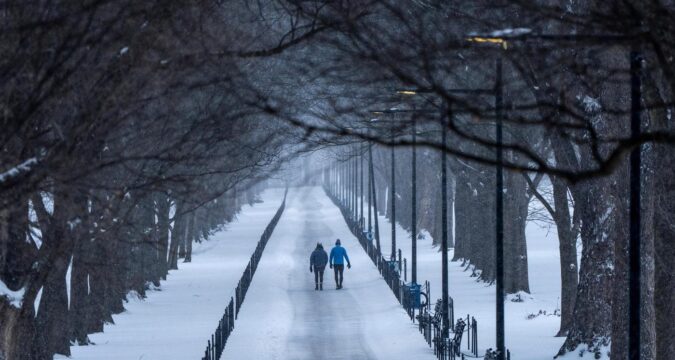
Massive winter storm across the US brings ice, frigid temperatures and widespread power outages
A massive winter storm continued Sunday morning, dumping sleet, freezing rain and snow across the South and up through New England, bringing frigid temperatures, widespread power outages and treacherous road conditions.
The ice and snowfall were expected to continue through Monday in much of the country, followed by very low temperatures, causing “dangerous travel and infrastructure impacts” to linger for several days, the National Weather Service said.
Heavy snow was forecast from the Ohio Valley to the Northeast, while “catastrophic ice accumulation” threatened from the Lower Mississippi Valley to the Mid-Atlantic and Southeast.
“It is a unique storm in the sense that it is so widespread,” weather service meteorologist Allison Santorelli said in a phone interview. “It was affecting areas all the way from New Mexico, Texas, all the way into New England, so we’re talking like a 2,000 mile spread.”
As of Sunday morning, about 213 million people were under some sort of winter weather warning, she said. The number of customers without power was approaching 800,000, according to poweroutage.us, and the number was rising.
Tennessee was hardest hit with more than a quarter of a million customers out, and Texas, Louisiana and Mississippi all had more than 100,000 customers in the dark.
More than 10,000 flights had already been canceled Sunday and another 8,000 have been delayed, according to the flight tracker flightaware.com. The biggest hubs hit so far were in Philadelphia, Washington, Raleigh-Durham in North Carolina, New York and New Jersey.
Even once the ice and snow stop falling, the danger will continue, Santorelli warned.
“Behind the storm it’s just going to get bitterly cold across basically the entirety of the eastern two-thirds of the nation, east of the Rockies,” she said. That means the ice and snow won’t melt as fast, which could hinder some efforts to restore power and other infrastructure.
President Donald Trump had approved emergency declarations for at least a dozen states by Saturday, with more expected to come. The Federal Emergency Management Agency pre-positioned commodities, staff and search and rescue teams in numerous states, Homeland Security Secretary Kristi Noem said.
Nashville and the surrounding area was seeing ice accumulations of half an inch or more, with icicles hanging from power lines and overburdened tree limbs crashing to the ground.
“We typically say that once you start seeing, you know, roughly a half an inch of ice, that’s when you’re going to start seeing the more widespread power outages,” Santorelli said.
In Oxford, Mississippi, police on Sunday morning used social media to tell residents to stay home as the danger of being outside was too great. Local utility crews were also pulled from their jobs during the overnight hours.
“Due to life-threatening conditions, Oxford Utilities has made the difficult decision to pull our crews off the road for the night,” the utility company posted on Facebook early Sunday.
“The situation is currently too dangerous to continue,” it said. “Trees are actively snapping and falling around our linemen while they are in the bucket trucks. We simply cannot clear the lines faster than the limbs are falling.”
Icy roads also made travel dangerous in north Georgia.
“You know it’s bad when Waffle House is closed!!!” the Cherokee County Sheriff’s office posted on Facebook with a photo of a shuttered restaurant. Whether the chain’s restaurants are open — known as the Waffle House Index — has become an informal way to gauge the severity of weather disasters across the South.
Brumback reported from Atlanta. Walker reported from New York. Kristin Hall and Jonathan Mattise reported from Nashville, and Jeff Martin contributed from Kennesaw, Georgia.
https://www.chicagotribune.com/2026/01/25/massive-winter-storm-across-nation/
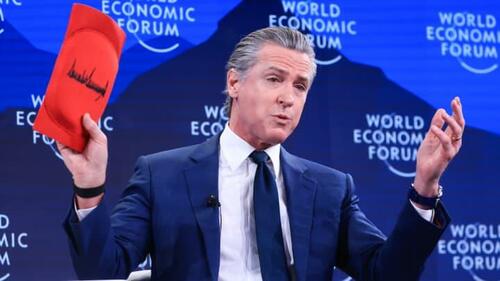
Gavin Newsom Humiliated At Davos After Trolling Trump With “Knee Pads” Stunt
Gavin Newsom Humiliated At Davos After Trolling Trump With “Knee Pads” Stunt
Leftists have a disconcerting habit of making everything lame and gay. And, because they have zero talent for memes or clever ridicule, when they do try to take their political opponents “down a notch” the attempt usually comes off as unintelligent and humiliating.
California Governor Gavin Newsom is the epitome of the bumbling narcissistic leftist stereotype. His bizarre hot takes, robotic behavior and inability to read the room have made him the subject of embarrassment on numerous occasions. Combine this problem with his ‘American Psycho’ demeanor (as Treasury Secretary Scott Bessent described him), and one can only hope that the Democrats are dumb enough to choose him as their presidential candidate in 2028.
It would appear that Newsom did not waste time making himself a subject of mockery during the Davos event this week after he hovered around geopolitical discussions vying for attention. His complaints about Europe’s unwillingness to take a hard stand against Donald Trump’s Greenland agenda reflected growing delusion among US activists that the rest of the world is going to join their woke revolution.
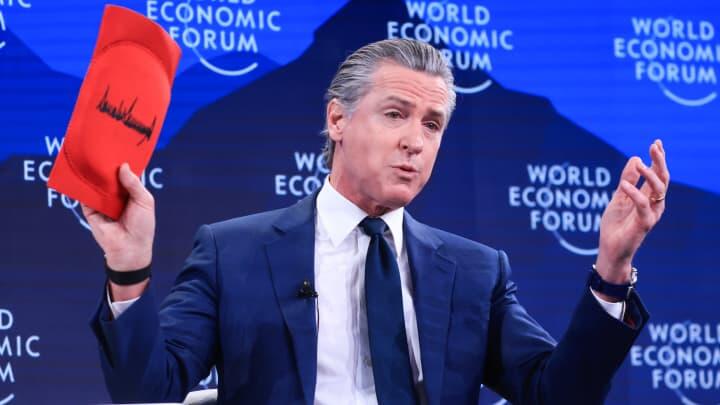
Newsom was caught on camera more than a couple times lamenting the lack of European posturing and called EU politicians “pathetic”. He also kept suggesting that EU leaders “should wear knee pads” in order to better please Trump. And, just in case anyone missed the bad joke, he brought a pair of knee pads with him on stage to drive his point home.
Gov. Gavin Newsom showcases the “Trump Signature Series Knee Pads”
I wonder if his wife helped design them? pic.twitter.com/4xhc3VFWP2
— TaraBull (@TaraBull) January 22, 2026
A handful of attendees laughed but the gimmick did not go over well for the rest of Newsom’s stay in Switzerland. Scott Bessent, who previously referred to Newsom as “Sparkle Beach Ken”, was ruthless in his reaction to Newsom’s whining.
NEW: Secretary Scott Bessent rips Gavin Newsom, says he brought his knee pads to Davos for his meeting with Alex Soros.
“Being on the national stage is very different than being governor of California with no signature achievements…”
“I could say Gavin Newsom is a Brontosaurus… pic.twitter.com/PBGzbZv0Qv
— Collin Rugg (@CollinRugg) January 23, 2026
The California peacock was not the only Democrat to make a fool of himself at Davos. Al Gore was also in the audience and tried to heckle Secretary of Commerce Howard Lutnick after a speech in which he declared globalism a failed ideology.
🚨 BREAKING: Former Vice President AL GORE was caught HECKLING and YELLING at Trump’s Cabinet in DAVOS 🚨@HowardLutnick: “At the end of my talk, one person out of the 200 YELLED out “BOO,” and I look over and I’m like, who booed? And it is AL GORE.” 😡😡
“And I go, REALLY? And… pic.twitter.com/c3JfbmiUpK
— Jesse Watters (@JesseBWatters) January 23, 2026
It is amusing to see that even among the WEF elites Democrats are struggling to garner much sympathy and support. They’ve charged headlong to the far-left; so far to the left that almost no one can understand them and their rhetoric anymore. It’s a stunning decline. It’s also frightening to think that only couple years ago such people were actually writing US immigration policy, educational planning, health mandates, economic policy and dictating geopolitical agendas that had the potential to trigger global war.
Tyler Durden
Sun, 01/25/2026 – 09:55

How figure skating became a comfort zone for the LGBTQ+ community amid perilous times
The moment Amber Glenn stepped onto the ice at figure skating’s world championships, fans began to wave American flags, from the lowest rows inside TD Garden to the highest rafters, where the jerseys of Boston’s sporting greats hang in honor.
It seemed a fitting backdrop to her program: Glenn is the three-time reigning U.S. champion, one of the current faces of figure skating, and as the daughter of a police officer and a proud native Texan, patriotism flows through her as thick as oil.
Related Articles
Chloe Kim rediscovers love for Olympics. But will an injury derail quest for a 3rd straight gold medal?
Injury questions linger for many of the top men’s hockey teams at the Olympics
2028 Olympics could bring big wins for Los Angeles labor unions
Ryan Wedding, a former Olympic snowboarder on the FBI’s ‘Most Wanted’ list, has been arrested
How Norway’s ski jumping scandal led to new rules in place for the Olympics
Yet the stars-and-stripes weren’t the only flags flying high that night.
Scattered throughout the sellout crowd at the last worlds before the Milan Cortina Olympics were the equally conspicuous rainbow flags that for nearly 50 years have signified pride within the LGBTQ+ community. They started popping up at Glenn’s competitions a year earlier, when she carried one across her shoulders in celebration of her national championship.
“I saw them,” Glenn acknowledged later, long after her performance, “and I was proud to see both of those flags flying.”
Glenn, who identifies as pansexual, never sought to be an icon within the queer community.
In fact, she didn’t come to grips with her own sexuality until she had been through the wringer, including a stint in a mental health facility spent working through depression, anxiety and an eating disorder. Glenn didn’t come out publicly until letting it slip during an interview a half-dozen years ago, and then thought with horror, “I haven’t even told my Catholic grandma yet!”
Yet as the 26-year-old Glenn reflected on her journey in an interview with The Associated Press, she expressed a profound sense of gratitude for having experienced it within the tight-knit figure skating world. For decades, the sport has provided a progressive sort of safe space for those within the LGTBQ+ community, some of whom still may be trying to realize their authentic selves.
“I’m so, so grateful that I grew up in skating, because I grew up in Texas, and luckily it was Dallas, which was still a bit more forward,” Glenn said. “Plus, I was homeschooled. So I had to figure out a lot of things on my own, coming from that background.
“But as I ventured out to competitions, you know, outside of Texas,” Glenn continued, “I ended up seeing this community and these people around me, and they were some of the top coaches and really good skaters. I was like, ‘Oh, OK. This is OK.’ It made me realize, ‘OK, there are people who are fans of me that would probably feel even more connected if they saw someone like them.’”
The long and winding road
It hasn’t always been that way in figure skating, a sport where success and failure is quite literally a judgment call, and looks, attitude and mannerisms all matter in the scores. Throughout the 1900s, and even into the ‘80s and ’90s, women often were encouraged to be more effeminate, and male counterparts were told to embrace their masculinity.
It wasn’t until Rudy Galindo came out in a book released shortly before he was crowned U.S. champion in 1996 that walls began to crumble. Three-time U.S. champion Johnny Weir, now a lead analyst for NBC’s coverage of the Olympics, said later that Galindo gave him the confidence to come out in 2011, and ultimately embrace who he was both on the ice and off.
Eventually, other prominent skaters came forward, some of whom had never publicly acknowledged their sexuality. Each had their reasons, whether personal, political or simply the desire to give back to the community.
As the U.S. team was preparing for the 2014 Winter Games in Sochi, former Olympic champion Brian Boitano was picked to be a part of the delegation. At the time, the Russian government was under fire for an anti-gay “propaganda” law passed in June 2013, and Boitano told the AP that he never considered coming out until he was chosen to represent his country again.
“They know how private a person I am,” Boitano said, “and that this was a big move for me.”
Success on big stages
While LGBTQ+ athletes compete in just about every sport, what might set figure skating apart — at least, presently — has been their success on the biggest stages, whether they be international competitions, the world championships or even the Olympics.
In 2018, former U.S. champion Adam Rippon not only became the first openly gay man to make the Olympic team but the first to capture a medal at the Winter Games, earning bronze as part of the team event. Four years later, Timothy LeDuc became the first non-binary Olympic athlete by teaming with Ashley Cain-Gribble in the pairs event at the Beijing Games.
“I grew up in a very conservative environment,” explained LeDuc, a two-time U.S. champion, who went into coaching after stepping away from competition. “Sometimes just seeing someone like you in that community is what you need to feel comfortable in yourself. That continued in my journey, where I saw a lot of queer people in my life.
“Even in high school, there was one or two queer people,” LeDuc said, “but it was always figure skating where I found my community.”
Where things stand
Glenn had just won her first elite-level Grand Prix event in Angers, France, in November 2024, when Donald Trump won the presidential election in the U.S. She remembers watching the results scroll across the TV screen.
Glenn’s heart sank, thinking about what it would mean for the LGBTQ+ community.
Two months later Trump signed an executive order defining “sex” in federal policy as a binary, biological concept unchangeable from birth. It was the first move made by an administration that has been accused of targeting the rights and recognition of the LGBTQ+ community, such as rolling back protections in education, healthcare and housing. The administration pitched the changes as a way to protect women from “gender extremism.”
“Both of my grandpas were in the military. I was raised in Texas, a proud American,” Glenn told AP. “It was so disheartening. It made me feel even closer to the community around me, because we had to come together to try and protect ourselves.”
Those feelings continue among many in the LGBTQ+ community.
One of the reasons that fan-favorite Jason Brown, a two-time Olympian, came out in an Instagram post five years ago was to provide support to those who may feel uncomfortable — skaters, of course, but also coaches, choreographers and even fans.
“I hope I can leave the sport a little better for the next athlete, or make someone more comfortable to step up and be who they are,” Brown said. “There are so many people out there that love and support that community, and they want them to feel safe and seen and accepted. I think that my biggest message is, ‘Know how supported you are.’”

‘Repatriate The Gold’: German Economists Urge Withdrawal From US Vaults
‘Repatriate The Gold’: German Economists Urge Withdrawal From US Vaults
Authored by Kate Connolly via The Guardian,
Shift in relations and unpredictability of Donald Trump make it ‘risky to store so much gold in the US’, say experts
Germany is facing calls to withdraw its billions of euros’ worth of gold from US vaults, spurred on by the shift in transatlantic relations and the unpredictability of Donald Trump.
Germany holds the world’s second biggest national gold reserves after the US, of which approximately €164bn (£122bn) worth – 1,236 tonnes – is stored in New York.
Emanuel Mönch, a leading economist and former head of research at Germany’s federal bank, the Bundesbank, called for the gold to be brought home, saying it was too “risky” for it to be kept in the US under the current administration.
“Given the current geopolitical situation, it seems risky to store so much gold in the US,” he told the financial newspaper Handelsblatt.
“In the interest of greater strategic independence from the US, the Bundesbank would therefore be well advised to consider repatriating the gold.”
Stefan Kornelius, the spokesperson for Friedrich Merz’s coalition government, said recently that withdrawal of the gold reserves was not currently under consideration.
But Mönch is only the latest in a string of economists and financial experts to argue that such a move would be in keeping with the greater strategic independence that Europe’s largest economy has been seeking from the US in recent months.
Michael Jäger, the head of the European Taxpayers Association (TAE) as well as the Association of German Taxpayers, has also said Berlin should make its move, arguing that the US’s stated desire to seize Greenland should concentrate minds.
“Trump is unpredictable and he does everything to generate revenue. That’s why our gold is no longer safe in the Fed’s vaults,” Jäger told the Rheinische Post.
“What happens if the Greenland provocation continues? … The risk is increasing that the German Bundesbank will no longer be able to access its gold. Therefore, it should repatriate its reserves.”
Jäger said he had written last year to the Bundesbank and the finance ministry, urging them to “bring our gold home”.
Until recently the gold issue has been the preserve mainly of the far-right Alternative für Deutschland (AfD), which has repeatedly urged the return of the gold for patriotic reasons. But it has increasingly crept into the mainstream discourse.
Katharina Beck, the finance spokesperson for the opposition Greens in the Bundestag, has also spoken out in favour of relocating the gold bars, calling them an “important anchor of stability and trust”, which “must not become pawns in geopolitical disputes”.
However, Clemens Fuest, the president of the Institute for Economic Research (Ifo) and one of the country’s most prominent economists, warned against such a move, saying it could lead to unintended consequences and would “only pour oil on the fire of the current situation”, he told the Rheinische Post.
Germany’s total gold reserves are worth almost €450bn.
Just over half are held at the Bundesbank in Frankfurt am Main, 37% in the vaults of the US Federal Reserve in New York and 12% at the Bank of England in London, the global centre of gold trading. The Bundesbank says it regularly undertakes an audit of the supplies of gold it holds in storage.
Speaking last October at the International Monetary Fund’s (IMF) autumn meetings in Washington DC, the Bundesbank president, Joachim Nagel, assured attenders there was “no cause for concern” over the German gold held at the US Federal Reserve.
Frauke Heiligenstadt, the parliamentary group spokesperson on financial policy for the Social Democrats, junior partners in the government, said that while she understood concerns about the gold reserves, there was no need for panic.
“Germany’s gold reserves are well diversified,” she said. Because half of them are located in Frankfurt, “our ability to act is guaranteed”. Having gold in New York made sense, she added, because “Germany, Europe and the US are closely linked in terms of financial policy”.
But, amid Trump’s hardening rhetoric towards his western partners, an increasing number of Merz’s Christian Democrats have been speaking out in favour of relocation.
“Due to the Trump administration, the US is no longer a reliable partner,” Ulrike Neyer, a professor of economics at the University of Düsseldorf, told the Rheinische Post.
Tyler Durden
Sun, 01/25/2026 – 09:20