Category: News
USD Pops, Yen Drops As TsySec Bessent Says “Absolutely Not Intervening”
USD Pops, Yen Drops As TsySec Bessent Says “Absolutely Not Intervening”
US Treasury Secretary Scott Bessent told CNBC Sara Eisen this morning that “the US always has a strong dollar policy”.
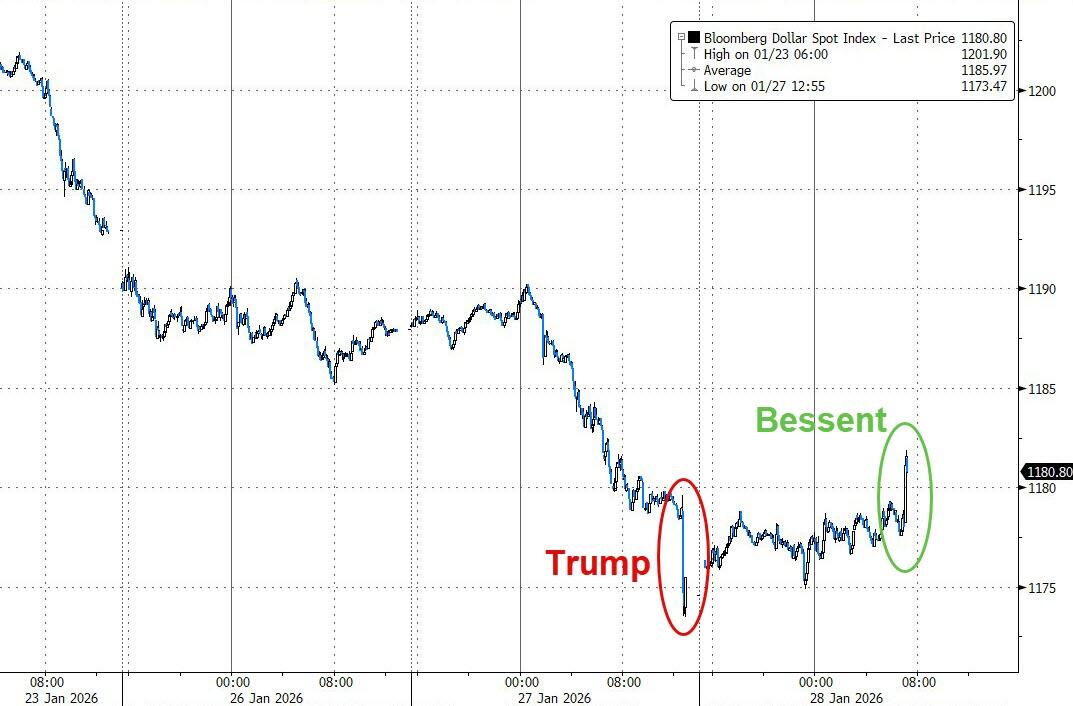
This statement comes after President Trump’s apparent ‘comfort’ last night with the dollar declining…
When asked if he was worried about losses in the dollar, Trump told reporters in Iowa on Tuesday: “No, I think it’s great.”
Bessent then dropped two more tapebombs…
While stating that “WE DON’T COMMENT ON INTERVENTION SPECULATION”…
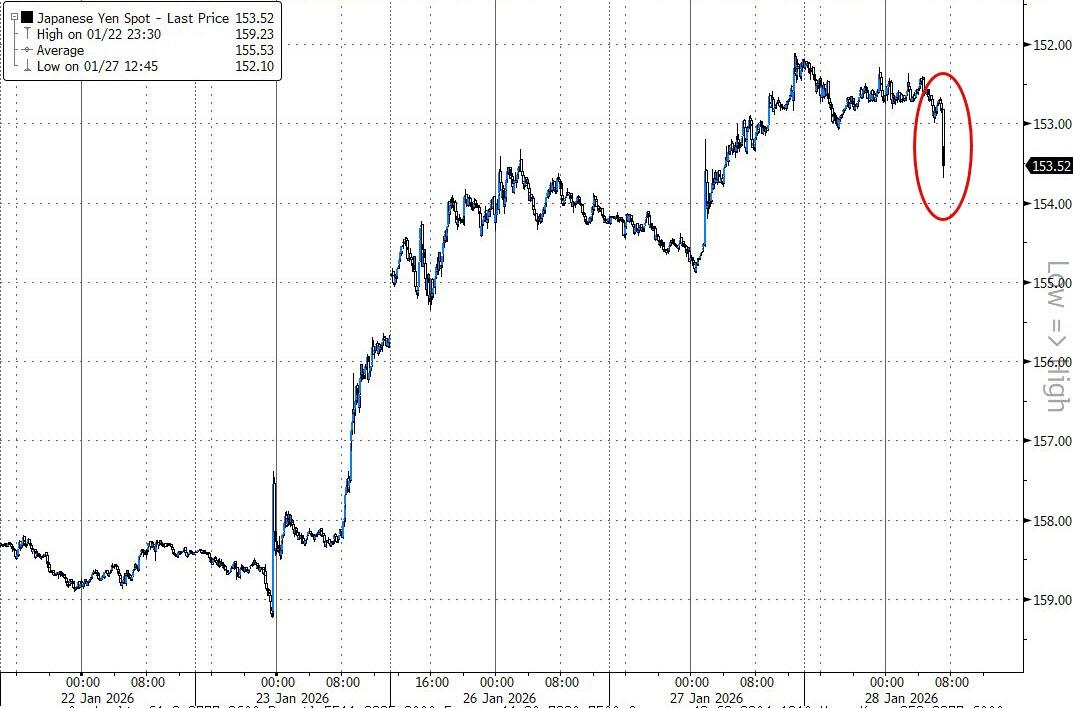
Bessent then confirmed that “US IS ‘ABSOLUTELY NOT’ INTERVENING IN DOLLAR-YEN NOW”
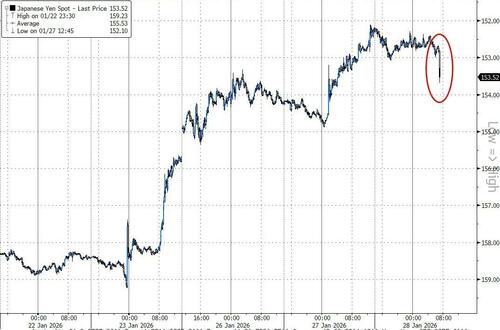
This prompted yen weakness, retracing some of the post ‘rate check’ rally…
…and dollar strength…
This move comes minutes after Goldman Sachs Delta-One desk head warned: Near-term, feels dangerous to press dollar downside given how extreme the moves have been.
Tyler Durden
Wed, 01/28/2026 – 10:18
https://www.zerohedge.com/markets/usd-pops-yen-drops-tsysec-bessent-says-absolutely-not-intervening

Hobart freshman Corabella Wesley is dominant on the mat. Even at state. ‘She’s just not scared of anybody.’
Corabella Wesley appeared on Hobart girls wrestling coach Tomas Westberg’s radar long before she arrived on campus a few months ago.
Wesley had already made an impression during matches against boys in middle school.
“The very first time I ever saw Bella was at a summer tournament with my middle school kids,” Westberg said. “I was like, ‘Who is this girl beating all these boys on my team?’ I eventually heard her name, knew of her and have watched her since middle school.
“So I was very excited to see her here as a freshman with the group I already had coming in because I knew our team was going to be pretty decent.”
But Wesley has exceeded even Westberg’s most ambitious expectations. She won all 42 of her matches this season and went largely unchallenged during her march to the state championship in the 125-pound weight class at the Corteva Coliseum in Indianapolis on Jan. 16.
When she pinned Plymouth junior Angel Smith in a rematch of their regional showdown, Wesley also became the first Hobart girl to win a state title in wrestling.
“It means everything to me,” she said. “I’ve always dreamt of it since I was little. All of the state champs are painted in the wrestling room, and I wanted to be the first girl up there, and I will be.”
Wesley is one of four state champions from Northwest Indiana this season. She was joined by Crown Point sophomore Ava Strayer (130), who won her second state title; Merrillville senior Charisma Lawrence (145); and Highland senior Aleksandra Bastaic (155), who won her fourth state title.
Westberg said Wesley’s strength, especially for her age, plays a role in her success but that her mindset is what truly separates her from opponents.
“She’s just not scared of anybody,” Westberg said. “She never seems to be scared at all. If anything, it’s more the other way around — the other girls are scared of her.
“But she’s very humble, she listens and she’s very respectful. If you saw her walking in the halls, you’d think, ‘That girl wrestles? She doesn’t seem like the type.’ Then you see her on the mat, and you’re like, ‘OK, yeah, she wrestles.’”
Even Wesley’s teammates were a little intimidated at first.
“She was quiet at the beginning, and then she opened up, and she’s actually really funny,” Hobart senior Joanna Cantu said. “Seeing her wrestle, she’s super aggressive and so locked in, and then after the match, she just smiles and skips and gives us all hugs. It’s like a totally different person than on the mat.”
Despite a routine that includes 90 grams of protein a day and prematch voiceovers of strangers telling her she’s “not good enough” or “not strong enough,” Wesley proudly calls herself a “girly girl.”
“I love baking for my family and my friends and anybody who’s sick,” she said. “I like to do my makeup. I like to practice my makeup a lot, actually. I hang out with my brothers and play their games with them, even games they make up, and I like to hang out with friends. … We’re having a Galentine’s Day coming up.”
Wesley is the oldest of four siblings. Her three brothers are following in her footsteps as they begin their wrestling journeys. She said her brothers and parents are her biggest supporters, although her father has been particularly important in her wrestling career.
Wesley said she started wrestling as a 7-year-old after her father, Brian, who is her part-time strength and conditioning coach, introduced her to the sport to help her deal with bullying. Before long, she knew she had found her calling.
“He’s amazing,” Wesley said. “I love him. He helps me through every match, through every practice. He’s my No. 1 coach. He’s always been there for me and been supportive. He’s everything I could ask for in a dad.”
Wesley said her favorite part of wrestling is “making my dad proud.” She expects to have more opportunities to do that.
“Just keep going,” Wesley said of her goals. “Take it one match at a time, get stronger, get smarter and hopefully win a couple more titles.”
Noah Poser is a freelance reporter.
https://www.chicagotribune.com/2026/01/28/wrestling-hobart-corabella-wesley/
Trump Unveils Mercantilism 101
Trump Unveils Mercantilism 101
By Benjamin Picton, Senior Market Strategist at Rabobank
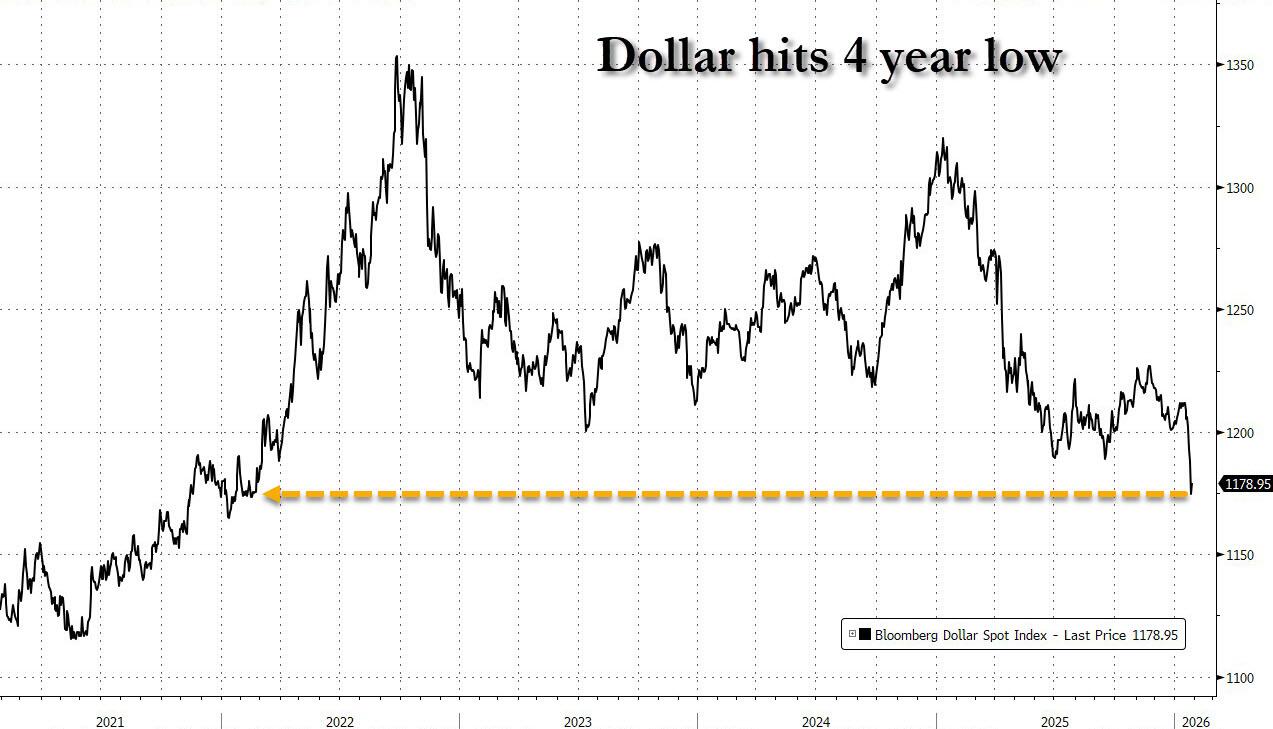
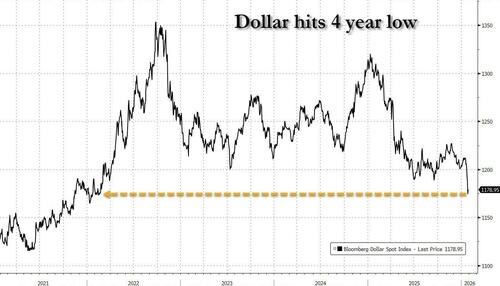
The de-Dollarisation meme rolled on yesterday as the Bloomberg Dollar spot index sank to its lowest reading since February of 2022. The fall became precipitous after Donald Trump was given an opportunity by journalists to talk up the Dollar, but instead replied “no, I think it’s great” when asked whether he was concerned about its recent drop. It would seem that there is no rage against the dying of the strong Dollar from the President.
Trump’s Treasury Secretary Scott Bessent had repeatedly assured financial markets last year that the administration still supports the strong Dollar policy. Trump himself has been a little more circumspect over the years, and implied yesterday that a weaker Dollar was good for US trade competitiveness. “Look at the business we are doing. The Dollar’s doing great.” Trump also pointed out that China and Japan have historically intervened to weaken their own currencies – thereby boosting trade competitiveness at the expense of trading partners. This is Mercantilism 101, as regular readers of this Daily would have been aware of for years.
On Monday we wrote about the Triffin Dilemma, and particularly the necessity of reserve currency issuers running trade deficits. The Triffin Dilemma also describes why the global reserve currency might be artificially strong as there is always a bid to hold it as a reserve asset and it is always demanded by other countries to conduct trade – even trade that does not involve the country issuing the reserve currency.
Along with the US Navy’s policing of global sea lanes at no cost to other countries (who benefit from absence of piracy, etc), the provision of the Dollar as a global medium of exchange is one of two public goods that Council of Economic Advisors Chair and now Fed Governor Stephen Miran (and author of the Mar-A-Lago accord) argues the US provides to other countries an substantial cost to itself. Under that framing, if the Dollar can be weakened without losing its status as the reserve currency, the Trump administration may consider that a welcome development.
Equity markets certainly considered it a welcome development. The S&P500 gained 0.41% yesterday and the NASDAQ was up 0.91%, but the Dow Jones finished well in the red. US equities are in the black for the year-to-date, and are performing similarly to European stocks, but the standout markets for the year so far appear to be in South America, where US intervention in Venezuela under the revamped Monroe Doctrine and a shift toward pro-US right wing government seems to be helping market sentiment. Indices in Peru, Chile, Colombia and Brazil are all well into double-digit growth YTD. Year-to-date growth in Mexican and Argentinian indices remains in the single-digits, but is still outperforming Asian, European and US markets.
Another excuse to sell Dollars was provided by the Conference Board’s latest consumer confidence report, which showed overall confidence falling to the lowest levels since 2014 (i.e. lower than during the pandemic) and undershooting the estimate of every analyst on the Bloomberg survey. The present conditions index fell to a five year low and the expectations index fell 9.5 points to 65.1 – its lowest reading since the immediate aftermath of Liberation Day and well below levels typically consistent with impending recession!
The weak confidence reading provides an interesting backdrop for today’s FOMC rate decision. There is virtually no chance of a change in the Fed Funds rate today, but Fed-dated OIS has slithered a little closer to a cut being fully priced for June and two more cuts fully priced for the year. The Conference Board report’s emphasis of labor market conditions may be of particular interest as last week’s more consumer spending-oriented University of Michigan confidence index rose to even stronger levels while inflation expectations fell. Personal spending reported earlier in the week was also reasonably strong.
Of course, a weaker US Dollar is providing an endogenous easing in financial conditions that – taken together with core PCE running at 2.8% YoY and the apparent feud between the FOMC and the White House – may cause the Fed to resist further monetary easing. Jerome Powell seemingly made it clear in his sensational press conference following the Department of Justice’s issuance of grand jury subpoenas that he will not go gently into that good night.
There are others raging against the dying of the light, too. Mark Carney is the most Davos of Davos men and in his well-publicized speech pronouncing the death of the liberal world order he unpacked what he thought that would mean for global prosperity: “a world of fortresses will be poorer, more fragile and less sustainable… Allies will diversify to hedge against uncertainty… They’ll buy insurance… to rebuild sovereignty.” He then said that “…the cost of strategic autonomy can be shared. Collective investments in resilience are cheaper than everyone building their own.”
Herein lies the rub, Carney recognises that strategic autonomy is desirable, but then immediately makes the mistake of trying to achieve strategic autonomy through multilateral coordination. That is a re-run of liberal globalism, but on a smaller scale. True strategic autonomy would logically require greater autonomy, not continued integration. To suggest otherwise is to forget Lord Palmerston’s dictum “we have no permanent friends, only permanent interests.”
The European Union is similarly raging against the change in the world order. The EU just pushed back against the protectionism trend by announcing that it has concluded “the mother of all trade deals” with India, forming what Ursula von der Leyen calls a free trade zone of 2 billion people. This follows a similar deal with the South American Mercosur bloc after years of drawn out negotiations. Of course, the India deal isn’t actually for “free” trade, but for preferential trade. Tariffs will be eliminated or cut on 96% of EU exports to India, while the EU will do the same for 99% of India’s exports to the EU.
Europe will be granted improved market access for many agricultural products, but India’s dairy sector will see no reduction in protection. Similarly, European beef and poultry producers will remain shielded by protectionist measures and Europe’s strict regulatory regime may pose hurdles for Indian products that, in theory, are now granted greater access to the European market but may be waylaid by Europe’s powerful bureaucracy.
Alongside the trade deal, Europe and India have signed a new pact for security and defense partnership. India’s defense minister on Tuesday said that India’s defence industry can play a meaningful role in the EU’s ReArm Initiative and that the partnership will “become a force multiplier by integrating supply chains for building trusted defence ecosystems”.
This talk of integrating supply chains and trusted defense ecosystems sounds a lot like the arrangement the EU has (had?) with the United States. It also sounds a lot like Mark Carney’s prescription of integration on a somewhat-less-than-global scale. What it does not sound like is strategic autonomy – or supply chain sovereignty, and it is likely to cause some consternation in Paris, where Emmanuel Macron has been vocal about the need for Europe to prioritize indigenous industry in arms procurement.
Perhaps Europe still isn’t ready to admit that the light of the liberal international order really is dying.
Tyler Durden
Wed, 01/28/2026 – 10:15
https://www.zerohedge.com/markets/trump-unveils-mercantilism-101
“Not A Pullback”: Trump Dismisses Bovino Departure As Border Czar Homan Meets With Gov. Walz, Mayor Frey
“Not A Pullback”: Trump Dismisses Bovino Departure As Border Czar Homan Meets With Gov. Walz, Mayor Frey
Authored by Aldgra Fredly via The Epoch Times,
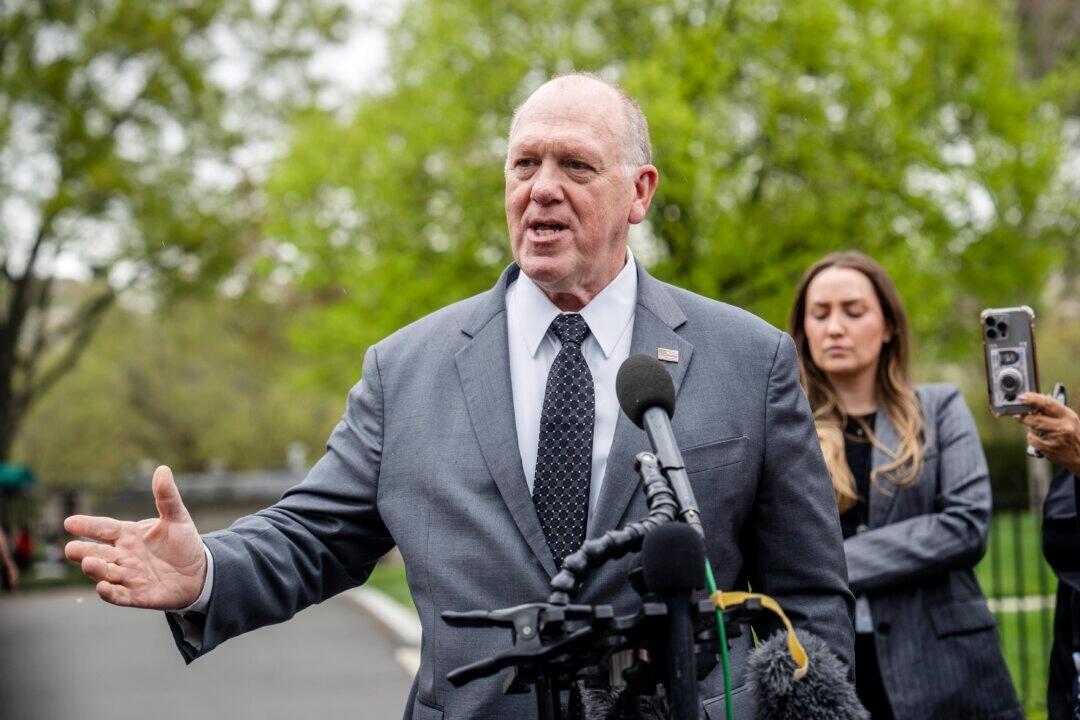
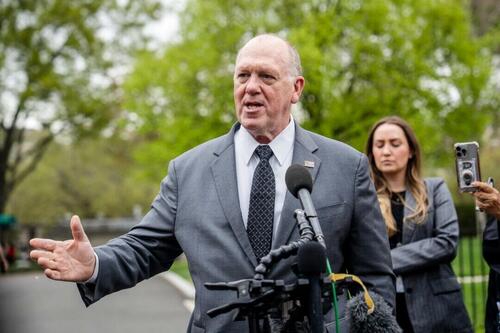
Border czar Tom Homan said on Jan. 27 that he met with Minnesota Gov. Tim Walz and Minneapolis Mayor Jacob Frey individually amid ongoing protests against federal immigration enforcement in the state.
The meetings were held as anti-ICE protests intensified in Minnesota following the deaths of two Minneapolis residents protesting in separate incidents this month during immigration enforcement.
Homan, in a post on X, described the meetings as productive and said he also spoke with senior law enforcement officials “to discuss the issues on the ground” in Minnesota.
“We all agree that we need to support our law enforcement officers and get criminals off the streets,” he said.
“While we don’t agree on everything, these meetings were a productive starting point and I look forward to more conversations with key stakeholders in the days ahead.
“President Trump has been clear: he wants American cities to be safe and secure for law-abiding residents—and they will be.”
Homan did not provide specific details about the discussions during his meetings with Minnesota leaders.
In a post on X, Frey said he reiterated during the meeting that his main ask was for Operation Metro Surge—the federal immigration operation launched in Minnesota in December—to end as soon as possible and that Minneapolis will not enforce federal immigration laws.
“I shared with Mr. Homan the serious negative impacts this operation has had on Minneapolis and surrounding communities, as well as the strain it has placed on our local police officers,” the mayor said.
“I also made it clear that Minneapolis does not and will not enforce federal immigration laws, and that we will remain focused on keeping our neighbors and streets safe.”
Frey said they agreed to continue dialogue with federal authorities.
Minneapolis Police Chief Brian O’Hara was also present during the mayor’s meeting with Homan.
Walz’s office did not respond to a request for comment on the meeting with Homan by publication time.
Walz told CNN on Jan. 27 that the meeting was “progress” in de-escalating tensions in Minnesota. He called for impartial investigations of the shooting incidents involving ICE agents and the departure of federal officers from the state.
“I think that’s progress, but they started this fire, so we’re not giving anybody credit for putting it out,” Walz said of the meeting.
“But right now, what we need is, we need to return to normalcy.”
Before the meeting, Walz spoke by phone with President Donald Trump on Jan. 26 and told the president the number of federal agents in Minnesota needed to be reduced.
Trump has assigned Homan to oversee immigration enforcement operations in Minnesota and investigate fraud in state programs, White House press secretary Karoline Leavitt said on Jan. 26. The operations had previously been led by Border Patrol Commander Greg Bovino.
During a Fox News interview aired on Jan. 27, Trump said Bovino’s departure from Minnesota is not a pullback, but rather a minor adjustment in the oversight of immigration enforcement operations.
“I don’t think it’s a pullback. It’s a little bit of a change. Everybody in this room that has a business … you make little changes,” he said.
“You know, Bovino’s very good, but he’s a pretty out there kind of a guy, and in some cases, that’s good; maybe it wasn’t good here.”
In a Jan. 26 post on Truth Social, Trump said that Homan has not been involved in operations in Minnesota, but he is familiar with many officials there.
“Tom is tough but fair, and will report directly to me,” Trump wrote.
Protesters and federal agents have clashed during enforcement operations in Minnesota in recent months, with demonstrations intensifying after a federal agent in Minneapolis fatally shot U.S. citizen Renee Good, who allegedly drove her SUV toward an officer during an ICE operation on Jan. 7.
Another fatal shooting occurred on Jan. 24 when a Customs and Border Protection officer shot and killed protestor Alex Pretti, a 37-year-old nurse, during a federal immigration operation in Minneapolis.
Tyler Durden
Wed, 01/28/2026 – 10:00
Alemania reduce al 1% previsión de crecimiento para 2026 ante lenta recuperación económica
BERLÍN (AP) — El gobierno alemán redujo el miércoles su pronóstico de crecimiento para 2026 debido a que el crecimiento se recupera más lentamente de lo que se esperaba en la economía del país, la más grande de Europa.
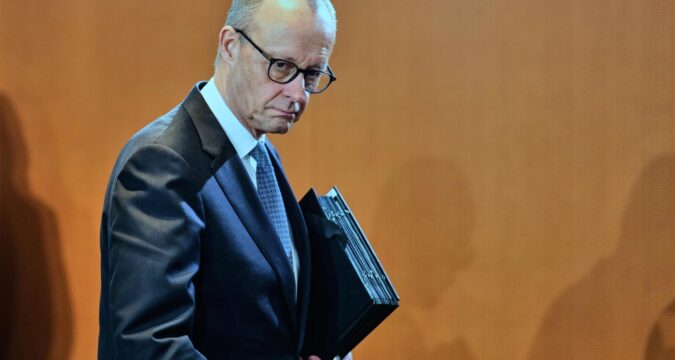
El gobierno del canciller Friedrich Merz ahora espera que el producto interno bruto se expanda alrededor de un 1% este año y un 1,3% en 2027, según la ministra de Economía, Katherina Reiche. En octubre, había pronosticado un crecimiento del 1,3% y 1,4% respectivamente.
La economía recuperó un modesto crecimiento del 0,2% el año pasado tras haberse contraído durante dos años consecutivos, según cifras oficiales preliminares publicadas hace dos semanas.
La coalición gobernante de Merz asumió el cargo en mayo, y la revitalización de la economía era una de sus prioridades. Puso en marcha un programa para fomentar la inversión, estableció un fondo de 500.000 millones de euros (596.000 millones de dólares) para inyectar dinero en la deteriorada infraestructura de Alemania durante los próximos 12 años y allanó el camino para un aumento en el gasto en defensa. Está avanzando para subsidiar los precios de la energía para la industria pesada, reducir la burocracia y acelerar la rezagada digitalización del país.
“El trasfondo de la estimación, un tanto cautelosa, es el hecho de que el impulso esperado de las medidas de política financiera y económica no se materializó tan rápidamente ni en la medida que asumimos”. dijo Reiche a los periodistas. Sin embargo, señaló que los datos ahora apuntan a una “clara recuperación”.
Durante años, Alemania expandió sus exportaciones y dominó el comercio mundial en productos de ingeniería como maquinaria industrial y automóviles de lujo. Pero ha sufrido por la creciente competencia de empresas chinas, mayores costos de energía tras la invasión a gran escala de Ucrania por parte de Rusia y muchos otros factores que han aumentado los riesgos, incluidos los aranceles y las amenazas comerciales del presidente de Estados Unidos, Donald Trump.
___
Esta historia fue traducida del inglés por un editor de AP con la ayuda de una herramienta de inteligencia artificial generativa.

Indian Prairie school board OKs $1.55 million purchase of property next to administrative center in Aurora
Indian Prairie School District 204 is expanding its footprint, after the district’s school board on Monday gave the district the green light to purchase a facility adjacent to its administrative center in Aurora to be used for administrative offices, storage and support services.
The cost of the facility — which is at 3695 Prairie Lake Court in Aurora, next to the district’s administrative center — is set at $1.55 million, according to documents from the district.
Because the Crouse Education Center, the district’s administrative center, is currently at capacity for administrative space and does not have dedicated warehouse-style storage for receiving goods, the district has been using various school facilities for some staff, support services and supplies, a memo from the district noted.
The facility being acquired is meant to provide space for those purposes, and open up the spaces they’re currently taking up at school facilities for student learning.
The district also intends for the move to reduce the number of visitors, deliveries and guests at school buildings in order to improve safety and security.
Indian Prairie is set to take over ownership of the property after a 30-day due diligence period is completed, the district memo says, but the building’s current owner will be leasing the facility from the district until July 15, at which point the district will take over using it.
The purchase agreement for the property was approved by the board as part of the consent agenda at its meeting on Monday.
mmorrow@chicagotribune.com
“America Is Back!!”: President Trump Celebrates S&P Topping 7,000 As ‘Gamma Wall’ Looms
“America Is Back!!”: President Trump Celebrates S&P Topping 7,000 As ‘Gamma Wall’ Looms
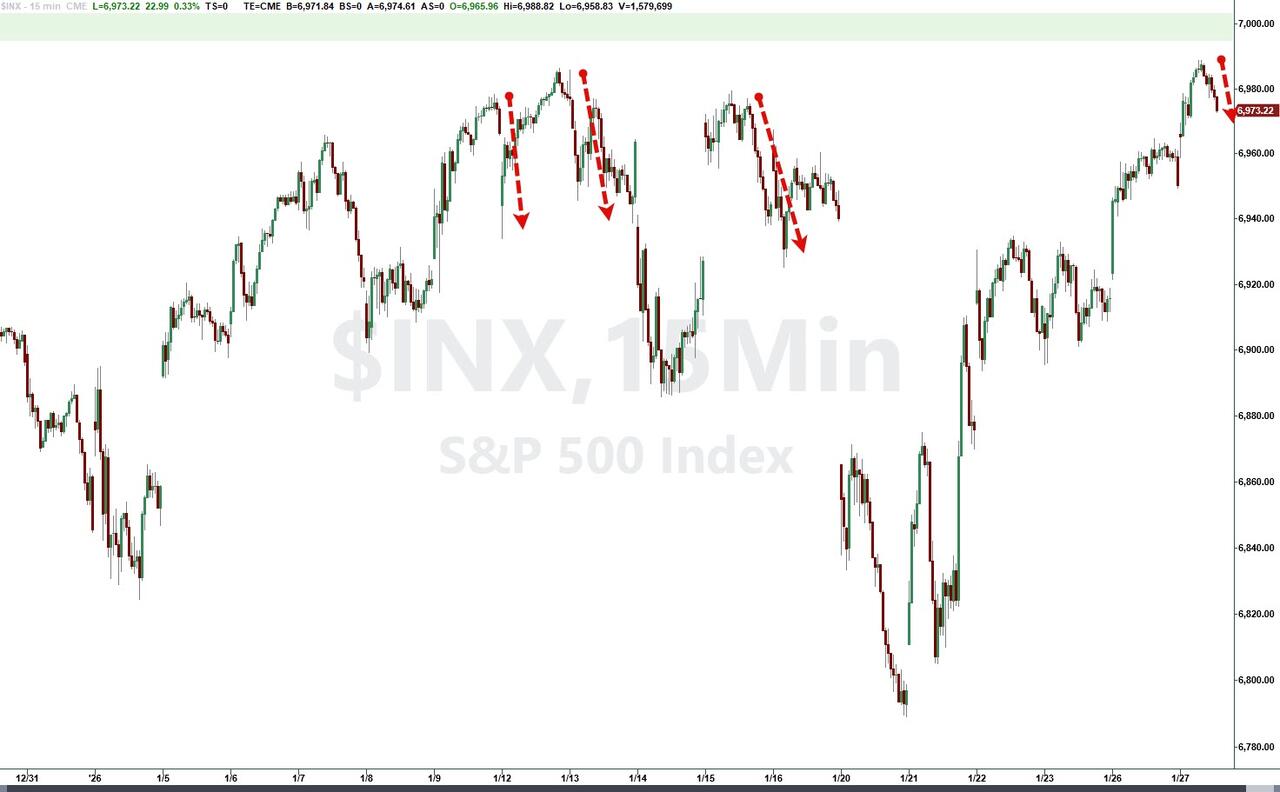
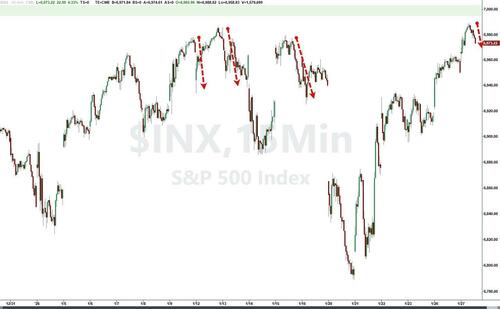
After continuously hitting the ‘Gamma Wall’ discussed by Goldman’s Brian Garrett…
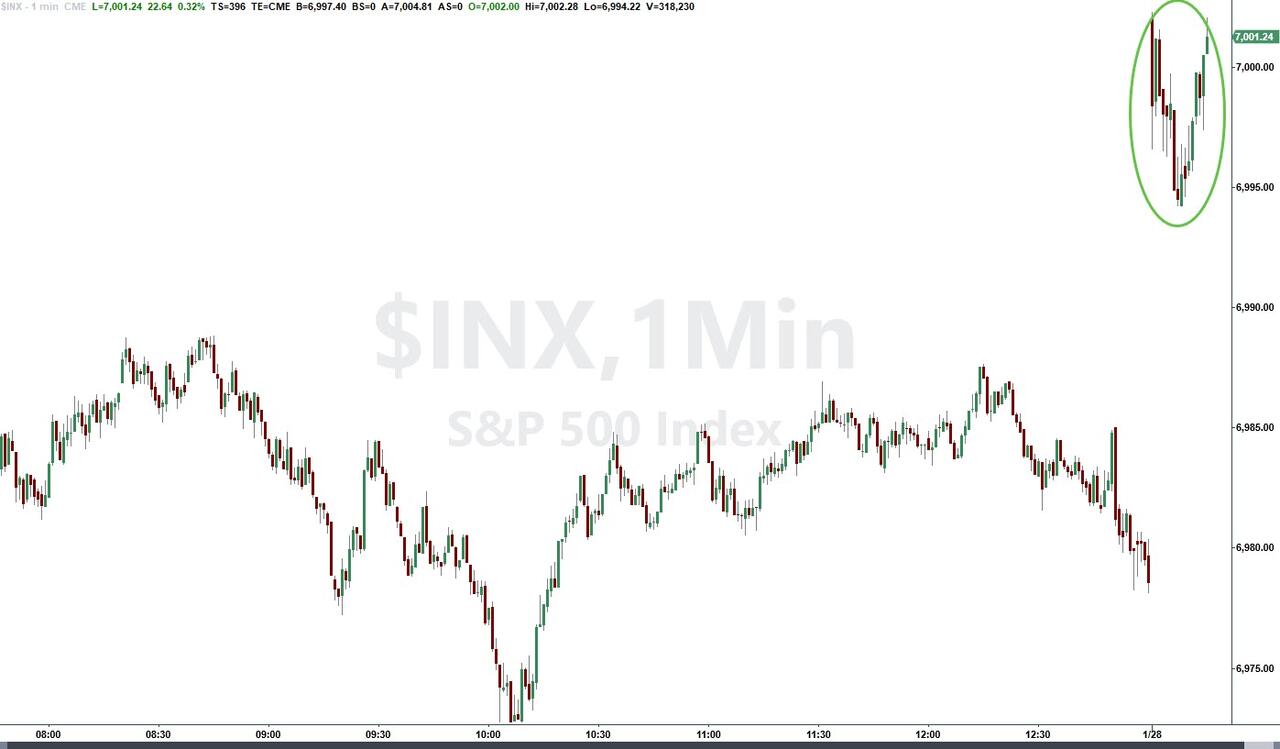
…the S&P 500 index opened higher this morning after strong results from ASML (and a slew of AI industry headlines), trading above 7,000 for the first time…
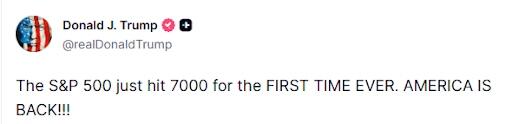
President Trump took the opportunity to exclaim “America Is Back!!”
Will that jinx it?
Maybe… but there’s another potential problem.
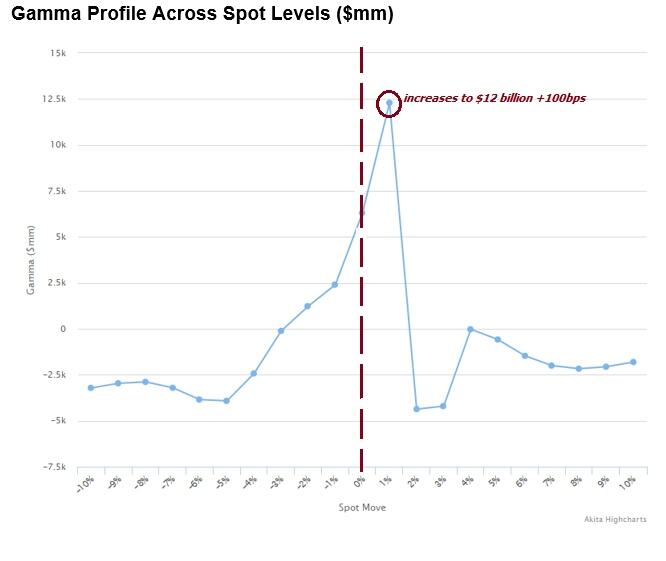
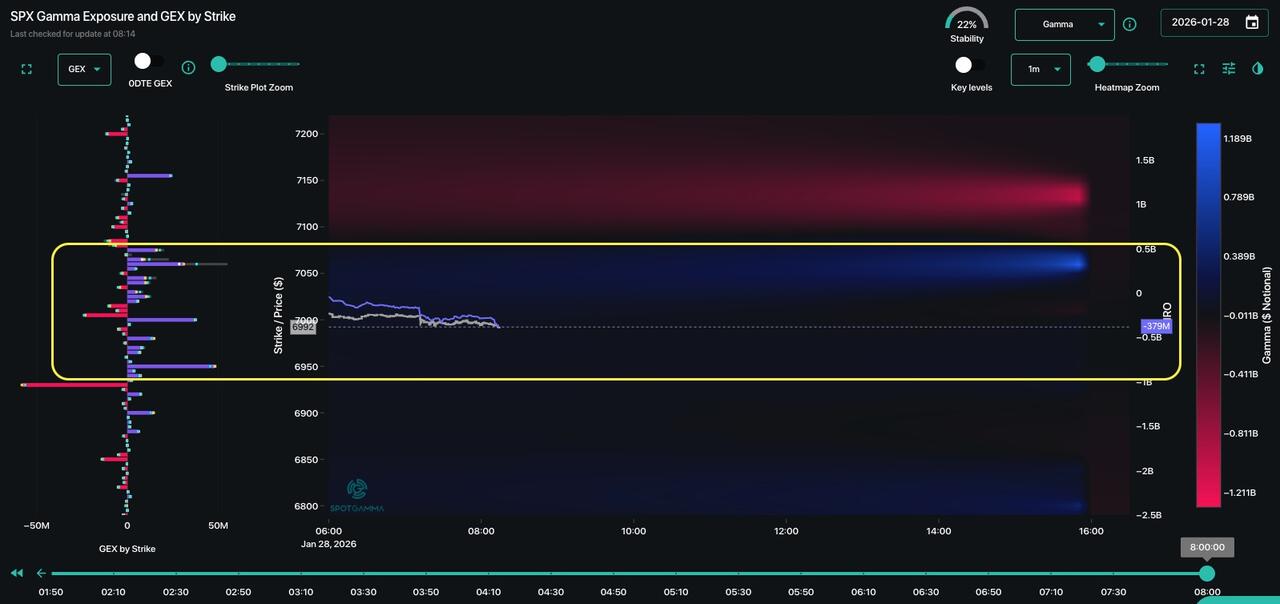
Going back to where we started, GS futures strats calculate $6bn of long gamma at spot, which increases to $12bn long gamma +100bps higher
In English, a 100bps rally in spx cash creates supply of ~35,000 e-minis from market makers
Goldman’s vol desk desk believes the 7,000 strike is the peak concentration…
…beyond this level, the market doesn’t necessarily “flip short,” but the dynamic is much cleaner.
While many charts look “ready to break out” and calls are clearly bid (a benign FOMC and solid Mag earnings could certainly allow for fresh ATH), SpotGamma warns that this market is priced for pure perfection, and there is risk embedded in that.
Confirming Garrett’s warning, there is a clear block of positive gamma today from 6,950 up to 7,010, which implies the market should be supported in this range.
Below 6,950 is a large negative gamma strike, and so we are now raising our Risk Pivot to 6,950.
Overhead resistance for today is into the 7,000-7,020 range.
Given the risk we see, SpotGamma’s preference is for long calls and/or call spreads in the QQQ (vs long stock) as the IV is low and skew is neutral.
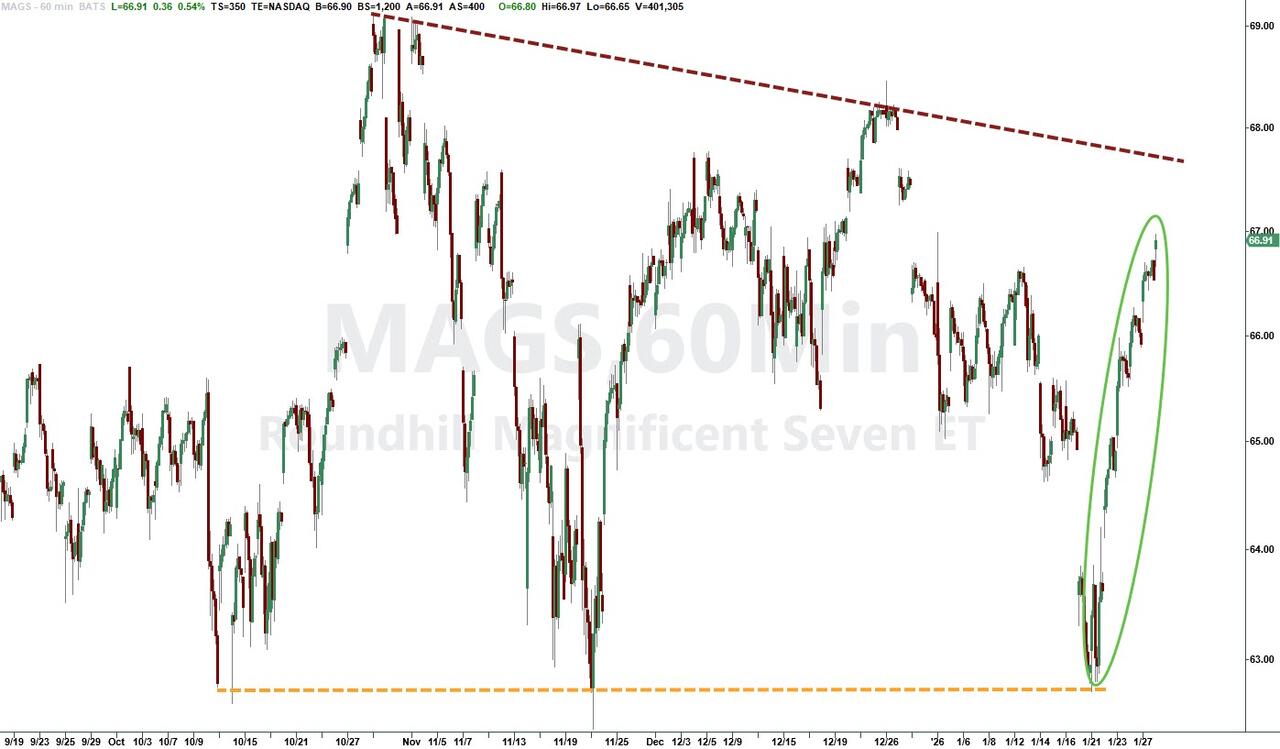
Back to the point of “stocks near breaking out”, here is the MAGS (Mag7) ETF, and this comes into focus with much of this index reporting today into tomorrow.
Most of these Mag 7 names have estimated earnings moves of 5%, with a skew towards calls.
For bulls, if earnings are decent and these names break out it will be hard for equity indexes to sell off. That being said, there is a lot of positive gamma in these names, and with the skew toward calls it will likely take some really good earnings to evoke a big response. So our expectation here “less than ±5% moves make sense”.
The setup into earnings is straightforward. Mega-cap leadership can keep the indexes moving higher, and a Nasdaq breakout gets validated if results and capex guidance are received as intended. While AI capex is squeezing free cash flows, the market is willing to live with that as long as the debt issuance remains capped and ROI improves as past investments start to increasingly pay off.
Tyler Durden
Wed, 01/28/2026 – 09:48

Reino Unido propone obligar a Google a permitir que editores rechacen resúmenes de IA
Por KELVIN CHAN
LONDRES (AP) — Google debería permitir a sitios de noticias y creadores de contenido abstenerse de tener su material usado para resúmenes creados por inteligencia artificial, declaró el organismo de control de la competencia de Gran Bretaña.
La propuesta es una de varias formuladas por la Autoridad de Competencia y Mercados para aflojar el control del gigante tecnológico sobre el mercado de búsquedas en línea del Reino Unido.
El año pasado, la agencia calificó a Google como un actor “estratégico” en la publicidad de búsqueda en línea, utilizando nuevos poderes digitales para promover más competencia al forzar cambios en las prácticas comerciales de la empresa.
El informe de la agencia, conocida como la CMA por sus siglas en inglés, señaló que los editores de noticias han sufrido una caída en su tráfico desde que Google lanzó sus resúmenes de IA, que aparecen en la parte superior de algunas búsquedas porque menos usuarios hacen clic para acceder a los artículos originales.
El organismo indicó que Google debería dar a los editores una “elección significativa” sobre cómo se utiliza su contenido en las respuestas generadas por IA; ser más transparente sobre el proceso; y citar adecuadamente el contenido utilizado en los resultados de IA.
Google dijo que esperaba con interés participar con la agencia y continuaría las discusiones con los propietarios de sitios web.
“Ahora estamos explorando actualizaciones de nuestros controles para permitir que los sitios se excluyan de las búsquedas de IA generativa”, apuntó en un blog Ron Eden, jefe de gerencia de producción de Google.
“Nuestro objetivo es proteger la utilidad de búsquedas para las personas que desean información rápidamente, al mismo tiempo que damos a los sitios web las herramientas adecuadas para gestionar su contenido”.
Will Hayter, director ejecutivo de mercados digitales de la CMA, sostuvo en un blog que las medidas apoyarían la “sostenibilidad a largo plazo” de los editores y “ayudarían a las personas a verificar fuentes en los resultados generados por IA y a generar confianza en lo que ven”.
La CMA también recomendó que Google clasifique sus resultados de búsqueda de manera justa y no dé prioridad a los sitios web que tienen publicidad u otros acuerdos comerciales con Google. Y propuso facilitar que las personas cambien su motor de búsqueda predeterminado al requerir distintas pantallas en dispositivos Android y el navegador Chrome.
El organismo de control tomará su decisión final después de recopilar comentarios en una consulta que finaliza el 25 de febrero.
___________________________________
Esta historia fue traducida del inglés por un editor de AP con ayuda de una herramienta de inteligencia artificial generativa.
3 months after rapidly scheduled arguments, the Supreme Court has yet to decide on Trump’s tariffs
WASHINGTON — When the Supreme Court granted an unusually quick hearing over President Donald Trump’s tariffs, a similarly rapid resolution seemed possible.
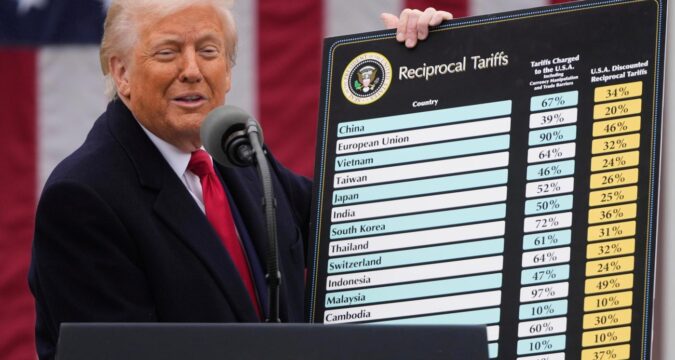
After all, Trump’s lawyers told the court that speed was of the essence on an issue central to the Republican president’s economic agenda. They pointed to a statement from Treasury Secretary Scott Bessent warning that the “longer a final ruling is delayed, the greater the risk of economic disruption.”
But nearly three months have elapsed since arguments in the closely watched case, and the court isn’t scheduled to meet in public for more than three weeks.
No one knows for sure what’s going on among the nine justices, several of whom expressed skepticism about the tariffs’ legality at arguments in November. But the timeline for deciding the case now looks more or less typical and could reflect the normal back-and-forth that occurs not just in the biggest cases but in almost all the disputes the justices hear.
Several Supreme Court practitioners and law professors scoffed at the idea the justices are dragging their feet on tariffs, putting off a potentially uncomfortable ruling against Trump.
“People suspect this kind of thing from time to time, but I am not aware of instances in which we have more than speculation,” said Jonathan Adler, a law professor at the College of William & Mary in Williamsburg, Virginia.
The timeframe alone also doesn’t point to one outcome or the other.
One possible explanation, said Carter Phillips, a lawyer with 91 arguments before the high court, “is that the court is more evenly divided than appeared to be the case at oral argument and the fifth vote is wavering.”
Even if the majority opinion has been drafted and more or less agreed to by five or more members of the court, a separate opinion, probably in dissent, could slow things down, Phillips said.
Just last week, the court issued two opinions in cases that were argued in October. All nine justices agreed with the outcome, a situation that typically allows decisions to be issued relatively quickly. But a separate opinion in each case probably delayed the decision.
The court is generally moving more slowly in argued cases, perhaps because of the flood of emergency appeals the Trump administration has brought to the justices. The first argued case wasn’t decided until January this year. Typically, that happens in December, if not November.
Over the last 20 years, the average turnaround time for a Supreme Court opinion was just over three months, according to data gathered by Adam Feldman, creator of Empirical SCOTUS. The timeline has increased in recent years, with the court releasing half or more of its cases in June.
Decision times can vary widely. The court can move quickly, especially in cases with hard external deadlines: The landmark Bush v. Gore case that effectively decided the 2000 presidential election took just over a day. The recent case over TikTok took seven days.
On the higher end, when the justices are on their own timelines, cases can take much longer to resolve. Gundy v. U.S., a case argued in 2018 about how the sex offender registry is administered, took more than eight months to be decided.
Major decisions on expanding gun rights, overturning Roe v. Wade and ending affirmative action in college admissions were handed down six to eight months after the cases were argued.
Also undecided so far is a second major case in which the court sped up its pace over redistricting in Louisiana and the future of a key provision of the Voting Rights Act.
The tariffs case took on added urgency because the consequences of the Trump administration’s policy were playing out in real time, in ways that have been both positive and negative.
“Like many, I had hoped that the Supreme would rush the decision out,” said Marc Busch, an expert on international trade policy and law at Georgetown University. “But it’s not a surprise in the sense that they have until June and lots of issues to work through.”
The separation of powers questions central to the case are complicated. Whatever the majority decides, there will likely be a dissent and both sides will be carefully calibrating their writing.
“It is the language at the end of the day that’s going to make this more or less meaningful,” he said.
Meanwhile, as the justices weigh the case, Trump continues to invoke the threat of tariffs, extol their virtues and refer to the case as the court’s most important.
“I would hope, like a lot of people, the justices have been watching the tariff threats over Greenland and realize the gravity of this moment,” Busch said.
https://www.chicagotribune.com/2026/01/28/supreme-court-trump-tariffs-2/
A month after Iran protests began, worry pervades Mideast over possible US strike
DUBAI, United Arab Emirates — Iranian officials reached out to the wider Middle East on Wednesday over the threat of a possible U.S. military strike on the country, a month since the start of protests in Iran that soon spread nationwide and sparked a bloody crackdown.
Two nations, Saudi Arabia and the United Arab Emirates, have signaled they won’t allow their airspace to be used for any attack. But America has moved the USS Abraham Lincoln and several guided missile destroyers into the region, which can be used to launch attacks from the sea.
It remains unclear what U.S. President Donald Trump will decide about using force, though he laid down two red lines — the killing of peaceful demonstrators and the possible mass execution of detainees. The protests saw at least 6,221 people killed as Iran launched a bloody crackdown on the demonstrations, with many others feared dead, activists said Wednesday.
“Hopefully Iran will quickly ‘Come to the Table’ and negotiate a fair and equitable deal – NO NUCLEAR WEAPONS – one that is good for all parties,” Trump wrote on his Truth Social platform on Wednesday. “Time is running out, it is truly of the essence!”
Mentioning the June strikes on Iran, Trump wrote: “The next attack will be far worse!”
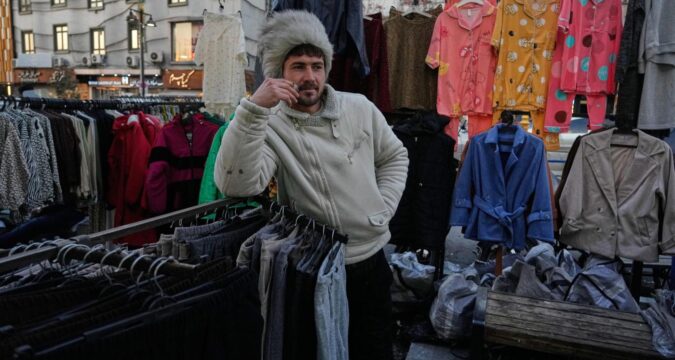
Iran’s state-run media, which now only refers to protesters as “terrorists,” remains the sole source of news for many as Tehran cut off access to the global internet some three weeks ago. But Iranians have become angry and anxious in the weeks since, seeing footage of protesters shot and killed while worrying about what may happen next as the country’s economy sinks further.
“I feel that my generation failed to give a better lesson to younger ones,” said Mohammad Heidari, a 59-year-old high school teacher in Tehran. “The result of decades of teaching by my colleagues and me led to death of thousands, and maybe more injured and prisoners.”
Rapid diplomacy between Iran, Arab nations
Egypt’s Foreign Ministry said its top diplomat, Badr Abdelatty, separately spoke with Iranian Foreign Minister Abbas Araghchi and U.S. Mideast envoy Steve Witkoff to “work toward achieving calm, in order to avoid the region slipping into new cycles of instability.”
The statement offered no details, though Iranian state media quoted Araghchi as saying third-party mediators had been in touch. Witkoff, a billionaire real estate developer and Trump’s friend, had earlier negotiated over Iran’s nuclear program. There was no immediate acknowledgment from the White House of the call.
Meanwhile, Saudi Arabia’s Crown Prince Mohammed bin Salman held a call with Iranian President Masoud Pezeshkian, saying the kingdom would “not allow its airspace or territory to be used for any military actions against Iran or for any attacks from any party, regardless of their origin.” That follows a similar pledge by the UAE.
Both Saudi Arabia and the UAE host American air assets and troops. Both also have faced attacks in the last decade. A 2019 assault believed by the West to have been carried out by Iran briefly halved Saudi oil production. The UAE faced several attacks claimed by Yemen’s Houthi rebels in 2022.
However, America’s biggest base in the region is Qatar’s vast Al Udeid Air Base, which serves as the forward operating headquarters of the U.S. military’s Central Command. Both Araghchi and Ali Larijani, a top Iranian security official, held calls with Qatar’s Prime Minister Mohammed bin Abdulrahman Al Thani. Qatar acknowledged the calls, but offered few specifics on what was discussed.
Iran attacked Al Udeid in June in response to Trump sending American warplanes to bomb Iranian nuclear enrichment sites after Israel launched a 12-day war on the Islamic Republic.
“Our position is exactly this: Applying diplomacy through military threats cannot be effective or constructive,” Araghchi told journalists Wednesday outside of a Cabinet meeting. “If they want negotiations to take shape, they must abandon threats, excessive demands, and the raising of illogical issues. Negotiations have their own principles: they must be conducted on an equal footing, based on mutual respect, and for mutual benefit.”
Activists offer new death toll
While the protests have been halted for weeks after the crackdown, information slowly trickling out of Iran via Starlink satellite dishes is reaching activists, who have been trying to tally the carnage.
On Wednesday, the U.S.-based Human Rights Activists News Agency, which has been accurate in multiple rounds of unrest in Iran, said at least 6,221 dead it counted included at least 5,858 protesters, 214 government-affiliated forces, 100 children and 49 civilians who weren’t demonstrating. More than 42,300 have been arrested, it added.
The group verifies each death and arrest with a network of activists on the ground in Iran. The Associated Press has been unable to independently assess the death toll given that authorities cut off the internet and disrupted calls into the Islamic Republic.
Iran’s government has put the death toll at a far lower 3,117, saying 2,427 were civilians and security forces, and labeled the rest “terrorists.” In the past, Iran’s theocracy has undercounted or not reported fatalities from unrest.
That death toll exceeds that of any other round of protest or unrest in Iran in decades, and recalls the chaos surrounding the 1979 Islamic Revolution.
The protests began on Dec. 28, sparked by the fall of the Iranian currency, the rial, and quickly spread across the country. They were met by a violent crackdown, the scale of which is only starting to become clear as the country has faced more than two weeks of internet blackout — the most comprehensive in its history.
Iran on Wednesday also announced the execution of Hamidreza Sabet, a man it convicted of spying for Israel. Sabet’s execution marks the 13th carried out by Iran against alleged spies for Israel since the June war.