Category: News

Girl Scout cookie sales teach digital marketing skills, Northbrook, Glenview leaders say
People who buy Girl Scout cookies know the treats taste good, but may not realize all the skills, from digital marketing to managing money to speaking to adults, they are helping to teach the young cookie salesgirls.
Diana Zuver leads two troops in Glenview. One troop, to which Zuver’s older daughter belongs, is for fifth- and sixth-graders. They are classified as Juniors (grades 4-5) and Cadettes (grades 6-8).
The other troop, to which Zuver’s younger daughter belongs, is for fourth-graders, and are classified as Juniors. Her troops, which are going into their seventh and fifth years, have been selling cookies since they were formed.
The Scout salesgirls learn skills which can benefit them in other aspects of their lives.
“Definitely people skills,” Zuver said. “They get confidence to start a conversation with someone they don’t know. They learn about goal-setting and money management.”
She added that they are developing entrepreneurial skills. “The girls get really excited trying to outdo themselves from the previous year,” Zuver noted.
She laughingly reported that one ambitious scout was always “hitting up the parents” at every social event at her school.
Naturally, some of the girls are shy about asking people to buy cookies. “I encourage girls to buddy up,” Zuver said.
To help all of the girls, whether or not they’re shy, they do practice scenarios, Zuver said. During those scenarios, they are coached in what to say to prospective customers and given important pointers.
Zuver said they are told to smile and be courteous. Girls are also told, “It’s okay if they say no,” she indicated. “You can tell them what your favorites are. Tell them how you’re going to use the money.”
The scout leader added that they are also taught the importance of setting goals. “We’ll meet as a troop and we’ll decide what projects we want to focus on this year and how we’re going to use our proceeds,” Zuver said. “We use that as our starting point for setting goals.”
The scouts sell cookies in a variety of locations, including door-to-door and at tables set out at stores and other locations.
“Selling cookies online is a new and very popular way to sell cookies,” Zuver added. “We started our cookie sales in December. Girls set up their digital cookie sites and they sent email blasts to friends and family. Customers can order directly online, pay online, and they’ll deliver the cookies once they get them.”
Girl Scouts of the USA announced that Exploremores will join the lineup for the 2026 cookie-selling season. (Girl Scouts of the USA)
Zuver said that the girls love cookie season and “enjoy the fruits of the cookie season because we usually do a camping trip in celebration each year.”
Girls earn rewards for their cookie sales. Prizes vary from a stuffed animal to a craft kit.
Girl Scout cookie volunteer Diana Zuver of Glenview, at right, shows the Exploremore cookie, new for this year’s Girl Scout cookie sales, to Isabella “Izzy” Zuver, who holds the rank of Cadette, at left and Olivia Zuver, who holds the rank of Junior in Girl Scouts. (Zuver family)
“Last year, both of my girls were able to earn the 500-package level prize,” Zuver said. “You had a choice to either earn cookie dough—which you can use for either Girl Scout Camp or other Girl Scout Council items—or you could go on a Cookie Cruise. They were each able to bring a parent, so Zuver and her husband both went on the adventure, sailing on Lake Michigan.
“It was awesome,” she declared. “It had a DJ and food.”
Zuver’s troops typically earn a little over $2,000. Their goal for this year is $1,800.
The latest news from the world of Girl Scout cookies is that there’s a new cookie this year, Exploremores. “It is very chocolate-heavy, inspired by Rocky Road ice cream,” Zuver related.
Karen Kohl has been a troop leader in Northbrook for seven years. The troop consists of sixth-graders through high school sophomores. They are Cadettes (grades 6-8) and Seniors (grades 9-10).
Kohl’s troop has been selling cookies every year since it was formed. She noted that, “At this point they’re veterans. Almost all the girls have sold in the past.”
Preparation for selling includes talking about the ways to sell, setting up their digital sites, and doing email marketing, Kohl said.
In terms of where they sell, “Each girl has a different approach,” Kohl said. “Some of them still do door-to-door to neighbors. A lot of them do sharing on social media and sharing their digital site with friends and family through emails.” They also set up booths at local businesses.
Kohl believes the girls earn valuable skills through selling cookies.
“They learn digital marketing, having a presence, and following up with their customers,” Kohl said. “When we do the booths, they’re learning some people skills. They’re learning how to ask and approach people and have those sales conversations. They learn that not everybody wants cookies.”
When people say no, Kohl tells them to “put a smile on their face and move on.”
Kohl works with girls who are shy, teaching them skills to make them more comfortable. In other cases, a shy girl might be given a different role, such as a money handler or inventory tracker, Kohl reported.
Some girls develop entrepreneurial skills, Kohl noted. “Some of them get into it and think about ways that they can sell,” she said. “The girls that do the booths have ideas about how they present their inventory.”
Kohl said that some of the girls did a lot of booths because they wanted to go on the Cookie Cruise. “They spent six-hour shifts selling cookies.”
She added that 10 of the scouts are going to Switzerland this year with one-third to one-half of the cost for a couple of the girls being covered by their cookie sales proceeds.
Kohl’s scouts sold over $15,000 worth of cookies last year. “A portion goes to the Council, a portion goes to the troop, and a portion the girls get into an account that they can use for their activities,” she said.
Both Zuver and Kohl were girl scouts themselves.
Zuver said, “I made it up to my second year of Cadette, until I got involved in sports and other things.” Her mother was a troop leader.
The big change Zuver has seen since her scouting days is the way cookies are sold. She went door-to-door, rather than today’s methods of social media and digital sites.
Kohl, who was a Girl Scout for a couple of years, doesn’t remember selling cookies. She does appreciate the way the programs are structured now for badges and activities.
“There’s a lot of opportunities and ways to go about achieving the requirements of a badge,” Kohl said.
Myrna Petlicki is a freelance reporter for Pioneer Press.
https://www.chicagotribune.com/2026/01/28/girl-scout-cookie-teach-digital-marketing-skills/

Indiana Senate committee passes carbon sequestration bill
Nearing the deadline for bills to be heard in committee, the Senate Environmental Affairs Committee looked at legislation that would allow for more local regulation on carbon sequestration projects.
After hearing testimony, the committee passed the bill to second reading in the Senate.
State Sen. Rick Niemeyer, R-Lowell, authored Senate Bill 7, which would require a carbon storage operator to receive approval from a county legislative body or plan commission if the sequestration project would transport or store carbon dioxide outside the county where it’s generated.
Niemeyer, who’s also chair of the Senate Environmental Affairs Committee, said he created the bill because Benton County had an issue with a previously planned carbon sequestration project. Trucks were doing seismic testing on farmland with approval of the property owner, but the plan commission and county commissioners “had no idea” about the project.
“The bill says that when you’re bringing a carbon sequestration project from outside your county, and you’re taking it to another county and bringing carbon outside the jurisdiction, it has to be noticed by a plan commission or county executive,” Niemeyer said. “It’s a property rights issue, it’s about zoning, and it’s about local control.”
Niemeyer said the bill does not apply to pipelines, which transport the carbon dioxide from the capture site to its storage location, according to the Liquid Energy Pipeline Association.
According to the U.S. Geological Survey, carbon sequestration captures and stores atmospheric carbon dioxide, and it’s a method to reduce the atmosphere’s carbon dioxide “with the goal of reducing global climate change.”
According to Post-Tribune archives, in June 2025, BP indefinitely paused a previously announced carbon sequestration project, which would have required a pipeline to run through hundreds of miles in six Indiana counties to store carbon emissions underground.
“BP is committed to remaining a critical driver of this economic engine that powers Northwest Indiana and the Midwest,” a company spokesperson previously told the Post-Tribune. “While we are indefinitely pausing our low-carbon project in the region, our focus is on building a strong, economically competitive future for our Whiting Refinery.”
The Senate Environmental Affairs Committee heard six testimonies about the carbon sequestration bill on Tuesday, with the speakers evenly split on their bill opinions.
William Peebles, Vermillion County commissioner, was in support of the carbon sequestration bill during Tuesday’s committee meeting. Peebles and the other county commissioners support the ill because it gives the county a voice, he said.
“Projects of this nature can affect land use, infrastructure and public safety, and counties should have the ability to review and approve them,” Peebles said. “Senate Bill 7 respects local control and ensures decisions are made with community input for these reasons.”
During Tuesday’s meeting, Niemeyer said commissioners from Benton and Newton counties wrote letters in support of the bill.
Citizens Action Coalition Executive Director Kerwin Olson also testified in support of the carbon sequestration bill. Olson believes it’s “completely appropriate” for county governments to have a say on if they’ll accept carbon from another area.
“If they’re going to accept a waste product from another county, that does present a risk,” Olson said.
Multiple people testified in opposition to the bill, including oil and gas representatives who said that local governments wouldn’t have the necessary expertise of carbon sequestration to make these decisions.
Mark Shublak, representing CountryMark, said oil and gas law has not allowed local control for more than 100 years.
Shublak told the committee that it might be a better idea to have local leaders and residents to consult with IDEM, the DNR, or U.S. Environmental Protection Agency about their carbon sequestration concerns.
“The policy of the state for over 100 years, as it relates to natural resources, is to conserve and responsibly alienate valuable natural resources with oversight from (the Indiana Department of Environmental Management) and (Department of Natural Resources),” Shublak said. “This bill establishes a policy where local authorities can conflict with that state policy.”
The DNR was established in 1965, and IDEM was created in 1986.

Han pasado tres meses y la Corte Suprema no ha decidido sobre los aranceles de Trump
Por MARK SHERMAN y LINDSAY WHITEHURST
WASHINGTON (AP) — Cuando la Corte Suprema concedió una audiencia inusualmente rápida sobre los aranceles del presidente Donald Trump, parecía posible una resolución igualmente rápida.
Al fin y al cabo, los abogados de Trump dijeron a la corte que la rapidez era esencial en un tema central para la agenda económica del presidente republicano. Señalaron una declaración del secretario del Tesoro Scott Bessent de que “cuanto más se retrase un fallo final, mayor será el riesgo de una disrupción económica”.
Sin embargo, han pasado casi tres meses desde los argumentos y la corte no tiene reuniones programadas en más de tres semanas.
Nadie sabe con certeza qué está sucediendo entre los nueve magistrados, varios de los cuales expresaron escepticismo sobre la legalidad de los aranceles durante los argumentos en noviembre. Pero el cronograma para decidir el caso ahora parece más o menos típico y podría reflejar el intercambio normal que ocurre no solo en los casos más grandes, sino en casi todas las disputas que los jueces escuchan.
Los expertos dudan de que los jueces están demorando su decisión, posponiendo un fallo potencialmente incómodo contra Trump.
“La gente sospecha este tipo de cosas de vez en cuando, pero no estoy al tanto de casos en los que tengamos más que especulaciones”, estimó Jonathan Adler, profesor de derecho en el College of William & Mary en Williamsburg, Virginia.
El lapso de tiempo por sí solo tampoco apunta a un resultado u otro.
Una posible explicación, declaró Carter Phillips, un abogado con 91 argumentos ante la corte suprema, “es que la corte está más dividida de lo que parecía durante el argumento oral y el quinto voto está vacilando”.
Incluso si la opinión mayoritaria ha sido redactada y más o menos acordada por cinco o más miembros de la corte, una opinión separada, probablemente en disidencia, podría ralentizar las cosas, dijo Phillips.
La semana pasada, la corte emitió dos opiniones en casos que se argumentaron en octubre. Los nueve jueces estuvieron de acuerdo con el resultado, una situación que típicamente permite que las decisiones se emitan relativamente rápido. Pero una opinión separada en cada caso probablemente retrasó la decisión.
La corte generalmente se está moviendo más lentamente quizás debido a la avalancha de apelaciones de emergencia que la administración Trump ha llevado a los jueces. El primer caso argumentado no se decidió hasta enero de este año. Típicamente, eso ocurre en diciembre, si no en noviembre.
En los últimos 20 años, el tiempo promedio de respuesta para una opinión de la Corte Suprema fue de poco más de tres meses, según datos recopilados por Adam Feldman, creador de Empirical SCOTUS. El cronograma ha aumentado en los últimos años, con la corte emitiendo la mitad o más de sus casos en junio.
Los tiempos de decisión pueden variar mucho. La corte puede moverse rápidamente, especialmente en casos con plazos externos estrictos: el caso histórico Bush v. Gore que efectivamente decidió la elección presidencial de 2000 tomó poco más de un día. El caso reciente sobre TikTok tomó siete días.
En el extremo superior, cuando los jueces están en sus propios cronogramas, los casos pueden tardar mucho más en resolverse. Gundy v. Estados Unidos, un caso argumentado en 2018 sobre cómo se administra el registro de delincuentes sexuales, tardó más de ocho meses en decidirse.
Decisiones importantes sobre la expansión de los derechos de armas, la revocación de Roe vs. Wade y el fin de la acción afirmativa en las admisiones universitarias se emitieron de seis a ocho meses después de que se argumentaron los casos.
También está sin decidir hasta ahora un segundo caso importante en el que la corte aceleró su ritmo sobre la redistribución de distritos en Luisiana y el futuro de una disposición clave de la Ley de Derechos de Votación.
El caso de los aranceles adquirió urgencia adicional porque las consecuencias se estaban viendo en tiempo real, de maneras que han sido tanto positivas como negativas.
“Como muchos, esperaba que la Corte Suprema apresurara la decisión”, destacó Marc Busch, experto en política y derecho de comercio internacional en la Universidad de Georgetown. “Pero no es una sorpresa en el sentido de que tienen hasta junio y muchos temas que resolver”.
Las preguntas sobre la separación de poderes centrales en el caso son complicadas. Cualquiera que sea la decisión de la mayoría, probablemente habrá una disidencia y ambas partes estarán calibrando cuidadosamente su redacción.
“Es el lenguaje al final del día lo que hará que esto sea más o menos significativo”, dijo.
Mientras los jueces sopesan el caso, Trump continúa invocando la amenaza de los aranceles, exaltando sus virtudes y refiriéndose al caso como el más importante de la corte.
“Esperaría, como mucha gente, que los jueces hayan estado observando las amenazas de aranceles sobre Groenlandia y se den cuenta de la gravedad de este momento”, comentó Busch.
___________________________________
Esta historia fue traducida del inglés por un editor de AP con ayuda de una herramienta de inteligencia artificial generativa.

WTI Holds Gains After Winter Storm Sparks Biggest Total Inventory Draw Since October
WTI Holds Gains After Winter Storm Sparks Biggest Total Inventory Draw Since October
Oil prices hit a fresh four-month high this morning after President Trump threatened another attack on Iran, urging Tehran to negotiate a nuclear deal.
“Hopefully Iran will quickly ‘Come to the Table’ and negotiate a fair and equitable deal,” Trump said in a post on his Truth Social network, adding that “the next attack will be far worse!” than the one that took place last year.
Prices pared gains somewhat after Iran’s mission to the UN repeated in a post on X that it stands ready for dialogue based on mutual respect and interests, but said it will “defend itself and respond like never before,” to US aggression.
API
Crude -247k
Cushing -92k
Gasoline -415k
Distillates +2.01mm
DOE
Crude -2.295mm (+1.95mm exp)
Cushing -278k
Gasoline +223k
Distillates +329k
Total crude and fuel stockpiles fell last week for the first time since early December led by a surprise crude draw (bigger than the small one reported by API)…
Source: Bloomberg
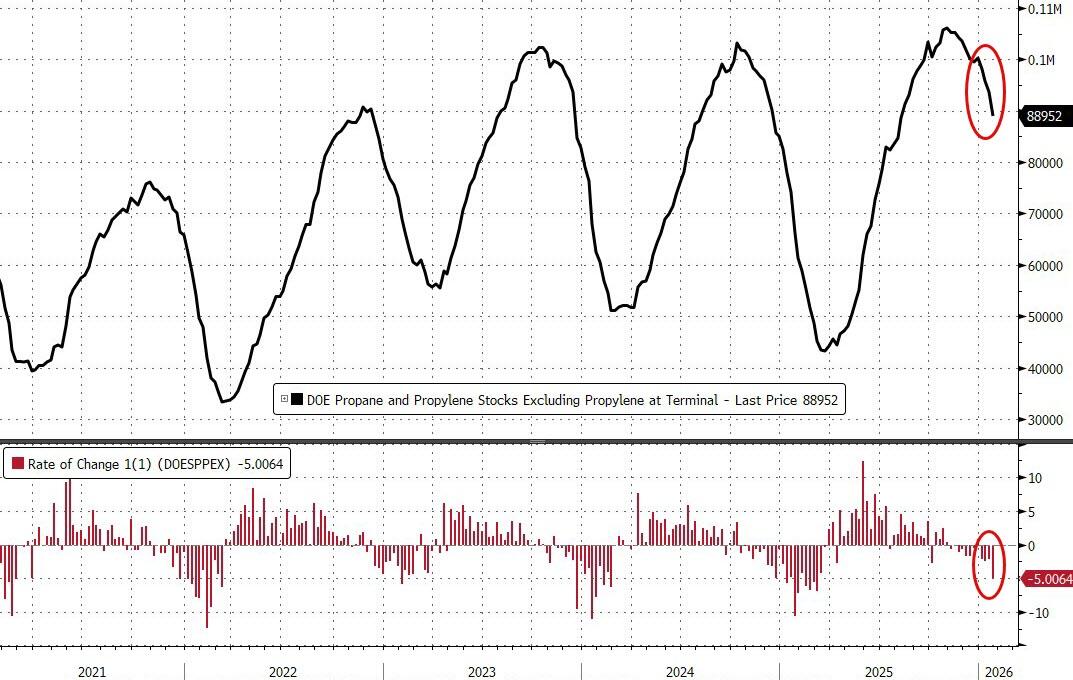
Bloomberg reports that the 6 million barrel draw (which was the biggest since October) was led by a decline in crude inventories and also the biggest drop in propane inventories since early last year ahead of the big freeze.
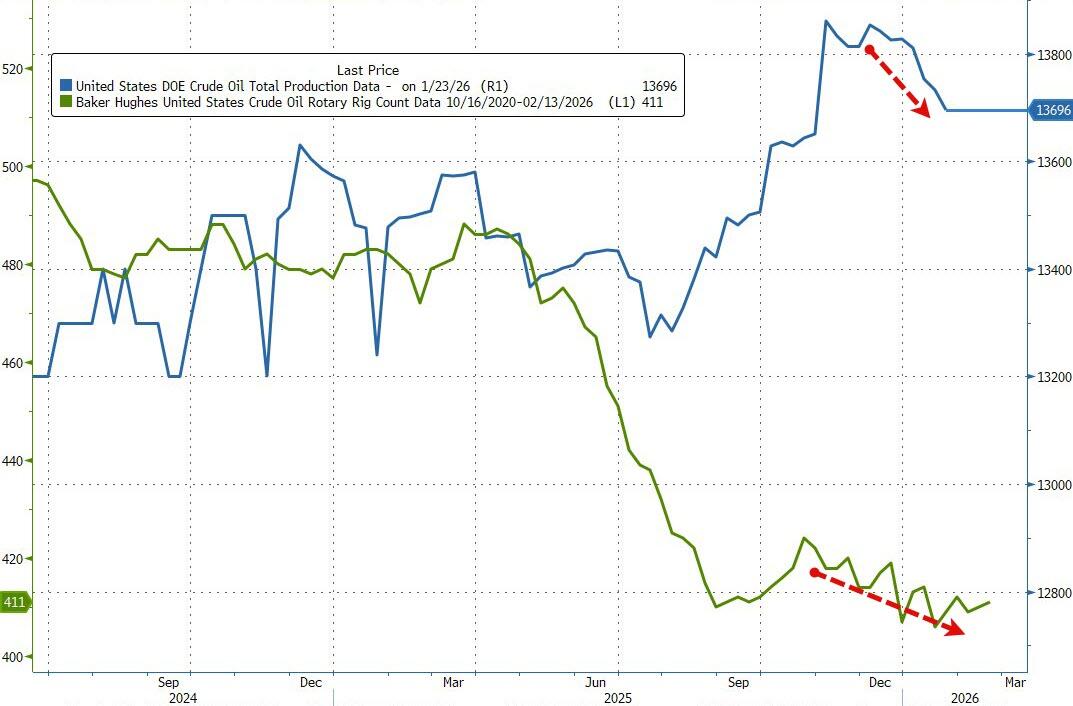
Crude production fell to 13.7 million barrels a day last week, down by 36,000 barrels a day from the previous week. The drop may reflect the initial impact of the winter storm that hit the US in recent days and came as the number of rigs drilling for oil edged higher for a second week, with 1 unit put into operation last week, according to Baker Hughes.
Source: Bloomberg
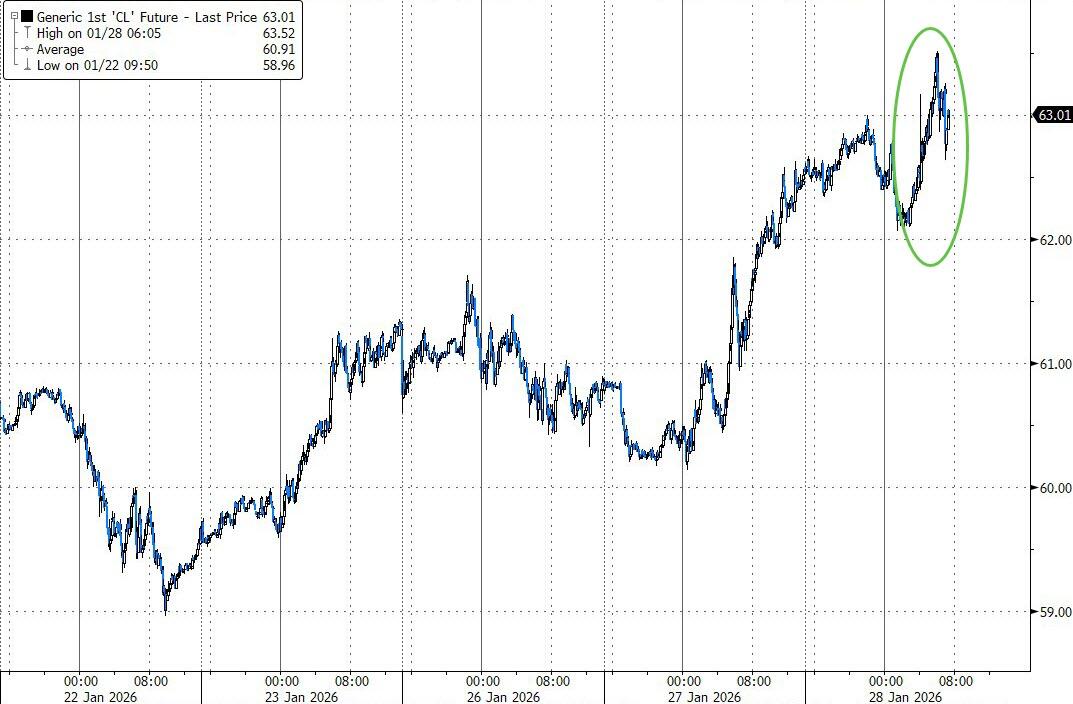
WTI is holding on to early gains after the surprise draw…
Finally, circling back to the start, the potential risk to Iranian supplies has injected a premium into oil prices and led futures to start the year on a strong footing, up more than 10% this month, despite forecasts for a glut. That has also kept the cost of bullish options high relative to bearish ones.
“Market sentiment appears to be gradually turning more positive, as the bearish oversupply narrative so prevalent in the second half of 2025 weakens,” Standard Chartered analysts including Emily Ashford wrote in a note.
“We envisage an uptick in volatility and increasing focus on both supply and demand risks.”
The prompt spread for both oil benchmarks — the difference between their two nearest contracts — has widened in a bullish backwardation structure over the course of this month, indicating tighter supply.
Tyler Durden
Wed, 01/28/2026 – 10:42
River Plate anuncia ampliación y techado de su estadio Monumental para Mundial 2030
Por DÉBORA REY
BUENOS AIRES (AP) — El club argentino River Plate anunció que techará la totalidad de las tribunas de su mítico estadio Monumental y la ampliación de la capacidad a más de 100.000 espectadores con vistas al Mundial de 2030, convirtiéndose en uno de los recintos de fútbol más grandes del mundo.
La obra comenzará en abril de este año y tendrá un plazo aproximado de 36 meses, con un costo estimado que superará los 100 millones de dólares, anunció el club millonario el miércoles en un comunicado.
El estadio Monumental de Buenos Aires, el más grande de Sudamérica con capacidad actual para unos 85.000 fanáticos, será sede de la Copa del Mundo 2030 que por primera vez en la historia contará con seis co-anfitriones de tres continentes diferentes: Argentina, Paraguay, Uruguay por América; España y Portugal por Europa y Marruecos por África.
Allí Argentina ganó su primer Mundial en 1978 y se suelen disputar los partidos de la Albiceleste de Lionel Messi en eliminatorias.
River construirá una nueva bandeja 360° que permitirá incorporar unos 16.000 lugares adicionales. Una vez concluida la obra, el Monumental se convertirá en uno de los estadios de fútbol más grandes del mundo. Actualmente, ese escalafón lo lidera el estadio Rungrado 1 de Mayo de Pyongyang, Corea del Norte, con 114.000 butacas.
La obra estará a cargo de la empresa alemana Schlaich Bergermann Partner (SBP), partícipe de otros proyectos icónicos como los estadios Maracaná en Río de Janeiro, Santiago Bernabéu y Metropolitano en Madrid, el Tottenham Hotspur en Londres y el Allianz Arena en Múnich.
Según el club, se verán afectados un máximo de tres partidos de local durante los tres años que dure el proyecto.
El presidente de River, Stefano Di Carlo, afirmó que la obra será financiada por bancos internacionales y un nuevo contrato comercial por venta de los derechos de nombre de estadio por los próximos 10 años.
“Quiero agradecer especialmente a los de 350.000 socios de River artífices de este momento histórico y de la grandeza de River a lo largo de más de un siglo…que son quienes permiten que River tenga el orgullo, como asociación civil sin fines de lucro, de emprender una obra de esta envergadura”, resaltó el directivo en un mensaje en X.
___
Deportes AP: https://apnews.com/hub/deportes

Illinois Racing Board suspends harness racing license at Hawthorne Race Course due to financial troubles
The Illinois Racing Board has suspended the operating license for harness racing at Hawthorne Race Course, citing ongoing financial difficulties.
The board cited Suburban Downs, which operates harness racing at Hawthorne, Monday for “failure to provide documentation demonstrating its financial integrity,” and proof that it can meet the minimum standards of the state Horse Racing Act.
Domenic DiCera, the board’s executive director, called the decision “very difficult.”
“On January 15th, IRB requested bank statements that reflect the operating fund, and any fund related to racing operations at Suburban Downs,” DiCera said in a written statement. “Unfortunately, their financial difficulties, including failure to provide financial documents showing their ability to operate assigned 2026 race dates, have led us to suspend their license.”
Previously, the board had canceled the track’s races in west suburban Stickney on Jan. 3 and 4 for failure to submit required surety bonds.
The track rectified that, but horse owners said the track’s checks to them from previous races were bouncing, and the track has canceled its races on every subsequent weekend this year.
Jeff Davis, president of the Illinois Harness Horsemen’s Association, wrote online that the races were canceled because the horsemen cannot be paid due to the track’s banking issues.
“Our position remains unchanged: racing should not resume until horsemen have reliable access to their earned funds,” Davis wrote.
The racing board sent a letter January 26 to Tim Carey, owner and CEO of Suburban Downs, and president and general manager of the Carey family-owned Hawthorne, citing state law that the board may require access to a license holder’s financial records, and stating that if a track’s check bounces, the matter shall go to the board for disposition.
The Board stated that it will consider reinstating the Suburban Downs licenses “should they cure the violations and provide documentation demonstrating they meet the minimum standards, including but not limited to its financial integrity…”
Track officials did not immediately respond to requests for comment. Carey and Davis were scheduled to speak to the board at its meeting Wednesday.
As part of a massive expansion of gambling in Illinois in 2019, state lawmakers authorized Hawthorne to open a combination racecourse and casino, or racino, at its current location and in the south suburbs. Lawmakers also granted the track the extraordinary authority to veto any other attempt to open a track in the south suburbs.
Despite demolition of part of its grandstand and repeated promises of progress, after six years, Hawthorne has failed to get funding for a racino at either site.
Harness horse owners, breeders and trainers say their industry is dying without the revenue from racinos, as other states have. The horse operators have called for state lawmakers to rescind that veto, and let others build a new track in the south suburbs and in downstate Decatur. The state Senate approved such a measure in October, and it may get action by the House in the current legislative session.
Since Arlington International Racecourse closed in 2021, Hawthorne is the only horse racing venue in the Chicago area, and the only harness race course in the state. Hawthorne is scheduled to make its annual switch from harness racing to thoroughbred racing in March through November.
https://www.chicagotribune.com/2026/01/28/illinois-racing-board-hawthorne-race-course/

La Champions cierra su fase de liga con una tanda de 18 partidos simultáneos
Por GRAHAM DUNBAR
En una intensa última jornada de la fase inicial de la Liga de Campeones, totalizar 16 puntos podría no ser suficiente para siturarse entre los ocho primeros.
Los 36 equipos disputarán 18 partidos que comienzan simultáneamente, a las 2000 GMT. Únicamente el líder Arsenal y el segundo Bayern Múnich han asegurado uno de los ocho boletos automáticos a los octavos de final.
Desde el Real Madrid, tercero con 15 puntos, hasta el Borussia Dortmund, 16to con 11 puntos, buscan ubicarse entre los ocho primeros cuando suenen el silbatazo en ocho países diferentes de Europa.
La diferencia entre el octavo Chelsea y el noveno Barcelona, ambos con 13 puntos, es que el club inglés tiene seis goles más.
Se perfila un desenlace similar al de la temporada debut del nuevo y ampliado formato de la Liga de Campeones, cuando el corte fue de 16 puntos para entrar entre los ocho primeros.
Aún así, el campeón defensor Paris Saint-Germain demostró hace un año que terminar 15to —y tener que sortear un playoff de eliminación directa a dos partidos en un calendario congestionado de febrero— no necesariamente es un obstáculo para ganar el título.
París será el escenario del duelo entre el PSG y Newcastle, sexto y séptimo, respectivamente. Ambos suman 13 unidades. El que pierda seguramente irá a los playoffs. Un empate podría enviar a ambos al sorteo del viernes que involucra a todos los equipos que terminen del noveno al 24mo puesto.
El Barcelona y el Manchester City estarán en guardia para aprovechar cualquier desliz en la parte superior de la tabla. El Barça recibe a un Copenhague que se ubica 26to, mientras que el City hará otro con el Galatasaray turco, 17mo con 10 puntos.
Qarabag también acumula 10 tantos y visita al Liverpool, cuarto en la clasificación. Ya es la temporada más exitosa para un club de Azerbaiyán en la Copa de Europa o la Liga de Campeones.
Napoli corre el riesgo de ser el mayor damnificado. El campeón italiano peligra despedirse temprano pues languidece en el 25to puesto antes de su encuentro contra Chelsea, el exequipo de su entrenador Antonio Conte.
Benfica, con seis puntos, precisa vencer al Real Madrid, equipo al que su técnico Jose Mourinho también dirigió, para permanecer en la competición. El Inter de Milán visita al Dortmund con la necesidad de ganar para evitar los playoffs.
El Bodo/Glimt de Noruega suma seis unidades tras su sorprendente victoria la semana pasada contra el City y ahora visita al Atlético de Madrid, 12do en la tabla.
___
Deportes AP: https://apnews.com/hub/deportes

Philip Glass cancela estreno de sinfonía en el Centro Kennedy en protesta
Por HILLEL ITALIE
NUEVA YORK (AP) — El compositor galardonado Philip Glass canceló un estreno mundial programado en el Centro Kennedy de una sinfonía sobre Abraham Lincoln, la última de una serie de cancelaciones desde que el presidente Donald Trump destituyó a la anterior dirección del centro.
La Sinfonía No. 15 de Glass, “Lincoln”, iba a ser dirigida por la ganadora del Grammy Karen Kamensek para presentaciones el 12 y 13 de junio.
“La Sinfonía No. 15 es un retrato de Abraham Lincoln, y los valores del Centro Kennedy hoy están en conflicto directo con el mensaje de la sinfonía”, dijo Glass en un comunicado difundido el martes por su publicista. “Por lo tanto, siento la obligación de retirar este estreno de la sinfonía del Centro Kennedy bajo su actual liderazgo”.
Roma Daravi, vicepresidenta de relaciones públicas del centro, respondió en un comunicado: “No tenemos lugar para la política en las artes, y aquellos que llaman a boicots basados en la política están tomando la decisión equivocada”.
Glass, quien cumplirá 89 años el sábado, fue homenajeado en el Centro Kennedy en 2018. Tres años antes, recibió una Medalla Nacional de las Artes de manos del entonces presidente Barack Obama.
Los artistas que se han retirado de presentaciones programadas en el Centro Kennedy han variado desde Renée Fleming hasta Bela Fleck. Trump, cuyo consejo de administración elegido a dedo ha dicho que cambiarán el nombre de la institución a Centro Kennedy Trump, ha colocado al centro en el corazón de su campaña contra lo que él llama la cultura “woke”.
El nombre de Trump ya ha sido añadido a la fachada del edificio, a pesar de que los académicos dicen que tal cambio requiere una proclamación del Congreso.
“Lincoln” fue inspirada por el “Discurso del Liceo” de 1838, en el que el futuro presidente advirtió contra la violencia de las turbas y los peligros que creaba para la democracia y el Estado de derecho. Lincoln, un representante estatal de Illinois de 28 años en ese momento, pronunció el discurso ante el Liceo de Jóvenes, una sociedad de debate en Springfield.
___
Esta historia fue traducida del inglés por un editor de AP con la ayuda de una herramienta de inteligencia artificial generativa.

Amazon Cuts 16,000 Jobs As Tech Layoffs Accelerate In 2026
Amazon Cuts 16,000 Jobs As Tech Layoffs Accelerate In 2026
Amazon is laying off about 16,000 more employees as it works to cut bureaucracy and respond to growing competition from AI.
The move follows October’s 14,000 job cuts and the closure of its gaming unit. The company also announced it will shut down its Amazon-branded grocery and cashierless stores.
A note on the company’s website on Wednesday said: “I want to let you know that we’re making additional organizational changes across Amazon that will impact some of our teammates. I recognize this is difficult news, which is why I’m sharing what’s happening and why.”
“As I shared in October, we’ve been working to strengthen our organization by reducing layers, increasing ownership, and removing bureaucracy. While many teams finalized their organizational changes in October, other teams did not complete that work until now.”
It continued: “The reductions we are making today will impact approximately 16,000 roles across Amazon, and we’re again working hard to support everyone whose role is impacted. That starts with offering most US-based employees 90 days to look for a new role internally (timing will vary internationally based on local and country level requirements).”
“While we’re making these changes, we’ll also continue hiring and investing in strategic areas and functions that are critical to our future. We’re still in the early stages of building every one of our businesses and there’s significant opportunity ahead,” it concludes.
Amazon’s layoffs follow other major tech cuts early in 2026, including Autodesk’s plan to eliminate about 1,000 roles (~7% of its workforce) amid a restructuring that includes shifting investment toward AI and cloud, and Pinterest’s decision to cut nearly 15% of employees as it reallocates resources toward AI initiatives; layoffs trackers also show thousands of tech workers have already been affected by job reductions across dozens of firms so far this year.
Tyler Durden
Wed, 01/28/2026 – 10:30
https://www.zerohedge.com/markets/amazon-cuts-16000-jobs-tech-layoffs-accelerate-2026
El IRS enfrenta grandes desafíos en 2026 por recortes de personal y nuevas leyes tributarias
Por FATIMA HUSSEIN
WASHINGTON (AP) — La defensora nacional del contribuyente advirtió que el periodo 2026 para presentar declaraciones probablemente presentará desafíos dado el éxodo de trabajadores del Servicio Interno de Impuestos de Estados Unidos (IRS) en lo que va de la administración Trump.
La defensora nacional del contribuyente, Erin M. Collins, publicó su informe anual al Congreso el miércoles, dos días después del inicio de la temporada 2026. Ella encuentra que, si bien el IRS pudo procesar las declaraciones en 2025 sin interrupciones importantes, “al entrar en 2026, el panorama es marcadamente diferente”.
“El IRS está enfrentando simultáneamente una reducción del 27% de su fuerza laboral, cambios en el liderazgo y la implementación de extensos y complejos cambios en la ley tributaria” exigidos por la medida de impuestos y gastos de los republicanos que el presidente Donald Trump firmó como ley el verano pasado, dijo Collins en su informe.
La funcionaria señaló que la mayoría de los contribuyentes deberían poder presentar sus declaraciones y recibir sus reembolsos sin demora, pero señala que “el éxito se definirá por lo bien que el IRS pueda asistir a los millones de contribuyentes que experimenten problemas”.
La temporada de presentación de impuestos comenzó el lunes, y los líderes de la agencia, incluido el secretario del Tesoro, Scott Bessent, y el director del IRS Frank Bisignano, han dicho que esperan una temporada sin contratiempos.
Bisignano anunció la semana pasada nuevas prioridades y una reorganización del liderazgo ejecutivo del IRS en una carta dirigida a los 74.000 empleados de la agencia, diciendo que está “seguro de que con este nuevo equipo en su lugar, el IRS está bien preparado para ofrecer una exitosa temporada de presentación de impuestos para el público estadounidense”.
Bessent, así como otros en la segunda administración de Trump, también han prometido a los contribuyentes estadounidenses “reembolsos de impuestos sustanciales”, como parte de la solución de la administración republicana a una crisis de asequibilidad en curso.
Aún así, otros supervisores del IRS han señalado preocupaciones importantes al inicio de la temporada de impuestos de 2026.
Diana M. Tengesdal, subinspectora general de auditoría en la Oficina del Inspector General del Tesoro para la Administración Tributaria, escribió una carta al liderazgo del IRS el lunes y señaló que personal está en niveles de octubre de 2021, combinado con miles de declaraciones de impuestos y correspondencia de contribuyentes sin procesar.
El IRS comenzó 2025 con alrededor de 102.000 empleados y terminó con unos 74.000 después de una serie de despidos y ceses provocados por el Departamento de Eficiencia Gubernamental. A los empleados del IRS involucrados en la temporada de impuestos de 2025 no se les permitió aceptar los pagos por despidos anticipados que ofrecía la administración Trump hasta después de la fecha límite de presentación de impuestos, este año muchos de esos trabajadores de servicio al cliente se han ido.
La oficina de Tengesdal dice que a pesar de los esfuerzos para modernizar la administración tributaria, “las iniciativas para compensar las pérdidas de personal pueden no producir los beneficios esperados durante la Temporada de Declaraciones 2026”.
Más de 165 millones de declaraciones de impuestos sobre la renta individuales fueron procesadas en 2025, y 94% se presentaron electrónicamente. El reembolso promedio fue de 3.167 dólares.
_______
Esta historia fue traducida del inglés por un editor de AP con la ayuda de una herramienta de inteligencia artificial generativa.